

- Industry Size (2026)
- USD 1000.0 Mn
- Forecast (2036)
- USD 2200.0 Mn
- CAGR (2026 to 2036)
- 8.20%
Monomaterial PET Pharmaceutical Blister Packs Market Size, Market Forecast and Outlook By FMI
The monomaterial PET pharmaceutical blister packs market crossed a valuation of USD 920.0 million in 2025. Industry is expected to surpass USD 1,000.0 million in 2026 at a CAGR of 8.20% during the forecast. Demand outlook carries the valuation to USD 2,200.0 million through 2036 as pharmaceutical manufacturers qualify fully recyclable mono-PET films on existing form-fill-seal lines to meet extended producer responsibility obligations without reformulating solid-dose products.
Formulation scientists and packaging engineers executing new product launches now reject multi-layer laminates that complicate mechanical recycling streams. Contract development and manufacturing organizations must integrate virgin and recycled PET grades into every new blister specification to satisfy downstream EPR audits. Suppliers entering 2027 tender cycles without verified mono-material compatibility face a disqualification window they cannot close after shortlisting begins.
Summary of Monomaterial PET Pharmaceutical Blister Packs Market
- Monomaterial PET Pharmaceutical Blister Packs Market Definition:
- Monomaterial PET Pharmaceutical Blister Packs encompass specialized PET films and lidding built to guarantee bounded moisture and oxygen protection for solid oral dosage forms while enabling full recyclability in standard PET streams.
- Demand Drivers in the Market:
- Extended producer responsibility legislation compels formulation teams to specify mono-PET structures capable of maintaining drug stability without multi-layer barriers.
- Global net-zero commitments by branded pharmaceutical companies mandate verifiable closed-loop recyclability for all primary packaging by 2030.
- CDMO qualification timelines for new solid-dose launches force rapid adoption of mono-material films to avoid reformulation delays.
- Key Segments Analyzed in the FMI Report:
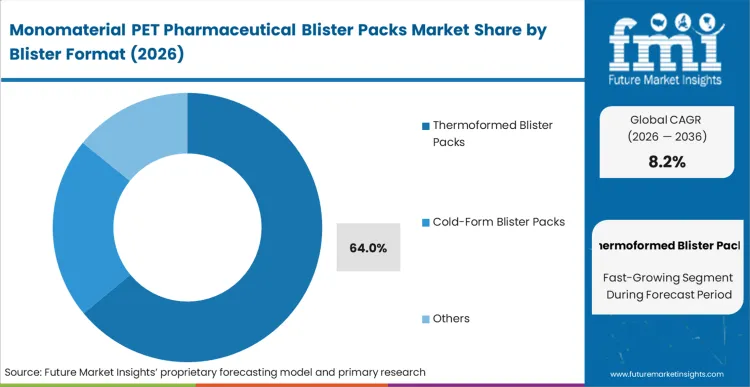
- Thermoformed Blister Packs: 64.0% share in 2026, reflecting the massive installed base of form-fill-seal lines already qualified for PET conversion.
- Tablets: 52.0% share in 2026, as solid oral dosage forms dominate unit-dose dispensing in both retail and institutional channels.
- India: 12.5% compound growth driven by greenfield CDMO campuses deploying unified mono-PET tooling from initial blueprints.
- Analyst Opinion at FMI:
- Ismail Sutaria, Principal Consultant for Packaging at Future Market Insights, opines, “In our latest Monomaterial PET Pharmaceutical Blister Packs Market assessment, my team and I have identified regulatory-driven material transition as the key industry inflection point. Pharmaceutical companies are under growing pressure to reduce complex multilayer packaging that disrupts recycling streams. Monomaterial PET blister structures offer a pathway toward circularity, but success will depend on precise thermoforming behavior, optical clarity, and compatibility with existing sealing technologies. Suppliers that engineer PET films capable of maintaining drug stability while simplifying end-of-life processing will gain strategic advantage.”
- Strategic Implications / Executive Takeaways:
- CDMO procurement leads must secure rPET supply contracts to qualify for impending branded-pharma sustainability audits.
- Formulation scientists should mandate native mono-PET compatibility in all new product development specifications.
- Capital project directors must phase out multi-layer tooling and retrofit existing lines with PET-specific heat-seal parameters.
- Methodology:
- Primary Research: FMI conducted detailed technical interviews with principal packaging architects, stability scientists, and procurement directors across 40 countries to validate material conversion timelines.
- Desk Research: Analysts aggregated public pharmacopeial documentation, EPR compliance registries, corporate qualification sheets, and national circular-economy grant programs.
- Market-Sizing and Forecasting: The model applies a bottom-up methodology starting with global installed base metrics for blister lines and projecting the conversion rate to mono-PET standards.
- Data Validation and Update Cycle: Segment forecasts undergo cross-validation against quarterly PET resin shipment volumes for pharmaceutical-grade film.
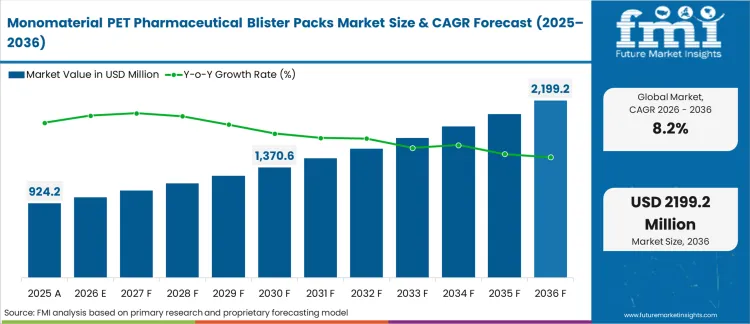
Branded pharmaceutical procurement teams face mounting pressure to abandon legacy PVC-aluminum formats and commit capital to converged mono-PET tooling. The underlying mechanism sustaining market growth is the absolute necessity of maintaining moisture and oxygen barriers while enabling closed-loop recycling, a capability legacy laminates physically cannot deliver at scale. The geographic distribution of this architectural migration reveals distinct adoption velocities tied directly to national circular-economy policies.
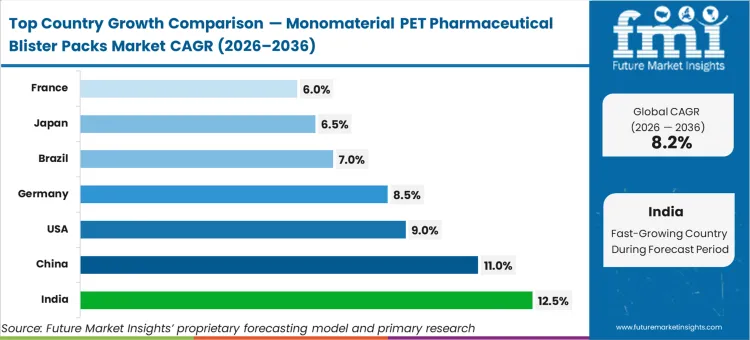
As regional pharmaceutical hubs navigate this transition, India sets the pace with a 12.5% CAGR, followed closely by China at 11.0% as both nations leverage greenfield CDMO facilities to bypass legacy retrofit hurdles. The United States advances at a 9.0% rate, supported by federal EPR frameworks. Germany registers an 8.5% expansion while Brazil tracks at 7.0%, both driven by export compliance to EU markets. Japan expands at a 6.5% trajectory anchored by its domestic generics sector. France maintains a steady 6.0% pace as energy-intensive blister lines implement synchronized mono-PET conversion.
Monomaterial PET Pharmaceutical Blister Packs Market Key Takeaways
| Metric | Details |
|---|---|
| Industry Size (2026) | USD 1,000.0 million |
| Industry Value (2036) | USD 2,200.0 million |
| CAGR (2026-2036) | 8.20% |
Source: Future Market Insights (FMI) analysis, based on proprietary forecasting model and primary research
Monomaterial PET Pharmaceutical Blister Packs Market Definition
Monomaterial PET Pharmaceutical Blister Packs represent single-polymer primary packaging solutions engineered from polyethylene terephthalate film and lidding that deliver guaranteed moisture and oxygen protection for solid oral dosage forms while enabling full mechanical recyclability in existing PET streams. The ecosystem includes thermoformed cavities, cold-formed structures, and compatible heat-seal lidding compliant with pharmacopeial stability requirements. A core inclusion is film supporting high-barrier coatings without additional polymer layers.
Monomaterial PET Pharmaceutical Blister Packs Market Inclusions
Market scope includes pharmaceutical-grade mono-PET base films, preformed blister trays, lidding foils with PET-compatible heat-seal coatings, and integrated form-fill-seal consumables featuring native recyclability. Configuration tools for cavity design, inline barrier coating applicators, and associated stability-testing protocols fall within the boundaries. Products utilizing 100% PET structures for critical solid-dose protection are fully incorporated. For deeper insights into related blister packaging solutions see the blister packaging solutions.
Monomaterial PET Pharmaceutical Blister Packs Market Exclusions
Multi-material laminates containing PVC, PVDC, or aluminum layers are excluded because they disrupt mechanical recycling streams and require separate sorting infrastructure. Pure secondary cartons, non-pharmaceutical consumer blister formats, and liquid or injectable primary packaging fall outside the defined parameters. Legacy non-PET films without verified mono-material certification are explicitly omitted from the valuation.
Monomaterial PET Pharmaceutical Blister Packs Market Research Methodology
- Primary Research: Analysts engaged with packaging specification leads, formulation scientists, and CDMO procurement directors to map the specific decision gates triggering material conversion programs.
- Desk Research: The data collection phase aggregated compliance roadmaps from pharmacopeial updates, EPR regulatory filings, and major CDMO vendor qualification guidelines.
- Market-Sizing and Forecasting: The baseline value derives from a bottom-up aggregation of mono-PET film shipments, applying region-specific sustainability adoption curves to project the future conversion velocity.
- Data Validation and Update Cycle: Projections are rigorously tested against publicly reported capital expenditure guidance from the leading branded and generic pharmaceutical manufacturers.
Segmental Analysis
Monomaterial PET Pharmaceutical Blister Packs Market Analysis by Blister Format
With legacy multi-layer laminates proving inadequate for closed-loop recyclability, capital projects directors are executing full-scale tooling replacement programs across pharmaceutical packaging lines. Thermoformed Blister Packs command a dominant 64.0% share in 2026, reflecting the large installed base of form-fill-seal infrastructure already capable of PET conversion with targeted process adjustments. Pharmaceutical manufacturers specifying mono-PET thermoformed cavities establish the practical foundation for recyclable primary packaging without forcing immediate reformulation of solid-dose products. This material-level transition reduces conversion complexity and allows packaging engineers to retain optical clarity, forming precision, and line efficiency within existing production environments. According to FMI’s estimates, facilities qualifying thermoformed mono-PET structures can shorten sustainability transition timelines while preserving compatibility with high-volume pharmaceutical packaging operations. Suppliers unable to provide verified thermoformable PET structures with acceptable barrier performance risk immediate exclusion from the next wave of branded and generic blister conversion tenders.
- • Line compatibility: Thermoformed PET structures integrate more easily into existing blister machinery, reducing the scale of mechanical modification required during material conversion.
- • Material efficiency: Optimized thermoforming allows packaging engineers to balance cavity definition, clarity, and resin usage across high-volume pharmaceutical runs.
- • Qualification speed: Faster adaptation on installed lines supports quicker validation cycles for manufacturers under pressure to meet recyclability targets.
Monomaterial PET Pharmaceutical Blister Packs Market Analysis by Drug Form
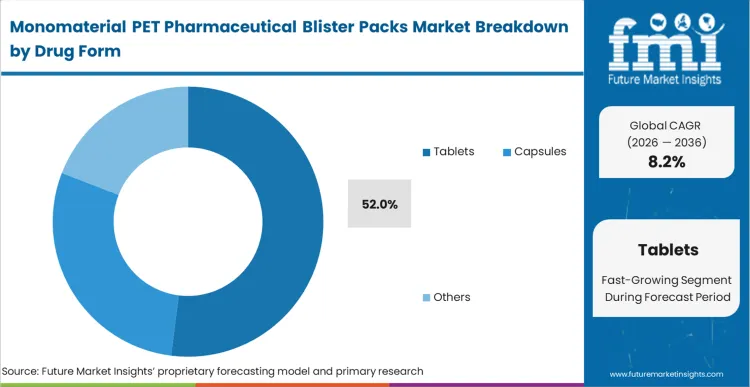
Tablets emerge as the dominant drug form, expected to represent 52.0% of total market share in 2026. High-volume solid oral dosage manufacturing increasingly depends on packaging formats that can combine unit-dose protection with verifiable recyclability performance. FMI analysts opine that tablet packaging provides the most scalable entry point for mono-PET adoption because tablet stability profiles, dispensing formats, and retail distribution models already align closely with standardized blister architectures. Packaging teams qualifying mono-PET formats for tablet applications can accelerate commercialization programs while avoiding the more complex containment challenges associated with certain alternative dosage forms. The widespread concentration of tablet volumes in branded and generic pharmaceutical supply chains further reinforces mono-PET demand across this segment.
- • Dispensing dominance: Tablets remain the most widely used unit-dose pharmaceutical format across retail and institutional channels, supporting large-scale blister demand.
- • Standardization advantage: Established cavity geometries and handling systems simplify qualification of mono-PET structures for tablet packaging programs.
- • Commercial scalability: High tablet production volumes make this segment the most practical platform for broad mono-PET packaging conversion.
Monomaterial PET Pharmaceutical Blister Packs Market Drivers, Restraints, and Opportunities
The convergence of extended producer responsibility legislation and brand net-zero commitments forces packaging specification leads to extract verifiable recyclability data directly from every blister cavity. This architectural requirement renders fragmented multi-layer structures obsolete. Asset owners upgrading brownfield lines face a strict binary choice between deploying complex separation processes or overhauling the base film. Transitioning to a unified mono-PET backbone simplifies supply-chain logistics and enables direct inline recycling for advanced analytics. Facilities that fail to modernize their core packaging layers risk operational blind spots and reduced overall equipment effectiveness.
The intricate qualification parameters required to optimize mono-PET barrier coatings create steep learning curves for traditional stability scientists. Designing conflict-free stability profiles across multi-vendor tooling demands specialized expertise that most pharmaceutical facilities lack internally. To mitigate this skill gap, capital project directors increasingly rely on advanced simulation software that automates cavity design and validates performance before physical deployment.
Opportunities in the Monomaterial PET Pharmaceutical Blister Packs Market
- Inline rPET Integration: Next-generation mono-PET cavities enable stability teams to run virtualized barrier testing directly on the line. This consolidation eliminates dedicated pilot lines and drastically simplifies qualification protocols.
- Export Compliance Acceleration: Upgraded mono-PET bandwidth permits quality assurance teams to deploy inline stability monitoring without impacting critical production traffic. This capability prevents defective batches from progressing through the supply sequence.
- Captive Recycling Loops: Utility network planners integrating distributed renewable energy resources require precise phase measurement data. Mono-PET structures provide the microsecond accuracy necessary to balance volatile power generation inputs across the wide-area network.
Regional Analysis
Based on the regional analysis, the Monomaterial PET Pharmaceutical Blister Packs market is segmented into Asia Pacific, North America, Europe, Latin America, Middle East & Africa across 40+ countries.
.webp "Top Country Growth Comparison Monomaterial Pet Pharmaceutical Blister Packs Market Cagr (2026 2036)")
| Country | CAGR (2026 to 2036) |
|---|---|
| India | 12.5% |
| China | 11.0% |
| USA | 9.0% |
| Germany | 8.5% |
| Brazil | 7.0% |
| Japan | 6.5% |
| France | 6.0% |
Source: Future Market Insights (FMI) analysis, based on proprietary forecasting model and primary research
Asia Pacific Monomaterial PET Pharmaceutical Blister Packs Market Analysis
Greenfield infrastructure development across the Asia Pacific region accelerates the bypass of legacy multi-layer constraints. Capital project directors constructing new CDMO campuses specify unified mono-PET tooling in their initial site blueprints. FMI analysts opine that this clean-slate approach entirely eliminates the costly and time-consuming retrofit phase that plagues older manufacturing centers. By building native recyclability capabilities into the foundation, regional asset owners establish highly flexible production environments capable of rapid retooling. This aggressive greenfield expansion strategy directly fuels the demand for high-performance mono-PET film. The integration of robust packaging architecture forms the critical prerequisite for deploying advanced stability monitoring applications. The specific manufacturing requirements of individual nations dictate the precise implementation parameters for these packaging technologies.
- India: India's pharmaceutical export sector operates under stringent FDA Pre-Approval Inspection frameworks requiring immutable electronic records for all batch production parameters. Process engineers must deploy blister structures capable of guaranteeing critical sensor data delivery to centralized historians without any ingress. The national push toward active pharmaceutical ingredient self-sufficiency triggers a wave of facility upgrades prioritizing unified, secure mono-PET backbones. This regulatory compliance pressure anchors India's 12.5% compound expansion of mono-PET blister demand to 2036. Suppliers failing to provide hardware with built-in data integrity mechanisms face disqualification from major life sciences facility tenders.
- China: China's generic drug manufacturing sector deploys highly automated, software-defined production lines requiring seamless data exchange between IT scheduling systems and OT blister robots. Greenfield facility architects bypass legacy multi-layer protocols entirely, specifying native mono-PET cavities for all new tablet procurement contracts. The sheer volume of new factory construction establishes a massive installed base of interoperable recyclable infrastructure across the eastern industrial corridor. This aggressive modernization strategy drives an 11.0% CAGR for mono-PET blister infrastructure in China through 2036. Vendors unable to demonstrate verified high-barrier performance lose access to the most lucrative greenfield export projects in the region.
- Japan: Japan's generic supply chain enforces strict component qualification through JAMA/JAPIA electronic data interchange standards for synchronized production sequences. Every new blister architecture must validate network timing compliance before receiving authorization for series production integration. The domestic generics manufacturing sector embeds precision barrier silicon directly into forming tools to maintain global competitive advantage in high-volume dispensing. This continuous qualification constraint sustains a 6.5% CAGR for precision-packaging upgrades in Japan's domestic corridor. Component suppliers lacking verified interoperable testing records forfeit access to the next generation of full-line product launches.
FMI's report includes extensive coverage of the Asia Pacific mono-PET blister landscape. It incorporates detailed analysis of South Korea, Indonesia, Australia, and the broader ASEAN region. A primary trend shaping these nations is the rapid localization of pharmaceutical assembly, forcing contract manufacturers to deploy unified architectures to satisfy stringent global brand traceability requirements.
North America Monomaterial PET Pharmaceutical Blister Packs Market Analysis
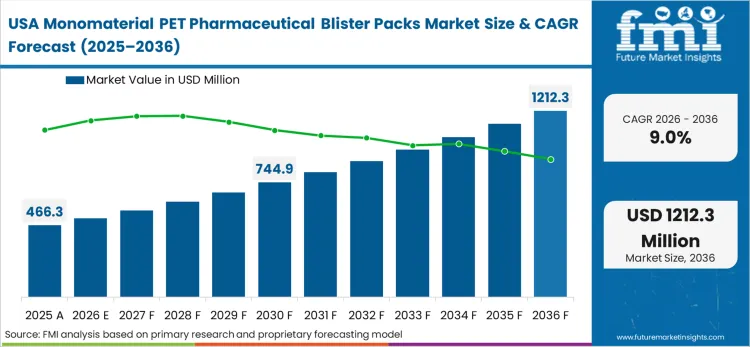
Industrial modernization mandates across North America target the systematic eradication of isolated multi-layer blister networks. Control systems engineers leading critical infrastructure overhauls face strict directives to unify disparate communication domains under a single manageable architecture. According to FMI's estimates, the branded pharmaceutical sectors actively drive this consolidation to secure their supply chain data flows against sophisticated regulatory audits. Implementing a standardized, mono-PET backbone enables facilities to deploy advanced predictive maintenance algorithms without compromising real-time stability. This strategic shift requires significant capital allocation toward robust film hardware capable of isolating mixed-criticality requirements. The success of these modernization initiatives depends entirely on the availability of certified interoperable components. National security frameworks and pharmacopeial standards govern the exact specifications required for these critical deployments.
- USA: The United States branded pharmaceutical supply chain enforces strict data visibility mandates across its entire multi-tier ecosystem. Network specification leads replacing aging proprietary control systems must deploy converged architectures capable of supporting both real-time stability monitoring and secure telemetry extraction. Federal infrastructure modernization initiatives actively fund the replacement of vulnerable legacy formats with standardized, resilient mono-PET backbones. The United States advances at a 9.0% compound rate across the forecast decade as discrete manufacturers unify their logical packaging topologies. Hardware vendors lacking documented compliance with rigorous pharmacopeial standards face immediate exclusion from modernization contracts.
FMI's report includes comprehensive evaluation of the North American mono-PET blister sector. It features specific analysis of the Canadian and Mexican industrial markets. A defining dynamic in these countries involves the integration of cross-border supply chains, which requires standardized protocols to coordinate just-in-time delivery sequences and maintain synchronized production schedules across multiple facilities.
Europe Monomaterial PET Pharmaceutical Blister Packs Market Analysis
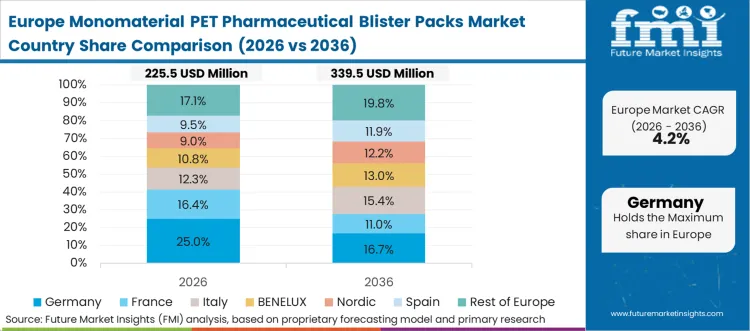
European industrial policy actively penalizes the continued operation of energy-inefficient and technologically isolated manufacturing facilities. Automation architects redesigning legacy production lines must integrate continuous energy monitoring data alongside critical machine control signals. This dual-purpose network requirement forces the rapid adoption of traffic-shaping protocols to guarantee control stability while transmitting heavy diagnostic payloads. The transition requires a complete overhaul of existing communication topologies, shifting from hierarchical polling structures to event-driven deterministic architectures. Upgrading the core switching infrastructure provides the necessary bandwidth and synchronization precision to support advanced sustainable manufacturing practices. Facility directors recognize that maintaining outdated network standards severely limits their ability to compete in highly regulated European markets. Regional engineering standards and safety certifications heavily influence the technical requirements for these network transformations.
- Germany: Germany's pharmaceutical OEM supply chain dictates stringent validation criteria for mixed-criticality network traffic on advanced production lines. Control systems engineers must demonstrate flawless execution of scheduled traffic flows before receiving authorization to connect new production cells to the main factory backbone. The national machine tool export sector operates under rigorous functional safety certifications that mandate unified diagnostic layers, creating a recurring compliance cycle that accelerates switch hardware replacement. This systemic qualification pressure drives an 8.5% annual expansion rate for certified OT switching hardware as the standard proliferates. Network infrastructure providers targeting domestic plant retooling projects must guarantee microsecond-level synchronization performance prior to the finalization of capital procurement budgets.
- France: The French energy grid modernization programs require precise phase measurement data to balance increasingly volatile renewable power generation inputs. Utility network planners deploying advanced substation automation systems mandate communication architectures capable of sub-millisecond data delivery across distributed geographic assets. The shift toward decentralized power generation forces grid operators to abandon legacy telecontrol protocols in favor of highly resilient, synchronized Ethernet networks. This critical infrastructure transition anchors France’s 6.0% compound trajectory to 2036 as utility providers systematically upgrade their operational backbones. Systems integrators unable to demonstrate absolute network determinism under severe load conditions forfeit qualification for national grid expansion projects.
FMI's report includes thorough investigation of the European industrial networking framework. The analysis encompasses Italy, Spain, the Nordics, and the Benelux region. A prevailing structural condition across these nations is the mandatory compliance with strict machinery safety directives, forcing asset owners to specify deterministic networks that can reliably transport fail-safe signals alongside standard operational data.
Competitive Aligners for Market Players
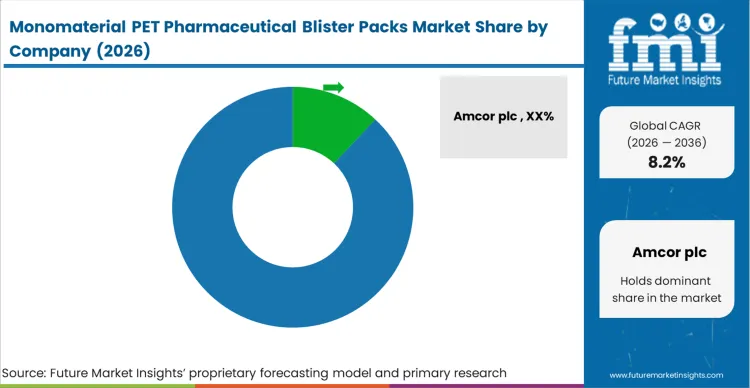
The introduction of standardized testing profiles under the EU Packaging and Packaging Waste Regulation is reshaping how pharmaceutical buyers evaluate blister hardware. Instead of accepting multi-layer timing mechanisms, procurement teams now demand certified, interoperable mono-PET silicon in all new tenders. This shift has raised the performance bar across the industry, meaning vendors that continue to rely on closed, single-vendor ecosystems risk being excluded from major modernization programs.
Industry leaders have already begun adapting. Manufacturers such as Amcor, Huhtamaki, and Klöckner Pentaplast have aligned portions of their portfolios with open, mono-PET networking standards, setting a new competitive baseline for others to follow. As a result, automation suppliers are now pushed to integrate native mono-PET-compliant capabilities directly into their hardware instead of using add-on gateways or proprietary extensions.
Vendors embedding precision barrier coatings and synchronization protocols directly into edge devices gain a significant architectural advantage. Companies like Constantia Flexibles and Tekni-Plex, which increasingly incorporate mono-PET silicon at the device level, help reduce engineering overhead during commissioning and shrink the physical control-cabinet footprint. This silicon-first approach accelerates brownfield migration projects, allowing network architects and project leads to prioritize platforms that avoid the complexity associated with external timing gateways. In contrast, component manufacturers slow to adopt native mono-PET designs risk losing position during early-stage vendor shortlisting. For detailed competitive insights see the pharmaceutical plastic packaging.
Key Players in Monomaterial PET Pharmaceutical Blister Packs Market
- Amcor plc
- Huhtamaki
- Klöckner Pentaplast
- Constantia Flexibles
- Tekni-Plex, Inc.
- Berry Global Inc.
- Sonoco Products Company
Scope of the Report
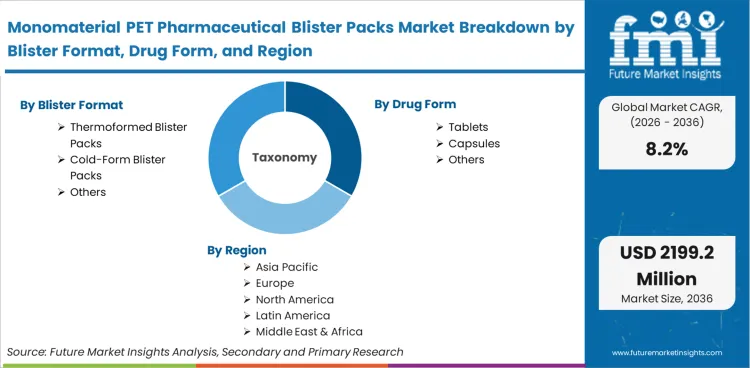
| Metric | Value |
|---|---|
| Quantitative Units | USD 1,000.0 million to USD 2,200.0 million, at a CAGR of 8.20% |
| Market Definition | Monomaterial PET Pharmaceutical Blister Packs encompass specialized PET films and lidding built to guarantee bounded moisture and oxygen protection for solid oral dosage forms while enabling full recyclability in standard PET streams. |
| Blister Format Segmentation | Thermoformed Blister Packs, Cold-Form Blister Packs, Others |
| Drug Form Segmentation | Tablets, Capsules, Others |
| End Use Segmentation | Branded Pharmaceuticals, Generic Pharmaceuticals, Others |
| Barrier Requirement Segmentation | High Barrier, Standard Barrier, Others |
| Regions Covered | Asia Pacific, North America, Europe, Latin America, Middle East & Africa |
| Countries Covered | India, China, USA, Germany, Brazil, Japan, France, and 40 plus countries |
| Key Companies Profiled | Amcor plc, Huhtamaki, Klöckner Pentaplast, Constantia Flexibles, Tekni-Plex, Inc., Berry Global Inc., Sonoco Products Company |
| Forecast Period | 2026 to 2036 |
| Approach | The baseline value derives from a bottom-up aggregation of mono-PET film shipments, applying region-specific sustainability adoption curves to project future conversion velocity. Projections undergo cross-validation against quarterly PET resin shipment volumes for pharmaceutical-grade film. |
Source: Future Market Insights (FMI) analysis, based on proprietary forecasting model and primary research
Monomaterial PET Pharmaceutical Blister Packs Market Analysis by Segments
Blister Format:
- Thermoformed Blister Packs
- Cold-Form Blister Packs
- Others
Drug Form:
- Tablets
- Capsules
- Others
End Use:
- Branded Pharmaceuticals
- Generic Pharmaceuticals
- Others
Barrier Requirement:
- High Barrier
- Standard Barrier
- Others
Region:
- Asia Pacific
- India
- China
- Japan
- South Korea
- Indonesia
- Australia & New Zealand
- ASEAN
- Rest of Asia Pacific
- Europe
- Germany
- Italy
- France
- United Kingdom
- Spain
- Benelux
- Nordics
- Central & Eastern Europe
- Rest of Europe
- North America
- United States
- Canada
- Mexico
- Latin America
- Brazil
- Argentina
- Chile
- Rest of Latin America
- Middle East & Africa
- Kingdom of Saudi Arabia
- United Arab Emirates
- South Africa
- Turkey
- Rest of Middle East & Africa
Bibliography
- European Medicines Agency. (2024). Compilation of QRD decisions on stylistic matters in product information.
- European Directorate for the Quality of Medicines & HealthCare. (2025). Publication of three new Ph. Eur. general chapters for plastic materials for containers.
- European Directorate for the Quality of Medicines & HealthCare. (2024). New general chapter on extractable elements in plastic materials for pharmaceutical use (2.4.35) adopted.
- International Council for Harmonisation of Technical Requirements for Pharmaceuticals for Human Use. (2025). ICH Q1: Stability testing of drug substances and drug products (Step 2 draft guideline).
- RecyClass. (2025). Recyclability Evaluation Protocol for Labels & Lids applied on PET Trays (v.1.1).
- Jackman, S., Mc Guinness, P., Brennan, L., Pereira, R., Tyrrell, A., Barry, A. M., Brennan, C., & Naughton, B. D. (2025). Global Innovations in Sustainable Pharmaceutical Packaging in the Last 25 Years: A Scoping Review. Sustainability, 17(23), 10716.
This bibliography is provided for reader reference. The full FMI report contains the complete reference list with primary source documentation.
This Report Addresses
- Market sizing and quantitative forecast metrics detailing the precise capital expenditure dedicated to monomaterial PET blister hardware across major pharmaceutical sectors through 2036.
- Segmentation analysis mapping the adoption velocity of specific mono-PET configurations and evaluating the technical limitations driving format upgrades.
- Regional deployment intelligence comparing the aggressive greenfield construction strategies in Asia Pacific against the complex brownfield modernization requirements prevalent in European manufacturing hubs.
- Regulatory compliance assessment analyzing how stringent EPR directives and pharmacopeial standards force the adoption of unified network architectures.
- Competitive posture evaluation tracking the mandatory shift toward third-party recyclability certification and the resulting commoditization of the physical communication layer.
- Capital project strategic guidance defining the exact procurement specifications and synchronization tolerances required to support next-generation closed-loop stability testing.
- Supply chain vulnerability analysis identifying the specific network integration bottlenecks that extend facility commissioning timelines.
- Custom data delivery formats encompassing interactive dashboards, raw Excel datasets, and comprehensive PDF narrative reports.
Frequently Asked Questions
How large is the demand for Monomaterial PET Pharmaceutical Blister Packs in the global market in 2026?
Demand for Monomaterial PET Pharmaceutical Blister Packs in the global market is estimated to be valued at USD 1,000.0 million in 2026 as branded manufacturers accelerate qualification programs to meet impending EPR deadlines.
What will be the market size of Monomaterial PET Pharmaceutical Blister Packs in the global market by 2036?
Market size for Monomaterial PET Pharmaceutical Blister Packs is projected to reach USD 2,200.0 million by 2036 driven by sustained regulatory tailwinds and cost parity improvements in recycled PET supply.
What CAGR is projected for Monomaterial PET Pharmaceutical Blister Packs from 2026 to 2036?
Demand for Monomaterial PET Pharmaceutical Blister Packs is expected to grow at a CAGR of 8.20% between 2026 and 2036 sustained by the structural necessity of maintaining drug stability while enabling closed-loop recycling.
Which Blister Format is poised to lead global sales by 2026?
Thermoformed Blister Packs accounts for 64.0% in 2026 as capital project directors execute full-scale hardware replacement programs to eliminate multi-layer separation steps.
How significant is the role of Tablets in driving Monomaterial PET Pharmaceutical Blister Packs adoption in 2026?
Tablets represent 52.0% of segment share as solid oral dosage forms dominate unit-dose dispensing in both retail and institutional channels.
What is driving demand in India?
India’s pharmaceutical export sector operates under stringent FDA Pre-Approval Inspection frameworks requiring immutable electronic records for all batch production parameters, anchoring 12.5% CAGR through regulatory compliance pressure.
What compliance standards or regulations are referenced for Germany?
The German machine tool export sector operates under rigorous functional safety certifications that mandate unified diagnostic layers, driving 8.5% expansion.
What is the India growth outlook in this report?
India is projected to grow at a CAGR of 12.5% during 2026 to 2036 through greenfield CDMO expansion.
Why is Asia Pacific described as a priority region in this report?
The Asia Pacific greenfield CDMO campuses actively drive network consolidation to secure supply chain traceability against sophisticated regulatory audits.
What type of demand dominates in North America?
Demand heavily focuses on replacing vulnerable legacy multi-layer formats with standardized mono-PET backbones that comply with federal EPR mandates.
What is the China growth outlook in this report?
China is projected to expand at a CAGR of 11.0% during 2026 to 2036 driven by massive new capacity buildout.
Does the report cover USA in its regional analysis?
Yes, USA is included within North America under the regional scope of analysis.
What are the sources referred to for analyzing USA?
Federal infrastructure modernization initiatives and pharmacopeial qualification standards form the analytical basis.
What is the main demand theme linked to USA in its region coverage?
Strict cybersecurity and data visibility mandates across multi-tier supply chains force the deployment of converged mono-PET architectures.
Does the report cover Germany in its regional analysis?
Yes, Germany is included within Europe under the regional coverage framework.
What is the main Germany related demand theme in its region coverage?
Stringent validation criteria for mixed-criticality network traffic on advanced production lines compel the adoption of scheduled mono-PET flows.
Which product formats or configurations are strategically important for Asia Pacific supply chains?
Embedded mono-PET cavities integrated directly into field devices are critical for streamlining localized pharmaceutical assembly.
What is Monomaterial PET Pharmaceutical Blister Packs and what is it mainly used for?
Monomaterial PET provides time-bound moisture protection and full recyclability. It is primarily used to synchronize stability requirements for tablets and capsules in high-volume dispensing environments.
What does Monomaterial PET Pharmaceutical Blister Packs mean in this report?
The scope encompasses specialized hardware and software built on single-polymer PET standards to guarantee low-latency stability protection.
What is included in the scope of this Monomaterial PET Pharmaceutical Blister Packs report?
Market covers pharmaceutical-grade mono-PET films, preformed trays, lidding foils, and integrated form-fill-seal consumables featuring native recyclability capabilities.
What is excluded from the scope of this report?
Multi-material laminates containing PVC or aluminum, non-pharmaceutical consumer formats, and liquid or injectable primary packaging are explicitly excluded.
What does market forecast mean on this page?
The market forecast represents a model-based projection built on defined technology adoption assumptions for strategic planning purposes.
How does FMI build and validate the Monomaterial PET Pharmaceutical Blister Packs forecast?
The model applies a bottom-up methodology starting with global installed base metrics and cross-validates projections against publicly reported capital expenditure guidance.
What does zero reliance on speculative third-party market research mean here?
Primary interviews, verified regulatory filings, and official industry compliance registries are used exclusively instead of unverified syndicated estimates.
Preview the report firsthand - request a free sample
Get SampleGet the brochure for pricing and purchase details.
Get PDFTable of Content
- Global Market Outlook
- Demand-side Trends
- Supply-side Trends
- Technology Roadmap Analysis
- Market Coverage / Taxonomy
- Market Definition / Scope / Limitations
- Research Methodology
- Chapter Orientation
- Analytical Lens and Working Hypotheses
- Market Structure, Signals, and Trend Drivers
- Benchmarking and Cross-market Comparability
- Market Sizing, Forecasting, and Opportunity Mapping
- Research Design and Evidence Framework
- Desk Research Programme (Secondary Evidence)
- Company Annual and Sustainability Reports
- Peer-reviewed Journals and Academic Literature
- Corporate Websites, Product Literature, and Technical Notes
- Earnings Decks and Investor Briefings
- Statutory Filings and Regulatory Disclosures
- Technical White Papers and Standards Notes
- Social Channels, Communities, and Digital Listening Inputs
- Additional Desk Sources
- Expert Input and Fieldwork (Primary Evidence)
- Primary Modes
- Qualitative Interviews and Expert Elicitation
- Quantitative Surveys and Structured Data Capture
- Blended Approach
- Why Primary Evidence is Used
- Field Techniques
- Interviews
- Surveys
- Focus Groups
- Observational and In-context Research
- Social and Community Interactions
- Stakeholder Universe Engaged
- C-suite Leaders
- Board Members
- Presidents and Vice Presidents
- R&D and Innovation Heads
- Technical Specialists
- Domain Subject-matter Experts
- Scientists
- Physicians and Other Healthcare Professionals
- Governance, Ethics, and Data Stewardship
- Research Ethics
- Data Integrity and Handling
- Primary Modes
- Tooling, Models, and Reference Databases
- Desk Research Programme (Secondary Evidence)
- Data Engineering and Model Build
- Data Acquisition and Ingestion
- Cleaning, Normalisation, and Verification
- Synthesis, Triangulation, and Analysis
- Quality Assurance and Audit Trail
- Market Background
- Market Dynamics
- Drivers
- Restraints
- Opportunity
- Trends
- Scenario Forecast
- Demand in Optimistic Scenario
- Demand in Likely Scenario
- Demand in Conservative Scenario
- Opportunity Map Analysis
- Product Life Cycle Analysis
- Supply Chain Analysis
- Investment Feasibility Matrix
- Value Chain Analysis
- PESTLE and Porter’s Analysis
- Regulatory Landscape
- Regional Parent Market Outlook
- Production and Consumption Statistics
- Import and Export Statistics
- Market Dynamics
- Global Market Analysis 2021 to 2025 and Forecast, 2026 to 2036
- Historical Market Size Value (USD Million) Analysis, 2021 to 2025
- Current and Future Market Size Value (USD Million) Projections, 2026 to 2036
- Y-o-Y Growth Trend Analysis
- Absolute $ Opportunity Analysis
- Global Market Pricing Analysis 2021 to 2025 and Forecast 2026 to 2036
- Global Market Analysis 2021 to 2025 and Forecast 2026 to 2036, By Blister Format
- Introduction / Key Findings
- Historical Market Size Value (USD Million) Analysis By Blister Format , 2021 to 2025
- Current and Future Market Size Value (USD Million) Analysis and Forecast By Blister Format , 2026 to 2036
- Thermoformed Blister Packs
- Cold-Form Blister Packs
- Others
- Thermoformed Blister Packs
- Y-o-Y Growth Trend Analysis By Blister Format , 2021 to 2025
- Absolute $ Opportunity Analysis By Blister Format , 2026 to 2036
- Global Market Analysis 2021 to 2025 and Forecast 2026 to 2036, By Drug Form
- Introduction / Key Findings
- Historical Market Size Value (USD Million) Analysis By Drug Form, 2021 to 2025
- Current and Future Market Size Value (USD Million) Analysis and Forecast By Drug Form, 2026 to 2036
- Tablets
- Capsules
- Others
- Tablets
- Y-o-Y Growth Trend Analysis By Drug Form, 2021 to 2025
- Absolute $ Opportunity Analysis By Drug Form, 2026 to 2036
- Global Market Analysis 2021 to 2025 and Forecast 2026 to 2036, By Region
- Introduction
- Historical Market Size Value (USD Million) Analysis By Region, 2021 to 2025
- Current Market Size Value (USD Million) Analysis and Forecast By Region, 2026 to 2036
- North America
- Latin America
- Western Europe
- Eastern Europe
- East Asia
- South Asia and Pacific
- Middle East & Africa
- Market Attractiveness Analysis By Region
- North America Market Analysis 2021 to 2025 and Forecast 2026 to 2036, By Country
- Historical Market Size Value (USD Million) Trend Analysis By Market Taxonomy, 2021 to 2025
- Market Size Value (USD Million) Forecast By Market Taxonomy, 2026 to 2036
- By Country
- USA
- Canada
- Mexico
- By Blister Format
- By Drug Form
- By Country
- Market Attractiveness Analysis
- By Country
- By Blister Format
- By Drug Form
- Key Takeaways
- Latin America Market Analysis 2021 to 2025 and Forecast 2026 to 2036, By Country
- Historical Market Size Value (USD Million) Trend Analysis By Market Taxonomy, 2021 to 2025
- Market Size Value (USD Million) Forecast By Market Taxonomy, 2026 to 2036
- By Country
- Brazil
- Chile
- Rest of Latin America
- By Blister Format
- By Drug Form
- By Country
- Market Attractiveness Analysis
- By Country
- By Blister Format
- By Drug Form
- Key Takeaways
- Western Europe Market Analysis 2021 to 2025 and Forecast 2026 to 2036, By Country
- Historical Market Size Value (USD Million) Trend Analysis By Market Taxonomy, 2021 to 2025
- Market Size Value (USD Million) Forecast By Market Taxonomy, 2026 to 2036
- By Country
- Germany
- UK
- Italy
- Spain
- France
- Nordic
- BENELUX
- Rest of Western Europe
- By Blister Format
- By Drug Form
- By Country
- Market Attractiveness Analysis
- By Country
- By Blister Format
- By Drug Form
- Key Takeaways
- Eastern Europe Market Analysis 2021 to 2025 and Forecast 2026 to 2036, By Country
- Historical Market Size Value (USD Million) Trend Analysis By Market Taxonomy, 2021 to 2025
- Market Size Value (USD Million) Forecast By Market Taxonomy, 2026 to 2036
- By Country
- Russia
- Poland
- Hungary
- Balkan & Baltic
- Rest of Eastern Europe
- By Blister Format
- By Drug Form
- By Country
- Market Attractiveness Analysis
- By Country
- By Blister Format
- By Drug Form
- Key Takeaways
- East Asia Market Analysis 2021 to 2025 and Forecast 2026 to 2036, By Country
- Historical Market Size Value (USD Million) Trend Analysis By Market Taxonomy, 2021 to 2025
- Market Size Value (USD Million) Forecast By Market Taxonomy, 2026 to 2036
- By Country
- China
- Japan
- South Korea
- By Blister Format
- By Drug Form
- By Country
- Market Attractiveness Analysis
- By Country
- By Blister Format
- By Drug Form
- Key Takeaways
- South Asia and Pacific Market Analysis 2021 to 2025 and Forecast 2026 to 2036, By Country
- Historical Market Size Value (USD Million) Trend Analysis By Market Taxonomy, 2021 to 2025
- Market Size Value (USD Million) Forecast By Market Taxonomy, 2026 to 2036
- By Country
- India
- ASEAN
- Australia & New Zealand
- Rest of South Asia and Pacific
- By Blister Format
- By Drug Form
- By Country
- Market Attractiveness Analysis
- By Country
- By Blister Format
- By Drug Form
- Key Takeaways
- Middle East & Africa Market Analysis 2021 to 2025 and Forecast 2026 to 2036, By Country
- Historical Market Size Value (USD Million) Trend Analysis By Market Taxonomy, 2021 to 2025
- Market Size Value (USD Million) Forecast By Market Taxonomy, 2026 to 2036
- By Country
- Kingdom of Saudi Arabia
- Other GCC Countries
- Turkiye
- South Africa
- Other African Union
- Rest of Middle East & Africa
- By Blister Format
- By Drug Form
- By Country
- Market Attractiveness Analysis
- By Country
- By Blister Format
- By Drug Form
- Key Takeaways
- Key Countries Market Analysis
- USA
- Pricing Analysis
- Market Share Analysis, 2025
- By Blister Format
- By Drug Form
- Canada
- Pricing Analysis
- Market Share Analysis, 2025
- By Blister Format
- By Drug Form
- Mexico
- Pricing Analysis
- Market Share Analysis, 2025
- By Blister Format
- By Drug Form
- Brazil
- Pricing Analysis
- Market Share Analysis, 2025
- By Blister Format
- By Drug Form
- Chile
- Pricing Analysis
- Market Share Analysis, 2025
- By Blister Format
- By Drug Form
- Germany
- Pricing Analysis
- Market Share Analysis, 2025
- By Blister Format
- By Drug Form
- UK
- Pricing Analysis
- Market Share Analysis, 2025
- By Blister Format
- By Drug Form
- Italy
- Pricing Analysis
- Market Share Analysis, 2025
- By Blister Format
- By Drug Form
- Spain
- Pricing Analysis
- Market Share Analysis, 2025
- By Blister Format
- By Drug Form
- France
- Pricing Analysis
- Market Share Analysis, 2025
- By Blister Format
- By Drug Form
- India
- Pricing Analysis
- Market Share Analysis, 2025
- By Blister Format
- By Drug Form
- ASEAN
- Pricing Analysis
- Market Share Analysis, 2025
- By Blister Format
- By Drug Form
- Australia & New Zealand
- Pricing Analysis
- Market Share Analysis, 2025
- By Blister Format
- By Drug Form
- China
- Pricing Analysis
- Market Share Analysis, 2025
- By Blister Format
- By Drug Form
- Japan
- Pricing Analysis
- Market Share Analysis, 2025
- By Blister Format
- By Drug Form
- South Korea
- Pricing Analysis
- Market Share Analysis, 2025
- By Blister Format
- By Drug Form
- Russia
- Pricing Analysis
- Market Share Analysis, 2025
- By Blister Format
- By Drug Form
- Poland
- Pricing Analysis
- Market Share Analysis, 2025
- By Blister Format
- By Drug Form
- Hungary
- Pricing Analysis
- Market Share Analysis, 2025
- By Blister Format
- By Drug Form
- Kingdom of Saudi Arabia
- Pricing Analysis
- Market Share Analysis, 2025
- By Blister Format
- By Drug Form
- Turkiye
- Pricing Analysis
- Market Share Analysis, 2025
- By Blister Format
- By Drug Form
- South Africa
- Pricing Analysis
- Market Share Analysis, 2025
- By Blister Format
- By Drug Form
- USA
- Market Structure Analysis
- Competition Dashboard
- Competition Benchmarking
- Market Share Analysis of Top Players
- By Regional
- By Blister Format
- By Drug Form
- Competition Analysis
- Competition Deep Dive
- Amcor plc
- Overview
- Product Portfolio
- Profitability by Market Segments (Product/Age /Sales Channel/Region)
- Sales Footprint
- Strategy Overview
- Marketing Strategy
- Product Strategy
- Channel Strategy
- Huhtamaki
- Klöckner Pentaplast
- Constantia Flexibles
- Tekni-Plex, Inc.
- Berry Global Inc.
- Sonoco Products Company
- Amcor plc
- Competition Deep Dive
- Assumptions & Acronyms Used


