

- Industry Size (2026)
- USD 1155.0 Mn
- Forecast (2036)
- USD 3350.0 Mn
- CAGR (2026 to 2036)
- 10.4%
Monomaterial PE Dry Food Pouches Market Size, Market Forecast and Outlook By FMI
The Monomaterial PE Dry Food Pouches market crossed a valuation of USD 1,080.0 million in 2025 and is expected to increase to USD 1,155.0 million in 2026, reaching USD 3,350.0 million by 2036. This trajectory represents a CAGR of 10.4% during the forecast period. Regulators penalize multi-layer laminates, forcing fast-moving consumer goods brands to rapidly qualify single-polymer alternatives. Procurement cycles heavily favor recycle-ready formats to meet upcoming regional sustainability directives.
Absolute dollar growth of USD 2,195.0 million between 2026 and 2036 reflects a fundamental transition driven by extended producer responsibility taxation. Packaging accounts for 40% of global plastic waste, pushing buyers to prioritize verifiable sustainability credentials [1]. Integration of high-barrier technologies into single-layer configurations reduces landfill burdens while keeping shelf life intact.
Summary of Monomaterial PE Dry Food Pouches
- Monomaterial PE Dry Food Pouches Market Definition
- Industry activity centers on single-polymer flexible enclosures engineered for high recyclability and moisture protection in retail snack and pet nutrition applications.
- Demand Drivers in the Market
- Extended producer responsibility laws penalize multi-material laminates.
- Consumer goods giants mandate fully recyclable portfolios.
- Advances in PE extrusion match legacy barrier capabilities.
- Key Segments Analyzed in the FMI Report
- Pouch Type: Flat bottom / stand up pouches (42%) versus side-gusset, quad seal, and spouted formats.
- Material Grade: High-density PE (51% of total volume) versus LDPE and linear LDPE.
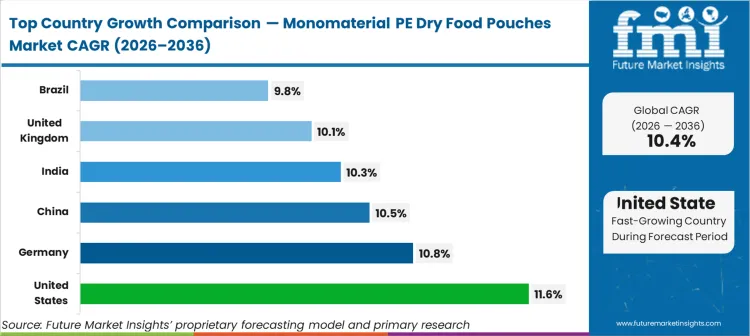
- Geography: High-growth North America and Asia-Pacific (United States 11.6%, China 10.5%, India 10.3%) versus regulation-driven Europe (Germany 10.8%, United Kingdom 10.1%).
- Analyst Opinion at FMI
- Ismail Sutaria, Principal Consultant for Packaging at Future Market Insights, opines, "Our latest assessment indicates that barrier optimization is the decisive battleground. Dry food categories require controlled moisture transmission rates without compromising recyclability claims. Metallization and EVOH content thresholds must align with regional recycling guidelines. Companies that engineer high-performance PE blends while retaining stream compatibility will unlock large-scale retail adoption."
- Strategic Implications/Executive Takeaways
- Suppliers must formulate mono-PE films that seal efficiently on legacy machinery.
- Brands reduce extended producer responsibility fees by adopting APR-recognized formats.
- Converters build scale to lower unit costs of high-barrier single-polymer structures.
- Methodology
- Validated through first-hand corporate production and capacity data.
- Zero reliance on speculative third-party market research reports.
- Based on verifiable industrial benchmarks and verified sources.
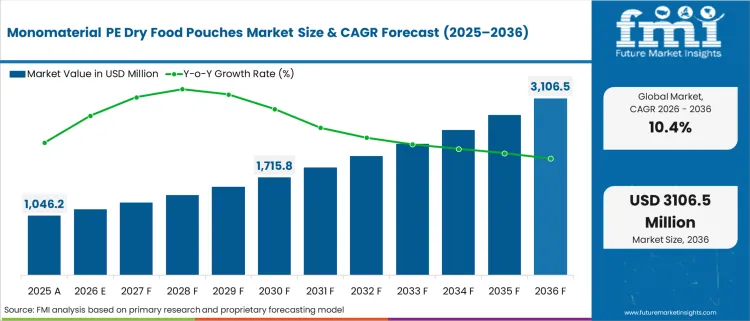
Monomaterial PE Dry Food Pouches Market Key Takeaways
| Metric | Details |
|---|---|
| Industry Size (2026) | USD 1,155.0 million |
| Industry Value (2036) | USD 3,350.0 million |
| CAGR (2026-2036) | 10.4% |
Transitioning to single-polymer architectures alters fundamental manufacturing workflows. As noted by Phil Van Houts, R&D Director ANZ at Amcor Flexibles Asia Pacific, "With AmPrima, we've created a simple, recycle-ready solution. It's a step forward that helps our customers make the transition without changing how they operate, while maintaining pack performance, appearance and food-grade standards." [2] Executives focus on drop-in replacements that do not require massive capital expenditure on sealing equipment.
Demand for Monomaterial PE Dry Food Pouches in United States (11.6% CAGR), Germany (10.8% CAGR), China (10.5% CAGR), India (10.3% CAGR), United Kingdom (10.1% CAGR), and Brazil (9.8% CAGR) accelerates alongside localized collection infrastructure rollouts. Across these regions, growth concentrates where compliance timing aligns with procurement cycles. European directives penalize unrecyclable composite films, forcing an accelerated industry transition.
Monomaterial PE Dry Food Pouches Definition
Monomaterial PE Dry Food Pouches are flexible packaging solutions made entirely from polyethylene resins, specifically designed for the storage of moisture-sensitive food products. These pouches offer a more sustainable alternative to traditional multi-material laminates, as they are composed of a single polymer, simplifying post-consumer recycling. Manufacturers use advanced extrusion techniques to integrate essential oxygen and moisture barrier properties into the polyethylene structure, ensuring that food products remain fresh and protected.
Monomaterial PE Dry Food Pouches Inclusions
This category includes sales of various pouch types such as flat-bottom, side-gusset, quad seal, and spouted pouches, all manufactured exclusively from high-density polyethylene (HDPE), low-density polyethylene (LDPE), or linear low-density polyethylene (LLDPE). The revenue calculations account for sales of both printed and unprinted roll-stock, which are then converted into finished monomaterial polyethylene pouches. It also includes sales to snack food manufacturers, pet nutrition brands, and bulk ingredient suppliers, who require moisture-sensitive packaging solutions.
Monomaterial PE Dry Food Pouches Exclusions
Projections exclude multi-material pouches that incorporate additional layers such as aluminum foil, polyethylene terephthalate (PET), or nylon, as these are outside the scope of monomaterial packaging. Similarly, liquid storage applications, retort-grade pouches, and packaging formats used for high-temperature sterilization are not considered. Additionally, secondary packaging solutions such as rigid display cartons or transit shipping boxes, which do not form part of the pouch itself, are not included in the revenue calculations.
Monomaterial PE Dry Food Pouches Market Research Methodology
- Primary Research: Direct interviews with resin suppliers, film extruders, and consumer goods packaging engineers confirm actual adoption rates.
- Desk Research: Analysts review extended producer responsibility guidelines, capacity expansion press releases, and corporate sustainability disclosures to map supply constraints.
- Market-Sizing and Forecasting: Models triangulate resin output data against dry food consumption volumes.
- Data Validation and Update Cycle: Findings undergo cross-examination against regional recycling infrastructure reports and peer reviews prior to final publication.
Segmental Analysis
Monomaterial PE Dry Food Pouches Market Analysis by Pouch Type
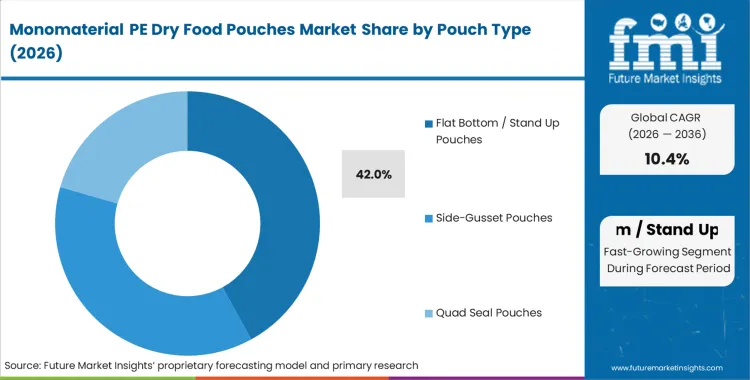
Flat Bottom / Stand Up Pouches command 42% of the market in 2026. According to FMI's estimates, brands prioritize formats offering maximum billboard space for branding while remaining stable on grocery shelves. Transitioning away from rigid containers toward flexible stand-up configurations reduces transport weight. Mono-PE stand-up formats align perfectly with modern retail layout constraints.
- Merchandising requirement: Retailers demand self-supporting packages to maximize shelf density. Mono-PE stand-up designs deliver structural rigidity without relying on non-recyclable PET layers. Implementation occurs during package redesign cycles.
- Logistics efficiency: Transporting empty flexible pouches consumes significantly less volume than rigid alternatives. Supply chain managers adopt flexible plastic pouch changes to cut freight expenditures. Procurement teams execute vendor switches ahead of peak seasonal production. Logistics costs drop measurably following the June 2025 introduction of Mondi's mono-material recyclable FlexiBag for dry pet food sectors. [4]
- Recovery alignment: Municipal recycling facilities effectively process rigid-leaning PE structures. Brands select these designs to guarantee compatibility with store drop-off programs. Compliance officers verify material parameters before authorizing purchase orders. Post-consumer recovery metrics climb steadily as US plastic recycling capacity expands by 2 billion pounds. [4]
Monomaterial PE Dry Food Pouches Market Analysis by Material Grade
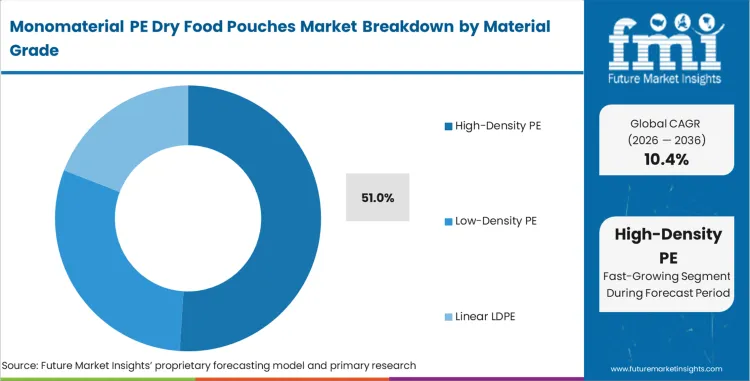
High-Density PE, which offers essential moisture barriers for delicate items, will account for 51% of volume in 2026. FMI analysts opine that HDPE stiffness mimics legacy PET films, allowing converters to run new materials on existing form-fill-seal lines. Extrusion engineers utilize specialized HDPE grades to achieve optimal tensile strength without sacrificing clarity.
- Barrier necessity: Sensitive snacks require robust moisture protection to prevent spoilage. HDPE delivers superior water vapor transmission rates compared to low-density variants. Technical teams specify resin blends during initial product formulation. Shelf life parity prevents food waste as Charter Next Generation partnered with NOVA Chemicals to commercialize rPE for mono-material pouches in September 2025. [5]
- Machine compatibility: Converters face immense downtime risks if new films stretch during high-speed packaging. High-stiffness HDPE limits elongation under tension. Operations directors trial new films during scheduled maintenance windows. Throughput speeds remain stable across Erolzheim facility operations expanded by Südpack in November 2025. [6]
- Format evolution: End users prefer resealable stand-up designs for pantry storage. Extruders incorporate mono-PE tracks to maintain single-polymer classification.
Monomaterial PE Dry Food Pouches Market Drivers, Restraints, and Opportunities
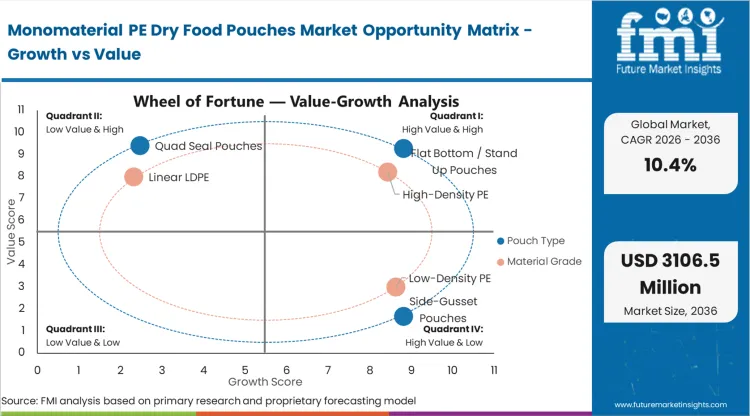
Stringent extended producer responsibility legislation acts as the primary catalyst pushing converters toward mono-polymer designs. Regulators in crucial geographies link taxation directly to packaging recyclability. Brands clinging to mixed-material laminates face escalating fees that rapidly destroy product margins. Procurement officers prioritize PE-based design for recycling packaging formats qualifying for lower municipal recycling tariffs. Berry and VOID Technologies collaborated to launch high-performance sustainable film in 2025 to meet these precise mandates. [14]
Heat resistance limitations of polyethylene create significant processing friction on legacy packaging lines. Traditional form-fill-seal machines utilize high-temperature sealing jaws optimized for PET outer layers. When running pure PE films, operators frequently encounter melted outer layers or compromised seal integrity. Companies deploy specialized heat-resistant coatings or invest in ultrasonic sealing jaw retrofits to maintain necessary production speeds without destroying package integrity.
- E-commerce optimization: Online channels require robust flexible formats to survive individual parcel shipping. Brands specify thicker mono-PE films to prevent transit ruptures, expanding e commerce flexible packaging applications.
- Chemical recycling integration: Advanced recycling technologies handle PE films exceptionally well. Chemical conversion bypasses traditional mechanical degradation limits. Post-consumer resins re-enter the supply chain as food-grade material.
- Regulatory alignment: Domestic demand accelerates supported by bans on specific single-use plastics that convert directly into measurable budget allocation. FMCG giants transition snack lines to compliant PE structures.
Regional Analysis
Based on the regional analysis, the Monomaterial PE Dry Food Pouches market is segmented into North America, Latin America, Europe, East Asia, South Asia, Oceania and Middle East & Africa across 40+ countries. The full report also offers market attractiveness analysis based on regional trends.
.webp "Top Country Growth Comparison Monomaterial Pe Dry Food Pouches Market Cagr (2026 2036)")
| Country | CAGR (2026 to 2036) |
|---|---|
| United States | 11.6% |
| Germany | 10.8% |
| China | 10.5% |
| India | 10.3% |
| United Kingdom | 10.1% |
| Brazil | 9.8% |
Source: Future Market Insights (FMI) analysis, based on proprietary forecasting model and primary research
North America Monomaterial PE Dry Food Pouches Analysis
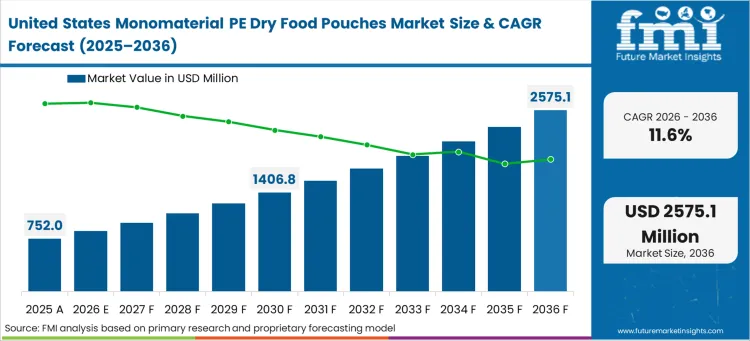
North America shifts rapidly toward recyclable designs as state-level legislation penalizes landfill-bound plastics. California's stringent laws force national brands to standardise on APR-recognized formats. Buyers demand drop-in solutions to avoid replacing expensive capital equipment.
- United States: Demand for Monomaterial PE Dry Food Pouches in United States is set to grow at 11.6% CAGR through 2036, supported by state-level EPR mandates before procurement cycles translate into higher deployment volumes. Brands update specifications to secure compliance following ProAmpac's USD 1.51 billion acquisition of TC Transcontinental Packaging to scale sustainable pouch structures. [8]
FMI's report includes a detailed growth analysis and country-wise assessment. Canada and Mexico present strong adoption avenues for snack food packaging upgrades. Cross-border trade requires harmonized material standards to streamline logistics.
Europe Monomaterial PE Dry Food Pouches Analysis
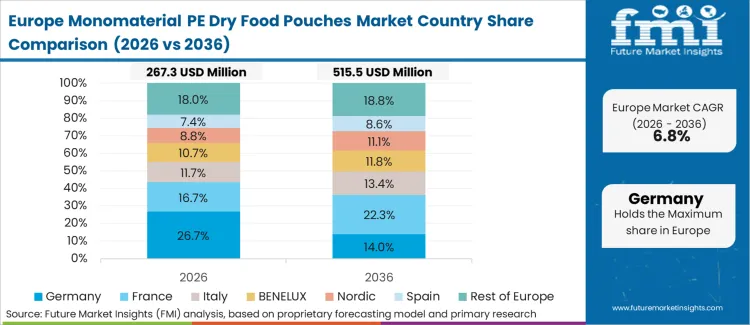
Europe operates under aggressive circular economy directives targeting plastic waste reduction. Regulators implement steep taxes on non-recyclable plastic tons, directly punishing multi-layer laminate usage. Converters race to secure high-barrier PE resin supplies to meet surging brand demands.
- Germany: Monomaterial PE Dry Food Pouches sales in Germany are projected to rise at 10.8% CAGR from 2026 to 2036 as national packaging laws enforce strict recycling quotas, creating a clearer pathway from policy to purchase orders. Sourcing shifts entirely to verified mono-polymer structures as European plastic packaging waste recycled rates hit 42.1%. [9]
- United Kingdom: In the United Kingdom, retail consortiums are increasingly mandating sustainable packaging formats, encouraging brands to transition away from problematic plastics. Supermarkets are reinforcing this shift by penalizing non-compliant materials, while 72% of plastic packaging from signatory brands is already reusable or recyclable [12]. As sustainability requirements tighten and packaging lines are upgraded accordingly, the Monomaterial PE dry food pouches sector is projected to grow at a 10.1% CAGR from 2026 to 2036.
FMI's report includes a detailed growth analysis and country-wise assessment. France and Italy actively pursue green packaging film initiatives within grocery networks. Strong localized recycling infrastructure empowers brands to deploy mono-PE confidently.
Asia Pacific Monomaterial PE Dry Food Pouches Analysis
Asia Pacific registers immense volume expansion as rising middle-class demographics consume more packaged snacks. Urbanization drives demand for single-serve and on-the-go flexible formats. Local converters upgrade extrusion lines to handle sophisticated single-polymer blends for export markets.
- China: China is expected to record 10.5% CAGR in Monomaterial PE Dry Food Pouches demand over 2026 to 2036 as government waste reduction targets take effect, tightening the link between operational constraints and adoption-led investment. Export-oriented manufacturers align packaging with Western EPR standards as packaging pollution projects to double without intervention. [10]
- India: In India, regulatory bans on specific single-use plastics are accelerating the shift toward compliant monomaterial PE packaging structures. FMCG companies are actively transitioning snack and dry food lines to recyclable PE formats to align with tightening sustainability norms. With global flexible packaging consumption projected to reach 37.5 million tons [11], domestic manufacturers are allocating measurable budgets toward packaging upgrades. As regulatory enforcement strengthens and industry adoption widens, the monomaterial PE dry food pouches market in India is projected to grow at a 10.3% CAGR through 2036.
FMI's report includes a detailed growth analysis and country-wise assessment. Japan and Australia implement rigorous biodegradable food packaging and recyclable material tracking systems. Domestic brands leverage mono-material designs to capture eco-conscious consumer spending.
Latin America Monomaterial PE Dry Food Pouches Analysis
Latin America modernizes retail supply chains, driving transitions from rigid containers to lightweight flexible pouches. Multinational brands export sustainability pledges to regional subsidiaries. Push for recyclable materials gains traction amid growing municipal waste crises.
- Brazil: Monomaterial PE Dry Food Pouches uptake in Brazil is anticipated to climb at 9.8% CAGR over the forecast period as urban waste management policies tighten, helping suppliers align positioning with local buying triggers. Major pet food brands transition kibble lines to PE formats following Dow's introduction of recyclable mono-material pouches. [13]
FMI's report includes a detailed growth analysis and country-wise assessment. Mexico and Chile explore advanced recycling frameworks for flexible films. Strategic partnerships between resin suppliers and local converters accelerate regional knowledge transfer.
Competitive Aligners for Market Players
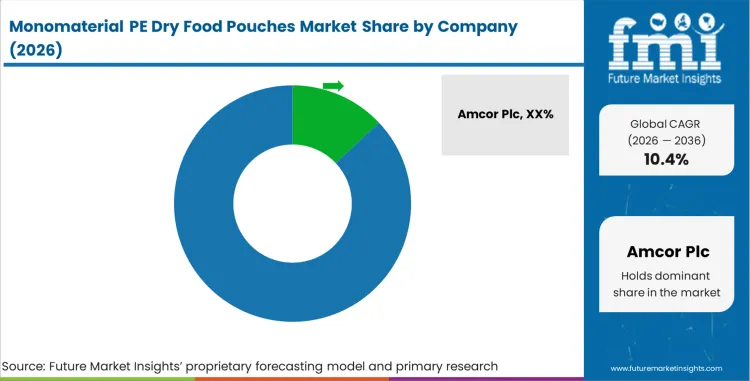
Material science innovation dictates market leadership hierarchies. Resin suppliers developing high-barrier PE grades capture premium pricing models while shielding brands from EPR taxation. Smaller converters lacking advanced extrusion capabilities lose lucrative contracts with multinational food corporations.
Securing raw material streams for post industrial recyclate pir flexible packaging content provides a massive strategic advantage. Brands demand verifiable recycled content to meet 2030 sustainability pledges. Suppliers integrating chemical recycling outputs directly into supply chains build resilient moats against competitors.
Equipment compatibility remains the largest hurdle for food packaging film converter adoption. FMI analysts opine that films requiring extensive machinery modifications face severe sales resistance. Companies engineering PE films with broader sealing windows win bids by guaranteeing zero productivity losses during transition phases.
Recent Developments
The report includes full coverage of key trends from competitive benchmarking. Some of the recent developments covered in the reports:
- In September 2025, Borouge and Siegwerk launched a fully recyclable mono-material PE stand-up pouch featuring an oxygen barrier. [3]
- In February 2026, SPS Pouches launched mono-material PE spout pouches targeting refill packaging formats. [7]
Key Players in Monomaterial PE Dry Food Pouches
- Amcor Plc
- Mondi Group
- Huhtamaki Oyj
- ProAmpac
- Constantia Flexibles
- Coveris
- UFlex Limited
Scope of the Report
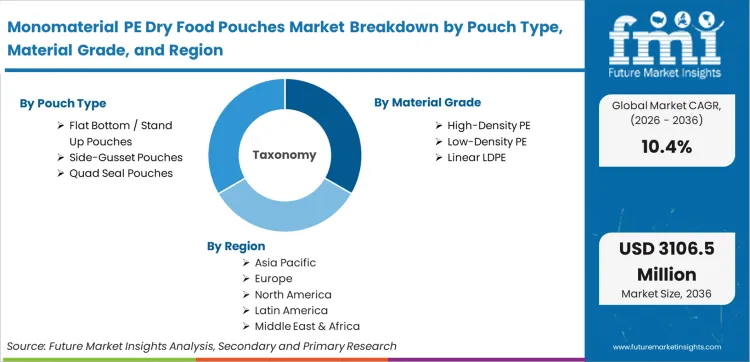
| Metric | Value |
|---|---|
| Quantitative Units | USD 1,155.0 million (2026) to USD 3,350.0 million (2036), at a CAGR of 10.4% |
| Market Definition | Monomaterial PE Dry Food Pouches represent flexible containers manufactured entirely from polyethylene resins designed specifically for storing moisture-sensitive consumables. |
| Pouch Type Segmentation | Flat Bottom / Stand Up Pouches, Side-Gusset Pouches, Quad Seal Pouches, Spouted / Reclosable Pouches |
| Material Grade Segmentation | High-Density PE, Low-Density PE, Linear LDPE |
| Regions Covered | North America, Latin America, Europe, East Asia, South Asia, Oceania, Middle East and Africa |
| Countries Covered | United States, Canada, Mexico, Brazil, Argentina, Germany, France, United Kingdom, Italy, Spain, China, India, Japan, South Korea, Indonesia, Australia and 40 plus countries |
| Key Companies Profiled | Amcor Plc, Mondi Group, Huhtamaki Oyj, ProAmpac, Constantia Flexibles, Coveris, UFlex Limited |
| Forecast Period | 2026 to 2036 |
| Approach | Hybrid top-down and bottom-up market modeling, validated through primary interviews with pouch manufacturers and material suppliers, supported by trade data benchmarking and production capacity analysis for sustainable monomaterial packaging solutions |
Monomaterial PE Dry Food Pouches Market Analysis by Segments
Pouch Type:
- Flat Bottom / Stand Up Pouches
- Side-Gusset Pouches
- Quad Seal Pouches
- Spouted / Reclosable Pouches
Material Grade:
- High-Density PE
- Low-Density PE
- Linear LDPE
Region:
- Asia Pacific
- India
- China
- Japan
- South Korea
- Indonesia
- Australia & New Zealand
- ASEAN
- Rest of Asia Pacific
- Europe
- Germany
- Italy
- France
- United Kingdom
- Spain
- Benelux
- Nordics
- Central & Eastern Europe
- Rest of Europe
- North America
- United States
- Canada
- Mexico
- Latin America
- Brazil
- Argentina
- Chile
- Rest of Latin America
- Middle East & Africa
- Kingdom of Saudi Arabia
- United Arab Emirates
- South Africa
- Turkey
- Rest of Middle East & Africa
Bibliography
- [1] Our World in Data. (2025). Packaging is the source of 40% of the planet's plastic waste.
- [2] Amcor. (2026). Amcor WorldStar global packaging awards recycle-ready shredded cheese.
- [3] Borouge and Siegwerk. (2025). Fully recyclable mono-material packaging solution.
- [4] APR. (2025). Plastic recycling capacity in the US and Canada.
- [5] NOVA Chemicals. (2025). Charter Next Generation and NOVA Chemicals collaborate.
- [6] Plastics News. (2025). Südpack mono-material blister packaging.
- [7] Packnode. (2026). SPS Pouches launches mono-material PE spout pouches.
- [8] ProAmpac. (2025). ProAmpac to acquire TC Transcontinental Packaging.
- [9] Eurostat. (2025). EU plastic packaging waste statistics.
- [10] Pew. (2025). Breaking the Plastic Wave.
- [11] Flexography. (2025). Global flexible packaging consumption.
- [12] Ellen MacArthur Foundation. (2025). Global Commitment 2025 Report.
- [13] Dow. (2025). Corporate press releases on mono-material pouch.
- [14] Berry Global. (2025). Berry and VOID Technologies collaborate to launch high-performance sustainable film.
This bibliography is provided for reader reference and is not exhaustive. The full report contains the complete reference list and detailed citations.
This Report Addresses
- Market intelligence to enable structured strategic decision making across mature and emerging resin economies
- Market size estimation and 10 year revenue forecasts from 2026 to 2036, supported by validated capacity and trade benchmarks
- Growth opportunity mapping across flat bottom, side-gusset, and spouted pouch formats
- Segment and regional revenue forecasts covering pouch type and material grade applications
- Competition strategy assessment including integration models, cost survivability positioning, and compliance capability benchmarking
- Product reformulation and emission compliance tracking aligned with regional EPR mandates
- Regulatory impact analysis covering recycling quotas and landfill taxation protocols
- Market report delivery in PDF, Excel, PPT, and interactive dashboard formats for executive and operational use
Frequently Asked Questions
How large is the demand for Monomaterial PE Dry Food Pouches in the global market in 2026?
Demand registers USD 1,155.0 million in 2026 as brands adopt recyclable flexible formats.
What will be the market size of Monomaterial PE Dry Food Pouches in the global market by 2036?
Valuation is projected to reach USD 3,350.0 million by 2036.
What is the expected demand growth for Monomaterial PE Dry Food Pouches in the global market between 2026 and 2036?
Sales scale at 10.4% CAGR between 2026 and 2036.
Which Pouch Type is poised to lead global sales by 2026?
Flat Bottom / Stand Up Pouches command 42% share due to superior retail shelf stability and consumer convenience.
How significant is the role of High-Density PE in driving Monomaterial PE Dry Food Pouches adoption in 2026?
High-Density PE holds 51% share as its stiffness mimics legacy PET films, allowing converters to run new materials on existing lines.
What is driving demand in United States?
Strict state-level extended producer responsibility laws push converters to standardise on APR-recognized formats.
What compliance standards or regulations are referenced for United States?
APR design guidelines dictate acceptable material specifications for full recyclability.
What is the United States growth outlook in this report?
United States expansion tracks 11.6% CAGR over the forecast period.
Why is Europe described as a priority region in this report?
Aggressive circular economy directives and steep taxes on non-recyclable plastic tons destroy multi-layer laminate viability.
What type of demand dominates in Europe?
Regulatory-driven replacement demand forces rapid transitions to verified mono-polymer structures.
What is Germany growth outlook in this report?
Germany accelerates at 10.8% CAGR over the forecast period.
Does the report cover China in its regional analysis?
Yes, China falls under Asia Pacific scope.
What are the sources referred to for analyzing China?
Analysis relies on government waste reduction targets and Pew's Breaking the Plastic Wave updates.
What is the main demand theme linked to China in its region coverage?
Export-oriented manufacturers align packaging with Western EPR standards to maintain global distribution access.
Does the report cover India in its regional analysis?
Yes, India falls under Asia Pacific scope.
What is the main India related demand theme in its region coverage?
Bans on specific single-use plastics convert directly into measurable budget allocation for compliant PE structures.
Which product formats or configurations are strategically important for North America supply chains?
Drop-in mono-PE solutions that run on legacy form-fill-seal machinery without causing productivity losses remain critical.
What is Monomaterial PE Dry Food Pouches and what is it mainly used for?
These represent flexible containers manufactured entirely from polyethylene resins designed specifically for storing moisture-sensitive consumables.
What does Monomaterial PE Dry Food Pouches mean in this report?
The term covers flat bottom, side-gusset, quad seal, and spouted pouch formats made exclusively from polyethylene grades.
What is included in the scope of this Monomaterial PE Dry Food Pouches report?
Direct sales of printed and unprinted roll-stock converted into finished mono-PE enclosures for retail food distribution.
What is excluded from the scope of this report?
Multi-polymer flexible formats containing aluminum foil, PET, or nylon layers, along with liquid and retort applications.
What does market forecast mean on this page?
Forecasts represent model-based projections triangulating resin output data against dry food consumption volumes.
How does FMI build and validate the Monomaterial PE Dry Food Pouches forecast?
Models rely on hybrid top-down and bottom-up methodology validated through direct interviews with resin suppliers and film extruders.
What does zero reliance on speculative third party market research mean here?
Findings stem strictly from primary corporate disclosures, regional recycling infrastructure reports, and peer-reviewed industry data.
Preview the report firsthand - request a free sample
Get SampleGet the brochure for pricing and purchase details.
Get PDFTable of Content
- Executive Summary
- Global Market Outlook
- Demand-side Trends
- Supply-side Trends
- Technology Roadmap Analysis
- Analysis and Recommendations
- Market Overview
- Market Coverage / Taxonomy
- Market Definition / Scope / Limitations
- Research Methodology
- Chapter Orientation
- Analytical Lens and Working Hypotheses
- Market Structure, Signals, and Trend Drivers
- Benchmarking and Cross-market Comparability
- Market Sizing, Forecasting, and Opportunity Mapping
- Research Design and Evidence Framework
- Desk Research Programme (Secondary Evidence)
- Company Annual and Sustainability Reports
- Peer-reviewed Journals and Academic Literature
- Corporate Websites, Product Literature, and Technical Notes
- Earnings Decks and Investor Briefings
- Statutory Filings and Regulatory Disclosures
- Technical White Papers and Standards Notes
- Trade Journals, Industry Magazines, and Analyst Briefs
- Conference Proceedings, Webinars, and Seminar Materials
- Government Statistics Portals and Public Data Releases
- Press Releases and Reputable Media Coverage
- Specialist Newsletters and Curated Briefings
- Sector Databases and Reference Repositories
- FMI Internal Proprietary Databases and Historical Market Datasets
- Subscription Datasets and Paid Sources
- Social Channels, Communities, and Digital Listening Inputs
- Additional Desk Sources
- Expert Input and Fieldwork (Primary Evidence)
- Primary Modes
- Qualitative Interviews and Expert Elicitation
- Quantitative Surveys and Structured Data Capture
- Blended Approach
- Why Primary Evidence is Used
- Field Techniques
- Interviews
- Surveys
- Focus Groups
- Observational and In-context Research
- Social and Community Interactions
- Stakeholder Universe Engaged
- C-suite Leaders
- Board Members
- Presidents and Vice Presidents
- R&D and Innovation Heads
- Technical Specialists
- Domain Subject-matter Experts
- Scientists
- Physicians and Other Healthcare Professionals
- Governance, Ethics, and Data Stewardship
- Research Ethics
- Data Integrity and Handling
- Primary Modes
- Tooling, Models, and Reference Databases
- Desk Research Programme (Secondary Evidence)
- Data Engineering and Model Build
- Data Acquisition and Ingestion
- Cleaning, Normalisation, and Verification
- Synthesis, Triangulation, and Analysis
- Quality Assurance and Audit Trail
- Market Background
- Market Dynamics
- Drivers
- Restraints
- Opportunity
- Trends
- Scenario Forecast
- Demand in Optimistic Scenario
- Demand in Likely Scenario
- Demand in Conservative Scenario
- Opportunity Map Analysis
- Product Life Cycle Analysis
- Supply Chain Analysis
- Investment Feasibility Matrix
- Value Chain Analysis
- PESTLE and Porter’s Analysis
- Regulatory Landscape
- Regional Parent Market Outlook
- Production and Consumption Statistics
- Import and Export Statistics
- Market Dynamics
- Global Market Analysis 2021 to 2025 and Forecast, 2026 to 2036
- Historical Market Size Value (USD Million) Analysis, 2021 to 2025
- Current and Future Market Size Value (USD Million) Projections, 2026 to 2036
- Y-o-Y Growth Trend Analysis
- Absolute $ Opportunity Analysis
- Global Market Pricing Analysis 2021 to 2025 and Forecast 2026 to 2036
- Global Market Analysis 2021 to 2025 and Forecast 2026 to 2036, By Pouch Type
- Introduction / Key Findings
- Historical Market Size Value (USD Million) Analysis By Pouch Type , 2021 to 2025
- Current and Future Market Size Value (USD Million) Analysis and Forecast By Pouch Type , 2026 to 2036
- Flat Bottom / Stand Up Pouches
- Side-Gusset Pouches
- Quad Seal Pouches
- Flat Bottom / Stand Up Pouches
- Y-o-Y Growth Trend Analysis By Pouch Type , 2021 to 2025
- Absolute $ Opportunity Analysis By Pouch Type , 2026 to 2036
- Global Market Analysis 2021 to 2025 and Forecast 2026 to 2036, By Material Grade
- Introduction / Key Findings
- Historical Market Size Value (USD Million) Analysis By Material Grade, 2021 to 2025
- Current and Future Market Size Value (USD Million) Analysis and Forecast By Material Grade, 2026 to 2036
- High-Density PE
- Low-Density PE
- Linear LDPE
- High-Density PE
- Y-o-Y Growth Trend Analysis By Material Grade, 2021 to 2025
- Absolute $ Opportunity Analysis By Material Grade, 2026 to 2036
- Global Market Analysis 2021 to 2025 and Forecast 2026 to 2036, By Region
- Introduction
- Historical Market Size Value (USD Million) Analysis By Region, 2021 to 2025
- Current Market Size Value (USD Million) Analysis and Forecast By Region, 2026 to 2036
- North America
- Latin America
- Western Europe
- Eastern Europe
- East Asia
- South Asia and Pacific
- Middle East & Africa
- Market Attractiveness Analysis By Region
- North America Market Analysis 2021 to 2025 and Forecast 2026 to 2036, By Country
- Historical Market Size Value (USD Million) Trend Analysis By Market Taxonomy, 2021 to 2025
- Market Size Value (USD Million) Forecast By Market Taxonomy, 2026 to 2036
- By Country
- USA
- Canada
- Mexico
- By Pouch Type
- By Material Grade
- By Country
- Market Attractiveness Analysis
- By Country
- By Pouch Type
- By Material Grade
- Key Takeaways
- Latin America Market Analysis 2021 to 2025 and Forecast 2026 to 2036, By Country
- Historical Market Size Value (USD Million) Trend Analysis By Market Taxonomy, 2021 to 2025
- Market Size Value (USD Million) Forecast By Market Taxonomy, 2026 to 2036
- By Country
- Brazil
- Chile
- Rest of Latin America
- By Pouch Type
- By Material Grade
- By Country
- Market Attractiveness Analysis
- By Country
- By Pouch Type
- By Material Grade
- Key Takeaways
- Western Europe Market Analysis 2021 to 2025 and Forecast 2026 to 2036, By Country
- Historical Market Size Value (USD Million) Trend Analysis By Market Taxonomy, 2021 to 2025
- Market Size Value (USD Million) Forecast By Market Taxonomy, 2026 to 2036
- By Country
- Germany
- UK
- Italy
- Spain
- France
- Nordic
- BENELUX
- Rest of Western Europe
- By Pouch Type
- By Material Grade
- By Country
- Market Attractiveness Analysis
- By Country
- By Pouch Type
- By Material Grade
- Key Takeaways
- Eastern Europe Market Analysis 2021 to 2025 and Forecast 2026 to 2036, By Country
- Historical Market Size Value (USD Million) Trend Analysis By Market Taxonomy, 2021 to 2025
- Market Size Value (USD Million) Forecast By Market Taxonomy, 2026 to 2036
- By Country
- Russia
- Poland
- Hungary
- Balkan & Baltic
- Rest of Eastern Europe
- By Pouch Type
- By Material Grade
- By Country
- Market Attractiveness Analysis
- By Country
- By Pouch Type
- By Material Grade
- Key Takeaways
- East Asia Market Analysis 2021 to 2025 and Forecast 2026 to 2036, By Country
- Historical Market Size Value (USD Million) Trend Analysis By Market Taxonomy, 2021 to 2025
- Market Size Value (USD Million) Forecast By Market Taxonomy, 2026 to 2036
- By Country
- China
- Japan
- South Korea
- By Pouch Type
- By Material Grade
- By Country
- Market Attractiveness Analysis
- By Country
- By Pouch Type
- By Material Grade
- Key Takeaways
- South Asia and Pacific Market Analysis 2021 to 2025 and Forecast 2026 to 2036, By Country
- Historical Market Size Value (USD Million) Trend Analysis By Market Taxonomy, 2021 to 2025
- Market Size Value (USD Million) Forecast By Market Taxonomy, 2026 to 2036
- By Country
- India
- ASEAN
- Australia & New Zealand
- Rest of South Asia and Pacific
- By Pouch Type
- By Material Grade
- By Country
- Market Attractiveness Analysis
- By Country
- By Pouch Type
- By Material Grade
- Key Takeaways
- Middle East & Africa Market Analysis 2021 to 2025 and Forecast 2026 to 2036, By Country
- Historical Market Size Value (USD Million) Trend Analysis By Market Taxonomy, 2021 to 2025
- Market Size Value (USD Million) Forecast By Market Taxonomy, 2026 to 2036
- By Country
- Kingdom of Saudi Arabia
- Other GCC Countries
- Turkiye
- South Africa
- Other African Union
- Rest of Middle East & Africa
- By Pouch Type
- By Material Grade
- By Country
- Market Attractiveness Analysis
- By Country
- By Pouch Type
- By Material Grade
- Key Takeaways
- Key Countries Market Analysis
- USA
- Pricing Analysis
- Market Share Analysis, 2025
- By Pouch Type
- By Material Grade
- Canada
- Pricing Analysis
- Market Share Analysis, 2025
- By Pouch Type
- By Material Grade
- Mexico
- Pricing Analysis
- Market Share Analysis, 2025
- By Pouch Type
- By Material Grade
- Brazil
- Pricing Analysis
- Market Share Analysis, 2025
- By Pouch Type
- By Material Grade
- Chile
- Pricing Analysis
- Market Share Analysis, 2025
- By Pouch Type
- By Material Grade
- Germany
- Pricing Analysis
- Market Share Analysis, 2025
- By Pouch Type
- By Material Grade
- UK
- Pricing Analysis
- Market Share Analysis, 2025
- By Pouch Type
- By Material Grade
- Italy
- Pricing Analysis
- Market Share Analysis, 2025
- By Pouch Type
- By Material Grade
- Spain
- Pricing Analysis
- Market Share Analysis, 2025
- By Pouch Type
- By Material Grade
- France
- Pricing Analysis
- Market Share Analysis, 2025
- By Pouch Type
- By Material Grade
- India
- Pricing Analysis
- Market Share Analysis, 2025
- By Pouch Type
- By Material Grade
- ASEAN
- Pricing Analysis
- Market Share Analysis, 2025
- By Pouch Type
- By Material Grade
- Australia & New Zealand
- Pricing Analysis
- Market Share Analysis, 2025
- By Pouch Type
- By Material Grade
- China
- Pricing Analysis
- Market Share Analysis, 2025
- By Pouch Type
- By Material Grade
- Japan
- Pricing Analysis
- Market Share Analysis, 2025
- By Pouch Type
- By Material Grade
- South Korea
- Pricing Analysis
- Market Share Analysis, 2025
- By Pouch Type
- By Material Grade
- Russia
- Pricing Analysis
- Market Share Analysis, 2025
- By Pouch Type
- By Material Grade
- Poland
- Pricing Analysis
- Market Share Analysis, 2025
- By Pouch Type
- By Material Grade
- Hungary
- Pricing Analysis
- Market Share Analysis, 2025
- By Pouch Type
- By Material Grade
- Kingdom of Saudi Arabia
- Pricing Analysis
- Market Share Analysis, 2025
- By Pouch Type
- By Material Grade
- Turkiye
- Pricing Analysis
- Market Share Analysis, 2025
- By Pouch Type
- By Material Grade
- South Africa
- Pricing Analysis
- Market Share Analysis, 2025
- By Pouch Type
- By Material Grade
- USA
- Market Structure Analysis
- Competition Dashboard
- Competition Benchmarking
- Market Share Analysis of Top Players
- By Regional
- By Pouch Type
- By Material Grade
- Competition Analysis
- Competition Deep Dive
- Amcor Plc
- Overview
- Product Portfolio
- Profitability by Market Segments (Product/Age /Sales Channel/Region)
- Sales Footprint
- Strategy Overview
- Marketing Strategy
- Product Strategy
- Channel Strategy
- Mondi Group
- Huhtamaki Oyj
- ProAmpac
- Constantia Flexibles
- Coveris
- UFlex Limited
- Amcor Plc
- Competition Deep Dive
- Assumptions & Acronyms Used


