

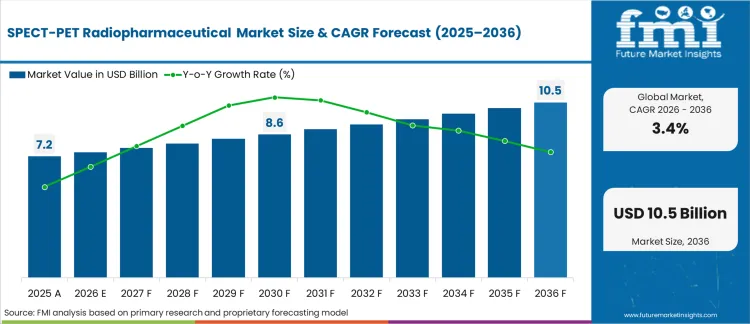
- Industry Size (2026)
- USD 7485.0 Mn
- Forecast (2036)
- USD 10456.8 Mn
- CAGR (2026 to 2036)
- 3.4%
SPECT/PET Radiopharmaceutical Market Size, Market Forecast and Outlook By FMI
In 2026, the SPECT/PET radiopharmaceutical market was valued at USD 7,485.0 million. Based on Future Market Insights analysis, demand for SPECT/PET radiopharmaceuticals is estimated to grow to USD 10,456.8 million by 2036. FMI projects a CAGR of 3.4% during the forecast period.
Absolute dollar growth of USD 2,971.7 million over the decade signals steady expansion rather than a step-change cycle. As per FMI, growth is expected to be supported by broader utilisation of nuclear imaging and radiotheranostic pathways, while manufacturing lead times, regulated transport controls, and site qualification requirements are expected to limit rapid capacity switching.
“The FDA’s acceptance of our NDA is an important regulatory milestone in advancing this new radiopharmaceutical treatment option for patients with GEP-NETs, In the Phase 3 COMPETE trial, 177Lu-edotreotide demonstrated extended PFS, a straightforward dosing regimen, and a favorable safety profile, supporting its potential to improve the current treatment paradigm. We look forward to working closely with the FDA toward potential approval.’ said Dr. Celine Wilke, Chief Medical Officer of ITM.5]
Summary of SPECT/PET Radiopharmaceutical Market
- SPECT/PET Radiopharmaceutical Market Definition
- The industry covers diagnostic and therapeutic radiopharmaceuticals used in SPECT and PET procedures, supplied as dose-ready products for imaging and targeted radionuclide therapy across nuclear medicine settings.
- Demand Drivers in the Market
- Growth in oncology and cardiology scan volumes is sustaining routine purchasing of imaging tracers through hospital nuclear medicine departments and imaging networks.
- Expansion of theranostics is increasing demand for therapy-linked radionuclides, with scheduling tied to treatment cycles and dose planning.
- Buyer preference is being filtered by on-time delivery performance, batch release discipline, and short half-life handling readiness across the supply chain, as per FMI.
- Key Segments Analyzed in the FMI Report
- By Radioisotope: lutetium-177 leads at 25.1% share in 2026, followed by fluorine-18 at 17.6% share.
- By Application: imaging leads at 51.2% share in 2026, followed by therapeutics at 48.8% share.
- Geography: India and China show the fastest growth at 6.2% and 6.0% CAGR, supported by capacity additions and broader access to nuclear medicine services.
- Analyst Opinion at FMI
- Sabyasachi Ghosh, Principal Consultant at Future Market Insights, opines, ‘Supplier selection is being decided by dose availability on the planned day, validated handling across short shelf-life windows, and dependable logistics execution, since missed delivery slots translate into cancelled scans or deferred therapy cycles.’
- Strategic Implications and Executive Takeaways
- Prioritize supply assurance for Lu-177 programs through scheduling discipline, redundancy planning, and site-level coordination with therapy calendars.
- Protect F-18 tracer continuity with strong cold-chain logistics, predictable batch release timing, and rapid deviation response processes.
- Strengthen relationships with hospital systems where 49.4% of demand sits, using service-level performance as the primary renewal lever.
- Methodology
- As per FMI, sizing and splits were reconciled using company primary disclosures, isotope mix mapping, and site-of-care demand logic.
- Segment shares were validated by linking application use patterns to nuclear medicine workflow realities and repeat purchasing behavior.
- Pricing sensitivity was tested against isotope mix changes and therapy uptake to confirm revenue response under plausible adoption paths.
India (6.2% CAGR, supported by expanding nuclear medicine capacity and higher diagnostic throughput), China (6.0% CAGR, driven by installed-base expansion and wider oncology imaging use), and Brazil (5.7% CAGR, linked to rising access to advanced imaging) are expected to lead growth. The UK (3.9% CAGR) and the U.S. (3.7% CAGR) are expected to grow through repeat imaging demand. Germany (3.2% CAGR) and Japan (2.2% CAGR) are expected to contribute more through replacement demand, constrained by tight scheduling governance and budget-led reimbursement pressure.
SPECT/PET Radiopharmaceutical Market Definition
The market includes radiopharmaceuticals for SPECT and PET procedures for imaging and targeted therapy. The products are used in controlled clinical environments and are sold to hospitals, imaging centers, and cancer therapy centers based on protocol and tracer availability. The market includes radioisotopes used for imaging and therapeutic purposes and are presented as oral solution and IV solution formats. The market is driven by procedure volumes, oncology and cardiology case mix, and regulatory requirements for handling and transporting the products. The revenue stream is driven by dose sales and repeat business based on imaging and therapy schedules.
SPECT/PET Radiopharmaceutical Market Inclusions
The report provides global and regional market sizes and a 10-year forecast from 2026 to 2036. The market is sized by radioisotope, application, dosage form, and end user, with country-level CAGR comparisons across key markets. The report also examines the role of supply chain and site readiness factors in purchasing, continuity of scheduling, and vendor selection, through primary research and desk research from authorized public sources.
SPECT/PET Radiopharmaceutical Market Exclusions
The scope excludes PET and SPECT scanners, cyclotrons and generators sold as capital equipment, dose calibrators, injectors, shielding consumables, and imaging software. It also omits radiology service revenue and procedure fees, focusing strictly on radiopharmaceutical product value. Non-nuclear contrast media and radiotherapy devices are excluded. Research-only isotopes not supplied for clinical imaging or therapeutic use are excluded unless sold under compliant clinical supply pathways.
SPECT/PET Radiopharmaceutical Market Research Methodology
- Primary Research: Interviews were held with nuclear medicine practitioners, radiopharmacy managers, imaging center owners, hospital purchasing departments, and supplier key accounts to confirm tracer mixture, time constraints, and purchasing criteria.
- Desk Research: Available data from regulatory agencies, health system publications, standards organizations, primary company announcements, and peer-reviewed literature was analyzed to compare handling needs and usage patterns.
- Market Sizing and Forecasting: A hybrid bottom-up approach was carried out to understand disease incidence, diagnosis rate, dosage per case was employed, integrating country demand trends with segment shares based on radioisotope and use type, and then balanced through value build-up with dose usage and price tiers.
- Data Validation and Update Cycle: Results were verified by internal consistency screening for segment totals and country growth rates, with variance analysis prior to finalization.
Segmental Analysis
SPECT/PET Radiopharmaceutical Market Analysis by Radioisotope
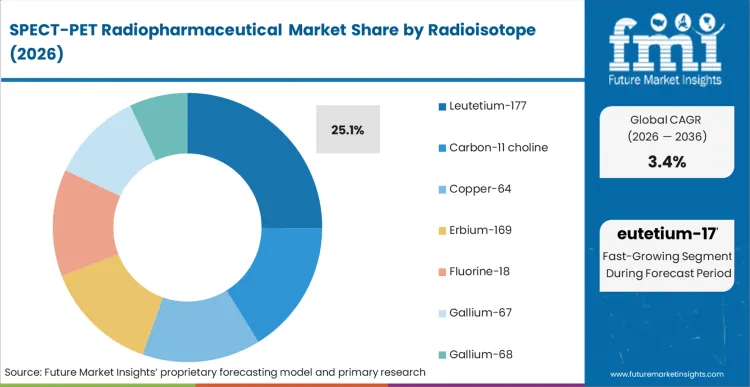
Based on FMI’s report, lutetium-177 is estimated to hold 25.1% share in 2026, followed by fluorine-18 at 17.6% share. Lu-177 leadership is supported by its role in targeted radionuclide therapy workflows, where treatment courses create repeat dosing schedules and higher value per patient cycle. F-18 remains the second largest share due to its broad PET imaging footprint and routine ordering patterns that track daily scan throughput.
- Indication Expansion: FDA expanded Pluvicto (Lu-177) use on March 28, 2025 to earlier PSMA-positive mCRPC patients. Treatment follows scheduled repeat dosing (every 6 weeks, up to 6 doses), driving higher per-patient use than diagnostics and reinforcing Lu-177’s leading share [4]
- Theranostic Fit: Lu-177 leads because it is built for targeted radionuclide therapy, not just imaging. It emits therapeutic radiation that can damage tumor cells, has a practical half-life (measured in days) for centralized production and scheduled delivery, and can be securely attached to targeting molecules.[6] [2]
- Care-Pathway Lock: Eligibility is tied to PSMA testing and multidisciplinary oncology protocols, which keeps Lu-177 embedded once sites activate therapy programs.
SPECT/PET Radiopharmaceutical Market Analysis by Application
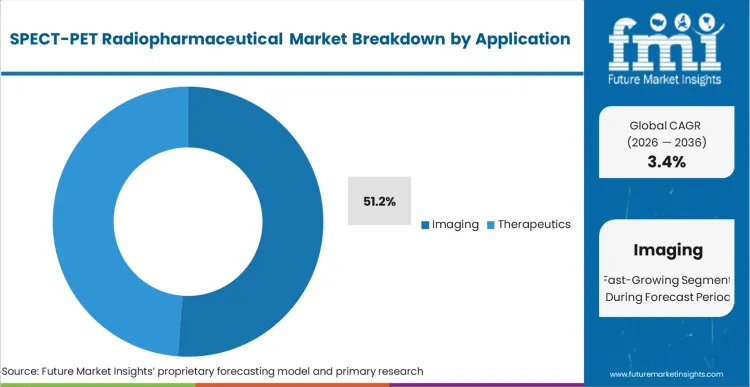
Imaging accounts for 51.2% share in 2026, followed by therapeutics at 48.8%, based on FMI’s report. Imaging remains marginally higher as scan volumes are spread across oncology staging, cardiology perfusion, and neurological assessments, keeping repeat tracer procurement steady. Therapeutics is close behind as theranostic pathways expand, where higher value per administration supports revenue growth even when treated patient counts are smaller than scan volumes.
- Diagnostic Backbone: Cancer workups rely heavily on scans. NCI notes imaging tests, including nuclear scans and PET scans, are routinely used to detect tumors and guide diagnosis, creating high, repeat tracer demand versus therapy-limited use.[1]
- Broad Adoption: PET imaging is widely used not only in oncology but also applied across neurology, cardiology, infection, and autoimmune evaluation. This broad, routine clinical use keeps tracer demand tied to daily scan throughput, so imaging contributes the highest application share.[2]
- Routine Scanning: Imaging holds the highest share because SPECT and PET tracers are used daily for diagnosis, staging, and follow-up across many conditions. High scan volumes create steady, repeat ordering, while therapy use is limited to fewer indications and specialized sites.
SPECT/PET Radiopharmaceutical Market Drivers, Restraints, and Opportunities
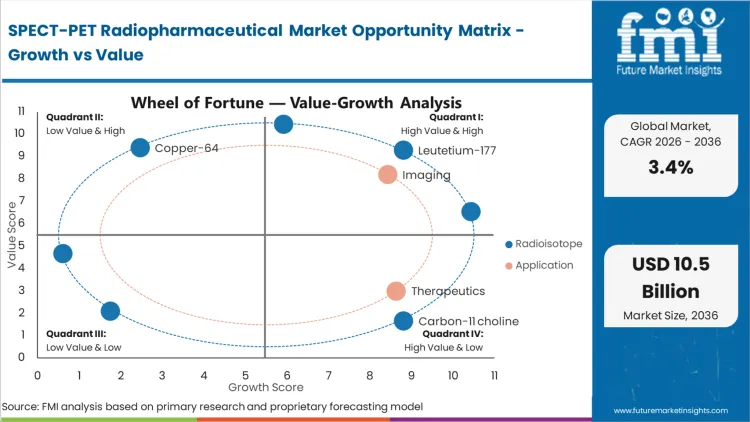
Future Market Insights analysis that historical patterns point at a capacity- and logistics-governed category where demand is anchored in repeat nuclear medicine imaging throughput and scheduled radionuclide therapy cycles. Procurement is being shaped by short half-life handling requirements, dose-day delivery discipline, and site scheduling realities that convert any disruption into cancelled scans or deferred therapy sessions, as per FMI.
While demand expansion is being paced by isotope availability limits, licensed site readiness, and strict cold-chain execution windows that increase cancellation risk, value growth is being supported by rising theranostic utilization and continued dependence on routine PET imaging tracers. Based on FMI’s report, the forecast reflects a new operating balance where supplier qualification is being tightened around release reliability, contingency planning, and documented handling consistency across hospitals and imaging networks.
- Execution-led Upgrading: Growth is shifting toward suppliers that can protect dose-day availability through validated release cadence and on-time logistics performance.
- Capacity Bottleneck Restraint: Cyclotron, reactor, and processing throughput constraints are limiting rapid scale-up, keeping allocation discipline central during demand spikes.
- Theranostic Conversion Mechanism: Mix is expected to tilt toward therapy-linked isotopes as theranostic pathways expand, while imaging demand remains anchored in routine tracer use.
Regional Analysis
.webp "Top Country Growth Comparison Spect Pet Radiopharmaceutical Market Cagr (2026 2036)")
Based on the regional analysis, SPECT/PET radiopharmaceutical market is segmented into North America, Latin America, Western Europe, Eastern Europe, East Asia, South Asia, and Middle East & Africa across 40+ countries. Regional performance is assessed using country-level demand signals linked to cyclotron and reactor access, radiopharmacy network density, reimbursement discipline, and hospital and imaging-center uptake of imaging and therapeutic isotopes, as per FMI. The full report also offers market attractiveness analysis based on regional trends.
| Country | CAGR |
|---|---|
| United States | 3.7% |
| India | 6.2% |
| Germany | 3.2% |
| United Kingdom | 3.9% |
| Japan | 2.2% |
| China | 6.0% |
| Brazil | 5.7% |
Source: Future Market Insights (FMI) analysis, based on proprietary forecasting model and primary research
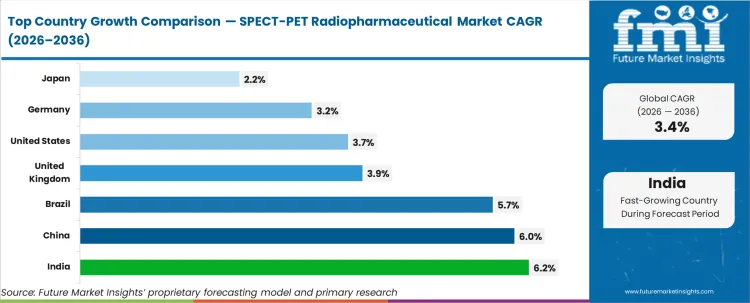
North America SPECT/PET Radiopharmaceutical Market Analysis
North America is shaped by theranostics scale-up and hospital-led nuclear medicine throughput, where product selection is governed by delivery reliability, site readiness for therapy, and payer coverage discipline. Novartis AG is the largest scale participant through broad radioligand therapy footprint and associated supply infrastructure. GE Healthcare holds strong positioning in PET imaging tracers and radiopharmacy reach aligned to hospital and imaging networks. Lantheus Holdings, Inc. competes through a focused nuclear medicine portfolio with strong USA channel penetration According to Future Market Insights analysis, the growth is still limited by the availability of isotopes and the risk of scheduling, although the value share linked to therapy continues to increase.
- United States: The demand for SPECT/PET radiopharmaceuticals in the United States is expected to grow at a CAGR of 3.7% during the forecast period of 2036. This growth is driven by the stable demand for PET imaging and the increasing use of therapy-linked isotopes in cancer treatment, although the throughput is tempered by logistics related to the short shelf life of products and the limited production capacity for certain isotopes. The demand is still hospital-based, although centers for diagnostic imaging are increasing their use if they can guarantee a stable supply of dose-days.
FMI’s report includes a detailed analysis of the growth in the North American region, along with a country-wise assessment that includes the United States. Readers can also find regional trends, regulations, and market growth based on different segments and countries in the North America region.
Asia Pacific SPECT/PET Radiopharmaceutical Market Analysis
The Asia Pacific continues to be the fastest-growing market, driven by the development of nuclear medicine infrastructure, the increasing need for oncology imaging, and the eventual development of local isotope production and radiopharmacy distribution infrastructure. Curium Pharma and local vendors engage through tracer product lines and radiopharmacy services, while hospital systems and cancer centers drive usage growth as new facilities come on line. FMI analysts point out that the growth trajectory of the region is being led by site licensing, radiopharmacy staffing, and the ability to maintain cold-chain delivery windows.
- China: The SPECT/PET radiopharmaceutical market in China is expected to grow with a CAGR of 6.0% during the forecast period of 2036. The growth is driven by PET/CT capacity increases and rising diagnostic intensity in large public hospitals, although limited by production and distribution in tier 1 cities. The demand is driven by imaging volumes, with a gradual shift to therapy depending on site readiness and supply chain reliability.
- India: The SPECT/PET market in India is expected to grow with a CAGR of 6.2% during the forecast period of 2036. The growth is driven by the rising PET imaging market in cancer treatment and the extension of nuclear medicine departments in large hospitals, although limited by the density of radiopharmacies and dose day logistics over long distances.
- Japan: The SPECT/PET market in Japan is expected to grow with a CAGR of 2.2% during the forecast period of 2036. The growth is driven by high existing nuclear medicine utilization and stable imaging volumes, although tempered by a mature market with existing infrastructure and conservative evolution of imaging protocols.
The full report provides an overview of the SPECT/PET Radiopharmaceuticals market in East Asia and South Asia from 2021 to 2036. The trends that dictate the market are discussed in the report, which covers countries like China, Japan, South Korea, India, Indonesia, Malaysia, and Thailand.
Latin America SPECT/PET Radiopharmaceutical Market Analysis
Latin America has a mixed public and private adoption pattern, where access to the cyclotron, import dependence for certain isotopes, and distributor reach impact adoption and pricing. Lantheus and Curium operate through tracer distribution channels, and radiopharmacies in the region help with distribution in large urban agglomerations. FMI believes that the market is being fueled by the expansion of PET imaging availability and oncology diagnostics, with challenges related to infrastructure concentration and reimbursement variability.
- Brazil: The demand for SPECT/PET radiopharmaceuticals in Brazil is expected to grow at 5.7% CAGR during the forecast period of 2036. The market is fueled by the increasing demand for PET imaging in large cities and a gradual increase in oncology diagnostic intensity, although access remains limited by infrastructure concentration and budget cycles for procurement.
The report provides a complete analysis of the market in Brazil, Mexico, Chile, Argentina, Peru, and Rest of Latin America. The reader can gain insights into various aspects, including the pricing trends, which are currently influencing the Latin America market.
Europe SPECT/PET Radiopharmaceutical Market Analysis
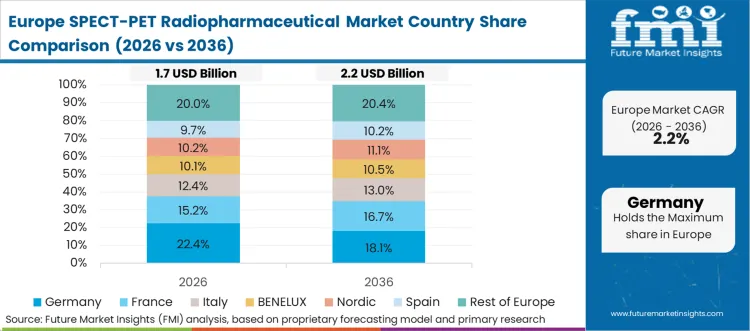
Europe is a compliance-driven and capacity-constrained market, where the demand for radiopharmaceuticals is driven by reactor and cyclotron capacity, transportation windows, and reimbursement control in the national healthcare systems. Novartis AG and Curium Pharma operate in the therapy and imaging franchises, which are linked to the regulated supply chains. GE Healthcare maintains engagement with the imaging tracer portfolios and distribution infrastructure. According to the FMI analysis, market growth is fueled by the demand for oncologic imaging, and therapy market growth is fueled by site readiness and isotope availability.
- Germany: The demand for SPECT/PET radiopharmaceuticals in Germany is expected to grow at 3.2% CAGR through 2036. Market growth is fueled by the favorable nuclear medicine infrastructure and consistent oncologic imaging procedures, and therapy market growth is fueled by site capacity and isotope availability. Demand is expected to remain hospital-centric, with specialty hospitals fueling incremental growth, where theranostics programs are developed.
- United Kingdom: The demand for SPECT/PET radiopharmaceuticals in the United Kingdom is expected to grow at 3.9% CAGR through 2036. Market growth is fueled by consistent PET imaging procedures and gradual therapy-linked adoption in specialist cancer centers, with procurement and delivery influenced by NHS commissioning and radiopharmacy infrastructure capabilities.
FMI’s analysis of SPECT/PET radiopharmaceutical market in Europe consists of country-wise assessment that includes the Germany, Italy, France, United Kingdom, Spain, Russia, Nordic, Benelux and Rest of Europe. Readers can know various regulations and latest trends in the regional market.
Competitive Aligners for Market Players
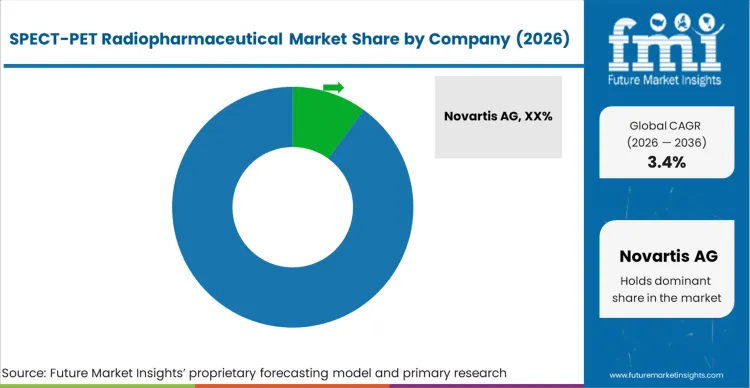
Market structure remains fragmented, yet practical competition is concentrated among a limited set of suppliers that can control radionuclide access, run GMP radiopharmaceutical manufacturing with repeatable batch release, and execute time bound distribution that matches imaging slots and therapy appointments. Competition is shaped by execution reliability more than price swings, since dose usability is constrained by isotope decay and shipping windows. Portfolio breadth across PET and SPECT tracers supports account stability, yet performance gates such as on time delivery, cancellation rates, and deviation handling tend to determine allocation decisions, as per FMI.
The suppliers with structural advantages are usually placed at various points in the chain, ranging from isotope production or secure long-term isotope supply, through formulation and aseptic fill finish, to regional radiopharmacy or distribution reach. Redundancy in manufacturing across facilities minimizes the risk of disruption due to cyclotron, reactor, or processing downtime. High-quality systems, quick release testing, and cold chain capability safeguard valuable time at the point of care. Those without redundancy usually operate on single geography networks or isotope reach, which heightens vulnerability to contract loss as service levels deteriorate, according to the report by FMI.
The buyer behavior also perpetuates leverage. Hospitals and large health systems usually prequalify multiple suppliers for routine tracers, maintain approved alternates active, and employ substitution clauses to manage product shortages without postponing procedures. Imaging center networks usually contract with radiopharmacy partners and maintain the ability to switch when delivery performance deteriorates. Cancer treatment centers can be more protocol bound for certain therapeutic agents, yet contingency arrangements are still maintained to protect scheduling continuity. This procurement approach limits pricing power for routine imaging products, while measured premiums are retained mainly where supply is tight or handling requirements raise switching friction, Future Market Insights analysis.
Recent Developments
The report includes full coverage of key trends from competitive benchmarking. Some of the recent developments covered in the reports:
- In November 2025, ITM Isotope Technologies Munich SE (ITM), a leading radiopharmaceutical biotech company, announced that the USA Food and Drug Administration (FDA) completed its filing review and accepted the company’s New Drug Application (NDA) for n.c.a. 177Lu-edotreotide. 177Lu-edotreotide is ITM’s proprietary, synthetic, targeted radiotherapeutic investigational agent for the treatment of gastroenteropancreatic neuroendocrine tumors (GEP-NETs).[5]
- In November, 2025, The FDA has granted Fast Track designation to ITM’s diagnostic agent, ITM-94, for detecting clear cell renal cell carcinoma (ccRCC). This gallium-68-radiolabeled ([68Ga]Ga-DPI-4452) PET tracer targets CAIX, a protein linked to tumor growth. As part of a first-in-class theranostic pair, ITM-94 offers a non-invasive alternative to traditional imaging, aiming to improve staging and clinical decision-making for patients with indeterminate renal masses and high unmet medical needs.
- In June 2025, Blue Earth Therapeutics announced radiation dosimetry results for its radiohybrid lutetium labelled, PSMA targeted, investigational radioligand therapy at the Society for Nuclear Medicine and Molecular Imaging (SNMMI) annual meeting. Data were evaluated from 34 cycles of treatment across 13 metastatic castrate resistant prostate cancer patients in the radiation dosimetry portion of a Phase 1/2 clinical trial of Lutetium (177Lu) rhPSMA-10.1 Injection.[3]
- In March 2025, the Food and Drug Administration expanded the indication for lutetium Lu 177 vipivotide tetraxetan to include adults with prostate-specific membrane antigen (PSMA)-positive metastatic castration-resistant prostate cancer (mCRPC) who have been treated with androgen receptor pathway inhibitor (ARPI) therapy and are considered appropriate to delay taxane-based chemotherapy.[4]
Key players in SPECT/PET Radiopharmaceutical Market
- Novartis AG
- GE HealthCare Technologies Inc.
- Cardinal Health, Inc.
- Eli Lilly and Company
- Lantheus Holdings, Inc.
- Bayer AG
- Boston Scientific Corporation
- Life Molecular Imaging GmbH
- Curium Pharma
- Q BioMed Inc.
- Jubilant DraxImage Inc.
- NorthStar Medical Radioisotopes, LLC
Scope of the Report
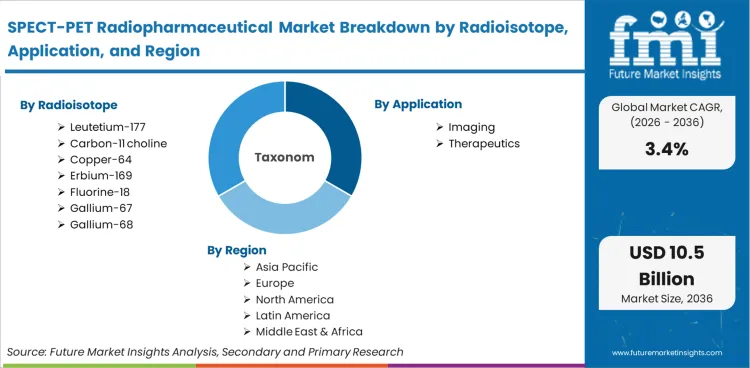
| Metric | Value |
|---|---|
| Quantitative Units | USD 7,485.0 million (2026) to USD 10,456.8 million (2036), at a CAGR of 3.4% |
| Market Definition | The SPECT and PET radiopharmaceutical market comprises the global production and trade of diagnostic and therapeutic radioisotope based agents supplied to nuclear medicine and molecular imaging services, where demand is linked to oncology and cardiology imaging volumes, radionuclide therapy expansion, and supply chain constraints tied to isotope production, distribution windows, and site licensing requirements. |
| Radioisotope Segmentation | Carbon-11 choline, Copper-64, Erbium-169, Fluorine-18, Gallium-67, Gallium-68, Indium-111, Iodine-123, Iodine-125, Leutetium-177, Nitrogen-13, Radium-223, Rhenium-186, Rubidium-82, Strontium-89, Technetium-99, Thallium-201, Yttrium-90 |
| Application Coverage | Imaging, Therapeutics |
| Dosage Form Coverage | Oral Solution, IV Solution |
| End User Coverage | Hospitals, Diagnostic Imaging Centers, Cancer Treatment Centers, Specialty Centers, Research and Academic Institutes, Others |
| Regions Covered | North America, Latin America, East Asia, South Asia & Pacific, Western Europe, Eastern Europe, and Middle East & Africa. |
| Countries Covered | United States, Canada, Mexico, Brazil, Argentina, Germany, France, United Kingdom, Italy, Spain, China, India, Japan, South Korea, Indonesia, Australia and 40+ countries |
| Key Companies Profiled | Novartis AG, GE HealthCare Technologies Inc., Cardinal Health, Inc., Eli Lilly and Company, Lantheus Holdings, Inc., Bayer AG, Boston Scientific Corporation, Life Molecular Imaging GmbH, Curium Pharma, Q BioMed Inc., Jubilant DraxImage Inc., NorthStar Medical Radioisotopes, LLC |
| Forecast Period | 2026 to 2036 |
| Approach | Hybrid top down and bottom up market modeling validated through primary interviews with radiopharmaceutical suppliers, radiopharmacies, and nuclear medicine stakeholders, supported by isotope supply benchmarking and procedure volume triangulation, as per FMI. |
SPECT/PET Radiopharmaceutical Market Analysis by Segments
Radioisotope
- Carbon-11 choline
- Copper-64
- Erbium-169
- Fluorine-18
- Gallium-67
- Gallium-68
- Indium-111
- Indium-111
- Iodine-123
- Iodine-125
- Leutetium-177
- Nitrogen-13
- Radium-223
- Rhenium-186
- Rubidium-82
- Strontium-89
- Technetium-99
- Thallium-201
- Yttrium-90
Application
- Imaging
- Therapeutics
Dosage Form
- Oral Solution
- IV Solution
End User
- Hospitals
- Diagnostic Imaging Centers
- Cancer Treatment Centers
- Specialty Centers
- Research and Academic Institutes
- Others
Region
- North America
- U.S.
- Canada
- Mexico
- Latin America
- Brazil
- Argentina
- Rest of Latin America
- East Asia
- China
- Japan
- South Korea
- South Asia & Pacific
- India
- ASEAN Countries
- Australia & New Zealand
- Rest of South Asia
- Western Europe
- Germany
- U.K.
- France
- Italy
- Spain
- BENELUX
- Nordic Countries
- Rest of Western Europe
- Eastern Europe
- Russia
- Hungary
- Poland
- Rest of Eastern Europe
- Middle East & Africa
- Saudi Arabia
- Türkiye
- South Africa
- Other African Union
- Rest of Middle East & Africa
Bibliography
- [2] February 2025, PET Scanning by National Library of Medicine.
- [3] June 2025, Blue Earth Therapeutics: SNMMI Presentation of Results from Lutetium (177Lu) rhPSMA-10.1 Injection Phase 1 Clinical Trial.
- [4] March 2025, FDA expands Pluvicto’s metastatic castration-resistant prostate cancer indication.
- [5] November 2025, ITM Announces FDA Acceptance of New Drug Application (NDA) and PDUFA Date for n.c.a. 177Lu-edotreotide (ITM-11) in Gastroenteropancreatic Neuroendocrine Tumors (GEP-NETs)
- [6] June 2021, Lutetium-177–PSMA-617 for Metastatic Castration-Resistant Prostate Cancer.
This Report Addresses
- Market intelligence to enable structured strategic decision making across nuclear medicine capacity planning and radiopharmaceutical procurement
- Market size estimation and 10-year revenue forecasts from 2026 to 2036 for diagnostic and therapeutic radiopharmaceutical demand
- Growth opportunity mapping across radioisotope classes, application use cases, dosage forms, and end user demand pools
- Segment and regional revenue forecasts aligned to the stated taxonomy and covered geographies
- Competition strategy assessment including isotope access, distribution fit, and hospital and imaging center channel positioning benchmarking
- Product and compliance tracking focused on radiopharmaceutical quality systems, site licensing expectations, and release documentation discipline
- Regulatory impact analysis covering PET drug cGMP expectations and radiopharmacy handling requirements affecting market access planning
- Market report delivery in PDF, Excel, PPT, and interactive dashboard formats for executive and operational use
Frequently Asked Questions
How large is the demand for SPECT/PET Radiopharmaceuticals in the global market in 2026?
Demand for SPECT/PET Radiopharmaceuticals in the global market is estimated to be valued at USD 7,485.0 million in 2026, as per FMI.
What will be the market size of SPECT/PET Radiopharmaceuticals in the global market by 2036?
Market size for SPECT/PET radiopharmaceuticals is projected to reach USD 10,456.8 million by 2036.
What is the expected demand growth for SPECT/PET Radiopharmaceuticals in the global market between 2026 and 2036?
Demand for SPECT/PET Radiopharmaceuticals in the global market is expected to grow at a CAGR of 3.4% between 2026 and 2036.
Which application is poised to lead global demand by 2026?
Imaging is expected to be the dominant application, capturing 51.2% share in 2026.
Which dosage form is expected to account for the largest share in 2026?
IV Solution is expected to hold the highest share at 98.3% in 2026.
How significant is the role of hospitals in driving adoption in 2026?
Hospitals are projected to hold 49.4% share of end user demand in 2026.
Preview the report firsthand - request a free sample
Get SampleGet the brochure for pricing and purchase details.
Get PDFTable of Content
- Executive Summary
- Global Market Outlook
- Demand-side Trends
- Supply-side Trends
- Technology Roadmap Analysis
- Analysis and Recommendations
- Market Overview
- Market Coverage / Taxonomy
- Market Definition / Scope / Limitations
- Research Methodology
- Chapter Orientation
- Analytical Lens and Working Hypotheses
- Market Structure, Signals, and Trend Drivers
- Benchmarking and Cross-market Comparability
- Market Sizing, Forecasting, and Opportunity Mapping
- Research Design and Evidence Framework
- Desk Research Programme (Secondary Evidence)
- Company Annual and Sustainability Reports
- Peer-reviewed Journals and Academic Literature
- Corporate Websites, Product Literature, and Technical Notes
- Earnings Decks and Investor Briefings
- Statutory Filings and Regulatory Disclosures
- Technical White Papers and Standards Notes
- Trade Journals, Industry Magazines, and Analyst Briefs
- Conference Proceedings, Webinars, and Seminar Materials
- Government Statistics Portals and Public Data Releases
- Press Releases and Reputable Media Coverage
- Specialist Newsletters and Curated Briefings
- Sector Databases and Reference Repositories
- FMI Internal Proprietary Databases and Historical Market Datasets
- Subscription Datasets and Paid Sources
- Social Channels, Communities, and Digital Listening Inputs
- Additional Desk Sources
- Expert Input and Fieldwork (Primary Evidence)
- Primary Modes
- Qualitative Interviews and Expert Elicitation
- Quantitative Surveys and Structured Data Capture
- Blended Approach
- Why Primary Evidence is Used
- Field Techniques
- Interviews
- Surveys
- Focus Groups
- Observational and In-context Research
- Social and Community Interactions
- Stakeholder Universe Engaged
- C-suite Leaders
- Board Members
- Presidents and Vice Presidents
- R&D and Innovation Heads
- Technical Specialists
- Domain Subject-matter Experts
- Scientists
- Physicians and Other Healthcare Professionals
- Governance, Ethics, and Data Stewardship
- Research Ethics
- Data Integrity and Handling
- Primary Modes
- Tooling, Models, and Reference Databases
- Desk Research Programme (Secondary Evidence)
- Data Engineering and Model Build
- Data Acquisition and Ingestion
- Cleaning, Normalisation, and Verification
- Synthesis, Triangulation, and Analysis
- Quality Assurance and Audit Trail
- Market Background
- Market Dynamics
- Drivers
- Restraints
- Opportunity
- Trends
- Scenario Forecast
- Demand in Optimistic Scenario
- Demand in Likely Scenario
- Demand in Conservative Scenario
- Opportunity Map Analysis
- Product Life Cycle Analysis
- Supply Chain Analysis
- Investment Feasibility Matrix
- Value Chain Analysis
- PESTLE and Porter’s Analysis
- Regulatory Landscape
- Regional Parent Market Outlook
- Production and Consumption Statistics
- Import and Export Statistics
- Market Dynamics
- Global Market Analysis 2021 to 2025 and Forecast, 2026 to 2036
- Historical Market Size Value (USD Million) Analysis, 2021 to 2025
- Current and Future Market Size Value (USD Million) Projections, 2026 to 2036
- Y-o-Y Growth Trend Analysis
- Absolute $ Opportunity Analysis
- Global Market Pricing Analysis 2021 to 2025 and Forecast 2026 to 2036
- Global Market Analysis 2021 to 2025 and Forecast 2026 to 2036, By Radioisotope
- Introduction / Key Findings
- Historical Market Size Value (USD Million) Analysis By Radioisotope , 2021 to 2025
- Current and Future Market Size Value (USD Million) Analysis and Forecast By Radioisotope , 2026 to 2036
- Leutetium-177
- Carbon-11 choline
- Copper-64
- Erbium-169
- Fluorine-18
- Gallium-67
- Gallium-68
- Leutetium-177
- Y-o-Y Growth Trend Analysis By Radioisotope , 2021 to 2025
- Absolute $ Opportunity Analysis By Radioisotope , 2026 to 2036
- Global Market Analysis 2021 to 2025 and Forecast 2026 to 2036, By Application
- Introduction / Key Findings
- Historical Market Size Value (USD Million) Analysis By Application, 2021 to 2025
- Current and Future Market Size Value (USD Million) Analysis and Forecast By Application, 2026 to 2036
- Imaging
- Therapeutics
- Imaging
- Y-o-Y Growth Trend Analysis By Application, 2021 to 2025
- Absolute $ Opportunity Analysis By Application, 2026 to 2036
- Global Market Analysis 2021 to 2025 and Forecast 2026 to 2036, By Region
- Introduction
- Historical Market Size Value (USD Million) Analysis By Region, 2021 to 2025
- Current Market Size Value (USD Million) Analysis and Forecast By Region, 2026 to 2036
- North America
- Latin America
- Western Europe
- Eastern Europe
- East Asia
- South Asia and Pacific
- Middle East & Africa
- Market Attractiveness Analysis By Region
- North America Market Analysis 2021 to 2025 and Forecast 2026 to 2036, By Country
- Historical Market Size Value (USD Million) Trend Analysis By Market Taxonomy, 2021 to 2025
- Market Size Value (USD Million) Forecast By Market Taxonomy, 2026 to 2036
- By Country
- USA
- Canada
- Mexico
- By Radioisotope
- By Application
- By Country
- Market Attractiveness Analysis
- By Country
- By Radioisotope
- By Application
- Key Takeaways
- Latin America Market Analysis 2021 to 2025 and Forecast 2026 to 2036, By Country
- Historical Market Size Value (USD Million) Trend Analysis By Market Taxonomy, 2021 to 2025
- Market Size Value (USD Million) Forecast By Market Taxonomy, 2026 to 2036
- By Country
- Brazil
- Chile
- Rest of Latin America
- By Radioisotope
- By Application
- By Country
- Market Attractiveness Analysis
- By Country
- By Radioisotope
- By Application
- Key Takeaways
- Western Europe Market Analysis 2021 to 2025 and Forecast 2026 to 2036, By Country
- Historical Market Size Value (USD Million) Trend Analysis By Market Taxonomy, 2021 to 2025
- Market Size Value (USD Million) Forecast By Market Taxonomy, 2026 to 2036
- By Country
- Germany
- UK
- Italy
- Spain
- France
- Nordic
- BENELUX
- Rest of Western Europe
- By Radioisotope
- By Application
- By Country
- Market Attractiveness Analysis
- By Country
- By Radioisotope
- By Application
- Key Takeaways
- Eastern Europe Market Analysis 2021 to 2025 and Forecast 2026 to 2036, By Country
- Historical Market Size Value (USD Million) Trend Analysis By Market Taxonomy, 2021 to 2025
- Market Size Value (USD Million) Forecast By Market Taxonomy, 2026 to 2036
- By Country
- Russia
- Poland
- Hungary
- Balkan & Baltic
- Rest of Eastern Europe
- By Radioisotope
- By Application
- By Country
- Market Attractiveness Analysis
- By Country
- By Radioisotope
- By Application
- Key Takeaways
- East Asia Market Analysis 2021 to 2025 and Forecast 2026 to 2036, By Country
- Historical Market Size Value (USD Million) Trend Analysis By Market Taxonomy, 2021 to 2025
- Market Size Value (USD Million) Forecast By Market Taxonomy, 2026 to 2036
- By Country
- China
- Japan
- South Korea
- By Radioisotope
- By Application
- By Country
- Market Attractiveness Analysis
- By Country
- By Radioisotope
- By Application
- Key Takeaways
- South Asia and Pacific Market Analysis 2021 to 2025 and Forecast 2026 to 2036, By Country
- Historical Market Size Value (USD Million) Trend Analysis By Market Taxonomy, 2021 to 2025
- Market Size Value (USD Million) Forecast By Market Taxonomy, 2026 to 2036
- By Country
- India
- ASEAN
- Australia & New Zealand
- Rest of South Asia and Pacific
- By Radioisotope
- By Application
- By Country
- Market Attractiveness Analysis
- By Country
- By Radioisotope
- By Application
- Key Takeaways
- Middle East & Africa Market Analysis 2021 to 2025 and Forecast 2026 to 2036, By Country
- Historical Market Size Value (USD Million) Trend Analysis By Market Taxonomy, 2021 to 2025
- Market Size Value (USD Million) Forecast By Market Taxonomy, 2026 to 2036
- By Country
- Kingdom of Saudi Arabia
- Other GCC Countries
- Turkiye
- South Africa
- Other African Union
- Rest of Middle East & Africa
- By Radioisotope
- By Application
- By Country
- Market Attractiveness Analysis
- By Country
- By Radioisotope
- By Application
- Key Takeaways
- Key Countries Market Analysis
- USA
- Pricing Analysis
- Market Share Analysis, 2025
- By Radioisotope
- By Application
- Canada
- Pricing Analysis
- Market Share Analysis, 2025
- By Radioisotope
- By Application
- Mexico
- Pricing Analysis
- Market Share Analysis, 2025
- By Radioisotope
- By Application
- Brazil
- Pricing Analysis
- Market Share Analysis, 2025
- By Radioisotope
- By Application
- Chile
- Pricing Analysis
- Market Share Analysis, 2025
- By Radioisotope
- By Application
- Germany
- Pricing Analysis
- Market Share Analysis, 2025
- By Radioisotope
- By Application
- UK
- Pricing Analysis
- Market Share Analysis, 2025
- By Radioisotope
- By Application
- Italy
- Pricing Analysis
- Market Share Analysis, 2025
- By Radioisotope
- By Application
- Spain
- Pricing Analysis
- Market Share Analysis, 2025
- By Radioisotope
- By Application
- France
- Pricing Analysis
- Market Share Analysis, 2025
- By Radioisotope
- By Application
- India
- Pricing Analysis
- Market Share Analysis, 2025
- By Radioisotope
- By Application
- ASEAN
- Pricing Analysis
- Market Share Analysis, 2025
- By Radioisotope
- By Application
- Australia & New Zealand
- Pricing Analysis
- Market Share Analysis, 2025
- By Radioisotope
- By Application
- China
- Pricing Analysis
- Market Share Analysis, 2025
- By Radioisotope
- By Application
- Japan
- Pricing Analysis
- Market Share Analysis, 2025
- By Radioisotope
- By Application
- South Korea
- Pricing Analysis
- Market Share Analysis, 2025
- By Radioisotope
- By Application
- Russia
- Pricing Analysis
- Market Share Analysis, 2025
- By Radioisotope
- By Application
- Poland
- Pricing Analysis
- Market Share Analysis, 2025
- By Radioisotope
- By Application
- Hungary
- Pricing Analysis
- Market Share Analysis, 2025
- By Radioisotope
- By Application
- Kingdom of Saudi Arabia
- Pricing Analysis
- Market Share Analysis, 2025
- By Radioisotope
- By Application
- Turkiye
- Pricing Analysis
- Market Share Analysis, 2025
- By Radioisotope
- By Application
- South Africa
- Pricing Analysis
- Market Share Analysis, 2025
- By Radioisotope
- By Application
- USA
- Market Structure Analysis
- Competition Dashboard
- Competition Benchmarking
- Market Share Analysis of Top Players
- By Regional
- By Radioisotope
- By Application
- Competition Analysis
- Competition Deep Dive
- Novartis AG
- Overview
- Product Portfolio
- Profitability by Market Segments (Product/Age /Sales Channel/Region)
- Sales Footprint
- Strategy Overview
- Marketing Strategy
- Product Strategy
- Channel Strategy
- GE HealthCare Technologies Inc.
- Cardinal Health, Inc.
- Eli Lilly and Company
- Lantheus Holdings, Inc.
- Bayer AG
- Boston Scientific Corporation
- Life Molecular Imaging GmbH
- Curium Pharma
- Q BioMed Inc.
- Jubilant DraxImage Inc.
- Novartis AG
- Competition Deep Dive
- Assumptions & Acronyms Used


