

- Industry Size (2026)
- USD 0.7 Bn
- Forecast (2036)
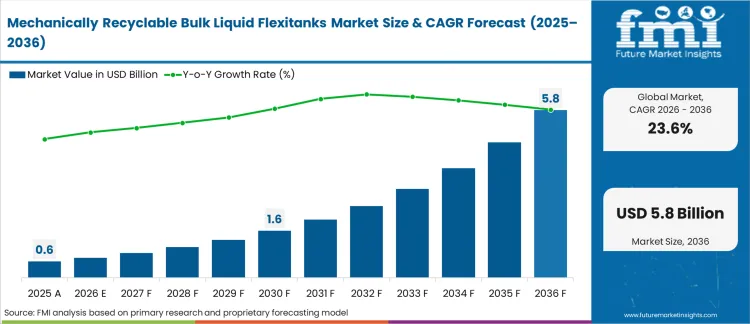
- USD 5.7 Bn
- CAGR (2026 to 2036)
- 23.6%
Mechanically Recyclable Bulk Liquid Flexitanks Market Size, Market Forecast and Outlook By FMI
The Mechanically Recyclable Bulk Liquid Flexitanks market registered USD 0.5 billion in 2025. Procurement advances project USD 0.7 billion for 2026. Sustained adoption delivers USD 5.7 billion by 2036 at a 23.6% annual rate. Logistics directors substituting mixed-material transport liners face mounting pressure from port authorities enforcing strict disposal protocols. Fleet operators executing bulk liquid logistics require mono-polymer containment solutions that integrate directly into existing mechanical recycling streams. Shippers failing to specify easily recoverable materials risk punitive disposal fees at destination terminals.
Amcor completed its combination with Berry Global in April 2025 [1], expanding the material science scale necessary to commercialize recyclable barrier structures for heavy-duty bulk liquid transport packaging applications. Supply chain managers interpret this capacity consolidation as proof that mono-material extrusion technology has achieved the tensile strength required for high-volume liquid containment. As standard liner specifications pivot toward verifiable circularity, shippers securing contracts with vertically integrated film converters insulate their operations against volatile port-level waste management surcharges.
Summary of Mechanically Recyclable Bulk Liquid Flexitanks Market
- Mechanically Recyclable Bulk Liquid Flexitanks Market Definition
- A specialized bulk logistics containment system manufactured from mono-material polymer films, designed for mechanical recycling post-discharge, and used for transporting non-hazardous liquids inside standard twenty-foot shipping containers.
- Demand Drivers in the Market
- Terminal operators levying steep disposal surcharges on multi-material waste.
- Corporate sustainability targets forcing shippers to eliminate landfill-bound transport packaging.
- Advancements in mono-PE extrusion delivering hybrid burst strength without non-recyclable nylon layers.
- Key Segments Analyzed in the FMI Report
- Single-Use Recyclable: 60.0% share as bulk shippers prioritize verifiable post-use material recovery over return logistics.
- Food & Beverage: 45.0% share driven by high-volume edible oil and juice concentrate export flows.
- India: 27.0% CAGR anchored by rapid conversion from rigid steel drums to containerized flexible liquid transport.
- Analyst Opinion at FMI
- Ismail Sutaria, Principal Consultant for Packaging, opines, “Most shippers view mechanical recyclability as an environmental compliance box, but the actual operational bottleneck is port-level waste handling. Terminals are actively refusing mixed-material liner disposal. Operators who fail to transition their liquid export lanes to verified mono-polymer flexitanks will forfeit their berth priority to competitors deploying zero-waste discharge systems.”
- Strategic Implications/Executive Takeaways
- Audit destination port waste policies to quantify the direct cost of non-recyclable liner disposal.
- Secure supply agreements with converters capable of multi-layer mono-PE extrusion.
- Transition high-volume edible liquid lanes to circular formats before mandatory EPR enforcement.
- Methodology
- Primary Research: Direct interviews with fleet managers, port waste handlers, and polymer film extruders.
- Desk Research: Validation via customs shipment logs, corporate sustainability reports, and packaging patent filings.
- Market-Sizing and Forecasting: Bottom-up projection scaling from global containerized liquid trade volumes and mono-material adoption curves.
- Data Validation and Update Cycle: Findings cross-verified against maritime trade data before final integration.
Tom Szaky, CEO of TerraCycle, opined, "The general answer on recyclability is simplify and increase value. Those are the two things that make that item more desirable for recyclers." [2] This carrier-level mandate fundamentally reconfigures logistics economics. Shipping lines dictating the end-of-life pathway for container liners force beneficial cargo owners to align procurement with port infrastructure realities. Brands continuing to source multi-layer nylon structures face escalating demurrage risks as disposal delays compound at major European and Asian shipping hubs.
Asia Pacific demonstrates the steepest growth trajectory, driven by massive export flows of edible oils and agricultural inputs from centralized refining zones. Europe leads regulatory enforcement, applying eco-modulation fees that penalize complex barrier materials. North American adoption accelerates as domestic rail and cross-border freight networks transition away from legacy rigid intermediate bulk containers. Latin America leverages recyclable flexitanks to protect margins on high-volume juice and wine exports.
Mechanically Recyclable Bulk Liquid Flexitanks Market Definition
Mechanically recyclable bulk liquid flexitanks represent specialized flexible containment bladders manufactured exclusively from compatible polymer families, typically mono-polyethylene, allowing the entire structure to be processed through standard mechanical recycling facilities after liquid discharge. Unlike traditional multi-material variants, these systems eliminate incompatible barrier layers like nylon or EVOH while maintaining the requisite hydraulic burst strength for trans-oceanic transit.
Mechanically Recyclable Bulk Liquid Flexitanks Market Inclusions
The category includes mono-polymer flexitanks, compatible barrier structures certified for mechanical recycling, recyclable bulk filling accessories, and associated recyclable bulkhead components. Single-use mono-PE flexitanks designed specifically for food-grade oil transport are fully included.
Mechanically Recyclable Bulk Liquid Flexitanks Market Exclusions
The scope excludes traditional multi-material flexitanks containing incompatible nylon or metallic foils, rigid intermediate bulk containers, steel or plastic drums, and ISO tank containers. Tankers transporting hazardous chemicals requiring specialized thermal destruction are strictly excluded.
Mechanically Recyclable Bulk Liquid Flexitanks Market Research Methodology
- Primary Research: Direct interviews with shipping line operators, terminal managers, and mono-material film extruders across major liquid trade hubs.
- Desk Research: Custom import/export datasets from maritime authorities and corporate polymer supply announcements.
- Market-Sizing and Forecasting: Analysts developed a bottom-up adoption model starting from baseline containerized liquid volumes, applying verified substitution rates for recyclable film architectures.
- Data Validation and Update Cycle: Projections underwent cross-verification against global maritime trade growth logs before final forecast integration.
Segmental Analysis
Mechanically Recyclable Bulk Liquid Flexitanks Market Analysis by Tank Type
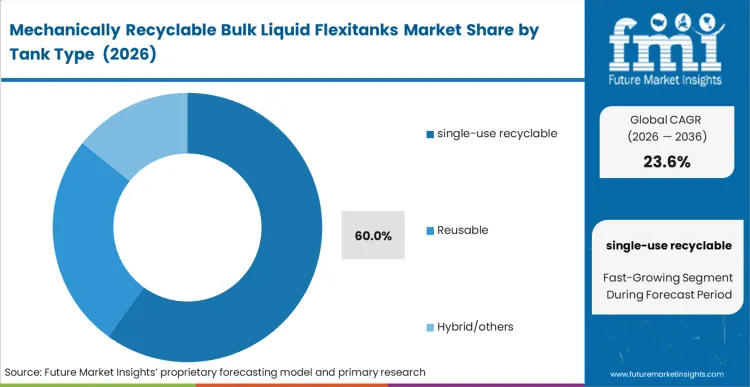
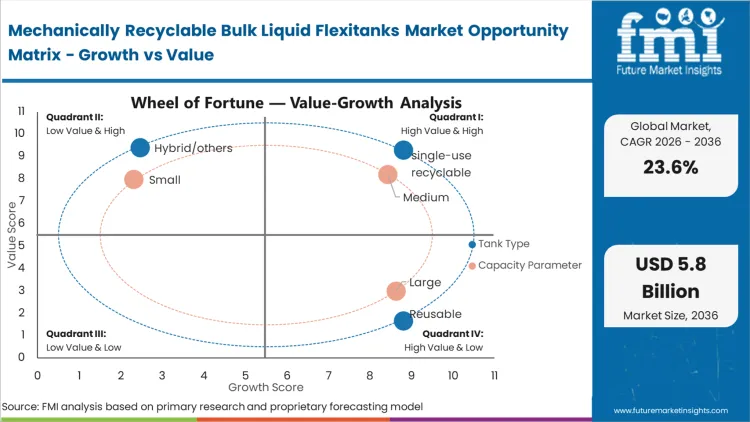
With over 400 million tonnes of plastic produced annually globally [3], chemical regulators actively target logistics packaging as a primary intervention point for mechanical recyclability. This intense regulatory scrutiny drives single-use recyclable formats to a commanding 60.0% segment share in 2026. Shippers deploying bulk container packaging solutions systematically reject multi-material returnable tanks to eliminate empty repositioning costs. According to FMI's estimates, fleet managers reliant on hybrid multi-material structures face severe supply chain bottlenecks as major terminal operators decline to handle unrecyclable composite waste. Logistics directors recognize that verifiable single-trip structures represent the only scalable compliance pathway to bypass escalating terminal surcharges.
- Logistics economics: Single-trip containment structures eliminate reverse logistics and return freight costs for empty bladders.
- Terminal compliance: Port authorities increasingly levy steep disposal surcharges on mixed-material waste requiring specialized destruction.
- Supply chain velocity: Verified mechanical disposal pathways at destination ports prevent crippling demurrage delays for bulk shippers.
Mechanically Recyclable Bulk Liquid Flexitanks Market Analysis by Capacity Parameter
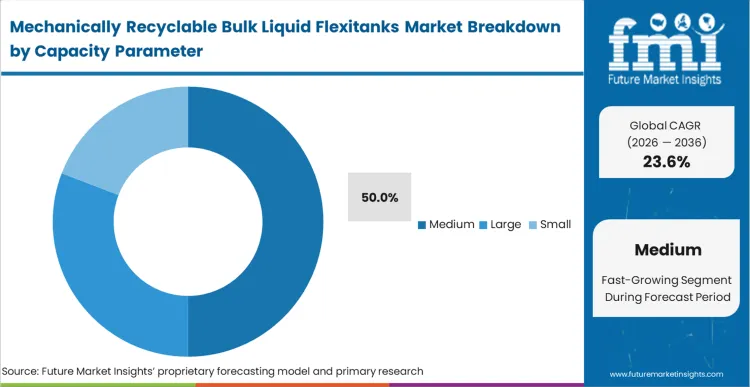
Moving liquids efficiently within massive international supply chains forces exporters to maximize payload per twenty-foot equivalent unit across congested shipping lanes. Global maritime trade reached 12.3 billion tons in 2023 [4], establishing the immense scale of liquid logistics requiring specialized containment. Medium capacity units capture 50.0% of the volume share as they offer the optimal mathematical balance between gross vehicle weight limits and container wall stress tolerances. As per FMI's projection, bulk liquid shippers specify these standard dimensions to ensure broad compatibility with multi-modal chassis networks. Exporters failing to align their volumetric specifications with standard container limits risk delayed inland rail transfers and severe overweight penalties.
- Weight tolerance: Standard container wall stress limits dictate maximum fluid density configurations during ocean transit.
- Intermodal compatibility: Standardized dimensions guarantee seamless transfers across fragmented international rail and truck corridors.
- Fleet standardization: Logistics planners align volumetric specifications to prevent delayed inland transfers at automated railheads.
Mechanically Recyclable Bulk Liquid Flexitanks Market Analysis by End Use
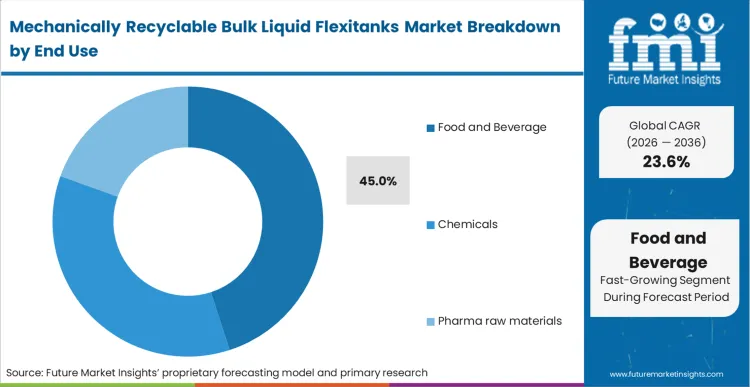
Formulation directors executing high-volume export contracts must now satisfy both strict food-grade migration limits and corporate zero-waste-to-landfill pledges. Fertilizer consumption is forecast at 205 million metric tons of nutrients in FY2025 [5], illustrating the massive scale of agricultural supply chains requiring specialized and compliant liquid inputs. Food and beverage leaders drive adoption with a 45.0% segment share as edible oil and juice exporters seek mono-material packaging formats. FMI analysts opine that these structures guarantee contamination-free transit while simultaneously satisfying strict retailer sustainability scorecards. Processors attempting to utilize legacy rigid drums incur unacceptable cleaning protocols and return-freight penalties.
- Food-grade migration: Mono-polyethylene structures satisfy stringent regulatory contamination limits for high-volume edible oil transit.
- Corporate sustainability: Formulation directors mandate mechanically recyclable bladders to fulfill zero-waste-to-landfill packaging pledges.
- Cleaning penalties: Processors substituting legacy rigid drums bypass unacceptable chemical washing and reverse logistics costs.
Mechanically Recyclable Bulk Liquid Flexitanks Market Analysis by Filling Method
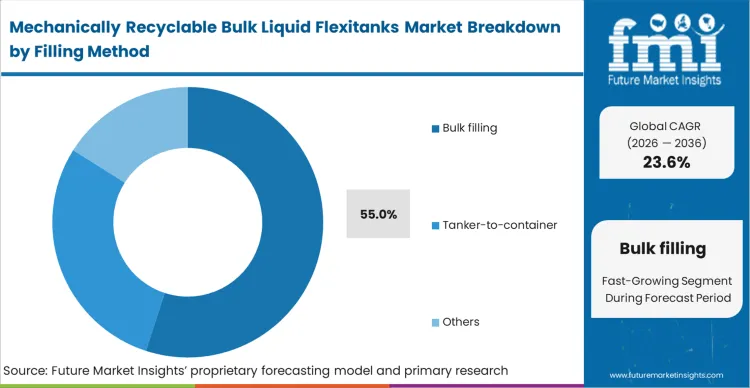
Legacy manual top-filling processes surrender critical turnaround speed during peak export windows, forcing plant managers to upgrade their bulk liquid transfer infrastructure. Signode launched the Octopus Prestige stretch wrapper in September 2025 [6], highlighting the critical equipment advancements required to support secure, automated containerized bulk load handling. Bulk filling formats account for 55.0% of regional demand, reflecting the extreme throughput requirements of modern chemical and agricultural refineries. According to FMI's estimates, plant managers require bottom-discharge capabilities that integrate seamlessly with automated pumping stations to maintain flow velocity. This automated architecture eliminates confined space entry risks for port personnel during discharge operations.
- Throughput velocity: Automated pumping stations drastically reduce container turnaround times during peak agricultural export windows.
- Worker safety: Bottom-discharge capabilities eliminate dangerous confined space entry requirements for terminal personnel.
- Operational integration: Mechanized liquid handling systems replace manual top-filling inefficiencies at centralized refining zones.
Mechanically Recyclable Bulk Liquid Flexitanks Market Analysis by Material Compliance
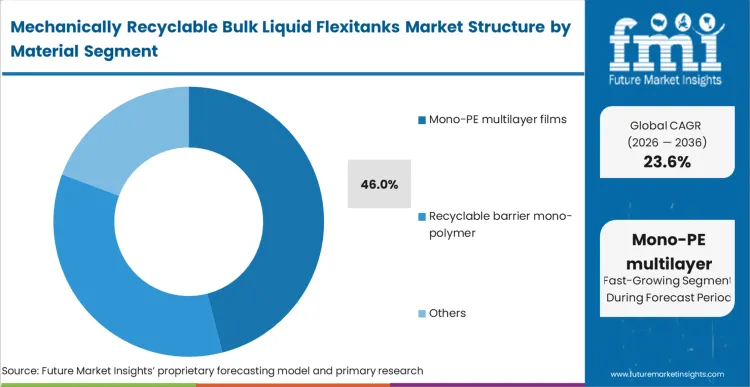
With TotalEnergies and SML announcing recyclable downgauging film solutions in September 2025 [7], extrusion innovation successfully addresses the historical burst-strength limitations of mono-material containment. Mono-PE multilayer films capture a 46.0% segment share as converters successfully replace incompatible nylon barrier layers with oriented polyethylene structures. As per FMI's projection, packaging engineers mandate these certified mono-materials to ensure the discharged bladders qualify for domestic mechanical recycling streams without requiring manual delamination. Suppliers lacking verified mono-PE extrusion capabilities rapidly lose their preferred vendor status with major chemical distributors. Chemical exporters refusing to transition toward verified circular materials face immediate exclusion from sustainability-focused procurement frameworks.
- Barrier replacement: Converters successfully substitute nylon layers with oriented polyethylene structures to maintain hydraulic burst strength.
- Recycling stream access: Certified mono-materials enter domestic mechanical recovery facilities directly without requiring complex manual delamination.
- Vendor qualification: Suppliers lacking verified mono-PE extrusion capabilities lose preferred status with major industrial chemical distributors.
Mechanically Recyclable Bulk Liquid Flexitanks Market Drivers, Restraints, and Opportunities
Shippers executing high-volume edible oil contracts specify mechanically recyclable liners to bypass escalating landfill taxes and complex disposal administration at discharge hubs. Terminal waste directives actively force the transition toward single-polymer containment. The USA Plastics Pact targets a 13.3% national recycling rate for plastic packaging [8], establishing a rigid compliance baseline for industrial material handlers. Logistics directors integrating these mono-material bladders secure reliable offloading workflows, shielding their operations from unpredictable terminal-level waste rejection events.
Material yield constraints and burst-strength limitations restrict the rapid downgauging of massive fluid containment structures. Buyers mitigate this operational cost by partnering with integrated logistics providers that manage localized closed-loop film collection.
- Stretch Film Integration: Warehouse managers deploy compatible cast stretch films to stabilize bulk liquid container bulkheads, standardizing the entire load's material composition for single-stream recycling. Coveris secured an award for a recyclable stretch solution incorporating post-consumer recycled content in September 2025 [10].
- Weather Protection Architecture: CNG introduced a stretch hood film featuring UV protection and recycled content [11]. Fleet operators utilize this weatherized secondary layer to protect exposed flexitank valves during extended multi-modal transit cycles.
- Capacity Expansion: Trioworld announced a new manufacturing facility in Indiana during August 2025 [12]. Procurement teams leverage localized film extrusion capacity to secure shorter lead times for high-performance mono-polymer transport liners.
Regional Analysis
Based on the regional analysis, the Mechanically Recyclable Bulk Liquid Flexitanks market is segmented into North America, Latin America, Europe, East Asia, South Asia, Oceania and Middle East & Africa across 40+ countries. The full report also offers market attractiveness analysis based on regional trends.
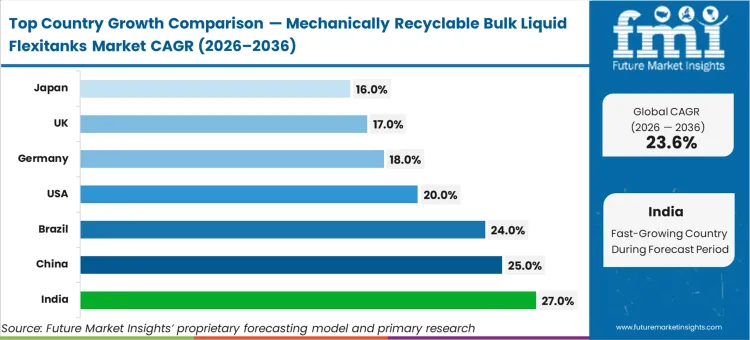
.webp "Top Country Growth Comparison Mechanically Recyclable Bulk Liquid Flexitanks Market Cagr (2026 2036)")
| Country | CAGR (2026 to 2036) |
|---|---|
| India | 27.0% |
| China | 25.0% |
| Brazil | 24.0% |
| USA | 20.0% |
| Germany | 18.0% |
| UK | 17.0% |
| Japan | 16.0% |
Source: Future Market Insights (FMI) analysis, based on proprietary forecasting model and primary research
Asia Pacific Mechanically Recyclable Bulk Liquid Flexitanks Market Analysis
Heavy industrial expansion and export-oriented agricultural processing dictate the bulk liquid logistics baseline across Asia Pacific. Exporters traditionally reliant on carbon-intensive rigid packaging are overhauling their fulfillment networks to leverage standard containerized sea freight. Over 80% of world trade volume is carried by sea [13]. High-volume trade routes originating from regional manufacturing centers demand flexible containment systems that integrate easily with massive outbound maritime flows. Supply chain planners who lock in verified mono-material flexitank sourcing insulate their export margins against evolving destination-port environmental tariffs.
- India: Exporters pivoting from traditional steel drums to containerized liquid formats face strict pressure from European buyers demanding documented circularity. Global maritime trade growth of 2.4% in 2023 [14] confirms the expanding capacity for containerized bulk movements out of regional hubs. This structural shift anchors a 27.0% CAGR for recyclable fluid containment systems in India through 2036. Logistics operators failing to offer mono-polymer liner options to forfeit premium edible oil export contracts.
- China: Vast domestic manufacturing output forces massive internal and outbound liquid chemical movements that require lightweight transport packaging. Cement production measuring 2.1 billion metric tons in 2023 [15] highlights the sheer scale of the nation's industrial infrastructure and corresponding chemical logistics demand. Expanding trade corridors support a 25.0% compound rate for mono-material flexitanks across China over the forecast period. Bulk shippers lacking mechanized disposal workflows incur severe terminal delays.
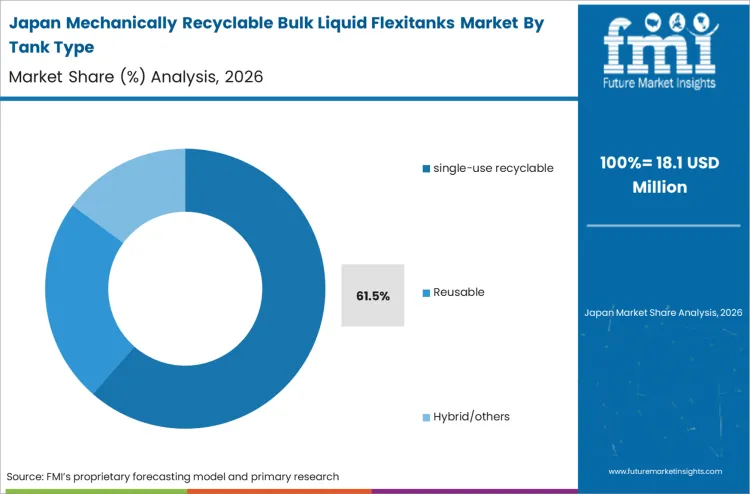
- Japan: Stringent domestic quality assurance protocols compel chemical exporters to specify verified single-stream logistics packaging. Crude steel production of 87.0 million tonnes [16] sustains a vast network of specialized lubricants and industrial fluids requiring pristine transit conditions. This rigorous compliance environment yields a 16.0% annual expansion rate for certified recyclable liquid bladders in Japan. Suppliers not pre-qualified with mono-material extrusion data lose access to Tier-1 automotive chemical tenders.
FMI's report includes detailed analysis for South Korea, Indonesia, and Australia. Export terminals in these nations strictly regulate industrial waste handling. Processors managing palm oil and specialty chemical shipments must align their bulk packaging procurement with regional mechanical recycling capabilities.
North America Mechanically Recyclable Bulk Liquid Flexitanks Market Analysis
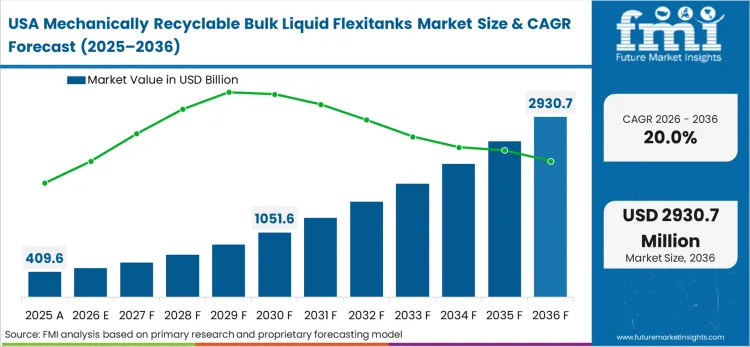
Cross-border agricultural trade and sprawling domestic chemical supply chains define the North American bulk liquid container market. Freight operators managing thousands of rail and truck transfers require robust containment bladders that meet stringent domestic transportation regulations while satisfying corporate environmental scorecards. Approximately USD 3.5 billion per day in land-border freight shipments [17] flow through regional arteries, necessitating highly efficient logistics packaging. Fleet directors specifying multi-layer disposable liners face immediate exclusion from sustainability-focused retail distribution networks.
- USA: Major industrial shippers managing complex multi-modal networks require flexible tanks that comply with strict end-of-life material recovery programs. SIA Flexitanks expanded into New Orleans in October 2025 [18] to directly service the massive chemical and agricultural outflows generated along the Gulf Coast corridor. This localized technical support drives a 20.0% CAGR for mechanically recyclable flexitanks within the United States market. Fleet operators ignoring mono-material specifications surrender their competitive position in high-value pharmaceutical raw material transport.
FMI's report includes detailed analysis for Canada and Mexico. Cross-border logistics providers in these markets demand robust transit packaging. Operators shipping industrial lubricants must prioritize verifiable circular materials to avoid cross-border waste disposal penalties.
Europe Mechanically Recyclable Bulk Liquid Flexitanks Market Analysis
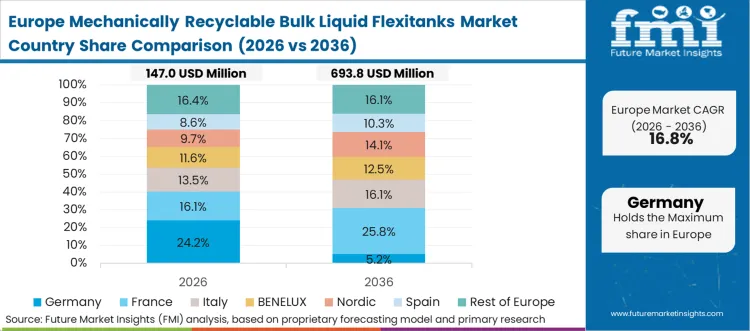
Aggressive regulatory enforcement regarding plastic waste limits sets the commercial reality for Europe's bulk logistics sector. Port authorities actively penalize shipping lines abandoning unrecyclable multi-material bladders within terminal boundaries. With 19 to 23 million tonnes of plastic waste leaking into aquatic ecosystems annually [19], European regulators enforce strict EPR schemes on all industrial transit packaging. Plant managers utilizing legacy industrial chemical packaging formats absorb punitive eco-taxes that erode chemical export margins.
- Germany: High-volume chemical exporters operating under strict national circular economy mandates must specify transport liners capable of direct integration into domestic recycling streams. Maersk's 2026 implementation of mandatory flexitank removal charges at major regional ports forces beneficial cargo owners to calculate exact disposal liabilities. This rigid regulatory structure fuels an 18.0% CAGR for mono-polymer liquid containment in Germany through 2036. Export directors without secured mechanical recycling partners face immediate margin compression from terminal surcharges.
- UK: Food and beverage exporters managing complex supply chains require pristine bulk liquid transit solutions that also satisfy retailer sustainability metrics. Flexible plastics recycling rates sitting near 7% [20] expose significant vulnerabilities for logistics operators utilizing non-recoverable multi-layer films. The demand for verifiable circularity supports a 17.0% compound expansion rate for recyclable bulk liquid shipping systems in the UK. Converters failing to demonstrate post-consumer recyclability lose preferred supplier status with major supermarket logistics networks.
FMI's report includes detailed analysis for France, Italy, and Spain. Mediterranean port operators strictly monitor containerized waste disposal. Agricultural exporters utilizing multi-material bladders incur massive handling fees upon discharge.
Latin America Mechanically Recyclable Bulk Liquid Flexitanks Market Analysis
Massive agricultural exports dominate Latin America's bulk liquid shipping profile. Exporters of fruit juices, wines, and edible oils leverage flexible container liners to maximize payload volumes out of regional deep-water ports. Securing reliable, food-grade containment that aligns with destination-market environmental requirements dictates regional procurement strategies.
- Brazil: High-volume agricultural and industrial processors require cost-effective, high-capacity liquid transit packaging that satisfies European and Asian import regulations. Cement output reaching 63.0 million metric tons confirms the immense scale of the region's raw material and chemical logistics networks. Surging export volumes drive a 24.0% CAGR for mechanically recyclable flexitanks across Brazil over the forecast window. Suppliers unable to provide certified mono-material bladders forfeit lucrative edible oil export contracts.
FMI's report includes detailed analysis for Argentina, Chile, and Colombia. Vast agricultural output requires continuous bulk liquid shipping capacity. Shippers managing wine exports must deploy recyclable formats to satisfy strict European Union packaging waste directives.
Competitive Aligners for Market Players
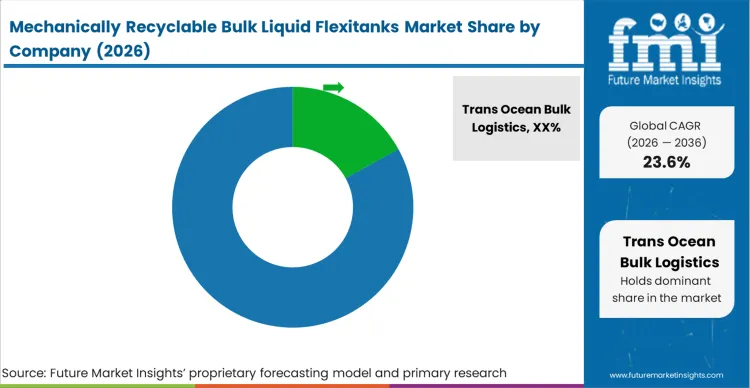
Polymer extrusion capacity establishes the non-negotiable barrier for flexible containment suppliers. Film converters optimizing mono-polyethylene structures secure critical performance advantages by matching the burst strength of legacy multi-material systems. Buyers executing international logistics contracts specify these verified circular materials to bypass terminal disposal fees. Operators reliant on outdated nylon-barrier extrusion forfeit their market position as shipping lines implement strict single-material mandates.
Centralized waste recovery partnerships reconfigure regional logistics economics. SIA Flexitanks established a dedicated California office in September 2024 to support specialized wine and non-wine bulk liquid sectors. Regional shippers require localized technical support to manage the complete lifecycle of their fluid containment systems. Logistics providers failing to offer comprehensive installation and verified recycling services lose their strategic relevance to high-volume exporters.
Packaging alliances dictate the speed of material commercialization. Resin producers collaborating directly with film extruders accelerate the deployment of high-performance mono-polymer architectures. Supply chain directors exploit these localized partnerships to secure reliable access to mechanically recyclable flexitanks. Converters operating without integrated resin supply networks face volatile production costs that undermine their competitive pricing models.
Recent Developments
The report includes full coverage of key trends from competitive benchmarking. Some of the recent developments covered in the reports:
- In February 2026, Maersk introduced centralized flexitank removal at major European ports with a fixed charge of EUR 695 per container, including destruction and recycling handling. [9]
- In September 2025, TotalEnergies and SML announced recyclable downgauging film solutions aligned with lighter-weight transport packaging films. [7]
Key Players in Mechanically Recyclable Bulk Liquid Flexitanks Market
- Trans Ocean Bulk Logistics
- Braid Logistics
- SIA Flexitanks
- BLT Flexitanks
- Bulk Liquid Solutions
- Qingdao LET Flexitank
- Trust Flexitanks
Scope of the Report
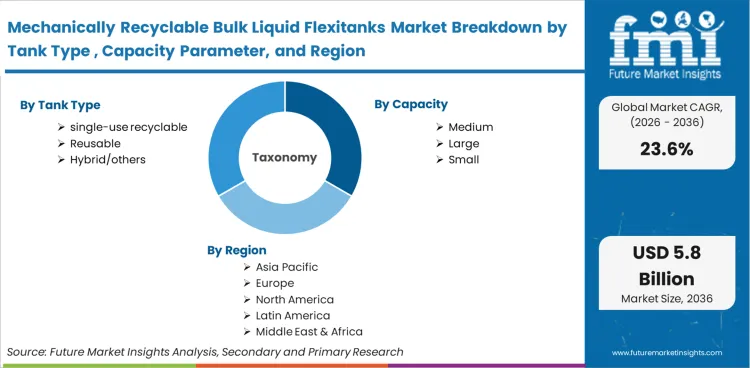
| Metric | Value |
|---|---|
| Quantitative Units | USD 0.7 billion to USD 5.7 billion, at a CAGR of 23.6% |
| Market Definition | A specialized bulk logistics containment system manufactured from mono-material polymer films, designed for mechanical recycling post-discharge. |
| Tank type Segmentation | Single-use recyclable, Reusable, Hybrid/others |
| Capacity Segmentation | Medium capacity, Large capacity, Small capacity |
| End use Segmentation | Food & beverage, Chemicals, Pharma raw materials, Others |
| Filling method Segmentation | Bulk filling, Tanker-to-container, Others |
| Material Segmentation | Mono-PE multilayer, Recyclable barrier mono-polymer, Others |
| Regions Covered | North America, Latin America, Europe, East Asia, South Asia, Oceania, Middle East and Africa |
| Countries Covered | United States, Canada, Mexico, Brazil, Argentina, Germany, France, United Kingdom, Italy, Spain, China, India, Japan, South Korea, Indonesia, Australia and 40 plus countries |
| Key Companies Profiled | Trans Ocean Bulk Logistics, Braid Logistics, SIA Flexitanks, BLT Flexitanks, Bulk Liquid Solutions, Qingdao LET Flexitank, Trust Flexitanks |
| Forecast Period | 2026 to 2036 |
| Approach | Bottom-up projection scaling from global containerized liquid trade volumes and mono-material adoption curves. |
Source: Future Market Insights (FMI) analysis, based on proprietary forecasting model and primary research
Segmental Analysis
Tank Type:
- Single-use recyclable
- Reusable
- Hybrid/others
Capacity:
- Medium capacity
- Large capacity
- Small capacity
End Use:
- Food & beverage
- Chemicals
- Pharma raw materials
- Others
Filling Method:
- Bulk filling
- Tanker-to-container
- Others
Material:
- Mono-PE multilayer
- Recyclable barrier mono-polymer
- Others
Region:
- Asia Pacific
- India
- China
- Japan
- South Korea
- Indonesia
- Australia & New Zealand
- ASEAN
- Rest of Asia Pacific
- Europe
- Germany
- Italy
- France
- United Kingdom
- Spain
- Benelux
- Nordics
- Central & Eastern Europe
- Rest of Europe
- North America
- United States
- Canada
- Mexico
- Latin America
- Brazil
- Argentina
- Chile
- Rest of Latin America
- Middle East & Africa
- Kingdom of Saudi Arabia
- United Arab Emirates
- South Africa
- Turkey
- Rest of Middle East & Africa
Bibliography
- [1] Amcor. (2025, April 30). Amcor completes combination with Berry Global; Positioned to significantly enhance value for customers and shareholders (Press release). Amcor.
- [2] Packaging Digest. (2024). Are brands on target to meet their 2025 packaging sustainability goals? Packaging Digest.
- [3] United Nations Environment Programme (UNEP). (2024). Taking on plastic pollution (UNEP Annual Report 2024 story). UNEP.
- [4] UN Trade and Development (UNCTAD). (2024, October 22). Review of Maritime Transport 2024 (Report / publication page). UNCTAD.
- [5] International Fertilizer Association (IFA). (2025, February). Public summary: Short-Term Fertilizer Outlook 2024-2025 (Report). IFA.
- [6] TT Club and Container Owners Association (COA). (2024). Flexitanks in the supply chain-defining safe operations (Stop Loss guidance). TT Club/COA.
- [7] TotalEnergies Polymers. (2025, September 18). New downgauging film solutions to be revealed at K 2025 by TotalEnergies and SML (Press release). TotalEnergies.
- [8] USA Plastics Pact. (2025). 2023-24 Impact Report (Impact report). USA Plastics Pact.
- [9] A.P. Moller-Maersk. (2026, February 17). Flexitank Removal Service Update (Advisory). Maersk.
- [10] Coveris. (2025, September 25). Coveris wins Green Packaging Star Award 2025 for sustainable sleeve solution (Press release). Coveris.
- [11] Charter Next Generation (CNG). (2024, February 13). Charter Next Generation introduces stretch hood film with 20% post-consumer recycled content (Press release). CNG.
- [12] Trioworld. (2025, August 5). Trioworld announces new state-of-the-art manufacturing facility in Brownsburg, Indiana, USA (Press release). Trioworld.
- [13] UN Trade and Development (UNCTAD). (n.d.). Review of Maritime Transport (Topic page: “Around 80% of the volume of international trade…”). UNCTAD.
- [14] UN Trade and Development (UNCTAD). (2024, October 22). Review of Maritime Transport 2024 (Publication page; 2.4% to 12.3 billion tons in 2023). UNCTAD.
- [15] USA Geological Survey. (2024, January). Mineral Commodity Summaries 2024: Cement (Commodity chapter). USGS.
- [16] World Steel Association. (2024, May 27). World Steel in Figures 2024 (Data publication). worldsteel.
- [17] Bureau of Transportation Statistics. (2025, March 20). TransBorder Freight Annual Report 2024 (Report). USA Department of Transportation.
- [18] SIA Flexitanks. (2025, October 7). Press Release: SIA Flexitanks Expands Operations to New Orleans (Press release). SIA Flexitanks.
- [19] United Nations Environment Programme (UNEP). (n.d.). Plastic pollution (Topic page). UNEP.
- [20] WRAP. (2024, July). Film and flexible packaging roadmap 2025 (Report). WRAP.
This bibliography is provided for reader reference and is not exhaustive. The full report contains the complete reference list and detailed citations.
This Report Addresses
- Market size estimation and revenue forecasts quantifying the transition toward mono-material liquid containment systems globally.
- Regulatory impact analysis detailing port-level disposal mandates and eco-tax penalties affecting international bulk logistics.
- Segment opportunity mapping across tank types and material structures to identify high-yield recyclable polymer formats.
- Regional adoption tracking highlighting specific compliance drivers across major export hubs in Asia and Europe.
- Competitive positioning data evaluating supplier integration with mechanical recycling networks and resin manufacturers.
- Supplier capability assessments charting advancements in downgauged extrusion and hybrid barrier performance.
- Market intelligence delivery in PDF, Excel, PPT, and interactive dashboard formats for immediate operational deployment.
Frequently Asked Questions
How large is the demand for Mechanically Recyclable Bulk Liquid Flexitanks in the global market in 2026?
Demand for Mechanically Recyclable Bulk Liquid Flexitanks in the global market is estimated to be valued at USD 0.7 billion in 2026.
What will be the market size of Mechanically Recyclable Bulk Liquid Flexitanks in the global market by 2036?
Market size for Mechanically Recyclable Bulk Liquid Flexitanks is projected to reach USD 5.7 billion by 2036.
What is the expected demand growth for Mechanically Recyclable Bulk Liquid Flexitanks in the global market between 2026 and 2036?
Demand for Mechanically Recyclable Bulk Liquid Flexitanks is expected to grow at a CAGR of 23.6% between 2026 and 2036.
Which Tank type is poised to lead global sales by 2026?
Single-use recyclable commands 60.0% in 2026 as shippers prioritize verifiable port-level disposal pathways over costly return logistics.
How significant is the role of Food & beverage in driving Mechanically Recyclable Bulk Liquid Flexitanks adoption in 2026?
Food & beverage represents 45.0% of segment share as edible oil exporters align packaging procurement with zero-waste-to-landfill sustainability scorecards.
What is driving demand in India?
Accelerated conversion from rigid steel drums to containerized liquid formats under pressure from European compliance standards.
What compliance standards or regulations are referenced for India?
UNCTAD maritime trade reporting dynamics directly influence regional containerization strategies.
What is the India growth outlook in this report?
India is projected to grow at a CAGR of 27.0% during 2026 to 2036.
Why is North America described as a priority region in this report?
Massive domestic land-border freight flows necessitate high-performance, compliant flexible containment bladders.
What type of demand dominates in North America?
Cross-border chemical and agricultural liquid movements utilizing integrated intermodal rail and truck networks.
What is China's growth outlook in this report?
China is projected to expand at a CAGR of 25.0% during 2026 to 2036.
Does the report cover United States in its regional analysis?
Yes, United States is included within North America under the regional scope of analysis.
What are the sources referred to for analyzing United States?
Bureau of Transportation Statistics freight data and corporate expansion announcements form the analytical basis.
What is the main demand theme linked to United States in its region coverage?
High-volume industrial shipments requiring secure, recyclable mono-material transit packaging to satisfy corporate waste protocols.
Does the report cover Germany in its regional analysis?
Yes, Germany is included within Europe under the regional coverage framework.
What is the main Germany related demand theme in its region coverage?
Strict port-level waste removal mandates penalizing multi-material bulk shipping solutions.
Which product formats or configurations are strategically important for Asia Pacific supply chains?
High-capacity mono-PE multilayer architectures capable of securing massive trans-oceanic agricultural flows.
What is Mechanically Recyclable Bulk Liquid Flexitanks and what is it mainly used for?
It is a single-material flexible bladder designed to transport non-hazardous liquids inside standard shipping containers and be mechanically recycled after use.
What does Mechanically Recyclable Bulk Liquid Flexitanks mean in this report?
The market refers to the global production, distribution, and utilization of mono-polymer bulk liquid containment systems.
What is included in the scope of this Mechanically Recyclable Bulk Liquid Flexitanks report?
Mono-polymer flexitanks, compatible barrier structures, and recyclable filling accessories designed for standard twenty-foot containers.
What is excluded from the scope of this report?
Multi-material tanks containing incompatible nylon, ISO tank containers, and rigid intermediate bulk containers.
What does market forecast mean on this page?
The market forecast represents a model-based projection built on defined industrial capacity and adoption assumptions for strategic planning purposes.
How does FMI build and validate the Mechanically Recyclable Bulk Liquid Flexitanks forecast?
Forecasts combine top-down maritime trade data with bottom-up substitution yields, validated by primary fleet manager interviews.
What does zero reliance on speculative third-party market research mean here?
Primary interviews, verified corporate supply announcements, and official government datasets are used exclusively instead of unverified syndicated estimates.
Preview the report firsthand - request a free sample
Get SampleGet the brochure for pricing and purchase details.
Get PDFTable of Content
- Executive Summary
- Global Market Outlook
- Demand-side Trends
- Supply-side Trends
- Technology Roadmap Analysis
- Analysis and Recommendations
- Market Overview
- Market Coverage / Taxonomy
- Market Definition / Scope / Limitations
- Research Methodology
- Chapter Orientation
- Analytical Lens and Working Hypotheses
- Market Structure, Signals, and Trend Drivers
- Benchmarking and Cross-market Comparability
- Market Sizing, Forecasting, and Opportunity Mapping
- Research Design and Evidence Framework
- Desk Research Programme (Secondary Evidence)
- Company Annual and Sustainability Reports
- Peer-reviewed Journals and Academic Literature
- Corporate Websites, Product Literature, and Technical Notes
- Earnings Decks and Investor Briefings
- Statutory Filings and Regulatory Disclosures
- Technical White Papers and Standards Notes
- Trade Journals, Industry Magazines, and Analyst Briefs
- Conference Proceedings, Webinars, and Seminar Materials
- Government Statistics Portals and Public Data Releases
- Press Releases and Reputable Media Coverage
- Specialist Newsletters and Curated Briefings
- Sector Databases and Reference Repositories
- FMI Internal Proprietary Databases and Historical Market Datasets
- Subscription Datasets and Paid Sources
- Social Channels, Communities, and Digital Listening Inputs
- Additional Desk Sources
- Expert Input and Fieldwork (Primary Evidence)
- Primary Modes
- Qualitative Interviews and Expert Elicitation
- Quantitative Surveys and Structured Data Capture
- Blended Approach
- Why Primary Evidence is Used
- Field Techniques
- Interviews
- Surveys
- Focus Groups
- Observational and In-context Research
- Social and Community Interactions
- Stakeholder Universe Engaged
- C-suite Leaders
- Board Members
- Presidents and Vice Presidents
- R&D and Innovation Heads
- Technical Specialists
- Domain Subject-matter Experts
- Scientists
- Physicians and Other Healthcare Professionals
- Governance, Ethics, and Data Stewardship
- Research Ethics
- Data Integrity and Handling
- Primary Modes
- Tooling, Models, and Reference Databases
- Desk Research Programme (Secondary Evidence)
- Data Engineering and Model Build
- Data Acquisition and Ingestion
- Cleaning, Normalisation, and Verification
- Synthesis, Triangulation, and Analysis
- Quality Assurance and Audit Trail
- Market Background
- Market Dynamics
- Drivers
- Restraints
- Opportunity
- Trends
- Scenario Forecast
- Demand in Optimistic Scenario
- Demand in Likely Scenario
- Demand in Conservative Scenario
- Opportunity Map Analysis
- Product Life Cycle Analysis
- Supply Chain Analysis
- Investment Feasibility Matrix
- Value Chain Analysis
- PESTLE and Porter’s Analysis
- Regulatory Landscape
- Regional Parent Market Outlook
- Production and Consumption Statistics
- Import and Export Statistics
- Market Dynamics
- Global Market Analysis 2021 to 2025 and Forecast, 2026 to 2036
- Historical Market Size Value (USD Million) Analysis, 2021 to 2025
- Current and Future Market Size Value (USD Million) Projections, 2026 to 2036
- Y-o-Y Growth Trend Analysis
- Absolute $ Opportunity Analysis
- Global Market Pricing Analysis 2021 to 2025 and Forecast 2026 to 2036
- Global Market Analysis 2021 to 2025 and Forecast 2026 to 2036, By Tank Type
- Introduction / Key Findings
- Historical Market Size Value (USD Million) Analysis By Tank Type , 2021 to 2025
- Current and Future Market Size Value (USD Million) Analysis and Forecast By Tank Type , 2026 to 2036
- single-use recyclable
- Reusable
- Hybrid/others
- single-use recyclable
- Y-o-Y Growth Trend Analysis By Tank Type , 2021 to 2025
- Absolute $ Opportunity Analysis By Tank Type , 2026 to 2036
- Global Market Analysis 2021 to 2025 and Forecast 2026 to 2036, By Capacity Parameter
- Introduction / Key Findings
- Historical Market Size Value (USD Million) Analysis By Capacity Parameter, 2021 to 2025
- Current and Future Market Size Value (USD Million) Analysis and Forecast By Capacity Parameter, 2026 to 2036
- Medium
- Large
- Small
- Medium
- Y-o-Y Growth Trend Analysis By Capacity Parameter, 2021 to 2025
- Absolute $ Opportunity Analysis By Capacity Parameter, 2026 to 2036
- Global Market Analysis 2021 to 2025 and Forecast 2026 to 2036, By End Use
- Introduction / Key Findings
- Historical Market Size Value (USD Million) Analysis By End Use, 2021 to 2025
- Current and Future Market Size Value (USD Million) Analysis and Forecast By End Use, 2026 to 2036
- Food and Beverage
- Chemicals
- Pharma raw materials
- Food and Beverage
- Y-o-Y Growth Trend Analysis By End Use, 2021 to 2025
- Absolute $ Opportunity Analysis By End Use, 2026 to 2036
- Global Market Analysis 2021 to 2025 and Forecast 2026 to 2036, By Filling Method
- Introduction / Key Findings
- Historical Market Size Value (USD Million) Analysis By Filling Method, 2021 to 2025
- Current and Future Market Size Value (USD Million) Analysis and Forecast By Filling Method, 2026 to 2036
- Bulk filling
- Tanker-to-container
- Others
- Bulk filling
- Y-o-Y Growth Trend Analysis By Filling Method, 2021 to 2025
- Absolute $ Opportunity Analysis By Filling Method, 2026 to 2036
- Global Market Analysis 2021 to 2025 and Forecast 2026 to 2036, By Material
- Introduction / Key Findings
- Historical Market Size Value (USD Million) Analysis By Material, 2021 to 2025
- Current and Future Market Size Value (USD Million) Analysis and Forecast By Material, 2026 to 2036
- Mono-PE multilayer films
- Recyclable barrier mono-polymer
- Others
- Mono-PE multilayer films
- Y-o-Y Growth Trend Analysis By Material, 2021 to 2025
- Absolute $ Opportunity Analysis By Material, 2026 to 2036
- Global Market Analysis 2021 to 2025 and Forecast 2026 to 2036, By Region
- Introduction
- Historical Market Size Value (USD Million) Analysis By Region, 2021 to 2025
- Current Market Size Value (USD Million) Analysis and Forecast By Region, 2026 to 2036
- North America
- Latin America
- Western Europe
- Eastern Europe
- East Asia
- South Asia and Pacific
- Middle East & Africa
- Market Attractiveness Analysis By Region
- North America Market Analysis 2021 to 2025 and Forecast 2026 to 2036, By Country
- Historical Market Size Value (USD Million) Trend Analysis By Market Taxonomy, 2021 to 2025
- Market Size Value (USD Million) Forecast By Market Taxonomy, 2026 to 2036
- By Country
- USA
- Canada
- Mexico
- By Tank Type
- By Capacity Parameter
- By End Use
- By Filling Method
- By Material
- By Country
- Market Attractiveness Analysis
- By Country
- By Tank Type
- By Capacity Parameter
- By End Use
- By Filling Method
- By Material
- Key Takeaways
- Latin America Market Analysis 2021 to 2025 and Forecast 2026 to 2036, By Country
- Historical Market Size Value (USD Million) Trend Analysis By Market Taxonomy, 2021 to 2025
- Market Size Value (USD Million) Forecast By Market Taxonomy, 2026 to 2036
- By Country
- Brazil
- Chile
- Rest of Latin America
- By Tank Type
- By Capacity Parameter
- By End Use
- By Filling Method
- By Material
- By Country
- Market Attractiveness Analysis
- By Country
- By Tank Type
- By Capacity Parameter
- By End Use
- By Filling Method
- By Material
- Key Takeaways
- Western Europe Market Analysis 2021 to 2025 and Forecast 2026 to 2036, By Country
- Historical Market Size Value (USD Million) Trend Analysis By Market Taxonomy, 2021 to 2025
- Market Size Value (USD Million) Forecast By Market Taxonomy, 2026 to 2036
- By Country
- Germany
- UK
- Italy
- Spain
- France
- Nordic
- BENELUX
- Rest of Western Europe
- By Tank Type
- By Capacity Parameter
- By End Use
- By Filling Method
- By Material
- By Country
- Market Attractiveness Analysis
- By Country
- By Tank Type
- By Capacity Parameter
- By End Use
- By Filling Method
- By Material
- Key Takeaways
- Eastern Europe Market Analysis 2021 to 2025 and Forecast 2026 to 2036, By Country
- Historical Market Size Value (USD Million) Trend Analysis By Market Taxonomy, 2021 to 2025
- Market Size Value (USD Million) Forecast By Market Taxonomy, 2026 to 2036
- By Country
- Russia
- Poland
- Hungary
- Balkan & Baltic
- Rest of Eastern Europe
- By Tank Type
- By Capacity Parameter
- By End Use
- By Filling Method
- By Material
- By Country
- Market Attractiveness Analysis
- By Country
- By Tank Type
- By Capacity Parameter
- By End Use
- By Filling Method
- By Material
- Key Takeaways
- East Asia Market Analysis 2021 to 2025 and Forecast 2026 to 2036, By Country
- Historical Market Size Value (USD Million) Trend Analysis By Market Taxonomy, 2021 to 2025
- Market Size Value (USD Million) Forecast By Market Taxonomy, 2026 to 2036
- By Country
- China
- Japan
- South Korea
- By Tank Type
- By Capacity Parameter
- By End Use
- By Filling Method
- By Material
- By Country
- Market Attractiveness Analysis
- By Country
- By Tank Type
- By Capacity Parameter
- By End Use
- By Filling Method
- By Material
- Key Takeaways
- South Asia and Pacific Market Analysis 2021 to 2025 and Forecast 2026 to 2036, By Country
- Historical Market Size Value (USD Million) Trend Analysis By Market Taxonomy, 2021 to 2025
- Market Size Value (USD Million) Forecast By Market Taxonomy, 2026 to 2036
- By Country
- India
- ASEAN
- Australia & New Zealand
- Rest of South Asia and Pacific
- By Tank Type
- By Capacity Parameter
- By End Use
- By Filling Method
- By Material
- By Country
- Market Attractiveness Analysis
- By Country
- By Tank Type
- By Capacity Parameter
- By End Use
- By Filling Method
- By Material
- Key Takeaways
- Middle East & Africa Market Analysis 2021 to 2025 and Forecast 2026 to 2036, By Country
- Historical Market Size Value (USD Million) Trend Analysis By Market Taxonomy, 2021 to 2025
- Market Size Value (USD Million) Forecast By Market Taxonomy, 2026 to 2036
- By Country
- Kingdom of Saudi Arabia
- Other GCC Countries
- Turkiye
- South Africa
- Other African Union
- Rest of Middle East & Africa
- By Tank Type
- By Capacity Parameter
- By End Use
- By Filling Method
- By Material
- By Country
- Market Attractiveness Analysis
- By Country
- By Tank Type
- By Capacity Parameter
- By End Use
- By Filling Method
- By Material
- Key Takeaways
- Key Countries Market Analysis
- USA
- Pricing Analysis
- Market Share Analysis, 2025
- By Tank Type
- By Capacity Parameter
- By End Use
- By Filling Method
- By Material
- Canada
- Pricing Analysis
- Market Share Analysis, 2025
- By Tank Type
- By Capacity Parameter
- By End Use
- By Filling Method
- By Material
- Mexico
- Pricing Analysis
- Market Share Analysis, 2025
- By Tank Type
- By Capacity Parameter
- By End Use
- By Filling Method
- By Material
- Brazil
- Pricing Analysis
- Market Share Analysis, 2025
- By Tank Type
- By Capacity Parameter
- By End Use
- By Filling Method
- By Material
- Chile
- Pricing Analysis
- Market Share Analysis, 2025
- By Tank Type
- By Capacity Parameter
- By End Use
- By Filling Method
- By Material
- Germany
- Pricing Analysis
- Market Share Analysis, 2025
- By Tank Type
- By Capacity Parameter
- By End Use
- By Filling Method
- By Material
- UK
- Pricing Analysis
- Market Share Analysis, 2025
- By Tank Type
- By Capacity Parameter
- By End Use
- By Filling Method
- By Material
- Italy
- Pricing Analysis
- Market Share Analysis, 2025
- By Tank Type
- By Capacity Parameter
- By End Use
- By Filling Method
- By Material
- Spain
- Pricing Analysis
- Market Share Analysis, 2025
- By Tank Type
- By Capacity Parameter
- By End Use
- By Filling Method
- By Material
- France
- Pricing Analysis
- Market Share Analysis, 2025
- By Tank Type
- By Capacity Parameter
- By End Use
- By Filling Method
- By Material
- India
- Pricing Analysis
- Market Share Analysis, 2025
- By Tank Type
- By Capacity Parameter
- By End Use
- By Filling Method
- By Material
- ASEAN
- Pricing Analysis
- Market Share Analysis, 2025
- By Tank Type
- By Capacity Parameter
- By End Use
- By Filling Method
- By Material
- Australia & New Zealand
- Pricing Analysis
- Market Share Analysis, 2025
- By Tank Type
- By Capacity Parameter
- By End Use
- By Filling Method
- By Material
- China
- Pricing Analysis
- Market Share Analysis, 2025
- By Tank Type
- By Capacity Parameter
- By End Use
- By Filling Method
- By Material
- Japan
- Pricing Analysis
- Market Share Analysis, 2025
- By Tank Type
- By Capacity Parameter
- By End Use
- By Filling Method
- By Material
- South Korea
- Pricing Analysis
- Market Share Analysis, 2025
- By Tank Type
- By Capacity Parameter
- By End Use
- By Filling Method
- By Material
- Russia
- Pricing Analysis
- Market Share Analysis, 2025
- By Tank Type
- By Capacity Parameter
- By End Use
- By Filling Method
- By Material
- Poland
- Pricing Analysis
- Market Share Analysis, 2025
- By Tank Type
- By Capacity Parameter
- By End Use
- By Filling Method
- By Material
- Hungary
- Pricing Analysis
- Market Share Analysis, 2025
- By Tank Type
- By Capacity Parameter
- By End Use
- By Filling Method
- By Material
- Kingdom of Saudi Arabia
- Pricing Analysis
- Market Share Analysis, 2025
- By Tank Type
- By Capacity Parameter
- By End Use
- By Filling Method
- By Material
- Turkiye
- Pricing Analysis
- Market Share Analysis, 2025
- By Tank Type
- By Capacity Parameter
- By End Use
- By Filling Method
- By Material
- South Africa
- Pricing Analysis
- Market Share Analysis, 2025
- By Tank Type
- By Capacity Parameter
- By End Use
- By Filling Method
- By Material
- USA
- Market Structure Analysis
- Competition Dashboard
- Competition Benchmarking
- Market Share Analysis of Top Players
- By Regional
- By Tank Type
- By Capacity Parameter
- By End Use
- By Filling Method
- By Material
- Competition Analysis
- Competition Deep Dive
- Trans Ocean Bulk Logistics
- Overview
- Product Portfolio
- Profitability by Market Segments (Product/Age /Sales Channel/Region)
- Sales Footprint
- Strategy Overview
- Marketing Strategy
- Product Strategy
- Channel Strategy
- Braid Logistics
- SIA Flexitanks
- BLT Flexitanks
- Bulk Liquid Solutions
- Qingdao LET Flexitank
- Trans Ocean Bulk Logistics
- Competition Deep Dive
- Assumptions & Acronyms Used


