

- Industry Size (2026)
- USD 1.3 Bn
- Forecast (2036)
- USD 3.4 Bn
- CAGR (2026 to 2036)
- 10.2%
Recyclable Thermoset Resins Market Size, Market Forecast and Outlook By FMI
The Recyclable Thermoset Resins Market surpassed a value of USD 1.2 billion in 2025. The industry is estimated to surpass USD 1.3 billion in 2026 at a CAGR of 10.2% during the forecast period. Sustained investment propels the total opportunity to USD 3.4 billion through 2036 as decommissioning waves of first-generation wind turbine blades compel original equipment manufacturers to specify reversible matrices to bypass escalating landfill liabilities.
Buyers of composite materials are navigating a fundamental transition from managing end-of-life structures as pure waste overhead to actively qualifying reversible cross-linking chemistries. This shift forces procurement teams to evaluate resins not just on mechanical strength, but on their ability to cleanly separate from carbon and glass fibers decades later. Delaying this qualification locks manufacturers into permanent disposal pathways that increasingly carry severe financial penalties under new circularity frameworks. According to FMI analysts, the prevailing belief is that these cleavable resin architectures are gated by synthetic complexity, when the true commercial barrier is the absence of a coordinated reverse logistics network capable of returning massive cured structures to processing facilities.
Summary of Recyclable Thermoset Resins Market
- Recyclable Thermoset Resins Market Definition:
- This sector comprises engineered polymer matrices featuring reversible cross-links or cleavable bonds, allowing rigid composites to be depolymerized at end-of-life. It represents the structural shift from permanent, single-use thermoset plastics toward circular composite architectures capable of fiber recovery and monomer reuse.
- Demand Drivers in the Market:
- Extended producer responsibility frameworks compel wind turbine manufacturers to specify recoverable blade materials to avoid future disposal levies.
- Automotive lightweighting targets force tier-1 component suppliers to integrate circular composites that comply with end-of-life vehicle directives.
- Supply chain volatility pushes specialty chemical formulators to develop recoverable oligomers to insulate against raw petrochemical price fluctuations.
- Key Segments Analyzed in the FMI Report:
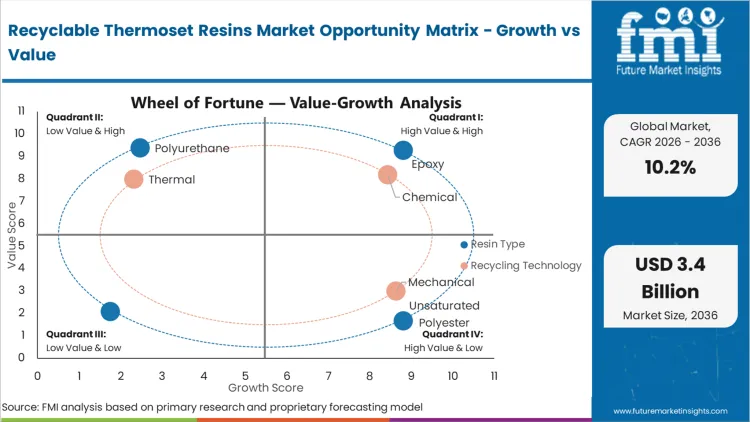
- Epoxy: Epoxy is expected to hold 45.2% share in 2026, as its dominance in high-stress structural applications creates the largest immediate liability for non-recyclable variants.
- Chemical Recycling: Chemical Recycling is projected to garner 52.4% share in 2026, providing the only pathway to recover continuous fibers without catastrophic loss of tensile strength.
- Wind Energy: Wind Energy is estimated to record 38.7% share in 2026, driven by the massive volume of composite material per unit and acute public scrutiny over turbine disposal.
- India: 13.4% compound growth, reflecting rapid domestic renewable energy expansion paired with early-stage mandates for circular manufacturing infrastructure.
- Analyst Opinion at FMI:
- Nikhil Kaitwade, Principal Analyst, Chemicals, at FMI, suggests, "The widespread industry assumption is that reversible epoxies command a price premium purely due to their complex synthetic pathways. What dictates the actual cost structure is the absence of coordinated reverse logistics. Until the industry scales the collection and sizing of massive composite structures before they reach the depolymerization reactor, the chemical innovation alone cannot deliver cost parity."
- Strategic Implications / Executive Takeaways:
- Specialty chemical formulators must validate their cleavage agents on commercial-scale composite structures to secure off-take agreements with major resin buyers.
- Wind farm operators should integrate end-of-life recovery metrics into their initial procurement tenders to avoid holding stranded, non-compliant assets.
- Composite tooling engineers face the constraint of matching the exact thermal and mechanical profiles of legacy resins, requiring iterative qualification of new dynamic networks.
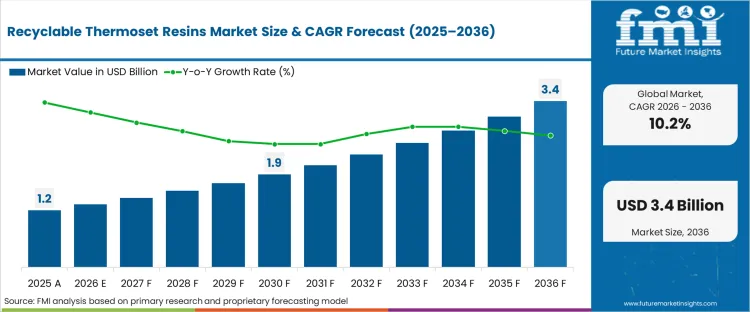
The structural gate for self-reinforcing adoption requires the commissioning of localized depolymerization facilities capable of processing industrial volumes without fracturing the recovered continuous fibers. Chemical companies trigger this shift by transitioning from lab-scale batch cleavage to continuous-flow solvent recovery systems. Once this infrastructure density is achieved, the cost of specifying cleavable thermosets drops below the blended cost of legacy resins plus their associated landfill surcharges.
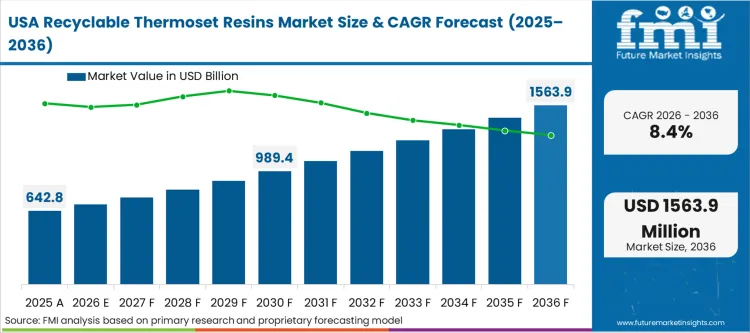
India tracks at 13.4%, followed by China expanding at 12.5%, and Germany growing at 11.2%. The United Kingdom advances at 10.5%, France registers 10.1%, Japan posts 9.1%, and the United States follows at 8.4%. The structural divergence across this range reflects the proximity of domestic composite manufacturing to pending regulatory deadlines for blade and airframe decommissioning, pushing localised supply chains to secure cleavable chemistry ahead of statutory mandates.
Recyclable Thermoset Resins Market Key Takeaways
| Metric | Details |
|---|---|
| Industry Size (2026) | USD 1.3 billion |
| Industry Value (2036) | USD 3.4 billion |
| CAGR (2026-2036) | 10.2% |
Source: Future Market Insights (FMI) analysis, based on proprietary forecasting model and primary research
Recyclable Thermoset Resins Market Definition
The recyclable thermoset resins market encompasses cross-linked polymer matrices engineered with cleavable bonds or reversible curing mechanisms that allow the solid plastic to be broken down, separated from reinforcements, and re-polymerized or recovered as usable monomers. This specifically tracks materials designed from the synthesis stage for circularity, distinguishing them from legacy thermosets that can only undergo destructive mechanical grinding or incineration.
Recyclable Thermoset Resins Market Inclusions
Scope includes cleavable epoxies, recyclable polyurethanes, reversible unsaturated polyesters, and dynamic covalent network resins designed for end-of-life recovery. It covers the virgin resin formulations, specific cleavage agents required for their depolymerization, and the recovered oligomers when sold back into the advanced materials supply chain for secondary composite manufacturing.
Recyclable Thermoset Resins Market Exclusions
Thermoplastic resins, even those used in high-performance composites, are strictly excluded because their physical remelting process does not involve breaking and reforming covalent cross-links. Traditional thermosets subjected to downcycling via mechanical grinding into filler powders are also excluded, as this represents structural degradation rather than true matrix recovery or circular reuse.
Recyclable Thermoset Resins Market Research Methodology
- Primary Research: Sourcing directors at wind turbine manufacturers, composite tooling engineers at tier-1 aerospace suppliers, and lead formulators at specialty chemical companies.
- Desk Research: Patent filings for dynamic covalent chemistries, regulatory publications on composite landfill bans, and sustainability reports from major original equipment manufacturers.
- Market-Sizing and Forecasting: Baseline volume anchors to the installed capacity of wind blade manufacturing and the tracked substitution rate of legacy epoxies in new layups.
- Data Validation and Update Cycle: Forecasts are triangulated against the announced capital expenditure for chemical recycling pilot plants and the qualification timelines of major automotive lightweighting programs.
Segmental Analysis
Recyclable Thermoset Resins Market Analysis by Resin Type
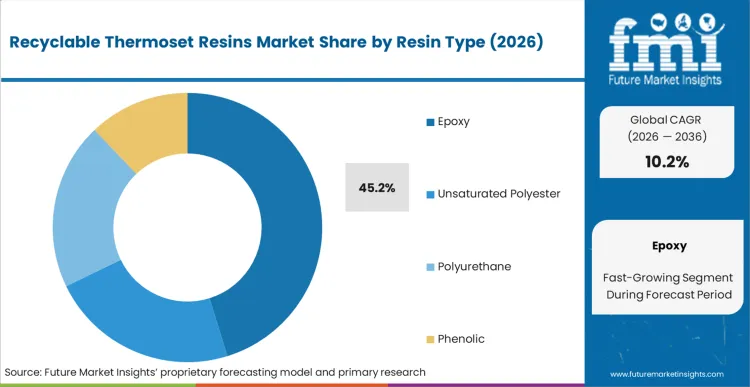
The reason epoxy holds 45.2% of this market comes down to a single operational reality: critical structural applications cannot absorb the mechanical performance penalties of weaker alternative matrices.
According to FMI's estimates, this chemistry is not chosen simply for its regulatory credentials. It is chosen because its high cross-link density provides the extreme tensile strength required for continuous fiber composites, creating the single largest financial liability if those structures cannot be recycled. Procurement teams at major original equipment manufacturers authorize the premium for cleavable epoxies precisely because the alternative is abandoning composite lightweighting altogether. Delaying this qualification forces aerospace and wind manufacturers to build massive contingency funds for the inevitable end-of-life disposal costs of non-compliant layups.
- Initial specification: Engineering teams select cleavable epoxies when their lifecycle cost models finally internalize future landfill surcharges into the initial bill of materials. This shift fundamentally alters the procurement baseline.
- Validation pathways: Tooling engineers validate these networks by ensuring the reversible bonds remain completely inert under standard operational thermal and mechanical stresses. Failing this validation immediately disqualifies the resin from flight-critical or load-bearing applications.
- Expansion criteria: Sourcing directors expand the use of these matrices across product lines only after the chemical supplier demonstrates a closed-loop off-take agreement for the recovered oligomers. This proves the economic viability of the entire circular system.
Recyclable Thermoset Resins Market Analysis by Recycling Technology
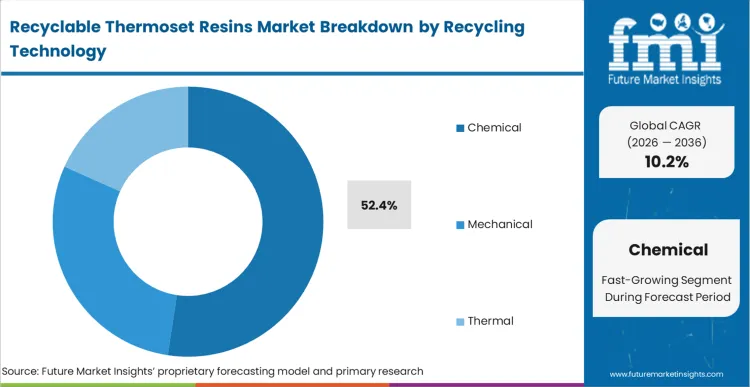
The structural tension in recycling technology lies between the low capital barrier of mechanical grinding and the absolute necessity of chemical recycling to recover high-value continuous fibers. Chemical recycling captures a 52.4% share in 2026 because grinding a carbon fiber composite destroys the very structural properties that made the material valuable in the first place.
FMI analysts opine that solvent-based depolymerization is the only mechanism that dissolves the matrix without fracturing the embedded reinforcement. Chemical plant operators face the intense engineering challenge of scaling these solvent recovery loops to handle massive composite structures. Failing to optimize this specific chemical reclamation process leaves operators with degraded fibers that can only be sold into low-margin filler markets.
- Sourcing leverage: Facilities operating continuous-flow chemical cleavage reactors extract maximum economic value from end-of-life composites by yielding virgin-equivalent carbon fiber. This process dictates the profitability of the entire recovery operation.
- Hidden expenditures: Processing managers encounter severe hidden costs in the mechanical pre-sizing required before composite chunks can enter the chemical reactor. These logistical hurdles often outweigh the cost of the actual chemical solvent.
- Lifecycle parity: Investment committees approve chemical recycling infrastructure when the blended value of recovered fiber and reusable monomer achieves parity with virgin petrochemical inputs. This calculation shifts rapidly as regulatory penalties on virgin plastics increase.
Recyclable Thermoset Resins Market Analysis by End Use
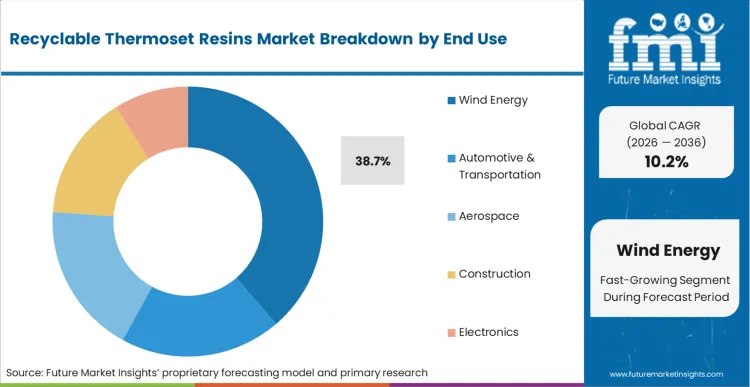
The commercial consequence of ignoring circularity in the wind energy sector is the accumulation of thousands of tons of stranded assets with no legal disposal route. Wind energy commands 38.7% share in 2026 because the sheer physical volume of a single decommissioned turbine blade creates an immediate, highly visible crisis for farm operators.
As per FMI's projection, farm developers are now writing end-of-life recyclability into their initial turbine procurement tenders. This forces the blade manufacturers to secure reversible composite resin supplies long before the first layup begins. Turbine manufacturers who fail to redesign their blade architectures around cleavable matrices face absolute exclusion from new offshore leasing auctions in highly regulated European markets.
- Structural failure prevention: Specifying dynamic covalent networks prevents the catastrophic financial failure of holding un-disposable assets at the end of a 20-year power purchase agreement. This proactive specification insulates the project's long-term internal rate of return.
- Residual vulnerabilities: Farm operators maintain residual risk regarding the localized availability of depolymerization facilities when their specific blades reach the end of their service life. A cleavable resin is useless without a chemical plant capable of processing it nearby.
- Operational capture: Logistics coordinators must actively map reverse supply chains during the initial wind farm commissioning to ensure they can capture the full economic benefit of the recyclable materials decades later.
Recyclable Thermoset Resins Market Drivers, Restraints, and Opportunities
Extended producer responsibility frameworks compel wind turbine manufacturers and aerospace tier-1 suppliers to integrate circular composite architectures directly into their next-generation designs. This structural pressure forces procurement directors to qualify reversible cross-linking chemistries, fundamentally shifting the composite sourcing model from a linear material purchase to a closed-loop lifecycle contract. The commercial stakes of acting now involve securing constrained supply of these advanced matrices before regulatory deadlines lock out legacy materials. Manufacturers who delay this integration risk severe supply chain bottlenecks as the limited pool of certified cleavable resin formulators commits their output to early-moving competitors.
The absence of coordinated reverse logistics to gather, size, and transport massive composite structures creates a severe structural friction that limits the immediate scalability of cleavable networks. This bottleneck is not a temporary lack of awareness; it is a fundamental infrastructural gap between where massive structures are decommissioned and where centralized chemical processing plants operate. Emerging consortia between resin suppliers and waste management firms offer partial localized solutions, but their impact remains constrained by the extreme transportation costs of moving intact turbine blades or airframe sections.
Opportunities in the Recyclable Thermoset Resins Market
- Automotive lightweighting capture: Rigid end-of-life vehicle directives enable the integration of cleavable epoxies in high-volume passenger vehicle architectures. Tier-1 component suppliers capture this by validating rapid-cure reversible resins that match the cycle times of traditional automotive stamping.
- Closed-loop monomer off-take: The maturation of depolymerization infrastructure creates a secondary market for recovered resin oligomers. Specialty chemical formulators capture this by designing their primary advanced polymer matrices to yield high-purity feedstocks that can be resold into adjacent industrial sectors.
- Tooling infrastructure adaptation: The shift to dynamic covalent bonds requires precise thermal control during the initial curing phase. Equipment manufacturers capture this opportunity by retrofitting existing composite autoclaves with the advanced thermal management systems required for these specific chemistries.
Regional Analysis
Based on the regional analysis, the Recyclable Thermoset Resins Market is segmented into North America, Europe, Asia Pacific, and others across 40 plus countries.
.webp "Top Country Growth Comparison Recyclable Thermoset Resins Market Cagr (2026 2036)")
| Country | CAGR (2026 to 2036) |
|---|---|
| India | 13.4% |
| China | 12.5% |
| Germany | 11.2% |
| United Kingdom | 10.5% |
| France | 10.1% |
| Japan | 9.1% |
| United States | 8.4% |
Source: Future Market Insights (FMI) analysis, based on proprietary forecasting model and primary research
North America Recyclable Thermoset Resins Market Analysis
The cost structure of landfill disposal versus the capital expenditure required for chemical recycling infrastructure drives the adoption timeline across North American composite manufacturing hubs. Procurement directors in this region evaluate cleavable resins primarily as a hedge against future volatility in raw petrochemical inputs, recognizing that recovered continuous fibers fundamentally alter the economics of advanced lightweighting programs.
Based on FMI's assessment, this economic calculus pushes major aerospace and automotive OEMs to fund pilot depolymerization facilities near their primary assembly lines. The structural transition relies heavily on private capital aligning with massive industrial players to bridge the gap between lab-scale chemistry and commercial-scale composite recovery.
- United States: The United States' concentration of tier-1 aerospace manufacturing necessitates the localized development of high-performance reversible epoxies that meet rigorous flight qualification standards. Engineering teams in the US must map these new chemistries against legacy performance baselines to ensure zero compromise in structural integrity. FMI estimates the recyclable thermoset resins sector in the United States to expand at an annual growth rate of 8.4%. Aerospace suppliers that successfully validate these cleavable networks secure entrenched positions in next-generation commercial aircraft programs that increasingly prioritize full lifecycle material accounting.
FMI's report includes Canada and Mexico. The integration of cross-border automotive supply chains forces material formulators to ensure their cleavable resins can be processed effectively in decentralized tier-2 supplier facilities across the broader North American manufacturing footprint.
Europe Recyclable Thermoset Resins Market Analysis
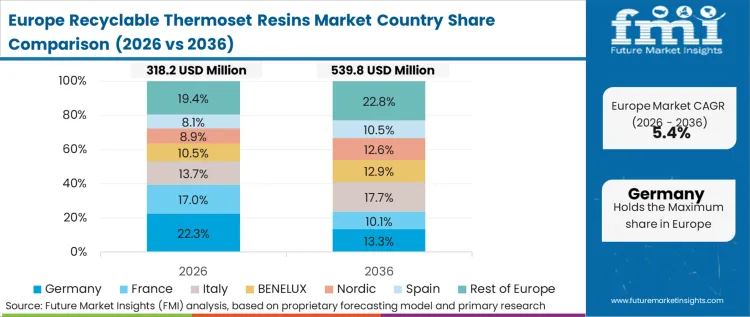
Aggressive extended producer responsibility frameworks and stringent end-of-life vehicle directives actively reshape how European procurement networks evaluate composite materials. In FMI's view, this policy-led environment penalizes the use of permanent, single-use thermoset plastics, forcing manufacturers to internalize the end-of-life disposal costs at the point of initial material specification. This regulatory pressure removes the option of passive compliance, requiring wind farm operators and automotive suppliers to secure off-take agreements for their decommissioned structures before new projects are even approved. The region acts as the primary proving ground for commercial-scale continuous chemical recycling facilities.
- Germany: A CAGR of 11.2% is expected for recyclable thermoset resins in Germany over the forecast period. Germany's updated extended producer responsibility requirements create a direct cost differential between legacy mixed-material composites and cleavable alternatives, making the transition an economic necessity rather than a compliance gesture. Automotive suppliers operating German distribution routes have already begun requalification processes for their primary structural matrices. The transition occurring here establishes the baseline regulatory and engineering standards that will eventually govern composite recycling frameworks across the broader European continent.
- United Kingdom: The United Kingdom’s recyclable thermoset resins sector is projected to grow at a CAGR of 10.5%. Procurement directives within the United Kingdom's expanding offshore wind sector mandate clear decommissioning pathways for all new turbine installations. Project developers operate under strict mandates to integrate circular materials, forcing localized blade manufacturers to adapt their layup processes for reversible resins. While the policy mandates are clear, the on-the-ground reality is that blade manufacturers struggle with the precise thermal curing profiles required by these new dynamic covalent networks.
- France: France's stringent aerospace sustainability targets compel tier-1 structural component suppliers to actively phase out legacy epoxies in favor of chemically recoverable alffavourtives. Material scientists in France face intense pressure to validate cleavage agents that function efficiently without requiring massive energy inputs during the depolymerization phase. The French sector for recyclable thermoset resins is likely to post a CAGR of 10.1%. This aggressive qualification push will ultimately force the entire European aerospace supply chain to standardize around a specific family of reversible cross-linking chemistries within the next decade.
FMI's report includes Italy, Spain, and the Benelux region. The rapid expansion of specialized chemical recycling startups across these nations provides the necessary technological diversity to tackle the highly varied curing mechanisms used across different composite end-use sectors.
Asia Pacific Recyclable Thermoset Resins Market Analysis
The massive scaling of physical infrastructure for renewable energy generation dictates the adoption curve for cleavable matrices throughout the Asia Pacific region. Unlike markets driven purely by legacy replacement, operations heads here are specifying recyclable composites for entirely new, massive-scale wind and transportation networks. According to FMI's estimates, this infrastructure-led expansion forces domestic chemical formulators to rapidly develop high-volume, cost-effective reversible resins that do not rely on expensive imported catalyst systems. The scale of composite deployment in this region means that any failure to integrate circularity now will result in an unmanageable volume of physical waste within a single generation.
- India: India's aggressive capacity additions in domestic wind energy manufacturing create a massive future liability if non-recyclable matrices are utilized for current blade production. Demand for recyclable thermoset resins in India is estimated to expand at a CAGR of 13.4%. Wind farm developers in India must integrate circularity into their localized supply chains to align with emerging national sustainability frameworks. Localized resin formulators that can deliver cost-competitive cleavable systems will capture massive multi-year supply contracts from the rapidly expanding domestic turbine manufacturing base.
- China: The sheer scale of China's automotive lightweighting and renewable energy initiatives forces a rapid, state-backed transition toward circular composite material networks. Tier-1 manufacturers in China operate under extreme pressure to secure scalable supplies of reversible epoxies that can maintain performance across vast production volumes. China's recyclable thermoset resins industry is expected to demonstrate a CAGR of 12.5%. When these massive manufacturers finally achieve parity with legacy resins, they will fundamentally alter the global cost curve for continuous fiber recovery processes.
- Japan: FMI estimates the recyclable thermoset resins sector in Japan to expand at an annual growth rate of 9.1%. Japan's highly advanced domestic carbon fiber manufacturing base requires sophisticated cleavage technologies to ensure zero degradation of the premium reinforcements during the recycling phase. Procurement specialists in Japan must secure dynamic covalent networks that pair perfectly with their specific proprietary high-modulus fibers. This intense focus on fiber preservation positions Japanese chemical formulators to dominate the high-end aerospace recycling sector globally over the next decade.
FMI's report includes South Korea and ASEAN countries. The integration of advanced composite manufacturing into broader regional electronics supply chains forces formulators to develop specific cleavable resins that meet stringent dielectric and thermal management requirements.
Competitive Aligners for Market Players
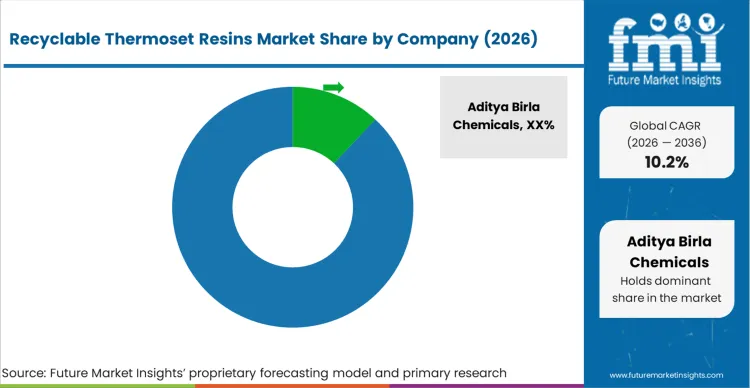
The structural reason for the high concentration in the recyclable thermoset resins space is the immense foundational intellectual property required to formulate dynamic covalent bonds that remain stable during use but cleave predictably on demand. Aditya Birla Chemicals, Olin Corporation, and Hexion lead the sector because they possess both the advanced catalyst manufacturing capabilities and the massive production scale required to bring these complex chemistries to cost parity with legacy systems. Buyers in this space primarily distinguish qualified from unqualified vendors based on the vendor's ability to provide a fully validated, closed-loop chemical depolymerization pathway alongside the virgin resin supply.
Incumbents like Huntsman Corporation and Connora Technologies hold a specific structural advantage because they have successfully mapped their reversible epoxies against the exact thermal curing profiles of existing composite autoclaves. This advantage persists because tier-1 aerospace and automotive manufacturers will not endure the capital expenditure of replacing their legacy thermal curing infrastructure just to accommodate a new resin. To replicate this position, a challenger must build a comprehensive application engineering capability that can seamlessly drop their novel cleavage chemistry into a buyer's existing manufacturing line without altering cycle times. This engineering integration is the true mechanism that secures long-term structural resin contracts.
Large buyers actively resist lock-in by mandating interoperability standards for the cleavage agents used to depolymerize these dynamic networks. The structural tension moving toward 2036 involves resin formulators attempting to lock buyers into proprietary solvent recovery ecosystems, while OEMs demand standardized cleavable bonds that can be processed by any third-party chemical recycler. The space is becoming increasingly concentrated among players who can offer total lifecycle material management, effectively shifting from selling a chemical product to leasing a high-performance structural matrix that must eventually be returned and recovered.
Key Players in Recyclable Thermoset Resins Market
- Aditya Birla Chemicals
- Olin Corporation
- Hexion Inc.
- Huntsman Corporation
- Swancor Holding Co., Ltd.
- Mallinda Inc.
- IBM Research
Scope of the Report
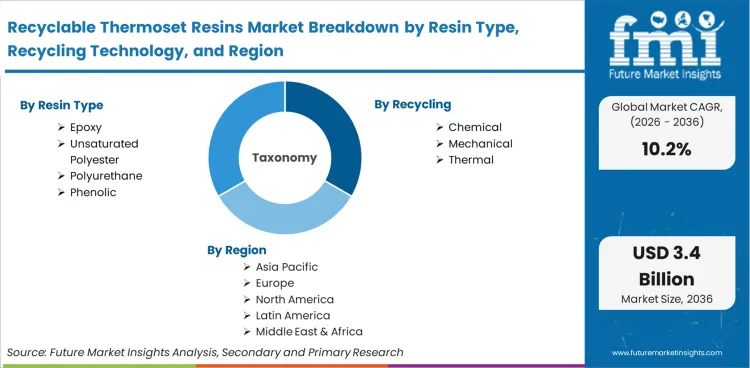
| Metric | Value |
|---|---|
| Quantitative Units | USD 1.3 billion to USD 3.4 billion, at a CAGR of 10.2% |
| Market Definition | This sector comprises engineered polymer matrices featuring reversible cross-links or cleavable bonds, allowing rigid composites to be depolymerized at end-of-life. It tracks materials designed from synthesis for circularity, distinguishing them from legacy thermosets that undergo destructive mechanical grinding. |
| Resin Type Segmentation | Epoxy, Unsaturated Polyester, Polyurethane, Phenolic |
| Recycling Technology Segmentation | Mechanical, Thermal, Chemical |
| End Use Segmentation | Wind Energy, Automotive & Transportation, Aerospace, Construction, Electronics |
| Regions Covered | North America, Europe, Asia Pacific, Latin America, Middle East & Africa |
| Countries Covered | India, China, Germany, United Kingdom, France, Japan, United States, and 40 plus countries |
| Key Companies Profiled | Aditya Birla Chemicals, Olin Corporation, Hexion, Huntsman Corporation, Swancor Holding, Connora Technologies, Mallinda, IBM |
| Forecast Period | 2026 to 2036 |
| Approach | The baseline value derives from a bottom-up aggregation of recyclable thermoset resin volumes across key end-use sectors, applying region-specific adoption curves for chemical, mechanical, and thermal recycling pathways to project future market expansion |
Source: Future Market Insights (FMI) analysis, based on proprietary forecasting model and primary research
Recyclable Thermoset Resins Market Analysis by Segments
Resin Type:
- Epoxy
- Unsaturated Polyester
- Polyurethane
- Phenolic
Recycling Technology:
- Mechanical
- Thermal
- Chemical
End Use:
- Wind Energy
- Automotive & Transportation
- Aerospace
- Construction
- Electronics
Region:
- North America
- United States
- Canada
- Europe
- Germany
- United Kingdom
- France
- Italy
- Spain
- Asia Pacific
- China
- Japan
- India
- South Korea
- Australia
- Latin America
- Brazil
- Mexico
- Middle East & Africa
- GCC
- South Africa
Bibliography
- USA Department of Energy, Office of Energy Efficiency & Renewable Energy. (2024, October). Circularity for Secure and Sustainable Products and Materials: A Draft Strategic Framework.
- European Environment Agency. (2024, April 16). Recycling Materials from Green Energy Technologies (Signal).
- Kreider, M., Eshuis, L., Constant, C., & Berry, D. (2024, May). Winding Down: End of Service and Recycling for Wind Energy. National Renewable Energy Laboratory.
- Miravalle, E., Viada, G., Bonomo, M., Barolo, C., Bracco, P., & Zanetti, M. (2024). Recycling of Commercially Available Biobased Thermoset Polyurethane Using Covalent Adaptable Network Mechanisms. Polymers, 16(15), 2217.
This bibliography is provided for reader reference. The full FMI report contains the complete reference list with primary source documentation.
This Report Addresses
- Market intelligence to support strategic decision making across cleavable epoxies and reversible cross-linking chemistries
- Market size estimation and 10-year revenue forecasts from 2026 to 2036, supported by baseline anchoring to wind blade manufacturing capacity
- Growth opportunity mapping across Resin Type, Recycling Technology, and End Use with emphasis on the transition from lab-scale batch cleavage to continuous-flow solvent recovery systems
- Segment and regional revenue forecasts covering chemical depolymerization technologies across aggressive European extended producer responsibility frameworks
- Competition strategy assessment including IP concentration, application engineering integration, and closed-loop chemical depolymerization pathways
- Technology development tracking including dynamic covalent bonds, cleavage agents, and thermal management systems for composite autoclaves
- Market access analysis covering end-of-life vehicle directives and offshore wind turbine decommissioning procurement pathways
- Market report delivery in PDF, Excel, PPT, and interactive dashboard formats for executive strategy, lifecycle material management, and operational benchmarking use
Frequently Asked Questions
How large is the demand for Recyclable Thermoset Resins in the global market in 2026?
Demand for Recyclable Thermoset Resins in the global market is estimated to be valued at USD 1.3 billion in 2026.
What will be the market size of Recyclable Thermoset Resins in the global market by 2036?
Market size for Recyclable Thermoset Resins is projected to reach USD 3.4 billion by 2036.
What is the expected demand growth for Recyclable Thermoset Resins in the global market between 2026 and 2036?
Demand for Recyclable Thermoset Resins is expected to grow at a CAGR of 10.2% between 2026 and 2036.
Which Resin Type is poised to lead global sales by 2026?
Epoxy accounts for 45.2% in 2026 as high-stress structural applications continue to require strong cross-link density and high tensile performance.
How significant is the role of Wind Energy in driving Recyclable Thermoset Resins adoption in 2026?
Wind Energy represents 38.7% of segment share as turbine blade decommissioning pressures force operators to adopt circular composite material strategies.
What is driving demand in China?
China’s automotive lightweighting and renewable energy expansion are accelerating the adoption of reversible epoxies and circular composite material systems.
What compliance standards or regulations are referenced for Germany?
Germany’s market is shaped by updated extended producer responsibility requirements that create direct cost pressure on legacy non-recyclable composite materials.
What is the China growth outlook in this report?
China is projected to grow at a CAGR of 12.5% during 2026 to 2036.
Why is North America described as a priority region in this report?
North America is a priority region because aerospace and automotive OEMs are funding pilot depolymerization facilities to reduce future landfill exposure and recover valuable continuous fibers.
What type of demand dominates in North America?
Demand focuses on cleavable resins that protect long-term composite economics by supporting high-value fiber recovery and reducing raw material volatility.
What is India's growth outlook in this report?
India is projected to expand at a CAGR of 13.4% during 2026 to 2036.
Does the report cover USA in its regional analysis?
Yes, USA is included within North America under the regional scope of analysis.
What are the sources referred to for analyzing USA?
Tier-1 aerospace manufacturing trends, qualification standards for structural composites, and commercial-scale resin validation pathways form the analytical basis.
What is the main demand theme linked to USA in its region coverage?
High-performance reversible epoxies for aerospace structures form the main demand theme in the United States.
Does the report cover Germany in its regional analysis?
Yes, Germany is included within Europe under the regional coverage framework.
What is the main Germany related demand theme in its region coverage?
Germany’s demand is linked to producer responsibility pressures and automotive supplier requalification of cleavable structural matrices.
Which product formats or configurations are strategically important for Asia Pacific supply chains?
Cleavable epoxies, dynamic covalent networks, and cost-effective reversible resin systems are strategically important for Asia Pacific composite manufacturing supply chains.
What is Recyclable Thermoset Resins and what is it mainly used for?
Recyclable Thermoset Resins are cross-linked polymer matrices engineered with cleavable bonds or reversible curing mechanisms. They are mainly used to enable composite recovery, fiber separation, and circular reuse at end-of-life.
What does Recyclable Thermoset Resins mean in this report?
The scope refers to thermoset materials designed from the synthesis stage for circularity, allowing depolymerization, recovery, and reuse instead of destructive disposal.
What is included in the scope of this Recyclable Thermoset Resins report?
The market covers cleavable epoxies, recyclable polyurethanes, reversible unsaturated polyesters, dynamic covalent network resins, cleavage agents, and recovered oligomers sold into secondary composite value chains.
What is excluded from the scope of this report?
Thermoplastic resins and traditional thermosets subjected only to grinding or downcycling are explicitly excluded because they do not enable true cross-link recovery or circular reuse.
What does market forecast mean on this page?
The market forecast represents a model-based projection built on composite manufacturing trends, recycling infrastructure development, and adoption assumptions across major end-use sectors.
How does FMI build and validate the Recyclable Thermoset Resins forecast?
The model applies a bottom-up methodology based on recyclable thermoset resin volumes across key end-use sectors and cross-validates projections against wind blade capacity, recycling plant investments, and qualification timelines in automotive and aerospace programs.
What does zero reliance on speculative third-party market research mean here?
Primary interviews, patent filings, regulatory publications, OEM sustainability disclosures, and validated infrastructure announcements are used instead of unverified syndicated estimates.
Preview the report firsthand - request a free sample
Get SampleGet the brochure for pricing and purchase details.
Get PDFTable of Content
- Executive Summary
- Global Market Outlook
- Demand-side Trends
- Supply-side Trends
- Technology Roadmap Analysis
- Analysis and Recommendations
- Market Overview
- Market Coverage / Taxonomy
- Market Definition / Scope / Limitations
- Research Methodology
- Chapter Orientation
- Analytical Lens and Working Hypotheses
- Market Structure, Signals, and Trend Drivers
- Benchmarking and Cross-market Comparability
- Market Sizing, Forecasting, and Opportunity Mapping
- Research Design and Evidence Framework
- Desk Research Programme (Secondary Evidence)
- Company Annual and Sustainability Reports
- Peer-reviewed Journals and Academic Literature
- Corporate Websites, Product Literature, and Technical Notes
- Earnings Decks and Investor Briefings
- Statutory Filings and Regulatory Disclosures
- Technical White Papers and Standards Notes
- Trade Journals, Industry Magazines, and Analyst Briefs
- Conference Proceedings, Webinars, and Seminar Materials
- Government Statistics Portals and Public Data Releases
- Press Releases and Reputable Media Coverage
- Specialist Newsletters and Curated Briefings
- Sector Databases and Reference Repositories
- FMI Internal Proprietary Databases and Historical Market Datasets
- Subscription Datasets and Paid Sources
- Social Channels, Communities, and Digital Listening Inputs
- Additional Desk Sources
- Expert Input and Fieldwork (Primary Evidence)
- Primary Modes
- Qualitative Interviews and Expert Elicitation
- Quantitative Surveys and Structured Data Capture
- Blended Approach
- Why Primary Evidence is Used
- Field Techniques
- Interviews
- Surveys
- Focus Groups
- Observational and In-context Research
- Social and Community Interactions
- Stakeholder Universe Engaged
- C-suite Leaders
- Board Members
- Presidents and Vice Presidents
- R&D and Innovation Heads
- Technical Specialists
- Domain Subject-matter Experts
- Scientists
- Physicians and Other Healthcare Professionals
- Governance, Ethics, and Data Stewardship
- Research Ethics
- Data Integrity and Handling
- Primary Modes
- Tooling, Models, and Reference Databases
- Desk Research Programme (Secondary Evidence)
- Data Engineering and Model Build
- Data Acquisition and Ingestion
- Cleaning, Normalisation, and Verification
- Synthesis, Triangulation, and Analysis
- Quality Assurance and Audit Trail
- Market Background
- Market Dynamics
- Drivers
- Restraints
- Opportunity
- Trends
- Scenario Forecast
- Demand in Optimistic Scenario
- Demand in Likely Scenario
- Demand in Conservative Scenario
- Opportunity Map Analysis
- Product Life Cycle Analysis
- Supply Chain Analysis
- Investment Feasibility Matrix
- Value Chain Analysis
- PESTLE and Porter’s Analysis
- Regulatory Landscape
- Regional Parent Market Outlook
- Production and Consumption Statistics
- Import and Export Statistics
- Market Dynamics
- Global Market Analysis 2021 to 2025 and Forecast, 2026 to 2036
- Historical Market Size Value (USD Million) Analysis, 2021 to 2025
- Current and Future Market Size Value (USD Million) Projections, 2026 to 2036
- Y-o-Y Growth Trend Analysis
- Absolute $ Opportunity Analysis
- Global Market Pricing Analysis 2021 to 2025 and Forecast 2026 to 2036
- Global Market Analysis 2021 to 2025 and Forecast 2026 to 2036, By Resin Type
- Introduction / Key Findings
- Historical Market Size Value (USD Million) Analysis By Resin Type , 2021 to 2025
- Current and Future Market Size Value (USD Million) Analysis and Forecast By Resin Type , 2026 to 2036
- Epoxy
- Unsaturated Polyester
- Polyurethane
- Phenolic
- Epoxy
- Y-o-Y Growth Trend Analysis By Resin Type , 2021 to 2025
- Absolute $ Opportunity Analysis By Resin Type , 2026 to 2036
- Global Market Analysis 2021 to 2025 and Forecast 2026 to 2036, By Recycling Technology
- Introduction / Key Findings
- Historical Market Size Value (USD Million) Analysis By Recycling Technology, 2021 to 2025
- Current and Future Market Size Value (USD Million) Analysis and Forecast By Recycling Technology, 2026 to 2036
- Chemical
- Mechanical
- Thermal
- Chemical
- Y-o-Y Growth Trend Analysis By Recycling Technology, 2021 to 2025
- Absolute $ Opportunity Analysis By Recycling Technology, 2026 to 2036
- Global Market Analysis 2021 to 2025 and Forecast 2026 to 2036, By End Use
- Introduction / Key Findings
- Historical Market Size Value (USD Million) Analysis By End Use, 2021 to 2025
- Current and Future Market Size Value (USD Million) Analysis and Forecast By End Use, 2026 to 2036
- Wind Energy
- Automotive & Transportation
- Aerospace
- Construction
- Electronics
- Wind Energy
- Y-o-Y Growth Trend Analysis By End Use, 2021 to 2025
- Absolute $ Opportunity Analysis By End Use, 2026 to 2036
- Global Market Analysis 2021 to 2025 and Forecast 2026 to 2036, By Region
- Introduction
- Historical Market Size Value (USD Million) Analysis By Region, 2021 to 2025
- Current Market Size Value (USD Million) Analysis and Forecast By Region, 2026 to 2036
- North America
- Latin America
- Western Europe
- Eastern Europe
- East Asia
- South Asia and Pacific
- Middle East & Africa
- Market Attractiveness Analysis By Region
- North America Market Analysis 2021 to 2025 and Forecast 2026 to 2036, By Country
- Historical Market Size Value (USD Million) Trend Analysis By Market Taxonomy, 2021 to 2025
- Market Size Value (USD Million) Forecast By Market Taxonomy, 2026 to 2036
- By Country
- USA
- Canada
- Mexico
- By Resin Type
- By Recycling Technology
- By End Use
- By Country
- Market Attractiveness Analysis
- By Country
- By Resin Type
- By Recycling Technology
- By End Use
- Key Takeaways
- Latin America Market Analysis 2021 to 2025 and Forecast 2026 to 2036, By Country
- Historical Market Size Value (USD Million) Trend Analysis By Market Taxonomy, 2021 to 2025
- Market Size Value (USD Million) Forecast By Market Taxonomy, 2026 to 2036
- By Country
- Brazil
- Chile
- Rest of Latin America
- By Resin Type
- By Recycling Technology
- By End Use
- By Country
- Market Attractiveness Analysis
- By Country
- By Resin Type
- By Recycling Technology
- By End Use
- Key Takeaways
- Western Europe Market Analysis 2021 to 2025 and Forecast 2026 to 2036, By Country
- Historical Market Size Value (USD Million) Trend Analysis By Market Taxonomy, 2021 to 2025
- Market Size Value (USD Million) Forecast By Market Taxonomy, 2026 to 2036
- By Country
- Germany
- UK
- Italy
- Spain
- France
- Nordic
- BENELUX
- Rest of Western Europe
- By Resin Type
- By Recycling Technology
- By End Use
- By Country
- Market Attractiveness Analysis
- By Country
- By Resin Type
- By Recycling Technology
- By End Use
- Key Takeaways
- Eastern Europe Market Analysis 2021 to 2025 and Forecast 2026 to 2036, By Country
- Historical Market Size Value (USD Million) Trend Analysis By Market Taxonomy, 2021 to 2025
- Market Size Value (USD Million) Forecast By Market Taxonomy, 2026 to 2036
- By Country
- Russia
- Poland
- Hungary
- Balkan & Baltic
- Rest of Eastern Europe
- By Resin Type
- By Recycling Technology
- By End Use
- By Country
- Market Attractiveness Analysis
- By Country
- By Resin Type
- By Recycling Technology
- By End Use
- Key Takeaways
- East Asia Market Analysis 2021 to 2025 and Forecast 2026 to 2036, By Country
- Historical Market Size Value (USD Million) Trend Analysis By Market Taxonomy, 2021 to 2025
- Market Size Value (USD Million) Forecast By Market Taxonomy, 2026 to 2036
- By Country
- China
- Japan
- South Korea
- By Resin Type
- By Recycling Technology
- By End Use
- By Country
- Market Attractiveness Analysis
- By Country
- By Resin Type
- By Recycling Technology
- By End Use
- Key Takeaways
- South Asia and Pacific Market Analysis 2021 to 2025 and Forecast 2026 to 2036, By Country
- Historical Market Size Value (USD Million) Trend Analysis By Market Taxonomy, 2021 to 2025
- Market Size Value (USD Million) Forecast By Market Taxonomy, 2026 to 2036
- By Country
- India
- ASEAN
- Australia & New Zealand
- Rest of South Asia and Pacific
- By Resin Type
- By Recycling Technology
- By End Use
- By Country
- Market Attractiveness Analysis
- By Country
- By Resin Type
- By Recycling Technology
- By End Use
- Key Takeaways
- Middle East & Africa Market Analysis 2021 to 2025 and Forecast 2026 to 2036, By Country
- Historical Market Size Value (USD Million) Trend Analysis By Market Taxonomy, 2021 to 2025
- Market Size Value (USD Million) Forecast By Market Taxonomy, 2026 to 2036
- By Country
- Kingdom of Saudi Arabia
- Other GCC Countries
- Turkiye
- South Africa
- Other African Union
- Rest of Middle East & Africa
- By Resin Type
- By Recycling Technology
- By End Use
- By Country
- Market Attractiveness Analysis
- By Country
- By Resin Type
- By Recycling Technology
- By End Use
- Key Takeaways
- Key Countries Market Analysis
- USA
- Pricing Analysis
- Market Share Analysis, 2025
- By Resin Type
- By Recycling Technology
- By End Use
- Canada
- Pricing Analysis
- Market Share Analysis, 2025
- By Resin Type
- By Recycling Technology
- By End Use
- Mexico
- Pricing Analysis
- Market Share Analysis, 2025
- By Resin Type
- By Recycling Technology
- By End Use
- Brazil
- Pricing Analysis
- Market Share Analysis, 2025
- By Resin Type
- By Recycling Technology
- By End Use
- Chile
- Pricing Analysis
- Market Share Analysis, 2025
- By Resin Type
- By Recycling Technology
- By End Use
- Germany
- Pricing Analysis
- Market Share Analysis, 2025
- By Resin Type
- By Recycling Technology
- By End Use
- UK
- Pricing Analysis
- Market Share Analysis, 2025
- By Resin Type
- By Recycling Technology
- By End Use
- Italy
- Pricing Analysis
- Market Share Analysis, 2025
- By Resin Type
- By Recycling Technology
- By End Use
- Spain
- Pricing Analysis
- Market Share Analysis, 2025
- By Resin Type
- By Recycling Technology
- By End Use
- France
- Pricing Analysis
- Market Share Analysis, 2025
- By Resin Type
- By Recycling Technology
- By End Use
- India
- Pricing Analysis
- Market Share Analysis, 2025
- By Resin Type
- By Recycling Technology
- By End Use
- ASEAN
- Pricing Analysis
- Market Share Analysis, 2025
- By Resin Type
- By Recycling Technology
- By End Use
- Australia & New Zealand
- Pricing Analysis
- Market Share Analysis, 2025
- By Resin Type
- By Recycling Technology
- By End Use
- China
- Pricing Analysis
- Market Share Analysis, 2025
- By Resin Type
- By Recycling Technology
- By End Use
- Japan
- Pricing Analysis
- Market Share Analysis, 2025
- By Resin Type
- By Recycling Technology
- By End Use
- South Korea
- Pricing Analysis
- Market Share Analysis, 2025
- By Resin Type
- By Recycling Technology
- By End Use
- Russia
- Pricing Analysis
- Market Share Analysis, 2025
- By Resin Type
- By Recycling Technology
- By End Use
- Poland
- Pricing Analysis
- Market Share Analysis, 2025
- By Resin Type
- By Recycling Technology
- By End Use
- Hungary
- Pricing Analysis
- Market Share Analysis, 2025
- By Resin Type
- By Recycling Technology
- By End Use
- Kingdom of Saudi Arabia
- Pricing Analysis
- Market Share Analysis, 2025
- By Resin Type
- By Recycling Technology
- By End Use
- Turkiye
- Pricing Analysis
- Market Share Analysis, 2025
- By Resin Type
- By Recycling Technology
- By End Use
- South Africa
- Pricing Analysis
- Market Share Analysis, 2025
- By Resin Type
- By Recycling Technology
- By End Use
- USA
- Market Structure Analysis
- Competition Dashboard
- Competition Benchmarking
- Market Share Analysis of Top Players
- By Regional
- By Resin Type
- By Recycling Technology
- By End Use
- Competition Analysis
- Competition Deep Dive
- Aditya Birla Chemicals
- Overview
- Product Portfolio
- Profitability by Market Segments (Product/Age /Sales Channel/Region)
- Sales Footprint
- Strategy Overview
- Marketing Strategy
- Product Strategy
- Channel Strategy
- Olin Corporation
- Hexion Inc.
- Huntsman Corporation
- Swancor Holding Co., Ltd.
- Mallinda Inc.
- IBM Research
- Aditya Birla Chemicals
- Competition Deep Dive
- Assumptions & Acronyms Used


