

- Industry Size (2026)
- USD 4.4 Bn
- Forecast (2036)
- USD 8.7 Bn
- CAGR (2026 to 2036)
- 7.1%
Recyclable Thermoforms Market Size, Market Forecast and Outlook By FMI
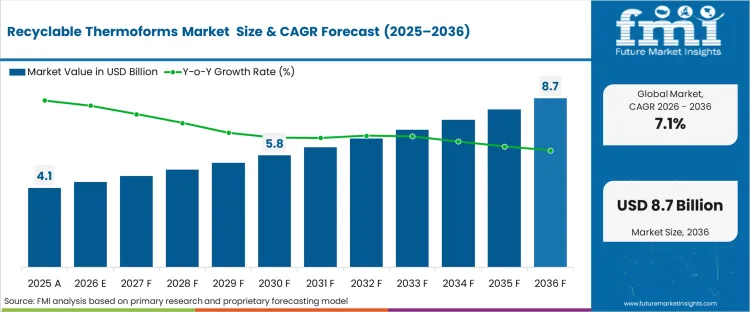
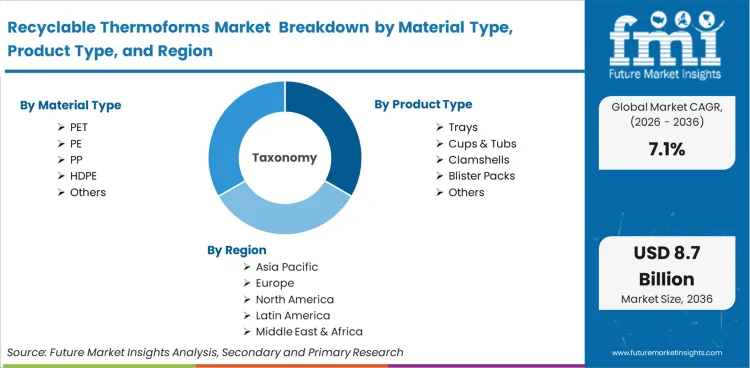
The recyclable thermoforms market was valued at USD 4.1 billion in 2025. The market is projected to reach USD 4.4 billion in 2026 and USD 8.7 billion by 2036, expanding at a CAGR of 7.1% during the forecast period. The PET segment leads material type with a 43.4% share in 2026. The Trays segment is projected to remain the leading product type segment with a 36.7% share in 2026. The Fresh Food segment is expected to lead end-use demand with a 47.3% share in 2026.
Key Drivers
- Fresh-pack demand: Thermoforms remain essential in fresh food, dairy, and healthcare packs where shape retention and product visibility matter.
- Design-guide influence: APR and other recycler guidance is pushing thermoform design toward more recyclable formats.
- Rigid-pack pragmatism: Many brands still need rigid or semi-rigid pack functionality, so redesign is happening inside thermoforms rather than away from them.
Key Segments Analyzed in the Report
- Material Type: PET, PE, PP, HDPE, and Others
- Product Type: Trays, Cups & Tubs, Clamshells, Blister Packs, and Others
- End Use Industry: Fresh Food, Dairy & Deli, Healthcare, Foodservice, and Others
- Region: North America, Latin America, Europe, Asia Pacific, and Middle East & Africa
Analyst Opinion
- Ismail Sutaria, Senior Consultant at Future Market Insights says, "Recyclable thermoforms are gaining because thermoforming never disappeared. What changed is that trays, cups, and blisters now have to justify their place in a circular system. The market is rewarding formats that redesign labels, lids, and structures together rather than treating recyclability as an afterthought."
Recyclable Thermoforms Market Definition
The recyclable thermoforms market covers thermoformed packaging formats designed to be compatible with recognised recycling pathways through material choice, structure simplification, and design-for-recycling optimization. It includes PET, PE, PP, and related thermoformed trays, cups, tubs, clamshells, and blisters used in food, healthcare, and foodservice packaging. These packs are adopted where the shape, clarity, or protection benefits of thermoforming remain valuable but pack designers are under pressure to improve recyclability and reduce problematic components.
Recyclable Thermoforms Market Inclusions
- Thermoformed trays, tubs, clamshells, blisters, and related packs designed for recyclability.
- Revenue from food, healthcare, and foodservice thermoform applications.
- Demand across North America, Latin America, Europe, Asia Pacific, and the Middle East & Africa.
Recyclable Thermoforms Market Exclusions
- Thermoforms without a credible recycling-design pathway.
- Finished packaged consumer products sold in thermoforms.
- Injection-moulded and blow-moulded rigid packaging except as adjacent-format benchmarks.
Recyclable Thermoforms Market Research Methodology
This study evaluates the recyclable thermoforms market across material type, product type, end use industry, and region, using 2025 as the base year and 2026 to 2036 as the forecast period. Market value is expressed in USD billion. Evidence inputs include APR design guidance, company recycle-ready thermoform launches, healthcare blister innovation materials, and official packaging regulation documents. Triangulation combines end-use demand, pack conversion intensity, barrier-function value density, material substitution rates, and supplier positioning to derive the segment and regional estimates.
Key Drivers, Restraints, and Trends in Recyclable Thermoforms Market
Drivers
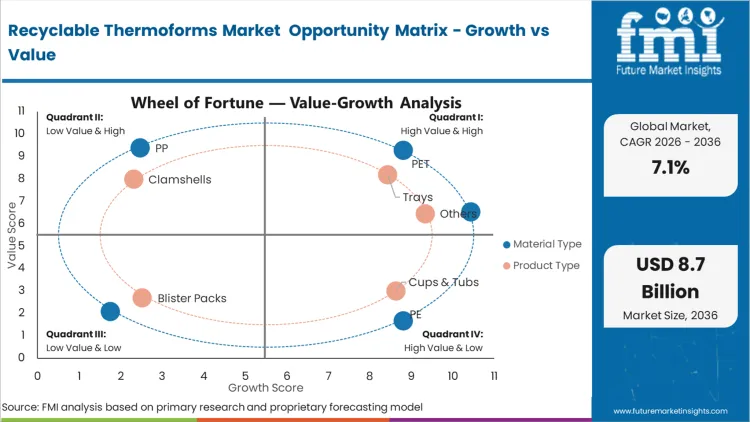
Recyclable thermoforms are expanding because rigid and semi-rigid packaging performance still matters in many markets. Fresh foods, deli, dairy, and healthcare need shape retention, stackability, visibility, and pack protection that many flexible alternatives cannot fully replace. The redesign challenge is therefore to keep the functional benefits of thermoforming while improving the pack's fit with real recycling systems. Guidance from APR and similar bodies has made that redesign more structured. As trays, cups, and blisters are reworked around better material choice, compatible labels, and simplified layers, recyclable thermoforms move from a niche goal into an operational packaging priority.
Restraints
Thermoform recycling remains technically and commercially uneven. Labels, adhesives, colour, barrier layers, and lid combinations can all weaken recyclability. PET thermoforms also intersect with bottle-stream economics, which creates added scrutiny. In healthcare and pharma, requalification is slow and costly. Replacing legacy PA or PVC combinations can require major validation work. Cost pressure is also rising as thermoform converters balance recycled-content goals, clarity expectations, and mechanical performance.
Trends
The strongest trend is the move from generic recyclable claims to design-detail optimisation. Thermoform suppliers are focusing more on the total pack, including lids, labels, closures, and additives. Healthcare blister redesign is another visible trend, especially where mono-PE systems are promoted as alternatives to PVC-based structures. Food trays remain the largest commercial base, but deli, dairy, and medical applications are increasingly important because they offer high-value proof points for recyclable thermoform design.
Segmental Analysis
Recyclable Thermoforms Analysis by Material Type
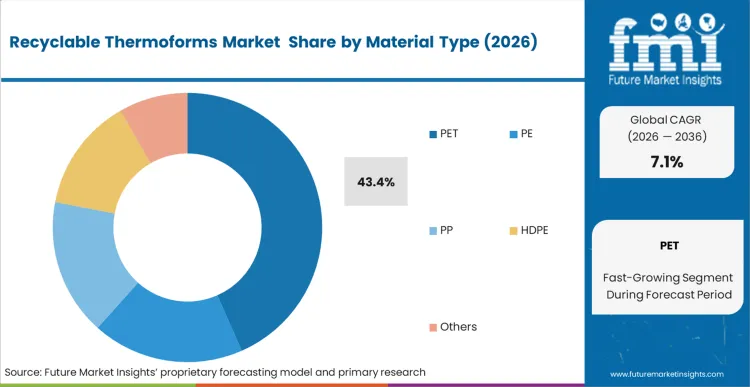
The PET segment is expected to lead the material type segment with a 43.4% share in 2026. PET leads because it remains the reference material for many clear thermoforms and has the largest installed base in trays, clamshells, and food packaging. That installed base creates the biggest incentive for recyclable redesign rather than outright format replacement. The APR's 2024 PET Thermoform Packaging Design Resource Document shows how much technical attention is being directed toward keeping PET thermoforms more compatible with established recycling pathways.
Recyclable Thermoforms Analysis by Product Type

The Trays segment is expected to lead the product type segment with a 36.7% share in 2026. Trays dominate because they are the workhorse thermoformed format across fresh food, meat, produce, and deli applications. Their scale and visibility make them the first target for recyclable redesign and material substitution. Metsa Board's 2025 case study comparing dispersion-barrier board trays with PET trays, together with Amcor's recycle-ready thermoforming film work, confirms that trays are the centre of commercial redesign activity.
Competitive Aligners for Market Players
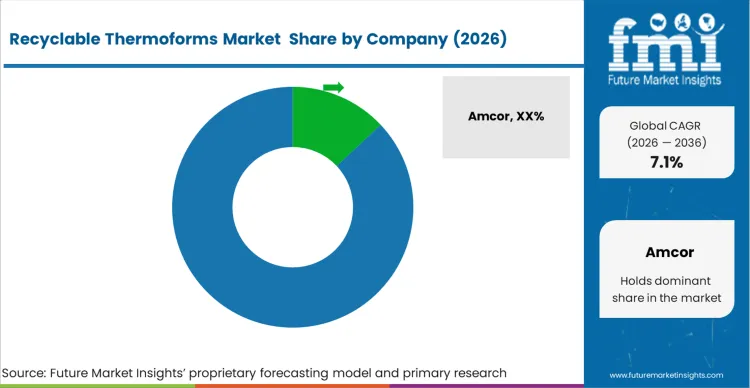
Competition in recyclable thermoforms is built around pack-system optimisation, not just material claims. APR has given the market a clearer design benchmark for PET thermoforms, while Amcor has expanded recycle-ready thermoforming and blister solutions into food and healthcare. Metsa Board is using tray case studies to challenge fossil-based rigid formats from the fibre side, adding further pressure on incumbent plastics. The strongest companies are the ones that can show recyclability gains without undermining pack protection, line efficiency, or consumer presentation. That is where thermoform value is being defended.
Key Players in Recyclable Thermoforms Market
- Amcor
- Berry Global
- Sonoco
- Metsa Board
- Klöckner Pentaplast
- SEE
- TekniPlex
- Sabert
- Pactiv Evergreen
- Faerch
Strategic Outlook by FMI on Recyclable Thermoforms Market
FMI expects recyclable thermoforms to remain a major redesign market because many end uses still need the structural benefits of thermoforming. Future growth will be shaped by design-guide compliance, better accessory compatibility, and more credible recycling outcomes in food and healthcare formats. Suppliers that optimise the full thermoform system instead of only the tray or web will gain the strongest competitive position.
Scope of the Report
| Metric | Value |
|---|---|
| Market Value | USD 4.1 billion in 2025 to USD 8.7 billion by 2036 |
| CAGR | 7.1% from 2026 to 2036 |
| Base Year | 2025 |
| Forecast Period | 2026 to 2036 |
| Material Type Segmentation | PET, PE, PP, HDPE, Others |
| Product Type Segmentation | Trays, Cups & Tubs, Clamshells, Blister Packs, Others |
| End Use Industry Segmentation | Fresh Food, Dairy & Deli, Healthcare, Foodservice, Others |
| Regions Covered | North America, Latin America, Europe, Asia Pacific, Middle East & Africa |
Bibliography
- Association of Plastic Recyclers. 2024. PET Thermoform Packaging Design Resource Document.
- Association of Plastic Recyclers. APR Design Guide Overview.
- European Parliament and Council. 2025. Regulation (EU) 2025/40 on packaging and packaging waste.
- Amcor. 2023. New recycle-ready forming films for meat, fish and cheese, with 80% carbon footprint reduction.
- Amcor. AmSky Recycle-Ready Thermoformed Blister System.
Frequently Asked Questions
What is the projected size of the Recyclable Thermoforms market by 2036?
The recyclable thermoforms market is projected to reach USD 8.7 billion by 2036.
What is the CAGR of the Recyclable Thermoforms market from 2026 to 2036?
The recyclable thermoforms market is projected to expand at a CAGR of 7.1% from 2026 to 2036.
Which material type segment leads the Recyclable Thermoforms market? The
PET segment leads the recyclable thermoforms market with a 43.4% share in 2026.
Which product type segment dominates the Recyclable Thermoforms market?
The Trays segment holds the leading position in the recyclable thermoforms market with a 36.7% share in 2026.
Which end use industry leads the Recyclable Thermoforms market? The Fresh
Food segment is expected to account for the largest share of the recyclable thermoforms market at 47.3% in 2026.
Who are the key companies in the Recyclable Thermoforms market? Key
companies active in the recyclable thermoforms market include Amcor, Berry Global, Sonoco, Metsa Board, Klöckner Pentaplast, and other packaging-material and converter specialists.
What is driving demand in the Recyclable Thermoforms market? Demand in
the recyclable thermoforms market is being driven by packaging redesign toward better recyclability, stronger barrier performance, and improved line economics.
Preview the report firsthand - request a free sample
Get SampleGet the brochure for pricing and purchase details.
Get PDFTable of Content
- Executive Summary
- Global Market Outlook
- Demand-side Trends
- Supply-side Trends
- Technology Roadmap Analysis
- Analysis and Recommendations
- Market Overview
- Market Coverage / Taxonomy
- Market Definition / Scope / Limitations
- Research Methodology
- Chapter Orientation
- Analytical Lens and Working Hypotheses
- Market Structure, Signals, and Trend Drivers
- Benchmarking and Cross-market Comparability
- Market Sizing, Forecasting, and Opportunity Mapping
- Research Design and Evidence Framework
- Desk Research Programme (Secondary Evidence)
- Company Annual and Sustainability Reports
- Peer-reviewed Journals and Academic Literature
- Corporate Websites, Product Literature, and Technical Notes
- Earnings Decks and Investor Briefings
- Statutory Filings and Regulatory Disclosures
- Technical White Papers and Standards Notes
- Trade Journals, Industry Magazines, and Analyst Briefs
- Conference Proceedings, Webinars, and Seminar Materials
- Government Statistics Portals and Public Data Releases
- Press Releases and Reputable Media Coverage
- Specialist Newsletters and Curated Briefings
- Sector Databases and Reference Repositories
- FMI Internal Proprietary Databases and Historical Market Datasets
- Subscription Datasets and Paid Sources
- Social Channels, Communities, and Digital Listening Inputs
- Additional Desk Sources
- Expert Input and Fieldwork (Primary Evidence)
- Primary Modes
- Qualitative Interviews and Expert Elicitation
- Quantitative Surveys and Structured Data Capture
- Blended Approach
- Why Primary Evidence is Used
- Field Techniques
- Interviews
- Surveys
- Focus Groups
- Observational and In-context Research
- Social and Community Interactions
- Stakeholder Universe Engaged
- C-suite Leaders
- Board Members
- Presidents and Vice Presidents
- R&D and Innovation Heads
- Technical Specialists
- Domain Subject-matter Experts
- Scientists
- Physicians and Other Healthcare Professionals
- Governance, Ethics, and Data Stewardship
- Research Ethics
- Data Integrity and Handling
- Primary Modes
- Tooling, Models, and Reference Databases
- Desk Research Programme (Secondary Evidence)
- Data Engineering and Model Build
- Data Acquisition and Ingestion
- Cleaning, Normalisation, and Verification
- Synthesis, Triangulation, and Analysis
- Quality Assurance and Audit Trail
- Market Background
- Market Dynamics
- Drivers
- Restraints
- Opportunity
- Trends
- Scenario Forecast
- Demand in Optimistic Scenario
- Demand in Likely Scenario
- Demand in Conservative Scenario
- Opportunity Map Analysis
- Product Life Cycle Analysis
- Supply Chain Analysis
- Investment Feasibility Matrix
- Value Chain Analysis
- PESTLE and Porter’s Analysis
- Regulatory Landscape
- Regional Parent Market Outlook
- Production and Consumption Statistics
- Import and Export Statistics
- Market Dynamics
- Global Market Analysis 2021 to 2025 and Forecast, 2026 to 2036
- Historical Market Size Value (USD Million) Analysis, 2021 to 2025
- Current and Future Market Size Value (USD Million) Projections, 2026 to 2036
- Y-o-Y Growth Trend Analysis
- Absolute $ Opportunity Analysis
- Global Market Pricing Analysis 2021 to 2025 and Forecast 2026 to 2036
- Global Market Analysis 2021 to 2025 and Forecast 2026 to 2036, By Material Type
- Introduction / Key Findings
- Historical Market Size Value (USD Million) Analysis By Material Type , 2021 to 2025
- Current and Future Market Size Value (USD Million) Analysis and Forecast By Material Type , 2026 to 2036
- PET
- PE
- PP
- HDPE
- Others
- PET
- Y-o-Y Growth Trend Analysis By Material Type , 2021 to 2025
- Absolute $ Opportunity Analysis By Material Type , 2026 to 2036
- Global Market Analysis 2021 to 2025 and Forecast 2026 to 2036, By Product Type
- Introduction / Key Findings
- Historical Market Size Value (USD Million) Analysis By Product Type, 2021 to 2025
- Current and Future Market Size Value (USD Million) Analysis and Forecast By Product Type, 2026 to 2036
- Trays
- Cups & Tubs
- Clamshells
- Blister Packs
- Others
- Trays
- Y-o-Y Growth Trend Analysis By Product Type, 2021 to 2025
- Absolute $ Opportunity Analysis By Product Type, 2026 to 2036
- Global Market Analysis 2021 to 2025 and Forecast 2026 to 2036, By Region
- Introduction
- Historical Market Size Value (USD Million) Analysis By Region, 2021 to 2025
- Current Market Size Value (USD Million) Analysis and Forecast By Region, 2026 to 2036
- North America
- Latin America
- Western Europe
- Eastern Europe
- East Asia
- South Asia and Pacific
- Middle East & Africa
- Market Attractiveness Analysis By Region
- North America Market Analysis 2021 to 2025 and Forecast 2026 to 2036, By Country
- Historical Market Size Value (USD Million) Trend Analysis By Market Taxonomy, 2021 to 2025
- Market Size Value (USD Million) Forecast By Market Taxonomy, 2026 to 2036
- By Country
- USA
- Canada
- Mexico
- By Material Type
- By Product Type
- By Country
- Market Attractiveness Analysis
- By Country
- By Material Type
- By Product Type
- Key Takeaways
- Latin America Market Analysis 2021 to 2025 and Forecast 2026 to 2036, By Country
- Historical Market Size Value (USD Million) Trend Analysis By Market Taxonomy, 2021 to 2025
- Market Size Value (USD Million) Forecast By Market Taxonomy, 2026 to 2036
- By Country
- Brazil
- Chile
- Rest of Latin America
- By Material Type
- By Product Type
- By Country
- Market Attractiveness Analysis
- By Country
- By Material Type
- By Product Type
- Key Takeaways
- Western Europe Market Analysis 2021 to 2025 and Forecast 2026 to 2036, By Country
- Historical Market Size Value (USD Million) Trend Analysis By Market Taxonomy, 2021 to 2025
- Market Size Value (USD Million) Forecast By Market Taxonomy, 2026 to 2036
- By Country
- Germany
- UK
- Italy
- Spain
- France
- Nordic
- BENELUX
- Rest of Western Europe
- By Material Type
- By Product Type
- By Country
- Market Attractiveness Analysis
- By Country
- By Material Type
- By Product Type
- Key Takeaways
- Eastern Europe Market Analysis 2021 to 2025 and Forecast 2026 to 2036, By Country
- Historical Market Size Value (USD Million) Trend Analysis By Market Taxonomy, 2021 to 2025
- Market Size Value (USD Million) Forecast By Market Taxonomy, 2026 to 2036
- By Country
- Russia
- Poland
- Hungary
- Balkan & Baltic
- Rest of Eastern Europe
- By Material Type
- By Product Type
- By Country
- Market Attractiveness Analysis
- By Country
- By Material Type
- By Product Type
- Key Takeaways
- East Asia Market Analysis 2021 to 2025 and Forecast 2026 to 2036, By Country
- Historical Market Size Value (USD Million) Trend Analysis By Market Taxonomy, 2021 to 2025
- Market Size Value (USD Million) Forecast By Market Taxonomy, 2026 to 2036
- By Country
- China
- Japan
- South Korea
- By Material Type
- By Product Type
- By Country
- Market Attractiveness Analysis
- By Country
- By Material Type
- By Product Type
- Key Takeaways
- South Asia and Pacific Market Analysis 2021 to 2025 and Forecast 2026 to 2036, By Country
- Historical Market Size Value (USD Million) Trend Analysis By Market Taxonomy, 2021 to 2025
- Market Size Value (USD Million) Forecast By Market Taxonomy, 2026 to 2036
- By Country
- India
- ASEAN
- Australia & New Zealand
- Rest of South Asia and Pacific
- By Material Type
- By Product Type
- By Country
- Market Attractiveness Analysis
- By Country
- By Material Type
- By Product Type
- Key Takeaways
- Middle East & Africa Market Analysis 2021 to 2025 and Forecast 2026 to 2036, By Country
- Historical Market Size Value (USD Million) Trend Analysis By Market Taxonomy, 2021 to 2025
- Market Size Value (USD Million) Forecast By Market Taxonomy, 2026 to 2036
- By Country
- Kingdom of Saudi Arabia
- Other GCC Countries
- Turkiye
- South Africa
- Other African Union
- Rest of Middle East & Africa
- By Material Type
- By Product Type
- By Country
- Market Attractiveness Analysis
- By Country
- By Material Type
- By Product Type
- Key Takeaways
- Key Countries Market Analysis
- USA
- Pricing Analysis
- Market Share Analysis, 2025
- By Material Type
- By Product Type
- Canada
- Pricing Analysis
- Market Share Analysis, 2025
- By Material Type
- By Product Type
- Mexico
- Pricing Analysis
- Market Share Analysis, 2025
- By Material Type
- By Product Type
- Brazil
- Pricing Analysis
- Market Share Analysis, 2025
- By Material Type
- By Product Type
- Chile
- Pricing Analysis
- Market Share Analysis, 2025
- By Material Type
- By Product Type
- Germany
- Pricing Analysis
- Market Share Analysis, 2025
- By Material Type
- By Product Type
- UK
- Pricing Analysis
- Market Share Analysis, 2025
- By Material Type
- By Product Type
- Italy
- Pricing Analysis
- Market Share Analysis, 2025
- By Material Type
- By Product Type
- Spain
- Pricing Analysis
- Market Share Analysis, 2025
- By Material Type
- By Product Type
- France
- Pricing Analysis
- Market Share Analysis, 2025
- By Material Type
- By Product Type
- India
- Pricing Analysis
- Market Share Analysis, 2025
- By Material Type
- By Product Type
- ASEAN
- Pricing Analysis
- Market Share Analysis, 2025
- By Material Type
- By Product Type
- Australia & New Zealand
- Pricing Analysis
- Market Share Analysis, 2025
- By Material Type
- By Product Type
- China
- Pricing Analysis
- Market Share Analysis, 2025
- By Material Type
- By Product Type
- Japan
- Pricing Analysis
- Market Share Analysis, 2025
- By Material Type
- By Product Type
- South Korea
- Pricing Analysis
- Market Share Analysis, 2025
- By Material Type
- By Product Type
- Russia
- Pricing Analysis
- Market Share Analysis, 2025
- By Material Type
- By Product Type
- Poland
- Pricing Analysis
- Market Share Analysis, 2025
- By Material Type
- By Product Type
- Hungary
- Pricing Analysis
- Market Share Analysis, 2025
- By Material Type
- By Product Type
- Kingdom of Saudi Arabia
- Pricing Analysis
- Market Share Analysis, 2025
- By Material Type
- By Product Type
- Turkiye
- Pricing Analysis
- Market Share Analysis, 2025
- By Material Type
- By Product Type
- South Africa
- Pricing Analysis
- Market Share Analysis, 2025
- By Material Type
- By Product Type
- USA
- Market Structure Analysis
- Competition Dashboard
- Competition Benchmarking
- Market Share Analysis of Top Players
- By Regional
- By Material Type
- By Product Type
- Competition Analysis
- Competition Deep Dive
- Amcor
- Overview
- Product Portfolio
- Profitability by Market Segments (Product/Age /Sales Channel/Region)
- Sales Footprint
- Strategy Overview
- Marketing Strategy
- Product Strategy
- Channel Strategy
- Berry Global
- Sonoco
- Metsa Board
- Klöckner Pentaplast
- SEE
- TekniPlex
- Sabert
- Pactiv Evergreen
- Faerch
- Amcor
- Competition Deep Dive
- Assumptions & Acronyms Used


