

- Industry Size (2026)
- USD 2257.5 Mn
- Forecast (2036)
- USD 4652.8 Mn
- CAGR (2026 to 2036)
- 7.5%
Elastic Core-Spun Yarn Market Forecast and Outlook 2026 to 2036
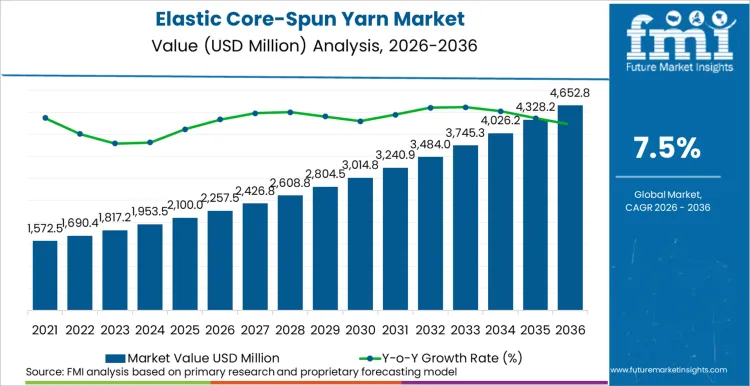
The elastic core-spun yarn market is likely to be valued at USD 2,257.5 million in 2026 and is forecasted to reach USD 4,652.8 million by 2036, expanding at a CAGR of 7.5% during the forecast period. Growth is driven by rising specification of stretch-enabled yarns in apparel and technical textiles where fit retention, recovery, and long-term comfort are essential performance parameters. Core-spun constructions, combining elastane or similar elastic cores with natural or synthetic sheath fibers, allow fabrics to sustain repeated extension without permanent deformation. Demand remains concentrated in denim, activewear, intimate apparel, and medical textiles, where controlled elasticity directly influences product functionality and user acceptance.
Market expansion reflects substitution within established textile categories rather than volume-driven fabric growth. Adoption depends on consistent yarn uniformity, predictable elongation behavior, and compatibility with high-speed knitting and weaving systems. Cost structure and production complexity moderate uptake, as elastomeric cores increase material expense and require precise spinning control. Value growth follows increasing use of stretch fabrics in everyday garments and performance applications, supported by brand emphasis on comfort, durability, and dimensional stability across repeated wear and laundering cycles.
Quick Stats for Elastic Core-Spun Yarn Market
- Elastic Core-Spun Yarn Market Value (2026): USD 2,257.5 million
- Elastic Core-Spun Yarn Market Forecast Value (2036): USD 4,652.8 million
- Elastic Core-Spun Yarn Market Forecast CAGR 2026 to 2036: 7.5%
- Leading Core Material by Demand Share: Spandex/Elastane Core
- Fastest-Growing Regions: China, Brazil, USA, Germany, South Korea
- Key Industry Participants: Lycra Company (via partners), Hyosung (creora), Asahi Kasei (Roica), Indorama Ventures, Toray Industries
Elastic Core-Spun Yarn Market Key Takeaways
| Metric | Value |
|---|---|
| Market Value (2026) | USD 2,257.5 million |
| Market Forecast Value (2036) | USD 4,652.8 million |
| Forecast CAGR 2026 to 2036 | 7.5% |
Source: Future Market Insights (FMI) analysis, based on proprietary forecasting model and primary research
Why is the Demand for Elastic Core Spun Yarn Growing?
Manufacturers in the apparel and technical textile sectors are increasingly specifying elastic core-spun yarn because it delivers enhanced stretch, recovery, and comfort that traditional yarns cannot match. Core-spun constructions wrap high-strength filaments such as polyester or nylon around an elastane core, creating fabrics that maintain shape under repeated extension, a critical performance attribute in activewear, intimate apparel, and compression garments. Athletic brands depend on this yarn to provide consistent elasticity and support in leggings, sports bras, and performance tops where fabric must respond to dynamic movement. Hosiery producers leverage core-spun designs to balance resilience with softness, addressing consumer demand for snug fit without restriction.
Technical textiles used in medical bandages and orthotic supports also benefit from controlled stretch and recovery that meets application-specific functional criteria. Procurement of elastic core-spun yarn is shaped by material innovations that improve filament integration and enhance durability under laundering and prolonged wear. Spinners refine sheath selection and processing parameters to optimize yarn evenness, reduce pilling, and control elongation at break. Textile converters evaluate these yarns for compatibility with knitting and weaving equipment to achieve target gauge and cover factor in fabric structures. Growth in athleisure, performance fashion, and health care textiles reinforces adoption because market segments prioritize both comfort and long-term dimensional stability. Retailers and brand owners seek suppliers who can deliver consistent lots and colorfast properties essential for seasonal collections and coordinated product lines.
How Is the Elastic Core-Spun Yarn Industry Structured by Core Material, Sheath Fiber, and Application?
Elastic core-spun yarn demand is shaped by stretch performance, comfort expectations, fabric durability, and downstream garment construction needs. Manufacturers assess core elasticity, sheath compatibility, and fabric end-use requirements when selecting yarn configurations. Segmenting the industry by core material, sheath fiber, and application explains how performance trade-offs and fabric engineering priorities influence adoption.
Which Core Material Dominates Elastic Core-Spun Yarn Production?
Spandex or elastane cores account for 58.0%, reflecting their superior stretch recovery, consistency, and durability under repeated laundering. Elastane cores support high elongation with controlled tension, making them suitable for apparel requiring long-term fit retention. Rubber and other elastic cores are used in cost-sensitive or specialty applications where extreme elasticity is not required. Dual or hybrid cores combine elastane with secondary elastic elements to balance stretch, strength, and cost. Other core systems serve niche textile constructions and technical fabrics.
Key Points:
- Elastane leads due to reliable stretch and recovery performance.
- Rubber cores remain relevant in select low-cost applications.
- Hybrid cores address specific durability and elasticity trade-offs.
How Does Sheath Fiber Selection Influence Yarn Performance?
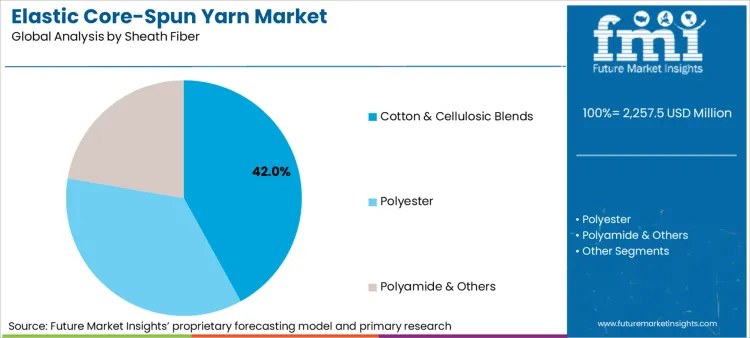
Cotton and cellulosic blends hold 42.0%, driven by comfort, breathability, and consumer preference for natural-feel fabrics. These sheath fibers provide softness while masking the elastic core, improving wearability. Polyester sheaths are selected for durability, wrinkle resistance, and color consistency, especially in performance and casualwear. Polyamide and other fibers offer abrasion resistance and lightweight properties, supporting activewear and specialty textiles. Sheath fiber choice directly affects hand feel, moisture management, and fabric appearance.
Key Points
- Cotton blends dominate for comfort and skin contact.
- Polyester enhances durability and dimensional stability.
- Polyamide supports abrasion-resistant and lightweight fabrics.
Which Applications Represent the Largest Use of Elastic Core-Spun Yarn?
Denim and bottomweight fabrics represent 34.0%, reflecting strong demand for stretch denim that balances structure with comfort. Elastic core-spun yarn enables improved fit retention and mobility in jeans and trousers. Knits and circular fabrics use elastic yarns to enhance stretch and recovery in casual and active apparel. Shirting and woven fabrics incorporate these yarns for comfort stretch without compromising fabric appearance. Other fabric categories include uniforms, workwear, and specialty garments.
Key Points:
- Denim remains the largest application due to stretch-comfort demand.
- Knits benefit from enhanced elasticity and shape retention.
- Wovens adopt elastic yarns for subtle comfort stretch.
What are the Key Dynamics in the Elastic Core-Spun Yarn Market?
Demand in the elastic core-spun yarn market is shaped by performance orientation in apparel, medical and industrial textiles where stretch, recovery and fabric comfort are essential. Sportswear, intimate apparel and compression garments increasingly specify core-spun constructions that combine an elastomeric core with a sheath of nylon, polyester or cotton to balance elasticity with surface aesthetics. Growth reflects consumer preference for garments that retain shape under repeated wear, and brand focus on tactile quality, fit retention and durable elasticity. Purchasing decisions are influenced by yarn tensile strength, elongation behavior, and compatibility with knitting and weaving systems used in mid- to high-speed production.
How do application performance requirements influence uptake?
Adoption of elastic core-spun yarn increases where product performance directly affects functional outcomes. In activewear and sports garments, designers require yarns that provide controlled stretch and recovery to support dynamic movement without sagging or distortion. Intimate apparel manufacturers use core-spun yarns to achieve soft hand feel next to skin while preserving elastic support in waistbands, cuffs and shaping panels. Medical textiles such as compression stockings and braces demand precise elongation and gradual load response to deliver therapeutic benefit without discomfort. Hosiery and fashion knitwear applications value uniformity of appearance and dye uptake, which core-spun yarns help deliver by encapsulating the elastomeric core within spinnable sheath fibers. Trials with fabric prototypes assess how core-spun yarns influence seam integrity and stitch performance under repeated extension and laundering.
How do raw material costs and production complexity influence market growth?
Market growth for elastic core-spun yarn is influenced by input pricing and the technical intricacy of production. Elastomeric cores such as spandex or elastane represent a higher cost component compared with staple fibers, which raises base yarn pricing relative to non-elastic alternatives. Yarn producers in the Europe balance these material costs against expected value delivered in finished garments, often negotiating bulk commitments with brand partners to stabilize supply economics. Complex core-spinning processes require specialized ring or rotor spinning frames and precise tension control to maintain consistent core centering and sheath coverage, which places demands on both capital investment and operator skill. Variability in feedstock quality can affect yarn uniformity, which in turn influences fabric performance and waste rates in knit or woven production. Producers may blend elastic core-spun yarn with complementary technical fibres to achieve targeted attributes such as moisture management or thermal regulation, increasing formulation complexity and development time for new product lines.
How Is Demand for the Elastic Core-Spun Yarn Market Evolving Globally?
Global demand for elastic core-spun yarn is rising as industries in apparel, automotive, and medical sectors increasingly seek textiles with enhanced stretch, durability, and comfort. Growth reflects a shift towards performance fabrics in activewear, lingerie, and sportswear, where elasticity and recovery are key. These yarns, made by spinning elastic fibers around a core, offer superior elasticity and shape retention. China records 8.7% CAGR, Brazil records 8.3% CAGR, USA records 7.2% CAGR, Germany records 7.1% CAGR, and South Korea records 6.7% CAGR. The expansion is driven by the need for advanced textiles in fashion and functional applications.
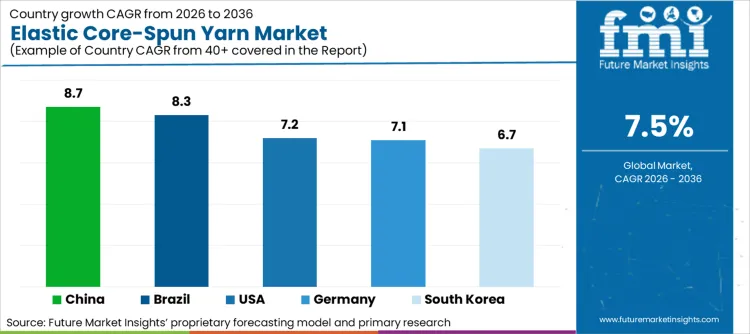
| Country | CAGR (%) |
|---|---|
| China | 8.7% |
| Brazil | 8.3% |
| USA | 7.2% |
| Germany | 7.1% |
| South Korea | 6.7% |
Source: Future Market Insights (FMI) analysis, based on proprietary forecasting model and primary research
What is driving growth of elastic core-spun yarn demand in China?
Demand for elastic core-spun yarn in China is expanding as the textile and apparel sectors continue to innovate with performance-oriented fabrics. Growth at 8.7% CAGR reflects rising production of activewear, sportswear, and functional textiles, where elasticity and shape retention are crucial. As China strengthens its position as a global textile manufacturing hub, there is an increasing demand for high-performance yarns that provide comfort, flexibility, and durability. Investments in textile innovation, combined with the growth of e-commerce and domestic retail, are driving the adoption of elastic core-spun yarn in various clothing categories, especially in athleisure and casual wear.
- Rising demand for activewear and sportswear
- Focus on textile innovation and performance fabrics
- Growth of e-commerce and retail channels
- Need for comfort and durability in apparel
Why is Brazil seeing expansion in elastic core-spun yarn adoption?
Elastic core-spun yarn demand in Brazil is increasing as the textile industry evolves to meet growing consumer demand for comfortable and flexible fabrics. Growth at 8.3% CAGR reflects increased production of garments requiring enhanced stretch and recovery properties, such as in activewear and intimate apparel. Brazil’s strong textile manufacturing base is shifting towards sustainable and high-performance fabrics, where elastic core-spun yarns offer a competitive edge. The demand for elastic fibers is particularly high in clothing that combines fashion with functionality, fueling adoption in sports and casual wear categories.
- Growing demand for comfortable, stretchable fabrics
- Rise in activewear and intimate apparel production
- Focus on textile sustainability and performance
- Increased production of functional, fashionable garments
What factors are shaping elastic core-spun yarn sales in the USA?
Sales of elastic core-spun yarn in the USA are increasing as the activewear and performance fabric sectors continue to expand. Growth at 7.2% CAGR reflects rising demand for elastic yarns in sportswear, athleisure, and medical textiles, where flexibility and durability are essential. USA manufacturers prioritize high-performance fabrics that provide comfort and support, driving the adoption of core-spun yarns. The focus on innovation and sustainability in the textile industry is pushing forward the development of new yarns that meet the performance, recovery, and comfort needs of the modern consumer.
- Expansion of the athleisure and sportswear markets
- Focus on high-performance, durable fabrics
- Growth of innovative, sustainable textile solutions
- Increasing consumer demand for comfort and flexibility in clothing
How is Germany supporting growth of elastic core-spun yarn demand?
Elastic core-spun yarn demand in Germany is advancing as the country leads in textile innovation and performance fabric development. Growth at 7.1% CAGR reflects the increasing demand for functional fabrics in activewear, medical textiles, and automotive upholstery, where elasticity and longevity are key. Germany’s commitment to high-quality textile manufacturing and sustainability encourages the adoption of advanced yarn technologies like elastic core-spun yarns. These yarns are essential in industries requiring high stretchability and recovery, such as in sports and medical garments. Demand is also supported by strong regulations encouraging the use of high-performance materials.
- Innovation-driven textile manufacturing
- Demand for functional fabrics in activewear and medical textiles
- Strong emphasis on quality and durability
- Growing need for stretchable, durable materials in textiles
What is driving expansion of elastic core-spun yarn demand in South Korea?
Demand for elastic core-spun yarn in South Korea is rising as the country’s textile industry shifts towards high-performance fabrics and innovative garment production. Growth at 6.7% CAGR reflects the increasing use of elastic core-spun yarns in activewear, sportswear, and intimate apparel, where comfort, elasticity, and shape retention are essential. South Korea’s focus on textile research and development, along with growing consumer demand for functional and fashionable products, supports the rise of elastic yarn technologies. The market is also driven by the growth of domestic fashion brands and the export of high-quality garments.
- Growth of activewear and performance fabric markets
- Focus on textile research and development
- Rising consumer demand for elastic, comfortable clothing
- Expansion of South Korea’s textile export sector
What Defines the Competitive Landscape for the Elastic Core-Spun Yarn Market Globally?
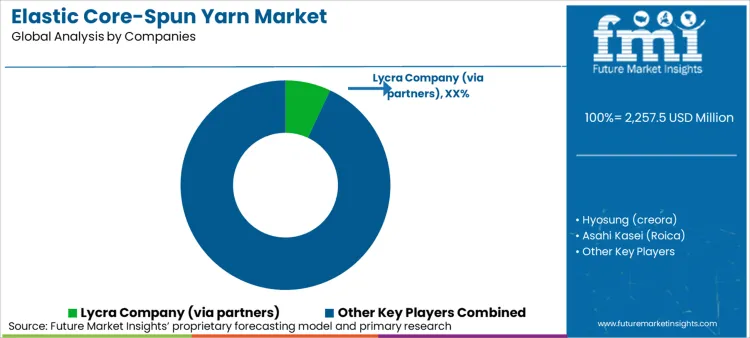
The global demand for elastic core-spun yarn is driven by the growing popularity of activewear, athleisure, and comfort-driven fashion, where stretch, durability, and recovery are critical. Buyers assess core-spun yarn based on its elasticity, wear resistance, moisture-wicking properties, and ability to retain shape after repeated stretching. Furthermore, yarns that integrate well with both synthetic and natural fibers are preferred for blending purposes. Procurement behavior favors manufacturers that can offer consistent yarn quality, scalable production, and quick-turnaround capabilities for fast fashion cycles. The market trend reflects strong demand for sustainable and performance-oriented yarns, with a growing preference for eco-friendly and recyclable options.
Lycra Company (via partners) leads competitive positioning through its widespread use of its signature LYCRA® fiber in core-spun yarns, particularly in activewear and performance fabrics. Hyosung (creora) competes with its innovative stretch fiber solutions, focusing on durability and comfort in high-performance fabrics. Asahi Kasei (Roica) remains a key player by offering eco-friendly elastic core-spun yarns designed for high stretch and recovery, targeting fashion, sportswear, and intimate apparel markets. Indorama Ventures supplies a diverse range of spun yarns with a focus on both sustainability and high-performance elastic properties.
Toray Industries and Teijin Frontier provide yarns that cater to technical textiles, such as sports, medical, and industrial applications, where elasticity and strength are paramount. NILIT and Fulgar support demand through high-performance nylon and elastane blends, while Coats Group offers a comprehensive range of elastic yarn solutions for industrial use. Acelon participates with competitive pricing and specialized yarns for the fashion and textile industries. Competitive differentiation centers on yarn elasticity, sustainability credentials, product versatility, and supply chain integration.
Key Players in the Elastic Core-Spun Yarn Market
- Lycra Company (via partners)
- Hyosung (creora)
- Asahi Kasei (Roica)
- Indorama Ventures (spun yarns)
- Toray Industries
- Teijin Frontier
- NILIT
- Fulgar
- Coats Group
- Acelon
Scope of the Report
| Items | Values |
|---|---|
| Quantitative Units | USD million |
| Core Material | Spandex/Elastane Core; Rubber & Other Elastic Cores; Dual/Hybrid Cores; Other Core Systems |
| Sheath Fiber | Cotton & Cellulosic Blends; Polyester; Polyamide & Others |
| Application | Denim & Bottomweight Fabrics; Knits & Circular Fabrics; Shirting & Wovens; Other Fabrics |
| Regions Covered | Asia Pacific, Europe, North America, Latin America, Middle East & Africa |
| Countries Covered | China, Brazil, USA, Germany, South Korea, and 40+ countries |
| Key Companies Profiled | Lycra Company (via partners); Hyosung (creora); Asahi Kasei (Roica); Indorama Ventures (spun yarns); Toray Industries; Teijin Frontier; NILIT; Fulgar; Coats Group; Acelon |
| Additional Attributes | Dollar sales by core material, sheath fiber, and application; advancements in core-spun yarn technologies; growing demand for elastic fabrics in activewear, denim, and other textile applications; market shift towards sustainable and eco-friendly yarn production; procurement trends in textile manufacturing. |
Elastic Core-Spun Yarn Market by Segment
Core Material:
- Spandex/Elastane Core
- Rubber & Other Elastic Cores
- Dual/Hybrid Cores
- Other Core Systems
Sheath Fiber:
- Cotton & Cellulosic Blends
- Polyester
- Polyamide & Others
Application:
- Denim & Bottomweight Fabrics
- Knits & Circular Fabrics
- Shirting & Wovens
- Other Fabrics
Region:
- Asia Pacific
- China
- Japan
- South Korea
- India
- Australia & New Zealand
- ASEAN
- Rest of Asia Pacific
- Europe
- Germany
- United Kingdom
- France
- Italy
- Spain
- Nordic
- BENELUX
- Rest of Europe
- North America
- United States
- Canada
- Mexico
- Latin America
- Brazil
- Chile
- Rest of Latin America
- Middle East & Africa
- Kingdom of Saudi Arabia
- Other GCC Countries
- Turkey
- South Africa
- Other African Union
- Rest of Middle East & Africa
Bibliography
- International Organization for Standardization. (2023). ISO 2062: Textiles-Yarns from packages-Determination of breaking force and elongation at break. ISO.
- European Apparel and Textile Confederation. (2024). Functional yarns and stretch textiles in European apparel manufacturing. EURATEX.
- The LYCRA Company. (2023). Elastane performance fundamentals in core-spun yarn applications. Technical fiber documentation.
- Hohenstein Institute. (2024). Elastic textiles: Comfort, recovery, and durability assessment methods. Hohenstein Research Reports.
- International Labour Organization. (2024). Textile and garment supply chains: Technology, materials, and performance evolution. ILO.
Frequently Asked Questions
How big is the elastic core-spun yarn market in 2026?
The global elastic core-spun yarn market is estimated to be valued at USD 2,257.5 million in 2026.
What will be the size of elastic core-spun yarn market in 2036?
The market size for the elastic core-spun yarn market is projected to reach USD 4,652.8 million by 2036.
How much will be the elastic core-spun yarn market growth between 2026 and 2036?
The elastic core-spun yarn market is expected to grow at a 7.5% CAGR between 2026 and 2036.
What are the key product types in the elastic core-spun yarn market?
The key product types in elastic core-spun yarn market are spandex/elastane core, rubber & other elastic cores, dual/hybrid cores and other core systems.
Which sheath fiber segment to contribute significant share in the elastic core-spun yarn market in 2026?
In terms of sheath fiber, cotton & cellulosic blends segment to command 42.0% share in the elastic core-spun yarn market in 2026.
Preview the report firsthand - request a free sample
Get SampleGet the brochure for pricing and purchase details.
Get PDFTable of Content
- Executive Summary
- Global Market Outlook
- Demand-side Trends
- Supply-side Trends
- Technology Roadmap Analysis
- Analysis and Recommendations
- Market Overview
- Market Coverage / Taxonomy
- Market Definition / Scope / Limitations
- Market Background
- Market Dynamics
- Drivers
- Restraints
- Opportunity
- Trends
- Scenario Forecast
- Demand in Optimistic Scenario
- Demand in Likely Scenario
- Demand in Conservative Scenario
- Opportunity Map Analysis
- Product Life Cycle Analysis
- Supply Chain Analysis
- Investment Feasibility Matrix
- Value Chain Analysis
- PESTLE and Porter’s Analysis
- Regulatory Landscape
- Regional Parent Market Outlook
- Production and Consumption Statistics
- Import and Export Statistics
- Market Dynamics
- Global Market Analysis 2021 to 2025 and Forecast, 2026 to 2036
- Historical Market Size Value (USD Million) Analysis, 2021 to 2025
- Current and Future Market Size Value (USD Million) Projections, 2026 to 2036
- Y-o-Y Growth Trend Analysis
- Absolute $ Opportunity Analysis
- Global Market Pricing Analysis 2021 to 2025 and Forecast 2026 to 2036
- Global Market Analysis 2021 to 2025 and Forecast 2026 to 2036, By Core Material
- Introduction / Key Findings
- Historical Market Size Value (USD Million) Analysis By Core Material , 2021 to 2025
- Current and Future Market Size Value (USD Million) Analysis and Forecast By Core Material , 2026 to 2036
- Spandex/Elastane Core
- Rubber & Other Elastic Cores
- Dual/Hybrid Cores
- Other Core Systems
- Spandex/Elastane Core
- Y-o-Y Growth Trend Analysis By Core Material , 2021 to 2025
- Absolute $ Opportunity Analysis By Core Material , 2026 to 2036
- Global Market Analysis 2021 to 2025 and Forecast 2026 to 2036, By Sheath Fiber
- Introduction / Key Findings
- Historical Market Size Value (USD Million) Analysis By Sheath Fiber, 2021 to 2025
- Current and Future Market Size Value (USD Million) Analysis and Forecast By Sheath Fiber, 2026 to 2036
- Cotton & Cellulosic Blends
- Polyester
- Polyamide & Others
- Cotton & Cellulosic Blends
- Y-o-Y Growth Trend Analysis By Sheath Fiber, 2021 to 2025
- Absolute $ Opportunity Analysis By Sheath Fiber, 2026 to 2036
- Global Market Analysis 2021 to 2025 and Forecast 2026 to 2036, By Application
- Introduction / Key Findings
- Historical Market Size Value (USD Million) Analysis By Application, 2021 to 2025
- Current and Future Market Size Value (USD Million) Analysis and Forecast By Application, 2026 to 2036
- Denim & Bottomweight Fabrics
- Knits & Circular Fabrics
- Shirting & Wovens
- Other Fabrics
- Denim & Bottomweight Fabrics
- Y-o-Y Growth Trend Analysis By Application, 2021 to 2025
- Absolute $ Opportunity Analysis By Application, 2026 to 2036
- Global Market Analysis 2021 to 2025 and Forecast 2026 to 2036, By Region
- Introduction
- Historical Market Size Value (USD Million) Analysis By Region, 2021 to 2025
- Current Market Size Value (USD Million) Analysis and Forecast By Region, 2026 to 2036
- North America
- Latin America
- Western Europe
- Eastern Europe
- East Asia
- South Asia and Pacific
- Middle East & Africa
- Market Attractiveness Analysis By Region
- North America Market Analysis 2021 to 2025 and Forecast 2026 to 2036, By Country
- Historical Market Size Value (USD Million) Trend Analysis By Market Taxonomy, 2021 to 2025
- Market Size Value (USD Million) Forecast By Market Taxonomy, 2026 to 2036
- By Country
- USA
- Canada
- Mexico
- By Core Material
- By Sheath Fiber
- By Application
- By Country
- Market Attractiveness Analysis
- By Country
- By Core Material
- By Sheath Fiber
- By Application
- Key Takeaways
- Latin America Market Analysis 2021 to 2025 and Forecast 2026 to 2036, By Country
- Historical Market Size Value (USD Million) Trend Analysis By Market Taxonomy, 2021 to 2025
- Market Size Value (USD Million) Forecast By Market Taxonomy, 2026 to 2036
- By Country
- Brazil
- Chile
- Rest of Latin America
- By Core Material
- By Sheath Fiber
- By Application
- By Country
- Market Attractiveness Analysis
- By Country
- By Core Material
- By Sheath Fiber
- By Application
- Key Takeaways
- Western Europe Market Analysis 2021 to 2025 and Forecast 2026 to 2036, By Country
- Historical Market Size Value (USD Million) Trend Analysis By Market Taxonomy, 2021 to 2025
- Market Size Value (USD Million) Forecast By Market Taxonomy, 2026 to 2036
- By Country
- Germany
- UK
- Italy
- Spain
- France
- Nordic
- BENELUX
- Rest of Western Europe
- By Core Material
- By Sheath Fiber
- By Application
- By Country
- Market Attractiveness Analysis
- By Country
- By Core Material
- By Sheath Fiber
- By Application
- Key Takeaways
- Eastern Europe Market Analysis 2021 to 2025 and Forecast 2026 to 2036, By Country
- Historical Market Size Value (USD Million) Trend Analysis By Market Taxonomy, 2021 to 2025
- Market Size Value (USD Million) Forecast By Market Taxonomy, 2026 to 2036
- By Country
- Russia
- Poland
- Hungary
- Balkan & Baltic
- Rest of Eastern Europe
- By Core Material
- By Sheath Fiber
- By Application
- By Country
- Market Attractiveness Analysis
- By Country
- By Core Material
- By Sheath Fiber
- By Application
- Key Takeaways
- East Asia Market Analysis 2021 to 2025 and Forecast 2026 to 2036, By Country
- Historical Market Size Value (USD Million) Trend Analysis By Market Taxonomy, 2021 to 2025
- Market Size Value (USD Million) Forecast By Market Taxonomy, 2026 to 2036
- By Country
- China
- Japan
- South Korea
- By Core Material
- By Sheath Fiber
- By Application
- By Country
- Market Attractiveness Analysis
- By Country
- By Core Material
- By Sheath Fiber
- By Application
- Key Takeaways
- South Asia and Pacific Market Analysis 2021 to 2025 and Forecast 2026 to 2036, By Country
- Historical Market Size Value (USD Million) Trend Analysis By Market Taxonomy, 2021 to 2025
- Market Size Value (USD Million) Forecast By Market Taxonomy, 2026 to 2036
- By Country
- India
- ASEAN
- Australia & New Zealand
- Rest of South Asia and Pacific
- By Core Material
- By Sheath Fiber
- By Application
- By Country
- Market Attractiveness Analysis
- By Country
- By Core Material
- By Sheath Fiber
- By Application
- Key Takeaways
- Middle East & Africa Market Analysis 2021 to 2025 and Forecast 2026 to 2036, By Country
- Historical Market Size Value (USD Million) Trend Analysis By Market Taxonomy, 2021 to 2025
- Market Size Value (USD Million) Forecast By Market Taxonomy, 2026 to 2036
- By Country
- Kingdom of Saudi Arabia
- Other GCC Countries
- Turkiye
- South Africa
- Other African Union
- Rest of Middle East & Africa
- By Core Material
- By Sheath Fiber
- By Application
- By Country
- Market Attractiveness Analysis
- By Country
- By Core Material
- By Sheath Fiber
- By Application
- Key Takeaways
- Key Countries Market Analysis
- USA
- Pricing Analysis
- Market Share Analysis, 2025
- By Core Material
- By Sheath Fiber
- By Application
- Canada
- Pricing Analysis
- Market Share Analysis, 2025
- By Core Material
- By Sheath Fiber
- By Application
- Mexico
- Pricing Analysis
- Market Share Analysis, 2025
- By Core Material
- By Sheath Fiber
- By Application
- Brazil
- Pricing Analysis
- Market Share Analysis, 2025
- By Core Material
- By Sheath Fiber
- By Application
- Chile
- Pricing Analysis
- Market Share Analysis, 2025
- By Core Material
- By Sheath Fiber
- By Application
- Germany
- Pricing Analysis
- Market Share Analysis, 2025
- By Core Material
- By Sheath Fiber
- By Application
- UK
- Pricing Analysis
- Market Share Analysis, 2025
- By Core Material
- By Sheath Fiber
- By Application
- Italy
- Pricing Analysis
- Market Share Analysis, 2025
- By Core Material
- By Sheath Fiber
- By Application
- Spain
- Pricing Analysis
- Market Share Analysis, 2025
- By Core Material
- By Sheath Fiber
- By Application
- France
- Pricing Analysis
- Market Share Analysis, 2025
- By Core Material
- By Sheath Fiber
- By Application
- India
- Pricing Analysis
- Market Share Analysis, 2025
- By Core Material
- By Sheath Fiber
- By Application
- ASEAN
- Pricing Analysis
- Market Share Analysis, 2025
- By Core Material
- By Sheath Fiber
- By Application
- Australia & New Zealand
- Pricing Analysis
- Market Share Analysis, 2025
- By Core Material
- By Sheath Fiber
- By Application
- China
- Pricing Analysis
- Market Share Analysis, 2025
- By Core Material
- By Sheath Fiber
- By Application
- Japan
- Pricing Analysis
- Market Share Analysis, 2025
- By Core Material
- By Sheath Fiber
- By Application
- South Korea
- Pricing Analysis
- Market Share Analysis, 2025
- By Core Material
- By Sheath Fiber
- By Application
- Russia
- Pricing Analysis
- Market Share Analysis, 2025
- By Core Material
- By Sheath Fiber
- By Application
- Poland
- Pricing Analysis
- Market Share Analysis, 2025
- By Core Material
- By Sheath Fiber
- By Application
- Hungary
- Pricing Analysis
- Market Share Analysis, 2025
- By Core Material
- By Sheath Fiber
- By Application
- Kingdom of Saudi Arabia
- Pricing Analysis
- Market Share Analysis, 2025
- By Core Material
- By Sheath Fiber
- By Application
- Turkiye
- Pricing Analysis
- Market Share Analysis, 2025
- By Core Material
- By Sheath Fiber
- By Application
- South Africa
- Pricing Analysis
- Market Share Analysis, 2025
- By Core Material
- By Sheath Fiber
- By Application
- USA
- Market Structure Analysis
- Competition Dashboard
- Competition Benchmarking
- Market Share Analysis of Top Players
- By Regional
- By Core Material
- By Sheath Fiber
- By Application
- Competition Analysis
- Competition Deep Dive
- Lycra Company (via partners)
- Overview
- Product Portfolio
- Profitability by Market Segments (Product/Age /Sales Channel/Region)
- Sales Footprint
- Strategy Overview
- Marketing Strategy
- Product Strategy
- Channel Strategy
- Hyosung (creora)
- Asahi Kasei (Roica)
- Indorama Ventures (spun yarns)
- Toray Industries
- Teijin Frontier
- NILIT
- Fulgar
- Coats Group
- Acelon
- Lycra Company (via partners)
- Competition Deep Dive
- Assumptions & Acronyms Used
- Research Methodology


