

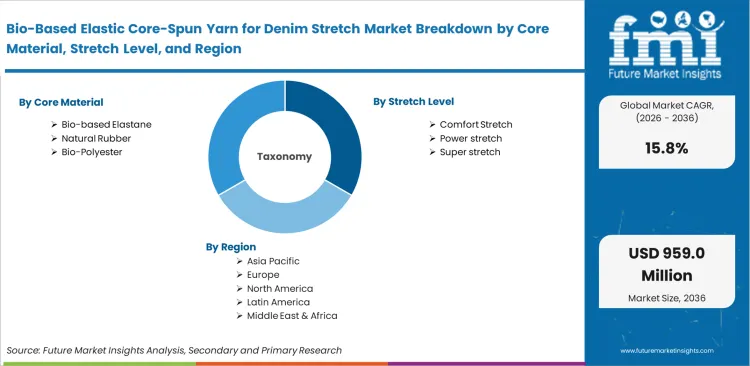
- Industry Size (2026)
- Forecast (2036)
- CAGR
- (2026 to 2036)
Bio-Based Elastic Core-Spun Yarn for Denim Stretch Market Size, Market Forecast and Outlook By FMI
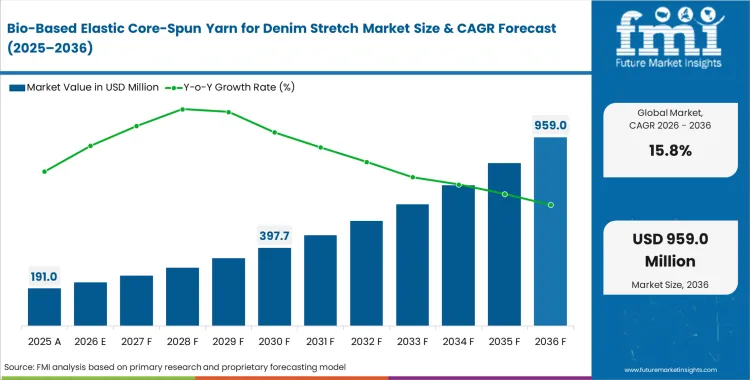
The Bio-Based Elastic Core-Spun Yarn for Denim Stretch Market was valued at USD 165.0 million in 2025. It is projected to reach USD 191.0 million in 2026 and USD 826.0 million by 2036, reflecting a CAGR of 15.8% for the global market during 2026 to 2036. Revenue growth is supported by stricter extended producer responsibility rules in Europe, where non-recyclable synthetic blends are facing higher commercial penalties.
Summary of Bio-Based Elastic Core-Spun Yarn for Denim Stretch Market
- Market Snapshot
- The bio-based elastic core-spun yarn for denim stretch market is valued at USD 165.0 million in 2025 and is projected to reach USD 826.0 million by 2036.
- The market is expected to grow at a 15.8% CAGR from 2026 to 2036, creating an incremental opportunity of USD 635.0 million over the period.
- This is a specification-led denim materials segment where buyers prioritize stretch recovery, circularity claims, and lower fossil-feedstock dependence in the same program.
- Commercialization remains early, with the strongest momentum tied to bio-derived spandex, plant-based elastic cores, and degradable stretch systems rather than bulk commodity substitution.
- Demand and Growth Drivers
- Demand is rising because major stretch suppliers are finally moving bio-led elastomer platforms from concept into commercial denim launches, especially in 2025.
- Bio-derived LYCRA EcoMade and Hyosung’s regen BIO line are improving buyer confidence because they preserve familiar stretch performance while advancing sustainability claims.
- Plant-based COREVA denim is expanding the market beyond bio-derived chemistry into a plastic-free elastic-core route for premium jeans programs.
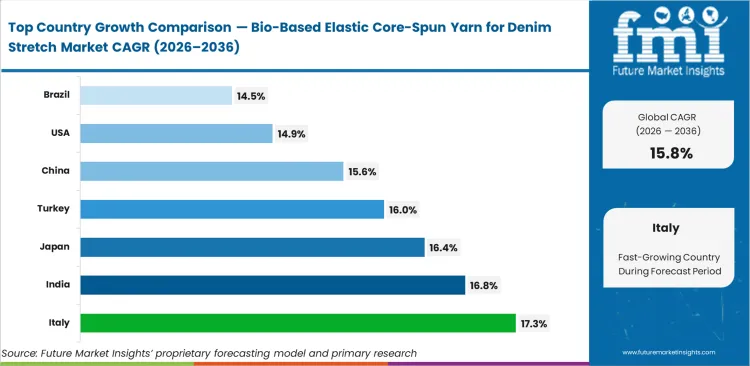
- Among key countries, Italy leads at 17.3% CAGR, followed by India at 16.8%, Japan at 16.4%, Turkey at 16.0%, China at 15.6%, the United States at 14.9%, and Brazil at 14.5%.
- Growth is moderated by cost premiums, tight qualified supply, and the fact that bio-based fiber volumes remain very small in the broader textile raw-material base.
- Product and Segment View
- The market covers bio-based elastic core-spun yarns built mainly with cotton or cellulosic sheath fibers wrapped around bio-derived elastane, natural rubber, or degradable elastic cores for denim stretch applications.
- These yarns are used across women’s jeans, men’s jeans, kidswear, premium fashion denim, and selected workwear-style denim lines.
- Bio-based elastane leads the Core Material segment with 44.0% share, supported by LYCRA and Hyosung commercialization pathways.
- Comfort stretch leads the Stretch Level segment with 41.0% share, as mills and brands still want everyday wearability over extreme elongation in most denim programs.
- Cotton leads the Sheath Fiber segment with 52.0% share, because denim buyers still anchor fabric hand, appearance, and merchandising around cotton-rich constructions.
- Fine denier leads the Yarn Count segment with 37.0% share, reflecting demand for cleaner denim aesthetics and easier integration into comfort-stretch fabrics.
- Women’s denim leads the End Use segment with 38.0% share, helped by stronger stretch-led fit segmentation and a faster willingness to trial sustainable premium denims.
- The scope includes yarn systems sold into stretch denim fabrics, but excludes standard petroleum-based elastane yarns, non-denim stretch yarns, and generic sustainable fibers without an elastic core-spun function.
- Geography and Competitive Outlook
- Italy, India, and Japan are the fastest-growing national markets, while China remains the most important scale manufacturing base for commercial denim conversion.
- Competition is shaped by branded-fiber launches, partner denim capsules, and mill-level collaborations rather than by commodity volume bidding alone.
- The LYCRA Company, Hyosung TNC, Candiani Denim, Asahi Kasei, Advance Denim, and Kaihara Denim are among the key participants influencing current market direction.
Sourcing heads at global apparel brands are under pressure to replace virgin petroleum-based spandex before upcoming circularity rules take effect. A slower shift could reduce supplier access to major retailer collections expected from 2028 onward. FMI analysis indicates that bio-based stretch yarns address this regulatory issue, though mills still face process changes during production. Plant-derived elastic cores can affect indigo dye uptake. Textile teams are adjusting tension settings to manage different elongation behavior and reduce filament breakage.
Commercial viability depends on whether renewable elastomers can match the break-rate performance of conventional synthetic materials on high-speed looms. Reaching that level would support broader adoption across Tier-2 suppliers. Core-spinning tension also remains an important factor, as it often determines whether mills stay focused on smaller orders or shift toward higher-volume programs. At the same time, quality teams continue to track recovery performance closely to make sure fabric reliability remains consistent.
Italy is expected to record a 17.3% CAGR in the bio-based elastic core-spun yarn for denim stretch market during 2026 to 2036, supported by exclusive polymer sourcing among luxury weavers. India is projected to expand at a 16.8% CAGR over the same period as vertically integrated producers add capacity. Japan is forecast to grow at 16.4% CAGR during 2026 to 2036 through specialized ring-spinning methods. Turkey is set to rise at 16.0% CAGR as denim manufacturers upgrade stretch-processing lines. China is likely to post a 15.6% CAGR over the forecast period as export-focused mills shift toward certified inputs. The United States is projected to grow at 14.9% CAGR during 2026 to 2036 due to domestic circularity programs. Brazil is anticipated to register a 14.5% CAGR over the same period, supported by local expertise in cotton-synthetic blending. Regional growth differences reflect access to proprietary polymer formulations more than basic spinning capacity.
Segmental Analysis
Bio-Based Elastic Core-Spun Yarn for Denim Stretch Market Analysis by Core Material
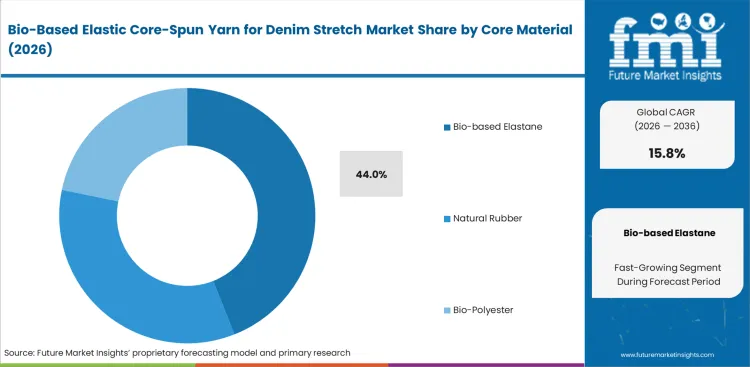
Some renewable polymers are seeing earlier adoption because they fit more easily into existing drafting systems. Bio-based elastane is projected to hold a 44.0% share in 2026, largely because it works well with current mill equipment. Mills tend to avoid polymers that require a full overhaul of tensioning rollers, as that adds cost and slows implementation. By using this core material, factories can continue running legacy spinning frames with limited disruption. Raw material costs often get more attention, even though mill-level processing constraints also affect performance. Raw material costs often get more attention, even though mill-level processing constraints also affect performance.
- Initial technical qualification: Technical directors evaluate biological polymers against strict elongation benchmarks before initiating pilot runs. Mill operators require exact match performance to prevent costly loom recalibrations.
- Wash cycle validation: Quality assurance teams test yarn recovery after aggressive industrial laundering simulations. Denim brands reject polymers failing to snap back after standard commercial ozone treatments.
- Long-term contract scaling: Sourcing executives commit to multi-season volume contracts only after validating consistent dye-lot uniformity. Spinners failing to secure steady high-quality feedstock lose major brand programs entirely.
Bio-Based Elastic Core-Spun Yarn for Denim Stretch Market Analysis by Stretch Level
Balancing consumer comfort with mill operating limits shapes demand across woven elongation categories in this market. Comfort stretch is projected to account for 41.0% share in 2026. Buyers prefer this moderate elasticity profile because it reduces the processing risks tied to newer bio-based filaments. Higher stretch levels tend to increase yarn breakage, especially when mills run looms at faster speeds. Many assume denim brands want maximum elasticity, though most cap stretch to preserve fabric structure and the classic denim look. Controlled elongation also helps circular design textiles withstand mechanical finishing without damage. Early-generation bio-based cores used in super-stretch formats often create puckering during garment washing. Production lines can stop when unsuitable stretch levels lead to quality issues across entire dye lots.
- Procurement savings logic: Sourcing directors minimize premium polymer usage by specifying moderate comfort stretch parameters. Reduced elastane content lowers overall garment cost without sacrificing basic mobility claims.
- Hidden operational costs: Mill floor supervisors battle increased machine downtime when processing biological elastomers. Frequent filament breakage requires constant manual intervention, elevating labor expenses significantly.
- Lifecycle performance reality: Sustainability officers track garment shape retention across multiple consumer washing cycles. Yarns failing to maintain structural recovery trigger massive retail return rates and damage brand credibility.
Bio-Based Elastic Core-Spun Yarn for Denim Stretch Market Analysis by Sheath Fiber
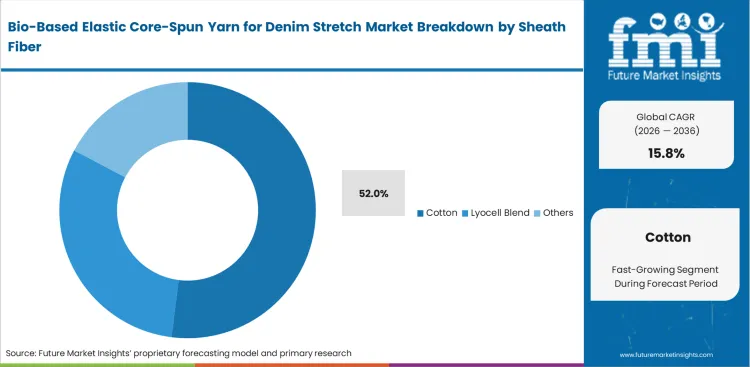
Abrasion resistance during wet processing plays a central role in outer layer selection for this market. Cotton is projected to hold a 52.0% share for 2026. Denim finishers prefer durable cellulosic sheaths because they can endure stone washing, bleaching, and laser etching without exposing sensitive bio-based elastic cores. Brands that use pure cotton outer layers also retain the fading effect expected in premium jeanswear. Thermal protection during drying is another key factor. Thicker cotton staple fibers help shield temperature-sensitive bio-elastane from heat damage inside industrial dryers. Mills that choose weak or overly fine sheath materials often damage the internal elastic filament during standard finishing. That can raise defect rates and push premium stretch fabrics into lower-value sales channels.
- Core protection failure: Quality inspectors reject entire fabric rolls when aggressive bleaching disintegrates weak sheath fibers. Exposed bio-elastane snaps instantly under tension, rendering garments completely unsalable.
- Residual finishing risk: Laundry technicians struggle to balance desired visual fading against core preservation. Even robust sheaths cannot protect delicate inner filaments if chemical exposure times exceed strict technical limits.
- Full benefit capture: Production managers must strictly control finishing temperatures to maintain elasticity. Brands capturing premium retail margins rely entirely on disciplined wet-processing controls at Tier-2 facilities.
Bio-Based Elastic Core-Spun Yarn for Denim Stretch Market Analysis by Yarn Count
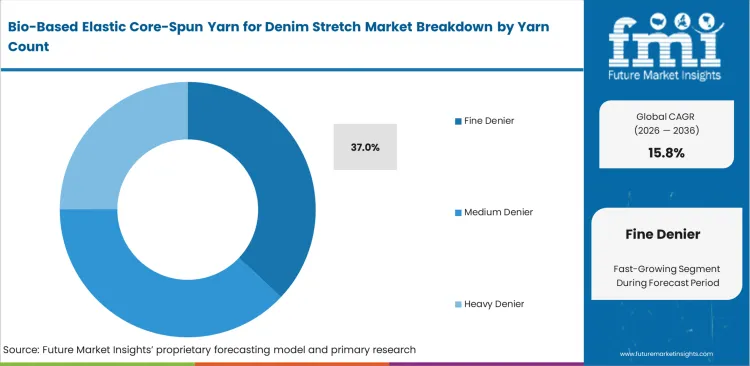
Demand from premium womenswear labels for lighter denim fabrics is shaping denier preferences in this market. Fine denier yarns are projected to account for 37.0% of the bio-based elastic core-spun yarn for denim stretch market in 2026. Product teams use thinner composite yarns to create softer fabrics with better drape and a look that differs from rigid workwear denim. These finer bio-based stretch yarns need very precise tension control during weaving to avoid micro-ruptures. Sourcing teams favor these counts to match seasonal silhouette requirements. Fine denier does not only mean lower fabric weight. Thinner bio-based cores can also show weaker tension recovery after repeated industrial washing. Brands that ignore this risk may face bagging at the knees and waist. Poor denier selection can also lead to returns, recalls, or stricter care instructions for garments using recycled apparel fibers.
- Specialized spinning dominance: Vertical mills possessing advanced ring-spinning technology control thin-count production. Competitors lacking precision drafting equipment cannot replicate these premium delicate constructions.
- Input feedstock constraints: Spinning directors face severe supply bottlenecks securing high-grade biological polymer suitable for micro-extrusion. Irregular feedstock quality causes instant filament snapping during fine-denier processing.
- Future supply landscape: Chemical innovators rapidly expand micro-denier extrusion capacity aiming for 2036 targets. Spinners establishing early off-take agreements will dominate premium fabric supply across upcoming fashion cycles.
Bio-Based Elastic Core-Spun Yarn for Denim Stretch Market Analysis by End Use
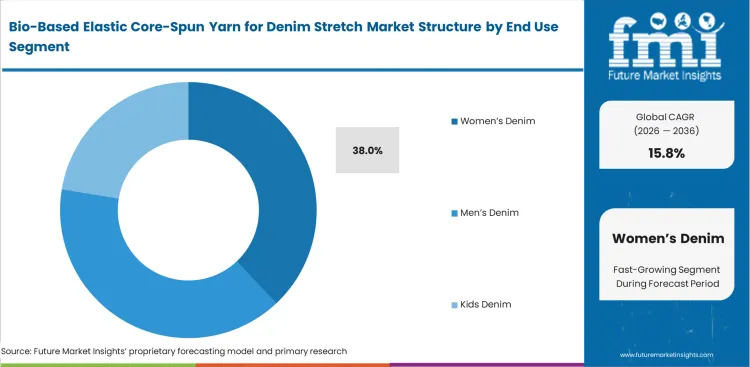
Women’s denim faces greater regulatory pressure as this segment has traditionally used higher spandex content than most other apparel categories. Women’s denim is projected to account for 38.0% share in 2026. Many brands are revising women’s product lines first because these programs offer the fastest route to reduce petroleum-based elastic content and improve circularity targets. Replacing conventional spandex also supports ESG goals ahead of upcoming compliance deadlines. The main challenge lies in product construction. High-stretch women’s fits often require heavier bio-elastane insertion, which makes mono-material recycling more difficult at the end of the garment’s life. Brands that delay this shift in women’s denim risk losing access to European retail channels as new rules take effect.
- Early premium adopters: Luxury women's labels absorb initial raw material price premiums easily. High retail margins allow these brands to market exclusive sustainable stretch collections without severe financial strain.
- Mass market followers: Mid-tier retailers wait for polymer scale to drive down unit costs before transitioning core lines. These buyers demand identical performance parameters before abandoning cheap legacy synthetic yarns.
- Late volume converters: Discount apparel chains resist adoption until legislation forces complete market compliance. These buyers usually switch only when regulatory penalties exceed biological polymer price premiums.
Bio-Based Elastic Core-Spun Yarn for Denim Stretch Market Drivers, Restraints, and Opportunities
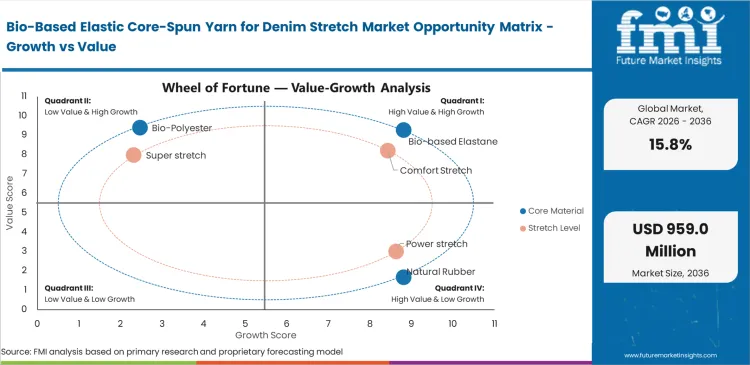
European penalties on non-recyclable elastane blends are pushing apparel procurement teams to review stretch denim portfolios much earlier than before. Sourcing teams are no longer waiting for full price parity before planning the shift. As regulations move from voluntary guidance to direct commercial costs, brands need bio-based alternatives to protect access to key retail markets. Buyers that postpone long-term supply agreements for renewable elastomers may also face raw material shortages as compliance deadlines approach. Limited capacity at premium spinning mills adds further pressure to qualify supply early.
Processing remains a major obstacle at the mill level. New bio-based cores do not always respond well to the thermal settings used for conventional cotton-sheathed stretch yarns. Technical teams cannot rely on legacy heat-set profiles without risking elasticity loss. They need to identify a stable temperature range that treats the cotton surface correctly without damaging the inner bio-based filament. This recalibration takes time and often slows line speeds. Lower throughput makes high-volume textile producers more cautious about switching too quickly.
Opportunities in the Bio-Based Elastic Core-Spun Yarn for Denim Stretch Market
- Closed-loop tracing contracts: Brands require absolute verification of biological origins to satisfy regulators. Technology providers offering embedded molecular tracers gain massive leverage negotiating with Tier-1 retailers.
- Low-heat polymer engineering: Chemical developers formulating bio-elastane capable of surviving traditional denim singeing temperatures unlock immediate mass adoption. Spinners eagerly switch to polymers requiring zero machine recalibration.
- Hybrid bio-synthetic blending: Textile engineers mixing biological polymers with specific low-shedding synthetic yarns achieve superior burst strength. Mills commercializing these durable blends capture heavy-duty workwear accounts previously inaccessible to pure plant-based options.
Regional Analysis
.webp "Top Country Growth Comparison Bio Based Elastic Core Spun Yarn For Denim Stretch Market Cagr (2026 2036)")
Based on regional analysis, bio-based elastic core-spun yarn for denim stretch market is segmented into North America, Latin America, Europe, East Asia, South Asia & Pacific, and Middle East & Africa across 40 plus countries.
| Country | CAGR (2026 to 2036) |
|---|---|
| Italy | 17.3% |
| India | 16.8% |
| Japan | 16.4% |
| Turkey | 16.0% |
| China | 15.6% |
| United States | 14.9% |
| Brazil | 14.5% |
Source: Future Market Insights (FMI) analysis, based on proprietary forecasting model and primary research
Europe Bio-Based Elastic Core-Spun Yarn for Denim Stretch Market Analysis
Material selection is now being shaped by binding commercial rules rather than broad environmental targets. European apparel brands face direct financial penalties when garments fail recyclability standards. FMI analysis indicates that this regulatory pressure is pushing regional weavers to qualify bio-based polymers faster than many global competitors. Supply chain teams are also working to build compliant regional sourcing networks to reduce exposure to import taxes on non-compliant fabrics. Vertically integrated mills that adopt renewable stretch materials early are likely to gain an advantage in upcoming seasonal sourcing contracts.
- Italy: Demand for bio-based elastic core-spun yarn for denim stretch in Italy is anticipated to rise at a 17.3% CAGR during the forecast period. The country benefits from a strong base in premium denim and luxury textile sourcing. Mills in Italy are often chosen for collections where fabric finish, stretch recovery, and certified material content are reviewed closely. European recyclability rules are also encouraging buyers to work with suppliers that can manage cleaner yarn structures without affecting garment quality. Italian producers are responding by securing bio-based polymer inputs early and refining premium denim constructions around them. This keeps Italy well placed in higher-value denim programs.
- Turkey: Sales of bio-based elastic core-spun yarn for denim stretch in Turkey are expected to record a 16.0% CAGR through 2036. The country already has a strong denim manufacturing base and close supply links with European fashion brands. This supports faster material qualification as buyers shift toward compliant stretch inputs. Turkish mills are adapting existing production lines to handle biological cores while maintaining volume output and turnaround speed. Its regional location also helps brands reduce lead times and manage sourcing closer to major European demand centers. This continues to support Turkey’s role as a practical supply base for regional buyers.
Asia Pacific Bio-Based Elastic Core-Spun Yarn for Denim Stretch Market Analysis
Production strategy across major eastern textile hubs is being shaped by rapid vertical capacity expansion. Mill owners increasingly treat bio-based stretch integration as a competitive advantage rather than a regulatory obligation. FMI analysis indicates that investment in specialized ring-spinning systems is helping regional manufacturers process delicate bio-based cores at higher operating speeds. Global sourcing teams are turning to this capacity to meet large-volume demand ahead of compliance deadlines. Mills that control core-spinning tension effectively are also in a stronger position to influence regional pricing.
- India: Demand for bio-based elastic core-spun yarn for denim stretch in India is expected to record a 16.8% CAGR during the forecast period. The country benefits from a large domestic spinning base and a well-established textile production network. Producers across India can support both high-volume denim orders and export-oriented supply needs for overseas buyers. This gives the country a practical advantage in serving large commercial demand with reliable quality. Stronger investment in extrusion systems, yarn certification, and process control is also supporting future growth.
- Japan: Sales of bio-based elastic core-spun yarn for denim stretch in Japan are anticipated to rise at a 16.4% CAGR through 2036. The country holds a strong position in high-quality denim and technically refined yarn manufacturing. Local mills usually place greater focus on surface finish, stretch recovery, and controlled production than on sheer scale. This technical strength continues to attract brands sourcing niche and premium collections. It also supports Japan’s position in higher-value denim programs.
- China: The bio-based elastic core-spun yarn for denim stretch industry in China is set to grow at a 15.6% CAGR by 2036. China continues to play a central role because of its scale in spinning, weaving, and denim fabric exports. Large suppliers in the country remain important for brands that need dependable output across major apparel programs. Compliance pressure from Western markets is pushing manufacturers to adopt certified bio-based yarn systems and improve processing standards. This shift is helping China protect export demand in stretch denim categories while strengthening production consistency.
Americas Bio-Based Elastic Core-Spun Yarn for Denim Stretch Market Analysis
Domestic circularity programs are pushing brands to rethink local sourcing for compliant textile inputs. Procurement teams are reviewing regional spinning capacity to shorten supply chains and secure traceable bio-based feedstocks. FMI analysis indicates that mills with strong experience in cotton-synthetic blending are better placed to process plant-derived cores efficiently. Weavers that integrate these materials successfully are also improving their position in the domestic market against overseas suppliers.
- United States: Sales of bio-based elastic core-spun yarn for denim stretch in the United States are expected to record a 14.9% CAGR during the forecast period. Demand for domestic textile sourcing is rising, especially in categories where traceability and circular material positioning influence procurement strategy. Local mills are being assessed for denim and workwear applications that require transparent sourcing and more controlled supply networks. Investment in local textile innovation is also supporting the adoption of new bio-based elastic yarns. Buyers looking to reduce overseas dependence are adding further support to this shift.
- Brazil: Demand for bio-based elastic core-spun yarn for denim stretch in Brazil is anticipated to rise at a 14.5% CAGR through 2036. The country benefits from its proximity to agricultural raw materials and its ability to link biomass supply with textile production. This creates a useful base for developing more traceable bio-based yarn systems for denim applications. Regional mills can work more closely with feedstock and polymer suppliers, which helps shorten development cycles and improve origin visibility. As buyers pay more attention to clearer sourcing chains, Brazil continues to strengthen its position in this space.
FMI's report includes Germany, United Kingdom, France, Mexico, and South Korea. Cross-border enforcement of textile recyclability standards compels brands operating in multiple jurisdictions to standardize bio-based adoption globally rather than managing fragmented regional material portfolios.
Competitive Aligners for Market Players
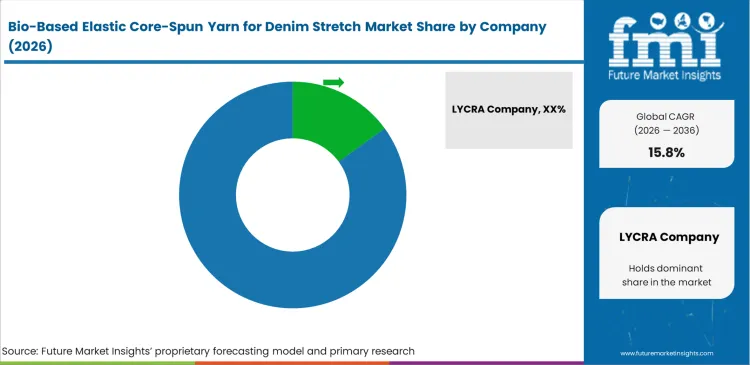
Innovation in core fiber chemistry remains concentrated among a small group of material suppliers, while spinning capability is spread across many denim mills. The LYCRA Company and Hyosung TNC hold strong positions in certified polymer development, which limits feedstock availability for downstream mills. Buyers now assess spinning partners on dye-uptake compatibility and processing stability, not only on stretch performance. Candiani Denim has built an edge through its control over thermal settings needed for bio-based cores, which makes entry harder for mills trying to shift quickly.
Established suppliers also benefit from years of internal testing on how bio-based cores perform under repeated commercial laundering. Newer entrants often lack comparable wear-test data, which makes brand approval harder to secure. Advance Denim uses this testing base to validate shrinkage behavior and fabric recovery, both of which matter in premium denim programs. Technical teams prefer traceable yarn systems that reduce the risk of garment distortion after consumer use.
Large apparel buyers are also avoiding dependence on a single supply source. Procurement teams often divide seasonal programs across multiple qualified mills to protect pricing flexibility and supply continuity. Partnerships linked to suppliers such as Asahi Kasei help brands maintain this balance where performance standards are tightly controlled. Denim producers must meet the same recovery and wash-performance targets across suppliers to remain eligible for global sourcing contracts.
Key Players in Bio-Based Elastic Core-Spun Yarn for Denim Stretch Market
- LYCRA Company
- Hyosung TNC
- Candiani Denim
- Asahi Kasei
- Advance Denim
- Kaihara Denim
Scope of the Report
| Metric | Value |
|---|---|
| Quantitative Units | USD 191.0 million to USD 826.0 million, at a CAGR of 15.8% |
| Market Definition | Composite textile filaments utilizing renewable biological elastic cores encased in staple cellulosic fibers, engineered specifically to provide stretch, recovery, and traditional indigo-dyeing capability for woven denim manufacturing. |
| Segmentation | Core Material, Stretch Level, Sheath Fiber, Yarn Count, End Use, Region |
| Regions Covered | North America, Latin America, Europe, East Asia, South Asia & Pacific, Middle East & Africa |
| Countries Covered | United States, Canada, Brazil, Mexico, Germany, United Kingdom, France, Italy, Spain, China, Japan, South Korea, India, ASEAN, ANZ, GCC, South Africa |
| Key Companies Profiled | LYCRA Company, Hyosung TNC, Candiani Denim, Asahi Kasei, Advance Denim, Kaihara Denim |
| Forecast Period | 2026 to 2036 |
| Approach | Mill-level yarn off-take volumes for certified sustainable denim programs. |
Source: Future Market Insights (FMI) analysis, based on proprietary forecasting model and primary research
Bio-Based Elastic Core-Spun Yarn for Denim Stretch Market Analysis by Segments
Core Material
- Bio-based elastane
- Natural rubber
- Bio-polyester
- PTT elastomer
- Hybrid elastomer
Stretch Level
- Comfort stretch
- Power stretch
- Super stretch
- Low stretch
- Vintage stretch
Sheath Fiber
- Cotton
- Organic cotton
- Recycled cotton
- Lyocell blend
- Cellulosic blend
Yarn Count
- Fine denier
- Medium denier
- Heavy denier
- Dual count
- Specialty count
End Use
- Women’s denim
- Men’s denim
- Kids denim
- Workwear denim
- Fashion denim
Region
- North America
- Latin America
- Europe
- East Asia
- South Asia & Pacific
- Middle East & Africa
Bibliography
- Asahi Kasei Corporation. (2025, April). Revisit ROICA™ by Asahi Kasei on Stage @Kingpins: Continue with Responsible Stretch Solutions for a Contemporary Denimwear.
- da Silva, T. N., & Bonse, B. C. (2025). Trends for producing sustainable yarns in the textile industry. Waste Management & Research.
- Hyosung TNC. (2025, January 15). Hyosung presents new CREORA® and regen™ spandex stretch innovations at Kingpins NYC.
- The LYCRA Company. (2025, April 29). AGOLDE adopts bio-derived LYCRA® EcoMade fiber.
This bibliography is provided for reader reference. The full FMI report contains the complete reference list with primary source documentation.
This Report Addresses
- Procurement strategies for replacing virgin petroleum spandex ahead of European circularity legislation.
- Operational bottlenecks encountered during high-speed core-spinning of novel biological elastomers.
- Tensioning equipment recalibration requirements necessary to process plant-derived continuous filaments.
- Heat-set temperature mismatches causing thermal degradation during industrial denim singeing processes.
- Wash cycle validation protocols required to guarantee commercial ozone treatment survival.
- Proprietary dye-uptake compatibility issues altering indigo fading aesthetics in premium jeanswear.
- Vendor lock-in risks associated with specialized bio-elastane shrinkage profiles.
- Regional capacity disparities across vertical textile setups in Italy, India, and Turkey.
Frequently Asked Questions
What limits faster adoption of biological stretch cores?
Heat-set temperature mismatch between plant-derived cores and traditional cotton sheaths creates severe processing bottlenecks. Factory managers must lower singeing temperatures to protect delicate inner filaments, which invariably alters desired indigo fading aesthetics during final garment processing.
Why does comfort stretch dominate production volumes?
Weaving managers experience exponentially higher breakage rates when attempting to run extreme power-stretch biological yarns at maximum loom speeds. Limiting elongation allows delicate cores to survive harsh mechanical finishing processes intact, minimizing costly machine downtime.
How do premium women's denim brands navigate compliance?
Merchandising directors overhaul female product lines first because traditional synthetic spandex content is historically highest in this category. Transitioning these high-volume programs yields maximum progress toward corporate ESG metrics before regulatory penalties activate.
What specific advantage do Italian luxury mills possess?
Italian weavers lock in exclusive multi-year polymer supply contracts with primary chemical innovators. Securing guaranteed feedstock allows these mills to dictate early aesthetic standards and capture massive commercial opportunity as global brands mandate certified inputs.
Why is cotton sheath fiber essential for premium applications?
Denim finishing experts require sturdy cellulosic sheaths to withstand aggressive stone washing, bleaching, and laser etching without exposing biological cores. Robust staple fibers insulate temperature-sensitive elastomers from destructive processing heat.
What risk do fine denier biological yarns present?
Thinner biological cores struggle with tension recovery after multiple industrial laundering cycles. Designers ignorant of this limitation release collections prone to permanent bagging at knees and waistbands, forcing embarrassing product recalls.
How do global brands prevent supplier lock-in?
Sourcing directors intentionally split seasonal contracts between multiple spinning mills to maintain pricing leverage. Brands utilize strict performance standardizations to ensure yarns from different vendors behave identically during commercial garment washing.
What triggers mass adoption across Tier-2 suppliers?
Spinning operations achieve true commercial scale only when break-rates of renewable elastomers match traditional synthetics on high-speed looms. Crossing this operational threshold allows factories to process sustainable options without sacrificing daily output capacity.
How does India compete against specialized boutique mills?
Corporate textile giants advance domestic production by building dedicated vertical setups strictly for biological yarn extrusion and spinning. Massive capacity allows Indian manufacturers to secure lucrative off-take agreements with global fast-fashion retailers.
Why are bare bio-elastane filaments excluded from analysis?
Functional boundaries require central elastic components to be completely wrapped by staple fibers. Bare filaments cannot present a traditional cellulosic outer surface necessary for indigo dyeing, rendering them useless for rigid warp-and-weft denim structures.
What happens when outer protective layers fail during bleaching?
Quality inspectors reject entire fabric rolls when aggressive chemicals disintegrate weak sheath fibers. Exposed bio-elastane snaps instantly under tension, rendering garments completely unsalable and destroying mill profit margins.
How do impending circularity regulations change procurement behavior?
Legislation transitioning from voluntary guidelines to strict commercial taxation forces brands to secure biological alternatives immediately. Sourcing teams can no longer delay transition strategies waiting for price parity without risking exclusion from major retail sectors.
Why do mid-tier retailers hesitate to transition core lines?
Mass market followers wait for polymer scale to drive down unit costs before abandoning cheap legacy synthetic yarns. These buyers demand identical performance parameters and cost structures before authorizing sweeping material changes.
Why do discount apparel chains resist early adoption?
Discount buyers resist switching until legislation forces complete market compliance. These retailers transition only when regulatory penalties exceed biological polymer price premiums, prioritizing immediate margin protection over ESG goals.
How do hybrid bio-synthetic blends alter market dynamics?
Textile engineers mixing biological polymers with high-tenacity synthetics achieve superior burst strength. Mills commercializing these durable blends capture heavy-duty workwear accounts previously inaccessible to pure plant-based options.
What role do proprietary testing libraries play in supplier selection?
Established suppliers hold extensive proprietary data on how bio-based cores perform under intensive commercial laundering conditions. Technical directors depend on these proven suppliers to reduce the risk of garment deformation during end use.
Preview the report firsthand - request a free sample
Get SampleGet the brochure for pricing and purchase details.
Get PDFTable of Content
- Executive Summary
- Global Market Outlook
- Demand-side Trends
- Supply-side Trends
- Technology Roadmap Analysis
- Analysis and Recommendations
- Market Overview
- Market Coverage / Taxonomy
- Market Definition / Scope / Limitations
- Research Methodology
- Chapter Orientation
- Analytical Lens and Working Hypotheses
- Market Structure, Signals, and Trend Drivers
- Benchmarking and Cross-market Comparability
- Market Sizing, Forecasting, and Opportunity Mapping
- Research Design and Evidence Framework
- Desk Research Programme (Secondary Evidence)
- Company Annual and Sustainability Reports
- Peer-reviewed Journals and Academic Literature
- Corporate Websites, Product Literature, and Technical Notes
- Earnings Decks and Investor Briefings
- Statutory Filings and Regulatory Disclosures
- Technical White Papers and Standards Notes
- Trade Journals, Industry Magazines, and Analyst Briefs
- Conference Proceedings, Webinars, and Seminar Materials
- Government Statistics Portals and Public Data Releases
- Press Releases and Reputable Media Coverage
- Specialist Newsletters and Curated Briefings
- Sector Databases and Reference Repositories
- FMI Internal Proprietary Databases and Historical Market Datasets
- Subscription Datasets and Paid Sources
- Social Channels, Communities, and Digital Listening Inputs
- Additional Desk Sources
- Expert Input and Fieldwork (Primary Evidence)
- Primary Modes
- Qualitative Interviews and Expert Elicitation
- Quantitative Surveys and Structured Data Capture
- Blended Approach
- Why Primary Evidence is Used
- Field Techniques
- Interviews
- Surveys
- Focus Groups
- Observational and In-context Research
- Social and Community Interactions
- Stakeholder Universe Engaged
- C-suite Leaders
- Board Members
- Presidents and Vice Presidents
- R&D and Innovation Heads
- Technical Specialists
- Domain Subject-matter Experts
- Scientists
- Physicians and Other Healthcare Professionals
- Governance, Ethics, and Data Stewardship
- Research Ethics
- Data Integrity and Handling
- Primary Modes
- Tooling, Models, and Reference Databases
- Desk Research Programme (Secondary Evidence)
- Data Engineering and Model Build
- Data Acquisition and Ingestion
- Cleaning, Normalisation, and Verification
- Synthesis, Triangulation, and Analysis
- Quality Assurance and Audit Trail
- Market Background
- Market Dynamics
- Drivers
- Restraints
- Opportunity
- Trends
- Scenario Forecast
- Demand in Optimistic Scenario
- Demand in Likely Scenario
- Demand in Conservative Scenario
- Opportunity Map Analysis
- Product Life Cycle Analysis
- Supply Chain Analysis
- Investment Feasibility Matrix
- Value Chain Analysis
- PESTLE and Porter’s Analysis
- Regulatory Landscape
- Regional Parent Market Outlook
- Production and Consumption Statistics
- Import and Export Statistics
- Market Dynamics
- Global Market Analysis 2021 to 2025 and Forecast, 2026 to 2036
- Historical Market Size Value (USD Million) Analysis, 2021 to 2025
- Current and Future Market Size Value (USD Million) Projections, 2026 to 2036
- Y-o-Y Growth Trend Analysis
- Absolute $ Opportunity Analysis
- Global Market Pricing Analysis 2021 to 2025 and Forecast 2026 to 2036
- Global Market Analysis 2021 to 2025 and Forecast 2026 to 2036, By Core Material
- Introduction / Key Findings
- Historical Market Size Value (USD Million) Analysis By Core Material , 2021 to 2025
- Current and Future Market Size Value (USD Million) Analysis and Forecast By Core Material , 2026 to 2036
- Bio-based Elastane
- Natural Rubber
- Bio-Polyester
- Bio-based Elastane
- Y-o-Y Growth Trend Analysis By Core Material , 2021 to 2025
- Absolute $ Opportunity Analysis By Core Material , 2026 to 2036
- Global Market Analysis 2021 to 2025 and Forecast 2026 to 2036, By Stretch Level
- Introduction / Key Findings
- Historical Market Size Value (USD Million) Analysis By Stretch Level, 2021 to 2025
- Current and Future Market Size Value (USD Million) Analysis and Forecast By Stretch Level, 2026 to 2036
- Comfort Stretch
- Power stretch
- Super stretch
- Comfort Stretch
- Y-o-Y Growth Trend Analysis By Stretch Level, 2021 to 2025
- Absolute $ Opportunity Analysis By Stretch Level, 2026 to 2036
- Global Market Analysis 2021 to 2025 and Forecast 2026 to 2036, By Sheath Fiber
- Introduction / Key Findings
- Historical Market Size Value (USD Million) Analysis By Sheath Fiber, 2021 to 2025
- Current and Future Market Size Value (USD Million) Analysis and Forecast By Sheath Fiber, 2026 to 2036
- Cotton
- Lyocell Blend
- Others
- Cotton
- Y-o-Y Growth Trend Analysis By Sheath Fiber, 2021 to 2025
- Absolute $ Opportunity Analysis By Sheath Fiber, 2026 to 2036
- Global Market Analysis 2021 to 2025 and Forecast 2026 to 2036, By Yarn Count
- Introduction / Key Findings
- Historical Market Size Value (USD Million) Analysis By Yarn Count, 2021 to 2025
- Current and Future Market Size Value (USD Million) Analysis and Forecast By Yarn Count, 2026 to 2036
- Fine Denier
- Medium Denier
- Heavy Denier
- Fine Denier
- Y-o-Y Growth Trend Analysis By Yarn Count, 2021 to 2025
- Absolute $ Opportunity Analysis By Yarn Count, 2026 to 2036
- Global Market Analysis 2021 to 2025 and Forecast 2026 to 2036, By End Use
- Introduction / Key Findings
- Historical Market Size Value (USD Million) Analysis By End Use, 2021 to 2025
- Current and Future Market Size Value (USD Million) Analysis and Forecast By End Use, 2026 to 2036
- Women’s Denim
- Men’s Denim
- Kids Denim
- Women’s Denim
- Y-o-Y Growth Trend Analysis By End Use, 2021 to 2025
- Absolute $ Opportunity Analysis By End Use, 2026 to 2036
- Global Market Analysis 2021 to 2025 and Forecast 2026 to 2036, By Region
- Introduction
- Historical Market Size Value (USD Million) Analysis By Region, 2021 to 2025
- Current Market Size Value (USD Million) Analysis and Forecast By Region, 2026 to 2036
- North America
- Latin America
- Western Europe
- Eastern Europe
- East Asia
- South Asia and Pacific
- Middle East & Africa
- Market Attractiveness Analysis By Region
- North America Market Analysis 2021 to 2025 and Forecast 2026 to 2036, By Country
- Historical Market Size Value (USD Million) Trend Analysis By Market Taxonomy, 2021 to 2025
- Market Size Value (USD Million) Forecast By Market Taxonomy, 2026 to 2036
- By Country
- USA
- Canada
- Mexico
- By Core Material
- By Stretch Level
- By Sheath Fiber
- By Yarn Count
- By End Use
- By Country
- Market Attractiveness Analysis
- By Country
- By Core Material
- By Stretch Level
- By Sheath Fiber
- By Yarn Count
- By End Use
- Key Takeaways
- Latin America Market Analysis 2021 to 2025 and Forecast 2026 to 2036, By Country
- Historical Market Size Value (USD Million) Trend Analysis By Market Taxonomy, 2021 to 2025
- Market Size Value (USD Million) Forecast By Market Taxonomy, 2026 to 2036
- By Country
- Brazil
- Chile
- Rest of Latin America
- By Core Material
- By Stretch Level
- By Sheath Fiber
- By Yarn Count
- By End Use
- By Country
- Market Attractiveness Analysis
- By Country
- By Core Material
- By Stretch Level
- By Sheath Fiber
- By Yarn Count
- By End Use
- Key Takeaways
- Western Europe Market Analysis 2021 to 2025 and Forecast 2026 to 2036, By Country
- Historical Market Size Value (USD Million) Trend Analysis By Market Taxonomy, 2021 to 2025
- Market Size Value (USD Million) Forecast By Market Taxonomy, 2026 to 2036
- By Country
- Germany
- UK
- Italy
- Spain
- France
- Nordic
- BENELUX
- Rest of Western Europe
- By Core Material
- By Stretch Level
- By Sheath Fiber
- By Yarn Count
- By End Use
- By Country
- Market Attractiveness Analysis
- By Country
- By Core Material
- By Stretch Level
- By Sheath Fiber
- By Yarn Count
- By End Use
- Key Takeaways
- Eastern Europe Market Analysis 2021 to 2025 and Forecast 2026 to 2036, By Country
- Historical Market Size Value (USD Million) Trend Analysis By Market Taxonomy, 2021 to 2025
- Market Size Value (USD Million) Forecast By Market Taxonomy, 2026 to 2036
- By Country
- Russia
- Poland
- Hungary
- Balkan & Baltic
- Rest of Eastern Europe
- By Core Material
- By Stretch Level
- By Sheath Fiber
- By Yarn Count
- By End Use
- By Country
- Market Attractiveness Analysis
- By Country
- By Core Material
- By Stretch Level
- By Sheath Fiber
- By Yarn Count
- By End Use
- Key Takeaways
- East Asia Market Analysis 2021 to 2025 and Forecast 2026 to 2036, By Country
- Historical Market Size Value (USD Million) Trend Analysis By Market Taxonomy, 2021 to 2025
- Market Size Value (USD Million) Forecast By Market Taxonomy, 2026 to 2036
- By Country
- China
- Japan
- South Korea
- By Core Material
- By Stretch Level
- By Sheath Fiber
- By Yarn Count
- By End Use
- By Country
- Market Attractiveness Analysis
- By Country
- By Core Material
- By Stretch Level
- By Sheath Fiber
- By Yarn Count
- By End Use
- Key Takeaways
- South Asia and Pacific Market Analysis 2021 to 2025 and Forecast 2026 to 2036, By Country
- Historical Market Size Value (USD Million) Trend Analysis By Market Taxonomy, 2021 to 2025
- Market Size Value (USD Million) Forecast By Market Taxonomy, 2026 to 2036
- By Country
- India
- ASEAN
- Australia & New Zealand
- Rest of South Asia and Pacific
- By Core Material
- By Stretch Level
- By Sheath Fiber
- By Yarn Count
- By End Use
- By Country
- Market Attractiveness Analysis
- By Country
- By Core Material
- By Stretch Level
- By Sheath Fiber
- By Yarn Count
- By End Use
- Key Takeaways
- Middle East & Africa Market Analysis 2021 to 2025 and Forecast 2026 to 2036, By Country
- Historical Market Size Value (USD Million) Trend Analysis By Market Taxonomy, 2021 to 2025
- Market Size Value (USD Million) Forecast By Market Taxonomy, 2026 to 2036
- By Country
- Kingdom of Saudi Arabia
- Other GCC Countries
- Turkiye
- South Africa
- Other African Union
- Rest of Middle East & Africa
- By Core Material
- By Stretch Level
- By Sheath Fiber
- By Yarn Count
- By End Use
- By Country
- Market Attractiveness Analysis
- By Country
- By Core Material
- By Stretch Level
- By Sheath Fiber
- By Yarn Count
- By End Use
- Key Takeaways
- Key Countries Market Analysis
- USA
- Pricing Analysis
- Market Share Analysis, 2025
- By Core Material
- By Stretch Level
- By Sheath Fiber
- By Yarn Count
- By End Use
- Canada
- Pricing Analysis
- Market Share Analysis, 2025
- By Core Material
- By Stretch Level
- By Sheath Fiber
- By Yarn Count
- By End Use
- Mexico
- Pricing Analysis
- Market Share Analysis, 2025
- By Core Material
- By Stretch Level
- By Sheath Fiber
- By Yarn Count
- By End Use
- Brazil
- Pricing Analysis
- Market Share Analysis, 2025
- By Core Material
- By Stretch Level
- By Sheath Fiber
- By Yarn Count
- By End Use
- Chile
- Pricing Analysis
- Market Share Analysis, 2025
- By Core Material
- By Stretch Level
- By Sheath Fiber
- By Yarn Count
- By End Use
- Germany
- Pricing Analysis
- Market Share Analysis, 2025
- By Core Material
- By Stretch Level
- By Sheath Fiber
- By Yarn Count
- By End Use
- UK
- Pricing Analysis
- Market Share Analysis, 2025
- By Core Material
- By Stretch Level
- By Sheath Fiber
- By Yarn Count
- By End Use
- Italy
- Pricing Analysis
- Market Share Analysis, 2025
- By Core Material
- By Stretch Level
- By Sheath Fiber
- By Yarn Count
- By End Use
- Spain
- Pricing Analysis
- Market Share Analysis, 2025
- By Core Material
- By Stretch Level
- By Sheath Fiber
- By Yarn Count
- By End Use
- France
- Pricing Analysis
- Market Share Analysis, 2025
- By Core Material
- By Stretch Level
- By Sheath Fiber
- By Yarn Count
- By End Use
- India
- Pricing Analysis
- Market Share Analysis, 2025
- By Core Material
- By Stretch Level
- By Sheath Fiber
- By Yarn Count
- By End Use
- ASEAN
- Pricing Analysis
- Market Share Analysis, 2025
- By Core Material
- By Stretch Level
- By Sheath Fiber
- By Yarn Count
- By End Use
- Australia & New Zealand
- Pricing Analysis
- Market Share Analysis, 2025
- By Core Material
- By Stretch Level
- By Sheath Fiber
- By Yarn Count
- By End Use
- China
- Pricing Analysis
- Market Share Analysis, 2025
- By Core Material
- By Stretch Level
- By Sheath Fiber
- By Yarn Count
- By End Use
- Japan
- Pricing Analysis
- Market Share Analysis, 2025
- By Core Material
- By Stretch Level
- By Sheath Fiber
- By Yarn Count
- By End Use
- South Korea
- Pricing Analysis
- Market Share Analysis, 2025
- By Core Material
- By Stretch Level
- By Sheath Fiber
- By Yarn Count
- By End Use
- Russia
- Pricing Analysis
- Market Share Analysis, 2025
- By Core Material
- By Stretch Level
- By Sheath Fiber
- By Yarn Count
- By End Use
- Poland
- Pricing Analysis
- Market Share Analysis, 2025
- By Core Material
- By Stretch Level
- By Sheath Fiber
- By Yarn Count
- By End Use
- Hungary
- Pricing Analysis
- Market Share Analysis, 2025
- By Core Material
- By Stretch Level
- By Sheath Fiber
- By Yarn Count
- By End Use
- Kingdom of Saudi Arabia
- Pricing Analysis
- Market Share Analysis, 2025
- By Core Material
- By Stretch Level
- By Sheath Fiber
- By Yarn Count
- By End Use
- Turkiye
- Pricing Analysis
- Market Share Analysis, 2025
- By Core Material
- By Stretch Level
- By Sheath Fiber
- By Yarn Count
- By End Use
- South Africa
- Pricing Analysis
- Market Share Analysis, 2025
- By Core Material
- By Stretch Level
- By Sheath Fiber
- By Yarn Count
- By End Use
- USA
- Market Structure Analysis
- Competition Dashboard
- Competition Benchmarking
- Market Share Analysis of Top Players
- By Regional
- By Core Material
- By Stretch Level
- By Sheath Fiber
- By Yarn Count
- By End Use
- Competition Analysis
- Competition Deep Dive
- LYCRA Company
- Overview
- Product Portfolio
- Profitability by Market Segments (Product/Age /Sales Channel/Region)
- Sales Footprint
- Strategy Overview
- Marketing Strategy
- Product Strategy
- Channel Strategy
- Hyosung TNC
- Candiani Denim
- Asahi Kasei
- Advance Denim
- Kaihara Denim
- LYCRA Company
- Competition Deep Dive
- Assumptions & Acronyms Used


