

- Industry Size (2026)
- USD 51.46 Bn
- Forecast (2036)
- USD 135.93 Bn
- CAGR (2026 to 2036)
- 10.2%
Copper and Copper Alloy Scrap and Recycling Market Size, Market Forecast and Outlook By FMI
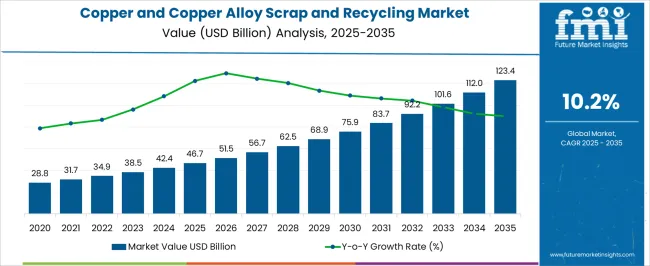
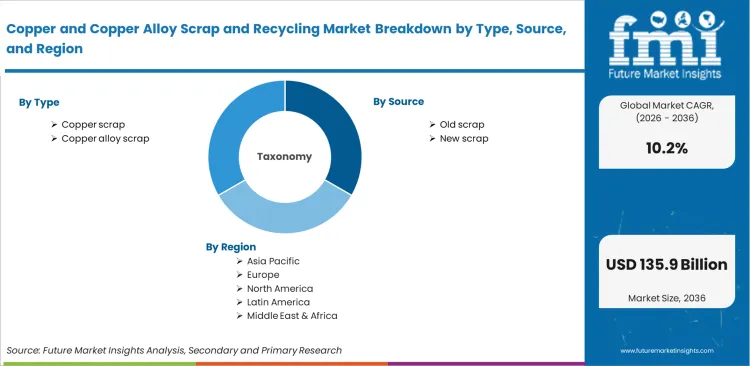
The copper and copper alloy scrap and recycling market was valued at USD 46.70 billion in 2025, projected to reach USD 51.46 billion in 2026, and is forecast to expand to USD 135.93 billion by 2036 at a 10.2% CAGR. Tightening primary copper supply constraints, rising extraction costs at aging mines, and expanding circular economy mandates across major industrial economies are accelerating secondary copper feedstock demand. Recycled copper requires up to 85% less energy to produce than primary copper from ore, creating a structural cost advantage that widens as energy prices and carbon pricing mechanisms increase across smelting regions.
Summary of Copper and Copper Alloy Scrap and Recycling Market
- Market Overview
- The copper and copper alloy scrap and recycling market is valued at USD 46.70 billion in 2025 and is projected to reach USD 135.93 billion by 2036.
- The industry is expected to grow at a 10.2% CAGR from 2026 to 2036, creating an incremental opportunity of USD 84.47 billion.
- Demand and Growth Drivers
- Demand is accelerating as primary copper supply constraints and rising extraction costs at aging mines increase the economic advantage of secondary copper feedstock.
- Circular economy mandates and extended producer responsibility regulations across major industrial economies are formalizing scrap collection and recovery infrastructure requirements.
- Recycled copper production requires up to 85% less energy than primary smelting, creating a structural cost advantage that widens with rising energy and carbon pricing.
- Among key countries, China leads at 13.8% CAGR, followed by India at 12.8%, Germany at 11.7%, France at 10.7%, the UK at 9.7%, the USA at 8.7%, and Brazil at 7.7%.
- Product and Segment View
- The market covers copper scrap and copper alloy scrap from old scrap (end-of-life products) and new scrap (manufacturing offcuts) sources.
- Processing methods include pyrometallurgical, mechanical, hydrometallurgical, and electrometallurgical pathways for secondary copper recovery.
- Copper Scrap leads by Type with 61.2% share in 2026. Old Scrap leads by Source with 55.2% share. Electrical and Electronics leads by End Use with 31.0% share.
- The scope includes scrap transaction value, while excluding primary copper mining, precious metal recovery from e-waste, and scrap brokerage commissions.
- Geography and Competitive Outlook
- China and India are the fastest-growing markets as expanding copper consumption and circular economy mandates drive secondary feedstock collection and processing infrastructure investment.
- Europe, led by Germany and France, represents a high-growth region where extended producer responsibility regulations and copper smelter capacity for secondary feed sustain scrap market expansion.
- Competition is shaped by scrap sourcing network scale, processing technology efficiency, and smelter offtake contract security, with key players including Aurubis, Glencore, Boliden, and Umicore.
- Analyst Opinion at FMI
- Nikhil Kaitwade, Principal Consultant for Metals and Mining, opines: 'In my analysis, I have observed that the primary constraint in secondary copper supply is not scrap availability but sorting and processing infrastructure capacity. The accumulated stock of copper embedded in global infrastructure exceeds current collection yields by a wide margin. Smelters that secure long-term scrap supply agreements with automated sorting capability will capture feedstock cost advantages that widen as primary copper extraction costs continue escalating.'
- Strategic Implications / Executive Takeaways
- Smelter operators must invest in automated scrap sorting and grading technology to improve secondary feed quality and reduce processing cost per tonne of recovered copper.
- Scrap collection network operators should secure long-term offtake agreements with secondary copper smelters to stabilize revenue against primary copper price volatility.
- Regulatory affairs teams must track extended producer responsibility implementation timelines across key markets to anticipate collection volume shifts and infrastructure investment requirements.
Urban mining economics are shifting as the accumulated stock of copper embedded in buildings, vehicles, electronics, and industrial equipment reaches quantities that justify dedicated collection and processing infrastructure investment. Scrap quality grading and automated sorting technologies are improving recovery yields from complex waste streams that previously defaulted to landfill or low-value export channels. Smelters and refineries with secondary copper processing capability are securing long-term scrap supply contracts to reduce exposure to primary copper price volatility and concentrate supply disruptions.
All major regional markets reflect differentiated adoption trajectories. China sets the pace with a 13.8% CAGR. India follows at 12.8%. Germany registers 11.7%. France registers 10.7%. UK registers 9.7%. USA maintains 8.7%. Brazil maintains 7.7%.
Copper and Copper Alloy Scrap and Recycling Market Key Takeaways
| Metric | Details |
|---|---|
| Industry Size (2026) | USD 51.46 billion |
| Industry Value (2036) | USD 135.93 billion |
| CAGR (2026 to 2036) | 10.2% |
Source: Future Market Insights, 2026
Copper and Copper Alloy Scrap and Recycling Market Definition
Copper and copper alloy scrap and recycling encompasses the collection, sorting, processing, and refining of end-of-life copper products and manufacturing offcuts into secondary copper feedstock. This market covers old scrap from demolished buildings, scrapped vehicles, and discarded electronics alongside new scrap generated during copper product fabrication, serving smelters and refineries that produce recycled copper cathode and alloy ingots for re-entry into electrical, transportation, and industrial supply chains.
Copper and Copper Alloy Scrap and Recycling Market Inclusions
Market scope covers copper scrap and copper alloy scrap across old scrap and new scrap sources processed through pyrometallurgical, mechanical, hydrometallurgical, and electrometallurgical methods. Analysis includes scrap-level transaction value across electrical and electronics, transportation, industrial machinery, and consumer product end-use categories.
Copper and Copper Alloy Scrap and Recycling Market Exclusions
The scope excludes primary copper mining and smelting from virgin ore, precious metal recovery from copper-bearing electronic waste (covered under e-waste recycling), and scrap brokerage commission revenue. Copper demolition services and building deconstruction labor costs are also outside the defined boundary.
Copper and Copper Alloy Scrap and Recycling Market Research Methodology
- Primary Research: Analysts engaged with procurement specialists, plant engineers, and operations directors to map decision gates that trigger system upgrades and new material specifications.
- Desk Research: Data collection phases aggregated regulatory compliance timelines, industry standards ratification schedules, and published investment disclosures from leading operators.
- Market-Sizing and Forecasting: Baseline values derive from a bottom-up aggregation of transaction records and contract databases, applying region-specific adoption curves to project future demand velocity.
- Data Validation and Update Cycle: Projections are tested against publicly reported capital expenditure guidance and quarterly revenue disclosures from leading manufacturers and processors.
Why is the Copper and Copper Alloy Scrap and Recycling Market Growing?
The market is experiencing strong growth driven by the rising global demand for sustainable raw materials and the increasing emphasis on circular economy practices. The need to conserve natural resources and reduce the environmental impact of mining has led to greater adoption of recycled copper and copper alloys across multiple industries.
Regulatory support for recycling initiatives, coupled with technological advancements in scrap processing and sorting, is improving recovery rates and cost efficiency. Growth is also supported by expanding urbanization, which generates a steady supply of post-consumer scrap from infrastructure, construction, and electronic waste.
The consistent use of copper in critical sectors such as electrical systems, renewable energy, and industrial machinery ensures a robust demand for recycled material As industries strive to meet decarbonization goals and strengthen supply chain resilience, the role of copper recycling is expected to expand further, making it an essential component of sustainable manufacturing practices worldwide.
Segmental Analysis
The copper and copper alloy scrap and recycling market is segmented by type, source, end use, processing method, and geographic regions. By type, copper and copper alloy scrap and recycling market is divided into copper scrap and copper alloy scrap. In terms of source, copper and copper alloy scrap and recycling market is classified into old scrap (post-consumer) and new scrap (pre-consumer/industrial). Based on end use, copper and copper alloy scrap and recycling market is segmented into electrical and electronics, transportation, industrial machinery and equipment, consumer products, and others. By processing method, copper and copper alloy scrap and recycling market is segmented into pyrometallurgical processing, mechanical processing, hydrometallurgical processing, electrometallurgical processing, and other processing methods. Regionally, the copper and copper alloy scrap and recycling industry is classified into North America, Latin America, Western Europe, Eastern Europe, Balkan & Baltic Countries, Russia & Belarus, Central Asia, East Asia, South Asia & Pacific, and the Middle East & Africa.
Insights into the Copper Scrap Type Segment
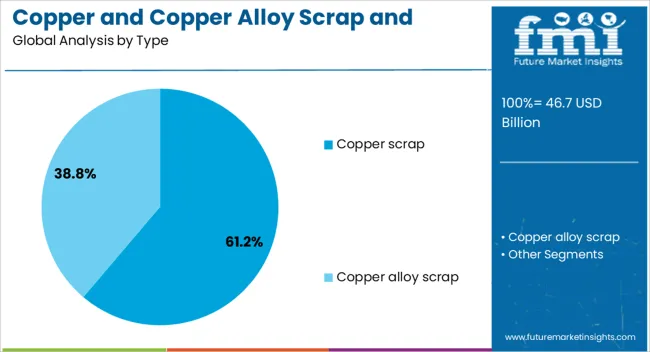
The copper scrap segment is projected to hold 61.20% of the copper and copper alloy scrap and recycling market revenue share in 2026, making it the leading type segment. This dominance has been driven by the high intrinsic value of copper and its ability to retain its physical and chemical properties through multiple recycling cycles. The strong demand for copper scrap has been supported by its significant use in manufacturing electrical conductors, plumbing materials, and industrial components. The segment has also benefited from the growing availability of collection networks and advanced separation technologies, which enable higher recovery efficiency. Increasing awareness about resource conservation and the lower energy requirements for recycling compared to primary production have further reinforced its preference among manufacturers The versatility of copper scrap in producing a range of alloys, combined with its contribution to reducing environmental impact, has ensured its sustained leadership in the overall market structure.
Insights into the Old Scrap (Post-Consumer) Source Segment
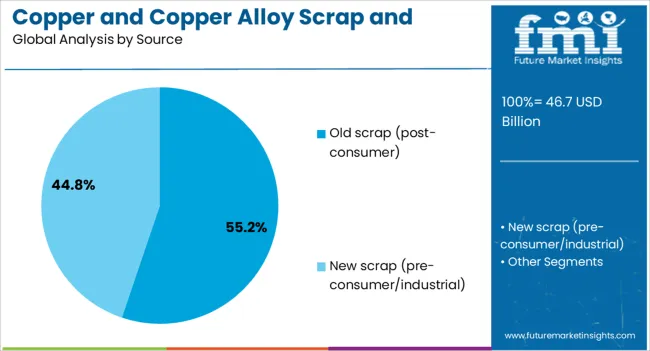
The old scrap or post-consumer source segment is anticipated to account for 55.20% of the market revenue share in 2026, emerging as the leading source category. This growth has been attributed to the increasing recovery of copper from end-of-life products such as electrical wiring, plumbing, vehicles, and consumer electronics. The segment’s prominence has been reinforced by regulatory mandates for e-waste management and landfill diversion, which prioritize recycling over disposal. Technological improvements in shredding, sorting, and refining processes have enhanced the ability to extract high-quality copper from post-consumer waste streams. Additionally, the availability of large volumes of scrap from urban demolition projects and obsolete electrical infrastructure has ensured a consistent feedstock supply The lower carbon footprint associated with processing post-consumer copper compared to mining new ore has further elevated its importance in achieving sustainability targets, supporting its dominant role in the market.
Insights into the Electrical and Electronics End-Use Segment
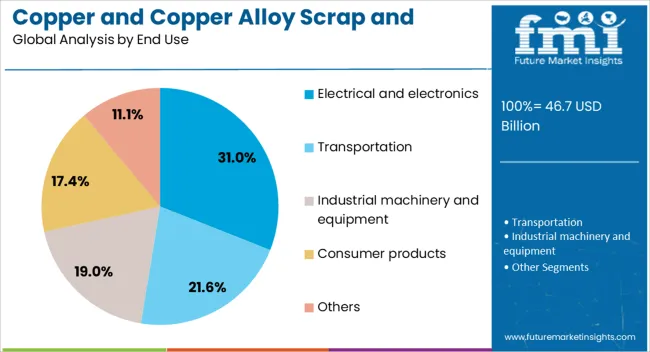
The electrical and electronics segment is expected to hold 31.00% of the market revenue share in 2026, making it the largest end-use industry. This leadership position has been reinforced by the extensive use of copper in wiring, circuit boards, connectors, and other electrical components due to its superior conductivity and durability. The segment has seen strong demand for recycled copper as manufacturers strive to reduce production costs and meet environmental compliance standards. Increasing global consumption of consumer electronics, coupled with frequent product replacement cycles, has generated a steady flow of recyclable material. The expansion of renewable energy projects and electric vehicle production has further boosted the requirement for copper in electrical applications With the dual benefit of performance consistency and sustainability, recycled copper continues to play a central role in supporting the growth and innovation within the electrical and electronics sector.
What are the Drivers, Restraints, and Key Trends of the Copper and Copper Alloy Scrap and Recycling Market?
Copper and copper alloy scrap recycling is increasingly central to electrical, construction, automotive, and industrial sectors. Growth is driven by cost efficiency, quality requirements, and regulatory frameworks that enhance adoption across diverse applications.
Rising Demand from Electrical and Electronics Sector
Copper and copper alloy scrap is increasingly adopted in the electrical and electronics sector due to its high conductivity and cost efficiency compared to primary copper. Electrical wiring, circuit boards, connectors, and electric motors drive steady consumption of recycled copper, reducing dependence on mined copper. Manufacturers are prioritizing quality and purity of scrap to meet industry standards, while growing production of electric vehicles and smart appliances further supports demand. Supply chain optimization ensures timely delivery to electronics manufacturers, while innovations in scrap sorting and refining enhance material recovery rates. Regulatory compliance for product safety and import-export certification reinforces confidence in recycled copper use, strengthening its position in high-value industrial applications.
Expanding Use in Construction and Building Applications
Recycled copper finds significant adoption in construction and building applications, including plumbing, roofing, cladding, and HVAC systems. Copper scrap is valued for corrosion resistance, durability, and ease of integration in prefabricated materials. Growth is driven by rising construction activity in both residential and commercial sectors, supported by infrastructure development and urban retrofitting projects. Efficient supply of high-quality scrap ensures material consistency, while recycling operations minimize production costs compared to primary copper. Demand for copper alloys in specialty architectural applications is increasing, particularly in premium buildings and institutional projects. The construction industry’s reliance on sustainable, reusable metals underlines recycled copper’s strategic importance for both cost management and material availability.
Impact of Automotive and Transport Industry Uptake
Copper scrap plays a crucial role in automotive and transport sectors due to widespread use in wiring harnesses, radiators, heat exchangers, and electric vehicle components. Growing production of hybrid and electric vehicles intensifies the need for high-purity recycled copper, making scrap an attractive alternative to primary metal. Supply chains emphasize consistency and traceability, while refiners focus on alloy composition and electrical performance standards. Recycled copper reduces raw material costs and shortens production timelines for automotive manufacturers. Regional automotive hubs increasingly integrate scrap processing facilities close to assembly plants, improving logistics efficiency. This trend supports circular supply chains and strengthens the adoption of recycled copper in high-value transport applications.
Regulatory and Economic Drivers Supporting Scrap Adoption
Government policies, import-export regulations, and metal procurement standards significantly influence copper scrap recycling. Incentives for secondary metal use and restrictions on landfilling industrial waste encourage higher collection and processing rates. Economic factors, including fluctuating copper prices and energy costs, make recycled copper a cost-effective feedstock for industrial users. Investments in sorting, shredding, and refining facilities improve output quality and operational efficiency. Regional variations in metal taxation, trade tariffs, and environmental standards impact market dynamics, with countries offering structured scrap collection and recycling programs gaining competitive advantage. Strategic alliances between scrap collectors, refiners, and end-use industries ensure steady availability of high-quality copper alloys, stabilizing pricing and supply.
Analysis of Copper and Copper Alloy Scrap and Recycling Market By Key Countries
.webp "Top Country Growth Comparison Copper And Copper Alloy Scrap And Recycling Market Cagr (2026 2036)")
| Country | CAGR |
|---|---|
| China | 13.8% |
| India | 12.8% |
| Germany | 11.7% |
| France | 10.7% |
| UK | 9.7% |
| USA | 8.7% |
| Brazil | 7.7% |
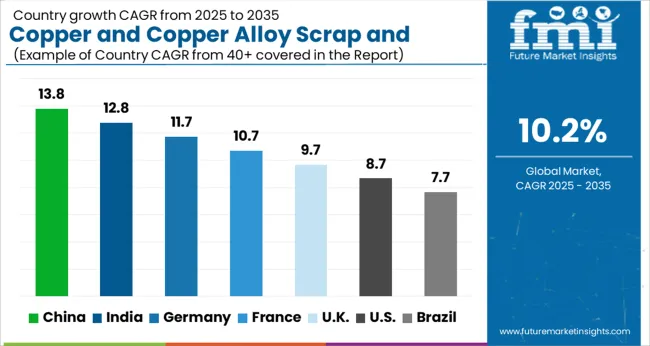
The copper and copper alloy scrap and recycling market is expected to grow globally at a CAGR of 10.2% from 2026 to 2036, supported by rising demand from electrical, construction, automotive, and industrial applications. China leads with a CAGR of 13.8%, driven by strong industrial demand, government-backed scrap collection initiatives, and growing use of recycled copper in electronics and renewable energy infrastructure. India follows at 12.8%, fueled by expansion of electrical and automotive sectors, rising construction activity, and investments in scrap processing facilities. France posts a CAGR of 10.7%, supported by regulatory incentives for secondary metal use and increasing adoption in industrial machinery. The United Kingdom grows at 9.7%, backed by efficient scrap collection programs, import substitution strategies, and uptake in high-value electronics. The United States posts 8.7%, with growth supported by stable recycling infrastructure, rising electrification in transportation, and demand for sustainable metal sourcing. The analysis spans over 40 global markets, with these five countries serving as benchmarks for evaluating supply chain efficiency, regulatory impact, and strategic investments in copper scrap recycling and processing.
Demand Outlook on Copper Scrap Recycling in China
China is projected to post a CAGR of 13.8% from 2026 to 2036, up from approximately 10.5% in 2021-2025, significantly above the global CAGR of 10.2%. Early-stage growth was driven by large-scale industrial demand, expansion in electrical and construction sectors, and government-backed scrap collection initiatives. As the period 2025-2035 unfolds, rising adoption of recycled copper in renewable energy, electronics, and automotive applications is expected to sustain growth. Increased investment in efficient recycling facilities and supply chain optimization is also lowering production costs, enabling broader market access. Growth is further fueled by import substitution strategies and regulatory support for secondary metal use.
- Expansion of industrial and electrical sectors drives scrap demand.
- Government programs enhance collection and processing of copper scrap.
- Investment in efficient recycling infrastructure reduces production costs.
Growth Analysis of Copper Scrap Recycling in India
India is expected to achieve a CAGR of 12.8% during 2026-2036, increasing from roughly 9.8% in 2021-2025, outperforming the global average of 10.2%. Initial growth was influenced by industrial electrification, automotive expansion, and gradual adoption of recycling practices. The acceleration in 2025-2035 is supported by increasing construction activity, higher industrial output, and growing reliance on secondary copper to meet rising demand. Enhanced scrap collection networks, improved logistics, and policy measures promoting circular metal use are strengthening market performance. In my assessment, India’s trajectory is aided by cost-competitive recycling units and growing domestic consumption across manufacturing and infrastructure projects.
- Industrial expansion increases copper consumption.
- Policy measures promote secondary copper utilization.
- Improved collection and logistics networks enhance supply stability.
Market Performance of Copper Scrap Recycling in France
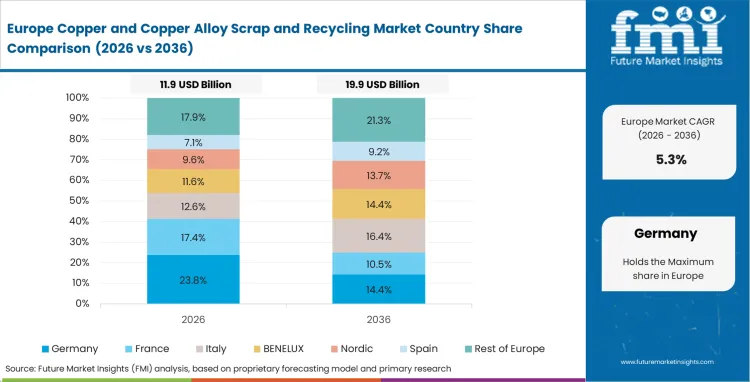
France is projected to post a CAGR of 10.7% from 2026 to 2036, up from around 8.5% in 2021-2025, closely aligned with EU industrial metal trends but above the global 10.2% baseline. Initial growth was supported by regulatory initiatives, high adoption in industrial machinery, and strong environmental compliance policies. From 2025 onwards, growth is expected to strengthen due to higher integration of recycled copper in electronics, energy transmission, and automotive sectors. Investments in advanced scrap sorting, refining technology, and strategic partnerships with manufacturers further enhance efficiency. France benefits from a mature recycling ecosystem that supports both domestic and export-driven demand for secondary copper.
- Strict regulations encourage recycled copper adoption.
- Integration in automotive and electronics sectors drives growth.
- Advanced sorting and refining technologies increase efficiency.
Future Outlook on Copper Scrap Recycling in the United Kingdom
The United Kingdom is positioned to grow at a CAGR of 9.7% from 2026 to 2036, rising from approximately 7.9% during 2021-2025, slightly below the global 10.2% rate. Early growth was driven by expansion in electrical infrastructure, moderate automotive demand, and gradual scrap collection improvements. The acceleration in 2025-2035 is expected from enhanced industrial recycling standards, rising adoption of secondary copper in high-value electronics, and government programs promoting circular economy initiatives. Strong logistics frameworks and partnerships with manufacturers help improve the availability of processed scrap, enabling a consistent supply for downstream applications.
- Electrical infrastructure upgrades increase secondary copper utilization.
- Government incentives promote scrap collection and recycling efficiency.
- Partnerships with industrial users enhance supply chain stability.
Sales Analysis of Copper Scrap Recycling in the United States
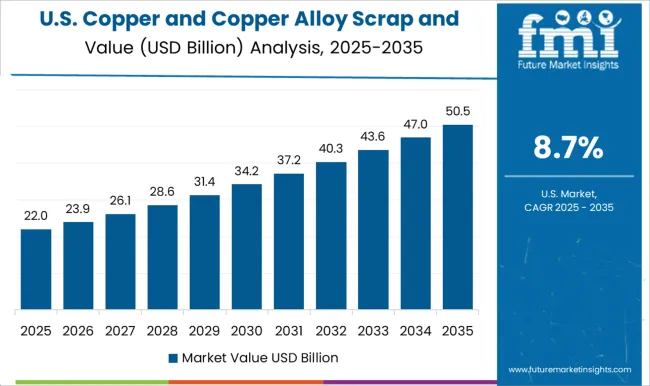
The United States is projected to post a CAGR of 8.7% from 2026 to 2036, increasing from about 7.0% in 2021-2025, below the global CAGR of 10.2% but steady due to mature market conditions. Initial growth was influenced by established recycling infrastructure, high industrial consumption, and moderate scrap imports. Future growth is expected from electrification of transport, energy grid modernization, and rising demand for high-quality recycled copper in electronics and industrial machinery. Expansion of scrap collection programs and investments in advanced separation and refining technologies are improving throughput and supporting cost efficiency. The US market benefits from predictable domestic demand and established supply chains.
- Electrification and energy upgrades increase copper recycling.
- Advanced refining and separation technologies enhance output quality.
- Stable domestic demand supports consistent market performance.
Competitive Landscape of Copper and Copper Alloy Scrap and Recycling Market
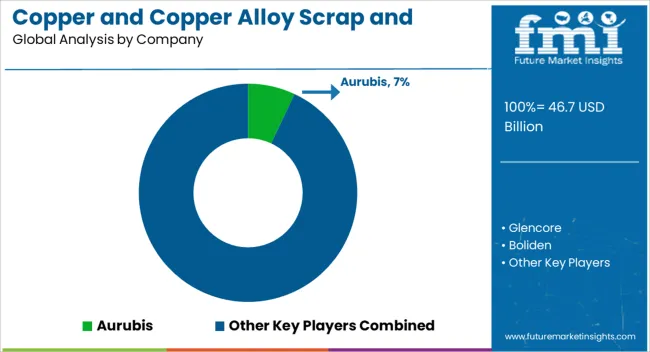
The copper and copper alloy scrap and recycling market is shaped by leading global players such as Aurubis, Glencore, Boliden, Umicore, and a wide range of regional recyclers and local operators. These companies compete by leveraging efficient smelting and refining processes, securing long-term scrap supply contracts, and integrating advanced separation technologies to maintain high-quality recycled copper output. Aurubis holds a dominant position through large-scale, vertically integrated recycling operations and consistent feedstock access, ensuring stable production and dollar sales growth. Glencore focuses on global scrap sourcing and commodity trading, optimizing supply chains to support downstream industrial applications.
Boliden emphasizes process efficiency and metal recovery rates, providing high-purity recycled copper for electronics and industrial sectors. Umicore integrates recycling with chemical refining to produce specialty copper alloys, while other smelters leverage regional scrap networks and partnerships to expand reach. Regional recyclers focus on niche markets, cost-effective collection, and localized smelting to serve specific industrial needs. Competitive strategies involve mergers and acquisitions for resource consolidation, investment in advanced refining technologies, and strategic collaborations with industrial consumers. These players prioritize operational efficiency, regulatory compliance, and supply chain stability to navigate fluctuating metal prices and evolving market requirements. Future growth will be supported by maintaining cost leadership, improving scrap collection and processing efficiency, and expanding into emerging industrial applications where recycled copper demand is rising.
Key Players in the Copper and Copper Alloy Scrap and Recycling Market
- Aurubis
- Glencore
- Boliden
- Umicore
Scope of the Report
| Metric | Value |
|---|---|
| Quantitative Units | USD 51.46 billion to USD 135.93 billion, at a CAGR of 10.2% |
| Market Definition | Copper and copper alloy scrap and recycling encompasses the collection, sorting, processing, and refining of end-of-life copper products and manufacturing offcuts into secondary copper feedstock. |
| Segmentation | Type (Copper Scrap, Copper Alloy Scrap); Source (Old Scrap, New Scrap); End Use (Electrical and Electronics, Transportation, Industrial Machinery and Equipment, Consumer Products, Others); Processing Method (Pyrometallurgical Processing, Mechanical Processing, Hydrometallurgical Processing, Electrometallurgical Processing, Other Processing Methods) |
| Regions Covered | North America, Latin America, Europe, East Asia, South Asia, Oceania, Middle East & Africa |
| Countries Covered | China, India, Germany, France, UK, USA, Brazil, and 40 plus countries |
| Key Companies Profiled | Aurubis, Glencore, Boliden, Umicore |
| Forecast Period | 2026 to 2036 |
| Approach | Forecasting models apply a bottom-up methodology starting with global installed base metrics and projecting conversion rates to next-generation systems. |
Copper and Copper Alloy Scrap and Recycling Market by Segments
Type:
- Copper scrap
- Copper alloy scrap
Source:
- Old scrap (post-consumer)
- New scrap (pre-consumer/industrial)
End Use:
- Electrical and electronics
- Transportation
- Industrial machinery and equipment
- Consumer products
- Others
Processing Method:
- Pyrometallurgical processing
- Mechanical processing
- Hydrometallurgical processing
- Electrometallurgical processing
- Other processing methods
Region:
- North America
- USA
- Canada
- Mexico
- Latin America
- Brazil
- Chile
- Rest of Latin America
- Western Europe
- Germany
- UK
- Italy
- Spain
- France
- Nordic
- BENELUX
- Rest of Western Europe
- Eastern Europe
- Russia
- Poland
- Hungary
- Balkan & Baltic
- Rest of Eastern Europe
- East Asia
- China
- Japan
- South Korea
- South Asia and Pacific
- India
- ASEAN
- Australia & New Zealand
- Rest of South Asia and Pacific
- Middle East & Africa
- Kingdom of Saudi Arabia
- Other GCC Countries
- Turkiye
- South Africa
- Other African Union
- Rest of Middle East & Africa
Bibliography
- International Copper Study Group. (2025). World Copper Factbook 2025. ICSG.
- United Nations Environment Programme. (2025). Global Resources Outlook 2025: Natural Resources for the Future We Want. UNEP.
- European Commission. (2025). Circular Economy Action Plan: Implementation Report. European Commission.
- Bureau of International Recycling. (2025). World Mirror on Non-Ferrous Metals Recycling. BIR.
- USA Geological Survey. (2025). Mineral Commodity Summaries: Copper. USGS.
This bibliography is provided for reader reference. The full Future Market Insights report contains the complete reference list with primary research documentation.
Frequently Asked Questions
How large is the demand for Copper and Copper Alloy Scrap and Recycling in the global market in 2026?
Demand for Copper and Copper Alloy Scrap and Recycling in the global market is estimated to be valued at USD 51.46 billion in 2026.
What will be the market size of Copper and Copper Alloy Scrap and Recycling in the global market by 2036?
Market size for Copper and Copper Alloy Scrap and Recycling is projected to reach USD 135.93 billion by 2036.
What is the expected demand growth for Copper and Copper Alloy Scrap and Recycling in the global market between 2026 and 2036?
Demand for Copper and Copper Alloy Scrap and Recycling is expected to grow at a CAGR of 10.2% between 2026 and 2036.
Which Type is poised to lead global sales by 2026?
Copper Scrap accounts for 61.2% in 2026 based on FMI analysis.
How is the role of Old Scrap in driving Copper and Copper Alloy Scrap and Recycling adoption in 2026?
Old Scrap represents 55.2% of segment share in 2026 as per FMI analysis.
What is the China growth outlook in this report?
China is projected to grow at a CAGR of 13.8% during 2026 to 2036.
What is Copper and Copper Alloy Scrap and Recycling and what is it mainly used for?
Copper and copper alloy scrap and recycling encompasses the collection, sorting, processing, and refining of end-of-life copper products and manufacturing offcuts into secondary copper feedstock. This market covers old scrap from demolished buildings, scrapped vehicles, and discarded electronics alongside new scrap generated during copper product fabrication, serving smelters and refineries that produce recycled copper cathode and alloy ingots for re-entry into electrical, transportation, and industrial supply chains.
What is included in the scope of this Copper and Copper Alloy Scrap and Recycling report?
Market scope covers copper scrap and copper alloy scrap across old scrap and new scrap sources processed through pyrometallurgical, mechanical, hydrometallurgical, and electrometallurgical methods. Analysis includes scrap-level transaction value across electrical and electronics, transportation, industrial machinery, and consumer product end-use categories.
Preview the report firsthand - request a free sample
Get SampleGet the brochure for pricing and purchase details.
Get PDFTable of Content
- Executive Summary
- Global Market Outlook
- Demand-side Trends
- Supply-side Trends
- Technology Roadmap Analysis
- Analysis and Recommendations
- Market Overview
- Market Coverage / Taxonomy
- Market Definition / Scope / Limitations
- Research Methodology
- Chapter Orientation
- Analytical Lens and Working Hypotheses
- Market Structure, Signals, and Trend Drivers
- Benchmarking and Cross-market Comparability
- Market Sizing, Forecasting, and Opportunity Mapping
- Research Design and Evidence Framework
- Desk Research Programme (Secondary Evidence)
- Company Annual and Sustainability Reports
- Peer-reviewed Journals and Academic Literature
- Corporate Websites, Product Literature, and Technical Notes
- Earnings Decks and Investor Briefings
- Statutory Filings and Regulatory Disclosures
- Technical White Papers and Standards Notes
- Trade Journals, Industry Magazines, and Analyst Briefs
- Conference Proceedings, Webinars, and Seminar Materials
- Government Statistics Portals and Public Data Releases
- Press Releases and Reputable Media Coverage
- Specialist Newsletters and Curated Briefings
- Sector Databases and Reference Repositories
- FMI Internal Proprietary Databases and Historical Market Datasets
- Subscription Datasets and Paid Sources
- Social Channels, Communities, and Digital Listening Inputs
- Additional Desk Sources
- Expert Input and Fieldwork (Primary Evidence)
- Primary Modes
- Qualitative Interviews and Expert Elicitation
- Quantitative Surveys and Structured Data Capture
- Blended Approach
- Why Primary Evidence is Used
- Field Techniques
- Interviews
- Surveys
- Focus Groups
- Observational and In-context Research
- Social and Community Interactions
- Stakeholder Universe Engaged
- C-suite Leaders
- Board Members
- Presidents and Vice Presidents
- R&D and Innovation Heads
- Technical Specialists
- Domain Subject-matter Experts
- Scientists
- Physicians and Other Healthcare Professionals
- Governance, Ethics, and Data Stewardship
- Research Ethics
- Data Integrity and Handling
- Primary Modes
- Tooling, Models, and Reference Databases
- Desk Research Programme (Secondary Evidence)
- Data Engineering and Model Build
- Data Acquisition and Ingestion
- Cleaning, Normalisation, and Verification
- Synthesis, Triangulation, and Analysis
- Quality Assurance and Audit Trail
- Market Background
- Market Dynamics
- Drivers
- Restraints
- Opportunity
- Trends
- Scenario Forecast
- Demand in Optimistic Scenario
- Demand in Likely Scenario
- Demand in Conservative Scenario
- Opportunity Map Analysis
- Product Life Cycle Analysis
- Supply Chain Analysis
- Investment Feasibility Matrix
- Value Chain Analysis
- PESTLE and Porter’s Analysis
- Regulatory Landscape
- Regional Parent Market Outlook
- Production and Consumption Statistics
- Import and Export Statistics
- Market Dynamics
- Global Market Analysis 2021 to 2025 and Forecast, 2026 to 2036
- Historical Market Size Value (USD Million) Analysis, 2021 to 2025
- Current and Future Market Size Value (USD Million) Projections, 2026 to 2036
- Y-o-Y Growth Trend Analysis
- Absolute $ Opportunity Analysis
- Global Market Pricing Analysis 2021 to 2025 and Forecast 2026 to 2036
- Global Market Analysis 2021 to 2025 and Forecast 2026 to 2036, By Type
- Introduction / Key Findings
- Historical Market Size Value (USD Million) Analysis By Type , 2021 to 2025
- Current and Future Market Size Value (USD Million) Analysis and Forecast By Type , 2026 to 2036
- Copper scrap
- Copper alloy scrap
- Copper scrap
- Y-o-Y Growth Trend Analysis By Type , 2021 to 2025
- Absolute $ Opportunity Analysis By Type , 2026 to 2036
- Global Market Analysis 2021 to 2025 and Forecast 2026 to 2036, By Source
- Introduction / Key Findings
- Historical Market Size Value (USD Million) Analysis By Source, 2021 to 2025
- Current and Future Market Size Value (USD Million) Analysis and Forecast By Source, 2026 to 2036
- Old scrap
- New scrap
- Old scrap
- Y-o-Y Growth Trend Analysis By Source, 2021 to 2025
- Absolute $ Opportunity Analysis By Source, 2026 to 2036
- Global Market Analysis 2021 to 2025 and Forecast 2026 to 2036, By End Use
- Introduction / Key Findings
- Historical Market Size Value (USD Million) Analysis By End Use, 2021 to 2025
- Current and Future Market Size Value (USD Million) Analysis and Forecast By End Use, 2026 to 2036
- Electrical and electronics
- Transportation
- Industrial machinery and equipment
- Consumer products
- Others
- Electrical and electronics
- Y-o-Y Growth Trend Analysis By End Use, 2021 to 2025
- Absolute $ Opportunity Analysis By End Use, 2026 to 2036
- Global Market Analysis 2021 to 2025 and Forecast 2026 to 2036, By Processing Method
- Introduction / Key Findings
- Historical Market Size Value (USD Million) Analysis By Processing Method, 2021 to 2025
- Current and Future Market Size Value (USD Million) Analysis and Forecast By Processing Method, 2026 to 2036
- Pyrometallurgical processing
- Mechanical processing
- Hydrometallurgical processing
- Electrometallurgical processing
- Other processing methods
- Pyrometallurgical processing
- Y-o-Y Growth Trend Analysis By Processing Method, 2021 to 2025
- Absolute $ Opportunity Analysis By Processing Method, 2026 to 2036
- Global Market Analysis 2021 to 2025 and Forecast 2026 to 2036, By Region
- Introduction
- Historical Market Size Value (USD Million) Analysis By Region, 2021 to 2025
- Current Market Size Value (USD Million) Analysis and Forecast By Region, 2026 to 2036
- North America
- Latin America
- Western Europe
- Eastern Europe
- East Asia
- South Asia and Pacific
- Middle East & Africa
- Market Attractiveness Analysis By Region
- North America Market Analysis 2021 to 2025 and Forecast 2026 to 2036, By Country
- Historical Market Size Value (USD Million) Trend Analysis By Market Taxonomy, 2021 to 2025
- Market Size Value (USD Million) Forecast By Market Taxonomy, 2026 to 2036
- By Country
- USA
- Canada
- Mexico
- By Type
- By Source
- By End Use
- By Processing Method
- By Country
- Market Attractiveness Analysis
- By Country
- By Type
- By Source
- By End Use
- By Processing Method
- Key Takeaways
- Latin America Market Analysis 2021 to 2025 and Forecast 2026 to 2036, By Country
- Historical Market Size Value (USD Million) Trend Analysis By Market Taxonomy, 2021 to 2025
- Market Size Value (USD Million) Forecast By Market Taxonomy, 2026 to 2036
- By Country
- Brazil
- Chile
- Rest of Latin America
- By Type
- By Source
- By End Use
- By Processing Method
- By Country
- Market Attractiveness Analysis
- By Country
- By Type
- By Source
- By End Use
- By Processing Method
- Key Takeaways
- Western Europe Market Analysis 2021 to 2025 and Forecast 2026 to 2036, By Country
- Historical Market Size Value (USD Million) Trend Analysis By Market Taxonomy, 2021 to 2025
- Market Size Value (USD Million) Forecast By Market Taxonomy, 2026 to 2036
- By Country
- Germany
- UK
- Italy
- Spain
- France
- Nordic
- BENELUX
- Rest of Western Europe
- By Type
- By Source
- By End Use
- By Processing Method
- By Country
- Market Attractiveness Analysis
- By Country
- By Type
- By Source
- By End Use
- By Processing Method
- Key Takeaways
- Eastern Europe Market Analysis 2021 to 2025 and Forecast 2026 to 2036, By Country
- Historical Market Size Value (USD Million) Trend Analysis By Market Taxonomy, 2021 to 2025
- Market Size Value (USD Million) Forecast By Market Taxonomy, 2026 to 2036
- By Country
- Russia
- Poland
- Hungary
- Balkan & Baltic
- Rest of Eastern Europe
- By Type
- By Source
- By End Use
- By Processing Method
- By Country
- Market Attractiveness Analysis
- By Country
- By Type
- By Source
- By End Use
- By Processing Method
- Key Takeaways
- East Asia Market Analysis 2021 to 2025 and Forecast 2026 to 2036, By Country
- Historical Market Size Value (USD Million) Trend Analysis By Market Taxonomy, 2021 to 2025
- Market Size Value (USD Million) Forecast By Market Taxonomy, 2026 to 2036
- By Country
- China
- Japan
- South Korea
- By Type
- By Source
- By End Use
- By Processing Method
- By Country
- Market Attractiveness Analysis
- By Country
- By Type
- By Source
- By End Use
- By Processing Method
- Key Takeaways
- South Asia and Pacific Market Analysis 2021 to 2025 and Forecast 2026 to 2036, By Country
- Historical Market Size Value (USD Million) Trend Analysis By Market Taxonomy, 2021 to 2025
- Market Size Value (USD Million) Forecast By Market Taxonomy, 2026 to 2036
- By Country
- India
- ASEAN
- Australia & New Zealand
- Rest of South Asia and Pacific
- By Type
- By Source
- By End Use
- By Processing Method
- By Country
- Market Attractiveness Analysis
- By Country
- By Type
- By Source
- By End Use
- By Processing Method
- Key Takeaways
- Middle East & Africa Market Analysis 2021 to 2025 and Forecast 2026 to 2036, By Country
- Historical Market Size Value (USD Million) Trend Analysis By Market Taxonomy, 2021 to 2025
- Market Size Value (USD Million) Forecast By Market Taxonomy, 2026 to 2036
- By Country
- Kingdom of Saudi Arabia
- Other GCC Countries
- Turkiye
- South Africa
- Other African Union
- Rest of Middle East & Africa
- By Type
- By Source
- By End Use
- By Processing Method
- By Country
- Market Attractiveness Analysis
- By Country
- By Type
- By Source
- By End Use
- By Processing Method
- Key Takeaways
- Key Countries Market Analysis
- USA
- Pricing Analysis
- Market Share Analysis, 2025
- By Type
- By Source
- By End Use
- By Processing Method
- Canada
- Pricing Analysis
- Market Share Analysis, 2025
- By Type
- By Source
- By End Use
- By Processing Method
- Mexico
- Pricing Analysis
- Market Share Analysis, 2025
- By Type
- By Source
- By End Use
- By Processing Method
- Brazil
- Pricing Analysis
- Market Share Analysis, 2025
- By Type
- By Source
- By End Use
- By Processing Method
- Chile
- Pricing Analysis
- Market Share Analysis, 2025
- By Type
- By Source
- By End Use
- By Processing Method
- Germany
- Pricing Analysis
- Market Share Analysis, 2025
- By Type
- By Source
- By End Use
- By Processing Method
- UK
- Pricing Analysis
- Market Share Analysis, 2025
- By Type
- By Source
- By End Use
- By Processing Method
- Italy
- Pricing Analysis
- Market Share Analysis, 2025
- By Type
- By Source
- By End Use
- By Processing Method
- Spain
- Pricing Analysis
- Market Share Analysis, 2025
- By Type
- By Source
- By End Use
- By Processing Method
- France
- Pricing Analysis
- Market Share Analysis, 2025
- By Type
- By Source
- By End Use
- By Processing Method
- India
- Pricing Analysis
- Market Share Analysis, 2025
- By Type
- By Source
- By End Use
- By Processing Method
- ASEAN
- Pricing Analysis
- Market Share Analysis, 2025
- By Type
- By Source
- By End Use
- By Processing Method
- Australia & New Zealand
- Pricing Analysis
- Market Share Analysis, 2025
- By Type
- By Source
- By End Use
- By Processing Method
- China
- Pricing Analysis
- Market Share Analysis, 2025
- By Type
- By Source
- By End Use
- By Processing Method
- Japan
- Pricing Analysis
- Market Share Analysis, 2025
- By Type
- By Source
- By End Use
- By Processing Method
- South Korea
- Pricing Analysis
- Market Share Analysis, 2025
- By Type
- By Source
- By End Use
- By Processing Method
- Russia
- Pricing Analysis
- Market Share Analysis, 2025
- By Type
- By Source
- By End Use
- By Processing Method
- Poland
- Pricing Analysis
- Market Share Analysis, 2025
- By Type
- By Source
- By End Use
- By Processing Method
- Hungary
- Pricing Analysis
- Market Share Analysis, 2025
- By Type
- By Source
- By End Use
- By Processing Method
- Kingdom of Saudi Arabia
- Pricing Analysis
- Market Share Analysis, 2025
- By Type
- By Source
- By End Use
- By Processing Method
- Turkiye
- Pricing Analysis
- Market Share Analysis, 2025
- By Type
- By Source
- By End Use
- By Processing Method
- South Africa
- Pricing Analysis
- Market Share Analysis, 2025
- By Type
- By Source
- By End Use
- By Processing Method
- USA
- Market Structure Analysis
- Competition Dashboard
- Competition Benchmarking
- Market Share Analysis of Top Players
- By Regional
- By Type
- By Source
- By End Use
- By Processing Method
- Competition Analysis
- Competition Deep Dive
- Aurubis
- Overview
- Product Portfolio
- Profitability by Market Segments (Product/Age /Sales Channel/Region)
- Sales Footprint
- Strategy Overview
- Marketing Strategy
- Product Strategy
- Channel Strategy
- Glencore
- Boliden
- Umicore
- Aurubis
- Competition Deep Dive
- Assumptions & Acronyms Used


