

- Industry Size (2026)
- USD 5420 Mn
- Forecast (2036)
- USD 15811 Mn
- CAGR (2026 to 2036)
- 11.3%
Full Closed-Loop Recycling Ecosystem Market Forecast and Outlook 2026 to 2036
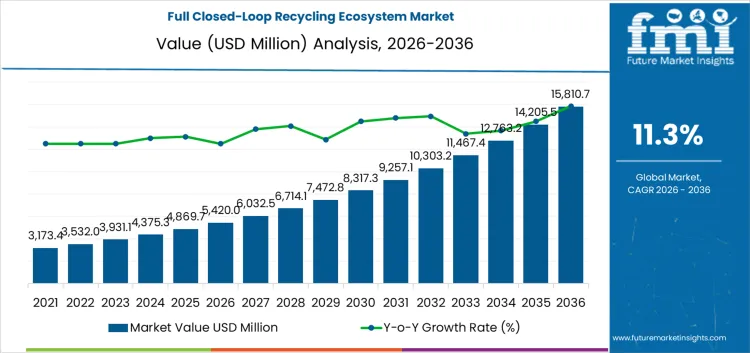
The full closed-loop recycling ecosystem market is forecast to increase from USD 5,420 million in 2026 to USD 15,811 million by 2036, corresponding to a CAGR of 11.3%. This expansion reflects tighter regulatory expectations, rising brand accountability for recycled content, and the need to stabilize both the quality and availability of secondary raw materials across value chains.
Closed-loop configurations help insulate participants from feedstock price swings by synchronizing collection, processing, and end-use performance requirements inside controlled systems. As a result, procurement decisions are increasingly governed by compliance economics, audit readiness, and long-term cost visibility rather than short-term recycling margins alone.
Across the forecast period, demand will cluster around packaging, electronics, and automotive applications, where high and repeatable material throughput supports reliable ecosystem utilization but requires sophisticated coordination and sizable capital commitments. Value creation will concentrate among operators that can broker and manage complex multi-party agreements, ensure transparent data flows, and secure multi-year offtake structures for recycled outputs.
Quick Stats for Full Closed-Loop Recycling Ecosystem Market
- Full Closed-Loop Recycling Ecosystem Market Value (2026): USD 5,420 Million
- Full Closed-Loop Recycling Ecosystem Market Forecast Value (2036): USD 15,811 Million
- Full Closed-Loop Recycling Ecosystem Market Forecast CAGR 2026 to 2036: 11.3%
- Leading Ecosystem Model in Full Closed-Loop Recycling Ecosystem Market: Integrated Collection-Recycling-Conversion (37% share)
- Key Growth Regions in Full Closed-Loop Recycling Ecosystem Market: Asia Pacific, Europe, and North America
- Top Key Players in Full Closed-Loop Recycling Ecosystem Market: Veolia Environnement S.A., BASF SE, Waste Management, Inc., Dow Inc., GEM Co., Ltd., China Everbright Environment Group Limited, JEPLAN, Inc., DOWA Eco-System Co., Ltd.
Full Closed-Loop Recycling Ecosystem Market Key Takeaways
| Metric | Value |
|---|---|
| Full Closed-Loop Recycling Ecosystem Market Value (2026) | USD 5,420 Million |
| Full Closed-Loop Recycling Ecosystem Market Forecast Value (2036) | USD 15,811 Million |
| Full Closed-Loop Recycling Ecosystem Market Forecast CAGR 2026 to 2036 | 11.3% |
How are Value-Chain Integration and Compliance Economics Driving the Full Closed-Loop Recycling Ecosystem Market?
The full closed-loop recycling ecosystem market is expanding as brands and regulators move beyond standalone recycling assets toward integrated, end-to-end material recovery systems. Closed-loop models link collection, sorting, recycling, compounding, and re-use into a coordinated ecosystem that delivers consistent, application-specific recycled materials. For solution providers and system integrators, demand is shifting from individual equipment sales to multi-stakeholder platforms that guarantee material quality, traceability, and long-term supply assurance for brand owners.
Commercial decision-making within this market is increasingly driven by risk mitigation and cost predictability. Brand owners face rising pressure to meet recycled-content mandates, extended producer responsibility obligations, and audit requirements. Closed-loop ecosystems reduce exposure to feedstock volatility by locking in material flows and aligning specifications across the value chain. Technology providers that enable data transparency, certification readiness, and performance verification are becoming critical partners rather than optional vendors.
Monetization models are also evolving as ecosystems scale. Revenue is no longer limited to material sales alone but extends to long-term offtake agreements, recycling-as-a-service contracts, digital traceability platforms, and compliance support services. Regional investments in Europe, North America, and Asia Pacific are accelerating ecosystem formation around packaging, automotive plastics, and consumer goods. For participants across the value chain, competitive advantage increasingly depends on orchestration capability-connecting infrastructure, technology, and commercial agreements into a resilient closed-loop system that delivers regulatory compliance, cost stability, and measurable sustainability outcomes.
How is The Full Closed-Loop Recycling Ecosystem Market Structured by End Use and Ecosystem Model?
The full closed-loop recycling ecosystem market is segmented by end use and ecosystem model, reflecting how material recovery, processing coordination, and scale determine system design. By end use, packaging, electronics, and automotive applications lead adoption, driven by high material throughput and repeatable product cycles. Other end uses include FMCG and consumer goods, high-volume recycling zones, precision recycling applications, emerging circular systems, and regional ecosystems with localized recovery needs. By ecosystem model, integrated collection-recycling-conversion frameworks represent the leading approach, while brand-led closed loops, industrial recycling parks, and corporate closed loops address different ownership, governance, and operational preferences across industries.
Why Do Packaging, Electronics, and Automotive Applications Lead End-Use Adoption?
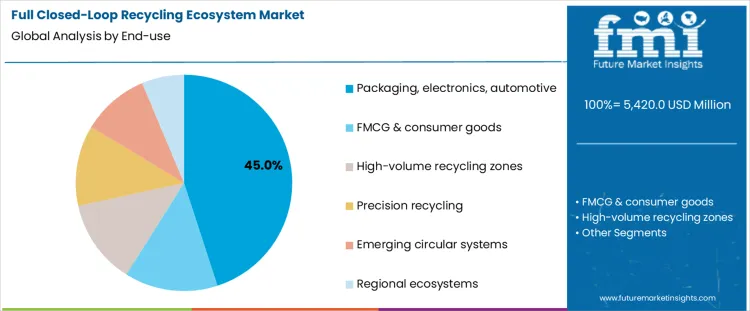
Packaging, electronics, and automotive applications account for 45% share of the full closed-loop recycling ecosystem market because these sectors generate large, consistent material streams with predictable composition. High product turnover in packaging and electronics supports frequent recovery cycles, while automotive platforms enable structured dismantling and material separation. Manufacturers in these sectors benefit from centralized sourcing, standardized specifications, and repeat production runs. Coordinated ecosystems reduce material variability and improve recovery efficiency across multiple product lifecycles. For ecosystem operators and solution providers, these industries offer scale, long-term participation, and multi-site deployment opportunities. These volume, structure, and repeatability factors explain why packaging, electronics, and automotive dominate end-use demand.
Why Do Integrated Collection Recycling Conversion Models Dominate Ecosystem Design?

Integrated collection recycling conversion models hold 37% share of the full closed-loop recycling ecosystem market because they align material capture, processing, and reuse within a single operational framework. This model reduces handoffs between stakeholders, improves material traceability, and shortens turnaround time from recovery to reuse. Operators gain better control over feedstock quality and process efficiency when collection and conversion are coordinated. Integrated systems also support consistent output specifications for downstream manufacturing. For technology providers and operators, this approach enables standardized infrastructure deployment and predictable operating economics. These coordination and efficiency advantages explain why integrated ecosystem models remain the most widely adopted.
What Defines the Full Closed-Loop Recycling Ecosystem Market?
The full closed-loop recycling ecosystem market revolves around integrating material collection, sorting, recycling, and re-conversion within a well-managed framework. This market growth is fueled by increasing material efficiency, waste diversion targets, and expanding collaboration among stakeholders in packaging, automotive, electronics, and FMCG sectors.
The closed-loop systems ensure that end-of-life materials are fed back into the production chain, reducing material leakage and supporting sustainability. These ecosystems are categorized into integrated collection-recycling-conversion systems, brand-led closed loops, and regional recycling models that offer flexibility and efficiency.
What Is the Country-Wise Outlook for Full Closed-Loop Recycling Ecosystem Market?
| Country | CAGR (%) |
|---|---|
| India | 14.4% |
| China | 13.6% |
| United States | 11.0% |
| Germany | 10.6% |
| Japan | 9.8% |
How is Germany Advancing Closed-Loop Recycling Systems?
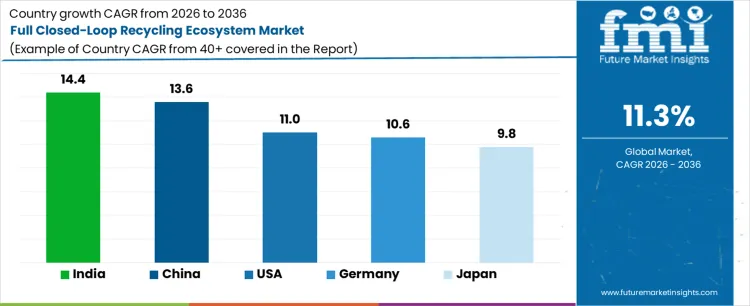
The closed-loop recycling ecosystem market in Germany, growing at a CAGR of 10.6% during 2026-2036, is driven by robust industrial and regulatory frameworks. Germany is a leader in integrating efficient recycling systems across packaging, electronics, and automotive sectors. Companies focus on improving material recovery through centralized recycling parks and high-volume processing zones. Key players in Germany adopt integrated collection-recycling-conversion systems, enhancing the supply chain by reducing material leakage and increasing material reuse. Buyers emphasize traceability, quality control, and compliance with stringent environmental regulations. The country's investments in regional ecosystems and industrial recycling parks further support the development of circular systems. Procurement strategies favor suppliers with proven track records in managing large-scale waste diversion and recovery programs.
What is Driving Rapid Growth of Closed-Loop Systems in the United States?
Demand for full closed-loop recycling ecosystem in the United States, expanding at a CAGR of 11.0%, is largely driven by the high volume of packaging, automotive, and electronics sectors. With growing focus on reducing environmental impact, many US companies are looking to integrate more efficient and scalable recycling systems. Both OEMs and FMCG brands are increasing their reliance on integrated collection, recycling, and conversion solutions, aligning with circular supply chain initiatives. The US market is seeing significant growth in regional recycling hubs and high-volume recycling zones designed to support various industries. Procurement decisions emphasize modular systems capable of processing a wide range of materials and meeting national standards. Companies are investing in industrial recycling parks, where waste can be processed efficiently, and ensuring high-quality material output.
How is China Becoming a Key Player in Closed-Loop Recycling Ecosystem Development?
Sale of closed-loop recycling ecosystem in China is expanding rapidly, growing at a CAGR of 13.6%. The country’s rapid urbanization, manufacturing capacity, and policy support are major drivers of this growth. China is a key market for integrated collection-recycling-conversion systems, especially for industries such as packaging, electronics, and automotive. The Chinese government has introduced various incentives to encourage recycling and minimize waste through integrated systems that optimize material reuse across industries. A key characteristic of China’s market is the rapid scaling of recycling infrastructure, including high-volume recycling zones and industrial recycling parks. These ecosystems support the massive demand for raw materials in both domestic and export markets. Chinese companies are investing in brand-led closed loops and corporate-level recycling systems, which help reduce raw material dependence by reintroducing processed materials into the production line.
How Is India Pioneering the High-Growth Closed-Loop Systems Market?
India is the fastest-growing market for closed-loop recycling ecosystems, expanding at a CAGR of 14.4%. The growth of manufacturing industries such as automotive, FMCG, and electronics is driving the need for more efficient recycling systems. India’s unique market dynamics include rapid adoption of regional ecosystems and industrial recycling parks. The country’s burgeoning middle class and rising consumer demand for packaged goods create a high volume of waste that can be effectively diverted and reused through advanced recycling technologies. India's closed-loop systems often focus on brand-led recovery programs, particularly in packaging and consumer goods, where companies take responsibility for the entire lifecycle of their products. With growing support from both government and private sectors, India is developing high-volume recycling zones and specialized hubs for electronics and automotive waste, offering ample opportunities for efficient material reuse and minimized leakage.
How Are Companies Competing in the Full Closed-Loop Recycling Ecosystem Market?
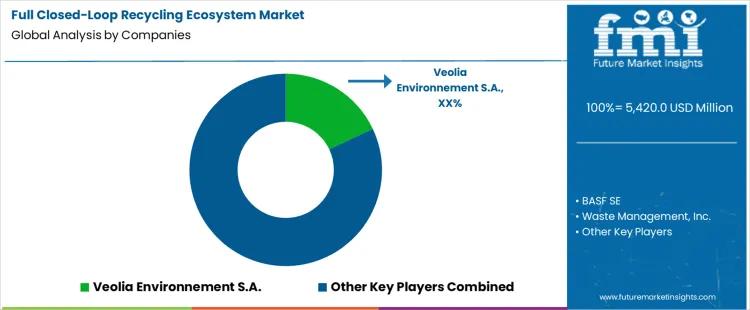
Competition in the full closed-loop recycling ecosystem market is defined by end-to-end recycling capabilities, verified material recovery rates, and documented integration across collection, processing, and supply chain reintegration as presented in official company materials. Veolia Environnement S.A. positions its closed-loop solutions with brochures that highlight comprehensive waste collection networks, advanced mechanical and chemical recycling technologies, and end-market reintegration for polymers and metals. Product and service literature emphasizes traceability, recycled content certification, and circular supply chain partnerships that appeal to brand owners and converters. BASF SE competes through its ChemCycling™ and related initiatives, with official documentation presenting mass balance approaches that channel recycled feedstocks into existing production streams while maintaining primary product performance standards.
Waste infrastructure leaders differentiate through scale and logistics integration. Waste Management, Inc. markets its closed-loop ecosystem with materials that document curbside collection reach, sorting accuracy, and high-throughput recycling facilities designed to feed quality recyclates into downstream manufacturing. Dow Inc. complements chemical and mechanical recycling capabilities with product literature that highlights recycled feedstock integration into performance polymers, supported by reported PCR yield data and applications in packaging, automotive, and industrial markets.
Regional recyclers and technology providers add competitive breadth through localized ecosystems. GEM Co., Ltd. and China Everbright Environment Group Limited emphasize municipal and industrial recycling platforms documented for high capture rates and material recovery tailored to domestic supply chains. JEPLAN, Inc. competes by integrating advanced sorting and depolymerization technologies with official materials highlighting circularity metrics and collaboration models with consumer brands. DOWA Eco-System Co., Ltd. positions its ecosystem with documentation on end-to-end recycling flows that include collection, processing, and remanufacturing, targeting closed-loop solutions in automotive, electronics, and packaging. Across suppliers, competitive advantage is established through brochure-verified material recovery performance, supply chain integration, and circularity certifications rather than basic service pricing.
Key Players in Full Closed-Loop Recycling Ecosystem Market
- Veolia Environnement S.A.
- BASF SE
- Waste Management, Inc.
- Dow Inc.
- GEM Co., Ltd.
- China Everbright Environment Group Limited
- JEPLAN, Inc.
- DOWA Eco-System Co., Ltd.
Scope of Report
| Attribute | Description |
|---|---|
| Quantitative Unit | USD Million |
| End-use | Packaging, Electronics, Automotive; FMCG & Consumer Goods; High-Volume Recycling Zones; Precision Recycling; Emerging Circular Systems; Regional Ecosystems |
| Ecosystem Model | Integrated Collection-Recycling-Conversion, Brand-Led Closed Loops, Industrial Recycling Parks, Corporate Closed Loops |
| Countries Covered | China, Japan, South Korea, India, Australia & New Zealand, ASEAN, Rest of Asia Pacific, Germany, United Kingdom, France, Italy, Spain, Nordic, BENELUX, Rest of Europe, United States, Canada, Mexico, Brazil, Chile, Rest of Latin America, Kingdom of Saudi Arabia, Other GCC Countries, Turkey, South Africa, Other African Union, Rest of Middle East & Africa |
| Regions Covered | Asia Pacific, Europe, North America, Latin America, Middle East & Africa |
| Key Companies Profiled | Veolia Environnement S.A., BASF SE, Waste Management, Inc., Dow Inc., GEM Co., Ltd., China Everbright Environment Group Limited, JEPLAN, Inc., DOWA Eco-System Co., Ltd. |
| Additional Attributes | Dollar sales by end-use and ecosystem model are evaluated across circular economy infrastructure deployments. The report includes country-level demand assessment, growth projections for 2026-2036, analysis of material recovery efficiency and loop closure rates, evaluation of brand and industrial participation models, competitive benchmarking of ecosystem operators, and assessment of policy-driven investment and scaling trends across global recycling value chains. |
Full Closed-Loop Recycling Ecosystem Market by Key Segments
End-use:
- Packaging, electronics, automotive
- FMCG & consumer goods
- High-volume recycling zones
- Precision recycling
- Emerging circular systems
- Regional ecosystems
Ecosystem Model:
- Integrated collection recycling conversion
- Brand-led closed loops
- Industrial recycling parks
- Corporate closed loops
Region:
- Asia Pacific
- China
- Japan
- South Korea
- India
- Australia & New Zealand
- ASEAN
- Rest of Asia Pacific
- Europe
- Germany
- United Kingdom
- France
- Italy
- Spain
- Nordic
- BENELUX
- Rest of Europe
- North America
- United States
- Canada
- Mexico
- Latin America
- Brazil
- Chile
- Rest of Latin America
- Middle East & Africa
- Kingdom of Saudi Arabia
- Other GCC Countries
- Turkey
- South Africa
- Other African Union
- Rest of Middle East & Africa
Bibliography
- European Commission. (2023). Commission Implementing Decision (EU) 2023/2683 on rules for calculation, verification and reporting of recycled content in plastic products. European Union.
- European Union. (2024). Regulation (EU) 2024/1781 establishing a framework for ecodesign requirements for sustainable products. Official Journal of the European Union.
- International Organization for Standardization. (2024). ISO 59020: Circular economy—Measuring and assessing circularity. ISO.
- Organisation for Economic Co-operation and Development. (2024). Global plastics outlook: Policy scenarios to 2060. OECD Publishing.
- United Nations Environment Programme. (2024). Global plastics outlook: Economic drivers, environmental impacts and policy responses. UNEP.
Frequently Asked Questions
How big is the full closed-loop recycling ecosystem market in 2026?
The global full closed-loop recycling ecosystem market is estimated to be valued at USD 5,420.0 million in 2026.
What will be the size of full closed-loop recycling ecosystem market in 2036?
The market size for the full closed-loop recycling ecosystem market is projected to reach USD 15,810.7 million by 2036.
How much will be the full closed-loop recycling ecosystem market growth between 2026 and 2036?
The full closed-loop recycling ecosystem market is expected to grow at a 11.3% CAGR between 2026 and 2036.
What are the key product types in the full closed-loop recycling ecosystem market?
The key product types in full closed-loop recycling ecosystem market are packaging, electronics, automotive, fmcg & consumer goods, high-volume recycling zones, precision recycling, emerging circular systems and regional ecosystems.
Which ecosystem model segment to contribute significant share in the full closed-loop recycling ecosystem market in 2026?
In terms of ecosystem model, integrated collection recyclingconversion segment to command 37.0% share in the full closed-loop recycling ecosystem market in 2026.
Preview the report firsthand - request a free sample
Get SampleGet the brochure for pricing and purchase details.
Get PDFTable of Content
- Executive Summary
- Global Market Outlook
- Demand-side Trends
- Supply-side Trends
- Technology Roadmap Analysis
- Analysis and Recommendations
- Market Overview
- Market Coverage / Taxonomy
- Market Definition / Scope / Limitations
- Market Background
- Market Dynamics
- Drivers
- Restraints
- Opportunity
- Trends
- Scenario Forecast
- Demand in Optimistic Scenario
- Demand in Likely Scenario
- Demand in Conservative Scenario
- Opportunity Map Analysis
- Product Life Cycle Analysis
- Supply Chain Analysis
- Investment Feasibility Matrix
- Value Chain Analysis
- PESTLE and Porter’s Analysis
- Regulatory Landscape
- Regional Parent Market Outlook
- Production and Consumption Statistics
- Import and Export Statistics
- Market Dynamics
- Global Market Analysis 2021 to 2025 and Forecast, 2026 to 2036
- Historical Market Size Value (USD Million) Analysis, 2021 to 2025
- Current and Future Market Size Value (USD Million) Projections, 2026 to 2036
- Y-o-Y Growth Trend Analysis
- Absolute $ Opportunity Analysis
- Global Market Pricing Analysis 2021 to 2025 and Forecast 2026 to 2036
- Global Market Analysis 2021 to 2025 and Forecast 2026 to 2036, By End-use
- Introduction / Key Findings
- Historical Market Size Value (USD Million) Analysis By End-use , 2021 to 2025
- Current and Future Market Size Value (USD Million) Analysis and Forecast By End-use , 2026 to 2036
- Packaging, electronics, automotive
- FMCG & consumer goods
- High-volume recycling zones
- Precision recycling
- Emerging circular systems
- Regional ecosystems
- Packaging, electronics, automotive
- Y-o-Y Growth Trend Analysis By End-use , 2021 to 2025
- Absolute $ Opportunity Analysis By End-use , 2026 to 2036
- Global Market Analysis 2021 to 2025 and Forecast 2026 to 2036, By Ecosystem Model
- Introduction / Key Findings
- Historical Market Size Value (USD Million) Analysis By Ecosystem Model, 2021 to 2025
- Current and Future Market Size Value (USD Million) Analysis and Forecast By Ecosystem Model, 2026 to 2036
- Integrated collection recyclingconversion
- Brand-led closed loops
- Industrial recycling parks
- Corporate closed loops
- Integrated collection recyclingconversion
- Y-o-Y Growth Trend Analysis By Ecosystem Model, 2021 to 2025
- Absolute $ Opportunity Analysis By Ecosystem Model, 2026 to 2036
- Global Market Analysis 2021 to 2025 and Forecast 2026 to 2036, By Region
- Introduction
- Historical Market Size Value (USD Million) Analysis By Region, 2021 to 2025
- Current Market Size Value (USD Million) Analysis and Forecast By Region, 2026 to 2036
- North America
- Latin America
- Western Europe
- Eastern Europe
- East Asia
- South Asia and Pacific
- Middle East & Africa
- Market Attractiveness Analysis By Region
- North America Market Analysis 2021 to 2025 and Forecast 2026 to 2036, By Country
- Historical Market Size Value (USD Million) Trend Analysis By Market Taxonomy, 2021 to 2025
- Market Size Value (USD Million) Forecast By Market Taxonomy, 2026 to 2036
- By Country
- USA
- Canada
- Mexico
- By End-use
- By Ecosystem Model
- By Country
- Market Attractiveness Analysis
- By Country
- By End-use
- By Ecosystem Model
- Key Takeaways
- Latin America Market Analysis 2021 to 2025 and Forecast 2026 to 2036, By Country
- Historical Market Size Value (USD Million) Trend Analysis By Market Taxonomy, 2021 to 2025
- Market Size Value (USD Million) Forecast By Market Taxonomy, 2026 to 2036
- By Country
- Brazil
- Chile
- Rest of Latin America
- By End-use
- By Ecosystem Model
- By Country
- Market Attractiveness Analysis
- By Country
- By End-use
- By Ecosystem Model
- Key Takeaways
- Western Europe Market Analysis 2021 to 2025 and Forecast 2026 to 2036, By Country
- Historical Market Size Value (USD Million) Trend Analysis By Market Taxonomy, 2021 to 2025
- Market Size Value (USD Million) Forecast By Market Taxonomy, 2026 to 2036
- By Country
- Germany
- UK
- Italy
- Spain
- France
- Nordic
- BENELUX
- Rest of Western Europe
- By End-use
- By Ecosystem Model
- By Country
- Market Attractiveness Analysis
- By Country
- By End-use
- By Ecosystem Model
- Key Takeaways
- Eastern Europe Market Analysis 2021 to 2025 and Forecast 2026 to 2036, By Country
- Historical Market Size Value (USD Million) Trend Analysis By Market Taxonomy, 2021 to 2025
- Market Size Value (USD Million) Forecast By Market Taxonomy, 2026 to 2036
- By Country
- Russia
- Poland
- Hungary
- Balkan & Baltic
- Rest of Eastern Europe
- By End-use
- By Ecosystem Model
- By Country
- Market Attractiveness Analysis
- By Country
- By End-use
- By Ecosystem Model
- Key Takeaways
- East Asia Market Analysis 2021 to 2025 and Forecast 2026 to 2036, By Country
- Historical Market Size Value (USD Million) Trend Analysis By Market Taxonomy, 2021 to 2025
- Market Size Value (USD Million) Forecast By Market Taxonomy, 2026 to 2036
- By Country
- China
- Japan
- South Korea
- By End-use
- By Ecosystem Model
- By Country
- Market Attractiveness Analysis
- By Country
- By End-use
- By Ecosystem Model
- Key Takeaways
- South Asia and Pacific Market Analysis 2021 to 2025 and Forecast 2026 to 2036, By Country
- Historical Market Size Value (USD Million) Trend Analysis By Market Taxonomy, 2021 to 2025
- Market Size Value (USD Million) Forecast By Market Taxonomy, 2026 to 2036
- By Country
- India
- ASEAN
- Australia & New Zealand
- Rest of South Asia and Pacific
- By End-use
- By Ecosystem Model
- By Country
- Market Attractiveness Analysis
- By Country
- By End-use
- By Ecosystem Model
- Key Takeaways
- Middle East & Africa Market Analysis 2021 to 2025 and Forecast 2026 to 2036, By Country
- Historical Market Size Value (USD Million) Trend Analysis By Market Taxonomy, 2021 to 2025
- Market Size Value (USD Million) Forecast By Market Taxonomy, 2026 to 2036
- By Country
- Kingdom of Saudi Arabia
- Other GCC Countries
- Turkiye
- South Africa
- Other African Union
- Rest of Middle East & Africa
- By End-use
- By Ecosystem Model
- By Country
- Market Attractiveness Analysis
- By Country
- By End-use
- By Ecosystem Model
- Key Takeaways
- Key Countries Market Analysis
- USA
- Pricing Analysis
- Market Share Analysis, 2025
- By End-use
- By Ecosystem Model
- Canada
- Pricing Analysis
- Market Share Analysis, 2025
- By End-use
- By Ecosystem Model
- Mexico
- Pricing Analysis
- Market Share Analysis, 2025
- By End-use
- By Ecosystem Model
- Brazil
- Pricing Analysis
- Market Share Analysis, 2025
- By End-use
- By Ecosystem Model
- Chile
- Pricing Analysis
- Market Share Analysis, 2025
- By End-use
- By Ecosystem Model
- Germany
- Pricing Analysis
- Market Share Analysis, 2025
- By End-use
- By Ecosystem Model
- UK
- Pricing Analysis
- Market Share Analysis, 2025
- By End-use
- By Ecosystem Model
- Italy
- Pricing Analysis
- Market Share Analysis, 2025
- By End-use
- By Ecosystem Model
- Spain
- Pricing Analysis
- Market Share Analysis, 2025
- By End-use
- By Ecosystem Model
- France
- Pricing Analysis
- Market Share Analysis, 2025
- By End-use
- By Ecosystem Model
- India
- Pricing Analysis
- Market Share Analysis, 2025
- By End-use
- By Ecosystem Model
- ASEAN
- Pricing Analysis
- Market Share Analysis, 2025
- By End-use
- By Ecosystem Model
- Australia & New Zealand
- Pricing Analysis
- Market Share Analysis, 2025
- By End-use
- By Ecosystem Model
- China
- Pricing Analysis
- Market Share Analysis, 2025
- By End-use
- By Ecosystem Model
- Japan
- Pricing Analysis
- Market Share Analysis, 2025
- By End-use
- By Ecosystem Model
- South Korea
- Pricing Analysis
- Market Share Analysis, 2025
- By End-use
- By Ecosystem Model
- Russia
- Pricing Analysis
- Market Share Analysis, 2025
- By End-use
- By Ecosystem Model
- Poland
- Pricing Analysis
- Market Share Analysis, 2025
- By End-use
- By Ecosystem Model
- Hungary
- Pricing Analysis
- Market Share Analysis, 2025
- By End-use
- By Ecosystem Model
- Kingdom of Saudi Arabia
- Pricing Analysis
- Market Share Analysis, 2025
- By End-use
- By Ecosystem Model
- Turkiye
- Pricing Analysis
- Market Share Analysis, 2025
- By End-use
- By Ecosystem Model
- South Africa
- Pricing Analysis
- Market Share Analysis, 2025
- By End-use
- By Ecosystem Model
- USA
- Market Structure Analysis
- Competition Dashboard
- Competition Benchmarking
- Market Share Analysis of Top Players
- By Regional
- By End-use
- By Ecosystem Model
- Competition Analysis
- Competition Deep Dive
- Veolia Environnement S.A.
- Overview
- Product Portfolio
- Profitability by Market Segments (Product/Age /Sales Channel/Region)
- Sales Footprint
- Strategy Overview
- Marketing Strategy
- Product Strategy
- Channel Strategy
- BASF SE
- Waste Management, Inc.
- Dow Inc.
- GEM Co., Ltd.
- China Everbright Environment Group Limited
- JEPLAN, Inc.
- DOWA Eco-System Co., Ltd.
- Veolia Environnement S.A.
- Competition Deep Dive
- Assumptions & Acronyms Used
- Research Methodology


