

- Industry Size (2026)
- USD 540.0 Mn
- Forecast (2036)
- USD 1220.9 Mn
- CAGR (2026 to 2036)
- 8.5%
Full Temperature Oscillating Incubator Market Forecast and Outlook 2026 to 2036
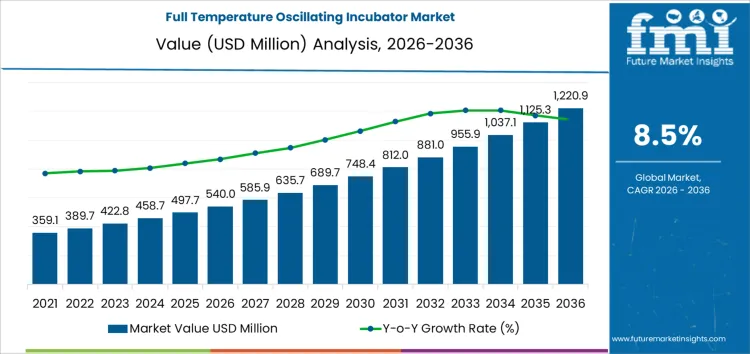
The full temperature oscillating incubator market is likely to be valued at USD 540.0 million in 2026 and is expected to reach USD 1,220.9 million by 2036, reflecting a CAGR of 8.5%. These instruments sit at the center of controlled biological and biochemical workflows, where temperature stability and agitation consistency determine culture yield and experimental reproducibility. Use is concentrated in pharmaceutical research, biotechnology, clinical laboratories, and academic facilities that run long duration, protocol driven incubation cycles. Performance expectations are defined by uniformity, recovery time after door openings, and vibration control rather than by chamber size alone. Procurement therefore follows laboratory program depth and assay complexity more than headcount or bench space.
Acquisition decisions are shaped by method validation, documentation requirements, and equipment standardization across study groups. Once an incubator model is written into protocols and quality systems, replacement or substitution becomes uncommon because revalidation consumes time and regulatory capacity. Buyers evaluate service response, calibration stability, and long term parts availability alongside technical specifications. Multi-site organizations often standardize platforms to preserve data comparability and simplify training. The market grows through expansion of regulated research activity and higher experiment density per laboratory, not through broad, one time outfitting of new facilities or short cycle equipment refresh programs.
Quick Stats for Full Temperature Oscillating Incubator Market
- Full Temperature Oscillating Incubator Market Value (2026): USD 540.0 million
- Full Temperature Oscillating Incubator Market Forecast Value (2036): USD 1,220.9 million
- Full Temperature Oscillating Incubator Market Forecast CAGR 2026 to 2036: 8.5%
- Leading Instrument Type in Full Temperature Oscillating Incubator Market: Full temperature oscillating incubators
- Leading Application in Full Temperature Oscillating Incubator Market: Microbiology and culture growth
- Key Growth Regions in Full Temperature Oscillating Incubator Market: Asia Pacific, Europe, North America
- Top Players in Full Temperature Oscillating Incubator Market: Eppendorf, Thermo Fisher Scientific, BINDER GmbH, Memmert GmbH + Co. KG, Labnet International, Benchmark Scientific, Fisher Scientific
What is the Growth Forecast for the Full Temperature Oscillating Incubator Market through 2036?
The full temperature oscillating incubator market is shaped primarily by the increasing standardization of laboratory workflows in life sciences, biotechnology, and pharmaceutical research rather than by simple growth in laboratory counts. In 2020, when the market is approximately USD 359 million, demand is largely concentrated in academic research centers, clinical laboratories, and early-stage biotech facilities where temperature-controlled shaking is required for cell culture, microbiology, and protein expression work. As the market reaches around USD 423 million in 2023 and approximately USD 540 million by 2026, these systems are no longer treated as specialized instruments but are increasingly specified as standard equipment in molecular biology, fermentation development, and quality control laboratories. This shift reflects the need for reproducibility, protocol consistency, and higher throughput in experimental and pre-production environments.
Further expansion of the full temperature oscillating incubator market is driven by deeper integration into regulated and industrialized laboratory operations rather than by exploratory research alone. By 2030, when the market reaches roughly USD 690 million, demand is increasingly supported by biopharmaceutical manufacturing support labs, contract research organizations, and diagnostic kit developers that require tightly controlled and auditable incubation conditions. As the market approaches about USD 956 million in 2033 and exceeds USD 1.12 billion by 2035, procurement trends favor higher-capacity, multi-stack, and digitally monitored systems that support validation, traceability, and continuous operation. The market reaches approximately USD 1.22 billion by 2036, driven mainly by higher system value, greater instrument density per facility, and the growing importance of standardized, repeatable biological processes rather than by a simple increase in the number of laboratories.
Full Temperature Oscillating Incubator Market Key Takeaways
| Metric | Value |
|---|---|
| Market Value (2026) | USD 540 million |
| Forecast Value (2036) | USD 1,220.9 million |
| Forecast CAGR 2026 to 2036 | 8.5% |
How Is the Full Temperature Oscillating Incubator Market Supporting Laboratory Precision and Sample Integrity?
Full temperature oscillating incubators are increasingly adopted in laboratories, research facilities, and biopharmaceutical production to maintain uniform temperature conditions while providing controlled agitation. Historically, conventional incubators relied on static heating, which often caused uneven temperature distribution, inconsistent sample mixing, and variability in experimental outcomes. Modern oscillating incubators integrate precise temperature control, programmable shaking patterns, and digital monitoring to ensure consistent environmental conditions, reproducible results, and enhanced sample integrity.
Research labs, pharmaceutical companies, and biotechnology firms prioritize temperature uniformity, shaking accuracy, and reliability under continuous operation. Early adoption focused on cell culture and microbiology research, while current demand spans protein expression studies, fermentation processes, and molecular diagnostics, driven by reproducibility, process control, and experimental efficiency. Temperature stability, agitation precision, and load capacity influence supplier selection.
Maintaining consistent incubation conditions and uniform mixing is central to laboratory workflow optimization. Compared with static incubators, oscillating systems reduce variability, improve reaction kinetics, and support high-throughput experimentation. Cost structures depend on motor reliability, temperature control precision, and digital interface capabilities, concentrating margins among suppliers delivering accurate, durable, and versatile systems. Laboratories adopt these incubators to enhance experimental consistency, accelerate development timelines, and protect sensitive samples. In the coming years, full temperature oscillating incubators are expected to become essential in research and production facilities, enabling precise environmental control, reproducible experimental results, and streamlined laboratory operations across biotechnology and pharmaceutical applications.
What Factors Are Shaping the Demand for Full Temperature Oscillating Incubator Market, Segment wise?
The Full Temperature Oscillating Incubator Market in 2026 is structured primarily by laboratory throughput planning, method validation requirements, and the need to preserve experimental continuity rather than by nominal temperature range or shaking speed alone. By instrument type, demand in the Full Temperature Oscillating Incubator Market is distributed across full temperature oscillating incubators, stackable oscillating incubators, multi-chamber oscillating incubators, and CO₂ compatible oscillating incubators. By application, demand in the Full Temperature Oscillating Incubator Market is concentrated in microbiology and culture growth, pharmaceutical testing, biotechnology research, and food and beverage quality testing.
These segments reflect differences in sample volumes, protocol rigidity, and tolerance for instrument downtime. In regulated and research environments, incubators are not treated as interchangeable general laboratory equipment. They are treated as qualified process instruments embedded in specific test methods. As a result, procurement decisions are closely linked to method portfolios, audit exposure, and long-term capacity utilization rather than to short-term budget cycles.
How Do Method Qualification and Continuity Requirements Shape Instrument Type Demand in the Full Temperature Oscillating Incubator Market?
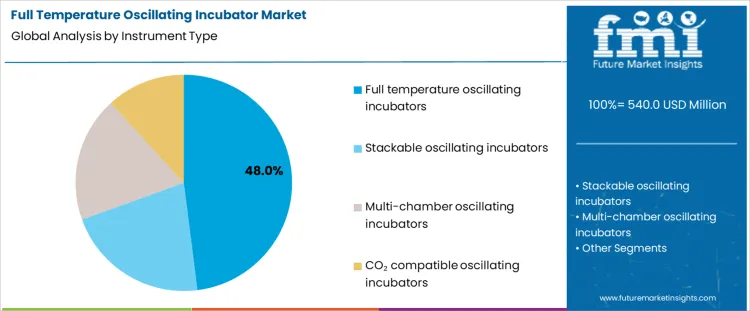
Full temperature oscillating incubators account for approximately 48% of demand in the Full Temperature Oscillating Incubator Market because they provide the broadest compatibility with existing test protocols and culture methods. Many laboratories operate under validated procedures that specify temperature ranges, agitation profiles, and recovery behavior in detail. Replacing or supplementing such equipment with narrower or specialized instruments often requires partial or full method revalidation, which carries time, documentation, and regulatory review costs. As a result, laboratories prefer general-purpose systems that can support multiple workflows without forcing changes to established procedures. Stackable and multi-chamber systems are adopted where space utilization and parallel processing capacity are critical, particularly in high-throughput environments. CO₂ compatible systems are specified for cell culture and sensitive biological applications but are limited to narrower user groups. The structure of the Full Temperature Oscillating Incubator Market is therefore driven less by performance differentiation and more by the desire to minimize procedural disruption while expanding or renewing laboratory capacity.
Why Does Microbiology and Culture Growth Represent the Largest Application Segment in the Full Temperature Oscillating Incubator Market?
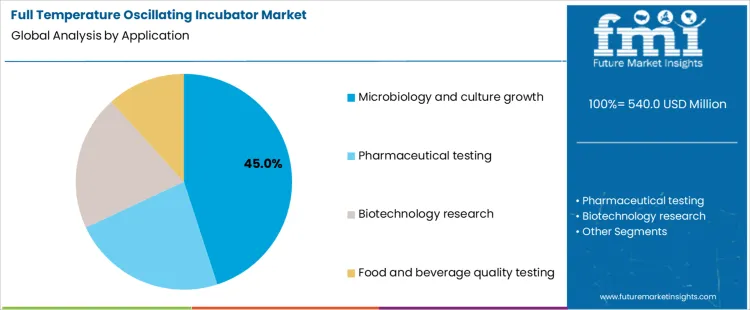
Microbiology and culture growth account for approximately 45% of demand in the Full Temperature Oscillating Incubator Market because these activities represent the most widespread and routine use of controlled incubation with agitation across laboratory environments. Clinical, industrial, academic, and quality control laboratories all perform culture growth, inoculum preparation, and microbial propagation as standard operations. These workflows are continuous rather than project-based, which creates stable baseline demand for both new equipment and capacity replacement. Pharmaceutical testing and biotechnology research rely on similar equipment but are more sensitive to protocol specificity and batch scheduling, which limits the number of instruments deployed per site. Food and beverage testing uses oscillating incubation primarily for defined quality and contamination assays, often in smaller volumes. Microbiology laboratories, by contrast, combine high sample frequency, standardized methods, and multi-shift operation. This combination makes incubator utilization rates structurally high and justifies continuous investment in capacity and redundancy. These characteristics explain why microbiology and culture growth remain the dominant application segment in the Full Temperature Oscillating Incubator Market.
How Are the Key Dynamics Reshaping the Full Temperature Oscillating Incubator Market?
The Full Temperature Oscillating Incubator Market sits at the intersection of biological variability and laboratory discipline. These systems are chosen less for capacity and more for how tightly they can hold conditions while experiments run for days or weeks. As research moves toward more sensitive cell cultures, enzyme work, and fermentation studies, small deviations in temperature or agitation turn into failed runs rather than minor noise. At the same time, labs are becoming more standardized and more audited. This turns the Full Temperature Oscillating Incubator Market into infrastructure for experimental reliability, not just another piece of benchtop equipment.
Why the Full Temperature Oscillating Incubator Market Is Reproducibility Driven?
Many experiments do not fail loudly. They drift. Yields fall, growth curves shift, or results cannot be repeated. In these cases, temperature stability and agitation consistency are often the hidden variables. The Full Temperature Oscillating Incubator Market benefits when labs realize that biological systems punish small control errors over long durations. Once a group experiences the cost of irreproducible runs, controlled incubation stops being optional. The equipment becomes part of method definition rather than a convenience. Demand follows the move toward protocol driven research and multi-site replication, not simple expansion in sample volume.
Why the Full Temperature Oscillating Incubator Market Is Workflow Sensitive?
These incubators do not live in isolation. They sit inside sample preparation chains, measurement schedules, and staff routines. If access is awkward, if recovery time is long, or if cleaning interrupts schedules, researchers work around the machine instead of with it. In some labs, this keeps utilization low even when the technical need exists. The Full Temperature Oscillating Incubator Market therefore depends on how well systems fit daily laboratory rhythm. Ease of loading, programmability, and reliability often matter more than extreme specifications. Adoption accelerates where equipment disappears into the workflow instead of demanding attention.
Why the Full Temperature Oscillating Incubator Market Follows Laboratory Standardization?
Large research organizations increasingly define standard equipment lists to make results comparable across teams and sites. When a specific incubator type is written into methods and training, it becomes a reference point rather than a choice. The Full Temperature Oscillating Incubator Market benefits from this shift because repeat purchases follow standards, not individual preferences. In fragmented labs, buying remains ad hoc. In standardized environments, it becomes systematic. This ties growth to how research organizations are governed and scaled, not just to how many experiments are being run at any given time.
What is the Demand for Full Temperature Oscillating Incubators by Country?
| Country | CAGR (%) |
|---|---|
| US | 8.0% |
| UK | 7.5% |
| China | 9.2% |
| India | 9.8% |
| Brazil | 8.3% |
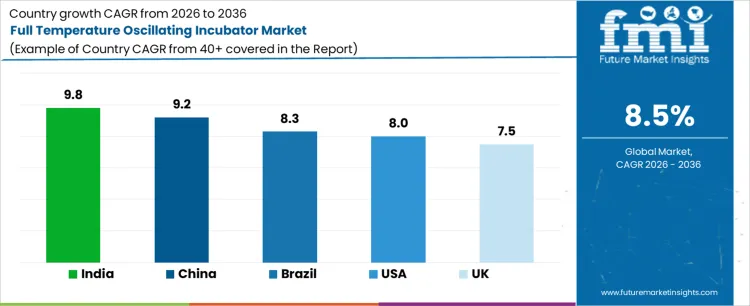
Demand for full temperature oscillating incubators is rising as laboratories, research institutions, and biotech facilities adopt equipment for cell culture, microbial growth, and experimental consistency. India leads with a 9.8% CAGR, driven by expansion of research infrastructure, biotechnology activities, and adoption of advanced incubation systems. China follows at 9.2%, supported by growing laboratory networks and industrial biotechnology applications. Brazil records 8.3% growth, shaped by adoption in academic and industrial research facilities. The US grows at 8.0%, influenced by replacement demand and integration in scientific research. The UK shows 7.5% CAGR, reflecting steady use of oscillating incubators in laboratory and experimental settings.
How do laboratory capacity programs shape demand in the United States?
Research capacity planning inside United States laboratories keeps full temperature oscillating incubator demand on an 8% CAGR path under current funding and expansion programs. Most orders follow new facility buildouts, consolidation of testing work, and scale up of cell culture and microbiology workflows. Procurement committees and lab operations teams define specification sets. Equipment choice centers on temperature stability, shaking uniformity, and validation workload. Replacement demand follows protocol changes more than age. Integration with sample tracking and quality systems affects model selection. Service coverage and calibration support influence vendor positioning. Funding release schedules shape order timing. Premium systems serve regulated development while standard units cover routine research. Commercial success depends on inclusion in institutional equipment lists and framework agreements rather than one off purchases by individual research groups.
Why does protocol harmonization influence purchases in the United Kingdom?
Laboratory network coordination in United Kingdom keeps full temperature oscillating incubator demand expanding at a 7.5% CAGR across academic, clinical, and applied research sites. Institutions aim to align methods and equipment across multiple locations. Equipment selection emphasizes reproducibility, documentation quality, and audit readiness. Central procurement teams and lab services groups manage vendor shortlists. New facility projects add volume while existing labs upgrade to meet shared standards. Import suppliers serve higher specification regulated work. Local service capability affects uptime planning. Spending decisions follow grant cycles and facility upgrade schedules. Utilization grows with expansion of cell culture, fermentation, and assay development work. Commercial visibility depends on placement in standardized laboratory catalogs rather than direct selling to individual principal investigators or isolated departments.
What institutional investment patterns drive scale in China?
National research programs and hospital laboratory expansion keep China on a 9.2% CAGR trajectory for full temperature oscillating incubator installations. Volume concentrates in life science parks, university clusters, and large clinical research centers. New laboratory construction and major capacity expansion projects generate most orders. Domestic manufacturers dominate standard configurations through pricing and delivery speed. International suppliers retain roles in higher stability and validated systems. Tender systems and procurement committees control access. Order timing follows multi-year funding plans. Training and qualification support influence acceptance. Margin structure depends on mix between routine research units and regulated development systems. Commercial success depends on participation in large institutional projects rather than repeated pursuit of small laboratory level purchases.
Why does infrastructure buildout dominate demand in India?
Expansion of academic research, biopharma laboratories, and diagnostic facilities keeps India on a 9.8% CAGR path for full temperature oscillating incubator demand. New lab construction and program scale up drive most equipment orders. Procurement decisions pass through institutional committees and funding authorities. Equipment choice balances cost control with temperature stability and operating reliability. Import systems serve regulated and export oriented research while domestic suppliers cover routine workloads. Installation planning and service reach influence vendor selection. Replacement demand remains secondary to capacity growth. Spending timing follows grant awards and facility commissioning schedules. Utilization rises with growth in cell culture and microbiology programs. Commercial success depends on alignment with large laboratory projects and framework supply positions rather than sales to individual research groups.
How do consolidation programs shape Brazil purchase behavior?
Laboratory modernization and consolidation initiatives keep Brazil on an 8.3% CAGR track for full temperature oscillating incubator purchases across public institutes and private testing groups. Work moves into fewer larger facilities that require standardized equipment sets. Selection emphasizes reliability, ease of validation, and service support. Import systems serve higher specification applications. Local distributors manage installation and training logistics. Project timing follows funding approvals and facility upgrade schedules. Replacement spending plays a smaller role than capacity expansion. Procurement teams prefer common models across sites to simplify training and maintenance. Utilization growth follows expansion of life science and clinical research programs. Commercial position depends on participation in institutional upgrade programs rather than isolated purchases by individual laboratories.
How Are Suppliers Advancing Precision and Versatility in the Full Temperature Oscillating Incubator Market?
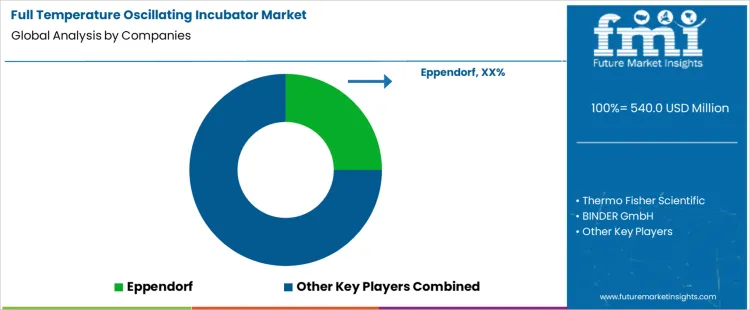
Eppendorf supplies oscillating incubators engineered for stable temperature control and uniform orbital motion, addressing cellular, microbiological, and biochemical growth applications. Thermo Fisher Scientific provides units with broad temperature ranges and robust construction tailored to research and clinical laboratories. BINDER GmbH develops incubators with precise regulation and consistent shaking patterns that support reproducible experimental conditions. Memmert GmbH + Co. KG delivers systems emphasizing thermal homogeneity and energy efficient operation. Labnet International offers compact incubators suitable for constrained lab spaces while maintaining reliable performance across varied protocols. Benchmark Scientific supplies incubators designed for durability and straightforward operation in routine lab workflows. Fisher Scientific, operating within Thermo Fisher’s distribution network, facilitates access to oscillating incubators and technical support across research and industrial segments.
Variations in product design reflect user priorities such as temperature uniformity, noise levels, and chamber capacity. Eppendorf’s control interfaces and validation data help labs maintain repeatability across experiments. Thermo Fisher’s broader ecosystem enables integration with other analytical instruments and service agreements. BINDER’s emphasis on precise environmental control supports sensitive culture work. Memmert models combine intuitive controls with engineered airflow for consistent results. Labnet’s offerings appeal where space efficiency and cost effectiveness are key. Benchmark Scientific focuses on rugged construction that endures frequent use. Other regional or niche suppliers provide units optimized for specialized protocols or localized service support. Differences arise from cooling and heating ramp rates, orbital motion precision, maintenance requirements, and calibration traceability. Buyers evaluate these attributes alongside after sales support and documentation that aligns with institutional quality standards.
Key Players in the Full Temperature Oscillating Incubator Market
- Eppendorf
- Thermo Fisher Scientific
- BINDER GmbH
- Memmert GmbH + Co. KG
- Labnet International
- Benchmark Scientific
- Fisher Scientific (part of Thermo Fisher)
Scope of the Report
| Items | Values |
|---|---|
| Quantitative Units (2026) | USD million |
| Instrument Type | Full temperature oscillating incubators, Stackable oscillating incubators, Multi-chamber oscillating incubators, CO₂ compatible oscillating incubators |
| Application | Microbiology and culture growth, Pharmaceutical testing, Biotechnology research, Food and beverage quality testing |
| Region | Asia Pacific, Europe, North America, Latin America, Middle East & Africa |
| Countries Covered | China, Japan, South Korea, India, Australia & New Zealand, ASEAN, Germany, United Kingdom, France, Italy, Spain, Nordic, BENELUX, United States, Canada, Mexico, Brazil, Chile, Saudi Arabia, Turkey, South Africa, and other regional markets |
| Key Companies Profiled | Eppendorf, Thermo Fisher Scientific, BINDER GmbH, Memmert GmbH + Co. KG, Labnet International, Benchmark Scientific, Fisher Scientific |
| Additional Attributes | Dollar by sales by instrument type and application; demand driven by protocol standardization, validation requirements, and reproducibility needs; growth led by higher instrument density in regulated labs and biopharma support facilities; purchasing shaped by temperature uniformity, agitation stability, recovery time, service support, and long-term calibration reliability rather than chamber size alone. |
Full Temperature Oscillating Incubator Market Segmentation
Instrument Type:
- Full temperature oscillating incubators
- Stackable oscillating incubators
- Multi-chamber oscillating incubators
- CO₂ compatible oscillating incubators
Application:
- Microbiology and culture growth
- Pharmaceutical testing
- Biotechnology research
- Food and beverage quality testing
Region:
- Asia Pacific
- China
- Japan
- South Korea
- India
- Australia & New Zealand
- ASEAN
- Rest of Asia Pacific
- Europe
- Germany
- United Kingdom
- France
- Italy
- Spain
- Nordic
- BENELUX
- Rest of Europe
- North America
- United States
- Canada
- Mexico
- Latin America
- Brazil
- Chile
- Rest of Latin America
- Middle East & Africa
- Kingdom of Saudi Arabia
- Other GCC Countries
- Turkey
- South Africa
- Other African Union
- Rest of Middle East & Africa
Bibliography
- World Health Organization. (2024). Good practices for laboratories (GPCL): Quality management systems and equipment control. World Health Organization.
- National Institutes of Health. (2024). NIH Design Requirements Manual (DRM): Biomedical laboratory equipment standards. U.S. Department of Health and Human Services.
- European Medicines Agency. (2024). EU guidelines for Good Manufacturing Practice for medicinal products – Annex 15: Qualification and validation. European Medicines Agency.
- U.S. Food and Drug Administration. (2024). CGMP for Phase 1 investigational drugs: Guidance for industry. U.S. Food and Drug Administration.
Frequently Asked Questions
How big is the full temperature oscillating incubator market in 2026?
The global full temperature oscillating incubator market is estimated to be valued at USD 540.0 million in 2026.
What will be the size of full temperature oscillating incubator market in 2036?
The market size for the full temperature oscillating incubator market is projected to reach USD 1,220.9 million by 2036.
How much will be the full temperature oscillating incubator market growth between 2026 and 2036?
The full temperature oscillating incubator market is expected to grow at a 8.5% CAGR between 2026 and 2036.
What are the key product types in the full temperature oscillating incubator market?
The key product types in full temperature oscillating incubator market are full temperature oscillating incubators , stackable oscillating incubators, multi‑chamber oscillating incubators and co₂ compatible oscillating incubators.
Which application segment to contribute significant share in the full temperature oscillating incubator market in 2026?
In terms of application, microbiology and culture growth segment to command 45.0% share in the full temperature oscillating incubator market in 2026.
Preview the report firsthand - request a free sample
Get SampleGet the brochure for pricing and purchase details.
Get PDFTable of Content
- Executive Summary
- Global Market Outlook
- Demand-side Trends
- Supply-side Trends
- Technology Roadmap Analysis
- Analysis and Recommendations
- Market Overview
- Market Coverage / Taxonomy
- Market Definition / Scope / Limitations
- Market Background
- Market Dynamics
- Drivers
- Restraints
- Opportunity
- Trends
- Scenario Forecast
- Demand in Optimistic Scenario
- Demand in Likely Scenario
- Demand in Conservative Scenario
- Opportunity Map Analysis
- Product Life Cycle Analysis
- Supply Chain Analysis
- Investment Feasibility Matrix
- Value Chain Analysis
- PESTLE and Porter’s Analysis
- Regulatory Landscape
- Regional Parent Market Outlook
- Production and Consumption Statistics
- Import and Export Statistics
- Market Dynamics
- Global Market Analysis 2021 to 2025 and Forecast, 2026 to 2036
- Historical Market Size Value (USD Million) Analysis, 2021 to 2025
- Current and Future Market Size Value (USD Million) Projections, 2026 to 2036
- Y-o-Y Growth Trend Analysis
- Absolute $ Opportunity Analysis
- Global Market Pricing Analysis 2021 to 2025 and Forecast 2026 to 2036
- Global Market Analysis 2021 to 2025 and Forecast 2026 to 2036, By Instrument Type
- Introduction / Key Findings
- Historical Market Size Value (USD Million) Analysis By Instrument Type , 2021 to 2025
- Current and Future Market Size Value (USD Million) Analysis and Forecast By Instrument Type , 2026 to 2036
- Full temperature oscillating incubators
- Stackable oscillating incubators
- Multi‑chamber oscillating incubators
- CO₂ compatible oscillating incubators
- Full temperature oscillating incubators
- Y-o-Y Growth Trend Analysis By Instrument Type , 2021 to 2025
- Absolute $ Opportunity Analysis By Instrument Type , 2026 to 2036
- Global Market Analysis 2021 to 2025 and Forecast 2026 to 2036, By Application
- Introduction / Key Findings
- Historical Market Size Value (USD Million) Analysis By Application, 2021 to 2025
- Current and Future Market Size Value (USD Million) Analysis and Forecast By Application, 2026 to 2036
- Microbiology and culture growth
- Pharmaceutical testing
- Biotechnology research
- Food and beverage quality testing
- Microbiology and culture growth
- Y-o-Y Growth Trend Analysis By Application, 2021 to 2025
- Absolute $ Opportunity Analysis By Application, 2026 to 2036
- Global Market Analysis 2021 to 2025 and Forecast 2026 to 2036, By Region
- Introduction
- Historical Market Size Value (USD Million) Analysis By Region, 2021 to 2025
- Current Market Size Value (USD Million) Analysis and Forecast By Region, 2026 to 2036
- North America
- Latin America
- Western Europe
- Eastern Europe
- East Asia
- South Asia and Pacific
- Middle East & Africa
- Market Attractiveness Analysis By Region
- North America Market Analysis 2021 to 2025 and Forecast 2026 to 2036, By Country
- Historical Market Size Value (USD Million) Trend Analysis By Market Taxonomy, 2021 to 2025
- Market Size Value (USD Million) Forecast By Market Taxonomy, 2026 to 2036
- By Country
- USA
- Canada
- Mexico
- By Instrument Type
- By Application
- By Country
- Market Attractiveness Analysis
- By Country
- By Instrument Type
- By Application
- Key Takeaways
- Latin America Market Analysis 2021 to 2025 and Forecast 2026 to 2036, By Country
- Historical Market Size Value (USD Million) Trend Analysis By Market Taxonomy, 2021 to 2025
- Market Size Value (USD Million) Forecast By Market Taxonomy, 2026 to 2036
- By Country
- Brazil
- Chile
- Rest of Latin America
- By Instrument Type
- By Application
- By Country
- Market Attractiveness Analysis
- By Country
- By Instrument Type
- By Application
- Key Takeaways
- Western Europe Market Analysis 2021 to 2025 and Forecast 2026 to 2036, By Country
- Historical Market Size Value (USD Million) Trend Analysis By Market Taxonomy, 2021 to 2025
- Market Size Value (USD Million) Forecast By Market Taxonomy, 2026 to 2036
- By Country
- Germany
- UK
- Italy
- Spain
- France
- Nordic
- BENELUX
- Rest of Western Europe
- By Instrument Type
- By Application
- By Country
- Market Attractiveness Analysis
- By Country
- By Instrument Type
- By Application
- Key Takeaways
- Eastern Europe Market Analysis 2021 to 2025 and Forecast 2026 to 2036, By Country
- Historical Market Size Value (USD Million) Trend Analysis By Market Taxonomy, 2021 to 2025
- Market Size Value (USD Million) Forecast By Market Taxonomy, 2026 to 2036
- By Country
- Russia
- Poland
- Hungary
- Balkan & Baltic
- Rest of Eastern Europe
- By Instrument Type
- By Application
- By Country
- Market Attractiveness Analysis
- By Country
- By Instrument Type
- By Application
- Key Takeaways
- East Asia Market Analysis 2021 to 2025 and Forecast 2026 to 2036, By Country
- Historical Market Size Value (USD Million) Trend Analysis By Market Taxonomy, 2021 to 2025
- Market Size Value (USD Million) Forecast By Market Taxonomy, 2026 to 2036
- By Country
- China
- Japan
- South Korea
- By Instrument Type
- By Application
- By Country
- Market Attractiveness Analysis
- By Country
- By Instrument Type
- By Application
- Key Takeaways
- South Asia and Pacific Market Analysis 2021 to 2025 and Forecast 2026 to 2036, By Country
- Historical Market Size Value (USD Million) Trend Analysis By Market Taxonomy, 2021 to 2025
- Market Size Value (USD Million) Forecast By Market Taxonomy, 2026 to 2036
- By Country
- India
- ASEAN
- Australia & New Zealand
- Rest of South Asia and Pacific
- By Instrument Type
- By Application
- By Country
- Market Attractiveness Analysis
- By Country
- By Instrument Type
- By Application
- Key Takeaways
- Middle East & Africa Market Analysis 2021 to 2025 and Forecast 2026 to 2036, By Country
- Historical Market Size Value (USD Million) Trend Analysis By Market Taxonomy, 2021 to 2025
- Market Size Value (USD Million) Forecast By Market Taxonomy, 2026 to 2036
- By Country
- Kingdom of Saudi Arabia
- Other GCC Countries
- Turkiye
- South Africa
- Other African Union
- Rest of Middle East & Africa
- By Instrument Type
- By Application
- By Country
- Market Attractiveness Analysis
- By Country
- By Instrument Type
- By Application
- Key Takeaways
- Key Countries Market Analysis
- USA
- Pricing Analysis
- Market Share Analysis, 2025
- By Instrument Type
- By Application
- Canada
- Pricing Analysis
- Market Share Analysis, 2025
- By Instrument Type
- By Application
- Mexico
- Pricing Analysis
- Market Share Analysis, 2025
- By Instrument Type
- By Application
- Brazil
- Pricing Analysis
- Market Share Analysis, 2025
- By Instrument Type
- By Application
- Chile
- Pricing Analysis
- Market Share Analysis, 2025
- By Instrument Type
- By Application
- Germany
- Pricing Analysis
- Market Share Analysis, 2025
- By Instrument Type
- By Application
- UK
- Pricing Analysis
- Market Share Analysis, 2025
- By Instrument Type
- By Application
- Italy
- Pricing Analysis
- Market Share Analysis, 2025
- By Instrument Type
- By Application
- Spain
- Pricing Analysis
- Market Share Analysis, 2025
- By Instrument Type
- By Application
- France
- Pricing Analysis
- Market Share Analysis, 2025
- By Instrument Type
- By Application
- India
- Pricing Analysis
- Market Share Analysis, 2025
- By Instrument Type
- By Application
- ASEAN
- Pricing Analysis
- Market Share Analysis, 2025
- By Instrument Type
- By Application
- Australia & New Zealand
- Pricing Analysis
- Market Share Analysis, 2025
- By Instrument Type
- By Application
- China
- Pricing Analysis
- Market Share Analysis, 2025
- By Instrument Type
- By Application
- Japan
- Pricing Analysis
- Market Share Analysis, 2025
- By Instrument Type
- By Application
- South Korea
- Pricing Analysis
- Market Share Analysis, 2025
- By Instrument Type
- By Application
- Russia
- Pricing Analysis
- Market Share Analysis, 2025
- By Instrument Type
- By Application
- Poland
- Pricing Analysis
- Market Share Analysis, 2025
- By Instrument Type
- By Application
- Hungary
- Pricing Analysis
- Market Share Analysis, 2025
- By Instrument Type
- By Application
- Kingdom of Saudi Arabia
- Pricing Analysis
- Market Share Analysis, 2025
- By Instrument Type
- By Application
- Turkiye
- Pricing Analysis
- Market Share Analysis, 2025
- By Instrument Type
- By Application
- South Africa
- Pricing Analysis
- Market Share Analysis, 2025
- By Instrument Type
- By Application
- USA
- Market Structure Analysis
- Competition Dashboard
- Competition Benchmarking
- Market Share Analysis of Top Players
- By Regional
- By Instrument Type
- By Application
- Competition Analysis
- Competition Deep Dive
- Eppendorf
- Overview
- Product Portfolio
- Profitability by Market Segments (Product/Age /Sales Channel/Region)
- Sales Footprint
- Strategy Overview
- Marketing Strategy
- Product Strategy
- Channel Strategy
- Thermo Fisher Scientific
- BINDER GmbH
- Memmert GmbH + Co. KG
- Labnet International
- Benchmark Scientific
- Fisher Scientific (part of Thermo Fisher)
- Eppendorf
- Competition Deep Dive
- Assumptions & Acronyms Used
- Research Methodology


