

- Industry Size (2026)
- USD 410 Mn
- Forecast (2036)
- USD 748.2 Mn
- CAGR (2026 to 2036)
- 6.2%
Oscillating Granulator Market Forecast and Outlook 2026 to 2036
The oscillating granulator market is projected to reach USD 748.2 million by 2036, growing at a CAGR of 6.2% from its 2026 value of USD 410 million. The demand quality in this market is rooted in the necessity for precise, consistent granulation in industries such as pharmaceuticals and food processing. Stability is largely driven by the continuous need for high-quality, uniform products in these sectors, which rely on granulators for large-scale production. Repeat usage is common, as manufacturers depend on reliable equipment for ongoing operations, ensuring long product lifecycles and reducing the frequency of replacements. Buyer commitment levels are high, with customers seeking dependable, long-term relationships with equipment suppliers who can meet strict regulatory requirements and offer technical support. As the market matures, demand will remain steady, with a focus on durability and performance rather than volume-driven expansion, making customer loyalty and consistent product delivery essential to success.
Quick Stats for the Oscillating Granulator Market
- Oscillating Granulator Market Value (2026): USD 410 million
- Oscillating Granulator Market Forecast Value (2036): USD 748.2 million
- Oscillating Granulator Market Forecast CAGR (2026–2036): 6.2%
- Oscillating Granulator Market Leading Segment: Pharmaceutical Manufacturing (54%)
- Key Growth Regions in Oscillating Granulator Market: India
- Top Players in Oscillating Granulator Market: GEA Group, IMA Group, Freund-Vector, Glatt, L.B. Bohle, Alexanderwerk, SaintyCo, Cadmach, AIPAK, Tapasya Engineering
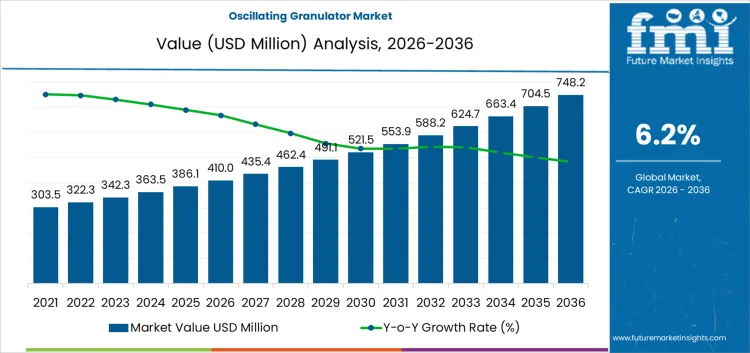
What is the Contribution of Volume vs Price Growth for the Oscillating Granulator Market through 2036?
In the oscillating granulator market, both volume and price growth are expected to contribute to the overall market expansion, but their relative contributions will shift over the forecast period.
In the early years of the forecast period (2026-2028), volume growth will likely be the primary contributor to market expansion. As industries such as pharmaceuticals, chemicals, and food processing continue to grow, the demand for oscillating granulators will increase, leading to higher unit sales. From USD 410 million in 2026, the market will grow to USD 462.4 million in 2028, driven mainly by increased volume demand as new manufacturing plants and upgrades to existing production facilities are implemented across key sectors.
From 2029 onward, price growth is expected to play a more significant role in market expansion as the technology behind oscillating granulators improves, leading to the introduction of more advanced, higher-priced models. Technological advancements, such as automation and greater efficiency in production, will lead to higher-value machines entering the market. The market will grow from USD 491.1 million in 2029 to USD 521.5 million in 2030, with a larger contribution from price growth as more specialized granulators become available at higher price points.
By the end of the forecast period, in 2036, the market is projected to reach USD 748.2 million, with a more balanced contribution from both volume and price growth. While volume growth will continue due to increased demand in emerging markets and technological adoption, price growth will reflect the rising value of advanced oscillating granulators with better capabilities and enhanced features. The combination of volume and price growth will be crucial for reaching the final market size.
Oscillating Granulator Market Key Takeaways
| Metric | Value |
|---|---|
| Industry Sales Value (2026) | USD 410 million |
| Industry Forecast Value (2036) | USD 748.2 million |
| Industry Forecast CAGR 2026 to 2036 | 6.2% |
What Is Driving the Oscillating Granulator Market?
Historically, the oscillating granulator market developed from the need to convert bulk materials into controlled, uniform granules for downstream processing across industries such as pharmaceuticals, chemicals, food, and plastics. Conventional milling and crushing methods produced irregular particle sizes, generating dust, segregation issues, and inconsistent flow properties that impaired product quality and process efficiency. Early granulation techniques relied on rotary cutters and simple crushers that lacked precision for fine or cohesive materials. The introduction of oscillating granulators provided a method to achieve tighter particle size distribution through controlled, reciprocating blade action combined with optimized screen apertures. Initial adoption was strongest in pharmaceutical and specialty chemical sectors where stringent quality standards and regulatory requirements demanded consistent granule properties to ensure blend uniformity, compressibility, and dissolution performance. This phase demonstrated that oscillating granulators could reduce fines generation, improve material flow, and enhance safety by limiting dust exposure, prompting broader interest among formulators and production engineers tasked with meeting quality benchmarks.
Future demand for the oscillating granulator market is expected to be shaped by increasing automation in manufacturing, growth in high-performance materials, and heightened focus on process reproducibility and scale-up efficiency. Expansion of biologics, advanced polymers, and multi-component formulations will drive adoption of granulators capable of handling diverse material characteristics without compromising particle integrity. Industry 4.0 integration will further enhance granulator utility by enabling real-time monitoring of granulation parameters, predictive maintenance, and seamless linkage with upstream and downstream equipment. Growth factors include rising demand for uniform feedstock in 3D printing powders, controlled release excipients in pharmaceuticals, and consistent granules in agrochemical formulations. Challenges include the need for customization to accommodate a wide range of materials and the investment required for high-precision, compliant equipment in regulated sectors. Long-term market expansion will depend on how effectively oscillating granulator manufacturers innovate modular, scalable designs that balance precision, throughput, and integration with digital process controls, aligning with evolving production demands and quality imperatives across multiple end-use industries.
What are the Key Segments in the Oscillating Granulator Market?
The Oscillating Granulator market is segmented by end use and automation level. End-use segments include pharmaceutical manufacturing, nutraceuticals, chemicals & specialty materials, food & ingredients, and others, with pharmaceutical manufacturing leading the market at 54%. Automation levels include semi-automatic, manual or bench-top, automatic or closed system, and others, with semi-automatic holding the largest share at 52%. The market is driven by the need for high-quality, efficient granulation equipment in various industries, particularly in the pharmaceutical sector, where precise granulation processes are critical for the production of tablets, capsules, and other dosage forms. As industries continue to grow and emphasize productivity, automation and precision in granulation processes are becoming increasingly important, especially in regulated industries like pharmaceuticals.
What is Driving Growth in the Pharmaceutical Manufacturing End-Use Segment?
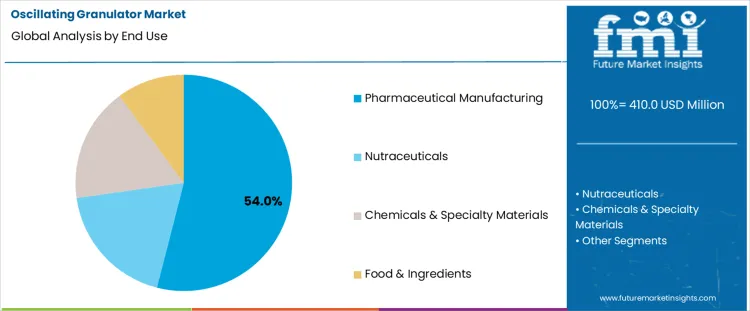
Pharmaceutical manufacturing is the dominant end-use segment in the Oscillating Granulator market, accounting for 54% of the market share. This growth is driven by the increasing demand for granulation processes in the production of pharmaceutical products, particularly solid dosage forms such as tablets and capsules. Granulation plays a crucial role in improving the flowability, consistency, and dissolution of active pharmaceutical ingredients (APIs) in formulations. As the pharmaceutical industry continues to expand, driven by the rise in global healthcare needs, the demand for efficient and high-quality granulators is growing. Oscillating granulators are preferred due to their ability to produce uniform granules, which are essential for consistent drug performance and bioavailability. Additionally, the regulatory requirements for manufacturing pharmaceutical products are becoming more stringent, further increasing the demand for precise granulation equipment. The growth of the pharmaceutical industry in regions like North America, Europe, and Asia Pacific is expected to continue driving the demand for oscillating granulators in this segment, particularly with the increasing focus on generic drug production and the development of complex formulations.
What is Driving the Demand for Semi-Automatic Systems in the Automation Level Segment?
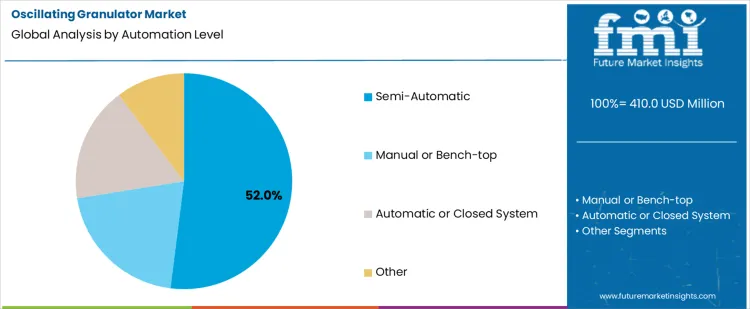
Semi-automatic systems are the leading automation level in the Oscillating Granulator market, accounting for 52% of the market share. This growth is driven by the balance they offer between productivity and cost-effectiveness, making them particularly suitable for small to medium-scale production. Semi-automatic oscillating granulators are highly valued in industries like pharmaceuticals, nutraceuticals, and chemicals, where they allow for efficient operation while still giving operators control over certain aspects of the granulation process. These systems are more affordable compared to fully automatic systems, making them an attractive option for smaller manufacturers or facilities with limited budgets. Additionally, semi-automatic granulators offer flexibility in handling a wide range of materials, including both powders and granules, which is important for diverse production processes. As manufacturing processes in the pharmaceutical, nutraceutical, and food industries continue to grow, the demand for semi-automatic granulators is expected to remain strong, particularly in regions where small to mid-sized manufacturers are increasing their production capabilities to meet growing consumer demand.
What are the Key Dynamics in the Oscillating Granulator Market?
The oscillating granulator market is expanding as the demand for efficient powder processing equipment in various industries such as pharmaceuticals, food processing, chemicals, and cosmetics increases. Oscillating granulators are used to reduce the size of particles and create uniform granules, which are essential in manufacturing tablets, capsules, and other solid dosage forms. These machines offer advantages in terms of consistency, high throughput, and cost-effectiveness, making them essential for industries that require precise particle size distribution. The market is driven by the increasing demand for granulation processes in drug formulation, as well as the growing need for improved efficiency and automation in manufacturing systems. Additionally, regulatory pressures to ensure product consistency and quality in industries like pharmaceuticals further contribute to market growth.
What are the Key Drivers of Growth in the Oscillating Granulator Market?
The growth of the oscillating granulator market is primarily driven by the expanding pharmaceutical industry, where granulation is a critical step in producing tablets, capsules, and other solid dosage forms. As the demand for high-quality, efficient, and cost-effective manufacturing methods rises, oscillating granulators are increasingly favored for their ability to produce uniform granules. The market is also being driven by the growing demand for food and beverage products that require granulation, such as powdered ingredients, nutritional supplements, and vitamins. Moreover, advancements in oscillating granulator technology, including improved automation, ease of use, and better control over granule size and consistency, are fueling market growth. Increasing emphasis on regulatory compliance and the need for greater operational efficiency in pharmaceutical manufacturing are also key factors contributing to the expansion of this market.
What are the Key Restraints in the Oscillating Granulator Market?
Despite the market's growth, several challenges exist. One of the main restraints is the high initial cost of oscillating granulators, which can be a barrier for smaller manufacturers or those operating with limited budgets. The purchase, installation, and maintenance costs associated with advanced granulation equipment can be significant. Additionally, the complexity of the granulation process can require specialized training and expertise to ensure optimal operation, which adds to the operational cost. Another challenge is the need for continuous research and development to meet evolving industry standards and regulations, especially in pharmaceuticals, which can strain resources for some manufacturers. Additionally, competition from alternative granulation technologies, such as high-shear granulators and fluidized bed granulators, could limit market share for oscillating granulators, particularly if these alternatives offer more advantages in terms of performance or cost.
What are the Key Trends in the Oscillating Granulator Market?
Several key trends are shaping the oscillating granulator market. One prominent trend is the increasing adoption of automation in granulation processes. Modern oscillating granulators are equipped with advanced control systems that allow for precise monitoring of granule size, moisture content, and other critical factors. This trend toward automation is enhancing production efficiency, reducing human error, and improving overall product quality. Another significant trend is the growing demand for continuous manufacturing in pharmaceutical and food processing industries, where oscillating granulators are being integrated into continuous production lines to increase throughput and reduce batch processing time. Additionally, the development of more compact and energy-efficient oscillating granulators is becoming a key trend, especially in industries looking to optimize space and reduce energy consumption. There is also an increasing emphasis on sustainability, with manufacturers exploring ways to reduce waste during the granulation process and improve the environmental impact of their operations.
What is the Country-Wise Analysis of the Oscillating Granulator Market?
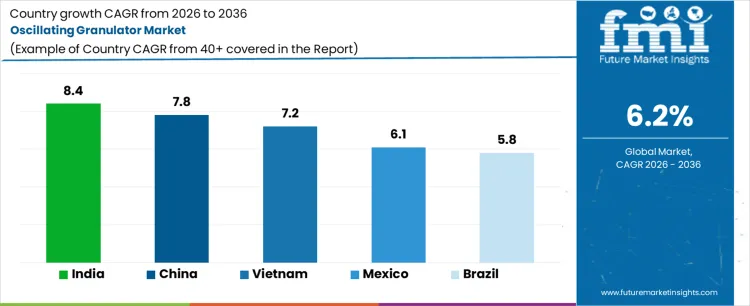
The oscillating granulator market is experiencing growth as industries such as pharmaceuticals, food processing, and chemicals increasingly require efficient granulation solutions for the production of uniform granules. Oscillating granulators are essential for improving the consistency, quality, and processing efficiency of materials, particularly in sectors that demand precise particle size distribution. The market is driven by the growing demand for high-quality granulation equipment to meet industry standards for manufacturing processes. Key countries like India, China, Vietnam, Mexico, and Brazil are seeing growth in this market, driven by increasing industrialization, advancements in manufacturing technology, and the expansion of sectors such as pharmaceuticals and food processing.
| Country | CAGR (%) |
|---|---|
| India | 8.4 |
| China | 7.8 |
| Vietnam | 7.2 |
| Mexico | 6.1 |
| Brazil | 5.8 |
What is Driving the Growth of the Oscillating Granulator Market in India?
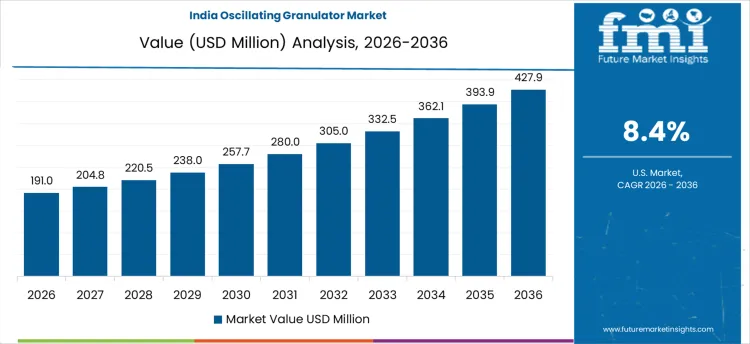
India’s oscillating granulator market is growing at a CAGR of 8.4%, the highest among the countries analyzed. The growth is largely driven by the rapid expansion of the pharmaceutical, food processing, and chemical industries in India. As these sectors continue to grow, there is an increasing need for efficient and precise granulation equipment to meet the demands for consistent product quality. India’s strong pharmaceutical manufacturing base, coupled with its focus on improving manufacturing processes, is driving the demand for oscillating granulators. Additionally, the growth in industrialization and the need for standardized production processes are contributing to the expansion of the market. As India continues to invest in industrial and pharmaceutical infrastructure, the demand for granulation solutions is expected to grow steadily.
How is the Oscillating Granulator Market Performing in China?
China’s oscillating granulator market is growing at a CAGR of 7.8%. As one of the largest manufacturing hubs in the world, China is witnessing significant demand for high-quality granulation equipment across multiple industries, including pharmaceuticals, chemicals, and food processing. The country’s pharmaceutical industry, in particular, is expanding rapidly, and with it, the need for precise and efficient granulation solutions. Additionally, China’s chemical and food processing industries are seeing increased automation and adoption of advanced manufacturing technologies, further boosting the demand for oscillating granulators. With government policies supporting industrial growth and a focus on advancing production standards, the oscillating granulator market in China is expected to continue expanding.
What Factors are Shaping the Oscillating Granulator Market in Vietnam?
Vietnam’s oscillating granulator market is growing at a CAGR of 7.2%. The growth in Vietnam is being driven by the expanding pharmaceutical and food processing sectors, both of which require precise and efficient granulation equipment for the production of high-quality products. As Vietnam’s pharmaceutical industry continues to grow and modernize, the demand for advanced granulation technologies is rising. Additionally, the country’s food processing industry, which is becoming more industrialized, is fueling the need for oscillating granulators to ensure uniform particle sizes and consistency in food products. The country’s rapid industrialization and increasing focus on improving manufacturing standards are contributing to the market’s growth. As Vietnam continues to develop its industrial capabilities, the demand for granulation solutions is expected to increase.
How is the Oscillating Granulator Market Evolving in Mexico?
Mexico’s oscillating granulator market is growing at a CAGR of 6.1%. Mexico’s growing pharmaceutical, chemical, and food processing industries are driving the demand for granulation equipment. As the country’s manufacturing sector expands, the need for advanced granulation solutions to produce high-quality products with consistent particle sizes is increasing. The pharmaceutical industry in Mexico is experiencing growth, and with this, there is a rising demand for efficient and precise granulators for the production of solid dosage forms. Additionally, the growth of the food processing sector, which requires consistent product quality and efficient production processes, is fueling the demand for oscillating granulators. As Mexico continues to strengthen its manufacturing capabilities, the market for granulation equipment is expected to expand steadily.
What is Contributing to the Growth of the Oscillating Granulator Market in Brazil?
Brazil’s oscillating granulator market is growing at a CAGR of 5.8%. The growth is primarily driven by the expansion of Brazil’s pharmaceutical, chemical, and food processing industries. As the country’s pharmaceutical sector continues to grow and modernize, there is increasing demand for granulation equipment that can produce high-quality products with consistent granule sizes. The food processing industry in Brazil, which is one of the largest in Latin America, is also driving demand for oscillating granulators. As the country’s manufacturing and industrial sectors evolve, the need for efficient and precise granulation technologies is rising. The Brazilian government’s support for industrial growth and the push towards more advanced manufacturing processes are expected to continue contributing to the market’s growth.
What is the Competitive Landscape for the Oscillating Granulator Market?
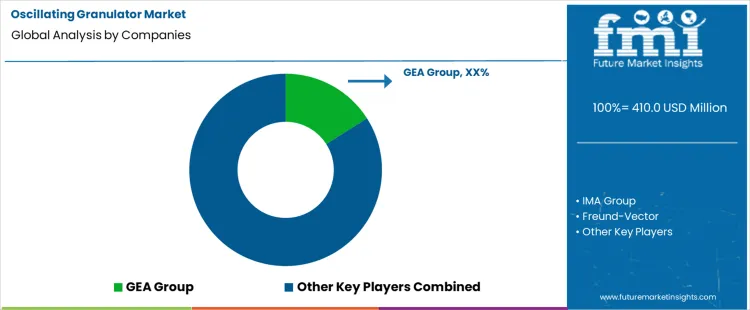
The oscillating granulator market is expanding as industries such as pharmaceuticals, chemicals, and food processing demand more advanced and efficient granulation technologies. GEA Group leads the market, offering high-quality oscillating granulators designed to meet the evolving needs of these industries. Known for its reliable, efficient, and customizable granulation solutions, GEA Group's products cater to a wide range of applications, ensuring high product consistency and minimal downtime. IMA Group is a key competitor, providing cutting-edge granulation equipment that integrates advanced technologies to enhance productivity and optimize the granulation process.
Freund-Vector is another significant player, focusing on delivering robust and high-performance oscillating granulators that are widely used in the pharmaceutical industry for consistent particle size distribution and high-quality granulation. Glatt offers specialized granulation systems that combine precision and efficiency, catering to both large-scale production and smaller batch requirements. L.B. Bohle also competes in the market with oscillating granulators designed to provide superior performance in high-volume and continuous production settings, focusing on durability and easy maintenance. Alexanderwerk provides granulation solutions that offer high capacity and advanced technological features, making them ideal for large-scale manufacturing.
SaintyCo offers a range of efficient granulating machines that cater to the needs of the pharmaceutical and food industries, with a focus on ease of operation and cost-effectiveness. Cadmach, AIPAK, and Tapasya Engineering contribute to the market with affordable, reliable granulation solutions designed to improve productivity, reduce waste, and maintain high product quality.
To remain competitive in the oscillating granulator market, companies focus on continuous innovation, product quality, and industry-specific customization. GEA Group continues to lead by enhancing the performance and versatility of its oscillating granulators, ensuring that its equipment meets the specific needs of various industries. IMA Group focuses on integrating advanced technologies, such as automation and real-time monitoring, into its granulation equipment to optimize production efficiency. Freund-Vector is advancing its offerings with more robust and scalable granulators, designed to meet the high standards of pharmaceutical manufacturing. Glatt is enhancing its granulation solutions by incorporating user-friendly interfaces and improving granulator efficiency and energy consumption.
L.B. Bohle focuses on providing flexible, high-performance solutions that can be customized for various granulation applications, ensuring that manufacturers can achieve consistent, high-quality results. Alexanderwerk continues to refine its equipment, prioritizing automation and efficiency to enhance manufacturing capabilities. SaintyCo, Cadmach, AIPAK, and Tapasya Engineering are enhancing their granulation equipment with improved features such as ease of maintenance, flexibility, and better granule size distribution. These strategies, combined with the growing demand for efficient and reliable granulation technologies, position these companies to remain key players in the oscillating granulator market.
Key Players of the Oscillating Granulator Market
- GEA Group
- IMA Group
- Freund-Vector
- Glatt
- L.B. Bohle
- Alexanderwerk
- SaintyCo
- Cadmach
- AIPAK
- Tapasya Engineering
Scope of the Report
| Items | Values |
|---|---|
| Quantitative Units (2026) | USD Million |
| End Use | Pharmaceutical Manufacturing, Nutraceuticals, Chemicals & Specialty Materials, Food & Ingredients |
| Automation Level | Manual or Bench-top, Semi-Automatic, Automatic or Closed System, Other |
| Batch Capacity | Up to 50 kg per batch, 50-200 kg per batch, Above 200 kg per batch, Other |
| Sales Channel | Direct OEM Sales, System Integrators, Distributors, Refurbished or Other |
| Companies | GEA Group, IMA Group, Freund-Vector, Glatt, L.B. Bohle, Alexanderwerk, SaintyCo, Cadmach, AIPAK, Tapasya Engineering |
| Regions Covered | North America, Latin America, Western Europe, Eastern Europe, South Asia and Pacific, East Asia, Middle East & Africa |
| Countries Covered | United States, Canada, Mexico, Brazil, Argentina, Germany, France, United Kingdom, Italy, Spain, Netherlands, China, India, Japan, South Korea, ANZ, GCC Countries, South Africa |
| Additional Attributes | Dollar sales by end use, automation level, batch capacity, and sales channel. Includes market trends towards automation, cost-effectiveness, regulatory compliance, and the role of oscillating granulators in enhancing manufacturing processes across industries. |
Oscillating Granulator Market Segmentation
End Use
- Pharmaceutical Manufacturing
- Nutraceuticals
- Chemicals & Specialty Materials
- Food & Ingredients
- Other
Automation Level
- Manual or Bench-top
- Semi-Automatic
- Automatic or Closed System
- Other
Batch Capacity
- Up to 50 kg per batch
- 50-200 kg per batch
- Above 200 kg per batch
- Other
Sales Channel
- Direct OEM Sales
- System Integrators
- Distributors
- Refurbished or Other
Region
- Asia Pacific
- China
- Japan
- India
- Australia & New Zealand
- ASEAN
- Rest of Asia Pacific
- Europe
- Germany
- United Kingdom
- France
- Italy
- Spain
- Nordic
- BENELUX
- Rest of Europe
- North America
- United States
- Canada
- Mexico
- Latin America
- Brazil
- Argentina
- Rest of Latin America
- Middle East & Africa
- Kingdom of Saudi Arabia
- Other GCC Countries
- South Africa
- Rest of Middle East & Africa
Bibliography
- International Organization for Standardization. (2024). ISO 21469: Safety of machinery — Lubricants with incidental product contact — Hygiene requirements. ISO.
- European Committee for Standardization. (2023). EN 1672-2: Food processing machinery — Basic concepts — Part 2: Hygiene requirements. CEN.
- United States Pharmacopeial Convention. (2024). USP General Chapter <1065> — Granulation process validation for solid oral dosage forms. USP.
- International Society for Pharmaceutical Engineering. (2023). Guidelines for equipment design and operation in wet and dry granulation systems. ISPE.
- World Health Organization. (2023). WHO Technical Report Series No. 1044 — Annex 2: Good manufacturing practices for pharmaceutical products. WHO.
Frequently Asked Questions
How big is the oscillating granulator market in 2026?
The global oscillating granulator market is estimated to be valued at USD 410.0 million in 2026.
What will be the size of oscillating granulator market in 2036?
The market size for the oscillating granulator market is projected to reach USD 748.2 million by 2036.
How much will be the oscillating granulator market growth between 2026 and 2036?
The oscillating granulator market is expected to grow at a 6.2% CAGR between 2026 and 2036.
What are the key product types in the oscillating granulator market?
The key product types in oscillating granulator market are pharmaceutical manufacturing, nutraceuticals, chemicals & specialty materials and food & ingredients.
Which automation level segment to contribute significant share in the oscillating granulator market in 2026?
In terms of automation level, semi-automatic segment to command 52.0% share in the oscillating granulator market in 2026.
Preview the report firsthand - request a free sample
Get SampleGet the brochure for pricing and purchase details.
Get PDFTable of Content
- Executive Summary
- Global Market Outlook
- Demand-side Trends
- Supply-side Trends
- Technology Roadmap Analysis
- Analysis and Recommendations
- Market Overview
- Market Coverage / Taxonomy
- Market Definition / Scope / Limitations
- Market Background
- Market Dynamics
- Drivers
- Restraints
- Opportunity
- Trends
- Scenario Forecast
- Demand in Optimistic Scenario
- Demand in Likely Scenario
- Demand in Conservative Scenario
- Opportunity Map Analysis
- Product Life Cycle Analysis
- Supply Chain Analysis
- Investment Feasibility Matrix
- Value Chain Analysis
- PESTLE and Porter’s Analysis
- Regulatory Landscape
- Regional Parent Market Outlook
- Production and Consumption Statistics
- Import and Export Statistics
- Market Dynamics
- Global Market Analysis 2021 to 2025 and Forecast, 2026 to 2036
- Historical Market Size Value (USD Million) Analysis, 2021 to 2025
- Current and Future Market Size Value (USD Million) Projections, 2026 to 2036
- Y-o-Y Growth Trend Analysis
- Absolute $ Opportunity Analysis
- Global Market Pricing Analysis 2021 to 2025 and Forecast 2026 to 2036
- Global Market Analysis 2021 to 2025 and Forecast 2026 to 2036, By End Use
- Introduction / Key Findings
- Historical Market Size Value (USD Million) Analysis By End Use , 2021 to 2025
- Current and Future Market Size Value (USD Million) Analysis and Forecast By End Use , 2026 to 2036
- Pharmaceutical Manufacturing
- Nutraceuticals
- Chemicals & Specialty Materials
- Food & Ingredients
- Pharmaceutical Manufacturing
- Y-o-Y Growth Trend Analysis By End Use , 2021 to 2025
- Absolute $ Opportunity Analysis By End Use , 2026 to 2036
- Global Market Analysis 2021 to 2025 and Forecast 2026 to 2036, By Automation Level
- Introduction / Key Findings
- Historical Market Size Value (USD Million) Analysis By Automation Level, 2021 to 2025
- Current and Future Market Size Value (USD Million) Analysis and Forecast By Automation Level, 2026 to 2036
- Semi-Automatic
- Manual or Bench-top
- Automatic or Closed System
- Other
- Semi-Automatic
- Y-o-Y Growth Trend Analysis By Automation Level, 2021 to 2025
- Absolute $ Opportunity Analysis By Automation Level, 2026 to 2036
- Global Market Analysis 2021 to 2025 and Forecast 2026 to 2036, By Batch Capacity
- Introduction / Key Findings
- Historical Market Size Value (USD Million) Analysis By Batch Capacity, 2021 to 2025
- Current and Future Market Size Value (USD Million) Analysis and Forecast By Batch Capacity, 2026 to 2036
- 50–200 kg per batch
- Up to 50 kg per batch
- Above 200 kg per batch
- Other
- 50–200 kg per batch
- Y-o-Y Growth Trend Analysis By Batch Capacity, 2021 to 2025
- Absolute $ Opportunity Analysis By Batch Capacity, 2026 to 2036
- Global Market Analysis 2021 to 2025 and Forecast 2026 to 2036, By Sales Channel
- Introduction / Key Findings
- Historical Market Size Value (USD Million) Analysis By Sales Channel, 2021 to 2025
- Current and Future Market Size Value (USD Million) Analysis and Forecast By Sales Channel, 2026 to 2036
- Direct OEM Sales
- System Integrators
- Distributors
- Refurbished or Other
- Direct OEM Sales
- Y-o-Y Growth Trend Analysis By Sales Channel, 2021 to 2025
- Absolute $ Opportunity Analysis By Sales Channel, 2026 to 2036
- Global Market Analysis 2021 to 2025 and Forecast 2026 to 2036, By Region
- Introduction
- Historical Market Size Value (USD Million) Analysis By Region, 2021 to 2025
- Current Market Size Value (USD Million) Analysis and Forecast By Region, 2026 to 2036
- North America
- Latin America
- Western Europe
- Eastern Europe
- East Asia
- South Asia and Pacific
- Middle East & Africa
- Market Attractiveness Analysis By Region
- North America Market Analysis 2021 to 2025 and Forecast 2026 to 2036, By Country
- Historical Market Size Value (USD Million) Trend Analysis By Market Taxonomy, 2021 to 2025
- Market Size Value (USD Million) Forecast By Market Taxonomy, 2026 to 2036
- By Country
- USA
- Canada
- Mexico
- By End Use
- By Automation Level
- By Batch Capacity
- By Sales Channel
- By Country
- Market Attractiveness Analysis
- By Country
- By End Use
- By Automation Level
- By Batch Capacity
- By Sales Channel
- Key Takeaways
- Latin America Market Analysis 2021 to 2025 and Forecast 2026 to 2036, By Country
- Historical Market Size Value (USD Million) Trend Analysis By Market Taxonomy, 2021 to 2025
- Market Size Value (USD Million) Forecast By Market Taxonomy, 2026 to 2036
- By Country
- Brazil
- Chile
- Rest of Latin America
- By End Use
- By Automation Level
- By Batch Capacity
- By Sales Channel
- By Country
- Market Attractiveness Analysis
- By Country
- By End Use
- By Automation Level
- By Batch Capacity
- By Sales Channel
- Key Takeaways
- Western Europe Market Analysis 2021 to 2025 and Forecast 2026 to 2036, By Country
- Historical Market Size Value (USD Million) Trend Analysis By Market Taxonomy, 2021 to 2025
- Market Size Value (USD Million) Forecast By Market Taxonomy, 2026 to 2036
- By Country
- Germany
- UK
- Italy
- Spain
- France
- Nordic
- BENELUX
- Rest of Western Europe
- By End Use
- By Automation Level
- By Batch Capacity
- By Sales Channel
- By Country
- Market Attractiveness Analysis
- By Country
- By End Use
- By Automation Level
- By Batch Capacity
- By Sales Channel
- Key Takeaways
- Eastern Europe Market Analysis 2021 to 2025 and Forecast 2026 to 2036, By Country
- Historical Market Size Value (USD Million) Trend Analysis By Market Taxonomy, 2021 to 2025
- Market Size Value (USD Million) Forecast By Market Taxonomy, 2026 to 2036
- By Country
- Russia
- Poland
- Hungary
- Balkan & Baltic
- Rest of Eastern Europe
- By End Use
- By Automation Level
- By Batch Capacity
- By Sales Channel
- By Country
- Market Attractiveness Analysis
- By Country
- By End Use
- By Automation Level
- By Batch Capacity
- By Sales Channel
- Key Takeaways
- East Asia Market Analysis 2021 to 2025 and Forecast 2026 to 2036, By Country
- Historical Market Size Value (USD Million) Trend Analysis By Market Taxonomy, 2021 to 2025
- Market Size Value (USD Million) Forecast By Market Taxonomy, 2026 to 2036
- By Country
- China
- Japan
- South Korea
- By End Use
- By Automation Level
- By Batch Capacity
- By Sales Channel
- By Country
- Market Attractiveness Analysis
- By Country
- By End Use
- By Automation Level
- By Batch Capacity
- By Sales Channel
- Key Takeaways
- South Asia and Pacific Market Analysis 2021 to 2025 and Forecast 2026 to 2036, By Country
- Historical Market Size Value (USD Million) Trend Analysis By Market Taxonomy, 2021 to 2025
- Market Size Value (USD Million) Forecast By Market Taxonomy, 2026 to 2036
- By Country
- India
- ASEAN
- Australia & New Zealand
- Rest of South Asia and Pacific
- By End Use
- By Automation Level
- By Batch Capacity
- By Sales Channel
- By Country
- Market Attractiveness Analysis
- By Country
- By End Use
- By Automation Level
- By Batch Capacity
- By Sales Channel
- Key Takeaways
- Middle East & Africa Market Analysis 2021 to 2025 and Forecast 2026 to 2036, By Country
- Historical Market Size Value (USD Million) Trend Analysis By Market Taxonomy, 2021 to 2025
- Market Size Value (USD Million) Forecast By Market Taxonomy, 2026 to 2036
- By Country
- Kingdom of Saudi Arabia
- Other GCC Countries
- Turkiye
- South Africa
- Other African Union
- Rest of Middle East & Africa
- By End Use
- By Automation Level
- By Batch Capacity
- By Sales Channel
- By Country
- Market Attractiveness Analysis
- By Country
- By End Use
- By Automation Level
- By Batch Capacity
- By Sales Channel
- Key Takeaways
- Key Countries Market Analysis
- USA
- Pricing Analysis
- Market Share Analysis, 2025
- By End Use
- By Automation Level
- By Batch Capacity
- By Sales Channel
- Canada
- Pricing Analysis
- Market Share Analysis, 2025
- By End Use
- By Automation Level
- By Batch Capacity
- By Sales Channel
- Mexico
- Pricing Analysis
- Market Share Analysis, 2025
- By End Use
- By Automation Level
- By Batch Capacity
- By Sales Channel
- Brazil
- Pricing Analysis
- Market Share Analysis, 2025
- By End Use
- By Automation Level
- By Batch Capacity
- By Sales Channel
- Chile
- Pricing Analysis
- Market Share Analysis, 2025
- By End Use
- By Automation Level
- By Batch Capacity
- By Sales Channel
- Germany
- Pricing Analysis
- Market Share Analysis, 2025
- By End Use
- By Automation Level
- By Batch Capacity
- By Sales Channel
- UK
- Pricing Analysis
- Market Share Analysis, 2025
- By End Use
- By Automation Level
- By Batch Capacity
- By Sales Channel
- Italy
- Pricing Analysis
- Market Share Analysis, 2025
- By End Use
- By Automation Level
- By Batch Capacity
- By Sales Channel
- Spain
- Pricing Analysis
- Market Share Analysis, 2025
- By End Use
- By Automation Level
- By Batch Capacity
- By Sales Channel
- France
- Pricing Analysis
- Market Share Analysis, 2025
- By End Use
- By Automation Level
- By Batch Capacity
- By Sales Channel
- India
- Pricing Analysis
- Market Share Analysis, 2025
- By End Use
- By Automation Level
- By Batch Capacity
- By Sales Channel
- ASEAN
- Pricing Analysis
- Market Share Analysis, 2025
- By End Use
- By Automation Level
- By Batch Capacity
- By Sales Channel
- Australia & New Zealand
- Pricing Analysis
- Market Share Analysis, 2025
- By End Use
- By Automation Level
- By Batch Capacity
- By Sales Channel
- China
- Pricing Analysis
- Market Share Analysis, 2025
- By End Use
- By Automation Level
- By Batch Capacity
- By Sales Channel
- Japan
- Pricing Analysis
- Market Share Analysis, 2025
- By End Use
- By Automation Level
- By Batch Capacity
- By Sales Channel
- South Korea
- Pricing Analysis
- Market Share Analysis, 2025
- By End Use
- By Automation Level
- By Batch Capacity
- By Sales Channel
- Russia
- Pricing Analysis
- Market Share Analysis, 2025
- By End Use
- By Automation Level
- By Batch Capacity
- By Sales Channel
- Poland
- Pricing Analysis
- Market Share Analysis, 2025
- By End Use
- By Automation Level
- By Batch Capacity
- By Sales Channel
- Hungary
- Pricing Analysis
- Market Share Analysis, 2025
- By End Use
- By Automation Level
- By Batch Capacity
- By Sales Channel
- Kingdom of Saudi Arabia
- Pricing Analysis
- Market Share Analysis, 2025
- By End Use
- By Automation Level
- By Batch Capacity
- By Sales Channel
- Turkiye
- Pricing Analysis
- Market Share Analysis, 2025
- By End Use
- By Automation Level
- By Batch Capacity
- By Sales Channel
- South Africa
- Pricing Analysis
- Market Share Analysis, 2025
- By End Use
- By Automation Level
- By Batch Capacity
- By Sales Channel
- USA
- Market Structure Analysis
- Competition Dashboard
- Competition Benchmarking
- Market Share Analysis of Top Players
- By Regional
- By End Use
- By Automation Level
- By Batch Capacity
- By Sales Channel
- Competition Analysis
- Competition Deep Dive
- GEA Group
- Overview
- Product Portfolio
- Profitability by Market Segments (Product/Age /Sales Channel/Region)
- Sales Footprint
- Strategy Overview
- Marketing Strategy
- Product Strategy
- Channel Strategy
- IMA Group
- Freund-Vector
- Glatt
- L.B. Bohle
- Alexanderwerk
- SaintyCo
- Cadmach
- AIPAK
- Tapasya Engineering
- GEA Group
- Competition Deep Dive
- Assumptions & Acronyms Used
- Research Methodology


