

- Industry Size (2026)
- USD 2250.0 Mn
- Forecast (2036)
- USD 3807.1 Mn
- CAGR (2026 to 2036)
- 5.40%
Filtering Centrifuge Market Forecast and Outlook 2026 to 2036
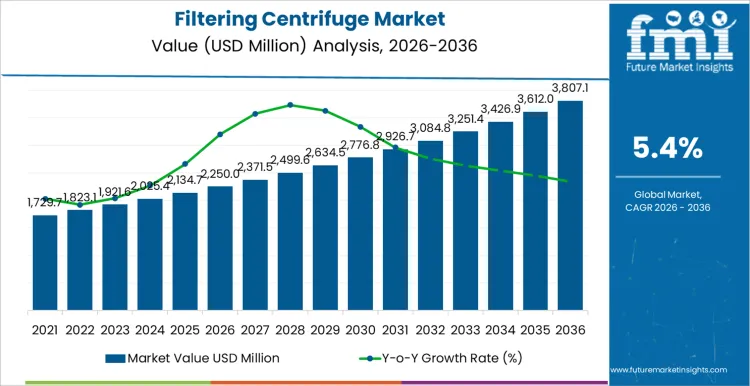
The filtering centrifuge market is set to expand from USD 2,250.0 million in 2026 to USD 3,807.1 million by 2036, progressing at a CAGR of 5.40%. Supply chain performance in this market is shaped by concentrated manufacturing capability and tight control over critical components rather than broad geographic dispersion. Production of high performance filtering centrifuges remains anchored in a limited number of engineering intensive hubs in Europe, Japan, and parts of China, where precision fabrication, materials expertise, and testing infrastructure are deeply embedded.
This concentration supports quality consistency but exposes buyers to longer lead times and capacity constraints during project upcycles. Dependence on specialized castings, high grade stainless steels, wear resistant alloys, and automation hardware introduces further sensitivity to supplier reliability and logistics disruption. Regional assembly and localization strategies mitigate some risk, yet core subassemblies often remain centralized. As plants push for faster commissioning and predictable uptime, supply reliability, spare parts availability, and manufacturing discipline increasingly influence purchasing outcomes.
Quick Stats for Filtering Centrifuge Market
- Filtering Centrifuge Market Value (2026): USD 2,250.0 Million
- Filtering Centrifuge Market Forecast Value (2036): USD 3,807.1 Million
- Filtering Centrifuge Market Forecast CAGR 2026 to 2036: 5.40%
- Leading Centrifuge Type in Filtering Centrifuge Market: Peeler Centrifuges (28% share)
- Key Growth Regions in Filtering Centrifuge Market: Asia Pacific, Europe, North America, Latin America, Middle East & Africa
- Top Key Players in Filtering Centrifuge Market: GEA, Alfa Laval, ANDRITZ, Flottweg, SPX FLOW, Ferrum, De Dietrich Process Systems (Heinkel), Pieralisi, Hiller, Rousselet Robatel
Filtering Centrifuge Market Key Takeaways
| Metric | Value |
|---|---|
| Filtering Centrifuge Market Value (2026) | USD 2,250.0 Million |
| Filtering Centrifuge Market Forecast Value (2036) | USD 3,807.1 Million |
| Filtering Centrifuge Market Forecast CAGR 2026 to 2036 | 5.40% |
How Are Process Intensification and Product Quality Requirements Driving the Filtering Centrifuge Market?
The filtering centrifuge market is expanding as manufacturers seek faster and more controllable solid-liquid separation in continuous and batch processing environments. Some sites benchmark cycle stability versus centrifugal separators where continuous clarification is preferred over cake-handling steps. Industries such as chemicals, pharmaceuticals, food processing, and specialty materials rely on filtering centrifuges to achieve precise particle separation while maintaining product purity and yield. In multi-step separation trains, liquid filtration is often used as the downstream polishing step after centrifugation to protect final product specifications. For equipment suppliers, demand is increasingly tied to applications where filtration efficiency, moisture control, and repeatability directly influence downstream processing costs and product quality. Where final moisture is the key KPI, membrane filter press machines are frequently evaluated alongside centrifuges to reduce downstream dryer load.
Buyer evaluation criteria are shifting toward process integration and automation readiness. Plants that standardize automation stacks often compare retrofits with automatic filter press solutions to reduce manual intervention and stabilize cake discharge cycles. End users prefer filtering centrifuges that support automated feed control, cake washing, and discharge while minimizing operator intervention. Designs that enable higher centrifugal forces, improved basket geometry, and optimized filter media are gaining traction as plants push for higher throughput within limited footprints. For slurries with difficult cake release, plate and frame filter presses remain a common alternative when maximum cake dryness outweighs cycle-time constraints. Suppliers offering application-specific centrifuge designs and scalable configurations are better positioned to meet diverse process requirements.
Replacement demand and regulatory compliance are further supporting market growth. Upgrades are increasingly justified under broader industrial filtration compliance programs that combine emission controls, solvent recovery, and wastewater performance targets. Aging separation equipment in mature industrial facilities is being upgraded to meet stricter safety, hygiene, and environmental standards. At the same time, expansion of pharmaceutical and specialty chemical capacity in Asia Pacific and the Middle East is driving new installations. For manufacturers and system integrators, competitive advantage increasingly depends on engineering expertise, customization capability, and service support positioning filtering centrifuges as a stable, performance-driven segment within industrial separation technologies.
How Is the Filtering Centrifuge Market Structured By Centrifuge Type and End Use?
The filtering centrifuge market is segmented by centrifuge type and end use, reflecting how separation efficiency, solids handling, and process continuity requirements influence equipment selection. By centrifuge type, peeler centrifuges represent the leading segment, widely used for batch solid-liquid separation where high cake dryness and product purity are required. Other centrifuge types include pusher centrifuges, decanter centrifuges, basket centrifuges, and other specialized designs used for continuous or heavy-duty separation tasks. By end use, chemical processing leads overall demand, followed by pharmaceutical and biotech, food and beverage, mining and minerals, and environmental applications, each with distinct separation and compliance needs.
Why Do Peeler Centrifuges Lead Centrifuge Type Adoption in the Filtering Centrifuge Market?
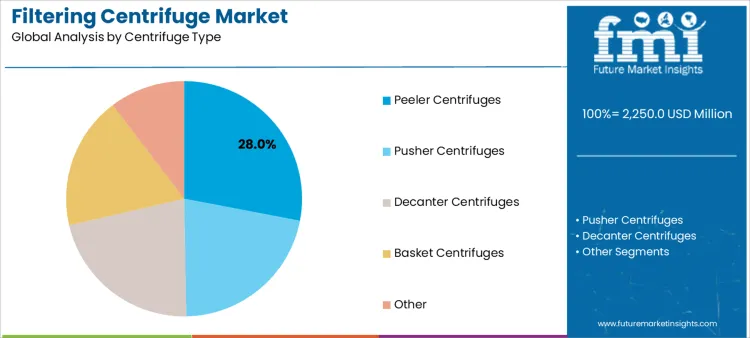
Peeler centrifuges account for 28% share of the filtering centrifuge market because they deliver high separation efficiency and excellent cake washing performance. These centrifuges are widely used in chemical and pharmaceutical production where product purity and controlled batch processing are critical. Automated peeling mechanisms enable efficient cake discharge while minimizing product loss. Peeler centrifuges handle a wide range of crystal sizes and slurry concentrations, supporting flexible operation. Manufacturers value their ability to achieve low residual moisture content, which reduces downstream drying requirements. These performance advantages, combined with suitability for regulated industries, explain why peeler centrifuges remain the most widely adopted centrifuge type.
Why Does the Chemicals Industry Dominate End-Use Demand in the Filtering Centrifuge Market?
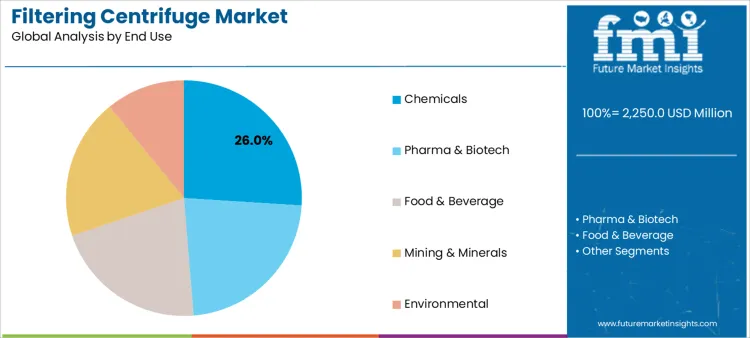
The chemicals industry holds 26% share of the filtering centrifuge market because solid-liquid separation is integral to chemical synthesis, crystallization, and intermediate recovery processes. Filtering centrifuges are used to separate catalysts, salts, and chemical solids from process liquids with high precision. Continuous production cycles and high throughput requirements drive consistent equipment utilization. Chemical manufacturers prioritize centrifuges that offer reliable operation under corrosive and high-temperature conditions. Replacement demand and capacity expansions further support market growth. For centrifuge suppliers, chemical processing offers large project sizes and long-term service opportunities, explaining its position as the leading end-use segment.
What Are The Key Dynamics Of The Filtering Centrifuge Market?
The filtering centrifuge market is driven by demand for efficient solid liquid separation in industries such as chemicals, pharmaceuticals, food and beverage, mining, wastewater treatment, and oil and gas. Filtering centrifuges such as peeler, pusher, and scroll types provide high throughput, consistent cake discharge, and precise solids control, making them suitable for applications requiring rapid separation and solvent recovery. For centrifuge manufacturers and suppliers, separation efficiency, material compatibility, ease of maintenance, and automation capabilities are crucial performance attributes that influence buyer decisions. Stringent discharge and recovery standards, cost pressures, and process intensification strategies also shape investment cycles in industrial operations.
How Are Technology Advancements And Automation Trends Shaping This Market?
Technology advancements and automation trends are reshaping the filtering centrifuge market by improving operational performance, reliability, and integration with plant control systems. Modern units increasingly feature servo driven controls, real time vibration monitoring, and programmable separation profiles that adjust to changing feed conditions, enhancing throughput and reducing cycle variability. Sensors for differential pressure, torque, and liquid clarity enable operators to optimize cycles and detect maintenance needs before failures occur. Integration with distributed control systems and programmable logic controllers supports centralized process visibility and data analysis. For suppliers, offering modular automation packages that can be retrofitted to existing machines expands customer value and strengthens aftermarket engagement.
Why Do Operational, Cost, And Feedstock Variability Challenges Restrain Market Growth?
Operational, cost, and feedstock variability challenges restrain growth in the filtering centrifuge market by increasing implementation complexity and total cost of ownership. High initial capital investment and installation costs, especially for custom built or large scale units, can deter adoption in cost sensitive segments. Operational challenges such as managing abrasive or corrosive slurries require specialized materials and maintenance regimes, raising lifecycle costs. Variability in feed composition, such as solids concentration, particle size, and viscosity, complicates parameter optimization and can reduce separation consistency, necessitating skilled technicians. These factors slow technology uptake, particularly in facilities with budget constraints or limited in house engineering support.
What is The Country-Wise Outlook for the Filtering Centrifuge Market?
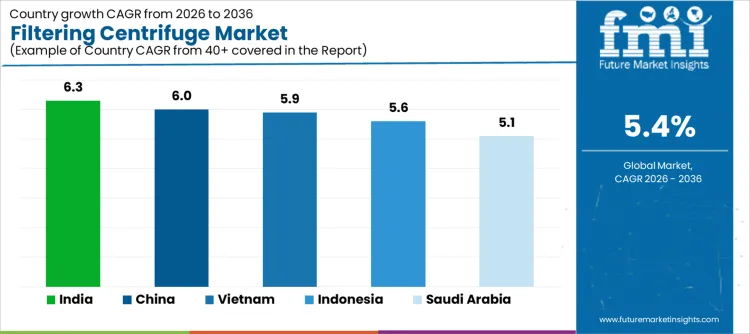
The filtering centrifuge market is expanding steadily as industries seek efficient solid-liquid separation solutions for high-throughput and continuous processing applications. These systems are widely used across chemicals, pharmaceuticals, food processing, mining, and wastewater treatment to improve separation efficiency, product recovery, and process consistency. Growth varies by country depending on industrial capacity additions, modernization of processing plants, and adoption of automated separation technologies. Faster-growing markets are supported by new manufacturing facilities and infrastructure investments, while more mature regions see demand driven by equipment replacement and efficiency upgrades.
| Country | CAGR (%) |
|---|---|
| India | 6.3 |
| China | 6.0 |
| Vietnam | 5.9 |
| Indonesia | 5.6 |
| Saudi Arabia | 5.1 |
Why Is India Emerging As A Strong Growth Market For Filtering Centrifuges?
India’s filtering centrifuge market is projected to grow at a CAGR of 6.3% during 2026 to 2036, driven by rapid expansion across chemicals, pharmaceuticals, food processing, and industrial wastewater treatment. Increasing production volumes and tighter process efficiency requirements are pushing manufacturers to adopt high-capacity, reliable solid-liquid separation equipment. Filtering centrifuges are widely used in bulk drug manufacturing, specialty chemicals, sugar processing, and fertilizer production, where consistent cake quality and moisture control are critical. Buyers emphasize throughput efficiency, ease of cleaning, and compatibility with automated process lines. Cost sensitivity remains high, but downtime risks make reliability a decisive factor in procurement. Demand is supported by both Greenfield plant installations and upgrades of legacy separation systems. Domestic manufacturing and localized assembly help improve affordability and delivery timelines.
How Is China Sustaining Large-Scale Demand For Filtering Centrifuge Systems?
China’s filtering centrifuge market is expanding at a CAGR of 6.0% during 2026 to 2036, supported by extensive industrial activity across chemicals, pharmaceuticals, food processing, and mineral processing. Filtering centrifuges are integral to high-volume operations requiring continuous and reliable separation performance. Buyers prioritize high throughput, mechanical robustness, and long service life under continuous-duty conditions. Local manufacturing capacity plays a major role, supporting cost efficiency and widespread availability. Procurement decisions favor suppliers that offer standardized designs, automation compatibility, and proven performance across large production lines. Replacement demand remains significant as older centrifuge systems are modernized to improve energy efficiency and reduce maintenance burden. Market value is driven by industrial scale, process standardization, and strong demand from large integrated manufacturing complexes.
Why Is Vietnam Becoming An Attractive Market For Filtering Centrifuges?
Vietnam’s filtering centrifuge market is growing at a CAGR of 5.9% during 2026 to 2036, driven by rapid industrialization and rising investment in food processing, chemicals, and pharmaceuticals. Demand is largely project-led, with centrifuges specified during construction of new manufacturing facilities and industrial parks. Buyers focus on reliability, compact design, and ease of operation, particularly in facilities with limited skilled labor availability. Imported centrifuges dominate supply, often selected by EPC contractors managing plant construction and commissioning. Supplier selection is influenced by compliance with international standards, delivery timelines, and availability of commissioning support. Vietnam represents an emerging market where success depends on EPC relationships, competitive pricing, and strong technical support during installation and startup.
What Is Driving Steady Growth Of Filtering Centrifuges In Indonesia?
Indonesia’s filtering centrifuge market is expanding at a CAGR of 5.6% during 2026 to 2036, supported by investments in chemicals, food processing, palm oil refining, and industrial wastewater treatment. Filtering centrifuges are increasingly adopted to improve separation efficiency and manage high-solid-content streams. Buyers prioritize durability, corrosion resistance, and ease of maintenance due to humid operating environments and variable feed conditions. Demand is split between new installations and gradual replacement of aging separation equipment. Procurement decisions often favor suppliers with local service capability, spare parts availability, and experience in industrial projects. Market value is driven by infrastructure development, environmental compliance requirements, and increasing focus on process reliability. Indonesia represents a balanced growth market where supplier success depends on system robustness, responsive field service, and adaptability to diverse industrial applications.
How Is Saudi Arabia Maintaining Controlled Growth In The Filtering Centrifuge Market?
Saudi Arabia’s filtering centrifuge market is growing at a CAGR of 5.1% during the forecast period, shaped by steady demand from chemicals, refining, petrochemicals, and industrial processing sectors. Filtering centrifuges are used in process streams requiring reliable separation under high-temperature and high-load conditions. Buyers emphasize engineering quality, material strength, and compliance with stringent industrial specifications. Procurement is largely project-driven, aligned with refinery expansions, petrochemical integration projects, and capacity upgrades. Supplier qualification processes are rigorous, focusing on proven field performance, documentation quality, and long-term reliability. Replacement demand remains stable due to disciplined maintenance practices. Saudi Arabia represents a mature industrial market where growth is measured, and supplier success depends on technical excellence, project execution capability, and long-term operational support.
How Are Manufacturers Competing in the Filtering Centrifuge Market?
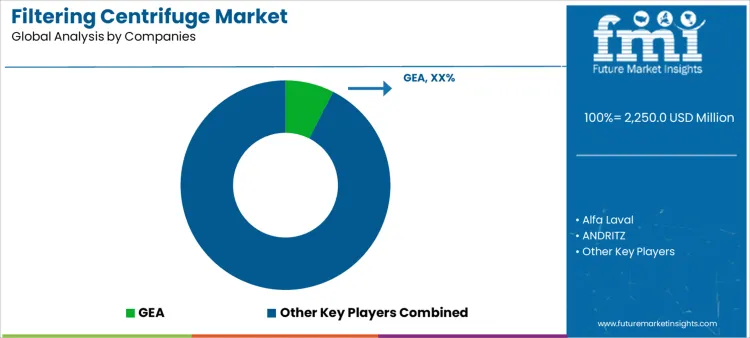
Competition in the filtering centrifuge market is shaped by separation efficiency, mechanical reliability, and adaptability to diverse solid-liquid separation duties across chemicals, pharmaceuticals, food processing, and minerals. GEA positions its filtering centrifuges around high-capacity designs with precise solids discharge control and automation-ready operation. Product portfolios emphasize hygienic construction, reproducible cake dryness, and compatibility with continuous and batch processes. Alfa Laval competes through robust centrifuge platforms engineered for consistent separation performance, highlighting low energy consumption, compact footprints, and ease of cleaning for regulated industries.
Engineering depth and process customization define the next competitive tier. ANDRITZ differentiates by offering filtering centrifuges optimized for high-throughput and abrasive applications, with designs focused on wear resistance and long service intervals. Flottweg emphasizes precision engineering, modular machine configurations, and advanced control systems that allow operators to fine-tune separation parameters for varying feed characteristics. SPX FLOW competes by integrating centrifuges into broader process lines, stressing reliability and system-level optimization.
Specialist manufacturers strengthen competition through niche expertise. Ferrum and De Dietrich Process Systems (Heinkel brand) focus on pharmaceutical and fine chemical applications, with designs highlighting containment, cleanability, and regulatory compliance. Pieralisi, Hiller, and Rousselet Robatel compete through application-specific centrifuge designs and strong aftermarket support. Across the market, competitive advantage is driven by proven separation performance, durability, and process integration rather than equipment price alone.
Key Players in Filtering Centrifuge Market
- GEA
- Alfa Laval
- ANDRITZ
- Flottweg
- SPX FLOW
- Ferrum
- De Dietrich Process Systems (Heinkel)
- Pieralisi
- Hiller
- Rousselet Robatel
Scope of Report
| Attribute | Details |
|---|---|
| Market Size Unit | USD Million |
| Centrifuge Type Covered | Peeler Centrifuges, Pusher Centrifuges, Decanter Centrifuges, Basket Centrifuges, Other |
| End Use Covered | Chemicals, Pharma & Biotech, Food & Beverage, Mining & Minerals, Environmental |
| Countries Covered | China, Japan, South Korea, India, Australia & New Zealand, ASEAN, Rest of Asia Pacific, Germany, United Kingdom, France, Italy, Spain, Nordic, BENELUX, Rest of Europe, United States, Canada, Mexico, Brazil, Chile, Rest of Latin America, Kingdom of Saudi Arabia, Other GCC Countries, Turkey, South Africa, Other African Union, Rest of Middle East & Africa |
| Regions Covered | Asia Pacific, Europe, North America, Latin America, Middle East & Africa |
| Key Companies Profiled | GEA, Alfa Laval, ANDRITZ, Flottweg, SPX FLOW, Ferrum, De Dietrich Process Systems (Heinkel), Pieralisi, Hiller, Rousselet Robatel |
| Additional Attributes | Dollar sales by centrifuge type and end use are evaluated across continuous and batch filtration processes. The scope includes equipment capacity ranges, automation levels, materials of construction, solids discharge mechanisms, and aftermarket services. Country-level analysis reflects industrial processing activity, environmental compliance requirements, and investments in chemical, food, pharmaceutical, and mineral processing facilities. |
Filtering Centrifuge Market by Key Segments
Centrifuge Type:
- Peeler Centrifuges
- Pusher Centrifuges
- Decanter Centrifuges
- Basket Centrifuges
- Other
End Use:
- Chemicals
- Pharma & Biotech
- Food & Beverage
- Mining & Minerals
- Environmental
Region:
- Asia Pacific
- China
- Japan
- South Korea
- India
- Australia & New Zealand
- ASEAN
- Rest of Asia Pacific
- Europe
- Germany
- United Kingdom
- France
- Italy
- Spain
- Nordic
- BENELUX
- Rest of Europe
- North America
- United States
- Canada
- Mexico
- Latin America
- Brazil
- Chile
- Rest of Latin America
- Middle East & Africa
- Kingdom of Saudi Arabia
- Other GCC Countries
- Turkey
- South Africa
- Other African Union
- Rest of Middle East & Africa
HEINKEL Process Technology GmbH. (2024, April 19). Newly developed BLUETECTOR® peeler centrifuge from HEINKEL at Achema 2024: High product quality and flexibility in multi-purpose operation. HEINKEL.
- United States Environmental Protection Agency. (2024). Industrial wastewater treatment technologies: Application of centrifuges and other mechanical solid–liquid separation devices. U.S. EPA Technical Report.
- Separation and Purification Technology Editorial Board. (2023). Advances in solid–liquid separation technologies: The role of industrial centrifuges. Separation and Purification Technology, 300, 122450.
- International Organization for Standardization. (2023). ISO 9001: Quality management systems — Requirements (2023 edition). ISO.
Frequently Asked Questions
How big is the filtering centrifuge market in 2026?
The global filtering centrifuge market is estimated to be valued at USD 2,250.0 million in 2026.
What will be the size of filtering centrifuge market in 2036?
The market size for the filtering centrifuge market is projected to reach USD 3,807.1 million by 2036.
How much will be the filtering centrifuge market growth between 2026 and 2036?
The filtering centrifuge market is expected to grow at a 5.4% CAGR between 2026 and 2036.
What are the key product types in the filtering centrifuge market?
The key product types in filtering centrifuge market are peeler centrifuges, pusher centrifuges, decanter centrifuges, basket centrifuges and other.
Which end use segment to contribute significant share in the filtering centrifuge market in 2026?
In terms of end use, chemicals segment to command 26.0% share in the filtering centrifuge market in 2026.
Preview the report firsthand - request a free sample
Get SampleGet the brochure for pricing and purchase details.
Get PDFTable of Content
- Executive Summary
- Global Market Outlook
- Demand-side Trends
- Supply-side Trends
- Technology Roadmap Analysis
- Analysis and Recommendations
- Market Overview
- Market Coverage / Taxonomy
- Market Definition / Scope / Limitations
- Market Background
- Market Dynamics
- Drivers
- Restraints
- Opportunity
- Trends
- Scenario Forecast
- Demand in Optimistic Scenario
- Demand in Likely Scenario
- Demand in Conservative Scenario
- Opportunity Map Analysis
- Product Life Cycle Analysis
- Supply Chain Analysis
- Investment Feasibility Matrix
- Value Chain Analysis
- PESTLE and Porter’s Analysis
- Regulatory Landscape
- Regional Parent Market Outlook
- Production and Consumption Statistics
- Import and Export Statistics
- Market Dynamics
- Global Market Analysis 2021 to 2025 and Forecast, 2026 to 2036
- Historical Market Size Value (USD Million) Analysis, 2021 to 2025
- Current and Future Market Size Value (USD Million) Projections, 2026 to 2036
- Y-o-Y Growth Trend Analysis
- Absolute $ Opportunity Analysis
- Global Market Pricing Analysis 2021 to 2025 and Forecast 2026 to 2036
- Global Market Analysis 2021 to 2025 and Forecast 2026 to 2036, By Centrifuge Type
- Introduction / Key Findings
- Historical Market Size Value (USD Million) Analysis By Centrifuge Type , 2021 to 2025
- Current and Future Market Size Value (USD Million) Analysis and Forecast By Centrifuge Type , 2026 to 2036
- Peeler Centrifuges
- Pusher Centrifuges
- Decanter Centrifuges
- Basket Centrifuges
- Other
- Peeler Centrifuges
- Y-o-Y Growth Trend Analysis By Centrifuge Type , 2021 to 2025
- Absolute $ Opportunity Analysis By Centrifuge Type , 2026 to 2036
- Global Market Analysis 2021 to 2025 and Forecast 2026 to 2036, By End Use
- Introduction / Key Findings
- Historical Market Size Value (USD Million) Analysis By End Use, 2021 to 2025
- Current and Future Market Size Value (USD Million) Analysis and Forecast By End Use, 2026 to 2036
- Chemicals
- Pharma & Biotech
- Food & Beverage
- Mining & Minerals
- Environmental
- Chemicals
- Y-o-Y Growth Trend Analysis By End Use, 2021 to 2025
- Absolute $ Opportunity Analysis By End Use, 2026 to 2036
- Global Market Analysis 2021 to 2025 and Forecast 2026 to 2036, By Region
- Introduction
- Historical Market Size Value (USD Million) Analysis By Region, 2021 to 2025
- Current Market Size Value (USD Million) Analysis and Forecast By Region, 2026 to 2036
- North America
- Latin America
- Western Europe
- Eastern Europe
- East Asia
- South Asia and Pacific
- Middle East & Africa
- Market Attractiveness Analysis By Region
- North America Market Analysis 2021 to 2025 and Forecast 2026 to 2036, By Country
- Historical Market Size Value (USD Million) Trend Analysis By Market Taxonomy, 2021 to 2025
- Market Size Value (USD Million) Forecast By Market Taxonomy, 2026 to 2036
- By Country
- USA
- Canada
- Mexico
- By Centrifuge Type
- By End Use
- By Country
- Market Attractiveness Analysis
- By Country
- By Centrifuge Type
- By End Use
- Key Takeaways
- Latin America Market Analysis 2021 to 2025 and Forecast 2026 to 2036, By Country
- Historical Market Size Value (USD Million) Trend Analysis By Market Taxonomy, 2021 to 2025
- Market Size Value (USD Million) Forecast By Market Taxonomy, 2026 to 2036
- By Country
- Brazil
- Chile
- Rest of Latin America
- By Centrifuge Type
- By End Use
- By Country
- Market Attractiveness Analysis
- By Country
- By Centrifuge Type
- By End Use
- Key Takeaways
- Western Europe Market Analysis 2021 to 2025 and Forecast 2026 to 2036, By Country
- Historical Market Size Value (USD Million) Trend Analysis By Market Taxonomy, 2021 to 2025
- Market Size Value (USD Million) Forecast By Market Taxonomy, 2026 to 2036
- By Country
- Germany
- UK
- Italy
- Spain
- France
- Nordic
- BENELUX
- Rest of Western Europe
- By Centrifuge Type
- By End Use
- By Country
- Market Attractiveness Analysis
- By Country
- By Centrifuge Type
- By End Use
- Key Takeaways
- Eastern Europe Market Analysis 2021 to 2025 and Forecast 2026 to 2036, By Country
- Historical Market Size Value (USD Million) Trend Analysis By Market Taxonomy, 2021 to 2025
- Market Size Value (USD Million) Forecast By Market Taxonomy, 2026 to 2036
- By Country
- Russia
- Poland
- Hungary
- Balkan & Baltic
- Rest of Eastern Europe
- By Centrifuge Type
- By End Use
- By Country
- Market Attractiveness Analysis
- By Country
- By Centrifuge Type
- By End Use
- Key Takeaways
- East Asia Market Analysis 2021 to 2025 and Forecast 2026 to 2036, By Country
- Historical Market Size Value (USD Million) Trend Analysis By Market Taxonomy, 2021 to 2025
- Market Size Value (USD Million) Forecast By Market Taxonomy, 2026 to 2036
- By Country
- China
- Japan
- South Korea
- By Centrifuge Type
- By End Use
- By Country
- Market Attractiveness Analysis
- By Country
- By Centrifuge Type
- By End Use
- Key Takeaways
- South Asia and Pacific Market Analysis 2021 to 2025 and Forecast 2026 to 2036, By Country
- Historical Market Size Value (USD Million) Trend Analysis By Market Taxonomy, 2021 to 2025
- Market Size Value (USD Million) Forecast By Market Taxonomy, 2026 to 2036
- By Country
- India
- ASEAN
- Australia & New Zealand
- Rest of South Asia and Pacific
- By Centrifuge Type
- By End Use
- By Country
- Market Attractiveness Analysis
- By Country
- By Centrifuge Type
- By End Use
- Key Takeaways
- Middle East & Africa Market Analysis 2021 to 2025 and Forecast 2026 to 2036, By Country
- Historical Market Size Value (USD Million) Trend Analysis By Market Taxonomy, 2021 to 2025
- Market Size Value (USD Million) Forecast By Market Taxonomy, 2026 to 2036
- By Country
- Kingdom of Saudi Arabia
- Other GCC Countries
- Turkiye
- South Africa
- Other African Union
- Rest of Middle East & Africa
- By Centrifuge Type
- By End Use
- By Country
- Market Attractiveness Analysis
- By Country
- By Centrifuge Type
- By End Use
- Key Takeaways
- Key Countries Market Analysis
- USA
- Pricing Analysis
- Market Share Analysis, 2025
- By Centrifuge Type
- By End Use
- Canada
- Pricing Analysis
- Market Share Analysis, 2025
- By Centrifuge Type
- By End Use
- Mexico
- Pricing Analysis
- Market Share Analysis, 2025
- By Centrifuge Type
- By End Use
- Brazil
- Pricing Analysis
- Market Share Analysis, 2025
- By Centrifuge Type
- By End Use
- Chile
- Pricing Analysis
- Market Share Analysis, 2025
- By Centrifuge Type
- By End Use
- Germany
- Pricing Analysis
- Market Share Analysis, 2025
- By Centrifuge Type
- By End Use
- UK
- Pricing Analysis
- Market Share Analysis, 2025
- By Centrifuge Type
- By End Use
- Italy
- Pricing Analysis
- Market Share Analysis, 2025
- By Centrifuge Type
- By End Use
- Spain
- Pricing Analysis
- Market Share Analysis, 2025
- By Centrifuge Type
- By End Use
- France
- Pricing Analysis
- Market Share Analysis, 2025
- By Centrifuge Type
- By End Use
- India
- Pricing Analysis
- Market Share Analysis, 2025
- By Centrifuge Type
- By End Use
- ASEAN
- Pricing Analysis
- Market Share Analysis, 2025
- By Centrifuge Type
- By End Use
- Australia & New Zealand
- Pricing Analysis
- Market Share Analysis, 2025
- By Centrifuge Type
- By End Use
- China
- Pricing Analysis
- Market Share Analysis, 2025
- By Centrifuge Type
- By End Use
- Japan
- Pricing Analysis
- Market Share Analysis, 2025
- By Centrifuge Type
- By End Use
- South Korea
- Pricing Analysis
- Market Share Analysis, 2025
- By Centrifuge Type
- By End Use
- Russia
- Pricing Analysis
- Market Share Analysis, 2025
- By Centrifuge Type
- By End Use
- Poland
- Pricing Analysis
- Market Share Analysis, 2025
- By Centrifuge Type
- By End Use
- Hungary
- Pricing Analysis
- Market Share Analysis, 2025
- By Centrifuge Type
- By End Use
- Kingdom of Saudi Arabia
- Pricing Analysis
- Market Share Analysis, 2025
- By Centrifuge Type
- By End Use
- Turkiye
- Pricing Analysis
- Market Share Analysis, 2025
- By Centrifuge Type
- By End Use
- South Africa
- Pricing Analysis
- Market Share Analysis, 2025
- By Centrifuge Type
- By End Use
- USA
- Market Structure Analysis
- Competition Dashboard
- Competition Benchmarking
- Market Share Analysis of Top Players
- By Regional
- By Centrifuge Type
- By End Use
- Competition Analysis
- Competition Deep Dive
- GEA
- Overview
- Product Portfolio
- Profitability by Market Segments (Product/Age /Sales Channel/Region)
- Sales Footprint
- Strategy Overview
- Marketing Strategy
- Product Strategy
- Channel Strategy
- Alfa Laval
- ANDRITZ
- Flottweg
- SPX FLOW
- Ferrum
- De Dietrich Process Systems (Heinkel)
- Pieralisi
- Hiller
- Rousselet Robatel
- GEA
- Competition Deep Dive
- Assumptions & Acronyms Used
- Research Methodology


