

- Industry Size (2026)
- USD 1.68 Bn
- Forecast (2036)
- USD 2.74 Bn
- CAGR (2026 to 2036)
- 5.00%
Benchtop Centrifuges Market Size, Market Forecast and Outlook by FMI
Summary of the Benchtop Centrifuges Market
- Demand and Growth Drivers
- Around the world, drug research and development costs more than $250 billion. This makes it even more important for labs to have benchtop centrifuges for separating cells, purifying proteins, and making drugs.
- More people are getting chronic diseases and the population is getting older, so there are more clinical diagnostics tests. This means that hospitals and reference labs need to process more samples more quickly.
- As laboratory automation becomes more common, benchtop centrifuges are going from being separate tools to being connected parts of automated sample processing workflows.
- Product and Segment View
- Centrifugation Type: Differential Centrifugation is expected to lead, accounting for 45.0% of the centrifugation type segment in 2026.
- End Use: Health Care & Pharmaceutical Companies is expected to lead, accounting for 40.0% of the end use segment in 2026.
- The market for benchtop centrifuges is growing steadily because more money is being spent on drug research and development, more clinical diagnostics are being done, and more labs are using automation. Pharmaceutical companies are adding to their existing labs and building new ones for research. To do both regular and specialized sample separation tasks, each of these new or expanded labs needs several benchtop centrifuge units.
- Geography and Competitive Outlook
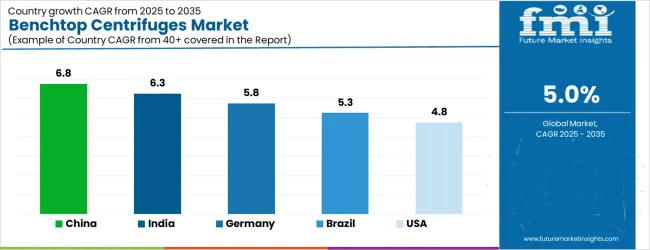
- China leads at 6.8% CAGR, driven by pharmaceutical R&D investment, healthcare laboratory infrastructure expansion, and domestic laboratory equipment manufacturing capability development.
- India follows at 6.3% CAGR, propelled by pharmaceutical industry growth, expanding hospital laboratory networks, and government health research investment.
- Thermo Fisher, Eppendorf, and Beckman Coulter collectively hold significant market share, with competitive differentiation based on rotor technology, temperature control precision, and laboratory automation integration.
- Analyst Opinion
- Nandini Roy Choudhury, Principal Consultant at FMI says, “Companies that can navigate the evolving benchtop centrifuges landscape — barriers to entry include laboratory instrument regulatory certification, established pharmaceutical procurement relationships, and global service and calibration network requirements — are likely to strengthen their position over the forecast period.”
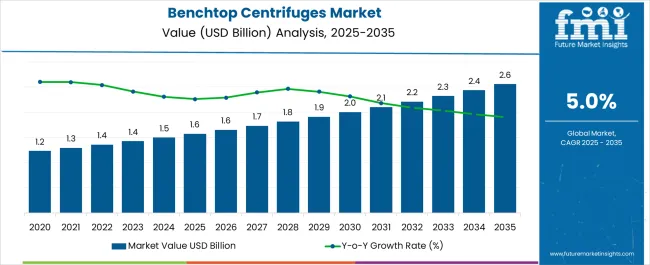
Key Takeaways, Market Size, and Forecast
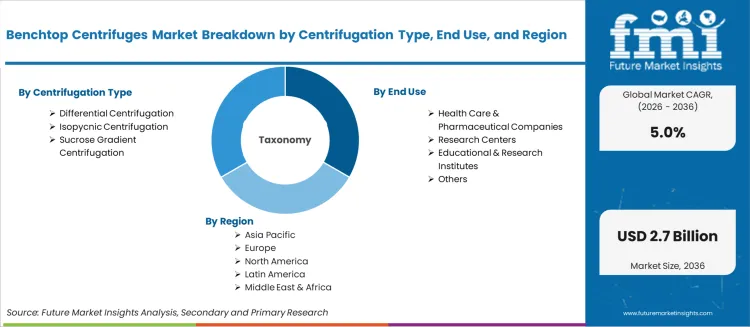
- Benchtop Centrifuges Market is projected to grow from USD 1.7 billion in 2026 to USD 2.7 billion by 2036, at a CAGR of 5.0%.
- The benchtop centrifuges market was valued at USD 1.6 billion in 2025.
- By 2036, the Benchtop Centrifuges Market is expected to be worth USD 2.7 billion.
- From 2026 to 2036, the market is projected to expand at a CAGR of 5.0%.
- The market is projected to create an incremental opportunity of USD 1.1 billion between 2026 and 2036.
- In 2026, Differential Centrifugation is expected to account for 45.0% of the centrifugation type segment.
- China (6.8%) and India (6.3%) are two of the fastest growing markets.
Clinical diagnostics is the biggest source of ongoing demand. Every year, hospitals and reference labs get millions of blood, urine, and tissue samples. In most analytical workflows, centrifugation is a key step. Because more people are getting older and have chronic diseases, the number of samples per person is going up. This means that the centrifuge throughput needs to go up too.
Benchtop Centrifuges Market Definition
The benchtop centrifuges market includes small laboratory centrifuges that are used in clinical, pharmaceutical, and research settings to separate samples by density. Differential, isopycnic, and sucrose gradient centrifugation systems are some of the products used by healthcare companies, pharmaceutical companies, research centers, and schools.
Benchtop Centrifuges Market Inclusions
The market includes all commercially available benchtop centrifuge systems, divided by type of centrifugation (differential, isopycnic, and sucrose gradient), end use (health care and pharmaceutical companies, research centers, educational and research institutes, and others), and region. The revenue sizing covers the years 2026 to 2036.
Benchtop Centrifuges Market Exclusions
The scope does not include floor-standing ultracentrifuges, industrial-scale centrifugation equipment, microcentrifuges with a capacity of less than 0.2 mL, or centrifuge consumables like rotors and tubes that are sold separately.
Benchtop Centrifuges Market Research Methodology
- Primary Research: FMI analysts did primary research by talking to laboratory equipment procurement directors, pharmaceutical research managers, and clinical laboratory heads at hospitals, pharmaceutical companies, and research institutions in North America, Europe, and Asia-Pacific.
- Desk Research: The data collection used statistics on the laboratory equipment industry, spending on pharmaceutical R&D, databases of accredited clinical laboratories, and company annual reports to create verifiable baseline parameters.
- Market Sizing and Forecasting: We find the baseline values by adding up the placements of benchtop centrifuge units from the bottom up. We then use the growth rates of pharmaceutical R&D in each region and the patterns of clinical laboratory expansion to guess how much demand there will be until 2036.
- Data validation and update cycle: Every three months, projections are checked against statistics on pharmaceutical industry R&D spending, hospital laboratory installations, and shipments of centrifuges from manufacturers. This is called the data validation and update cycle.
Why is the Benchtop Centrifuges Market Growing?
- Around the world, drug research and development costs more than $250 billion. This makes it even more important for labs to have benchtop centrifuges for separating cells, purifying proteins, and making drugs.
- More people are getting chronic diseases and the population is getting older, so there are more clinical diagnostics tests. This means that hospitals and reference labs need to process more samples more quickly.
- As laboratory automation becomes more common, benchtop centrifuges are going from being separate tools to being connected parts of automated sample processing workflows.
The market for benchtop centrifuges is growing steadily because more money is being spent on drug research and development, more clinical diagnostics are being done, and more labs are using automation. Pharmaceutical companies are adding to their existing labs and building new ones for research. To do both regular and specialized sample separation tasks, each of these new or expanded labs needs several benchtop centrifuge units.
Clinical diagnostics is the biggest source of ongoing demand. Every year, hospitals and reference labs get millions of blood, urine, and tissue samples. In most analytical workflows, centrifugation is a key step. Because more people are getting older and have chronic diseases, the number of samples per person is going up. This means that the centrifuge throughput needs to go up too.
Thanks to rotor technology and automation controls, centrifuges are getting better at what they do. Modern benchtop centrifuges have chambers that can be set to different temperatures, automatic rotor recognition, and programmable protocols for separating things. These features make it less likely that different operators will get different results and make it easier to do the same experiments again. You can keep track of samples and write down protocols if you connect to laboratory information management systems (LIMS).
Market Segmentation Analysis
- Differential centrifugation will still have a 45% market share in 2026, which shows that it is still the most popular way to separate samples for research and clinical use.
- Forty percent of the end-use segment is made up of health care and pharmaceutical companies. This is due to the high volumes of drug development research workflows and clinical laboratory sample processing.
- Research centers and schools are two groups that need more centrifuges because they are getting more money for academic research and development and need to teach in labs.
There are two main types of benchtop centrifuges: those that are used for centrifugation and those that are used for other things. There are three main types of centrifugation on the market: differential centrifugation, isopycnic centrifugation, and sucrose gradient centrifugation. Based on how they will be used, the market is split into groups like health care and pharmaceutical companies, research centers, educational and research institutes, and others.
Insights into the Differential Centrifugation Type Segment
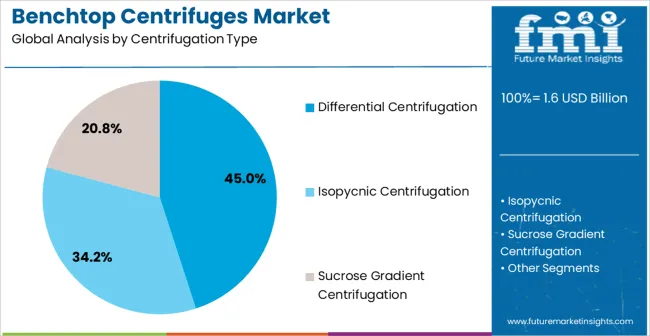
The most common type of centrifugation in 2026 is expected to be differential centrifugation, which will have a 45.0% share of the market. Differential centrifugation is the most common way to separate samples by size and density in clinical and research labs. This is why it is so popular. The method is the standard way to separate blood components, isolate cell pellets, and collect protein fractions because it is easy to use, can be repeated, and works with standard rotors.
Insights into the Health Care & Pharmaceutical End-Use Segment
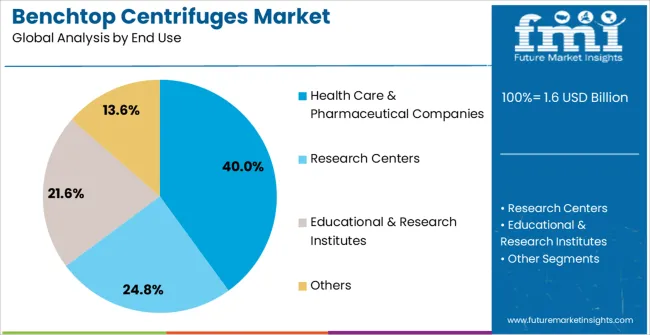
By 2026, health care and pharmaceutical companies are expected to make up 40% of the end-use market. The three biggest sub-applications are labs in hospitals, research and development facilities for drugs, and contract research organizations. Centrifugation is needed at many points in drug development workflows, from getting cell cultures to making formulations. This means that each pharmaceutical research site has to buy more than one of each type of equipment.
Benchtop Centrifuges Market Drivers, Restraints, and Opportunities
- The growth of pharmaceutical R&D spending and the number of clinical diagnostics tests are making laboratory equipment more popular in all parts of the world.
- It's hard for smaller labs and healthcare facilities in developing economies to get into premium automated centrifuge systems because they cost too much.
- Benchtop centrifuges are becoming smart lab tools thanks to smart centrifuge platforms that connect to the Internet of Things (IoT), pick protocols automatically, and let you keep an eye on them from a distance.
The market for benchtop centrifuges is steadily growing. This is due to the growth of pharmaceutical research and development, the expansion of clinical diagnostics, and the use of laboratory automation. In developing markets, manufacturers have to deal with things like price sensitivity, and smaller facilities have to deal with tight budgets. The growth of pharmaceutical labs, the increase in clinical volume, and the creation of smart instrument platforms all offer opportunities for growth.
Pharmaceutical R&D Investment and Laboratory Expansion
The global pharmaceutical R&D budget is over USD 250 billion, which drives demand. New laboratory construction and expansion of existing labs create the need for benchtop centrifuges. In cell biology, biochemistry, and formulation development labs, each pharmaceutical research site usually has 5 to 20 benchtop centrifuge units.
Instrument Pricing and Developing Market Budget Constraints
Adoption is limited by the high prices of benchtop centrifuges, which range from $3,000 for basic models to $30,000 for advanced refrigerated systems with automated features. Laboratories in developing economies and smaller research institutions encounter financial constraints that postpone the acquisition of high-end instruments, resulting in concentrated demand for advanced models within well-funded pharmaceutical and hospital laboratories.
Smart Instrument Platform and IoT Integration
The growth of connected centrifuge platforms with IoT monitoring, automated rotor recognition, and LIMS integration shows how technology is getting better. Smart centrifuges let you keep an eye on run parameters from afar, get alerts for predictive maintenance, and keep track of protocols that help with regulatory compliance in clinical and pharmaceutical settings.
Analysis of Benchtop Centrifuges Market By Key Countries
.webp "Top Country Growth Comparison Benchtop Centrifuges Market Cagr (2026 2036)")
| Country | CAGR |
|---|---|
| China | 6.8% |
| India | 6.3% |
| Germany | 5.8% |
| Brazil | 5.3% |
| USA | 4.8% |
| UK | 4.3% |
| Japan | 3.8% |
- China leads at 6.8% CAGR, driven by pharmaceutical R&D investment, healthcare laboratory infrastructure expansion, and domestic laboratory equipment manufacturing capability development.
- India follows at 6.3% CAGR, propelled by pharmaceutical industry growth, expanding hospital laboratory networks, and government health research investment.
- Germany maintains 5.8% CAGR through pharmaceutical R&D excellence, clinical laboratory quality standards, and advanced centrifuge engineering leadership.
- USA grows at 4.8% CAGR reflecting the largest pharmaceutical R&D market with mature laboratory infrastructure and instrument replacement cycles.
The benchtop centrifuges market is projected to grow globally at a CAGR of 5.0% from 2026 to 2036. Among the top markets, China leads at 6.8%. The analysis spans over 30 countries, with the leading markets detailed below.
Demand Outlook for Benchtop Centrifuges Market in the United States
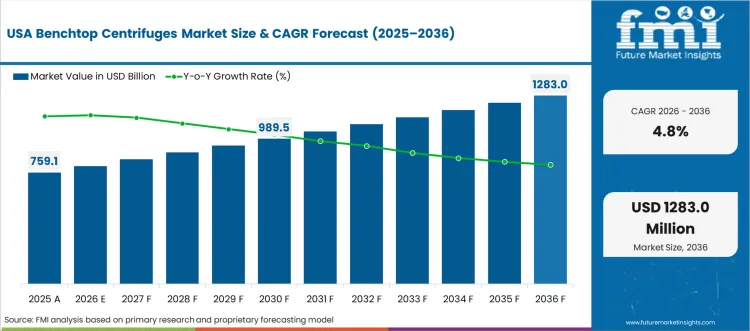
The US is expected to grow at a CAGR of 4.8% through 2036, thanks to investments in pharmaceutical research and development, the modernization of clinical laboratories, and the cycles of upgrading instrument technology. The US has the world's largest pharmaceutical research and development lab infrastructure, which creates a lot of demand for buying and replacing equipment.
- The leaders of pharmaceutical research and development keep buying lab equipment.
- Modernizing clinical laboratories leads to upgrades in instruments.
- Instrument replacement cycles lead to ongoing demand.
Future Outlook for Benchtop Centrifuges Market in the United Kingdom
The UK is expected to grow at a CAGR of 4.3% through 2036, thanks to the presence of pharmaceutical R&D, investments in NHS clinical laboratories, and funding for academic research. UK universities and research institutions have a lot of centrifuges that need to be replaced every now and then.
- The presence of pharmaceutical R&D keeps the demand for equipment high.
- Investing in NHS labs leads to buying clinical instruments.
- Funding for academic research helps schools buy things.
Opportunity Analysis of Benchtop Centrifuges Market in Germany
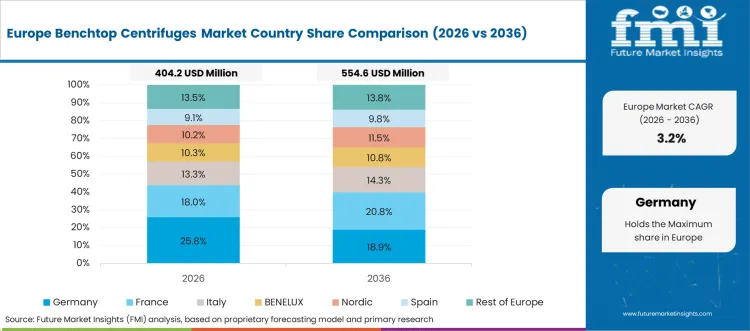
Germany's market will grow at a rate of 5.8% per year through 2036. This is because of investments in pharmaceutical research and development, high standards for clinical laboratories, and advanced centrifuge engineering knowledge. Eppendorf and Hettich, two German companies, are still the best in the world at making precision centrifuges.
- The need for lab equipment is driven by investment in pharmaceutical research and development.
- German companies are still the best in the world at designing centrifuges.
- Clinical quality standards drive the purchase of high-end instruments.
In-depth Analysis of Benchtop Centrifuges Market in Japan
Japan is expected to grow at a compound annual growth rate (CAGR) of 3.8% through 2036. This is due to the country's well-established pharmaceutical research and development infrastructure, high standards for precision laboratory equipment, and an aging population that is driving up the number of clinical diagnostics. Japanese precision engineering helps with the development of advanced centrifuges.
- The infrastructure for pharmaceutical research and development keeps demand for equipment high.
- The growing number of older people is causing clinical diagnostics volume to grow.
- Precision engineering standards help create new, more advanced instruments.
Sales Analysis of Benchtop Centrifuges Market in China
China is expected to grow the fastest, at 6.8% per year through 2036. This is because of more money going into pharmaceutical research and development, more healthcare laboratory infrastructure, and government programs to build biosafety laboratories. China's pharmaceutical industry is spending more on research and development at rates of 10% or more, which is increasing the need for lab equipment.
- The growth of pharmaceutical research and development (R&D) spending leads to the growth of laboratories.
- The growth of healthcare laboratory infrastructure creates a need for procurement.
- Government biosafety programs add more specific requirements for centrifuges.
In-depth Analysis of Benchtop Centrifuges Market in India
India is growing quickly, with a CAGR of 6.3% through 2036. This is due to the growth of the pharmaceutical industry, the hospital laboratory network, and government investment in health research. India's status as a major center for pharmaceutical manufacturing creates a need for research lab infrastructure.
- The growth of the pharmaceutical industry is what drives the need for R&D lab equipment.
- The growth of hospital laboratory networks increases the need for clinical instruments.
- Government funding for health research helps institutions buy things.
Competitive Landscape and Strategic Positioning
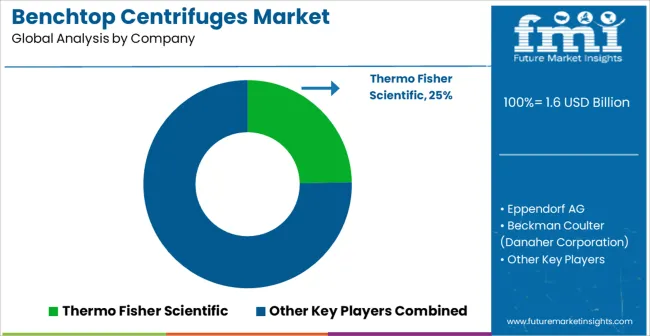
- Thermo Fisher, Eppendorf, and Beckman Coulter collectively hold significant market share, with competitive differentiation based on rotor technology, temperature control precision, and laboratory automation integration.
- European manufacturers maintain quality leadership in precision centrifuge engineering, while North American manufacturers leverage pharmaceutical industry relationships for direct laboratory placement.
- Emerging manufacturers in Asia are gaining share through competitive pricing and localized service networks in developing market healthcare and research facilities.
The benchtop centrifuges market is shaped by global laboratory equipment manufacturers with integrated instrument platforms. Thermo Fisher Scientific maintains market leadership through comprehensive laboratory equipment portfolio integration, pharmaceutical industry relationships, and global service network reach. Eppendorf AG differentiates through premium centrifuge engineering, ergonomic design, and strong academic research laboratory positioning.
Beckman Coulter (Danaher Corporation) leverages clinical laboratory automation expertise and high-throughput centrifuge platforms for hospital and reference laboratory applications. Hettich Instruments specializes in refrigerated centrifuge technology with advanced temperature control for sensitive biological sample processing. Sigma Laborzentrifugen provides precision-engineered centrifuges with focus on European pharmaceutical and research laboratory markets.
Barriers to entry include laboratory instrument regulatory certification, established pharmaceutical procurement relationships, and global service and calibration network requirements.
Key Companies in the Benchtop Centrifuges Market
Key global companies leading the benchtop centrifuges market include:
- Thermo Fisher Scientific (USA), Eppendorf AG (Germany), Beckman Coulter (Danaher Corporation) (USA), and Hettich Instruments (Germany) were identified as some of the star players in the benchtop centrifuges market (global), given their strong laboratory instrument engineering, established pharmaceutical and clinical laboratory relationships, and product portfolio spanning differential, isopycnic, and gradient centrifugation systems.
- Sigma Laborzentrifugen (Germany), Kubota Corporation (Japan), and NuAire, Inc. (USA) have established strong regional positions by specializing in precision centrifuge solutions, serving pharmaceutical companies and research institutions that prioritize instrument reliability and application-specific performance across their respective markets.
- Centurion Scientific (UK), among others, have distinguished themselves among startups and SMEs by securing strong footholds in specialized niche areas focused on compact centrifuge solutions and cost-effective laboratory instruments for emerging market healthcare and research facilities, underscoring their potential as emerging market leaders.
Competitive Benchmarking: Benchtop Centrifuges Market
| Company | Instrument Range | Automation Capability | Pharma Access | Service Network |
|---|---|---|---|---|
| Thermo Fisher Scientific | High | High | Strong | Global |
| Eppendorf AG | High | High | Strong | Global |
| Beckman Coulter | High | High | Strong | Global |
| Hettich Instruments | High | Medium | Strong | Europe |
| Sigma Laborzentrifugen | Medium | Medium | Moderate | Europe |
| Kubota Corporation | Medium | Low | Moderate | Asia-Pacific |
| NuAire, Inc. | Medium | Low | Moderate | North America |
Source: Future Market Insights competitive analysis, 2026.
Key Developments in Benchtop Centrifuges Market
- In 2025, Thermo Fisher Scientific continued expanding its benchtop centrifuge portfolio with enhanced digital interfaces and improved sample processing efficiency, supporting pharmaceutical and biotechnology laboratory workflows.
- In 2025, Eppendorf AG advanced its refrigerated benchtop centrifuge offerings with improved energy efficiency, low-noise operation, and automated rotor recognition features for multi-application laboratory use.
Key Players in the Benchtop Centrifuges Market:
Major Global Players:
- Thermo Fisher Scientific
- Eppendorf AG
- Beckman Coulter (Danaher Corporation)
- Hettich Instruments
- Sigma Laborzentrifugen
Emerging Players/Startups
- Kubota Corporation
- NuAire, Inc.
- Centurion Scientific
Report Scope and Coverage
| Metric | Value |
|---|---|
| Quantitative Units | USD 1.7 billion to USD 2.7 billion, at a CAGR of 5.0% |
| Market Definition | The benchtop centrifuges market encompasses compact laboratory centrifugation instruments designed for sample separation by density in clinical, pharmaceutical, and research applications. Products include differential, isopycnic, and sucrose gradient centrifugation systems deployed across healthcare companies, pharmaceutical firms, research centres, and educational institutions. |
| Segmentation | Others |
| Regions Covered | North America, Latin America, Western Europe, Eastern Europe, East Asia, South Asia and Pacific, Middle East & Africa |
| Countries Covered | China, India, Germany, Brazil, USA, UK, Japan, 30 plus countries |
| Key Companies Profiled | Thermo Fisher Scientific, Eppendorf AG, Beckman Coulter (Danaher Corporation), Hettich Instruments, Sigma Laborzentrifugen, Kubota Corporation, NuAire, Inc., Centurion Scientific |
| Forecast Period | 2026 to 2036 |
| Approach | Hybrid bottom-up and top-down methodology starting with verified transaction data, projecting adoption velocity across segments and regions. |
Benchtop Centrifuges Market by Segments
Benchtop Centrifuges Market Segmented by Centrifugation Type:
- Differential Centrifugation
- Isopycnic Centrifugation
- Sucrose Gradient Centrifugation
Benchtop Centrifuges Market Segmented by End Use:
- Health Care & Pharmaceutical Companies
- Research Centers
- Educational & Research Institutes
- Others
Benchtop Centrifuges Market by Region:
- North America
- USA
- Canada
- Mexico
- Latin America
- Brazil
- Chile
- Rest of Latin America
- Western Europe
- Germany
- UK
- Italy
- Spain
- France
- Nordic
- BENELUX
- Rest of Western Europe
- Eastern Europe
- Russia
- Poland
- Hungary
- Balkan & Baltic
- Rest of Eastern Europe
- East Asia
- China
- Japan
- South Korea
- South Asia and Pacific
- India
- ASEAN
- Australia & New Zealand
- Rest of South Asia and Pacific
- Middle East & Africa
- Kingdom of Saudi Arabia
- Other GCC Countries
- Turkiye
- South Africa
- Other African Union
- Rest of Middle East & Africa
Research Sources and Bibliography
- 1. International Council for Laboratory Animal Science. (2024). ICLAS Laboratory Equipment Standards. ICLAS.
- 2. Pharmaceutical Research and Manufacturers of America. (2025). PhRMA R&D Spending Statistics. PhRMA.
- 3. International Organization for Standardization. (2024). ISO 15189: Medical Laboratories Quality and Competence Requirements. ISO.
- 4. World Health Organization. (2025). WHO Laboratory Equipment Technical Specifications. WHO.
- 5. European Commission. (2024). EU In Vitro Diagnostic Regulation (IVDR): Laboratory Equipment Standards. EC.
This bibliography is provided for reader reference. The full FMI report contains the complete reference list with primary research documentation.
This Report Answers
- Finding out how big the market is and how much money benchtop centrifuges will make from 2026 to 2036.
- Segmentation analysis by type of centrifugation, end use, and region.
- Insights about more than 30 markets at the regional and country level.
- An analysis of technology that includes rotor design, automation, and IoT integration.
- Recent changes and an assessment of the competitive landscape.
- Delivery of data in PDF and Excel formats, with access to quarterly updates.
Frequently Asked Questions
What is driving demand in China?
China is projected to grow at a CAGR of 17.1% through 2036, propelled by the country's dominant position in global lithium-ion cell manufacturing, rapid EV production scale-up, and large-scale investment in energy storage system deployment and battery quality infrastructure.
What defines the battery voltage recorder market in this report?
The market includes portable and stationary measurement instruments used to record, monitor, and analyse battery voltage, internal resistance, and discharge characteristics across multiple applications including automotive, industrial, telecom backup, stationary storage, and consumer electronics.
How does FMI build and validate the battery voltage recorder forecast?
FMI uses a hybrid research methodology, combining bottom-up market sizing with validation against industry data. Models are built on verified unit shipment data and cross-validated against battery production statistics, EV manufacturing volumes, and instrument manufacturer disclosures.
How large is the demand for benchtop centrifuges in the global market in 2026?
Demand for benchtop centrifuges in the global market is estimated to be valued at USD 1.68 billion in 2026, supported by steady procurement across clinical diagnostic laboratories, pharmaceutical R&D, and academic research institutions for routine sample preparation workflows.
What will be the market size of benchtop centrifuges by 2036?
Market size for benchtop centrifuges is projected to reach USD 2.74 billion by 2036, driven by expanding healthcare infrastructure, rising biopharmaceutical R&D investment, and continued replacement cycles of ageing laboratory equipment in mature and emerging markets.
What is the expected demand growth for benchtop centrifuges between 2026 and 2036?
Demand is expected to grow at a CAGR of 5.0% between 2026 and 2036, reflecting sustained investment in molecular diagnostics, growing clinical sample processing volumes, and routine adoption across biotech, pharmaceutical, and research laboratory workflows.
Which centrifugation type is poised to lead global sales by 2026?
Differential centrifugation accounts for 45.0% in 2026 as the standard separation method for routine clinical and research sample processing, reflecting its widespread use in blood, serum, and cell preparation across diagnostic laboratories and life science research settings.
How are healthcare and pharmaceutical companies driving benchtop centrifuges adoption?
Healthcare and pharmaceutical companies represent 40.0% of end-use demand through drug development research and clinical diagnostics volume, with continued investment in sample preparation capacity supporting drug discovery pipelines, biologics manufacturing QC, and high-throughput diagnostic testing.
Preview the report firsthand - request a free sample
Get SampleGet the brochure for pricing and purchase details.
Get PDFTable of Content
- Executive Summary
- Global Market Outlook
- Demand-side Trends
- Supply-side Trends
- Technology Roadmap Analysis
- Analysis and Recommendations
- Market Overview
- Market Coverage / Taxonomy
- Market Definition / Scope / Limitations
- Research Methodology
- Chapter Orientation
- Analytical Lens and Working Hypotheses
- Market Structure, Signals, and Trend Drivers
- Benchmarking and Cross-market Comparability
- Market Sizing, Forecasting, and Opportunity Mapping
- Research Design and Evidence Framework
- Desk Research Programme (Secondary Evidence)
- Company Annual and Sustainability Reports
- Peer-reviewed Journals and Academic Literature
- Corporate Websites, Product Literature, and Technical Notes
- Earnings Decks and Investor Briefings
- Statutory Filings and Regulatory Disclosures
- Technical White Papers and Standards Notes
- Trade Journals, Industry Magazines, and Analyst Briefs
- Conference Proceedings, Webinars, and Seminar Materials
- Government Statistics Portals and Public Data Releases
- Press Releases and Reputable Media Coverage
- Specialist Newsletters and Curated Briefings
- Sector Databases and Reference Repositories
- FMI Internal Proprietary Databases and Historical Market Datasets
- Subscription Datasets and Paid Sources
- Social Channels, Communities, and Digital Listening Inputs
- Additional Desk Sources
- Expert Input and Fieldwork (Primary Evidence)
- Primary Modes
- Qualitative Interviews and Expert Elicitation
- Quantitative Surveys and Structured Data Capture
- Blended Approach
- Why Primary Evidence is Used
- Field Techniques
- Interviews
- Surveys
- Focus Groups
- Observational and In-context Research
- Social and Community Interactions
- Stakeholder Universe Engaged
- C-suite Leaders
- Board Members
- Presidents and Vice Presidents
- R&D and Innovation Heads
- Technical Specialists
- Domain Subject-matter Experts
- Scientists
- Physicians and Other Healthcare Professionals
- Governance, Ethics, and Data Stewardship
- Research Ethics
- Data Integrity and Handling
- Primary Modes
- Tooling, Models, and Reference Databases
- Desk Research Programme (Secondary Evidence)
- Data Engineering and Model Build
- Data Acquisition and Ingestion
- Cleaning, Normalisation, and Verification
- Synthesis, Triangulation, and Analysis
- Quality Assurance and Audit Trail
- Market Background
- Market Dynamics
- Drivers
- Restraints
- Opportunity
- Trends
- Scenario Forecast
- Demand in Optimistic Scenario
- Demand in Likely Scenario
- Demand in Conservative Scenario
- Opportunity Map Analysis
- Product Life Cycle Analysis
- Supply Chain Analysis
- Investment Feasibility Matrix
- Value Chain Analysis
- PESTLE and Porter’s Analysis
- Regulatory Landscape
- Regional Parent Market Outlook
- Production and Consumption Statistics
- Import and Export Statistics
- Market Dynamics
- Global Market Analysis 2021 to 2025 and Forecast, 2026 to 2036
- Historical Market Size Value (USD Million) Analysis, 2021 to 2025
- Current and Future Market Size Value (USD Million) Projections, 2026 to 2036
- Y-o-Y Growth Trend Analysis
- Absolute $ Opportunity Analysis
- Global Market Pricing Analysis 2021 to 2025 and Forecast 2026 to 2036
- Global Market Analysis 2021 to 2025 and Forecast 2026 to 2036, By Centrifugation Type
- Introduction / Key Findings
- Historical Market Size Value (USD Million) Analysis By Centrifugation Type , 2021 to 2025
- Current and Future Market Size Value (USD Million) Analysis and Forecast By Centrifugation Type , 2026 to 2036
- Differential Centrifugation
- Isopycnic Centrifugation
- Sucrose Gradient Centrifugation
- Differential Centrifugation
- Y-o-Y Growth Trend Analysis By Centrifugation Type , 2021 to 2025
- Absolute $ Opportunity Analysis By Centrifugation Type , 2026 to 2036
- Global Market Analysis 2021 to 2025 and Forecast 2026 to 2036, By End Use
- Introduction / Key Findings
- Historical Market Size Value (USD Million) Analysis By End Use, 2021 to 2025
- Current and Future Market Size Value (USD Million) Analysis and Forecast By End Use, 2026 to 2036
- Health Care & Pharmaceutical Companies
- Research Centers
- Educational & Research Institutes
- Others
- Health Care & Pharmaceutical Companies
- Y-o-Y Growth Trend Analysis By End Use, 2021 to 2025
- Absolute $ Opportunity Analysis By End Use, 2026 to 2036
- Global Market Analysis 2021 to 2025 and Forecast 2026 to 2036, By Region
- Introduction
- Historical Market Size Value (USD Million) Analysis By Region, 2021 to 2025
- Current Market Size Value (USD Million) Analysis and Forecast By Region, 2026 to 2036
- North America
- Latin America
- Western Europe
- Eastern Europe
- East Asia
- South Asia and Pacific
- Middle East & Africa
- Market Attractiveness Analysis By Region
- North America Market Analysis 2021 to 2025 and Forecast 2026 to 2036, By Country
- Historical Market Size Value (USD Million) Trend Analysis By Market Taxonomy, 2021 to 2025
- Market Size Value (USD Million) Forecast By Market Taxonomy, 2026 to 2036
- By Country
- USA
- Canada
- Mexico
- By Centrifugation Type
- By End Use
- By Country
- Market Attractiveness Analysis
- By Country
- By Centrifugation Type
- By End Use
- Key Takeaways
- Latin America Market Analysis 2021 to 2025 and Forecast 2026 to 2036, By Country
- Historical Market Size Value (USD Million) Trend Analysis By Market Taxonomy, 2021 to 2025
- Market Size Value (USD Million) Forecast By Market Taxonomy, 2026 to 2036
- By Country
- Brazil
- Chile
- Rest of Latin America
- By Centrifugation Type
- By End Use
- By Country
- Market Attractiveness Analysis
- By Country
- By Centrifugation Type
- By End Use
- Key Takeaways
- Western Europe Market Analysis 2021 to 2025 and Forecast 2026 to 2036, By Country
- Historical Market Size Value (USD Million) Trend Analysis By Market Taxonomy, 2021 to 2025
- Market Size Value (USD Million) Forecast By Market Taxonomy, 2026 to 2036
- By Country
- Germany
- UK
- Italy
- Spain
- France
- Nordic
- BENELUX
- Rest of Western Europe
- By Centrifugation Type
- By End Use
- By Country
- Market Attractiveness Analysis
- By Country
- By Centrifugation Type
- By End Use
- Key Takeaways
- Eastern Europe Market Analysis 2021 to 2025 and Forecast 2026 to 2036, By Country
- Historical Market Size Value (USD Million) Trend Analysis By Market Taxonomy, 2021 to 2025
- Market Size Value (USD Million) Forecast By Market Taxonomy, 2026 to 2036
- By Country
- Russia
- Poland
- Hungary
- Balkan & Baltic
- Rest of Eastern Europe
- By Centrifugation Type
- By End Use
- By Country
- Market Attractiveness Analysis
- By Country
- By Centrifugation Type
- By End Use
- Key Takeaways
- East Asia Market Analysis 2021 to 2025 and Forecast 2026 to 2036, By Country
- Historical Market Size Value (USD Million) Trend Analysis By Market Taxonomy, 2021 to 2025
- Market Size Value (USD Million) Forecast By Market Taxonomy, 2026 to 2036
- By Country
- China
- Japan
- South Korea
- By Centrifugation Type
- By End Use
- By Country
- Market Attractiveness Analysis
- By Country
- By Centrifugation Type
- By End Use
- Key Takeaways
- South Asia and Pacific Market Analysis 2021 to 2025 and Forecast 2026 to 2036, By Country
- Historical Market Size Value (USD Million) Trend Analysis By Market Taxonomy, 2021 to 2025
- Market Size Value (USD Million) Forecast By Market Taxonomy, 2026 to 2036
- By Country
- India
- ASEAN
- Australia & New Zealand
- Rest of South Asia and Pacific
- By Centrifugation Type
- By End Use
- By Country
- Market Attractiveness Analysis
- By Country
- By Centrifugation Type
- By End Use
- Key Takeaways
- Middle East & Africa Market Analysis 2021 to 2025 and Forecast 2026 to 2036, By Country
- Historical Market Size Value (USD Million) Trend Analysis By Market Taxonomy, 2021 to 2025
- Market Size Value (USD Million) Forecast By Market Taxonomy, 2026 to 2036
- By Country
- Kingdom of Saudi Arabia
- Other GCC Countries
- Turkiye
- South Africa
- Other African Union
- Rest of Middle East & Africa
- By Centrifugation Type
- By End Use
- By Country
- Market Attractiveness Analysis
- By Country
- By Centrifugation Type
- By End Use
- Key Takeaways
- Key Countries Market Analysis
- USA
- Pricing Analysis
- Market Share Analysis, 2025
- By Centrifugation Type
- By End Use
- Canada
- Pricing Analysis
- Market Share Analysis, 2025
- By Centrifugation Type
- By End Use
- Mexico
- Pricing Analysis
- Market Share Analysis, 2025
- By Centrifugation Type
- By End Use
- Brazil
- Pricing Analysis
- Market Share Analysis, 2025
- By Centrifugation Type
- By End Use
- Chile
- Pricing Analysis
- Market Share Analysis, 2025
- By Centrifugation Type
- By End Use
- Germany
- Pricing Analysis
- Market Share Analysis, 2025
- By Centrifugation Type
- By End Use
- UK
- Pricing Analysis
- Market Share Analysis, 2025
- By Centrifugation Type
- By End Use
- Italy
- Pricing Analysis
- Market Share Analysis, 2025
- By Centrifugation Type
- By End Use
- Spain
- Pricing Analysis
- Market Share Analysis, 2025
- By Centrifugation Type
- By End Use
- France
- Pricing Analysis
- Market Share Analysis, 2025
- By Centrifugation Type
- By End Use
- India
- Pricing Analysis
- Market Share Analysis, 2025
- By Centrifugation Type
- By End Use
- ASEAN
- Pricing Analysis
- Market Share Analysis, 2025
- By Centrifugation Type
- By End Use
- Australia & New Zealand
- Pricing Analysis
- Market Share Analysis, 2025
- By Centrifugation Type
- By End Use
- China
- Pricing Analysis
- Market Share Analysis, 2025
- By Centrifugation Type
- By End Use
- Japan
- Pricing Analysis
- Market Share Analysis, 2025
- By Centrifugation Type
- By End Use
- South Korea
- Pricing Analysis
- Market Share Analysis, 2025
- By Centrifugation Type
- By End Use
- Russia
- Pricing Analysis
- Market Share Analysis, 2025
- By Centrifugation Type
- By End Use
- Poland
- Pricing Analysis
- Market Share Analysis, 2025
- By Centrifugation Type
- By End Use
- Hungary
- Pricing Analysis
- Market Share Analysis, 2025
- By Centrifugation Type
- By End Use
- Kingdom of Saudi Arabia
- Pricing Analysis
- Market Share Analysis, 2025
- By Centrifugation Type
- By End Use
- Turkiye
- Pricing Analysis
- Market Share Analysis, 2025
- By Centrifugation Type
- By End Use
- South Africa
- Pricing Analysis
- Market Share Analysis, 2025
- By Centrifugation Type
- By End Use
- USA
- Market Structure Analysis
- Competition Dashboard
- Competition Benchmarking
- Market Share Analysis of Top Players
- By Regional
- By Centrifugation Type
- By End Use
- Competition Analysis
- Competition Deep Dive
- Thermo Fisher Scientific
- Overview
- Product Portfolio
- Profitability by Market Segments (Product/Age /Sales Channel/Region)
- Sales Footprint
- Strategy Overview
- Marketing Strategy
- Product Strategy
- Channel Strategy
- Eppendorf AG
- Beckman Coulter (Danaher Corporation)
- Hettich Instruments
- Sigma Laborzentrifugen
- Kubota Corporation
- NuAire, Inc.
- Centurion Scientific
- Thermo Fisher Scientific
- Competition Deep Dive
- Assumptions & Acronyms Used


