

- Market Size (2026)
- USD 861.5 Mn
- Forecast (2036)
- USD 1663.3 Mn
- CAGR (2026 to 2036)
- 6.8%
How big is Automated Brake Testing Systems Market in 2026?
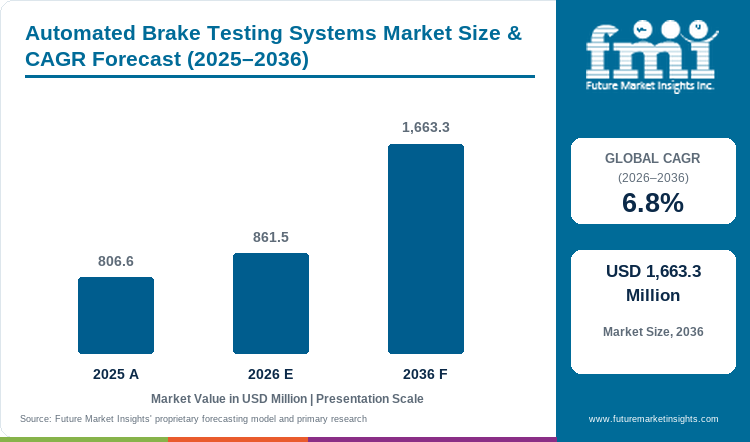
USD 861.5 million in 2026 and USD 1,663.3 million by 2036, expanding at 6.8% CAGR.
Sales of automated brake testing systems are estimated to rise at 6.8% CAGR through 2036. Valuation rises from USD 806.6 million in 2025 to USD 861.5 million in 2026 and reaches USD 1,663.3 million by 2036. Brake rules keep measured stopping performance within routine vehicle inspection programs. In October 2025, CVSA recorded 528 PBBT inspections across 15 US states. Inspection sites are replacing older benches that no longer cover changing vehicle configurations or reporting requirements. Lane speed also influences replacement timing because slower equipment can reduce the number of vehicles tested each day. Software support and dependable field service shape purchase decisions at sites that cannot afford extended lane downtime.
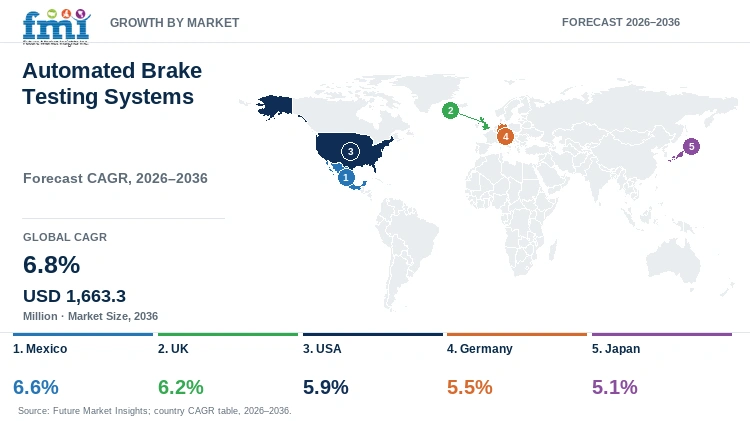
The UK is projected to expand at 6.2% CAGR through 2036, reinforced by regular MOT testing and a large approved station base. Japan is projected to grow at 5.1% CAGR over the same period, influenced by retrofit needs across established inspection stations. In September 2026, DVSA recorded 35.48 million MOT tests for the 2025 to 2026 financial year. That national volume supports connected brake testers and digital result handling across busy UK stations. Japan is adding electronic checks to its national inspection system while physical brake-force testing remains a separate requirement. Both countries require approved equipment that covers several vehicle classes without disrupting routine inspection work. Software links and calibration access shape equipment selection in the UK, while limited floor space narrows retrofit options in Japan.
Key Takeaways
- Regular brake inspections sustain equipment demand because approved sites must record measured stopping performance during safety checks.
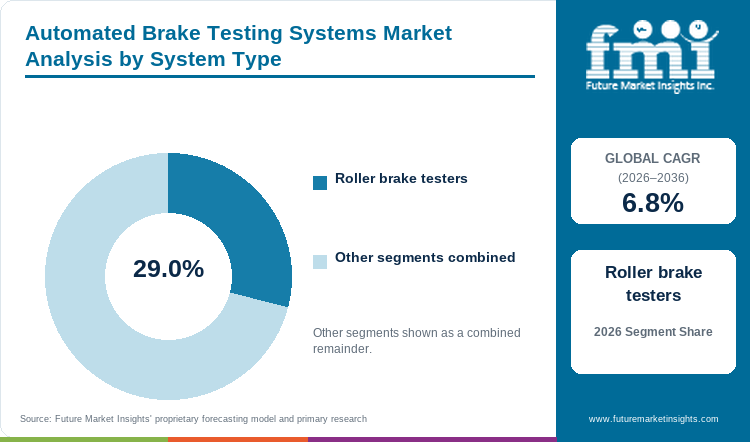
- Roller brake testers are estimated to hold 29.0% of system type revenue in 2026, supported by repeatable force measurement.
- Passenger cars are expected to lead vehicle type with 32.0% share in 2026, reinforced by high throughput across standard inspection bays.
- Fully automatic systems are set to lead automation level with 37.0% share in 2026, enabled by guided test workflows.
- Equipment purchase cycles can lengthen owing to approval reviews, calibration requirements, civil work, and drivetrain-specific setup.
- Some of the key players in this market include MAHA Maschinenbau Haldenwang, Hunter Engineering, Snap-on, BOSCH Automotive Service Solutions, SAXON Prüftechnik, BM Autoteknik, Vamag, Beissbarth, Sherpa Autodiagnostik, and Capelec.
Analyst Perspective
“Retrofit demand is strongest when inspection centers can expand vehicle coverage without sacrificing lane uptime or rebuilding the full bay. Adoption depends on proving local approval, calibration access, and reliable service before operators commit to connected brake-test upgrades.”
- Nikhil Kaitwade, Principal Consultant, Future Market Insights
How is the automated brake testing systems market segmented?
The automated brake testing systems market is segmented by System Type, Vehicle Type, Automation Level, End Use, Sales Channel, and Region.
The global forecast uses System Type, Vehicle Type, Automation Level, End Use, Sales Channel, and Region as six segmentation axes. System Type covers roller, plate, dynamometer, end-of-line, and portable testers. Vehicle Type includes passenger cars, commercial vehicles, two-wheelers, rail vehicles, and off-highway equipment. Automation Level includes fully automatic, semi-automatic, robotic - integrated line, and data-connected inspection lanes. End Use covers inspection centers, automotive OEMs, workshops - service chains, rail depots, and fleet operators. Sales Channel covers direct equipment OEM, garage equipment distributors, inspection lane integrators, and government - fleet tenders. Region completes the geographic structure used across the full global forecast.
What makes roller brake testers central to the system type category?
Roller systems place each wheel on a controlled surface and measure braking force across the axle. Fixed lanes compare left and right wheel performance during each inspection cycle and record the results. Many benches also weigh vehicles and guide all-wheel-drive checks through integrated software. Plate and portable testers serve sites that face different space limits or vehicle mixes. Inspection centers often place automotive test equipment beside other service tools within the same bay. Vehicle coverage and foundation work influence the installation plan before a purchase. Approval requirements and local service then shape the final equipment choice.
- Roller brake testers are forecast to represent 29.0% of system type revenue in 2026, supported by repeatable force measurement in permanent lanes.
- In October 2025, MAHA said its roller-test-bench series would apply EN 17003 safety requirements by year-end.
How do passenger cars shape demand within the vehicle type category?
Passenger-car lanes process large test volumes because many vehicles use similar track widths and bay layouts. Standard inspection bays repeat light-vehicle checks without major equipment changes between appointments. One bench can handle all-wheel-drive cars and electronic parking brakes across selected light commercial vehicles. Heavy truck testers need stronger frames and higher load limits for safe brake-force measurement. Rail and off-highway systems use layouts built around different operating conditions and vehicle geometry. Workshops often pair brake checks with wheel aligner equipment during scheduled service visits. High passenger-car throughput favors flexible bench setups that maintain consistent results without slowing routine bay turnover.
- Passenger cars are estimated to hold 32.0% of vehicle type demand in 2026, reinforced by high daily volumes across standard inspection bays.
- In September 2026, DVSA recorded 33.31 million Class 3 and 4 MOT tests for the 2025 to 2026 financial year.
How does full automation influence selection within the automation level category?
Fully automatic systems reduce routine operator decisions and keep brake-test steps consistent across repeated cycles. Guided software controls roller movement and tracks wheel position during each test. The same workflow measures brake force and saves the result without repeated manual entry. Busy inspection stations use these steps to maintain consistent workflows across high daily test volumes. Semi-automatic systems retain more manual control while reducing setup work for trained staff. Robotic systems support production lines that use fixed test sequences during vehicle assembly. Some sites use diagnostic scan tools for separate electronic checks outside the physical brake test.
- Fully automatic systems are expected to lead automation level with 37.0% share in 2026, enabled by guided test steps and digital records.
- In December 2025, DVSA clarified ATL roller-brake procedures for parking brakes and 4WD or AWD vehicle tests.
What supports vehicle inspection centers within the end use category?
Vehicle inspection centers run brake tests as part of required road-safety checks across several vehicle classes. Daily lane uptime determines how many vehicles a site can inspect without creating booking delays. Centers need approved equipment and current calibration records for different drivetrain configurations. Automotive plants test braking performance near the end of vehicle production before release. Workshops and fleets use brake testing during scheduled maintenance to identify service needs. A failed bench reduces inspection capacity until technicians restore the lane. Equipment selection also depends on service access and testing and certification requirements alongside purchase price.
- Vehicle inspection centers are forecast to represent 31.0% of end-use demand in 2026, attributable to recurring legal tests and sustained lane use.
- In June 2025, Mexico required covered federal vehicles to use approved sites for scheduled physical-mechanical inspections.
What drives direct equipment OEM supply within the sales channel category?
Direct equipment OEM supply suits sites that want one contract covering hardware installation and software setup alongside service. Site teams review axle-load limits and foundation plans before checking safety controls and local inspection rules. The manufacturer configures control software and trains operators while supporting calibration during commissioning. Distributors serve smaller workshops that need standard equipment packages and simpler installation. Lane integrators combine brake testers with suspension and side-slip tools across coordinated inspection lanes. Some facilities place automotive garage equipment in the same work area for broader service tasks. Government and fleet tenders add technical reviews that can lengthen the purchase process.
- Direct equipment OEM supply is estimated to hold 39.0% of sales-channel demand in 2026, linked to coordinated setup across complex inspection lanes.
- In May 2026, Vamag demonstrated dynamic brake testing at Transpotec with multi-platform diagnostic benches.
What are the drivers, restraints and opportunities in the Automated Brake Testing Systems Market?
Recurring brake inspections sustain equipment use while installation constraints delay replacement and connected reporting increases automation value.
- Driver: Replacement demand is driven by recurring brake inspections that require measured stopping results at approved sites.
- Restraint: Purchase timing is constrained by approval reviews, calibration access, civil work, and drivetrain-specific setup.
- Opportunity: Connected test lanes reduce manual data entry while preserving clear separation between physical brake results and other safety checks.
Recurring safety inspections drive demand for automated brake testing because regulated fleets and inspection sites need measured stopping results. In May 2026, CVSA recorded 4,021 commercial-vehicle inspections during Brake Safety Day. The event focused on brake faults that can remove unsafe vehicles from service. Inspection sites need equipment that delivers stable readings through repeated daily test cycles. Changing vehicle layouts and automotive brake systems alter axle loads and drivetrain requirements for force measurement. Older benches lose value when they cannot cover those configurations or updated reporting needs. Lane speed also influences replacement because new equipment must protect planned inspection throughput. Reliable testing and wider vehicle coverage keep replacement demand tied to routine compliance work.
Installation requirements constrain brake-tester purchases even when an inspection site has clear replacement demand. Before ordering, a site must review bay dimensions and power supply alongside vehicle classes and calibration access. DVSA updated its MOT manual in December 2025 with roller-brake procedures for 4WD and AWD vehicles. Those vehicle cases require suitable software and clear operator guidance for correct testing. Workshops that share bays with repair and maintenance services also face scheduling pressure during installation. In-ground rollers can require civil work and planned downtime that removes capacity from daily operations. Buyers compare total site work against expected throughput gains before approving replacement equipment and long-term service support.
Connected reporting creates an opportunity to reduce manual data entry across regulated inspection lanes. In December 2025, Snap-on marketed its connected SUN roller brake tester for DVSA-linked MOT work. The system transfers measured brake results into the inspection process while the physical test remains separate. Sites using ADAS testing equipment must keep each safety check identifiable within the wider workflow. Clear screens guide operators through test steps and reduce mistakes during result transfer. Remote support can shorten repair time and protect lane availability during software or equipment faults. Reliable data transfer and clear test control improve throughput without weakening inspection traceability.
Which country CAGRs are profiled in the Automated Brake Testing Systems Market?
| Country | CAGR |
|---|---|
| Mexico | 6.6% |
| UK | 6.2% |
| USA | 5.9% |
| Germany | 5.5% |
| Japan | 5.1% |
How do country-level CAGRs compare in the Automated Brake Testing Systems Market?
Mexico and the UK form the upper forecast group among the five profiled countries. The USA occupies the middle position, while Germany and Japan show slower forecast expansion. The 1.5 percentage-point spread compares expected growth speed rather than current revenue or installed equipment base. Local approval rules, inspection volumes, and service access create different replacement conditions across these countries. Mature inspection systems can still support equipment sales when calibration needs or vehicle coverage require continued upgrades.
- Mexico’s mixed passenger and cargo inspection base creates demand for rugged testers that cover several vehicle classes at approved sites.
- The UK’s large MOT station network reinforces demand for connected result transfer that reduces manual entry during routine brake inspections.
- Targeted commercial-vehicle enforcement in the USA shapes demand for flexible brake-test configurations across different programs and vehicle classes.
- Germany’s mature installed lane base makes calibration access and local repair support central to replacement decisions for aging brake-test equipment.
- Japan’s combined mechanical and electronic inspection process requires clear data separation between physical brake tests and digital diagnostics.
The full report provides country-level CAGR analysis across North America, Latin America, Western Europe, Eastern Europe, East Asia, South Asia and Pacific, and the Middle East and Africa.
Country-wise Analysis
- Mexico requires covered federal vehicles to complete scheduled physical-mechanical safety inspections at approved sites. Brake-test system sales in Mexico are forecast to expand at 6.6% CAGR through 2036, supported by formal inspection capacity. In June 2025, a federal notice retained required checks under NOM-068-SCT-2-2014 for covered vehicles. Approved sites test passenger and cargo vehicles under the same regulatory framework, increasing the value of broad vehicle coverage. Tender reviews can delay orders even when replacement needs are clear. Limited calibration access can also extend commissioning for a new lane. Complete tender documentation and local field support reduce setup risk during planned replacement projects.
- UK MOT stations operate under a national approval system that sets clear requirements for brake-testing equipment. The UK sector is projected to record 6.2% CAGR through 2036, reinforced by regular test volumes. In September 2026, DVSA counted 23,092 private MOT test stations for the 2025 to 2026 financial year. Each station must protect uptime and follow approved brake-test procedures during daily work. Calibration schedules can reduce available booking capacity at busy sites. Some 4WD and AWD vehicles require additional brake-test steps under current guidance. Connected result transfer reduces manual entry without changing the physical test requirement. Reliable field service and compliant software help stations limit outages during planned upgrades.
- Commercial-vehicle enforcement shapes brake-test demand across federal and state safety programs in the USA. The USA is projected to grow at 5.9% CAGR through 2036, influenced by targeted PBBT use in enforcement work. In October 2025, CVSA recorded 528 PBBT inspections across 15 US states. State requirements differ, so one equipment format may not serve every inspection program. Test sites need operating procedures and reporting formats that match each program. Local field service matters because equipment faults can remove scarce testing capacity. Equipment that matches program-specific methods and support plans has a clearer route into replacement projects. Mobile and fixed formats serve different enforcement settings across the country.
- Germany operates a mature Hauptuntersuchung system that requires regular vehicle safety inspections across a large installed network. Brake-test system sales in Germany are forecast to expand at 5.5% CAGR through 2036, linked to replacement of aging lanes. In November 2025, TÜV-Verband said its 2026 report covered 9.5 million passenger-car inspections. Brake faults remain part of these routine national safety checks. High lane use makes calibration planning and dependable repair support important for site capacity. Long service outages can delay booked inspections and reduce daily throughput. Scheduled maintenance and local parts availability strengthen replacement decisions at high-volume inspection sites. Replacement work depends on service planning that protects daily lane availability.
- Japan combines mechanical vehicle checks with digital inspection steps inside structured national testing stations. Japan is estimated to post 5.1% CAGR through 2036, shaped by retrofit needs across established inspection lanes. In August 2026, MLIT updated guidance supporting scan tools used with the national OBD inspection system. Physical brake-force testing remains separate from ADAS calibration systems and other electronic checks. Existing stations must fit new controls into fixed workflows without disrupting scheduled inspections. Limited floor space narrows hardware choices and increases the value of compact upgrades. Clear data paths and stocked spare parts reduce disruption during retrofit work. Retrofit projects favor compact controls that preserve lane access during installation.
Who are the notable companies in the Automated Brake Testing Systems Market?
MAHA Maschinenbau Haldenwang, Hunter Engineering, Snap-on, BOSCH Automotive Service Solutions, SAXON Prüftechnik, BM Autoteknik, Vamag, Beissbarth, Sherpa Autodiagnostik, and Capelec are active in automated brake testing.
Competition in automated brake testing spans dedicated specialists and lane integrators alongside wider workshop-equipment groups. MAHA Maschinenbau Haldenwang, BM Autoteknik, Vamag, SAXON Prüftechnik, Sherpa Autodiagnostik, and Capelec publish dedicated brake-test platforms. Snap-on and Beissbarth connect brake testing to broader workshop tools and inspection-lane workflows. Hunter Engineering and BOSCH Automotive Service Solutions address wider inspection needs but show narrower public brake-test evidence. Workshop groups can place ADAS calibration equipment beside brake-test tools within one service area. Dedicated specialists emphasize roller systems and lane controls across several vehicle classes and test modes. Buyers compare product fit and local approval before weighing integration needs and service capacity.
- MAHA Maschinenbau Haldenwang, BM Autoteknik, Vamag, SAXON Prüftechnik, Sherpa Autodiagnostik, and Capelec build dedicated brake-test systems and integrated inspection-lane products.
- Snap-on and Beissbarth combine brake testing with broader workshop equipment and connected inspection-lane workflows.
- Hunter Engineering and BOSCH Automotive Service Solutions serve wider inspection needs with narrower public brake-test evidence.
Competitive Benchmarking: Automated Brake Testing Systems Market
| Company | Brake-Test System Depth | Inspection-Lane Integration | Connected Workflow Evidence | Geographic Reach |
|---|---|---|---|---|
| MAHA Maschinenbau Haldenwang | High | High | High | Europe and international |
| Hunter Engineering | Low | Medium | High | North America and international |
| Snap-on | High | High | High | Europe and North America |
| BOSCH Automotive Service Solutions | Medium | High | High | Europe and international |
| SAXON Prüftechnik | High | High | High | Europe and export markets |
| BM Autoteknik | High | High | High | Europe and international |
| Vamag | High | High | Medium | Europe and export markets |
| Beissbarth | High | High | High | Europe and international |
| Sherpa Autodiagnostik | High | High | High | Europe and export markets |
| Capelec | High | High | High | Europe and international |
Brake-test system depth measures public evidence for roller, plate, portable, or heavy-duty testing systems. Inspection-lane integration measures links between brake testers and other station tools or lane controls. Connected workflow evidence covers software guidance, remote control, automated test steps, and result transfer. A High rating represents broad public evidence across the named criterion. A Medium rating represents narrower public evidence within the same criterion. A Low rating represents limited public evidence for that criterion. Geographic reach summarizes regions documented in public company records rather than a market-share ranking.
Key Developments in the Automated Brake Testing Systems Market
- In May 2026, Vamag demonstrated dynamic brake testing at Transpotec with multi-platform diagnostic benches.
- In March 2026, Sherpa Autodiagnostik added XT electronics to axle-suspension testers integrated with XT brake-test lanes.
- In October 2025, MAHA said its roller-test-bench series would adopt EN 17003 safety requirements by year-end.
Key Players in the Automated Brake Testing Systems Market
Dedicated brake-test and lane engineering
- MAHA Maschinenbau Haldenwang
- SAXON Prüftechnik
- BM Autoteknik
- Vamag
- Beissbarth
- Sherpa Autodiagnostik
- Capelec
Workshop and connected test-equipment groups
- Snap-on
- BOSCH Automotive Service Solutions
- Hunter Engineering
Automated Brake Testing Systems Market - Report Scope
| Coverage field | Report scope |
|---|---|
| Market breakdown | By system type, vehicle type, automation level, end use, sales channel and region. |
| Quantitative Units | USD million. |
| Market Definition | Automated systems that measure vehicle braking performance in inspection, workshop, fleet, production, rail, or off-highway settings are included. Standalone brake components and repair revenue are excluded. |
| Regions Covered | North America, Latin America, Western Europe, Eastern Europe, East Asia, South Asia and Pacific, and Middle East and Africa. |
| Countries Covered | Mexico, UK, USA, Germany, Japan, and 20+ countries included in the full report. |
| Key Companies Profiled | MAHA Maschinenbau Haldenwang, Hunter Engineering, Snap-on, BOSCH Automotive Service Solutions, SAXON Prüftechnik, BM Autoteknik, Vamag, Beissbarth, Sherpa Autodiagnostik, Capelec. |
| Forecast Period | 2026 to 2036. |
| Approach | Primary and secondary research with market triangulation. |
Automated Brake Testing Systems Market - Research Methodology
| Method | Approach |
|---|---|
| Primary Research | FMI analysts gathered input from manufacturers, service providers, technology developers, distributors, end users, procurement teams, and subject-matter experts. Interviews examined purchasing decisions, product or service evaluation, adoption barriers, approval requirements, pricing considerations, and expectations for technical or commercial support. Respondents were also asked what evidence is required before a trial, pilot, or initial order develops into regular purchasing. |
| Desk Research | Desk research covered government statistics, regulatory publications, trade data, industry associations, technical literature, standards, company filings, product information, and official corporate announcements. Sources were reviewed for relevance, publication date, geographic coverage, and consistency with the defined market scope. Claims relating to performance, applications, approvals, capacity, investment, and commercial activity were retained only when supported by credible public evidence. |
| Market Sizing and Forecasting | The market model combined the baseline value with historical performance, segment structure, pricing and volume indicators, adoption levels, company participation, and country-level demand conditions. Forecast assumptions considered economic activity, investment trends, regulatory developments, technology adoption, purchasing cycles, supply availability, and barriers to wider market use. Segment and regional estimates were reconciled before the final market total was calculated. |
| Data Validation | Estimates were checked against multiple independent indicators, including public data, company activity, trade patterns, industry developments, and findings from primary interviews. Validation also tested whether products, services, applications, and company revenues fell within the defined market boundaries. Adjacent categories, unsupported claims, overlapping revenues, and activities without direct market relevance were excluded to reduce double counting and maintain consistency across segments and countries. |
Automated Brake Testing Systems Market by Segments
Automated Brake Testing Systems Market segmented by System Type:
- Roller brake testers
- Plate brake testers
- Dynamometer brake test systems
- End-of-line brake testers
- Portable brake testers
Automated Brake Testing Systems Market segmented by Vehicle Type:
- Passenger cars
- Commercial vehicles
- Two-wheelers
- Rail vehicles
- Off-highway equipment
Automated Brake Testing Systems Market segmented by Automation Level:
- Fully automatic
- Semi-automatic
- Robotic - integrated line
- Data-connected inspection lane
Automated Brake Testing Systems Market segmented by End Use:
- Vehicle inspection centers
- Automotive OEMs
- Workshops - service chains
- Rail depots
- Fleet operators
Automated Brake Testing Systems Market segmented by Sales Channel:
- Direct equipment OEM
- Garage equipment distributors
- Inspection lane integrators
- Government - fleet tenders
Automated Brake Testing Systems Market by Region:
- North America
- United States
- Canada
- Latin America
- Brazil
- Mexico
- Chile
- Rest of Latin America
- Western Europe
- Germany
- United Kingdom
- Italy
- Spain
- France
- Nordics
- Benelux
- Rest of Western Europe
- Eastern Europe
- Russia
- Poland
- Hungary
- Balkan and Baltic States
- Rest of Eastern Europe
- East Asia
- China
- Japan
- South Korea
- South Asia and Pacific
- India
- ASEAN
- Australia and New Zealand
- Rest of South Asia and Pacific
- Middle East and Africa
- Kingdom of Saudi Arabia
- Other GCC Countries
- Türkiye
- South Africa
- Other African Union Countries
- Rest of Middle East and Africa
Research Sources and Bibliography
- Commercial Vehicle Safety Alliance. (2025, October 27). CVSA releases 2025 Brake Safety Week results.
- Driver and Vehicle Standards Agency. (2026, September 10). MOT test results by class of vehicle.
- MAHA Maschinenbau Haldenwang. (2025, October 9). Improved safety for all roller test benches: MAHA systematically implements EN 17003.
- Driver and Vehicle Standards Agency. (2025, December 10). Updates: MOT inspection manual for private passenger and light commercial vehicles.
- Secretaría de Infraestructura, Comunicaciones y Transportes. (2025, June 25). Modification to the 2025 mandatory physical-mechanical verification notice.
- Vamag. (2026, May). Vamag at Transpotec 2026: Live dynamic brake testing.
- Commercial Vehicle Safety Alliance. (2026, May 19). Nearly 600 commercial motor vehicles removed from North American roadways in one day due to brake violations.
- Snap-on. (2025, December). Built for the long-haul: BR-20 commercial ATF roller brake tester.
- TÜV-Verband. (2025, November 20). TÜV Report 2026: Defect rates rise for the fourth year in a row.
- Ministry of Land, Infrastructure, Transport and Tourism, Japan. (2026, August 7). OBD inspection guidance for repair businesses.
- Capelec. (2026, September 14). HGV equipment takes center stage.
- Hunter Engineering. (2025, September 3). Hunter enhances Quick Check inspection with new cloud-based software.
- Beissbarth. (2025, November 27). Car brake testers: QB.4.
- SAXON Prüftechnik GmbH. (2025, July 24). SAXON InspectionLine Android application update.
- Sherpa Autodiagnostik. (2026, March 27). SHERPA advances axle suspension tester to XT series.
- Automechanika Frankfurt. (2026, September). BM Autoteknik A/S: BM Trailer solution and BM1010 brake tester.
- Robert Bosch GmbH. (2025). Boxberg proving ground safety manual, Edition 01/V19: Brake Test Bench BSA 7.
- MAHA Maschinenbau Haldenwang. (2026, September). Automechanika Frankfurt 2026 virtual tour and brake-testing systems.
- Capelec. (2026, August 26). Capelec at IAA Transportation 2026.
- Automechanika Frankfurt. (2026, September). Vamag | Motorscan: Roller brake tester.
- Automechanika Frankfurt. (2026, September). Sherpa Autodiagnostik GmbH: Roller brake testers - XT.
This bibliography is provided for reader reference and is not exhaustive. The full report contains the complete reference list and detailed citations.
This Report Answers
- What are the automated brake testing systems market values for 2026 and 2036?
- Which road-safety requirements are supporting automated brake-testing equipment demand today?
- Why do roller brake testers hold 29.0% of system type revenue?
- Why do passenger cars hold 32.0% of vehicle type demand?
- Why do fully automatic systems hold 37.0% of automation demand?
- How do forecast CAGRs differ across the five profiled countries?
- Which companies compete across brake testing and connected inspection lanes?
- How do approval requirements and site constraints delay brake-tester installation?
- What should inspection operators evaluate before replacing an existing brake-test lane?
- How do connected brake-test workflows change data handling and service requirements?
Frequently Asked Questions
What is the automated brake testing systems market value in 2026?
The market is valued at USD 861.5 million in 2026 and projected at USD 1,663.3 million by 2036. Operators use this forecast to plan lane replacement, service capacity, and equipment investment.
What CAGR is projected for automated brake testing systems through 2036?
The automated brake testing systems market is projected to grow at 6.8% CAGR from 2026 to 2036. Changing vehicle requirements and reporting rules reinforce replacement demand for aging brake benches.
Which system type holds the largest revenue share during 2026?
Roller brake testers are forecast to represent 29.0% of system type revenue in 2026, supported by repeatable wheel-force measurement. Permanent lanes record controlled results that support clear pass-or-fail inspection decisions.
Which vehicle type holds the largest demand share during 2026?
Passenger cars are estimated to hold 32.0% of vehicle type demand in 2026, reinforced by high inspection volumes across standard bays. Standard layouts let each bay test many cars with few setup changes between inspections.
Which automation level holds the largest demand share during 2026?
Fully automatic systems are set to hold 37.0% of automation demand in 2026, enabled by guided test steps. Guided workflows reduce routine staff input and transfer brake results into the site record.
Which profiled countries have the higher forecast CAGRs through 2036?
Mexico is projected to grow at 6.6% CAGR through 2036, supported by formal inspection capacity. The UK follows at 6.2%, while the USA reaches 5.9% under different local rules and service conditions.
Which companies are active across automated brake testing systems today?
Key companies include MAHA Maschinenbau Haldenwang, Hunter Engineering, Snap-on, BOSCH Automotive Service Solutions, SAXON Prüftechnik, BM Autoteknik, Vamag, Beissbarth, Sherpa Autodiagnostik, and Capelec. The group spans dedicated brake-test specialists and integrated lane providers alongside wider workshop-equipment companies. Competition centers on brake-test depth, lane integration, connected workflow, and lifecycle service.
What factors limit return on investment for brake testing systems?
Return on investment falls when a tester is underused or unavailable for calibration and repair. Vehicle exceptions can also reduce lane availability and extend payback. Operators compare civil work and software links alongside approval status and field service. Weak service coverage or closed software links can raise lifetime cost and reduce completed tests.
What is driving growth in the Automated Brake Testing Systems Market?
Road-safety rules require measured brake tests at inspection sites and across regulated fleets. Replacement of older benches is driven by changing vehicle designs and updated safety requirements. Sites also need equipment that transfers physical brake results into digital inspection records.
What notable restraint affects the Automated Brake Testing Systems Market?
Approval and calibration work can extend the purchase cycle despite clear testing demand. Installation work and vehicle limits add further delays during site planning. Buyers compare bay downtime and foundation work alongside software links and field service. Reliable use depends on resolving these requirements before equipment commissioning.
Why should executives track the Automated Brake Testing Systems Market?
Brake testers connect road-safety requirements to workshop output and fleet safety. Executives track current approval changes and digital inspection processes before planning equipment replacement. Those conditions shape channel spending and the service capacity required for installed systems.
What business problem does the Automated Brake Testing Systems Market address?
Automated brake testers turn braking performance into measured results for inspection and factory checks. Automation reduces repeated staff steps and improves consistency across routine test cycles. Sites must manage test procedures and vehicle fit alongside calibration requirements during daily use.
What should inspection-center operators evaluate in the Automated Brake Testing Systems Market?
Inspection-center operators should compare vehicle coverage and axle limits alongside drivetrain handling and approval status. They also review software links and expected test volume for each lane. Good installation work and accessible calibration keep the lane ready for use. Local field service matters because repairs can stop scheduled testing and reduce daily capacity.
What supports long-term commercial confidence in the Automated Brake Testing Systems Market?
Regular vehicle inspection rules keep brake testing within required safety programs. Sites use connected MOT equipment and digital inspection records to manage high test volumes. Continued safety updates keep physical brake checks tied to routine compliance work and replacement planning.
Preview the report firsthand - request a free sample
Get SampleGet the brochure for pricing and purchase details.
Get PDFTable of Content
- Key Takeaways
- Market Size and CAGR
- Top Growth Driver
- Fastest Growing Segment
- Leading Region
- Key Companies
- Emerging Opportunities
- Executive Summary
- Global Market Outlook
- Demand-side Trends
- Supply-side Trends
- Technology Roadmap Analysis
- Analysis and Recommendations
- Analyst Perspective (What is happening? Why now? What should investors know?)
- Key Questions Answered
- How large is the market?
- What is the CAGR?
- What are key trends?
- Which region dominates?
- Who are the leaders?
- Market Overview
- Market Coverage / Taxonomy
- Market Definition / Scope / Limitations
- Research Methodology
- Chapter Orientation
- Analytical Lens and Working Hypotheses
- Market Structure, Signals, and Trend Drivers
- Benchmarking and Cross-market Comparability
- Market Sizing, Forecasting, and Opportunity Mapping
- Research Design and Evidence Framework
- Desk Research Programme (Secondary Evidence)
- Expert Input and Fieldwork (Primary Evidence)
- Tooling, Models, and Reference Databases
- Data Engineering and Model Build
- Quality Assurance and Audit Trail
- Market Background
- Market Dynamics (Drivers, Restraints, Opportunity, Trends)
- Scenario Forecast (Optimistic, Likely, Conservative)
- Impact Analysis
- AI Impact
- Sustainability Impact
- Regulatory Impact
- Technology Impact
- Consumer / Buyer Analysis
- Purchase Drivers
- Adoption Barriers
- Buyer Journey
- Opportunity Map Analysis
- Product Life Cycle Analysis
- Supply Chain Analysis
- Investment Feasibility Matrix
- Value Chain Analysis
- PESTLE and Porter's Analysis
- Regulatory Landscape
- Regional Parent Market Outlook
- Production and Consumption Statistics
- Import and Export Statistics
- Global Market Analysis and Forecast, 2021 to 2036
- Historical Market Size Value (USD Million) Analysis, 2021 to 2025
- Current and Future Market Size Value (USD Million) Projections, 2026 to 2036
- Y-o-Y Growth Trend Analysis
- Absolute $ Opportunity Analysis
- Global Market Pricing Analysis, 2021 to 2036
- Global Market Analysis and Forecast, By System Type, 2021 to 2036
- Introduction / Key Findings
- Historical Market Size Value (USD Million) Analysis By System Type, 2021 to 2025
- Current and Future Market Size Value (USD Million) Analysis and Forecast By System Type, 2026 to 2036
- Roller brake testers
- Plate brake testers
- Dynamometer brake test systems
- End-of-line brake testers
- Portable brake testers
- Y-o-Y Growth Trend Analysis By System Type, 2021 to 2025
- Absolute $ Opportunity Analysis By System Type, 2026 to 2036
- Global Market Analysis and Forecast, By Vehicle Type, 2021 to 2036
- Introduction / Key Findings
- Historical Market Size Value (USD Million) Analysis By Vehicle Type, 2021 to 2025
- Current and Future Market Size Value (USD Million) Analysis and Forecast By Vehicle Type, 2026 to 2036
- Passenger cars
- Commercial vehicles
- Two-wheelers
- Rail vehicles
- Off-highway equipment
- Y-o-Y Growth Trend Analysis By Vehicle Type, 2021 to 2025
- Absolute $ Opportunity Analysis By Vehicle Type, 2026 to 2036
- Global Market Analysis and Forecast, By Automation Level, 2021 to 2036
- Introduction / Key Findings
- Historical Market Size Value (USD Million) Analysis By Automation Level, 2021 to 2025
- Current and Future Market Size Value (USD Million) Analysis and Forecast By Automation Level, 2026 to 2036
- Fully automatic
- Semi-automatic
- Robotic - integrated line
- Data-connected inspection lane
- Y-o-Y Growth Trend Analysis By Automation Level, 2021 to 2025
- Absolute $ Opportunity Analysis By Automation Level, 2026 to 2036
- Global Market Analysis and Forecast, By End Use, 2021 to 2036
- Introduction / Key Findings
- Historical Market Size Value (USD Million) Analysis By End Use, 2021 to 2025
- Current and Future Market Size Value (USD Million) Analysis and Forecast By End Use, 2026 to 2036
- Vehicle inspection centers
- Automotive OEMs
- Workshops - service chains
- Rail depots
- Fleet operators
- Y-o-Y Growth Trend Analysis By End Use, 2021 to 2025
- Absolute $ Opportunity Analysis By End Use, 2026 to 2036
- Global Market Analysis and Forecast, By Sales Channel, 2021 to 2036
- Introduction / Key Findings
- Historical Market Size Value (USD Million) Analysis By Sales Channel, 2021 to 2025
- Current and Future Market Size Value (USD Million) Analysis and Forecast By Sales Channel, 2026 to 2036
- Direct equipment OEM
- Garage equipment distributors
- Inspection lane integrators
- Government - fleet tenders
- Y-o-Y Growth Trend Analysis By Sales Channel, 2021 to 2025
- Absolute $ Opportunity Analysis By Sales Channel, 2026 to 2036
- Global Market Analysis and Forecast, By Region, 2021 to 2036
- Introduction
- Historical Market Size Value (USD Million) Analysis By Region, 2021 to 2025
- Current Market Size Value (USD Million) Analysis and Forecast By Region, 2026 to 2036
- North America
- Latin America
- Western Europe
- Eastern Europe
- East Asia
- South Asia and Pacific
- Middle East and Africa
- Market Attractiveness Analysis By Region
- North America Market Analysis and Forecast, By Country, 2021 to 2036
- Historical Market Size Value (USD Million) Trend Analysis By Market Taxonomy, 2021 to 2025
- Market Size Value (USD Million) Forecast By Market Taxonomy, 2026 to 2036
- By Country
- United States
- Canada
- By System Type
- By Vehicle Type
- By Automation Level
- By End Use
- By Sales Channel
- By Country
- Market Attractiveness Analysis
- By Country
- By System Type
- By Vehicle Type
- By Automation Level
- By End Use
- By Sales Channel
- Key Takeaways
- Latin America Market Analysis and Forecast, By Country
- Historical Market Size Value (USD Million) Trend Analysis By Market Taxonomy, 2021 to 2025
- Market Size Value (USD Million) Forecast By Market Taxonomy, 2026 to 2036
- By Country
- Brazil
- Mexico
- Chile
- Rest of Latin America
- By System Type
- By Vehicle Type
- By Automation Level
- By End Use
- By Sales Channel
- By Country
- Market Attractiveness Analysis
- By Country
- By System Type
- By Vehicle Type
- By Automation Level
- By End Use
- By Sales Channel
- Key Takeaways
- Western Europe Market Analysis and Forecast, By Country
- Historical Market Size Value (USD Million) Trend Analysis By Market Taxonomy, 2021 to 2025
- Market Size Value (USD Million) Forecast By Market Taxonomy, 2026 to 2036
- By Country
- Germany
- United Kingdom
- Italy
- Spain
- France
- Nordics
- Benelux
- Rest of Western Europe
- By System Type
- By Vehicle Type
- By Automation Level
- By End Use
- By Sales Channel
- By Country
- Market Attractiveness Analysis
- By Country
- By System Type
- By Vehicle Type
- By Automation Level
- By End Use
- By Sales Channel
- Key Takeaways
- Eastern Europe Market Analysis and Forecast, By Country
- Historical Market Size Value (USD Million) Trend Analysis By Market Taxonomy, 2021 to 2025
- Market Size Value (USD Million) Forecast By Market Taxonomy, 2026 to 2036
- By Country
- Russia
- Poland
- Hungary
- Balkan and Baltic States
- Rest of Eastern Europe
- By System Type
- By Vehicle Type
- By Automation Level
- By End Use
- By Sales Channel
- By Country
- Market Attractiveness Analysis
- By Country
- By System Type
- By Vehicle Type
- By Automation Level
- By End Use
- By Sales Channel
- Key Takeaways
- East Asia Market Analysis and Forecast, By Country
- Historical Market Size Value (USD Million) Trend Analysis By Market Taxonomy, 2021 to 2025
- Market Size Value (USD Million) Forecast By Market Taxonomy, 2026 to 2036
- By Country
- China
- Japan
- South Korea
- By System Type
- By Vehicle Type
- By Automation Level
- By End Use
- By Sales Channel
- By Country
- Market Attractiveness Analysis
- By Country
- By System Type
- By Vehicle Type
- By Automation Level
- By End Use
- By Sales Channel
- Key Takeaways
- South Asia and Pacific Market Analysis and Forecast, By Country
- Historical Market Size Value (USD Million) Trend Analysis By Market Taxonomy, 2021 to 2025
- Market Size Value (USD Million) Forecast By Market Taxonomy, 2026 to 2036
- By Country
- India
- ASEAN
- Australia and New Zealand
- Rest of South Asia and Pacific
- By System Type
- By Vehicle Type
- By Automation Level
- By End Use
- By Sales Channel
- By Country
- Market Attractiveness Analysis
- By Country
- By System Type
- By Vehicle Type
- By Automation Level
- By End Use
- By Sales Channel
- Key Takeaways
- Middle East and Africa Market Analysis and Forecast, By Country
- Historical Market Size Value (USD Million) Trend Analysis By Market Taxonomy, 2021 to 2025
- Market Size Value (USD Million) Forecast By Market Taxonomy, 2026 to 2036
- By Country
- Kingdom of Saudi Arabia
- Other GCC Countries
- Türkiye
- South Africa
- Other African Union Countries
- Rest of Middle East and Africa
- By System Type
- By Vehicle Type
- By Automation Level
- By End Use
- By Sales Channel
- By Country
- Market Attractiveness Analysis
- By Country
- By System Type
- By Vehicle Type
- By Automation Level
- By End Use
- By Sales Channel
- Key Takeaways
- Key Countries Market Analysis
- United States
- Pricing Analysis
- Market Share Analysis, 2025
- By System Type
- By Vehicle Type
- By Automation Level
- By End Use
- By Sales Channel
- Canada
- Pricing Analysis
- Market Share Analysis, 2025
- By System Type
- By Vehicle Type
- By Automation Level
- By End Use
- By Sales Channel
- Mexico
- Pricing Analysis
- Market Share Analysis, 2025
- By System Type
- By Vehicle Type
- By Automation Level
- By End Use
- By Sales Channel
- Brazil
- Pricing Analysis
- Market Share Analysis, 2025
- By System Type
- By Vehicle Type
- By Automation Level
- By End Use
- By Sales Channel
- Chile
- Pricing Analysis
- Market Share Analysis, 2025
- By System Type
- By Vehicle Type
- By Automation Level
- By End Use
- By Sales Channel
- Germany
- Pricing Analysis
- Market Share Analysis, 2025
- By System Type
- By Vehicle Type
- By Automation Level
- By End Use
- By Sales Channel
- United Kingdom
- Pricing Analysis
- Market Share Analysis, 2025
- By System Type
- By Vehicle Type
- By Automation Level
- By End Use
- By Sales Channel
- Italy
- Pricing Analysis
- Market Share Analysis, 2025
- By System Type
- By Vehicle Type
- By Automation Level
- By End Use
- By Sales Channel
- Spain
- Pricing Analysis
- Market Share Analysis, 2025
- By System Type
- By Vehicle Type
- By Automation Level
- By End Use
- By Sales Channel
- France
- Pricing Analysis
- Market Share Analysis, 2025
- By System Type
- By Vehicle Type
- By Automation Level
- By End Use
- By Sales Channel
- India
- Pricing Analysis
- Market Share Analysis, 2025
- By System Type
- By Vehicle Type
- By Automation Level
- By End Use
- By Sales Channel
- ASEAN
- Pricing Analysis
- Market Share Analysis, 2025
- By System Type
- By Vehicle Type
- By Automation Level
- By End Use
- By Sales Channel
- Australia and New Zealand
- Pricing Analysis
- Market Share Analysis, 2025
- By System Type
- By Vehicle Type
- By Automation Level
- By End Use
- By Sales Channel
- China
- Pricing Analysis
- Market Share Analysis, 2025
- By System Type
- By Vehicle Type
- By Automation Level
- By End Use
- By Sales Channel
- Japan
- Pricing Analysis
- Market Share Analysis, 2025
- By System Type
- By Vehicle Type
- By Automation Level
- By End Use
- By Sales Channel
- South Korea
- Pricing Analysis
- Market Share Analysis, 2025
- By System Type
- By Vehicle Type
- By Automation Level
- By End Use
- By Sales Channel
- Russia
- Pricing Analysis
- Market Share Analysis, 2025
- By System Type
- By Vehicle Type
- By Automation Level
- By End Use
- By Sales Channel
- Poland
- Pricing Analysis
- Market Share Analysis, 2025
- By System Type
- By Vehicle Type
- By Automation Level
- By End Use
- By Sales Channel
- Hungary
- Pricing Analysis
- Market Share Analysis, 2025
- By System Type
- By Vehicle Type
- By Automation Level
- By End Use
- By Sales Channel
- Kingdom of Saudi Arabia
- Pricing Analysis
- Market Share Analysis, 2025
- By System Type
- By Vehicle Type
- By Automation Level
- By End Use
- By Sales Channel
- Türkiye
- Pricing Analysis
- Market Share Analysis, 2025
- By System Type
- By Vehicle Type
- By Automation Level
- By End Use
- By Sales Channel
- South Africa
- Pricing Analysis
- Market Share Analysis, 2025
- By System Type
- By Vehicle Type
- By Automation Level
- By End Use
- By Sales Channel
- United States
- Market Structure Analysis
- Competition Dashboard
- Competition Benchmarking
- Market Share Analysis of Top Players
- By Regional
- By System Type
- By Vehicle Type
- By Automation Level
- By End Use
- By Sales Channel
- Emerging Startups
- Innovation Benchmarking
- Competition Analysis
- Competition Deep Dive
- MAHA Maschinenbau Haldenwang
- Overview
- Product Portfolio
- Profitability by Market Segments
- Sales Footprint
- Strategy Overview
- Marketing Strategy
- Product Strategy
- Channel Strategy
- Hunter Engineering
- Snap-on
- BOSCH Automotive Service Solutions
- SAXON Prüftechnik
- BM Autoteknik
- Vamag
- Beissbarth
- Sherpa Autodiagnostik
- Capelec
- MAHA Maschinenbau Haldenwang
- Case Studies
- Success Stories
- Recent Developments
- Competition Deep Dive
- Assumptions & Acronyms Used


