

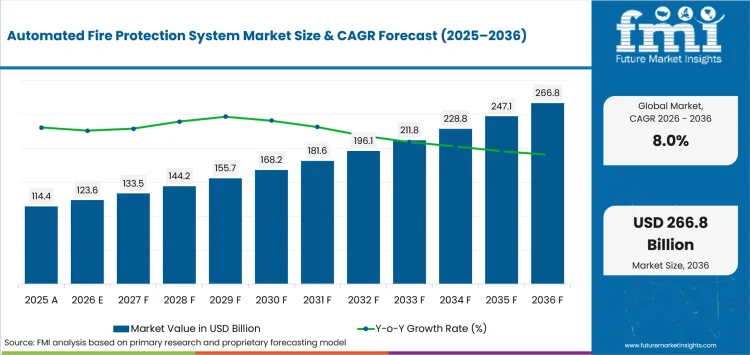
- Market Size (2026)
- USD 123.6 Bn
- Forecast (2036)
- USD 266.8 Bn
- CAGR (2026 to 2036)
- 8.0%
How big is Automated Fire Protection System Market in 2026?
USD 123.6 billion in 2026 and USD 266.8 billion by 2036 at an 8.0% CAGR.
Demand for automated fire protection systems is projected to expand at 8.0% CAGR between 2026 and 2036. Valuation is anticipated to rise from USD 123.6 billion in 2026 and reach USD 266.8 billion by 2036 as inspection obligations sustain system replacement. The USA Fire Administration counted 111,900 nonresidential building fires in 2024. Persistent nonresidential fire exposure keeps fire alarm systems inside long-term facility maintenance plans. Owners therefore continue budgeting for detection and automatic response equipment that must remain inspectable during long building life cycles.
Brazil's 9.4% forecast exceeds Germany's 6.6% as state approval activity creates more corrective project flow in growing property stock. Espírito Santo's fire service logged 51,892 inspection and project-analysis actions during 2025 including fire or explosion forensics. Germany's mature installed base shifts fire suppression systems toward engineered replacement under tighter sprinkler documentation. Companies therefore face more approval-driven volume in Brazil and more specification-intensive retrofit work in Germany.
Key Takeaways
- Inspection and replacement obligations keep active fire protection inside recurring facility budgets for commercial and industrial properties with long operating lives.
- By product type, fire response system is projected to account for 44.0% in 2026 due to coordinated control between detection and protective action.
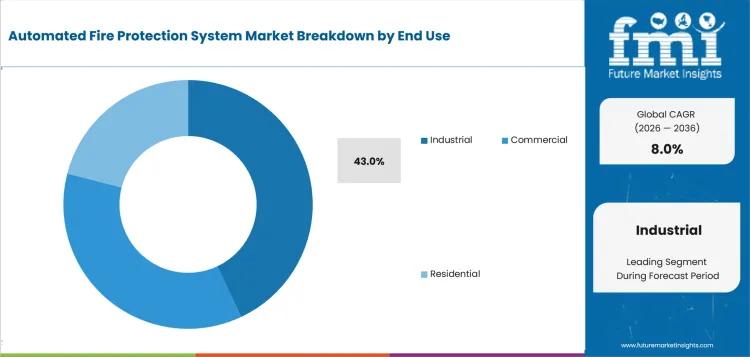
- In 2026, industrial is expected to lead end use with 43.0% share owing to mixed hazards and high downtime exposure.
- Wired is set to lead the connectivity category with 54.0% share in 2026 owing to supervised loops embedded in long-lived installed systems.
- Legacy-panel integration and nuisance-alarm exposure can lengthen commissioning and weaken retrofit economics on occupied sites with limited impairment windows.
- Some of the key players in this market include Johnson Controls International plc, Honeywell International Inc., Siemens AG, Robert Bosch GmbH, Halma plc, Minimax Viking GmbH, Hochiki Corporation, and Securiton AG.
Analyst Perspective
“Automated fire protection projects are won on integration quality because panel compatibility and alarm logic directly affect handover time. The strongest retrofit offers keep serviceable wiring in place while improving response coordination and remote maintenance without increasing nuisance alarms.”
- Nikhil Kaitwade, Principal Consultant, Future Market Insights
How is the Automated Fire Protection System Market segmented?
The automated fire protection system market is segmented by product type, end use, connectivity, suppression agent and application area.
The automated fire protection system market is segmented by product type, end use, connectivity, suppression agent and application area. Product type covers fire response system, fire suppression system, fire detection systems and fire extinguishers. End use includes industrial, commercial and residential sites. Connectivity includes wired, wireless and hybrid systems. Suppression agents include water-based, clean agent, foam, dry chemical and CO2 / inert gas. Application area covers buildings, industrial facilities, transport infrastructure and data centers & critical assets.
Why does Industrial lead the End Use category?
Data-center fire protection provides a high-availability reference for engineered response, while industrial plants add process-specific shutdown interfaces and mixed ignition sources. System design must therefore match different hazard zones without extending production outages or forcing separate protection packages for every process area.
- In 2026, industrial is expected to lead end use with 43.0% share owing to mixed hazards that require engineered protection around process equipment during normal plant operation.
- In January 2026, Halma acquired Safetec to extend integrated fire-and-gas engineering for large industrial projects where application support governs final system acceptance.
What makes Fire Response System central to the Product Type category?
Fire response system carries the control logic between detection and protective action during a verified alarm. Project teams reduce commissioning handoffs once panel logic also coordinates smoke control and audible signaling devices within the same incident sequence without splitting control responsibility among separate subsystems.
- By product type, fire response system is projected to account for 44.0% in 2026 due to its role in coordinating verified protective actions.
- In June 2026, Honeywell expanded NOTIFIER INSPIRE with integrated smoke control and cloud-connected life-safety functions that simplify commissioning while preserving coordinated response.
How does Wired influence selection within the Connectivity category?
Wired loops remain embedded in long-lived alarm panels and supervised field networks that maintenance teams already understand and test routinely. Existing cabling reduces retrofit scope during control modernization or additions of wireless smoke detectors without replacing serviceable field infrastructure.
- By connectivity, wired is forecast to represent 54.0% in 2026 driven by supervised loops that support predictable commissioning and fault monitoring over long service cycles.
- In March 2026, Siemens introduced Sinteso Nova and Cerberus Nova with cloud connectivity plus panel compatibility for staged detector upgrades on occupied sites.
What supports demand for Water-based systems within the Suppression Agent category?
Water-based suppression gives engineers a familiar design basis for occupied buildings and storage hazards that inspectors and contractors already know well. Fire sprinkler systems suit routine code reviews, while fire suppression chemicals remain necessary for water-sensitive equipment or special fuels.
- Water-based systems are projected to hold 44.0% of suppression agent demand in 2026 owing to broad sprinkler applicability and codified design practice.
- In September 2025, VdS issued VdS 2100-41 with sprinkler requirements and test methods that formalize component performance for engineered water-based installations during qualification.
What are the drivers, restraints and opportunities in the Automated Fire Protection System Market?
Code-driven inspection supports demand, legacy integration raises installed cost and connected diagnostics make phased modernization easier to fund.
- Driver: Inspection obligations keep active fire systems inside scheduled maintenance and replacement budgets for commercial and industrial properties.
- Restraint: Legacy panels and nuisance-alarm exposure can extend commissioning until renovated systems return to stable operation.
- Opportunity: Connected diagnostics and compatible retrofit hardware reduce service effort without forcing replacement of usable field infrastructure.
Owners continue replacing active fire equipment because inspection programs must prove that alarm and suppression functions remain available over long asset lives. NFPA estimated 1.388 million USA fires during 2024 in its November 2025 review, with 34% occurring in or on structures. The incident base keeps smoke detector upgrades and suppression work inside planned maintenance cycles instead of discretionary building improvement budgets.
Legacy panels raise retrofit cost when new devices need custom interfaces or repeated alarm testing ahead of handover. The UK Ministry of Housing recorded 252,162 fire false alarms in the year ending December 2025. Owners scrutinize nuisance-alarm performance since added false activations can erase service savings and extend commissioning on occupied properties.
Connected diagnostics make phased modernization easier to fund if existing wiring and suppression hardware remain serviceable. Johnson Controls expanded fire-prevention packages in April 2025 for non-acute healthcare and correctional facilities with connected sprinkler functions. Remote condition data gives integrators a practical upgrade path so owners can improve inspection visibility without forcing a complete system replacement.
Which country CAGRs are profiled in the Automated Fire Protection System Market?
| Country | CAGR |
|---|---|
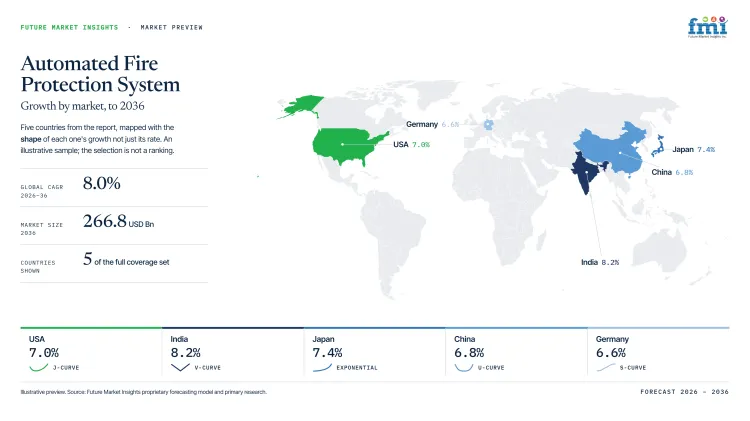
| India | 8.2% |
| Japan | 7.4% |
| USA | 7.0% |
| China | 6.8% |
| Germany | 6.6% |
How do country-level CAGRs compare in the Automated Fire Protection System Market?
The 1.6-point gap between India’s 8.2% CAGR and Germany’s 6.6% reflects stronger expansion in India compared with Germany’s mature installed-base replacement. Japan and the USA form the middle group at 7.4% and 7.0%, while China follows at 6.8% as occupied-building and retrofit projects sustain demand.
- Indian operators require broad service coverage as property portfolios expand and newly commissioned systems move into maintenance.
- Japan’s dense occupied buildings place greater emphasis on staged work, compact hardware, and minimal disruption during installation.
- USA contractor availability makes integration labor a greater constraint than equipment access.
- China’s industrial and commercial expansion supports commissioning activity alongside upgrades across existing facilities.
- German retrofit projects carry greater engineering content as existing sprinkler systems require documented design changes and controlled installation.
These rates mask different labor and qualification costs for companies entering each country. The full report provides country-level CAGR analysis across North America, Latin America, Europe, East Asia, South Asia, Oceania and the Middle East and Africa.
Country-wise Analysis
- Indian industrial and commercial sites increasingly require fire-system integrators to coordinate installation, commissioning, and maintenance across expanding facilities, with local teams supporting documentation and site-specific compliance requirements. India is projected to grow at 8.2% CAGR over the forecast period, supported by industrial expansion, new commercial construction, and modernization of existing facilities. Specialist coverage remains important as operators extend fire-protection systems across multiple sites and regions while maintaining consistent inspection and maintenance standards.
- Japanese building operators place heavy weight on false-alarm control in occupied properties, where unnecessary evacuations can disrupt hospitals, offices, and commercial facilities. Japan is forecast to advance at 7.4% CAGR through 2036, reflecting retrofit demand across an aging and densely occupied building stock. Growth depends on staged modernization, compact equipment, and local maintenance teams that can upgrade panels, detectors, and related systems without prolonged facility shutdowns.
- At industrial and critical-asset sites, United States facility owners typically procure fire-protection systems through engineer specifications and authority review because extended impairment during production or renovation can create significant operational exposure. USA demand is projected to rise at 7.0% CAGR during the forecast period, supported by brownfield modernization and expanding energy-storage infrastructure. Established service networks support scheduled inspection and commissioning, while complex legacy estates keep integration labor and engineering coordination important.
- Chinese industrial and commercial facilities increasingly require coordinated fire-protection installation as manufacturing capacity, logistics infrastructure, and large buildings expand. China is projected to grow at 6.8% CAGR through 2036, supported by new industrial construction and modernization of existing facilities. Integrators must coordinate equipment installation with construction and production schedules, while multi-site operators increasingly value standardized commissioning, inspection, and maintenance practices across expanding property portfolios.
- German retrofit projects require recognized components, documented engineering changes, and auditable sprinkler or detection-system designs before modifications can proceed through approval and commissioning. Germany is estimated to expand at 6.6% CAGR through 2036, driven primarily by replacement and modernization across a mature installed base. Existing building constraints increase documentation and engineering requirements, while occupied-site upgrades require carefully staged work to maintain protection during complex renovation projects.
Who are the notable companies in the Automated Fire Protection System Market?
Johnson Controls International plc, Honeywell International Inc., Siemens AG, Robert Bosch GmbH, Halma plc, Minimax Viking GmbH, Hochiki Corporation, and Securiton AG are the notable companies serving this market.
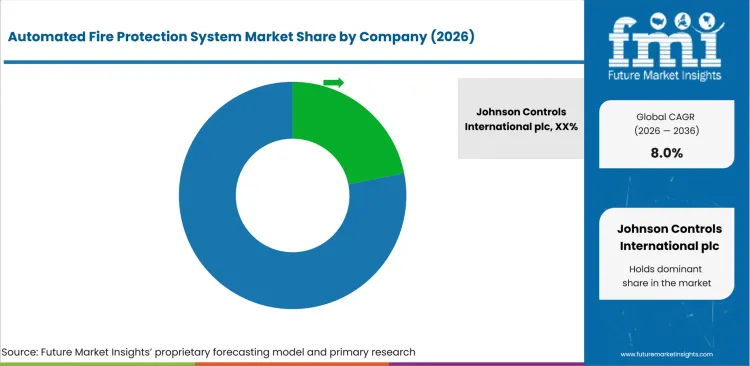
Competition separates integrated building-platform groups from fire suppression specialists with deeper exposure to high-hazard work. Engineering contractors also require approved components and service coverage that fit installed controls, raising entry barriers for companies without documented system breadth.
- Johnson Controls International plc, Honeywell International Inc., Siemens AG and Robert Bosch GmbH cover broader building-system integration and connected service architectures.
- Halma plc and Minimax Viking GmbH concentrate more heavily on industrial hazards and engineered suppression for complex sites.
- Hochiki Corporation and Securiton AG focus on detection, alarm control and application-specific sensing for demanding installations.
Competitive Benchmarking: Automated Fire Protection System Market
| Company | Integrated Detection-to-Response Architecture | Hazard/Application Qualification Depth | Lifecycle Service and Retrofit Support | Geographic Reach |
|---|---|---|---|---|
| Johnson Controls International plc | High | High | High | Global |
| Honeywell International Inc. | High | High | High | Global |
| Siemens AG | Medium | High | High | Global |
| Robert Bosch GmbH | High | Medium | Medium | Europe, North America, Asia-Pacific and other international markets |
| Halma plc | Medium | High | Medium | Global via fire-safety operating companies |
| Minimax Viking GmbH | Medium | High | Medium | Global |
| Hochiki Corporation | Medium | Medium | Medium | Europe, Asia-Pacific, Middle East, Caribbean and other international markets |
| Securiton AG | Medium | High | High | Europe, Asia, Middle East, Africa and Latin America |
Scoring basis: High architecture requires three or more documented fire-system functions and Medium requires two. Low identifies one narrower verified role. High qualification depth requires at least three demanding application groups and Medium requires two. Low requires one. High lifecycle support requires remote monitoring plus retrofit compatibility. Medium requires documented commissioning or service support and Low reflects a narrower current service role.
Key Developments in the Automated Fire Protection System Market
- In September 2025, Robert Bosch GmbH launched an integrated fire-protection solution for fire and rescue stations using video detection with mobile smoke alarms and coordinated notification.
- In May 2025, Securiton AG deployed SecuriHeat LIST linear heat detection along Colombia's 9.73-kilometre Toyo Tunnel for continuous monitoring under demanding tunnel conditions.
- In May 2025, Hochiki Corporation partnered with Jendee Trading on Caribbean fire-safety seminars that involved local electrical inspectorates plus design and commissioning training.
Key Players in the Automated Fire Protection System Market
Integrated Building Fire and Life-Safety Platforms
- Johnson Controls International plc
- Honeywell International Inc.
- Siemens AG
- Robert Bosch GmbH
Diversified and Engineered Fire Protection Specialists
- Halma plc
- Minimax Viking GmbH
Detection-Focused Fire Safety Specialists
- Hochiki Corporation
- Securiton AG
Automated Fire Protection System Market - Report Scope
| Coverage field | Report scope |
|---|---|
| Market breakdown | By product type, end use, connectivity, suppression agent, application area and region. |
| Quantitative Units | USD billion |
| Market Definition | Commercial revenue from active automated fire-protection products and packaged systems covering detection, control, notification and automatic suppression within the stated taxonomy. |
| Regions Covered | North America, Latin America, Europe, East Asia, South Asia and Pacific, and Middle East and Africa. |
| Countries Covered | Brazil, Mexico, Japan, USA, Germany, and 20+ countries included in the full report. |
| Key Companies Profiled | Johnson Controls International plc, Honeywell International Inc., Siemens AG, Robert Bosch GmbH, Halma plc, Minimax Viking GmbH, Hochiki Corporation, and Securiton AG. |
| Forecast Period | 2026 to 2036. |
| Approach | Primary and secondary research with market triangulation. |
Automated Fire Protection System Market - Research Methodology
| Method | Approach |
|---|---|
| Primary Research | FMI analysts gathered input from manufacturers, service providers, technology developers, distributors, end users, procurement teams, and subject-matter experts. Interviews examined purchasing decisions, product or service evaluation, adoption barriers, approval requirements, pricing considerations, and expectations for technical or commercial support. Respondents were also asked what evidence is required before a trial, pilot, or initial order develops into regular purchasing. |
| Desk Research | Desk research covered government statistics, regulatory publications, trade data, industry associations, technical literature, standards, company filings, product information, and official corporate announcements. Sources were reviewed for relevance, publication date, geographic coverage, and consistency with the defined market scope. Claims relating to performance, applications, approvals, capacity, investment, and commercial activity were retained only when supported by credible public evidence. |
| Market Sizing and Forecasting | The market model combined the baseline value with historical performance, segment structure, pricing and volume indicators, adoption levels, company participation, and country-level demand conditions. Forecast assumptions considered economic activity, investment trends, regulatory developments, technology adoption, purchasing cycles, supply availability, and barriers to wider market use. Segment and regional estimates were reconciled before the final market total was calculated. |
| Data Validation | Estimates were checked against multiple independent indicators, including public data, company activity, trade patterns, industry developments, and findings from primary interviews. Validation also tested whether products, services, applications, and company revenues fell within the defined market boundaries. Adjacent categories, unsupported claims, overlapping revenues, and activities without direct market relevance were excluded to reduce double counting and maintain consistency across segments and countries. |
Automated Fire Protection System Market by Segments
Automated Fire Protection System Market segmented by Product Type:
- Fire Response system
- Fire Suppression system
- Fire Detection Systems
- Fire Extinguishers
Automated Fire Protection System Market segmented by End Use:
- Industrial
- Commercial
- Residential
Automated Fire Protection System Market segmented by Connectivity:
- Wired
- Wireless
- Hybrid
Automated Fire Protection System Market segmented by Suppression Agent:
- Water-based
- Clean Agent
- Foam
- Dry Chemical
- CO2 / Inert Gas
Automated Fire Protection System Market segmented by Application Area:
- Buildings
- Industrial Facilities
- Transport Infrastructure
- Data Centers & Critical Assets
Automated Fire Protection System Market by Region:
- North America
- United States
- Canada
- Latin America
- Brazil
- Mexico
- Argentina
- Chile
- Western Europe
- Germany
- France
- United Kingdom
- Italy
- Spain
- Benelux
- Nordics
- Eastern Europe
- Poland
- Czech Republic
- Romania
- Hungary
- East Asia
- China
- Japan
- South Korea
- South Asia and Pacific
- India
- ASEAN
- Australia and New Zealand
- Middle East and Africa
- GCC Countries
- South Africa
- Türkiye
- Israel
Research Sources and Bibliography
- USA Fire Administration. (2026, July 6). Statistics.
- Corpo de Bombeiros Militar do Estado do Espírito Santo. (2026, January 30). CBMES encerra 2025 com mais de 74 mil atendimentos no Espírito Santo.
- Honeywell International Inc. (2026, June 23). Honeywell Expands Fire Portfolio with Advanced Smoke Control and Connected Life Safety Innovations.
- Halma plc. (2026, January 9). Halma expands its industrial safety capabilities.
- Siemens AG. (2026, March 27). Siemens unveils next-gen fire safety protection, paving the way for autonomous buildings.
- VdS Schadenverhütung GmbH. (2025, September). VdS 2100-41: Sprinkler, Anforderungen und Prüfmethoden.
- Hall, S. (2025, November). Fire Loss in the United States During 2024.
- Ministry of Housing, Communities and Local Government. (2026, April 29). Fire and rescue incident statistics, year ending December 2025.
- Johnson Controls International plc. (2025, April 1). Johnson Controls expands industry-specific security and fire solutions.
- Ministério do Trabalho e Emprego. (2026, May 13). Apresentação - RAIS 2025.
- Instituto Nacional de Estadística y Geografía. (2025, July 24). Censos Económicos 2024: Resultados definitivos.
- Fire and Disaster Management Agency of Japan. (2025, November 25).
- USA Energy Information Administration. (2026, August 7). Battery storage capacity averaged 70% growth over the last three years.
- VdS Schadenverhütung GmbH. (2025, February). VdS 6054: VdS-Merkblatt Normenreihe DIN EN 12845.
- Bosch Building Technologies. (2025, September 18). Bosch Building Technologies launcht Komplettlösung für Feuerwehren und Rettungsdienste.
- Securiton AG. (2025, May 14). Fire protection in America's longest road tunnel.
- Hochiki Europe. (2025, May 2). Hochiki Europe and Jendee Trading Join Forces for Caribbean Fire Safety Seminars.
- Johnson Controls International plc. (2025, June 17). Johnson Controls Connected Sprinkler service offers a smarter approach to fire safety.
- Siemens AG. (2026, June 22). Siemens brings digital intelligence to fire safety.
- Honeywell International Inc. (2025, July 1). Honeywell Makes Strategic Tuck-in Acquisition of Li-ion Tamer to Bolster Fire Detection Technologies, Further Strengthening Building Automation Portfolio.
- Halma plc. (2025, December 5). Halma grows its safety capabilities into highly regulated industrial market.
- Hochiki Europe. (2025, December 11). Hochiki Europe Moves Shipping Hub to Italy.
- Minimax Viking GmbH. (2025, December 2). Minimax Minifog marine XP extinguishing system complies with IMO 1165 guidelines.
- Securiton AG. (2025, December 5). Securiton achieves ISO 27001 certification.
- Gentex Corporation. (2025, June 27). Gentex Launches PLACE Smart Home Safety System.
- Securiton AG. (2026, January 1). SecuriSmoke ASD 2000 product family: launch of the next generation of aspirating smoke detectors.
This bibliography is provided for reader reference and is not exhaustive. The full report contains the complete reference list and detailed citations.
This Report Answers
- How large is the automated fire protection system market in 2026 and 2036?
- Which inspection and replacement conditions support repeat automated fire-protection spending?
- Why does fire response system hold the leading product type share in 2026?
- Why does industrial represent the largest end use share in 2026?
- How does wired connectivity retain its position in installed fire-system modernization?
- What limits retrofit economics for automated fire protection systems?
- How do Brazil, Mexico, Japan, the USA and Germany differ in forecast growth?
- Which companies differ in platform integration, suppression specialization and detection depth?
- What should facility owners evaluate before selecting an automated fire protection architecture?
Frequently Asked Questions
How big is the Automated Fire Protection System Market in 2026?
The automated fire protection system market is valued at USD 123.6 billion in 2026 and is projected to reach USD 266.8 billion by 2036. Growth is driven by scheduled inspection and retrofit replacement in commercial and industrial properties over long operating life cycles.
What is the CAGR of the Automated Fire Protection System Market from 2026 to 2036?
The automated fire protection system market is projected to grow at a CAGR of 8.0% between 2026 and 2036. Expansion is supported by code-driven inspection and replacement of installed detection and suppression equipment during scheduled facility maintenance cycles.
Which product type leads the Automated Fire Protection System Market?
The fire response system segment is expected to hold 44.0% of the automated fire protection system market in 2026, driven by coordinated control between detection and protective action. Its control role reduces handoffs during alarm response and simplifies commissioning on integrated building systems.
Which end use leads the Automated Fire Protection System Market?
The industrial segment is expected to hold 43.0% of the automated fire protection system market in 2026, attributable to mixed hazards and high downtime exposure. Industrial sites require engineered detection and suppression logic that matches process zones and shutdown interfaces during normal plant operation.
How much value will the Automated Fire Protection System Market add between 2026 and 2036?
The automated fire protection system market is expected to add USD 143,200.0 million in value between 2026 and 2036. The increase comes from new installations and brownfield modernization plus lifecycle service for active fire-protection systems over long asset lives.
Which countries are projected to record the highest growth in the Automated Fire Protection System Market?
Brazil is projected to grow at 9.4% CAGR, followed by Mexico at 8.0% and Japan at 7.4% through 2036. The spread reflects different combinations of construction activity and installed-base modernization plus local service conditions in each country.
Which companies are active in the Automated Fire Protection System Market?
Key companies operating in the automated fire protection system market include Johnson Controls International plc, Honeywell International Inc., Siemens AG, Robert Bosch GmbH, Halma plc, Minimax Viking GmbH, Hochiki Corporation, and Securiton AG. They compete through integration breadth and hazard specialization in fire projects.
Preview the report firsthand - request a free sample
Get SampleGet the brochure for pricing and purchase details.
Get PDFTable of Content
- Key Takeaways
- Market Size and CAGR
- Top Growth Driver
- Fastest Growing Segment
- Leading Region
- Key Companies
- Emerging Opportunities
- Executive Summary
- Global Market Outlook
- Demand-side Trends
- Supply-side Trends
- Technology Roadmap Analysis
- Analysis and Recommendations
- Analyst Perspective (What is happening? Why now? What should investors know?)
- Key Questions Answered
- How large is the market?
- What is the CAGR?
- What are key trends?
- Which region dominates?
- Who are the leaders?
- Market Overview
- Market Coverage / Taxonomy
- Market Definition / Scope / Limitations
- Research Methodology
- Chapter Orientation
- Analytical Lens and Working Hypotheses
- Market Structure, Signals, and Trend Drivers
- Benchmarking and Cross-market Comparability
- Market Sizing, Forecasting, and Opportunity Mapping
- Research Design and Evidence Framework
- Desk Research Programme (Secondary Evidence)
- Expert Input and Fieldwork (Primary Evidence)
- Tooling, Models, and Reference Databases
- Data Engineering and Model Build
- Quality Assurance and Audit Trail
- Market Background
- Market Dynamics (Drivers, Restraints, Opportunity, Trends)
- Scenario Forecast (Optimistic, Likely, Conservative)
- Impact Analysis
- AI Impact
- Sustainability Impact
- Regulatory Impact
- Technology Impact
- Consumer / Buyer Analysis
- Purchase Drivers
- Adoption Barriers
- Buyer Journey
- Opportunity Map Analysis
- Product Life Cycle Analysis
- Supply Chain Analysis
- Investment Feasibility Matrix
- Value Chain Analysis
- PESTLE and Porter's Analysis
- Regulatory Landscape
- Regional Parent Market Outlook
- Production and Consumption Statistics
- Import and Export Statistics
- Global Market Analysis and Forecast, 2021 to 2036
- Historical Market Size Value (USD Billion) Analysis, 2021 to 2025
- Current and Future Market Size Value (USD Billion) Projections, 2026 to 2036
- Y-o-Y Growth Trend Analysis
- Absolute $ Opportunity Analysis
- Global Market Pricing Analysis, 2021 to 2036
- Global Market Analysis and Forecast, By Product Type, 2021 to 2036
- Introduction / Key Findings
- Historical Market Size Value (USD Billion) Analysis By Product Type, 2021 to 2025
- Current and Future Market Size Value (USD Billion) Analysis and Forecast By Product Type, 2026 to 2036
- Fire Response system
- Fire Suppression system
- Fire Detection Systems
- Fire Extinguishers
- Fire Response system
- Y-o-Y Growth Trend Analysis By Product Type, 2021 to 2025
- Absolute $ Opportunity Analysis By Product Type, 2026 to 2036
- Global Market Analysis and Forecast, By End Use, 2021 to 2036
- Introduction / Key Findings
- Historical Market Size Value (USD Billion) Analysis By End Use, 2021 to 2025
- Current and Future Market Size Value (USD Billion) Analysis and Forecast By End Use, 2026 to 2036
- Industrial
- Commercial
- Residential
- Industrial
- Y-o-Y Growth Trend Analysis By End Use, 2021 to 2025
- Absolute $ Opportunity Analysis By End Use, 2026 to 2036
- Global Market Analysis and Forecast, By Connectivity, 2021 to 2036
- Introduction / Key Findings
- Historical Market Size Value (USD Billion) Analysis By Connectivity, 2021 to 2025
- Current and Future Market Size Value (USD Billion) Analysis and Forecast By Connectivity, 2026 to 2036
- Wired
- Wireless
- Hybrid
- Wired
- Y-o-Y Growth Trend Analysis By Connectivity, 2021 to 2025
- Absolute $ Opportunity Analysis By Connectivity, 2026 to 2036
- Global Market Analysis and Forecast, By Suppression Agent, 2021 to 2036
- Introduction / Key Findings
- Historical Market Size Value (USD Billion) Analysis By Suppression Agent, 2021 to 2025
- Current and Future Market Size Value (USD Billion) Analysis and Forecast By Suppression Agent, 2026 to 2036
- Water-based
- Clean Agent
- Foam
- Dry Chemical
- CO2 - Inert Gas
- Water-based
- Y-o-Y Growth Trend Analysis By Suppression Agent, 2021 to 2025
- Absolute $ Opportunity Analysis By Suppression Agent, 2026 to 2036
- Global Market Analysis and Forecast, By Application Area, 2021 to 2036
- Introduction / Key Findings
- Historical Market Size Value (USD Billion) Analysis By Application Area, 2021 to 2025
- Current and Future Market Size Value (USD Billion) Analysis and Forecast By Application Area, 2026 to 2036
- Buildings
- Industrial Facilities
- Transport Infrastructure
- Data Centers & Critical Assets
- Buildings
- Y-o-Y Growth Trend Analysis By Application Area, 2021 to 2025
- Absolute $ Opportunity Analysis By Application Area, 2026 to 2036
- Global Market Analysis and Forecast, By Region, 2021 to 2036
- Introduction
- Historical Market Size Value (USD Billion) Analysis By Region, 2021 to 2025
- Current Market Size Value (USD Billion) Analysis and Forecast By Region, 2026 to 2036
- North America
- Latin America
- Western Europe
- Eastern Europe
- East Asia
- South Asia and Pacific
- Middle East & Africa
- Market Attractiveness Analysis By Region
- North America Market Analysis and Forecast, By Country, 2021 to 2036
- Historical Market Size Value (USD Billion) Trend Analysis By Market Taxonomy, 2021 to 2025
- Market Size Value (USD Billion) Forecast By Market Taxonomy, 2026 to 2036
- By Country
- USA
- Canada
- By Product Type
- By End Use
- By Connectivity
- By Suppression Agent
- By Application Area
- By Country
- Market Attractiveness Analysis
- By Country
- By Product Type
- By End Use
- By Connectivity
- By Suppression Agent
- By Application Area
- Key Takeaways
- Latin America Market Analysis and Forecast, By Country
- Historical Market Size Value (USD Billion) Trend Analysis By Market Taxonomy, 2021 to 2025
- Market Size Value (USD Billion) Forecast By Market Taxonomy, 2026 to 2036
- By Country
- Brazil
- Mexico
- Chile
- Rest of Latin America
- By Product Type
- By End Use
- By Connectivity
- By Suppression Agent
- By Application Area
- By Country
- Market Attractiveness Analysis
- By Country
- By Product Type
- By End Use
- By Connectivity
- By Suppression Agent
- By Application Area
- Key Takeaways
- Western Europe Market Analysis and Forecast, By Country
- Historical Market Size Value (USD Billion) Trend Analysis By Market Taxonomy, 2021 to 2025
- Market Size Value (USD Billion) Forecast By Market Taxonomy, 2026 to 2036
- By Country
- Germany
- UK
- Italy
- Spain
- France
- Nordic
- BENELUX
- Rest of Western Europe
- By Product Type
- By End Use
- By Connectivity
- By Suppression Agent
- By Application Area
- By Country
- Market Attractiveness Analysis
- By Country
- By Product Type
- By End Use
- By Connectivity
- By Suppression Agent
- By Application Area
- Key Takeaways
- Eastern Europe Market Analysis and Forecast, By Country
- Historical Market Size Value (USD Billion) Trend Analysis By Market Taxonomy, 2021 to 2025
- Market Size Value (USD Billion) Forecast By Market Taxonomy, 2026 to 2036
- By Country
- Russia
- Poland
- Hungary
- Balkan & Baltic
- Rest of Eastern Europe
- By Product Type
- By End Use
- By Connectivity
- By Suppression Agent
- By Application Area
- By Country
- Market Attractiveness Analysis
- By Country
- By Product Type
- By End Use
- By Connectivity
- By Suppression Agent
- By Application Area
- Key Takeaways
- East Asia Market Analysis and Forecast, By Country
- Historical Market Size Value (USD Billion) Trend Analysis By Market Taxonomy, 2021 to 2025
- Market Size Value (USD Billion) Forecast By Market Taxonomy, 2026 to 2036
- By Country
- China
- Japan
- South Korea
- By Product Type
- By End Use
- By Connectivity
- By Suppression Agent
- By Application Area
- By Country
- Market Attractiveness Analysis
- By Country
- By Product Type
- By End Use
- By Connectivity
- By Suppression Agent
- By Application Area
- Key Takeaways
- South Asia and Pacific Market Analysis and Forecast, By Country
- Historical Market Size Value (USD Billion) Trend Analysis By Market Taxonomy, 2021 to 2025
- Market Size Value (USD Billion) Forecast By Market Taxonomy, 2026 to 2036
- By Country
- India
- ASEAN
- Australia & New Zealand
- Rest of South Asia and Pacific
- By Product Type
- By End Use
- By Connectivity
- By Suppression Agent
- By Application Area
- By Country
- Market Attractiveness Analysis
- By Country
- By Product Type
- By End Use
- By Connectivity
- By Suppression Agent
- By Application Area
- Key Takeaways
- Middle East & Africa Market Analysis and Forecast, By Country
- Historical Market Size Value (USD Billion) Trend Analysis By Market Taxonomy, 2021 to 2025
- Market Size Value (USD Billion) Forecast By Market Taxonomy, 2026 to 2036
- By Country
- Kingdom of Saudi Arabia
- Other GCC Countries
- Türkiye
- South Africa
- Other African Union
- Rest of Middle East & Africa
- By Product Type
- By End Use
- By Connectivity
- By Suppression Agent
- By Application Area
- By Country
- Market Attractiveness Analysis
- By Country
- By Product Type
- By End Use
- By Connectivity
- By Suppression Agent
- By Application Area
- Key Takeaways
- Key Countries Market Analysis
- USA
- Pricing Analysis
- Market Share Analysis, 2025
- By Product Type
- By End Use
- By Connectivity
- By Suppression Agent
- By Application Area
- Canada
- Pricing Analysis
- Market Share Analysis, 2025
- By Product Type
- By End Use
- By Connectivity
- By Suppression Agent
- By Application Area
- Mexico
- Pricing Analysis
- Market Share Analysis, 2025
- By Product Type
- By End Use
- By Connectivity
- By Suppression Agent
- By Application Area
- Brazil
- Pricing Analysis
- Market Share Analysis, 2025
- By Product Type
- By End Use
- By Connectivity
- By Suppression Agent
- By Application Area
- Chile
- Pricing Analysis
- Market Share Analysis, 2025
- By Product Type
- By End Use
- By Connectivity
- By Suppression Agent
- By Application Area
- Germany
- Pricing Analysis
- Market Share Analysis, 2025
- By Product Type
- By End Use
- By Connectivity
- By Suppression Agent
- By Application Area
- UK
- Pricing Analysis
- Market Share Analysis, 2025
- By Product Type
- By End Use
- By Connectivity
- By Suppression Agent
- By Application Area
- Italy
- Pricing Analysis
- Market Share Analysis, 2025
- By Product Type
- By End Use
- By Connectivity
- By Suppression Agent
- By Application Area
- Spain
- Pricing Analysis
- Market Share Analysis, 2025
- By Product Type
- By End Use
- By Connectivity
- By Suppression Agent
- By Application Area
- France
- Pricing Analysis
- Market Share Analysis, 2025
- By Product Type
- By End Use
- By Connectivity
- By Suppression Agent
- By Application Area
- India
- Pricing Analysis
- Market Share Analysis, 2025
- By Product Type
- By End Use
- By Connectivity
- By Suppression Agent
- By Application Area
- ASEAN
- Pricing Analysis
- Market Share Analysis, 2025
- By Product Type
- By End Use
- By Connectivity
- By Suppression Agent
- By Application Area
- Australia & New Zealand
- Pricing Analysis
- Market Share Analysis, 2025
- By Product Type
- By End Use
- By Connectivity
- By Suppression Agent
- By Application Area
- China
- Pricing Analysis
- Market Share Analysis, 2025
- By Product Type
- By End Use
- By Connectivity
- By Suppression Agent
- By Application Area
- Japan
- Pricing Analysis
- Market Share Analysis, 2025
- By Product Type
- By End Use
- By Connectivity
- By Suppression Agent
- By Application Area
- South Korea
- Pricing Analysis
- Market Share Analysis, 2025
- By Product Type
- By End Use
- By Connectivity
- By Suppression Agent
- By Application Area
- Russia
- Pricing Analysis
- Market Share Analysis, 2025
- By Product Type
- By End Use
- By Connectivity
- By Suppression Agent
- By Application Area
- Poland
- Pricing Analysis
- Market Share Analysis, 2025
- By Product Type
- By End Use
- By Connectivity
- By Suppression Agent
- By Application Area
- Hungary
- Pricing Analysis
- Market Share Analysis, 2025
- By Product Type
- By End Use
- By Connectivity
- By Suppression Agent
- By Application Area
- Kingdom of Saudi Arabia
- Pricing Analysis
- Market Share Analysis, 2025
- By Product Type
- By End Use
- By Connectivity
- By Suppression Agent
- By Application Area
- Türkiye
- Pricing Analysis
- Market Share Analysis, 2025
- By Product Type
- By End Use
- By Connectivity
- By Suppression Agent
- By Application Area
- South Africa
- Pricing Analysis
- Market Share Analysis, 2025
- By Product Type
- By End Use
- By Connectivity
- By Suppression Agent
- By Application Area
- USA
- Market Structure Analysis
- Competition Dashboard
- Competition Benchmarking
- Market Share Analysis of Top Players
- By Regional
- By Product Type
- By End Use
- By Connectivity
- By Suppression Agent
- By Application Area
- Emerging Startups
- Innovation Benchmarking
- Competition Analysis
- Competition Deep Dive
- Johnson Controls International plc
- Overview
- Product Portfolio
- Profitability by Market Segments
- Sales Footprint
- Strategy Overview
- Marketing Strategy
- Product Strategy
- Channel Strategy
- Honeywell International Inc.
- Siemens AG
- Carrier Global Corporation
- Robert Bosch GmbH
- Halma plc
- Hochiki Corporation
- Gentex Corporation
- Minimax Viking GmbH
- Securiton AG
- Johnson Controls International plc
- Case Studies
- Success Stories
- Recent Developments
- Competition Deep Dive
- Assumptions & Acronyms Used


