

- Market Size (2026)
- USD 1.9 Bn
- Forecast (2036)
- USD 3.2 Bn
- CAGR (2026 to 2036)
- 5.7%
How big is Automated Panel Sorters Market in 2026?
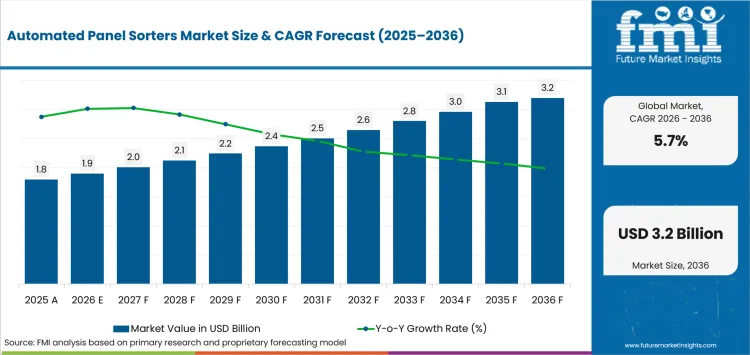
USD 1.9 billion in 2026 and USD 3.2 billion by 2036 at a 5.7% CAGR.
Demand in the automated panel sorters market is anticipated to push valuation from USD 1.9 billion in 2026 to USD 3.2 billion by 2036, expanding at a 5.7% CAGR over the forecast period. High-mix furniture lines support spending because cutting and assembly rarely need components in the same sequence. At LIGNA in May 2025, HOMAG presented SORTBOT R-300 with random access to 11 vertical racks and two narrow-part racks. Direct access lets the next machine receive the required workpiece without unloading the full buffer.
Country economics determine how quickly an operating benefit clears a plant's capital-approval threshold. Larger manufacturing bases generally create more opportunities for automation suppliers to find facilities with sufficient throughput to justify investment. USA Bureau of Labor Statistics data extracted on August 28, 2026 listed 17,992 private furniture and related-product manufacturing establishments in the fourth quarter of 2025. The scale of the manufacturing base expands the pool of plants evaluating productivity improvements and labor-efficiency measures. Larger facilities can justify sorting equipment through utilization gains and labor savings. Smaller sites often face service-distance challenges and legacy-control constraints that slow purchasing decisions.
Key Takeaways
- Demand rises where high-mix panel production requires a buffer to release workpieces in the sequence required by downstream equipment.
- Based on sorter type, robotic panel sorters are projected to account for 26.0% in 2026 due to direct part access in variable production schedules.
- Order/batch sorting is set to lead the sorting method with 36.0% share in 2026 due to reliable downstream resequencing after machine-optimized processing.
- The furniture manufacturing segment is likely to capture 36.0% share in 2026 attributable to repeated synchronization between cutting, edging, drilling, finishing, and assembly.
- Brownfield interfaces, guarding changes, floor-space limits, and uncertain utilization can extend payback and delay approval for integrated sorter projects.
- Some of the key players in this market include HOMAG, Biesse, SCM Group, IMA Schelling, WEINIG Group, Cefla Finishing, Venjakob, and Felder Group.
Analyst Perspective
"Automated panel sorting earns its return where random-access buffering keeps saws and assembly cells supplied without repeated manual restacking. Strong project cases pair retrieval logic with clear controls ownership and local fault recovery because fast sorting cannot compensate for unstable line interfaces."
- Nikhil Kaitwade, Principal Consultant, Future Market Insights
How is the automated panel sorters market segmented?
The automated panel sorters market is segmented by sorter type, sorting method, end use, automation level, and sales channel.
The taxonomy covers sorter type, sorting method, end use, automation level, and sales channel. Sorter types include robotic, gantry, stack, barcode-driven, and buffer-warehouse systems. Sorting methods cover order/batch, size, material, and quality sorting. End uses include furniture manufacturing, cabinet and kitchen plants, panel processing centers, distribution or warehouse operations, and door production. Automation levels include fully automatic, semi-automatic, MES/ERP integrated, and robot-integrated systems. Sales channels include plant automation projects, machinery OEMs, system integrators, and aftermarket upgrades.
What makes robotic panel sorters central to the sorter type category?
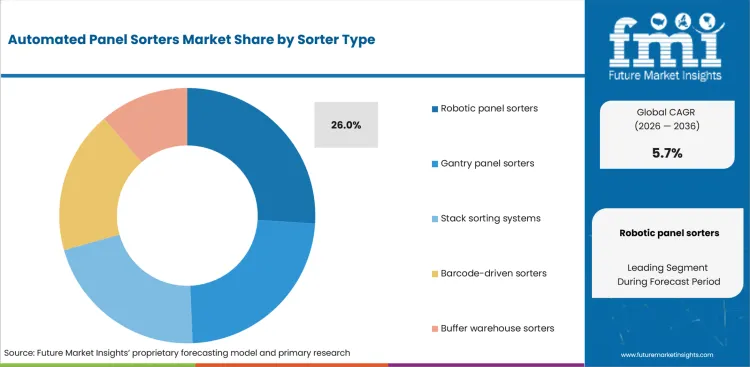
Robotic panel sorters fit production lines that need direct access to one workpiece without shifting the entire buffer. In October 2025, IMA Schelling described a camera-guided robot arrangement that improved board handling and stable stacking for mixed furniture parts. The architecture lets production priority determine which stored component leaves next.
- By sorter type, robotic panel sorters are estimated to hold 26.0% in 2026 owing to random access that reduces buffer reshuffling as production sequences change.
- Robot-assisted retrieval also lets plants expand storage positions without replacing the basic sorting concept, provided controls retain part identity between the buffer and downstream equipment.
Why does order/batch sorting lead the sorting method category?
Order/batch sorting resolves the mismatch between machine-efficient cutting plans and order-complete assembly. At IWF in August 2026, Biesse presented a batch-size-one line with robotic handling, intelligent sorting, and connected software under one operating workflow. The line preserved the release sequence required by later production steps.
- Order/batch sorting is set to lead the sorting method with 36.0% share in 2026 due to its ability to rebuild job sequence after machine-optimized processing.
- Production managers can release complete orders without forcing saws or nesting cells to follow assembly order. The separation protects upstream utilization and reduces manual searches for missing components during each production shift.
How does furniture manufacturing shape the end use category?
Furniture manufacturing produces several sorting points because components leave cutting, edging, drilling, and finishing at different times. WEINIG presented its HOLZ-HER STORE-PICK concept for LIGNA in May 2025, using automatic unloading, intelligent stacking, and sorting to prepare nested parts for the next production step. The operating need is strongest in variant-heavy cabinet and furniture work.
- The furniture manufacturing segment is likely to capture 36.0% share in 2026 attributable to repeated synchronization between several processing stages.
- A sorter becomes more valuable as one customer order contains more parts that travel through different machines before assembly during each production shift.
What supports fully automatic systems in the automation level category?
Fully automatic systems suit lines that need the buffer to identify, transfer, and release panels without routine operator decisions. Biesse introduced Biesse Technic at LIGNA in May 2025 for integrated production lines backed by material-flow engineering and digital simulation. The approach places sorter performance inside a coordinated plant project instead of a standalone machine purchase.
- In 2026, fully automatic systems are expected to lead automation level with 38.0% share because unattended transfer reduces routine routing decisions between connected machines.
- The benefit depends on reliable identification and fault recovery, since automation loses value if operators must repeatedly correct routing or panel position.
What are the drivers, restraints and opportunities in the Automated Panel Sorters Market?
High-mix production raises buffering demand, capital and brownfield integration raise payback thresholds, and modular connected automation broadens the addressable plant base.
- Driver: High-mix production raises the cost of manual buffering, resequencing, and repeated panel handling between production stages.
- Restraint: Capital approval and brownfield integration delay projects where utilization cannot absorb controls, guarding, and commissioning costs.
- Opportunity: Modular robots, machine vision, and open software interfaces let mid-sized plants automate one material-flow constraint before expanding the line.
High-mix production raises sorter value because upstream equipment and final assembly rarely need parts in the same order. SCM stated for its LIGNA 2025 furniture cell that the system could process up to 1,200 furniture components per shift using automatic storage, robots, handling equipment, and software. At that volume, automated resequencing protects machine time and surface quality by reducing manual restacking between operations.
Capital approval becomes harder if a sorter must be integrated into an operating furniture line during weak demand. In August 2025, the German Furniture Industry Association reported that sector revenue had fallen 7.8% in 2024. That contraction raises the hurdle for conveyors and controls work, making observed part flow and clear interface responsibility central to the payback case.
Mid-sized plants gain a practical entry route once automation can be added without rebuilding the complete production line. In August 2026, the National Confederation of Industry (CNI) reported that 5% of Brazilian industrial firms investing in machinery during 2025 targeted production automation. The low share leaves room for modular sorting projects that solve one handling bottleneck first and expand after the plant proves utilization.
Which country CAGRs are profiled in the Automated Panel Sorters Market?
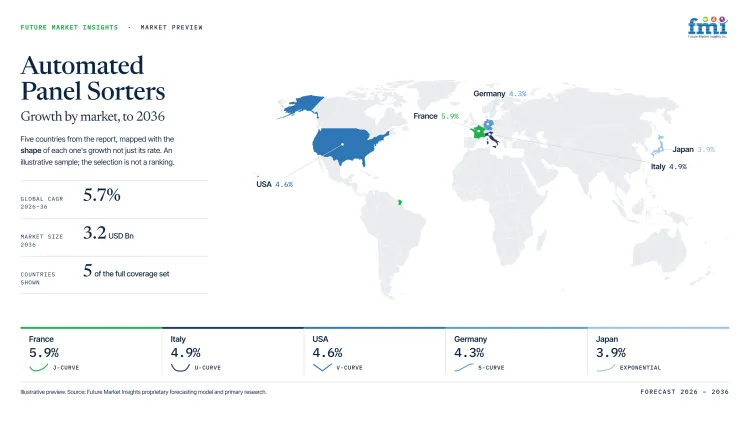
| Country | CAGR |
|---|---|
| France | 5.9% |
| Mexico | 5.6% |
| Brazil | 5.3% |
| Italy | 5.0% |
| USA | 4.6% |
| Germany | 4.3% |
| Japan | 3.9% |
How do country-level CAGRs compare in the Automated Panel Sorters Market?
France is anticipated to rise at a notable CAGR at 5.9%, while Japan is projected at the moderate 3.9% during the forecast period. The spread is 2.0 percentage points from 2026 to 2036. France and Mexico form part of an upper growth band above 5%. Brazil is also in that band, though its buying conditions differ. Italy and USA sit in a middle band where project economics remain attractive but more selective.
- France’s machinery-service base can shorten retrofit troubleshooting.
- Mexico’s export plants must align handling with North American delivery cycles.
- Brazil carries more replacement urgency as older equipment competes for capital.
- Italy sits closer to mature European replacement demand.
- USA factories can generate volume from a large installed base.
- Japanese adoption is shaped by labor-saving needs and by the fit of equipment with compact or highly specific production environments.
- Germany german furniture plants operate in a mature machinery environment, so sorter purchases face close scrutiny on capacity utilization and lifecycle economics.
Service reach and retrofit complexity still change order timing. The full report provides country-level CAGR analysis across North America, Latin America, Europe, East Asia, South Asia, Oceania and the Middle East and Africa.
Country-wise Analysis
- Brownfield furniture plants in France can draw on strong local robotics engineering, but controls ownership still needs to be clear during production changeovers and commissioning. France is projected to grow at 5.9% CAGR through 2036, reinforced by national smart-machine investment and the Direction générale des Entreprises announcement of 31 new France 2030 robotics and sovereign-drone projects in June 2026. The funding broadens the engineering base available to automation projects, while established factories still face downtime and interface risk, so sorter integrators with disciplined commissioning and fast service response are better placed than firms selling machine speed without a credible retrofit plan.
- Export-oriented furniture plants in Mexico put unusual weight on restart time because a controls fault can interrupt shipment schedules tied to North American customers. INEGI's January 2025 IMMEX bulletin counted 136 manufacturing establishments in the furniture and related subsector and 37,572 personnel in November 2024, which defines a production base with uneven plant scale. Automated panel sorter sales in Mexico are forecast to expand at 5.6% CAGR by 2036, owing to staged automation that lets plants add handling and sequencing without replacing an entire line, while local spare parts and commissioning depth remain the main test for converting that opportunity into repeat projects.
- Brazilian sorter projects compete directly with other factory-modernization investments, so access to innovation finance can materially change which equipment reaches approval first. In Brazil, automated panel sorter demand is predicted to advance at 5.3% CAGR through 2036, aided by public innovation funding and a March 2026 BNDES report showing approvals with Finep during 2023-2025 were 321% higher than in 2019-2022. Greater financing capacity can bring replacement projects forward, but eligibility, regional integration coverage, and spare-parts support still determine execution, leaving integrators with modular designs and documented productivity gains better positioned locally than firms relying on a large greenfield proposal.
- Italian furniture plants operate within a dense woodworking machinery base and often require handling logic to follow product design and finish variation, which makes application testing more important than a standard line specification. IMA Schelling documented an Italian project in December 2025 that automated straight and profiled furniture fronts with several custom process adaptations, showing how batch-size-one production can require purpose-built transfer logic before acceptance. Italy's automated panel sorters sector is projected to record 5.0% CAGR during the assessment period, helped by demand for flexible sequencing, while customization increases handover risk and raises the value of stable part identification, local application support, and agreed acceptance tests after commissioning.
- Large United States cabinet and furniture plants usually assess sorting as part of a labor and throughput redesign, with phased retrofits preferred where existing machining assets still have useful life. The United States market is estimated to post 4.6% CAGR over the forecast period, tied to line utilization and a June 2026 Bureau of Labor Statistics release showing furniture and related-products labor productivity fell 4.1% in 2025. Falling productivity strengthens the case for labor-saving handling, but long commissioning windows can erase part of that benefit, so regional service coverage and fault recovery weigh heavily in project selection at plants that cannot absorb extended disruption.
- German furniture plants operate in a mature machinery environment, so sorter purchases face close scrutiny on capacity utilization and lifecycle economics. Demand for automated panel sorters in Germany is forecast to expand at 4.3% CAGR from 2026 to 2036. Destatis reported in March 2025 that German furniture-industry revenue fell 7.8% in 2024, with kitchen-furniture revenue down 6.5%. That weaker demand backdrop raises the hurdle for discretionary capital spending even when automation can improve flow. Suppliers need to quantify waiting-time reduction and staffing impact. Energy use and maintenance burden also affect the case. Buyers will favor designs that reuse existing machines instead of forcing a full line replacement.
- Japanese adoption is shaped by labor-saving needs and by the fit of equipment with compact or highly specific production environments. Demand for automated panel sorters in Japan is forecast to expand at 3.9% CAGR from 2026 to 2036. In February 2025, Japan's SME Agency published application materials for a labor-saving investment program. The program supports process automation and robot production-process improvement. It also supports digital transformation tailored to individual business sites. The purchase hurdle is proving that a sorter fits existing workflow without creating excess complexity. Suppliers need to offer modular footprints, careful commissioning, and controls that can be adapted to site-specific operating practices.
Who are the notable companies in the Automated Panel Sorters Market?
HOMAG, Biesse, SCM Group, IMA Schelling, WEINIG Group, Cefla Finishing, Venjakob, and Felder Group are the notable companies profiled in this market.
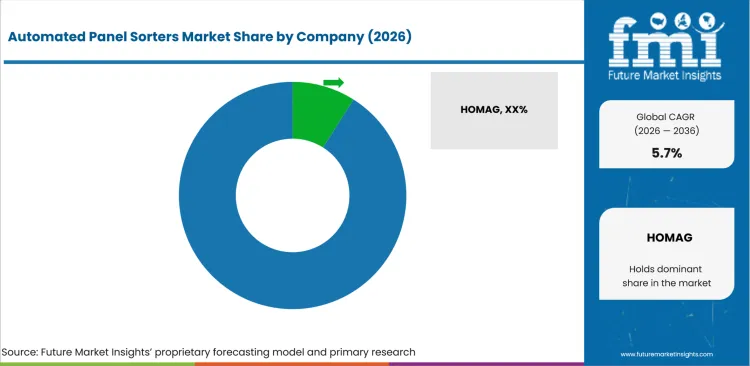
Competition separates dedicated sorter platforms from woodworking groups that integrate storage, machining, controls, and material handling. HOMAG and IMA Schelling document direct sorting and buffering functions. Biesse, SCM Group, and WEINIG Group position sorting inside broader production lines. Cefla Finishing, Venjakob, and Felder Group remain adjacent participants whose relevance depends on the handling scope of each project.
- Dedicated sorting and buffering: HOMAG and IMA Schelling document random-access retrieval, buffer control, and sequencing functions.
- Integrated woodworking automation: Biesse, SCM Group, and WEINIG Group tie panel handling to machining, storage, and production-control software.
- Adjacent handling and finishing automation: Cefla Finishing, Venjakob, and Felder Group cover robotic transfer, line handling, or production support with less direct sorter specialization.
Competitive Benchmarking: Automated Panel Sorters Market
| Company | Panel Handling and Storage Integration | Sorting, Buffering, and Sequencing | Digital Production-Line Integration | Geographic Reach |
|---|---|---|---|---|
| HOMAG | High | High | High | Europe, North America, Asia-Pacific and other global markets |
| Biesse | High | High | High | Europe, North America, Asia-Pacific and other international markets |
| SCM Group | High | High | High | Europe, North America, Asia-Pacific and other international markets |
| IMA Schelling | High | High | High | Europe, North America, Asia and other international markets |
| WEINIG Group | High | Medium | High | Europe, North America, Asia-Pacific and other international markets |
| Cefla Finishing | Medium | Low | Medium | Europe with overseas branches and international finishing projects |
| Venjakob | Medium | Low | Medium | Europe and North America with an international partner network |
| Felder Group | Medium | Low | Medium | Europe, North America and other international markets |
Scoring basis: High panel-handling integration requires automated storage or robotic panel transfer at line scale. Medium indicates narrower automated handling, while Low identifies auxiliary transfer without dedicated storage. High sorting and sequencing requires a buffer that deliberately changes release order between production steps. Medium indicates partial sequencing, while Low covers automated handling without a verified sorting stage. High digital integration requires line-level software coordinating several production assets. Medium indicates machine connectivity, while Low identifies limited evidence of line-level production control.
Key Developments in the Automated Panel Sorters Market
- In August 2026, SCM Group presented a scalable vault sorting unit at IWF for production-order collection and sequencing. QR-identified nested parts were routed into organized stacks for later order reconstruction.
- In April 2026, IMA Schelling presented VisionAI for the first time as an industrial image-analysis platform. Furniture applications include robot-assisted panel picking, drill-hole inspection, surface inspection, and automatic removal of defective parts.
- In April 2026, Biesse and Hansen & Company Woodworks unveiled HCo 2.0 as a fully automated frameless batch-one cabinet line. The system coordinates storage, machining, sequencing, and digital workflow inside one production facility.
Key Players in the Automated Panel Sorters Market
Dedicated Panel Sorting and Buffering
- HOMAG
- IMA Schelling
Integrated Woodworking Automation
- Biesse
- SCM Group
- WEINIG Group
Adjacent Panel Handling and Robotic Automation
- Cefla Finishing
- Venjakob
- Felder Group
Automated Panel Sorters Market - Report Scope
| Coverage field | Report scope |
|---|---|
| Market breakdown | By sorter type, sorting method, end use, automation level, sales channel and region. |
| Quantitative Units | USD billion. |
| Market Definition | Automated systems that buffer, identify, resequence, stack, retrieve, or transfer panels between defined woodworking production stages. |
| Regions Covered | North America, Latin America, Western Europe, Eastern Europe, East Asia, South Asia and Pacific, and Middle East and Africa. |
| Countries Covered | France, Mexico, Brazil, Italy, USA, and 20+ countries included in the full report. |
| Key Companies Profiled | HOMAG, Biesse, SCM Group, IMA Schelling, WEINIG Group, Cefla Finishing, Venjakob, Felder Group. |
| Forecast Period | 2026 to 2036. |
| Approach | Primary and secondary research with market triangulation. |
Automated Panel Sorters Market - Research Methodology
| Method | Approach |
|---|---|
| Primary Research | FMI analysts gathered input from manufacturers, service providers, technology developers, distributors, end users, procurement teams, and subject-matter experts. Interviews examined purchasing decisions, product or service evaluation, adoption barriers, approval requirements, pricing considerations, and expectations for technical or commercial support. Respondents were also asked what evidence is required before a trial, pilot, or initial order develops into regular purchasing. |
| Desk Research | Desk research covered government statistics, regulatory publications, trade data, industry associations, technical literature, standards, company filings, product information, and official corporate announcements. Sources were reviewed for relevance, publication date, geographic coverage, and consistency with the defined market scope. Claims relating to performance, applications, approvals, capacity, investment, and commercial activity were retained only when supported by credible public evidence. |
| Market Sizing and Forecasting | The market model combined the baseline value with historical performance, segment structure, pricing and volume indicators, adoption levels, company participation, and country-level demand conditions. Forecast assumptions considered economic activity, investment trends, regulatory developments, technology adoption, purchasing cycles, supply availability, and barriers to wider market use. Segment and regional estimates were reconciled before the final market total was calculated. |
| Data Validation | Estimates were checked against multiple independent indicators, including public data, company activity, trade patterns, industry developments, and findings from primary interviews. Validation also tested whether products, services, applications, and company revenues fell within the defined market boundaries. Adjacent categories, unsupported claims, overlapping revenues, and activities without direct market relevance were excluded to reduce double counting and maintain consistency across segments and countries. |
Automated Panel Sorters Market by Segments
Automated Panel Sorters Market segmented by Sorter Type:
- Robotic panel sorters
- Gantry panel sorters
- Stack sorting systems
- Barcode-driven sorters
- Buffer warehouse sorters
Automated Panel Sorters Market segmented by Sorting Method:
- Order/batch sorting
- Size-based sorting
- Material-type sorting
- Defect/quality sorting
Automated Panel Sorters Market segmented by End Use:
- Furniture manufacturing
- Cabinet and kitchen plants
- Panel processing centers
- Distribution/warehouse
- Door production
Automated Panel Sorters Market segmented by Automation Level:
- Fully automatic
- Semi-automatic
- MES/ERP integrated
- Robot-integrated
Automated Panel Sorters Market segmented by Sales Channel:
- Plant automation projects
- Machinery OEMs
- System integrators
- Aftermarket upgrade
Automated Panel Sorters Market by Region:
- North America
- United States
- Canada
- Latin America
- Brazil
- Mexico
- Chile
- Rest of Latin America
- Western Europe
- Germany
- United Kingdom
- Italy
- Spain
- France
- Nordics
- Benelux
- Rest of Western Europe
- Eastern Europe
- Russia
- Poland
- Hungary
- Balkan and Baltic States
- Rest of Eastern Europe
- East Asia
- China
- Japan
- South Korea
- South Asia and Pacific
- India
- ASEAN
- Australia and New Zealand
- Rest of South Asia and Pacific
- Middle East and Africa
- Kingdom of Saudi Arabia
- Other GCC Countries
- Türkiye
- South Africa
- Other African Union Countries
- Rest of Middle East and Africa
Research Sources and Bibliography
- HOMAG. (2025, May 26). CNC-Bearbeitung - Neue Lösungen vom Einstieg bis zur industriellen Fertigung
- USA Bureau of Labor Statistics. (2026, August 28). Furniture and related product manufacturing: NAICS 337
- IMA Schelling Group. (2025, October 7). Robots set to revolutionise furniture production
- Biesse. (2026, August 25). IWF 2026
- WEINIG Group. (2025, May 27). WEINIG Group at LIGNA 2025: Complete solutions from a single source - the most comprehensive portfolio in solid wood processing
- Biesse. (2025, May 25). Biesse at Ligna: focus on wood within a comprehensive multimaterial portfolio
- SCM Group. (2025, May 26). LIGNA 2025
- Verband der Deutschen Möbelindustrie. (2025, August 26). Umsatz der deutschen Möbelindustrie liegt im ersten Halbjahr um 5 Prozent unter dem Vorjahresniveau
- Confederação Nacional da Indústria. (2026, August 5). CNI: Indústria compra máquinas novas, mas investimento em automatização segue baixo
- Direction générale des Entreprises. (2026, June 18). France 2030 : 31 nouveaux projets pour accélérer l’émergence d’une filière française d’excellence en robotique et en drones souverains
- INEGI. (2025, January 20). Indicadores de establecimientos con programa IMMEX
- Agência BNDES de Notícias. (2026, March 26). BNDES e Finep já aprovaram crédito para inovação desde 2023
- IMA Schelling Group. (2025, December 3). Automated production of handleless fronts
- USA Bureau of Labor Statistics. (2026, June 24). Productivity and Costs by Industry: Manufacturing and Mining Industries - 2025
- SCM Group. (2026, August 25). IWF 2026
- IMA Schelling Group. (2026, April 29). Artificial Intelligence in Production
- Biesse. (2026, May 1). Hansen & Company Woodworks Unveils HCo 2.0 Powered by Biesse
- HOMAG. (2026, March 17). Floor-level destacking. Next-level efficiency. Robot Saws
- Biesse. (2026, July 5). Biesse acquires Orchestra Srl
- HOMAG. (2026, July 24). More Performance with Less Floor Space: The New Footprint Saver package for the LOOPTEQ O-400
- SCM Group. (2025, December 2). SCM and Tecnest formalize partnership for MES/MOM digital systems
- Cefla. (2025, July 21). The balance between innovation and sustainability with Cefla Finishing solutions for Taizhou Rayard
- HOMAG. (2025, July 28). HOMAG INTELLIGENCE: The world welcomes the new digital platform
- Biesse. (2025, June 4). Hawk furniture: Reliability with Edgebanding
- SCM Group. (2026, February 2). SCM France, a new headquarters to celebrate 50 years of presence on the market
- IMA Schelling Group. (2026, April 22). Secure Manufacturing with IMA Schelling
- WEINIG Group. (2026, February 20). After investment offensive: WEINIG consolidates production
- Cefla. (2026, August 26). Taking major industrial players towards Industry 4.0: how Cefla Finishing redefined production efficiency at Puertas Proma
- Venjakob Maschinenbau. (2026, March 24). Venjakob at the Holz-Handwerk 2026
- Felder Group. (2026, August 25). IWF-Atlanta 2026
This bibliography is provided for reader reference and is not exhaustive. The full report contains the complete reference list and detailed citations
This Report Answers
- How large is the automated panel sorters market in 2026 and 2036?
- Which production conditions support automated panel sorter demand?
- Why do robotic panel sorters account for 26.0% share in 2026?
- Why does order/batch sorting hold 36.0% share in 2026?
- Why does furniture manufacturing represent 36.0% share in 2026?
- How do the five profiled country growth rates differ?
- Which companies provide dedicated sorting or integrated woodworking automation?
- Which capital and brownfield constraints can delay adoption?
- Which integration conditions determine whether an automated sorter protects line utilization?
Frequently Asked Questions
How big is the automated panel sorters market in 2026?
The automated panel sorters market is valued at USD 1.9 billion in 2026 and is projected to reach USD 3.2 billion by 2036. Growth is supported by automated buffering and resequencing in high-mix panel production.
What is the CAGR of the automated panel sorters market from 2026 to 2036?
The automated panel sorters market is projected to grow at a CAGR of 5.7% between 2026 and 2036. Expansion depends on labor-saving handling, batch-size-one production, and better utilization of connected woodworking equipment.
Which sorter type leads the automated panel sorters market?
The robotic panel sorters segment is expected to hold 26.0% of the automated panel sorters market in 2026, driven by direct access to individual workpieces. Random retrieval reduces buffer reshuffling as production priorities change.
Which sorting method leads the automated panel sorters market?
The order/batch sorting segment is expected to hold 36.0% of the automated panel sorters market in 2026, driven by downstream resequencing after machine-optimized processing. That sequencing keeps cutting efficient without forcing assembly teams to search for missing parts.
Which automation level leads the automated panel sorters market?
The fully automatic segment is expected to hold 38.0% of the automated panel sorters market in 2026, attributable to unattended transfer between connected machines. Reliable identification and fault recovery determine whether that automation protects line continuity.
Which countries are projected to record the highest growth in the automated panel sorters market?
France is projected to grow at 5.9% CAGR, followed by Mexico at 5.6% and Brazil at 5.3% through 2036. The three markets differ in robotics support, export-production service needs, and modernization finance.
Which companies are active in the automated panel sorters market?
Key companies operating in the market include HOMAG, Biesse, SCM Group, IMA Schelling, WEINIG Group, Cefla Finishing, Venjakob, and Felder Group. Their positions differ between dedicated sorting, integrated woodworking lines, and adjacent panel-handling automation.
Preview the report firsthand - request a free sample
Get SampleGet the brochure for pricing and purchase details.
Get PDFTable of Content
- Key Takeaways
- Market Size and CAGR
- Top Growth Driver
- Fastest Growing Segment
- Leading Region
- Key Companies
- Emerging Opportunities
- Executive Summary
- Global Market Outlook
- Demand-side Trends
- Supply-side Trends
- Technology Roadmap Analysis
- Analysis and Recommendations
- Analyst Perspective (What is happening? Why now? What should investors know?)
- Key Questions Answered
- How large is the market?
- What is the CAGR?
- What are key trends?
- Which region dominates?
- Who are the leaders?
- Market Overview
- Market Coverage / Taxonomy
- Market Definition / Scope / Limitations
- Research Methodology
- Chapter Orientation
- Analytical Lens and Working Hypotheses
- Market Structure, Signals, and Trend Drivers
- Benchmarking and Cross-market Comparability
- Market Sizing, Forecasting, and Opportunity Mapping
- Research Design and Evidence Framework
- Desk Research Programme (Secondary Evidence)
- Expert Input and Fieldwork (Primary Evidence)
- Tooling, Models, and Reference Databases
- Data Engineering and Model Build
- Quality Assurance and Audit Trail
- Market Background
- Market Dynamics (Drivers, Restraints, Opportunity, Trends)
- Scenario Forecast (Optimistic, Likely, Conservative)
- Impact Analysis
- AI Impact
- Sustainability Impact
- Regulatory Impact
- Technology Impact
- Consumer / Buyer Analysis
- Purchase Drivers
- Adoption Barriers
- Buyer Journey
- Opportunity Map Analysis
- Product Life Cycle Analysis
- Supply Chain Analysis
- Investment Feasibility Matrix
- Value Chain Analysis
- PESTLE and Porter's Analysis
- Regulatory Landscape
- Regional Parent Market Outlook
- Production and Consumption Statistics
- Import and Export Statistics
- Global Market Analysis and Forecast, 2021 to 2036
- Historical Market Size Value (USD Billion) Analysis, 2021 to 2025
- Current and Future Market Size Value (USD Billion) Projections, 2026 to 2036
- Y-o-Y Growth Trend Analysis
- Absolute $ Opportunity Analysis
- Global Market Pricing Analysis, 2021 to 2036
- Global Market Analysis and Forecast, By Sorter Type, 2021 to 2036
- Introduction / Key Findings
- Historical Market Size Value (USD Billion) Analysis By Sorter Type, 2021 to 2025
- Current and Future Market Size Value (USD Billion) Analysis and Forecast By Sorter Type, 2026 to 2036
- Robotic panel sorters
- Gantry panel sorters
- Stack sorting systems
- Barcode-driven sorters
- Buffer warehouse sorters
- Robotic panel sorters
- Y-o-Y Growth Trend Analysis By Sorter Type, 2021 to 2025
- Absolute $ Opportunity Analysis By Sorter Type, 2026 to 2036
- Global Market Analysis and Forecast, By Sorting Method, 2021 to 2036
- Introduction / Key Findings
- Historical Market Size Value (USD Billion) Analysis By Sorting Method, 2021 to 2025
- Current and Future Market Size Value (USD Billion) Analysis and Forecast By Sorting Method, 2026 to 2036
- Order/batch sorting
- Size-based sorting
- Material-type sorting
- Defect/quality sorting
- Order/batch sorting
- Y-o-Y Growth Trend Analysis By Sorting Method, 2021 to 2025
- Absolute $ Opportunity Analysis By Sorting Method, 2026 to 2036
- Global Market Analysis and Forecast, By End Use, 2021 to 2036
- Introduction / Key Findings
- Historical Market Size Value (USD Billion) Analysis By End Use, 2021 to 2025
- Current and Future Market Size Value (USD Billion) Analysis and Forecast By End Use, 2026 to 2036
- Furniture manufacturing
- Cabinet and kitchen plants
- Panel processing centers
- Distribution/warehouse
- Door production
- Furniture manufacturing
- Y-o-Y Growth Trend Analysis By End Use, 2021 to 2025
- Absolute $ Opportunity Analysis By End Use, 2026 to 2036
- Global Market Analysis and Forecast, By Automation Level, 2021 to 2036
- Introduction / Key Findings
- Historical Market Size Value (USD Billion) Analysis By Automation Level, 2021 to 2025
- Current and Future Market Size Value (USD Billion) Analysis and Forecast By Automation Level, 2026 to 2036
- Fully automatic
- Semi-automatic
- MES/ERP integrated
- Robot-integrated
- Fully automatic
- Y-o-Y Growth Trend Analysis By Automation Level, 2021 to 2025
- Absolute $ Opportunity Analysis By Automation Level, 2026 to 2036
- Global Market Analysis and Forecast, By Sales Channel, 2021 to 2036
- Introduction / Key Findings
- Historical Market Size Value (USD Billion) Analysis By Sales Channel, 2021 to 2025
- Current and Future Market Size Value (USD Billion) Analysis and Forecast By Sales Channel, 2026 to 2036
- Plant automation projects
- Machinery OEMs
- System integrators
- Aftermarket upgrade
- Plant automation projects
- Y-o-Y Growth Trend Analysis By Sales Channel, 2021 to 2025
- Absolute $ Opportunity Analysis By Sales Channel, 2026 to 2036
- Global Market Analysis and Forecast, By Region, 2021 to 2036
- Introduction
- Historical Market Size Value (USD Billion) Analysis By Region, 2021 to 2025
- Current Market Size Value (USD Billion) Analysis and Forecast By Region, 2026 to 2036
- North America
- Latin America
- Western Europe
- Eastern Europe
- East Asia
- South Asia and Pacific
- Middle East & Africa
- Market Attractiveness Analysis By Region
- North America Market Analysis and Forecast, By Country, 2021 to 2036
- Historical Market Size Value (USD Billion) Trend Analysis By Market Taxonomy, 2021 to 2025
- Market Size Value (USD Billion) Forecast By Market Taxonomy, 2026 to 2036
- By Country
- USA
- Canada
- By Sorter Type
- By Sorting Method
- By End Use
- By Automation Level
- By Sales Channel
- By Country
- Market Attractiveness Analysis
- By Country
- By Sorter Type
- By Sorting Method
- By End Use
- By Automation Level
- By Sales Channel
- Key Takeaways
- Latin America Market Analysis and Forecast, By Country
- Historical Market Size Value (USD Billion) Trend Analysis By Market Taxonomy, 2021 to 2025
- Market Size Value (USD Billion) Forecast By Market Taxonomy, 2026 to 2036
- By Country
- Brazil
- Mexico
- Chile
- Rest of Latin America
- By Sorter Type
- By Sorting Method
- By End Use
- By Automation Level
- By Sales Channel
- By Country
- Market Attractiveness Analysis
- By Country
- By Sorter Type
- By Sorting Method
- By End Use
- By Automation Level
- By Sales Channel
- Key Takeaways
- Western Europe Market Analysis and Forecast, By Country
- Historical Market Size Value (USD Billion) Trend Analysis By Market Taxonomy, 2021 to 2025
- Market Size Value (USD Billion) Forecast By Market Taxonomy, 2026 to 2036
- By Country
- Germany
- UK
- Italy
- Spain
- France
- Nordic
- BENELUX
- Rest of Western Europe
- By Sorter Type
- By Sorting Method
- By End Use
- By Automation Level
- By Sales Channel
- By Country
- Market Attractiveness Analysis
- By Country
- By Sorter Type
- By Sorting Method
- By End Use
- By Automation Level
- By Sales Channel
- Key Takeaways
- Eastern Europe Market Analysis and Forecast, By Country
- Historical Market Size Value (USD Billion) Trend Analysis By Market Taxonomy, 2021 to 2025
- Market Size Value (USD Billion) Forecast By Market Taxonomy, 2026 to 2036
- By Country
- Russia
- Poland
- Hungary
- Balkan & Baltic
- Rest of Eastern Europe
- By Sorter Type
- By Sorting Method
- By End Use
- By Automation Level
- By Sales Channel
- By Country
- Market Attractiveness Analysis
- By Country
- By Sorter Type
- By Sorting Method
- By End Use
- By Automation Level
- By Sales Channel
- Key Takeaways
- East Asia Market Analysis and Forecast, By Country
- Historical Market Size Value (USD Billion) Trend Analysis By Market Taxonomy, 2021 to 2025
- Market Size Value (USD Billion) Forecast By Market Taxonomy, 2026 to 2036
- By Country
- China
- Japan
- South Korea
- By Sorter Type
- By Sorting Method
- By End Use
- By Automation Level
- By Sales Channel
- By Country
- Market Attractiveness Analysis
- By Country
- By Sorter Type
- By Sorting Method
- By End Use
- By Automation Level
- By Sales Channel
- Key Takeaways
- South Asia and Pacific Market Analysis and Forecast, By Country
- Historical Market Size Value (USD Billion) Trend Analysis By Market Taxonomy, 2021 to 2025
- Market Size Value (USD Billion) Forecast By Market Taxonomy, 2026 to 2036
- By Country
- India
- ASEAN
- Australia & New Zealand
- Rest of South Asia and Pacific
- By Sorter Type
- By Sorting Method
- By End Use
- By Automation Level
- By Sales Channel
- By Country
- Market Attractiveness Analysis
- By Country
- By Sorter Type
- By Sorting Method
- By End Use
- By Automation Level
- By Sales Channel
- Key Takeaways
- Middle East & Africa Market Analysis and Forecast, By Country
- Historical Market Size Value (USD Billion) Trend Analysis By Market Taxonomy, 2021 to 2025
- Market Size Value (USD Billion) Forecast By Market Taxonomy, 2026 to 2036
- By Country
- Kingdom of Saudi Arabia
- Other GCC Countries
- Türkiye
- South Africa
- Other African Union
- Rest of Middle East & Africa
- By Sorter Type
- By Sorting Method
- By End Use
- By Automation Level
- By Sales Channel
- By Country
- Market Attractiveness Analysis
- By Country
- By Sorter Type
- By Sorting Method
- By End Use
- By Automation Level
- By Sales Channel
- Key Takeaways
- Key Countries Market Analysis
- USA
- Pricing Analysis
- Market Share Analysis, 2025
- By Sorter Type
- By Sorting Method
- By End Use
- By Automation Level
- By Sales Channel
- Canada
- Pricing Analysis
- Market Share Analysis, 2025
- By Sorter Type
- By Sorting Method
- By End Use
- By Automation Level
- By Sales Channel
- Mexico
- Pricing Analysis
- Market Share Analysis, 2025
- By Sorter Type
- By Sorting Method
- By End Use
- By Automation Level
- By Sales Channel
- Brazil
- Pricing Analysis
- Market Share Analysis, 2025
- By Sorter Type
- By Sorting Method
- By End Use
- By Automation Level
- By Sales Channel
- Chile
- Pricing Analysis
- Market Share Analysis, 2025
- By Sorter Type
- By Sorting Method
- By End Use
- By Automation Level
- By Sales Channel
- Germany
- Pricing Analysis
- Market Share Analysis, 2025
- By Sorter Type
- By Sorting Method
- By End Use
- By Automation Level
- By Sales Channel
- UK
- Pricing Analysis
- Market Share Analysis, 2025
- By Sorter Type
- By Sorting Method
- By End Use
- By Automation Level
- By Sales Channel
- Italy
- Pricing Analysis
- Market Share Analysis, 2025
- By Sorter Type
- By Sorting Method
- By End Use
- By Automation Level
- By Sales Channel
- Spain
- Pricing Analysis
- Market Share Analysis, 2025
- By Sorter Type
- By Sorting Method
- By End Use
- By Automation Level
- By Sales Channel
- France
- Pricing Analysis
- Market Share Analysis, 2025
- By Sorter Type
- By Sorting Method
- By End Use
- By Automation Level
- By Sales Channel
- India
- Pricing Analysis
- Market Share Analysis, 2025
- By Sorter Type
- By Sorting Method
- By End Use
- By Automation Level
- By Sales Channel
- ASEAN
- Pricing Analysis
- Market Share Analysis, 2025
- By Sorter Type
- By Sorting Method
- By End Use
- By Automation Level
- By Sales Channel
- Australia & New Zealand
- Pricing Analysis
- Market Share Analysis, 2025
- By Sorter Type
- By Sorting Method
- By End Use
- By Automation Level
- By Sales Channel
- China
- Pricing Analysis
- Market Share Analysis, 2025
- By Sorter Type
- By Sorting Method
- By End Use
- By Automation Level
- By Sales Channel
- Japan
- Pricing Analysis
- Market Share Analysis, 2025
- By Sorter Type
- By Sorting Method
- By End Use
- By Automation Level
- By Sales Channel
- South Korea
- Pricing Analysis
- Market Share Analysis, 2025
- By Sorter Type
- By Sorting Method
- By End Use
- By Automation Level
- By Sales Channel
- Russia
- Pricing Analysis
- Market Share Analysis, 2025
- By Sorter Type
- By Sorting Method
- By End Use
- By Automation Level
- By Sales Channel
- Poland
- Pricing Analysis
- Market Share Analysis, 2025
- By Sorter Type
- By Sorting Method
- By End Use
- By Automation Level
- By Sales Channel
- Hungary
- Pricing Analysis
- Market Share Analysis, 2025
- By Sorter Type
- By Sorting Method
- By End Use
- By Automation Level
- By Sales Channel
- Kingdom of Saudi Arabia
- Pricing Analysis
- Market Share Analysis, 2025
- By Sorter Type
- By Sorting Method
- By End Use
- By Automation Level
- By Sales Channel
- Türkiye
- Pricing Analysis
- Market Share Analysis, 2025
- By Sorter Type
- By Sorting Method
- By End Use
- By Automation Level
- By Sales Channel
- South Africa
- Pricing Analysis
- Market Share Analysis, 2025
- By Sorter Type
- By Sorting Method
- By End Use
- By Automation Level
- By Sales Channel
- USA
- Market Structure Analysis
- Competition Dashboard
- Competition Benchmarking
- Market Share Analysis of Top Players
- By Regional
- By Sorter Type
- By Sorting Method
- By End Use
- By Automation Level
- By Sales Channel
- Emerging Startups
- Innovation Benchmarking
- Competition Analysis
- Competition Deep Dive
- HOMAG
- Overview
- Product Portfolio
- Profitability by Market Segments
- Sales Footprint
- Strategy Overview
- Marketing Strategy
- Product Strategy
- Channel Strategy
- Biesse
- SCM Group
- IMA Schelling
- Barberán
- Cefla Finishing
- Doucet Machineries
- KDT Machinery
- Venjakob
- Siemens Logistics
- HOMAG
- Case Studies
- Success Stories
- Recent Developments
- Competition Deep Dive
- Assumptions & Acronyms Used


