

- Market Size (2026)
- USD 150.0 Mn
- Forecast (2036)
- USD 320.9 Mn
- CAGR (2026 to 2036)
- 7.9%
How big is the laboratory contamination control incubator market in 2026?
USD 150.0 million in 2026 and USD 320.9 million by 2036 at a 7.9% CAGR.
The laboratory contamination control incubator market is expected to grow from USD 139.0 million in 2025 to USD 320.9 million by 2036 at 7.9% CAGR. H2O2 Decontamination is forecast to represent 36.0% share in 2026 with demand centered on fast chamber reset. Cell Culture is estimated to hold 52.0% share in 2026 due to long-duration cell work and contamination-loss risk.
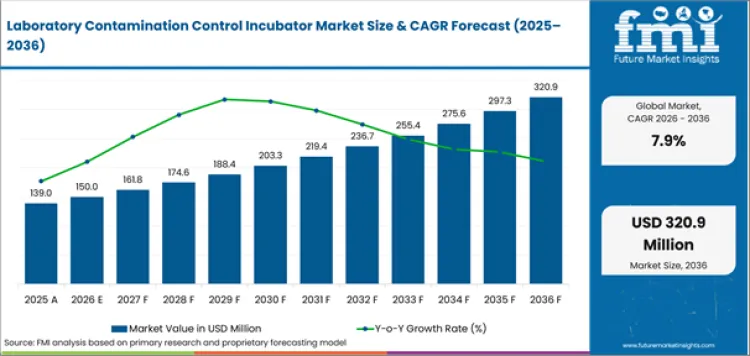
| Metric | Value |
|---|---|
| 2026 Market Size | USD 150.0 million |
| 2036 Market Size | USD 320.9 million |
| Forecast CAGR | 7.9% from 2026 to 2036 |
| Leading Decontamination Technology | H2O2 Decontamination |
| H2O2 Decontamination Share in 2026 | 36.0% |
| Leading Application | Cell Culture |
| Cell Culture Share in 2026 | 52.0% |
| Fastest-growing Country | China |
| China CAGR | 8.9% by 2036 |
Summary of the Laboratory Contamination Control Incubator Market
| Market Signal | Commercial Impact |
|---|---|
| Demand and Growth Drivers | Laboratory contamination control incubator demand is increasing as research and clinical laboratories prioritize contamination-free incubation environments.
|
| Product and Segment View | H₂O₂ decontamination systems, cell culture applications, and mid-capacity incubators lead the market.
|
| Geography and Growth Outlook | China, India, and the United States are expected to remain the leading growth markets.
|
| Competitive Landscape | Competition is focused on contamination control performance, chamber design, and after-sales support.
|
| Analyst Perspective | Laboratory contamination control incubators are increasingly viewed as risk-management investments rather than standard laboratory equipment.
— Nikhil Kaitwade, Principal Analyst, Future Market Insights |
Laboratory contamination control incubator demand is being supported by cell culture reliability because one contamination event can waste samples and delay repeat experiments. For instance, NIH said it awarded USD 35.3 billion in competing and noncompeting grants in FY 2025. This keeps a large, funded base of academic and biomedical labs using incubators for controlled growth work.
PHC launched its MCO-171AICUVD-PA high-heat CO₂ incubator in March 2025 with inCu-saFe chamber material and an optional 180°C sterilization cycle. This is important because buyers are selecting incubators that reduce cleaning downtime and protect valuable cultures before contamination becomes a project-level cost.
Which factors support expansion in the laboratory contamination control incubator market?
Validated chamber reset and cleaner airflow support value growth across regulated laboratory equipment channels.
- Market value is supported by finished incubator revenue before service contracts and validation support add incremental sales.
- Supplier pricing reflects decontamination technology and gas-control stability before digital monitoring affects premium tiers.
- Revenue improves as biopharma labs replace basic CO2 systems with validated contamination-control platforms.
- Buyer confidence rises with documented chamber recovery and user-safety routines.
Why is the laboratory contamination control incubator market growing?
Laboratories are moving toward incubators that reduce contamination risk and shorten return-to-use time after cleaning cycles.
Cell culture is the main demand anchor. FDA reported 50 novel drug approvals in 2024, which signals the depth of drug development workflows that rely on controlled laboratory environments. HFEA reported over 77,500 IVF cycles in 2023 at UK licensed clinics. These figures do not directly size incubator demand. They show why biopharma and fertility laboratories place higher value on chamber stability and contamination proof. Buyers considering cell culture incubator demand often compare contamination control with chamber size and service response.
How is the laboratory contamination control incubator market segmented?
The laboratory contamination control incubator market is segmented by decontamination technology and application. Capacity and end user complete the buyer view.
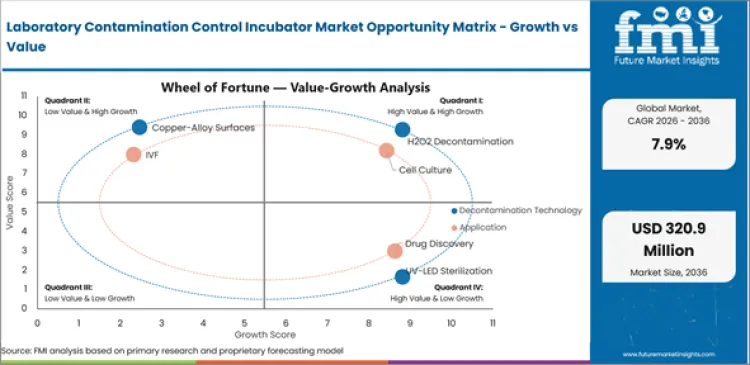
- H2O2 Decontamination is projected to secure 36.0% share in 2026 with short cycle time and validatable chamber reset supporting premium demand.
- Cell Culture is estimated to hold 52.0% share in 2026 due to long-duration workflows and higher sample-loss risk.
- 150-250 Liters is forecast to account for 47.0% share in 2026 through fit across shared research rooms.
- Pharmaceutical & Biotech end users are projected to represent 55.0% share in 2026 with GMP-adjacent documentation needs.
Which decontamination technology category holds a notable share in the laboratory contamination control incubator market?
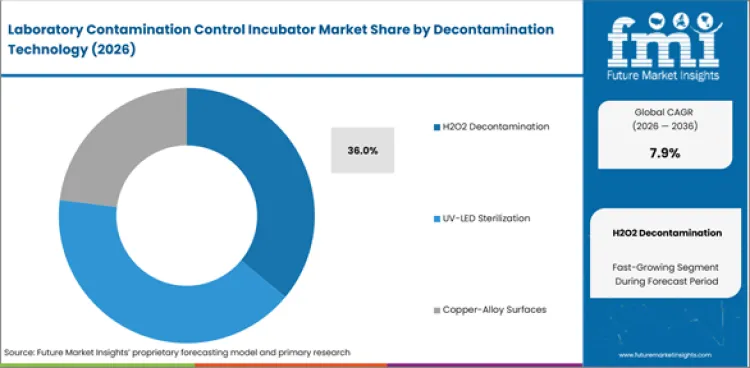
- H2O2 Decontamination is projected to account for 36.0% share in 2026 with faster chamber reset supporting high-use laboratories.
- HEPA Filtration remains relevant for shared laboratories that need continuous air protection between full cleaning cycles.
How does the application segment perform in the laboratory contamination control incubator market?
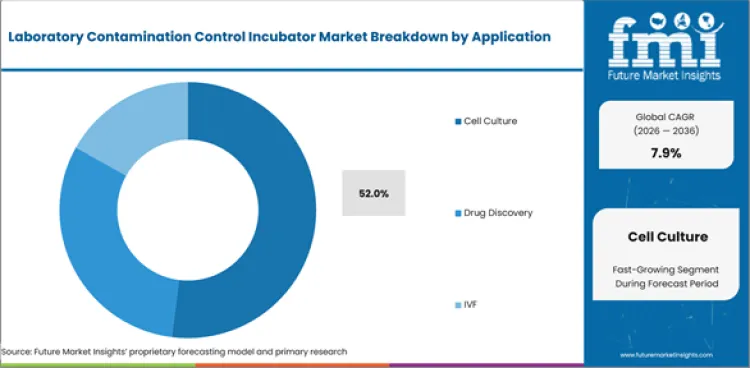
- Cell Culture is estimated to hold 52.0% share in 2026 with mammalian cell work needing stable gas control and low microbial exposure.
- IVF demand creates a premium clinical use case through embryo culture needs and low-disturbance chamber access.
What drives demand across capacity options in the laboratory contamination control incubator market?
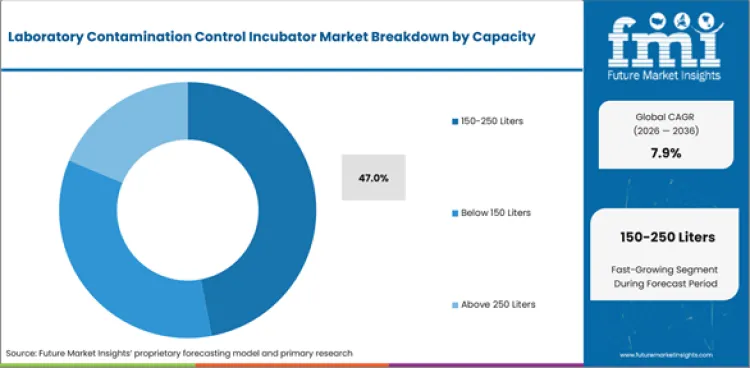
- 150-250 Liters is anticipated to represent 47.0% share in 2026 with broad fit across shared labs and multi-user workflows.
- Below 150 Liters gains use in IVF clinics and smaller research rooms that need compact controlled chambers.
How are buyers selecting across end-user options in the laboratory contamination control incubator market?
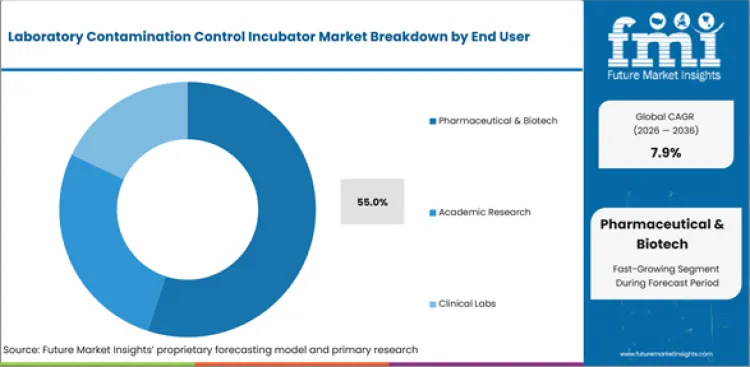
- Pharmaceutical & Biotech is expected to account for 55.0% share in 2026 with traceable contamination control influencing supplier choice.
- Academic Research buyers continue to compare purchase price and service cover before selecting premium systems for shared rooms.
What are the driver, restraints, and opportunities in the laboratory contamination control incubator market?
Fast chamber reset and cleaner airflow support growth. Service cost and academic budget cycles limit faster replacement.
- Driver: Fast decontamination cycles raise premium demand by reducing lost culture time and repeat cleaning work.
- Restraint: Price sensitivity slows upgrades in academic and smaller clinical laboratories with lower contamination-risk exposure.
- Opportunity: Connected monitoring creates a route to audit trails and remote alarms. Preventive service programs add recurring value.
Decontamination Downtime Economics
Downtime cost is the clearest buying trigger in this market. PHCbi states that H2O2 decontamination can limit total chamber downtime to under three hours. That feature changes the sales discussion from hardware price to lost-work avoidance.
Chamber Airflow Contamination Control
Shared laboratories need protection between scheduled cleaning cycles. NuAire describes In-VitroCell CO2 incubators for microbiological cell culture laboratories and emphasizes contamination prevention. HEPA-based systems therefore compete well in academic cores and clinical labs.
IVF Chamber Stability
Fertility clinics value low-disturbance chambers and rapid recovery after door openings. Esco Medical describes CelCulture incubators with ISO Class 5 cleanliness and inner door kits for embryo-related workflows. This makes compact contamination-control systems relevant for IVF labs. Biopharma procurement teams also review carbon dioxide incubators during comparisons of gas recovery and service coverage for long culture runs.
Automation teams evaluate automated cell culture systems with incubation capacity to reduce exposure events caused by manual handling. Digital teams connect lab automation plans with incubator alarms and maintenance records for cleaner audit preparation.
Which countries are growing fastest in the laboratory contamination control incubator market?
China 8.9% CAGR, India 8.6% CAGR, South Korea 8.3% CAGR, United States 8.2% CAGR, Japan 8.0% CAGR, Germany 7.7% CAGR, France 7.6% CAGR, United Kingdom 7.5% CAGR through 2036.
| Country | CAGR |
|---|---|
| China | 8.9% |
| India | 8.6% |
| South Korea | 8.3% |
| United States | 8.2% |
| Japan | 8.0% |
| Germany | 7.7% |
| France | 7.6% |
| United Kingdom | 7.5% |
Source: Future Market Insights, 2026.
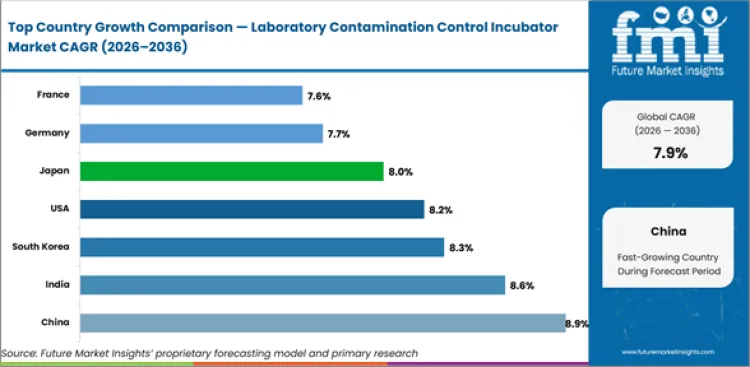
How do country-level CAGRs compare in the laboratory contamination control incubator market?
China records the highest stated CAGR profile. The United Kingdom shows the most measured expansion among profiled countries.
- China is expected to post an 8.9% CAGR through 2036, driven by advances in drug innovation and the scaling of domestic biopharma operations.
- India is forecast to grow at an 8.6% CAGR through 2036, supported by biomanufacturing policy initiatives and rising biotech startup activity.
- South Korea is projected to register an 8.3% CAGR through 2036, with biohealth R&D investment and distributor‑led service networks sustaining demand.
- The United States is anticipated to expand at an 8.2% CAGR through 2036, as biopharma validation requirements and nationwide service coverage influence purchasing.
- Japan is expected to advance at an 8.0% CAGR through 2036, led by regenerative medicine programs and the relevance of established domestic suppliers.
- Germany is projected to grow at a 7.7% CAGR through 2036, supported by deep biopharma expertise and local equipment engineering capabilities.
- France is forecast to rise at a 7.6% CAGR through 2036, driven by biomanufacturing investments and concentration of pharmaceutical research hubs.
- The United Kingdom is expected to record a 7.5% CAGR through 2036, with fertility clinic regulation and biomedical research procurement contributing to demand.
How fast is the laboratory contamination control incubator market growing in China?
A 8.9% CAGR through 2036 reflects domestic biopharma scale supports premium incubator demand.
| Parameter | Value |
|---|---|
| Market Size in 2025 (Value) | USD 15.6 million |
| Market Size in 2026 (Value) | USD 17.0 million |
| Market Forecast in 2036 (Value) | USD 39.9 million |
| CAGR (2026 to 2036) | 8.9% |
| Years Considered | 2021 to 2036 |
| Base Year | 2025 |
| Forecast Period | 2026 to 2036 |
| Units Considered | Value (USD million) |
| Leading Sub-Region | Shanghai, Suzhou, and Shenzhen life-science corridors |
China Laboratory Contamination Control Incubator Market Outlook
- China demand is expected to expand with domestic biopharma investment and faster laboratory buildout. Buyers compare performance proof and local service before selecting premium H2O2 or HEPA systems.
- Imported brands retain influence in premium accounts. Domestic suppliers keep pricing pressure visible in standard laboratory tenders.
Key Growth Drivers
- Drug discovery demand is supported by NMPA reporting 31 new drug approvals from January to August 2024.
- Research lab demand is supported by NBS reporting China’s R&D spending above 3.6 trillion yuan in 2024.
- Biopharma clusters in Shanghai and Suzhou are increasing orders for mid-capacity systems that protect long culture runs.
- Distributor service routes improve adoption for imported platforms that need installation and maintenance support.
Key Restraints
- Tender budgets remain selective after the Ministry of Finance reported 337.118 billion yuan in central science and technology spending in 2024.
- Local maintenance confidence can limit premium adoption outside large coastal hubs.
- Regulatory review creates documentation pressure after NMPA reported nearly 20 percent more new drug approvals in January to August 2024.
What makes China unique
China combines fast biopharma buildout with intense price competition and short service-response expectations.
Key Companies
- Thermo Fisher Scientific China
- Eppendorf China
- PHCbi China
- Haier Biomedical
- BIOBASE
- Heal Force Bio-Meditech
- Esco Lifesciences China
Sales & Marketing Channels
- Direct sales to biopharma groups
- Life-science hub distributors
- University tender procurement
- Service and spare-part partners
- Clinical laboratory dealers
Country Segment Breakdown Table
| Segment | Sub-Segments |
|---|---|
| By Decontamination Technology | UV-LED Sterilization · H2O2 Decontamination · HEPA Filtration · Copper-Alloy Surfaces |
| By Application | Cell Culture · Drug Discovery · IVF |
| By Capacity | Below 150 Liters · 150-250 Liters · Above 250 Liters |
| By End User | Pharmaceutical & Biotech · Academic Research · Clinical Labs |
| Key Sub-Regions Covered | Shanghai, Suzhou, and Shenzhen life-science corridors |
Frequently Asked Questions
How fast is China laboratory contamination control incubator market growing?
China is projected to record 8.9% CAGR through 2036 with biopharma expansion and local service demand.
Who leads China laboratory contamination control incubator market?
Haier Biomedical, BIOBASE, and Heal Force compete with Thermo Fisher Scientific China, Eppendorf China, PHCbi China, and Esco Lifesciences China.
What is driving adoption in China laboratory contamination control incubator market?
Drug discovery workflows and fast biopharma lab buildout are raising demand for validated chamber protection.
How fast is the laboratory contamination control incubator market growing in India?
A 8.6% CAGR through 2036 reflects biotech startup growth and bioe3 policy support laboratory equipment demand.
| Parameter | Value |
|---|---|
| Market Size in 2025 (Value) | USD 6.0 million |
| Market Size in 2026 (Value) | USD 6.5 million |
| Market Forecast in 2036 (Value) | USD 14.8 million |
| CAGR (2026 to 2036) | 8.6% |
| Years Considered | 2021 to 2036 |
| Base Year | 2025 |
| Forecast Period | 2026 to 2036 |
| Units Considered | Value (USD million) |
| Leading Sub-Region | Bengaluru, Hyderabad, Pune, and Ahmedabad biotech hubs |
India Laboratory Contamination Control Incubator Market Outlook
- India demand is expected to rise with biotechnology expansion and biomanufacturing policy support. Buyers remain price sensitive and look for service assurance before moving beyond basic CO2 incubators.
- Funded institutes and private biopharma sites create the clearest premium demand. Distributor quality has a direct effect on supplier selection.
Key Growth Drivers
- Biotechnology adoption is supported by PIB reporting India’s bioeconomy at USD 165.7 billion in 2024.
- Biopharma demand is supported by IBER 2024 placing BioPharma at 35 percent of India’s bioeconomy.
- Contract research labs are increasing demand for cleaner culture environments in cell biology projects.
- Large academic institutes use shared incubators for biotechnology and cell-line work.
Key Restraints
- Budget limits remain visible after PIB reported India’s GERD at 0.64 percent of GDP in the latest official series.
- Service reach outside major cities affects confidence in premium contamination-control systems.
- Price discipline remains important after PIB placed the bioeconomy contribution at 4.25 percent of GDP in 2024.
What makes India unique
India combines high biotechnology momentum with price-sensitive procurement and distributor-led service dependence.
Key Companies
- Thermo Fisher Scientific India
- Eppendorf India
- Esco Lifesciences India
- PHCbi India
- BINDER India
- REMI Lab World
- iLabot Technologies
Sales & Marketing Channels
- Research lab distributors
- Institutional tender platforms
- Direct biopharma account sales
- Clinical lab dealers
- Calibration service packages
Country Segment Breakdown Table
| Segment | Sub-Segments |
|---|---|
| By Decontamination Technology | UV-LED Sterilization · H2O2 Decontamination · HEPA Filtration · Copper-Alloy Surfaces |
| By Application | Cell Culture · Drug Discovery · IVF |
| By Capacity | Below 150 Liters · 150-250 Liters · Above 250 Liters |
| By End User | Pharmaceutical & Biotech · Academic Research · Clinical Labs |
| Key Sub-Regions Covered | Bengaluru, Hyderabad, Pune, and Ahmedabad biotech hubs |
Frequently Asked Questions
How fast is India laboratory contamination control incubator market growing?
India is expected to expand at 8.6% CAGR through 2036 with biotech policy support and distributor expansion.
Who leads India laboratory contamination control incubator market?
REMI Lab World and iLabot Technologies compete with Thermo Fisher Scientific India, Eppendorf India, Esco Lifesciences India, PHCbi India, and BINDER India.
What is driving adoption in India laboratory contamination control incubator market?
Biotech funding and contract research demand are supporting upgrades from basic incubators. Biomanufacturing policy adds another upgrade reason.
How fast is the laboratory contamination control incubator market growing in South Korea?
A 8.3% CAGR through 2036 reflects biohealth r&d and pharmaceutical activity support clean cell culture equipment demand.
Country Market Snapshot Table
| Parameter | Value |
|---|---|
| Market Size in 2025 (Value) | USD 6.6 million |
| Market Size in 2026 (Value) | USD 7.2 million |
| Market Forecast in 2036 (Value) | USD 16.0 million |
| CAGR (2026 to 2036) | 8.3% |
| Years Considered | 2021 to 2036 |
| Base Year | 2025 |
| Forecast Period | 2026 to 2036 |
| Units Considered | Value (USD million) |
| Leading Sub-Region | Seoul, Incheon, Daejeon, and Osong biohealth corridors |
South Korea Laboratory Contamination Control Incubator Market Outlook
- South Korea demand is expected to rise with biohealth R&D and service-sensitive laboratory buying. Distributor relationships matter for Korean-language support and fast maintenance.
- Premium platforms are adopted in pharma and hospital research settings. Biotech labs remain a core buyer group. Smaller labs compare imported prices against basic incubator alternatives.
Key Growth Drivers
- Lab infrastructure demand is supported by MSIT setting the 2025 major R&D budget at KRW 24.8 trillion.
- Bioindustry demand is supported by Invest Korea reporting Korean bio industry production near KRW 23 trillion in 2024.
- Pharma and biotech clusters need contamination-control systems for longer cell culture workflows.
- Distributor-backed support makes imported systems easier to maintain in major research corridors.
Key Restraints
- Export-linked budget caution remains after Korea.net reported biohealth exports at USD 27.9 billion in 2025.
- Service gaps outside Seoul and major biotech hubs can reduce buyer confidence.
- Budget review remains strict after MSIT listed the 2024 major R&D budget at KRW 21.9 trillion.
What makes South Korea unique
South Korea combines large R&D commitments with compact service networks and technically cautious buyers.
Key Companies
- Thermo Fisher Scientific Korea
- Eppendorf Korea
- PHCbi Korea
- Jeio Tech
- DAIHAN Scientific
- Esco Lifesciences Korea
- BINDER Korea
Sales & Marketing Channels
- Life-science equipment distributors
- Pharma account sales
- Hospital research procurement
- University tender channels
- Maintenance contract renewals
Country Segment Breakdown Table
| Segment | Sub-Segments |
|---|---|
| By Decontamination Technology | UV-LED Sterilization · H2O2 Decontamination · HEPA Filtration · Copper-Alloy Surfaces |
| By Application | Cell Culture · Drug Discovery · IVF |
| By Capacity | Below 150 Liters · 150-250 Liters · Above 250 Liters |
| By End User | Pharmaceutical & Biotech · Academic Research · Clinical Labs |
| Key Sub-Regions Covered | Seoul, Incheon, Daejeon, and Osong biohealth corridors |
Frequently Asked Questions
How fast is South Korea laboratory contamination control incubator market growing?
South Korea is forecast to post 8.3% CAGR through 2036 with biohealth R&D and distributor support.
Who leads South Korea laboratory contamination control incubator market?
Jeio Tech and DAIHAN Scientific compete with Thermo Fisher Scientific Korea, Eppendorf Korea, PHCbi Korea, Esco Lifesciences Korea, and BINDER Korea.
What is driving adoption in South Korea laboratory contamination control incubator market?
Biohealth R&D funding and pharma laboratory upgrades are supporting demand for validated contamination-control systems.
How fast is the laboratory contamination control incubator market growing in United States?
A 8.2% CAGR through 2036 reflects USA biopharma labs support premium co2 incubators with validated chamber controls.
Country Market Snapshot Table
| Parameter | Value |
|---|---|
| Market Size in 2025 (Value) | USD 38.8 million |
| Market Size in 2026 (Value) | USD 42.0 million |
| Market Forecast in 2036 (Value) | USD 92.4 million |
| CAGR (2026 to 2036) | 8.2% |
| Years Considered | 2021 to 2036 |
| Base Year | 2025 |
| Forecast Period | 2026 to 2036 |
| Units Considered | Value (USD million) |
| Leading Sub-Region | Boston, San Diego, San Francisco, and Research Triangle hubs |
United States Laboratory Contamination Control Incubator Market Outlook
- United States demand is expected to reflect biopharma validation needs and nationwide service coverage. Buyers treat contamination-control features as workflow risk controls in long-duration cell culture.
- Large accounts often buy through direct manufacturer contracts. Smaller labs use distributors and catalog channels to manage service cost.
Key Growth Drivers
- Biopharma replacement demand is supported by FDA reporting 50 novel drug approvals in 2024.
- Academic lab demand is supported by NSF reporting higher education R&D expenditures above USD 117 billion in FY2024.
- IVF clinics in major metro areas support compact incubator demand with stable gas recovery.
- University core labs buy multi-user systems after service cover and documentation are clear.
Key Restraints
- Federal budget cycles remain visible after NIH reported FY2025 appropriations of USD 48.5 billion.
- High service-cost expectations can limit adoption among small private clinical laboratories.
- Grant-dependent buyers remain timing sensitive even though NIH reported a USD 48.5 billion FY2025 appropriation.
What makes United States unique
The United States is distinct through premium purchases shaped by biopharma validation needs and national service coverage.
Key Companies
- Thermo Fisher Scientific
- PHC Corporation of North America
- NuAire
- Sheldon Manufacturing
- Eppendorf North America
- BINDER Inc.
- Esco Lifesciences USA
Sales & Marketing Channels
- Direct biopharma enterprise sales
- Laboratory equipment catalog distributors
- University procurement platforms
- IVF clinic equipment specialists
- Service contract renewals
Country Segment Breakdown Table
| Segment | Sub-Segments |
|---|---|
| By Decontamination Technology | UV-LED Sterilization · H2O2 Decontamination · HEPA Filtration · Copper-Alloy Surfaces |
| By Application | Cell Culture · Drug Discovery · IVF |
| By Capacity | Below 150 Liters · 150-250 Liters · Above 250 Liters |
| By End User | Pharmaceutical & Biotech · Academic Research · Clinical Labs |
| Key Sub-Regions Covered | Boston, San Diego, San Francisco, and Research Triangle hubs |
Frequently Asked Questions
How fast is United States laboratory contamination control incubator market growing?
The United States is projected to record 8.2% CAGR through 2036 with biopharma validation and service demand.
Who leads United States laboratory contamination control incubator market?
Thermo Fisher Scientific, PHC Corporation of North America, NuAire, Sheldon Manufacturing, Eppendorf North America, BINDER Inc., and Esco Lifesciences USA compete in the market.
What is driving adoption in United States laboratory contamination control incubator market?
Drug development and academic R&D support demand for cleaner incubation systems. Fertility clinic workflows add a premium use case.
How fast is the laboratory contamination control incubator market growing in Japan?
A 8.0% CAGR through 2036 reflects regenerative medicine and ips cell research support clean incubation demand.
| Parameter | Value |
|---|---|
| Market Size in 2025 (Value) | USD 10.6 million |
| Market Size in 2026 (Value) | USD 11.5 million |
| Market Forecast in 2036 (Value) | USD 24.8 million |
| CAGR (2026 to 2036) | 8.0% |
| Years Considered | 2021 to 2036 |
| Base Year | 2025 |
| Forecast Period | 2026 to 2036 |
| Units Considered | Value (USD million) |
| Leading Sub-Region | Tokyo, Osaka, Kobe, and Tsukuba research corridors |
Japan Laboratory Contamination Control Incubator Market Outlook
- Japan demand is expected to rise with regenerative medicine and iPS cell research. Buyers favor suppliers that can prove chamber stability and long service life.
- PHCbi has a clear domestic fit through copper-enriched interiors and UV options. H2O2 decontamination adds premium chamber reset value. Imported suppliers compete through documentation and application support.
Key Growth Drivers
- Research demand is supported by the Statistics Bureau reporting 912,800 researchers as of March 31 2025.
- Science budget support is visible after JST reported Japan’s FY2025 science and technology budget at 5.0526 trillion yen.
- Domestic supplier strength gives buyers access to familiar product and service channels.
- Pharma laboratories use contamination-control systems to protect cell-based discovery work.
Key Restraints
- Technical expectations remain high after PMDA Updates 2025 described Japan as the 4th-largest pharmaceutical and medical-device market.
- Higher equipment prices can slow adoption in small academic laboratories.
- Documentation burden remains high after PMDA’s FY2024 GMP and GCTP report highlighted retention rules for product records.
What makes Japan unique
Japan is unique through regenerative medicine research that creates a premium need for low-disruption incubation.
Key Companies
- PHCbi
- ASTEC
- TOKAI HIT
- Yamato Scientific
- Eppendorf Japan
- Thermo Fisher Scientific Japan
- Esco Lifesciences Japan
Sales & Marketing Channels
- Pharma and research institute sales
- University distributor sales
- Service-led upgrades
- Regenerative medicine procurement
- IVF clinic equipment channels
Country Segment Breakdown Table
| Segment | Sub-Segments |
|---|---|
| By Decontamination Technology | UV-LED Sterilization · H2O2 Decontamination · HEPA Filtration · Copper-Alloy Surfaces |
| By Application | Cell Culture · Drug Discovery · IVF |
| By Capacity | Below 150 Liters · 150-250 Liters · Above 250 Liters |
| By End User | Pharmaceutical & Biotech · Academic Research · Clinical Labs |
| Key Sub-Regions Covered | Tokyo, Osaka, Kobe, and Tsukuba research corridors |
Frequently Asked Questions
How fast is Japan laboratory contamination control incubator market growing?
Japan is expected to rise at 8.0% CAGR through 2036 with regenerative medicine and cell research demand.
Who leads Japan laboratory contamination control incubator market?
PHCbi, ASTEC, TOKAI HIT, Yamato Scientific, Eppendorf Japan, Thermo Fisher Scientific Japan, and Esco Lifesciences Japan compete in the market.
What is driving adoption in Japan laboratory contamination control incubator market?
Regenerative medicine and iPS cell research support adoption. Service-backed premium systems add another buyer reason.
How fast is the laboratory contamination control incubator market growing in Germany?
A 7.7% CAGR through 2036 reflects medical biotechnology and domestic supplier depth support demand.
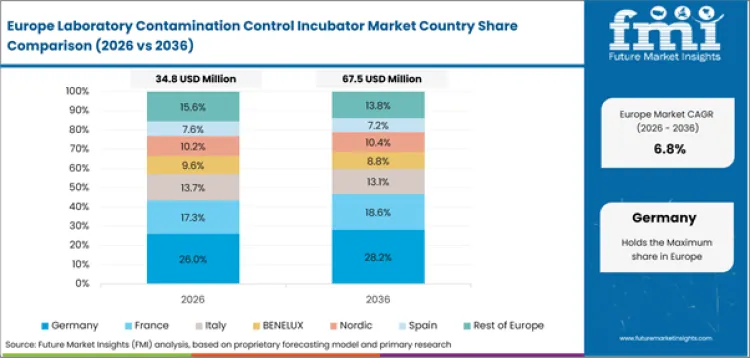
Country Market Snapshot Table
| Parameter | Value |
|---|---|
| Market Size in 2025 (Value) | USD 11.6 million |
| Market Size in 2026 (Value) | USD 12.5 million |
| Market Forecast in 2036 (Value) | USD 26.2 million |
| CAGR (2026 to 2036) | 7.7% |
| Years Considered | 2021 to 2036 |
| Base Year | 2025 |
| Forecast Period | 2026 to 2036 |
| Units Considered | Value (USD million) |
| Leading Sub-Region | Munich, Berlin, Heidelberg, and Rhine-Main laboratory clusters |
Germany Laboratory Contamination Control Incubator Market Outlook
- Germany demand is expected to remain technically demanding due to biopharma activity and domestic equipment manufacturing. Buyers compare sterilization proof and sensor stability. Service response remains a supplier-selection point.
- German laboratories often favor documented heat sterilization and clean chamber design. Domestic supplier presence makes technical comparison more detailed.
Key Growth Drivers
- Biopharma demand is supported by GTAI reporting EUR 23.1 billion in German biopharmaceutical turnover in 2024.
- R&D equipment demand is supported by Eurostat reporting EU R&D expenditure at EUR 403 billion in 2024.
- Domestic suppliers strengthen buyer confidence through local service and technical training.
- University and institute laboratories use mid-capacity units for shared culture workflows.
Key Restraints
- Healthcare cost scrutiny remains visible after the USA International Trade Administration placed German healthcare gross value added at USD 496 billion in 2024.
- Validation expectations can lengthen procurement cycles in regulated labs.
- Capital review stays strict even with GTAI reporting about 1,480 medtech companies above 20 employees in 2023.
What makes Germany unique
Germany combines biopharma demand with a domestic laboratory-equipment base and strict technical evaluation habits.
Key Companies
- BINDER GmbH
- Memmert GmbH
- Eppendorf SE
- Thermo Fisher Scientific Germany
- PHCbi Europe
- Esco Lifesciences Germany
- Andreas Hettich GmbH
Sales & Marketing Channels
- Direct manufacturer sales
- University procurement systems
- Biopharma key-account programs
- Regional laboratory distributors
- Validation service channels
Country Segment Breakdown Table
| Segment | Sub-Segments |
|---|---|
| By Decontamination Technology | UV-LED Sterilization · H2O2 Decontamination · HEPA Filtration · Copper-Alloy Surfaces |
| By Application | Cell Culture · Drug Discovery · IVF |
| By Capacity | Below 150 Liters · 150-250 Liters · Above 250 Liters |
| By End User | Pharmaceutical & Biotech · Academic Research · Clinical Labs |
| Key Sub-Regions Covered | Munich, Berlin, Heidelberg, and Rhine-Main laboratory clusters |
Frequently Asked Questions
How fast is Germany laboratory contamination control incubator market growing?
Germany is expected to grow at 7.7% CAGR through 2036 with biopharma and domestic supplier support.
Who leads Germany laboratory contamination control incubator market?
BINDER GmbH, Memmert GmbH, Eppendorf SE, Andreas Hettich GmbH, Thermo Fisher Scientific Germany, PHCbi Europe, and Esco Lifesciences Germany compete in the market.
What is driving adoption in Germany laboratory contamination control incubator market?
Biopharma research and local equipment expertise support demand. Strict validation practices add premium supplier-selection pressure.
How fast is the laboratory contamination control incubator market growing in France?
A 7.6% CAGR through 2036 reflects french biomanufacturing investment supports laboratory upgrades around biologics workflows.
Country Market Snapshot Table
| Parameter | Value |
|---|---|
| Market Size in 2025 (Value) | USD 8.4 million |
| Market Size in 2026 (Value) | USD 9.0 million |
| Market Forecast in 2036 (Value) | USD 18.7 million |
| CAGR (2026 to 2036) | 7.6% |
| Years Considered | 2021 to 2036 |
| Base Year | 2025 |
| Forecast Period | 2026 to 2036 |
| Units Considered | Value (USD million) |
| Leading Sub-Region | Paris-Saclay, Lyon, Grenoble, and Toulouse research corridors |
France Laboratory Contamination Control Incubator Market Outlook
- France demand is expected to rise with biomanufacturing programs and pharma research concentration. Buyers emphasize validation paperwork and supplier service quality.
- Premium demand remains more concentrated in pharma and research hubs than in broad clinical-lab replacement. French-language service improves supplier access.
Key Growth Drivers
- Biomanufacturing investment is supported by Sanofi announcing over EUR 1 billion for added capacity in France in May 2024.
- Biotherapy planning is supported by France 2030 targeting 20 biomedicines produced in France by 2030.
- Pharma R&D hubs need contamination-control incubators for cell-based assays and biologics work.
- University and hospital research labs use shared systems for cell culture workflows.
Key Restraints
- Public-sector research funding can slow replacement after France 2030 set a EUR 54 billion investment envelope.
- Buyers may avoid premium options without clear local validation support.
- Budget scrutiny remains visible under the EUR 54 billion France 2030 program and its defined priorities.
What makes France unique
France is distinct through health sovereignty goals that support biomanufacturing and related laboratory capability.
Key Companies
- Thermo Fisher Scientific France
- Eppendorf France
- Froilabo
- PHCbi Europe
- BINDER France
- Memmert France
- Esco Lifesciences France
Sales & Marketing Channels
- Pharma key-account sales
- Academic research procurement
- Regional laboratory distributors
- Service-contract renewals
- IVF clinic equipment vendors
Country Segment Breakdown Table
| Segment | Sub-Segments |
|---|---|
| By Decontamination Technology | UV-LED Sterilization · H2O2 Decontamination · HEPA Filtration · Copper-Alloy Surfaces |
| By Application | Cell Culture · Drug Discovery · IVF |
| By Capacity | Below 150 Liters · 150-250 Liters · Above 250 Liters |
| By End User | Pharmaceutical & Biotech · Academic Research · Clinical Labs |
| Key Sub-Regions Covered | Paris-Saclay, Lyon, Grenoble, and Toulouse research corridors |
Frequently Asked Questions
How fast is France laboratory contamination control incubator market growing?
France is projected to advance at 7.6% CAGR through 2036 with biomanufacturing and research demand.
Who leads France laboratory contamination control incubator market?
Froilabo, Thermo Fisher Scientific France, Eppendorf France, PHCbi Europe, BINDER France, Memmert France, and Esco Lifesciences France compete in the market.
What is driving adoption in France laboratory contamination control incubator market?
Biomanufacturing investments and pharma research hubs are supporting laboratory contamination-control upgrades.
How fast is the laboratory contamination control incubator market growing in United Kingdom?
A 7.5% CAGR through 2036 reflects fertility clinics and research centers support contamination-control incubator demand.
Country Market Snapshot Table
| Parameter | Value |
|---|---|
| Market Size in 2025 (Value) | USD 7.7 million |
| Market Size in 2026 (Value) | USD 8.3 million |
| Market Forecast in 2036 (Value) | USD 17.1 million |
| CAGR (2026 to 2036) | 7.5% |
| Years Considered | 2021 to 2036 |
| Base Year | 2025 |
| Forecast Period | 2026 to 2036 |
| Units Considered | Value (USD million) |
| Leading Sub-Region | London, Cambridge, Oxford, and Manchester life-science clusters |
United Kingdom Laboratory Contamination Control Incubator Market Outlook
- United Kingdom demand is expected to reflect fertility clinic governance and research procurement discipline. Clinics compare chamber stability and contamination-control documentation before selecting equipment.
- Private clinics can move faster than public research buyers. Suppliers with clear training and service materials can reduce concern around lifetime cost.
Key Growth Drivers
- Fertility clinic demand is supported by HFEA reporting more than 100,000 treatment cycles in 2024/25.
- Research equipment demand is supported by ONS reporting GBP 55.6 billion in UK business R&D expenditure in 2024.
- Biomedical research centers buy contamination-control systems for shared cell culture rooms.
- Quality-focused clinic procurement favors equipment with clear maintenance and validation support.
Key Restraints
- Funding pressure remains visible after ONS reported UK government R&D expenditure of GBP 20.4 billion in 2024.
- Smaller clinics may avoid premium features unless service benefits are clear.
- Tender oversight remains strict after ONS reported GBP 20.4 billion in UK government R&D expenditure for 2024.
What makes United Kingdom unique
The United Kingdom stands out through fertility-sector reporting and formal clinic governance.
Key Companies
- PHCbi UK
- Eppendorf UK
- BINDER UK
- Thermo Fisher Scientific UK
- Esco Lifesciences UK
- Memmert UK
- Wolflabs
Sales & Marketing Channels
- Private fertility clinic procurement
- University purchasing frameworks
- Laboratory distributor networks
- Direct biopharma account sales
- Service-led replacement programs
Country Segment Breakdown Table
| Segment | Sub-Segments |
|---|---|
| By Decontamination Technology | UV-LED Sterilization · H2O2 Decontamination · HEPA Filtration · Copper-Alloy Surfaces |
| By Application | Cell Culture · Drug Discovery · IVF |
| By Capacity | Below 150 Liters · 150-250 Liters · Above 250 Liters |
| By End User | Pharmaceutical & Biotech · Academic Research · Clinical Labs |
| Key Sub-Regions Covered | London, Cambridge, Oxford, and Manchester life-science clusters |
Frequently Asked Questions
How fast is United Kingdom laboratory contamination control incubator market growing?
The United Kingdom is expected to expand at 7.5% CAGR through 2036 with fertility and research demand.
Who leads United Kingdom laboratory contamination control incubator market?
PHCbi UK, Eppendorf UK, BINDER UK, Thermo Fisher Scientific UK, Esco Lifesciences UK, Memmert UK, and Wolflabs compete through UK laboratory channels.
What is driving adoption in United Kingdom laboratory contamination control incubator market?
Fertility clinic workloads and biomedical research procurement support demand for stable contamination-control chambers.
Who are the leading companies in the laboratory contamination control incubator market?
Thermo Fisher Scientific and PHCbi are profiled with Eppendorf and BINDER. Esco Lifesciences and NuAire are profiled with Memmert.
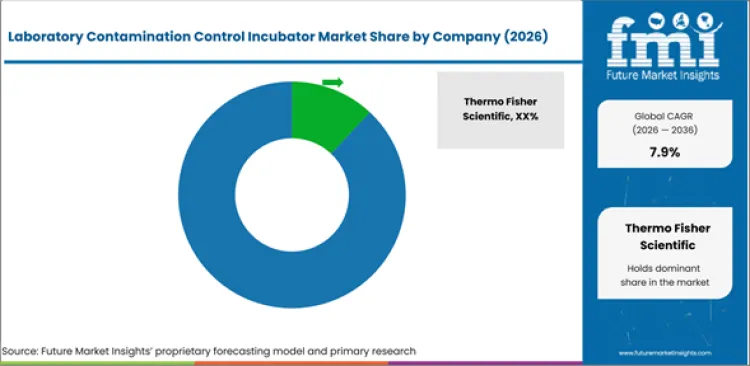
- Competition is based on decontamination cycle speed and chamber air protection. Service reach and documentation support add supplier separation.
- Premium suppliers compete through H2O2 and HEPA portfolios. Heat sterilization and connected monitoring add feature depth.
- Application specialists win accounts by matching IVF and microbiological cell culture needs. Medical-use requirements add a separate specification path.
- Regional distributors influence supplier choice through installation and calibration. Spare parts and maintenance response affect repeat buying.
Competition centers on global incubator makers and application specialists. Thermo Fisher Scientific and PHCbi compete with Eppendorf and BINDER through broad CO2 incubator portfolios. Esco and NuAire compete with Memmert through targeted clinical or microbiological use cases.
Filing depth and manufacturing credibility matter in biopharma accounts. Buyers reviewing biopharmaceutical contract manufacturing capacity often ask for incubator validation documents before approving equipment upgrades.
The better-positioned suppliers combine proven chamber recovery with service readiness. Monitoring options add differentiation. This matters in drug discovery services workflows that cannot absorb repeated cell-based assay failures.
HEPA suppliers also benefit from adjacent laboratory filtration devices demand. Users already understand filter validation and maintenance routines.
- Biologics facilities place more value on documented contamination-control performance. Culture failure can affect development timelines.
- Cell line development services also support premium incubator demand. Stable chambers protect long-duration culture and clone expansion work.
- Clinical research organization buyers compare service cover and documentation for decentralized testing and sponsor-facing laboratory work.
How do top laboratory contamination control incubator market companies compare?
Thermo Fisher and PHCbi show deep contamination-control positioning. Eppendorf and BINDER strengthen connected monitoring and sterilization value.
| Company | Relevance to Market Title | Decontamination Cycle Depth | Chamber Air Protection | Service and Monitoring Support | Channel Reach | Geographic Footprint |
|---|---|---|---|---|---|---|
| Thermo Fisher Scientific | Very High | High | Strong | Very High | Very High | Global |
| PHCbi | Very High | Very High | Very High | Strong | Strong | Global |
| Eppendorf | High | Strong | Medium | Very High | High | Global |
| BINDER | High | Very High | Medium | Strong | High | Europe and global |
| Esco Lifesciences | High | Strong | Strong | Medium | Medium | Global |
| NuAire | High | Medium | Very High | Strong | Medium | North America and export |
| Memmert | Medium | Medium | Medium | Strong | Medium | Europe and global |
Source: Future Market Insights competitive analysis, 2026. Ratings reflect relative positioning based on product literature and service reach.
Who are the key players in the laboratory contamination control incubator market?
Key global companies include Thermo Fisher Scientific and PHCbi. Eppendorf and BINDER are included with Esco Lifesciences. NuAire and Memmert complete the profiled group.
Key global companies leading the laboratory contamination control incubator market include:
- Thermo Fisher Scientific
- PHCbi
- Eppendorf
- BINDER
- Esco Lifesciences
- NuAire
- Memmert
Key Developments in Laboratory Contamination Control Incubator Market
- In June 2024, Thermo Fisher Scientific published Heracell Vios CR evidence for G-Rex bioreactor incubation. The material supports cell and gene therapy workflows needing stable chamber recovery.
Key Players in the Laboratory Contamination Control Incubator Market
Global Leaders
- Thermo Fisher Scientific
- PHCbi
- Eppendorf
- BINDER
Application Specialists
- Esco Lifesciences
- NuAire
- Memmert
Channel-Driven Competitors
- Regional laboratory equipment distributors
- Clinical laboratory equipment dealers
- IVF equipment specialists
What is the scope and definition of the laboratory contamination control incubator market?
| Attribute | Detail |
|---|---|
| Market Definition | CO2 and multi-gas laboratory incubators with built-in contamination-prevention features for controlled cell culture and clinical laboratory workflows |
| Functions Covered | Chamber decontamination, air protection, gas control, temperature stability, contamination-risk reduction, and documentation support |
| Applications Covered | Cell culture, drug discovery, IVF, and regulated laboratory workflows |
| End-Use Industries | Pharmaceutical and biotech companies, academic research centers, clinical laboratories, IVF clinics, and contract research organizations |
| Grades Covered | UV-LED sterilization systems, H2O2 decontamination systems, HEPA filtration systems, copper-alloy surface systems, and heat sterilization platforms |
| Inclusions | Commercial contamination-control incubators sold with integrated chamber protection features, controls, accessories, and service-ready platforms |
| Exclusions | Basic microbiological incubators, dry ovens, neonatal incubators, biosafety cabinets, clean benches, and standalone decontamination equipment |
Source: Future Market Insights, 2026.
What research methodology is used for the laboratory contamination control incubator market?
| Method | Description |
|---|---|
| Primary Research | FMI analyst interviews with laboratory managers, IVF lab directors, biopharma equipment buyers, service engineers, and distributor teams across profiled markets |
| Desk Research | Review of regulator releases, national statistics, company product literature, equipment specifications, and supplier development materials related to contamination-control incubators |
| Market Sizing & Forecasting | Bottom-up equipment demand modeling combined with feature penetration, capacity mix, application split, and country-level laboratory investment indicators |
| Data Validation | Cross-checks using supplier portfolios, adjacent CO2 incubator demand, country research activity, IVF workflow signals, and expert review of forecast assumptions |
Source: Future Market Insights, 2026.
What is the report scope for the laboratory contamination control incubator market?
| Parameter | Details |
|---|---|
| Forecast period | 2026 to 2036 |
| Historical period | 2021 to 2025 |
| Quantitative unit | Value in USD million and CAGR in percent |
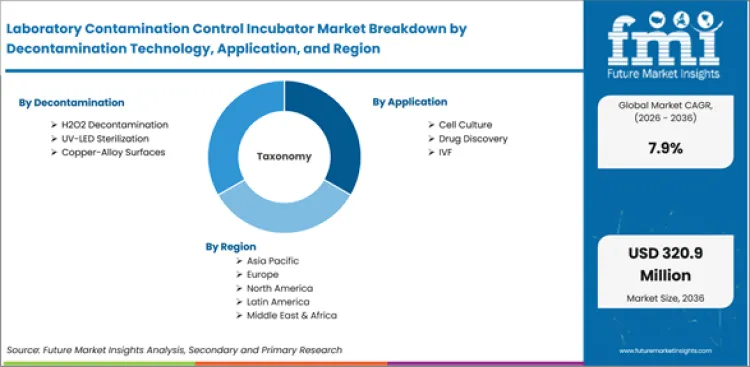
| Segmentation by Decontamination Technology | UV-LED Sterilization, H2O2 Decontamination, HEPA Filtration, and Copper-Alloy Surfaces |
| Segmentation by Application | Cell Culture, Drug Discovery, and IVF |
| Segmentation by Capacity | Below 150 Liters, 150-250 Liters, and Above 250 Liters |
| Segmentation by End User | Pharmaceutical & Biotech, Academic Research, and Clinical Labs |
| Regions covered | North America, Europe, East Asia, Middle East, and Rest of World |
| Countries covered | United States, United Kingdom, Germany, France, Japan, China, South Korea, and India |
| Key companies profiled | Thermo Fisher Scientific, PHCbi, Eppendorf, BINDER, Esco Lifesciences, NuAire, Memmert |
| Approach | Hybrid bottom-up and top-down methodology using product portfolios, feature penetration, capacity mix, and country demand indicators |
Source: Future Market Insights, 2026.
Laboratory Contamination Control Incubator Market Breakdown by Decontamination Technology, Application, Capacity, End User, and Region
Laboratory Contamination Control Incubator Market Segmented by Decontamination Technology
- UV-LED Sterilization
- H2O2 Decontamination
- HEPA Filtration
- Copper-Alloy Surfaces
Laboratory Contamination Control Incubator Market Segmented by Application
- Cell Culture
- Drug Discovery
- IVF
Laboratory Contamination Control Incubator Market Segmented by Capacity
- Below 150 Liters
- 150-250 Liters
- Above 250 Liters
Laboratory Contamination Control Incubator Market Segmented by End User
- Pharmaceutical & Biotech
- Academic Research
- Clinical Labs
Laboratory Contamination Control Incubator Market by Region
- North America
- United States
- Canada
- Europe
- Germany
- United Kingdom
- France
- Italy
- Spain
- Asia Pacific
- China
- Japan
- South Korea
- Taiwan
- Singapore
- Latin America
- Brazil
- Mexico
- Argentina
- Middle East & Africa
- GCC Countries
- South Africa
- Israel
Research Sources and Bibliography
- USA Food and Drug Administration. (2025, January). 2024 New Drug Therapy Approvals Annual Report.
- National Center for Science and Engineering Statistics. (2026, February). Universities report 8.1% growth in R&D expenditures in FY 2024. National Science Foundation.
- National Institutes of Health. (2026, March). Fiscal year 2025 by the numbers: Extramural grant investments in research.
- Human Fertilisation and Embryology Authority. (2025, June). Fertility treatment 2023: trends and figures.
- Human Fertilisation and Embryology Authority. (2025, November). The fertility sector 2024/25.
- Office for National Statistics. (2025, November). Business enterprise research and development, UK: 2024.
- Office for National Statistics. (2026, April). Research and development expenditure by the UK government: 2024.
- Germany Trade & Invest. (2026, April). R&D spending in Germany increases by 3.8 percent in 2024.
- Germany Trade & Invest. (2025, August). The medical biotechnology industry in Germany.
- Sanofi. (2024, May). Sanofi adds over EUR 1 billion for biomanufacturing.
- French Healthcare. (2025, March). French bioproduction: Unparalleled dynamism.
- France Diplomatie. (2025, October). The France 2030 investment programme.
- Japan Agency for Medical Research and Development. (2025, September). Project for regenerative medicine and cell and gene therapies.
- Pharmaceuticals and Medical Devices Agency. (2025, September). FY 2024 GMP/GCTP Annual Report.
- Pharmaceuticals and Medical Devices Agency. (2026, May). Regenerative medical products.
- National Medical Products Administration. (2024, September). Big push for homegrown innovative medicines.
- Ministry of Science and ICT. (2024, September). Major R&D budget for 2025 set to be KRW 24.8 trillion.
- Press Information Bureau, Government of India. (2025, March). The rise of India’s bioeconomy from USD 10 billion to USD 165.7 billion.
- National Bureau of Statistics of China. (2025, January). China’s R&D spending reports growth in 2024.
- Ministry of Finance of China. (2024, March). Report on central and local budgets.
- Biotechnology Industry Research Assistance Council. (2024, December). India BioEconomy Report 2024.
- Ministry of Science and Technology, Government of India. (2025, August). Parliament question: R&D investment in India.
- Invest Korea. (2026, June). Industry deep dive: biotechnology in Korea.
- Korea.net. (2026, March). Biohealth exports reach record high of USD 27.9 billion.
- Statistics Bureau of Japan. (2026, January). News bulletin on R&D activity.
- Japan Science and Technology Agency. (2025, June). FY2025 science and technology budget exceeds 5 trillion yen.
- Eurostat. (2025, November). R&D expenditure statistics explained.
- USA International Trade Administration. (2025, August). Germany: healthcare and medical technology.
- Thermo Fisher Scientific. (2024, June). G-Rex bioreactors incubated in Heracell Vios CR CO2 incubators.
- NuAire. (2024, August). In-VitroCell CO2 incubator: Advanced contamination control for cell culture.
The bibliography is provided for reader reference and uses primary government, regulator, company, or official organization sources.
This Report Answers
- What is the current and future value of the Laboratory Contamination Control Incubator Market from 2026 to 2036?
- Which decontamination technology is expected to lead contamination-control incubator demand in 2026?
- Why are H2O2 systems gaining buyer attention in high-use laboratory workflows?
- How do cell culture and IVF applications differ in contamination-control incubator buying behavior?
- Which countries are forecast to grow fastest in contamination-control incubator demand?
- Which companies have the clearest contamination-control incubator product positioning?
- How do HEPA filtration and H2O2 decontamination differ in operating value?
- What restraints affect replacement cycles in academic and clinical laboratories?
- How does FMI size the contamination-control subset within the wider CO2 incubator category?
Frequently Asked Questions
What is the growth prospect for laboratory contamination control incubator market?
Demand is expected to rise as laboratories upgrade from basic incubation to validated contamination-control systems.
Why are laboratories investing in contamination-control incubators?
Laboratories are investing to reduce downtime and protect cell-line integrity. Regulated workflows also need stronger documentation.
Why is H2O2 decontamination important in this market?
H2O2 decontamination is important due to faster chamber reset after contamination events or scheduled cleaning.
Which application is most important for contamination-control incubators?
Cell culture is the main application due to higher risk from microbial exposure and unstable gas recovery in long experiments.
How do IVF clinics use contamination-control incubators?
IVF clinics use compact controlled chambers to protect embryo culture stability and reduce disturbance during access.
What role does HEPA filtration play in contamination control?
HEPA filtration provides continuous chamber air protection between full cleaning cycles in shared laboratory environments.
How do buyers compare suppliers in this market?
Buyers compare decontamination cycle time and airflow protection. Service response and validation support affect supplier selection.
What limits faster adoption of premium systems?
Higher purchase price and service cost limit faster adoption. User training and budget cycles add pressure in smaller laboratories.
Preview the report firsthand - request a free sample
Get SampleGet the brochure for pricing and purchase details.
Get PDFTable of Content
- Key Takeaways
- Market Size and CAGR
- Top Growth Driver
- Fastest Growing Segment
- Leading Region
- Key Companies
- Emerging Opportunities
- Executive Summary
- Global Market Outlook
- Demand-side Trends
- Supply-side Trends
- Technology Roadmap Analysis
- Analysis and Recommendations
- Analyst Perspective (What is happening? Why now? What should investors know?)
- Key Questions Answered
- How large is the market?
- What is the CAGR?
- What are key trends?
- Which region dominates?
- Who are the leaders?
- Market Overview
- Market Coverage / Taxonomy
- Market Definition / Scope / Limitations
- Research Methodology
- Chapter Orientation
- Analytical Lens and Working Hypotheses
- Market Structure, Signals, and Trend Drivers
- Benchmarking and Cross-market Comparability
- Market Sizing, Forecasting, and Opportunity Mapping
- HEPA Filtration
- Research Design and Evidence Framework
- Desk Research Programme (Secondary Evidence)
- Expert Input and Fieldwork (Primary Evidence)
- Tooling, Models, and Reference Databases
- HEPA Filtration
- Data Engineering and Model Build
- Quality Assurance and Audit Trail
- Market Background
- Market Dynamics (Drivers, Restraints, Opportunity, Trends)
- Scenario Forecast (Optimistic, Likely, Conservative)
- Impact Analysis
- AI Impact
- Sustainability Impact
- Regulatory Impact
- Technology Impact
- HEPA Filtration
- Consumer / Buyer Analysis
- Purchase Drivers
- Adoption Barriers
- Buyer Journey
- HEPA Filtration
- Opportunity Map Analysis
- Product Life Cycle Analysis
- Supply Chain Analysis
- Investment Feasibility Matrix
- Value Chain Analysis
- PESTLE and Porter's Analysis
- Regulatory Landscape
- Regional Parent Market Outlook
- Production and Consumption Statistics
- Import and Export Statistics
- Global Market Analysis and Forecast, 2021 to 2036
- Historical Market Size Value (USD Million) & Volume (Unit) Analysis, 2021 to 2025
- Current and Future Market Size Value (USD Million) & Volume (Unit) Projections, 2026 to 2036
- Y-o-Y Growth Trend Analysis
- Absolute $ Opportunity Analysis
- Global Market Pricing Analysis, 2021 to 2036
- Global Market Analysis and Forecast, By Decontamination Technology, 2021 to 2036
- Introduction / Key Findings
- Historical Market Size Value (USD Million) & Volume (Unit) Analysis By Decontamination Technology, 2021 to 2025
- Current and Future Market Size Value (USD Million) & Volume (Unit) Analysis and Forecast By Decontamination Technology, 2026 to 2036
- H2O2 Decontamination
- UV-LED Sterilization
- Copper-Alloy Surfaces
- HEPA Filtration
- H2O2 Decontamination
- Y-o-Y Growth Trend Analysis By Decontamination Technology, 2021 to 2025
- Absolute $ Opportunity Analysis By Decontamination Technology, 2026 to 2036
- Global Market Analysis and Forecast, By Application, 2021 to 2036
- Introduction / Key Findings
- Historical Market Size Value (USD Million) & Volume (Unit) Analysis By Application, 2021 to 2025
- Current and Future Market Size Value (USD Million) & Volume (Unit) Analysis and Forecast By Application, 2026 to 2036
- Cell Culture
- Drug Discovery
- IVF
- HEPA Filtration
- Cell Culture
- Y-o-Y Growth Trend Analysis By Application, 2021 to 2025
- Absolute $ Opportunity Analysis By Application, 2026 to 2036
- Global Market Analysis and Forecast, By Capacity, 2021 to 2036
- Introduction / Key Findings
- Historical Market Size Value (USD Million) & Volume (Unit) Analysis By Capacity, 2021 to 2025
- Current and Future Market Size Value (USD Million) & Volume (Unit) Analysis and Forecast By Capacity, 2026 to 2036
- 150-250 Liters
- Below 150 Liters
- Above 250 Liters
- HEPA Filtration
- 150-250 Liters
- Y-o-Y Growth Trend Analysis By Capacity, 2021 to 2025
- Absolute $ Opportunity Analysis By Capacity, 2026 to 2036
- Global Market Analysis and Forecast, By End User, 2021 to 2036
- Introduction / Key Findings
- Historical Market Size Value (USD Million) & Volume (Unit) Analysis By End User, 2021 to 2025
- Current and Future Market Size Value (USD Million) & Volume (Unit) Analysis and Forecast By End User, 2026 to 2036
- Pharmaceutical & Biotech
- Academic Research
- Clinical Labs
- HEPA Filtration
- Pharmaceutical & Biotech
- Y-o-Y Growth Trend Analysis By End User, 2021 to 2025
- Absolute $ Opportunity Analysis By End User, 2026 to 2036
- Global Market Analysis and Forecast, By Region, 2021 to 2036
- Introduction
- Historical Market Size Value (USD Million) & Volume (Unit) Analysis By Region, 2021 to 2025
- Current Market Size Value (USD Million) & Volume (Unit) Analysis and Forecast By Region, 2026 to 2036
- North America
- Latin America
- Western Europe
- Eastern Europe
- East Asia
- South Asia and Pacific
- Middle East & Africa
- HEPA Filtration
- Market Attractiveness Analysis By Region
- North America Market Analysis and Forecast, By Country, 2021 to 2036
- Historical Market Size Value (USD Million) & Volume (Unit) Trend Analysis By Market Taxonomy, 2021 to 2025
- Market Size Value (USD Million) & Volume (Unit) Forecast By Market Taxonomy, 2026 to 2036
- By Country
- USA
- Canada
- Mexico
- By Decontamination Technology
- By Application
- By Capacity
- By End User
- HEPA Filtration
- By Country
- Market Attractiveness Analysis
- By Country
- By Decontamination Technology
- By Application
- By Capacity
- By End User
- HEPA Filtration
- Key Takeaways
- Latin America Market Analysis and Forecast, By Country
- Historical Market Size Value (USD Million) & Volume (Unit) Trend Analysis By Market Taxonomy, 2021 to 2025
- Market Size Value (USD Million) & Volume (Unit) Forecast By Market Taxonomy, 2026 to 2036
- By Country
- Brazil
- Chile
- Rest of Latin America
- By Decontamination Technology
- By Application
- By Capacity
- By End User
- HEPA Filtration
- By Country
- Market Attractiveness Analysis
- By Country
- By Decontamination Technology
- By Application
- By Capacity
- By End User
- HEPA Filtration
- Key Takeaways
- Western Europe Market Analysis and Forecast, By Country
- Historical Market Size Value (USD Million) & Volume (Unit) Trend Analysis By Market Taxonomy, 2021 to 2025
- Market Size Value (USD Million) & Volume (Unit) Forecast By Market Taxonomy, 2026 to 2036
- By Country
- Germany
- UK
- Italy
- Spain
- France
- Nordic
- BENELUX
- Rest of Western Europe
- By Decontamination Technology
- By Application
- By Capacity
- By End User
- HEPA Filtration
- By Country
- Market Attractiveness Analysis
- By Country
- By Decontamination Technology
- By Application
- By Capacity
- By End User
- HEPA Filtration
- Key Takeaways
- Eastern Europe Market Analysis and Forecast, By Country
- Historical Market Size Value (USD Million) & Volume (Unit) Trend Analysis By Market Taxonomy, 2021 to 2025
- Market Size Value (USD Million) & Volume (Unit) Forecast By Market Taxonomy, 2026 to 2036
- By Country
- Russia
- Poland
- Hungary
- Balkan & Baltic
- Rest of Eastern Europe
- By Decontamination Technology
- By Application
- By Capacity
- By End User
- HEPA Filtration
- By Country
- Market Attractiveness Analysis
- By Country
- By Decontamination Technology
- By Application
- By Capacity
- By End User
- HEPA Filtration
- Key Takeaways
- East Asia Market Analysis and Forecast, By Country
- Historical Market Size Value (USD Million) & Volume (Unit) Trend Analysis By Market Taxonomy, 2021 to 2025
- Market Size Value (USD Million) & Volume (Unit) Forecast By Market Taxonomy, 2026 to 2036
- By Country
- China
- Japan
- South Korea
- By Decontamination Technology
- By Application
- By Capacity
- By End User
- HEPA Filtration
- By Country
- Market Attractiveness Analysis
- By Country
- By Decontamination Technology
- By Application
- By Capacity
- By End User
- HEPA Filtration
- Key Takeaways
- South Asia and Pacific Market Analysis and Forecast, By Country
- Historical Market Size Value (USD Million) & Volume (Unit) Trend Analysis By Market Taxonomy, 2021 to 2025
- Market Size Value (USD Million) & Volume (Unit) Forecast By Market Taxonomy, 2026 to 2036
- By Country
- India
- ASEAN
- Australia & New Zealand
- Rest of South Asia and Pacific
- By Decontamination Technology
- By Application
- By Capacity
- By End User
- HEPA Filtration
- By Country
- Market Attractiveness Analysis
- By Country
- By Decontamination Technology
- By Application
- By Capacity
- By End User
- HEPA Filtration
- Key Takeaways
- Middle East & Africa Market Analysis and Forecast, By Country
- Historical Market Size Value (USD Million) & Volume (Unit) Trend Analysis By Market Taxonomy, 2021 to 2025
- Market Size Value (USD Million) & Volume (Unit) Forecast By Market Taxonomy, 2026 to 2036
- By Country
- Kingdom of Saudi Arabia
- Other GCC Countries
- Türkiye
- South Africa
- Other African Union
- Rest of Middle East & Africa
- By Decontamination Technology
- By Application
- By Capacity
- By End User
- HEPA Filtration
- By Country
- Market Attractiveness Analysis
- By Country
- By Decontamination Technology
- By Application
- By Capacity
- By End User
- HEPA Filtration
- Key Takeaways
- Key Countries Market Analysis
- USA
- Pricing Analysis
- Market Share Analysis, 2025
- By Decontamination Technology
- By Application
- By Capacity
- By End User
- HEPA Filtration
- Canada
- Pricing Analysis
- Market Share Analysis, 2025
- By Decontamination Technology
- By Application
- By Capacity
- By End User
- HEPA Filtration
- Mexico
- Pricing Analysis
- Market Share Analysis, 2025
- By Decontamination Technology
- By Application
- By Capacity
- By End User
- HEPA Filtration
- Brazil
- Pricing Analysis
- Market Share Analysis, 2025
- By Decontamination Technology
- By Application
- By Capacity
- By End User
- HEPA Filtration
- Chile
- Pricing Analysis
- Market Share Analysis, 2025
- By Decontamination Technology
- By Application
- By Capacity
- By End User
- HEPA Filtration
- Germany
- Pricing Analysis
- Market Share Analysis, 2025
- By Decontamination Technology
- By Application
- By Capacity
- By End User
- HEPA Filtration
- UK
- Pricing Analysis
- Market Share Analysis, 2025
- By Decontamination Technology
- By Application
- By Capacity
- By End User
- HEPA Filtration
- Italy
- Pricing Analysis
- Market Share Analysis, 2025
- By Decontamination Technology
- By Application
- By Capacity
- By End User
- HEPA Filtration
- Spain
- Pricing Analysis
- Market Share Analysis, 2025
- By Decontamination Technology
- By Application
- By Capacity
- By End User
- HEPA Filtration
- France
- Pricing Analysis
- Market Share Analysis, 2025
- By Decontamination Technology
- By Application
- By Capacity
- By End User
- HEPA Filtration
- India
- Pricing Analysis
- Market Share Analysis, 2025
- By Decontamination Technology
- By Application
- By Capacity
- By End User
- HEPA Filtration
- ASEAN
- Pricing Analysis
- Market Share Analysis, 2025
- By Decontamination Technology
- By Application
- By Capacity
- By End User
- HEPA Filtration
- Australia & New Zealand
- Pricing Analysis
- Market Share Analysis, 2025
- By Decontamination Technology
- By Application
- By Capacity
- By End User
- HEPA Filtration
- China
- Pricing Analysis
- Market Share Analysis, 2025
- By Decontamination Technology
- By Application
- By Capacity
- By End User
- HEPA Filtration
- Japan
- Pricing Analysis
- Market Share Analysis, 2025
- By Decontamination Technology
- By Application
- By Capacity
- By End User
- HEPA Filtration
- South Korea
- Pricing Analysis
- Market Share Analysis, 2025
- By Decontamination Technology
- By Application
- By Capacity
- By End User
- HEPA Filtration
- Russia
- Pricing Analysis
- Market Share Analysis, 2025
- By Decontamination Technology
- By Application
- By Capacity
- By End User
- HEPA Filtration
- Poland
- Pricing Analysis
- Market Share Analysis, 2025
- By Decontamination Technology
- By Application
- By Capacity
- By End User
- HEPA Filtration
- Hungary
- Pricing Analysis
- Market Share Analysis, 2025
- By Decontamination Technology
- By Application
- By Capacity
- By End User
- HEPA Filtration
- Kingdom of Saudi Arabia
- Pricing Analysis
- Market Share Analysis, 2025
- By Decontamination Technology
- By Application
- By Capacity
- By End User
- HEPA Filtration
- Türkiye
- Pricing Analysis
- Market Share Analysis, 2025
- By Decontamination Technology
- By Application
- By Capacity
- By End User
- HEPA Filtration
- South Africa
- Pricing Analysis
- Market Share Analysis, 2025
- By Decontamination Technology
- By Application
- By Capacity
- By End User
- USA
- Market Structure Analysis
- Competition Dashboard
- Competition Benchmarking
- Market Share Analysis of Top Players
- By Regional
- By Decontamination Technology
- By Application
- By Capacity
- By End User
- Emerging Startups
- Innovation Benchmarking
- HEPA Filtration
- Competition Analysis
- Competition Deep Dive
- Thermo Fisher Scientific
- Overview
- Product Portfolio
- Profitability by Market Segments (Product/Region/Sales Channel)
- Sales Footprint
- Strategy Overview
- Marketing Strategy
- Product Strategy
- Channel Strategy
- PHCbi
- Eppendorf
- BINDER
- NuAire
- Thermo Fisher Scientific
- Case Studies
- Success Stories
- Recent Developments
- Competition Deep Dive
- Assumptions & Acronyms Used


