

- Industry Size (2026)
- USD 382 Mn
- Forecast (2036)
- USD 641 Mn
- CAGR (2026 to 2036)
- 5.3%
UV-Resistant Industrial Stretch Film Market Size, Market Forecast and Outlook By FMI
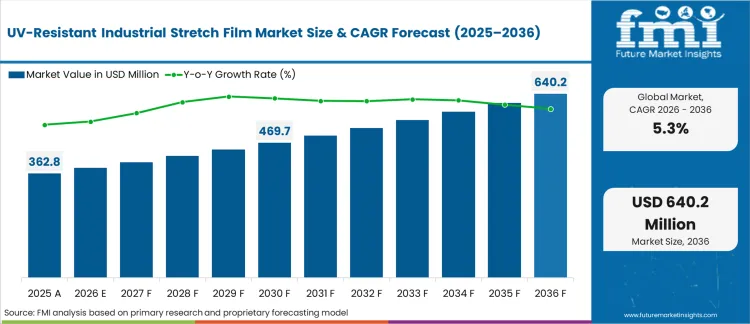
The UV‑Resistant Industrial Stretch Film Market was valued at USD 363 million in 2025, reflecting strong demand driven by the need for weather‑resilient palletized logistics systems. Market projections indicate that revenues will rise to USD 382 million in 2026, supported by increased procurement commitments across construction, logistics, and outdoor material‑handling sectors.
Over the longer term, sustained adoption of UVI‑enhanced packaging solutions is expected to push the market to USD 641 million by 2036, representing a compound annual growth rate (CAGR) of 5.3%. Packaging engineers exposed to maritime trade bottlenecks and prolonged outdoor container dwell times are respecifying primary load containment architectures to prevent ultraviolet degradation. Operations directors who fail to upgrade wrapping standards face severe cargo rejection rates from downstream receivers.
Supply chain leaders are recalibrating packaging resilience after recognizing that port congestion extends outdoor exposure far beyond historical logistics models. UN Trade and Development data indicates global maritime trade grew 2.4% in 2023 [1], increasing the volume of palletized goods subjected to aggressive port-side conditions. Logistics directors are mandating ultraviolet stabilization additives in stretch hood films to secure high-value industrial materials. Facilities neglecting these baseline specifications forfeit long-term transport contracts to competitors deploying scientifically validated weatherproof layers.
Summary of UV-Resistant Industrial Stretch Film Market
- UV-Resistant Industrial Stretch Film Market Definition
- A specialized secondary packaging material formulated with ultraviolet inhibitors to protect palletized industrial goods from photodegradation during prolonged outdoor storage.
- Demand Drivers in the Market
- Extended maritime shipping delays forcing goods into uncovered port staging zones.
- Construction sector reliance on outdoor staging for bulk materials like cement and lumber.
- Regulatory pressure to incorporate post-consumer recycled content into durable film structures.
- Key Segments Analyzed in the FMI Report
- UVI Machine Stretch Film: 29.8% share as high-volume automated wrapping lines dominate industrial output.
- Construction Sites: 34.6% share driven by mandatory outdoor material staging protocols.
- Asia Pacific: Expanding due to massive export-driven port infrastructure and manufacturing density.
- Analyst Opinion at FMI
- Ismail Sutaria, Principal Consultant for Packaging, opines, “Most operations managers treat ultraviolet stabilizers as an optional upgrade, but the actual gate is a supply chain liability: vendors who guarantee 12-month outdoor film integrity win the contract before a single load ships. Operators still waiting for basic clear film to survive summer transits will forfeit their logistics contracts to partners who committed to UVI specifications a year ago.”
- Strategic Implications/Executive Takeaways
- Integrate UVI additives into thinner film gauges to balance material cost with performance.
- Align film structures with emerging recycling pacts to ensure downstream compliance.
- Target high-dwell-time industries like cement and bulk chemicals for premium contracts.
- Methodology
- Primary Research: Direct interviews with packaging engineers, polymer scientists, and facility logistics directors across major industrial hubs.
- Desk Research: Custom data extraction from global trade organizations, shipping databases, and corporate material science announcements.
- Market-Sizing and Forecasting: Analysts developed a bottom-up adoption model starting from palletized freight volumes and applying UVI penetration rates.
- Data Validation and Update Cycle: Findings underwent cross-verification against official transportation logs and material science journals before final integration.
Christian Kolarik, CEO at Coveris, opined, “The Green Packaging Star Award win highlights our innovative strength and our strong commitment to the circular economy. With our new sleeve solution, we have demonstrated that resource efficiency, recyclability and brand presence can be seamlessly combined.” [2] Chemical formulation advances validate that ultraviolet resistance and environmental compliance are no longer mutually exclusive targets for industrial packaging buyers. Converters securing certified recycled resin streams are permanently elevating the baseline performance criteria that all competing manufacturers must meet before the next tender cycle opens.
India's 6.5% rate reflects rapid infrastructure expansion requiring massive open-air material staging. China follows at 6.0% as coastal port congestion necessitates highly durable containment for exported goods. Brazil expands at 5.6% driven by agricultural and industrial exports facing intense equatorial sunlight. The United States advances at 4.8% as established logistics networks enforce strict pallet integrity rules. Germany and the UK post steady rates of 4.5% and 4.3% respectively, balancing strict circularity policies with heavy industrial output. Japan grows at 4.0% under rigid domestic quality assurance standards for outdoor storage.
UV-Resistant Industrial Stretch Film Market Definition
The UV-Resistant Industrial Stretch Film Market encompasses the commercial ecosystem of polyethylene-based wrapping solutions engineered with specific chemical inhibitors to block ultraviolet radiation. These films are utilized predominantly for securing palletized freight, heavy machinery, and construction materials that endure prolonged exposure to sunlight. The market includes both manual and machine-applied formats alongside specialized stretch hoods and pallet covers.
UV-Resistant Industrial Stretch Film Market Inclusions
The scope includes linear low-density polyethylene films containing UVI additives, tinted and opaque protective wraps, and heavy-duty shrink hoods designed for outdoor industrial application. Stretch films incorporating certified post-consumer recycled content while maintaining ultraviolet resistance ratings are also strictly included. A primary example is black UVI machine wrap used by lumber yards to prevent wood bleaching and moisture accumulation.
UV-Resistant Industrial Stretch Film Market Exclusions
The scope strictly excludes standard indoor stretch films lacking chemical UV stabilizers. Primary food contact films, consumer-facing cling wraps, and rigid plastic bulk containers are entirely excluded. A clear example of an excluded product is standard 80-gauge clear pallet wrap utilized solely within climate-controlled, windowless distribution centers.
UV-Resistant Industrial Stretch Film Market Research Methodology
- Primary Research: Extensive dialogue with resin suppliers, film extrusion facility managers, and industrial end-users across construction and logistics sectors.
- Desk Research: Aggregation of data from national environmental agencies, global shipping registries, and polymer patent filings to substantiate capacity models.
- Market-Sizing and Forecasting: Adoption of a bottom-up approach linking regional industrial output to required pallet containment metrics, validating projected tonnage.
- Data Validation and Update Cycle: All projection variables face rigorous testing against recognized international trade data and sustainability pact targets prior to forecast lock.
Segmental Analysis
UV-Resistant Industrial Stretch Film Market Analysis by Type
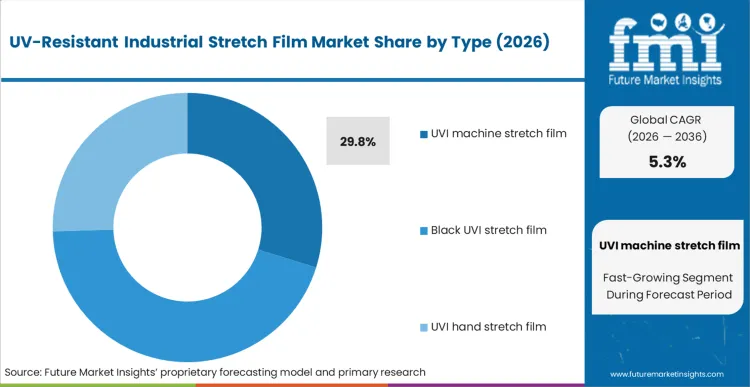
High-volume distribution centers reject manual wrapping methods as labor constraints force full automation across the load containment sector. Operations directors specify UVI machine stretch film to align with these automated systems, generating 29.8% of the total segment volume. FMI analysts opine that integrating ultraviolet stabilizers directly into machine-grade rolls eliminates the secondary step of applying protective tarps. Packaging engineers without access to these advanced automated films lose bid priority for large-scale outdoor storage contracts.
- Throughput Optimization: UVI machine films minimize application time on automated turntables.
- Tension Control: Automated delivery systems require highly consistent film yielding properties.
- Labor Displacement: Facilities eliminate manual tarping protocols by deploying integrated UVI stretch films.
UV-Resistant Industrial Stretch Film Market Analysis by End Use
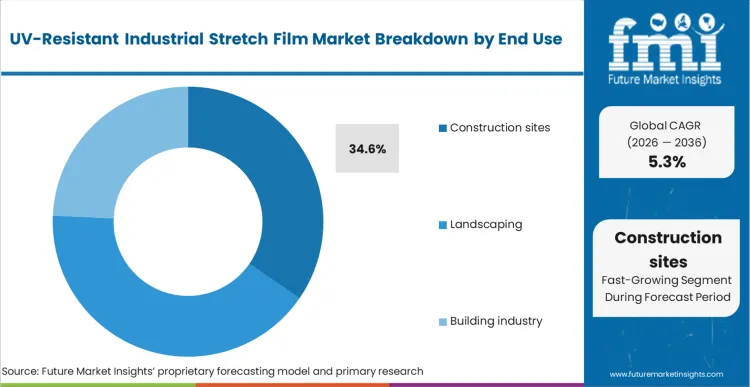
Contractors operating under strict project timelines cannot afford material degradation losses caused by elemental exposure. The USGS estimates United States cement shipments reached 110 million tons in 2023 [4], representing a massive, palletized flow requiring outdoor staging stability. Construction sites capture 34.6% of segment demand as builders mandate ultraviolet-stabilized wraps for all incoming raw materials. Procurement teams immediately disqualify suppliers delivering cement or lumber in standard untreated films. Distributors failing to adopt these resistant packaging standards face immediate contract termination from Tier-1 commercial developers.
- Material Preservation: UVI films prevent moisture and sun damage to cured building products.
- Site Logistics: Uncovered staging areas demand heavy-duty pallet containment security.
- Inventory Buffering: Extended project timelines require packaging that survives multi-month outdoor exposure.
UV-Resistant Industrial Stretch Film Market Analysis by Colour
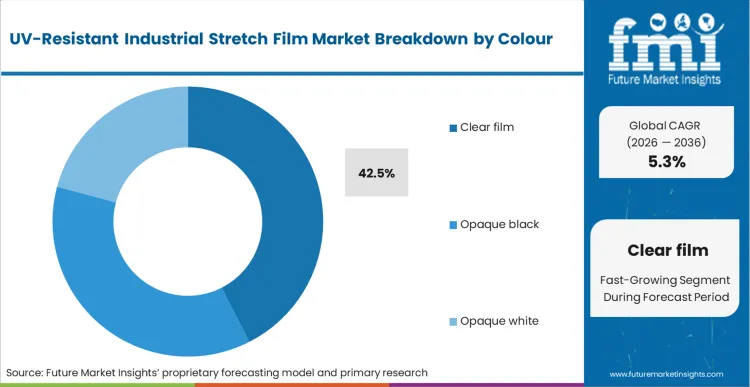
Visual inspection requirements heavily dictate the aesthetic specifications of protective industrial wraps. Clear film maintains a dominant 42.5% share as distribution hubs prioritize barcode scannability and immediate product identification without compromising ultraviolet resistance. TotalEnergies and SML announced new downgauging film solutions in September 2025 [5], proving that material clarity and strength can coexist in modern polymer structures. Logistics managers specify clear formulations to accelerate customs and inventory auditing procedures at active shipping ports. Manufacturers restricted to opaque formulations face narrowing opportunities in sectors requiring high-speed visual verification.
- Inventory Tracking: Transparent structures allow immediate scanning of internal pallet labels.
- Security Auditing: Clear films reveal internal load tampering without breaking the containment seal.
- Aesthetic Preference: Brands prefer visible logos beneath the protective weather barrier.
UV-Resistant Industrial Stretch Film Market Analysis by Feature
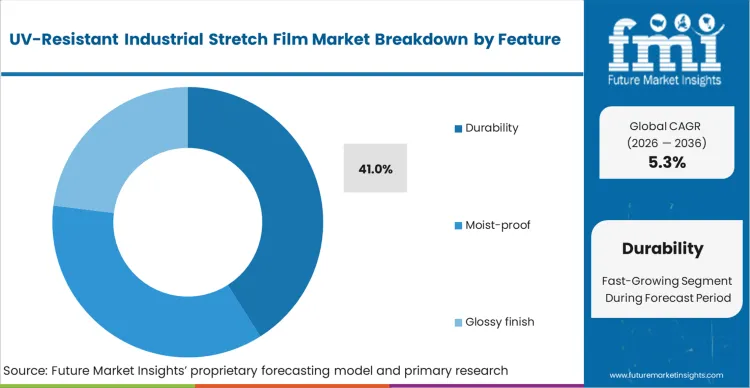
Puncture resistance and tear propagation limits dictate the survivability of films during aggressive mechanical handling. Charter Next Generation launched the Titanium 5P stretch hood film featuring 20% recycled content and all-weather protection in February 2024 [6]. Durability commands 41.0% of the segment share as heavy industrial users require films that withstand both solar degradation and forklift abrasions. Procurement heads prioritize this dual-threat resilience to eliminate catastrophic pallet failures during transit. Film extruders unable to verify high-impact durability alongside UVI ratings are excluded from heavy-goods logistics tenders.
- Load Shifting Prevention: High holding force maintains pallet structure during chaotic transit.
- Abrasion Resistance: Thickened structures prevent edge-tearing from sharp industrial components.
- Recycled Integration: Durability metrics must now be achieved using post-consumer resin streams.
UV-Resistant Industrial Stretch Film Market Analysis by Size
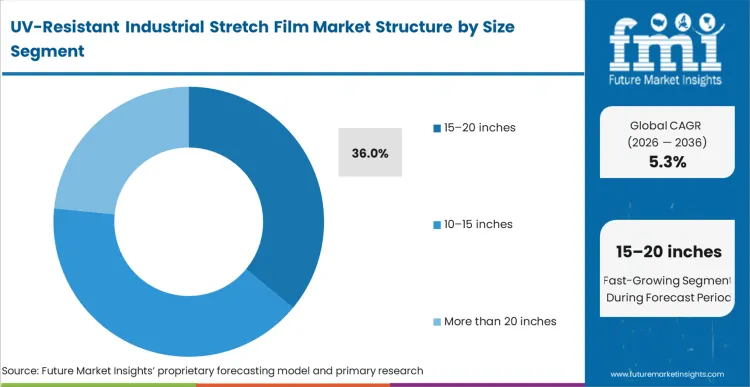
Standardization of pallet dimensions dictates the geometric requirements of compatible machine wrap rolls. The 15-20 inches width category accounts for 36.0% of the market, perfectly aligning with the carriage capacities of universal stretch wrapping equipment. Warehouse operators standardize their purchasing around this dimension to guarantee interoperability across different wrapping stations. Suppliers deviating from these core dimensions struggle to secure long-term procurement agreements with multinational logistics providers.
- Machine Compatibility: Standard carriages are calibrated specifically for 20-inch roll widths.
- Application Efficiency: Optimal width-to-overlap ratios ensure maximum load stability.
- Inventory Consolidation: Procurement teams stock single sizes to minimize operational complexity.
UV-Resistant Industrial Stretch Film Market Drivers, Restraints, and Opportunities
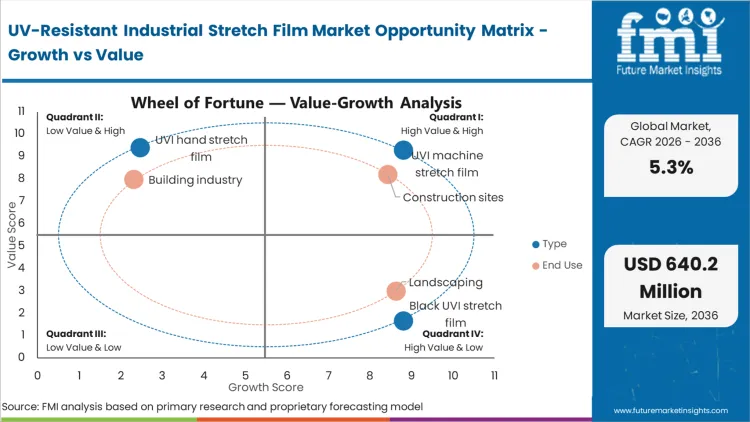
Aggressive sustainability mandates are forcing packaging engineers to redefine performance specifications across the entire industrial film sector. The USA Plastics Pact reports an 11% average post-consumer recycled content usage by its participating organizations [8]. Procurement heads leverage this regulatory momentum to require UVI films that meet both weatherability standards and circularity goals. FMI analysts opine that integrating PCR into durable outdoor films transitions the product from a compliance liability into a strategic corporate asset. Extruders holding verified recycled-content UVI formulations capture the most lucrative contracts from publicly scrutinized global brands.
The physical scarcity of high-quality recycled polyethylene restricts the rapid scaling of circular industrial films. The Recycling Partnership reports that only 43% of all households participate in recycling [9], creating a structural bottleneck for clean flexible packaging feedstock. Industrial buyers mitigate this by securing long-term offtake agreements with specialized agricultural and commercial film recyclers.
- Resin Downgauging Technology: Extruders implementing advanced die technology achieve UVI ratings with 20% less virgin material. Trioworld announced a new manufacturing facility in Indiana in August 2025 [10], bringing high-performance extrusion capacity closer to domestic buyers.
- Multi-layer Coextrusion: Packaging engineers utilize coextrusion lines to bury recycled content in the core while keeping UVI additives on the outer skins. Mondi launched mono-PE recyclable bag structures in July 2024 [11].
- Acquisition of Recycling Assets: Primary film producers are buying recycling infrastructure to guarantee their own supply chains. Greif completed the Ipackchem acquisition in April 2024 [12], demonstrating the strategic value of integrated industrial packaging networks.
Regional Analysis
.webp "Top Country Growth Comparison Uv Resistant Industrial Stretch Film Market Cagr (2026 2036)")
Based on the regional analysis, the UV-Resistant Industrial Stretch Film market is segmented into North America, Latin America, Europe, East Asia, South Asia, Oceania and Middle East & Africa across 40+ countries. The full report also offers market attractiveness analysis based on regional trends.
| Country | CAGR (2026 to 2036) |
|---|---|
| India | 6.5% |
| China | 6.0% |
| Brazil | 5.6% |
| United States | 4.8% |
| Germany | 4.5% |
| United Kingdom | 4.3% |
| Japan | 4.0% |
Source: Future Market Insights (FMI) analysis, based on proprietary forecasting model and primary research
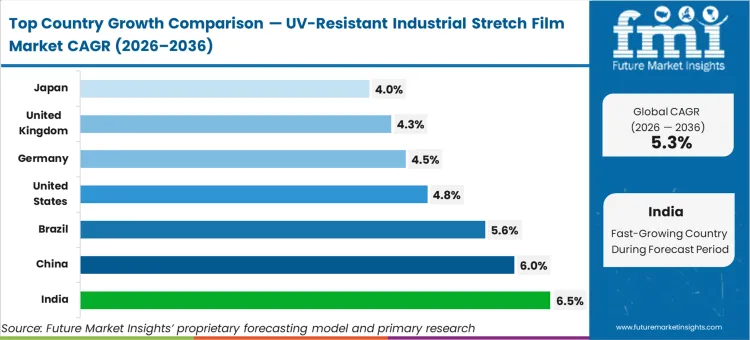
Asia Pacific UV-Resistant Industrial Stretch Film Market Analysis
Asia Pacific's industrial packaging ecosystem relies entirely on massive coastal port networks that frequently experience operational bottlenecks. As transit vessels queue offloading, millions of pallets sit exposed to intense solar radiation in temporary staging yards. UN Trade and Development reports that global maritime trade reached 12.3 billion tons in 2023 [13], amplifying the exact volume pressures that cause these localized delays. Logistics directors operating across these maritime hubs cannot risk ultraviolet degradation compromising bulk material shipments before they clear customs. The ability to deploy highly stabilized protective films determines which exporters maintain acceptable cargo intact rates.
- India: Massive infrastructure initiatives require contractors to stage cement and steel in open-air environments for months prior to installation. Prolonged ultraviolet exposure rapidly degrades standard wrapping, forcing project managers to specify chemically stabilized films to prevent load collapse. The USGS lists Indonesia cement production at 62 million tons [14], reflecting the broader regional surge in construction materials requiring robust outdoor containment. This staging reality anchors India's 6.5% compound expansion of UV-resistant stretch film demand to 2036. Suppliers failing to guarantee 12-month outdoor survivability lose access to Tier-1 national infrastructure procurement tenders.
- China: Port congestion and extended outdoor container dwell times define China's export-heavy coastal logistics network. Extended staging periods degrade standard polyethylene integrity, forcing terminal operators to deploy ultraviolet-stabilized wraps to maintain pallet stability. World Steel Association data shows Japan crude steel production at 89.2 million tons [15], highlighting the massive heavy industrial volumes moving through adjacent Asian trade corridors that share these exposure risks. This operational friction sustains a 6.0% CAGR for UV-resistant load containment solutions in China over the forecast period. Shippers failing to implement stabilized exterior wrapping before the upcoming peak export cycle face elevated rejection penalties from international receiving hubs.
- Japan: Japan's automotive and electronics supply chains enforce rigid component qualification standards that penalize any aesthetic or structural degradation during transit. Strict environmental quality controls mean any pallet arriving with brittle or yellowed wrapping is immediately quarantined by receiving facilities. Jindal Films highlighted PP and PE mono-material recyclable solutions in May 2024 [16], aligning with Japanese corporate preferences for high-performance films that also meet circularity goals. This quality-assurance pressure drives a 4.0% CAGR for precision-engineered UV wraps in the country. Packaging vendors not listed on the approved supplier roster before the 2027 fiscal planning cycle forfeit access to the domestic heavy-manufacturing sector.
FMI's report includes detailed analysis for South Korea, Indonesia, and Australia. These markets emphasize logistics packaging solutions tailored to intense equatorial sun exposure and extreme cross-country freight durations.
North America UV-Resistant Industrial Stretch Film Market Analysis
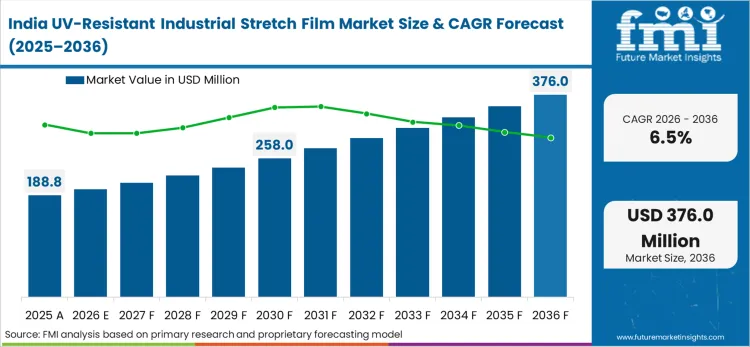
North America's freight infrastructure moves staggering volumes of palletized goods across immense geographic distances, exposing loads to highly variable weather conditions. The Bureau of Transportation Statistics reports nearly USD 3.5 billion per day in United States cross-border freight shipments [17], a massive flow requiring guaranteed containment stability. Packaging engineers must formulate films that survive both the intense ultraviolet radiation of southern transit routes and the mechanical stress of intermodal transfers. Procurement heads utilize weatherability data as the primary filter for shortlisting film converters during annual tender cycles.
- United States: National retail pacts and regulatory frameworks are systematically forcing the integration of post-consumer resins into industrial film specifications. Extruding companies must balance these recycled content quotas against the strict mechanical and UV-resistance thresholds demanded by heavy industry. The USA Plastics Pact indicates a 13.3% national recycling rate for plastic packaging [18], proving that verified recycled feedstock remains critically scarce. The United States market expands at a 4.8% annual rate as brands transition their massive pallet networks toward these advanced circular UVI films. Converters unable to provide certified PCR-integrated stretch hoods before the 2026 reporting deadlines will be systematically excluded from major retail distribution networks.
FMI's report includes detailed analysis for Canada and Mexico. Cross-border automotive and agricultural logistics dictate strict material performance parameters across these trade zones.
Europe UV-Resistant Industrial Stretch Film Market Analysis
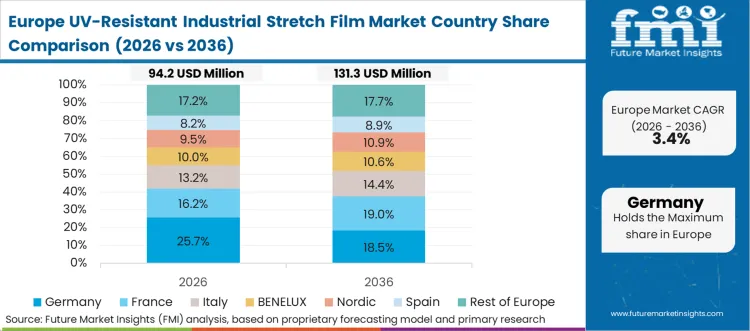
European packaging regulations aggressively target single-use plastics, forcing industrial film users to adopt downgauged, highly recyclable structures without sacrificing load integrity. Government mandates and extended producer responsibility schemes apply heavy financial penalties to packaging that cannot be easily recovered and processed. Operations directors must source UV-resistant wraps that explicitly fit into established mono-material recycling streams to avoid punitive taxation.
- Germany: Circularity policy pressure accelerates the transition toward advanced downgauged polyethylene structures across the domestic manufacturing base. World Steel Association data shows Germany crude steel production at 36.8 million tons [20], requiring massive volumes of industrial wrapping that must now comply with strict new end-of-life directives. Germany's packaging sector is expected to grow at a 4.5% CAGR through 2036 as extruders upgrade machinery to produce compliant, high-performance UVI films. Packaging engineers who cannot validate the recyclability of their stabilized films lose immediate bid priority for government-regulated industrial contracts.
- United Kingdom: Retail sustainability targets and intense public scrutiny regarding soft plastics are shifting corporate purchasing behavior away from disposable wraps. Distribution centers now mandate high-durability, UV-stable solutions that enable multi-trip pallet covering or guaranteed closed-loop recycling. The Recycling Partnership reports that 73% of USA households have recycling access [21], illustrating the infrastructure challenges that UK policy makers are simultaneously trying to solve for flexible films. This legislative climate supports a 4.3% CAGR for specialized outdoor containment films in the UK. Suppliers targeting the grocery logistics network must demonstrate full compliance with the Plastic Packaging Tax requirements before 2026 procurement approval cycles close.
FMI's report includes detailed analysis for France, Italy, and Spain. These nations focus intensely on agricultural bulk wrapping and maritime export protections tailored to Mediterranean climates.
Latin America UV-Resistant Industrial Stretch Film Market Analysis
Latin America's agricultural export economy relies on massive outdoor storage facilities where products face intense equatorial ultraviolet radiation. Regional infrastructure deficits mean goods often remain staged in open fields or uncovered rail yards for extended durations before reaching modern port facilities. Operations directors evaluate wrapping solutions purely on their ability to prevent catastrophic crops or chemical losses during these prolonged delays. The survival of these pallets directly impacts the profitability of the entire seasonal harvest.
- Brazil: Surging agricultural export volumes and a severe shortage of covered warehousing necessitate the widespread use of highly durable, sun-resistant pallet wraps. Extrusion companies are aggressively localizing production to meet this specific regional demand and bypass import tariffs. Companies are launching recyclable large-format flexible packs reflecting the broader industry push toward durable, high-capacity containment structures relevant to Brazilian agribusiness. This storage reality anchors Brazil's 5.6% compound expansion of industrial film demand to 2036. Distributors failing to secure domestic supplies of heavy-duty UVI wraps forfeit lucrative contracts during the critical soybean and sugar export windows.
FMI's report includes detailed analysis for Argentina, Chile, and Mexico. These countries prioritize cost-effective heavy-duty containment for mining outputs and bulk agricultural commodities.
Competitive Aligners for Market Players
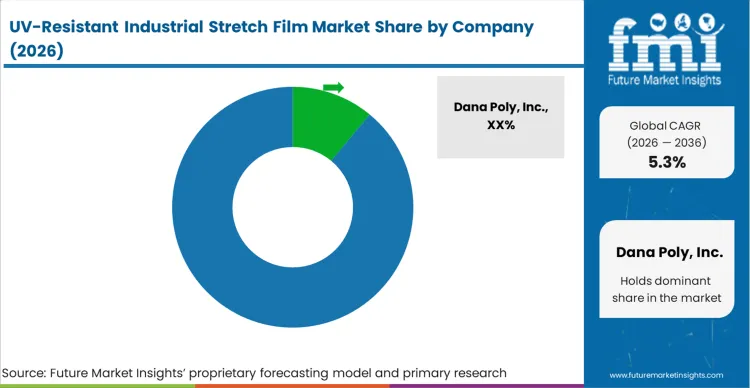
Chemical formulation capabilities now establish the non-negotiable barrier to entry in the premium industrial film sector. Packaging engineers mandate verified ultraviolet resistance ratings combined with certified post-consumer recycled content for all new vendor qualifications. Extruders failing to secure consistent supplies of high-quality recycled resin face immediate exclusion from sustainable-focused corporate tenders. For instance, Berry and T2 demonstrated PE bag films with 50% recycled content in November 2024 [24].
Highlighting upon machinery partnerships and extrusion technology upgrades dictating the cost competitiveness of high-performance films. Systems integrators require downgauged films that maintain absolute weatherability without tearing on high-speed wrappers. Component suppliers lacking state-of-the-art multi-layer coextrusion lines cannot achieve these thin-wall performance metrics, permanently trapping them in low-margin commodity markets.
Corporate consolidation alters the global supply dynamic by merging material science expertise with massive distribution footprints. The integration of advanced polymer research directly into regional manufacturing centers allows conglomerates to dictate pricing floors. Converters operating without these strategic alliances struggle to absorb raw material price shocks while maintaining the expensive chemical additives required for UVI certification.
Recent Developments
The report includes full coverage of key trends from competitive benchmarking. Some of the recent developments covered in the reports:
- In September 2025, Signode launched the Octopus Prestige stretch wrapper to raise throughput for high-speed stretch wrapping applications. [3]
- In April 2025, Amcor completed its combination with Berry, expanding scale and material-science capability across flexible packaging categories including PE shrink and stretch portfolios. [7]
Key Players in UV-Resistant Industrial Stretch Film Market
- Dana Poly, Inc.
- Transhield, Inc.
- Nexus Plastics, Inc.
- Navrang Polyfilms
- Reliant Packaging Films Ltd.
- Johnson Plastic & Supply Co.
- Larsen Packaging Products
Scope of the Report
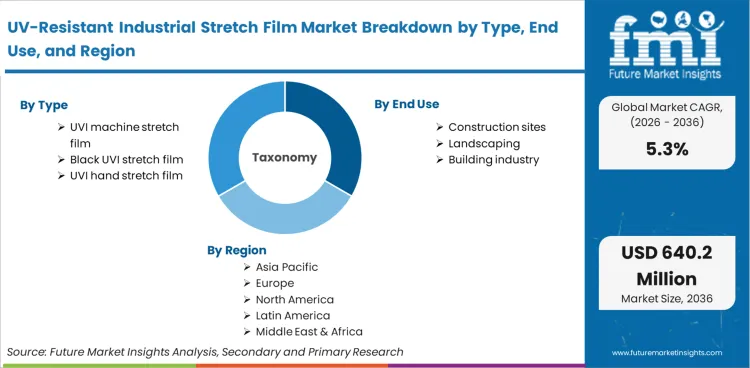
| Metric | Value |
|---|---|
| Quantitative Units | USD 382 million to USD 641 million, at a CAGR of 5.3% |
| Market Definition | A specialized secondary packaging material formulated with ultraviolet inhibitors to protect palletized industrial goods from photodegradation during prolonged outdoor storage. |
| Type Segmentation | UVI machine stretch film, Black UVI stretch film, UVI hand stretch film, Pallet covers & sheeting, Others |
| End Use Segmentation | Construction sites, Landscaping, Building industry, Bagged products stored outside, Others |
| Colour Segmentation | Clear film, Opaque black, Opaque white |
| Feature Segmentation | Durability, Moist-proof, Glossy finish |
| Size Segmentation | 15-20 inch, 10-15 inch, More than 20 inch |
| Regions Covered | North America, Latin America, Europe, East Asia, South Asia, Oceania, Middle East and Africa |
| Countries Covered | United States, Canada, Mexico, Brazil, Argentina, Germany, France, United Kingdom, Italy, Spain, China, India, Japan, South Korea, Indonesia, Australia and 40 plus countries |
| Key Companies Profiled | Dana Poly, Inc., Transhield, Inc., Nexus Plastics, Inc., Navrang Polyfilms, Reliant Packaging Films Ltd., Johnson Plastic & Supply Co., Larsen Packaging Products |
| Forecast Period | 2026 to 2036 |
| Approach | Hybrid top-down and bottom-up market modeling validated through primary interviews with extrusion managers and logistics directors, supported by trade data benchmarking. |
Source: Future Market Insights (FMI) analysis, based on proprietary forecasting model and primary research
Segmental Analysis
Type:
- UVI machine stretch film
- Black UVI stretch film
- UVI hand stretch film
- Pallet covers & sheeting
- Others
End Use:
- Construction sites
- Landscaping
- Building industry
- Bagged products stored outside
- Others
Colour:
- Clear film
- Opaque black
- Opaque white
Feature:
- Durability
- Moist-proof
- Glossy finish
Size:
- 15–20 inches
- 10–15 inches
- More than 20 inches
Region:
- Asia Pacific
- India
- China
- Japan
- South Korea
- Indonesia
- Australia & New Zealand
- ASEAN
- Rest of Asia Pacific
- Europe
- Germany
- Italy
- France
- United Kingdom
- Spain
- Benelux
- Nordics
- Central & Eastern Europe
- Rest of Europe
- North America
- United States
- Canada
- Mexico
- Latin America
- Brazil
- Argentina
- Chile
- Rest of Latin America
- Middle East & Africa
- Kingdom of Saudi Arabia
- United Arab Emirates
- South Africa
- Turkey
- Rest of Middle East & Africa
Bibliography
- [1] UN Trade and Development (UNCTAD). (2024, October 22). Review of Maritime Transport 2024 (Publication page / overview). UNCTAD.
- [2] Coveris. (2025). Coveris wins Green Packaging Star Award 2025 for sustainable sleeve solution (Press release). Coveris.
- [3] Signode. (2025, September 15). Signode launches the Octopus® Prestige™ stretch wrapper - a new benchmark in high-speed stretch wrap (Company news release). Signode.
- [4] USA Geological Survey. (2024, January). Mineral Commodity Summaries 2024: Cement (Commodity chapter). USGS.
- [5] TotalEnergies Polymers. (2025, September 18). New downgauging film solutions to be revealed at K 2025 by TotalEnergies and SML (Press release). TotalEnergies.
- [6] Charter Next Generation (CNG). (2024, February 13). Charter Next Generation introduces stretch hood film with 20% post-consumer recycled content (Press release). CNG.
- [7] Amcor. (2025, April 30). Amcor completes combination with Berry Global; Positioned to significantly enhance value for customers and shareholders (Press release). Amcor.
- [8] USA Plastics Pact. (2024). USA Pact 2023-24 Impact Report (Report page). USA Plastics Pact.
- [9] The Recycling Partnership. (2024, January 12). State of Recycling 2024 (Report). The Recycling Partnership.
- [10] Trioworld. (2025, August 5). Trioworld announces new state-of-the-art manufacturing facility in Brownsburg, Indiana (Press release). Trioworld.
- [11] Mondi Group. (2024, July 3). Unveiling FlexiBag Reinforced - Mondi’s cost-effective next generation of recyclable packaging (Press release). Mondi.
- [12] Greif. (2024, April 17). Greif completes acquisition of Ipackchem (Press release). Greif.
- [13] UN Trade and Development (UNCTAD). (2024, October 22). Review of Maritime Transport 2024. UNCTAD.
- [14] USA Geological Survey. (2024, January). Mineral Commodity Summaries 2024: Cement. USGS.
- [15] World Steel Association (worldsteel). (2024, May 27). World Steel in Figures 2024. worldsteel.
- [17] Bureau of Transportation Statistics. (2025, March 20). TransBorder Freight Annual Report 2024 (Report page). USA DOT BTS.
- [18] USA Plastics Pact. (2024). USA Pact 2023-24 Impact Report. USA Plastics Pact.
- [20] World Steel Association (worldsteel). (2024, May 27). World Steel in Figures 2024. worldsteel.
- [23] Nefab Group. (2024). Nefab Group acquires Precision Formed Plastics, Inc. Nefab.
- [24] Amcor Packaging Solutions. (2024, November 13). Berry Global and T2 join forces to deliver PE bags with 50% recycled plastic content (Article). Amcor.
This bibliography is provided for reader reference and is not exhaustive. The full report contains the complete reference list and detailed citations.
This Report Addresses
- Market size estimation and revenue forecasts from 2026 to 2036, supported by validated production and trade benchmarks across major industrial hubs.
- Growth opportunity mapping across various film formats with an emphasis on sustainable material transitions and circularity integration.
- Segment and regional revenue forecasts covering critical applications like construction, logistics, and bulk material staging.
- Competition strategy assessment including polymer science integration models, pricing survivability positioning, and recycled resin sourcing capability.
- Product reformulation tracking covering key metrics such as ultraviolet inhibition duration, puncture resistance, and clarity parameters.
- Regulatory impact analysis evaluating strict plastic packaging taxes, extended producer responsibility frameworks, and post-consumer recycled content mandates.
- Market report delivery in PDF, Excel, PPT, and interactive dashboard formats for executive and operational use.
Frequently Asked Questions
How large is the demand for UV-Resistant Industrial Stretch Film in the global market in 2026?
Demand for UV-Resistant Industrial Stretch Film in the global market is estimated to be valued at USD 382 million in 2026.
What will be the market size of UV-Resistant Industrial Stretch Film in the global market by 2036?
Market size for UV-Resistant Industrial Stretch Film is projected to reach USD 641 million by 2036.
What is the expected demand growth for UV-Resistant Industrial Stretch Film in the global market between 2026 and 2036?
Demand for UV-Resistant Industrial Stretch Film is expected to grow at a CAGR of 5.3% between 2026 and 2036.
Which Type is poised to lead global sales by 2026?
UVI machine stretch film commands 29.8% in 2026 as high-volume distribution centers strictly mandate automated wrapping lines.
How significant is the role of Construction sites in driving UV-Resistant Industrial Stretch Film adoption in 2026?
Construction sites represents 34.6% of segment share as contractors enforce severe weather-proofing requirements for outdoor material staging.
What is driving demand in India?
Massive infrastructure expansion and prolonged open-air material staging directly fuel the adoption of stabilized stretch hoods.
What compliance standards or regulations are referenced for India?
Strict public infrastructure procurement guidelines enforcing weather-resistant bulk containment govern material deliveries.
What is the India growth outlook in this report?
India is projected to grow at a CAGR of 6.5% during 2026 to 2036.
Why is North America described as a priority region in this report?
Massive cross-border freight volumes and intense southern ultraviolet radiation necessitate rigorous load containment standards.
What type of demand dominates in North America?
Integration of post-consumer recycled resins into high-durability transit films dominates regional formulation demand.
What is China's growth outlook in this report?
China is projected to expand at a CAGR of 6.0% during 2026 to 2036.
Does the report cover United States in its regional analysis?
Yes, United States is included within North America under the regional scope of analysis.
What are the sources referred to for analyzing United States?
Official transportation logs from the Bureau of Transportation Statistics and sustainability reports from the USA Plastics Pact form the analytical basis.
What is the main demand theme linked to United States in its region coverage?
Strict retail distribution mandates and circularity targets heavily influence corporate material specifications.
Does the report cover Germany in its regional analysis?
Yes, Germany is included within Europe under the regional coverage framework.
What is the main Germany related demand theme in its region coverage?
Aggressive end-of-life recycling mandates force converters to develop downgauged, mono-material UVI structures.
Which product formats or configurations are strategically important for Asia Pacific supply chains?
High-durability machine wraps designed to survive extended maritime port congestion hold immense strategic importance.
What is UV-Resistant Industrial Stretch Film and what is it mainly used for?
It is a heavy-duty polymer wrap infused with chemical stabilizers used to protect palletized industrial goods stored outdoors.
What does UV-Resistant Industrial Stretch Film mean in this report?
The market covers polyethylene-based films specifically engineered to block solar degradation during commercial distribution.
What is included in the scope of this UV-Resistant Industrial Stretch Film report?
Included product types involve linear low-density machine wraps, stretch hoods, and pallet covers utilized in industrial outdoor settings.
What is excluded from the scope of this report?
Standard indoor clear wraps, consumer food films, and rigid bulk plastic containers are entirely excluded.
What does market forecast mean on this page?
The market forecast represents a model-based projection built on defined industrial capacity and supply-chain logistical assumptions for strategic planning purposes.
How does FMI build and validate the UV-Resistant Industrial Stretch Film forecast?
Forecasts combine top-down trade volumes with bottom-up penetration rates, validated through primary interviews with extrusion engineers.
What does zero reliance on speculative third-party market research mean here?
Primary interviews, verified corporate material announcements, and official maritime trade datasets are used exclusively instead of unverified syndicated estimates.
Preview the report firsthand - request a free sample
Get SampleGet the brochure for pricing and purchase details.
Get PDFTable of Content
- Executive Summary
- Global Market Outlook
- Demand-side Trends
- Supply-side Trends
- Technology Roadmap Analysis
- Analysis and Recommendations
- Market Overview
- Market Coverage / Taxonomy
- Market Definition / Scope / Limitations
- Research Methodology
- Chapter Orientation
- Analytical Lens and Working Hypotheses
- Market Structure, Signals, and Trend Drivers
- Benchmarking and Cross-market Comparability
- Market Sizing, Forecasting, and Opportunity Mapping
- Research Design and Evidence Framework
- Desk Research Programme (Secondary Evidence)
- Company Annual and Sustainability Reports
- Peer-reviewed Journals and Academic Literature
- Corporate Websites, Product Literature, and Technical Notes
- Earnings Decks and Investor Briefings
- Statutory Filings and Regulatory Disclosures
- Technical White Papers and Standards Notes
- Trade Journals, Industry Magazines, and Analyst Briefs
- Conference Proceedings, Webinars, and Seminar Materials
- Government Statistics Portals and Public Data Releases
- Press Releases and Reputable Media Coverage
- Specialist Newsletters and Curated Briefings
- Sector Databases and Reference Repositories
- FMI Internal Proprietary Databases and Historical Market Datasets
- Subscription Datasets and Paid Sources
- Social Channels, Communities, and Digital Listening Inputs
- Additional Desk Sources
- Expert Input and Fieldwork (Primary Evidence)
- Primary Modes
- Qualitative Interviews and Expert Elicitation
- Quantitative Surveys and Structured Data Capture
- Blended Approach
- Why Primary Evidence is Used
- Field Techniques
- Interviews
- Surveys
- Focus Groups
- Observational and In-context Research
- Social and Community Interactions
- Stakeholder Universe Engaged
- C-suite Leaders
- Board Members
- Presidents and Vice Presidents
- R&D and Innovation Heads
- Technical Specialists
- Domain Subject-matter Experts
- Scientists
- Physicians and Other Healthcare Professionals
- Governance, Ethics, and Data Stewardship
- Research Ethics
- Data Integrity and Handling
- Primary Modes
- Tooling, Models, and Reference Databases
- Desk Research Programme (Secondary Evidence)
- Data Engineering and Model Build
- Data Acquisition and Ingestion
- Cleaning, Normalisation, and Verification
- Synthesis, Triangulation, and Analysis
- Quality Assurance and Audit Trail
- Market Background
- Market Dynamics
- Drivers
- Restraints
- Opportunity
- Trends
- Scenario Forecast
- Demand in Optimistic Scenario
- Demand in Likely Scenario
- Demand in Conservative Scenario
- Opportunity Map Analysis
- Product Life Cycle Analysis
- Supply Chain Analysis
- Investment Feasibility Matrix
- Value Chain Analysis
- PESTLE and Porter’s Analysis
- Regulatory Landscape
- Regional Parent Market Outlook
- Production and Consumption Statistics
- Import and Export Statistics
- Market Dynamics
- Global Market Analysis 2021 to 2025 and Forecast, 2026 to 2036
- Historical Market Size Value (USD Million) Analysis, 2021 to 2025
- Current and Future Market Size Value (USD Million) Projections, 2026 to 2036
- Y-o-Y Growth Trend Analysis
- Absolute $ Opportunity Analysis
- Global Market Pricing Analysis 2021 to 2025 and Forecast 2026 to 2036
- Global Market Analysis 2021 to 2025 and Forecast 2026 to 2036, By Type
- Introduction / Key Findings
- Historical Market Size Value (USD Million) Analysis By Type , 2021 to 2025
- Current and Future Market Size Value (USD Million) Analysis and Forecast By Type , 2026 to 2036
- UVI machine stretch film
- Black UVI stretch film
- UVI hand stretch film
- UVI machine stretch film
- Y-o-Y Growth Trend Analysis By Type , 2021 to 2025
- Absolute $ Opportunity Analysis By Type , 2026 to 2036
- Global Market Analysis 2021 to 2025 and Forecast 2026 to 2036, By End Use
- Introduction / Key Findings
- Historical Market Size Value (USD Million) Analysis By End Use, 2021 to 2025
- Current and Future Market Size Value (USD Million) Analysis and Forecast By End Use, 2026 to 2036
- Construction sites
- Landscaping
- Building industry
- Construction sites
- Y-o-Y Growth Trend Analysis By End Use, 2021 to 2025
- Absolute $ Opportunity Analysis By End Use, 2026 to 2036
- Global Market Analysis 2021 to 2025 and Forecast 2026 to 2036, By Colour
- Introduction / Key Findings
- Historical Market Size Value (USD Million) Analysis By Colour, 2021 to 2025
- Current and Future Market Size Value (USD Million) Analysis and Forecast By Colour, 2026 to 2036
- Clear film
- Opaque black
- Opaque white
- Clear film
- Y-o-Y Growth Trend Analysis By Colour, 2021 to 2025
- Absolute $ Opportunity Analysis By Colour, 2026 to 2036
- Global Market Analysis 2021 to 2025 and Forecast 2026 to 2036, By Feature
- Introduction / Key Findings
- Historical Market Size Value (USD Million) Analysis By Feature, 2021 to 2025
- Current and Future Market Size Value (USD Million) Analysis and Forecast By Feature, 2026 to 2036
- Durability
- Moist-proof
- Glossy finish
- Durability
- Y-o-Y Growth Trend Analysis By Feature, 2021 to 2025
- Absolute $ Opportunity Analysis By Feature, 2026 to 2036
- Global Market Analysis 2021 to 2025 and Forecast 2026 to 2036, By Size
- Introduction / Key Findings
- Historical Market Size Value (USD Million) Analysis By Size, 2021 to 2025
- Current and Future Market Size Value (USD Million) Analysis and Forecast By Size, 2026 to 2036
- 15–20 inches
- 10–15 inches
- More than 20 inches
- 15–20 inches
- Y-o-Y Growth Trend Analysis By Size, 2021 to 2025
- Absolute $ Opportunity Analysis By Size, 2026 to 2036
- Global Market Analysis 2021 to 2025 and Forecast 2026 to 2036, By Region
- Introduction
- Historical Market Size Value (USD Million) Analysis By Region, 2021 to 2025
- Current Market Size Value (USD Million) Analysis and Forecast By Region, 2026 to 2036
- North America
- Latin America
- Western Europe
- Eastern Europe
- East Asia
- South Asia and Pacific
- Middle East & Africa
- Market Attractiveness Analysis By Region
- North America Market Analysis 2021 to 2025 and Forecast 2026 to 2036, By Country
- Historical Market Size Value (USD Million) Trend Analysis By Market Taxonomy, 2021 to 2025
- Market Size Value (USD Million) Forecast By Market Taxonomy, 2026 to 2036
- By Country
- USA
- Canada
- Mexico
- By Type
- By End Use
- By Colour
- By Feature
- By Size
- By Country
- Market Attractiveness Analysis
- By Country
- By Type
- By End Use
- By Colour
- By Feature
- By Size
- Key Takeaways
- Latin America Market Analysis 2021 to 2025 and Forecast 2026 to 2036, By Country
- Historical Market Size Value (USD Million) Trend Analysis By Market Taxonomy, 2021 to 2025
- Market Size Value (USD Million) Forecast By Market Taxonomy, 2026 to 2036
- By Country
- Brazil
- Chile
- Rest of Latin America
- By Type
- By End Use
- By Colour
- By Feature
- By Size
- By Country
- Market Attractiveness Analysis
- By Country
- By Type
- By End Use
- By Colour
- By Feature
- By Size
- Key Takeaways
- Western Europe Market Analysis 2021 to 2025 and Forecast 2026 to 2036, By Country
- Historical Market Size Value (USD Million) Trend Analysis By Market Taxonomy, 2021 to 2025
- Market Size Value (USD Million) Forecast By Market Taxonomy, 2026 to 2036
- By Country
- Germany
- UK
- Italy
- Spain
- France
- Nordic
- BENELUX
- Rest of Western Europe
- By Type
- By End Use
- By Colour
- By Feature
- By Size
- By Country
- Market Attractiveness Analysis
- By Country
- By Type
- By End Use
- By Colour
- By Feature
- By Size
- Key Takeaways
- Eastern Europe Market Analysis 2021 to 2025 and Forecast 2026 to 2036, By Country
- Historical Market Size Value (USD Million) Trend Analysis By Market Taxonomy, 2021 to 2025
- Market Size Value (USD Million) Forecast By Market Taxonomy, 2026 to 2036
- By Country
- Russia
- Poland
- Hungary
- Balkan & Baltic
- Rest of Eastern Europe
- By Type
- By End Use
- By Colour
- By Feature
- By Size
- By Country
- Market Attractiveness Analysis
- By Country
- By Type
- By End Use
- By Colour
- By Feature
- By Size
- Key Takeaways
- East Asia Market Analysis 2021 to 2025 and Forecast 2026 to 2036, By Country
- Historical Market Size Value (USD Million) Trend Analysis By Market Taxonomy, 2021 to 2025
- Market Size Value (USD Million) Forecast By Market Taxonomy, 2026 to 2036
- By Country
- China
- Japan
- South Korea
- By Type
- By End Use
- By Colour
- By Feature
- By Size
- By Country
- Market Attractiveness Analysis
- By Country
- By Type
- By End Use
- By Colour
- By Feature
- By Size
- Key Takeaways
- South Asia and Pacific Market Analysis 2021 to 2025 and Forecast 2026 to 2036, By Country
- Historical Market Size Value (USD Million) Trend Analysis By Market Taxonomy, 2021 to 2025
- Market Size Value (USD Million) Forecast By Market Taxonomy, 2026 to 2036
- By Country
- India
- ASEAN
- Australia & New Zealand
- Rest of South Asia and Pacific
- By Type
- By End Use
- By Colour
- By Feature
- By Size
- By Country
- Market Attractiveness Analysis
- By Country
- By Type
- By End Use
- By Colour
- By Feature
- By Size
- Key Takeaways
- Middle East & Africa Market Analysis 2021 to 2025 and Forecast 2026 to 2036, By Country
- Historical Market Size Value (USD Million) Trend Analysis By Market Taxonomy, 2021 to 2025
- Market Size Value (USD Million) Forecast By Market Taxonomy, 2026 to 2036
- By Country
- Kingdom of Saudi Arabia
- Other GCC Countries
- Turkiye
- South Africa
- Other African Union
- Rest of Middle East & Africa
- By Type
- By End Use
- By Colour
- By Feature
- By Size
- By Country
- Market Attractiveness Analysis
- By Country
- By Type
- By End Use
- By Colour
- By Feature
- By Size
- Key Takeaways
- Key Countries Market Analysis
- USA
- Pricing Analysis
- Market Share Analysis, 2025
- By Type
- By End Use
- By Colour
- By Feature
- By Size
- Canada
- Pricing Analysis
- Market Share Analysis, 2025
- By Type
- By End Use
- By Colour
- By Feature
- By Size
- Mexico
- Pricing Analysis
- Market Share Analysis, 2025
- By Type
- By End Use
- By Colour
- By Feature
- By Size
- Brazil
- Pricing Analysis
- Market Share Analysis, 2025
- By Type
- By End Use
- By Colour
- By Feature
- By Size
- Chile
- Pricing Analysis
- Market Share Analysis, 2025
- By Type
- By End Use
- By Colour
- By Feature
- By Size
- Germany
- Pricing Analysis
- Market Share Analysis, 2025
- By Type
- By End Use
- By Colour
- By Feature
- By Size
- UK
- Pricing Analysis
- Market Share Analysis, 2025
- By Type
- By End Use
- By Colour
- By Feature
- By Size
- Italy
- Pricing Analysis
- Market Share Analysis, 2025
- By Type
- By End Use
- By Colour
- By Feature
- By Size
- Spain
- Pricing Analysis
- Market Share Analysis, 2025
- By Type
- By End Use
- By Colour
- By Feature
- By Size
- France
- Pricing Analysis
- Market Share Analysis, 2025
- By Type
- By End Use
- By Colour
- By Feature
- By Size
- India
- Pricing Analysis
- Market Share Analysis, 2025
- By Type
- By End Use
- By Colour
- By Feature
- By Size
- ASEAN
- Pricing Analysis
- Market Share Analysis, 2025
- By Type
- By End Use
- By Colour
- By Feature
- By Size
- Australia & New Zealand
- Pricing Analysis
- Market Share Analysis, 2025
- By Type
- By End Use
- By Colour
- By Feature
- By Size
- China
- Pricing Analysis
- Market Share Analysis, 2025
- By Type
- By End Use
- By Colour
- By Feature
- By Size
- Japan
- Pricing Analysis
- Market Share Analysis, 2025
- By Type
- By End Use
- By Colour
- By Feature
- By Size
- South Korea
- Pricing Analysis
- Market Share Analysis, 2025
- By Type
- By End Use
- By Colour
- By Feature
- By Size
- Russia
- Pricing Analysis
- Market Share Analysis, 2025
- By Type
- By End Use
- By Colour
- By Feature
- By Size
- Poland
- Pricing Analysis
- Market Share Analysis, 2025
- By Type
- By End Use
- By Colour
- By Feature
- By Size
- Hungary
- Pricing Analysis
- Market Share Analysis, 2025
- By Type
- By End Use
- By Colour
- By Feature
- By Size
- Kingdom of Saudi Arabia
- Pricing Analysis
- Market Share Analysis, 2025
- By Type
- By End Use
- By Colour
- By Feature
- By Size
- Turkiye
- Pricing Analysis
- Market Share Analysis, 2025
- By Type
- By End Use
- By Colour
- By Feature
- By Size
- South Africa
- Pricing Analysis
- Market Share Analysis, 2025
- By Type
- By End Use
- By Colour
- By Feature
- By Size
- USA
- Market Structure Analysis
- Competition Dashboard
- Competition Benchmarking
- Market Share Analysis of Top Players
- By Regional
- By Type
- By End Use
- By Colour
- By Feature
- By Size
- Competition Analysis
- Competition Deep Dive
- Dana Poly, Inc.
- Overview
- Product Portfolio
- Profitability by Market Segments (Product/Age /Sales Channel/Region)
- Sales Footprint
- Strategy Overview
- Marketing Strategy
- Product Strategy
- Channel Strategy
- Transhield, Inc.
- Nexus Plastics, Inc.
- Navrang Polyfilms
- Reliant Packaging Films Ltd.
- Johnson Plastic & Supply Co.
- Dana Poly, Inc.
- Competition Deep Dive
- Assumptions & Acronyms Used


