

- Industry Size (2025)
- USD 7.2 Bn
- Forecast (2035)
- USD 17.8 Bn
- CAGR (2025 to 2035)
- 9.5%
Life-Cycle Safe Battery Production Chemicals Market Forecast and Outlook 2026 to 2036
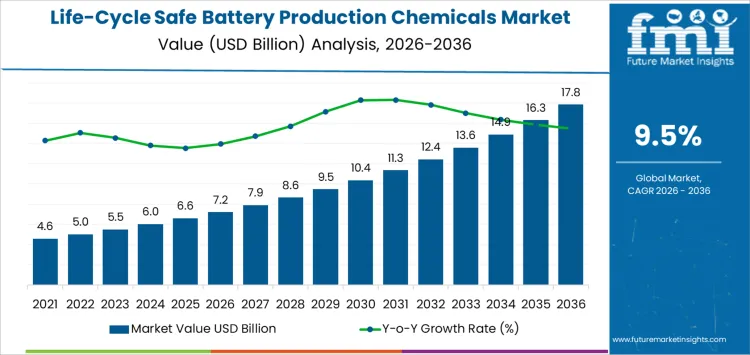
The life-cycle safe battery production chemicals market is experiencing significant growth, with the market value expected to reach USD 7.2 billion in 2026 and USD 17.8 billion by 2036, advancing at a 9.5% CAGR. The market is driven by increasing demand for eco-friendly and eco-friendly materials in battery production, especially for electric vehicles (EVs) and energy storage systems. The key chemical products include low-toxicity binders, low-VOC solvents, recyclable electrolyte formulations, and safe electrolyte salts. The electrode formulation and coating stage, involving slurries, binders, and solvents, holds the largest market share at 45%, driven by the need for high-performance, environmentally safe chemicals in battery manufacturing.
Quick Stats for Life-Cycle Safe Battery Production Chemicals Market
- Life-Cycle Safe Battery Production Chemicals Market Value (2026): USD 7.2 billion
- Life-Cycle Safe Battery Production Chemicals Market Forecast Value (2036): USD 17.8 billion
- Life-Cycle Safe Battery Production Chemicals Market Forecast CAGR (2026 to 2036): 9.5%
- Leading Chemical / Product Type in Life-Cycle Safe Battery Production Chemicals Market: Low-toxicity binders
- Key Growth Regions in Life-Cycle Safe Battery Production Chemicals Market: Asia Pacific, North America
- Top Players in Life-Cycle Safe Battery Production Chemicals Market: BASF, Mitsubishi Chemical, Solvay, Albemarle, Celanese
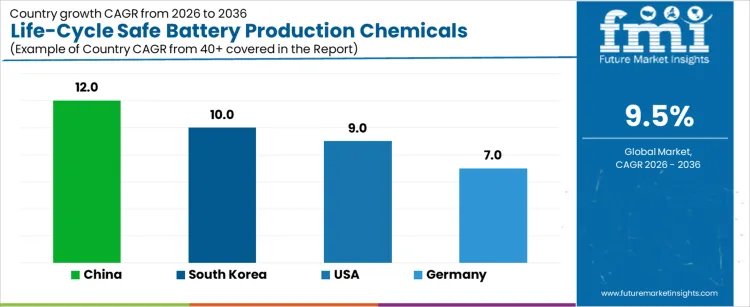
China is leading the market with the highest growth rate of 12.0%, driven by its dominance in global battery manufacturing, particularly for EVs and energy storage solutions. The country’s push for eco-friendly practices and government policies supporting green manufacturing are accelerating market expansion. South Korea follows closely at 10.0%, supported by strong battery manufacturing demand and eco-friendly regulations. The USA shows steady growth at 9.0%, fueled by the booming EV sector and regulatory push for cleaner production. Germany, with a growth rate of 7.0%, is focusing on eco-friendly battery production chemicals, driven by strict environmental regulations and a strong automotive industry. India’s market is growing at 7.2%, supported by increasing demand for eco-friendly construction and transportation solutions.
Life-Cycle Safe Battery Production Chemicals Market Key Takeaways
| Metric | Value |
|---|---|
| Industry Value (2026) | USD 7.2 billion |
| Forecast Value (2036) | USD 17.8 billion |
| Forecast CAGR (2026 to 2036) | 9.5% |
How Is the Global Life-Cycle Safe Battery Production Chemicals Sector Advancing?
The global life-cycle safe battery production chemicals market is experiencing significant growth due to the rising demand for batteries in electric vehicles, renewable energy storage, and portable electronics. These chemicals are essential in ensuring the safety, efficiency, and environmental friendliness of battery production throughout their entire life cycle. Life-cycle safe chemicals focus on reducing the environmental impact during the manufacturing, usage, and disposal phases of batteries. Initially, battery production relied on conventional chemicals, but as sustainability and safety became top priorities, life-cycle safe chemicals have been developed to reduce hazardous emissions, enhance performance, and ensure easier recycling of battery materials.
The market for life-cycle safe battery production chemicals is set to grow rapidly, driven by the global shift toward electric vehicles and renewable energy adoption. Innovations in battery chemistry, along with stricter environmental regulations, will fuel demand for safer, more sustainable chemicals in battery production. The increasing focus on improving battery longevity and minimizing environmental risks during disposal will drive the growth of life-cycle safe chemicals. Challenges such as the high cost of these chemicals, the need for specialized technology, and scaling production processes may impact market dynamics. Nonetheless, as industries transition to cleaner energy solutions, life-cycle safe battery production chemicals will play a crucial role in ensuring sustainable, efficient, and safe battery manufacturing.
What Is the Segment-Wise Analysis for the Global Life-Cycle Safe Battery Production Chemicals Market?
The global life-cycle safe battery production chemicals market is segmented by chemical/product types and battery manufacturing stages. Low-toxicity binders lead the market with a 28% share due to their role in enhancing the safety and performance of battery electrodes. Other key chemical types include low-VOC/green solvents & solvent substitutes, safe electrolyte salts, recyclable electrolyte formulations, conductive additives, and low-residue carbons. In terms of battery manufacturing stages, electrode formulation & coating (including slurries, binders, and solvents) dominates with a 45% share, driven by the high demand for eco-friendly and efficient materials in battery production.
Why Do Low-Toxicity Binders Lead the Global Life-Cycle Safe Battery Production Chemicals Market?
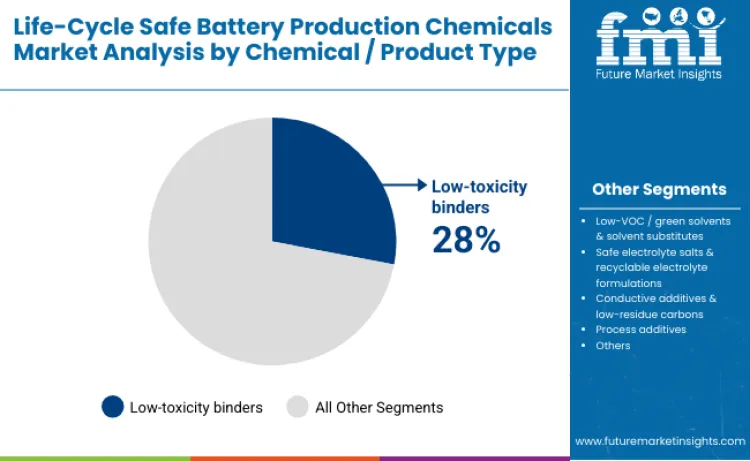
Low-toxicity binders hold a 28% share of the global life-cycle safe battery production chemicals market due to their crucial role in enhancing battery performance while ensuring minimal environmental and health risks. These binders are essential in the electrode formulation process, where they help bind active materials to the electrode structure, improving battery stability and lifespan. The shift towards safer, non-toxic materials in battery production has led to the increasing adoption of low-toxicity binders. With growing concerns over battery safety, environmental impact, and regulatory compliance, low-toxicity binders are becoming the preferred choice for manufacturers aiming to produce eco-friendly, high-performance batteries.
Why Does Electrode Formulation & Coating Hold the Largest Market Share in the Global Life-Cycle Safe Battery Production Chemicals Market?
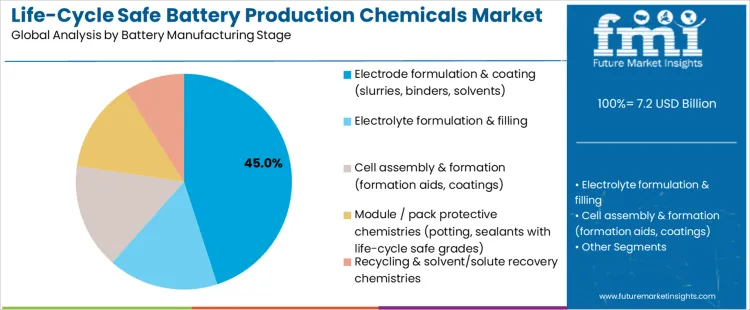
The electrode formulation & coating stage accounts for 45% of the global life-cycle safe battery production chemicals market, driven by its critical role in determining battery efficiency, capacity, and safety. This stage involves the use of slurries, binders, solvents, and other chemicals to create the active electrode materials that store and release energy in a battery. With the growing demand for advanced, high-performance batteries, especially for electric vehicles and portable electronics, the formulation and coating of electrodes require innovative, safe, and eco-friendly chemicals. This stage’s dominant market share reflects the increasing focus on using life-cycle safe materials to improve battery longevity and safety while reducing environmental impact.
What Factors Are Driving Growth in the Life-Cycle Safe Battery Production Chemicals Market?
The life cycle safe battery production chemicals market is growing due to the rising demand for environmentally friendly and safer chemical alternatives in battery manufacturing. With the surge in electric vehicles (EVs), renewable energy storage, and portable electronics, there is increasing pressure on manufacturers to adopt chemicals that are both efficient and safe throughout the battery’s lifecycle. Global regulations aimed at reducing hazardous substances, increasing safety standards, and improving recycling practices are key drivers, pushing companies to opt for non-toxic and eco-friendly solutions.
What Are the Main Challenges Facing the Life Cycle Safe Battery Production Chemicals Market?
Adoption of life cycle safe battery production chemicals faces challenges related to higher costs and performance concerns. Environmentally friendly alternatives can often be more expensive compared to traditional chemicals, creating cost pressure for manufacturers. Some green chemicals may also underperform in specific battery applications, requiring further research and development to match the effectiveness of conventional products. Navigating the complex regulatory landscape across different regions can be cumbersome, as companies must meet diverse standards and compliance requirements for various chemicals used in production.
How Are Innovations Shaping the Life Cycle Safe Battery Production Chemicals Market?
Key innovations in the life cycle safe battery production chemicals market include the development of advanced, eco-friendly formulations that improve battery performance while reducing environmental impacts. There is a growing focus on bio-based materials, recyclable chemicals, and low-toxicity electrolytes, binders, and additives. Improvements in recycling processes for battery materials and the use of digital tools to monitor chemical usage and safety standards are emerging as vital trends. These innovations are helping manufacturers reduce their carbon footprint, improve durability, and meet the growing demand for cleaner, safer production processes.
What is the Growth Outlook for the Life-Cycle Safe Battery Production Chemicals Market in Key Countries?
| Country | CAGR (%) |
|---|---|
| China | 12.0% |
| United States | 9.0% |
| South Korea | 10.0% |
| Germany | 7.0% |
The life-cycle safe battery production chemicals market is witnessing strong growth, led by China at 12.0%, driven by a dominant battery production industry and a focus on eco-friendly practices. South Korea follows with a growth rate of 10.0%, supported by an expanding battery manufacturing sector and eco-friendly chemical demand. The United States shows a steady growth rate of 9.0%, fueled by the electric vehicle and energy storage boom. Germany’s market grows at 7.0%, backed by strict environmental regulations and advanced battery technology. With the rising demand for eco-friendly and safe battery production, the market is set to expand across these countries.
Why is China Leading in the Life-Cycle Safe Battery Production Chemicals Market?
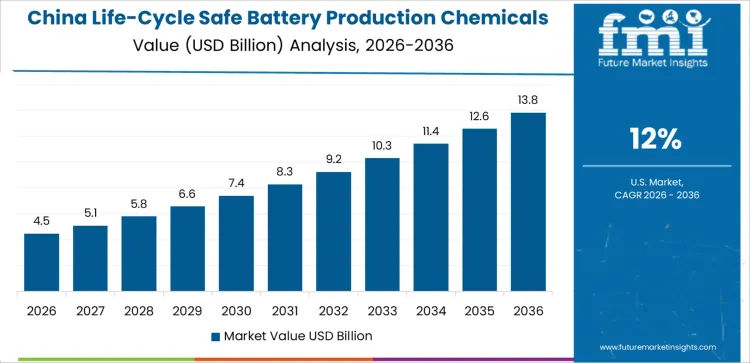
China’s life-cycle safe battery production chemicals market is expanding at a 12.0% CAGR, driven by its role as the global leader in battery production, especially for electric vehicles (EVs) and energy storage systems. The government’s push for greener technologies, including EV adoption and renewable energy storage solutions, is a major factor accelerating demand for eco-friendly and safe battery chemicals. China’s rapidly growing automotive sector requires high-performance, eco-friendly materials, making low-impact battery production chemicals essential. The country’s strict environmental regulations and focus on clean manufacturing are driving manufacturers to adopt life-cycle safe production chemicals. With China investing heavily in electric mobility and infrastructure, its large-scale battery production for both domestic use and export is further propelling the growth of this market. As the demand for eco-friendly solutions increases, China’s role as a major player in the global battery industry ensures continued market expansion.
What Factors Are Fueling the Life-Cycle Safe Battery Production Chemicals Market Growth in South Korea?
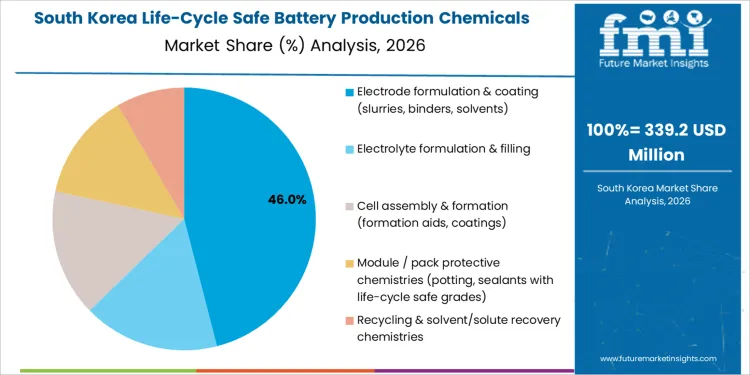
South Korea’s life-cycle safe battery production chemicals market is growing at 10.0%, driven by the country's strong foothold in the global battery manufacturing industry. With major players in the electric vehicle (EV) and energy storage sectors, South Korea is at the forefront of developing and producing eco-friendly battery solutions. The increasing demand for safer, higher-performance batteries, combined with government regulations promoting environmentally friendly production methods, is a significant factor in market growth. South Korea’s commitment to reducing carbon emissions and enhancing energy efficiency in production processes is pushing manufacturers to adopt life-cycle safe chemicals for battery production. With a shift toward greener technologies and innovations in battery systems, South Korea is prioritizing eco-friendly solutions, further driving market demand. As the automotive and energy storage sectors expand, the growth of eco-friendly battery chemicals in South Korea is expected to remain strong, bolstered by durability initiatives and regulatory support.
How is the Life-Cycle Safe Battery Production Chemicals Market Developing in the United States?
The USA’s life-cycle safe battery production chemicals market is growing at 9.0%, fueled by the rapid expansion of electric vehicle (EV) production and energy storage solutions. As the country pushes for a clean energy transition, the demand for safe, eco-friendly battery chemicals is rising across industries. The USA’s strong commitment to reducing carbon emissions, coupled with government support for green technologies, is accelerating the adoption of life-cycle safe production chemicals. The increasing demand for electric vehicles, energy storage systems, and renewable energy solutions drives the need for high-quality, eco-friendly battery production materials. Manufacturers in the USA are adhering to stricter environmental regulations, ensuring that battery production processes minimize harmful environmental impacts. With rising consumer demand for eco-friendly products and the expansion of EV infrastructure, the USA’s market for life-cycle safe battery production chemicals is poised for steady growth in the coming years.
What is Driving the Life-Cycle Safe Battery Production Chemicals Market in Germany?
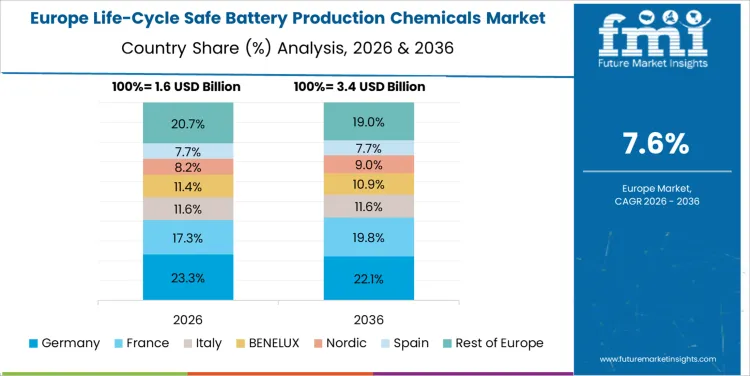
Germany’s life-cycle safe battery production chemicals market is growing at a 7.0% CAGR, supported by the country’s commitment to durability and energy efficiency. As Germany leads Europe in the transition to electric mobility, the demand for eco-friendly, high-performance battery chemicals is on the rise. The automotive industry’s shift toward electric vehicles (EVs) and renewable energy systems is driving the need for safer, eco-friendlier production materials in battery manufacturing. Germany’s strict environmental regulations and policies promoting green technologies further contribute to the adoption of life-cycle safe production chemicals. The country’s focus on reducing carbon emissions, improving energy efficiency, and promoting clean energy solutions is pushing the market toward eco-friendly alternatives. As Germany continues to advance energy storage and EV technologies, the demand for life-cycle safe battery chemicals will remain strong. Germany’s regulatory environment and consumer preference for eco-friendly solutions ensure steady growth in this sector.
What Are the Competitive Dynamics in the Life-Cycle Safe Battery Production Chemicals Market?
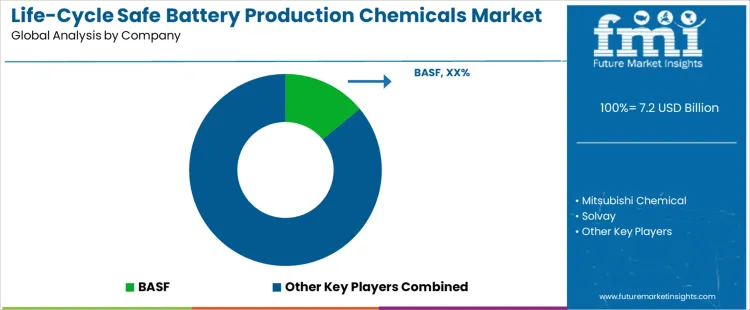
BASF, Mitsubishi Chemical, Solvay, Albemarle, and Celanese each bring unique strengths to the life-cycle safe battery production chemicals market, where durability and safety are key drivers. BASF focuses on high performance chemicals designed to enhance battery efficiency and extend life cycles, with an emphasis on reducing environmental impact throughout the production process. Mitsubishi Chemical offers advanced chemical solutions that optimize battery performance, supporting both traditional and emerging battery technologies.
Solvay’s product portfolio includes eco friendly chemicals that address battery safety and efficiency, with particular attention to recycling and minimizing hazardous materials. Albemarle emphasizes specialty chemicals that meet stringent quality and safety standards, designed to improve battery lifespan and performance. Celanese focuses on innovative additives and materials that support the production of safe, high capacity batteries.
These companies compete by innovating with environmentally safe production processes and offering products that meet evolving regulatory standards. Their strategies are shaped by an increasing demand for eco-friendly, high performance battery solutions in industries such as automotive and energy storage. Clear technical specifications, safety features, and durability credentials are key differentiators in their approach to securing market share in the growing battery production sector.
Key Players in Life-Cycle Safe Battery Production Chemicals Market
- BASF
- Mitsubishi Chemical
- Solvay
- Albemarle
- Celanese
Scope of Report
| Items | Values |
|---|---|
| Quantitative Units (2026) | USD billion |
| Chemical / Product Type | Low-Toxicity Binders, Low-VOC / Green Solvents & Solvent Substitutes, Safe Electrolyte Salts & Recyclable Electrolyte Formulations, Conductive Additives & Low-Residue Carbons, Process Additives, Others |
| Battery Manufacturing Stage | Electrode Formulation & Coating (Slurries, Binders, Solvents), Electrolyte Formulation & Filling, Cell Assembly & Formation (Formation Aids, Coatings), Module / Pack Protective Chemistries (Potting, Sealants with Life-Cycle Safe Grades), Recycling & Solvent/Solute Recovery Chemistries |
| Regions Covered | Asia Pacific, Europe, North America, Latin America, Middle East & Africa |
| Countries Covered | USA, China, India, Japan, South Korea, ASEAN, Germany, UK, France, Italy, Spain, Nordic, BENELUX, Brazil, Chile, Mexico, Saudi Arabia, Other GCC Countries, Turkey, South Africa, Other African Union |
| Key Companies Profiled | BASF, Mitsubishi Chemical, Solvay, Albemarle, Celanese |
| Additional Attributes | Dollar sales by chemical/product type, battery manufacturing stage, and end-use sector; regional CAGR and growth outlook; distribution channels including OEMs, material suppliers, and recyclers; innovation trends in low-toxicity binders, green solvents, and recyclable electrolyte formulations; competitive positioning of global vs regional suppliers. |
Life-Cycle Safe Battery Production Chemicals Market by Segments
Chemical / Product Type
- Low-toxicity binders
- Low-VOC / green solvents & solvent substitutes
- Safe electrolyte salts & recyclable electrolyte formulations
- Conductive additives & low-residue carbons
- Process additives
- Others
Battery Manufacturing Stage
- Electrode formulation & coating (slurries, binders, solvents)
- Electrolyte formulation & filling
- Cell assembly & formation (formation aids, coatings)
- Module / pack protective chemistries (potting, sealants with life-cycle safe grades)
- Recycling & solvent/solute recovery chemistries
Region
- Asia Pacific
- China
- India
- Japan
- South Korea
- ASEAN
- Rest of Asia Pacific
- Europe
- Germany
- United Kingdom
- France
- Italy
- Spain
- Nordic
- BENELUX
- Rest of Europe
- North America
- United States
- Canada
- Mexico
- Latin America
- Brazil
- Chile
- Rest of Latin America
- Middle East & Africa
- Kingdom of Saudi Arabia
- Other GCC Countries
- Turkey
- South Africa
- Other African Union
- Rest of Middle East & Africa
Frequently Asked Questions
How big is the life-cycle safe battery production chemicals market in 2026?
The global life-cycle safe battery production chemicals market is estimated to be valued at USD 7.2 billion in 2026.
What will be the size of life-cycle safe battery production chemicals market in 2036?
The market size for the life-cycle safe battery production chemicals market is projected to reach USD 17.8 billion by 2036.
How much will be the life-cycle safe battery production chemicals market growth between 2026 and 2036?
The life-cycle safe battery production chemicals market is expected to grow at a 9.5% CAGR between 2026 and 2036.
What are the key product types in the life-cycle safe battery production chemicals market?
The key product types in life-cycle safe battery production chemicals market are low-toxicity binders, low-voc / green solvents & solvent substitutes, safe electrolyte salts & recyclable electrolyte formulations, conductive additives & low-residue carbons, process additives and others.
Which battery manufacturing stage segment to contribute significant share in the life-cycle safe battery production chemicals market in 2026?
In terms of battery manufacturing stage, electrode formulation & coating (slurries, binders, solvents) segment to command 45.0% share in the life-cycle safe battery production chemicals market in 2026.
Preview the report firsthand - request a free sample
Get SampleGet the brochure for pricing and purchase details.
Get PDFTable of Content
- Executive Summary
- Global Market Outlook
- Demand-side Trends
- Supply-side Trends
- Technology Roadmap Analysis
- Analysis and Recommendations
- Market Overview
- Market Coverage / Taxonomy
- Market Definition / Scope / Limitations
- Market Background
- Market Dynamics
- Drivers
- Restraints
- Opportunity
- Trends
- Scenario Forecast
- Demand in Optimistic Scenario
- Demand in Likely Scenario
- Demand in Conservative Scenario
- Opportunity Map Analysis
- Product Life Cycle Analysis
- Supply Chain Analysis
- Investment Feasibility Matrix
- Value Chain Analysis
- PESTLE and Porter’s Analysis
- Regulatory Landscape
- Regional Parent Market Outlook
- Production and Consumption Statistics
- Import and Export Statistics
- Market Dynamics
- Global Market Analysis 2021 to 2025 and Forecast, 2026 to 2036
- Historical Market Size Value (USD Million) Analysis, 2021 to 2025
- Current and Future Market Size Value (USD Million) Projections, 2026 to 2036
- Y-o-Y Growth Trend Analysis
- Absolute $ Opportunity Analysis
- Global Market Pricing Analysis 2021 to 2025 and Forecast 2026 to 2036
- Global Market Analysis 2021 to 2025 and Forecast 2026 to 2036, By Chemical / Product Type
- Introduction / Key Findings
- Historical Market Size Value (USD Million) Analysis By Chemical / Product Type , 2021 to 2025
- Current and Future Market Size Value (USD Million) Analysis and Forecast By Chemical / Product Type , 2026 to 2036
- Low-toxicity binders
- Low-VOC / green solvents & solvent substitutes
- Safe electrolyte salts & recyclable electrolyte formulations
- Conductive additives & low-residue carbons
- Process additives
- Others
- Y-o-Y Growth Trend Analysis By Chemical / Product Type , 2021 to 2025
- Absolute $ Opportunity Analysis By Chemical / Product Type , 2026 to 2036
- Global Market Analysis 2021 to 2025 and Forecast 2026 to 2036, By Battery Manufacturing Stage
- Introduction / Key Findings
- Historical Market Size Value (USD Million) Analysis By Battery Manufacturing Stage, 2021 to 2025
- Current and Future Market Size Value (USD Million) Analysis and Forecast By Battery Manufacturing Stage, 2026 to 2036
- Electrode formulation & coating (slurries, binders, solvents)
- Electrolyte formulation & filling
- Cell assembly & formation (formation aids, coatings)
- Module / pack protective chemistries (potting, sealants with life-cycle safe grades)
- Recycling & solvent/solute recovery chemistries
- Y-o-Y Growth Trend Analysis By Battery Manufacturing Stage, 2021 to 2025
- Absolute $ Opportunity Analysis By Battery Manufacturing Stage, 2026 to 2036
- Global Market Analysis 2021 to 2025 and Forecast 2026 to 2036, By Region
- Introduction
- Historical Market Size Value (USD Million) Analysis By Region, 2021 to 2025
- Current Market Size Value (USD Million) Analysis and Forecast By Region, 2026 to 2036
- North America
- Latin America
- Western Europe
- Eastern Europe
- East Asia
- South Asia and Pacific
- Middle East & Africa
- Market Attractiveness Analysis By Region
- North America Market Analysis 2021 to 2025 and Forecast 2026 to 2036, By Country
- Historical Market Size Value (USD Million) Trend Analysis By Market Taxonomy, 2021 to 2025
- Market Size Value (USD Million) Forecast By Market Taxonomy, 2026 to 2036
- By Country
- USA
- Canada
- Mexico
- By Chemical / Product Type
- By Battery Manufacturing Stage
- By Country
- Market Attractiveness Analysis
- By Country
- By Chemical / Product Type
- By Battery Manufacturing Stage
- Key Takeaways
- Latin America Market Analysis 2021 to 2025 and Forecast 2026 to 2036, By Country
- Historical Market Size Value (USD Million) Trend Analysis By Market Taxonomy, 2021 to 2025
- Market Size Value (USD Million) Forecast By Market Taxonomy, 2026 to 2036
- By Country
- Brazil
- Chile
- Rest of Latin America
- By Chemical / Product Type
- By Battery Manufacturing Stage
- By Country
- Market Attractiveness Analysis
- By Country
- By Chemical / Product Type
- By Battery Manufacturing Stage
- Key Takeaways
- Western Europe Market Analysis 2021 to 2025 and Forecast 2026 to 2036, By Country
- Historical Market Size Value (USD Million) Trend Analysis By Market Taxonomy, 2021 to 2025
- Market Size Value (USD Million) Forecast By Market Taxonomy, 2026 to 2036
- By Country
- Germany
- UK
- Italy
- Spain
- France
- Nordic
- BENELUX
- Rest of Western Europe
- By Chemical / Product Type
- By Battery Manufacturing Stage
- By Country
- Market Attractiveness Analysis
- By Country
- By Chemical / Product Type
- By Battery Manufacturing Stage
- Key Takeaways
- Eastern Europe Market Analysis 2021 to 2025 and Forecast 2026 to 2036, By Country
- Historical Market Size Value (USD Million) Trend Analysis By Market Taxonomy, 2021 to 2025
- Market Size Value (USD Million) Forecast By Market Taxonomy, 2026 to 2036
- By Country
- Russia
- Poland
- Hungary
- Balkan & Baltic
- Rest of Eastern Europe
- By Chemical / Product Type
- By Battery Manufacturing Stage
- By Country
- Market Attractiveness Analysis
- By Country
- By Chemical / Product Type
- By Battery Manufacturing Stage
- Key Takeaways
- East Asia Market Analysis 2021 to 2025 and Forecast 2026 to 2036, By Country
- Historical Market Size Value (USD Million) Trend Analysis By Market Taxonomy, 2021 to 2025
- Market Size Value (USD Million) Forecast By Market Taxonomy, 2026 to 2036
- By Country
- China
- Japan
- South Korea
- By Chemical / Product Type
- By Battery Manufacturing Stage
- By Country
- Market Attractiveness Analysis
- By Country
- By Chemical / Product Type
- By Battery Manufacturing Stage
- Key Takeaways
- South Asia and Pacific Market Analysis 2021 to 2025 and Forecast 2026 to 2036, By Country
- Historical Market Size Value (USD Million) Trend Analysis By Market Taxonomy, 2021 to 2025
- Market Size Value (USD Million) Forecast By Market Taxonomy, 2026 to 2036
- By Country
- India
- ASEAN
- Australia & New Zealand
- Rest of South Asia and Pacific
- By Chemical / Product Type
- By Battery Manufacturing Stage
- By Country
- Market Attractiveness Analysis
- By Country
- By Chemical / Product Type
- By Battery Manufacturing Stage
- Key Takeaways
- Middle East & Africa Market Analysis 2021 to 2025 and Forecast 2026 to 2036, By Country
- Historical Market Size Value (USD Million) Trend Analysis By Market Taxonomy, 2021 to 2025
- Market Size Value (USD Million) Forecast By Market Taxonomy, 2026 to 2036
- By Country
- Kingdom of Saudi Arabia
- Other GCC Countries
- Turkiye
- South Africa
- Other African Union
- Rest of Middle East & Africa
- By Chemical / Product Type
- By Battery Manufacturing Stage
- By Country
- Market Attractiveness Analysis
- By Country
- By Chemical / Product Type
- By Battery Manufacturing Stage
- Key Takeaways
- Key Countries Market Analysis
- USA
- Pricing Analysis
- Market Share Analysis, 2025
- By Chemical / Product Type
- By Battery Manufacturing Stage
- Canada
- Pricing Analysis
- Market Share Analysis, 2025
- By Chemical / Product Type
- By Battery Manufacturing Stage
- Mexico
- Pricing Analysis
- Market Share Analysis, 2025
- By Chemical / Product Type
- By Battery Manufacturing Stage
- Brazil
- Pricing Analysis
- Market Share Analysis, 2025
- By Chemical / Product Type
- By Battery Manufacturing Stage
- Chile
- Pricing Analysis
- Market Share Analysis, 2025
- By Chemical / Product Type
- By Battery Manufacturing Stage
- Germany
- Pricing Analysis
- Market Share Analysis, 2025
- By Chemical / Product Type
- By Battery Manufacturing Stage
- UK
- Pricing Analysis
- Market Share Analysis, 2025
- By Chemical / Product Type
- By Battery Manufacturing Stage
- Italy
- Pricing Analysis
- Market Share Analysis, 2025
- By Chemical / Product Type
- By Battery Manufacturing Stage
- Spain
- Pricing Analysis
- Market Share Analysis, 2025
- By Chemical / Product Type
- By Battery Manufacturing Stage
- France
- Pricing Analysis
- Market Share Analysis, 2025
- By Chemical / Product Type
- By Battery Manufacturing Stage
- India
- Pricing Analysis
- Market Share Analysis, 2025
- By Chemical / Product Type
- By Battery Manufacturing Stage
- ASEAN
- Pricing Analysis
- Market Share Analysis, 2025
- By Chemical / Product Type
- By Battery Manufacturing Stage
- Australia & New Zealand
- Pricing Analysis
- Market Share Analysis, 2025
- By Chemical / Product Type
- By Battery Manufacturing Stage
- China
- Pricing Analysis
- Market Share Analysis, 2025
- By Chemical / Product Type
- By Battery Manufacturing Stage
- Japan
- Pricing Analysis
- Market Share Analysis, 2025
- By Chemical / Product Type
- By Battery Manufacturing Stage
- South Korea
- Pricing Analysis
- Market Share Analysis, 2025
- By Chemical / Product Type
- By Battery Manufacturing Stage
- Russia
- Pricing Analysis
- Market Share Analysis, 2025
- By Chemical / Product Type
- By Battery Manufacturing Stage
- Poland
- Pricing Analysis
- Market Share Analysis, 2025
- By Chemical / Product Type
- By Battery Manufacturing Stage
- Hungary
- Pricing Analysis
- Market Share Analysis, 2025
- By Chemical / Product Type
- By Battery Manufacturing Stage
- Kingdom of Saudi Arabia
- Pricing Analysis
- Market Share Analysis, 2025
- By Chemical / Product Type
- By Battery Manufacturing Stage
- Turkiye
- Pricing Analysis
- Market Share Analysis, 2025
- By Chemical / Product Type
- By Battery Manufacturing Stage
- South Africa
- Pricing Analysis
- Market Share Analysis, 2025
- By Chemical / Product Type
- By Battery Manufacturing Stage
- USA
- Market Structure Analysis
- Competition Dashboard
- Competition Benchmarking
- Market Share Analysis of Top Players
- By Regional
- By Chemical / Product Type
- By Battery Manufacturing Stage
- Competition Analysis
- Competition Deep Dive
- BASF
- Overview
- Product Portfolio
- Profitability by Market Segments (Product/Age /Sales Channel/Region)
- Sales Footprint
- Strategy Overview
- Marketing Strategy
- Product Strategy
- Channel Strategy
- Mitsubishi Chemical
- Solvay
- Albemarle
- Celanese
- BASF
- Competition Deep Dive
- Assumptions & Acronyms Used
- Research Methodology


