

- Industry Size (2026)
- USD 5.2 Bn
- Forecast (2036)
- USD 22.9 Bn
- CAGR (2026 to 2036)
- 16.0%
Alternative Data Market Forecast and Outlook By FMI
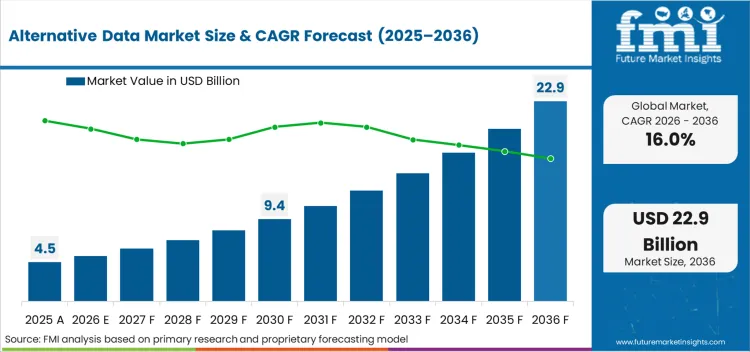
In 2025, the alternative data market was valued at USD 4.6 billion. Based on Future Market Insights' analysis, demand for alternative data is estimated to grow to USD 5.2 billion in 2026 and USD 22.9 billion by 2036. FMI projects a CAGR of 16.0% during the forecast period.
Absolute dollar growth of USD 17.7 billion over the decade signals a fundamental shift in how institutional investors, corporate strategists, and government agencies source intelligence. The sustained growth trajectory reflects the migration of alternative data from an experimental supplemental input to a core analytical layer in investment workflows, driven by the structural transition from discretionary portfolio management toward quantitative and systematic strategies.
Summary of Alternative Data Market
- Alternative Data Market Definition
- Alternative data refers to commercially licensed datasets derived from non-traditional sources, including web scraping, transaction records, geolocation signals, satellite imagery, and app usage logs, used to generate insights beyond conventional financial data.
- Demand Drivers in the Market
- Systematic institutionalization of quantitative investment strategies requires continuously updated, machine-readable data feeds.
- ESG regulatory mandates in Europe and Asia Pacific compel asset managers to validate claims using independent third-party data.
- Expansion of use cases into corporate strategy and government intelligence diversifies the buyer base beyond finance.
- Key Segments Analyzed in the FMI Report
- Data Type: Web-Scraped Data leads with approximately 29% share in 2026.
- End Use Industry: Investment and Trading Firms account for approximately 41% of revenues in 2026.
- Geography: North America represents the largest regional market; Asia Pacific is the fastest-growing.
- Analyst Opinion at FMI
- Rahul Pandita, Principal Consultant for Technology at Future Market Insights, opines, "In the updated version of the Alternative Data Market Report for 2026 to 2036, CXOs will find insights into how privacy-centric data collaboration is replacing open-market scraping. Besides this, my findings point at the critical role of AI in resolving entity mapping across fragmented datasets, which will distinguish winning platforms from legacy aggregators."
- Strategic Implications/Executive Takeaways
- Investment managers must integrate systematic alternative data to avoid information disadvantage relative to quant competitors.
- Corporate strategy teams should prioritize web-scraped pricing and foot traffic data for competitive intelligence.
- Vendors must establish regional partnerships in high-growth markets like India and China to capture local demand.
- Methodology
- Market size estimates are revenue-based, constructed using a bottom-up segment aggregation approach.
- Forecasts incorporate segment-specific growth rates derived from demand driver analysis.
- Validated against top-down vendor revenue data and buyer budget trend data.
As Richard Lai, Global Head of Alternative Data at Bloomberg, noted regarding the industry's evolution toward accessibility, “Our goal has always been to make alternative data accessible, scalable, and easy to adopt across a broad range of research workflows." [1] These shifts underscore how deeply embedded alternative datasets have become in modern investment infrastructure.
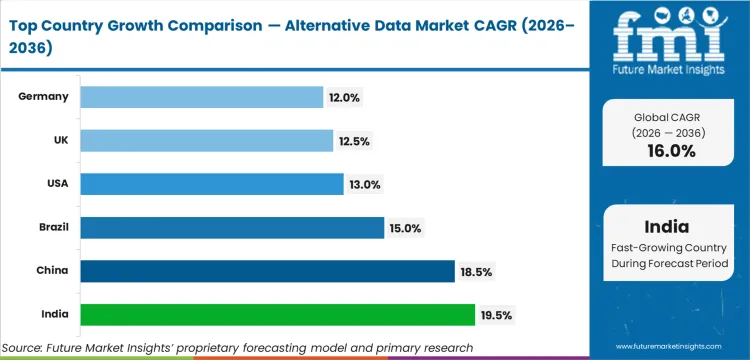
India (19.5% CAGR) and China (18.5% CAGR) represent the fastest-growing markets, driven by the expansion of formal capital markets and the demand for credit analytics serving underbanked populations. Brazil (15.0% CAGR) follows, supported by financial market sophistication and agricultural commodity trading. Mature markets like the United States (13.0% CAGR), the United Kingdom (12.5% CAGR), and Germany (12.0% CAGR) generate demand primarily through the institutionalization of quantitative strategies and ESG compliance, though growth is structurally constrained by increasing regulatory scrutiny and market saturation.
Alternative Data Market Definition
Alternative data refers to information derived from non-traditional sources that sits outside the standard financial data ecosystem that is, outside earnings reports, regulatory filings, macroeconomic indicators, and exchange-generated price and volume data. It encompasses any dataset that provides incremental informational advantage for investment decision-making, credit risk assessment, corporate competitive intelligence, or government policy analysis.
Alternative Data Market Inclusions
The report includes a comprehensive analysis of global and regional market sizes, forecast periods, and segment breakdowns by data type (web-scraped, transaction, geolocation, satellite, app usage) and end-use industry. It covers commercial licensing revenues for web-scraped datasets, transaction data products, geolocation and mobile device data, satellite imagery, and app usage analytics. The scope also includes revenues from data delivery infrastructure, normalization services, and value-added analytics bundled within commercial licenses.
Alternative Data Market Exclusions
The scope excludes traditional financial data revenues, internal proprietary data assets, and primary survey and market research revenues. It also omits raw satellite launch infrastructure revenues, retail banking transaction processing revenues, and consulting revenues earned by firms that use alternative data but do not commercially license the underlying datasets. Publicly available government datasets and general-purpose cloud infrastructure revenues are also excluded.
Alternative Data Market Research Methodology
- Primary Research: Interviews were conducted with buy-side investment professionals, data procurement officers at institutional asset managers, alternative data vendor executives, quantitative analysts, and compliance officers responsible for data governance. Participants included key decision-makers to validate market sizing assumptions and identify demand drivers.
- Desk Research: A systematic review of vendor annual reports, regulatory guidance from the SEC, FCA, ESMA, and SEBI, and academic literature on systematic investing was performed. Industry association publications from AIMA and CAIA were also analyzed to contextualize market trends.
- Market-Sizing and Forecasting: A bottom-up sizing methodology aggregated vendor-level revenue estimates across data type categories and end-use verticals, reconciled against top-down vendor revenue aggregations. The forecast model applies segment-specific growth rates derived from demand driver analysis and regulatory adoption curves.
- Data Validation and Update Cycle: All quantitative estimates were subject to a multi-stage validation protocol involving cross-referencing between primary interview findings, secondary revenue disclosures, and proprietary analytics benchmarks. Segment shares were validated against buyer-side data procurement survey data.
Segmental Analysis
Alternative Data Market Analysis by Data Type
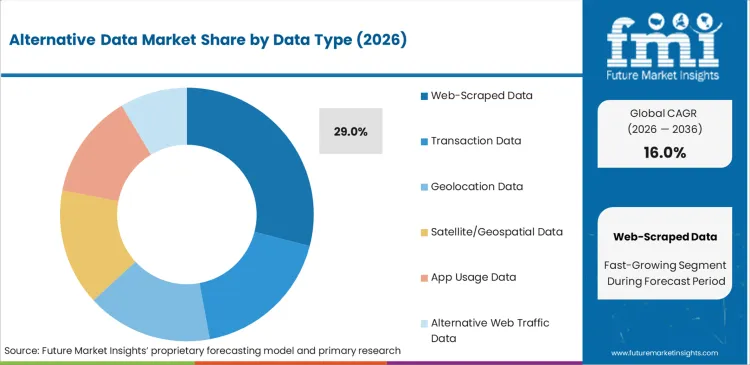
Based on FMI's Alternative Data Market report, consumption of Web-Scraped Data is estimated to hold 29% share in 2026. This segment dominates due to the structural proliferation of e-commerce, which provides a continuously expanding substrate for data collection. For investment managers, these signals serve as critical leading indicators of consumer demand trends and competitive pricing behavior that manifest in financial results weeks later.
- Digital Commerce Expansion: The commercial value of web-scraped retail data is directly coupled to the expansion of digital commerce; for example, S&P Global's acquisition of With Intelligence in October 2025 significantly expanded its private markets data coverage to include granular fundraising and investor relationship signals [2].
- Job Posting Intelligence: Web-scraped job posting data has emerged as a high-value corporate intelligence signal; FactSet's strategic partnership with Arcesium in December 2025 integrates front and middle-office workflows, enabling seamless ingestion of employment and alternative datasets for risk analysis [3].
- Regulatory Complexity: The technical sophistication required to maintain high-quality scraping infrastructure favors established vendors; Bloomberg's integration of Similarweb's digital intelligence data in June 2025 validates the market's shift toward fully compliant, verified web traffic feeds over raw scraping [4].
Alternative Data Market Analysis by End Use Industry
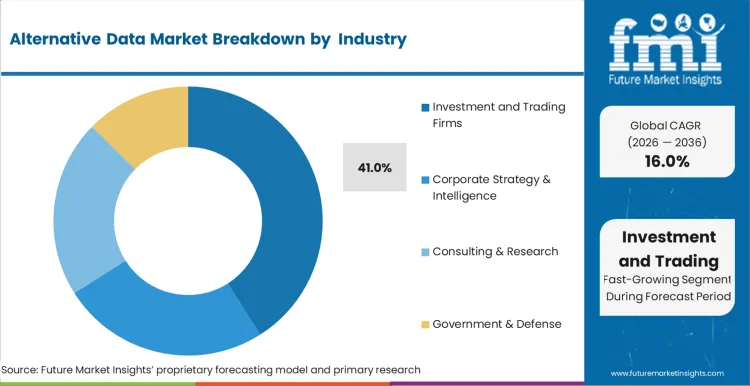
Investment and Trading Firms are estimated to account for approximately 41% of total Alternative Data Market revenues in 2026. This dominance is driven by the institutionalization of quantitative and systematic investment strategies that require high-frequency, machine-readable alternative data inputs for signal generation, risk management, and ESG compliance.
- Risk Management Integration: Firms are embedding alternative data into risk infrastructure; FactSet’s partnership with Arcesium enables buy-side firms to combine public and private data for unified risk exposure analysis [3].
- Systematic Strategy Growth: The expansion of AUM in quantitative strategies creates direct demand; Bloomberg’s integration of Similarweb data provides systematic funds with near real-time digital performance indicators for thousands of public companies [4].
- Private Market Transparency: Demand is expanding into private credit and equity; S&P Global’s acquisition of With Intelligence addresses the need for opaque market data, providing institutional investors with previously inaccessible fundraising and allocation signals.
Alternative Data Market Drivers, Restraints, and Opportunities
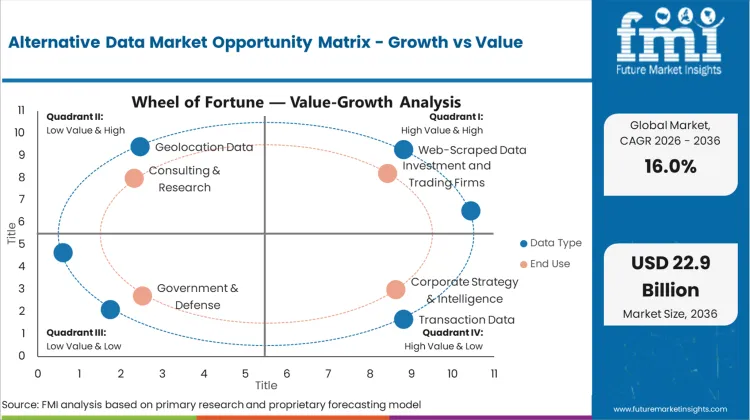
Future Market Insights analysis observes that the Alternative Data Market is in the early stages of a structural maturation phase, transitioning from a fragmented, provider-led market characterized by bespoke licensing arrangements toward a standardized, institutionalized procurement environment. Historically, the market was driven by discretionary alpha generation; however, the current valuation reflects the convergence of systematic investment mandates and regulatory compliance requirements. This shift anchors the market's growth in a more stable, non-discretionary demand base.
The core tension in the market lies in the shift from experimental adoption to core infrastructure integration. Demand for raw, unstructured data is declining in favor of normalized, machine-readable feeds that can be directly ingested into quantitative models. As traditional financial data sources become commoditized, the premium for unique, high-frequency signals like web-scraped pricing and geolocation data is rising. However, vendors face pressure to demonstrate legal defensibility and data provenance, creating a bifurcation where compliant, high-quality providers gain share at the expense of "grey market" scrapers.
- Green De-commoditization: ESG regulatory mandates create a structural demand floor for alternative data that is distinct from discretionary alpha generation. Under frameworks like SFDR, asset managers must validate ESG claims using independent data, converting satellite imagery and supply chain tracking from optional inputs to compliance-mandated procurement categories.
- Regulatory Baseline Mandates: Data privacy regulations like GDPR and CCPA impose compliance costs and data residency requirements, increasing vendor operating complexity. While this creates barriers to entry, it also drives demand for compliant data products, pushing buyers toward established vendors with robust governance frameworks.
- Export-Driven Upgrading: The expansion of alternative data use cases into non-financial verticals represents a structural opportunity. In emerging markets, the translation of capabilities into domestic applications-such as credit scoring in India and agricultural monitoring in Brazil-creates new local demand vectors beyond the traditional investment management buyer base.
Regional Analysis
Based on the regional analysis, the Alternative Data Market is segmented into North America, Latin America, Europe, East Asia, South Asia, Oceania and Middle East & Africa across 40+ countries. The full report also offers market attractiveness analysis based on regional trends.
.webp "Top Country Growth Comparison Alternative Data Market Cagr (2026 2036)")
| Country | CAGR (2026 to 2036) |
|---|---|
| India | 19.5% |
| China | 18.5% |
| Brazil | 15.0% |
| United States | 13.0% |
| United Kingdom | 12.5% |
| Germany | 12.0% |
Source: Future Market Insights (FMI) analysis, based on proprietary forecasting model and primary research
North America Alternative Data Market Analysis
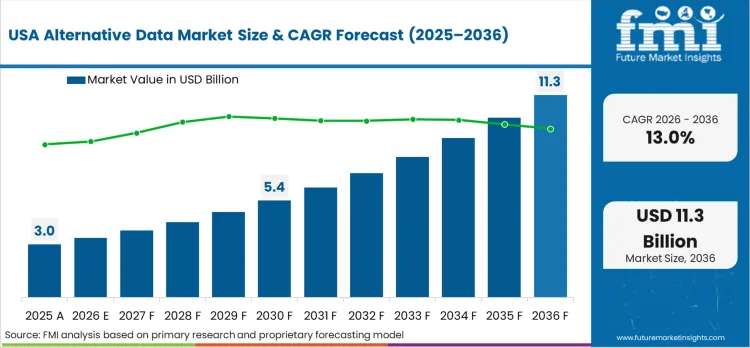
North America dominates the global alternative data market, with the United States functioning as the primary hub for institutional procurement. USA hedge funds and quantitative trading firms drive high-volume demand for web-scraped and transaction data to feed systematic strategies.
- United States: Demand for alternative data in the United States is projected to rise at 13.0% CAGR through 2036. This growth is driven by the mature adoption of quantitative investment strategies and the expansion into corporate intelligence use cases. For instance, the SEC's increasing scrutiny on alternative data usage has prompted firms to invest heavily in compliant data sourcing. Additionally, major financial data vendors like Bloomberg continue to acquire specialized alternative data providers, such as the integration of Similarweb's traffic data in June 2025, to embed these capabilities into core terminal workflows [4].
FMI's analysis of the alternative data market in North America consists of country-wise assessment that includes the United States and Canada. Readers can find detailed analysis of regulatory impacts and vendor consolidation trends.
Asia Pacific Alternative Data Market Analysis
Asia Pacific is the fastest-growing regional market, characterized by the rapid digitization of consumer economies and the deepening of capital markets. The region's growth is fueled by the massive scale of behavioral data generated in China and the demand for credit analytics in India.
- India: Demand for alternative data in India is projected to rise at 19.5% CAGR through 2036. Growth is driven by the expansion of formal capital markets and the urgent need for alternative credit scoring models to serve the large underbanked population. Fintech companies are leveraging mobile device data and transaction signals to assess creditworthiness where traditional bureau data is sparse.
- China: Demand for alternative data in China is projected to rise at 18.5% CAGR through 2036. The market is propelled by the sheer volume of data generated by its digital commerce and mobile payment ecosystems. Domestic quantitative funds are rapidly adopting structured alternative data feeds to gain an edge in the highly retail-driven equity market, while corporate strategists use e-commerce analytics to track real-time consumer trends.
The full report analyzes the alternative data market across East and South Asia from 2021-2036, covering pricing, trends, and growth drivers in China, India, Japan, South Korea, and Australia. The assessment highlights trends that dictate regional platform adoption and data localization requirements.
Latin America Alternative Data Market Analysis
Latin America's market is anchored by Brazil, where financial market sophistication and agricultural commodity trading create dual demand vectors. The region is seeing increasing use of satellite data for crop monitoring and transaction data for economic tracking.
- Brazil: Demand for alternative data in Brazil is projected to rise at 15.0% CAGR through 2036. The country's robust agricultural sector drives demand for satellite and geospatial data to monitor crop yields and optimize logistics for soy, corn, and sugarcane. Concurrently, the sophisticated financial services sector is adopting alternative transaction data to track consumer spending and inform macro-trading strategies.
The report consists of a detailed analysis for the market in Brazil, Mexico, Colombia, and Rest of Latin America. Readers can find detailed information about several factors, such as the pricing analysis and regional trends, which are impacting growth in the Latin America region.
Europe Alternative Data Market Analysis
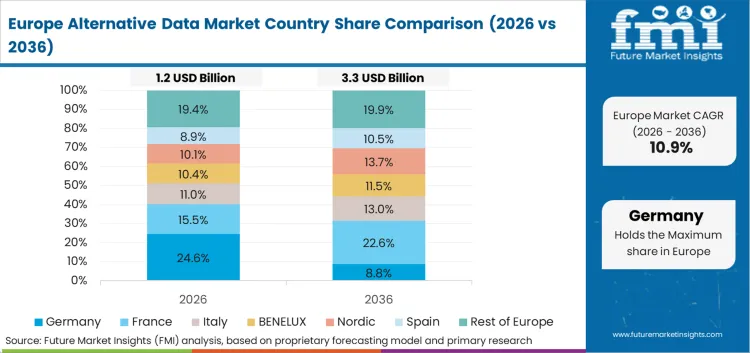
Europe is the second-largest regional market, heavily influenced by its regulatory leadership in sustainable finance. The region's demand is uniquely shaped by ESG mandates that require independent, verifiable data for compliance and reporting.
- United Kingdom: Demand for alternative data in the United Kingdom is projected to rise at 12.5% CAGR through 2036. London's status as a premier global financial hub drives consistent demand from hedge funds and asset managers for diverse alternative datasets. The FCA's proactive stance on data regulation encourages the adoption of compliant, high-quality data sources, pushing firms toward established vendors.
- Germany: Demand for alternative data in Germany is projected to rise at 12.0% CAGR through 2036. The market is distinguished by its strong industrial base, where corporate strategy teams utilize alternative data for supply chain monitoring and competitive intelligence. Germany's strict adherence to data privacy laws like GDPR also drives innovation in anonymized data products and privacy-preserving analytics technologies.
FMI’s analysis of the alternative data market in Europe consists of country-wise assessment that includes the United Kingdom, Germany, France, Switzerland, and the Netherlands. Readers can know various regulations and latest trends in the regional market.
Competitive Aligners for Market Players
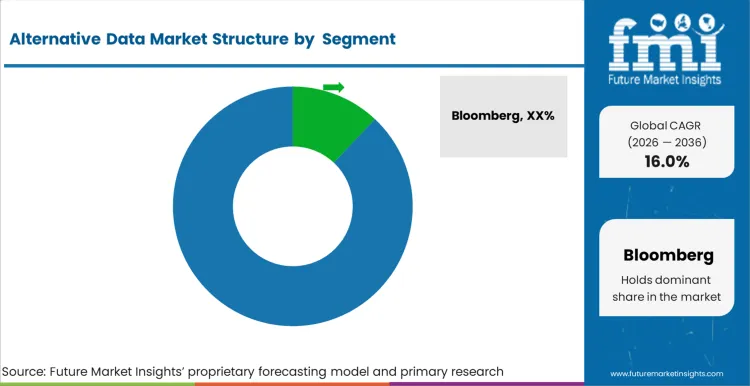
The alternative data market is characterized by a heterogeneous competitive structure spanning large financial data conglomerates, specialized pure-play vendors, and niche providers. The market is moderately concentrated at the top, with incumbents leveraging established distribution channels, while the long tail of specialized vendors competes on data exclusivity and coverage breadth. The primary competitive variable is the ability to provide legally defensible, high-frequency data that integrates seamlessly into institutional workflows.
Large incumbents like Bloomberg and S&P Global have structural advantages due to their ability to bundle alternative data with core financial products, reducing procurement friction for buyers. Pure-play vendors like YipitData and Similarweb differentiate through deep specialization in specific data types. These firms invest heavily in proprietary collection infrastructure to maintain data uniqueness.
Buyer behavior is increasingly sophisticated, with institutional investors conducting rigorous due diligence on data provenance and compliance. This shifts pricing power toward vendors with robust governance frameworks and transparent methodologies. Large customers are managing supplier dependency by diversifying data sources and demanding flexible delivery mechanisms, such as APIs and cloud-native feeds.
Recent Developments
- In October 2025, S&P Global agreed to acquire With Intelligence for $1.8 billion to expand its data coverage across private equity, hedge funds, and private credit markets [2].
- In June 2025, Bloomberg announced the integration of Similarweb's web traffic data directly into the Bloomberg Terminal, enabling investors to access near real-time digital performance insights alongside traditional financial data [4].
- In December 2025, FactSet and Arcesium debuted a strategic partnership to unite front, middle, and back-office workflows, delivering a unified platform that integrates public and private asset data [3].
Key Players in Alternative Data Market
- Bloomberg
- Refinitiv (LSEG)
- S&P Global
- FactSet
- Similarweb
- YipitData
- Earnest Analytics
- Thinknum
- Advan Research
- Quandl (Nasdaq Data Link)
Scope of the Report
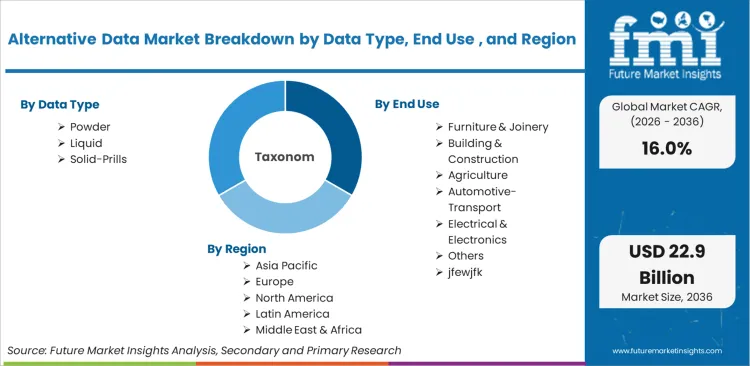
| Metric | Value |
|---|---|
| Quantitative Units | USD 5.2 Billion (2026) to USD 22.9 Billion (2036), at a CAGR of 16.0% |
| Market Definition | Alternative data refers to commercially licensed datasets derived from non-traditional sources-including web scraping, transaction records, geolocation signals, satellite imagery, and app usage logs-used to generate insights beyond conventional financial data. |
| Data Type Segmentation | Web-Scraped Data, Transaction Data, Geolocation Data, Satellite/Geospatial Data, App Usage Data, Alternative Web Traffic Data, Others |
| End Use Industry Segmentation | Investment & Trading Firms, Corporate Strategy & Intelligence, Consulting & Research, Government & Defense, Others |
| Application Coverage | Alpha Generation, Risk Management, ESG Compliance, Competitive Intelligence, Credit Scoring |
| Regions Covered | North America, Latin America, Europe, Asia Pacific, Middle East & Africa |
| Countries Covered | United States, Canada, Mexico, Brazil, Colombia, Germany, France, United Kingdom, Switzerland, Netherlands, China, India, Japan, South Korea, Australia, and 40 plus countries |
| Key Companies Profiled | Bloomberg, Refinitiv (LSEG), S&P Global, FactSet, Similarweb, YipitData, Earnest Analytics, Thinknum, Advan Research, Quandl |
| Forecast Period | 2026 to 2036 |
| Approach | Bottom-up sizing methodology aggregated vendor-level revenue estimates across data type categories and end-use verticals, reconciled against top-down vendor revenue aggregations |
Alternative Data Market Analysis by Segments
Data Type
- Web-Scraped Data
- Transaction Data
- Geolocation Data
- Satellite/Geospatial Data
- App Usage Data
- Alternative Web Traffic Data
- Others
End Use Industry
- Investment & Trading Firms
- Corporate Strategy & Intelligence
- Consulting & Research
- Government & Defense
- Others
Region
- Asia Pacific
- India
- China
- Japan
- South Korea
- Australia
- Rest of Asia Pacific
- Europe
- Germany
- United Kingdom
- France
- Switzerland
- Netherlands
- Rest of Europe
- North America
- United States
- Canada
- Latin America
- Brazil
- Mexico
- Colombia
- Rest of Latin America
- Middle East & Africa
- Rest of Middle East & Africa
Bibliography
- [1] Bloomberg. (2025). Bloomberg Takes Home Best Alternative Data Provider at WatersTechnology's Inside Market Data & Inside Reference Data Awards 2025. Bloomberg Professional Services.
- [2] S&P Global. (2025). S&P Global Agrees to Acquire With Intelligence from Motive Partners for $1.8 Billion. Investor Relations.
- [3] FactSet. (2025). FactSet and Arcesium Debut Tech To Unite Front, Middle, and Back Office Workflows. Investor Relations.
- [4] Bloomberg. (2025). Bloomberg Expands Alternative Data Offering with Web Traffic Data from Similarweb. BigDATAwire.
This bibliography is provided for reader reference and is not exhaustive. The full report contains the complete reference list and detailed citations.
This Report Addresses
- Market intelligence to enable structured strategic decision making across investment and corporate segments.
- Market size estimation and 10-year revenue forecasts from 2026 to 2036, supported by validated capacity and trade benchmarks.
- Growth opportunity mapping across web-scraped, transaction, and satellite data types.
- Segment and regional revenue forecasts covering investment firms, corporate strategy, and government sectors.
- Competition strategy assessment including data exclusivity, compliance capability, and delivery infrastructure.
- Product capability tracking including normalization services, API access, and bundled analytics.
- Regulatory impact analysis covering ESG mandates, data privacy laws, and web scraping litigation.
- Market report delivery in PDF, Excel, PPT, and interactive dashboard formats.
Frequently Asked Questions
How large is the demand for Alternative Data in the global market in 2026?
Demand for Alternative Data in the global market is estimated to be valued at USD 5.2 Billion in 2026.
What will be the market size of Alternative Data in the global market by 2036?
Market size for Alternative Data is projected to reach USD 22.9 Billion by 2036.
What is the expected demand growth for Alternative Data in the global market between 2026 and 2036?
Demand for Alternative Data in the global market is expected to grow at a CAGR of 16.0% between 2026 and 2036.
What is the absolute dollar growth projected for the market?
The market represents an absolute dollar growth of USD 17,739 million over the decade.
Which Data Type is poised to lead global sales by 2026?
Web-Scraped Data is expected to be the dominant type, capturing approximately 29% of global market share in 2026.
Which End Use Industry is the primary consumer of Alternative Data?
Investment and Trading Firms represent the largest segment, accounting for approximately 41% of total revenues in 2026.
What is driving demand in the United States?
Demand is driven by the mature adoption of quantitative investment strategies and the expansion into corporate intelligence use cases.
What is the United States growth outlook in this report?
The United States is projected to grow at a CAGR of 13.0% during 2026 to 2036.
What is the growth outlook for the United Kingdom?
The United Kingdom is projected to expand at a CAGR of 12.5% during 2026 to 2036.
Why is Europe described as a priority region in this report?
Europe is a priority because ESG mandates require independent, verifiable data for compliance, driving demand for satellite and supply chain data.
What is the growth outlook for Germany?
Germany is projected to expand at a CAGR of 12.0% during 2026 to 2036.
Does the report cover India in its regional analysis?
Yes, India is included within Asia Pacific under the regional scope of analysis.
What is the growth outlook for India?
India has the highest projected CAGR at 19.5% for the 2026 to 2036 period.
What is the main demand theme linked to India?
India's demand is linked to the expansion of formal capital markets and the need for alternative credit scoring models.
What is the growth outlook for China?
China is projected to grow at a CAGR of 18.5% during 2026 to 2036.
What is the main demand theme linked to China?
China's demand is driven by the sheer volume of data generated by its digital commerce and mobile payment ecosystems.
What is the growth outlook for Brazil?
Brazil is projected to expand at a CAGR of 15.0% during 2026 to 2036.
What drives demand in Brazil?
Demand in Brazil is driven by the robust agricultural sector requiring satellite data and a sophisticated financial services sector using transaction data.
What is Alternative Data and what is it mainly used for?
Alternative data refers to non-traditional datasets used to provide incremental informational advantage for investment and corporate decision-making.
What is included in the scope of this Alternative Data report?
Scope covers commercial licensing revenues for web-scraped, transaction, geolocation, satellite, and app usage data.
What is excluded from the scope of this report?
Traditional financial data, internal proprietary data, and primary survey research are excluded.
How does FMI build and validate the Alternative Data forecast?
Forecast is developed using a bottom-up sizing methodology aggregated from vendor revenues and cross-validated against buyer budget trends.
What does zero reliance on speculative third party market research mean here?
Primary interviews and verifiable public datasets are used instead of unverified syndicated market estimates.
Preview the report firsthand - request a free sample
Get SampleGet the brochure for pricing and purchase details.
Get PDFTable of Content
- Executive Summary
- Global Market Outlook
- Demand-side Trends
- Supply-side Trends
- Technology Roadmap Analysis
- Analysis and Recommendations
- Market Overview
- Market Coverage / Taxonomy
- Market Definition / Scope / Limitations
- Research Methodology
- Chapter Orientation
- Analytical Lens and Working Hypotheses
- Market Structure, Signals, and Trend Drivers
- Benchmarking and Cross-market Comparability
- Market Sizing, Forecasting, and Opportunity Mapping
- Research Design and Evidence Framework
- Desk Research Programme (Secondary Evidence)
- Company Annual and Sustainability Reports
- Peer-reviewed Journals and Academic Literature
- Corporate Websites, Product Literature, and Technical Notes
- Earnings Decks and Investor Briefings
- Statutory Filings and Regulatory Disclosures
- Technical White Papers and Standards Notes
- Trade Journals, Industry Magazines, and Analyst Briefs
- Conference Proceedings, Webinars, and Seminar Materials
- Government Statistics Portals and Public Data Releases
- Press Releases and Reputable Media Coverage
- Specialist Newsletters and Curated Briefings
- Sector Databases and Reference Repositories
- FMI Internal Proprietary Databases and Historical Market Datasets
- Subscription Datasets and Paid Sources
- Social Channels, Communities, and Digital Listening Inputs
- Additional Desk Sources
- Expert Input and Fieldwork (Primary Evidence)
- Primary Modes
- Qualitative Interviews and Expert Elicitation
- Quantitative Surveys and Structured Data Capture
- Blended Approach
- Why Primary Evidence is Used
- Field Techniques
- Interviews
- Surveys
- Focus Groups
- Observational and In-context Research
- Social and Community Interactions
- Stakeholder Universe Engaged
- C-suite Leaders
- Board Members
- Presidents and Vice Presidents
- R&D and Innovation Heads
- Technical Specialists
- Domain Subject-matter Experts
- Scientists
- Physicians and Other Healthcare Professionals
- Governance, Ethics, and Data Stewardship
- Research Ethics
- Data Integrity and Handling
- Primary Modes
- Tooling, Models, and Reference Databases
- Desk Research Programme (Secondary Evidence)
- Data Engineering and Model Build
- Data Acquisition and Ingestion
- Cleaning, Normalisation, and Verification
- Synthesis, Triangulation, and Analysis
- Quality Assurance and Audit Trail
- Market Background
- Market Dynamics
- Drivers
- Restraints
- Opportunity
- Trends
- Scenario Forecast
- Demand in Optimistic Scenario
- Demand in Likely Scenario
- Demand in Conservative Scenario
- Opportunity Map Analysis
- Product Life Cycle Analysis
- Supply Chain Analysis
- Investment Feasibility Matrix
- Value Chain Analysis
- PESTLE and Porter’s Analysis
- Regulatory Landscape
- Regional Parent Market Outlook
- Production and Consumption Statistics
- Import and Export Statistics
- Market Dynamics
- Global Market Analysis 2021 to 2025 and Forecast, 2026 to 2036
- Historical Market Size Value (USD Million) Analysis, 2021 to 2025
- Current and Future Market Size Value (USD Million) Projections, 2026 to 2036
- Y-o-Y Growth Trend Analysis
- Absolute $ Opportunity Analysis
- Global Market Pricing Analysis 2021 to 2025 and Forecast 2026 to 2036
- Global Market Analysis 2021 to 2025 and Forecast 2026 to 2036, By Data Type
- Introduction / Key Findings
- Historical Market Size Value (USD Million) Analysis By Data Type , 2021 to 2025
- Current and Future Market Size Value (USD Million) Analysis and Forecast By Data Type , 2026 to 2036
- Web-Scraped Data
- Transaction Data
- Geolocation Data
- Satellite/Geospatial Data
- App Usage Data
- Alternative Web Traffic Data
- Web-Scraped Data
- Y-o-Y Growth Trend Analysis By Data Type , 2021 to 2025
- Absolute $ Opportunity Analysis By Data Type , 2026 to 2036
- Global Market Analysis 2021 to 2025 and Forecast 2026 to 2036, By End Use
- Introduction / Key Findings
- Historical Market Size Value (USD Million) Analysis By End Use, 2021 to 2025
- Current and Future Market Size Value (USD Million) Analysis and Forecast By End Use, 2026 to 2036
- Investment and Trading Firms
- Corporate Strategy & Intelligence
- Consulting & Research
- Government & Defense
- Investment and Trading Firms
- Y-o-Y Growth Trend Analysis By End Use, 2021 to 2025
- Absolute $ Opportunity Analysis By End Use, 2026 to 2036
- Global Market Analysis 2021 to 2025 and Forecast 2026 to 2036, By Region
- Introduction
- Historical Market Size Value (USD Million) Analysis By Region, 2021 to 2025
- Current Market Size Value (USD Million) Analysis and Forecast By Region, 2026 to 2036
- North America
- Latin America
- Western Europe
- Eastern Europe
- East Asia
- South Asia and Pacific
- Middle East & Africa
- Market Attractiveness Analysis By Region
- North America Market Analysis 2021 to 2025 and Forecast 2026 to 2036, By Country
- Historical Market Size Value (USD Million) Trend Analysis By Market Taxonomy, 2021 to 2025
- Market Size Value (USD Million) Forecast By Market Taxonomy, 2026 to 2036
- By Country
- USA
- Canada
- Mexico
- By Data Type
- By End Use
- By Country
- Market Attractiveness Analysis
- By Country
- By Data Type
- By End Use
- Key Takeaways
- Latin America Market Analysis 2021 to 2025 and Forecast 2026 to 2036, By Country
- Historical Market Size Value (USD Million) Trend Analysis By Market Taxonomy, 2021 to 2025
- Market Size Value (USD Million) Forecast By Market Taxonomy, 2026 to 2036
- By Country
- Brazil
- Chile
- Rest of Latin America
- By Data Type
- By End Use
- By Country
- Market Attractiveness Analysis
- By Country
- By Data Type
- By End Use
- Key Takeaways
- Western Europe Market Analysis 2021 to 2025 and Forecast 2026 to 2036, By Country
- Historical Market Size Value (USD Million) Trend Analysis By Market Taxonomy, 2021 to 2025
- Market Size Value (USD Million) Forecast By Market Taxonomy, 2026 to 2036
- By Country
- Germany
- UK
- Italy
- Spain
- France
- Nordic
- BENELUX
- Rest of Western Europe
- By Data Type
- By End Use
- By Country
- Market Attractiveness Analysis
- By Country
- By Data Type
- By End Use
- Key Takeaways
- Eastern Europe Market Analysis 2021 to 2025 and Forecast 2026 to 2036, By Country
- Historical Market Size Value (USD Million) Trend Analysis By Market Taxonomy, 2021 to 2025
- Market Size Value (USD Million) Forecast By Market Taxonomy, 2026 to 2036
- By Country
- Russia
- Poland
- Hungary
- Balkan & Baltic
- Rest of Eastern Europe
- By Data Type
- By End Use
- By Country
- Market Attractiveness Analysis
- By Country
- By Data Type
- By End Use
- Key Takeaways
- East Asia Market Analysis 2021 to 2025 and Forecast 2026 to 2036, By Country
- Historical Market Size Value (USD Million) Trend Analysis By Market Taxonomy, 2021 to 2025
- Market Size Value (USD Million) Forecast By Market Taxonomy, 2026 to 2036
- By Country
- China
- Japan
- South Korea
- By Data Type
- By End Use
- By Country
- Market Attractiveness Analysis
- By Country
- By Data Type
- By End Use
- Key Takeaways
- South Asia and Pacific Market Analysis 2021 to 2025 and Forecast 2026 to 2036, By Country
- Historical Market Size Value (USD Million) Trend Analysis By Market Taxonomy, 2021 to 2025
- Market Size Value (USD Million) Forecast By Market Taxonomy, 2026 to 2036
- By Country
- India
- ASEAN
- Australia & New Zealand
- Rest of South Asia and Pacific
- By Data Type
- By End Use
- By Country
- Market Attractiveness Analysis
- By Country
- By Data Type
- By End Use
- Key Takeaways
- Middle East & Africa Market Analysis 2021 to 2025 and Forecast 2026 to 2036, By Country
- Historical Market Size Value (USD Million) Trend Analysis By Market Taxonomy, 2021 to 2025
- Market Size Value (USD Million) Forecast By Market Taxonomy, 2026 to 2036
- By Country
- Kingdom of Saudi Arabia
- Other GCC Countries
- Turkiye
- South Africa
- Other African Union
- Rest of Middle East & Africa
- By Data Type
- By End Use
- By Country
- Market Attractiveness Analysis
- By Country
- By Data Type
- By End Use
- Key Takeaways
- Key Countries Market Analysis
- USA
- Pricing Analysis
- Market Share Analysis, 2025
- By Data Type
- By End Use
- Canada
- Pricing Analysis
- Market Share Analysis, 2025
- By Data Type
- By End Use
- Mexico
- Pricing Analysis
- Market Share Analysis, 2025
- By Data Type
- By End Use
- Brazil
- Pricing Analysis
- Market Share Analysis, 2025
- By Data Type
- By End Use
- Chile
- Pricing Analysis
- Market Share Analysis, 2025
- By Data Type
- By End Use
- Germany
- Pricing Analysis
- Market Share Analysis, 2025
- By Data Type
- By End Use
- UK
- Pricing Analysis
- Market Share Analysis, 2025
- By Data Type
- By End Use
- Italy
- Pricing Analysis
- Market Share Analysis, 2025
- By Data Type
- By End Use
- Spain
- Pricing Analysis
- Market Share Analysis, 2025
- By Data Type
- By End Use
- France
- Pricing Analysis
- Market Share Analysis, 2025
- By Data Type
- By End Use
- India
- Pricing Analysis
- Market Share Analysis, 2025
- By Data Type
- By End Use
- ASEAN
- Pricing Analysis
- Market Share Analysis, 2025
- By Data Type
- By End Use
- Australia & New Zealand
- Pricing Analysis
- Market Share Analysis, 2025
- By Data Type
- By End Use
- China
- Pricing Analysis
- Market Share Analysis, 2025
- By Data Type
- By End Use
- Japan
- Pricing Analysis
- Market Share Analysis, 2025
- By Data Type
- By End Use
- South Korea
- Pricing Analysis
- Market Share Analysis, 2025
- By Data Type
- By End Use
- Russia
- Pricing Analysis
- Market Share Analysis, 2025
- By Data Type
- By End Use
- Poland
- Pricing Analysis
- Market Share Analysis, 2025
- By Data Type
- By End Use
- Hungary
- Pricing Analysis
- Market Share Analysis, 2025
- By Data Type
- By End Use
- Kingdom of Saudi Arabia
- Pricing Analysis
- Market Share Analysis, 2025
- By Data Type
- By End Use
- Turkiye
- Pricing Analysis
- Market Share Analysis, 2025
- By Data Type
- By End Use
- South Africa
- Pricing Analysis
- Market Share Analysis, 2025
- By Data Type
- By End Use
- USA
- Market Structure Analysis
- Competition Dashboard
- Competition Benchmarking
- Market Share Analysis of Top Players
- By Regional
- By Data Type
- By End Use
- Competition Analysis
- Competition Deep Dive
- Bloomberg
- Overview
- Product Portfolio
- Profitability by Market Segments (Product/Age /Sales Channel/Region)
- Sales Footprint
- Strategy Overview
- Marketing Strategy
- Product Strategy
- Channel Strategy
- Refinitiv (LSEG)
- S&P Global
- FactSet
- Similarweb
- YipitData
- Earnest Analytics
- Thinknum
- Advan Research
- Quandl (Nasdaq Data Link)
- Bloomberg
- Competition Deep Dive
- Assumptions & Acronyms Used


