

- Industry Size (2026)
- USD 1.9 Bn
- Forecast (2036)
- USD 18.5 Bn
- CAGR (2026 to 2036)
- 25.8%
Automotive GenAI Copilot Market Size, Market Forecast and Outlook By FMI
The automotive GenAI Copilot market was valued at USD 1.3 billion in 2025. The sector is expected to reach USD 1.9 billion in 2026 at a CAGR of 25.8% during the forecast period. Sustained investment propels the valuation to USD 18.5 billion through 2036 as the transition from command-based voice recognition to context-aware generative logic integrates directly with vehicle CAN bus systems and user digital ecosystems.
OEM architecture teams are currently forced to decide whether to build continuous cloud-to-edge lifecycle management capabilities internally or outsource the cabin experience entirely to established consumer tech platforms. Delaying this architectural commitment effectively cedes the primary driver relationship to third-party ecosystems, commoditizing the vehicle itself into mere hardware. This shift fundamentally alters how in-vehicle digital interfaces are developed, moving from static, one-time software integration at the factory to a continuous, dynamic inference model driven by automotive AI agents. The underlying tension remains that automakers recognize these systems as both a critical selling point and a structural threat to their own brand equity if another company's persona dominates the cabin.
Summary of Automotive GenAI Copilot Market
- Automotive GenAI Copilot Market Definition:
- This category encompasses generative AI systems, including both cloud-tethered large language models and edge-processed small language models, that interface directly with vehicle architectures to provide context-aware orchestration of cabin features, navigation, and predictive maintenance.
- Demand Drivers in the Market:
- The commoditization of EV hardware compels OEM product strategy teams to differentiate vehicles based almost entirely on dynamic, software-driven cabin experiences.
- Edge computing limitations force Tier-1 silicon designers to develop localized inference chips that eliminate cloud latency for critical driving commands, utilizing cellular connectivity modules only when necessary.
- Increasing complexity of advanced driver assistance systems requires UX designers to implement conversational logic that safely explains automated decisions to human drivers.
- Key Segments Analyzed in the FMI Report:
- In-Cabin Conversational AI: In-Cabin Conversational AI is estimated to hold 45.2% share in 2026, as it provides the most immediate, marketable differentiation for OEMs facing severe hardware commoditization.
- Passenger Vehicles: Passenger Vehicles is projected to record 72.5% in 2026, driven by high consumer expectations for smartphone-like fluidity in personal transit.
- L2/L2+ (Partial Automation): L2/L2+ (Partial Automation) is poised to account for 58.4% in 2026, reflecting the current regulatory sweet spot for complex system management requiring driver supervision.
- OEM/Factory Fitted: OEM/Factory Fitted is expected to garner 85.6% in 2026, due to the necessity of deep CAN bus integration that aftermarket solutions cannot safely access.
- India: 32.4% compound growth, resulting from the rapid digitization of mid-tier passenger vehicles and a high reliance on voice-first interfaces in unstructured traffic conditions.
- Analyst Opinion at FMI:
- Nikhil Kaitwade, Principal Analyst for Automotive, opines, "The architectural tension in the EV cabin centers entirely on data sovereignty. While Tier-1 integrators push for centralized cloud orchestration to minimize localized thermal loads, OEM product strategists recognize that surrendering edge inference to a third-party tech giant strips them of their primary recurring revenue vector. Brands that maintain a proprietary, vehicle-specific persona processed at the edge will protect their digital equity; those that default to off-the-shelf cloud assistants relegate themselves to low-margin hardware manufacturing."
- Strategic Implications / Executive Takeaways:
- OEM architecture teams must transition from sourcing static software components to managing continuous, cloud-to-edge lifecycle development to maintain relevance.
- Tier-1 suppliers should invest in highly localized Small Language Models (SLMs) to avoid the inherent latency and privacy risks of cloud-tethered logic architectures.
- Fleet management operators face integration bottlenecks that require standardizing middleware layers before deploying generative routing solutions across mixed-brand vehicle pools.
- Methodology:
- Primary Research: Direct interviews with connected car product managers, OEM software architecture heads, and Tier-1 AI integration leads.
- Desk Research: Aggregation of hardware compliance registries, AI safety standard drafts, and next-generation SoC procurement specifications.
- Market-Sizing and Forecasting: Baseline established via observable integration volumes of automotive-grade neural processing units (NPUs).
- Data Validation and Update Cycle: Forecasts triangulated against independent data streams tracking OEM software R&D capital expenditure and strategic tech partnerships.
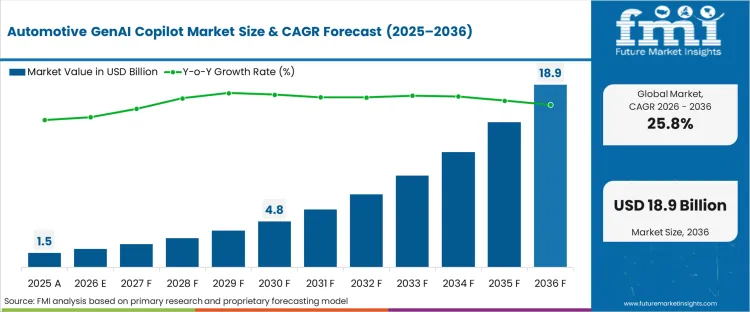
Before adoption becomes truly self-reinforcing, the industry must clear the standardization of automotive-grade Small Language Models (SLMs) capable of operating entirely offline. Tier-1 suppliers trigger this inflection when they deploy edge-optimized inference chips that allow critical vehicle functions to bypass cloud latency entirely. Once localized inference reaches near-zero latency for safety-critical inputs, the architectural penalty of integrating generative logic drops, accelerating deployment across mid-tier vehicle platforms.
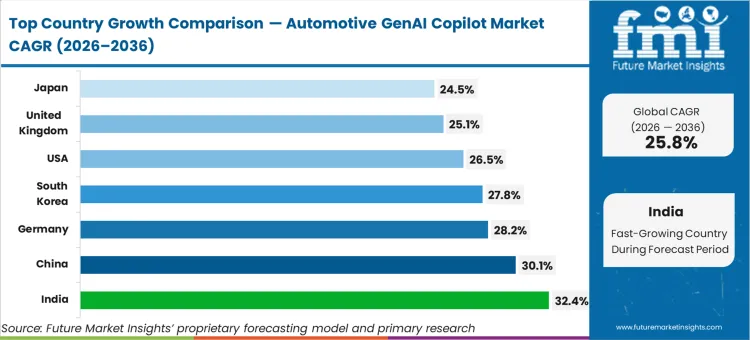
India is poised to advance at 32.4%, followed by China tracking at 30.1% and Germany growing at 28.2%. South Korea is estimated to expand at 27.8%, while the United States is likely to post 26.5% and the United Kingdom follows at 25.1%. Japan is projected to garner 24.5%. This aggressive growth curve in emerging Asian economies reflects the rapid digitization of mid-tier passenger platforms combined with a structural preference for voice-first interfaces to navigate highly unstructured driving environments.
Automotive GenAI Copilot Market Key Takeaways
| Metric | Details |
|---|---|
| Industry Size (2026) | USD 1.9 billion |
| Industry Value (2036) | USD 18.5 billion |
| CAGR (2026 to 2036) | 25.8% |
Source: Future Market Insights (FMI) analysis, based on proprietary forecasting model and primary research
Automotive GenAI Copilot Market Definition
The automotive GenAI Copilot encompasses large and small language models, multimodal generative AI, and localized inference engines explicitly designed to govern, assist, or orchestrate vehicle functions and occupant interactions. It functionally replaces deterministic, rule-based voice assistants with probabilistic, context-aware reasoning systems capable of synthesizing vehicle telemetry data, external environmental inputs, and occupant preferences to execute complex, multi-step operations without rigid command syntax.
Automotive GenAI Copilot Market Inclusions
The scope includes localized edge-inference hardware architectures tailored for generative tasks, cloud-tethered foundation models licensed for automotive application, and middleware bridging natural language processing with core vehicle bus networks. It covers in-cabin conversational agents, generative predictive maintenance algorithms, and dynamic machine learning frameworks utilized for real-time routing optimization including AI driven HD mapping. Both factory-installed systems and validated aftermarket integrations are included.
Automotive GenAI Copilot Market Exclusions
The scope explicitly excludes traditional, rule-based infotainment voice command systems because they rely on deterministic logic trees rather than generative inference. Standard autonomous driving perception modules are excluded unless they specifically utilize generative AI to synthesize edge-case simulations or interact with the driver via natural language. Generic smartphone mirroring applications are excluded as they do not constitute deeply integrated, vehicle-specific generative reasoning platforms.
Automotive GenAI Copilot Market Research Methodology
- Primary Research: Chief Technology Officers at automotive OEMs, Tier-1 software architecture leads, and AI foundation model product directors.
- Desk Research: Edge-computing hardware specifications, software-defined vehicle (SDV) architectural consortium whitepapers, and regulatory filings regarding in-cabin driver monitoring systems.
- Market-Sizing and Forecasting: The baseline anchors to the volume of next-generation System-on-Chip (SoC) shipments specifically certified for in-vehicle LLM/SLM inference.
- Data Validation and Update Cycle: Forecasts cross-validated against the announced rollout schedules of software-defined vehicle platforms by top-15 global automakers.
Segmental Analysis
Automotive GenAI Copilot Market Analysis by Application
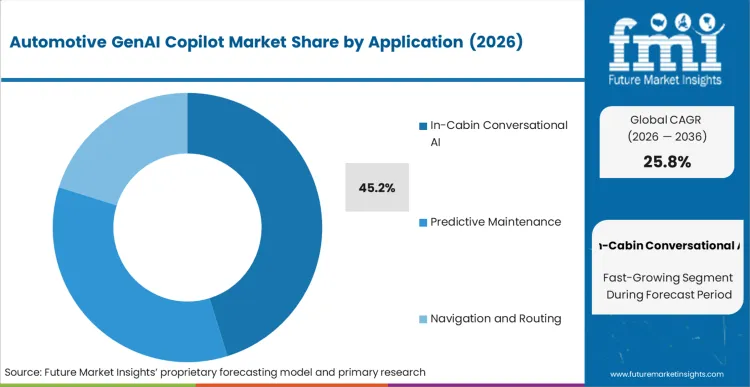
The reason in-cabin conversational AI holds 45.2% of this market comes down to a single operational reality: hardware commoditization in the EV era leaves the digital cabin as the primary battleground for brand differentiation. Automakers cannot easily distinguish a vehicle purely on battery range anymore, forcing product strategists to rely on intuitive, conversational interfaces to justify premium pricing. According to FMI's estimates, this application layer shifts the buyer's interaction from navigating complex sub-menus to utilizing simple, context-aware natural language via an AI powered in car assistant. For the end user, this eliminates the cognitive load of finding manual controls while driving, fundamentally altering the safety profile of the cabin. A manufacturer that delays integrating fluid conversational logic risks their vehicle feeling obsolete the moment it rolls off the assembly line.
- Displacement catalyst: Traditional voice command architectures fail because their rigid syntax requirements frustrate users, pushing them to bypass native OEM systems entirely.
- Architectural validation: Deep integration into the CAN bus allows the conversational AI to control physical actuators rather than merely managing media.
- Ecosystem expansion: The ability to natively orchestrate energy routing optimization transforms the assistant from a convenience feature into a core operational necessity for EV drivers.
Automotive GenAI Copilot Market Analysis by Vehicle Type
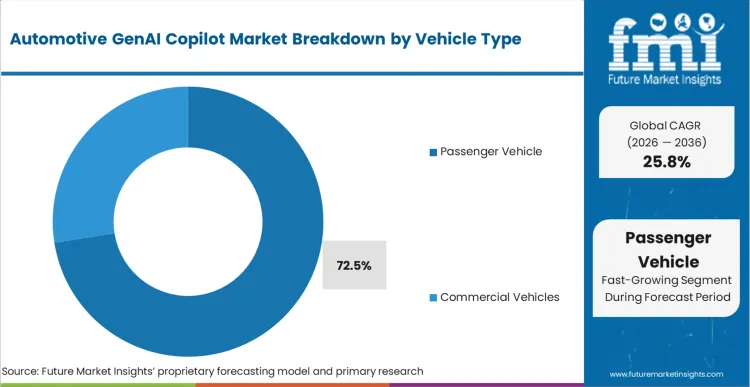
Buyers no longer tolerate a performance downgrade when they enter their personal vehicles. This segment delivers a fluid, multimodal interaction that allows drivers to process complex routing, messaging, and vehicle diagnostics safely at highway speeds. As per FMI's projection, passenger vehicle leads the industry with a 72.5% share during the forecast as architecture teams must deploy sophisticated, localized generative models to meet these expectations without incurring massive cloud compute costs. The operational shift requires OEMs to treat the vehicle as a continuously updating computing node rather than a static piece of hardware heavily reliant on automotive AI chipset performance. Delaying this architectural pivot leaves passenger vehicle brands highly vulnerable to pure-play EV disruptors who build their entire user experience around software-defined paradigms.
- Cost realization: Initial capital expenditure on advanced SoCs is offset by the ability to monetize subscription-based, over-the-air feature upgrades post-sale.
- Hidden operational drag: The thermal management of running high-parameter generative models continuously at the edge requires total vehicle cooling system redesigns.
- Lifecycle comparison: Vehicles equipped with updateable GenAI platforms sustain higher secondary market valuations compared to mechanically identical models with static legacy software.
Automotive GenAI Copilot Market Analysis by Level of Autonomy
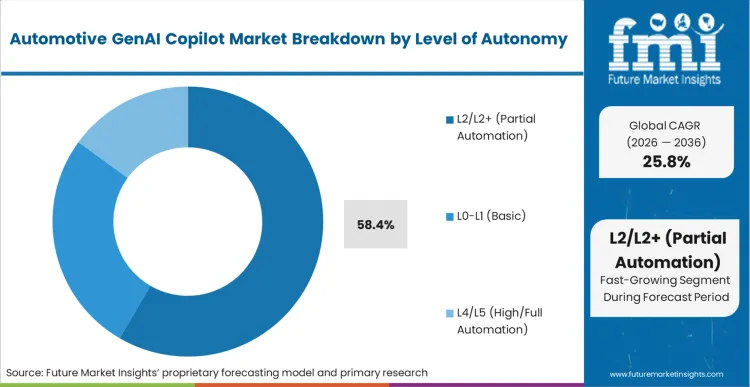
The specific operational threshold forcing buyers toward L2/L2+ (Partial Automation) systems, which hold a 58.4% share, is the critical need for human-machine trust during hand-off scenarios. When a vehicle is operating semi-autonomously, the driver must instantly understand why the system is making a specific maneuver. FMI analysts opine that generative AI provides the necessary translation layer, articulating complex sensor data into plain language explanations using advanced in cabin monitoring systems. This builds the requisite psychological comfort for drivers utilizing advanced conditional driving algorithms. An OEM that fails to adequately explain its L2+ decision-making through an intuitive copilot faces severe consumer backlash and potential regulatory scrutiny over driver disengagement.
- Safety gap mitigation: Generative overlays prevent mode confusion by clearly verbalizing exactly what the vehicle is seeing and intending to do next.
- Residual edge risk: The potential for an AI hallucination during a high-speed handoff scenario remains the single largest liability vector for autonomous engineering teams.
- Operational capture: To realize the full safety benefit, drivers must be trained to engage in two-way dialogue with the vehicle rather than passively monitoring dashboard icons.
Automotive GenAI Copilot Market Analysis by Sales Channel
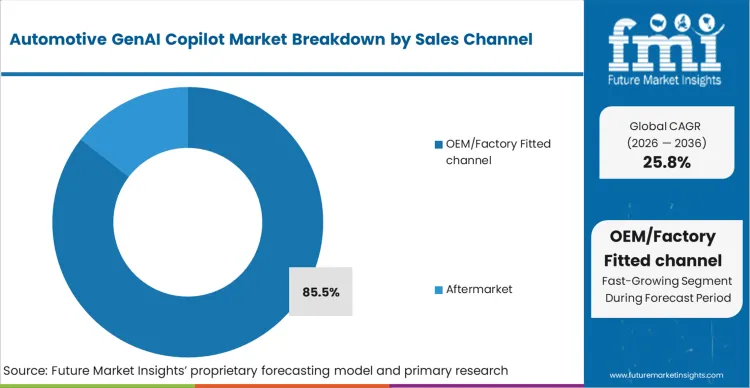
Aftermarket solutions simply cannot safely or legally interface with critical CAN bus networks to control steering, braking, or high-voltage battery routing. This fundamental physical limitation forces consumers to select their GenAI ecosystem at the point of vehicle purchase, heavily weighing the software capability against mechanical specifications. Deep architectural integration into vehicle safety and comfort systems requires the OEM/Factory Fitted channel to dominate at 85.6% share. Based on FMI's assessment, OEM integration allows the copilot to leverage the vehicle's entire sensor suite natively, heavily utilizing embedded AI to provide context‑aware responses that a plug‑in device could never achieve. Consequently, automakers who lack a compelling factory‑fitted over‑the‑air update framework will see their market share erode.
- Production concentration: Silicon foundries and Tier-1 software integrators dictate the pace of innovation, tightly controlling access to automotive-grade inference hardware.
- Constraint mapping: The long lead times of automotive hardware cycles mean today's silicon must be over-provisioned to run the larger language models expected five years post-production.
- End-state landscape: By 2036, the aftermarket channel will essentially collapse for advanced copilots, restricted purely to superficial media overlay applications.
Automotive GenAI Copilot Market Drivers, Restraints, and Opportunities
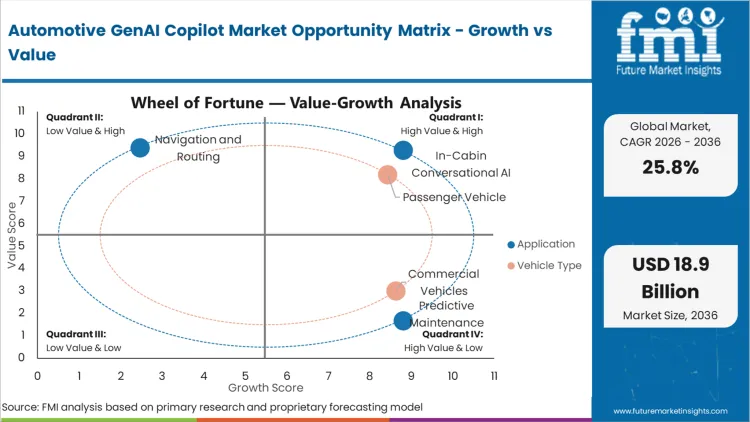
The commoditization of electric vehicle drivetrains forces OEM product strategy teams to establish brand differentiation entirely through the digital cabin experience. As battery density and motor efficiency reach parity across major manufacturers, the deciding commercial factor for consumers becomes the intelligence and fluidity of the vehicle's software ecosystem. This structural pressure obligates software architecture leads to integrate advanced generative logic that can orchestrate complex daily tasks without explicit driver commands. Failing to provide a seamlessly integrated, context-aware environment strips the manufacturer of its ability to command premium pricing, effectively reducing them to a low-margin hardware assembler in a software-defined era.
The tension between cloud dependency and edge latency creates a severe architectural friction that slows deployment even when OEMs want to accelerate. Specifically, automakers struggle to balance the high hallucination risks and latency of cloud-tethered large language models with the computational and thermal costs of running localized models. This is not a temporary software bug; it is a structural limitation of current automotive-grade silicon operating in extreme temperature environments. While Tier-1 suppliers are developing specialized Small Language Models (SLMs) as a partial solution, these constrained models still struggle with the complex, open-ended conversational reasoning required to fully satisfy consumer expectations.
Opportunities in the Automotive GenAI Copilot Market
- Proprietary Persona Development: Automakers leveraging white-labeled foundation models can build highly distinct, brand-specific digital assistants. OEM software teams capture this by training models on brand-specific nomenclature, ensuring the digital voice perfectly matches the physical identity of the vehicle via optimized voice assistance application layers.
- Predictive Maintenance Monetization: Edge-based generative logic that interprets subtle variations in component telemetry allows manufacturers to preemptively schedule service. Dealership service networks capture this by transitioning from reactive repairs to predictive, subscription-based uptime guarantees via remote diagnostic protocols.
- Contextual Commerce Integration: The ability of a copilot to understand a driver's routine and route enables highly targeted, frictionless in-cabin purchasing. Digital service integrators capture this by securely linking the vehicle's secure enclave to payment gateways, turning the dashboard into a secure point-of-sale for charging and tolling.
Regional Analysis
Based on the regional analysis, the automotive GenAI Copilot market is segmented into Asia, Europe, and North America across 40 plus countries.
.webp "Top Country Growth Comparison Automotive Genai Copilot Market Cagr (2026 2036)")
| Country | CAGR (2026 to 2036) |
|---|---|
| India | 32.4% |
| China | 30.1% |
| Germany | 28.2% |
| South Korea | 27.8% |
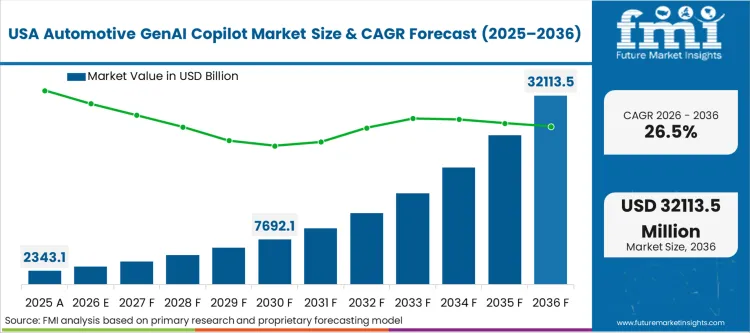
| United States | 26.5% |
| United Kingdom | 25.1% |
| Japan | 24.5% |
Source: Future Market Insights (FMI) analysis, based on proprietary forecasting model and primary research
Asia Automotive GenAI Copilot Market Analysis
Rapid digitization of domestic automotive infrastructure and intense domestic competition define the trajectory across Asian markets. In FMI's view, the extreme pace of new vehicle development cycles in this region forces automakers to treat generative AI not as a premium add-on, but as a baseline requirement for market entry. This structural reality creates an environment where software iterates much faster than the underlying hardware. Procurement directors operating in this environment must architect their hardware sourcing with massive computational overhead to accommodate software models that will inevitably expand in complexity over the vehicle's short lifecycle. Consequently, the regional dynamic is defined by a race to secure advanced neural processing units (NPUs) before competitors lock up foundry capacity.
- India: Rapid digitization of the mid-tier passenger vehicles, combined with its highly unstructured road environments, forces a heavy reliance on intelligent, voice-first interfaces for India. Drivers in India operate under intense cognitive load, making tactile touchscreen navigation hazardous and elevating accurate, multilingual voice orchestration to a safety necessity. FMI estimates the automotive GenAI Copilot market in India to expand at an annual growth rate of 32.4%. A practitioner operating in this market understands that success hinges entirely on the copilot's ability to seamlessly switch between regional dialects and English mid-sentence, a nuance that generic models fail to grasp.
- China: China's highly fragmented and hyper-competitive EV landscape forces domestic manufacturers to utilize cutting-edge digital copilots as primary weapons for market share acquisition. Automotive product strategists in China must continuously push Beta-level generative software to the public to maintain the perception of technological leadership. Demand for automotive GenAI Copilot in China is set to grow at 30.1% over the forecast period. The aggressive deployment of these systems positions Chinese OEMs to export highly mature software-defined vehicle architectures to global markets.
- South Korea: High digital literacy combined with concentrated urban driving environments in South Korea requires copilots that can handle extreme multimodal complexity. Fleet operators and individual buyers utilize these systems to mitigate the cognitive load of navigating dense, dynamic traffic grids via advanced connected vehicle technology. South Korea is expected to see its automotive GenAI Copilot sector grow at a compound annual rate of 27.8%. The deep integration of these copilots with national telecommunications networks opens up massive commercial opportunities for localized telecom operators.
- Japan: Structural reliance on highly localized navigation logic and a deep-seated cultural preference for polite, ultra-reliable digital interactions dictate a slower, more deliberate adoption curve. The market for automotive GenAI Copilot in Japan is forecast to register a CAGR of 24.5%. Engineering teams in Japan face intense internal pressure to eliminate any possibility of AI hallucination before commercial deployment, prioritizing flawless execution over rapid feature releases. This methodical approach ensures that when full integration is achieved, the resulting operational stability dramatically reduces post-sale software warranty claims for Japanese automakers.
FMI's report includes secondary markets across Southeast Asia. The gradual rollout of 5G infrastructure in these adjacent markets acts as a pacing mechanism, dictating exactly when cloud-tethered generative features can safely be activated by regional distributors.
Europe Automotive GenAI Copilot Market Analysis
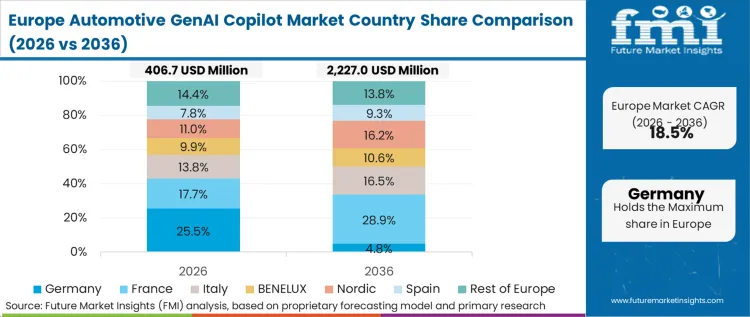
Strict regulatory environments regarding data privacy and driver distraction fundamentally shape the deployment parameters in Europe. Unlike markets prioritizing rapid feature expansion, European regulatory frameworks force automakers to prove that generative systems actively reduce driver cognitive load rather than adding to it. As per FMI's projection, this policy-led environment requires software architects to heavily bias their designs toward edge-based inference utilizing specialized vehicle cybersecurity management, ensuring that personal biometric and location data does not continuously stream to external cloud servers. Operations heads in this region must construct rigorous data compliance pathways before a single line of generative code is pushed over-the-air to European fleets.
- Germany: Stringent automotive safety standards in Germany and data sovereignty laws compel luxury automakers to invest heavily in highly secure, localized small language models. Software engineering directors in Germany must architect systems that can execute complex sensor fusion suites and predictive maintenance logic entirely within the vehicle's secure hardware enclave. The Germany market for automotive GenAI Copilot is likely to post a CAGR of 28.2%. The structural trajectory established here forces a bifurcation in global automotive software architecture, setting a high-privacy baseline that ultimately dictates the minimum standard for premium vehicles worldwide.
- United Kingdom: The aggressive push toward comprehensive electric vehicle adoption creates a distinct necessity for copilots capable of highly dynamic, real-time energy routing and charging orchestration. Over the forecast period, automotive GenAI Copilot in the United Kingdom is set for a CAGR of 25.1%. Logistics operators and EV drivers in the UK must seamlessly navigate fragmented charging networks, an operational hurdle perfectly suited for generative AI to untangle. Achieving this fluid energy management clears a massive operational bottleneck, directly increasing the daily utilization rates of commercial EV fleets operating in dense urban zones.
FMI's report includes Nordic and Western European automotive markets. The aggressive phasing out of internal combustion engines across these nations inextricably links the adoption of generative software with the expansion of the EV installed base.
North America Automotive GenAI Copilot Market Analysis
The North America market is shaped fundamentally by the aggressive consumer demand for seamless digital continuity between their home ecosystems and their vehicles. Buyers in this region view the vehicle as an extension of their digital workspace and entertainment hubs, placing immense pressure on automakers to deliver highly integrated, multimodal generative experiences. In FMI's view, this economics-led environment rewards OEMs that can successfully monetize the digital cabin through subscription services and contextual commerce, creating a powerful incentive to deploy the most advanced generative models available.
- United States: The intense competition between pure-play EV disruptors and legacy automakers in the United States accelerates the deployment of generative AI across all vehicle segments. Operations heads must navigate a fragmented regulatory landscape while satisfying a consumer base that demands frictionless, voice-first interactions for everything from complex routing to localized commerce utilizing robust United States automotive AI chipset frameworks. The United States market is likely to post a CAGR of 26.5%. The ability to establish a proprietary, vehicle-specific persona that captures recurring revenue from these digital interactions is the primary competitive differentiator for automakers operating in this high-value market.
FMI's report includes the broader North American automotive ecosystem. Cross-border logistics and the expansion of heavy-duty commercial EV fleets present localized opportunities for generative routing solutions.
Competitive Aligners for Market Players
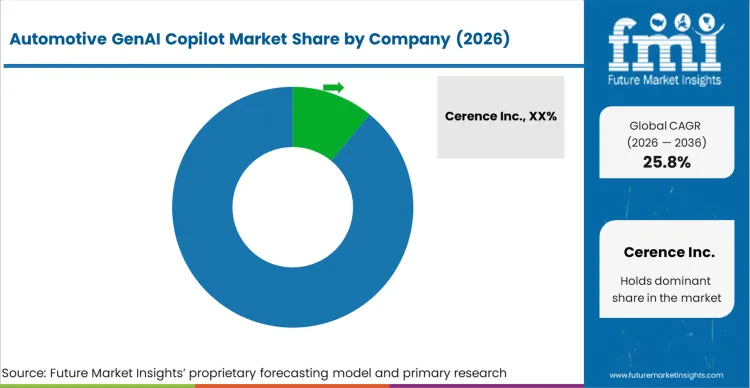
The highly concentrated nature of the foundation model layer stems from the massive capital expenditure required to train automotive-grade LLMs. Cerence Inc., SoundHound AI, Inc., and Google LLC hold dominant positions because they possess both the vast computing infrastructure and the highly specialized acoustic engineering required to filter out cabin noise. Procurement directors at major OEMs use a vendor's ability to offer a completely white-labeled, brand-specific voice persona as the primary variable to distinguish qualified partners from those simply offering a generic API wrapper.
While tech giants offer unparalleled cloud intelligence, legacy Tier-1 suppliers like Robert Bosch GmbH possess the crucial structural advantage of deep, historical CAN bus integration and functional safety certification (ASIL). This advantage persists structurally because integrating a conversational AI into safety-critical braking or steering systems requires years of rigorous hardware-in-the-loop testing. To replicate this, a Silicon Valley challenger must build comprehensive edge-to-cloud infrastructure capable of meeting stringent automotive durability standards, a capability that cannot simply be coded in software without extensive automotive engineering services.
Large automotive buyers actively resist software lock-in by designing abstraction layers that allow them to swap foundation models over the lifecycle of the vehicle. The structural tension between automakers wanting to own the customer data and dominant tech vendors wanting to route that data through their proprietary ecosystems defines the competitive landscape. Through 2036, the market for integration services will become increasingly fragmented as OEMs stand up internal software houses, shifting their reliance away from monolithic tech platforms toward modular, open-source AI frameworks.
Key Players in Automotive GenAI Copilot Market
- Cerence Inc.
- SoundHound AI, Inc.
- Google LLC
- Amazon.com, Inc.
- Baidu, Inc.
- Microsoft Corporation
- NVIDIA Corporation
- Harman International Industries, Inc.
- Apple Inc.
- TomTom International BV
Scope of the Report
| Metric | Value |
|---|---|
| Quantitative Units | USD 1.9 billion to USD 18.5 billion, at a CAGR of 25.8% |
| Market Definition | Generative AI systems, including cloud-tethered LLMs and edge-processed SLMs, that interface directly with vehicle architectures to provide context-aware orchestration of cabin features, navigation, and predictive maintenance. |
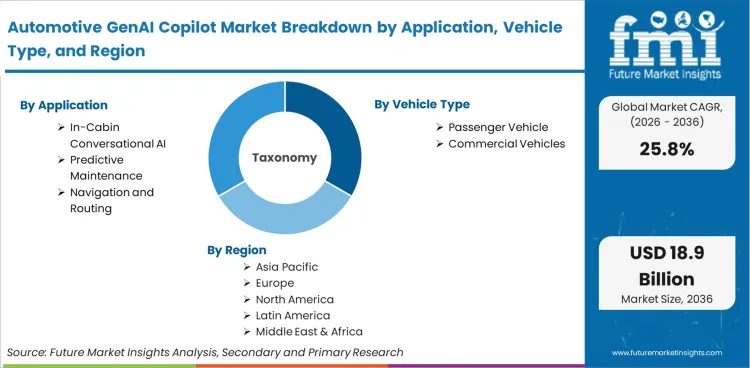
| Application Segmentation | In-Cabin Conversational AI, Predictive Maintenance, Advanced Driver Assistance Systems (ADAS) Integration, Navigation and Routing, Personalized Entertainment |
| Vehicle Type Segmentation | Passenger Vehicles, Commercial Vehicles |
| Level of Autonomy Segmentation | L0-L1 (Basic), L2/L2+ (Partial Automation), L3 (Conditional Automation), L4/L5 (High/Full Automation) |
| Sales Channel Segmentation | OEM/Factory Fitted, Aftermarket |
| Regions Covered | Asia, Europe, North America, and Others |
| Countries Covered | India, China, Germany, South Korea, United States, United Kingdom, Japan, and 40 plus countries |
| Key Companies Profiled | Cerence Inc., SoundHound AI, Inc., Google LLC, Baidu, Inc., NVIDIA Corporation, TomTom International BV |
| Forecast Period | 2026 to 2036 |
| Approach | Interviews conducted with OEM software architecture heads and Tier-1 AI integration leads. Baselines anchored to observable integration volumes of automotive-grade neural processing units. Forecasts validated against OEM software R&D capital expenditure and strategic tech partnerships. |
Source: Future Market Insights (FMI) analysis, based on proprietary forecasting model and primary research
Automotive GenAI Copilot Market Analysis by Segments
Application:
- In-Cabin Conversational AI
- Predictive Maintenance
- Advanced Driver Assistance Systems (ADAS) Integration
- Navigation and Routing
- Personalized Entertainment
Vehicle Type:
- Passenger Vehicles
- Commercial Vehicles
Level of Autonomy:
- L0-L1 (Basic)
- L2/L2+ (Partial Automation)
- L3 (Conditional Automation)
- L4/L5 (High/Full Automation)
- Sales Channel:
- OEM/Factory Fitted
- Aftermarket
Region:
- North America
- United States
- Canada
- Mexico
- Latin America
- Brazil
- Argentina
- Europe
- Germany
- United Kingdom
- France
- Italy
- Spain
- East Asia
- China
- Japan
- South Korea
- South Asia
- India
- ASEAN
- Oceania
- Australia
- New Zealand
- Middle East & Africa
- GCC
- South Africa
Bibliography
- National Highway Traffic Safety Administration. (2025, January). Research and rulemaking activities on vehicles equipped with automated driving systems: Report to Congress. U.S. Department of Transportation.
- National Institute of Standards and Technology. (2024, June). Standards and performance metrics for on-road automated vehicles (NIST IR 8527). U.S. Department of Commerce.
- European Parliament. (2024, March 13). Artificial Intelligence Act: MEPs adopt landmark law.
- Department for Transport. (2025). Transport Artificial Intelligence Action Plan: Transforming ambitions. UK Government.
- World Economic Forum. (2025, April). Autonomous vehicles: Timeline and roadmap ahead.
This bibliography is provided for reader reference. The full FMI report contains the complete reference list with primary source documentation.
This Report Addresses
- Market intelligence to support strategic decision making across In-Cabin Conversational AI and generative routing architectures
- Market size estimation and 10-year revenue forecasts from 2026 to 2036, supported by neural processing unit procurement data modeling
- Growth opportunity mapping across specific named dimensions from this market with emphasis on the standardization of automotive-grade small language models capable of offline operation
- Segment and regional revenue forecasts covering L2/L2+ automation levels across strict European data privacy compliance environments
- Competition strategy assessment including white-labeled persona development, CAN bus integration advantages, and abstraction layer implementation
- Capability development tracking including ISO 26262 functional safety, AUTOSAR adaptive platforms, and SLM edge-inference protocols
- Market access analysis covering European data sovereignty laws and localized Asian smart city integration pathways
- Market report delivery in PDF, Excel, PPT, and interactive dashboard formats for executive strategy, OEM software architecture planning, and operational benchmarking use
Frequently Asked Questions
How large is the automotive GenAI Copilot in 2026?
The industry is expected to cross USD 1.9 billion in 2026. This initial valuation reflects the capital expenditure required by early-adopting luxury OEMs integrating heavy hardware capable of edge-inference, rather than widespread fleet adoption.
What will it be valued at by 2036?
The market is projected to hit USD 18.5 billion by 2036. This scale signals the transition of generative software from a premium luxury feature into a standardized safety and operational requirement across all mid-tier vehicle segments globally.
What CAGR is projected?
A CAGR of 25.8% is projected from 2026 to 2036. This rate reflects the aggressive rollout schedules of software-defined vehicle platforms by top global automakers, strictly tied to their hardware refresh cycles.
Which Application segment leads?
In-Cabin Conversational AI leads with 45.2% share. Automakers prioritize this segment because delivering a fluid, highly visible, smartphone-like interface is the fastest way to differentiate a heavily commoditized EV platform to the end consumer.
Which Vehicle Type segment leads?
Passenger Vehicles dominate at 72.5%. Consumer demand for frictionless digital continuity between their home ecosystem and personal transit forces rapid deployment, while commercial fleets lag due to stricter cost-per-mile calculations.
Which Level of Autonomy segment leads?
L2/L2+ (Partial Automation) captures 58.4%. In scenarios requiring human supervision, generative AI acts as the critical translation layer, verbalizing complex sensor data to maintain driver trust during autonomous hand-offs.
What drives rapid growth?
The commoditization of electric drivetrains forces automakers to shift their entire brand differentiation strategy toward the digital cabin. OEMs must provide context-aware orchestration of features to justify premium pricing and retain customer loyalty.
What is the primary restraint?
The severe thermal and computational cost of running localized inference engines creates a major bottleneck. Engineering teams struggle to balance the latency risks of cloud dependency against the power drain of executing complex models natively on the edge.
Which country grows fastest?
India's 32.4% CAGR outpaces China's 30.1%. While China focuses on hyper-competitive feature sets, India's growth is structurally driven by the necessity for advanced voice orchestration in highly chaotic, unstructured traffic environments where touchscreens pose significant safety hazards.
How do European data sovereignty laws impact deployment?
Strict privacy frameworks compel automakers to bias their software architectures heavily toward edge-computing. Generative models must process sensitive biometric and location data securely within the vehicle's hardware enclave without continuously streaming to external clouds.
How does CAN bus integration define market leadership?
True copilots differ from basic media assistants by possessing the authority to control physical vehicle actuators. Vendors who achieve deep CAN bus integration can orchestrate predictive maintenance and energy routing, rendering superficial aftermarket solutions obsolete.
Why do legacy Tier-1 suppliers maintain a structural advantage over tech giants?
While Silicon Valley possesses superior foundational models, legacy suppliers hold ASIL functional safety certifications and decades of hardware-in-the-loop testing experience. Tech companies cannot simply code their way past the rigorous physical durability standards required for safety-critical braking or steering integration.
Why is OEM/Factory Fitted the dominant sales channel?
Aftermarket devices cannot legally or safely interface with high-voltage battery routing or critical ADAS networks. Deep architectural integration forces consumers to select their generative ecosystem entirely at the point of vehicle purchase.
What inflection point accelerates mid-tier adoption?
The standardization of automotive-grade small language models (SLMs) that operate offline triggers mass adoption. Once these models achieve near-zero latency without cloud reliance, the architectural penalty for OEMs drops significantly.
How does generative AI impact predictive maintenance?
Instead of flagging a generic check-engine light, generative logic interprets subtle variations in component telemetry to preemptively schedule service via automotive remote diagnostic gateways. This shifts dealership networks from reactive repair models to lucrative, subscription-based uptime guarantees.
What hidden costs emerge for OEMs post-deployment?
The thermal management required to continuously run high-parameter inference models mandates costly redesigns of vehicle cooling systems. Additionally, the necessity for constant over-the-air updates requires OEMs to fund expensive, permanent software lifecycle teams.
How do automakers resist lock-in from dominant AI providers?
OEM architecture teams deploy modular abstraction layers that separate the underlying foundation model from the vehicle's user interface. This structural buffer allows manufacturers to swap backend AI vendors without altering the car's established brand persona.
What makes the Japanese adoption curve distinct?
Japanese engineering teams face intense cultural and internal pressure to completely eliminate AI hallucinations before commercial launch. This methodical, zero-risk approach slows initial deployment but drastically reduces post-sale warranty liabilities.
How does generative AI alter the EV charging experience?
The copilot preemptively manages battery routing by predicting driver routines and untangling fragmented charging networks. This context-aware energy optimization removes cognitive load from the driver and increases the daily utilization rates of commercial fleets.
How do FMI analysts validate the 10-year forecasts?
Forecast baselines are anchored firmly to the observable procurement volumes of next-generation automotive neural processing units (NPUs). These figures are triangulated against the announced software R&D capital expenditure plans of the top 15 global automakers.
Why are generic smartphone mirroring applications excluded from scope?
Standard Apple CarPlay or Android Auto act as mere digital overlays and do not possess the native reasoning capability to synthesize vehicle telemetry. True copilots require localized generative engines deeply integrated into the vehicle's core operating system.
What is the stakes for automakers who delay architectural integration?
OEMs who outsource the cabin experience entirely to consumer tech platforms surrender their primary relationship with the driver. Failing to maintain a proprietary, vehicle-specific persona permanently relegates the automaker to the role of a low-margin hardware assembler.
Preview the report firsthand - request a free sample
Get SampleGet the brochure for pricing and purchase details.
Get PDFTable of Content
- Executive Summary
- Global Market Outlook
- Demand-side Trends
- Supply-side Trends
- Technology Roadmap Analysis
- Analysis and Recommendations
- Market Overview
- Market Coverage / Taxonomy
- Market Definition / Scope / Limitations
- Research Methodology
- Chapter Orientation
- Analytical Lens and Working Hypotheses
- Market Structure, Signals, and Trend Drivers
- Benchmarking and Cross-market Comparability
- Market Sizing, Forecasting, and Opportunity Mapping
- Research Design and Evidence Framework
- Desk Research Programme (Secondary Evidence)
- Company Annual and Sustainability Reports
- Peer-reviewed Journals and Academic Literature
- Corporate Websites, Product Literature, and Technical Notes
- Earnings Decks and Investor Briefings
- Statutory Filings and Regulatory Disclosures
- Technical White Papers and Standards Notes
- Trade Journals, Industry Magazines, and Analyst Briefs
- Conference Proceedings, Webinars, and Seminar Materials
- Government Statistics Portals and Public Data Releases
- Press Releases and Reputable Media Coverage
- Specialist Newsletters and Curated Briefings
- Sector Databases and Reference Repositories
- FMI Internal Proprietary Databases and Historical Market Datasets
- Subscription Datasets and Paid Sources
- Social Channels, Communities, and Digital Listening Inputs
- Additional Desk Sources
- Expert Input and Fieldwork (Primary Evidence)
- Primary Modes
- Qualitative Interviews and Expert Elicitation
- Quantitative Surveys and Structured Data Capture
- Blended Approach
- Why Primary Evidence is Used
- Field Techniques
- Interviews
- Surveys
- Focus Groups
- Observational and In-context Research
- Social and Community Interactions
- Stakeholder Universe Engaged
- C-suite Leaders
- Board Members
- Presidents and Vice Presidents
- R&D and Innovation Heads
- Technical Specialists
- Domain Subject-matter Experts
- Scientists
- Physicians and Other Healthcare Professionals
- Governance, Ethics, and Data Stewardship
- Research Ethics
- Data Integrity and Handling
- Primary Modes
- Tooling, Models, and Reference Databases
- Desk Research Programme (Secondary Evidence)
- Data Engineering and Model Build
- Data Acquisition and Ingestion
- Cleaning, Normalisation, and Verification
- Synthesis, Triangulation, and Analysis
- Quality Assurance and Audit Trail
- Market Background
- Market Dynamics
- Drivers
- Restraints
- Opportunity
- Trends
- Scenario Forecast
- Demand in Optimistic Scenario
- Demand in Likely Scenario
- Demand in Conservative Scenario
- Opportunity Map Analysis
- Product Life Cycle Analysis
- Supply Chain Analysis
- Investment Feasibility Matrix
- Value Chain Analysis
- PESTLE and Porter’s Analysis
- Regulatory Landscape
- Regional Parent Market Outlook
- Production and Consumption Statistics
- Import and Export Statistics
- Market Dynamics
- Global Market Analysis 2021 to 2025 and Forecast, 2026 to 2036
- Historical Market Size Value (USD Million) Analysis, 2021 to 2025
- Current and Future Market Size Value (USD Million) Projections, 2026 to 2036
- Y-o-Y Growth Trend Analysis
- Absolute $ Opportunity Analysis
- Global Market Pricing Analysis 2021 to 2025 and Forecast 2026 to 2036
- Global Market Analysis 2021 to 2025 and Forecast 2026 to 2036, By Application
- Introduction / Key Findings
- Historical Market Size Value (USD Million) Analysis By Application , 2021 to 2025
- Current and Future Market Size Value (USD Million) Analysis and Forecast By Application , 2026 to 2036
- In-Cabin Conversational AI
- Predictive Maintenance
- Navigation and Routing
- In-Cabin Conversational AI
- Y-o-Y Growth Trend Analysis By Application , 2021 to 2025
- Absolute $ Opportunity Analysis By Application , 2026 to 2036
- Global Market Analysis 2021 to 2025 and Forecast 2026 to 2036, By Vehicle Type
- Introduction / Key Findings
- Historical Market Size Value (USD Million) Analysis By Vehicle Type, 2021 to 2025
- Current and Future Market Size Value (USD Million) Analysis and Forecast By Vehicle Type, 2026 to 2036
- Passenger Vehicle
- Commercial Vehicles
- Passenger Vehicle
- Y-o-Y Growth Trend Analysis By Vehicle Type, 2021 to 2025
- Absolute $ Opportunity Analysis By Vehicle Type, 2026 to 2036
- Global Market Analysis 2021 to 2025 and Forecast 2026 to 2036, By Level of Autonomy
- Introduction / Key Findings
- Historical Market Size Value (USD Million) Analysis By Level of Autonomy, 2021 to 2025
- Current and Future Market Size Value (USD Million) Analysis and Forecast By Level of Autonomy, 2026 to 2036
- L2/L2+ (Partial Automation)
- L0-L1 (Basic)
- L4/L5 (High/Full Automation)
- L2/L2+ (Partial Automation)
- Y-o-Y Growth Trend Analysis By Level of Autonomy, 2021 to 2025
- Absolute $ Opportunity Analysis By Level of Autonomy, 2026 to 2036
- Global Market Analysis 2021 to 2025 and Forecast 2026 to 2036, By Sales Channel
- Introduction / Key Findings
- Historical Market Size Value (USD Million) Analysis By Sales Channel, 2021 to 2025
- Current and Future Market Size Value (USD Million) Analysis and Forecast By Sales Channel, 2026 to 2036
- OEM/Factory Fitted channel
- Aftermarket
- OEM/Factory Fitted channel
- Y-o-Y Growth Trend Analysis By Sales Channel, 2021 to 2025
- Absolute $ Opportunity Analysis By Sales Channel, 2026 to 2036
- Global Market Analysis 2021 to 2025 and Forecast 2026 to 2036, By Region
- Introduction
- Historical Market Size Value (USD Million) Analysis By Region, 2021 to 2025
- Current Market Size Value (USD Million) Analysis and Forecast By Region, 2026 to 2036
- North America
- Latin America
- Western Europe
- Eastern Europe
- East Asia
- South Asia and Pacific
- Middle East & Africa
- Market Attractiveness Analysis By Region
- North America Market Analysis 2021 to 2025 and Forecast 2026 to 2036, By Country
- Historical Market Size Value (USD Million) Trend Analysis By Market Taxonomy, 2021 to 2025
- Market Size Value (USD Million) Forecast By Market Taxonomy, 2026 to 2036
- By Country
- USA
- Canada
- Mexico
- By Application
- By Vehicle Type
- By Level of Autonomy
- By Sales Channel
- By Country
- Market Attractiveness Analysis
- By Country
- By Application
- By Vehicle Type
- By Level of Autonomy
- By Sales Channel
- Key Takeaways
- Latin America Market Analysis 2021 to 2025 and Forecast 2026 to 2036, By Country
- Historical Market Size Value (USD Million) Trend Analysis By Market Taxonomy, 2021 to 2025
- Market Size Value (USD Million) Forecast By Market Taxonomy, 2026 to 2036
- By Country
- Brazil
- Chile
- Rest of Latin America
- By Application
- By Vehicle Type
- By Level of Autonomy
- By Sales Channel
- By Country
- Market Attractiveness Analysis
- By Country
- By Application
- By Vehicle Type
- By Level of Autonomy
- By Sales Channel
- Key Takeaways
- Western Europe Market Analysis 2021 to 2025 and Forecast 2026 to 2036, By Country
- Historical Market Size Value (USD Million) Trend Analysis By Market Taxonomy, 2021 to 2025
- Market Size Value (USD Million) Forecast By Market Taxonomy, 2026 to 2036
- By Country
- Germany
- UK
- Italy
- Spain
- France
- Nordic
- BENELUX
- Rest of Western Europe
- By Application
- By Vehicle Type
- By Level of Autonomy
- By Sales Channel
- By Country
- Market Attractiveness Analysis
- By Country
- By Application
- By Vehicle Type
- By Level of Autonomy
- By Sales Channel
- Key Takeaways
- Eastern Europe Market Analysis 2021 to 2025 and Forecast 2026 to 2036, By Country
- Historical Market Size Value (USD Million) Trend Analysis By Market Taxonomy, 2021 to 2025
- Market Size Value (USD Million) Forecast By Market Taxonomy, 2026 to 2036
- By Country
- Russia
- Poland
- Hungary
- Balkan & Baltic
- Rest of Eastern Europe
- By Application
- By Vehicle Type
- By Level of Autonomy
- By Sales Channel
- By Country
- Market Attractiveness Analysis
- By Country
- By Application
- By Vehicle Type
- By Level of Autonomy
- By Sales Channel
- Key Takeaways
- East Asia Market Analysis 2021 to 2025 and Forecast 2026 to 2036, By Country
- Historical Market Size Value (USD Million) Trend Analysis By Market Taxonomy, 2021 to 2025
- Market Size Value (USD Million) Forecast By Market Taxonomy, 2026 to 2036
- By Country
- China
- Japan
- South Korea
- By Application
- By Vehicle Type
- By Level of Autonomy
- By Sales Channel
- By Country
- Market Attractiveness Analysis
- By Country
- By Application
- By Vehicle Type
- By Level of Autonomy
- By Sales Channel
- Key Takeaways
- South Asia and Pacific Market Analysis 2021 to 2025 and Forecast 2026 to 2036, By Country
- Historical Market Size Value (USD Million) Trend Analysis By Market Taxonomy, 2021 to 2025
- Market Size Value (USD Million) Forecast By Market Taxonomy, 2026 to 2036
- By Country
- India
- ASEAN
- Australia & New Zealand
- Rest of South Asia and Pacific
- By Application
- By Vehicle Type
- By Level of Autonomy
- By Sales Channel
- By Country
- Market Attractiveness Analysis
- By Country
- By Application
- By Vehicle Type
- By Level of Autonomy
- By Sales Channel
- Key Takeaways
- Middle East & Africa Market Analysis 2021 to 2025 and Forecast 2026 to 2036, By Country
- Historical Market Size Value (USD Million) Trend Analysis By Market Taxonomy, 2021 to 2025
- Market Size Value (USD Million) Forecast By Market Taxonomy, 2026 to 2036
- By Country
- Kingdom of Saudi Arabia
- Other GCC Countries
- Turkiye
- South Africa
- Other African Union
- Rest of Middle East & Africa
- By Application
- By Vehicle Type
- By Level of Autonomy
- By Sales Channel
- By Country
- Market Attractiveness Analysis
- By Country
- By Application
- By Vehicle Type
- By Level of Autonomy
- By Sales Channel
- Key Takeaways
- Key Countries Market Analysis
- USA
- Pricing Analysis
- Market Share Analysis, 2025
- By Application
- By Vehicle Type
- By Level of Autonomy
- By Sales Channel
- Canada
- Pricing Analysis
- Market Share Analysis, 2025
- By Application
- By Vehicle Type
- By Level of Autonomy
- By Sales Channel
- Mexico
- Pricing Analysis
- Market Share Analysis, 2025
- By Application
- By Vehicle Type
- By Level of Autonomy
- By Sales Channel
- Brazil
- Pricing Analysis
- Market Share Analysis, 2025
- By Application
- By Vehicle Type
- By Level of Autonomy
- By Sales Channel
- Chile
- Pricing Analysis
- Market Share Analysis, 2025
- By Application
- By Vehicle Type
- By Level of Autonomy
- By Sales Channel
- Germany
- Pricing Analysis
- Market Share Analysis, 2025
- By Application
- By Vehicle Type
- By Level of Autonomy
- By Sales Channel
- UK
- Pricing Analysis
- Market Share Analysis, 2025
- By Application
- By Vehicle Type
- By Level of Autonomy
- By Sales Channel
- Italy
- Pricing Analysis
- Market Share Analysis, 2025
- By Application
- By Vehicle Type
- By Level of Autonomy
- By Sales Channel
- Spain
- Pricing Analysis
- Market Share Analysis, 2025
- By Application
- By Vehicle Type
- By Level of Autonomy
- By Sales Channel
- France
- Pricing Analysis
- Market Share Analysis, 2025
- By Application
- By Vehicle Type
- By Level of Autonomy
- By Sales Channel
- India
- Pricing Analysis
- Market Share Analysis, 2025
- By Application
- By Vehicle Type
- By Level of Autonomy
- By Sales Channel
- ASEAN
- Pricing Analysis
- Market Share Analysis, 2025
- By Application
- By Vehicle Type
- By Level of Autonomy
- By Sales Channel
- Australia & New Zealand
- Pricing Analysis
- Market Share Analysis, 2025
- By Application
- By Vehicle Type
- By Level of Autonomy
- By Sales Channel
- China
- Pricing Analysis
- Market Share Analysis, 2025
- By Application
- By Vehicle Type
- By Level of Autonomy
- By Sales Channel
- Japan
- Pricing Analysis
- Market Share Analysis, 2025
- By Application
- By Vehicle Type
- By Level of Autonomy
- By Sales Channel
- South Korea
- Pricing Analysis
- Market Share Analysis, 2025
- By Application
- By Vehicle Type
- By Level of Autonomy
- By Sales Channel
- Russia
- Pricing Analysis
- Market Share Analysis, 2025
- By Application
- By Vehicle Type
- By Level of Autonomy
- By Sales Channel
- Poland
- Pricing Analysis
- Market Share Analysis, 2025
- By Application
- By Vehicle Type
- By Level of Autonomy
- By Sales Channel
- Hungary
- Pricing Analysis
- Market Share Analysis, 2025
- By Application
- By Vehicle Type
- By Level of Autonomy
- By Sales Channel
- Kingdom of Saudi Arabia
- Pricing Analysis
- Market Share Analysis, 2025
- By Application
- By Vehicle Type
- By Level of Autonomy
- By Sales Channel
- Turkiye
- Pricing Analysis
- Market Share Analysis, 2025
- By Application
- By Vehicle Type
- By Level of Autonomy
- By Sales Channel
- South Africa
- Pricing Analysis
- Market Share Analysis, 2025
- By Application
- By Vehicle Type
- By Level of Autonomy
- By Sales Channel
- USA
- Market Structure Analysis
- Competition Dashboard
- Competition Benchmarking
- Market Share Analysis of Top Players
- By Regional
- By Application
- By Vehicle Type
- By Level of Autonomy
- By Sales Channel
- Competition Analysis
- Competition Deep Dive
- Cerence Inc.
- Overview
- Product Portfolio
- Profitability by Market Segments (Product/Age /Sales Channel/Region)
- Sales Footprint
- Strategy Overview
- Marketing Strategy
- Product Strategy
- Channel Strategy
- SoundHound AI, Inc.
- Google LLC
- Amazon.com, Inc.
- Baidu, Inc.
- Microsoft Corporation
- NVIDIA Corporation
- Cerence Inc.
- Competition Deep Dive
- Assumptions & Acronyms Used


