

- Industry Size (2026)
- USD 190.0 Mn
- Forecast (2036)
- USD 445.8 Mn
- CAGR (2026 to 2036)
- 8.9%
Automotive Cell Vent Spacer Market Size, Market Forecast and Outlook By FMI
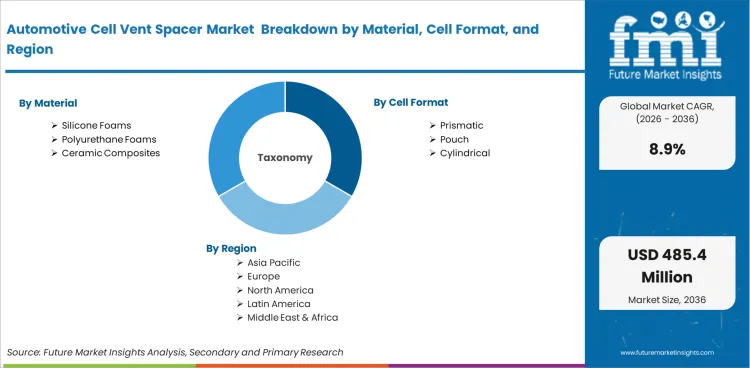
The automotive cell vent spacer market was valued at USD 174.5 million in 2025. Demand is anticipated to hit USD 190.0 million in 2026 at a CAGR of 8.9% during this forecast period. Total valuation is expected to reach USD 445.8 million by 2036 as module spacing requirements move beyond thermal isolation toward managed off-gas routing and propagation control.
Summary of Automotive Cell Vent Spacer Market
- Automotive Cell Vent Spacer Market Snapshot
- The automotive cell vent spacer market is estimated at USD 174.5 million in 2025 and is projected to reach USD 445.8 million by 2036.
- The market is expected to expand at a CAGR of 8.9% from 2026 to 2036, creating an incremental opportunity of USD 255.7 million over the forecast period.
- This sector sits within the battery safety materials space, where product performance is judged on spacing control, vent-path management, electrical insulation, swelling accommodation, and resistance to thermal propagation.
- Demand analysis shows that qualification standards and pack-level safety requirements matter more here than cosmetic pack design.
- Automotive Cell Vent Spacer Market Demand and Growth Drivers
- Demand is rising as electric vehicle production and battery manufacturing continue to expand globally. This shift is increasing the importance of engineered cell vent spacers as a standard component within modern EV battery systems.
- Spacer requirements are becoming more important in pouch and prismatic battery systems, where engineering teams need tighter control over compression, dielectric separation, and internal breathing space across the service life of the pack.
- Regulatory scrutiny around venting performance and thermal-event containment is adding further support to market expansion.
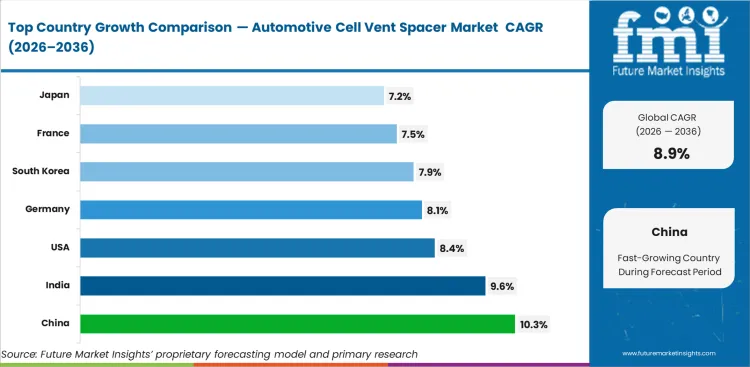
- China is expected to post the highest growth at 10.3% CAGR by 2036, followed by India at 9.6%, the United States at 8.4%, Germany at 8.1%, South Korea at 7.9%, France at 7.5%, and Japan at 7.2% through 2036.
- Growth still faces some moderation from cell-to-pack programs that aim to reduce part count by combining spacer, pad, and shielding functions into fewer components.
- Automotive Cell Vent Spacer Market Product and Segment View
- The market includes spacer and vent-control materials manufactured from silicone foams, polyurethane foams, ceramic composites, cork composites, and engineering plastics for use inside EV battery packs.
- These materials are selected for electrical separation, thermal-event control, and fit stability across passenger EVs, electric buses, light vans, and heavy trucks, with the strongest use case in packs built around prismatic and pouch cells.
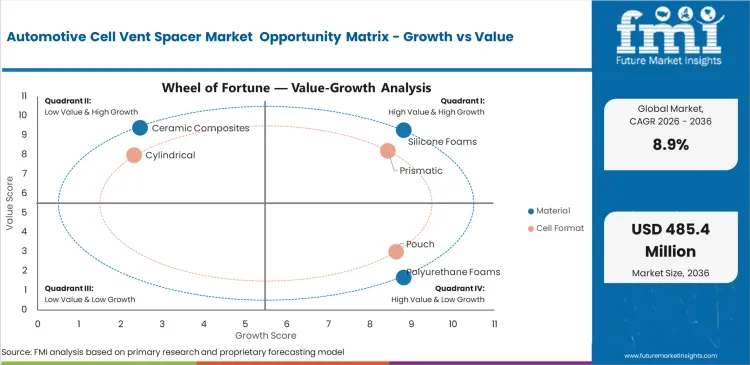
- Silicone foams are expected to account for 34% of the Material segment in 2026, supported by their balance of compressibility, dielectric performance, and flame-retardant tuning.
- In the Cell format segment, prismatic formats are projected to represent 43% share in 2026 because pack developers continue to favor dense layouts that still require controlled compression management.
- Reflecting the continued focus on delaying propagation during abuse events, thermal shielding is likely to contribute 39% of the Function segment in 2026.
- Passenger EVs are anticipated to emerge with 62% share in the Vehicle type segment in 2026 due to the scale of electric passenger-car production.
- Adhesive-backed products are forecast to represent 48% share in the Mounting type segment in 2026, as manufacturers prefer lighter, faster-to-install die-cut and laminated formats.
- Market scope covers inter-cell spacers, vent-path spacer layers, cushioning and compression spacer pads, and dielectric separation materials, while full vent valves, complete pack housings, cooling plates, and standalone sealants remain outside the category.
- Automotive Cell Vent Spacer Market Geography and Competitive Outlook
- China, India, and the United States are set to remain the fastest-expanding national markets, while Germany continues to stand out as a high-value engineering base tied to premium battery-pack development.
- Competitive positions are shaped by material formulation, die-cut precision, validation support, and the ability to combine spacing, compression, insulation, and anti-propagation performance within a single part.
- The market is expected to stay fragmented, as supplier positions are often linked to specific OEM platforms and application-specific design requirements.
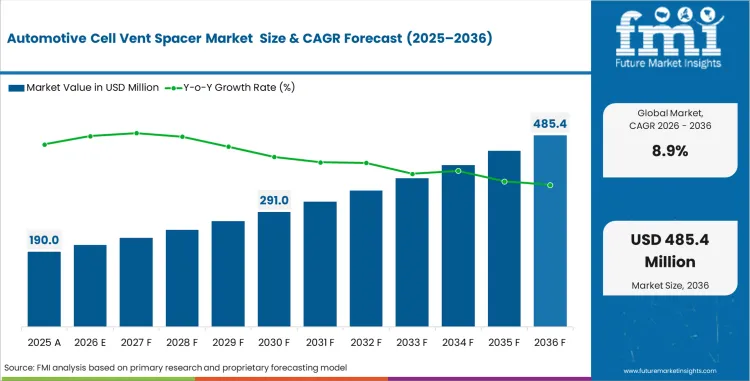
| Metric | Details |
|---|---|
| Industry Size (2026) | USD 190.0 million |
| Industry Value (2036) | USD 445.8 million |
| CAGR (2026 to 2036) | 8.9% |
Source: Future Market Insights (FMI) analysis, based on proprietary forecasting model and primary research
Segmental Analysis
Automotive Cell Vent Spacer Market Analysis by Material
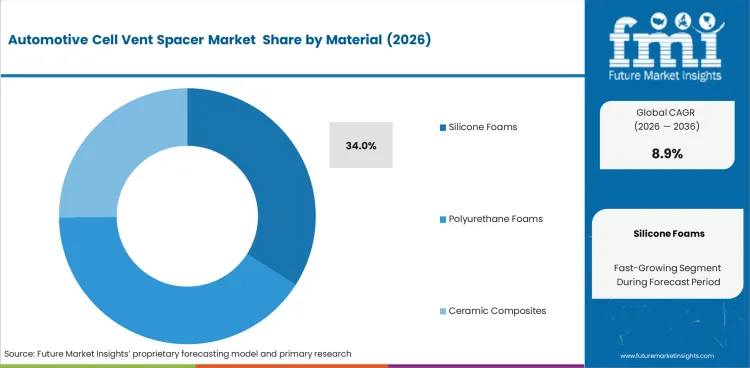
High-temperature recovery characteristics dictate why Silicone foams is estimated to hold 34.0% share in 2026. Battery chemists require materials that maintain elasticity after thousands of charge cycles. The cell swelling exerts massive force and basic polyurethanes permanently deform under such pressure. Selecting EV battery pack thermal interface materials alongside these spacers ensures complete thermal isolation. Generalists assume fire resistance drives selection but lifecycle compression set recovery actually determines long-term viability. Purchasing managers prioritizing initial cost over long-term elasticity face expensive warranty claims when aged batteries lose critical spacing tolerances.
- Elasticity retention: Silicones resist permanent deformation over ten-year vehicle lifespans. Battery chemists avoid premature module degradation.
- Temperature stability: Material properties remain constant across extreme seasonal variations. Thermal managers ensure predictable heat propagation delays.
- Manufacturing yield: Precise die-cutting minimizes waste during high-volume production. Operations directors achieve targeted cost reductions when utilizing gap fill adhesives.
Automotive Cell Vent Spacer Market Analysis by Cell format
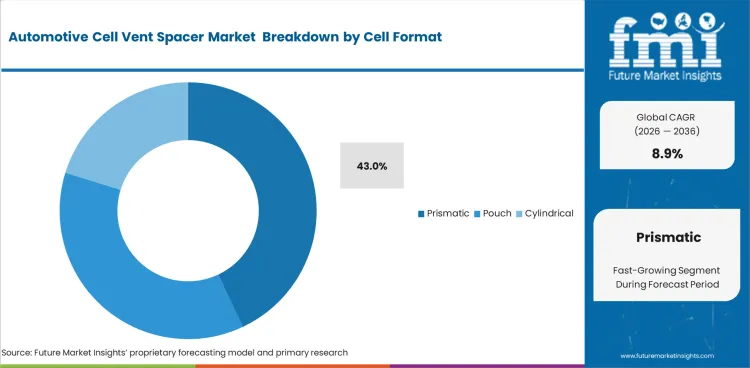
Module packing density requirements drive 43.0% position Prismatic shapes command. Flat geometries allow direct face-to-face stacking. It has been estimated that the pack integrators maximize volumetric efficiency using this predictable form factor. Flat configurations naturally trap battery pack sealants and exhaust gases if not properly vented. Volumetric efficiency metrics mask a critical cooling challenge because dense prismatic blocks offer minimal natural exhaust pathways. Sourcing teams investing in basic insulating pads without molded channels discover their dense modules fail standardized propagation tests.
- Surface conformity: Flat cell faces require uniform pressure distribution. Pack integrators prevent localized hot spots.
- Volumetric optimization: Direct stacking eliminates wasted air gaps. Design engineers maximize total vehicle range.
- Exhaust trapping: Tightly packed blocks restrict natural gas flow. Safety officers mandate specialized channeled spacers after analyzing data from swelling measurement systems.
Automotive Cell Vent Spacer Market Analysis by Function
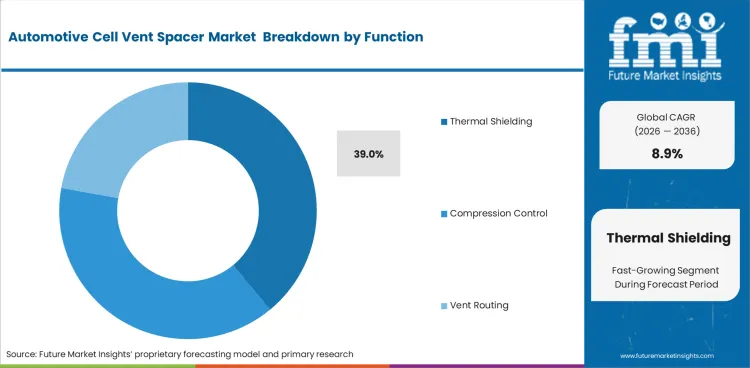
Preventing adjacent cell ignition explains 39.0% share Thermal shielding captures. Homologation officers must prove a single cell failure will not trigger full pack combustion. Insulating barriers buy critical time for passenger evacuation. Integrating battery cell and module compression fasteners ensures these shields remain tightly positioned during physical impacts. Laboratory thermal ratings suggest complete isolation is possible but real-world physical deformation during runaway events compromises most rigid barriers. Engineering leads choosing brittle ceramic barriers risk catastrophic propagation when expanding cells fracture shielding materials.
- Ignition delay: Shielding layers slow conductive heat transfer. Homologation officers secure regulatory compliance approvals.
- Passenger safety: Extended evacuation windows meet stringent global mandates. Vehicle architects avoid product launch delays.
- Fracture vulnerability: Rigid materials crack under swelling pressure. Reliability engineers switch to elastomeric composites verified via off gas detection solutions.
Automotive Cell Vent Spacer Market Analysis by Vehicle type
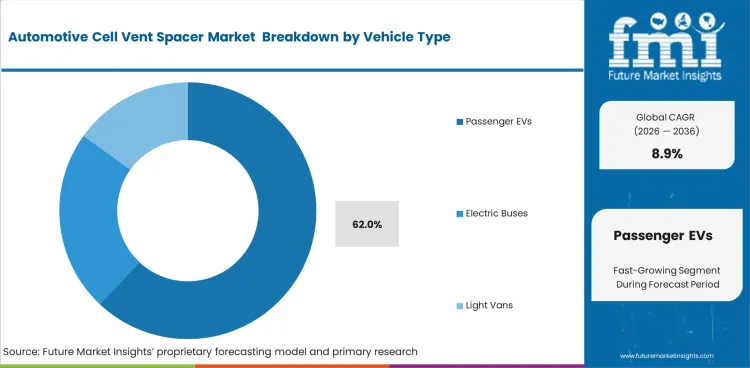
Mass-market production volumes propel Passenger EVs to 62.0% share. Automotive OEMs prioritize high-throughput assembly for consumer fleets. Consumer models utilize highly standardized module designs. Large format cell to pack structural fasteners dominate commercial chassis but passenger platforms require ultra-thin spacing solutions. Fleet statistics suggest uniform usage profiles but passenger vehicles actually experience erratic charging behaviors. Supply chain directors optimizing for commercial bus platforms struggle to miniaturize spacing solutions for compact passenger sedan architectures.
- Volume scaling: Automated manufacturing lines process identical modules rapidly. Operations directors achieve necessary throughput targets.
- Erratic charging: Unpredictable consumer fast-charging creates sudden thermal spikes. Thermal engineers specify high-performance buffers combined with silane terminated polymer adhesives.
- Space constraints: Compact sedans restrict available z-axis height. Packaging leads demand millimeter-thin composite layers.
Automotive Cell Vent Spacer Market Analysis by Mounting type
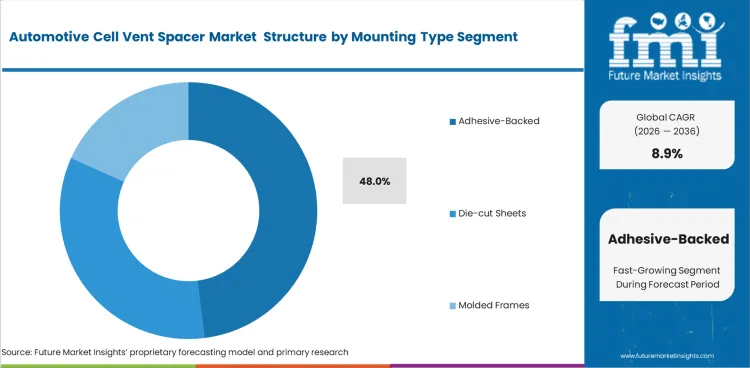
High-speed robotic placement justifies 48.0% share Adhesive-backed formats secure. Manufacturing engineers eliminate manual positioning tasks. Pre-applied adhesives reduce cycle times by seconds per module. Testing vent gas and propagation test systems alongside these mounts verifies venting efficacy. Clean room assembly environments hide realities regarding airborne factory dust degrading adhesive bonding strength. Plant managers skipping environmental controls during assembly face massive scrap rates when spacers detach before final module compression.
- Cycle reduction: Pre-applied backing eliminates wet adhesive application steps. Manufacturing engineers accelerate production lines.
- Positioning accuracy: Robots place sticky pads with perfect repeatability. Quality control supervisors eliminate human alignment errors.
- Contamination risk: Dust particles compromise backing bond strength. Plant managers must implement strict clean room protocols or utilize debonding on demand adhesives for rework.
Automotive Cell Vent Spacer Market Drivers, Restraints, and Opportunities
Regulatory amendments covering passenger evacuation times compel homologation officers to mandate zero-propagation battery pack designs. Failing to pass five-minute delay requirements halts entire vehicle production lines. Battery engineers must integrate specialized physical barriers capable of withstanding extreme localized heat and pressure. Directed exhaust channels become mandatory to route combustible gases away from high-voltage busbars. Immediate safety compliance pressure forces OEMs to abandon cheap passive pads in favor of engineered composite solutions specifically designed for advanced electric vehicle batteries.
Conflicting dimensional tolerances across different cell suppliers create severe operational friction. Module integrators discover varying cell expansion rates require bespoke spacer thicknesses for every battery supplier. Standardizing a single pad design proves impossible when prismatic cells from one vendor swell three millimeters while another vendor's cells swell five millimeters. Adaptive multi-layer laminates offer partial fixes but increase unit costs significantly. Variability slows automated assembly line deployment because robots require frequent recalibration to handle different supplier material batches, a complexity revealed by off gassing characterization systems.
Opportunities in the Automotive Cell Vent Spacer Market
- Intumescent integration: Material scientists combine expanding fire retardants with compressible foams using intumescent sealants. Pack designers reduce total component counts.
- Sensor embedding: R&D directors embed diagnostic arrays within spacing layers. Software engineers gain real-time localized temperature data.
- Recyclable composites: Sustainability officers demand easily separable module components. Sourcing managers secure end-of-life recycling compliance.
Regional Analysis
.webp "Top Country Growth Comparison Automotive Cell Vent Spacer Market Cagr (2026 2036)")
Based on regional analysis, Automotive Cell Vent Spacer is segmented into North America, Europe, and Asia Pacific across 40 plus countries.
| Country | CAGR (2026 to 2036) |
|---|---|
| China | 10.3% |
| India | 9.6% |
| United States | 8.4% |
| Germany | 8.1% |
| South Korea | 7.9% |
| France | 7.5% |
| Japan | 7.2% |
Source: Future Market Insights (FMI) analysis, based on proprietary forecasting model and primary research
Asia Pacific Automotive Cell Vent Spacer Market Analysis
Asia Pacific sets the pace for this market because battery manufacturers across the region shorten development cycles and push spacer materials into production faster than most global peers. Pack developers are working through frequent chemistry updates, tighter module integration, and faster model refresh schedules, so material qualification is handled with a stronger bias toward speed and manufacturability. Local engineering teams are also more willing to standardize molded composite and vent-channel designs early when those formats support assembly efficiency and lower system cost. The region’s advantage comes from execution speed as much as scale, with Asian battery programs often reaching commercial readiness before Western competitors complete longer validation cycles.
- China: China remains a significant demand center because battery makers revise cell and pack designs at a pace that forces repeated updates to spacer specifications. Local converters benefit from short prototyping cycles, close coordination with battery plants, and the ability to adjust die-cut or molded formats without long commercial delays. The market in China is projected to expand at a CAGR of 10.3% through 2036. That pace reflects a supply base built around fast engineering response and direct alignment with high-volume battery manufacturing.
- India: India’s market is being shaped by thermal stress considerations, tighter automotive-grade quality requirements, and a steady improvement in local manufacturing capability. Spacer materials face greater scrutiny in battery systems exposed to high ambient temperatures, which pushes buyers toward better insulation control and more consistent dimensional performance. India is expected to record 9.6% CAGR in the market during the forecast period. As domestic producers upgrade die-cutting accuracy and process control, the country is becoming more credible for localized supply.
- Japan: The industry outlook in Japan points to 7.2% CAGR through 2036. The pace is more measured than in China or India, but the market remains important because approval in Japan often signals strong technical credibility. Japan brings a different demand profile, built around precision manufacturing and stricter acceptance standards. Buyers place heavy weight on thickness consistency, clean process control, and repeatable performance across long qualification cycles, which raises the bar for suppliers trying to enter approved programs.
- South Korea: The South Korea market is expected to advance at a CAGR of 7.9% through 2036. That position is supported by strong coordination between material developers and major battery manufacturers during product refinement. The country benefits from its concentration of large cell manufacturers and its influence over battery material standards used across export programs. Development work tends to move quickly when material suppliers are located close to battery producers, especially in applications requiring thinner silicone-based constructions and tighter packaging efficiency.
FMI’s report points to Asia Pacific’s continued lead being tied to specialized foam conversion capacity, faster engineering iteration, and earlier scale-up of spacer formats suited to next-generation battery pack designs.
North America Automotive Cell Vent Spacer Market Analysis
North America is driven by a more test-driven buying environment, where crash response, thermal-event containment, and long-cycle durability carry significant weight in material selection. Vehicle programs in the region face close scrutiny on abuse performance, which pushes spacer and cushioning materials beyond simple separation functions. Pack developers must balance shock absorption, swelling control, and thermal resistance without adding more thickness than the platform can tolerate which leaves suppliers competing on validated performance under severe operating conditions rather than on conversion capability alone.
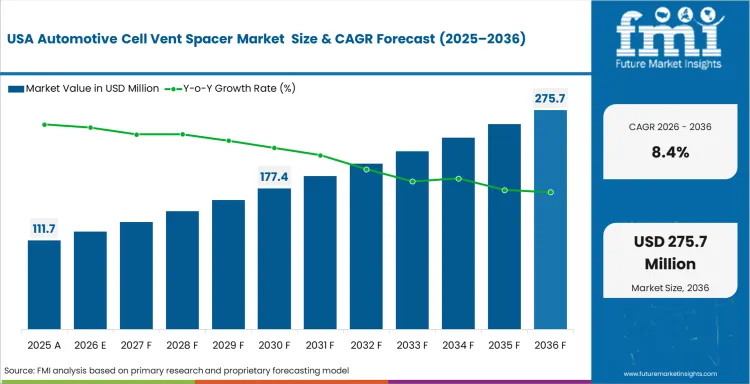
- United States: The United States market is strongly influenced by larger vehicle platforms, especially electric pickups and commercial vehicles that place heavier loads on module-level protection materials. Buyers want spacer systems that can maintain compression behavior, isolation performance, and dimensional stability over long operating lives, particularly in heavy-duty applications. The United States is likely to post 8.4% CAGR in the sector in 2026. Suppliers that can satisfy durability testing and support demanding truck platforms are better placed to secure long-cycle OEM programs.
FMI observes that North American qualification protocols are giving more weight to dynamic compression recovery and localized heat resistance, which raises the technical threshold for supplier approval.
Europe Automotive Cell Vent Spacer Market Analysis
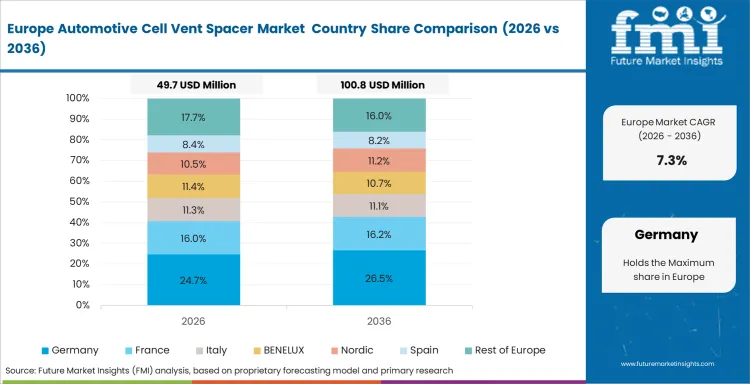
Europe’s market is being reshaped by sustainability rules, material traceability requirements, and tighter scrutiny over end-of-life treatment for battery components. Buyers in the region are under pressure to improve thermal performance without relying on material systems that complicate recycling or compliance documentation. That is forcing a reassessment of adhesive choices, laminate structures, and fire-protection chemistry across battery pack designs. The regional market is being defined by the need to balance safety performance with recyclability and regulatory alignment.
- Germany: Germany remains the region’s reference market for high-specification battery pack design, supported by premium vehicle programs that place strong emphasis on propagation control and engineering precision. Buyers are more willing to specify advanced composites when those materials improve thermal-event resistance, installation reliability, or qualification confidence in premium architectures. Germany is forecast to register 8.1% CAGR in this market over the study period. The country continues to support stronger material value because safety requirements remain stringent across passenger EV platforms.
- France: Adoption in France is anticipated to move ahead at a CAGR of 7.5% during the assessment period. Space efficiency will remain central to material selection as smaller vehicle platforms continue to influence pack design choices. France is shaped by compact vehicle architectures where battery module packaging leaves limited space for added material thickness. That pushes design teams toward spacer formats that combine insulation, separation, and integration efficiency without consuming unnecessary volume inside the pack.
FMI highlights that European supply chains are moving away from traditional mixed-material constructions as safety targets and recyclability requirements increasingly need to be addressed together.
Competitive Aligners for Market Players
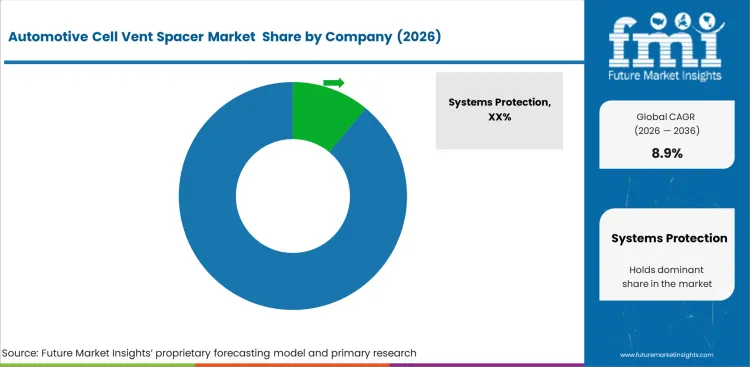
Rapid prototyping capabilities separate successful tier-1 suppliers from commoditized material converters. Alkegen and Saint-Gobain compete by integrating advanced ceramic fibers into flexible matrices. Purchasing teams evaluate vendors based entirely on dynamic compression test data rather than static thermal management materials specification sheets.
Established material science firms possess extensive proprietary testing laboratories. Rogers Corporation and Asahi Kasei run internal fire and explosion containment test chambers pre-validating their materials. Challengers cannot afford multi-million dollar testing facilities. Lacking empirical runaway propagation data eliminates new entrants from OEM qualification rounds immediately.
Automotive OEMs actively resist single-source material lock-in specifying generic performance parameters instead of branded formulations. Lohmann and Amorim Cork Solutions navigate this reality by tailoring adhesive backings to specific robotic assembly line requirements. Linking material performance directly to manufacturing throughput speeds makes swapping suppliers too disruptive for plant managers. Environmental regulations phasing out certain chemical foaming agents force complete baseline reformulations for electric vehicle insulation by 2036.
Key Players in Automotive Cell Vent Spacer Market
- Systems Protection
- Alkegen
- Saint-Gobain
- Rogers Corporation
- Lohmann
- Asahi Kasei
- Amorim Cork Solutions
Scope of the Report
| Metric | Value |
|---|---|
| Quantitative Units | USD 190.0 million to USD 445.8 million, at a CAGR of 8.9% |
| Market Definition | Inter-cell components engineered to absorb mechanical swelling while simultaneously providing directed exhaust pathways for venting gases during battery failure modes. |
| Segmentation | Material, Cell format, Function, Vehicle type, Mounting type, Region |
| Regions Covered | North America, Latin America, Europe, Asia Pacific, Middle East and Africa |
| Countries Covered | China, India, United States, Germany, South Korea, France, Japan |
| Key Companies Profiled | Systems Protection, Alkegen, Saint-Gobain, Rogers Corporation, Lohmann, Asahi Kasei, Amorim Cork Solutions |
| Forecast Period | 2026 to 2036 |
| Approach | Module assembly volume multipliers per vehicle platform |
Source: Future Market Insights (FMI) analysis, based on proprietary forecasting model and primary research
Automotive Cell Vent Spacer Market Analysis by Segments
Material
- Silicone foams
- Polyurethane foams
- Ceramic composites
- Cork composites
- Engineering plastics
Cell format
- Prismatic
- Pouch
- Cylindrical
Function
- Thermal shielding
- Compression control
- Vent routing
- Electrical insulation
- Vibration damping
Vehicle type
- Passenger EVs
- Electric buses
- Light vans
- Heavy trucks
Mounting type
- Adhesive-backed
- Die-cut sheets
- Molded frames
- Laminate stacks
Region
- North America
- Latin America
- Europe
- Asia Pacific
- Middle East and Africa
Bibliography
- International Energy Agency. (2025, May 14). Global EV Outlook 2025. IEA.
- United Nations Economic Commission for Europe. (2026, December). Proposal for an amendment of UN GTR No. 20. UNECE
- Liu, D. T., Kriesten, C., Sattelkow, J., Brandstätter, C., & Trattner, A. (2024). A characterization program for cell spacer materials: Unveiling key material parameters. Montanuniversität Leoben.
- Schöberl, J., Gschwendtner, M., Mahr, M., Daubinger, P., Schmid, M., Sinz, W., & Fuchs, A. (2024, January). Thermal runaway propagation in automotive lithium-ion battery cells: A comparative study of NMC-811 and LFP chemistries. eTransportation, 19, 100302.
- Chen, S., Li, B., Liu, Y., & Zhang, J. (2024, April). Space-efficient protection for cylindrical batteries under mechanical abuse using composite spacer concepts. Composite Structures, 337, 118145.
This bibliography is provided for reader reference. The full FMI report contains the complete reference list with primary source documentation.
This Report Addresses
- Homologation challenges surrounding five-minute thermal runaway delay compliance.
- Compression set recovery requirements for high-silicon anode battery modules.
- Material selection criteria for automated high-speed robotic spacer placement.
- Tooling costs associated with custom molded exhaust routing channels.
- Exothermic heat transfer models dictating minimum spacing tolerances.
- Warranty risks tied to permanent foam deformation during charge cycles.
- Regional variations in crash-induced propagation testing standards.
- Manufacturing yield impacts from adhesive backing contamination.
Frequently Asked Questions
What is the projected valuation by 2036?
Total revenue is forecast to cross USD 445.8 million by 2036. This baseline assumes global implementation of strict zero-propagation regulations forcing all major automakers to abandon passive pads.
What was the recorded baseline value?
Global sales reached USD 174.5 million in 2025. This figure represents early adoption by premium electric vehicle brands ahead of broader mainstream compliance deadlines.
Which material dominates current module designs?
Silicone foams lead with 34.0% share. Their ability to resist permanent deformation over ten-year vehicle lifespans makes them indispensable for handling constant battery swelling.
Why do prismatic formats capture majority share?
Prismatic shapes account for 43.0% of demand because their flat faces require uniform pressure distribution. These tight block configurations completely trap exhaust gases without specialized vented spacers.
What primary function drives component selection?
Thermal shielding secures 39.0% share. Insulating barriers slow conductive heat transfer long enough to satisfy five-minute passenger evacuation mandates during catastrophic failure events.
Which vehicle segment dictates volume requirements?
Passenger EVs represent 62.0% of total volume. High-throughput automated assembly lines produce identical consumer vehicle modules rapidly requiring highly standardized spacer formats.
What mounting technique accelerates factory output?
Adhesive-backed components command 48.0% share. Pre-applied sticky layers eliminate wet gluing steps allowing robots to place pads with perfect repeatability.
Why does China lead regional adoption?
China expands at 10.3% because domestic battery giants standardize molded composite architectures faster than global competitors. Rapid prototyping turnarounds grant domestic converters immense advantages.
How does the United States market perform?
United States demand advances at 8.4%. Federal regulators scrutinize high-speed impact survival rates forcing heavy truck manufacturers to prioritize extreme mechanical shock absorption.
What barrier slows automated assembly deployment?
Varying cell expansion rates require bespoke spacer thicknesses for every battery supplier. Robots require frequent recalibration to handle different supplier material batches.
How do established firms defend positions?
Major suppliers run multi-million dollar internal propagation test chambers. Lacking empirical runaway data eliminates new entrants from OEM qualification rounds immediately.
How do commercial platforms differ from passenger cars?
Heavy trucks utilize thick padding to absorb impacts but passenger sedans restrict available z-axis height. Packaging leads demand millimeter-thin composite layers for compact platforms.
What happens when environmental controls fail during assembly?
Airborne dust instantly degrades adhesive bonding strength. Plant managers skipping clean room protocols face massive scrap rates when spacers detach before final module compression.
How do Indian localization mandates alter supply chains?
New regulations prohibit importing fully assembled modules. Local sourcing managers must find domestic converters capable of meeting precise automotive cutting tolerances.
What role do ceramic fibers play in modern spacers?
Ceramic matrices withstand extreme localized heat blasts better than pure polymers. Integrators weave these fibers into flexible pads to prevent physical fracturing during expansion.
Why are standard thermal tests insufficient for qualification?
Standard tests measure insulation value under static conditions. They miss entirely how materials behave when crushed by cell swelling while blasted by high-pressure exhaust gases.
How will sustainability mandates alter product design?
Recycling regulations demand easily separable module components. Sourcing managers must abandon permanent adhesives to secure end-of-life compliance for future vehicle generations.
What marks the critical threshold for active venting integration?
Once module energy densities surpass 300 Wh/kg passive spacing fails. Crossing this threshold makes multifunctional spacer adoption non-negotiable for next-generation platforms.
Preview the report firsthand - request a free sample
Get SampleGet the brochure for pricing and purchase details.
Get PDFTable of Content
- Executive Summary
- Global Market Outlook
- Demand-side Trends
- Supply-side Trends
- Technology Roadmap Analysis
- Analysis and Recommendations
- Market Overview
- Market Coverage / Taxonomy
- Market Definition / Scope / Limitations
- Research Methodology
- Chapter Orientation
- Analytical Lens and Working Hypotheses
- Market Structure, Signals, and Trend Drivers
- Benchmarking and Cross-market Comparability
- Market Sizing, Forecasting, and Opportunity Mapping
- Research Design and Evidence Framework
- Desk Research Programme (Secondary Evidence)
- Company Annual and Sustainability Reports
- Peer-reviewed Journals and Academic Literature
- Corporate Websites, Product Literature, and Technical Notes
- Earnings Decks and Investor Briefings
- Statutory Filings and Regulatory Disclosures
- Technical White Papers and Standards Notes
- Trade Journals, Industry Magazines, and Analyst Briefs
- Conference Proceedings, Webinars, and Seminar Materials
- Government Statistics Portals and Public Data Releases
- Press Releases and Reputable Media Coverage
- Specialist Newsletters and Curated Briefings
- Sector Databases and Reference Repositories
- FMI Internal Proprietary Databases and Historical Market Datasets
- Subscription Datasets and Paid Sources
- Social Channels, Communities, and Digital Listening Inputs
- Additional Desk Sources
- Expert Input and Fieldwork (Primary Evidence)
- Primary Modes
- Qualitative Interviews and Expert Elicitation
- Quantitative Surveys and Structured Data Capture
- Blended Approach
- Why Primary Evidence is Used
- Field Techniques
- Interviews
- Surveys
- Focus Groups
- Observational and In-context Research
- Social and Community Interactions
- Stakeholder Universe Engaged
- C-suite Leaders
- Board Members
- Presidents and Vice Presidents
- R&D and Innovation Heads
- Technical Specialists
- Domain Subject-matter Experts
- Scientists
- Physicians and Other Healthcare Professionals
- Governance, Ethics, and Data Stewardship
- Research Ethics
- Data Integrity and Handling
- Primary Modes
- Tooling, Models, and Reference Databases
- Desk Research Programme (Secondary Evidence)
- Data Engineering and Model Build
- Data Acquisition and Ingestion
- Cleaning, Normalisation, and Verification
- Synthesis, Triangulation, and Analysis
- Quality Assurance and Audit Trail
- Market Background
- Market Dynamics
- Drivers
- Restraints
- Opportunity
- Trends
- Scenario Forecast
- Demand in Optimistic Scenario
- Demand in Likely Scenario
- Demand in Conservative Scenario
- Opportunity Map Analysis
- Product Life Cycle Analysis
- Supply Chain Analysis
- Investment Feasibility Matrix
- Value Chain Analysis
- PESTLE and Porter’s Analysis
- Regulatory Landscape
- Regional Parent Market Outlook
- Production and Consumption Statistics
- Import and Export Statistics
- Market Dynamics
- Global Market Analysis 2021 to 2025 and Forecast, 2026 to 2036
- Historical Market Size Value (USD Million) Analysis, 2021 to 2025
- Current and Future Market Size Value (USD Million) Projections, 2026 to 2036
- Y-o-Y Growth Trend Analysis
- Absolute $ Opportunity Analysis
- Global Market Pricing Analysis 2021 to 2025 and Forecast 2026 to 2036
- Global Market Analysis 2021 to 2025 and Forecast 2026 to 2036, By Material
- Introduction / Key Findings
- Historical Market Size Value (USD Million) Analysis By Material , 2021 to 2025
- Current and Future Market Size Value (USD Million) Analysis and Forecast By Material , 2026 to 2036
- Silicone Foams
- Polyurethane Foams
- Ceramic Composites
- Silicone Foams
- Y-o-Y Growth Trend Analysis By Material , 2021 to 2025
- Absolute $ Opportunity Analysis By Material , 2026 to 2036
- Global Market Analysis 2021 to 2025 and Forecast 2026 to 2036, By Cell Format
- Introduction / Key Findings
- Historical Market Size Value (USD Million) Analysis By Cell Format, 2021 to 2025
- Current and Future Market Size Value (USD Million) Analysis and Forecast By Cell Format, 2026 to 2036
- Prismatic
- Pouch
- Cylindrical
- Prismatic
- Y-o-Y Growth Trend Analysis By Cell Format, 2021 to 2025
- Absolute $ Opportunity Analysis By Cell Format, 2026 to 2036
- Global Market Analysis 2021 to 2025 and Forecast 2026 to 2036, By Function
- Introduction / Key Findings
- Historical Market Size Value (USD Million) Analysis By Function, 2021 to 2025
- Current and Future Market Size Value (USD Million) Analysis and Forecast By Function, 2026 to 2036
- Thermal Shielding
- Compression Control
- Vent Routing
- Thermal Shielding
- Y-o-Y Growth Trend Analysis By Function, 2021 to 2025
- Absolute $ Opportunity Analysis By Function, 2026 to 2036
- Global Market Analysis 2021 to 2025 and Forecast 2026 to 2036, By Vehicle Type
- Introduction / Key Findings
- Historical Market Size Value (USD Million) Analysis By Vehicle Type, 2021 to 2025
- Current and Future Market Size Value (USD Million) Analysis and Forecast By Vehicle Type, 2026 to 2036
- Passenger EVs
- Electric Buses
- Light Vans
- Passenger EVs
- Y-o-Y Growth Trend Analysis By Vehicle Type, 2021 to 2025
- Absolute $ Opportunity Analysis By Vehicle Type, 2026 to 2036
- Global Market Analysis 2021 to 2025 and Forecast 2026 to 2036, By Mounting Type
- Introduction / Key Findings
- Historical Market Size Value (USD Million) Analysis By Mounting Type, 2021 to 2025
- Current and Future Market Size Value (USD Million) Analysis and Forecast By Mounting Type, 2026 to 2036
- Adhesive-Backed
- Die-cut Sheets
- Molded Frames
- Adhesive-Backed
- Y-o-Y Growth Trend Analysis By Mounting Type, 2021 to 2025
- Absolute $ Opportunity Analysis By Mounting Type, 2026 to 2036
- Global Market Analysis 2021 to 2025 and Forecast 2026 to 2036, By Region
- Introduction
- Historical Market Size Value (USD Million) Analysis By Region, 2021 to 2025
- Current Market Size Value (USD Million) Analysis and Forecast By Region, 2026 to 2036
- North America
- Latin America
- Western Europe
- Eastern Europe
- East Asia
- South Asia and Pacific
- Middle East & Africa
- Market Attractiveness Analysis By Region
- North America Market Analysis 2021 to 2025 and Forecast 2026 to 2036, By Country
- Historical Market Size Value (USD Million) Trend Analysis By Market Taxonomy, 2021 to 2025
- Market Size Value (USD Million) Forecast By Market Taxonomy, 2026 to 2036
- By Country
- USA
- Canada
- Mexico
- By Material
- By Cell Format
- By Function
- By Vehicle Type
- By Mounting Type
- By Country
- Market Attractiveness Analysis
- By Country
- By Material
- By Cell Format
- By Function
- By Vehicle Type
- By Mounting Type
- Key Takeaways
- Latin America Market Analysis 2021 to 2025 and Forecast 2026 to 2036, By Country
- Historical Market Size Value (USD Million) Trend Analysis By Market Taxonomy, 2021 to 2025
- Market Size Value (USD Million) Forecast By Market Taxonomy, 2026 to 2036
- By Country
- Brazil
- Chile
- Rest of Latin America
- By Material
- By Cell Format
- By Function
- By Vehicle Type
- By Mounting Type
- By Country
- Market Attractiveness Analysis
- By Country
- By Material
- By Cell Format
- By Function
- By Vehicle Type
- By Mounting Type
- Key Takeaways
- Western Europe Market Analysis 2021 to 2025 and Forecast 2026 to 2036, By Country
- Historical Market Size Value (USD Million) Trend Analysis By Market Taxonomy, 2021 to 2025
- Market Size Value (USD Million) Forecast By Market Taxonomy, 2026 to 2036
- By Country
- Germany
- UK
- Italy
- Spain
- France
- Nordic
- BENELUX
- Rest of Western Europe
- By Material
- By Cell Format
- By Function
- By Vehicle Type
- By Mounting Type
- By Country
- Market Attractiveness Analysis
- By Country
- By Material
- By Cell Format
- By Function
- By Vehicle Type
- By Mounting Type
- Key Takeaways
- Eastern Europe Market Analysis 2021 to 2025 and Forecast 2026 to 2036, By Country
- Historical Market Size Value (USD Million) Trend Analysis By Market Taxonomy, 2021 to 2025
- Market Size Value (USD Million) Forecast By Market Taxonomy, 2026 to 2036
- By Country
- Russia
- Poland
- Hungary
- Balkan & Baltic
- Rest of Eastern Europe
- By Material
- By Cell Format
- By Function
- By Vehicle Type
- By Mounting Type
- By Country
- Market Attractiveness Analysis
- By Country
- By Material
- By Cell Format
- By Function
- By Vehicle Type
- By Mounting Type
- Key Takeaways
- East Asia Market Analysis 2021 to 2025 and Forecast 2026 to 2036, By Country
- Historical Market Size Value (USD Million) Trend Analysis By Market Taxonomy, 2021 to 2025
- Market Size Value (USD Million) Forecast By Market Taxonomy, 2026 to 2036
- By Country
- China
- Japan
- South Korea
- By Material
- By Cell Format
- By Function
- By Vehicle Type
- By Mounting Type
- By Country
- Market Attractiveness Analysis
- By Country
- By Material
- By Cell Format
- By Function
- By Vehicle Type
- By Mounting Type
- Key Takeaways
- South Asia and Pacific Market Analysis 2021 to 2025 and Forecast 2026 to 2036, By Country
- Historical Market Size Value (USD Million) Trend Analysis By Market Taxonomy, 2021 to 2025
- Market Size Value (USD Million) Forecast By Market Taxonomy, 2026 to 2036
- By Country
- India
- ASEAN
- Australia & New Zealand
- Rest of South Asia and Pacific
- By Material
- By Cell Format
- By Function
- By Vehicle Type
- By Mounting Type
- By Country
- Market Attractiveness Analysis
- By Country
- By Material
- By Cell Format
- By Function
- By Vehicle Type
- By Mounting Type
- Key Takeaways
- Middle East & Africa Market Analysis 2021 to 2025 and Forecast 2026 to 2036, By Country
- Historical Market Size Value (USD Million) Trend Analysis By Market Taxonomy, 2021 to 2025
- Market Size Value (USD Million) Forecast By Market Taxonomy, 2026 to 2036
- By Country
- Kingdom of Saudi Arabia
- Other GCC Countries
- Turkiye
- South Africa
- Other African Union
- Rest of Middle East & Africa
- By Material
- By Cell Format
- By Function
- By Vehicle Type
- By Mounting Type
- By Country
- Market Attractiveness Analysis
- By Country
- By Material
- By Cell Format
- By Function
- By Vehicle Type
- By Mounting Type
- Key Takeaways
- Key Countries Market Analysis
- USA
- Pricing Analysis
- Market Share Analysis, 2025
- By Material
- By Cell Format
- By Function
- By Vehicle Type
- By Mounting Type
- Canada
- Pricing Analysis
- Market Share Analysis, 2025
- By Material
- By Cell Format
- By Function
- By Vehicle Type
- By Mounting Type
- Mexico
- Pricing Analysis
- Market Share Analysis, 2025
- By Material
- By Cell Format
- By Function
- By Vehicle Type
- By Mounting Type
- Brazil
- Pricing Analysis
- Market Share Analysis, 2025
- By Material
- By Cell Format
- By Function
- By Vehicle Type
- By Mounting Type
- Chile
- Pricing Analysis
- Market Share Analysis, 2025
- By Material
- By Cell Format
- By Function
- By Vehicle Type
- By Mounting Type
- Germany
- Pricing Analysis
- Market Share Analysis, 2025
- By Material
- By Cell Format
- By Function
- By Vehicle Type
- By Mounting Type
- UK
- Pricing Analysis
- Market Share Analysis, 2025
- By Material
- By Cell Format
- By Function
- By Vehicle Type
- By Mounting Type
- Italy
- Pricing Analysis
- Market Share Analysis, 2025
- By Material
- By Cell Format
- By Function
- By Vehicle Type
- By Mounting Type
- Spain
- Pricing Analysis
- Market Share Analysis, 2025
- By Material
- By Cell Format
- By Function
- By Vehicle Type
- By Mounting Type
- France
- Pricing Analysis
- Market Share Analysis, 2025
- By Material
- By Cell Format
- By Function
- By Vehicle Type
- By Mounting Type
- India
- Pricing Analysis
- Market Share Analysis, 2025
- By Material
- By Cell Format
- By Function
- By Vehicle Type
- By Mounting Type
- ASEAN
- Pricing Analysis
- Market Share Analysis, 2025
- By Material
- By Cell Format
- By Function
- By Vehicle Type
- By Mounting Type
- Australia & New Zealand
- Pricing Analysis
- Market Share Analysis, 2025
- By Material
- By Cell Format
- By Function
- By Vehicle Type
- By Mounting Type
- China
- Pricing Analysis
- Market Share Analysis, 2025
- By Material
- By Cell Format
- By Function
- By Vehicle Type
- By Mounting Type
- Japan
- Pricing Analysis
- Market Share Analysis, 2025
- By Material
- By Cell Format
- By Function
- By Vehicle Type
- By Mounting Type
- South Korea
- Pricing Analysis
- Market Share Analysis, 2025
- By Material
- By Cell Format
- By Function
- By Vehicle Type
- By Mounting Type
- Russia
- Pricing Analysis
- Market Share Analysis, 2025
- By Material
- By Cell Format
- By Function
- By Vehicle Type
- By Mounting Type
- Poland
- Pricing Analysis
- Market Share Analysis, 2025
- By Material
- By Cell Format
- By Function
- By Vehicle Type
- By Mounting Type
- Hungary
- Pricing Analysis
- Market Share Analysis, 2025
- By Material
- By Cell Format
- By Function
- By Vehicle Type
- By Mounting Type
- Kingdom of Saudi Arabia
- Pricing Analysis
- Market Share Analysis, 2025
- By Material
- By Cell Format
- By Function
- By Vehicle Type
- By Mounting Type
- Turkiye
- Pricing Analysis
- Market Share Analysis, 2025
- By Material
- By Cell Format
- By Function
- By Vehicle Type
- By Mounting Type
- South Africa
- Pricing Analysis
- Market Share Analysis, 2025
- By Material
- By Cell Format
- By Function
- By Vehicle Type
- By Mounting Type
- USA
- Market Structure Analysis
- Competition Dashboard
- Competition Benchmarking
- Market Share Analysis of Top Players
- By Region
- By Material
- By Cell Format
- By Function
- By Vehicle Type
- By Mounting Type
- Competition Analysis
- Competition Deep Dive
- Systems Protection
- Overview
- Product Portfolio
- Profitability by Market Segments (Product/Age /Sales Channel/Region)
- Sales Footprint
- Strategy Overview
- Marketing Strategy
- Product Strategy
- Channel Strategy
- Alkegen
- Saint-Gobain
- Rogers Corporation
- Lohmann
- Asahi Kasei
- Systems Protection
- Competition Deep Dive
- Assumptions & Acronyms Used


