

- Industry Size (2026)
- USD 355.9 Mn
- Forecast (2036)
- USD 906.4 Mn
- CAGR (2026 to 2036)
- 9.8%
Automotive Cell Contact System Carrier Market Size, Market Forecast and Outlook By FMI
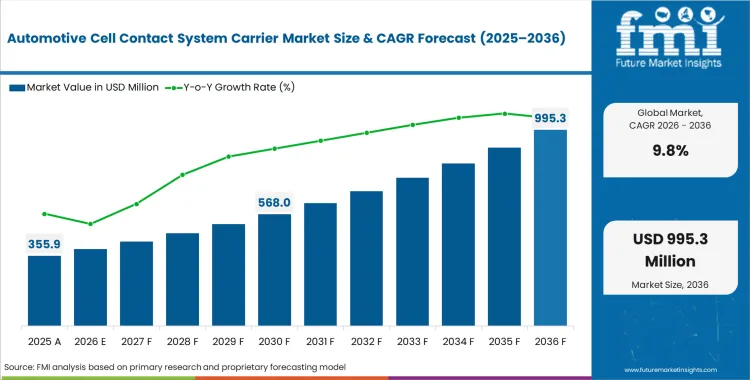
The automotive cell contact system carrier market was valued at USD 324.1 million in 2025. FMI estimates the market will reach USD 355.9 million in 2026 and climb to USD 906.4 million by 2036, registering a 9.8% CAGR over the forecast period. Expansion is being supported by the shift toward cell-to-pack battery systems, where compact architecture and integrated sensing requirements are increasing the need for more advanced cell connection layouts.
Summary of Automotive Cell Contact System Carrier Market
- The market is forecast to reach USD 906.4 million by 2036.
- The market is expected to grow at a CAGR of 9.8% from 2026 to 2036.
- The market was estimated at USD 324.1 million in 2025.
- The market is projected to generate an incremental opportunity of USD 550.6 million over the forecast period.
- Prismatic leads by cell format with a 43.0% share.
- Laminated flex leads by carrier construction with a 38.0% share.
- Module CCS dominates by integration level with a 49.0% share.
- Voltage sensing leads by function with a 41.0% share.
- Passenger EVs dominate by vehicle class with a 68.0% share.
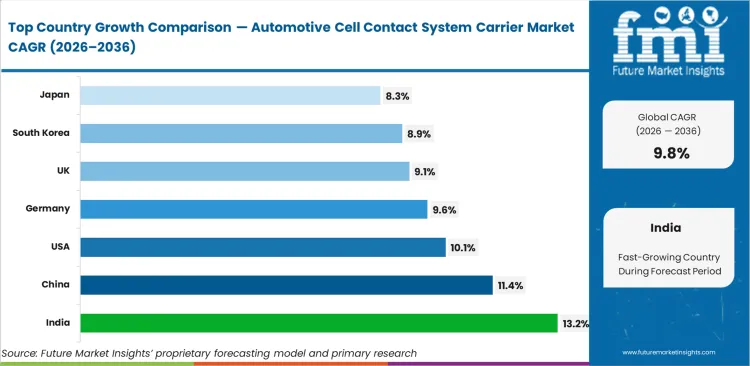
- India is the fastest-growing market at 13.2%, followed by China at 11.4% and the United States at 10.1%.
- The market is driven by rising EV adoption, increasing battery demand, and the shift toward integrated CCS designs that reduce wiring complexity and improve assembly efficiency.
- Key companies in the market include Molex, ENNOVI, TE Connectivity, Aptiv, Yazaki, and Sumitomo Electric.
Automakers are replacing discrete wiring layouts as battery pack designs become tighter and electrically more demanding. Flexible printed circuit carriers help reduce manual assembly effort, improve consistency in high-voltage conditions, and support more efficient packaging across battery systems. Conventional wiring adds weight, takes up more space, and creates extra failure points, which makes it less suitable when manufacturers are trying to improve energy density and assembly precision at the same time. Direct cell-terminal monitoring is also becoming a more important part of battery design, and carrier systems offer a practical way to add that function without increasing vertical pack height. Manufacturers are increasingly judging suppliers on routing precision, inspection compatibility, and process stability rather than treating this component as a basic low-cost interconnect.
Manufacturing scale improves once battery plants shift busbar attachment into automated laser-welding lines. Manual ultrasonic bonding limits output and introduces variation that becomes harder to control at gigafactory volumes. Higher automation is estimated to reduce defect exposure, shorten pack-level integration time, and support more stable scale-up across EV battery production. FMI analysis suggests that this shift in assembly method is expected to reinforce long-term demand for integrated automotive cell contact system carriers.
India is projected to record a CAGR of 13.2% through 2036, where electric two-wheeler manufacturers are adopting flexible circuit configurations that perform more reliably under constant vibration and compact battery packaging conditions. China is estimated to expand at a CAGR of 11.4% over the forecast period, supported by large-scale battery capacity additions and broader use of cell-to-pack production platforms. Demand for automotive cell contact system carriers in the United States is anticipated to rise at a CAGR of 10.1% through 2036 as domestic battery supply chains become more localized and vehicle manufacturers strengthen regional pack assembly capability. Premium vehicle platforms are expected to keep Germany on a steady growth path, with the market there likely to record a CAGR of 9.6% through 2036 as high-voltage monitoring becomes more deeply integrated into battery design. The United Kingdom is estimated to grow at a CAGR of 9.1% through 2036, supported by investment in local cell manufacturing. South Korea is projected to register a CAGR of 8.9% through 2036 as advanced pouch-cell integration continues to support demand for compact carrier layouts. Japan is expected to expand at a CAGR of 8.3% over the same period, with carrier development increasingly aligned with next-generation battery formats, including solid-state programs.
Segmental Analysis
Automotive Cell Contact System Carrier Market Analysis by Cell format
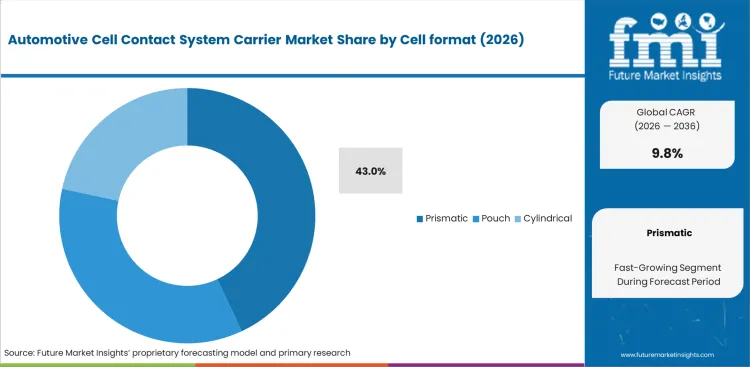
Carrier attachment methods across high-capacity electric vehicle platforms depend heavily on structural rigidity requirements. Prismatic cell formats are estimated to account for 43.0% share in 2026, as leading gigafactories continue aligning production around block-shaped cell geometries. Flat upper surfaces support stable bonding during automated laser welding, which keeps prismatic layouts favorable for carrier design. Integrating sensing traces across hundreds of terminals also requires tight dimensional control throughout vehicle operation. Pouch-based layouts make uniform pressure control more difficult during carrier lamination because surface consistency is harder to maintain. A longer-term constraint is that carrier designs optimized for prismatic layouts reduce flexibility when cylindrical architectures gain wider adoption. Retrofitting prismatic carrier trays to alternate cell shapes usually leads to full redesign work and fresh qualification cycles.
- Initial Specification: Volumetric density targets push battery layouts toward flat prismatic cells that provide stable mounting surfaces for carrier systems.
- Validation Hurdle: Coplanarity across hundreds of terminal weld points must remain tightly controlled to avoid signal inconsistency during operation.
- Expansion Lock-in: A shift toward alternate cell geometries usually brings fresh supplier approval work and added redesign cost.
Automotive Cell Contact System Carrier Market Analysis by Carrier Construction
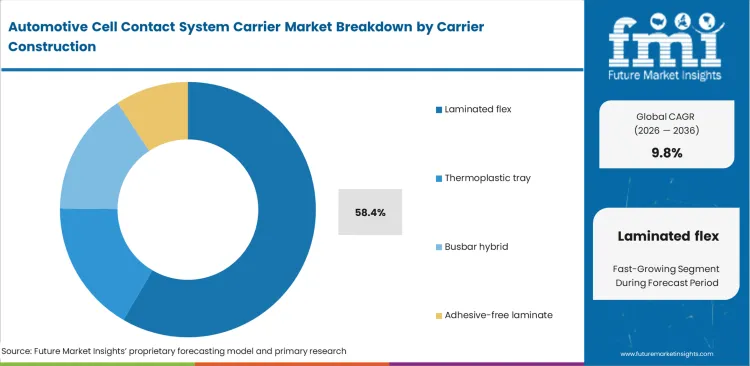
Mechanical durability and weight reduction remain tightly balanced within high-voltage battery systems. Flexible printed circuits use polyimide layers to protect copper traces from thermal exposure, which supports continued adoption of laminated flex construction. This segment is expected to retain a leading share through 2036 as manufacturers keep reducing excess vertical height in battery packs. Rigid thermoplastic trays consume valuable packaging space and add mass that is harder to justify in tightly engineered battery layouts. Continuous vibration also places greater fatigue on rigid solder joints than on flexible traces built to absorb movement. This distinction becomes more relevant as pack busbar integration strategies shift toward thinner and more space-efficient architectures. Thick plastic housing increasingly creates packaging penalties in layouts where every millimeter of stack height matters.
- Sourcing savings: Lower plastic content reduces component weight and helps vehicle programs remain within strict pack mass thresholds.
- Operational risk: Ultra-thin laminate routing can expose high-voltage lines if severe thermal events compromise protective polyimide barriers.
- Lifecycle comparison: Flexible carrier designs generally show fewer vibration-related failures than rigid plastic alternatives over extended operating cycles.
Automotive Cell Contact System Carrier Market Analysis by Integration Level
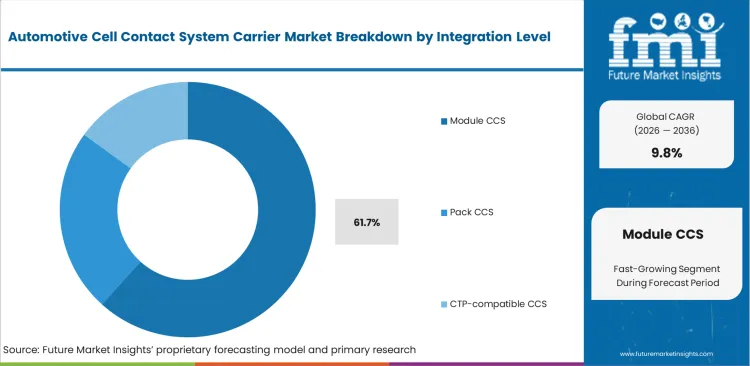
Battery architecture changes are reshaping where sensing intelligence is positioned within the pack. Module CCS formats remain the most established configuration because many OEM battery systems still rely on intermediate structural groupings, and module-level layouts are estimated to account for the leading share in 2026. Independent validation of sub-assemblies before final pack insertion continues to reinforce this format. Smaller modular carrier sections also reduce the financial impact of localized production defects because only part of the hardware needs replacement. A growing limitation is that multiple carrier interfaces increase signal complexity as systems scale toward next-generation high-voltage connectors. Designs built too heavily around current module architectures can become harder to adapt once cell-to-pack layouts require broader, unified sensing networks. This transition raises the requirement for carrier scale, routing precision, and integration simplicity.
- Early adoption: Module-level carriers remain attractive where battery layouts are designed to isolate defects within smaller repeatable subunits.
- Subsequent transition: Removing module housings shifts carrier design toward larger single-piece layouts spanning broader vehicle floor structures.
- Final conversion: Late-stage platform changes gradually reduce module redundancy when lower component counts become necessary.
Automotive Cell Contact System Carrier Market Analysis by Function
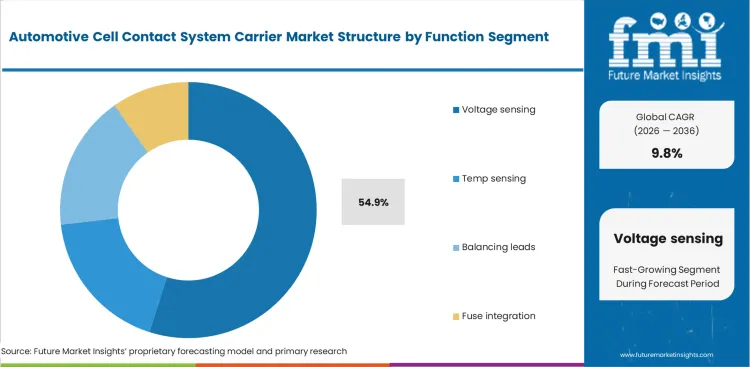
Monitoring hundreds of individual power sources at once has made legacy wiring layouts less suitable for modern battery systems. Voltage sensing functions are estimated to represent the largest share in 2026 because electric powertrains depend on millisecond-level telemetry to control cell imbalance. Battery management performance relies on stable voltage signals captured directly from terminal points. Signal accuracy becomes harder to maintain when routing passes through broader automotive connectors that introduce resistance variation. Strong balancing software cannot compensate for weak mechanical contact at sensor pads. Minor weld defects missed during carrier assembly can still allow packs to enter service with false range-loss alerts and unstable diagnostic behavior. This keeps precise voltage sensing at the center of carrier design requirements.
- Failure prevention: Immediate voltage anomaly detection enables system control units to isolate failing cells before fault conditions spread.
- Residual vulnerability: Micro-fractures in sensing traces caused by road vibration may remain hidden until failure appears during actual vehicle use.
- Full capture: Maximum driving range depends on precise voltage mapping aligned with active thermal control across the full battery system.
Automotive Cell Contact System Carrier Market Analysis by Vehicle Class
Hardware complexity in battery carriers is strongly shaped by consumer expectations around driving range. Passenger EVs are estimated to account for 68.0% share in 2026 as global automakers continue electrifying high-volume sedan and SUV platforms. Large-scale production also improves cost control for complex flexible circuit laminations used in these vehicles. Commercial truck platforms still rely more heavily on robust wiring layouts built around serviceability rather than compact packaging efficiency. Passenger vehicle battery layouts prioritize minimal Z-axis height, while commercial systems place greater weight on insulation strength and impact resistance. Delayed movement toward integrated automotive power distribution modules can leave commercial platforms with higher maintenance burdens tied to wiring harness wear. Passenger EV programs therefore continue setting the pace for carrier design scale and configuration.
- Initial phase: Tight floorpan packaging in passenger vehicles accelerates the shift toward ultra-thin carrier architectures.
- Qualification phase: Thermal cycling validation remains critical to confirm safe operation across varied climate and load conditions.
- Expansion driver: Operating cost pressure is gradually pushing light commercial platforms toward similar low-maintenance carrier designs.
Regional Analysis
Based on regional analysis, automotive cell contact system carrier market is segmented into North America, Latin America, Western Europe, Eastern Europe, East Asia, South Asia & Pacific, and Middle East & Africa across 40 plus countries.
.webp "Top Country Growth Comparison Automotive Cell Contact System Carrier Market Cagr (2026 2036)")
| Country | CAGR (2026 to 2036) |
|---|---|
| India | 13.2% |
| China | 11.4% |
| United States | 10.1% |
| Germany | 9.6% |
| United Kingdom | 9.1% |
| South Korea | 8.9% |
| Japan | 8.3% |
Source: Future Market Insights (FMI) analysis, based on proprietary forecasting model and primary research
South Asia & Pacific Automotive Cell Contact System Carrier Market Analysis
High ambient temperatures and severe road vibration profiles dictate hardware requirements across electrifying mobility sectors in South Asia. Manufacturers actively shift away from fragile wiring looms toward integrated carrier solutions to guarantee continuous telemetry data flow without mechanical failure. Supplying high-quality flexible circuits locally remains a challenge as domestic battery management system controllers assembly operations mature. Regional buyers seek partnerships with established global suppliers to secure reliable high-volume sensing hardware.
- India: Domestic electric two-wheeler production dictates regional hardware transitions as startups prioritize robust integrated sensing over legacy wiring to withstand high-vibration environments. Demand for automotive cell contact system carriers in India is anticipated to rise at a CAGR of 13.2% from 2026 to 2036. Replacing manual wiring looms with automated carrier placement directly increases factory throughput. Securing local flexible circuit supply unlocks long-term commercial contracts.
FMI's report includes extensive analysis covering ASEAN nations prioritizing localized electric vehicle assembly joint ventures. Supply chain localization initiatives gradually reduce heavy reliance on imported battery sensing components.
East Asia Automotive Cell Contact System Carrier Market Analysis
Extensive state-backed gigafactory scaling alters global component pricing structures. Chinese battery manufacturers dictate global architecture trends by forcing ultra-thin laminated carriers into high-volume production. Domestic engineering teams perfect cell-to-pack designs requiring unified sensing webs spanning entire battery housing enclosures. South Korean firms counter this volume dominance by pioneering complex pouch-cell carrier integration techniques requiring specialized ultrasonic welding expertise. Japanese automakers maintain steady adoption, focusing heavily on rigorous reliability testing before authorizing new flexible circuit geometries.
- China: China is projected to witness 11.4% CAGR in the automotive cell contact system carrier segment through 2036, driven by massive state-backed gigafactory output. Domestic cell manufacturers aggressively export cell-to-pack architectures globally to capture share. Leveraging broad localized supply chains drives flexible printed circuit costs below traditional wiring harness thresholds. Asian suppliers mastering single-piece carrier production secure higher market positioning than western competitors.
- South Korea: Advanced pouch cell engineering dominates local manufacturing strategies, prompting tier-1 suppliers to perfect complex 3D carrier routing techniques. Precision laser welding adoption allows factories to lower defect rates during final battery assembly. South Korea is set to record a CAGR of 8.9% in automotive cell contact system carriers during the assessment period. High-yield production output validates this shift toward automated pack integration.
- Japan: Stringent quality control mandates shape local manufacturing strategies as legacy automakers transition premium platforms away from rigid sensor trays. Automotive cell contact system carrier demand across Japan is anticipated to rise at an 8.3% CAGR during the forecast period. Strict validation protocols ensure deployed flexible circuits survive entire vehicle lifecycles without signal degradation. Continuous testing supports long-term battery pack reliability standards required by global consumers.
FMI's report includes detailed capacity tracking across Taiwan's advanced semiconductor and flexible printed circuit manufacturing hubs.
North America Automotive Cell Contact System Carrier Market Analysis
Federal reshoring incentives aggressively pull critical battery supply chains back onto domestic soil. Regulatory mandates compel local automakers to source sensing components from allied regional manufacturing bases rather than relying solely on overseas imports. Engineering teams push physical limits attempting to integrate complex thermal runway monitoring directly into carrier laminates. High-performance electric trucks require robust sensing pathways capable of handling high current spikes alongside advanced EV powertrain architecture designs. Start-up vehicle manufacturers typically pioneer these ultra-integrated solutions while legacy automakers gradually adopt proven flat-pack hardware.
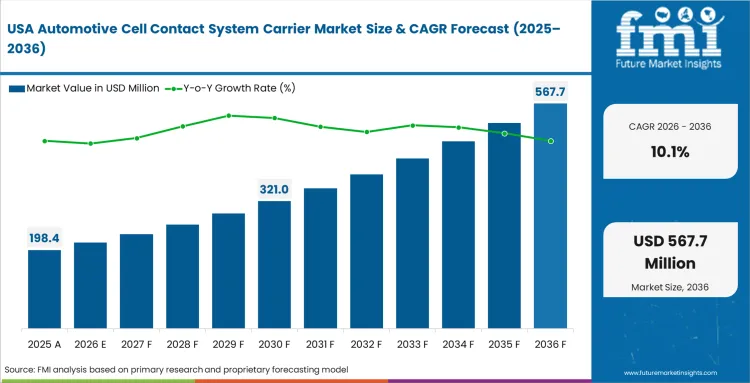
- United States: Intensive domestic battery factory construction accelerates localized electric vehicle hardware sourcing. Sales of automotive cell contact system carriers in the United States are poised to grow at a CAGR of 10.1% during the assessment period. Securing local automated laser welding capacity remains a bottleneck for launching heavy-duty electric truck platforms. Navigating domestic manufacturing requirements grants suppliers immediate access to regional production incentives.
FMI's report includes evaluation covering Canadian mineral processing facilities supporting regional copper foil production requirements. Early-stage investments in localized polyimide substrate manufacturing remain crucial for securing long-term North American carrier supply.
Western Europe Automotive Cell Contact System Carrier Market Analysis
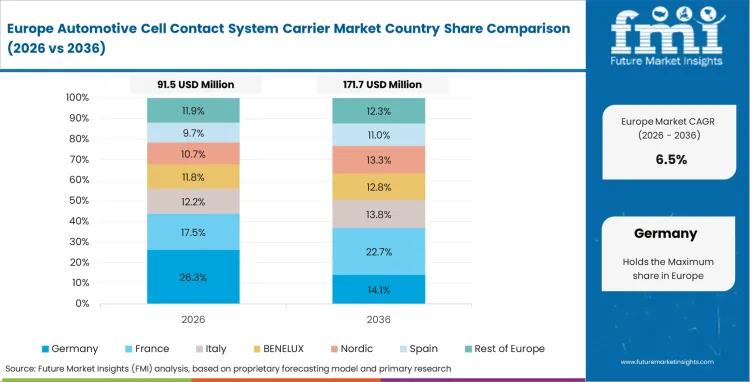
Stringent continental safety mandates dictate how automakers structure internal battery diagnostics. Premium automotive brands push beyond basic compliance, deploying dense sensor networks to maximize driving range while preventing thermal events. Battery pack design engineers utilize flexible printed circuits extensively to navigate complex chassis geometries unique to compact European vehicles. Local automakers face pressure sourcing components strictly from suppliers adhering to rigorous regional supply chain metrics.
- Germany: High-performance vehicle manufacturing requires continuous cell-level voltage monitoring across premium fleet architectures. Transitioning toward automated laser welding operations requires flawless carrier coplanarity to sustain profitable production yields. Automotive cells contact system carrier demand in Germany is expected to register a CAGR of 9.6% through 2036. Local automakers prioritize exact hardware tolerances to maintain high-speed assembly line efficiency and reduce scrap.
- United Kingdom: Localized cell production investments are rapidly expanding to support domestic automotive assembly plants. Adoption of automotive cell contact system carriers in the United Kingdom is expected to move ahead at a CAGR of 9.1% during the forecast period. Manufacturers specify advanced laminated carriers to shed critical vehicle mass, improving overall efficiency metrics. Lighter pack components remain essential to meeting strict regional emission reduction targets.
FMI's report covers expanded analysis of emerging Eastern European gigafactory hubs supporting continental supply chains.
Competitive Aligners for Market Players
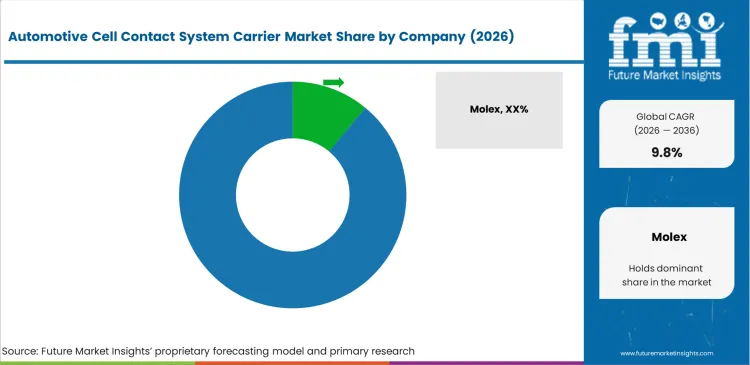
Manufacturing scale strongly influences competitive viability within this specialized automotive tier. Large global interconnect suppliers secure early volume by repurposing existing flexible printed circuit production lines to meet gigafactory demand, which places them in a strong position among automotive CCS carrier suppliers. Long-established relationships with Detroit and European automotive purchasing teams also support early platform design wins. Start-up electric vehicle manufacturers often lack the leverage to demand custom cell contact system carrier designs, which pushes them toward off-the-shelf modular layouts that can compromise volumetric packing efficiency. Supplier engineering teams that secure contracts usually prove they can maintain consistent automated optical inspection yields across complex multi-layer laminations.
Incumbent tier-1 suppliers also hold extensive validation libraries showing how specific polyimide substrates degrade over long periods of automotive thermal cycling. Reproducing this reliability base requires years of physical testing, which agile challengers cannot replace through digital simulation alone, making vendor selection highly selective among leading EV battery CCS carrier manufacturers. Established players also integrate advanced thermal interface materials directly into carrier assemblies, which adds measurable value at the pack engineering stage. Challengers evaluating Molex vs ENNOVI cell contact systems need to counter this position with clear technical gains, whether through adhesive-free lamination methods or faster laser welding cycle times. Continuous access to raw copper foil remains a less visible constraint that often determines actual delivery performance more than stated factory capacity.
Large automotive OEMs continue resisting vendor lock-in by designing battery architectures that can accept sensing hardware from multiple approved suppliers. Companies issuing a request quote for EV battery CCS carrier hardware generally seek open-standard termination points where flexible circuits connect to central battery management controllers. When dominant suppliers push proprietary connector formats, automakers often respond by splitting large volume awards across secondary regional challengers to preserve sourcing flexibility and maintain negotiating leverage. Cost pressure is likely to push sophisticated sensing hardware into entry-level commuter vehicles over time, which widens the addressable base for proven carrier platforms.
Key Players in Automotive Cell Contact System Carrier Market
- Molex
- ENNOVI
- TE Connectivity
- Aptiv
- Yazaki
- Sumitomo Electric
Scope of the Report
| Metric | Value |
|---|---|
| Quantitative Units | USD 355.9 million to USD 906.4 million, at a CAGR of 9.8% |
| Market Definition | Integrated electromechanical frameworks house busbars and sensing probes directly atop electric vehicle battery cells, replacing legacy wiring harnesses to ensure permanent telemetry alignment. |
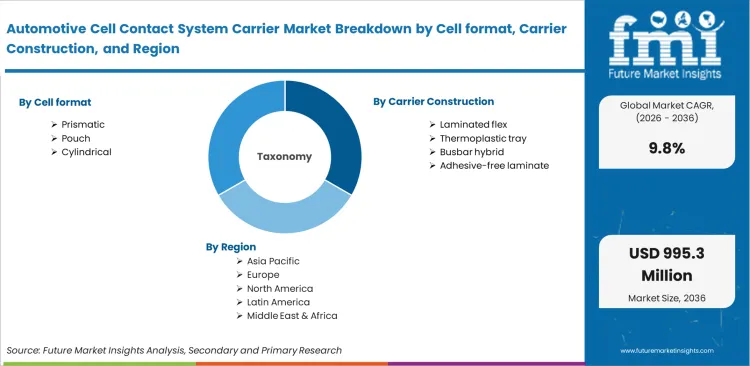
| Segmentation | Cell format, Carrier construction, Integration level, Function, Vehicle class, and Region |
| Regions Covered | North America, Latin America, Western Europe, Eastern Europe, East Asia, South Asia & Pacific, and Middle East & Africa |
| Countries Covered | United States, Canada, Brazil, Mexico, Germany, United Kingdom, France, Spain, Italy, Russia, Poland, Czech Republic, Romania, China, Japan, South Korea, India, ASEAN, ANZ, GCC, Türkiye, South Africa |
| Key Companies Profiled | Molex, ENNOVI, TE Connectivity, Aptiv, Yazaki, Sumitomo Electric |
| Forecast Period | 2026 to 2036 |
| Approach | Gigafactory production capacity tracking correlated with EV platform launch schedules |
Source: Future Market Insights (FMI) analysis, based on proprietary forecasting model and primary research
Automotive Cell Contact System Carrier Market Analysis by Segments
Cell format
- Prismatic
- Pouch
- Cylindrical
Carrier construction
- Laminated flex
- Thermoplastic tray
- Busbar hybrid
- Adhesive-free laminate
Integration level
- Module CCS
- Pack CCS
- CTP-compatible CCS
Function
- Voltage sensing
- Temp sensing
- Balancing leads
- Fuse integration
Vehicle class
- Passenger EVs
- Light commercial
- Heavy commercial
Region:
- North America
- United States
- Canada
- Europe
- Germany
- United Kingdom
- France
- Italy
- Spain
- Asia Pacific
- China
- Japan
- South Korea
- Taiwan
- Singapore
- Latin America
- Brazil
- Mexico
- Argentina
- Middle East & Africa
- GCC Countries
- South Africa
Bibliography
- USA Department of Energy. (2024). 2021-2024 four-year review of supply chains for the advanced batteries sector.
- Goel, S., Morenhout, T., & Bollini, R. (2024). Unlocking supply chains for localizing electric vehicle battery production in India. International Institute for Sustainable Development.
- Ko, B., Gryguc, A., Chen, J., Hunt, J., Gao, Z., Qian, C., Zhao, H., Zheng, J., Geng, H., & Wells, M. (2024). Parameter Optimization and Characterization of Aluminum-Copper Laser Welded Joints. SAE Technical Paper 2024-01-2428.
- Moradian, J. M., Ali, A., Yan, X., Pei, G., Zhang, S., Naveed, A., Shehzad, K., Shahnavaz, Z., Ahmad, F., & Yousaf, B. (2025). Sensors innovations for smart lithium-based batteries: Advancements, opportunities, and potential challenges. Nano-Micro Letters, 17, 279.
This bibliography is provided for reader reference. The full FMI report contains the complete reference list with primary source documentation.
This Report Addresses
- What automated laser welding requirements force production line managers to abandon manual ultrasonic bonding across gigafactories.
- How volumetric energy density mandates push automotive packaging engineers toward ultra-thin laminated flexible circuits.
- Why prismatic cell formats command dominant early adoption regarding integrated sensing hardware applications.
- Where fast-charging thermal constraints create significant fault risks for tightly routed high-voltage traces.
- When commercial fleet operators finally transition away from durable legacy wiring harnesses.
- Which specific vibration resilience standards drive rapid component replacement across emerging markets.
- How rigorous thermal cycling qualification prevents agile challengers from displacing entrenched interconnect manufacturers quickly.
- What specific polyimide lamination techniques eliminate bulky plastic trays entirely from modern battery architectures.
Frequently Asked Questions
What is an automotive cell contact system carrier?
These integrated electromechanical frameworks house busbars, voltage sensors, and temperature probes directly above electric vehicle battery cells. Hardware ensures permanent alignment for monitoring systems, replacing bulky legacy wiring harnesses to transmit vital cell-level data continuously to central controllers.
Explain the automotive cell contact system carrier market in simple terms?
Battery packs require continuous voltage monitoring to prevent fires and maximize driving range. This market involves manufacturing the ultra-thin, flexible sensor pathways that lie perfectly flat on top of battery cells, replacing thick bundles of wire that waste valuable space inside the vehicle.
How big is the automotive cell contact system carrier market?
Valuation reached USD 355.9 million entering 2026. This quantitative anchor demonstrates massive ongoing component replacement across global automotive manufacturing lines abandoning legacy point-to-point wiring harnesses in favor of integrated sensor arrays.
What is the CAGR of automotive cell contact system carriers?
Sales advance at a 9.8% CAGR through 2036. This trajectory outpaces General Electric vehicle production as multiple battery sensors become mandatory for high-voltage safety compliance across all global jurisdictions.
What drives demand for EV battery CCS carriers?
Volumetric energy density mandates force battery packaging engineers to eliminate every millimeter of wasted vertical space. Switching to laminated flexible circuit carriers reclaims critical volume allowing designers to stack additional active cell material into identical chassis footprints.
Which cell format uses the most CCS carriers?
Prismatic geometries provide absolute flat-top surfaces ideal for automated laser welding processes. Packaging engineers utilize this flat plane to ensure zero-dimensional deviation during rigid sensor mounting, commanding 43.0% share entering 2026.
How does cell to pack affect CCS carrier demand?
Aggressive cell-to-pack architecture adoption eliminates modular wiring. This transition requires extensive unified sensing webs spanning entire vehicle floorpans, drastically increasing the physical size and complexity of the required sensing laminates.
Compare module CCS carriers and cell to pack architectures?
Risk-averse engineers prefer scalable modules to isolate manufacturing defects, yet cascading multiple module connectors introduces severe signal latency. Cell-to-pack architectures eliminate this latency by routing all signals through one massive continuous flexible printed circuit.
Who are the leading automotive CCS carrier suppliers?
Massive global interconnect companies including TE Connectivity, Molex, and ENNOVI dominate early volume. These companies leverage deep historical relationships with Detroit and European automotive purchasing departments to secure initial platform design wins.
Which regions will lead automotive cell contact system carrier demand by 2036?
India leads compound growth at 13.2% driven by domestic two-wheeler electrification, while China dictates total volume through massive state-backed gigafactory scaling. The United States follows closely as federal reshoring incentives aggressively pull critical battery supply chains back onto domestic soil.
What EV battery carrier market trends dictate future pricing?
Massive state-backed gigafactory scaling creates unprecedented economies of scale. Asian interconnect suppliers push flexible printed circuit costs below traditional wiring harness thresholds through sheer unified production volume, forcing global competitors to optimize manufacturing yields.
What specific automotive cell contact system carrier companies pioneer solid-state solutions?
Leading tier-1 suppliers invest heavily in materials science to develop extreme-temperature polyimide substrates. These upgraded laminates prevent total sensor failure inside solid-state enclosures operating at elevated thermal profiles.
Why do manual assembly lines struggle with flexible carriers?
Ultra-thin polyimide circuits require complex mechanical tensioning to prevent folding during laser attachment. Without precise automated optical alignment, cell-to-pack structural fasteners crush fragile sensor traces instantly.
How does commercial vehicle packaging differ?
Commercial truck packaging prioritizes extreme field-serviceability and impact resistance over absolute volumetric density. Fleet engineers typically select thick robust wiring architectures over fragile thin-film laminates.
Why is localized automated laser welding capacity critical?
Transporting delicate pre-welded carriers across global shipping routes introduces unacceptable micro-fracture risks. Firms demand localized bonding stations to guarantee pristine sensor integrity just prior to final pack sealing.
How do companies evaluate flexible circuit vendors?
Companies ignore base material unit costs, focusing strictly on automated optical inspection yield rates. A cheaper laminate that fails laser welding alignment ultimately ruins entire battery modules downstream.
What role do proprietary reliability testing libraries play?
Incumbent tier-1 suppliers possess decades of thermal cycling degradation data across various polyimide substrates. Agile challengers cannot bypass this physical validation requirement using purely digital simulation software.
How do automakers prevent hardware vendor lock-in?
Open-standard termination points where sensing webs connect to central controllers are used for this. Mandating universal interconnect formats allows purchasing departments to split volume contracts across secondary regional suppliers.
What hidden constraint limits global carrier factory output?
Securing continuous high-quality raw copper battery pack foils dictates actual delivery capabilities. Factories boasting massive lamination capacity frequently stall waiting for specialized conductive substrate shipments.
Why do fast-charging scenarios complicate trace routing density?
Pushing massive current through underlying busbars generates extreme localized thermal spikes. Tightly routed sensing traces must maintain strict high-voltage isolation distances to prevent signal shorting.
What specific operational flaw activates phantom range software alerts?
Flawless algorithmic cell balancing cannot compensate for microscopic weld defects at individual sensor pads. Poor mechanical contact creates resistance variances resulting in inaccurate voltage telemetry data.
How do North American reshoring initiatives alter supply chains?
Federal production tax credits compel domestic automakers to source sensing components locally. Regional sourcing directors actively fund localized polyimide substrate manufacturing to break reliance on Asian component imports.
How does machine vision software improve final battery quality?
Advanced optical validation allows continuous inline quality control directly alongside welding stations. Detecting microscopic trace misalignment immediately prevents compromised sensing hardware from entering sealed modular battery platforms.
Why must quality assurance directors monitor polyimide thickness closely?
Shaving excess protective polyimide layers saves weight but leaves high-voltage lines critically vulnerable. Thermal runaway events easily melt compromised lamination, destroying entire sensor networks instantly.
Preview the report firsthand - request a free sample
Get SampleGet the brochure for pricing and purchase details.
Get PDFTable of Content
- Executive Summary
- Global Market Outlook
- Demand-side Trends
- Supply-side Trends
- Technology Roadmap Analysis
- Analysis and Recommendations
- Market Overview
- Market Coverage / Taxonomy
- Market Definition / Scope / Limitations
- Research Methodology
- Chapter Orientation
- Analytical Lens and Working Hypotheses
- Market Structure, Signals, and Trend Drivers
- Benchmarking and Cross-market Comparability
- Market Sizing, Forecasting, and Opportunity Mapping
- Research Design and Evidence Framework
- Desk Research Programme (Secondary Evidence)
- Company Annual and Sustainability Reports
- Peer-reviewed Journals and Academic Literature
- Corporate Websites, Product Literature, and Technical Notes
- Earnings Decks and Investor Briefings
- Statutory Filings and Regulatory Disclosures
- Technical White Papers and Standards Notes
- Trade Journals, Industry Magazines, and Analyst Briefs
- Conference Proceedings, Webinars, and Seminar Materials
- Government Statistics Portals and Public Data Releases
- Press Releases and Reputable Media Coverage
- Specialist Newsletters and Curated Briefings
- Sector Databases and Reference Repositories
- FMI Internal Proprietary Databases and Historical Market Datasets
- Subscription Datasets and Paid Sources
- Social Channels, Communities, and Digital Listening Inputs
- Additional Desk Sources
- Expert Input and Fieldwork (Primary Evidence)
- Primary Modes
- Qualitative Interviews and Expert Elicitation
- Quantitative Surveys and Structured Data Capture
- Blended Approach
- Why Primary Evidence is Used
- Field Techniques
- Interviews
- Surveys
- Focus Groups
- Observational and In-context Research
- Social and Community Interactions
- Stakeholder Universe Engaged
- C-suite Leaders
- Board Members
- Presidents and Vice Presidents
- R&D and Innovation Heads
- Technical Specialists
- Domain Subject-matter Experts
- Scientists
- Physicians and Other Healthcare Professionals
- Governance, Ethics, and Data Stewardship
- Research Ethics
- Data Integrity and Handling
- Primary Modes
- Tooling, Models, and Reference Databases
- Desk Research Programme (Secondary Evidence)
- Data Engineering and Model Build
- Data Acquisition and Ingestion
- Cleaning, Normalisation, and Verification
- Synthesis, Triangulation, and Analysis
- Quality Assurance and Audit Trail
- Market Background
- Market Dynamics
- Drivers
- Restraints
- Opportunity
- Trends
- Scenario Forecast
- Demand in Optimistic Scenario
- Demand in Likely Scenario
- Demand in Conservative Scenario
- Opportunity Map Analysis
- Product Life Cycle Analysis
- Supply Chain Analysis
- Investment Feasibility Matrix
- Value Chain Analysis
- PESTLE and Porter’s Analysis
- Regulatory Landscape
- Regional Parent Market Outlook
- Production and Consumption Statistics
- Import and Export Statistics
- Market Dynamics
- Global Market Analysis 2021 to 2025 and Forecast, 2026 to 2036
- Historical Market Size Value (USD Million) Analysis, 2021 to 2025
- Current and Future Market Size Value (USD Million) Projections, 2026 to 2036
- Y-o-Y Growth Trend Analysis
- Absolute $ Opportunity Analysis
- Global Market Pricing Analysis 2021 to 2025 and Forecast 2026 to 2036
- Global Market Analysis 2021 to 2025 and Forecast 2026 to 2036, By Cell format
- Introduction / Key Findings
- Historical Market Size Value (USD Million) Analysis By Cell format , 2021 to 2025
- Current and Future Market Size Value (USD Million) Analysis and Forecast By Cell format , 2026 to 2036
- Prismatic
- Pouch
- Cylindrical
- Prismatic
- Y-o-Y Growth Trend Analysis By Cell format , 2021 to 2025
- Absolute $ Opportunity Analysis By Cell format , 2026 to 2036
- Global Market Analysis 2021 to 2025 and Forecast 2026 to 2036, By Carrier Construction
- Introduction / Key Findings
- Historical Market Size Value (USD Million) Analysis By Carrier Construction, 2021 to 2025
- Current and Future Market Size Value (USD Million) Analysis and Forecast By Carrier Construction, 2026 to 2036
- Laminated flex
- Thermoplastic tray
- Busbar hybrid
- Adhesive-free laminate
- Laminated flex
- Y-o-Y Growth Trend Analysis By Carrier Construction, 2021 to 2025
- Absolute $ Opportunity Analysis By Carrier Construction, 2026 to 2036
- Global Market Analysis 2021 to 2025 and Forecast 2026 to 2036, By Vehicle Class
- Introduction / Key Findings
- Historical Market Size Value (USD Million) Analysis By Vehicle Class, 2021 to 2025
- Current and Future Market Size Value (USD Million) Analysis and Forecast By Vehicle Class, 2026 to 2036
- Passenger EVs
- Passenger EVs
- Y-o-Y Growth Trend Analysis By Vehicle Class, 2021 to 2025
- Absolute $ Opportunity Analysis By Vehicle Class, 2026 to 2036
- Global Market Analysis 2021 to 2025 and Forecast 2026 to 2036, By Integration Level
- Introduction / Key Findings
- Historical Market Size Value (USD Million) Analysis By Integration Level, 2021 to 2025
- Current and Future Market Size Value (USD Million) Analysis and Forecast By Integration Level, 2026 to 2036
- Module CCS
- Pack CCS
- CTP-compatible CCS
- Module CCS
- Y-o-Y Growth Trend Analysis By Integration Level, 2021 to 2025
- Absolute $ Opportunity Analysis By Integration Level, 2026 to 2036
- Global Market Analysis 2021 to 2025 and Forecast 2026 to 2036, By Function
- Introduction / Key Findings
- Historical Market Size Value (USD Million) Analysis By Function, 2021 to 2025
- Current and Future Market Size Value (USD Million) Analysis and Forecast By Function, 2026 to 2036
- Voltage sensing
- Temp sensing
- Balancing leads
- Fuse integration
- Voltage sensing
- Y-o-Y Growth Trend Analysis By Function, 2021 to 2025
- Absolute $ Opportunity Analysis By Function, 2026 to 2036
- Global Market Analysis 2021 to 2025 and Forecast 2026 to 2036, By Region
- Introduction
- Historical Market Size Value (USD Million) Analysis By Region, 2021 to 2025
- Current Market Size Value (USD Million) Analysis and Forecast By Region, 2026 to 2036
- North America
- Latin America
- Western Europe
- Eastern Europe
- East Asia
- South Asia and Pacific
- Middle East & Africa
- Market Attractiveness Analysis By Region
- North America Market Analysis 2021 to 2025 and Forecast 2026 to 2036, By Country
- Historical Market Size Value (USD Million) Trend Analysis By Market Taxonomy, 2021 to 2025
- Market Size Value (USD Million) Forecast By Market Taxonomy, 2026 to 2036
- By Country
- USA
- Canada
- Mexico
- By Cell format
- By Carrier Construction
- By Vehicle Class
- By Integration Level
- By Function
- By Country
- Market Attractiveness Analysis
- By Country
- By Cell format
- By Carrier Construction
- By Vehicle Class
- By Integration Level
- By Function
- Key Takeaways
- Latin America Market Analysis 2021 to 2025 and Forecast 2026 to 2036, By Country
- Historical Market Size Value (USD Million) Trend Analysis By Market Taxonomy, 2021 to 2025
- Market Size Value (USD Million) Forecast By Market Taxonomy, 2026 to 2036
- By Country
- Brazil
- Chile
- Rest of Latin America
- By Cell format
- By Carrier Construction
- By Vehicle Class
- By Integration Level
- By Function
- By Country
- Market Attractiveness Analysis
- By Country
- By Cell format
- By Carrier Construction
- By Vehicle Class
- By Integration Level
- By Function
- Key Takeaways
- Western Europe Market Analysis 2021 to 2025 and Forecast 2026 to 2036, By Country
- Historical Market Size Value (USD Million) Trend Analysis By Market Taxonomy, 2021 to 2025
- Market Size Value (USD Million) Forecast By Market Taxonomy, 2026 to 2036
- By Country
- Germany
- UK
- Italy
- Spain
- France
- Nordic
- BENELUX
- Rest of Western Europe
- By Cell format
- By Carrier Construction
- By Vehicle Class
- By Integration Level
- By Function
- By Country
- Market Attractiveness Analysis
- By Country
- By Cell format
- By Carrier Construction
- By Vehicle Class
- By Integration Level
- By Function
- Key Takeaways
- Eastern Europe Market Analysis 2021 to 2025 and Forecast 2026 to 2036, By Country
- Historical Market Size Value (USD Million) Trend Analysis By Market Taxonomy, 2021 to 2025
- Market Size Value (USD Million) Forecast By Market Taxonomy, 2026 to 2036
- By Country
- Russia
- Poland
- Hungary
- Balkan & Baltic
- Rest of Eastern Europe
- By Cell format
- By Carrier Construction
- By Vehicle Class
- By Integration Level
- By Function
- By Country
- Market Attractiveness Analysis
- By Country
- By Cell format
- By Carrier Construction
- By Vehicle Class
- By Integration Level
- By Function
- Key Takeaways
- East Asia Market Analysis 2021 to 2025 and Forecast 2026 to 2036, By Country
- Historical Market Size Value (USD Million) Trend Analysis By Market Taxonomy, 2021 to 2025
- Market Size Value (USD Million) Forecast By Market Taxonomy, 2026 to 2036
- By Country
- China
- Japan
- South Korea
- By Cell format
- By Carrier Construction
- By Vehicle Class
- By Integration Level
- By Function
- By Country
- Market Attractiveness Analysis
- By Country
- By Cell format
- By Carrier Construction
- By Vehicle Class
- By Integration Level
- By Function
- Key Takeaways
- South Asia and Pacific Market Analysis 2021 to 2025 and Forecast 2026 to 2036, By Country
- Historical Market Size Value (USD Million) Trend Analysis By Market Taxonomy, 2021 to 2025
- Market Size Value (USD Million) Forecast By Market Taxonomy, 2026 to 2036
- By Country
- India
- ASEAN
- Australia & New Zealand
- Rest of South Asia and Pacific
- By Cell format
- By Carrier Construction
- By Vehicle Class
- By Integration Level
- By Function
- By Country
- Market Attractiveness Analysis
- By Country
- By Cell format
- By Carrier Construction
- By Vehicle Class
- By Integration Level
- By Function
- Key Takeaways
- Middle East & Africa Market Analysis 2021 to 2025 and Forecast 2026 to 2036, By Country
- Historical Market Size Value (USD Million) Trend Analysis By Market Taxonomy, 2021 to 2025
- Market Size Value (USD Million) Forecast By Market Taxonomy, 2026 to 2036
- By Country
- Kingdom of Saudi Arabia
- Other GCC Countries
- Turkiye
- South Africa
- Other African Union
- Rest of Middle East & Africa
- By Cell format
- By Carrier Construction
- By Vehicle Class
- By Integration Level
- By Function
- By Country
- Market Attractiveness Analysis
- By Country
- By Cell format
- By Carrier Construction
- By Vehicle Class
- By Integration Level
- By Function
- Key Takeaways
- Key Countries Market Analysis
- USA
- Pricing Analysis
- Market Share Analysis, 2025
- By Cell format
- By Carrier Construction
- By Vehicle Class
- By Integration Level
- By Function
- Canada
- Pricing Analysis
- Market Share Analysis, 2025
- By Cell format
- By Carrier Construction
- By Vehicle Class
- By Integration Level
- By Function
- Mexico
- Pricing Analysis
- Market Share Analysis, 2025
- By Cell format
- By Carrier Construction
- By Vehicle Class
- By Integration Level
- By Function
- Brazil
- Pricing Analysis
- Market Share Analysis, 2025
- By Cell format
- By Carrier Construction
- By Vehicle Class
- By Integration Level
- By Function
- Chile
- Pricing Analysis
- Market Share Analysis, 2025
- By Cell format
- By Carrier Construction
- By Vehicle Class
- By Integration Level
- By Function
- Germany
- Pricing Analysis
- Market Share Analysis, 2025
- By Cell format
- By Carrier Construction
- By Vehicle Class
- By Integration Level
- By Function
- UK
- Pricing Analysis
- Market Share Analysis, 2025
- By Cell format
- By Carrier Construction
- By Vehicle Class
- By Integration Level
- By Function
- Italy
- Pricing Analysis
- Market Share Analysis, 2025
- By Cell format
- By Carrier Construction
- By Vehicle Class
- By Integration Level
- By Function
- Spain
- Pricing Analysis
- Market Share Analysis, 2025
- By Cell format
- By Carrier Construction
- By Vehicle Class
- By Integration Level
- By Function
- France
- Pricing Analysis
- Market Share Analysis, 2025
- By Cell format
- By Carrier Construction
- By Vehicle Class
- By Integration Level
- By Function
- India
- Pricing Analysis
- Market Share Analysis, 2025
- By Cell format
- By Carrier Construction
- By Vehicle Class
- By Integration Level
- By Function
- ASEAN
- Pricing Analysis
- Market Share Analysis, 2025
- By Cell format
- By Carrier Construction
- By Vehicle Class
- By Integration Level
- By Function
- Australia & New Zealand
- Pricing Analysis
- Market Share Analysis, 2025
- By Cell format
- By Carrier Construction
- By Vehicle Class
- By Integration Level
- By Function
- China
- Pricing Analysis
- Market Share Analysis, 2025
- By Cell format
- By Carrier Construction
- By Vehicle Class
- By Integration Level
- By Function
- Japan
- Pricing Analysis
- Market Share Analysis, 2025
- By Cell format
- By Carrier Construction
- By Vehicle Class
- By Integration Level
- By Function
- South Korea
- Pricing Analysis
- Market Share Analysis, 2025
- By Cell format
- By Carrier Construction
- By Vehicle Class
- By Integration Level
- By Function
- Russia
- Pricing Analysis
- Market Share Analysis, 2025
- By Cell format
- By Carrier Construction
- By Vehicle Class
- By Integration Level
- By Function
- Poland
- Pricing Analysis
- Market Share Analysis, 2025
- By Cell format
- By Carrier Construction
- By Vehicle Class
- By Integration Level
- By Function
- Hungary
- Pricing Analysis
- Market Share Analysis, 2025
- By Cell format
- By Carrier Construction
- By Vehicle Class
- By Integration Level
- By Function
- Kingdom of Saudi Arabia
- Pricing Analysis
- Market Share Analysis, 2025
- By Cell format
- By Carrier Construction
- By Vehicle Class
- By Integration Level
- By Function
- Turkiye
- Pricing Analysis
- Market Share Analysis, 2025
- By Cell format
- By Carrier Construction
- By Vehicle Class
- By Integration Level
- By Function
- South Africa
- Pricing Analysis
- Market Share Analysis, 2025
- By Cell format
- By Carrier Construction
- By Vehicle Class
- By Integration Level
- By Function
- USA
- Market Structure Analysis
- Competition Dashboard
- Competition Benchmarking
- Market Share Analysis of Top Players
- By Region
- By Cell format
- By Carrier Construction
- By Vehicle Class
- By Integration Level
- By Function
- Competition Analysis
- Competition Deep Dive
- Molex
- Overview
- Product Portfolio
- Profitability by Market Segments (Product/Age /Sales Channel/Region)
- Sales Footprint
- Strategy Overview
- Marketing Strategy
- Product Strategy
- Channel Strategy
- ENNOVI
- TE Connectivity
- Aptiv
- Yazaki
- Sumitomo Electric
- Molex
- Competition Deep Dive
- Assumptions & Acronyms Used


