

- Industry Size (2025)
- USD 4.1 Bn
- Forecast (2035)
- USD 12.4 Bn
- CAGR (2025 to 2035)
- 11.6%
Demand for Disinfection Equipment in USA Forecast and Outlook 2025 to 2035
Demand for disinfection equipment in the USA is projected to grow from USD 4.1 million in 2025 to USD 12.4 million in 2035, with a high CAGR of 11.60%. Between 2025 and 2027, demand rises gradually from USD 4.1 million to USD 4.6 million. This period marks the initial phase of industry expansion, as industries, particularly healthcare and hospitality, begin integrating disinfection equipment into their operations amid growing awareness of hygiene and infection control. Initial uptick is driven by rising standards for sanitation in public spaces and growing recognition of the importance of infection prevention.
Quick Stats of the Demand for Disinfection Equipment in USA
- Demand for Disinfection Equipment in USA Value (2025): USD 4.1 billion
- Demand for Disinfection Equipment in USA Forecast Value (2035): USD 12.4 billion
- Demand for Disinfection Equipment in USA Forecast CAGR (2025-2035): 11.6%
- Demand for Disinfection Equipment in USA Leading Equipment Type: UV Disinfection
- Demand for Disinfection Equipment in USA Key Growth Regions: West USA, South USA, Northeast USA, Midwest USA
- Demand for Disinfection Equipment in USA Top Players: Xylem, Sotera Health, Shinva Medical Instrument, STERIS Corporation, Matachana
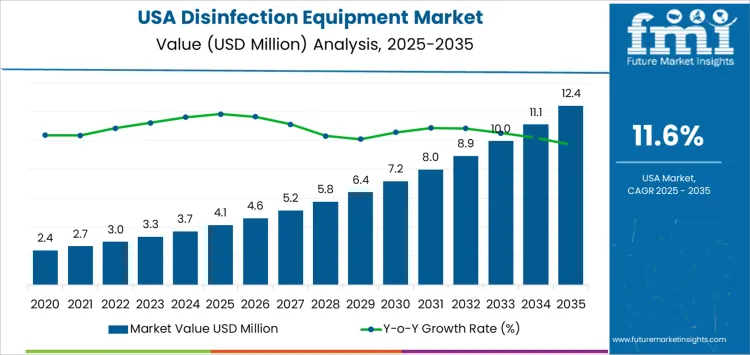
A major breakpoint occurs between 2027 and 2029, when demand accelerates, rising from USD 4.6 million to USD 5.8 million. Healthcare facilities, public transport, and commercial enterprises are investing more heavily in automated disinfection systems, driving significant industry expansion. The second breakpoint, occurring around 2030, marks a sustained period of rapid growth, with demand rising from USD 6.4 million to USD 12.4 million by 2035. This acceleration is fueled by technological advancements in disinfection systems, such as UV-C and electrostatic spray technologies, as well as stricter government regulations around public health and sanitation. The continued focus on cleanliness in both public and private sectors ensures that disinfection equipment remains a crucial investment, solidifying its role in maintaining health and safety standards across industries.
Demand for Disinfection Equipment in USA Key Takeaways
| Metric | Value |
|---|---|
| Demand for Disinfection Equipment in USA Value (2025) | USD 4.1 billion |
| Demand for Disinfection Equipment in USA Forecast Value (2035) | USD 12.4 billion |
| Demand for Disinfection Equipment in USA Forecast CAGR (2025-2035) | 11.6% |
Why is the Demand for Disinfection Equipment in USA Growing?
Demand for disinfection equipment in the USA is growing significantly due to heightened awareness of the importance of hygiene and sanitation in both healthcare and non-healthcare settings. The COVID-19 pandemic accelerated the adoption of disinfection technologies, and even as the immediate health crisis recedes, the focus on cleanliness and infection control remains strong. Disinfection equipment, such as ultraviolet (UV) sterilizers, air purifiers, and automated cleaning systems, is essential for ensuring that environments are free from harmful pathogens, including bacteria, viruses, and fungi. As a result, there is a rising demand across industries such as healthcare, food processing, hospitality, and education for robust disinfection solutions.
Key drivers for this growth include the increasing demand for higher levels of hygiene in public spaces and the need for effective infection control in hospitals, schools, and workplaces. The rise in awareness of healthcare-associated infections (HAIs) and the growing importance of preventing cross-contamination in industries such as food processing and pharmaceuticals are also contributing to the demand for disinfection equipment. Technological advancements in disinfection, such as the development of more efficient UV-C and ozone-based systems, are expanding the range of applications and improving the effectiveness of these products.
Rising adoption of smart and automated disinfection technologies, which can monitor and sanitize spaces without human intervention, is driving demand in commercial and residential sectors. While challenges such as the initial cost of advanced disinfection equipment and concerns about safety and environmental impact may affect adoption rates, the growing focus on hygiene and need for continued public health safety are expected to drive steady growth in demand for disinfection equipment in the USA through 2035.
What is the Segment-Wise Analysis of Demand for Disinfection Equipment in USA?
Demand for disinfection equipment in the USA is segmented by equipment type, end user, distribution channel, and region. By equipment type, UV disinfection systems lead with 40% of the demand, followed by electrostatic sprayers and disinfection sprayers. By end users, commercial applications account for 50% of demand, with industrial and household applications making up the remainder. Regarding distribution channels, wholesalers/distributors are the primary channels, followed by online retailers, independent small stores, and other sales channels. Demand is distributed across the West USA, South USA, Northeast USA, and Midwest USA.
How Does UV Disinfection Lead the Demand for Disinfection Equipment in USA?
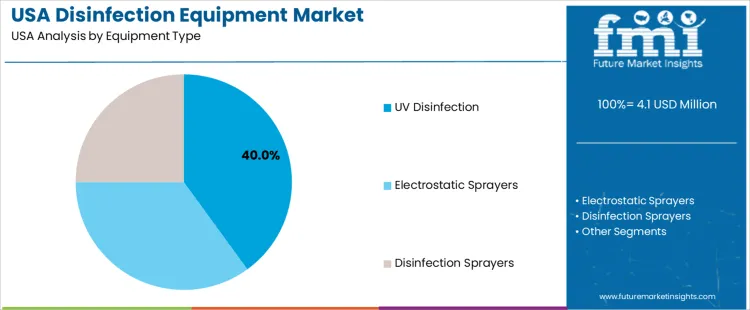
UV disinfection systems account for 40% of the demand for disinfection equipment in the USA, driven by their proven effectiveness in killing bacteria, viruses, and other pathogens. These systems are increasingly used across various sectors such as healthcare, commercial spaces, and water treatment, where effective sterilization and contamination control are essential. UV disinfection’s chemical-free nature makes it especially appealing for those seeking safe, non-toxic methods for disinfecting air, surfaces, and water. The systems’ efficiency, cost-effectiveness, and minimal environmental impact further contribute to their popularity. As concerns about hygiene, safety, and disease prevention continue to grow, especially in public spaces and high-traffic areas, the demand for UV disinfection systems is expected to increase. Their ability to disinfect without the use of harmful chemicals positions UV disinfection as the leading technology, solidifying its dominant position in the disinfection equipment industry.
How Does Commercial End-User Lead the Demand for Disinfection Equipment in USA?
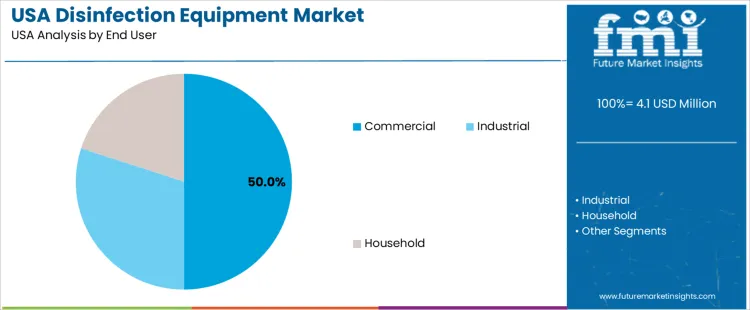
The commercial sector accounts for 50% of the demand for disinfection equipment in the USA, driven by the increasing need for enhanced sanitation in various public and business spaces. This includes offices, healthcare facilities, schools, gyms, and public transportation systems, all of which require frequent and effective disinfection to prevent the spread of infections. The rise in health consciousness, along with growing concerns about disease transmission, especially in light of recent global health events, has further amplified the demand for reliable disinfection equipment. Commercial spaces commonly utilize UV disinfection systems, electrostatic sprayers, and disinfection sprayers due to their efficiency and ability to cover large areas quickly. As businesses continue to prioritize employee and customer safety, the demand for disinfection equipment in commercial environments is expected to remain high, with disinfection systems playing a central role in maintaining a hygienic and safe environment across various industries.
What are the Key Trends, Drivers and Restraints in Demand for Disinfection Equipment in USA?
Healthcare‑associated infection (HAI) concerns and the need for sterilization in hospitals, clinics and long‑term care facilities are boosting demand for advanced disinfection and sterilization systems. The rise of automated disinfection technologies including ultraviolet (UV) light systems, electrostatic sprayers, and IoT‑enabled disinfection equipment is reshaping the disinfection segment by offering efficient, chemical‑free or low‑chemical cleaning solutions. Demand is also driven by food processing, hospitality, manufacturing, public transportation and school sectors seeking regular surface and air disinfection to protect health and meet regulatory hygiene standards. Restraints include high upfront cost of advanced disinfection systems, need for maintenance and skilled operation, and variable adoption levels across small businesses or smaller institutions hesitant to invest.
Why is Demand for Disinfection Equipment Growing in USA?
Demand for disinfection equipment in USA is growing because institutions and businesses increasingly recognize the importance of rigorous sanitation to prevent spread of infections and ensure public safety. The high volume of patients and surgical procedures in healthcare facilities demands reliable sterilization and disinfection to avoid contamination and HAIs. Growing consumer awareness of hygiene, especially since the pandemic, has pushed commercial establishments such as hotels, restaurants, offices, public transport and schools to adopt disinfection protocols. Regulatory pressure and standardization for sanitation in healthcare, food processing, and public spaces further drive demand. Modernization of infrastructure and renovations in public facilities encourage installation of built‑in disinfection systems. As a result, both new installations and replacement of older manual cleaning setups fuel continuous growth in demand across sectors.
How are Technological and Industry Innovations Driving Disinfection Equipment Demand in USA?
Technological advances are significantly boosting demand for disinfection equipment in USA by making systems more effective, automated and easier to deploy. The adoption of ultraviolet‑C (UV‑C) disinfection technologies, electrostatic spraying, and automated robots reduces reliance on manual cleaning and chemical disinfectants while delivering consistent sterilization. Integration with sensors, Internet of Things, and smart monitoring systems allows real‑time tracking of disinfection cycles, environmental conditions and compliance valuable for hospitals, food processing units and large facilities. Innovations also include energy‑efficient, compact, and portable disinfection units suitable for smaller clinics, offices or public transport. As these technologies improve in reliability, cost‑effectiveness and ease of use, a wider range of end users from large hospitals to small businesses find disinfection equipment practical. This broader applicability is expanding the addressable industry beyond just healthcare to commercial, industrial, hospitality and educational sectors.
What are the Key Challenges and Risks That Could Limit Disinfection Equipment Demand in USA?
High initial investment for advanced equipment such as UV‑C systems, automated sprayers or robotic disinfection units may deter smaller institutions or businesses. Maintenance, technical servicing, and need for trained personnel add to life‑cycle costs and may discourage some users. In certain cases, equipment efficiency may be constrained by physical environment for example shadowed or cluttered spaces may reduce efficacy of UV systems or spray coverage. Regulatory and compliance requirements for chemical disinfectants or sterilization methods can be complex, especially in food, healthcare or public settings, complicating adoption. Environmental concerns around chemical disinfectants or energy consumption of equipment may also influence decision‑making. Finally, competition from conventional cleaning methods and manual processes may slow shift toward advanced disinfection equipment in segments that prioritize cost over automation.
What is the Regional Demand Outlook for Disinfection Equipment in USA?
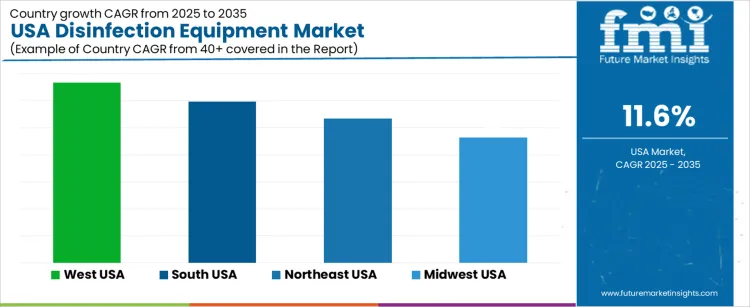
| Region | CAGR (%) |
|---|---|
| West USA | 13.3% |
| South USA | 11.9% |
| Northeast USA | 10.7% |
| Midwest USA | 9.3% |
Demand for disinfection equipment in the USA is growing rapidly, with West USA leading at a 13.3% CAGR, driven by healthcare expansion and heightened hygiene awareness. South USA follows with an 11.9% CAGR, fueled by the region's growing healthcare sector and the need for cleanliness in public and commercial spaces. Northeast USA experiences a 10.7% CAGR, supported by its dense urban environments and strong healthcare infrastructure. Midwest USA shows a 9.3% CAGR, with demand growing in healthcare, manufacturing, and commercial sectors. As the need for infection control and hygiene solutions continues to rise, demand for disinfection equipment will remain strong across all regions.
How is Demand for Disinfection Equipment Growing in West USA?
West USA leads the demand for disinfection equipment, growing at a 13.3% CAGR. The region’s focus on health and safety, coupled with the rapid expansion of healthcare infrastructure, is driving the adoption of advanced disinfection technologies. States like California and Washington have seen a significant increase in demand for disinfection equipment in both healthcare facilities and public spaces due to heightened awareness of hygiene and infection control, especially in the wake of the COVID-19 pandemic. The West’s emphasis on sustainability and green building technologies is promoting the use of eco-friendly disinfection solutions. The increasing need for disinfection in industries such as hospitality, education, and retail is further driving demand. As the region continues to prioritize public health and cleanliness, demand for disinfection equipment will remain strong, particularly in healthcare and high-traffic spaces. The West USA’s innovative approach to hygiene practices ensures the continued growth of this industry, fostering long-term demand for disinfection solutions.
Why is Demand for Disinfection Equipment Rising in South USA?
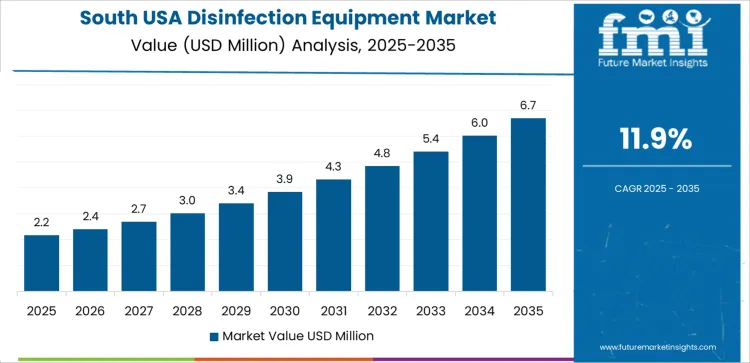
South USA is experiencing steady demand for disinfection equipment, with an 11.9% CAGR. The region’s rapidly expanding healthcare sector, alongside increased focus on public health and safety, is contributing to this growth. States like Texas, Florida, and Georgia are seeing heightened demand for disinfection solutions in both medical and commercial facilities, driven by the need to maintain hygiene standards and prevent the spread of infectious diseases. The increasing implementation of disinfection equipment in schools, offices, and public spaces is further driving demand as businesses and institutions seek to ensure the safety of employees, students, and the public. The South’s significant hospitality and tourism industry is increasingly adopting disinfection technologies to maintain cleanliness and safety standards in hotels, restaurants, and event venues. With the rise in awareness surrounding infection control and hygiene, demand for disinfection equipment will continue to increase in the South, supporting growth in healthcare, commercial, and public sectors.
How is Demand for Disinfection Equipment Expanding in Northeast USA?
Northeast USA is seeing steady demand for disinfection equipment, with a 10.7% CAGR. The region’s large population and dense urban environments, particularly in cities like New York, Boston, and Philadelphia, are key factors driving the need for disinfection solutions. High-traffic areas, healthcare facilities, and public spaces require advanced disinfection systems to ensure hygiene and prevent the spread of infectious diseases. The Northeast’s strong healthcare infrastructure, including hospitals and nursing homes, has seen significant investments in disinfection equipment as part of broader infection control measures. With the region’s focus on public health and safety, there is growing adoption of automated disinfection solutions in schools, offices, and retail environments. The region’s increasing commitment to sustainability also encourages the use of eco-friendly disinfection technologies. As the demand for effective infection control and cleanliness continues to rise, the Northeast will see continued growth in the adoption of disinfection equipment across both public and private sectors.
Why is Demand for Disinfection Equipment Growing in Midwest USA?
Midwest USA is experiencing moderate demand for disinfection equipment, with a 9.3% CAGR. The region’s broad healthcare infrastructure, including hospitals, clinics, and senior care facilities, is driving the adoption of advanced disinfection technologies. As awareness around hygiene and infection control increases, particularly post-pandemic, the demand for disinfection equipment has surged in both healthcare and commercial sectors. States like Illinois, Michigan, and Ohio are seeing a rising need for disinfection solutions in schools, offices, retail stores, and public spaces, as businesses and institutions invest in cleaner and safer environments. The Midwest’s significant industrial and manufacturing sectors are increasingly adopting disinfection technologies to maintain clean and safe production facilities. As companies across industries in the Midwest continue to prioritize employee and customer health, demand for disinfection equipment is expected to continue to grow. The combination of rising health concerns, healthcare investments, and a focus on public safety ensures sustained demand for disinfection technologies in the Midwest.
What is the Competitive Landscape of Disinfection Equipment Demand in USA?
Demand for disinfection equipment in the USA is rising, driven by the growing need for effective sanitation in healthcare, industrial, and commercial settings. The COVID-19 pandemic highlighted the importance of maintaining hygienic environments, leading to increased investments in disinfection technologies across hospitals, laboratories, water treatment facilities, and public spaces. As concerns about infectious diseases and contamination continue, the demand for advanced disinfection equipment, including ultraviolet (UV) disinfection, ozone treatment systems, and automated sterilization devices, remains strong.
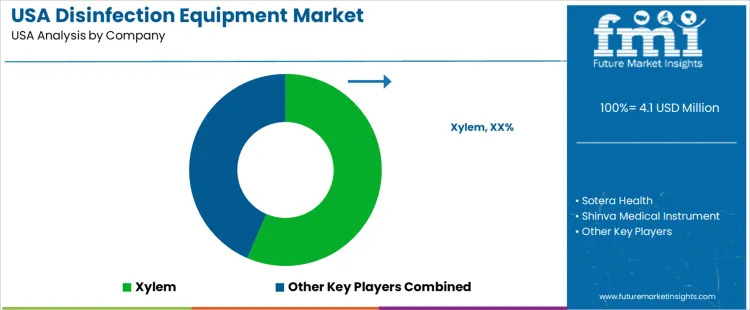
Xylem leads the industry with a dominant 56.5% share, offering a wide range of disinfection solutions focused on water treatment and industrial applications. The company’s strategy revolves around providing sustainable, efficient disinfection technologies, such as UV-based systems, to meet the growing demand for clean water and safe environments. Xylem’s strong industry position is supported by its expertise in water management and environmental solutions, making it a trusted provider of disinfection equipment across various sectors.
Other major players in the industry include Sotera Health, Shinva Medical Instrument, STERIS Corporation, and Matachana. Sotera Health specializes in sterilization services and equipment for the healthcare sector, offering comprehensive disinfection solutions for medical devices and surgical instruments. Shinva Medical Instrument and STERIS Corporation focus on providing high-quality disinfection equipment for healthcare settings, ensuring patient safety and compliance with stringent sanitation standards. Matachana offers cutting-edge sterilization solutions, emphasizing innovation and reliability for healthcare and industrial applications. As competition intensifies, companies are focusing on developing more efficient, eco-friendly, and cost-effective disinfection technologies to meet the evolving needs of the industry in the USA.
Key Players in USA Disinfection Equipment Demand
- Xylem
- Sotera Health
- Shinva Medical Instrument
- STERIS Corporation
- Matachana
Scope of Report
| Items | Values |
|---|---|
| Quantitative Units (2025) | USD billion |
| Equipment Type | UV Disinfection, Electrostatic Sprayers, Disinfection Sprayers |
| End-user | Commercial, Industrial, Household |
| Distribution Channel | Wholesalers / Distributors, Online Retailers, Independent Small Stores, Other sales channels |
| Regions Covered | West USA, South USA, Northeast USA, Midwest USA |
| Countries Covered | USA |
| Key Companies Profiled | Xylem, Sotera Health, Shinva Medical Instrument, STERIS Corporation, Matachana |
| Additional Attributes | Dollar sales by equipment type and end-user; regional CAGR and growth trends; increasing demand for UV and electrostatic sprayers in commercial and industrial applications. |
USA Disinfection Equipment Demand by Key Segments
Equipment Type
- UV Disinfection
- Electrostatic Sprayers
- Disinfection Sprayers
End User
- Commercial
- Industrial
- Household
Distribution Channel
- Wholesalers / Distributors
- Online Retailers
- Independent Small Stores
- Other sales channels
Region
- West USA
- South USA
- Northeast USA
- Midwest USA
Frequently Asked Questions
How big is the demand for disinfection equipment in USA in 2025?
The demand for disinfection equipment in USA is estimated to be valued at USD 4.1 million in 2025.
What will be the size of disinfection equipment in USA in 2035?
The market size for the disinfection equipment in USA is projected to reach USD 12.4 million by 2035.
How much will be the demand for disinfection equipment in USA growth between 2025 and 2035?
The demand for disinfection equipment in USA is expected to grow at a 11.6% CAGR between 2025 and 2035.
What are the key product types in the disinfection equipment in USA?
The key product types in disinfection equipment in USA are uv disinfection, electrostatic sprayers and disinfection sprayers.
Which end user segment is expected to contribute significant share in the disinfection equipment in USA in 2025?
In terms of end user, commercial segment is expected to command 50.0% share in the disinfection equipment in USA in 2025.
Preview the report firsthand - request a free sample
Get SampleGet the brochure for pricing and purchase details.
Get PDFTable of Content
- Executive Summary
- USA Market Outlook
- Demand-side Trends
- Supply-side Trends
- Technology Roadmap Analysis
- Analysis and Recommendations
- Market Overview
- Market Coverage / Taxonomy
- Market Definition / Scope / Limitations
- Market Background
- Market Dynamics
- Drivers
- Restraints
- Opportunity
- Trends
- Scenario Forecast
- Demand in Optimistic Scenario
- Demand in Likely Scenario
- Demand in Conservative Scenario
- Opportunity Map Analysis
- Product Life Cycle Analysis
- Supply Chain Analysis
- Investment Feasibility Matrix
- Value Chain Analysis
- PESTLE and Porter’s Analysis
- Regulatory Landscape
- Regional Parent Market Outlook
- Production and Consumption Statistics
- Import and Export Statistics
- Market Dynamics
- USA Market Analysis 2020 to 2024 and Forecast, 2025 to 2035
- Historical Market Size Value (USD Million) Analysis, 2020 to 2024
- Current and Future Market Size Value (USD Million) Projections, 2025 to 2035
- Y-o-Y Growth Trend Analysis
- Absolute $ Opportunity Analysis
- USA Market Pricing Analysis 2020 to 2024 and Forecast 2025 to 2035
- USA Market Analysis 2020 to 2024 and Forecast 2025 to 2035, By Equipment Type
- Introduction / Key Findings
- Historical Market Size Value (USD Million) Analysis By Equipment Type , 2020 to 2024
- Current and Future Market Size Value (USD Million) Analysis and Forecast By Equipment Type , 2025 to 2035
- UV Disinfection
- Electrostatic Sprayers
- Disinfection Sprayers
- Y-o-Y Growth Trend Analysis By Equipment Type , 2020 to 2024
- Absolute $ Opportunity Analysis By Equipment Type , 2025 to 2035
- USA Market Analysis 2020 to 2024 and Forecast 2025 to 2035, By End User
- Introduction / Key Findings
- Historical Market Size Value (USD Million) Analysis By End User, 2020 to 2024
- Current and Future Market Size Value (USD Million) Analysis and Forecast By End User, 2025 to 2035
- Commercial
- Industrial
- Household
- Y-o-Y Growth Trend Analysis By End User, 2020 to 2024
- Absolute $ Opportunity Analysis By End User, 2025 to 2035
- USA Market Analysis 2020 to 2024 and Forecast 2025 to 2035, By Distribution Channel
- Introduction / Key Findings
- Historical Market Size Value (USD Million) Analysis By Distribution Channel, 2020 to 2024
- Current and Future Market Size Value (USD Million) Analysis and Forecast By Distribution Channel, 2025 to 2035
- Wholesalers / Distributors
- Online Retailers
- Independent Small Stores
- Other sales channels
- Y-o-Y Growth Trend Analysis By Distribution Channel, 2020 to 2024
- Absolute $ Opportunity Analysis By Distribution Channel, 2025 to 2035
- Market Structure Analysis
- Competition Dashboard
- Competition Benchmarking
- Market Share Analysis of Top Players
- By Regional
- By Equipment Type
- By End User
- By Distribution Channel
- Competition Analysis
- Competition Deep Dive
- Xylem
- Overview
- Product Portfolio
- Profitability by Market Segments (Product/Age /Sales Channel/Region)
- Sales Footprint
- Strategy Overview
- Marketing Strategy
- Product Strategy
- Channel Strategy
- Sotera Health
- Shinva Medical Instrument
- STERIS Corporation
- Matachana
- Xylem
- Competition Deep Dive
- Assumptions & Acronyms Used
- Research Methodology


