

- Industry Size (2026)
- USD 13.0 Mn
- Forecast (2036)
- USD 27.9 Mn
- CAGR (2026 to 2036)
- 8.0%
Demand for Disinfection Equipment in Japan Forecast and Outlook 2026 to 2036
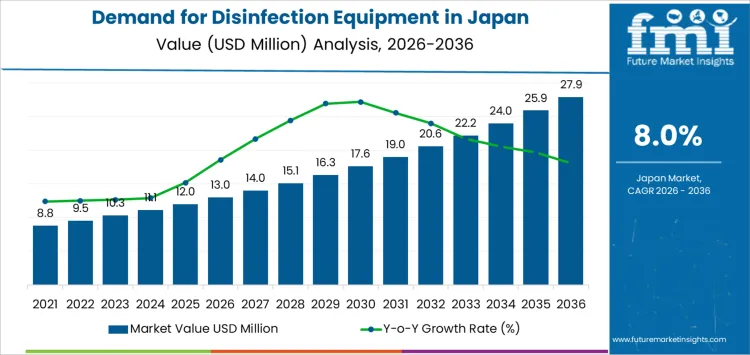
The demand for disinfection equipment in Japan is valued at USD 13.0 million in 2026 and is projected to reach USD 27.9 million by 2036, reflecting a CAGR of 8.0%. The rise from USD 8.2 million in 2020 to USD 13.0 million in 2026 is supported by consistent use across commercial buildings, industrial facilities, and households. UV systems anchor early demand due to reliability in high traffic environments, while electrostatic and general sprayers maintain steady deployment for routine sanitation cycles.
From 2027 onward, values increase from USD 14.0 million to USD 19.0 million by 2031, then progress to USD 27.9 million by 2036 through widening annual increments. Commercial operators remain the primary buyers, with industrial users maintaining predictable intake for equipment and workspace sanitization. Household adoption grows slowly as compact sprayers gain availability through online channels. Wholesalers, distributors, and small stores support steady product circulation. Long term growth reflects hygiene standards, facility management routines, and replacement cycles across Japan.
Quick Stats of the Demand for Disinfection Equipment in Japan
- Disinfection Equipment Demand in Japan Value (2026): USD 13.0 million
- Disinfection Equipment Demand in Japan Forecast Value (2036): USD 27.9 million
- Disinfection Equipment Demand in Japan Forecast CAGR (2026-2036): 8.0%
- Disinfection Equipment Leading Type: UV Disinfection (40%)
- Disinfection Equipment Key Growth Regions: Kyushu & Okinawa, Kanto, Kansai
- Disinfection Equipment Top Players: Xylem, Sotera Health, Shinva Medical Instrument, STERIS Corporation, Matachana
What is the Growth Forecast for Disinfection Equipment in Japan through 2036?
Between 2026 and 2031, demand for disinfection equipment in Japan increases from USD 13.0 million to USD 17.6 million, reflecting steady expansion as healthcare providers, laboratories, and public facilities continue upgrading hygiene protocols. Growth in this stage is influenced by rising throughput in clinical settings, modernization of sterilization rooms, and broader uptake of compact disinfection units in outpatient and diagnostic centers. Earlier use followed post-event precautionary investments, while the near-term period shows a shift toward routine procurement linked to clearer operating standards and continuous infection-control expectations across institutional environments.
From 2031 to 2036, demand rises from USD 17.6 million to USD 27.9 million, marking a pronounced acceleration. This phase is shaped by wider deployment of automated disinfection systems, expanding installation in food processing plants, and increased adoption across transportation hubs and corporate facilities. Earlier progress reflected incremental adoption, whereas later gains stem from long-term infrastructure planning, higher equipment reliability needs, and integration of disinfection systems within broader facility management routines. Consistent replacement cycles, heightened attention to environmental hygiene, and stronger investment from private operators reinforce Japan’s upward demand profile through 2036.
Disinfection Equipment Industry in Japan Key Takeaways
| Metric | Value |
|---|---|
| Industry Value (2026) | USD 13.0 million |
| Forecast Value (2036) | USD 27.9 million |
| Forecast CAGR (2026-2036) | 8.0% |
What Is Driving the Demand for Disinfection Equipment in Japan from 2026 to 2036?
Demand for disinfection equipment in Japan has grown with heightened awareness of infection control across healthcare, public facilities, and high-foot-traffic environments. Hospitals, clinics and long-term care facilities adopted ultraviolet, chemical spray and air purification systems to reduce pathogen exposure among patients and staff. Retailers, schools, and transport hubs installed touchless sanitising stations and automated surface disinfection tools to support routine cleanliness. Buyers historically focused on certified performance, ease of use, and integration with existing cleaning protocols. Procurement emphasised reliability and consistent output under frequent use, aligning with facility maintenance practices and occupational hygiene standards.
From 2026 to 2036 demand for disinfection equipment in Japan is expected to strengthen under ongoing public health emphasis and regulatory frameworks for indoor air quality. Expansion of smart building systems that monitor occupancy and air parameters encourages integration of disinfection technologies with ventilation and control networks. Innovations in low-energy UV-C devices, electrostatic spray systems, and sensor-activated units attract adoption in offices, hospitality, and institutional settings. Buyers prioritise equipment that balances efficacy with minimal impact on materials and occupant comfort. Demand will depend on lifecycle cost, safety compliance, and interoperability with facility automation platforms across urban and regional infrastructures nationwide.
What Is the Demand for Disinfection Equipment in Japan by Equipment Type and End User for 2026 to 2036?
The demand for disinfection equipment in Japan from 2026 to 2036 reflects structured hygiene standards, routine sanitization cycles across public spaces, and steady investment in contact-free disinfection tools. UV disinfection leads by equipment type due to its repeatable output and low consumable requirements. Commercial users hold the largest share as offices, retail spaces, and service facilities maintain regular sanitation schedules aligned with facility safety policies and occupant flow.
Why does UV disinfection account for 40% of the demand for disinfection equipment in Japan by equipment type from 2026 to 2036?
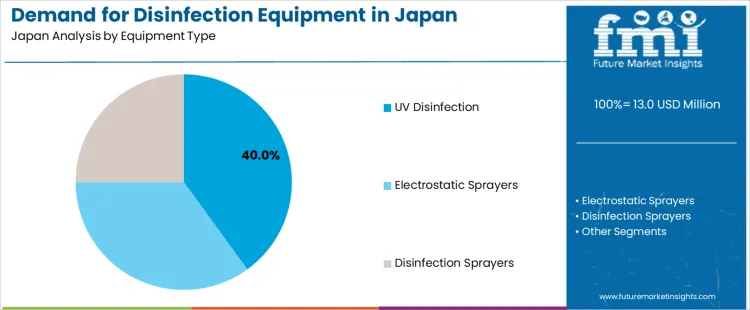
UV disinfection accounts for 40% of the demand in Japan because facilities favor predictable germicidal performance that does not rely on chemical replenishment. Consumption increases in settings requiring rapid room turnover, consistent dosage control, and minimal operator involvement. Usage remains steady since UV devices support fixed-cycle routines in meeting rooms, small clinics, and public service areas. Procurement is shaped by buyers seeking stable lamp intensity, validated irradiation patterns, and compact housings suitable for limited spaces. Price sensitivity stays moderate as lifetime operating costs decrease through reduced consumables. Specification control focuses on wavelength precision, uniform exposure coverage, and safe enclosure design. Demand continues through 2026 to 2036 as businesses maintain structured hygiene protocols and replace older UV units with higher-efficiency models.
Why do commercial users represent 50.0% of the demand for disinfection equipment in Japan by end user?
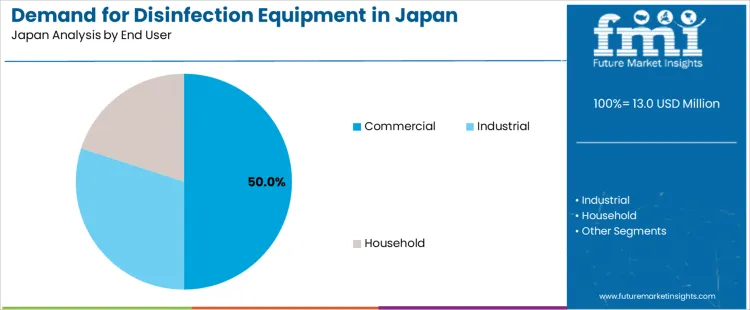
Commercial users represent 50.0% of the demand because these spaces maintain scheduled sanitation cycles linked to employee density, visitor flow, and regulatory expectations for shared environments. Consumption grows across retail stores, corporate offices, transport hubs, and hospitality venues where surface and air sanitation form part of daily operations. Usage remains steady since many buildings integrate disinfection equipment into routine closing procedures and mid-day cleaning breaks. Procurement is guided by facilities teams selecting equipment that supports consistent coverage, fast deployment, and minimal downtime. Price sensitivity stays moderate as commercial operators evaluate costs within broader building maintenance budgets. Specification control highlights ease of mobility, device durability, and compatibility with existing facility workflows. Demand remains stable from 2026 to 2036 as commercial facilities sustain structured cleanliness standards to support employee comfort and visitor confidence.
How Is Demand for Disinfection Equipment in Japan Expanding Across Local Healthcare and Public Facility Settings?
Demand grows through routine operations in hospitals, clinics, transit hubs, and elder care homes across Japan. Urban hospitals in Tokyo and Osaka use automated units to support daily surface cycles in high turnover wards. Community clinics in Saitama adopt compact devices for patient rooms with tight changeover times. Rail stations in Fukuoka use fixed units to maintain carriage cleanliness during short layovers. Elder care homes in Kanagawa rely on portable systems for shared spaces where frequent contact occurs. These needs create steady local pull shaped by Japan’s service patterns and facility layouts.
Which Local Operating Conditions Are Driving Demand for Disinfection Equipment in Japan?
Drivers come from workflows tied to dense public usage and regulated care routines. Hospitals in Aichi use automated systems to support isolation room turnover. Clinics in Chiba adopt handheld units for small waiting areas with continuous movement. Rail depots in Osaka use rapid cycle devices to meet carriage dispatch schedules. Elder care homes in Hyogo integrate surface treatment routines during meal and therapy rotations. These activities reflect localized patterns where high foot traffic and structured care programs require dependable disinfection steps in daily operations.
What Local Constraints Are Limiting Wider Adoption of Disinfection Equipment in Japan?
Barriers link to procurement, space, and staffing limits. Smaller clinics in rural prefectures avoid larger systems because storage rooms are compact. Municipal facilities with fixed budgets prioritize basic cleaning supplies instead of automated devices. Hospitals in older buildings face electrical load limits that slow installation of newer units. Elder care homes with small teams choose simpler tools to keep routines manageable. Local suppliers in Shikoku report uneven orders from facilities that rely on seasonal purchasing cycles. These constraints slow broader uptake in regions with tighter resources or limited infrastructure.
What is the Demand for Disinfection Equipment in Japan by Region?
| Region | CAGR (%) |
|---|---|
| Kyushu & Okinawa | 11.4% |
| Kanto | 10.5% |
| Kansai | 9.2% |
| Chubu | 8.1% |
| Tohoku | 7.1% |
| Rest of Japan | 6.8% |
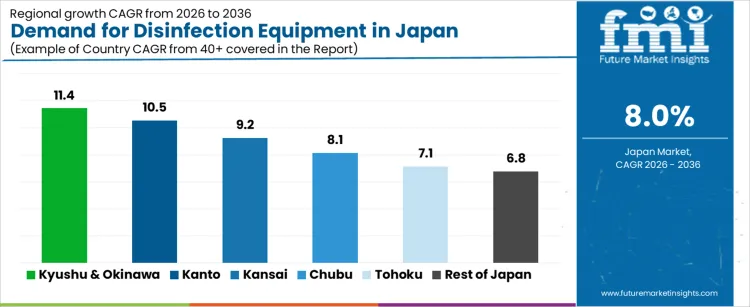
The demand for disinfection equipment in Japan is expanding rapidly across healthcare, commercial facilities, manufacturing sites, and public infrastructure, with Kyushu and Okinawa leading at an 11.4% CAGR. Growth in this region is supported by strong healthcare modernization, wider adoption of hygiene technologies, and increased deployment of UV and chemical based disinfection systems. Kanto follows at 10.5%, driven by dense urban populations, high hospital concentration, and widespread use of automated disinfection solutions in offices, schools, and transport stations. Kansai records 9.2% growth, reflecting steady commercial adoption and strong institutional procurement. Chubu at 8.1% sees moderate uptake linked to manufacturing related hygiene needs. Tohoku and the Rest of Japan, at 7.1% and 6.8%, show slower movement shaped by smaller facility footprints and more gradual replacement cycles for hygiene equipment.
How Are Institutional Hygiene Practices Supporting Disinfection Equipment Demand in Kyushu and Okinawa?
Demand for disinfection equipment in Kyushu and Okinawa is rising at a CAGR of 11.4% from 2026 to 2036 as hospitals, hotels, food processors, and public facilities rely on devices that support routine sanitation. Healthcare centers use disinfection units for patient rooms, instruments, and shared areas. Hotels and restaurants adopt equipment to strengthen daily cleaning cycles. Retail suppliers manage steady inventory movement shaped by active procurement across service industries. Growth reflects widespread hygiene priorities across coastal and island communities where consistent sanitation practices guide equipment adoption for varied operational needs.
- Hospitals use devices for routine sanitation
- Hospitality sectors integrate disinfection workflows
- Suppliers track strong regional demand
What Drives Disinfection Equipment Usage Across Kanto?
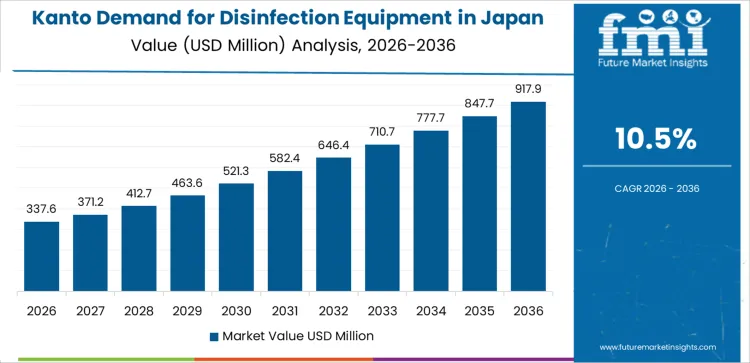
Demand for disinfection equipment in Kanto is progressing at a CAGR of 10.5% from 2026 to 2036 as dense healthcare networks, transportation hubs, and commercial facilities incorporate sanitation devices into daily operations. Hospitals use equipment for room turnover and instrument handling. Offices and retail spaces rely on devices to maintain cleanliness in high traffic zones. Distributors handle frequent replenishment cycles driven by strong metropolitan consumption. Growth reflects broad hygiene management across medical, corporate, and public settings.
- Hospitals apply equipment for daily cleaning
- Commercial sites maintain hygiene with devices
- Distributors manage rapid stock rotation
How Are Facility Operations Shaping Disinfection Equipment Demand in Kansai?
Demand for disinfection equipment in Kansai is increasing at a CAGR of 9.2% from 2026 to 2036 as hospitals, foodservice operators, and transport facilities adopt sanitation tools to support cleanliness standards. Providers use equipment to manage routine hygiene in wards and clinics. Foodservice units incorporate devices for kitchen and preparation zones. Retail suppliers maintain stable inventory movement guided by consistent purchasing. Growth aligns with balanced regional activity where diverse facilities depend on reliable sanitation equipment for daily operations.
- Hospitals use units for ward sanitation
- Foodservice adopts devices for kitchen cleaning
- Suppliers maintain steady distribution cycles
Which Conditions Influence Disinfection Equipment Demand Across Chubu?
Demand for disinfection equipment in Chubu is trending at a CAGR of 8.1% from 2026 to 2036 as hospitals, manufacturing sites, and public facilities integrate sanitation tools into daily workflows. Healthcare providers use equipment for procedure rooms and shared spaces. Factories adopt units to maintain controlled environments in production areas. Retail channels follow measured order cycles shaped by local consumption. Growth reflects steady hygiene requirements across industrial and healthcare operations.
- Providers use devices for shared spaces
- Factories adopt units for clean environments
- Retailers manage measured procurement cycles
How Do Regional Practices Support Disinfection Equipment Demand in Tohoku?
Demand for disinfection equipment in Tohoku is moving at a CAGR of 7.1% from 2026 to 2036 as healthcare centers, schools, and service facilities integrate sanitation devices into routine operations. Clinics use equipment to manage daily cleaning tasks. Schools adopt devices for classrooms and communal areas. Retail suppliers maintain stable stock movement based on community level demand. Growth reflects practical hygiene needs across varied facilities that require dependable disinfection support.
- Clinics use tools for daily care routines
- Schools maintain classroom hygiene
- Suppliers follow stable ordering patterns
What Sustains Disinfection Equipment Demand Across Rest of Japan?
Demand for disinfection equipment in Rest of Japan is advancing at a CAGR of 6.8% from 2026 to 2036 as smaller hospitals, public centers, and hospitality venues rely on sanitation devices for routine cleaning. Facilities use equipment for rooms, service areas, and visitor zones. Retail distributors support modest but steady stock turnover aligned with regional purchasing. Growth reflects ongoing hygiene management across dispersed communities where practical sanitation tools remain essential for daily operations.
- Facilities use devices for routine cleaning
- Hospitality relies on units for guest areas
- Distributors manage modest but steady supply
What Is Driving the Demand for Disinfection Equipment in Japan and Which Companies Shape Hospital and Industrial Adoption
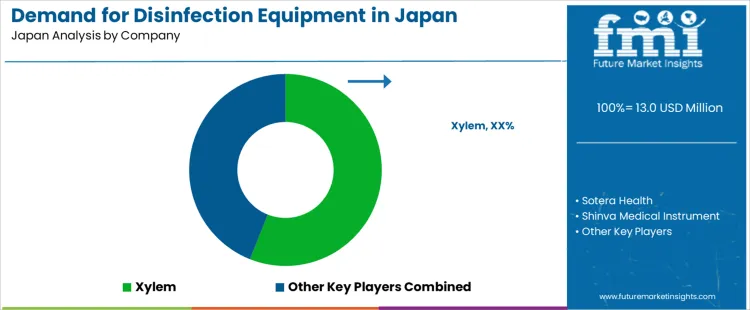
The demand for disinfection equipment in Japan is shaped by strict infection control standards, high hospital procedure volumes, and steady requirements for sterilization in pharmaceuticals, food processing, and public facilities. Domestic manufacturers supply much of the national base through washers, low temperature sterilizers, and UV systems designed for compact hospital layouts. Shinva Medical Instrument participates through imported disinfection and sterilization units adopted in selected medical centers and research institutes. STERIS Corporation supports demand through low temperature sterilizers and washing systems used in central sterile departments of large hospitals. Matachana reaches Japan through distributor channels serving surgical units, outpatient clinics, and laboratories requiring validated sterilization performance. Xylem influences water related disinfection through UV and ozone systems installed in municipal and industrial settings.
Product selection in Japan is governed by cycle reliability, compatibility with delicate instruments, chemical residue control, and conformity with national reprocessing guidelines. Hospitals emphasize compact machine footprints, clear user interfaces, and predictable cycle times that support smooth operating room turnover. Clinics focus on systems that require minimal maintenance and integrate with limited workspace. Industrial users prioritize robust materials, stable germicidal performance, and easy integration with existing process lines. Buyer preference centers on strong documentation, local service support, and validated results under Japanese environmental conditions.
Key Players in the Disinfection Equipment Industry in Japan
- Xylem
- Sotera Health
- Shinva Medical Instrument
- STERIS Corporation
- Matachana
Scope of the Report
| Items | Values |
|---|---|
| Quantitative Units (2026) | USD million |
| Equipment Type | UV Disinfection; Electrostatic Sprayers; Disinfection Sprayers |
| End User | Commercial; Industrial; Household |
| Distribution Channel | Wholesalers / Distributors; Online Retailers; Independent Small Stores; Other sales channels |
| Regions Covered | Kyushu & Okinawa; Kanto; Kansai; Chubu; Tohoku; Rest of Japan |
| Countries Covered | Japan |
| Key Companies Profiled | Xylem; Sotera Health; Shinva Medical Instrument; STERIS Corporation; Matachana |
| Additional Attributes | Dollar by sales across equipment types, end users, and distribution channels; hygiene compliance requirements; integration with facility maintenance routines; safety and exposure control considerations; equipment reliability and cycle performance; compact design preferences for clinics and small facilities; replacement cycle timing; interoperability with ventilation and building management systems; service and maintenance support patterns. |
Disinfection Equipment Industry in Japan Segmentation
Equipment Type:
- UV Disinfection
- Electrostatic Sprayers
- Disinfection Sprayers
End User:
- Commercial
- Industrial
- Household
Distribution Channel:
- Wholesalers / Distributors
- Online Retailers
- Independent Small Stores
- Other sales channels
Region:
- Kyushu & Okinawa
- Kanto
- Kansai
- Chubu
- Tohoku
- Rest of Japan
Frequently Asked Questions
How big is the demand for disinfection equipment in Japan in 2026?
The demand for disinfection equipment in Japan is estimated to be valued at USD 13.0 million in 2026.
What will be the size of disinfection equipment in Japan in 2036?
The market size for the disinfection equipment in Japan is projected to reach USD 27.9 million by 2036.
How much will be the demand for disinfection equipment in Japan growth between 2026 and 2036?
The demand for disinfection equipment in Japan is expected to grow at a 8.0% CAGR between 2026 and 2036.
What are the key product types in the disinfection equipment in Japan?
The key product types in disinfection equipment in Japan are uv disinfection, electrostatic sprayers and disinfection sprayers.
Which end user segment is expected to contribute significant share in the disinfection equipment in Japan in 2026?
In terms of end user, commercial segment is expected to command 50.0% share in the disinfection equipment in Japan in 2026.
Preview the report firsthand - request a free sample
Get SampleGet the brochure for pricing and purchase details.
Get PDFTable of Content
- Executive Summary
- Japan Market Outlook
- Demand-side Trends
- Supply-side Trends
- Technology Roadmap Analysis
- Analysis and Recommendations
- Market Overview
- Market Coverage / Taxonomy
- Market Definition / Scope / Limitations
- Market Background
- Market Dynamics
- Drivers
- Restraints
- Opportunity
- Trends
- Scenario Forecast
- Demand in Optimistic Scenario
- Demand in Likely Scenario
- Demand in Conservative Scenario
- Opportunity Map Analysis
- Product Life Cycle Analysis
- Supply Chain Analysis
- Investment Feasibility Matrix
- Value Chain Analysis
- PESTLE and Porter’s Analysis
- Regulatory Landscape
- Regional Parent Market Outlook
- Production and Consumption Statistics
- Import and Export Statistics
- Market Dynamics
- Japan Market Analysis 2020 to 2024 and Forecast, 2025 to 2035
- Historical Market Size Value (USD Million) Analysis, 2020 to 2024
- Current and Future Market Size Value (USD Million) Projections, 2025 to 2035
- Y-o-Y Growth Trend Analysis
- Absolute $ Opportunity Analysis
- Japan Market Pricing Analysis 2020 to 2024 and Forecast 2025 to 2035
- Japan Market Analysis 2020 to 2024 and Forecast 2025 to 2035, By Equipment Type
- Introduction / Key Findings
- Historical Market Size Value (USD Million) Analysis By Equipment Type , 2020 to 2024
- Current and Future Market Size Value (USD Million) Analysis and Forecast By Equipment Type , 2025 to 2035
- UV Disinfection
- Electrostatic Sprayers
- Disinfection Sprayers
- Y-o-Y Growth Trend Analysis By Equipment Type , 2020 to 2024
- Absolute $ Opportunity Analysis By Equipment Type , 2025 to 2035
- Japan Market Analysis 2020 to 2024 and Forecast 2025 to 2035, By End User
- Introduction / Key Findings
- Historical Market Size Value (USD Million) Analysis By End User, 2020 to 2024
- Current and Future Market Size Value (USD Million) Analysis and Forecast By End User, 2025 to 2035
- Commercial
- Industrial
- Household
- Y-o-Y Growth Trend Analysis By End User, 2020 to 2024
- Absolute $ Opportunity Analysis By End User, 2025 to 2035
- Japan Market Analysis 2020 to 2024 and Forecast 2025 to 2035, By Distribution Channel
- Introduction / Key Findings
- Historical Market Size Value (USD Million) Analysis By Distribution Channel, 2020 to 2024
- Current and Future Market Size Value (USD Million) Analysis and Forecast By Distribution Channel, 2025 to 2035
- Wholesalers / Distributors
- Online Retailers
- Independent Small Stores
- Other sales channels
- Y-o-Y Growth Trend Analysis By Distribution Channel, 2020 to 2024
- Absolute $ Opportunity Analysis By Distribution Channel, 2025 to 2035
- Market Structure Analysis
- Competition Dashboard
- Competition Benchmarking
- Market Share Analysis of Top Players
- By Regional
- By Equipment Type
- By End User
- By Distribution Channel
- Competition Analysis
- Competition Deep Dive
- Xylem
- Overview
- Product Portfolio
- Profitability by Market Segments (Product/Age /Sales Channel/Region)
- Sales Footprint
- Strategy Overview
- Marketing Strategy
- Product Strategy
- Channel Strategy
- Sotera Health
- Shinva Medical Instrument
- STERIS Corporation
- Matachana
- Xylem
- Competition Deep Dive
- Assumptions & Acronyms Used
- Research Methodology


