

- Industry Size (2025)
- USD 405.1 Mn
- Forecast (2035)
- USD 528.7 Mn
- CAGR (2025 to 2035)
- 2.7%
Demand for Marking and Coding Equipment in Japan Forecast and Outlook 2025 to 2035
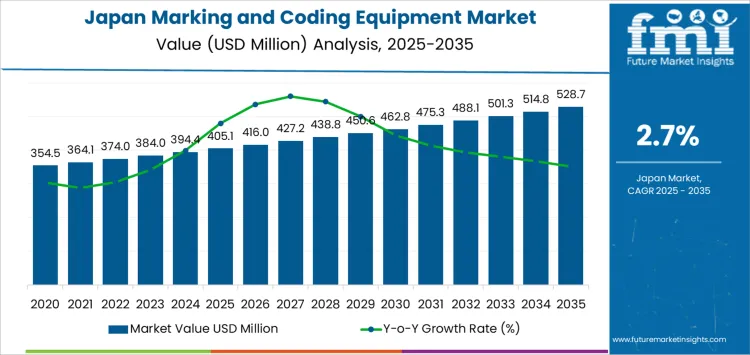
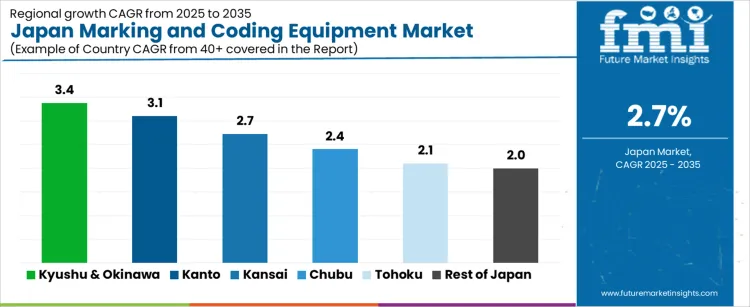
Demand for marking and coding equipment in Japan is expected to grow steadily, reaching USD 528.7 million by 2035, reflecting a CAGR of 2.7%. The market is forecast to reach USD 405.1 million in 2025. Regional demand for these systems varies across Japan, with Kyushu & Okinawa leading the growth at a 3.4% CAGR. This is driven by the region’s growing industrial and agricultural sectors, which require efficient labeling and traceability solutions for compliance and logistics.
Kanto follows with a 3.1% CAGR, fueled by the region’s diverse industrial landscape and the increasing need for high-speed and accurate labeling solutions in manufacturing, food processing, and e-commerce. Kansai shows a steady 2.7% CAGR, supported by its robust manufacturing base, particularly in food production and consumer goods, where the demand for regulatory-compliant coding systems is high.
Quick Stats of the Demand for Marking and Coding Equipment in Japan
- Demand for Marking and Coding Equipment in Japan Value (2025): USD 405.1 million
- Demand for Marking and Coding Equipment in Japan Forecast Value (2035): USD 528.7 million
- Demand for Marking and Coding Equipment in Japan Forecast CAGR (2025-2035): 2.7%
- Demand for Marking and Coding Equipment in Japan Leading Technology: Laser Coding System
- Demand for Marking and Coding Equipment in Japan Key Growth Regions: Kyushu & Okinawa, Kanto, Kansai, Chubu, Tohoku, Rest of Japan
- Demand for Marking and Coding Equipment in Japan Top Players: Hitachi Industrial Equipment & Solutions America, LLC, Videojet Technologies, Inc., Markem-Imaje Corporation, Domino Printing Sciences plc, Squid Ink Manufacturing Inc
Chubu experiences a 2.4% CAGR, driven by the need for marking and coding equipment in the automotive and food processing industries. Tohoku sees moderate growth at 2.1%, with increasing adoption of automated labeling systems in agriculture and small-scale manufacturing. The Rest of Japan, including rural and smaller urban areas, is witnessing gradual demand growth at 2.0% CAGR, driven by e-commerce and food safety regulations. As industries across Japan continue to prioritize traceability and regulatory compliance, marking and coding equipment will remain in high demand across all regions.
Demand for Marking and Coding Equipment in Japan Key Takeaways
| Metric | Value |
|---|---|
| Demand for Marking and Coding Equipment in Japan Value (2025) | USD 405.1 million |
| Demand for Marking and Coding Equipment in Japan Forecast Value (2035) | USD 528.7 million |
| Demand for Marking and Coding Equipment in Japan Forecast CAGR (2025-2035) | 2.7% |
Why is the Demand for Marking and Coding Equipment in Japan Growing?
The demand for marking and coding equipment in Japan is growing as industries increasingly require precise and efficient labeling, identification, and traceability solutions. Marking and coding equipment, which includes printers, lasers, and inkjet systems, is essential for ensuring product authenticity, compliance with regulatory standards, and efficient production processes. With Japan’s strong manufacturing sector, particularly in industries like food and beverage, pharmaceuticals, and electronics, the need for high-quality marking and coding systems is becoming more critical.
A key driver behind the growth of marking and coding equipment is the rising demand for product traceability and anti-counterfeit solutions. As consumers and regulatory bodies demand higher levels of transparency and safety, manufacturers are turning to advanced marking and coding systems to ensure that their products are correctly labeled, comply with safety standards, and can be traced throughout the supply chain. Industries like food and pharmaceuticals are adopting these systems to ensure accurate expiry dates, batch numbers, and ingredient labels are clearly visible on products.
Innovations in marking and coding technology, such as improvements in printing speed, resolution, and durability, are contributing to the increasing adoption of these systems. As businesses strive for greater operational efficiency and product quality, the demand for advanced and reliable marking and coding solutions continues to rise. With continued focus on regulatory compliance and technological advancements, the demand for marking and coding equipment in Japan is expected to grow steadily through 2035.
What is the Segment-Wise Analysis of Demand for Marking and Coding Equipment in Japan?
Demand for marking and coding equipment in Japan is segmented by application, technology, and region. By application, demand is divided into rigid packaging and flexible packaging, with rigid packaging leading at 91%. The demand is also segmented by technology, including laser coding systems, thermal inkjet (TIJ), thermal transfer overprint (TTO), continuous inkjet (CIJ), large character marking (LCP), print & apply systems/label print applicator (LPA), and others, with laser coding systems accounting for 15.5%. Regionally, demand spans across Kyushu & Okinawa, Kanto, Kansai, Chubu, Tohoku, and the rest of Japan.
How Does Rigid Packaging Lead the Demand for Marking and Coding Equipment in Japan?
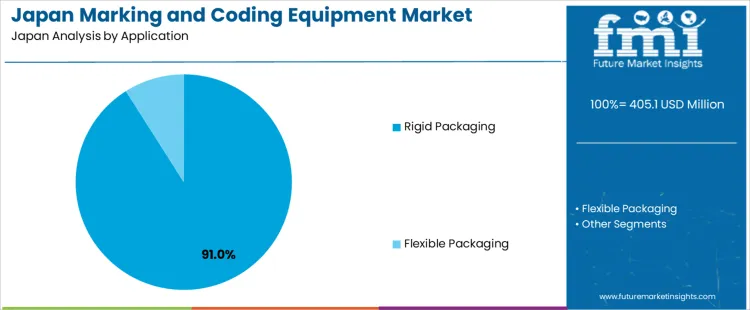
Rigid packaging accounts for 91% of the demand for marking and coding equipment in Japan, driven by its widespread use across industries such as food and beverage, pharmaceuticals, and consumer goods. Rigid packaging, such as bottles, cans, and jars, requires precise and reliable marking and coding to meet regulatory requirements and ensure product traceability. The high demand for rigid packaging is linked to the increasing focus on product labeling for brand identification, batch tracking, and expiration dates.
Marking and coding equipment, such as continuous inkjet (CIJ) printers and thermal transfer overprint (TTO) systems, are commonly used in rigid packaging applications due to their ability to mark on hard surfaces with high speed and accuracy. As consumer demand for packaged goods continues to rise, especially in the food and beverage sector, rigid packaging remains the dominant application driving the demand for marking and coding equipment in Japan.
Why Does Laser Coding System Lead the Demand for Marking and Coding Equipment in Japan?
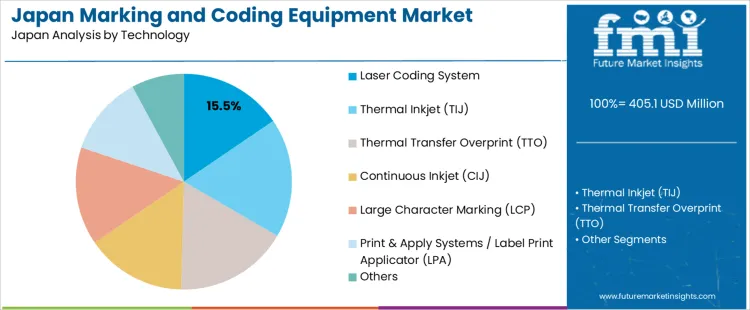
Laser coding systems account for 15.5% of the demand for marking and coding equipment in Japan, driven by their precision, high-speed capabilities, and low maintenance requirements. Laser coding is preferred for applications that require permanent, non-contact markings on packaging materials, such as barcodes, batch numbers, and expiration dates. The demand for laser coding systems is growing in industries like food and beverage, electronics, and pharmaceuticals, where traceability and product integrity are crucial.
Laser technology offers several advantages, including the ability to mark a wide variety of materials (such as glass, metal, and plastic), high resolution, and the lack of consumables like inks or ribbons. As the need for high-quality, permanent markings on packaging increases, especially for industries with stringent regulatory and quality control standards, laser coding systems are expected to remain a key technology in the marking and coding industry in Japan.
What are the Key Trends, Drivers, and Restraints in Demand for Marking and Coding Equipment in Japan?
Marking and coding systems such as inkjet, laser, and thermal are used to print essential information, including batch codes, expiration dates, barcodes, and lot numbers on packaging and products. As supply chains become more complex and compliance standards tighten, reliable marking systems are crucial for meeting these requirements. However, the growth in demand faces challenges related to high initial costs, maintenance, and integration complexity, especially for smaller manufacturers or those with outdated equipment. These challenges can make the transition to more advanced marking systems more difficult, although the benefits of regulatory compliance and process efficiency often outweigh these barriers for larger enterprises.
Why is Demand for Marking and Coding Equipment Growing in Japan?
The demand for marking and coding equipment in Japan is growing due to stricter regulations regarding labeling, traceability, and safety in industries like food and beverage and pharmaceuticals. With consumers increasingly demanding clear labeling, including expiration dates and traceability, the need for accurate and reliable coding systems has intensified. The rise of automated production and packaging lines has made manual labeling inefficient and error-prone.
Automated marking systems provide consistency, speed, and reduce human error, making them attractive for high-speed manufacturing environments. The need for serialization and anti-counterfeiting measures, especially for international exports, has further driven the demand for sophisticated coding equipment. This combination of regulatory pressures, demand for higher efficiency, and industry requirements has led to more widespread adoption of advanced marking and coding solutions across various sectors in Japan.
How are Technological & Industry Innovations Driving Marking and Coding Equipment Demand in Japan?
Technological innovations in marking and coding systems, including improvements in inkjet, laser, and thermal printing, are driving the demand for advanced coding equipment in Japan. These systems now offer faster print speeds, higher resolution, and greater compatibility with various packaging materials like plastic, glass, and metal. Modern systems are increasingly integrated into automated production lines, allowing for seamless and efficient operation in industries that require high-speed packaging.
Industry 4.0 trends are encouraging the adoption of smart, IoT-enabled coding systems, which offer real-time diagnostics, remote monitoring, and predictive maintenance. These features help reduce downtime, improve operational efficiency, and ensure compliance with strict regulatory standards. As businesses prioritize digitalization and smart manufacturing processes, marking and coding equipment has become a critical part of maintaining product integrity, traceability, and regulatory compliance.
What are the Key Challenges and Risks That Could Limit Marking and Coding Equipment Demand in Japan?
High initial costs and ongoing maintenance expenses, especially for advanced systems like laser or inkjet printers, may discourage smaller businesses or those with budget constraints. Integrating new equipment into existing production lines can be complex, often requiring downtime, training, and adjustments to packaging workflows. For some companies, manual labeling or simpler methods may still be sufficient, limiting the need for advanced automated systems.
Frequent changes in regulatory standards or labeling requirements can necessitate upgrades or modifications to existing equipment, adding to costs. These challenges can make businesses hesitant to invest in new technologies, even as the benefits of enhanced productivity, regulatory compliance, and improved accuracy become more apparent.
What is the Regional Demand Outlook for Marking and Coding Equipment in Japan?
| Region | CAGR (%) |
|---|---|
| Kyushu & Okinawa | 3.4% |
| Kanto | 3.1% |
| Kansai | 2.7% |
| Chubu | 2.4% |
| Tohoku | 2.1% |
| Rest of Japan | 2.0% |
Demand for marking and coding equipment in Japan is growing steadily across all regions, with Kyushu & Okinawa leading at a 3.4% CAGR, driven by increasing industrial and agricultural activities. Kanto follows with a 3.1% CAGR, supported by the region’s large urban population and the growing demand for flexible storage solutions in the retail and logistics sectors. Kansai shows a 2.7% CAGR, fueled by the region’s expanding industrial base and growing need for temporary storage in various sectors. Chubu experiences a 2.4% CAGR, as local businesses seek cost-effective and flexible storage options. Tohoku and the Rest of Japan see moderate growth at 2.1% and 2.0%, respectively.
What is the Demand Outlook for Marking and Coding Equipment in Kyushu & Okinawa?
Demand for marking and coding equipment in Kyushu & Okinawa is growing at a 3.4% CAGR. The region's focus on improving food processing, agriculture, and manufacturing drives demand for advanced marking and coding systems. As industries expand, these solutions ensure product traceability, regulatory compliance, and effective logistics. With rising international trade, there is also increasing demand for efficient labeling solutions to meet export standards.
Businesses are adopting automated solutions for more reliable and cost-effective packaging operations. Retailers and foodservice sectors in Kyushu & Okinawa are increasingly using marking systems that support freshness and shelf life, such as date coding and barcoding. As the region continues to modernize and integrate technological advancements, the need for marking and coding equipment is expected to grow steadily.
Why is Demand for Marking and Coding Equipment Rising in Kanto?
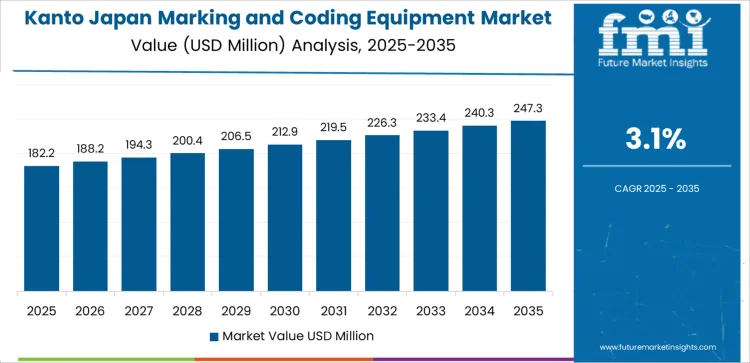
Kanto is experiencing rising demand for marking and coding equipment, with a 3.1% CAGR. The region’s industrial diversity and high urban density drive this demand, especially in sectors like retail, manufacturing, and food processing. As companies focus on improving production efficiency and meeting regulatory standards, marking and coding equipment becomes crucial for traceability, expiration dates, and branding. E-commerce growth is also playing a role, with increased need for labeling and packaging that ensures both product identification and compliance with safety standards.
Advancements in coding technology, such as high-speed inkjet systems and laser solutions, make adoption more accessible for businesses looking to automate their packaging processes. As demand for efficient packaging grows, the adoption of marking and coding systems in Kanto is expected to remain strong.
How is Demand for Marking and Coding Equipment Expanding in Kansai?
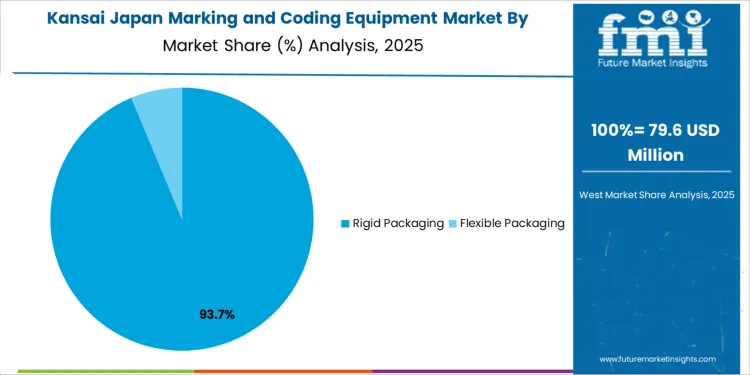
Kansai shows steady demand for marking and coding equipment, growing at a 2.7% CAGR. The region’s manufacturing base, especially in food production and consumer goods, continues to drive the need for advanced labeling and coding systems. As companies in Kansai focus on improving supply chain efficiency, they are increasingly adopting automated coding solutions to ensure product traceability and compliance.
The shift toward more sustainable and transparent packaging, alongside the need for high-quality, precise labeling, is also supporting growth in the marking and coding equipment industry. The adoption of new technologies, such as thermal inkjet and laser coding systems, is enhancing the accuracy and speed of production lines in Kansai. As regulatory requirements for traceability and safety continue to evolve, Kansai is expected to see steady growth in marking and coding system demand.
Why is Demand for Marking and Coding Equipment Growing in Chubu?
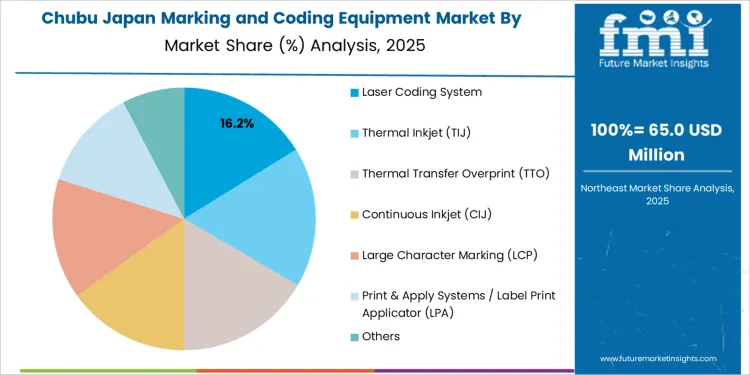
Chubu is seeing steady demand for marking and coding equipment, growing at a 2.4% CAGR. The region’s strong industrial presence, particularly in automotive, food processing, and manufacturing, drives the need for efficient and precise marking systems. As companies in Chubu adopt more automated and streamlined production processes, there is growing demand for marking and coding systems that improve speed, accuracy, and regulatory compliance.
The expansion of logistics and e-commerce businesses also plays a role in increasing the need for high-quality packaging with clear labeling and tracking codes. As businesses continue to modernize production lines and improve packaging quality, demand for marking and coding equipment is expected to grow steadily in Chubu, especially with advances in technology and automation systems.
How is Demand for Marking and Coding Equipment Expanding in Tohoku?
Tohoku is experiencing moderate growth in marking and coding equipment demand, with a 2.1% CAGR. While industrial activity in the region is smaller compared to urban areas, there is a steady rise in demand for automated marking and coding systems in industries such as agriculture, food processing, and small-scale manufacturing. As businesses modernize and adopt more efficient packaging practices, the need for coding systems that ensure traceability and freshness increases.
Local manufacturers are recognizing the benefits of automated systems for labeling, especially for food products that require batch coding, expiration dates, and product tracking. With increasing awareness of the importance of labeling in the food and beverage sector, demand for marking and coding equipment in Tohoku is expected to grow gradually, supported by the rise in food safety regulations and evolving consumer preferences.
Why is Demand for Marking and Coding Equipment Steady in the Rest of Japan?
The Rest of Japan is experiencing steady demand for marking and coding equipment, with a 2.0% CAGR. In rural areas and smaller cities, demand for automated marking and coding solutions is lower, yet growing as businesses increasingly adopt advanced technologies for product labeling and tracking. Industries such as agriculture, food processing, and consumer goods are seeing the benefits of using coding equipment to meet regulatory requirements and enhance product traceability.
The rise in e-commerce and logistics in smaller regions is also driving the adoption of coding systems for packaging and shipping. While adoption is slower compared to major urban centers, the Rest of Japan is expected to see gradual growth in demand for marking and coding equipment as awareness of food safety and quality control rises, and more businesses seek automation to improve efficiency and compliance.
What is Driving the Demand for Marking and Coding Equipment in Japan and Who Are the Key Players Shaping the Industry?
The demand for marking and coding equipment in Japan is increasing as industries such as manufacturing, food and beverage, pharmaceuticals, and logistics look for efficient, accurate, and reliable solutions for product identification and traceability. Marking and coding equipment is used to apply labels, barcodes, expiry dates, batch numbers, and other essential information to products, ensuring compliance with regulatory requirements and enhancing supply chain transparency. As Japan continues to prioritize quality control, traceability, and operational efficiency, marking and coding technologies are critical for businesses seeking to optimize their production processes and ensure the integrity of their products in the industry.
Key players shaping the marking and coding equipment industry in Japan include Hitachi Industrial Equipment & Solutions America, LLC, Videojet Technologies, Inc., Markem-Imaje Corporation, Domino Printing Sciences plc, and Squid Ink Manufacturing Inc. Hitachi Industrial Equipment & Solutions America, LLC leads the industry with a significant share of 40.0%, offering a wide range of marking and coding solutions for various industries. These companies provide advanced equipment that enhances productivity, improves accuracy, and reduces operational costs. They focus on delivering innovative, high-performance systems that cater to Japan’s demanding industrial and regulatory environment.
The growth of the marking and coding equipment industry in Japan is supported by increasing regulatory requirements and the need for efficient product tracking across supply chains. As consumer demand for transparency and high-quality standards continues to rise, the need for reliable marking and coding solutions is expected to expand. With ongoing advancements in technology and a continued focus on automation, the marking and coding equipment industry in Japan is poised for further growth, providing critical tools for the manufacturing and logistics sectors.
Key Players in Japan Marking and Coding Equipment Demand
- Hitachi Industrial Equipment & Solutions America, LLC
- Videojet Technologies, Inc.
- Markem-Imaje Corporation
- Domino Printing Sciences plc
- Squid Ink Manufacturing Inc
Scope of Report
| Items | Values |
|---|---|
| Quantitative Units (2025) | USD million |
| Application | Rigid Packaging, Flexible Packaging |
| Technology | Laser Coding System, Thermal Inkjet (TIJ), Thermal Transfer Overprint (TTO), Continuous Inkjet (CIJ), Large Character Marking (LCP), Print & Apply Systems (LPA), Others |
| Region | Kyushu & Okinawa, Kanto, Kansai, Chubu, Tohoku, Rest of Japan |
| Countries Covered | Japan |
| Key Companies Profiled | Hitachi Industrial Equipment & Solutions America, LLC, Videojet Technologies, Inc., Markem-Imaje Corporation, Domino Printing Sciences plc, Squid Ink Manufacturing Inc |
| Additional Attributes | Dollar sales by technology and application; regional CAGR and growth outlook; increasing adoption of advanced coding systems like laser and inkjet; demand driven by food and beverage packaging, consumer goods, and pharmaceutical industries. |
Japan Marking and Coding Equipment Demand by Key Segments
Application
- Rigid Packaging
- Flexible Packaging
Technology
- Laser Coding System
- Thermal Inkjet (TIJ)
- Thermal Transfer Overprint (TTO)
- Continuous Inkjet (CIJ)
- Large Character Marking (LCP)
- Print & Apply Systems / Label Print Applicator (LPA)
- Others
Region
- Kyushu & Okinawa
- Kanto
- Kansai
- Chubu
- Tohoku
- Rest of Japan
Frequently Asked Questions
How big is the demand for marking and coding equipment in Japan in 2025?
The demand for marking and coding equipment in Japan is estimated to be valued at USD 405.1 million in 2025.
What will be the size of marking and coding equipment in Japan in 2035?
The market size for the marking and coding equipment in Japan is projected to reach USD 528.7 million by 2035.
How much will be the demand for marking and coding equipment in Japan growth between 2025 and 2035?
The demand for marking and coding equipment in Japan is expected to grow at a 2.7% CAGR between 2025 and 2035.
What are the key product types in the marking and coding equipment in Japan?
The key product types in marking and coding equipment in Japan are rigid packaging and flexible packaging.
Which technology segment is expected to contribute significant share in the marking and coding equipment in Japan in 2025?
In terms of technology, laser coding system segment is expected to command 15.5% share in the marking and coding equipment in Japan in 2025.
Preview the report firsthand - request a free sample
Get SampleGet the brochure for pricing and purchase details.
Get PDFTable of Content
- Executive Summary
- Japan Market Outlook
- Demand-side Trends
- Supply-side Trends
- Technology Roadmap Analysis
- Analysis and Recommendations
- Market Overview
- Market Coverage / Taxonomy
- Market Definition / Scope / Limitations
- Market Background
- Market Dynamics
- Drivers
- Restraints
- Opportunity
- Trends
- Scenario Forecast
- Demand in Optimistic Scenario
- Demand in Likely Scenario
- Demand in Conservative Scenario
- Opportunity Map Analysis
- Product Life Cycle Analysis
- Supply Chain Analysis
- Investment Feasibility Matrix
- Value Chain Analysis
- PESTLE and Porter’s Analysis
- Regulatory Landscape
- Regional Parent Market Outlook
- Production and Consumption Statistics
- Import and Export Statistics
- Market Dynamics
- Japan Market Analysis 2020 to 2024 and Forecast, 2025 to 2035
- Historical Market Size Value (USD Million) Analysis, 2020 to 2024
- Current and Future Market Size Value (USD Million) Projections, 2025 to 2035
- Y-o-Y Growth Trend Analysis
- Absolute $ Opportunity Analysis
- Japan Market Pricing Analysis 2020 to 2024 and Forecast 2025 to 2035
- Japan Market Analysis 2020 to 2024 and Forecast 2025 to 2035, By Application
- Introduction / Key Findings
- Historical Market Size Value (USD Million) Analysis By Application , 2020 to 2024
- Current and Future Market Size Value (USD Million) Analysis and Forecast By Application , 2025 to 2035
- Rigid Packaging
- Flexible Packaging
- Y-o-Y Growth Trend Analysis By Application , 2020 to 2024
- Absolute $ Opportunity Analysis By Application , 2025 to 2035
- Japan Market Analysis 2020 to 2024 and Forecast 2025 to 2035, By Technology
- Introduction / Key Findings
- Historical Market Size Value (USD Million) Analysis By Technology, 2020 to 2024
- Current and Future Market Size Value (USD Million) Analysis and Forecast By Technology, 2025 to 2035
- Laser Coding System
- Thermal Inkjet (TIJ)
- Thermal Transfer Overprint (TTO)
- Continuous Inkjet (CIJ)
- Large Character Marking (LCP)
- Print & Apply Systems / Label Print Applicator (LPA)
- Others
- Y-o-Y Growth Trend Analysis By Technology, 2020 to 2024
- Absolute $ Opportunity Analysis By Technology, 2025 to 2035
- Market Structure Analysis
- Competition Dashboard
- Competition Benchmarking
- Market Share Analysis of Top Players
- By Regional
- By Application
- By Technology
- Competition Analysis
- Competition Deep Dive
- Hitachi Industrial Equipment & Solutions America, LLC
- Overview
- Product Portfolio
- Profitability by Market Segments (Product/Age /Sales Channel/Region)
- Sales Footprint
- Strategy Overview
- Marketing Strategy
- Product Strategy
- Channel Strategy
- Videojet Technologies, Inc.
- Markem-Imaje Corporation
- Domino Printing Sciences plc
- Squid Ink Manufacturing Inc
- Hitachi Industrial Equipment & Solutions America, LLC
- Competition Deep Dive
- Assumptions & Acronyms Used
- Research Methodology


