

- Industry Size (2026)
- USD 2.0 Bn
- Forecast (2036)
- USD 4.4 Bn
- CAGR (2026 to 2036)
- 8.2%
Demand for Atomic Layer Deposition Equipment in USA 2026 to 2036
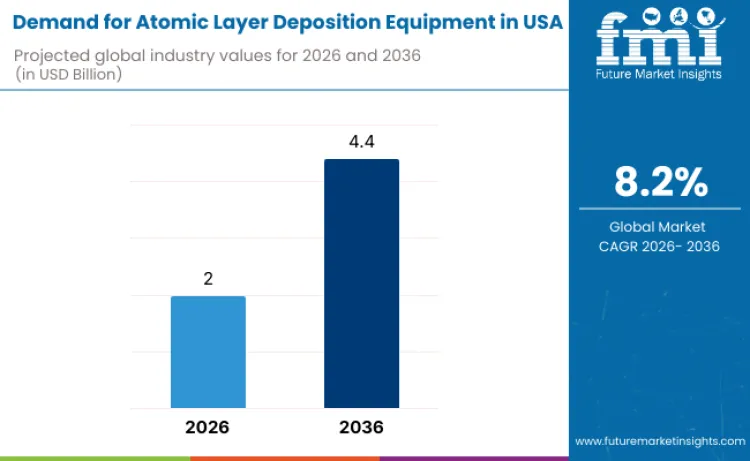
Demand for atomic layer deposition equipment in USA is valued at USD 2.0 billion in 2026 and is projected to reach USD 4.4 billion by 2036, reflecting a CAGR of 8.2%. Demand expands through sustained investment in semiconductor innovation, advanced materials research, and scaling of next-generation device architectures. Need for atomic-scale film control, conformality on complex geometries, and process repeatability supports continued equipment adoption.
Research and development facilities lead application-segment usage because ALD enables precise thickness control, uniform coatings, and rapid process iteration for emerging materials and device concepts. R&D users apply ALD systems in logic, memory, power electronics, and advanced packaging development. Capability to support low-temperature processes, novel precursors, and experimental stacks strengthens suitability for laboratory and pilot-scale environments.
West USA, South USA, Northeast USA, and Midwest USA represent key growth regions due to concentration of semiconductor fabs, national laboratories, and university-led research centers. Applied Materials, Lam Research, ASM International, Tokyo Electron America, and Kokusai Electric anchor competitive activity through advanced tool platforms, process engineering expertise, and service infrastructure aligned with evolving USA semiconductor technology roadmaps and manufacturing requirements.
Quick Stats for Demand for Atomic Layer Deposition Equipment in USA
- USA Atomic Layer Deposition Equipment Sales Value (2026): USD 2.0 billion
- USA Atomic Layer Deposition Equipment Forecast Value (2036): USD 4.4 billion
- USA Atomic Layer Deposition Equipment Forecast CAGR (2026 to 2036): 8.2%
- Leading Application Segment in USA: Research and Development Facilities
- Key Growth Regions in USA: West USA, South USA, Northeast USA, Midwest USA
- Top Players in USA: Applied Materials, Lam Research, ASM International, Tokyo Electron America, Kokusai Electric
USA Atomic Layer Deposition Equipment Key Takeaways
| Metric | Value |
|---|---|
| USA Atomic Layer Deposition Equipment Sales Value (2026) | USD 2.0 billion |
| USA Atomic Layer Deposition Equipment Forecast Value (2036) | USD 4.4 billion |
| USA Atomic Layer Deposition Equipment Forecast CAGR (2026 to 2036) | 8.2% |
How Are the Segments Classified in the Demand for Atomic Layer Deposition Equipment in USA?
Demand for atomic layer deposition equipment in USA is shaped by advanced materials research, semiconductor scaling requirements, and need for atomic-level film precision. Buyers evaluate thickness uniformity, conformality on complex structures, and repeatable process control under controlled environments. Adoption patterns reflect strong concentration in research-driven institutions, with gradual transition into electronics, energy devices, and medical manufacturing aligned with USA process validation and quality standards.
By Application, Do Research and Development Facilities Hold the Largest Share of Demand in USA?
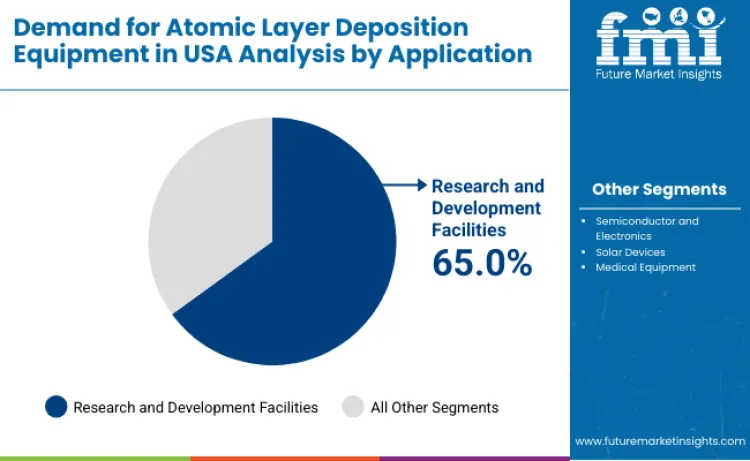
Research and development facilities hold 65.0%, making them the leading application segment in USA. Universities, national laboratories, and corporate research centers rely on ALD systems for materials discovery, prototype fabrication, and process characterization. These environments require flexible tools supporting diverse precursors, substrates, and experimental conditions. Semiconductor and electronics applications hold 15.0%, applying ALD for dielectric layers, passivation films, and advanced node research. Solar devices account for 12.0%, using ALD to improve interface stability and thin-film performance. Medical equipment holds 8.0%, supporting surface modification and biocompatible coating development. Application distribution reflects research-led adoption preceding broader industrial scaling.
Key Points
- Research facilities dominate due to intensive materials experimentation.
- Flexible ALD tools support multi-parameter experimental workflows.
- Industrial usage follows validation achieved in research environments.
By Product, Does Aluminum Oxide ALD Account for the Largest Share of Demand in USA?
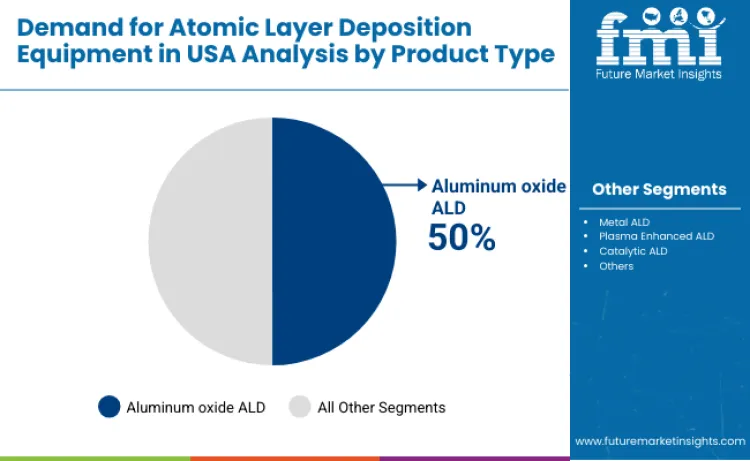
Aluminum oxide ALD holds 50.0%, making it the leading product segment in USA demand. Aluminum oxide films offer strong dielectric performance, chemical stability, and effective moisture barrier properties. These attributes support widespread use across research, semiconductor development, and protective coating applications. Metal ALD holds 20.0%, enabling deposition of conductive and catalytic layers for functional surfaces. Catalytic ALD accounts for 12.5%, supporting reaction-driven film growth processes. Plasma enhanced ALD holds 10.5%, enabling lower-temperature processing and improved film quality. Other products hold 7.0%, serving specialized material requirements. Product distribution reflects reliance on aluminum oxide due to versatility and process stability.
Key Points
- Aluminum oxide ALD leads due to dielectric and barrier properties.
- Metal ALD supports conductive and catalytic layer formation.
- Plasma enhanced systems address temperature-sensitive substrates.
What are the Key Dynamics in the Atomic Layer Deposition Equipment Industry in USA?
Demand increases as semiconductor manufacturers, advanced materials developers, and R&D centers in USA adopt atomic layer deposition (ALD) equipment to meet stringent film thickness control, conformity, and defect density requirements. Usage aligns with domestic investment in logic, memory, and specialty device segments, as well as materials research for sensors and power electronics. Adoption remains concentrated in high-technology clusters with established semiconductor fabrication and innovation ecosystems.
How do semiconductor scale and advanced materials research drive demand in USA?
USA semiconductor firms and foundries require ALD equipment to deposit ultra-thin films for high-k dielectrics, metal gates, and barrier layers critical to device performance and yield at advanced process nodes. Device miniaturization continues to push demand for sub-nanometer control and uniformity across complex 3D structures. Power electronics and RF components leverage ALD for conformal coatings on wide-bandgap substrates. National research institutions and corporate R&D labs use ALD platforms to explore novel materials and device architectures. Policies encouraging domestic semiconductor capacity expansion support capital investment in precision deposition tools. Proximity to design houses and test facilities strengthens utilization of advanced ALD systems within USA technology hubs.
How do capital costs, supply chain constraints, and integration complexity influence demand stability in USA?
ALD equipment involves significant capital expenditure, restricting purchases to large manufacturers and well-funded research facilities. Buyers require extended evaluation and qualification cycles to ensure integration with existing process flows without compromising uptime. Supply chain constraints for critical components such as high-purity precursors and precision control modules affect delivery schedules. Skilled engineers are necessary to install, tune, and maintain ALD systems, creating workforce planning challenges. Compatibility with cleanroom standards and Fab infrastructure influences installation lead times and facility modifications. Demand remains resilient where advanced manufacturing and materials research justify investment, while broader adoption depends on cost control, reliable supply chains, and continued innovation in deposition technology tailored to USA industry requirements.
How Is Demand for Atomic Layer Deposition Equipment in USA Evolving by Region?
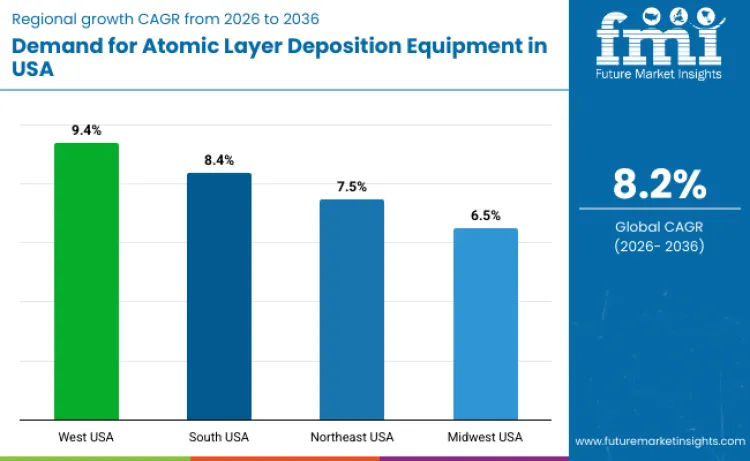
Demand for atomic layer deposition equipment in the USA is rising due to advanced semiconductor manufacturing, materials innovation, and need for precise thin-film control. West USA leads with a 9.4% CAGR, supported by leading-edge fabs and equipment development ecosystems. South USA follows at 8.4%, driven by capacity expansion, new fabrication facilities, and supplier localization. Northeast USA records a 7.5% CAGR, shaped by research-intensive device development and pilot manufacturing. Midwest USA posts 6.5%, reflecting power electronics, automotive semiconductors, and industrial applications. Regional variation reflects fabrication scale, research intensity, capital investment cycles, and alignment with federal manufacturing incentives across the USA.
| Region | CAGR (2026 to 2036) |
|---|---|
| West USA | 9.4% |
| South USA | 8.4% |
| Northeast USA | 7.5% |
| Midwest USA | 6.5% |
How is West USA driving demand for Atomic Layer Deposition Equipment in the USA?
West USA drives demand through concentration of advanced semiconductor fabs, equipment vendors, and process development centers. Region’s CAGR of 9.4% reflects extensive use of atomic layer deposition equipment for leading-edge logic, memory, and advanced packaging applications. Manufacturers rely on ALD to achieve conformal, ultra-thin films for gate stacks, interconnects, and barrier layers. Facilities prioritize throughput, process uniformity, and defect control to support high-volume manufacturing. Close collaboration between fabs and equipment suppliers accelerates qualification and deployment. Demand favors high-capacity systems integrated with advanced metrology and automation. Growth remains technology-node driven and capital-expenditure intensive.
- Leading-edge semiconductor fabrication demand
- Advanced node and packaging applications
- Close fab and equipment supplier collaboration
- High-throughput and automated ALD systems
How is South USA driving demand for Atomic Layer Deposition Equipment in the USA?
South USA demand is shaped by new fab construction, capacity expansion, and localization of semiconductor supply chains. Region’s CAGR of 8.4% reflects deployment of ALD equipment in newly established and expanding manufacturing sites. Operators focus on proven, scalable ALD platforms that support rapid ramp-up and stable yields. Investments align with federal and state incentives promoting domestic semiconductor manufacturing. Facilities emphasize equipment reliability, service availability, and long-term supplier support. Demand favors standardized configurations suitable for volume production rather than experimental flexibility. Growth remains capacity-led, tied to greenfield projects and expansion of mature process nodes.
- New fab construction and expansion activity
- Incentive-supported domestic manufacturing
- Focus on reliability and scalability
- Volume production-oriented ALD platforms
How is Northeast USA driving demand for Atomic Layer Deposition Equipment in the USA?
Northeast USA demand is driven by research institutions, device innovators, and pilot-scale manufacturing facilities. Region’s CAGR of 7.5% reflects extensive use of ALD equipment for process development, materials research, and next-generation device architectures. Universities and corporate labs apply ALD to explore novel materials, 3D structures, and advanced transistor concepts. Demand emphasizes precision, flexibility, and integration with characterization tools. Procurement aligns with research funding cycles and collaborative programs. Growth remains research-led, supporting technology validation and early manufacturing readiness rather than large-scale production.
- Research and pilot manufacturing usage
- Advanced materials and device development
- High-precision and flexible ALD systems
- Funding-driven equipment procurement
How is Midwest USA driving demand for Atomic Layer Deposition Equipment in the USA?
Midwest USA demand reflects power electronics, automotive semiconductors, and industrial device manufacturing. Region’s CAGR of 6.5% is supported by use of ALD equipment for wide-bandgap semiconductors, sensors, and reliability-critical components. Manufacturers prioritize film uniformity, durability, and process stability over extreme miniaturization. Equipment investments align with long-term manufacturing optimization and quality assurance programs. Demand favors robust systems compatible with existing production environments. Growth remains steady and application-focused, linked to automotive electrification and industrial electronics requirements.
- Power and automotive semiconductor applications
- Emphasis on durability and reliability
- Integration with existing production lines
- Application-driven and steady adoption
What is the competitive landscape of demand for atomic layer deposition equipment in the USA?
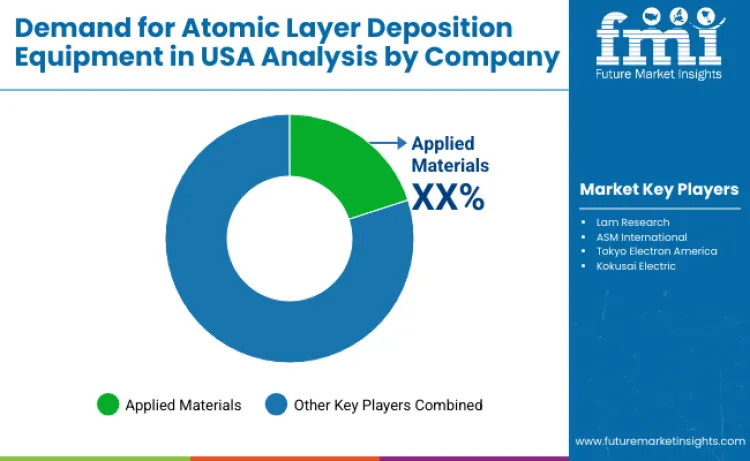
Demand for atomic layer deposition equipment in the USA is driven by semiconductor fabrication, advanced packaging, memory device production, and research in nanostructured materials. Usage spans conformal dielectric films, high-k/metal gate stacks, passivation layers, and precision coatings required for leading-edge logic, DRAM, and 3D NAND production. Buyers evaluate deposition uniformity, cycle throughput, precursor delivery precision, and integration with existing fab process flows. Procurement teams prioritize suppliers with strong local service networks, rapid parts availability, and tools that meet USA semiconductor reliability and yield targets. Trend in the USA market reflects sustained investment in domestic fabs, collaborative R&D between equipment makers and materials partners, and growing demand for tools capable of atomic-level thickness control in high-volume manufacturing.
Applied Materials maintains a strong presence in the USA through extensive deployment of atomic layer deposition systems supported by domestic service infrastructure and deep integration with USA logic and memory fabs. Lam Research participates with ALD tools designed for high-k dielectrics and gap-fill applications used by major USA manufacturers. ASM International supports demand with ALD platforms engineered for precision thin films and process repeatability. Tokyo Electron America operates through USA offices and service facilities supplying ALD systems adapted for local semiconductor customer requirements. Kokusai Electric USA contributes specialized deposition solutions used in production and R&D environments emphasizing conformity and stability. Competitive positioning in the USA reflects deposition performance, tool reliability, local support capability, and partnership depth with key semiconductor fabs and research organizations.
Key Players in USA Atomic Layer Deposition Equipment Industry
- Applied Materials
- Lam Research
- ASM International
- Tokyo Electron America
- Kokusai Electric
Scope of the Report
| Items | Details |
|---|---|
| Quantitative Units | USD billion |
| Application | Research and Development Facilities; Semiconductor and Electronics; Solar Devices; Medical Equipment |
| Product | Aluminum Oxide ALD; Metal ALD; Plasma Enhanced ALD; Catalytic ALD; Others |
| Regions Covered | West USA; South USA; Northeast USA; Midwest USA |
| Key Companies Profiled | Applied Materials; Lam Research; ASM International; Tokyo Electron America; Kokusai Electric |
| Additional Attributes | Demand is driven by advanced semiconductor node scaling, rising R&D expenditure, and increased adoption of precision thin-film deposition. Semiconductor fabrication leads installations, while medical devices and solar applications support incremental demand. Plasma-enhanced and metal ALD systems gain preference due to superior conformity and process control. |
USA Atomic Layer Deposition Equipment Demand by Segments
By Application:
- Research and Development Facilities
- Semiconductor and Electronics
- Solar Devices
- Medical Equipment
By Product:
- Aluminum Oxide ALD
- Metal ALD
- Plasma Enhanced ALD
- Catalytic ALD
- Others
By Region:
- West USA
- South USA
- Northeast USA
- Midwest USA
Frequently Asked Questions
How big is the demand for atomic layer deposition equipment in USA in 2026?
The demand for atomic layer deposition equipment in USA is estimated to be valued at USD 2.0 billion in 2026.
What will be the size of atomic layer deposition equipment demand in USA in 2036?
The demand size for atomic layer deposition equipment in USA is projected to reach USD 4.4 billion by 2036.
How much will the demand for atomic layer deposition equipment in USA grow between 2026 and 2036?
The demand for atomic layer deposition equipment in USA is expected to grow at an 8.2% CAGR between 2026 and 2036.
What are the key applications in the atomic layer deposition equipment demand in USA?
The key applications in atomic layer deposition equipment demand in USA include research and development facilities, semiconductor manufacturing, and advanced materials processing.
Which product segment is expected to contribute a significant share in the atomic layer deposition equipment demand in USA in 2026?
In terms of product, aluminum oxide ALD systems are expected to command 50.0% share in the atomic layer deposition equipment demand in USA in 2026.
Preview the report firsthand - request a free sample
Get SampleGet the brochure for pricing and purchase details.
Get PDFTable of Content
- Executive Summary
- USA Market Outlook
- Demand Side Trends
- Supply Side Trends
- Semiconductor and Advanced Materials Context
- Analysis and Recommendations
- Market Overview
- Market Coverage and Taxonomy
- Market Definition Scope and Limitations
- Market Background
- Market Dynamics
- Drivers
- Restraints
- Opportunities
- Trends
- Scenario Forecast
- Demand in Optimistic Scenario
- Demand in Likely Scenario
- Demand in Conservative Scenario
- Opportunity Map Analysis
- Technology Life Cycle Analysis
- Semiconductor Equipment Value Chain Analysis
- Investment Feasibility Matrix
- PESTLE and Porter Analysis
- Process Technology and Compliance Framework
- Regional Parent Market Outlook
- USA Atomic Layer Deposition Equipment Demand Analysis 2021 to 2025 and Forecast 2026 to 2036
- Historical Demand Value USD Billion Analysis 2021 to 2025
- Current and Future Demand Value USD Billion Projections 2026 to 2036
- Year on Year Growth Trend Analysis
- Absolute Dollar Opportunity Analysis
- USA Atomic Layer Deposition Equipment Pricing Analysis 2021 to 2025 and Forecast 2026 to 2036
- USA Atomic Layer Deposition Equipment Demand Analysis 2021 to 2025 and Forecast 2026 to 2036 By Application
- Introduction and Key Findings
- Historical Demand Value USD Billion Analysis by Application 2021 to 2025
- Current and Future Demand Value USD Billion Analysis and Forecast by Application 2026 to 2036
- Research and Development Facilities
- Semiconductor and Electronics
- Solar Devices
- Medical Equipment
- Year on Year Growth Trend Analysis by Application
- Absolute Dollar Opportunity Analysis by Application
- USA Atomic Layer Deposition Equipment Demand Analysis 2021 to 2025 and Forecast 2026 to 2036 By Product
- Introduction and Key Findings
- Historical Demand Value USD Billion Analysis by Product 2021 to 2025
- Current and Future Demand Value USD Billion Analysis and Forecast by Product 2026 to 2036
- Aluminum Oxide ALD
- Metal ALD
- Plasma Enhanced ALD
- Catalytic ALD
- Others
- Year on Year Growth Trend Analysis by Product
- Absolute Dollar Opportunity Analysis by Product
- USA Atomic Layer Deposition Equipment Demand Analysis 2021 to 2025 and Forecast 2026 to 2036 By Region
- West USA
- South USA
- Northeast USA
- Midwest USA
- Market Structure Analysis
- Competition Dashboard
- Competition Benchmarking
- Market Share Analysis of Key Players
- By Application
- By Product
- By Region
- Competition Analysis
- Competition Deep Dive
- Applied Materials
- Lam Research
- ASM International
- Tokyo Electron America
- Kokusai Electric
- Assumptions and Acronyms Used
- Research Methodology


