

- CAGR (2025 to 2035)
- 18.2%
ASEAN Carbon Capture and Storage Market Size and Share Forecast Outlook From 2025 to 2035
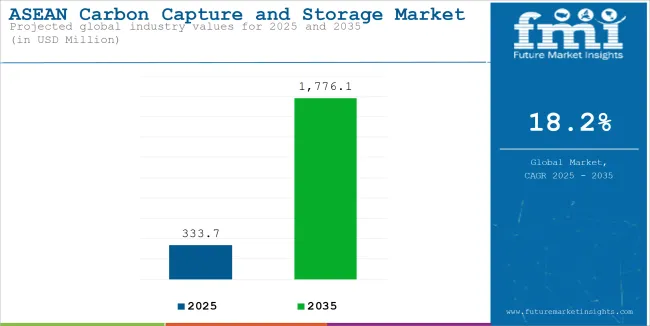
The ASEAN CCS market size is likely to reach USD 1,776.1 million by 2035 and would see a CAGR of 18.2% from 2025 to 2035, primarily because of the implementation of policies and frameworks like APAEC in the region along with rising private investment, coupled with large-scale CCS projects being implemented in Malaysia, including the Kasawari CCS Project.
As the region intensifies its focus on industrial decarbonization and energy transition, CCS technologies are becoming indispensable in meeting climate targets.The region’s significant reliance on fossil fuels, coupled with the need to decarbonize energy-intensive industries, further underscores the importance of CCS in ASEAN’s sustainability strategy.
| Attribute | Details |
|---|---|
| Anticipated Forecast Value (2035) | USD 1,776.1 Million |
| Value CAGR (2025 to 2035) | 18.2% |
ASEAN Carbon Capture and Storage Market Introduction
ASEAN Carbon Capture and Storage Market ASEAN is slowly turning into one of the emerging regions for carbon capture and storage technology. As commitments to net-zero emissions and international climate agreements like the Paris Agreement become increasingly important, many countries such as Indonesia, Malaysia, Vietnam, and Thailand are now initiating and promoting initiatives integrating CCS technologies in industrial operations, power generation, and oil and gas.
The region's extensive natural resources, including coastal and onshore geological conditions, offer great potential storage of CO₂. In addition, investments in regional CCS projects coupled with the co-operation of technological providers across the globe have positioned ASEAN as a critically important venue to promote sustainable carbon management solutions.
Top ASEAN Carbon Capture and Storage Market Dynamics and Industry Trends
Focus on Industrial Decarbonization
- ASEAN countries are heavily investing in CCS to reduce emissions in hard-to-abate industries, such as cement, steel, and chemicals. Cement manufacturing, a significant contributor to regional emissions, is increasingly integrating CCS to capture process emissions.
- The case of Indonesia demonstrates that the nation's largest cement manufacturers are running CCS systems toward the achievement of the government's carbon neutrality road map.
Shift in Oil and Gas Sector
- The oil and gas industry are the pioneers for the adoption of CCS in the ASEAN. Natural gas processing facilities and LNG plants are leveraging CCS to capture emissions during production. Malaysia, home to the Kasawari CCS Project, is expected to store up to 3.3 million tons of CO₂ annually in depleted offshore reservoirs.
- Pertamina in Indonesia is similarly investing in CCS to decarbonize its upstream and downstream operations.
Offshore Storage Development
- ASEAN’s abundant offshore reservoirs, particularly in Malaysia, Indonesia, and Brunei, are key to CCS deployment. These reservoirs are being repurposed as CO₂ storage sites, with several projects already underway.
- Collaborative efforts with technology providers like TotalEnergies and ExxonMobil are accelerating storage infrastructure development.
Policy and Regulatory Support
- Governments in ASEAN are introducing regulatory frameworks and incentives to attract CCS investments. National Energy Policy 2022 to 2040 by Malaysia, and Indonesia Carbon Neutral Road map are some policies that provide the public with an insight into the target of reduced emission and storage requirement.
International Partnerships
- ASEAN nations are cooperating with international technology firms and research centers to build expertise in CCS operations.
Top Segments Studied in the ASEAN Carbon Capture and Storage Market Report
By Technology
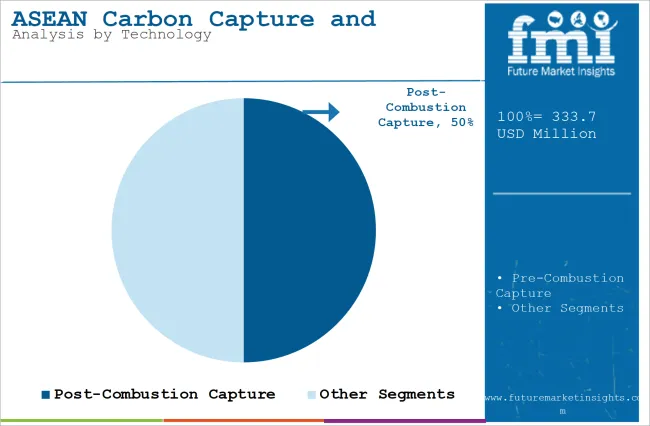
- Post-Combustion Capture (50% Share): Predominantly used for retrofitting existing power plants and industrial facilities. Widely adopted due to its ability to integrate seamlessly with existing infrastructure.
- Pre-Combustion Capture (9.0% CAGR): Increasingly used in gasification plants and hydrogen production, particularly in Indonesia and Malaysia.
By End Use
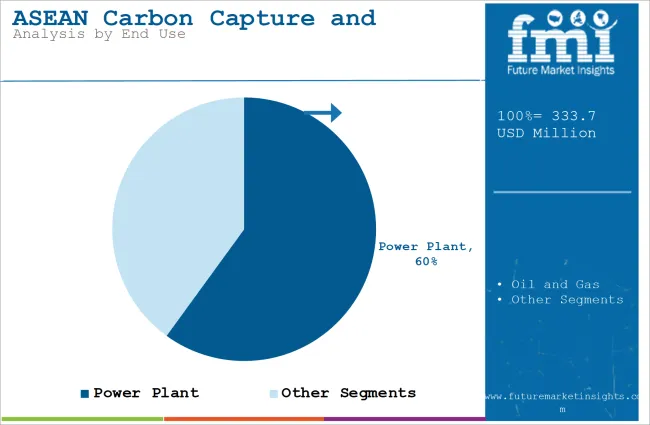
- Power Plant (30% Share): Coal and natural gas plants are piloting CCS technologies to reduce emissions while maintaining energy reliability.
- Oil and Gas (25% Share): The oil and gas sector is leveraging CCS to decarbonize natural gas processing and LNG production.
Industry-Wide Growth and Trends in ASEAN Carbon Capture and Storage Market
| Industry | Power Plant |
|---|---|
| CAGR (2025 to 2035) | 8.2% |
| Key Trends | Retrofitting coal and gas plants with CCS technology. |
| Industry | Oil and Gas |
|---|---|
| CAGR (2025 to 2035) | 8.5% |
| Key Trends | CCS integration into natural gas and LNG operations. |
The industrial and oil and gas sectors dominate CCS adoption, driven by significant emissions reduction goals and international climate commitments.
Key ASEAN Carbon Capture and Storage Market Players and Concentration
ASEAN CCS Market: a combination of international leaders, regional innovators and collaborative initiatives in the quest for growth.
Established Players
- International leaders like ExxonMobil, Shell, and TotalEnergies continue to lead this market with CCS innovation and experience in ocean environments. These parties are key partners for ASEAN's largest CCS projects.
Regional Innovators
- In ASEAN, Malaysian Petronas and Indonesian Pertamina lead the integration of CCS into their domestic energy and industrial operations.
Research and Academia
- Regional universities and research institutions, often in partnership with international organizations, are advancing innovation in CO₂ capture and storage techniques.
Industry Updates in ASEAN Carbon Capture and Storage Market
| Date | Key Development |
|---|---|
| February 2025 | Petronas launched the Kasawari CCS Project, the largest CCS initiative in Southeast Asia. |
| May 2025 | Indonesia signed a CCS collaboration agreement with ExxonMobil to explore offshore storage. |
| July 2025 | Vietnam initiated its first CCS pilot project in a coal-fired power plant. |
| October 2025 | TotalEnergies announced plans for a CCS hub in Malaysia, partnering with local firms. |
Future Outlook for ASEAN Carbon Capture and Storage Market
The ASEAN CCS market is poised for robust growth, driven by increasing decarbonization commitments, international collaboration, and advancements in storage technologies. Key factors shaping the future include:
Offshore Storage Expansion
- ASEAN countries, particularly Malaysia and Indonesia, will focus on developing offshore storage hubs to leverage their vast geological formations.
CCS in LNG and Natural Gas
- The oil and gas sector will continue to integrate CCS technologies to decarbonize LNG operations, enhancing the region’s competitiveness in the global energy market.
Advancements in Direct Air Capture (DAC)
- While still in its infancy, DAC is expected to gain momentum as ASEAN countries invest in long-term negative emissions solutions.
Strengthened Policy Frameworks
- Governments across ASEAN will enhance regulatory clarity and offer incentives to attract foreign investments and encourage domestic innovation.
Regional CCS Collaboration
- Cross-border initiatives, such as CO₂ transportation agreements, will accelerate CCS adoption and create a more integrated approach to emissions reduction.
ASEAN Carbon Capture and Storage Market Share Analysis Segmentation
By Technology:
- Post-Combustion Capture
- Pre-Combustion Capture
By End Use:
- Power Plant
- Oil and Gas
Frequently Asked Questions
What is the projected size of the ASEAN CCS market by 2035?
The market is expected to reach USD 1,776.1 million, growing at a CAGR of 18.2%.
Which sectors are driving CCS adoption in ASEAN?
The industrial sector, power generation, and oil and gas industries are the primary drivers of CCS adoption.
What distinguishes the ASEAN CCS market?
The ASEAN market stands out for its abundant offshore storage capacity, government support, and strong international collaborations.
Who are the key players in the ASEAN CCS market?
Key players include ExxonMobil, Shell, TotalEnergies, Petronas, and Pertamina, along with regional universities and research institutions.
Preview the report firsthand - request a free sample
Get SampleGet the brochure for pricing and purchase details.
Get PDFTable of Content
- Introduction
- Market Outlook
- Key Trends
- Segment Analysis
- Industry-Wise Growth and Trends
- Market Concentration
- Industry Updates
- Future Outlook
- Frequently Asked Questions (FAQs)


