

- Industry Size (2026)
- USD 2.9 Bn
- Forecast (2036)
- USD 4.8 Bn
- CAGR (2026 to 2036)
- 5.1%
Global Gas Leak Detectors Market Forecast and Outlook By FMI
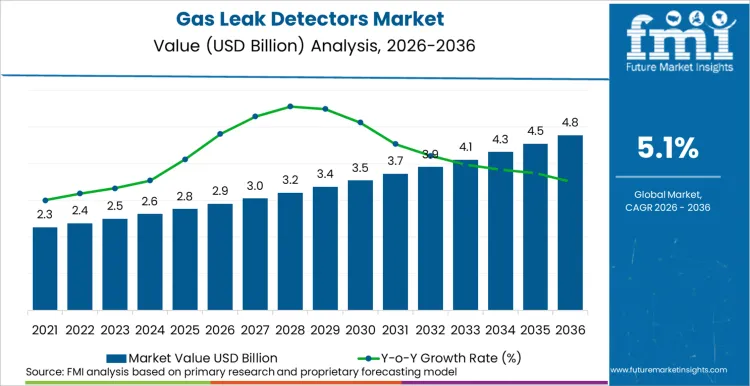
The global gas leak detectors market is valued at USD 2.9 billion in 2026 and is projected to reach USD 4.8 billion by 2036, expanding at a 5.1% CAGR. Growth is execution led in oil and gas, chemicals, utilities, mining, and process manufacturing where operators harden risk controls around combustible, toxic, and oxygen deficiency hazards. Procurement tilts toward systems that can be certified for explosive atmospheres and integrated into safety workflows, not standalone devices.
Certification and compliance continue to shape platform decisions in hazardous locations. The ATEX equipment directive governs equipment intended for use in potentially explosive atmospheres in the EU, pushing suppliers toward documented conformity, markings, and controlled product configurations that scale across sites. IECEx certification pathways reinforce the same direction for global operators standardising procurement across regions. In the United States, OSHA confined space interpretation guidance reinforces an operating requirement to test atmospheres for oxygen, flammables, and toxic contaminants in a defined order, supporting repeatable device deployment in entry programs.
Summary of Global Gas Leak Detectors Market
- The global gas leak detectors market comprises fixed and portable instruments and connected monitoring systems used to detect combustible gases, toxic gases, and oxygen deficiency in industrial and commercial environments, including devices integrated into plant safety systems and worker worn programs.
- The defined scope is structured under FMI taxonomy across product type, technology type, end use industry, and region, capturing new installations, replacements, and connected safety upgrades, while excluding residential only alarms and unrelated environmental monitoring equipment not designed for industrial safety use.
- The global gas leak detectors market is projected to grow at a CAGR of 5.1% from 2026 to 2036, expanding from USD 2.9 billion in 2026 to USD 4.8 billion by 2036, based on FMI proprietary modeling anchored to hazardous area compliance, connected worker deployments, and brownfield retrofit cycles in process industries.
- Fixed gas detectors lead in high consequence facilities where continuous monitoring is required and where ATEX and IECEx certification needs influence standardisation of installed detection architectures.
- Portable and confined space programs remain a repeatable demand engine because OSHA aligned entry practices require atmospheric testing and verification that scales across utilities, energy, and industrial maintenance teams.
- Connected platforms are gaining share because buyers want fleet level visibility, faster bump and calibration workflows, and remote monitoring features increasingly positioned in supplier portfolios.
Supplier actions signal a shift from instrument sales to managed detection. Honeywell’s BW Ultra positioning is explicitly tied to confined space sampling and monitoring and highlights connectivity and remote monitoring as part of the value proposition. Industrial Scientific’s public partnership disclosures show large industrial operators adopting connected safety programs to improve visibility and management of worker exposures. In parallel, major safety suppliers frame demand as resilient, service supported industrial spend. MSA’s CEO Nish Vartanian stated, “Our record first quarter results reflect broad based strength across our end markets,” consistent with replacement and upgrade demand in detection and adjacent safety categories.
Global Gas Leak Detectors Market Key Takeaways
| Metric | Value (USD Billion) |
|---|---|
| Market Size (2026) | 2.9 |
| Forecast Value (2036) | 4.8 |
| CAGR (2026 to 2036) | 5.1% |
What is driving growth in the global gas leak detectors market?
Growth is driven by enforcement linked operating practices and hazardous area certification needs that convert directly into equipment replacement and upgrade cycles. OSHA confined space interpretation guidance reinforces atmospheric testing expectations for oxygen, flammables, and toxic contaminants, expanding demand for portable multi gas devices and documented entry workflows across industrial maintenance and utilities. In Europe, ATEX conformity requirements for equipment in potentially explosive atmospheres push suppliers and operators toward certified, standardised detector configurations that can be deployed across multiple facilities with consistent documentation. Supplier roadmaps reinforce connected monitoring and device management as spend priorities, with Honeywell positioning BW Ultra around confined space sampling plus remote monitoring and connectivity, supporting fleet level visibility and faster field management.
How is the global gas leak detectors market segmented?
The global gas leak detectors market is segmented by product type, technology type, end use industry, and region to reflect how detection duty cycles and certification constraints vary by site risk profile and operational governance. By product type, demand spans fixed detectors, portable detectors, and wireless connected detectors. By technology type, deployments split across electrochemical, infrared, semiconductor, ultrasonic, and laser methods based on gas class, response requirements, and interference tolerance. By end use industry, adoption concentrates in oil and gas, chemical and petrochemical, mining, manufacturing, utilities, and commercial buildings where hazards, permit regimes, and audit readiness shape recurring spend.
Why do fixed detection systems anchor most high consequence deployments?
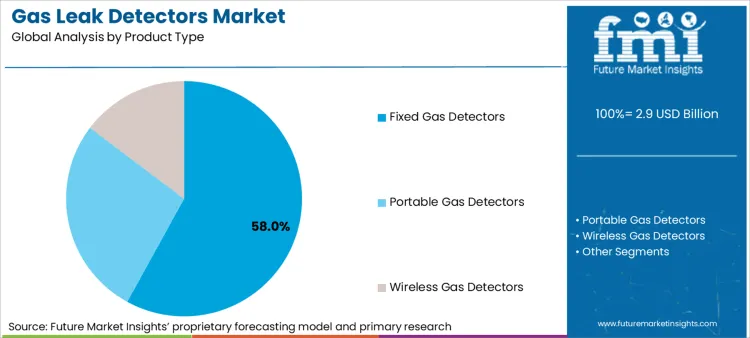
Fixed detection systems lead with 58% market share because buyers in process facilities optimise around continuous coverage, alarm integration, and auditability rather than episodic checks. Installed architectures integrate into plant control and safety systems and are specified to hazardous area requirements that reduce qualification ambiguity across multi site rollouts. ATEX conformity obligations for equipment used in potentially explosive atmospheres reinforce repeatable fixed system specifications in EU bound installations, tightening procurement language around markings, documentation, and certified configurations. IECEx certification frameworks support global operators that want a single approved equipment baseline across regions, further strengthening fixed deployments where standardisation lowers engineering friction. This segment also benefits from the shift toward remote visibility and managed device fleets, because fixed networks create stable data sources for monitoring rooms and compliance reporting.
Why do portable programs stay non discretionary in confined space and maintenance work?
Portable detectors with 35% market share remain structurally necessary because confined space entry and maintenance activity creates repeatable exposure risk that cannot be engineered out with fixed coverage alone. OSHA confined space interpretation guidance reinforces a disciplined atmospheric testing order and reinforces the operational expectation that entrants verify oxygen, flammables, and toxic contaminants during entry programs. That operating logic produces recurring purchases tied to workforce scale, contractor turnover, and calibration cycles. Honeywell’s BW Ultra positioning highlights portable confined space sampling and monitoring and frames connectivity and remote monitoring as part of modern portable value, signalling that buyers are shifting from personal instruments to managed fleets with stronger supervision and traceability. As industrial firms expand connected worker programs, portable fleets become data generating assets that support accountability, training enforcement, and contractor compliance, which sustains spend even in flat capex years.
Why does infrared sensing keep gaining preference in hydrocarbon rich environments?
Infrared detection gains preference in hydrocarbon rich environments because buyers want stable measurement under conditions where poisoning risk and cross sensitivities can increase lifecycle cost. In hazardous locations, procurement also prioritises certified configurations and predictable performance envelopes that reduce site acceptance delays. Honeywell’s BW Ultra specifications highlight optional IR sensor capability and explicitly present ATEX and IECEx markings for hazardous area use, illustrating how IR options are commercialised within certified portable platforms rather than as lab grade exceptions. As methane management and hydrocarbon leak risk remain board level concerns in energy and petrochemicals, IR based architectures fit operator needs for robust hydrocarbon detection with lower drift profiles in many applications, while electrochemical sensors retain strength in toxic gas duty cycles. The result is a technology mix driven by cost of ownership and certification readiness rather than incremental sensor novelty.
What are the key trends and restraints in the global gas leak detectors market?
A key trend is the migration from standalone detectors to connected fleets with remote monitoring and simplified device administration. Honeywell positions BW Ultra around confined space sampling plus TouchConnect style instrument management and remote monitoring, reflecting buyer demand for faster field workflows and supervisory visibility. Large industrial operators are also formalising connected worker and safety digitisation efforts through partnerships and programs that improve oversight and compliance consistency across sites. This shifts competition toward suppliers that can deliver certified hardware plus device management and service execution, not only sensor performance.
A key restraint is certification and lifecycle servicing burden that can slow conversions, especially in brownfield upgrades where hazardous area compliance, documentation, and site acceptance processes lengthen project timelines. ATEX conformity obligations for equipment used in potentially explosive atmospheres create procurement gates that limit rapid substitution and increase engineering work for multi site standardisation. OSHA aligned operational expectations for atmospheric testing also create ongoing calibration and program discipline requirements, raising total cost of ownership for buyers that lack mature maintenance systems.
Global Gas Leak Detectors Market by Key Countries
Gas leak detector demand across major industrial economies is tracking enforcement intensity, hazardous-area upgrade cycles, and process-industry maintenance discipline rather than discretionary instrumentation spend. The global gas leak detectors market expands at 5.1% CAGR from 2026 to 2036, with country-level dispersion reflecting how safety governance and brownfield modernisation translate into installed-base replacement and incremental coverage. Brazil leads at 7.1% as oil and gas, chemicals, and industrial clusters raise detection density across high-risk zones. China follows at 6.8%, supported by rapid capacity additions and tighter operating controls in large-scale process industries. India grows at 5.4% as hazardous-area audits and plant expansions lift demand across refining, petrochemicals, and manufacturing corridors. The United States records 4.2% on steady retrofit demand tied to compliance programs and reliability-led maintenance cycles, while Germany posts 3.9% amid mature installed base dynamics and disciplined capex timing. Growth remains safety-program anchored, not optional sensing-led.
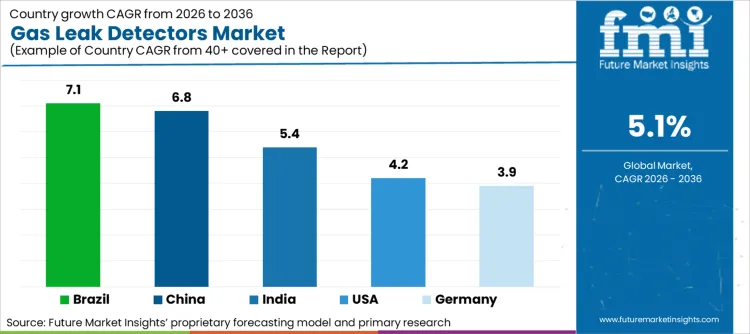
| Country | CAGR (2026 to 2036) |
|---|---|
| United States | 4.2% |
| China | 6.8% |
| Germany | 3.9% |
| India | 5.4% |
| Brazil | 7.1% |
Source: Future Market Insights (FMI) analysis, based on proprietary forecasting model and primary research.
Why does the United States stay an upgrade led market across 2026 to 2036?
The United States grows at 4.2% CAGR because demand is manufactured through confined space and maintenance activity that sustains portable fleet replacement plus enforcement aligned work practices. OSHA confined space interpretation guidance reinforces the operational expectation for atmospheric testing in a defined order, which institutionalises detector use in utilities, industrial maintenance, and energy operations. The market also benefits from scale in process industries and large multi site operators that increasingly standardise device fleets and monitoring practices to lower incident risk and improve audit readiness. Supplier performance commentary supports a view of broad based industrial demand for safety products, consistent with recurring replacement and upgrade cycles rather than one time buildouts. Connected platforms further pull spend forward because buyers want better visibility into compliance and device readiness across contractors and dispersed facilities.
Why does China outpace mature markets on installed base modernisation?
China grows at 6.8% CAGR because industrial expansion and modernisation in chemicals, refining, and manufacturing drives new installations plus upgrades of legacy safety systems. Hazardous location operations create strong incentives to adopt certified detection architectures and connected monitoring that can be supervised across large sites. IECEx aligned certification pathways matter for export oriented operators and globally benchmarked projects, supporting standardisation of equipment baselines. Growth also tracks the scale of new industrial facilities and infrastructure buildouts where fixed detection systems are specified at design stage, while connected safety programs increasingly translate into platform deployments rather than incremental device purchases.
Why is Germany’s growth more measured despite high compliance expectations?
Germany grows at 3.9% CAGR because the market is high specification but conversion pacing is disciplined, with buyers prioritising certified upgrades and lifecycle serviceability. ATEX equipment conformity requirements shape procurement and documentation requirements for hazardous locations in Europe, increasing engineering and acceptance burdens that can lengthen upgrade cycles. Demand still remains resilient because chemical and industrial operators maintain strict safety governance and prefer standardised, auditable detection architectures. Connected monitoring adoption is a further driver where operators integrate detection into broader industrial digitalisation, but the market grows through structured retrofit programs rather than rapid greenfield expansion.
Why does India’s demand compound through industrial expansion and governance tightening?
India grows at 5.4% CAGR because industrial capacity additions in chemicals, refining, manufacturing, and utilities expand the installed base while safety governance formalises in large enterprises and regulated facilities. Growth is reinforced by adoption of multi gas portable programs for confined space work and maintenance contractors in plants and infrastructure assets. OSHA aligned atmospheric testing logic is globally referenced in industrial safety practice and reinforces the operational need for portable verification and documentation in entry workflows, supporting recurring detector demand. Connected fleet management becomes more valuable as large Indian operators scale multi site footprints and contractor ecosystems and need central oversight of device readiness and compliance.
Why does Brazil show a faster trajectory driven by energy and industrial projects?
Brazil grows at 7.1% CAGR because energy and industrial investments expand hazardous operations where leak detection is a non discretionary layer of operational risk control. New and upgraded facilities convert into fixed detection specifications and portable fleet scaling for maintenance activity. International certification frameworks such as IECEx support procurement standardisation for equipment used in explosive atmospheres across global supply chains, which matters for operators and EPCs executing projects with international safety baselines. Growth also benefits from the economics of avoiding shutdowns and incidents in high consequence operations, which sustains upgrades even when broader industrial capex is uneven.
How is competition structured in the global gas leak detectors market, and who sets leadership?
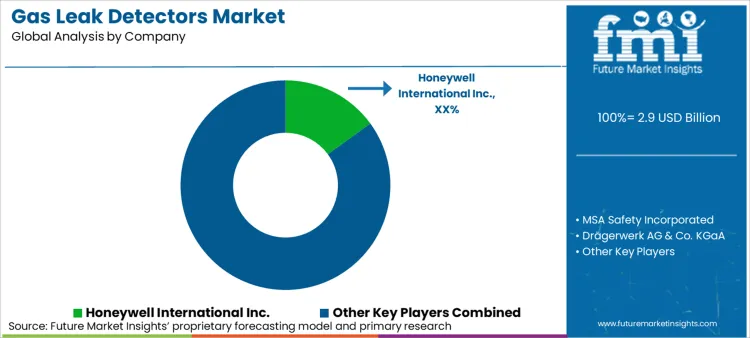
Competition is led by diversified safety and instrumentation suppliers that combine certified sensing portfolios with device fleet management, wireless connectivity, and service execution. Scope includes fixed point gas detectors, portable multi gas detectors, wireless gas detection networks, and associated device management and monitoring layers sold for industrial safety use. Scope excludes residential only alarms, general environmental monitoring not designed for industrial safety, and unrelated building automation devices without gas detection functions. Global leadership is best attributed to Honeywell based on breadth across fixed and portable detection, hazardous area certified configurations, and the company’s explicit positioning of connected worker and remote monitoring features within portable platforms such as BW Ultra. North America remains highly competitive with Honeywell, MSA, and Industrial Scientific differentiated by installed base, service networks, and enterprise fleet management adoption. Europe shows strong share for Dräger and other regional specialists where ATEX driven procurement and lifecycle service expectations favour suppliers with deep compliance documentation and service infrastructure. Asia remains fragmented across global brands and domestic suppliers, while Japan typically prefers proven, high reliability safety equipment and long cycle supplier relationships, meaning global leadership does not always translate into local leadership without field service depth and channel strength.
Recent Industry Developments
- Industrial Scientific announced a partnership with Gerdau to deploy connected safety technology and services, signalling continued enterprise adoption of managed gas detection and worker safety visibility.
- Honeywell published BW Ultra positioning that emphasises confined space sampling and remote monitoring features alongside hazardous location certifications, reinforcing the market shift toward connected, certified portable platforms.
- MSA reported record quarterly results with broad based demand across end markets, consistent with sustained replacement and upgrade activity in industrial safety categories including detection.
Key Players
- Honeywell International Inc.
- MSA Safety Incorporated
- Drägerwerk AG & Co. KGaA
- Industrial Scientific Corporation
- Emerson Electric Co. (Det-Tronics)
- Teledyne Gas and Flame Detection
- Sensidyne, LP
- Crowcon Detection Instruments Ltd.
- Trolex Ltd.
- International Gas Detectors Ltd.
What is the Market Definition?
The global gas leak detectors market covers instruments and systems designed to detect combustible gases, toxic gases, and oxygen deficiency in industrial and commercial environments where leaks create safety or operational risks. It includes portable multi gas devices used for confined space and maintenance work, fixed point detectors installed for continuous monitoring, and wireless or networked detectors that transmit alarms and readings to control rooms or monitoring platforms. Market value reflects equipment, certified configurations for hazardous locations, and detection systems specified as part of plant safety architectures.
Included are fixed gas detection systems, portable and personal gas detectors, confined space sampling instruments, wireless gas detection networks, and associated device management and remote monitoring capabilities sold for industrial safety use. Included also are detectors supplied with ATEX and IECEx certifications when used in explosive atmospheres and when specifications require marked conformity and documented product configurations. Inclusion extends to deployments in oil and gas, chemical and petrochemical, utilities, mining, manufacturing, and commercial facilities where detection integrates into safety protocols and emergency response procedures.
Excluded are residential only carbon monoxide alarms and home safety devices not designed for industrial duty cycles or hazardous location certification. Also excluded are generic environmental monitoring instruments used for ambient air quality measurement when not intended for industrial safety, plus fire detection devices that do not perform gas detection functions. Hydrogen production, storage, compression, and refuelling infrastructure are excluded as separate markets, even when facilities procure gas detectors as part of their safety systems. Standalone software without associated detection hardware is excluded unless bundled as part of a defined gas detection monitoring solution.
Scope of Report
| Items | Values |
|---|---|
| Quantitative Units | USD 2.9 Billion |
| Product Type | Fixed Gas Detectors; electrochemical; Wireless Gas Detectors |
| Technology Type | Electrochemical; Infrared; Semiconductor; Ultrasonic; Laser |
| End-Use Industry | Oil & Gas; Chemical & Petrochemical; Mining; Manufacturing; Utilities; Commercial Buildings |
| Regions Covered | North America; Latin America; Western Europe; Eastern Europe; East Asia; South Asia Pacific; Middle East and Africa |
| Countries Covered | United States; Canada; Mexico; Brazil; Germany; United Kingdom; France; Italy; China; Japan; South Korea; India; ASEAN; Kingdom of Saudi Arabia; United Arab Emirates; South Africa |
| Key Companies Profiled | Honeywell; MSA Safety; Dräger; Industrial Scientific; Det-Tronics; Teledyne Gas and Flame Detection; Crowcon; Trolex |
| Additional Attributes | Revenue analysis by product type, technology type, and end use; assessment of ATEX and IECEx certification impacts on procurement; evaluation of confined space entry practices shaping portable fleet demand; tracking of connected monitoring and device management adoption; competitive positioning based on installed base service capability and hazardous location certified portfolio depth |
Global Gas Leak Detectors Market by Key Segments
By Product Type
- Fixed Gas Detectors
- Portable Gas Detectors
- Wireless Gas Detectors
By Technology Type
- Electrochemical
- Infrared
- Semiconductor
- Ultrasonic
- Laser
By End-Use Industry
- Oil & Gas
- Chemical & Petrochemical
- Mining
- Manufacturing
- Utilities
- Commercial Buildings
By Region
- North America
- Latin America
- Western Europe
- Eastern Europe
- East Asia
- South Asia Pacific
- Middle East and Africa
Bibliography
- International Electrotechnical Commission. (n.d.). IECEx System overview and certification for equipment used in explosive atmospheres. IECEx.
- MSA Safety Incorporated. (2025). First quarter 2025 results and management commentary. MSA Safety investor news release.
- Honeywell. (n.d.). BW Ultra multi gas detector overview and specifications. Honeywell Automation Gas and Flame Detection.
- Industrial Scientific. (2024). Industrial Scientific and Gerdau partnership announcement. Industrial Scientific news release.
Frequently Asked Questions
How big is the global gas leak detectors market?
The global gas leak detectors market is valued at USD 2.9 billion in 2026 and is projected to reach USD 4.8 billion by 2036.
What is the growth outlook for the global gas leak detectors market over the next 10 years?
The market is forecast to expand at a 5.1% CAGR from 2026 to 2036, supported by hazardous area compliance and connected fleet adoption.
Which segments drive demand most directly in this market?
Demand is led by fixed detection in high consequence facilities, portable multi gas programs for confined space and maintenance work, and wireless monitoring layers that improve fleet visibility.
How does country growth differ by region?
Growth intensity varies by industrial expansion and compliance conversion, with China and Brazil growing faster than mature markets as installed base modernisation accelerates, while Germany grows more steadily under ATEX driven procurement discipline.
What are the main risks and constraints affecting this market?
Key constraints include certification and documentation requirements for hazardous locations and the lifecycle burden of calibration, bump testing, and program discipline needed to keep fleets compliant and auditable.
Preview the report firsthand - request a free sample
Get SampleGet the brochure for pricing and purchase details.
Get PDFTable of Content
- Executive Summary
- Global Market Outlook
- Demand-side Trends
- Supply-side Trends
- Technology Roadmap Analysis
- Analysis and Recommendations
- Market Overview
- Market Coverage / Taxonomy
- Market Definition / Scope / Limitations
- Research Methodology
- Chapter Orientation
- Analytical Lens and Working Hypotheses
- Market Structure, Signals, and Trend Drivers
- Benchmarking and Cross-market Comparability
- Market Sizing, Forecasting, and Opportunity Mapping
- Research Design and Evidence Framework
- Desk Research Programme (Secondary Evidence)
- Company Annual and Sustainability Reports
- Peer-reviewed Journals and Academic Literature
- Corporate Websites, Product Literature, and Technical Notes
- Earnings Decks and Investor Briefings
- Statutory Filings and Regulatory Disclosures
- Technical White Papers and Standards Notes
- Trade Journals, Industry Magazines, and Analyst Briefs
- Conference Proceedings, Webinars, and Seminar Materials
- Government Statistics Portals and Public Data Releases
- Press Releases and Reputable Media Coverage
- Specialist Newsletters and Curated Briefings
- Sector Databases and Reference Repositories
- FMI Internal Proprietary Databases and Historical Market Datasets
- Subscription Datasets and Paid Sources
- Social Channels, Communities, and Digital Listening Inputs
- Additional Desk Sources
- Expert Input and Fieldwork (Primary Evidence)
- Primary Modes
- Qualitative Interviews and Expert Elicitation
- Quantitative Surveys and Structured Data Capture
- Blended Approach
- Why Primary Evidence is Used
- Field Techniques
- Interviews
- Surveys
- Focus Groups
- Observational and In-context Research
- Social and Community Interactions
- Stakeholder Universe Engaged
- C-suite Leaders
- Board Members
- Presidents and Vice Presidents
- R&D and Innovation Heads
- Technical Specialists
- Domain Subject-matter Experts
- Scientists
- Physicians and Other Healthcare Professionals
- Governance, Ethics, and Data Stewardship
- Research Ethics
- Data Integrity and Handling
- Primary Modes
- Tooling, Models, and Reference Databases
- Desk Research Programme (Secondary Evidence)
- Data Engineering and Model Build
- Data Acquisition and Ingestion
- Cleaning, Normalisation, and Verification
- Synthesis, Triangulation, and Analysis
- Quality Assurance and Audit Trail
- Market Background
- Market Dynamics
- Drivers
- Restraints
- Opportunity
- Trends
- Scenario Forecast
- Demand in Optimistic Scenario
- Demand in Likely Scenario
- Demand in Conservative Scenario
- Opportunity Map Analysis
- Product Life Cycle Analysis
- Supply Chain Analysis
- Investment Feasibility Matrix
- Value Chain Analysis
- PESTLE and Porter’s Analysis
- Regulatory Landscape
- Regional Parent Market Outlook
- Production and Consumption Statistics
- Import and Export Statistics
- Market Dynamics
- Global Market Analysis 2021 to 2025 and Forecast, 2026 to 2036
- Historical Market Size Value (USD Million) Analysis, 2021 to 2025
- Current and Future Market Size Value (USD Million) Projections, 2026 to 2036
- Y-o-Y Growth Trend Analysis
- Absolute $ Opportunity Analysis
- Global Market Pricing Analysis 2021 to 2025 and Forecast 2026 to 2036
- Global Market Analysis 2021 to 2025 and Forecast 2026 to 2036, By Product Type
- Introduction / Key Findings
- Historical Market Size Value (USD Million) Analysis By Product Type , 2021 to 2025
- Current and Future Market Size Value (USD Million) Analysis and Forecast By Product Type , 2026 to 2036
- Fixed Gas Detectors
- Portable Gas Detectors
- Wireless Gas Detectors
- Fixed Gas Detectors
- Y-o-Y Growth Trend Analysis By Product Type , 2021 to 2025
- Absolute $ Opportunity Analysis By Product Type , 2026 to 2036
- Global Market Analysis 2021 to 2025 and Forecast 2026 to 2036, By Region
- Introduction
- Historical Market Size Value (USD Million) Analysis By Region, 2021 to 2025
- Current Market Size Value (USD Million) Analysis and Forecast By Region, 2026 to 2036
- North America
- Latin America
- Western Europe
- Eastern Europe
- East Asia
- South Asia and Pacific
- Middle East & Africa
- Market Attractiveness Analysis By Region
- North America Market Analysis 2021 to 2025 and Forecast 2026 to 2036, By Country
- Historical Market Size Value (USD Million) Trend Analysis By Market Taxonomy, 2021 to 2025
- Market Size Value (USD Million) Forecast By Market Taxonomy, 2026 to 2036
- By Country
- USA
- Canada
- Mexico
- By Product Type
- By Country
- Market Attractiveness Analysis
- By Country
- By Product Type
- Key Takeaways
- Latin America Market Analysis 2021 to 2025 and Forecast 2026 to 2036, By Country
- Historical Market Size Value (USD Million) Trend Analysis By Market Taxonomy, 2021 to 2025
- Market Size Value (USD Million) Forecast By Market Taxonomy, 2026 to 2036
- By Country
- Brazil
- Chile
- Rest of Latin America
- By Product Type
- By Country
- Market Attractiveness Analysis
- By Country
- By Product Type
- Key Takeaways
- Western Europe Market Analysis 2021 to 2025 and Forecast 2026 to 2036, By Country
- Historical Market Size Value (USD Million) Trend Analysis By Market Taxonomy, 2021 to 2025
- Market Size Value (USD Million) Forecast By Market Taxonomy, 2026 to 2036
- By Country
- Germany
- UK
- Italy
- Spain
- France
- Nordic
- BENELUX
- Rest of Western Europe
- By Product Type
- By Country
- Market Attractiveness Analysis
- By Country
- By Product Type
- Key Takeaways
- Eastern Europe Market Analysis 2021 to 2025 and Forecast 2026 to 2036, By Country
- Historical Market Size Value (USD Million) Trend Analysis By Market Taxonomy, 2021 to 2025
- Market Size Value (USD Million) Forecast By Market Taxonomy, 2026 to 2036
- By Country
- Russia
- Poland
- Hungary
- Balkan & Baltic
- Rest of Eastern Europe
- By Product Type
- By Country
- Market Attractiveness Analysis
- By Country
- By Product Type
- Key Takeaways
- East Asia Market Analysis 2021 to 2025 and Forecast 2026 to 2036, By Country
- Historical Market Size Value (USD Million) Trend Analysis By Market Taxonomy, 2021 to 2025
- Market Size Value (USD Million) Forecast By Market Taxonomy, 2026 to 2036
- By Country
- China
- Japan
- South Korea
- By Product Type
- By Country
- Market Attractiveness Analysis
- By Country
- By Product Type
- Key Takeaways
- South Asia and Pacific Market Analysis 2021 to 2025 and Forecast 2026 to 2036, By Country
- Historical Market Size Value (USD Million) Trend Analysis By Market Taxonomy, 2021 to 2025
- Market Size Value (USD Million) Forecast By Market Taxonomy, 2026 to 2036
- By Country
- India
- ASEAN
- Australia & New Zealand
- Rest of South Asia and Pacific
- By Product Type
- By Country
- Market Attractiveness Analysis
- By Country
- By Product Type
- Key Takeaways
- Middle East & Africa Market Analysis 2021 to 2025 and Forecast 2026 to 2036, By Country
- Historical Market Size Value (USD Million) Trend Analysis By Market Taxonomy, 2021 to 2025
- Market Size Value (USD Million) Forecast By Market Taxonomy, 2026 to 2036
- By Country
- Kingdom of Saudi Arabia
- Other GCC Countries
- Turkiye
- South Africa
- Other African Union
- Rest of Middle East & Africa
- By Product Type
- By Country
- Market Attractiveness Analysis
- By Country
- By Product Type
- Key Takeaways
- Key Countries Market Analysis
- USA
- Pricing Analysis
- Market Share Analysis, 2025
- By Product Type
- Canada
- Pricing Analysis
- Market Share Analysis, 2025
- By Product Type
- Mexico
- Pricing Analysis
- Market Share Analysis, 2025
- By Product Type
- Brazil
- Pricing Analysis
- Market Share Analysis, 2025
- By Product Type
- Chile
- Pricing Analysis
- Market Share Analysis, 2025
- By Product Type
- Germany
- Pricing Analysis
- Market Share Analysis, 2025
- By Product Type
- UK
- Pricing Analysis
- Market Share Analysis, 2025
- By Product Type
- Italy
- Pricing Analysis
- Market Share Analysis, 2025
- By Product Type
- Spain
- Pricing Analysis
- Market Share Analysis, 2025
- By Product Type
- France
- Pricing Analysis
- Market Share Analysis, 2025
- By Product Type
- India
- Pricing Analysis
- Market Share Analysis, 2025
- By Product Type
- ASEAN
- Pricing Analysis
- Market Share Analysis, 2025
- By Product Type
- Australia & New Zealand
- Pricing Analysis
- Market Share Analysis, 2025
- By Product Type
- China
- Pricing Analysis
- Market Share Analysis, 2025
- By Product Type
- Japan
- Pricing Analysis
- Market Share Analysis, 2025
- By Product Type
- South Korea
- Pricing Analysis
- Market Share Analysis, 2025
- By Product Type
- Russia
- Pricing Analysis
- Market Share Analysis, 2025
- By Product Type
- Poland
- Pricing Analysis
- Market Share Analysis, 2025
- By Product Type
- Hungary
- Pricing Analysis
- Market Share Analysis, 2025
- By Product Type
- Kingdom of Saudi Arabia
- Pricing Analysis
- Market Share Analysis, 2025
- By Product Type
- Turkiye
- Pricing Analysis
- Market Share Analysis, 2025
- By Product Type
- South Africa
- Pricing Analysis
- Market Share Analysis, 2025
- By Product Type
- USA
- Market Structure Analysis
- Competition Dashboard
- Competition Benchmarking
- Market Share Analysis of Top Players
- By Regional
- By Product Type
- Competition Analysis
- Competition Deep Dive
- Honeywell International Inc.
- Overview
- Product Portfolio
- Profitability by Market Segments (Product/Age /Sales Channel/Region)
- Sales Footprint
- Strategy Overview
- Marketing Strategy
- Product Strategy
- Channel Strategy
- MSA Safety Incorporated
- Drägerwerk AG & Co. KGaA
- Industrial Scientific Corporation
- Emerson Electric Co. (Det-Tronics)
- Teledyne Gas and Flame Detection
- Sensidyne, LP
- Crowcon Detection Instruments Ltd.
- Trolex Ltd.
- Honeywell International Inc.
- Competition Deep Dive
- Assumptions & Acronyms Used


