

- Market Size (2026)
- USD 444.3 Mn
- Forecast (2036)
- USD 1555.1 Mn
- CAGR (2026 to 2036)
- 13.4%
Gene Editing Off-Target Effect Detection Test Systems Market Size, Market Forecast and Outlook By FMI
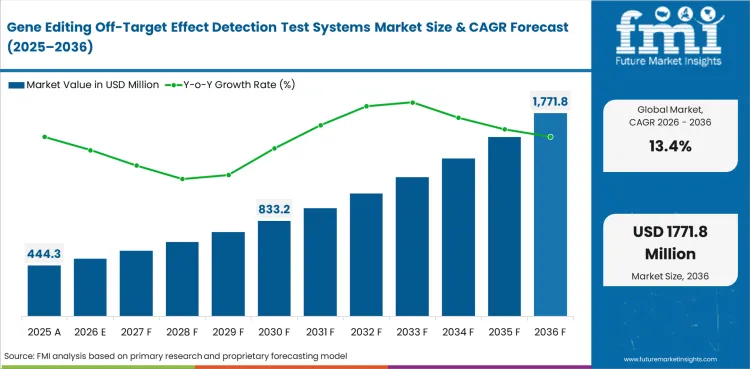
Gene Editing Off-Target Effect Detection Test Systems Market is estimated at USD 391.8 million in 2025. Industry value is projected to reach USD 444.3 million in 2026 and USD 1,555.1 million by 2036, reflecting a 13.4% CAGR during the forecast period. The market is gaining importance as genome editing programs move deeper into translational and clinical development. Sponsors are placing more emphasis on test systems that identify candidate off-target sites and support a clearer path into regulatory review.
Summary of Gene Editing Off-Target Effect Detection Test Systems Market
- Gene editing off-target effect detection test systems market valuation is expected to reach USD 1,555.1 million by 2036.
- The industry is forecast to expand at a 13.4% CAGR from 2026 to 2036.
- Gene editing off-target effect detection test systems market generated USD 391.8 million in 2025.
- Market value is expected to rise to USD 444.3 million in 2026.
- CRISPR-Cas9 is projected to remain the leading editing modality with 42.3% share in 2026.
- Site Nomination is set to lead workflow stage demand at 36.4% share in 2026.
- Cell-based Assays are expected to dominate detection approach with 31.2% share in 2026.
- Services hold 34.1% of the product format segment, supported by technical complexity in assay execution, sequencing review, and interpretation.
- Amplicon NGS accounts for 29.1% of the readout technology segment, supported by practical targeted sequencing for nominated site confirmation.
- Biopharma companies hold 39.4% of the end-user segment, reflecting stronger demand from clinical and translational development programs.
- IND-enabling studies represent 33.2% of the application segment, indicating higher commercial importance as programs move toward formal development.
Key Takeaways, Market Size, and Forecast
| Metric | Value |
|---|---|
| Market Size (2025) | USD 391.8 Million |
| Market Size (2026) | USD 444.3 Million |
| Market Size (2036) | USD 1,555.1 Million |
| CAGR (2026–2036) | 13.4% |
| Incremental Opportunity (2026–2036) | USD 1,110.8 Million |
| Leading Editing Modality (2026) | CRISPR-Cas9 |
| CRISPR-Cas9 Share (2026) | 42.3% |
| Fastest-Growing Country | China |
| China CAGR | 14.6% |
| 2nd Fastest-Growing Country | United States |
| United States CAGR | 13.9% |
Gene Editing Off-Target Effect Detection Test Systems Market Key Takeaways
| Parameter | Details |
|---|---|
| Market value (2026) | USD 444.3 million |
| Forecast value (2036) | USD 1,555.1 million |
| CAGR (2026 to 2036) | 13.4% |
| Estimated market value (2025) | USD 391.8 million |
| Incremental opportunity | USD 1,110.8 million |
| Leading detection approach | Cell-based assays (31.2% of detection approach segment) |
| Leading product format | Services (34.1% of product format segment) |
| Leading workflow stage | Site nomination (36.4% of workflow stage segment) |
| Leading editing modality | CRISPR-Cas9 (42.3% of editing modality segment) |
| Leading readout technology | Amplicon NGS (29.1% of readout technology segment) |
| Leading end user | Biopharma companies (39.4% of end user segment) |
| Key players | Integrated DNA Technologies, MaxCyte/SeQure, SeqWell, Active Motif, Mission Bio, Azenta Life Sciences, Avance Biosciences |
Source: Future Market Insights analysis, based on proprietary forecasting model and primary research.
Off-target effect detection is becoming more important in gene editing because development groups need earlier clarity on unintended edits before programs move deeper into preclinical and clinical work. Early analytical evidence helps identify risk before it affects guide selection, safety interpretation, or regulatory preparation. System choice depends on assay sensitivity, biologic relevance, sequencing quality, and clear interpretation. Adoption improves when developers define how each result supports nomination, confirmation, genomic integrity review, and routine program decisions.
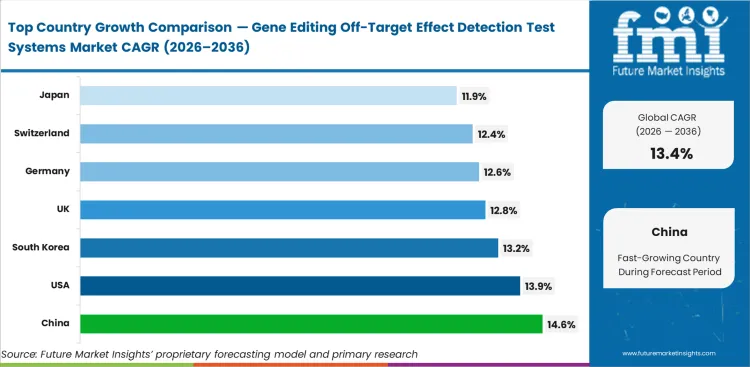
China is expected to rise at 14.6% CAGR through 2036 because expanding genome editing research and translational activity are increasing demand for stronger off-target assessment. The United States is projected to grow at 13.9% CAGR as clinical-stage gene editing work and regulatory-facing safety requirements continue supporting analytical use. South Korea is anticipated to expand at 13.2% CAGR through 2036, supported by precision medicine investment and strengthening genomic capability. The United Kingdom is likely to register 12.8% CAGR, while Germany is set to grow at 12.6% CAGR and Switzerland at 12.4% CAGR as high-value therapeutic development continues requiring stronger evidence around unintended edits and genomic integrity. Japan is expected to expand at 11.9% CAGR through 2036.
Gene Editing Off-Target Effect Detection Test Systems Market Definition
The gene editing off-target effect detection test systems market includes assay platforms, sequencing-linked workflows, software tools, and service-based analytical systems used to identify, nominate, confirm, and characterize unintended editing events generated during genome editing research, translational development, and therapeutic program advancement.
Gene Editing Off-Target Effect Detection Test Systems Market Inclusion
The market includes cell-based assays, biochemical assays, in silico prediction tools, orthogonal confirmation workflows, sequencing-based readout systems, analytical software, service-led off-target profiling, and related workflow components used across guide selection, preclinical development, IND-enabling studies, genomic integrity assessment, and edited-cell characterization.
Gene Editing Off-Target Effect Detection Test Systems Market Exclusion
The scope excludes general gene editing reagents sold without a defined off-target analysis role, broad sequencing activity not linked to genome editing safety assessment, general bioinformatics services without off-target workflow relevance, and manufacturing tools used for editing delivery or cell processing where off-target detection is not the primary analytical function.
Gene Editing Off-Target Effect Detection Test Systems Market Research Methodology
- Primary Research: FMI analysis uses interviews with genome editing researchers, assay developers, sequencing experts, regulatory consultants, and service providers across the United States, China, the United Kingdom, Germany, Switzerland, Japan, and South Korea.
- Secondary Research: Research includes FDA and EMA guidance, NIST material, company portfolios, investor filings, application notes, peer-reviewed studies, and public updates on off-target testing and gene editing safety.
- Market Sizing and Forecasting: Market estimates were built through a bottom-up review of assay use across discovery, preclinical, and IND-enabling work.
- Validation and Update Process: FMI checked outputs against company activity, regulatory changes, assay expansion, partnerships, and growth in genome editing programs.
Why Gene Editing Off-Target Effect Detection Test Systems Market t is Growing?
- Cell-based assays are projected to account for 31.2% of detection approach demand in 2026, supported by stronger interest in biologically relevant evidence during off-target nomination and confirmation.
- Services are expected to hold 34.1% of product format demand in 2026, reflecting the technical burden linked to assay execution, sequencing interpretation, and orthogonal review.
- United States and China remain major demand centers, while South Korea and the United Kingdom are strengthening regional growth through translational genome editing activity and advanced analytical adoption.
- Adoption is widening as developers seek earlier clarity on unintended edits, stronger genomic integrity assessment, and better-aligned evidence packages for preclinical and regulatory progression.
Demand for gene editing off-target effect detection test systems is rising because genome editing programs face tighter scrutiny around unintended edits and structural genomic changes. FDA’s draft guidance now places clearer emphasis on NGS and bioinformatics for off-target and chromosomal integrity assessment. EMA guidance also points to in vitro and in silico off-target evaluation in investigational advanced therapies.
The market is expanding as off-target assessment moves from a narrow discovery task into a broader program requirement. Developers use multiple methods across nomination, confirmation, and structural follow-up, especially in programs involving CRISPR-Cas systems, base editors, and prime editors. NIST work on assay qualification, interlaboratory consistency, and metadata discipline adds further relevance to workflows that support repeatable output and cleaner interpretation across development stages.
Clinical expansion is adding another further support. CRISPR programs continue to widen across therapeutic settings, and which increases the need for robust off-target evidence before later-stage investment decisions are made. Market growth is shaped by scientific depth, regulatory expectation, and the need for better-documented analytical support across gene editing programs moving closer to patient-facing use.
Gene Editing Off-Target Effect Detection Test Systems Market Segmental Analysis
- CRISPR-Cas9 is projected to hold 42.3% share of the editing modality segment in 2026 because a large share of current off-target assessment work continues to come from programs built around established CRISPR workflows.
- Site nomination is expected to account for 36.4% share of the workflow stage segment in 2026 because unintended edit review begins with identifying the genomic locations most likely to require deeper follow-up.
- Cell-based assays are expected to hold 31.2% share of the detection approach segment in 2026 because development teams are giving more weight to evidence that reflects biological context more clearly than sequence prediction by itself.
- Amplicon NGS is projected to account for 29.1% share of the readout technology segment in 2026 because targeted confirmation remains practical when nominated sites need structured sequencing review without the burden of broader genome-wide analysis.
- Services are projected to hold 34.1% share of the product format segment in 2026 because many developers still depend on external analytical support for assay execution, sequencing workflows, and data interpretation.
- IND-enabling studies are expected to account for 33.2% share of the application segment in 2026 because off-target assessment carries greater commercial weight once evidence packages begin supporting formal development progression.
The gene editing off-target effect detection test systems market is segmented by Detection Approach, Product Format, Workflow Stage, Editing Modality, Readout Technology, End User, Application, Deployment, and Region. By Detection Approach, the market is divided into Cell-based Assays, Biochemical Assays, In Silico Tools, and Orthogonal Validation. In terms of Product Format, the market is classified into Services, Assay Kits, Software, Instruments, and Reagents. Based on Workflow Stage, the market is segmented into Site Nomination, Site Confirmation, Structural Follow-up, and Release Support. By Editing Modality, the market is divided into CRISPR-Cas9, Base Editing, Prime Editing, Cas12 Systems, and Other Editors. In terms of Readout Technology, the market is classified into Amplicon NGS, Short-read WGS, Single-cell DNA, ChIP-seq Workflows, and Long-read Sequencing. Based on End User, the market is segmented into Biopharma Companies, Academic Laboratories, CROs, CDMOs, and Hospitals. By Application, the market is divided into IND-enabling Studies, Discovery Screening, Cell Therapy Quality Assessment, In vivo Profiling, and Comparability Studies. In terms of Deployment, the market is classified into Outsourced Testing, In-house Testing, and Hybrid Models.
Insights into the Cell-based Assays Detection Approach Segment
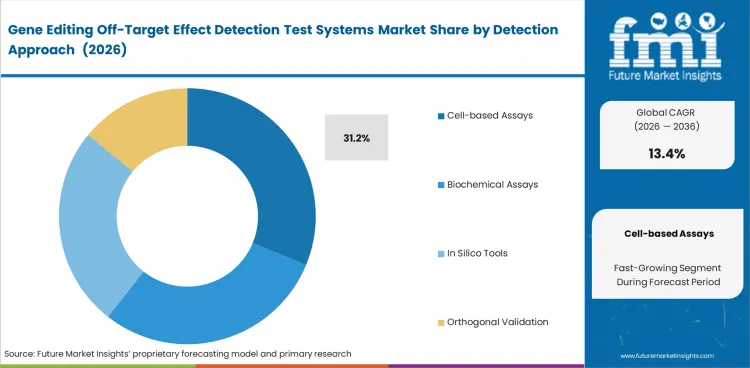
Cell-based assays lead this segment because off-target findings carry more value when they are generated in a biological setting closer edited cells. Cell-based assays are expected to account for 31.2% share in 2026, supported by the growing need for evidence that moves beyond computational prediction and strengthens confidence in follow-up review. Interest in this segment is also supported by progress in the CRISPR-based gene editing market, where therapeutic use continues to raise the bar for safety assessment.
Insights into the Services Product Format Segment
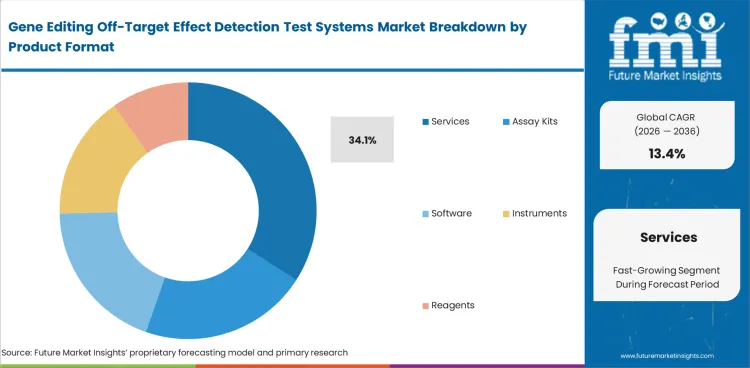
Services lead this segment because many gene editing developers still rely on external specialists for study design, assay execution, sequencing support, and interpretation of technically complex findings. Services are projected to hold 34.1% share in 2026 because off-target analysis often requires a broader analytical package than internal teams can manage with speed and consistency. This position is reinforced by activity across the bioinformatics market, where interpretation and data handling remain central to analytical value.
Insights into the Site Nomination Workflow Stage Segment
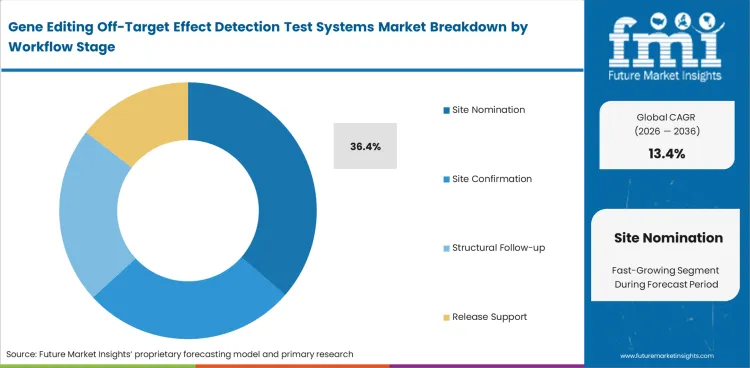
Site nomination leads because off-target assessment starts with identifying the genomic locations most likely to show unintended activity before confirmation work begins. Site nomination is likely to account for 36.4% share in 2026 because this step shapes later analytical work and determines how much confidence teams can place in downstream review. As the gene editing tools market continues expanding, this step remains one of the earliest and most important checkpoints in the workflow.
Insights into the CRISPR-Cas9 Editing Modality Segment
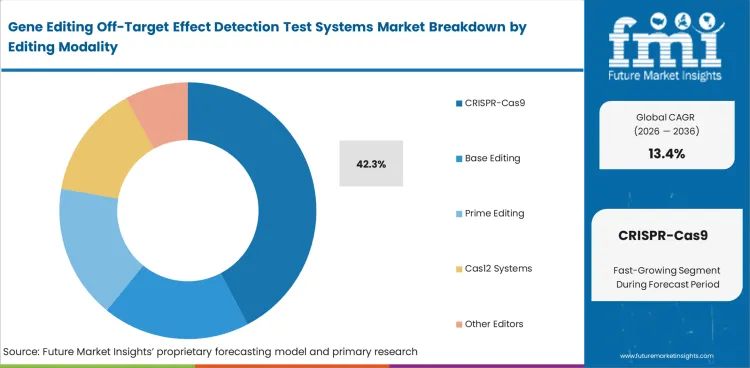
CRISPR-Cas9 leads this segment because a large share of active development work still depends on Cas9-based editing systems and the analytical needs linked to them. CRISPR-Cas9 is expected to account for 42.3% share in 2026 because the installed base of research and translational programs remains strongest in this modality even as base editing and prime editing continue to grow. This lead is closely tied to the wider CRISPR market, where therapeutic and research activity continue supporting demand for off-target review.
Insights into the Amplicon NGS Readout Technology Segment
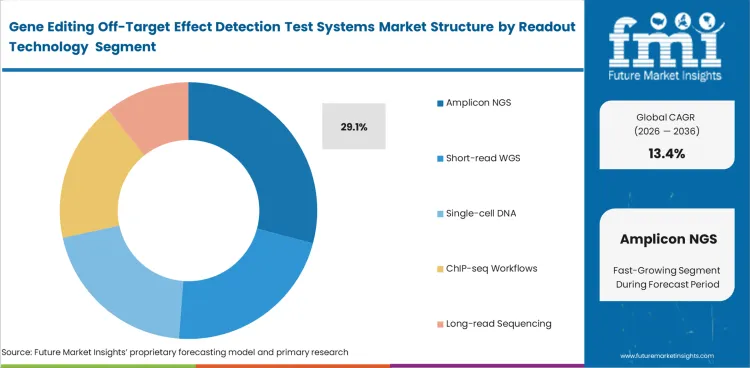
Amplicon NGS is expected to account for 29.1% share in 2026 because targeted sequencing remains a practical way to confirm nominated sites with clear and manageable output. Development groups continue to favor methods that support structured confirmation without the heavier burden linked to broader sequencing strategies, especially when turnaround time and interpretability both matter. This lead also fits with trends in the genomics market, where sequencing depth and analytical usability continue to shape adoption.
Insights into the Biopharma Companies End User Segment
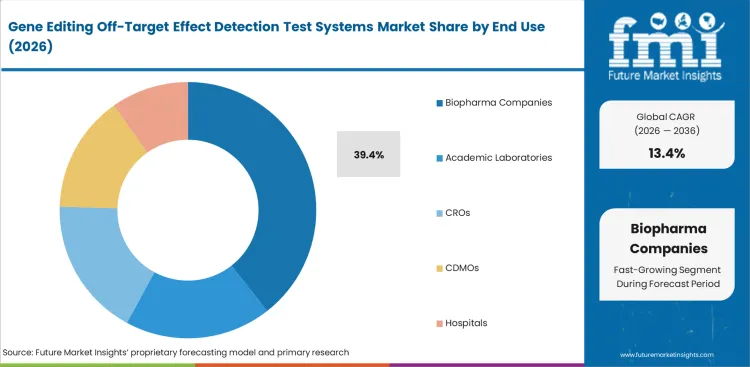
Biopharma companies are expected to account for 39.4% share in 2026 because the strongest commercial pressure for off-target analysis sits with organizations moving programs through preclinical and clinical development. These companies need stronger analytical evidence as programs move towards higher-cost and higher-risk development stages, which keeps demand concentrated in this group. The same pattern is visible across the genome editing market, where therapeutic progression continues to drive deeper analytical requirements.
What are the Drivers, Restraints, and Key Trends of the Gene Editing Off-Target Effect Detection Test Systems Market?
- Rising attention on unintended edits and broader genomic disruption is increasing demand for test systems that can support stronger safety assessment across gene editing programs.
- Assay qualification burden, cross-method variability, and interpretation complexity continue to slow wider adoption across development workflows that need more standardized evidence.
- Growing emphasis on biologically relevant data, sequencing-backed confirmation, and better documentation is favoring systems that support more structured off-target review across translational and clinical programs.
The gene editing off-target effect detection test systems market is expanding as development groups place more weight on stronger evidence around unintended edits, genomic integrity, and regulatory readiness. Adoption depends on whether analytical output supports clear interpretation, repeatable use across workflows, and stronger confidence during program review. Growth remains strong, though uptake is still shaped by method qualification burden, workflow complexity, and the challenge of aligning results from multiple assay types into one usable safety view.
Stronger Safety Expectations and Earlier Risk Visibility
Demand is rising because gene editing programs need earlier clarity on unintended edits before they move deeper into preclinical and clinical development. Development groups need systems that identify likely off-target sites, support confirmation with stronger evidence, and help interpret broader genomic disruption when safety questions become more complex. This is increasing the relevance of off-target test systems across guide selection, translational work, and IND-enabling studies. The same trend aligns with expansion in the gene editing tools market, where development-stage use continues to broaden.
Qualification Burden and Integration into Development Decision Logic
Wider uptake remains constrained by the effort required to qualify methods and interpret results across different assay classes. Development teams need more than sensitive detection. They need a clear understanding of how nomination methods, confirmation workflows, and sequencing readouts connect before results can support structured safety review. This slows adoption, especially in programs where low-frequency events and structural changes create added interpretation burden. It also increases dependence on capabilities associated with the bioinformatics market.
Biologically Relevant Evidence and Sequencing-backed Workflow Progress
Market direction is moving toward systems that support biologically relevant evidence, cleaner sequencing-backed confirmation, and stronger continuity from nomination through follow-up analysis. Development teams are giving more weight to tools and services that support routine analytical execution rather than one-off technical use, especially when programs move toward regulatory-facing stages. This shift also draws support from advances in the genomics market, where sequencing capability and analytical depth continue improving the usefulness of more structured off-target workflow.
Analysis of the Gene Editing Off-Target Effect Detection Test Systems Market by Key Countries
- China leads the tracked markets at 14.6% CAGR because genome editing research is expanding quickly and more programs are moving into translational development.
- The United States follows at 13.9% CAGR as clinical-stage activity and tighter safety expectations continue supporting demand for more structured analytical workflows across the wider CRISPR ecosystem.
- South Korea records 13.2% CAGR because precision medicine investment and broader genomic capability are improving the base for advanced off-target testing.
- The United Kingdom, Germany, Switzerland, and Japan remain important markets where scientific depth, documentation quality, assay credibility, and interpretation support continue to influence supplier selection.
Based on the regional analysis, the Gene Editing Off-Target Effect Detection Test Systems Market is segmented into North America, Latin America, Western Europe, Eastern Europe, East Asia, South Asia & Pacific, and Middle East & Africa across 40 plus countries.
.webp "Top Country Growth Comparison Gene Editing Off Target Effect Detection Test Systems Market Cagr (2026 2036)")
| Country | CAGR (2026 to 2036) |
|---|---|
| China | 14.6% |
| United States | 13.9% |
| South Korea | 13.2% |
| United Kingdom | 12.8% |
| Germany | 12.6% |
| Switzerland | 12.4% |
| Japan | 11.9% |
Source: Future Market Insights analysis, based on proprietary forecasting model and primary research
Demand Outlook for Gene Editing Off-Target Effect Detection Test Systems Market in China
China is projected to expand at 14.6% CAGR through 2036. Strong research activity in genome editing, rising translational work, and broader use of advanced sequencing workflows are support demand for off-target detection systems. Development teams are placing greater emphasis on methods that generate clearer evidence on unintended edits before programs move into more demanding stages of review.
- Expanding genome editing activity is strengthening demand for off-target analysis.
- Translational development is increasing the need for more credible safety evidence.
- Development teams continue to value methods supported by stronger analytical depth and clearer interpretation.
Future Outlook for Gene Editing Off-Target Effect Detection Test Systems Market in the United States
The United States is expected to grow at 13.9% CAGR through 2036. A strong base of gene editing companies, clinical development activity, and specialist analytical providers support market expansion. Demand also benefits from growing regulatory attention on unintended edits and genomic integrity. Companies active in this market are giving more weight to assay reliability, sequencing quality, and interpretive support as programs move toward higher-stakes development decisions. This pattern aligns with the wider CRISPR-based gene editing market.
- Clinical-stage genome editing activity continues to support analytical demand.
- Regulatory scrutiny is increasing the importance of stronger off-target workflows.
- Specialist service capability remains relevant across technically demanding programs.
Opportunity Analysis of Gene Editing Off-Target Effect Detection Test Systems Market in South Korea
South Korea is projected to record 13.2% CAGR by 2036. The market benefits from continued investment in genomic medicine, growing interest in advanced therapies, and improving analytical capability across research and development settings. Demand is building around systems that support more dependable safety interpretation without adding unnecessary complexity to program execution. Companies with stronger technical support and cleaner workflow delivery are likely to perform well in this market, especially as the country builds further capability across single cell analysis system applications.
- Genomic medicine investment is improving the outlook for advanced analytical systems.
- Development activity is increasing demand for more reliable off-target review.
- Technical support and workflow clarity remain important in supplier positioning.
In-depth Analysis of Gene Editing Off-Target Effect Detection Test Systems Market in the United Kingdom
The United Kingdom is projected to expand at 12.8% CAGR from 2026 to 2036. Strong academic science, translational research depth, and continued interest in cell and gene therapy development support this market. Off-target detection systems are gaining more attention because development groups need clearer evidence around unintended edits as programs mature. Market progress depends on scientific credibility, analytical consistency, and the ability to support structured development work with dependable results.
- Translational research activity supports steady demand for analytical systems.
- Development teams are placing more emphasis on clearer off-target evidence.
- Scientific credibility and analytical consistency strengthen commercial relevance.
In-depth Analysis of Gene Editing Off-Target Effect Detection Test Systems Market in Germany
Germany is projected to expand at 12.6% CAGR through 2036. The market is shaped by a technically disciplined research environment and strong interest in robust analytical workflows. Development teams assess these systems on assay performance, sequencing output, documentation quality, and interpretation support, especially in programs that require stronger evidence across multiple stages of review. This keeps Germany important for suppliers that combine technical depth with dependable analytical execution, particularly as the broader genomics market continues to deepen its analytical base.
- Technical discipline supports demand for well-validated analytical methods.
- Documentation quality remains important in workflow adoption.
- Stronger interpretation support helps suppliers build commercial relevance.
Sales Analysis of Gene Editing Off-Target Effect Detection Test Systems Market in Switzerland
Switzerland is projected to register 12.4% CAGR by 2036. Demand comes from a high-value therapeutic development environment where evidence quality carries strong weight. The strongest interest is directed toward systems and services that support confident interpretation of unintended edits and related genomic effects. Companies active here are more likely to gain traction when they provide dependable analytical support across specialized development programs with demanding evidence expectations. This also connects well with the wider bioinformatics market.
- High-value therapeutic work is increasing the need for stronger analytical evidence.
- Evidence quality remains central in off-target assessment workflows.
- Dependable support across specialized programs helps strengthen supplier standing.
Demand Outlook for Gene Editing Off-Target Effect Detection Test Systems Market in Japan
Japan is expected to expand at 11.9% CAGR through 2036. Growth remains solid, though adoption is moving in a more measured way than in some faster-growing countries. Development groups continue to favor methods that provide repeatable output, well-structured sequencing analysis, and dependable interpretation across different stages of program work. This keeps the market attractive for companies that can support long-term analytical consistency and clear workflow execution.
- Repeatable output remains important in development-stage analytical work.
- Sequencing quality and interpretation support influence market acceptance.
- Long-term analytical consistency continues to shape supplier relevance.
Competitive Landscape of the Gene Editing Off-Target Effect Detection Test Systems Market
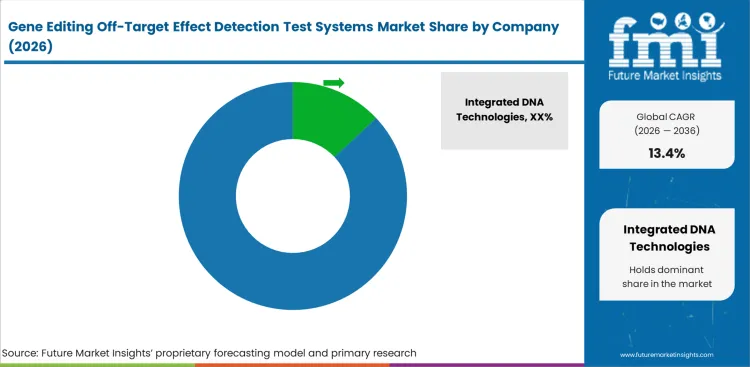
- Integrated DNA Technologies, MaxCyte / SeQure, and Mission Bio compete through stronger assay depth, sequencing-linked workflows, and broader support across therapeutic genome editing analysis.
- The market remains fragmented, with workflow breadth, documentation quality, and interpretive support shaping competition as much as assay sensitivity.
- Companies that can connect site nomination, confirmation, sequencing output, and genomic integrity follow-up are in a stronger position as programs move into more structured development stages.
The gene editing off-target effect detection test systems market includes assay specialists, sequencing-linked workflow providers, bioinformatics-supported analysis participants, and service-led companies working across genome editing research and therapeutic development. The wider CRISPR market gives useful context here because demand is widening across both research and clinical programs. Development teams compare workflow continuity, sequencing quality, interpretive support, service responsiveness, and the ability to generate results that can support internal review and later regulatory preparation.
Integrated DNA Technologies remains well positioned through its rhAmpSeq-based workflow, while MaxCyte has strengthened its position through SeQure and Mission Bio remains relevant through single-cell analysis of on-target edits, off-target events, and translocations. Active Motif, SeqWell, Azenta Life Sciences, and Avance Biosciences continue supporting the market through specialized services and workflow execution, with the single cell analysis system market adding useful context to this positioning. Stronger market positions are likely to remain with companies that combine analytical depth, dependable support, and clearer interpretive value across the broader genome editing landscape.
Major Industry Players
Key global companies leading the gene editing off-target effect detection test systems market include:
- Integrated DNA Technologies, MaxCyte / SeQure, and Mission Bio are among the leading participants due to their stronger assay capability, sequencing-linked analytical depth, and broader ability to support gene editing programs with dependable technical documentation and interpretive support.
- Active Motif, Azenta Life Sciences, and Avance Biosciences maintain strong competitive relevance through specialized service execution, support across off-target assessment workflows, and ability to assist development teams seeking clearer analytical output across nomination, confirmation, and follow-up review.
- SeqWell remains an important specialized participant where cellular off-target analysis, workflow refinement, and focused technical support matter more than broad portfolio scale, particularly in programs that place more value on practical assay performance and usable sequencing-based evidence.
Competitive Benchmarking
| Company | Off-Target Assay Depth | Genomic Integrity Coverage | Workflow Breadth | Documentation / Application Support |
|---|---|---|---|---|
| Integrated DNA Technologies | High | Medium | Strong | Strong |
| MaxCyte / SeQure | High | High | Strong | Strong |
| Mission Bio | High | High | Moderate | Strong |
| Active Motif | Medium | Medium | Moderate | Strong |
| SeqWell | Medium | Medium | Moderate | Moderate |
| Azenta Life Sciences | Medium | Medium | Moderate | Moderate |
| Avance Biosciences | Medium | Medium | Moderate | Moderate |
Source: Future Market Insights competitive analysis, 2026.
Recent Developments in Gene Editing Off-Target Effect Detection Test Systems Market
- In January 2025, MaxCyte acquired SeQure Dx, adding on-target and off-target editing assessment services to its cell-engineering portfolio and strengthening its position in gene-editing safety analysis.
- In May 2025, Mission Bio partnered with Integrated DNA Technologies (IDT) to introduce a workflow for precise on-target and off-target confirmation in gene-editing applications, expanding single-cell analytical capability in this category.
Key Players
Major Global Players
- Integrated DNA Technologies
- MaxCyte / SeQure
- Mission Bio
- Azenta Life Sciences
- Active Motif
Emerging Players / Specialized Participants
- SeqWell
- Avance Biosciences
Scope of the Report
| Metric | Value |
|---|---|
| Quantitative Units | USD 391.8 million (2025) / USD 444.3 million (2026) to USD 1,555.1 million (2036), at a CAGR of 13.4% |
| Market Definition | The gene editing off-target effect detection test systems market includes assay platforms, sequencing-linked workflows, software tools, and service-based analytical systems used to identify, nominate, confirm, and characterize unintended editing events generated during genome editing research, translational development, and therapeutic program advancement. |
| Segmentation |
|
| Regions Covered | North America, Latin America, Western Europe, Eastern Europe, East Asia, South Asia & Pacific, and Middle East & Africa |
| Countries Covered | China, United States, South Korea, United Kingdom, Germany, Switzerland, Japan, and 40 plus countries |
| Key Companies Profiled | Integrated DNA Technologies, MaxCyte / SeQure, Mission Bio, Azenta Life Sciences, Active Motif, SeqWell, Avance Biosciences |
| Forecast Period | 2026 to 2036 |
| Approach | Bottom-up review of assay use and workflow-based demand modeling, supported by primary interviews with genome editing researchers, assay developers, and regulatory consultants, alongside secondary research including FDA/EMA guidance, NIST material, peer-reviewed studies, and public company updates |
Source: Future Market Insights analysis, based on proprietary forecasting model and primary research.
Gene Editing Off-Target Effect Detection Test Systems Market by Segments
Detection Approach
- Cell-based Assays
- Biochemical Assays
- In Silico Tools
- Orthogonal Validation
Product Format
- Services
- Assay Kits
- Software
- Instruments
- Reagents
Workflow Stage
- Site Nomination
- Site Confirmation
- Structural Follow-up
- Release Support
Editing Modality
- CRISPR-Cas9
- Base Editing
- Prime Editing
- Cas12 Systems
- Other Editors
Readout Technology
- Amplicon NGS
- Short-read WGS
- Single-cell DNA
- ChIP-seq Workflows
- Long-read Sequencing
End User
- Biopharma Companies
- Academic Laboratories
- CROs
- CDMOs
- Hospitals
Application
- IND-enabling Studies
- Discovery Screening
- Cell Therapy Quality Assessment
- In vivo Profiling
- Comparability Studies
Deployment
- Outsourced Testing
- In-house Testing
- Hybrid Models
Region
- North America
- Latin America
- Western Europe
- Eastern Europe
- East Asia
- South Asia & Pacific
- Middle East & Africa
Bibliography
- MaxCyte, Inc. (2025, January 30). MaxCyte® acquires SeQure Dx to broaden cell engineering offerings with on-target and off-target editing assessments.
- Mission Bio. (2025, May 6). Mission Bio and Integrated DNA Technologies partner to advance single-cell precision in CRISPR genome editing analysis.
- USA Food and Drug Administration. (2026, April). Safety assessment of genome editing in human gene therapy products using next-generation sequencing: Draft guidance for industry.
- European Medicines Agency. (2025, January 20). Guideline on quality, non-clinical and clinical requirements for investigational advanced therapy medicinal products in clinical trials.
This bibliography is provided for reader reference. The full FMI report contains the complete reference list with primary source documentation.
This Report Addresses
- Market intelligence across analytical systems used for off-target detection in genome editing workflows.
- Revenue forecast from 2026 to 2036 using validated adoption assumptions and workflow-based demand modeling.
- Opportunity mapping across assay type, workflow stage, modality, sequencing readout, end user, and deployment structure.
- Regional outlook covering China, United States, South Korea, United Kingdom, Germany, Switzerland, and Japan.
- Competitive comparison based on assay depth, genomic integrity coverage, workflow breadth, and documentation support.
- Technology review across cell-based assays, biochemical assays, in silico tools, orthogonal confirmation, and sequencing-linked readouts.
- Scope boundaries separating off-target detection systems from broader gene editing reagents and general sequencing activity.
- Delivery format built for strategy review, benchmarking, investment planning, and category evaluation.
Frequently Asked Questions
How large is the Gene Editing Off-Target Effect Detection Test Systems Market in 2026?
The market is expected to reach USD 444.3 million in 2026.
What will the market be worth by 2036?
FMI estimates market value will reach USD 1,555.1 million by 2036.
What CAGR is projected for the market during 2026 to 2036?
The market is projected to expand at a 13.4% CAGR during the forecast period.
Which detection approach segment leads the market?
Cell-based assays lead the detection approach segment, with 31.2% share expected in 2026.
Which product format segment holds the leading position?
Services are projected to lead product format demand, accounting for 34.1% share in 2026.
Which workflow stage remains the most commercially important?
Site nomination is expected to hold 36.4% share in 2026 because candidate unintended edit sites need to be identified before deeper confirmation work proceeds.
Which end user segment leads the market?
Biopharma companies are expected to account for 39.4% share of end user demand in 2026.
Preview the report firsthand - request a free sample
Get SampleGet the brochure for pricing and purchase details.
Get PDFTable of Content
- Executive Summary
- Global Market Outlook
- Demand-side Trends
- Supply-side Trends
- Technology Roadmap Analysis
- Analysis and Recommendations
- Market Overview
- Market Coverage / Taxonomy
- Market Definition / Scope / Limitations
- Research Methodology
- Chapter Orientation
- Analytical Lens and Working Hypotheses
- Market Structure, Signals, and Trend Drivers
- Benchmarking and Cross-market Comparability
- Market Sizing, Forecasting, and Opportunity Mapping
- Research Design and Evidence Framework
- Desk Research Programme (Secondary Evidence)
- Company Annual and Sustainability Reports
- Peer-reviewed Journals and Academic Literature
- Corporate Websites, Product Literature, and Technical Notes
- Earnings Decks and Investor Briefings
- Statutory Filings and Regulatory Disclosures
- Technical White Papers and Standards Notes
- Trade Journals, Industry Magazines, and Analyst Briefs
- Conference Proceedings, Webinars, and Seminar Materials
- Government Statistics Portals and Public Data Releases
- Press Releases and Reputable Media Coverage
- Specialist Newsletters and Curated Briefings
- Sector Databases and Reference Repositories
- FMI Internal Proprietary Databases and Historical Market Datasets
- Subscription Datasets and Paid Sources
- Social Channels, Communities, and Digital Listening Inputs
- Additional Desk Sources
- Expert Input and Fieldwork (Primary Evidence)
- Primary Modes
- Qualitative Interviews and Expert Elicitation
- Quantitative Surveys and Structured Data Capture
- Blended Approach
- Why Primary Evidence is Used
- Field Techniques
- Interviews
- Surveys
- Focus Groups
- Observational and In-context Research
- Social and Community Interactions
- Stakeholder Universe Engaged
- C-suite Leaders
- Board Members
- Presidents and Vice Presidents
- R&D and Innovation Heads
- Technical Specialists
- Domain Subject-matter Experts
- Scientists
- Physicians and Other Healthcare Professionals
- Governance, Ethics, and Data Stewardship
- Research Ethics
- Data Integrity and Handling
- Primary Modes
- Tooling, Models, and Reference Databases
- Desk Research Programme (Secondary Evidence)
- Data Engineering and Model Build
- Data Acquisition and Ingestion
- Cleaning, Normalisation, and Verification
- Synthesis, Triangulation, and Analysis
- Quality Assurance and Audit Trail
- Market Background
- Market Dynamics
- Drivers
- Restraints
- Opportunity
- Trends
- Scenario Forecast
- Demand in Optimistic Scenario
- Demand in Likely Scenario
- Demand in Conservative Scenario
- Opportunity Map Analysis
- Product Life Cycle Analysis
- Supply Chain Analysis
- Investment Feasibility Matrix
- Value Chain Analysis
- PESTLE and Porter’s Analysis
- Regulatory Landscape
- Regional Parent Market Outlook
- Production and Consumption Statistics
- Import and Export Statistics
- Market Dynamics
- Global Market Analysis 2021 to 2025 and Forecast, 2026 to 2036
- Historical Market Size Value (USD Million) Analysis, 2021 to 2025
- Current and Future Market Size Value (USD Million) Projections, 2026 to 2036
- Y-o-Y Growth Trend Analysis
- Absolute $ Opportunity Analysis
- Global Market Pricing Analysis 2021 to 2025 and Forecast 2026 to 2036
- Global Market Analysis 2021 to 2025 and Forecast 2026 to 2036, By Detection Approach
- Introduction / Key Findings
- Historical Market Size Value (USD Million) Analysis By Detection Approach , 2021 to 2025
- Current and Future Market Size Value (USD Million) Analysis and Forecast By Detection Approach , 2026 to 2036
- Cell-based Assays
- Biochemical Assays
- In Silico Tools
- Orthogonal Validation
- Cell-based Assays
- Y-o-Y Growth Trend Analysis By Detection Approach , 2021 to 2025
- Absolute $ Opportunity Analysis By Detection Approach , 2026 to 2036
- Global Market Analysis 2021 to 2025 and Forecast 2026 to 2036, By Product Format
- Introduction / Key Findings
- Historical Market Size Value (USD Million) Analysis By Product Format, 2021 to 2025
- Current and Future Market Size Value (USD Million) Analysis and Forecast By Product Format, 2026 to 2036
- Services
- Assay Kits
- Software
- Instruments
- Reagents
- Services
- Y-o-Y Growth Trend Analysis By Product Format, 2021 to 2025
- Absolute $ Opportunity Analysis By Product Format, 2026 to 2036
- Global Market Analysis 2021 to 2025 and Forecast 2026 to 2036, By Workflow Stage
- Introduction / Key Findings
- Historical Market Size Value (USD Million) Analysis By Workflow Stage, 2021 to 2025
- Current and Future Market Size Value (USD Million) Analysis and Forecast By Workflow Stage, 2026 to 2036
- Site Nomination
- Site Confirmation
- Structural Follow-up
- Release Support
- Site Nomination
- Y-o-Y Growth Trend Analysis By Workflow Stage, 2021 to 2025
- Absolute $ Opportunity Analysis By Workflow Stage, 2026 to 2036
- Global Market Analysis 2021 to 2025 and Forecast 2026 to 2036, By Editing Modality
- Introduction / Key Findings
- Historical Market Size Value (USD Million) Analysis By Editing Modality, 2021 to 2025
- Current and Future Market Size Value (USD Million) Analysis and Forecast By Editing Modality, 2026 to 2036
- CRISPR-Cas9
- Base Editing
- Prime Editing
- Cas12 Systems
- Other Editors
- CRISPR-Cas9
- Y-o-Y Growth Trend Analysis By Editing Modality, 2021 to 2025
- Absolute $ Opportunity Analysis By Editing Modality, 2026 to 2036
- Global Market Analysis 2021 to 2025 and Forecast 2026 to 2036, By Readout Technology
- Introduction / Key Findings
- Historical Market Size Value (USD Million) Analysis By Readout Technology, 2021 to 2025
- Current and Future Market Size Value (USD Million) Analysis and Forecast By Readout Technology, 2026 to 2036
- Amplicon NGS
- Short-read WGS
- Single-cell DNA
- ChIP-seq Workflows
- Long-read Sequencing
- Amplicon NGS
- Y-o-Y Growth Trend Analysis By Readout Technology, 2021 to 2025
- Absolute $ Opportunity Analysis By Readout Technology, 2026 to 2036
- Global Market Analysis 2021 to 2025 and Forecast 2026 to 2036, By End Use
- Introduction / Key Findings
- Historical Market Size Value (USD Million) Analysis By End Use, 2021 to 2025
- Current and Future Market Size Value (USD Million) Analysis and Forecast By End Use, 2026 to 2036
- Biopharma Companies
- Academic Laboratories
- CROs
- CDMOs
- Hospitals
- Biopharma Companies
- Y-o-Y Growth Trend Analysis By End Use, 2021 to 2025
- Absolute $ Opportunity Analysis By End Use, 2026 to 2036
- Global Market Analysis 2021 to 2025 and Forecast 2026 to 2036, By Region
- Introduction
- Historical Market Size Value (USD Million) Analysis By Region, 2021 to 2025
- Current Market Size Value (USD Million) Analysis and Forecast By Region, 2026 to 2036
- North America
- Latin America
- Western Europe
- Eastern Europe
- East Asia
- South Asia and Pacific
- Middle East & Africa
- Market Attractiveness Analysis By Region
- North America Market Analysis 2021 to 2025 and Forecast 2026 to 2036, By Country
- Historical Market Size Value (USD Million) Trend Analysis By Market Taxonomy, 2021 to 2025
- Market Size Value (USD Million) Forecast By Market Taxonomy, 2026 to 2036
- By Country
- USA
- Canada
- Mexico
- By Detection Approach
- By Product Format
- By Workflow Stage
- By Editing Modality
- By Readout Technology
- By End Use
- By Country
- Market Attractiveness Analysis
- By Country
- By Detection Approach
- By Product Format
- By Workflow Stage
- By Editing Modality
- By Readout Technology
- By End Use
- Key Takeaways
- Latin America Market Analysis 2021 to 2025 and Forecast 2026 to 2036, By Country
- Historical Market Size Value (USD Million) Trend Analysis By Market Taxonomy, 2021 to 2025
- Market Size Value (USD Million) Forecast By Market Taxonomy, 2026 to 2036
- By Country
- Brazil
- Chile
- Rest of Latin America
- By Detection Approach
- By Product Format
- By Workflow Stage
- By Editing Modality
- By Readout Technology
- By End Use
- By Country
- Market Attractiveness Analysis
- By Country
- By Detection Approach
- By Product Format
- By Workflow Stage
- By Editing Modality
- By Readout Technology
- By End Use
- Key Takeaways
- Western Europe Market Analysis 2021 to 2025 and Forecast 2026 to 2036, By Country
- Historical Market Size Value (USD Million) Trend Analysis By Market Taxonomy, 2021 to 2025
- Market Size Value (USD Million) Forecast By Market Taxonomy, 2026 to 2036
- By Country
- Germany
- UK
- Italy
- Spain
- France
- Nordic
- BENELUX
- Rest of Western Europe
- By Detection Approach
- By Product Format
- By Workflow Stage
- By Editing Modality
- By Readout Technology
- By End Use
- By Country
- Market Attractiveness Analysis
- By Country
- By Detection Approach
- By Product Format
- By Workflow Stage
- By Editing Modality
- By Readout Technology
- By End Use
- Key Takeaways
- Eastern Europe Market Analysis 2021 to 2025 and Forecast 2026 to 2036, By Country
- Historical Market Size Value (USD Million) Trend Analysis By Market Taxonomy, 2021 to 2025
- Market Size Value (USD Million) Forecast By Market Taxonomy, 2026 to 2036
- By Country
- Russia
- Poland
- Hungary
- Balkan & Baltic
- Rest of Eastern Europe
- By Detection Approach
- By Product Format
- By Workflow Stage
- By Editing Modality
- By Readout Technology
- By End Use
- By Country
- Market Attractiveness Analysis
- By Country
- By Detection Approach
- By Product Format
- By Workflow Stage
- By Editing Modality
- By Readout Technology
- By End Use
- Key Takeaways
- East Asia Market Analysis 2021 to 2025 and Forecast 2026 to 2036, By Country
- Historical Market Size Value (USD Million) Trend Analysis By Market Taxonomy, 2021 to 2025
- Market Size Value (USD Million) Forecast By Market Taxonomy, 2026 to 2036
- By Country
- China
- Japan
- South Korea
- By Detection Approach
- By Product Format
- By Workflow Stage
- By Editing Modality
- By Readout Technology
- By End Use
- By Country
- Market Attractiveness Analysis
- By Country
- By Detection Approach
- By Product Format
- By Workflow Stage
- By Editing Modality
- By Readout Technology
- By End Use
- Key Takeaways
- South Asia and Pacific Market Analysis 2021 to 2025 and Forecast 2026 to 2036, By Country
- Historical Market Size Value (USD Million) Trend Analysis By Market Taxonomy, 2021 to 2025
- Market Size Value (USD Million) Forecast By Market Taxonomy, 2026 to 2036
- By Country
- India
- ASEAN
- Australia & New Zealand
- Rest of South Asia and Pacific
- By Detection Approach
- By Product Format
- By Workflow Stage
- By Editing Modality
- By Readout Technology
- By End Use
- By Country
- Market Attractiveness Analysis
- By Country
- By Detection Approach
- By Product Format
- By Workflow Stage
- By Editing Modality
- By Readout Technology
- By End Use
- Key Takeaways
- Middle East & Africa Market Analysis 2021 to 2025 and Forecast 2026 to 2036, By Country
- Historical Market Size Value (USD Million) Trend Analysis By Market Taxonomy, 2021 to 2025
- Market Size Value (USD Million) Forecast By Market Taxonomy, 2026 to 2036
- By Country
- Kingdom of Saudi Arabia
- Other GCC Countries
- Turkiye
- South Africa
- Other African Union
- Rest of Middle East & Africa
- By Detection Approach
- By Product Format
- By Workflow Stage
- By Editing Modality
- By Readout Technology
- By End Use
- By Country
- Market Attractiveness Analysis
- By Country
- By Detection Approach
- By Product Format
- By Workflow Stage
- By Editing Modality
- By Readout Technology
- By End Use
- Key Takeaways
- Key Countries Market Analysis
- USA
- Pricing Analysis
- Market Share Analysis, 2025
- By Detection Approach
- By Product Format
- By Workflow Stage
- By Editing Modality
- By Readout Technology
- By End Use
- Canada
- Pricing Analysis
- Market Share Analysis, 2025
- By Detection Approach
- By Product Format
- By Workflow Stage
- By Editing Modality
- By Readout Technology
- By End Use
- Mexico
- Pricing Analysis
- Market Share Analysis, 2025
- By Detection Approach
- By Product Format
- By Workflow Stage
- By Editing Modality
- By Readout Technology
- By End Use
- Brazil
- Pricing Analysis
- Market Share Analysis, 2025
- By Detection Approach
- By Product Format
- By Workflow Stage
- By Editing Modality
- By Readout Technology
- By End Use
- Chile
- Pricing Analysis
- Market Share Analysis, 2025
- By Detection Approach
- By Product Format
- By Workflow Stage
- By Editing Modality
- By Readout Technology
- By End Use
- Germany
- Pricing Analysis
- Market Share Analysis, 2025
- By Detection Approach
- By Product Format
- By Workflow Stage
- By Editing Modality
- By Readout Technology
- By End Use
- UK
- Pricing Analysis
- Market Share Analysis, 2025
- By Detection Approach
- By Product Format
- By Workflow Stage
- By Editing Modality
- By Readout Technology
- By End Use
- Italy
- Pricing Analysis
- Market Share Analysis, 2025
- By Detection Approach
- By Product Format
- By Workflow Stage
- By Editing Modality
- By Readout Technology
- By End Use
- Spain
- Pricing Analysis
- Market Share Analysis, 2025
- By Detection Approach
- By Product Format
- By Workflow Stage
- By Editing Modality
- By Readout Technology
- By End Use
- France
- Pricing Analysis
- Market Share Analysis, 2025
- By Detection Approach
- By Product Format
- By Workflow Stage
- By Editing Modality
- By Readout Technology
- By End Use
- India
- Pricing Analysis
- Market Share Analysis, 2025
- By Detection Approach
- By Product Format
- By Workflow Stage
- By Editing Modality
- By Readout Technology
- By End Use
- ASEAN
- Pricing Analysis
- Market Share Analysis, 2025
- By Detection Approach
- By Product Format
- By Workflow Stage
- By Editing Modality
- By Readout Technology
- By End Use
- Australia & New Zealand
- Pricing Analysis
- Market Share Analysis, 2025
- By Detection Approach
- By Product Format
- By Workflow Stage
- By Editing Modality
- By Readout Technology
- By End Use
- China
- Pricing Analysis
- Market Share Analysis, 2025
- By Detection Approach
- By Product Format
- By Workflow Stage
- By Editing Modality
- By Readout Technology
- By End Use
- Japan
- Pricing Analysis
- Market Share Analysis, 2025
- By Detection Approach
- By Product Format
- By Workflow Stage
- By Editing Modality
- By Readout Technology
- By End Use
- South Korea
- Pricing Analysis
- Market Share Analysis, 2025
- By Detection Approach
- By Product Format
- By Workflow Stage
- By Editing Modality
- By Readout Technology
- By End Use
- Russia
- Pricing Analysis
- Market Share Analysis, 2025
- By Detection Approach
- By Product Format
- By Workflow Stage
- By Editing Modality
- By Readout Technology
- By End Use
- Poland
- Pricing Analysis
- Market Share Analysis, 2025
- By Detection Approach
- By Product Format
- By Workflow Stage
- By Editing Modality
- By Readout Technology
- By End Use
- Hungary
- Pricing Analysis
- Market Share Analysis, 2025
- By Detection Approach
- By Product Format
- By Workflow Stage
- By Editing Modality
- By Readout Technology
- By End Use
- Kingdom of Saudi Arabia
- Pricing Analysis
- Market Share Analysis, 2025
- By Detection Approach
- By Product Format
- By Workflow Stage
- By Editing Modality
- By Readout Technology
- By End Use
- Turkiye
- Pricing Analysis
- Market Share Analysis, 2025
- By Detection Approach
- By Product Format
- By Workflow Stage
- By Editing Modality
- By Readout Technology
- By End Use
- South Africa
- Pricing Analysis
- Market Share Analysis, 2025
- By Detection Approach
- By Product Format
- By Workflow Stage
- By Editing Modality
- By Readout Technology
- By End Use
- USA
- Market Structure Analysis
- Competition Dashboard
- Competition Benchmarking
- Market Share Analysis of Top Players
- By Regional
- By Detection Approach
- By Product Format
- By Workflow Stage
- By Editing Modality
- By Readout Technology
- By End Use
- Competition Analysis
- Competition Deep Dive
- Integrated DNA Technologies
- Overview
- Product Portfolio
- Profitability by Market Segments (Product/Age /Sales Channel/Region)
- Sales Footprint
- Strategy Overview
- Marketing Strategy
- Product Strategy
- Channel Strategy
- MaxCyte / SeQure
- Mission Bio
- Azenta Life Sciences
- Active Motif
- Integrated DNA Technologies
- Competition Deep Dive
- Assumptions & Acronyms Used


