

- Industry Size (2026)
- USD 1.4 Bn
- Forecast (2036)
- USD 6.4 Bn
- CAGR (2026 to 2036)
- 16.6%
Removable Decal and Film Systems for Rapid Aircraft Livery Changes Market Forecast and Outlook 2026 to 2036
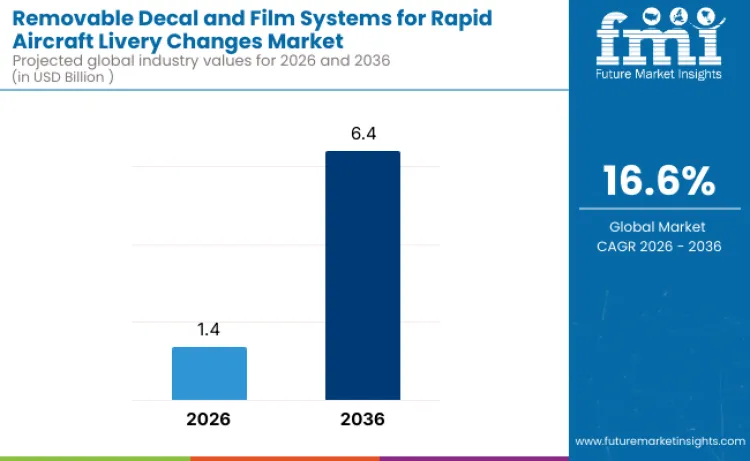
The removable decal and film systems for rapid aircraft livery changes market is valued at USD 1.4 billion in 2026 and is projected to reach USD 6.4 billion by 2036, reflecting a CAGR of 16.6%. Demand rises as airlines adopt flexible branding strategies, seasonal campaigns, and partnership liveries requiring rapid, low-downtime exterior customization. Growth is reinforced by leasing operators seeking reversible, non-destructive livery options that preserve aircraft residual value.
High-durability PVC-free aircraft graphic films lead film-type adoption because they offer reduced environmental impact, strong UV resistance, and improved conformability over complex fuselage contours. Enhanced adhesive systems enable clean removability without substrate damage, while advanced printing technologies deliver high-resolution graphics and consistent color longevity. Lightweight constructions help maintain aerodynamic efficiency and ease installation workflows.
China, India, USA, and Japan function as key global growth regions due to expanding fleet sizes, active MRO ecosystems, and increased use of promotional liveries. 3M, Avery Dennison, Sherwin-Williams Aerospace Coatings, AkzoNobel, and Mankiewicz shape competitive momentum through next-generation PVC-free film platforms, optimized adhesive chemistries, and integrated livery-change solutions designed for rapid, cost-effective aircraft exterior branding.
Quick Stats for Removable Decal and Film Systems for Rapid Aircraft Livery Changes Market
- Market Value (2026): USD 1.4 billion
- Market Forecast Value (2036): USD 6.4 billion
- Market Forecast CAGR (2026-2036): 16.6%
- Leading Film Type in Global Demand: High-durability PVC-free aircraft graphic films
- Key Growth Regions in Global Demand: China, India, USA, Japan
- Top Players in Global Demand: 3M, Avery Dennison, Sherwin-Williams Aerospace Coatings, AkzoNobel, Mankiewicz
Removable Decal and Film Systems for Rapid Aircraft Livery Changes Market Key Takeaways
| Metric | Value |
|---|---|
| Market Value (2026) | USD 1.4 billion |
| Market Forecast Value (2036) | USD 6.4 billion |
| Forecast CAGR (2026-2036) | 16.6% |
How Are the Segments Classified in the Removable Decal and Film Systems for Rapid Aircraft Livery Changes Market?
Demand for removable decal and film systems is shaped by frequent branding-change needs, reduced aircraft downtime, and interest in lightweight alternatives to repaint cycles. Buyers evaluate adhesion strength, weathering stability, drag impact, and compatibility with curved composite and metallic aircraft surfaces. Adoption patterns reflect airline requirements for short-term promotional wraps, rapid fleet rebranding, and protective overlay films that maintain exterior integrity during operational exposure.
Which Film Type Accounts for the Largest Share of Global Demand?
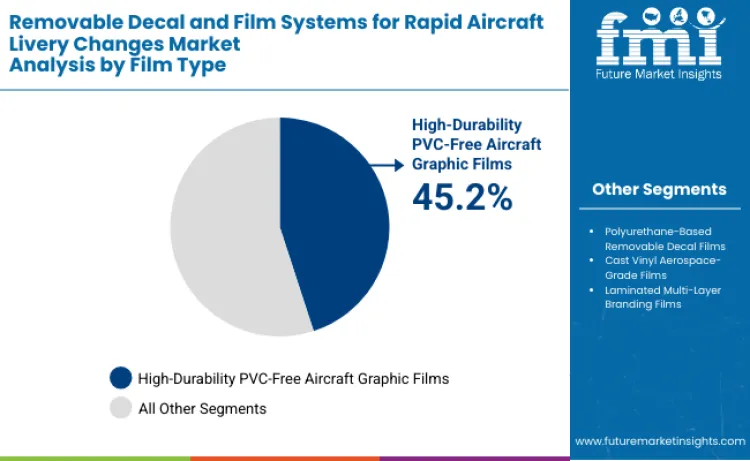
High-durability PVC-free aircraft graphic films hold 45.2%, making them the leading film-type segment globally. These films reduce environmental impact, deliver strong dimensional stability, and maintain adhesion without residue after removal. Polyurethane-based removable decal films support flexibility and durability across compound-curved airframe sections. Cast vinyl aerospace-grade films provide smooth finishes suited to detailed branding. Laminated multi-layer branding films combine print protection with surface durability for extended installations. Film-type distribution reflects increased adoption of PVC-free formats aligned with operational and sustainability requirements.
Key Points:
- PVC-free films provide stable adhesion with clean removability.
- Polyurethane films support flexibility for complex geometries.
- Cast vinyl films deliver smooth, high-resolution branding surfaces.
- Laminated films extend durability for longer promotional cycles.
Which Functional Attribute Represents the Largest Share of Global Demand?
Rapid-change branding films hold 44.1%, making them the largest functional-attribute segment. These films enable fast installation and removal to minimize aircraft downtime during rebranding or promotional updates. UV-resistant and weathering-stable films support exterior durability across long flights and variable climates. Lightweight low-drag surface films help maintain aerodynamic smoothness without added mass. Anti-corrosion protective overlay films shield fuselage coatings from abrasion and environmental exposure. Functional-attribute distribution reflects airline interest in rapid branding turnover with minimal operational disruption.
Key Points:
- Rapid-change films reduce downtime during livery updates.
- UV-stable films maintain visual quality under harsh exposure.
- Low-drag films preserve aerodynamic efficiency.
- Protective overlays extend coating life on exposed aircraft surfaces.
Which Application Area Accounts for the Largest Share of Global Demand?
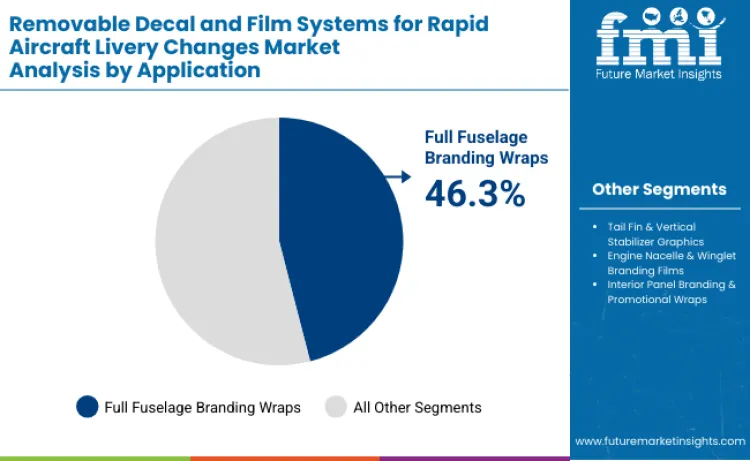
Full fuselage branding wraps hold 46.3%, making them the leading application-area segment. These wraps cover extensive aircraft surfaces and require films with strong conformability, removability, and resistance to operational stress. Tail fin and vertical stabilizer graphics support high-visibility branding areas with aerodynamic sensitivity. Engine nacelle and winglet branding films withstand airflow shear and temperature variability. Interior panel branding and promotional wraps support short-term campaigns within cabins. Application-area distribution reflects high branding impact and surface-area demand associated with full fuselage wraps.
Key Points:
- Fuselage wraps require durable, conformable removable films.
- Tail fins provide high-visibility branding zones.
- Nacelles and winglets require shear- and temperature-tolerant films.
- Interior wraps support short-duration promotional applications.
What are the Key Dynamics in the Removable Decal and Film Systems for Rapid Aircraft Livery Changes Market?
Global demand rises as airlines, leasing companies, and marketing teams adopt removable decal and film systems that enable rapid branding updates without traditional repaint cycles. Films support short-term promotions, fleet harmonization, and lease transitions while reducing aircraft downtime. Operators value lightweight materials, simplified application, and minimal curing requirements. Interest expands as digital printing advances improve color accuracy, durability, and design flexibility across large aircraft surfaces.
How are branding agility needs and operational efficiency goals shaping adoption of removable livery film systems?
Airlines pursue flexible branding solutions that accommodate seasonal campaigns, co-branded partnerships, and frequent fleet rotations. Removable decals reduce aircraft grounding time by allowing quick installation and removal compared with multi-layer paint processes. Digital-print films deliver high-resolution graphics tailored to fuselage contours and composite panels. Leasing companies use films to streamline transitions between operators. Maintenance teams value reduced masking, surface preparation, and curing times. Films designed for aerodynamic compatibility minimize drag impact. Demand grows across charter, cargo, and regional fleets seeking cost-effective visual differentiation without long-term paint commitments.
How do durability expectations, substrate compatibility, and regulatory considerations influence scalability?
Films must withstand UV exposure, rain erosion, temperature cycles, and jet blast without peeling or color degradation. Adhesive formulations require reliable adhesion to aluminium and composite fuselages while ensuring clean removal with minimal residue. Regulatory rules govern placement of safety markings, mandating integration with film layouts. Application processes require controlled environments to avoid bubbles, wrinkles, or surface defects that affect aerodynamic smoothness. MRO facilities need training for large-format film handling. Variability in climate across global routes influences film lifespan. Airlines evaluate total lifecycle cost, balancing durability with the flexibility advantages of removable systems.
How is Demand for Removable Decal and Film Systems for Rapid Aircraft Livery Changes Market Evolving Across Key Countries?
Demand for the removable decal and film systems for rapid aircraft livery changes market is rising due to increasing fleet-utilization rates, interest in reducing repaint downtime, and broader use of lightweight film-based branding solutions. China records a CAGR of 17.9% supported by rapid airline expansion. India shows a 17.2% CAGR driven by growing regional and low-cost carrier activity. USA posts a 16.0% CAGR supported by strong MRO and branding-innovation programs. Japan holds a 15.1% CAGR linked with precision material development. UK records a 14.6% CAGR supported by efficiency-driven fleet-modernization needs.
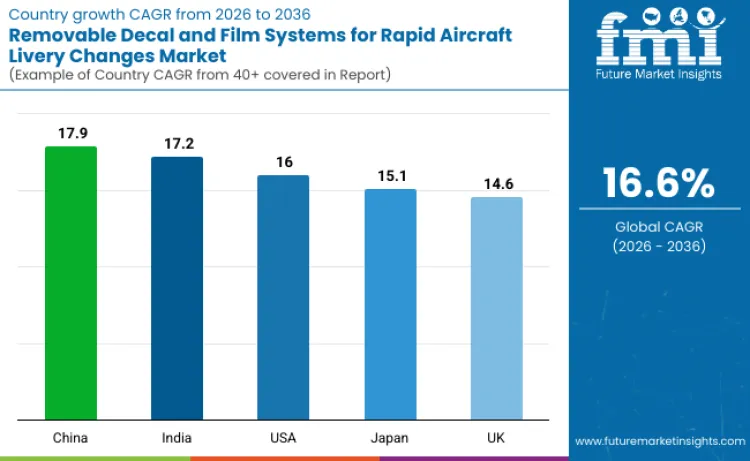
| Country | CAGR (%) |
|---|---|
| China | 17.9% |
| India | 17.2% |
| USA | 16.0% |
| Japan | 15.1% |
| UK | 14.6% |
How is China driving demand for Removable Decal and Film Systems for Rapid Aircraft Livery Changes?
China drives demand due to rapid commercial-fleet growth, high promotional-cycle frequency, and strong interest in minimizing aircraft downtime for livery updates. The country’s CAGR of 17.9% reflects adoption of lightweight adhesive film systems enabling quick application and removal. Airlines use decals for short-term campaigns requiring fast turnaround. Material suppliers develop UV-resistant and weather-stable films suited for wide-body and narrow-body fleets. MRO centers integrate specialized installation processes reducing operational disruption. National aviation expansion strengthens long-term demand for rapid-change livery solutions.
- Increased airline promotional activity raising decal usage
- Adoption of UV-resistant film systems for exterior durability
- Expansion of MRO capabilities supporting fast livery updates
- Fleet growth requiring flexible branding solutions
How is India driving demand for Removable Decal and Film Systems for Rapid Aircraft Livery Changes?
India supports rising demand due to strong growth of low-cost carriers, frequent branding updates, and operational pressure to reduce aircraft downtime. The country’s CAGR of 17.2% reflects adoption of removable decals enabling rapid fleet-wide campaigns. Airlines deploy film systems to support route launches, seasonal promotions, and partnership branding. Material suppliers introduce heat- and humidity-resistant films for varied climates. MRO facilities integrate standardized application protocols improving efficiency. Growth in domestic aviation reinforces interest in flexible livery solutions.
- Increased branding rotation among low-cost carriers
- Use of humidity-resistant decal materials
- MRO adoption of rapid-application processes
- Airline expansion strengthening demand for flexible livery systems
How is the USA driving demand for Removable Decal and Film Systems for Rapid Aircraft Livery Changes?
USA drives demand through strong fleet-modernization programs, heavy promotional activity, and interest in minimizing paint-related maintenance downtime. The country’s CAGR of 16.0% reflects deployment of advanced adhesive-film technologies offering durability, low mass, and controlled removability. Airlines adopt decals for sponsorships, marketing campaigns, and seasonal branding. Film manufacturers develop abrasion- and UV-resistant laminates suited for high-cycle operations. MRO facilities refine large-format installation processes reducing aircraft ground time. Research initiatives support compatibility with composite airframes.
- Development of abrasion- and UV-resistant decal films
- High promotional activity driving frequent livery changes
- MRO refinement of rapid-installation workflows
- Compatibility testing for composite aircraft structures
How is Japan driving demand for Removable Decal and Film Systems for Rapid Aircraft Livery Changes?
Japan drives demand due to precision manufacturing standards, strong interest in material reliability, and controlled use of branding updates across regional and commercial fleets. The country’s CAGR of 15.1% reflects adoption of high-stability adhesive films providing consistent surface performance. Research institutes develop polymer-laminate systems optimized for long-term color retention. Airlines evaluate decals to avoid repaint downtime and maintain schedule reliability. Precision MRO operations support careful installation techniques aligned with airframe requirements.
- Development of polymer-laminate films with improved stability
- Airline use of decals to reduce repaint downtime
- Precision MRO processes enhancing application reliability
- Interest in long-term color and adhesion consistency
How is the UK driving demand for Removable Decal and Film Systems for Rapid Aircraft Livery Changes?
UK supports demand through strong participation in fleet-modernization programs, heavy branding usage across carriers, and interest in reducing operational downtime. The country’s CAGR of 14.6% reflects adoption of removable films supporting quick livery transitions for promotional and seasonal campaigns. Material suppliers develop weather-resistant films suited for variable climates. Airlines use decal systems to extend repaint intervals. MRO facilities integrate specialized installation and removal procedures improving operational efficiency.
- Increased airline usage of promotional decals
- Development of climate-resistant film technologies
- Use of decals to extend repaint intervals
- MRO integration of rapid-change livery capabilities
What is the competitive landscape of demand for removable decal and film systems for rapid aircraft livery changes globally?
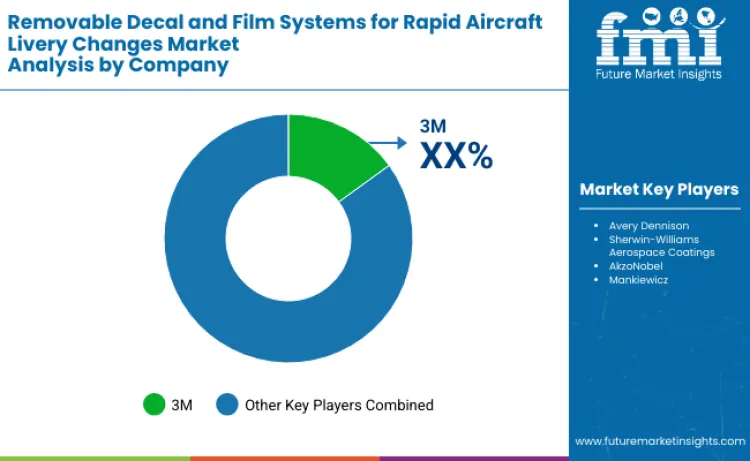
Demand for removable decal and film systems for rapid aircraft livery changes grows as airlines, leasing firms, and marketing partners pursue short-cycle branding without extended paint-shop downtime. Requirements center on adhesive systems that allow clean removal, UV-stable printable films, erosion resistance, and compatibility with composite and metallic exterior substrates. Buyers evaluate installation speed, conformability over complex contours, weight impact, and durability under varied environmental conditions.
Procurement teams prioritize certification readiness, maintenance predictability, and predictable performance across high-cycle aircraft exposed to weathering, wash operations, and aerodynamic loads. Trend in the global market reflects broader interest in time-efficient livery changes supporting seasonal campaigns, fleet transitions, and operational flexibility across mixed aircraft types.
Position strengthens through aviation-grade graphic films engineered for controlled adhesion, removability, and long-term exterior durability. Avery Dennison participates with pressure-sensitive films designed for aircraft exteriors requiring stable color, erosion resistance, and rapid application capability. Sherwin-Williams Aerospace Coatings maintains visibility with complementary decal systems integrated into its approved exterior paint platforms.
AkzoNobel supports demand through surface-preparation technologies and compatible protective coatings used beneath removable film installations. Mankiewicz contributes specialized surface systems that improve film adhesion and promote controlled removal within maintenance intervals. Competitive positioning globally reflects film durability, adhesive-engineering capability, certification compliance, and operational efficiency supporting rapid livery transitions.
Key Players in the Removable Decal and Film Systems for Rapid Aircraft Livery Changes Market
- 3M
- Avery Dennison
- Sherwin-Williams Aerospace Coatings
- AkzoNobel
- Mankiewicz
Scope of the Report
| Items | Values |
|---|---|
| Quantitative Units | USD billion |
| Film Type | High-Durability PVC-Free Aircraft Graphic Films; Polyurethane-Based Removable Decal Films; Cast Vinyl Aerospace-Grade Films; Laminated Multi-Layer Branding Films |
| Functional Attribute | Rapid-Change Branding Films; UV-Resistant & Weathering-Stable Films; Lightweight Low-Drag Surface Films; Anti-Corrosion Protective Overlay Films |
| Application Area | Full Fuselage Branding Wraps; Tail Fin & Vertical Stabilizer Graphics; Engine Nacelle & Winglet Branding Films; Interior Panel Branding & Promotional Wraps |
| End-User | Commercial Airlines; Aircraft OEMs; MRO & Paint/Wrap Installers; Aerospace Film & Material Manufacturers |
| Regions Covered | Asia Pacific, Europe, North America, Latin America, Middle East & Africa |
| Countries Covered | India, China, USA, Germany, South Korea, Japan, Italy, and 40+ countries |
| Key Companies Profiled | 3M; Avery Dennison; Sherwin-Williams Aerospace Coatings; AkzoNobel; Mankiewicz |
| Additional Attributes | Dollar sales by film type and functional attribute; adoption trends in rapid branding turnover for airline fleets; lifecycle performance of removable decal technologies compared with paint-based liveries; integration with low-drag aerodynamic film structures; regulatory compatibility for exterior aircraft surfaces; installation–removal efficiency metrics for MRO environments; advancements in PVC-free aerospace-grade graphic materials. |
Removable Decal and Film Systems for Rapid Aircraft Livery Changes Market by Segment
By Film Type:
- High-Durability PVC-Free Aircraft Graphic Films
- Polyurethane-Based Removable Decal Films
- Cast Vinyl Aerospace-Grade Films
- Laminated Multi-Layer Branding Films
By Functional Attribute:
- Rapid-Change Branding Films
- UV-Resistant & Weathering-Stable Films
- Lightweight Low-Drag Surface Films
- Anti-Corrosion Protective Overlay Films
By Application Area:
- Full Fuselage Branding Wraps
- Tail Fin & Vertical Stabilizer Graphics
- Engine Nacelle & Winglet Branding Films
- Interior Panel Branding & Promotional Wraps
By End-User:
- Commercial Airlines
- Aircraft OEMs
- MRO & Paint/Wrap Installers
- Aerospace Film & Material Manufacturers
Region:
- Asia Pacific
- China
- Japan
- South Korea
- India
- Australia & New Zealand
- ASEAN
- Rest of Asia Pacific
- Europe
- Germany
- United Kingdom
- France
- Italy
- Spain
- Nordic
- BENELUX
- Rest of Europe
- North America
- United States
- Canada
- Mexico
- Latin America
- Brazil
- Chile
- Rest of Latin America
- Middle East & Africa
- Kingdom of Saudi Arabia
- Other GCC Countries
- Turkey
- South Africa
- Other African Union
- Rest of Middle East & Africa
Frequently Asked Questions
What is the size of the removable decal and film systems for rapid aircraft livery changes market in 2026?
The market is valued at USD 1.4 billion in 2026 due to increased adoption of removable film technologies that reduce repainting requirements.
What will be the industry size by 2036?
Industry value will reach USD 6.4 billion by 2036 as airlines adopt rapid-change film systems for branding, partnerships, and seasonal operations.
What is the CAGR for 2026-2036?
The removable decal and film systems for rapid aircraft livery changes market expands at a 16.6% CAGR during the forecast period.
Which film-type segment leads in 2026?
High-durability PVC-free aircraft graphic films hold 45.2% share due to their environmental compliance, ease of application, and strong weather resistance.
Which functional-attribute segment holds the highest share?
Rapid-change branding films lead with 44.1% share, reflecting demand for fast-turnaround livery updates without extended maintenance downtime.
Preview the report firsthand - request a free sample
Get SampleGet the brochure for pricing and purchase details.
Get PDFTable of Content
- Executive Summary
- Removable Decal and Film Systems for Rapid Aircraft Livery Changes Market Overview
- Global Market Size and Value Analysis, 2020 to 2026
- Global Market Forecast and Growth Outlook, 2026 to 2036
- Aircraft Exterior Branding Value Chain and Workflow Analysis
- Livery Change Cycles and Airline Branding Economics
- Market Dynamics and Industry Fundamentals
- Key Market Drivers
- Operational and Technical Constraints
- Opportunities in Rapid Branding and Aircraft Leasing Transitions
- Certification, Safety Marking, and Regulatory Considerations
- Market Segmentation Analysis by Film Type
- High-Durability PVC-Free Aircraft Graphic Films
- Polyurethane-Based Removable Decal Films
- Cast Vinyl Aerospace-Grade Films
- Laminated Multi-Layer Branding Films
- Market Segmentation Analysis by Functional Attribute
- Rapid-Change Branding Films
- UV-Resistant and Weathering-Stable Films
- Lightweight Low-Drag Surface Films
- Anti-Corrosion Protective Overlay Films
- Market Segmentation Analysis by Application Area
- Full Fuselage Branding Wraps
- Tail Fin and Vertical Stabilizer Graphics
- Engine Nacelle and Winglet Branding Films
- Interior Panel Branding and Promotional Wraps
- Market Segmentation Analysis by End-User
- Commercial Airlines
- Aircraft OEMs
- MRO and Paint Wrap Installation Providers
- Aerospace Film and Material Manufacturers
- Regional Market Analysis
- North America Market Analysis
- Latin America Market Analysis
- Western Europe Market Analysis
- Eastern Europe Market Analysis
- South Asia and Pacific Market Analysis
- East Asia Market Analysis
- Middle East and Africa Market Analysis
- Country-Level Market Analysis
- United States
- Canada
- Mexico
- Brazil
- Argentina
- Germany
- France
- United Kingdom
- Italy
- Spain
- Netherlands
- China
- India
- Japan
- South Korea
- ANZ
- GCC Countries
- South Africa
- Competitive Landscape Analysis
- Global Competitive Structure
- Market Share Analysis of Leading Film and Decal Suppliers
- Adhesive Technology Differentiation and Certification Positioning
- Strategic Partnerships with Airlines, OEMs, and MRO Networks
- Company Profiles
- Scope of the Report
- Research Methodology
- Assumptions and Acronyms


