

- Industry Size (2026)
- USD 980.0 Mn
- Forecast (2036)
- USD 2450.9 Mn
- CAGR (2026 to 2036)
- 9.6%
Automated Cage Handling Systems Market Forecast and Outlook 2026 to 2036
The automated cage handling systems market is likely to be valued at USD 980.0 million in 2026, and is projected to reach USD 2,450.9 million by 2036, registering a 9.6% CAGR over the forecast period. Demand growth is tied to structural changes in laboratory animal research operations where rising study volumes, higher cage densities, and stricter biosafety protocols increase pressure on manual handling workflows. Large vivariums and preclinical facilities face sustained labor intensity in cage transfer, washing, bedding change, and storage activities, which elevates ergonomic risk and contamination exposure. Automated cage handling systems address these constraints by standardizing material flow between clean and dirty zones, stabilizing throughput, and reducing dependence on repetitive manual tasks that limit operational consistency.
Adoption momentum is reinforced by regulatory scrutiny around animal welfare, reproducibility, and staff safety across pharmaceutical, CRO, and academic research environments. Automated handling reduces animal stress during transfers, supports controlled environmental conditions, and improves traceability through software-coordinated workflows. Facilities operating multi-room or high-barrier layouts benefit from predictable cage change cycles and reduced cross-zone movement. Investment decisions prioritize systems that integrate with existing cage washers, ventilated racks, and facility control platforms while maintaining uptime under continuous operation. Demand expansion reflects long-term efficiency optimization, compliance alignment, and biosafety assurance rather than short-term laboratory capacity additions.
Quick Stats for Automated Cage Handling Systems Market
- Automated Cage Handling Systems Market Value (2026): USD 980.0 million
- Automated Cage Handling Systems Market Forecast Value (2036): USD 2,450.9 million
- Automated Cage Handling Systems Market Forecast CAGR 2026 to 2036: 9.6%
- Leading Product Type by Demand Share: Robotic cage washing systems
- Fastest-Growing Countries: India, Brazil, China, USA, Germany
- Top Players in Global Demand: Tecniplast, Allentown, Getinge, BioZone, Lenderking
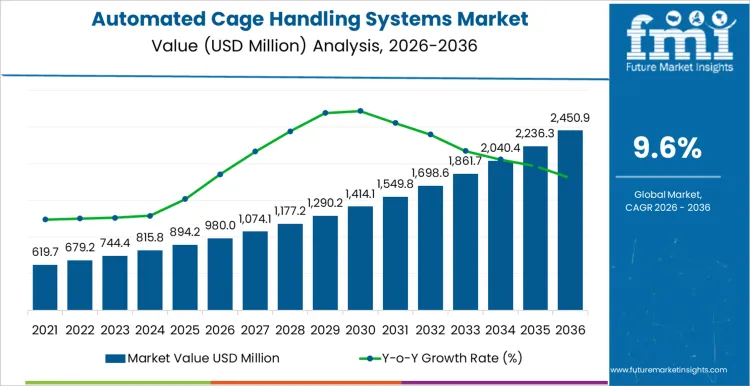
Automated Cage Handling Systems Market Key Takeaways
| Metric | Value |
|---|---|
| Market Value (2026) | USD 980.0 million |
| Market Forecast Value (2036) | USD 2,450.9 million |
| Forecast CAGR 2026 to 2036 | 9.6% |
Why is the Demand for Automated Cage Handling Systems Growing?
Demand for automated cage handling systems is increasing as pharmaceutical companies, contract research organizations, and academic institutions expand laboratory animal research under tightening biosafety, welfare, and reproducibility requirements. Vivariums managing high rodent populations operate continuous cage transfer, washing, bedding change, and storage cycles that place significant physical strain on staff and elevate contamination risk when performed manually. Automated cage handling systems reduce direct human contact with soiled cages, standardize material movement between clean and dirty zones, and stabilize throughput across high-density research facilities. Facility managers prioritize automation to maintain consistent daily operations, reduce ergonomic injuries, and sustain research timelines as study volumes increase.
Growth is reinforced by regulatory oversight and scientific expectations related to animal welfare, protocol consistency, and environmental control. Automated systems support predictable cage change intervals, controlled transfer conditions, and software-enabled traceability that aligns with institutional animal care guidelines and audit requirements. Integration with cage washers, individually ventilated cage racks, and facility management platforms enables synchronized workflows that minimize cross-room traffic and environmental variability. As vivarium layouts become more compartmentalized and study designs more complex, automation supports reproducibility while reducing operational disruption. These efficiency, compliance, and biosafety drivers are sustaining demand growth for automated cage handling systems as a core infrastructure investment in modern laboratory animal research facilities.
How Is the Automated Cage Handling Systems Industry Segmented by Product, Application, and End User?
Demand for automated cage handling systems is driven by rising laboratory animal volumes, biosecurity requirements, and labor optimization within research facilities. Institutions prioritize standardized handling, contamination risk reduction, and workflow consistency across vivarium operations. Adoption is influenced by regulatory oversight, reproducibility expectations, and pressure to improve staff safety. Purchasing behavior reflects facility scale, integration capability, and long-term operational efficiency objectives across pharmaceutical, academic, and contract research environments.
Why Do Robotic Cage Washing Systems Hold the Largest Share?
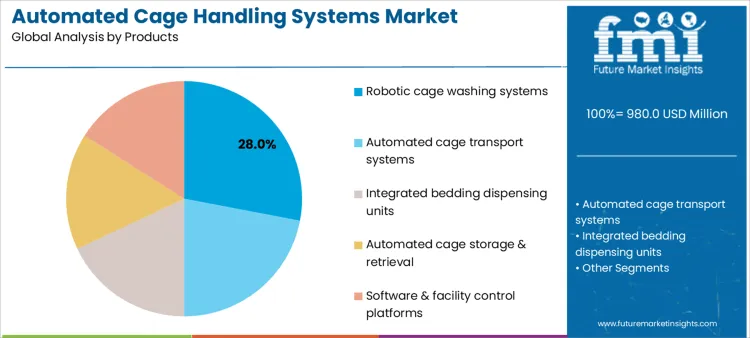
Robotic cage washing systems account for 28.0%, reflecting their central role in maintaining hygiene standards and throughput efficiency within animal facilities. These systems automate repetitive washing cycles, reduce manual handling, and support consistent sanitation outcomes. Automated cage transport systems at 22.0% improve internal logistics by reducing human movement between clean and dirty zones. Integrated bedding dispensing units at 18.0% standardize material usage and limit exposure risks. Automated cage storage and retrieval systems at 16.0% optimize space utilization in high-density facilities. Software and facility control platforms at 16.0% coordinate equipment, data logging, and compliance reporting across operations.
Key Points
- Cage washing automation supports hygiene and labor efficiency.
- Transport systems reduce cross-zone contamination risk.
- Software platforms enable centralized operational control.
How Does Application Segmentation Shape Demand for Automated Cage Handling Systems?
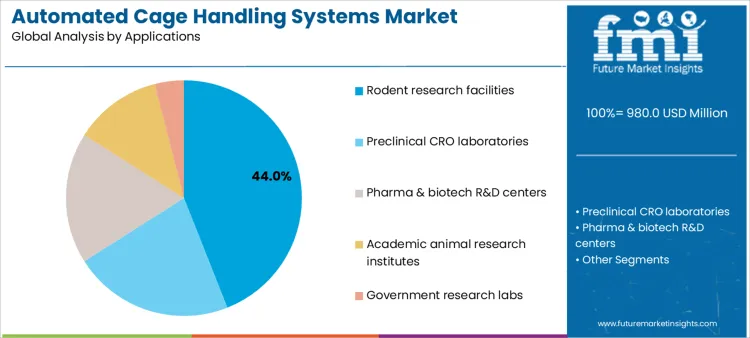
Rodent research facilities represent 44.0%, driven by high cage turnover and strict sanitation protocols in daily operations. Preclinical CRO laboratories at 22.0% rely on automation to manage multi-client studies and variable study volumes. Pharma and biotech R&D centers at 18.0% apply automated systems to support standardized internal research pipelines. Academic animal research institutes at 12.0% adopt automation selectively based on funding and facility scale. Government research labs at 4.0% deploy systems for long-term research programs with defined operational structures. Application segmentation reflects stronger demand where animal density, throughput, and compliance intensity are highest.
Key Points
- Rodent facilities generate continuous cage handling demand.
- CROs require flexibility across multiple studies.
- Academic adoption depends on scale and funding access.
Which Organizations Drive Adoption of Automated Cage Handling Systems?
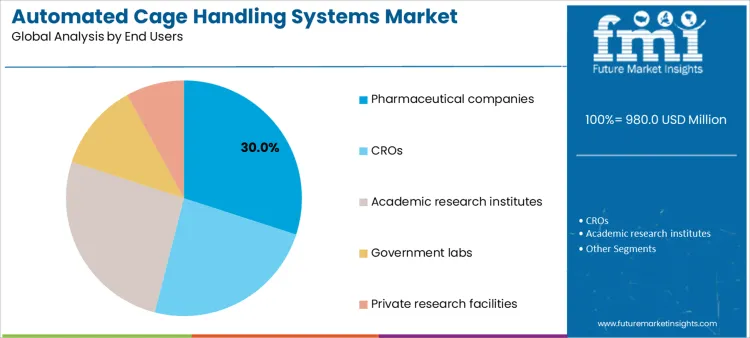
Pharmaceutical companies account for 30.0%, reflecting investment in large-scale vivarium infrastructure supporting internal research programs. Academic research institutes at 26.0% apply systems to improve reproducibility and staff safety within institutional facilities. CROs represent 24.0%, adopting automation to manage contract-driven workload variability. Government laboratories at 12.0% utilize systems within regulated research environments. Private research facilities at 8.0% implement automation selectively based on operational scale. End-user segmentation highlights adoption where long-term research activity, compliance responsibility, and operational efficiency requirements align.
Key Points
-
Pharmaceutical organizations invest in large-scale automation.
- Academic institutes focus on reproducibility and safety.
- CROs adopt systems to handle variable research demand.
What are the Key Dynamics in the Automated Cage Handling Systems Market?
Demand for automated cage storage handling systems reflects operational requirements to manage high-volume laboratory animal housing with consistency and biosafety. Adoption concentrates in pharmaceutical research facilities, contract research organizations, and academic vivariums. Global scope aligns with expansion of preclinical research capacity and stricter animal welfare oversight. Usage centers on robotic and conveyor-based systems that automate cage transport, washing, storage, and change-out within controlled environments.
How do labor efficiency pressures and biosafety control requirements shape adoption?
Large vivariums face repetitive, labor-intensive cage handling tasks that increase ergonomic risk and contamination exposure. Demand increases where manual workflows limit throughput and compromise environmental control. Automated systems standardize cage movement between housing rooms, wash areas, and storage, reducing human contact with soiled cages and allergens. Integration with individually ventilated cage racks supports consistent airflow management during transfers. Scheduling software coordinates cage change cycles to align with study protocols and staffing patterns. Facilities value reduced variability in sanitation outcomes and improved compliance with animal welfare standards. Adoption reflects operational need to improve labor utilization, reduce exposure risk, and maintain controlled conditions at scale.
How do facility integration complexity, capital intensity, and operational rigidity influence market scalability?
Automated cage handling requires facility-specific layout design, including ceiling heights, clean-dirty separation, and conveyor routing. Demand sensitivity rises where retrofitting existing vivariums disrupts ongoing studies. High upfront capital cost limits adoption to large or expanding facilities. System downtime risk necessitates redundancy planning and specialized maintenance support. Workflow rigidity reduces flexibility for protocol changes or mixed-species housing. Validation and biosafety certification add commissioning time. Space constraints restrict installation in urban research sites. Scalability remains constrained by integration complexity, capital requirements, and dependence on stable, high-throughput vivarium operations.
How Is Demand for Automated Cage Handling Systems Evolving Globally?
Demand for automated cage handling systems is expanding globally as research facilities prioritize biosecurity, labor efficiency, and reproducible animal care conditions. Growth in preclinical research, toxicology studies, and transgenic models increases cage throughput requirements. Automation reduces manual handling variability, improves ergonomics, and supports standardized workflows. Compliance with animal welfare regulations and audit readiness further accelerates adoption. Growth rates in India at 12.1%, Brazil at 11.6%, China at 11.2%, the USA at 8.0%, and Germany at 7.9% indicate sustained expansion driven by research capacity scaling, operational standardization, and biosafety assurance rather than simple facility expansion.
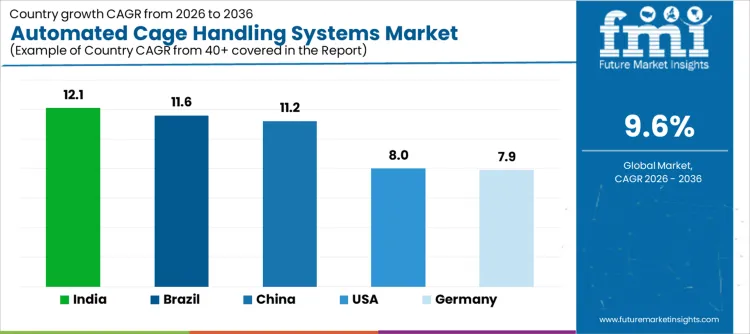
| Country | CAGR (%) |
|---|---|
| India | 12.1% |
| Brazil | 11.6% |
| China | 11.2% |
| USA | 8.0% |
| Germany | 7.9% |
What Is Driving Rapid Growth of Automated Cage Handling Demand in India?
Automated cage handling system demand in India is growing at a CAGR of 12.1%, supported by expansion of pharmaceutical R&D and contract research organizations. Increased preclinical testing volumes require high-throughput cage processing with minimal contamination risk. Facilities adopt automation to reduce labor dependency and improve consistency in cage washing, transfer, and storage. Regulatory oversight on animal welfare encourages standardized handling practices. Domestic integrators provide modular systems suitable for varied facility sizes. Growth reflects research ecosystem expansion, compliance alignment, and operational efficiency goals rather than isolated laboratory upgrades.
- Expansion of CRO and pharmaceutical preclinical research
- Need for high-throughput cage processing
- Emphasis on standardized animal welfare practices
- Availability of modular domestic automation solutions
Why Is Brazil Experiencing Strong Uptake of Automated Cage Handling Systems?
Automated cage handling demand in Brazil is expanding at a CAGR of 11.6%, driven by modernization of academic and public research facilities. National research institutes invest in automation to improve biosafety and reduce manual handling risks. Growth of toxicology and infectious disease research increases cage volume and processing frequency. Public funding supports infrastructure upgrades aligned with international standards. Regional service providers improve system installation and maintenance coverage. Growth reflects institutional modernization and biosafety priorities rather than rapid proliferation of new animal facilities.
- Modernization of public and academic research centers
- Increased toxicology and infectious disease studies
- Public funding for compliant infrastructure upgrades
- Improved regional installation and service support
How Is China Sustaining Momentum in Automated Cage Handling Adoption?
Automated cage handling system demand in China is growing at a CAGR of 11.2%, aligned with large-scale biomedical research expansion. High-density animal facilities require automated transfer and washing to maintain hygiene consistency. National research programs emphasize reproducibility and welfare compliance. Domestic manufacturers supply integrated systems compatible with large vivarium layouts. Centralized facility management enables efficient system utilization. Growth reflects scale-driven research operations and standardization mandates rather than discretionary technology upgrades.
- Expansion of large-scale biomedical research facilities
- High-density vivarium hygiene requirements
- National emphasis on reproducibility and welfare
- Availability of domestically manufactured integrated systems
What Factors Are Supporting Automated Cage Handling Demand in United States?
Automated cage handling system demand in the United States is expanding at a CAGR of 8.0%, supported by mature preclinical research infrastructure and labor efficiency needs. Large pharmaceutical and academic centers use automation to manage high cage turnover while reducing ergonomic strain. Compliance with AAALAC and institutional standards reinforces adoption. Replacement and upgrade demand sustains steady growth. Integration with digital facility management systems improves traceability. Growth reflects workflow optimization and compliance maintenance rather than expansion of animal research capacity.
- Labor efficiency and ergonomic risk reduction
- Compliance with AAALAC and institutional standards
- Replacement and upgrade cycles in existing facilities
- Integration with digital facility management tools
Why Is Germany Showing Measured Expansion in Automated Cage Handling Systems?
Automated cage handling demand in Germany is growing at a CAGR of 7.9%, shaped by stringent animal welfare regulation and engineering-led research environments. Certified facilities adopt automation to ensure consistent handling and documentation. Emphasis on staff safety and process traceability influences procurement decisions. Incremental upgrades integrate with existing vivarium infrastructure. Public funding oversight moderates deployment pace. Growth remains measured, reflecting compliance-driven optimization and quality governance rather than aggressive expansion of animal research programs.
- Stringent animal welfare and documentation requirements
- Focus on staff safety and handling consistency
- Incremental integration with existing infrastructure
- Disciplined, compliance-led procurement practices
What is the competitive landscape of demand for the automated cage handling systems market globally?
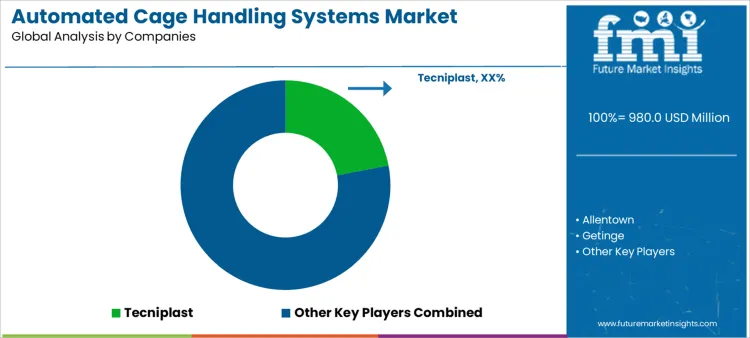
Demand for automated cage handling systems is driven by biosecurity standards, labor constraints, and throughput requirements in laboratory animal facilities. Vivarium managers evaluate cage transfer accuracy, decontamination integration, ergonomic risk reduction, uptime reliability, and compatibility with barrier workflows. Buyer assessment includes footprint optimization, scalability across room sizes, software traceability, and compliance with animal welfare protocols. Procurement behavior favors validated systems, service responsiveness, and long lifecycle support aligned with facility expansion plans. Trend in the automated cage handling systems market reflects increasing adoption in high-density research centers prioritizing contamination control, repeatability, and staff safety.
Tecniplast leads competitive positioning through integrated automation platforms combining cage handling, washing, and environmental monitoring for barrier facilities. Allentown competes with modular systems emphasizing throughput flexibility and compatibility with diverse cage formats. Getinge supports demand by aligning automated handling with sterilization, washers, and compliance-driven workflows. BioZone maintains relevance through bio-decontamination integration that complements automated transport and transfer operations. Lenderking participates by supplying automation components focused on material flow efficiency and ergonomic improvement. Competitive differentiation centers on workflow integration depth, validation strength, service coverage, and adaptability to evolving research protocols.
Key Players in the Automated Cage Handling Systems Market
- Tecniplast
- Allentown
- Getinge
- BioZone
- Lenderking
- Others
Scope of the Report
| Items | Values |
|---|---|
| Quantitative Units | USD million |
| Products | Robotic cage washing systems; Automated cage transport systems; Integrated bedding dispensing units; Automated cage storage & retrieval; Software & facility control platforms |
| Applications | Rodent research facilities; Preclinical CRO laboratories; Pharma & biotech R&D centers; Academic animal research institutes; Government research labs |
| End Users | Pharmaceutical companies; CROs; Academic research institutes; Government labs; Private research facilities |
| Regions Covered | Asia Pacific, Europe, North America, Latin America, Middle East & Africa |
| Countries Covered | India, Brazil, China, USA, Germany, and 40+ countries |
| Key Companies Profiled | Tecniplast; Allentown; Getinge; BioZone; Lenderking; Others |
| Additional Attributes | Dollar sales by product category, application, and end user; automation reliability and throughput efficiency across cage washing, transport, and storage systems; integration of bedding dispensing and facility control software to reduce manual handling; biosecurity and contamination control performance in high-density animal research environments; scalability aligned with pharma, CRO, and academic facility expansion; procurement dynamics shaped by capital budgeting cycles, regulatory compliance, and long-term service agreements. |
Automated Cage Handling Systems Market by Segment
Products:
- Robotic cage washing systems
- Automated cage transport systems
- Integrated bedding dispensing units
- Automated cage storage & retrieval
- Software & facility control platforms
Applications:
- Rodent research facilities
- Preclinical CRO laboratories
- Pharma & biotech R&D centers
- Academic animal research institutes
- Government research labs
End Users:
- Pharmaceutical companies
- CROs
- Academic research institutes
- Government labs
- Private research facilities
Region:
- Asia Pacific
- China
- Japan
- South Korea
- India
- Australia & New Zealand
- ASEAN
- Rest of Asia Pacific
- Europe
- Germany
- United Kingdom
- France
- Italy
- Spain
- Nordic
- BENELUX
- Rest of Europe
- North America
- United States
- Canada
- Mexico
- Latin America
- Brazil
- Chile
- Rest of Latin America
- Middle East & Africa
- Kingdom of Saudi Arabia
- Other GCC Countries
- Turkey
- South Africa
- Other African Union
- Rest of Middle East & Africa
Bibliography
- National Institutes of Health. (2023). Guide for the care and use of laboratory animals. U.S. Department of Health and Human Services.
- European Commission. (2023). Directive 2010/63/EU on the protection of animals used for scientific purposes (consolidated version). European Union.
- Organisation for Economic Co-operation and Development. (2023). OECD series on principles of good laboratory practice and compliance monitoring. OECD Publishing.
- International Organization for Standardization. (2023). ISO 14644-1: Cleanrooms and associated controlled environments – Classification of air cleanliness by particle concentration. ISO.
- World Organisation for Animal Health. (2023). Terrestrial animal health code: Laboratory animal welfare and housing standards. WOAH.
Frequently Asked Questions
How big is the automated cage handling systems market in 2026?
The global automated cage handling systems market is estimated to be valued at USD 980.0 million in 2026.
What will be the size of automated cage handling systems market in 2036?
The market size for the automated cage handling systems market is projected to reach USD 2,450.9 million by 2036.
How much will be the automated cage handling systems market growth between 2026 and 2036?
The automated cage handling systems market is expected to grow at a 9.6% CAGR between 2026 and 2036.
What are the key product types in the automated cage handling systems market?
The key product types in automated cage handling systems market are robotic cage washing systems, automated cage transport systems, integrated bedding dispensing units, automated cage storage & retrieval and software & facility control platforms.
Which applications segment to contribute significant share in the automated cage handling systems market in 2026?
In terms of applications, rodent research facilities segment to command 44.0% share in the automated cage handling systems market in 2026.
Preview the report firsthand - request a free sample
Get SampleGet the brochure for pricing and purchase details.
Get PDFTable of Content
- Executive Summary
- Global Market Outlook
- Demand-side Trends
- Supply-side Trends
- Technology Roadmap Analysis
- Analysis and Recommendations
- Market Overview
- Market Coverage / Taxonomy
- Market Definition / Scope / Limitations
- Market Background
- Market Dynamics
- Drivers
- Restraints
- Opportunity
- Trends
- Scenario Forecast
- Demand in Optimistic Scenario
- Demand in Likely Scenario
- Demand in Conservative Scenario
- Opportunity Map Analysis
- Product Life Cycle Analysis
- Supply Chain Analysis
- Investment Feasibility Matrix
- Value Chain Analysis
- PESTLE and Porter’s Analysis
- Regulatory Landscape
- Regional Parent Market Outlook
- Production and Consumption Statistics
- Import and Export Statistics
- Market Dynamics
- Global Market Analysis 2021 to 2025 and Forecast, 2026 to 2036
- Historical Market Size Value (USD Million) Analysis, 2021 to 2025
- Current and Future Market Size Value (USD Million) Projections, 2026 to 2036
- Y-o-Y Growth Trend Analysis
- Absolute $ Opportunity Analysis
- Global Market Pricing Analysis 2021 to 2025 and Forecast 2026 to 2036
- Global Market Analysis 2021 to 2025 and Forecast 2026 to 2036, By Products
- Introduction / Key Findings
- Historical Market Size Value (USD Million) Analysis By Products , 2021 to 2025
- Current and Future Market Size Value (USD Million) Analysis and Forecast By Products , 2026 to 2036
- Robotic cage washing systems
- Automated cage transport systems
- Integrated bedding dispensing units
- Automated cage storage & retrieval
- Software & facility control platforms
- Robotic cage washing systems
- Y-o-Y Growth Trend Analysis By Products , 2021 to 2025
- Absolute $ Opportunity Analysis By Products , 2026 to 2036
- Global Market Analysis 2021 to 2025 and Forecast 2026 to 2036, By Applications
- Introduction / Key Findings
- Historical Market Size Value (USD Million) Analysis By Applications, 2021 to 2025
- Current and Future Market Size Value (USD Million) Analysis and Forecast By Applications, 2026 to 2036
- Rodent research facilities
- Preclinical CRO laboratories
- Pharma & biotech R&D centers
- Academic animal research institutes
- Government research labs
- Rodent research facilities
- Y-o-Y Growth Trend Analysis By Applications, 2021 to 2025
- Absolute $ Opportunity Analysis By Applications, 2026 to 2036
- Global Market Analysis 2021 to 2025 and Forecast 2026 to 2036, By End Users
- Introduction / Key Findings
- Historical Market Size Value (USD Million) Analysis By End Users, 2021 to 2025
- Current and Future Market Size Value (USD Million) Analysis and Forecast By End Users, 2026 to 2036
- Pharmaceutical companies
- CROs
- Academic research institutes
- Government labs
- Private research facilities
- Pharmaceutical companies
- Y-o-Y Growth Trend Analysis By End Users, 2021 to 2025
- Absolute $ Opportunity Analysis By End Users, 2026 to 2036
- Global Market Analysis 2021 to 2025 and Forecast 2026 to 2036, By Region
- Introduction
- Historical Market Size Value (USD Million) Analysis By Region, 2021 to 2025
- Current Market Size Value (USD Million) Analysis and Forecast By Region, 2026 to 2036
- North America
- Latin America
- Western Europe
- Eastern Europe
- East Asia
- South Asia and Pacific
- Middle East & Africa
- Market Attractiveness Analysis By Region
- North America Market Analysis 2021 to 2025 and Forecast 2026 to 2036, By Country
- Historical Market Size Value (USD Million) Trend Analysis By Market Taxonomy, 2021 to 2025
- Market Size Value (USD Million) Forecast By Market Taxonomy, 2026 to 2036
- By Country
- USA
- Canada
- Mexico
- By Products
- By Applications
- By End Users
- By Country
- Market Attractiveness Analysis
- By Country
- By Products
- By Applications
- By End Users
- Key Takeaways
- Latin America Market Analysis 2021 to 2025 and Forecast 2026 to 2036, By Country
- Historical Market Size Value (USD Million) Trend Analysis By Market Taxonomy, 2021 to 2025
- Market Size Value (USD Million) Forecast By Market Taxonomy, 2026 to 2036
- By Country
- Brazil
- Chile
- Rest of Latin America
- By Products
- By Applications
- By End Users
- By Country
- Market Attractiveness Analysis
- By Country
- By Products
- By Applications
- By End Users
- Key Takeaways
- Western Europe Market Analysis 2021 to 2025 and Forecast 2026 to 2036, By Country
- Historical Market Size Value (USD Million) Trend Analysis By Market Taxonomy, 2021 to 2025
- Market Size Value (USD Million) Forecast By Market Taxonomy, 2026 to 2036
- By Country
- Germany
- UK
- Italy
- Spain
- France
- Nordic
- BENELUX
- Rest of Western Europe
- By Products
- By Applications
- By End Users
- By Country
- Market Attractiveness Analysis
- By Country
- By Products
- By Applications
- By End Users
- Key Takeaways
- Eastern Europe Market Analysis 2021 to 2025 and Forecast 2026 to 2036, By Country
- Historical Market Size Value (USD Million) Trend Analysis By Market Taxonomy, 2021 to 2025
- Market Size Value (USD Million) Forecast By Market Taxonomy, 2026 to 2036
- By Country
- Russia
- Poland
- Hungary
- Balkan & Baltic
- Rest of Eastern Europe
- By Products
- By Applications
- By End Users
- By Country
- Market Attractiveness Analysis
- By Country
- By Products
- By Applications
- By End Users
- Key Takeaways
- East Asia Market Analysis 2021 to 2025 and Forecast 2026 to 2036, By Country
- Historical Market Size Value (USD Million) Trend Analysis By Market Taxonomy, 2021 to 2025
- Market Size Value (USD Million) Forecast By Market Taxonomy, 2026 to 2036
- By Country
- China
- Japan
- South Korea
- By Products
- By Applications
- By End Users
- By Country
- Market Attractiveness Analysis
- By Country
- By Products
- By Applications
- By End Users
- Key Takeaways
- South Asia and Pacific Market Analysis 2021 to 2025 and Forecast 2026 to 2036, By Country
- Historical Market Size Value (USD Million) Trend Analysis By Market Taxonomy, 2021 to 2025
- Market Size Value (USD Million) Forecast By Market Taxonomy, 2026 to 2036
- By Country
- India
- ASEAN
- Australia & New Zealand
- Rest of South Asia and Pacific
- By Products
- By Applications
- By End Users
- By Country
- Market Attractiveness Analysis
- By Country
- By Products
- By Applications
- By End Users
- Key Takeaways
- Middle East & Africa Market Analysis 2021 to 2025 and Forecast 2026 to 2036, By Country
- Historical Market Size Value (USD Million) Trend Analysis By Market Taxonomy, 2021 to 2025
- Market Size Value (USD Million) Forecast By Market Taxonomy, 2026 to 2036
- By Country
- Kingdom of Saudi Arabia
- Other GCC Countries
- Turkiye
- South Africa
- Other African Union
- Rest of Middle East & Africa
- By Products
- By Applications
- By End Users
- By Country
- Market Attractiveness Analysis
- By Country
- By Products
- By Applications
- By End Users
- Key Takeaways
- Key Countries Market Analysis
- USA
- Pricing Analysis
- Market Share Analysis, 2025
- By Products
- By Applications
- By End Users
- Canada
- Pricing Analysis
- Market Share Analysis, 2025
- By Products
- By Applications
- By End Users
- Mexico
- Pricing Analysis
- Market Share Analysis, 2025
- By Products
- By Applications
- By End Users
- Brazil
- Pricing Analysis
- Market Share Analysis, 2025
- By Products
- By Applications
- By End Users
- Chile
- Pricing Analysis
- Market Share Analysis, 2025
- By Products
- By Applications
- By End Users
- Germany
- Pricing Analysis
- Market Share Analysis, 2025
- By Products
- By Applications
- By End Users
- UK
- Pricing Analysis
- Market Share Analysis, 2025
- By Products
- By Applications
- By End Users
- Italy
- Pricing Analysis
- Market Share Analysis, 2025
- By Products
- By Applications
- By End Users
- Spain
- Pricing Analysis
- Market Share Analysis, 2025
- By Products
- By Applications
- By End Users
- France
- Pricing Analysis
- Market Share Analysis, 2025
- By Products
- By Applications
- By End Users
- India
- Pricing Analysis
- Market Share Analysis, 2025
- By Products
- By Applications
- By End Users
- ASEAN
- Pricing Analysis
- Market Share Analysis, 2025
- By Products
- By Applications
- By End Users
- Australia & New Zealand
- Pricing Analysis
- Market Share Analysis, 2025
- By Products
- By Applications
- By End Users
- China
- Pricing Analysis
- Market Share Analysis, 2025
- By Products
- By Applications
- By End Users
- Japan
- Pricing Analysis
- Market Share Analysis, 2025
- By Products
- By Applications
- By End Users
- South Korea
- Pricing Analysis
- Market Share Analysis, 2025
- By Products
- By Applications
- By End Users
- Russia
- Pricing Analysis
- Market Share Analysis, 2025
- By Products
- By Applications
- By End Users
- Poland
- Pricing Analysis
- Market Share Analysis, 2025
- By Products
- By Applications
- By End Users
- Hungary
- Pricing Analysis
- Market Share Analysis, 2025
- By Products
- By Applications
- By End Users
- Kingdom of Saudi Arabia
- Pricing Analysis
- Market Share Analysis, 2025
- By Products
- By Applications
- By End Users
- Turkiye
- Pricing Analysis
- Market Share Analysis, 2025
- By Products
- By Applications
- By End Users
- South Africa
- Pricing Analysis
- Market Share Analysis, 2025
- By Products
- By Applications
- By End Users
- USA
- Market Structure Analysis
- Competition Dashboard
- Competition Benchmarking
- Market Share Analysis of Top Players
- By Regional
- By Products
- By Applications
- By End Users
- Competition Analysis
- Competition Deep Dive
- Tecniplast
- Overview
- Product Portfolio
- Profitability by Market Segments (Product/Age /Sales Channel/Region)
- Sales Footprint
- Strategy Overview
- Marketing Strategy
- Product Strategy
- Channel Strategy
- Allentown
- Getinge
- BioZone
- Lenderking
- Others
- Tecniplast
- Competition Deep Dive
- Assumptions & Acronyms Used
- Research Methodology


