

- Industry Size (2026):
- USD 1.8 Bn
- Forecast (2036):
- USD 5.2 Bn
- CAGR (2026 to 2036)
- 11.2%
Sustainable Jet Fuel Microalgae Market Forecast and Outlook 2026 to 2036
The sustainable jet fuel microalgae market is projected to reach USD 5.2 billion by 2036, growing at a CAGR of 11.2% from its 2026 valuation of USD 1.8 billion. Dominant players in this market defend pricing power through advanced production technologies and exclusive access to high-quality microalgae strains, enabling them to set premium prices. Entry barriers are upheld by significant capital investment requirements and the specialized knowledge needed to scale production. Regulatory approvals and long development timelines also limit new entrants, further solidifying the position of established players. Fragmentation in the market persists due to the high level of technological innovation and the growing number of niche players focused on specific applications. However, as larger firms expand their production capacities and acquire smaller innovators, the degree of fragmentation may narrow over time. Ultimately, larger companies are positioned to control more of the market through vertical integration and strategic partnerships.
Quick Stats for the Sustainable Jet Fuel Microalgae Market
- Sustainable Jet Fuel Microalgae Market Value (2026): USD 1.8 billion
- Sustainable Jet Fuel Microalgae Market Forecast Value (2036): USD 5.2 billion
- Sustainable Jet Fuel Microalgae Market Global Forecast CAGR (2026-2036): 11.2%
- Sustainable Jet Fuel Microalgae Market Leading Segment: Commercial Aviation (56%)
- Key Growth Regions in Sustainable Jet Fuel Microalgae Market: China
- Top Players in Sustainable Jet Fuel Microalgae Market: ExxonMobil (Algae Biofuels JV), Shell Aviation (Sustainable Fuels), Total Energies (SAF Programs), Lanza Tech / Lanza Jet (Algal SAF Partner), Air Company
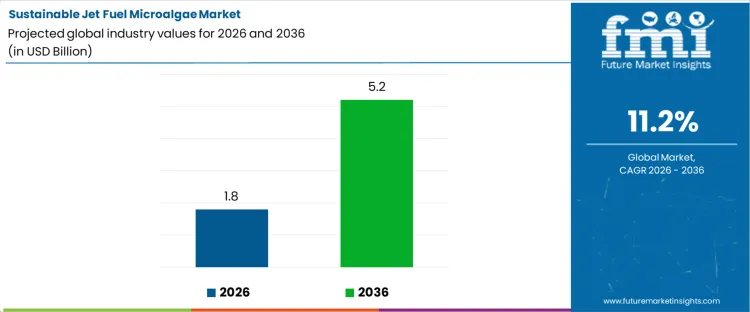
What is the Growth Forecast for the Sustainable Jet Fuel Microalgae Market through 2036?
The sustainable jet fuel microalgae market is expected to experience robust growth through 2036, driven by the increasing need for eco-friendly alternatives to traditional aviation fuels. The market is projected to grow at a CAGR of 11.2%, with an estimated value of USD 5.2 billion by 2036. This growth is propelled by technological advancements in microalgae cultivation and fuel conversion processes, which are making the production of sustainable jet fuel more economically viable. Additionally, increasing investments in green aviation technologies and growing support from governments for low-carbon aviation fuels will continue to support market expansion.
The next decade will likely see a steady rise in the adoption of sustainable jet fuel derived from microalgae, as airlines and governments work towards achieving environmental goals. By 2036, the market will play a significant role in reducing the carbon footprint of air travel, contributing to the broader efforts to achieve sustainability within the aviation sector. With the aviation industry's focus on environmental responsibility, the demand for sustainable jet fuel will continue to increase, establishing a vital market for microalgae-based biofuels.
Sustainable Jet Fuel Microalgae Market Key Takeaways
| Metric | Value |
|---|---|
| Industry Sales Value (2026) | USD 1.8 billion |
| Industry Forecast Value (2036) | USD 5.2 billion |
| Industry Forecast CAGR 2026 to 2036 | 11.2% |
What Is Driving the Sustainable Jet Fuel Microalgae Market?
Historically, the sustainable jet fuel microalgae market developed from early research into biofuels as alternatives to fossil derived aviation fuels. Conventional jet fuel production relied almost exclusively on crude oil refining, which delivered high energy density and established supply chains but posed climate impact concerns. Early biofuel initiatives focused on first generation feedstocks such as vegetable oils and animal fats, which competed with food uses and showed limited greenhouse gas reductions on a lifecycle basis. Microalgae emerged as a promising feedstock because of rapid biomass growth rates and high lipid content, enabling potential conversion into hydrocarbons compatible with existing jet engines. Initial efforts were concentrated in laboratory and pilot scale programs funded by governments and research consortia, aimed at understanding cultivation systems, strain selection, and oil extraction technologies. These initiatives highlighted challenges including high production costs, energy intensive processing, and the need for large scale photobioreactor or open pond infrastructure. Engagement by aircraft manufacturers and regulatory bodies laid the groundwork for certification pathways and fueled incremental investments in demonstration projects.
Future demand for sustainable jet fuel microalgae is expected to be driven by aviation decarbonization mandates, corporate net zero targets, and increasing recognition of lifecycle emissions in airline procurement policies. Airlines and fuel producers are anticipated to accelerate offtake agreements for microalgae derived fuel as governments implement regulations that constrain carbon emissions and incentivize low carbon fuels through credits or blending mandates. Technological advances in strain engineering, nutrient recycling, and integrated biorefinery models are projected to reduce costs and improve yields, making microalgae based jet fuel more competitive with conventional and other biojet alternatives. Expansion of sustainable aviation fuel (SAF) certification and investment in processing facilities that link algae cultivation with carbon capture sources will influence market growth. Remaining challenges include scaling cultivation infrastructure, securing reliable low cost CO2 and water resources, and navigating complex certification for new fuel pathways. Long term market prospects will depend on how effectively the industry demonstrates consistent production at commercial scale, aligns with regulatory frameworks, and integrates into airline fuel supply chains with quantifiable environmental benefits.
What are the Key Segments in the Sustainable Jet Fuel Microalgae Market?
The Sustainable Jet Fuel Microalgae market is divided into technology routes and end uses. The technology routes include hydrothermal liquefaction, transesterification + upgrading, pyrolysis & catalytic cracking, and gasification-based routes, with hydrothermal liquefaction holding the largest market share. On the end-use side, commercial aviation leads the market, accounting for 56% of the share, followed by military aviation, business & general aviation, and other sectors. The rising demand for environmentally sustainable fuel alternatives in the aviation industry is driving the growth of this market. The microalgae-derived jet fuel is seen as a promising solution due to its low carbon footprint and the potential to meet stringent emission regulations in aviation. Key regions driving this market include North America, Europe, and Asia Pacific, where advancements in biofuel technologies and strong governmental policies are fostering the development of sustainable aviation fuels.
What is Driving Growth in the Hydrothermal Liquefaction Technology Route?
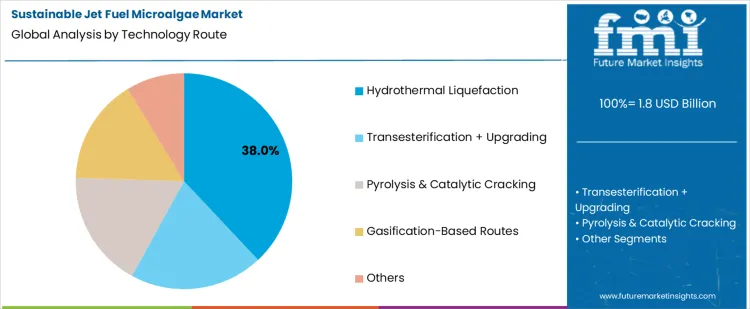
Hydrothermal liquefaction (HTL) is the leading technology route in the Sustainable Jet Fuel Microalgae market, accounting for 38% of the market share. HTL is favored due to its ability to convert microalgae biomass directly into a high-quality, renewable fuel that can be used in aviation without requiring significant upgrading or modifications to existing engines. This technology is highly efficient in producing jet fuel with a low carbon footprint, making it an attractive option for the aviation industry, particularly in regions with stringent emissions regulations. The growing demand for sustainable aviation fuels, especially in commercial aviation, is propelling the adoption of HTL. In commercial aviation, which represents 56% of the end-use segment, airlines are under increasing pressure to reduce greenhouse gas emissions and meet sustainability goals. HTL offers a scalable solution, as it can process large amounts of microalgae biomass in a cost-effective manner. Additionally, HTL produces a wide range of biofuels that can be tailored to meet the specific fuel requirements of the aviation industry. The technology is gaining traction in North America and Europe, where several government initiatives and subsidies are supporting the development of sustainable jet fuel. The continued advancement of HTL technology, including improved yields and efficiency, is expected to drive further growth in this segment.
What is Driving the Growth of Commercial Aviation in the Sustainable Jet Fuel Microalgae Market?
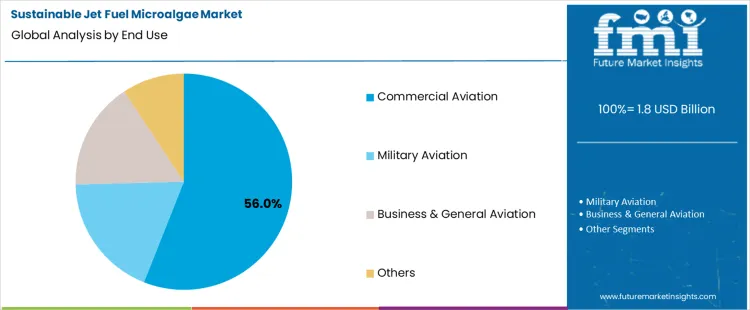
Commercial aviation is the largest end-use segment in the Sustainable Jet Fuel Microalgae market, accounting for 56% of the market share. This growth is primarily driven by the aviation industry's need to meet stringent global emissions standards while reducing its reliance on fossil-based fuels. As governments around the world set ambitious carbon-neutral targets, airlines are increasingly adopting sustainable fuel solutions, such as microalgae-derived jet fuel, to reduce their environmental impact. The aviation industry is one of the largest contributors to global carbon emissions, and as the demand for air travel increases, the pressure to find sustainable alternatives grows. Microalgae-based jet fuel offers a viable solution, as it has the potential to significantly reduce lifecycle greenhouse gas emissions compared to traditional jet fuels. In regions like North America and Europe, where regulatory frameworks are encouraging the transition to sustainable aviation fuels, the demand for microalgae-derived jet fuel is expected to rise. Furthermore, advancements in fuel production technologies, such as hydrothermal liquefaction, are making microalgae-derived fuels more economically competitive with conventional jet fuels. The scalability and sustainability of microalgae-based fuels are key factors in driving their adoption in commercial aviation, making them an integral part of the aviation sector’s long-term sustainability strategy.
What are the Key Dynamics in the Sustainable Jet Fuel Microalgae Market?
The sustainable jet fuel microalgae market is gaining momentum as part of the broader effort to reduce carbon emissions and dependence on fossil fuels in aviation. Microalgae-based jet fuel, often produced through the conversion of algae biomass into lipids or hydrocarbons, offers a promising alternative to traditional jet fuel due to its renewable nature and lower carbon footprint. As the aviation industry faces increasing pressure to meet stricter environmental regulations and sustainability targets, microalgae-based biofuels are viewed as an essential solution. The market is driven by technological advancements in algae cultivation, genetic engineering, and fuel conversion processes that improve the economic feasibility and scalability of algae-based jet fuel. The growing demand for sustainable aviation fuels (SAF) and support from global regulatory frameworks further propel market growth.
What are the Key Drivers of Growth in the Sustainable Jet Fuel Microalgae Market?
Key drivers of growth in the sustainable jet fuel microalgae market include the increasing global focus on reducing carbon emissions and achieving net-zero targets in aviation. Governments and international organizations are incentivizing the development and adoption of alternative fuels, including SAF, which provides a direct growth opportunity for algae-based fuels. Advances in algae cultivation techniques, such as optimized photobioreactor systems and genetically modified algae strains, have significantly increased biomass productivity, making the fuel more economically competitive. In addition, the aviation industry's long-term sustainability goals and rising public demand for greener air travel contribute to the growing interest in algae-derived jet fuel. Partnerships between airlines, governments, and biofuel companies are further accelerating research and development to make algae-based jet fuel a mainstream aviation solution.
What are the Key Restraints in the Sustainable Jet Fuel Microalgae Market?
The sustainable jet fuel microalgae market faces several challenges that can hinder its widespread adoption. High production costs are a significant restraint, as large-scale algae cultivation and fuel conversion technologies remain expensive compared to conventional fossil-based jet fuel. The infrastructure required to process algae into jet fuel is still under development, which adds complexity to the market's scalability. Additionally, the efficiency of algae-based fuel production is dependent on factors like nutrient availability, climate conditions, and the development of effective harvesting techniques. The variability in algae yields, along with the large-scale investment needed in both infrastructure and research, poses a barrier to achieving commercial competitiveness. These factors contribute to slower progress toward making algae-derived jet fuel a viable alternative for the aviation sector.
What are the Key Trends in the Sustainable Jet Fuel Microalgae Market?
Key trends in the sustainable jet fuel microalgae market include significant advancements in algae-based biofuel technology and increasing investment in research to optimize algae strains for higher oil yields and better fuel performance. Companies and research institutions are focusing on scaling up photobioreactor systems, which offer controlled environments for algae cultivation, enabling consistent and large-scale biomass production. There is also a growing trend of collaborations between the aviation industry, governments, and biofuel producers, aiming to meet the rising demand for SAF while adhering to sustainability regulations. Furthermore, the market is experiencing a shift toward integrating algae biofuels into hybrid systems, where they can be blended with conventional jet fuels, helping to ease the transition to cleaner aviation fuels. As regulatory support for sustainable fuels intensifies, microalgae-based jet fuel is expected to play a more prominent role in the decarbonization of the aviation industry.
What is the Country-Wise Analysis of the Sustainable Jet Fuel Microalgae Market?
The sustainable jet fuel microalgae market is growing rapidly in key regions including the USA, China, the UK, Japan, and India. This growth is largely driven by the need to reduce greenhouse gas emissions in the aviation industry and the increasing demand for renewable and environmentally friendly fuel alternatives. Microalgae-based jet fuel is considered a promising solution due to its potential for high energy output and minimal environmental impact. Each of these countries is focusing on expanding their renewable energy infrastructure, and sustainable jet fuel made from microalgae is being seen as a critical component in transitioning to a more sustainable aviation sector. Market dynamics in these regions are influenced by local government policies, technological advancements in biofuel production, and the increasing demand for greener solutions in the aviation industry.
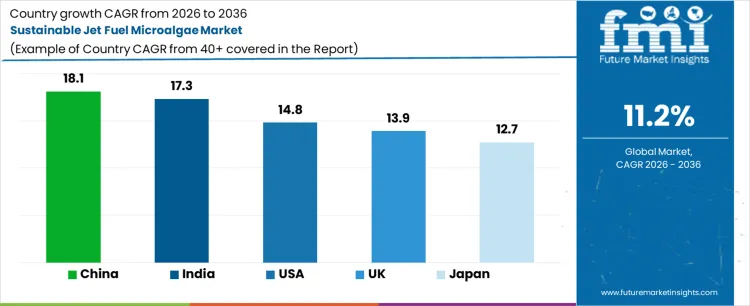
| Country | CAGR 2026 to 2036 |
|---|---|
| USA | 14.8% |
| China | 18.1% |
| UK | 13.9% |
| Japan | 12.7% |
| India | 17.3% |
What is Driving the Growth of the Sustainable Jet Fuel Microalgae Market in the USA?
The sustainable jet fuel microalgae market in the USA is expanding at a CAGR of 14.8%. This growth is driven by significant investments in renewable energy and biofuels, as the country strives to meet carbon reduction targets set by both government and industry bodies. The aviation sector in the USA is increasingly turning to sustainable fuel sources to address environmental concerns, particularly in light of rising fuel emissions. Microalgae-based jet fuel, with its high energy content and lower carbon footprint, is seen as a viable alternative to traditional fossil fuels. Research and development in biofuel technologies, coupled with supportive government incentives for renewable energy, are expected to drive further growth in the market, positioning the USA as a key player in the global sustainable jet fuel sector.
How is the Sustainable Jet Fuel Microalgae Market Performing in China?
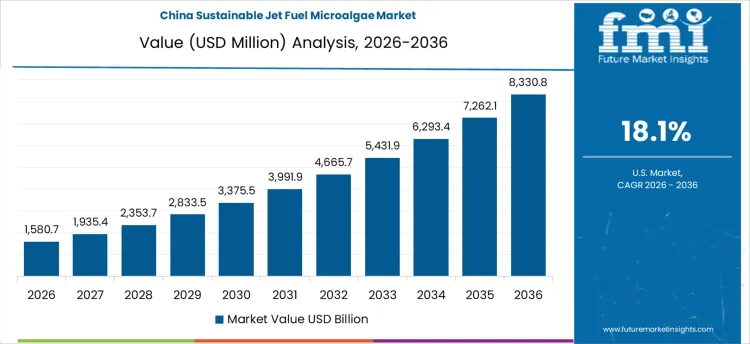
China’s sustainable jet fuel microalgae market is growing rapidly with a CAGR of 18.1%. As one of the world’s largest aviation markets, China is heavily investing in sustainable aviation fuel technologies. The country is actively pursuing the development of biofuels, particularly microalgae-based jet fuel, to reduce its dependency on traditional fossil fuels and lower its carbon emissions. China’s government has introduced various initiatives to support the growth of biofuels, including financial incentives and research grants for biofuel production. Additionally, as China continues to focus on environmental sustainability in all sectors, the aviation industry is shifting towards more sustainable fuel alternatives. The strong growth rate in China is indicative of the country's ambition to become a leader in green aviation solutions.
What Factors are Shaping the Sustainable Jet Fuel Microalgae Market in the UK?
The sustainable jet fuel microalgae market in the UK is expanding at a CAGR of 13.9%. The UK government has made significant strides in setting ambitious carbon reduction goals, which includes a strong push for sustainable aviation fuel. The UK aviation industry is under increasing pressure to meet stringent environmental regulations, and microalgae-based jet fuel offers a promising solution. Research and innovation in algae-based fuel technologies have accelerated in the UK, with several initiatives aimed at scaling up biofuel production. The aviation sector is seeing increased investment in renewable fuel options, and the UK’s leadership in clean energy technology is further driving the adoption of microalgae-based jet fuel as part of its broader efforts to achieve sustainability targets.
What is Contributing to the Growth of the Sustainable Jet Fuel Microalgae Market in Japan?
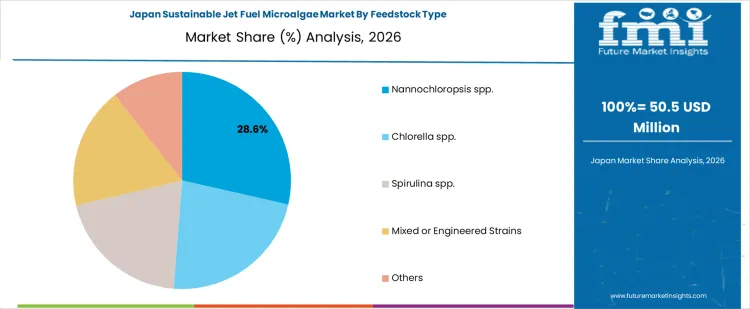
Japan’s sustainable jet fuel microalgae market is growing steadily, with a CAGR of 12.7%. Japan has been proactive in its efforts to reduce carbon emissions, and the aviation sector is increasingly exploring renewable fuel options, including microalgae-based jet fuel. With government support for the development of biofuels, Japan’s aviation industry is seeking alternative fuels to reduce its environmental impact. Japan’s emphasis on technological innovation, alongside the global shift towards more sustainable energy sources, positions the country well for the adoption of microalgae-based jet fuel. As Japan moves towards greener aviation practices, the market for sustainable jet fuel is expected to continue growing, with key players investing in biofuel research and production technologies.
What Factors Are Driving the Growth of the Sustainable Jet Fuel Microalgae Market in India?
The sustainable jet fuel microalgae market in India is growing at a CAGR of 17.3%. As the country faces rising demand for air travel, reducing aviation-related carbon emissions has become a priority. India’s government has introduced policies to support the development and use of sustainable aviation fuel, including microalgae-based jet fuel. The Indian aviation sector is increasingly looking to adopt biofuels to meet both domestic and international environmental standards. With India’s commitment to achieving its sustainability goals, the demand for microalgae-based jet fuel is expected to grow rapidly. The country’s burgeoning biofuel industry and its focus on renewable energy solutions are contributing to the expansion of the sustainable jet fuel market in India.
What is the Competitive Landscape for the Sustainable Jet Fuel Microalgae Market?
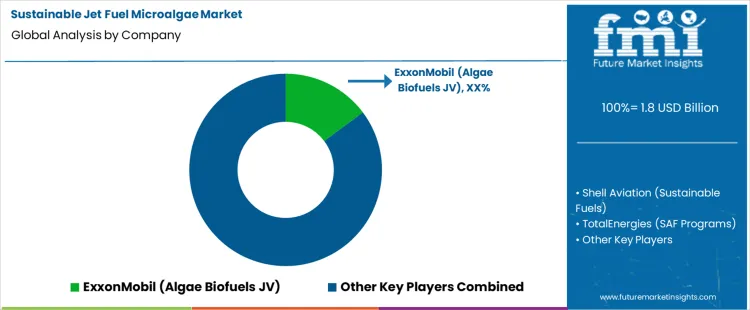
The sustainable jet fuel microalgae market is highly competitive, with major oil and energy companies leading the charge in the development of alternative fuels. ExxonMobil, through its Algae Biofuels joint venture, stands at the forefront of this market, focusing on algae-based biofuels as a renewable and sustainable solution for aviation. The company's significant investments in research and development, coupled with its expertise in large-scale production, have enabled it to maintain a strong market presence. Shell Aviation, with its focus on sustainable fuels, is another key player, working on scalable solutions that address the growing demand for low-carbon alternatives in the aviation sector. Total Energies is also investing in sustainable aviation fuel (SAF) programs, aiming to reduce the carbon footprint of air travel. Similarly, Lanza Tech and its subsidiary Lanza Jet, through their algae-based SAF partnerships, focus on developing cost-effective and environmentally friendly jet fuels. Other companies, including Air Company, are contributing to the market by utilizing innovative technologies to produce sustainable fuels from renewable resources, further intensifying competition.
In the sustainable jet fuel microalgae market, companies adopt a variety of strategies to maintain a competitive edge. Innovation in production processes is a key area of focus, with many firms working to scale algae biofuel production efficiently and economically. ExxonMobil’s partnership approach, combining its technological expertise with research-driven collaborations, is central to its strategy. Shell Aviation’s efforts in sustainable fuel development are aimed at securing long-term supply agreements with airlines, focusing on meeting regulatory requirements and reducing aviation sector emissions. Total Energies and LanzaTech are pursuing similar strategies, emphasizing partnerships with key stakeholders in the aviation industry and government to promote the adoption of SAF. Air Company leverages unique processes to capture carbon and convert it into sustainable fuel, further diversifying the solutions available in the market. These strategies, combined with the increasing demand for environmentally responsible fuels, are expected to drive market growth and solidify the positions of these companies in the competitive landscape of sustainable jet fuel microalgae.
Key Players of the Sustainable Jet Fuel Microalgae Market
- ExxonMobil (Algae Biofuels JV)
- Shell Aviation (Sustainable Fuels)
- TotalEnergies (SAF Programs)
- LanzaTech / LanzaJet (Algal SAF Partner)
- Air Company
- Others
Scope of the Report
| Items | Values |
|---|---|
| Quantitative Units (2026) | USD Billion |
| Feedstock Type | Nannochloropsis spp., Chlorella spp., Spirulina spp., Mixed or Engineered Strains, Others |
| Technology Route | Hydrothermal Liquefaction, Transesterification + Upgrading, Pyrolysis & Catalytic Cracking, Gasification-Based Routes, Others |
| End Use | Commercial Aviation, Military Aviation, Business & General Aviation, Others |
| Companies | ExxonMobil (Algae Biofuels JV), Shell Aviation (Sustainable Fuels), TotalEnergies (SAF Programs), LanzaTech / LanzaJet (Algal SAF Partner), Air Company, Others |
| Regions Covered | North America, Latin America, Western Europe, Eastern Europe, South Asia and Pacific, East Asia, Middle East & Africa |
| Countries Covered | United States, Canada, Mexico, Brazil, Argentina, Germany, France, United Kingdom, Italy, Spain, Netherlands, China, India, Japan, South Korea, ANZ, GCC Countries, South Africa |
| Additional Attributes | Dollar sales by feedstock type, technology route, end use, and region. Includes market trends towards sustainability in aviation, cost-effectiveness, fuel efficiency, regulatory compliance, advancements in fuel production technologies, and the role of algae-based fuels in reducing aviation’s carbon footprint. |
Sustainable Jet Fuel Microalgae Market Segmentation
Feedstock Type:
- Nannochloropsis spp.
- Chlorella spp.
- Spirulina spp.
- Mixed or Engineered Strains
- Others
Technology Route:
- Hydrothermal Liquefaction
- Transesterification + Upgrading
- Pyrolysis & Catalytic Cracking
- Gasification-Based Routes
- Others
End Use:
- Commercial Aviation
- Military Aviation
- Business & General Aviation
- Others
Region:
- Asia Pacific
- China
- Japan
- India
- Australia & New Zealand
- ASEAN
- Rest of Asia Pacific
- Europe
- Germany
- United Kingdom
- France
- Italy
- Spain
- Nordic
- BENELUX
- Rest of Europe
- North America
- United States
- Canada
- Mexico
- Latin America
- Brazil
- Argentina
- Rest of Latin America
- Middle East & Africa
- Kingdom of Saudi Arabia
- Other GCC Countries
- South Africa
- Rest of Middle East & Africa
Bibliography
- International Energy Agency (IEA). (2023). Net Zero Aviation Fuel Pathways and Bio-Based Feedstocks: Policy and Technology Perspectives. IEA Publications.
- International Civil Aviation Organization (ICAO). (2024). Sustainable Aviation Fuel (SAF) Framework and Lifecycle Emissions Methodology. ICAO Environment Branch.
- National Renewable Energy Laboratory (NREL). (2024). Algal Biomass-Derived Jet Fuel: Process Optimization and Energy Lifecycle Assessment. NREL Technical Report.
- U.S. Department of Energy (DOE). (2023). Bioenergy Technologies Office Multi-Year Program Plan 2023 Update: Algae to Hydrocarbon Fuels. DOE Bioenergy Technologies Office.
- European Commission. (2024). ReFuelEU Aviation Regulation: Promoting Sustainable Aviation Fuel Across the EU. Directorate-General for Mobility and Transport.
Frequently Asked Questions
How big is the sustainable jet fuel microalgae market in 2026?
The global sustainable jet fuel microalgae market is estimated to be valued at USD 1.8 billion in 2026.
What will be the size of sustainable jet fuel microalgae market in 2036?
The market size for the sustainable jet fuel microalgae market is projected to reach USD 5.2 billion by 2036.
How much will be the sustainable jet fuel microalgae market growth between 2026 and 2036?
The sustainable jet fuel microalgae market is expected to grow at a 11.2% CAGR between 2026 and 2036.
What are the key product types in the sustainable jet fuel microalgae market?
The key product types in sustainable jet fuel microalgae market are Nannochloropsis spp., Chlorella spp., Spirulina spp, mixed or engineered strains and others.
Which technology route segment to contribute significant share in the sustainable jet fuel microalgae market in 2026?
In terms of technology route, hydrothermal liquefaction segment to command 38.0% share in the sustainable jet fuel microalgae market in 2026.
Preview the report firsthand - request a free sample
Get SampleGet the brochure for pricing and purchase details.
Get PDFTable of Content
- Executive Summary
- Global Market Outlook
- Demand-side Trends
- Supply-side Trends
- Technology Roadmap Analysis
- Analysis and Recommendations
- Market Overview
- Market Coverage / Taxonomy
- Market Definition / Scope / Limitations
- Market Background
- Market Dynamics
- Drivers
- Restraints
- Opportunity
- Trends
- Scenario Forecast
- Demand in Optimistic Scenario
- Demand in Likely Scenario
- Demand in Conservative Scenario
- Opportunity Map Analysis
- Product Life Cycle Analysis
- Supply Chain Analysis
- Investment Feasibility Matrix
- Value Chain Analysis
- PESTLE and Porter’s Analysis
- Regulatory Landscape
- Regional Parent Market Outlook
- Production and Consumption Statistics
- Import and Export Statistics
- Market Dynamics
- Global Market Analysis 2021 to 2025 and Forecast, 2026 to 2036
- Historical Market Size Value (USD Million) Analysis, 2021 to 2025
- Current and Future Market Size Value (USD Million) Projections, 2026 to 2036
- Y-o-Y Growth Trend Analysis
- Absolute $ Opportunity Analysis
- Global Market Pricing Analysis 2021 to 2025 and Forecast 2026 to 2036
- Global Market Analysis 2021 to 2025 and Forecast 2026 to 2036, By Feedstock Type
- Introduction / Key Findings
- Historical Market Size Value (USD Million) Analysis By Feedstock Type , 2021 to 2025
- Current and Future Market Size Value (USD Million) Analysis and Forecast By Feedstock Type , 2026 to 2036
- Nannochloropsis spp.
- Chlorella spp.
- Spirulina spp.
- Mixed or Engineered Strains
- Others
- Nannochloropsis spp.
- Y-o-Y Growth Trend Analysis By Feedstock Type , 2021 to 2025
- Absolute $ Opportunity Analysis By Feedstock Type , 2026 to 2036
- Global Market Analysis 2021 to 2025 and Forecast 2026 to 2036, By Technology Route
- Introduction / Key Findings
- Historical Market Size Value (USD Million) Analysis By Technology Route, 2021 to 2025
- Current and Future Market Size Value (USD Million) Analysis and Forecast By Technology Route, 2026 to 2036
- Hydrothermal Liquefaction
- Transesterification + Upgrading
- Pyrolysis & Catalytic Cracking
- Gasification-Based Routes
- Others
- Hydrothermal Liquefaction
- Y-o-Y Growth Trend Analysis By Technology Route, 2021 to 2025
- Absolute $ Opportunity Analysis By Technology Route, 2026 to 2036
- Global Market Analysis 2021 to 2025 and Forecast 2026 to 2036, By End Use
- Introduction / Key Findings
- Historical Market Size Value (USD Million) Analysis By End Use, 2021 to 2025
- Current and Future Market Size Value (USD Million) Analysis and Forecast By End Use, 2026 to 2036
- Commercial Aviation
- Military Aviation
- Business & General Aviation
- Others
- Commercial Aviation
- Y-o-Y Growth Trend Analysis By End Use, 2021 to 2025
- Absolute $ Opportunity Analysis By End Use, 2026 to 2036
- Global Market Analysis 2021 to 2025 and Forecast 2026 to 2036, By Region
- Introduction
- Historical Market Size Value (USD Million) Analysis By Region, 2021 to 2025
- Current Market Size Value (USD Million) Analysis and Forecast By Region, 2026 to 2036
- North America
- Latin America
- Western Europe
- Eastern Europe
- East Asia
- South Asia and Pacific
- Middle East & Africa
- Market Attractiveness Analysis By Region
- North America Market Analysis 2021 to 2025 and Forecast 2026 to 2036, By Country
- Historical Market Size Value (USD Million) Trend Analysis By Market Taxonomy, 2021 to 2025
- Market Size Value (USD Million) Forecast By Market Taxonomy, 2026 to 2036
- By Country
- USA
- Canada
- Mexico
- By Feedstock Type
- By Technology Route
- By End Use
- By Country
- Market Attractiveness Analysis
- By Country
- By Feedstock Type
- By Technology Route
- By End Use
- Key Takeaways
- Latin America Market Analysis 2021 to 2025 and Forecast 2026 to 2036, By Country
- Historical Market Size Value (USD Million) Trend Analysis By Market Taxonomy, 2021 to 2025
- Market Size Value (USD Million) Forecast By Market Taxonomy, 2026 to 2036
- By Country
- Brazil
- Chile
- Rest of Latin America
- By Feedstock Type
- By Technology Route
- By End Use
- By Country
- Market Attractiveness Analysis
- By Country
- By Feedstock Type
- By Technology Route
- By End Use
- Key Takeaways
- Western Europe Market Analysis 2021 to 2025 and Forecast 2026 to 2036, By Country
- Historical Market Size Value (USD Million) Trend Analysis By Market Taxonomy, 2021 to 2025
- Market Size Value (USD Million) Forecast By Market Taxonomy, 2026 to 2036
- By Country
- Germany
- UK
- Italy
- Spain
- France
- Nordic
- BENELUX
- Rest of Western Europe
- By Feedstock Type
- By Technology Route
- By End Use
- By Country
- Market Attractiveness Analysis
- By Country
- By Feedstock Type
- By Technology Route
- By End Use
- Key Takeaways
- Eastern Europe Market Analysis 2021 to 2025 and Forecast 2026 to 2036, By Country
- Historical Market Size Value (USD Million) Trend Analysis By Market Taxonomy, 2021 to 2025
- Market Size Value (USD Million) Forecast By Market Taxonomy, 2026 to 2036
- By Country
- Russia
- Poland
- Hungary
- Balkan & Baltic
- Rest of Eastern Europe
- By Feedstock Type
- By Technology Route
- By End Use
- By Country
- Market Attractiveness Analysis
- By Country
- By Feedstock Type
- By Technology Route
- By End Use
- Key Takeaways
- East Asia Market Analysis 2021 to 2025 and Forecast 2026 to 2036, By Country
- Historical Market Size Value (USD Million) Trend Analysis By Market Taxonomy, 2021 to 2025
- Market Size Value (USD Million) Forecast By Market Taxonomy, 2026 to 2036
- By Country
- China
- Japan
- South Korea
- By Feedstock Type
- By Technology Route
- By End Use
- By Country
- Market Attractiveness Analysis
- By Country
- By Feedstock Type
- By Technology Route
- By End Use
- Key Takeaways
- South Asia and Pacific Market Analysis 2021 to 2025 and Forecast 2026 to 2036, By Country
- Historical Market Size Value (USD Million) Trend Analysis By Market Taxonomy, 2021 to 2025
- Market Size Value (USD Million) Forecast By Market Taxonomy, 2026 to 2036
- By Country
- India
- ASEAN
- Australia & New Zealand
- Rest of South Asia and Pacific
- By Feedstock Type
- By Technology Route
- By End Use
- By Country
- Market Attractiveness Analysis
- By Country
- By Feedstock Type
- By Technology Route
- By End Use
- Key Takeaways
- Middle East & Africa Market Analysis 2021 to 2025 and Forecast 2026 to 2036, By Country
- Historical Market Size Value (USD Million) Trend Analysis By Market Taxonomy, 2021 to 2025
- Market Size Value (USD Million) Forecast By Market Taxonomy, 2026 to 2036
- By Country
- Kingdom of Saudi Arabia
- Other GCC Countries
- Turkiye
- South Africa
- Other African Union
- Rest of Middle East & Africa
- By Feedstock Type
- By Technology Route
- By End Use
- By Country
- Market Attractiveness Analysis
- By Country
- By Feedstock Type
- By Technology Route
- By End Use
- Key Takeaways
- Key Countries Market Analysis
- USA
- Pricing Analysis
- Market Share Analysis, 2025
- By Feedstock Type
- By Technology Route
- By End Use
- Canada
- Pricing Analysis
- Market Share Analysis, 2025
- By Feedstock Type
- By Technology Route
- By End Use
- Mexico
- Pricing Analysis
- Market Share Analysis, 2025
- By Feedstock Type
- By Technology Route
- By End Use
- Brazil
- Pricing Analysis
- Market Share Analysis, 2025
- By Feedstock Type
- By Technology Route
- By End Use
- Chile
- Pricing Analysis
- Market Share Analysis, 2025
- By Feedstock Type
- By Technology Route
- By End Use
- Germany
- Pricing Analysis
- Market Share Analysis, 2025
- By Feedstock Type
- By Technology Route
- By End Use
- UK
- Pricing Analysis
- Market Share Analysis, 2025
- By Feedstock Type
- By Technology Route
- By End Use
- Italy
- Pricing Analysis
- Market Share Analysis, 2025
- By Feedstock Type
- By Technology Route
- By End Use
- Spain
- Pricing Analysis
- Market Share Analysis, 2025
- By Feedstock Type
- By Technology Route
- By End Use
- France
- Pricing Analysis
- Market Share Analysis, 2025
- By Feedstock Type
- By Technology Route
- By End Use
- India
- Pricing Analysis
- Market Share Analysis, 2025
- By Feedstock Type
- By Technology Route
- By End Use
- ASEAN
- Pricing Analysis
- Market Share Analysis, 2025
- By Feedstock Type
- By Technology Route
- By End Use
- Australia & New Zealand
- Pricing Analysis
- Market Share Analysis, 2025
- By Feedstock Type
- By Technology Route
- By End Use
- China
- Pricing Analysis
- Market Share Analysis, 2025
- By Feedstock Type
- By Technology Route
- By End Use
- Japan
- Pricing Analysis
- Market Share Analysis, 2025
- By Feedstock Type
- By Technology Route
- By End Use
- South Korea
- Pricing Analysis
- Market Share Analysis, 2025
- By Feedstock Type
- By Technology Route
- By End Use
- Russia
- Pricing Analysis
- Market Share Analysis, 2025
- By Feedstock Type
- By Technology Route
- By End Use
- Poland
- Pricing Analysis
- Market Share Analysis, 2025
- By Feedstock Type
- By Technology Route
- By End Use
- Hungary
- Pricing Analysis
- Market Share Analysis, 2025
- By Feedstock Type
- By Technology Route
- By End Use
- Kingdom of Saudi Arabia
- Pricing Analysis
- Market Share Analysis, 2025
- By Feedstock Type
- By Technology Route
- By End Use
- Turkiye
- Pricing Analysis
- Market Share Analysis, 2025
- By Feedstock Type
- By Technology Route
- By End Use
- South Africa
- Pricing Analysis
- Market Share Analysis, 2025
- By Feedstock Type
- By Technology Route
- By End Use
- USA
- Market Structure Analysis
- Competition Dashboard
- Competition Benchmarking
- Market Share Analysis of Top Players
- By Regional
- By Feedstock Type
- By Technology Route
- By End Use
- Competition Analysis
- Competition Deep Dive
- ExxonMobil (Algae Biofuels JV)
- Overview
- Product Portfolio
- Profitability by Market Segments (Product/Age /Sales Channel/Region)
- Sales Footprint
- Strategy Overview
- Marketing Strategy
- Product Strategy
- Channel Strategy
- Shell Aviation (Sustainable Fuels)
- TotalEnergies (SAF Programs)
- LanzaTech / LanzaJet (Algal SAF Partner)
- Air Company
- Others
- ExxonMobil (Algae Biofuels JV)
- Competition Deep Dive
- Assumptions & Acronyms Used
- Research Methodology


