

- Market Size (2026)
- USD 1.8 Bn
- Forecast (2036)
- USD 5.4 Bn
- CAGR (2026 to 2036)
- 11.6%
How big is the contract lifecycle management market in 2026?
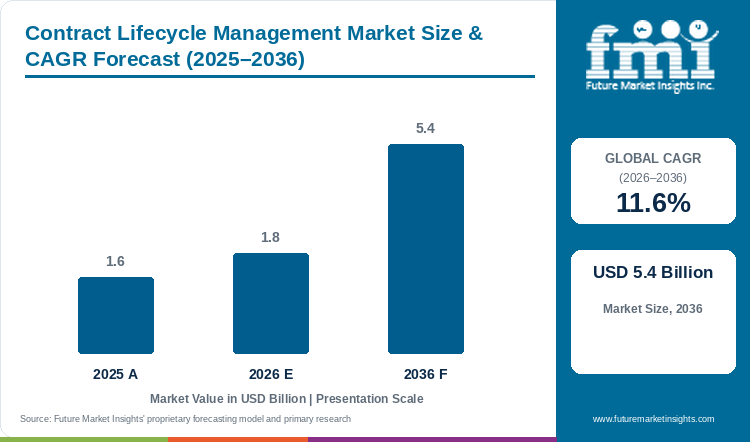
Demand is projected to expand at 11.6% CAGR from 2026 to 2036. Market value rises from USD 1.61 billion in 2025 to USD 1.8 billion in 2026 and USD 5.4 billion by 2036. [1]
Demand is estimated at USD 1.8 billion in 2026 and projected to reach USD 5.4 billion by 2036, at a CAGR of 11.6% from 2026 to 2036. [1] Contract lifecycle management connects the drafting and execution of an agreement with the obligations, approvals and renewals that continue throughout the relationship. A central repository creates value when staff can identify the relevant terms and act on them, rather than merely storing another document copy. [2][3][4] Integration with revenue management software can make those terms more useful to sales and finance teams, while procurement users need to link supplier commitments with purchasing activity. AI-assisted review and extraction support the process by reducing the effort of examining large document sets, although the organization still needs accountable review and clear permissions around the resulting information. [5] Purchasing therefore involves a choice of workflow, integration and governance as well as document capabilities. Software forms the continuing contract environment, while services configure approval paths and help bring existing records into a usable structure. Over the forecast period, demand is likely to favor systems that retain a clear connection between a clause, its responsible owner and the transaction or decision it governs. [1][2][3][4]
Key Market Trends and Insights
- Contract repositories are being connected with business workflows, making obligations and renewal dates more accessible to procurement, sales and finance users. [2][3]
- AI-assisted contract review creates demand for source visibility and accountable human decisions, since suggested language still needs to fit the organization's approval process. [4][5]
- Enterprise integration remains central to CLM selection, because customer and supplier details need to remain consistent across the agreement and transaction systems. [2][3]
Regional Highlights
- China and India present strong growth outlooks as enterprise digitization creates demand for consistent contract ownership, searchable terms and configurable approval workflows. [1]
- German manufacturers can connect contract information with procurement activity, placing supplier obligations and renewal management within the wider enterprise operating process. [1][3]
- US buyers compare specialist CLM providers with broader agreement platforms, while integration and review governance affect the suitability of each product. [1][2][3][4][5]
Market Size and Forecast
Table 1: Value outlook for the contract lifecycle management market
| Metric | Value |
|---|---|
| 2025 market value | USD 1.61 billion [1] |
| 2026 market value | USD 1.8 billion [1] |
| 2036 market value | USD 5.4 billion [1] |
| CAGR 2026 to 2036 | 11.6% [1] |
| Revenue increase 2026 to 2036 | USD 3.6 billion [1] |
| Market expansion 2026 to 2036 | 3.00 times [1] |
Growth at 11.6% CAGR from 2026 to 2036 reflects the need to make contract information useful after execution. Enterprises can connect renewal and obligation records with sales, procurement and finance, while the repository retains the terms needed to explain a commercial decision. Microsoft Dynamics integration offers one example of the enterprise relationship a CLM project may need to address, with successful implementation depending on consistent account information and an approval process that staff can maintain. [1][2][3]
How are contracts becoming connected enterprise records?
Current vendor documentation places contract workflows alongside searchable repositories and obligation management. DocuSign describes authoring and routing, Icertis connects contract intelligence with enterprise operations, and Ironclad positions its platform around contract intelligence and action. AI risk-management guidance adds a governance reference, helping distinguish useful assistance from a decision process that lacks accountable review or a traceable connection with the executed terms. [2][3][4][5]
Table 2: Industry evidence relevant to the contract lifecycle management market
| Indicator | Data point or observation | Market relevance | Source |
|---|---|---|---|
| Lifecycle workflow | DocuSign supports creation, routing and obligation records | Contract value continues after signature | [2] |
| Enterprise connection | Icertis connects agreements with enterprise applications | Terms can inform procurement and sales activity | [3] |
| AI governance | NIST addresses governance and risk management | Review responsibilities remain necessary | [5] |
Analyst Perspective
"Regulatory pressure is raising demand for auditable contract systems. Organizations should connect approvals and obligations with records that can be retrieved and reviewed, making everyday contract administration a central consideration alongside the initial selection of software." [1]
— Sudip Saha, Principal Consultant, FMI
How is the contract lifecycle management market segmented?
The market is segmented by Solution, Business Function, Industry, and Region.
By solution, coverage includes CLM Software, Services. By business function, coverage includes Legal, Finance, Procurement, Sales, Operations, Human Resource, Information Technology. By industry, coverage includes BFSI, IT & Telecom, Govt & Public Sector, Energy & Utilities, Manufacturing, Healthcare & Pharma, Life Sciences, Retail, Real Estate, Others. Regional coverage follows the report's defined geographic markets. [1]
Why does the CLM software segment lead demand within the solution category?
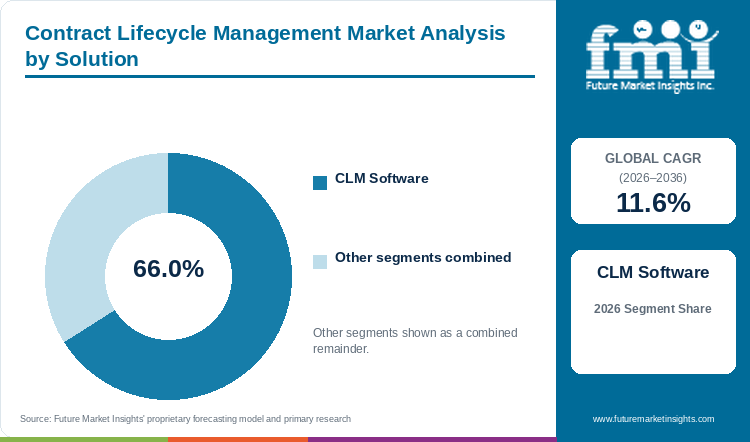
The CLM software segment accounts for 66.0% of solution demand in 2026. [1]
CLM software provides the continuing environment in which agreements are created, reviewed, stored and connected with operational responsibilities, giving it a central role within solution spending. A usable repository allows staff to find the relevant terms, while configured workflows direct exceptions and approvals to the appropriate people. [2][3][4] The commercial benefit grows when those records can inform the applications already used by procurement and sales, reducing the separation between the executed document and subsequent activity. Demand linked to no-code AI platforms may influence how workflows are configured, but the contract environment still requires controlled access and a dependable version history. Buyers consequently assess software through its fit with the organization's contracting practices and information systems. [1][5]
- The CLM software segment is estimated to account for 66.0% of solution demand in 2026, reflecting its continuing role in authoring, workflow control and the management of executed agreement records. [1]
- Enterprise connections make contract terms accessible within operating processes, while version history and review responsibilities remain essential to dependable lifecycle management. [2][3][4][5]
Table 3: Leading solution share in 2026
| Segment | Share of demand |
|---|---|
| CLM software | 66.0% [1] |
| Other solution segments | 34.0% [1] |
| Total | 100.0% |
Why does the Government and public sector segment lead demand within the industry category?
The Government and public sector segment accounts for 18.4% of industry demand in 2026. [1]
Government and public-sector contracting places substantial emphasis on preserving the agreement record and identifying who reviewed or authorized a change, making lifecycle visibility a useful operating capability. A platform can support repeatable workflows for document preparation, review and obligation tracking, while procurement staff need to retrieve the terms associated with a particular supplier or service. [1][2] The segment therefore benefits from a repository that remains connected to accountable processes, rather than an application that merely accelerates drafting. Integration and configuration deserve attention because public organizations may manage different contract types with different review responsibilities, and AI assistance is most useful where staff can inspect the relevant source language before accepting a suggestion or acting on a summary. [3][4][5]
- The Government and public sector segment is estimated to account for 18.4% of industry demand in 2026, as public organizations require a clear agreement history and accountable processes for review and obligation tracking. [1]
- Document preparation and approval need to follow the organization's defined responsibilities, particularly where automated assistance generates summaries or proposed contract language. [2][5]
What are the drivers, restraints, and opportunities in the contract lifecycle management market?
Driver
Enterprises need to find and use their executed terms when handling renewals, purchasing exceptions and customer commitments, creating demand for contract records that remain connected with business activity. A lifecycle platform can give those obligations a defined owner and workflow, reducing the separation between legal documents and operating systems. The need becomes more consequential as organizations manage larger agreement portfolios, because useful visibility depends on consistent information and an accountable route for acting on it. [1][2][3][4]
Restraint
Existing agreement portfolios may contain inconsistent formats, duplicate versions and incomplete ownership information, making repository migration a substantive implementation task. Workflow configuration also needs to reflect the responsibilities of legal, procurement and sales teams instead of imposing a single review route on every contract. AI does not remove these requirements, and weak source records or unclear decision authority can limit the usefulness of extraction and summaries even when the platform's document-processing capability is strong. [1][2][3][4][5]
Opportunity
Providers can connect contract terms with operational events that require a response, such as an approaching renewal or a purchasing condition that differs from the negotiated agreement. Making that connection visible within supply chain management gives procurement teams a practical use for the repository, while configurable workflows can preserve the review process around exceptions. The opportunity lies in clearer ownership and timely action, with AI assistance supporting the work when source language and decision responsibilities remain accessible. [2][3][4][5]
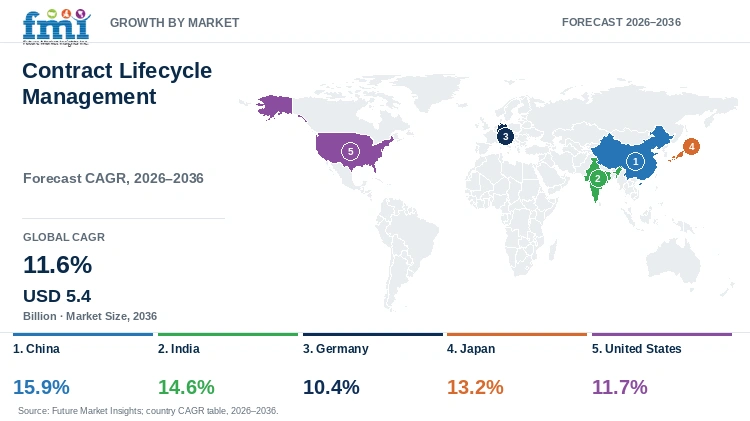
Which country CAGRs are profiled in the contract lifecycle management market?
Table 4: Country CAGR comparison for the contract lifecycle management market
| Country or market | CAGR 2026 to 2036 |
|---|---|
| China | 15.9% [1] |
| India | 14.6% [1] |
| Germany | 10.4% [1] |
| Japan | 13.2% [1] |
| United States | 11.7% [1] |
Country-wise Analysis
China
China's large enterprise procurement and sales relationships create recurring contract work across suppliers, customers and internal approvals, making a searchable repository useful when business teams need to identify obligations after signature. The practical requirement is to connect Chinese-language documents with the relevant workflow and owner, particularly where a company operates across several business units or trading relationships. [1] Market growth is projected at a CAGR of 15.9% from 2026 to 2036, with implementation depending on the quality of existing records and the ability to configure approval paths. AI-assisted extraction can support this work, although the organization still needs defined review responsibilities and controls around how generated output is used in a binding commercial decision. [2][3][4][5]
India
Indian enterprises expanding their supplier and customer networks need contract information that remains accessible beyond the legal team, especially when procurement and sales staff manage renewals or exceptions in day-to-day transactions. A CLM platform can support that requirement by connecting the document with a responsible owner and a defined approval process, while integration avoids entering the same account details repeatedly across applications. [1][2][3] A 14.6% CAGR from 2026 to 2036 is projected for the market, with adoption linked to enterprise digitization and growing workflow complexity. Buyers can evaluate implementation through a limited contract category first, checking language, access permissions and data quality before extending the repository across functions that follow different approval and review practices. [4][5]
Germany
German manufacturing and service enterprises often need to connect supplier agreements with purchasing activity, making obligation visibility relevant after the negotiation has been completed. A contract repository is useful when it lets the business identify renewal dates and agreed conditions without separating them from the transaction system that staff use to order goods or services. [1][2][3] The market is projected to expand at a CAGR of 10.4% from 2026 to 2036, with buyers comparing integration and governance alongside document-search capabilities. Detailed approval responsibilities remain necessary when AI assists with clause extraction or review, because the quality of a commercial decision depends on how a proposed change is assessed and recorded within the organization's own contracting process. [4][5]
Japan
Japan's contract-management opportunity concerns the coordination of enterprise records and review practices as agreements move between business teams, legal staff and external counterparties. A platform needs to handle the organization's document conventions and language requirements while preserving a clear version history, since later obligation tracking depends on identifying which terms were actually executed. [1][2] Demand is forecast at a CAGR of 13.2% from 2026 to 2036, with value emerging from consistent ownership and workflow rather than automated drafting alone. Buyers can assess how a supplier connects the repository with procurement or sales systems, while AI-supported review remains most useful when staff can examine the source clause and apply the organization's defined approval rules to any suggested change. [3][4][5]
United States
US enterprises have access to a mature group of specialist CLM suppliers, giving buyers a broad choice between contract-focused platforms and offerings connected with wider agreement or revenue workflows. The distinction matters when a business wants legal review, procurement and sales staff to work from the same agreement record instead of maintaining separate versions and renewal lists. [1][2][3][4] The projected 11.7% CAGR from 2026 to 2036 reflects continuing demand for those connections. AI features add another comparison point, but governance and access controls remain necessary when contract content is used to generate summaries or suggested language, so buyers assess how a platform makes source terms, human review and the resulting decision visible within the workflow. [5]
Who are the notable companies in the contract lifecycle management market?
Icertis; DocuSign; Ironclad; Sirion; Conga
Competitive Benchmarking
Icertis, DocuSign and Ironclad approach contract management through enterprise intelligence, agreement workflows and contract-focused automation, respectively, while Sirion and Conga bring their own lifecycle and revenue relationships to the market. Buyers can compare repository capabilities, integration and obligation management against the functions that will use the platform after implementation. A broad feature list alone cannot show that a system fits the organization's approval practices, making configuration and accountable review important parts of supplier selection. [1][2][3][4][5]
Table 5: Competitive positioning for the contract lifecycle management market
| Company | Positioning | Evidence or purchasing distinction |
|---|---|---|
| Icertis | Enterprise contract intelligence | Contract data connected to enterprise workflows. [3] |
| DocuSign | Contract lifecycle management | Authoring, routing, repository and obligation management. [2] |
| Ironclad | AI-based contract management | Workflow and contract intelligence platform. [4] |
| Sirion | Enterprise contract management | Contract performance and enterprise lifecycle management. [1] |
| Conga | Revenue-linked contract workflows | Contract management within revenue lifecycle offerings. [1] |
Key Developments in the Contract Lifecycle Management Market
- DocuSign's current CLM offering combines contract creation, routing and repository capabilities with AI-assisted review, illustrating the connection between drafting activity and ongoing agreement management. [2]
- Icertis' current AI-native platform positions contract information within enterprise workflows, extending the role of an agreement beyond storage to procurement and other business activities. [3]
- Ironclad's current product documentation emphasizes contract intelligence and action, while NIST's AI framework provides a general reference for governing the associated review responsibilities. [4][5]
Key Players in the Contract Lifecycle Management Market
- Icertis
- DocuSign
- Ironclad
- Sirion
- Conga
Contract Lifecycle Management Market Report Scope
Table 6: Report coverage for the contract lifecycle management market
| Attribute | Coverage |
|---|---|
| Market | Contract Lifecycle Management Market |
| Currency and unit | USD billion; market revenue |
| Historical reference year | 2025 |
| Base year | 2026 |
| Forecast period | 2026 to 2036 |
| Segmentation | Solution, Business Function, Industry |
| Country profiles | China; India; Germany; Japan; United States |
| Competitive coverage | Icertis; DocuSign; Ironclad; Sirion; Conga |
| Geographic coverage | North America, Latin America, Europe, East Asia, South Asia and Pacific, Middle East and Africa |
Contract Lifecycle Management Market Research Methodology
Table 7: Research methods for the contract lifecycle management market
| Method | Approach |
|---|---|
| Market definition | Revenue coverage is defined around contract lifecycle management offerings and their related commercial services, with adjacent markets retained as context. |
| Desk research | Public FMI outlooks, direct product documentation, institutional publications and official guidance provide the source base. |
| Segment assessment | Categories are assessed against their functional role, purchasing decisions and reported market structure, with shares kept within their own segmentation axes. |
| Country assessment | Country demand is examined through local customer requirements, industry composition and implementation conditions, with a consistent 2026 to 2036 forecast period. |
| Competitive comparison | Participants are compared through documented offerings and business roles; product features and service models are distinguished from market-share rankings. |
| Forecast assessment | The outlook considers adoption, replacement, integration effort and commercial constraints, expressing monetary forecasts and segment estimates in consistent units. |
Contract Lifecycle Management Market by Segments
Contract Lifecycle Management Market segmented by Solution:
- CLM Software
- Services
Contract Lifecycle Management Market segmented by Business Function:
- Legal
- Finance
- Procurement
- Sales
- Operations
- Human Resource
- Information Technology
Contract Lifecycle Management Market segmented by Industry:
- BFSI
- IT & Telecom
- Govt & Public Sector
- Energy & Utilities
- Manufacturing
- Healthcare & Pharma
- Life Sciences
- Retail
- Real Estate
- Others
Contract Lifecycle Management Market by Region
North America
- United States
- Canada
- Mexico
Latin America
- Brazil
- Chile
- Rest of Latin America
Western Europe
- Germany
- United Kingdom
- Italy
- Spain
- France
- Nordic
- BENELUX
- Rest of Western Europe
Eastern Europe
- Russia
- Poland
- Hungary
- Balkan & Baltic
- Rest of Eastern Europe
East Asia
- China
- Japan
- South Korea
South Asia and Pacific
- India
- ASEAN
- Australia & New Zealand
- Rest of South Asia and Pacific
Middle East & Africa
- Kingdom of Saudi Arabia
- Other GCC Countries
- Turkiye
- South Africa
- Other African Union
- Rest of Middle East & Africa
Research Sources and Bibliography
[1] Future Market Insights. Accessed 14 October 2026. Contract Lifecycle Management Market
[2] DocuSign. Accessed 14 October 2026. Contract Lifecycle Management
[3] Icertis. Accessed 14 October 2026. AI-native contract intelligence platform
[4] Ironclad. Accessed 14 October 2026. AI-based contract management
[5] National Institute of Standards and Technology. Accessed 14 October 2026. AI Risk Management Framework
This Report Answers
- How big is the contract lifecycle management market in 2026?
- What is the outlook for the contract lifecycle management market through 2036?
- Which solution segment is highlighted?
- Which markets are included in the growth comparison?
- Which participants are included in the competitive assessment?
Frequently Asked Questions
How big is the contract lifecycle management market in 2026?
The market is estimated at USD 1.8 billion in 2026, compared with USD 1.61 billion in 2025. [1]
What is the outlook for the contract lifecycle management market through 2036?
Revenue is projected to reach USD 5.4 billion by 2036, with a CAGR of 11.6% from 2026 to 2036. [1]
Which solution segment is highlighted?
The CLM software segment accounts for an estimated 66.0% share in 2026, reflecting the purchasing conditions described in the segment analysis. [1]
Which markets are included in the growth comparison?
The comparison profiles China, India, Germany, Japan, United States and presents their demand outlooks for 2026 to 2036. [1]
Which participants are included in the competitive assessment?
The assessment includes Icertis, DocuSign, Ironclad, Sirion, Conga, with positioning based on each participant's documented business role. [1]
Preview the report firsthand - request a free sample
Get SampleGet the brochure for pricing and purchase details.
Get PDFTable of Content
- Key Takeaways
- Market Size and CAGR
- Top Growth Driver
- Fastest Growing Segment
- Leading Region
- Key Companies
- Emerging Opportunities
- Executive Summary
- Global Market Outlook
- Demand-side Trends
- Supply-side Trends
- Technology Roadmap Analysis
- Analysis and Recommendations
- Analyst Perspective (What is happening? Why now? What should investors know?)
- Key Questions Answered
- How large is the market?
- What is the CAGR?
- What are key trends?
- Which region dominates?
- Who are the leaders?
- Market Overview
- Market Coverage / Taxonomy
- Market Definition / Scope / Limitations
- Research Methodology
- Chapter Orientation
- Analytical Lens and Working Hypotheses
- Market Structure, Signals, and Trend Drivers
- Benchmarking and Cross-market Comparability
- Market Sizing, Forecasting, and Opportunity Mapping
- Research Design and Evidence Framework
- Desk Research Programme (Secondary Evidence)
- Expert Input and Fieldwork (Primary Evidence)
- Tooling, Models, and Reference Databases
- Data Engineering and Model Build
- Quality Assurance and Audit Trail
- Market Background
- Market Dynamics (Drivers, Restraints, Opportunity, Trends)
- Scenario Forecast (Optimistic, Likely, Conservative)
- Impact Analysis
- AI Impact
- Sustainability Impact
- Regulatory Impact
- Technology Impact
- Consumer / Buyer Analysis
- Purchase Drivers
- Adoption Barriers
- Buyer Journey
- Opportunity Map Analysis
- Product Life Cycle Analysis
- Supply Chain Analysis
- Investment Feasibility Matrix
- Value Chain Analysis
- PESTLE and Porter's Analysis
- Regulatory Landscape
- Regional Parent Market Outlook
- Production and Consumption Statistics
- Import and Export Statistics
- Global Market Analysis and Forecast, 2021 to 2036
- Historical Market Size Value (USD Billion) Analysis, 2021 to 2025
- Current and Future Market Size Value (USD Billion) Projections, 2026 to 2036
- Y-o-Y Growth Trend Analysis
- Absolute $ Opportunity Analysis
- Global Market Pricing Analysis, 2021 to 2036
- Global Market Analysis and Forecast, By Solution, 2021 to 2036
- Introduction / Key Findings
- Historical Market Size Value (USD Billion) Analysis By Solution, 2021 to 2025
- Current and Future Market Size Value (USD Billion) Analysis and Forecast By Solution, 2026 to 2036
- CLM Software
- Services
- Y-o-Y Growth Trend Analysis By Solution, 2021 to 2025
- Absolute $ Opportunity Analysis By Solution, 2026 to 2036
- Global Market Analysis and Forecast, By Business Function, 2021 to 2036
- Introduction / Key Findings
- Historical Market Size Value (USD Billion) Analysis By Business Function, 2021 to 2025
- Current and Future Market Size Value (USD Billion) Analysis and Forecast By Business Function, 2026 to 2036
- Legal
- Finance
- Procurement
- Sales
- Operations
- Human Resource
- Information Technology
- Y-o-Y Growth Trend Analysis By Business Function, 2021 to 2025
- Absolute $ Opportunity Analysis By Business Function, 2026 to 2036
- Global Market Analysis and Forecast, By Industry, 2021 to 2036
- Introduction / Key Findings
- Historical Market Size Value (USD Billion) Analysis By Industry, 2021 to 2025
- Current and Future Market Size Value (USD Billion) Analysis and Forecast By Industry, 2026 to 2036
- BFSI
- IT & Telecom
- Govt & Public Sector
- Energy & Utilities
- Manufacturing
- Healthcare & Pharma
- Life Sciences
- Retail
- Real Estate
- Others
- Y-o-Y Growth Trend Analysis By Industry, 2021 to 2025
- Absolute $ Opportunity Analysis By Industry, 2026 to 2036
- Global Market Analysis and Forecast, By Region, 2021 to 2036
- Introduction
- Historical Market Size Value (USD Billion) Analysis By Region, 2021 to 2025
- Current Market Size Value (USD Billion) Analysis and Forecast By Region, 2026 to 2036
- North America
- Latin America
- Western Europe
- Eastern Europe
- East Asia
- South Asia and Pacific
- Middle East & Africa
- Market Attractiveness Analysis By Region
- North America Market Analysis and Forecast, By Country, 2021 to 2036
- Historical Market Size Value (USD Billion) Trend Analysis By Market Taxonomy, 2021 to 2025
- Market Size Value (USD Billion) Forecast By Market Taxonomy, 2026 to 2036
- By Country
- United States
- Canada
- Mexico
- By Solution
- By Business Function
- By Industry
- By Country
- Market Attractiveness Analysis
- By Country
- By Solution
- By Business Function
- By Industry
- Key Takeaways
- Latin America Market Analysis and Forecast, By Country
- Historical Market Size Value (USD Billion) Trend Analysis By Market Taxonomy, 2021 to 2025
- Market Size Value (USD Billion) Forecast By Market Taxonomy, 2026 to 2036
- By Country
- Brazil
- Chile
- Rest of Latin America
- By Solution
- By Business Function
- By Industry
- By Country
- Market Attractiveness Analysis
- By Country
- By Solution
- By Business Function
- By Industry
- Key Takeaways
- Western Europe Market Analysis and Forecast, By Country
- Historical Market Size Value (USD Billion) Trend Analysis By Market Taxonomy, 2021 to 2025
- Market Size Value (USD Billion) Forecast By Market Taxonomy, 2026 to 2036
- By Country
- Germany
- United Kingdom
- Italy
- Spain
- France
- Nordic
- BENELUX
- Rest of Western Europe
- By Solution
- By Business Function
- By Industry
- By Country
- Market Attractiveness Analysis
- By Country
- By Solution
- By Business Function
- By Industry
- Key Takeaways
- Eastern Europe Market Analysis and Forecast, By Country
- Historical Market Size Value (USD Billion) Trend Analysis By Market Taxonomy, 2021 to 2025
- Market Size Value (USD Billion) Forecast By Market Taxonomy, 2026 to 2036
- By Country
- Russia
- Poland
- Hungary
- Balkan & Baltic
- Rest of Eastern Europe
- By Solution
- By Business Function
- By Industry
- By Country
- Market Attractiveness Analysis
- By Country
- By Solution
- By Business Function
- By Industry
- Key Takeaways
- East Asia Market Analysis and Forecast, By Country
- Historical Market Size Value (USD Billion) Trend Analysis By Market Taxonomy, 2021 to 2025
- Market Size Value (USD Billion) Forecast By Market Taxonomy, 2026 to 2036
- By Country
- China
- Japan
- South Korea
- By Solution
- By Business Function
- By Industry
- By Country
- Market Attractiveness Analysis
- By Country
- By Solution
- By Business Function
- By Industry
- Key Takeaways
- South Asia and Pacific Market Analysis and Forecast, By Country
- Historical Market Size Value (USD Billion) Trend Analysis By Market Taxonomy, 2021 to 2025
- Market Size Value (USD Billion) Forecast By Market Taxonomy, 2026 to 2036
- By Country
- India
- ASEAN
- Australia & New Zealand
- Rest of South Asia and Pacific
- By Solution
- By Business Function
- By Industry
- By Country
- Market Attractiveness Analysis
- By Country
- By Solution
- By Business Function
- By Industry
- Key Takeaways
- Middle East & Africa Market Analysis and Forecast, By Country
- Historical Market Size Value (USD Billion) Trend Analysis By Market Taxonomy, 2021 to 2025
- Market Size Value (USD Billion) Forecast By Market Taxonomy, 2026 to 2036
- By Country
- Kingdom of Saudi Arabia
- Other GCC Countries
- Turkiye
- South Africa
- Other African Union
- Rest of Middle East & Africa
- By Solution
- By Business Function
- By Industry
- By Country
- Market Attractiveness Analysis
- By Country
- By Solution
- By Business Function
- By Industry
- Key Takeaways
- Key Countries Market Analysis
- United States
- Pricing Analysis
- Market Share Analysis, 2025
- By Solution
- By Business Function
- By Industry
- Canada
- Pricing Analysis
- Market Share Analysis, 2025
- By Solution
- By Business Function
- By Industry
- Mexico
- Pricing Analysis
- Market Share Analysis, 2025
- By Solution
- By Business Function
- By Industry
- Brazil
- Pricing Analysis
- Market Share Analysis, 2025
- By Solution
- By Business Function
- By Industry
- Chile
- Pricing Analysis
- Market Share Analysis, 2025
- By Solution
- By Business Function
- By Industry
- Germany
- Pricing Analysis
- Market Share Analysis, 2025
- By Solution
- By Business Function
- By Industry
- United Kingdom
- Pricing Analysis
- Market Share Analysis, 2025
- By Solution
- By Business Function
- By Industry
- Italy
- Pricing Analysis
- Market Share Analysis, 2025
- By Solution
- By Business Function
- By Industry
- Spain
- Pricing Analysis
- Market Share Analysis, 2025
- By Solution
- By Business Function
- By Industry
- France
- Pricing Analysis
- Market Share Analysis, 2025
- By Solution
- By Business Function
- By Industry
- India
- Pricing Analysis
- Market Share Analysis, 2025
- By Solution
- By Business Function
- By Industry
- ASEAN
- Pricing Analysis
- Market Share Analysis, 2025
- By Solution
- By Business Function
- By Industry
- Australia & New Zealand
- Pricing Analysis
- Market Share Analysis, 2025
- By Solution
- By Business Function
- By Industry
- China
- Pricing Analysis
- Market Share Analysis, 2025
- By Solution
- By Business Function
- By Industry
- Japan
- Pricing Analysis
- Market Share Analysis, 2025
- By Solution
- By Business Function
- By Industry
- South Korea
- Pricing Analysis
- Market Share Analysis, 2025
- By Solution
- By Business Function
- By Industry
- Russia
- Pricing Analysis
- Market Share Analysis, 2025
- By Solution
- By Business Function
- By Industry
- Poland
- Pricing Analysis
- Market Share Analysis, 2025
- By Solution
- By Business Function
- By Industry
- Hungary
- Pricing Analysis
- Market Share Analysis, 2025
- By Solution
- By Business Function
- By Industry
- Kingdom of Saudi Arabia
- Pricing Analysis
- Market Share Analysis, 2025
- By Solution
- By Business Function
- By Industry
- South Africa
- Pricing Analysis
- Market Share Analysis, 2025
- By Solution
- By Business Function
- By Industry
- United States
- Market Structure Analysis
- Competition Dashboard
- Competition Benchmarking
- Market Share Analysis of Top Players
- By Regional
- By Solution
- By Business Function
- By Industry
- Emerging Startups
- Innovation Benchmarking
- Competition Analysis
- Competition Deep Dive
- Icertis
- Overview
- Product Portfolio
- Profitability by Market Segments
- Sales Footprint
- Strategy Overview
- Marketing Strategy
- Product Strategy
- Channel Strategy
- DocuSign
- Ironclad
- Sirion
- Conga
- Icertis
- Case Studies
- Success Stories
- Recent Developments
- Competition Deep Dive
- Assumptions & Acronyms Used


