

- Market Size (2026)
- USD 2.8 Bn
- Forecast (2036)
- USD 14.1 Bn
- CAGR (2026 to 2036)
- 17.5%
How big is the Over The Air Engine Control Module Market in 2026?
USD 2.8 billion in 2026, reaching USD 14.1 billion by 2036 at a 17.5% CAGR
The over the air engine control module market was valued at USD 2.4 billion in 2025. The market is set to reach USD 2.8 billion by 2026-end and grow at a CAGR of 17.5% between 2026-2036 to reach USD 14.1 billion by 2036. Controller Area Network (CAN) will dominate with a 48.0% share, while High Speed will lead with a 61.7% share.
Over the air engine control module procurement is shaped by software-defined vehicle architecture adoption, OTA update mandate timelines, and connected vehicle platform development. Demand reflects ECU hardware and cloud-based software platforms that enable remote firmware, calibration, and feature updates for engine and powertrain control modules. Buyers include OEM software platform teams, tier-one ECU suppliers, and connected vehicle program managers evaluating CAN/Ethernet bandwidth, cybersecurity compliance, and update deployment reliability.
Growth reflects accelerating OTA-capable vehicle production and increasing OEM reliance on post-production software updates. McKinsey reported in 2025 that OTA-capable vehicles continued to increase as a share of new production, sustaining ECU hardware and cloud platform procurement.
Differentiation in this market rests on OTA platform scalability, cybersecurity architecture, and ECU hardware bandwidth. AUMOVIO and Bosch lead through integrated ECU and OTA platforms, while NXP and Aptiv gain preference where automotive connectivity ICs and vehicle architecture design drive procurement.
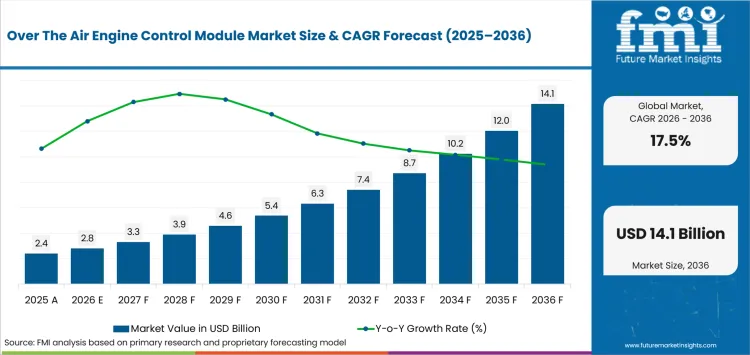
Key Takeaways of Over The Air Engine Control Module Market
- Software-defined vehicle architecture is expected to sustain OTA ECM procurement as OEMs expand remote update capability.
- Controller Area Network (CAN) is expected to account for 48.0% of interface demand in 2026 because CAN remains the dominant in-vehicle communication protocol.
- High Speed is projected to hold 61.7% of bandwidth demand in 2026, driven by large firmware file size and rapid update deployment requirements.
- OEM is anticipated to represent 78.0% of sales channel demand in 2026 as factory-installed OTA-capable ECUs capture every new connected vehicle.
- China leads with an 18.6% CAGR through 2036 as domestic EV production and connected vehicle platform development sustain OTA ECM procurement.
- AUMOVIO and Bosch are expected to compete through integrated ECU and OTA update platforms.
Analyst Perspective
"Buyers are expected to judge controller area network (can) on performance and total cost of ownership rather than headline price. OTA engine control module adoption is expected to depend on software-defined vehicle architecture progression and OTA update mandate expansion. Suppliers that combine ECU hardware bandwidth with cybersecurity architecture and cloud OTA scalability are likely to secure platform-level supply contracts. Market success is projected to depend on meeting cybersecurity and update reliability requirements across connected vehicle production programs."
- Nikhil Kaitwade, Principal Consultant at Future Market Insights
Why is the Over The Air Engine Control Module Market growing?
Rising Controller Area Network (CAN) and High Speed demand across automotive end users
- OTA control-module demand follows software-defined-vehicle architectures and update-capability requirements rather than legacy ECU replacement.
- China leads growth at 18.6% CAGR as domestic EV production and connected vehicle platform development sustain OTA ECM procurement.
- High Speed holds 61.7% of bandwidth revenue, indicating where standardization is concentrating buyer spend.
Because OTA modules gate secure software delivery, spend concentrates with suppliers whose update platforms integrate into vehicle networks and cockpit and ECU architectures.
How is the over the Over The Air Engine Control Module Market segmented?
The over the air engine control module industry is segmented by interface and connectivity options, bandwidth usage levels, vehicle types, sales channel, deployment type, and region.
The over the air engine control module market is segmented by interface and connectivity options, bandwidth usage levels for data communication, vehicle types, sales channel, deployment type, and region. By interface and connectivity, the market covers controller area network (CAN), ethernet, and LIN. By bandwidth usage, the market covers high speed and standard speed. By vehicle types, the market covers passenger vehicles, light commercial vehicles, and heavy commercial vehicles. By sales channel, the market covers OEM and aftermarket. By deployment type, the market covers cloud based OTA deployment and edge based OTA deployment. Regions include North America, Latin America, Western Europe, Eastern Europe, East Asia, South Asia and Pacific, and the Middle East and Africa.
How does CAN shape demand within the interface category?
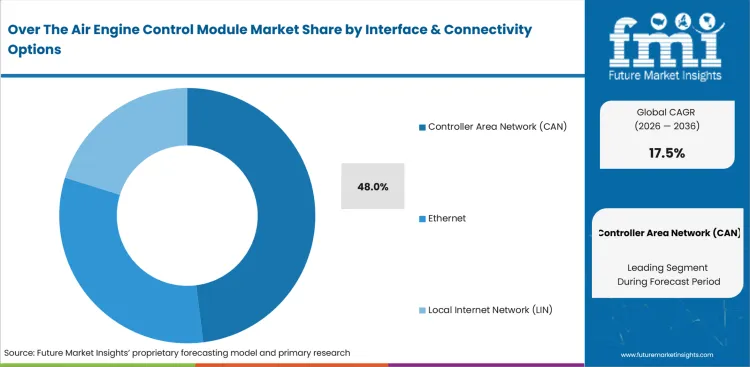
Interface selection determines fitment scope, program economics, and channel mix across OEM and aftermarket purchasing. CAN anchors the category, keeping buyer spend concentrated where qualification and service support are already established. Demand concentrates here because CAN remains the standard in-vehicle protocol for ECU communication.
- Controller Area Network (CAN) is expected to account for 48.0% of interface demand in 2026 because CAN remains the standard in-vehicle protocol for ECU communication.
- Cloud Based OTA Deployment is projected to hold 51.8% of deployment demand as cloud platforms enable scalable remote update management.
What supports high-speed bandwidth demand?
High-speed bandwidth shapes buyer requirements because segment choice here determines fitment scope, program economics, and channel mix across OEM and aftermarket purchasing. Demand concentrates here because large firmware updates and rapid deployment requirements drive high-bandwidth ECU communication.
- High Speed is projected to hold 61.7% of bandwidth demand because large firmware updates and rapid deployment requirements drive high-bandwidth ECU communication.
- Passenger Vehicles is forecast to represent 52.0% of vehicle type demand as OTA-capable passenger cars generate the highest ECU procurement volumes.
How do sales channel and deployment type shape procurement?
Sales channel and deployment type decide who controls the purchase and how the product reaches the account; together they determine fitment scope, program economics, and channel mix across OEM and aftermarket purchasing. Demand concentrates here because factory-installed OTA-capable ECUs capture every new connected vehicle.
- OEM is expected to hold 78.0% of sales channel demand because factory-installed OTA-capable ECUs capture every new connected vehicle.
- Cloud Based OTA Deployment is anticipated to hold 51.8% of deployment demand because cloud management enables centralized update distribution across fleet-scale vehicle populations.
What are the drivers, restraints, and opportunities in the Over The Air Engine Control Module Market?
Near-term procurement is shaped by software-defined vehicle timelines, OTA mandate expansion, and cybersecurity requirements.
- Driver: Software-defined vehicle architecture and OTA update mandates are expected to push ECM procurement as connected vehicle production scales.
- Restraint: Cybersecurity vulnerability risks in remote ECU updates are likely to slow adoption if OEMs face regulatory and liability concerns from OTA deployment.
- Opportunity: Feature-on-demand activation via OTA creates post-sale revenue models that are expected to sustain ECM platform investment.
OTA-capable vehicle production is expected to increase ECM procurement. AUMOVIO reported in 2025 that its connected vehicle platform expanded OTA update deployments across global OEM programs.
Cybersecurity risks are expected to limit deployment speed. UNECE WP.29 cybersecurity regulations reported in 2025 that OTA update compliance requirements continued to shape OEM deployment timelines.
Feature-on-demand creates a practical route by enabling post-sale revenue from software features. Visteon reported in 2025 that its cockpit OTA platform supported feature activation across connected vehicle programs.
Which country CAGRs are profiled in the Over The Air Engine Control Module Market?
China 18.6%, India 18.1%, USA 17.4%, South Korea 17.3%, UK 17.0% through 2036
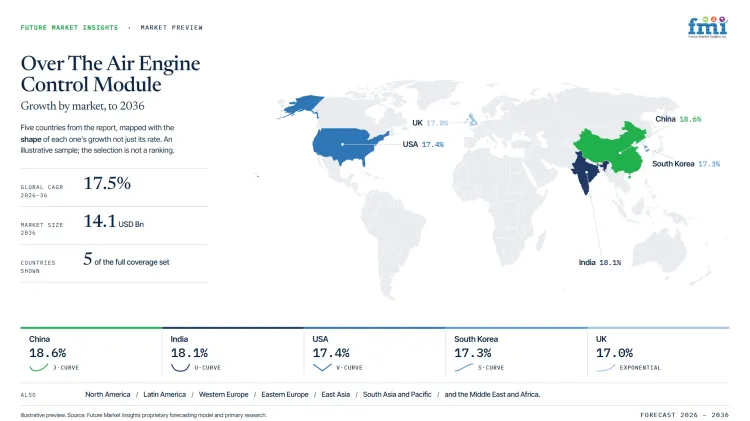
| Country | CAGR (2026 to 2036) |
|---|---|
| China | 18.6% |
| India | 18.1% |
| USA | 17.4% |
| South Korea | 17.3% |
| UK | 17.0% |
Source: FMI's proprietary forecasting model and primary research. 5 of the countries covered in the full report are shown here as a representative subset.
How do country-level CAGRs compare in the Over The Air Engine Control Module Market?
The country comparison spans 1.6 percentage points and reveals three distinct growth groups across the Over The Air Engine Control Module Market. China and India form the upper tier with a 0.5-point difference, while the United States and South Korea create a closely aligned middle group separated by only 0.1 percentage point. The United Kingdom remains at the lower end with a 0.3-point gap from South Korea.
- China leads the comparison at an 18.6% CAGR through 2036, supported by its large vehicle production base and electric-platform shift, which are concentrating OTA control-module sourcing across domestic automotive supply chains.
- India follows at an 18.1% CAGR, remaining 0.5 percentage points below China. Rising passenger vehicle production, component localization and extensive aftermarket channels support both OEM and replacement demand.
- The United States records a 17.4% CAGR, creating a 0.7-percentage-point gap from India. A large vehicle parc, steady replacement demand and feature-led purchasing across OEM and aftermarket channels support continued market expansion.
- South Korea grows at a 17.3% CAGR, only 0.1 percentage point below the United States. Established OEM supply chains, high electronics content and rapid platform cycles support demand for OTA-enabled engine control modules.
- The United Kingdom records a 17.0% CAGR, remaining 0.3 percentage points below South Korea. Its large vehicle parc, import-based supply structure and established aftermarket channels support replacement-oriented demand.
Comparable CAGRs can still produce different market conditions. Differences in software-defined vehicle adoption, vehicle production, electronics content, in-vehicle network capabilities, platform cycles and aftermarket activity influence OTA engine control module demand across countries. The full report provides country-level CAGR analysis across major regions and individual markets within the Over The Air Engine Control Module Market.
Country-wise Analysis
- Over the air engine control module demand in China moves with the world's largest vehicle production base and an accelerating shift to electric platforms. The Over The Air Engine Control Module Market in China is projected to record an 18.6% CAGR during the assessment period, supported by China's vehicle-build scale and local OTA control modules supply chains. CAN-based high-speed architectures lead bandwidth demand in 2026, concentrating spend on connected update modules. Domestic price competition and fast platform turns squeeze margins for late OTA control modules entrants. OTA control modules suppliers need localized production, competitive program pricing, and engineering support near OEM development centers to win awards.
- Indian demand for OTA control modules spans rising vehicle output, localization requirements, and one of the deepest aftermarket networks globally. Demand draws on software-defined vehicle architecture and OTA update mandates. Sales in India are forecast to expand at an 18.1% CAGR by 2036, supported by rising vehicle output and deep OTA control modules aftermarket channels. Fragmented OTA control modules aftermarket channels and price sensitivity demand disciplined-cost distribution. OTA control modules suppliers need local manufacturing or sourcing partnerships and dealer-level distribution to reach fragmented aftermarket buyers.
- US demand for OTA control modules rests on a large installed parc and feature-led OEM and aftermarket buying. The market outlook in the United States is anticipated to advance at a 17.4% CAGR over the assessment period, supported by a large installed OTA control modules base and steady replacement demand. Fragmented regional OTA control modules aftermarket channels raise the cost of national coverage. OTA control modules suppliers need North American OEM program relationships and aftermarket distribution that covers fragmented regional channels.
- South Korean OTA control modules sourcing sits inside conglomerate-linked OEM chains with fast platform cycles. Demand in South Korea is forecast to rise at a 17.3% CAGR over the forecast period, supported by conglomerate OEM chains and rapid OTA control modules platform cycles. Rapid platform cycles demand OTA control modules co-development speed that strains smaller suppliers. OTA control modules suppliers need co-development speed, integration capability, and delivery reliability to hold program positions.
- UK demand for OTA control modules is replacement-led and largely import-supplied through strong aftermarket channels. Adoption in the United Kingdom is estimated to expand at a 17.0% CAGR through 2036, supported by a large OTA control modules parc and replacement-led aftermarket demand. Import reliance exposes OTA control modules availability to logistics disruption during demand peaks. OTA control modules suppliers need distributor relationships and reliable availability to serve replacement-led purchasing.
Who are the notable companies in the Over The Air Engine Control Module Market??
Robert Bosch GmbH, NXP Semiconductors, Visteon Corporation, Aptiv PLC, Denso Corporation, Magna International, and ZF Friedrichshafen AG are the notable companies shaping this market.
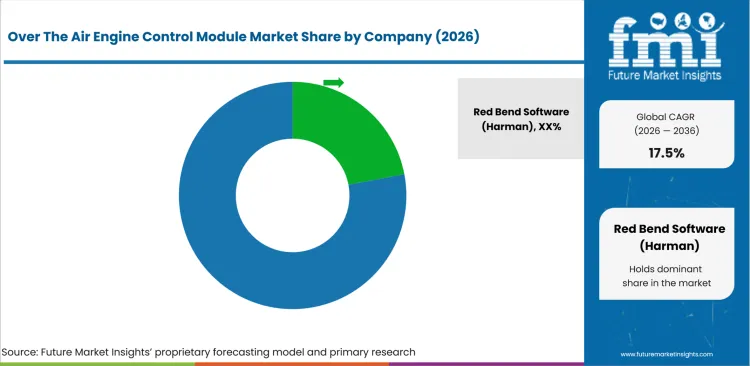
The field concentrates around connectivity suppliers that link OTA-update engineering to vehicle-network architecture and OEM program access. Global automotive tier-one electronics and OTA companies compete across OTA update platforms, ECU and OTA integration and Vehicle architecture and OTA throughout established accounts. Automotive software and connectivity platform companies emphasize Cockpit and OTA software and Automotive connectivity ICs, while automotive systems integration companies serve regional demand through Chassis and OTA systems. A workable entry is an OTA-integration or connectivity-IC niche, or a regional software position for a specific architecture. Growth then depends on cybersecurity qualification, delivery performance, and support coverage across each launch territory. Breadth pays off through engineers who integrate OTA modules across vehicle architectures and support localized software delivery.
- AUMOVIO SE and Robert Bosch GmbH combine OTA update platforms and ECU and OTA integration across multiple national markets. Aptiv PLC adds Vehicle architecture and OTA through established account relationships. Their edge comes from OTA-update and connectivity breadth across vehicle architectures.
- Visteon Corporation, NXP Semiconductors and Magna International follow focused routes across Cockpit and OTA software, Automotive connectivity ICs and Vehicle electronics integration. Their commercial edge comes from ECU-integration and cockpit-software niches rather than one standardized module.
- ZF Friedrichshafen AG, Harman International (Samsung) and Melexis provide regional coverage through Chassis and OTA systems. These firms compete on focused OTA strengths, though platform reach trails the global connectivity majors.
Competitive Benchmarking: Over The Air Engine Control Module Market
| Company | Portfolio Relevance | OTA Focus | Account Access | Service Reach |
|---|---|---|---|---|
| AUMOVIO SE | High | OTA update platforms | Strong | Global |
| Robert Bosch GmbH | High | ECU and OTA integration | Strong | Global |
| NXP Semiconductors | High | Automotive connectivity ICs | Strong | Global |
| Visteon Corporation | High | Cockpit and OTA software | Strong | Global |
| Aptiv PLC | High | Vehicle architecture and OTA | Strong | Global |
| Denso Corporation | Medium | ECU and powertrain electronics | Strong | Global |
| Magna International | Medium | Vehicle electronics integration | Strong | Global |
| ZF Friedrichshafen AG | Medium | Chassis and OTA systems | Strong | Global |
Source: Future Market Insights competitive analysis, 2026. Ratings reflect relative portfolio relevance, workflow or project fit, service capability, and geographic reach.
Key Developments in the Over The Air Engine Control Module Market
- In April 2025, Visteon Corporation announced a technology collaboration with Qualcomm to bring AI-based cockpit compute and personalization capabilities to its cockpit platform."
Key Players in the Over The Air Engine Control Module Market
Global automotive tier-one electronics and OTA companies
- AUMOVIO SE
- Robert Bosch GmbH
- Aptiv PLC
- Denso Corporation
Automotive software and connectivity platform companies
- Visteon Corporation
- NXP Semiconductors
- Magna International
Automotive systems integration companies
- ZF Friedrichshafen AG
- Harman International (Samsung)
- Melexis
Over The Air Engine Control Module Market: Report Scope
| Coverage field | Report scope |
|---|---|
| Market breakdown | Interface and connectivity options, bandwidth usage levels, vehicle types, sales channel, deployment type, and region. |
| Market Definition | Over the air engine control modules include CAN, Ethernet, and LIN-connected ECU hardware and cloud-based OTA deployment platforms for remote firmware, calibration, and feature updates across passenger and commercial vehicles. |
| Regions Covered | North America, Latin America, Western Europe, Eastern Europe, East Asia, South Asia and Pacific, and the Middle East and Africa. |
| Countries Covered | United States, China, India, South Korea, United Kingdom, and Japan. |
| Key Companies Profiled | Robert Bosch GmbH, NXP Semiconductors, Visteon Corporation, Aptiv PLC, Denso Corporation, Magna International, ZF Friedrichshafen AG. |
| Forecast Period | 2026 to 2036. |
| Approach | FMI used primary interviews, source validation, and proprietary demand modeling. |
Source: Future Market Insights, analysis driven by proprietary forecasting models and primary research
Over The Air Engine Control Module Market: Research Methodology
| Method | Approach |
|---|---|
| Primary Research | FMI interviewed over the air engine control module suppliers, buyers, and procurement leads. |
| Desk Research | Government releases, regulator updates, company filings, and product pages. |
| Market Sizing | Forecast model linked 2026 anchors to demand drivers and country conditions. |
| Data Validation | Forecast values checked against ten-year CAGR formula. |
Source: Future Market Insights (FMI) analysis
Market Segmentation Analysis
Over The Air Engine Control Module Market Segmented by Interface & Connectivity Options:
- Controller Area Network (CAN)
- CAN FD Systems
- Flexible Data Rate Communication
- Improved Engine Control Synchronization
- Standard CAN Modules
- Reliable Real Time Control
- Widely Adopted Automotive Protocol
- CAN FD Systems
- Ethernet
- Automotive Ethernet ECUs
- High Speed Data Transfer Capability
- Enhanced OTA Update Reliability
- Ethernet Gateway Modules
- Centralized Vehicle Communication
- Improved Data Security Handling
- Automotive Ethernet ECUs
- Local Internet Network (LIN)
- LIN Slave Modules
- Cost Effective Subsystem Communication
- Simplified Vehicle Network Architecture
- LIN Master Controllers
- Efficient Low Speed Data Handling
- Improved Component Coordination
- LIN Slave Modules
Over The Air Engine Control Module Market Segmented by Bandwidth Usage Levels for Data Communication:
- High Speed
- Real Time Engine Software Updates
- Faster OTA Deployment Capability
- Enhanced Performance Optimization
- Advanced ECU Reprogramming Systems
- High Volume Data Transmission
- Improved Update Efficiency
- Real Time Engine Software Updates
- Low Speed
- Low Bandwidth ECU Updates
- Basic Engine Parameter Calibration
- Improved Legacy System Compatibility
- Diagnostic Data Transfer Systems
- Efficient Minimal Data Exchange
- Reduced Communication Load
- Low Bandwidth ECU Updates
Over The Air Engine Control Module Market Segmented by Vehicle Types:
- Passenger Vehicles
- Sedan And Hatchback ECUs
- Improved Engine Efficiency Control
- Enhanced Fuel Management
- Luxury Connected Vehicles
- Advanced OTA Feature Integration
- Improved Driving Performance
- Sedan And Hatchback ECUs
- Commercial Vehicles
- Delivery Vans And LCV ECUs
- Optimized Fleet Performance Updates
- Improved Engine Diagnostics
- Logistics Vehicle Engine Controllers
- Enhanced Operational Efficiency
- Reduced Downtime
- Delivery Vans And LCV ECUs
- Heavy Trucks And Buses
- Long Haul Truck ECUs
- High Reliability Engine Control
- Improved Fuel Optimization
- Bus Fleet Control Modules
- Centralized Engine Monitoring
- Enhanced Safety And Performance
- Long Haul Truck ECUs
Over The Air Engine Control Module Market Segmented by Sales Channel:
- Original Equipment Manufacturer (OEM)
- Factory Installed ECU Systems
- Seamless Vehicle Integration
- Optimized Engine Calibration
- Tier 1 Supplier Modules
- High Reliability Standards
- Improved Production Efficiency
- Factory Installed ECU Systems
- Aftermarket
- REPROGRAMMABLE ECU Kits
- Performance Enhancement Solutions
- Improved Vehicle Customization
- Diagnostic And Update Services
- Cost Effective Maintenance Support
- Enhanced System Upgradability
- REPROGRAMMABLE ECU Kits
Over The Air Engine Control Module Market Segmented by Deployment Type:
- Cloud Based OTA Deployment
- Remote ECU Update Platforms
- Real Time Software Distribution
- Improved Scalability And Flexibility
- Connected Vehicle Cloud Infrastructure
- Centralized Update Management
- Enhanced Data Security Control
- Remote ECU Update Platforms
- On Premises Deployment
- Local Vehicle Update Servers
- Secure In House ECU Programming
- Reduced External Dependency
- Dealer Based Update Systems
- Controlled Software Deployment
- Improved Service Reliability
- Local Vehicle Update Servers
- Hybrid Deployment
- Cloud To Vehicle Hybrid Systems
- Optimized Update Speed And Security
- Enhanced System Redundancy
- Edge Enabled OTA Solutions
- Faster Local Processing Capability
- Improved Network Efficiency
- Cloud To Vehicle Hybrid Systems
Over The Air Engine Control Module Market by Region:
- North America
- USA
- Canada
- Mexico
- Latin America
- Brazil
- Chile
- Rest of Latin America
- Western Europe
- Germany
- UK
- Italy
- Spain
- France
- Nordic
- BENELUX
- Rest of Western Europe
- Eastern Europe
- Russia
- Poland
- Hungary
- Balkan & Baltic
- Rest of Eastern Europe
- East Asia
- China
- Japan
- South Korea
- South Asia and Pacific
- India
- ASEAN
- Australia & New Zealand
- Rest of South Asia and Pacific
- Middle East & Africa
- Kingdom of Saudi Arabia
- Other GCC Countries
- Türkiye
- South Africa
- Other African Union
- Rest of Middle East & Africa
Research Sources and Bibliography
- McKinsey & Company. (2025). OTA-Capable Vehicle Production Assessment.
- UNECE WP.29. (2025). Cybersecurity and OTA Update Regulatory Standards.
- NHTSA. (2025). Connected Vehicle Safety and OTA Guidance.
- MIIT China. (2025). Intelligent Connected Vehicle Standards.
- SIAM. (2025). Connected Vehicle Adoption Data.
- KAMA. (2025). Korean Connected Vehicle Production.
- JAMA. (2025). Japanese Connected Vehicle Development.
- NXP Semiconductors. (2025). Automotive Connectivity IC Portfolio Update.
This bibliography uses primary government and company sources.
This Report Answers
- What is the estimated 2026 value of the over the air engine control module market?
- What market value is projected by 2036?
- What CAGR is forecast from 2026 to 2036?
- Which interface is expected to account for a notable 2026 share?
- Which countries are profiled for CAGR comparison?
- Which companies are notable in the competitive landscape?
Frequently Asked Questions
How big is the Over The Air Engine Control Module Market in 2026?
The Over The Air Engine Control Module Market is valued at USD 2.8 billion in 2026 and is forecast to reach USD 14.1 billion by 2036, expanding at a 17.5% CAGR, up from USD 2.4 billion in 2025. Controller Area Network (CAN) holds 48.0% of interface demand in 2026.
What is the CAGR of the Over The Air Engine Control Module Market from 2026 to 2036?
A 17.5% CAGR is projected for the Over The Air Engine Control Module Market between 2026 and 2036, supported by accelerating OTA-capable vehicle production and increasing OEM reliance on post-production software updates. Controller Area Network (CAN) holds 48.0% of interface and connectivity options demand in 2026.
Which interface and connectivity options lead the Over The Air Engine Control Module Market?
Controller Area Network (CAN) accounts for 48.0% of the Over The Air Engine Control Module Market by interface and connectivity options in 2026, driven by accelerating OTA-capable vehicle production and increasing OEM reliance on post-production software updates. The Over The Air Engine Control Module Market grows at a 17.5% CAGR through 2036.7% in 2026.
How much will the Over The Air Engine Control Module Market add between 2026 and 2036?
The Over The Air Engine Control Module Market is set to add USD 11.3 billion between 2026 and 2036, growing from USD 2.8 billion to USD 14.1 billion at a 17.5% CAGR. High Speed leads bandwidth usage levels with 61.7% of Over The Air Engine Control Module Market revenue in 2026, anchoring that incremental demand.
Who are the leading companies in the Over The Air Engine Control Module Market?
The Over The Air Engine Control Module Market profiles 8 key companies in 2026, led by Continental AG, Robert Bosch GmbH, NXP Semiconductors, Visteon Corporation, and Aptiv PLC. These suppliers compete across interface and connectivity options, where Controller Area Network (CAN) holds 48.0% of Over The Air Engine Control Module Market demand in 2026.
Preview the report firsthand - request a free sample
Get SampleGet the brochure for pricing and purchase details.
Get PDFTable of Content
- Key Takeaways
- Market Size and CAGR
- Top Growth Driver
- Fastest Growing Segment
- Leading Region
- Key Companies
- Emerging Opportunities
- Executive Summary
- Global Market Outlook
- Demand-side Trends
- Supply-side Trends
- Technology Roadmap Analysis
- Analysis and Recommendations
- Analyst Perspective (What is happening? Why now? What should investors know?)
- Key Questions Answered
- How large is the market?
- What is the CAGR?
- What are key trends?
- Which region dominates?
- Who are the leaders?
- Market Overview
- Market Coverage / Taxonomy
- Market Definition / Scope / Limitations
- Research Methodology
- Chapter Orientation
- Analytical Lens and Working Hypotheses
- Market Structure, Signals, and Trend Drivers
- Benchmarking and Cross-market Comparability
- Market Sizing, Forecasting, and Opportunity Mapping
- Research Design and Evidence Framework
- Desk Research Programme (Secondary Evidence)
- Expert Input and Fieldwork (Primary Evidence)
- Tooling, Models, and Reference Databases
- Data Engineering and Model Build
- Quality Assurance and Audit Trail
- Market Background
- Market Dynamics (Drivers, Restraints, Opportunity, Trends)
- Scenario Forecast (Optimistic, Likely, Conservative)
- Impact Analysis
- AI Impact
- Sustainability Impact
- Regulatory Impact
- Technology Impact
- Consumer / Buyer Analysis
- Purchase Drivers
- Adoption Barriers
- Buyer Journey
- Opportunity Map Analysis
- Product Life Cycle Analysis
- Supply Chain Analysis
- Investment Feasibility Matrix
- Value Chain Analysis
- PESTLE and Porter's Analysis
- Regulatory Landscape
- Regional Parent Market Outlook
- Production and Consumption Statistics
- Import and Export Statistics
- Global Market Analysis and Forecast, 2021 to 2036
- Historical Market Size Value (USD Billion) Analysis, 2021 to 2025
- Current and Future Market Size Value (USD Billion) Projections, 2026 to 2036
- Y-o-Y Growth Trend Analysis
- Absolute $ Opportunity Analysis
- Global Market Pricing Analysis, 2021 to 2036
- Global Market Analysis and Forecast, By Interface And Connectivity Options, 2021 to 2036
- Introduction / Key Findings
- Historical Market Size Value (USD Billion) Analysis By Interface And Connectivity Options, 2021 to 2025
- Current and Future Market Size Value (USD Billion) Analysis and Forecast By Interface And Connectivity Options, 2026 to 2036
- Controller Area Network (CAN)
- CAN FD Systems
- Standard CAN Modules
- Ethernet
- Automotive Ethernet ECUs
- Ethernet Gateway Modules
- Local Internet Network (LIN)
- LIN Slave Modules
- LIN Master Controllers
- Controller Area Network (CAN)
- Y-o-Y Growth Trend Analysis By Interface And Connectivity Options, 2021 to 2025
- Absolute $ Opportunity Analysis By Interface And Connectivity Options, 2026 to 2036
- Global Market Analysis and Forecast, By Bandwidth Usage Levels For Data Communication, 2021 to 2036
- Introduction / Key Findings
- Historical Market Size Value (USD Billion) Analysis By Bandwidth Usage Levels For Data Communication, 2021 to 2025
- Current and Future Market Size Value (USD Billion) Analysis and Forecast By Bandwidth Usage Levels For Data Communication, 2026 to 2036
- High Speed
- Real Time Engine Software Updates
- Advanced ECU Reprogramming Systems
- Low Speed
- Low Bandwidth ECU Updates
- Diagnostic Data Transfer Systems
- High Speed
- Y-o-Y Growth Trend Analysis By Bandwidth Usage Levels For Data Communication, 2021 to 2025
- Absolute $ Opportunity Analysis By Bandwidth Usage Levels For Data Communication, 2026 to 2036
- Global Market Analysis and Forecast, By Vehicle Types, 2021 to 2036
- Introduction / Key Findings
- Historical Market Size Value (USD Billion) Analysis By Vehicle Types, 2021 to 2025
- Current and Future Market Size Value (USD Billion) Analysis and Forecast By Vehicle Types, 2026 to 2036
- Passenger Vehicles
- Sedan And Hatchback ECUs
- Luxury Connected Vehicles
- Commercial Vehicles
- Delivery Vans And LCV ECUs
- Logistics Vehicle Engine Controllers
- Heavy Trucks And Buses
- Long Haul Truck ECUs
- Bus Fleet Control Modules
- Passenger Vehicles
- Y-o-Y Growth Trend Analysis By Vehicle Types, 2021 to 2025
- Absolute $ Opportunity Analysis By Vehicle Types, 2026 to 2036
- Global Market Analysis and Forecast, By Sales Channel, 2021 to 2036
- Introduction / Key Findings
- Historical Market Size Value (USD Billion) Analysis By Sales Channel, 2021 to 2025
- Current and Future Market Size Value (USD Billion) Analysis and Forecast By Sales Channel, 2026 to 2036
- Original Equipment Manufacturer (OEM)
- Factory Installed ECU Systems
- Tier 1 Supplier Modules
- Aftermarket
- REPROGRAMMABLE ECU Kits
- Diagnostic And Update Services
- Original Equipment Manufacturer (OEM)
- Y-o-Y Growth Trend Analysis By Sales Channel, 2021 to 2025
- Absolute $ Opportunity Analysis By Sales Channel, 2026 to 2036
- Global Market Analysis and Forecast, By Deployment Type, 2021 to 2036
- Introduction / Key Findings
- Historical Market Size Value (USD Billion) Analysis By Deployment Type, 2021 to 2025
- Current and Future Market Size Value (USD Billion) Analysis and Forecast By Deployment Type, 2026 to 2036
- Cloud Based OTA Deployment
- Remote ECU Update Platforms
- Connected Vehicle Cloud Infrastructure
- On Premises Deployment
- Local Vehicle Update Servers
- Dealer Based Update Systems
- Hybrid Deployment
- Cloud To Vehicle Hybrid Systems
- Edge Enabled OTA Solutions
- Cloud Based OTA Deployment
- Y-o-Y Growth Trend Analysis By Deployment Type, 2021 to 2025
- Absolute $ Opportunity Analysis By Deployment Type, 2026 to 2036
- Global Market Analysis and Forecast, By Region, 2021 to 2036
- Introduction
- Historical Market Size Value (USD Billion) Analysis By Region, 2021 to 2025
- Current Market Size Value (USD Billion) Analysis and Forecast By Region, 2026 to 2036
- North America
- Latin America
- Western Europe
- Eastern Europe
- East Asia
- South Asia and Pacific
- Middle East & Africa
- Market Attractiveness Analysis By Region
- North America Market Analysis and Forecast, By Country, 2021 to 2036
- Historical Market Size Value (USD Billion) Trend Analysis By Market Taxonomy, 2021 to 2025
- Market Size Value (USD Billion) Forecast By Market Taxonomy, 2026 to 2036
- By Country
- USA
- Canada
- By Interface And Connectivity Options
- By Bandwidth Usage Levels For Data Communication
- By Vehicle Types
- By Sales Channel
- By Deployment Type
- By Country
- Market Attractiveness Analysis
- By Country
- By Interface And Connectivity Options
- By Bandwidth Usage Levels For Data Communication
- By Vehicle Types
- By Sales Channel
- By Deployment Type
- Key Takeaways
- Latin America Market Analysis and Forecast, By Country
- Historical Market Size Value (USD Billion) Trend Analysis By Market Taxonomy, 2021 to 2025
- Market Size Value (USD Billion) Forecast By Market Taxonomy, 2026 to 2036
- By Country
- Brazil
- Mexico
- Chile
- Rest of Latin America
- By Interface And Connectivity Options
- By Bandwidth Usage Levels For Data Communication
- By Vehicle Types
- By Sales Channel
- By Deployment Type
- By Country
- Market Attractiveness Analysis
- By Country
- By Interface And Connectivity Options
- By Bandwidth Usage Levels For Data Communication
- By Vehicle Types
- By Sales Channel
- By Deployment Type
- Key Takeaways
- Western Europe Market Analysis and Forecast, By Country
- Historical Market Size Value (USD Billion) Trend Analysis By Market Taxonomy, 2021 to 2025
- Market Size Value (USD Billion) Forecast By Market Taxonomy, 2026 to 2036
- By Country
- Germany
- UK
- Italy
- Spain
- France
- Nordic
- BENELUX
- Rest of Western Europe
- By Interface And Connectivity Options
- By Bandwidth Usage Levels For Data Communication
- By Vehicle Types
- By Sales Channel
- By Deployment Type
- By Country
- Market Attractiveness Analysis
- By Country
- By Interface And Connectivity Options
- By Bandwidth Usage Levels For Data Communication
- By Vehicle Types
- By Sales Channel
- By Deployment Type
- Key Takeaways
- Eastern Europe Market Analysis and Forecast, By Country
- Historical Market Size Value (USD Billion) Trend Analysis By Market Taxonomy, 2021 to 2025
- Market Size Value (USD Billion) Forecast By Market Taxonomy, 2026 to 2036
- By Country
- Russia
- Poland
- Hungary
- Balkan & Baltic
- Rest of Eastern Europe
- By Interface And Connectivity Options
- By Bandwidth Usage Levels For Data Communication
- By Vehicle Types
- By Sales Channel
- By Deployment Type
- By Country
- Market Attractiveness Analysis
- By Country
- By Interface And Connectivity Options
- By Bandwidth Usage Levels For Data Communication
- By Vehicle Types
- By Sales Channel
- By Deployment Type
- Key Takeaways
- East Asia Market Analysis and Forecast, By Country
- Historical Market Size Value (USD Billion) Trend Analysis By Market Taxonomy, 2021 to 2025
- Market Size Value (USD Billion) Forecast By Market Taxonomy, 2026 to 2036
- By Country
- China
- Japan
- South Korea
- By Interface And Connectivity Options
- By Bandwidth Usage Levels For Data Communication
- By Vehicle Types
- By Sales Channel
- By Deployment Type
- By Country
- Market Attractiveness Analysis
- By Country
- By Interface And Connectivity Options
- By Bandwidth Usage Levels For Data Communication
- By Vehicle Types
- By Sales Channel
- By Deployment Type
- Key Takeaways
- South Asia and Pacific Market Analysis and Forecast, By Country
- Historical Market Size Value (USD Billion) Trend Analysis By Market Taxonomy, 2021 to 2025
- Market Size Value (USD Billion) Forecast By Market Taxonomy, 2026 to 2036
- By Country
- India
- ASEAN
- Australia & New Zealand
- Rest of South Asia and Pacific
- By Interface And Connectivity Options
- By Bandwidth Usage Levels For Data Communication
- By Vehicle Types
- By Sales Channel
- By Deployment Type
- By Country
- Market Attractiveness Analysis
- By Country
- By Interface And Connectivity Options
- By Bandwidth Usage Levels For Data Communication
- By Vehicle Types
- By Sales Channel
- By Deployment Type
- Key Takeaways
- Middle East & Africa Market Analysis and Forecast, By Country
- Historical Market Size Value (USD Billion) Trend Analysis By Market Taxonomy, 2021 to 2025
- Market Size Value (USD Billion) Forecast By Market Taxonomy, 2026 to 2036
- By Country
- Kingdom of Saudi Arabia
- Other GCC Countries
- Türkiye
- South Africa
- Other African Union
- Rest of Middle East & Africa
- By Interface And Connectivity Options
- By Bandwidth Usage Levels For Data Communication
- By Vehicle Types
- By Sales Channel
- By Deployment Type
- By Country
- Market Attractiveness Analysis
- By Country
- By Interface And Connectivity Options
- By Bandwidth Usage Levels For Data Communication
- By Vehicle Types
- By Sales Channel
- By Deployment Type
- Key Takeaways
- Key Countries Market Analysis
- USA
- Pricing Analysis
- Market Share Analysis, 2025
- By Interface And Connectivity Options
- By Bandwidth Usage Levels For Data Communication
- By Vehicle Types
- By Sales Channel
- By Deployment Type
- Canada
- Pricing Analysis
- Market Share Analysis, 2025
- By Interface And Connectivity Options
- By Bandwidth Usage Levels For Data Communication
- By Vehicle Types
- By Sales Channel
- By Deployment Type
- Mexico
- Pricing Analysis
- Market Share Analysis, 2025
- By Interface And Connectivity Options
- By Bandwidth Usage Levels For Data Communication
- By Vehicle Types
- By Sales Channel
- By Deployment Type
- Brazil
- Pricing Analysis
- Market Share Analysis, 2025
- By Interface And Connectivity Options
- By Bandwidth Usage Levels For Data Communication
- By Vehicle Types
- By Sales Channel
- By Deployment Type
- Chile
- Pricing Analysis
- Market Share Analysis, 2025
- By Interface And Connectivity Options
- By Bandwidth Usage Levels For Data Communication
- By Vehicle Types
- By Sales Channel
- By Deployment Type
- Germany
- Pricing Analysis
- Market Share Analysis, 2025
- By Interface And Connectivity Options
- By Bandwidth Usage Levels For Data Communication
- By Vehicle Types
- By Sales Channel
- By Deployment Type
- UK
- Pricing Analysis
- Market Share Analysis, 2025
- By Interface And Connectivity Options
- By Bandwidth Usage Levels For Data Communication
- By Vehicle Types
- By Sales Channel
- By Deployment Type
- Italy
- Pricing Analysis
- Market Share Analysis, 2025
- By Interface And Connectivity Options
- By Bandwidth Usage Levels For Data Communication
- By Vehicle Types
- By Sales Channel
- By Deployment Type
- Spain
- Pricing Analysis
- Market Share Analysis, 2025
- By Interface And Connectivity Options
- By Bandwidth Usage Levels For Data Communication
- By Vehicle Types
- By Sales Channel
- By Deployment Type
- France
- Pricing Analysis
- Market Share Analysis, 2025
- By Interface And Connectivity Options
- By Bandwidth Usage Levels For Data Communication
- By Vehicle Types
- By Sales Channel
- By Deployment Type
- India
- Pricing Analysis
- Market Share Analysis, 2025
- By Interface And Connectivity Options
- By Bandwidth Usage Levels For Data Communication
- By Vehicle Types
- By Sales Channel
- By Deployment Type
- ASEAN
- Pricing Analysis
- Market Share Analysis, 2025
- By Interface And Connectivity Options
- By Bandwidth Usage Levels For Data Communication
- By Vehicle Types
- By Sales Channel
- By Deployment Type
- Australia & New Zealand
- Pricing Analysis
- Market Share Analysis, 2025
- By Interface And Connectivity Options
- By Bandwidth Usage Levels For Data Communication
- By Vehicle Types
- By Sales Channel
- By Deployment Type
- China
- Pricing Analysis
- Market Share Analysis, 2025
- By Interface And Connectivity Options
- By Bandwidth Usage Levels For Data Communication
- By Vehicle Types
- By Sales Channel
- By Deployment Type
- Japan
- Pricing Analysis
- Market Share Analysis, 2025
- By Interface And Connectivity Options
- By Bandwidth Usage Levels For Data Communication
- By Vehicle Types
- By Sales Channel
- By Deployment Type
- South Korea
- Pricing Analysis
- Market Share Analysis, 2025
- By Interface And Connectivity Options
- By Bandwidth Usage Levels For Data Communication
- By Vehicle Types
- By Sales Channel
- By Deployment Type
- Russia
- Pricing Analysis
- Market Share Analysis, 2025
- By Interface And Connectivity Options
- By Bandwidth Usage Levels For Data Communication
- By Vehicle Types
- By Sales Channel
- By Deployment Type
- Poland
- Pricing Analysis
- Market Share Analysis, 2025
- By Interface And Connectivity Options
- By Bandwidth Usage Levels For Data Communication
- By Vehicle Types
- By Sales Channel
- By Deployment Type
- Hungary
- Pricing Analysis
- Market Share Analysis, 2025
- By Interface And Connectivity Options
- By Bandwidth Usage Levels For Data Communication
- By Vehicle Types
- By Sales Channel
- By Deployment Type
- Kingdom of Saudi Arabia
- Pricing Analysis
- Market Share Analysis, 2025
- By Interface And Connectivity Options
- By Bandwidth Usage Levels For Data Communication
- By Vehicle Types
- By Sales Channel
- By Deployment Type
- Türkiye
- Pricing Analysis
- Market Share Analysis, 2025
- By Interface And Connectivity Options
- By Bandwidth Usage Levels For Data Communication
- By Vehicle Types
- By Sales Channel
- By Deployment Type
- South Africa
- Pricing Analysis
- Market Share Analysis, 2025
- By Interface And Connectivity Options
- By Bandwidth Usage Levels For Data Communication
- By Vehicle Types
- By Sales Channel
- By Deployment Type
- USA
- Market Structure Analysis
- Competition Dashboard
- Competition Benchmarking
- Market Share Analysis of Top Players
- By Regional
- By Interface And Connectivity Options
- By Bandwidth Usage Levels For Data Communication
- By Vehicle Types
- By Sales Channel
- By Deployment Type
- Emerging Startups
- Innovation Benchmarking
- Competition Analysis
- Competition Deep Dive
- Harman International (Samsung)
- Overview
- Product Portfolio
- Profitability by Market Segments
- Sales Footprint
- Strategy Overview
- Marketing Strategy
- Product Strategy
- Channel Strategy
- NXP Semiconductors
- Visteon Corporation
- Delphi Technologies
- Pana-Pacific
- Melexis
- Cypress Semiconductor Corporation
- Arynga
- Innopath
- AUMOVIO SE
- Bosch Mobility Solutions
- Denso Corporation
- Aptiv PLC
- Magna International
- ZF Friedrichshafen AG
- Harman International (Samsung)
- Case Studies
- Success Stories
- Recent Developments
- Competition Deep Dive
- Assumptions & Acronyms Used


