

- Industry Size (2026)
- USD 2.90 Bn
- Forecast (2036)
- USD 5.98 Bn
- CAGR (2026 to 2036)
- 7.5%
Roll Handling Machine Market Size, Market Forecast and Outlook By FMI
The roll handling machine market was valued at USD 2.70 billion in 2025, projected to reach USD 2.90 billion in 2026, and is forecast to expand to USD 5.98 billion by 2036 at a 7.5% CAGR. Based on Future Market Insights' analysis, this expansion translates to an incremental opportunity of USD 3.08 billion over the ten-year forecast window. FMI projects that demand patterns are shifting from standardized procurement cycles toward specification-driven purchasing, where buyers increasingly require product performance certifications and supply chain traceability documentation before approving orders. As per FMI, the structural transition underway is recalibrating supplier qualification criteria and contract renewal timelines across all major consuming regions.
Summary of Roll Handling Machine Market
- The market is forecast to touch USD 5.98 billion by 2036.
- Annual growth of 7.5% is projected across the 2026-2036 forecast horizon.
- In 2025, market value was pegged at USD 2.70 billion.
- The forecast period unlocks an incremental opportunity worth USD 3.08 billion.
- Automatic leads by Technology with 53.2% share in 2026.
- Truck Devices leads by Machine Type with 30.4% share in 2026.
- The market is a workplace safety and productivity equipment category where payload capacity, automation level, and integration with upstream converting systems drive procurement specifications.
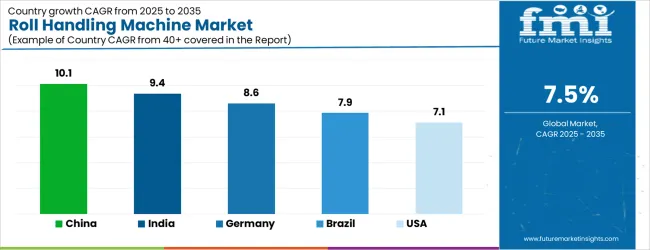
- Among key countries, China at 10.1%, India at 9.4%, Germany at 8.6%, Brazil at 7.9%, USA at 7.1%, UK at 6.4%, Japan at 5.6% CAGR through 2036.
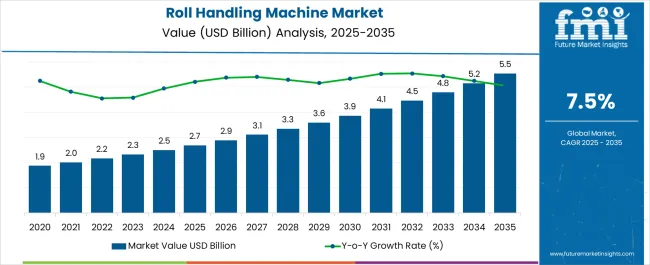
Manufacturing operations across paper, plastics, textiles, and metal converting are investing in automated roll handling systems to reduce manual lifting injuries and improve production changeover speed. Workplace safety regulations under OSHA in North America and EU Machinery Directive standards in Europe are mandating mechanical handling solutions for rolls exceeding manual lift weight thresholds. The shift toward wider web widths and heavier parent rolls in paper and film converting is increasing the payload requirements for roll handling equipment, driving replacement cycles for undersized legacy systems.
Country-level growth trajectories reflect divergent industrial maturity and regulatory timelines. China leads with a 10.1% CAGR through 2036, supported by scaled manufacturing infrastructure and government procurement programs. Other key markets include India (9.4%), Germany (8.6%), Brazil (7.9%), USA (7.1%), UK (6.4%), Japan (5.6%). Mature markets such as Japan maintain steady replacement demand cycles anchored by established supply contracts and quality compliance frameworks.
Roll Handling Machine Market Key Takeaways
| Metric | Details |
|---|---|
| Industry Size (2026) | USD 2.90 billion |
| Industry Value (2036) | USD 5.98 billion |
| CAGR (2026-2036) | 7.5% |
Source: Future Market Insights, 2026
Roll Handling Machine Market Definition
Roll handling machines are material handling equipment designed to lift, transport, rotate, stage, and position heavy cylindrical rolls of paper, plastic film, textile fabric, metal coil, and other web materials within converting and manufacturing environments. Equipment categories include truck devices, overhead crane systems, walk-behind units, robotic manipulators, and tilt tables configured for automatic or semi-automatic operation. These systems reduce manual lifting injuries, improve production changeover speed, and enable safe handling of rolls that exceed manual lift weight limits established by workplace safety regulations.
Roll Handling Machine Market Inclusions
Market scope includes automatic and semi-automatic roll handling machines across truck devices, overhead devices, walk-behind units, robotic systems, and tilt table configurations. Coverage extends to paper, plastic, textile, and other industrial end-use applications. Regional market sizing, technology adoption analysis, and competitive landscape assessment are included.
Roll Handling Machine Market Exclusions
The scope excludes general-purpose forklifts, overhead bridge cranes, and conveyor systems not specifically designed for cylindrical roll handling. Manual pallet jacks and hand trucks rated below powered roll handling thresholds are omitted from the valuation.
Roll Handling Machine Market Research Methodology
- Primary Research: Analysts conducted structured interviews with procurement managers, production engineers, and supply chain directors across key roll handling machine operations to map decision triggers and specification requirements.
- Desk Research: Data collection aggregated publicly available trade statistics, regulatory filings, industry association reports, and company annual disclosures relevant to roll handling machine production and consumption patterns.
- Market-Sizing and Forecasting: Baseline values derive from a bottom-up aggregation of production volume data and average selling price benchmarks, applying region-specific adoption curves to project demand through 2036.
- Data Validation and Update Cycle: Projections are cross-validated against publicly reported financial disclosures from leading market participants and verified against national trade data registries.
Why is the Roll Handling Machine Market Growing?
The Roll Handling Machine market is experiencing steady growth, driven by the increasing demand for efficient material handling solutions across the paper and packaging industries. Rising production volumes and the need for automation in manufacturing processes are fueling the adoption of advanced roll handling systems. Continuous advancements in machine technology, including automatic control, real-time monitoring, and integration with industrial automation systems, are improving operational efficiency, reducing labor dependency, and enhancing workplace safety.
Growing focus on minimizing downtime, optimizing throughput, and maintaining product quality is further supporting market expansion. The demand for energy-efficient and ergonomically designed machines is also increasing, driven by sustainability initiatives and occupational health considerations.
Manufacturers are investing in research and development to improve machine flexibility, load capacity, and adaptability to various roll sizes and weights As paper and packaging industries continue to modernize and adopt smart factory concepts, the market for roll handling machines is expected to witness sustained growth, with automated, high-performance solutions serving as key enablers for efficiency and cost-effectiveness.
Segmental Analysis
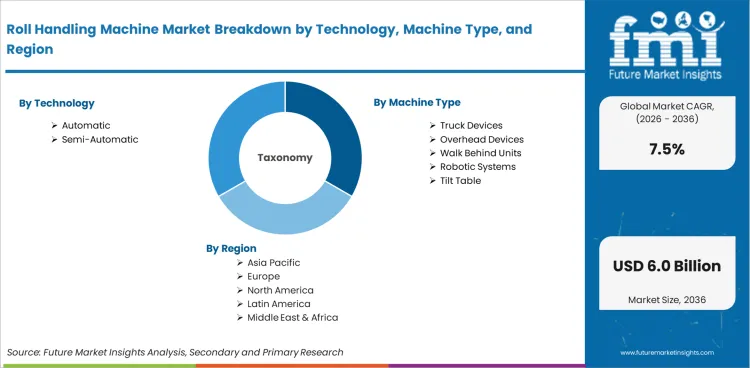
The roll handling machine market is segmented by technology, machine types, end use industry, and geographic regions. By technology, roll handling machine market is divided into Automatic and Semi-Automatic. In terms of machine types, roll handling machine market is classified into Truck Devices, Overhead Devices, Walk Behind Units, Robotic Systems, and Tilt Table. Based on end use industry, roll handling machine market is segmented into Paper Industry, Plastic Industry, Textile Industry, and Other Industries. Regionally, the roll handling machine industry is classified into North America, Latin America, Western Europe, Eastern Europe, Balkan & Baltic Countries, Russia & Belarus, Central Asia, East Asia, South Asia & Pacific, and the Middle East & Africa.
Insights into the Automatic Technology Segment
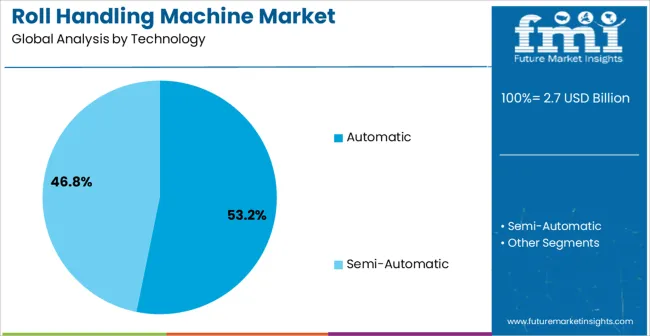
The automatic technology segment is projected to hold 53.2% of the market revenue in 2026, establishing it as the leading technology category. Growth in this segment is being driven by the increasing preference for automation to improve efficiency, reduce labor costs, and minimize human error in material handling operations.
Automatic roll handling machines are equipped with features such as programmable controls, real-time load monitoring, and integration with industrial production systems, which allow for smoother, faster, and safer handling of heavy rolls. The capability to handle high production volumes with minimal operator intervention enhances productivity and reduces operational risk.
In addition, automatic systems provide precise movement, alignment, and placement of rolls, which is essential for maintaining product quality and minimizing damage As industries increasingly adopt Industry 4.0 concepts and smart manufacturing practices, automatic roll handling technology is expected to maintain its leadership, driven by technological innovations that improve efficiency, reliability, and adaptability in complex production environments.
Insights into the Truck Devices Machine Type Segment
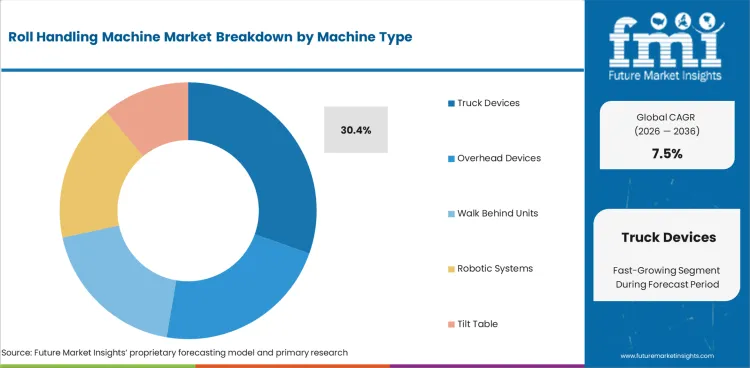
The truck devices machine type segment is expected to account for 30.4% of the market revenue in 2026, making it the leading machine type. Its growth is being driven by the need for flexible and mobile solutions that can transport heavy rolls efficiently across production floors and warehouses. Truck devices offer maneuverability and adaptability, allowing for easy integration into existing workflows without requiring significant infrastructure modifications.
These machines enhance safety by reducing manual handling and minimizing the risk of workplace injuries while improving operational speed. The ability to transport rolls of various sizes and weights reliably supports high-volume production environments.
As paper and packaging industries continue to adopt lean manufacturing practices and emphasize safety and productivity, truck devices are expected to remain a preferred machine type Their versatility, combined with ease of operation and integration into automated systems, ensures sustained demand and reinforces their leading position in the market.
Insights into the Paper Industry End-Use Segment
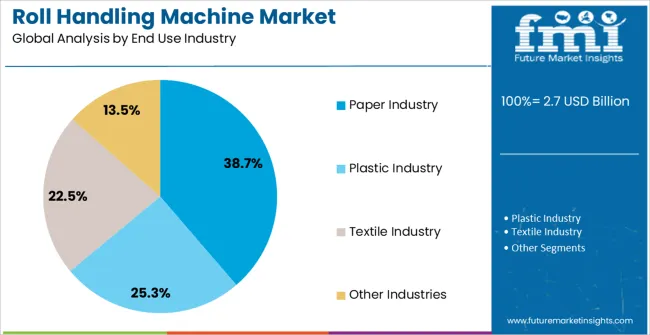
The paper industry segment is projected to hold 38.7% of the market revenue in 2026, establishing it as the leading end-use industry. Growth in this segment is driven by the increasing need for efficient roll handling in paper manufacturing, processing, and packaging operations. The sector requires high-capacity machines capable of transporting heavy and bulky rolls while maintaining product integrity and minimizing downtime.
Automation and integration with production lines enhance operational efficiency, reduce labor dependency, and improve workplace safety. Rising global demand for paper products, coupled with the adoption of smart factory concepts, is supporting investment in advanced roll handling solutions.
Additionally, the focus on energy efficiency, sustainability, and compliance with safety standards is driving the modernization of material handling equipment in paper plants As production volumes continue to increase and operational efficiency becomes more critical, the paper industry segment is expected to remain the primary revenue contributor, supported by ongoing technological innovations and automation trends in roll handling systems.
Market Overview
Global roll handling machine market: Introduction
Rolls of various materials are manufactured such as foil, paper, film, textiles, and nonwovens on cores of surfaces such as metal, cardboard or plastic. Handling of these rolls is important in order to transport them for further processing. In roll handling, rolls are manufactured and then wounded on core for web processing and then transported to other convertors for processing.
With roll handling machine, firstly rolls are handled and are transferred to convertors for further processing and packaging purposes. It provides faster way of handling rolls. Carrying out manual roll handling and packaging may cause back injuries to employees which costs industries millions of dollars in the form of compensation. Roll handling machine prevent lots of problems caused by manual work.
Also manual work may cause damage to rolls, which result in wastage of material. There are various devices available for roll handling such as truck devices, overhead roll handling devices, walk behind roll handling devices, automatic and semi-automatic robotic systems and other such devices. The truck devices are further divided into various types. The global roll handling machine market is anticipated to witness high preference among manufacturers across the globe due to various advantages.
Analysis of Roll Handling Machine Market By Key Countries
.webp "Top Country Growth Comparison Roll Handling Machine Market Cagr (2026 2036)")
| Country | CAGR |
|---|---|
| China | 10.1% |
| India | 9.4% |
| Germany | 8.6% |
| Brazil | 7.9% |
| USA | 7.1% |
| UK | 6.4% |
| Japan | 5.6% |
Country-wise Analysis
The Roll Handling Machine Market is expected to register a CAGR of 7.5% during the forecast period, exhibiting varied country level momentum. China leads with the highest CAGR of 10.1%, followed by India at 9.4%. Developed markets such as Germany, France, and the UK continue to expand steadily, while the USA is likely to grow at consistent rates. Japan posts the lowest CAGR at 5.6%, yet still underscores a broadly positive trajectory for the global Roll Handling Machine Market. In 2024, Germany held a dominant revenue in the Western Europe market and is expected to grow with a CAGR of 8.6%. The USA Roll Handling Machine Market is estimated to be valued at USD 1.0 billion in 2026 and is anticipated to reach a valuation of USD 1.0 billion by 2036. Sales are projected to rise at a CAGR of 0.0% over the forecast period between 2026 and 2036. While Japan and South Korea markets are estimated to be valued at USD 123.2 million and USD 84.4 million respectively in 2026.
Key Players in the Roll Handling Machine Market

- Schlumpf
- R&D ERGO
- Packline
- Tilt-Lock
- ASE Systems
- Torros
- AZTECH Converting System
- Easy Lift Equipment
- Hofpartner AB
- Dotec B.V.
- Factory Supply Inc.
Scope of the Report
| Metric | Value |
|---|---|
| Quantitative Units | USD 2.90 billion to USD 5.98 billion, at a CAGR of 7.5% |
| Market Definition | Roll handling machines are material handling equipment designed to lift, transport, rotate, stage, and position heavy cylindrical rolls of paper, plastic film, textile fabric, metal coil, and other web materials within converting and manufacturing environments. Equipment categories include truck devices, overhead crane systems, walk-behind units, robotic manipulators, and tilt tables configured for automatic or semi-automatic operation. These systems reduce manual lifting injuries, improve production changeover speed, and enable safe handling of rolls that exceed manual lift weight limits established by workplace safety regulations. |
| Technology, Machine Type, End Use Industry Segmentation | Technology: Automatic, Semi-Automatic; Machine Type: Truck Devices, Overhead Devices, Walk Behind Units, Robotic Systems, Tilt Table; End Use Industry: Paper Industry, Plastic Industry, Textile Industry, Other Industries |
| Regions Covered | North America, Latin America, Europe, East Asia, South Asia, Oceania, Middle East & Africa |
| Countries Covered | China, India, Germany, Brazil, USA, UK, Japan, and 40 plus countries |
| Key Companies Profiled | Schlumpf, R&D ERGO, Packline, Tilt-Lock, ASE Systems, Torros, AZTECH Converting System, Easy Lift Equipment, Hofpartner AB, Dotec B.V., Factory Supply Inc. |
| Forecast Period | 2026 to 2036 |
| Approach | Forecasting models apply a bottom-up methodology starting with production volume benchmarks and average selling price data, cross-validated against public financial disclosures and trade statistics. |
Roll Handling Machine Market by Segments
Technology:
- Automatic
- Semi-Automatic
Machine Types:
- Truck Devices
- Overhead Devices
- Walk Behind Units
- Robotic Systems
- Tilt Table
End Use Industry:
- Paper Industry
- Plastic Industry
- Textile Industry
- Other Industries
Region:
- North America
- USA
- Canada
- Mexico
- Latin America
- Brazil
- Chile
- Rest of Latin America
- Western Europe
- Germany
- UK
- Italy
- Spain
- France
- Nordic
- BENELUX
- Rest of Western Europe
- Eastern Europe
- Russia
- Poland
- Hungary
- Balkan & Baltic
- Rest of Eastern Europe
- East Asia
- China
- Japan
- South Korea
- South Asia and Pacific
- India
- ASEAN
- Australia & New Zealand
- Rest of South Asia and Pacific
- Middle East & Africa
- Kingdom of Saudi Arabia
- Other GCC Countries
- Turkiye
- South Africa
- Other African Union
- Rest of Middle East & Africa
Bibliography
- European Commission. (2024). Machinery Directive 2006/42/EC: Updated guidance. European Commission.
- Occupational Safety and Health Administration. (2024). Materials handling and storage guidelines. OSHA.
- International Organization for Standardization. (2024). ISO 3691:2024 Industrial trucks safety requirements. ISO.
- Confederation of European Paper Industries. (2024). Key statistics on European pulp and paper industry. CEPI.
- Organisation for Economic Co-operation and Development. (2024). Workplace safety indicators. OECD.
This bibliography is provided for reader reference. The full Future Market Insights report contains the complete reference list with primary research documentation.
Frequently Asked Questions
How large is the demand for Roll Handling Machine in the global market in 2026?
Demand for roll handling machine in the global market is estimated to be valued at USD 2.90 billion in 2026.
What will be the market size of Roll Handling Machine in the global market by 2036?
Market size for roll handling machine is projected to reach USD 5.98 billion by 2036.
What is the expected demand growth for Roll Handling Machine in the global market between 2026 and 2036?
Demand for roll handling machine is expected to grow at a CAGR of 7.5% between 2026 and 2036.
Which Technology is poised to lead global sales by 2026?
Automatic accounts for 53.2% share in 2026, as it remains the primary specification across established procurement channels.
How is the Machine Type segment structured in 2026?
Truck Devices leads with 30.4% of segment share in 2026, driven by established buyer preference and supply chain compatibility.
What is China's growth outlook in this report?
China is projected to grow at a CAGR of 10.1% during 2026 to 2036.
What is Roll Handling Machine and what is it mainly used for?
Roll handling machines are material handling equipment designed to lift, transport, rotate, stage, and position heavy cylindrical rolls of paper, plastic film, textile fabric, metal coil, and other web materials within converting and manufacturing environments. Equipment categories include truck devices, overhead crane systems, walk-behind units, robotic manipulators, and tilt tables configured for automatic or semi-automatic operation.
What is included in the scope of this Roll Handling Machine report?
Market scope includes automatic and semi-automatic roll handling machines across truck devices, overhead devices, walk-behind units, robotic systems, and tilt table configurations. Coverage extends to paper, plastic, textile, and other industrial end-use applications.
Preview the report firsthand - request a free sample
Get SampleGet the brochure for pricing and purchase details.
Get PDFTable of Content
- Executive Summary
- Global Market Outlook
- Demand-side Trends
- Supply-side Trends
- Technology Roadmap Analysis
- Analysis and Recommendations
- Market Overview
- Market Coverage / Taxonomy
- Market Definition / Scope / Limitations
- Research Methodology
- Chapter Orientation
- Analytical Lens and Working Hypotheses
- Market Structure, Signals, and Trend Drivers
- Benchmarking and Cross-market Comparability
- Market Sizing, Forecasting, and Opportunity Mapping
- Research Design and Evidence Framework
- Desk Research Programme (Secondary Evidence)
- Company Annual and Sustainability Reports
- Peer-reviewed Journals and Academic Literature
- Corporate Websites, Product Literature, and Technical Notes
- Earnings Decks and Investor Briefings
- Statutory Filings and Regulatory Disclosures
- Technical White Papers and Standards Notes
- Trade Journals, Industry Magazines, and Analyst Briefs
- Conference Proceedings, Webinars, and Seminar Materials
- Government Statistics Portals and Public Data Releases
- Press Releases and Reputable Media Coverage
- Specialist Newsletters and Curated Briefings
- Sector Databases and Reference Repositories
- FMI Internal Proprietary Databases and Historical Market Datasets
- Subscription Datasets and Paid Sources
- Social Channels, Communities, and Digital Listening Inputs
- Additional Desk Sources
- Expert Input and Fieldwork (Primary Evidence)
- Primary Modes
- Qualitative Interviews and Expert Elicitation
- Quantitative Surveys and Structured Data Capture
- Technical Specialists
- Domain Subject-matter Experts
- Scientists
- Physicians and Other Healthcare Professionals
- Governance, Ethics, and Data Stewardship
- Research Ethics
- Data Integrity and Handling
- Primary Modes
- Tooling, Models, and Reference Databases
- Desk Research Programme (Secondary Evidence)
- Data Engineering and Model Build
- Data Acquisition and Ingestion
- Cleaning, Normalisation, and Verification
- Synthesis, Triangulation, and Analysis
- Quality Assurance and Audit Trail
- Market Background
- Market Dynamics
- Drivers
- Restraints
- Opportunity
- Trends
- Scenario Forecast
- Demand in Optimistic Scenario
- Demand in Likely Scenario
- Demand in Conservative Scenario
- Opportunity Map Analysis
- Product Life Cycle Analysis
- Supply Chain Analysis
- Investment Feasibility Matrix
- Value Chain Analysis
- PESTLE and Porter’s Analysis
- Regulatory Landscape
- Regional Parent Market Outlook
- Production and Consumption Statistics
- Import and Export Statistics
- Market Dynamics
- Global Market Analysis 2021 to 2025 and Forecast, 2026 to 2036
- Historical Market Size Value (USD Million) Analysis, 2021 to 2025
- Current and Future Market Size Value (USD Million) Projections, 2026 to 2036
- Y-o-Y Growth Trend Analysis
- Absolute $ Opportunity Analysis
- Global Market Pricing Analysis 2021 to 2025 and Forecast 2026 to 2036
- Global Market Analysis 2021 to 2025 and Forecast 2026 to 2036, By Technology
- Introduction / Key Findings
- Historical Market Size Value (USD Million) Analysis By Technology , 2021 to 2025
- Current and Future Market Size Value (USD Million) Analysis and Forecast By Technology , 2026 to 2036
- Automatic
- Semi-Automatic
- Automatic
- Y-o-Y Growth Trend Analysis By Technology , 2021 to 2025
- Absolute $ Opportunity Analysis By Technology , 2026 to 2036
- Global Market Analysis 2021 to 2025 and Forecast 2026 to 2036, By Machine Type
- Introduction / Key Findings
- Historical Market Size Value (USD Million) Analysis By Machine Type, 2021 to 2025
- Current and Future Market Size Value (USD Million) Analysis and Forecast By Machine Type, 2026 to 2036
- Truck Devices
- Overhead Devices
- Walk Behind Value (USD Million)s
- Robotic Systems
- Tilt Table
- Truck Devices
- Y-o-Y Growth Trend Analysis By Machine Type, 2021 to 2025
- Absolute $ Opportunity Analysis By Machine Type, 2026 to 2036
- Global Market Analysis 2021 to 2025 and Forecast 2026 to 2036, By End Use Industry
- Introduction / Key Findings
- Historical Market Size Value (USD Million) Analysis By End Use Industry, 2021 to 2025
- Current and Future Market Size Value (USD Million) Analysis and Forecast By End Use Industry, 2026 to 2036
- Paper Industry
- Plastic Industry
- Textile Industry
- Other Industries
- Paper Industry
- Y-o-Y Growth Trend Analysis By End Use Industry, 2021 to 2025
- Absolute $ Opportunity Analysis By End Use Industry, 2026 to 2036
- Global Market Analysis 2021 to 2025 and Forecast 2026 to 2036, By Region
- Introduction
- Historical Market Size Value (USD Million) Analysis By Region, 2021 to 2025
- Current Market Size Value (USD Million) Analysis and Forecast By Region, 2026 to 2036
- North America
- Latin America
- Western Europe
- Eastern Europe
- East Asia
- South Asia and Pacific
- Middle East & Africa
- Market Attractiveness Analysis By Region
- North America Market Analysis 2021 to 2025 and Forecast 2026 to 2036, By Country
- Historical Market Size Value (USD Million) Trend Analysis By Market Taxonomy, 2021 to 2025
- Market Size Value (USD Million) Forecast By Market Taxonomy, 2026 to 2036
- By Country
- USA
- Canada
- Mexico
- By Technology
- By Machine Type
- By End Use Industry
- By Country
- Market Attractiveness Analysis
- By Country
- By Technology
- By Machine Type
- By End Use Industry
- Key Takeaways
- Latin America Market Analysis 2021 to 2025 and Forecast 2026 to 2036, By Country
- Historical Market Size Value (USD Million) Trend Analysis By Market Taxonomy, 2021 to 2025
- Market Size Value (USD Million) Forecast By Market Taxonomy, 2026 to 2036
- By Country
- Brazil
- Chile
- Rest of Latin America
- By Technology
- By Machine Type
- By End Use Industry
- By Country
- Market Attractiveness Analysis
- By Country
- By Technology
- By Machine Type
- By End Use Industry
- Key Takeaways
- Western Europe Market Analysis 2021 to 2025 and Forecast 2026 to 2036, By Country
- Historical Market Size Value (USD Million) Trend Analysis By Market Taxonomy, 2021 to 2025
- Market Size Value (USD Million) Forecast By Market Taxonomy, 2026 to 2036
- By Country
- Germany
- UK
- Italy
- Spain
- France
- Nordic
- BENELUX
- Rest of Western Europe
- By Technology
- By Machine Type
- By End Use Industry
- By Country
- Market Attractiveness Analysis
- By Country
- By Technology
- By Machine Type
- By End Use Industry
- Key Takeaways
- Eastern Europe Market Analysis 2021 to 2025 and Forecast 2026 to 2036, By Country
- Historical Market Size Value (USD Million) Trend Analysis By Market Taxonomy, 2021 to 2025
- Market Size Value (USD Million) Forecast By Market Taxonomy, 2026 to 2036
- By Country
- Russia
- Poland
- Hungary
- Balkan & Baltic
- Rest of Eastern Europe
- By Technology
- By Machine Type
- By End Use Industry
- By Country
- Market Attractiveness Analysis
- By Country
- By Technology
- By Machine Type
- By End Use Industry
- Key Takeaways
- East Asia Market Analysis 2021 to 2025 and Forecast 2026 to 2036, By Country
- Historical Market Size Value (USD Million) Trend Analysis By Market Taxonomy, 2021 to 2025
- Market Size Value (USD Million) Forecast By Market Taxonomy, 2026 to 2036
- By Country
- China
- Japan
- South Korea
- By Technology
- By Machine Type
- By End Use Industry
- By Country
- Market Attractiveness Analysis
- By Country
- By Technology
- By Machine Type
- By End Use Industry
- Key Takeaways
- South Asia and Pacific Market Analysis 2021 to 2025 and Forecast 2026 to 2036, By Country
- Historical Market Size Value (USD Million) Trend Analysis By Market Taxonomy, 2021 to 2025
- Market Size Value (USD Million) Forecast By Market Taxonomy, 2026 to 2036
- By Country
- India
- ASEAN
- Australia & New Zealand
- Rest of South Asia and Pacific
- By Technology
- By Machine Type
- By End Use Industry
- By Country
- Market Attractiveness Analysis
- By Country
- By Technology
- By Machine Type
- By End Use Industry
- Key Takeaways
- Middle East & Africa Market Analysis 2021 to 2025 and Forecast 2026 to 2036, By Country
- Historical Market Size Value (USD Million) Trend Analysis By Market Taxonomy, 2021 to 2025
- Market Size Value (USD Million) Forecast By Market Taxonomy, 2026 to 2036
- By Country
- Kingdom of Saudi Arabia
- Other GCC Countries
- Turkiye
- South Africa
- Other African Union
- Rest of Middle East & Africa
- By Technology
- By Machine Type
- By End Use Industry
- By Country
- Market Attractiveness Analysis
- By Country
- By Technology
- By Machine Type
- By End Use Industry
- Key Takeaways
- Key Countries Market Analysis
- USA
- Pricing Analysis
- Market Share Analysis, 2025
- By Technology
- By Machine Type
- By End Use Industry
- Canada
- Pricing Analysis
- Market Share Analysis, 2025
- By Technology
- By Machine Type
- By End Use Industry
- Mexico
- Pricing Analysis
- Market Share Analysis, 2025
- By Technology
- By Machine Type
- By End Use Industry
- Brazil
- Pricing Analysis
- Market Share Analysis, 2025
- By Technology
- By Machine Type
- By End Use Industry
- Chile
- Pricing Analysis
- Market Share Analysis, 2025
- By Technology
- By Machine Type
- By End Use Industry
- Germany
- Pricing Analysis
- Market Share Analysis, 2025
- By Technology
- By Machine Type
- By End Use Industry
- UK
- Pricing Analysis
- Market Share Analysis, 2025
- By Technology
- By Machine Type
- By End Use Industry
- Italy
- Pricing Analysis
- Market Share Analysis, 2025
- By Technology
- By Machine Type
- By End Use Industry
- Spain
- Pricing Analysis
- Market Share Analysis, 2025
- By Technology
- By Machine Type
- By End Use Industry
- France
- Pricing Analysis
- Market Share Analysis, 2025
- By Technology
- By Machine Type
- By End Use Industry
- India
- Pricing Analysis
- Market Share Analysis, 2025
- By Technology
- By Machine Type
- By End Use Industry
- ASEAN
- Pricing Analysis
- Market Share Analysis, 2025
- By Technology
- By Machine Type
- By End Use Industry
- Australia & New Zealand
- Pricing Analysis
- Market Share Analysis, 2025
- By Technology
- By Machine Type
- By End Use Industry
- China
- Pricing Analysis
- Market Share Analysis, 2025
- By Technology
- By Machine Type
- By End Use Industry
- Japan
- Pricing Analysis
- Market Share Analysis, 2025
- By Technology
- By Machine Type
- By End Use Industry
- South Korea
- Pricing Analysis
- Market Share Analysis, 2025
- By Technology
- By Machine Type
- By End Use Industry
- Russia
- Pricing Analysis
- Market Share Analysis, 2025
- By Technology
- By Machine Type
- By End Use Industry
- Poland
- Pricing Analysis
- Market Share Analysis, 2025
- By Technology
- By Machine Type
- By End Use Industry
- Hungary
- Pricing Analysis
- Market Share Analysis, 2025
- By Technology
- By Machine Type
- By End Use Industry
- Kingdom of Saudi Arabia
- Pricing Analysis
- Market Share Analysis, 2025
- By Technology
- By Machine Type
- By End Use Industry
- Turkiye
- Pricing Analysis
- Market Share Analysis, 2025
- By Technology
- By Machine Type
- By End Use Industry
- South Africa
- Pricing Analysis
- Market Share Analysis, 2025
- By Technology
- By Machine Type
- By End Use Industry
- USA
- Market Structure Analysis
- Competition Dashboard
- Competition Benchmarking
- Market Share Analysis of Top Players
- By Regional
- By Technology
- By Machine Type
- By End Use Industry
- Competition Analysis
- Competition Deep Dive
- Schlumpf
- Overview
- Product Portfolio
- Profitability by Market Segments (Product/Age /Sales Channel/Region)
- Sales Footprint
- Strategy Overview
- Marketing Strategy
- Product Strategy
- Channel Strategy
- R&D ERGO
- Packline
- Tilt-Lock
- ASE Systems
- Torros
- AZTECH Converting System
- Easy Lift Equipment
- Hofpartner AB
- Dotec B.V.
- Factory Supply Inc.
- Schlumpf
- Competition Deep Dive
- Assumptions & Acronyms Used


