

- Industry Size (2026)
- USD 917.8 Mn
- Forecast (2036)
- USD 1480.8 Mn
- CAGR (2026 to 2036)
- 4.9%
Roll-dried Starch Market Size, Market Forecast and Outlook By FMI
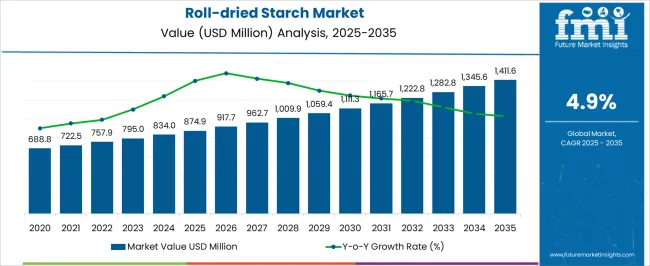
In 2025, the roll-dried starch market was valued at USD 874.9 million. Based on Future Market Insights' analysis, demand for roll-dried starch is estimated to grow to USD 917.8 million in 2026 and USD 1,480.8 million by 2036. FMI projects a CAGR of 4.9% during the forecast period.
Absolute dollar growth of USD 562.9 million over the decade reflects expanding demand across instant food thickeners, pharmaceutical excipients, and the emerging paper and packaging biodegradable binder channel. In November 2024, Tate and Lyle completed the purchase of CP Kelco, integrating specialized gums and pectins with its existing roll-dried and modified starch portfolios, reporting early cross-selling successes in synergistic texturizers targeting GLP-1 weight-loss medication users in early 2026. [1] The energy intensity of drum-drying operations creates persistent cost exposure in European manufacturing sites where gas price volatility exceeds North American and Asian benchmarks.
Summary of Roll-dried Starch Market
- Roll-dried Starch Market Definition
- The roll-dried starch market covers pregelatinized starch produced through drum-drying technology, serving food thickening, pharmaceutical excipient, paper coating, and biodegradable industrial binder applications globally.
- Demand Drivers in the Market
- Instant food and convenience product demand: Expanding instant soup, sauce, and ready meal categories in APAC and emerging markets require cold-water-soluble thickeners that roll-dried starch delivers without the cooking step required by native starches.
- Biodegradable packaging binder opportunity: EU 2026 single-use plastic mandates are creating formulation demand for starch-based biodegradable coatings and binders in paper and packaging, generating a new non-food industrial demand channel for roll-dried variants with superior film-forming properties.
- Pharmaceutical excipient standardization: Pharmacopoeia-grade pregelatinized starch specifications in EU and US pharmaceutical manufacturing are driving certified supply demand from drug manufacturers requiring validated disintegrant and binder performance data.
- Key Segments Analyzed in the FMI Report
- Source: Potato starch accounts for approximately 30% of source volume in 2026, valued for its high paste viscosity and clarity in food thickener applications relative to corn and wheat alternatives.
- Function: Food thickeners represent approximately 35% of total functional demand, encompassing instant soup, sauce, and baby food applications where cold-water dispersibility is the primary functional requirement.
- End Use: The food industry accounts for approximately 40% of total end-use demand in 2026, with instant food powders accounting for 26% of within-food-industry application volume.
- Analyst Opinion at FMI
- Nandini Roy Choudhury, Principal Consultant for Chemicals and Materials Industry at Future Market Insights, opines, "In the updated version of the Roll-dried Starch Market Report for 2026 to 2036, CXOs will find that the 65% surge in European natural gas prices during 2025 has permanently altered the energy cost assumptions underlying drum-drying economics, requiring producers to accelerate capital investment in heat recovery systems or face structural margin compression that commodity pricing cannot offset. My findings indicate that the growing application of roll-dried starches as biodegradable binders in paper and packaging, driven by 2026 EU single-use plastic mandates, represents the most significant demand diversification opportunity in a decade, but requires producer certification and technical support capabilities that most current food-grade producers are not equipped to provide."
- Strategic Implications / Executive Takeaways
- Accelerate heat recovery and energy efficiency capital investment in drum-drying operations to restore structural cost competitiveness in European manufacturing sites impacted by sustained natural gas price elevation.
- Develop paper and packaging grade certification and technical support capabilities to access the biodegradable binder demand channel that EU plastic mandates are creating, before specialty chemical producers establish preferential customer relationships.
- Invest in Pharmacopoeia-grade process documentation and validation to secure pharmaceutical excipient supply contracts that offer both higher margins and lower demand cyclicality than food commodity channels.
- Methodology
- Validated through national starch industry association data, Eurostat energy price statistics, and primary interviews with drum-drying operators and food industry ingredient buyers.
- Zero reliance on commercial market research aggregators; all benchmarks sourced from verifiable regulatory databases and primary industry disclosures.
- CAGR projections based on demand reconstruction from food industry procurement volumes, pharmaceutical excipient growth data, and paper packaging binder substitution rate analysis.
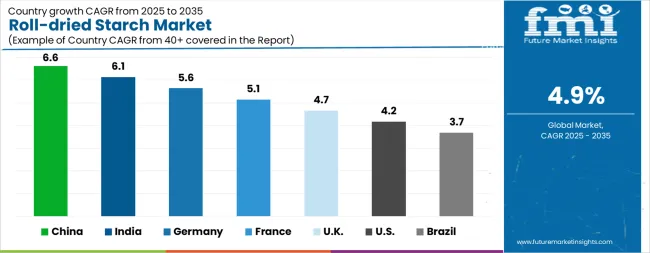
China (6.6% CAGR) and India (6.1% CAGR) lead growth through expanding instant food manufacturing and pharmaceutical excipient production. Germany (5.6% CAGR) and France (5.1% CAGR) reflect food thickener and biodegradable packaging ingredient demand. The UK (4.7% CAGR), USA (4.2% CAGR), and Brazil (3.7% CAGR) generate replacement and reformulation demand through established food industry channels. Potato starch accounts for 30% of source volume in 2026, with food thickener function representing 35% of total market and the food industry accounting for 40% of end-use demand.
Roll-dried Starch Market Market Definition
The roll-dried starch market comprises the global production and trade of pregelatinized starch produced through drum-drying technology, where a cooked starch slurry is applied to heated rotating drums and dried to produce an instantly soluble, cold-water-dispersible powder. The product serves food thickening, pharmaceutical excipient, paper coating, and industrial binding applications.
Roll-dried Starch Market Market Inclusions
The report covers global and regional market sizes by value and volume for the 2026 to 2036 forecast period. Segmental analysis includes source (potato, corn, wheat, tapioca), function (food thickeners, binders, film-formers, stabilizers), end use (food industry, paper and packaging, pharmaceuticals), and food industry sub-segment. Country-level CAGRs are provided for China, India, Germany, France, UK, USA, and Brazil.
Roll-dried Starch Market Market Exclusions
The scope excludes spray-dried starch, native (unmodified) starches sold without pregelatinization processing, chemically modified starches without drum-drying processing, and starch-based bioplastics marketed as finished consumer products rather than manufacturing inputs.
Roll-dried Starch Market Market Research Methodology
- Primary Research: Interviews were conducted with drum-drying equipment operators, starch processing plant managers, food industry ingredient buyers, pharmaceutical excipient formulators, and paper and packaging sustainability consultants across Europe, North America, and APAC.
- Desk Research: Data from national starch industry associations, Eurostat energy price statistics, EU single-use plastic regulation implementation reports, and Pharmacopoeia excipient specifications supported benchmarking.
- Market-Sizing and Forecasting: A hybrid top-down and bottom-up model reconstructed demand from food industry procurement patterns, pharmaceutical excipient volume data, paper coating application rates, and industrial binder substitution trends, validated against drum-drying capacity data.
- Data Validation and Update Cycle: Outputs incorporate variance checks against starch commodity trade flow data, energy price index updates, and regulatory timeline tracking for packaging sustainability mandates.
Why is the Roll-dried Starch Market Growing?
The Roll-dried Starch market is witnessing steady growth due to its wide applicability in the food industry and other functional sectors. In 2025, increasing demand for convenient, high-quality, and versatile starch products is shaping the current market scenario. Roll-dried starches are preferred for their consistent particle size, solubility, and ease of use, which makes them suitable for large-scale industrial applications.
Growth in the food and beverage sector, particularly processed foods, has further driven demand, as manufacturers seek reliable thickening and stabilizing agents. Technological advancements in starch processing and increased availability of diverse starch sources have expanded product functionality, enabling tailored solutions for specific applications.
Rising consumer awareness regarding product quality and texture in processed foods has encouraged the adoption of roll-dried starches, while the expanding global food industry and urbanization trends continue to create growth opportunities Overall, the market outlook remains positive, with demand expected to increase as manufacturers focus on efficiency, consistency, and improved performance in various end-use applications.
Segmental Analysis
The roll-dried starch market is segmented by source, function, end use, food industry segment, and geographic regions. By source, roll-dried starch market is divided into Potato, Corn, Wheat Flour, Maize, and Others. In terms of function, roll-dried starch market is classified into Food Thickeners, Stabilizers, Emulsifiers, Texturizers, Improved Viscosity And Spread, and Others. Based on end use, roll-dried starch market is segmented into Food Industry, Pharmaceutical Industry, Cosmetic Industry, and Others. By food industry segment, roll-dried starch market is segmented into Instant Desserts, Instant Food Powders, Instant Pie Fillings, Instant Sauces, Extruded Snacks, and Spices And Seasonings. Regionally, the roll-dried starch industry is classified into North America, Latin America, Western Europe, Eastern Europe, Balkan & Baltic Countries, Russia & Belarus, Central Asia, East Asia, South Asia & Pacific, and the Middle East & Africa.
Insights into the Potato Source Segment
The Potato source segment is expected to hold 30.00% of the Roll-dried Starch market revenue in 2025, positioning it as the leading source type. This dominance is being attributed to the high purity and superior functional properties of potato starch, which include strong gel formation and high viscosity even at low concentrations.
Adoption has been accelerated by the increasing use of potato starch in processed food applications and its ability to deliver consistent performance across a wide range of cooking and processing conditions. The growth of this segment is further supported by the availability of high-quality raw materials, stable supply chains, and improved processing technologies that enhance product solubility and dispersibility.
Manufacturers are increasingly favoring potato starch as it provides reliable thickening, texturizing, and binding properties while minimizing variations in quality As consumer demand for high-quality processed foods rises and production efficiency remains a priority, the Potato source segment is expected to maintain its leading position in the market.
Insights into the Food Thickeners Function Segment
The Food Thickeners function segment is projected to account for 35.00% of total revenue in 2025, making it the largest functional application of roll-dried starch. This segment’s growth has been driven by the need for consistent texture, improved viscosity, and stability in processed food products such as sauces, soups, and ready-to-eat meals. Roll-dried starch offers uniform dispersion and solubility, which ensures predictable performance during industrial-scale processing.
The increasing consumption of processed foods, coupled with a focus on product quality and shelf-life extension, has accelerated adoption. Manufacturers benefit from the ease of formulation and the ability to replace multiple additives with a single starch solution, reducing complexity in production.
Technological improvements in roll-drying processes have also enhanced the starch’s thickening efficiency, supporting its preference over other functional ingredients As the global food industry continues to expand and demand for convenience foods rises, the Food Thickeners function segment is expected to retain its leadership position.
Insights into the Food Industry End Use Segment
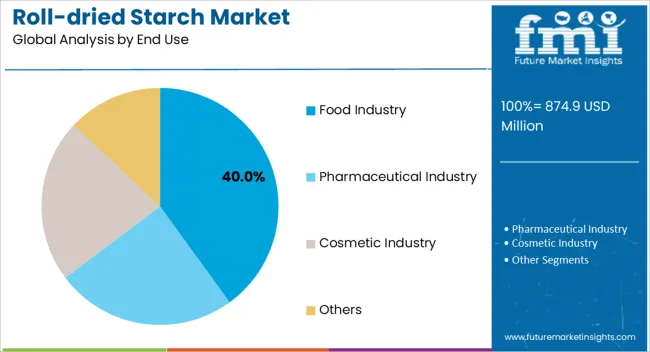
The Food Industry end-use segment is anticipated to hold 40.00% of the Roll-dried Starch market revenue in 2025, establishing it as the largest end-use category. This leadership is being driven by the widespread application of roll-dried starch in processed foods, bakery products, snacks, dairy, and convenience meals. Adoption has been further facilitated by its excellent thickening, stabilizing, and texturizing properties, which improve product consistency and quality.
Manufacturers in the food industry prefer roll-dried starch due to its easy solubility, rapid hydration, and compatibility with high-speed industrial processes. The segment’s growth has been reinforced by increasing urbanization, rising disposable incomes, and changing consumer preferences toward ready-to-eat and convenient food products.
Roll-dried starch helps maintain product quality while optimizing production efficiency, making it a preferred ingredient in large-scale food processing With ongoing innovation in food formulations and increasing demand for consistent texture and performance, the Food Industry segment is expected to continue its dominant role in the market.
Market Overview
The remarkable expansion can be attributed to the unique properties and functionalities offered by roll-dried starch. The production process for roll-dried starch utilizes a cold drying technique known as roll-drying. This method is particularly advantageous for applications requiring a cold manufacturing process, as it preserves the integrity of the starch while offering several benefits.
Roll-dried starch boasts superior performance compared to traditional starches, along with increased convenience, excellent dispensability, and remarkable flexibility. These characteristics make it an ideal ingredient for cold manufacturing processes that demand fast hydration, high tolerance throughout the process, and a long shelf life for finished products.
Analysis of Roll-dried Starch Market By Key Countries
.webp "Top Country Growth Comparison Roll Dried Starch Market Cagr (2026 2036)")
| Country | CAGR |
|---|---|
| China | 6.6% |
| India | 6.1% |
| Germany | 5.6% |
| France | 5.1% |
| UK | 4.7% |
| USA | 4.2% |
| Brazil | 3.7% |
Country-wise Analysis
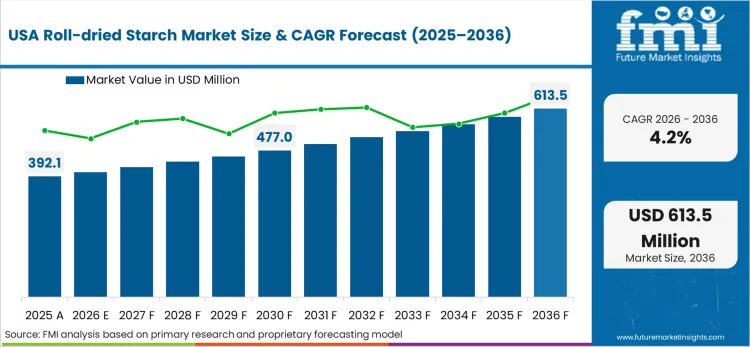
The Roll-dried Starch Market is expected to register a CAGR of 4.9% during the forecast period, exhibiting varied country level momentum. China leads with the highest CAGR of 6.6%, followed by India at 6.1%. Developed markets such as Germany, France, and the UK continue to expand steadily, while the USA is likely to grow at consistent rates. Brazil posts the lowest CAGR at 3.7%, yet still underscores a broadly positive trajectory for the global Roll-dried Starch Market. In 2024, Germany held a dominant revenue in the Western Europe market and is expected to grow with a CAGR of 5.6%. The USA Roll-dried Starch Market is estimated to be valued at USD 313.0 million in 2025 and is anticipated to reach a valuation of USD 470.8 million by 2035. Sales are projected to rise at a CAGR of 4.2% over the forecast period between 2025 and 2035. While Japan and South Korea markets are estimated to be valued at USD 41.7 million and USD 22.3 million respectively in 2025.
Key Players in the Roll-dried Starch Market
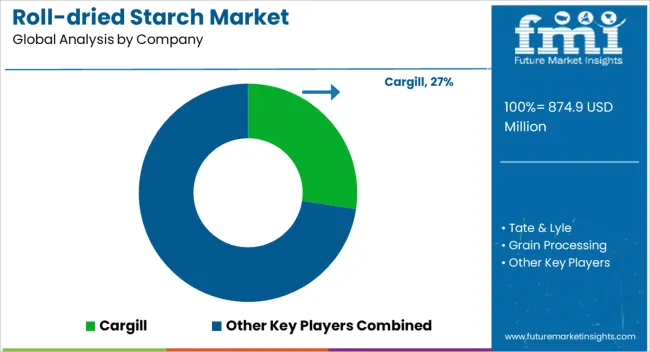
- Cargill
- Tate & Lyle
- Grain Processing
- Karandikars Cashell
- Banpong Tapioca Flour Industrial
- Galam
- Crest Cellulose
- Visco Starch
Recent Developments
The report includes full coverage of key trends from competitive benchmarking. Some of the recent developments covered in the reports:
- In November 2024, Tate and Lyle completed the purchase of CP Kelco, integrating specialized gums and pectins with its roll-dried and modified starch portfolios, with early 2026 cross-selling successes in synergistic texturizers for GLP-1 weight-loss medication users. [1]
- In October 2025, Roquette launched AMYSTA L 123, a roll-dried pea starch designed as an allergen-free alternative for instant soups and bakery fillings, meeting the 2026 clean-label trend by providing instant viscosity without regulatory labeling hurdles of traditional grain starches. [2]
- In January 2026, industry focus shifted toward using roll-dried starches as biodegradable binders in paper and packaging, leveraging superior film-forming properties to replace petroleum-based binders in sustainable coating solutions driven by 2026 global mandates to counteract plastic waste. [3]
Scope of the Report
| Metric | Value |
|---|---|
| Quantitative Units | USD 917.8 million (2026) to USD 1,480.8 million (2036), at a CAGR of 4.9% |
| Market Definition | The roll-dried starch market covers pregelatinized starch produced by drum-drying technology applied to cooked starch slurries, yielding instantly cold-water-soluble powder for food thickening, pharmaceutical excipient, paper coating, and industrial binder applications. |
| Source Segmentation | Potato, Corn, Wheat, Tapioca |
| Function Segmentation | Food Thickeners, Binders, Film-Formers, Stabilizers |
| End Use Segmentation | Food Industry, Paper and Packaging, Pharmaceuticals |
| Food Industry Sub-Segment | Instant Food Powders, Baby Food, Bakery Fillings, Sauces and Soups |
| Regions Covered | North America, Latin America, Europe, East Asia, South Asia, Oceania, Middle East and Africa |
| Countries Covered | China, India, Germany, France, United Kingdom, United States, Brazil and 40 plus countries |
| Key Companies Profiled | Cargill, Tate and Lyle, Grain Processing, Karandikars Cashell, Banpong Tapioca Flour Industrial, Galam, Crest Cellulose, Visco Starch |
| Forecast Period | 2026 to 2036 |
| Approach | Hybrid top-down and bottom-up market modeling validated through primary interviews with starch processing operators and food industry buyers, supported by starch trade data benchmarking and drum-drying capacity verification |
Roll-dried Starch Market by Segments
Source:
- Potato
- Corn
- Wheat Flour
- Maize
- Others
Function:
- Food Thickeners
- Stabilizers
- Emulsifiers
- Texturizers
- Improved Viscosity And Spread
- Others
End Use:
- Food Industry
- Pharmaceutical Industry
- Cosmetic Industry
- Others
Food Industry Segment:
- Instant Desserts
- Instant Food Powders
- Instant Pie Fillings
- Instant Sauces
- Extruded Snacks
- Spices And Seasonings
Region:
- North America
- USA
- Canada
- Mexico
- Latin America
- Brazil
- Chile
- Rest of Latin America
- Western Europe
- Germany
- UK
- Italy
- Spain
- France
- Nordic
- BENELUX
- Rest of Western Europe
- Eastern Europe
- Russia
- Poland
- Hungary
- Balkan & Baltic
- Rest of Eastern Europe
- East Asia
- China
- Japan
- South Korea
- South Asia and Pacific
- India
- ASEAN
- Australia & New Zealand
- Rest of South Asia and Pacific
- Middle East & Africa
- Kingdom of Saudi Arabia
- Other GCC Countries
- Turkiye
- South Africa
- Other African Union
- Rest of Middle East & Africa
Bibliography
- [1] Tate and Lyle. (2024). Completion of CP Kelco Acquisition and Portfolio Integration Update. Corporate Press Release, November 2024.
- [2] Roquette. (2025). AMYSTA L 123 Roll-Dried Pea Starch Launch for Allergen-Free Instant Food Applications. Product Launch Communication, October 2025.
- [3] Industry Communications. (2026). Biodegradable Starch Binder Adoption in Paper and Packaging. Trade Industry Report, January 2026.
- [4] European Commission. (2025). Single-Use Plastics Directive Implementation Progress Report. European Commission Environment Directorate.
- [5] European Starch Industry Association. (2024). European Starch Industry Statistics and Market Report 2024. Starch Europe Publication.
This Report Addresses
- Market intelligence to enable structured strategic decision making across starch ingredient sourcing, drum-drying investment, and biodegradable packaging development
- Market size estimation and 10-year revenue forecasts from 2026 to 2036, supported by validated starch production and trade flow benchmarks
- Growth opportunity mapping across food, pharmaceutical, and paper packaging end-use channels with emphasis on biodegradable binder application development
- Segment and regional revenue forecasts covering food thickeners, binders, film-formers, and pharmaceutical excipient applications
- Competition strategy assessment including energy cost positioning, Pharmacopoeia certification, and packaging biodegradability certification capabilities
- Regulatory impact analysis covering EU single-use plastic mandates, Pharmacopoeia excipient standards, and clean-label ingredient requirements
- Market report delivery in PDF, Excel, PPT, and interactive dashboard formats for executive and operational use
Frequently Asked Questions
How large is the roll-dried starch market in 2026?
The roll-dried starch market is estimated to be valued at USD 917.8 million in 2026.
What will the roll-dried starch market size be by 2036?
The market is projected to reach USD 1,480.8 million by 2036.
What is the expected CAGR for roll-dried starch from 2026 to 2036?
The roll-dried starch market is expected to grow at a CAGR of 4.9% between 2026 and 2036.
Which source leads the roll-dried starch market?
Potato starch accounts for approximately 30% of source volume in 2026, valued for its high paste viscosity and clarity in food thickener applications.
Which function drives the most roll-dried starch demand?
Food thickeners represent approximately 35% of total functional demand, driven by instant soup, sauce, and baby food manufacturers requiring cold-water-dispersible ingredients.
Which countries are the fastest-growing markets for roll-dried starch?
China at 6.6% CAGR and India at 6.1% CAGR lead growth, driven by expanding instant food manufacturing and pharmaceutical excipient production.
What is roll-dried starch and how is it produced?
Roll-dried starch is a pregelatinized starch produced by applying a cooked starch slurry to heated rotating drums, then scraping off the dried film to produce a cold-water-soluble powder for food, pharmaceutical, and industrial applications.
What is excluded from the scope of this roll-dried starch report?
Spray-dried starch, native unmodified starches, chemically modified starches without drum-drying, and starch-based bioplastic consumer products are excluded from scope.
Preview the report firsthand - request a free sample
Get SampleGet the brochure for pricing and purchase details.
Get PDFTable of Content
- Executive Summary
- Global Market Outlook
- Demand-side Trends
- Supply-side Trends
- Technology Roadmap Analysis
- Analysis and Recommendations
- Market Overview
- Market Coverage / Taxonomy
- Market Definition / Scope / Limitations
- Research Methodology
- Chapter Orientation
- Analytical Lens and Working Hypotheses
- Market Structure, Signals, and Trend Drivers
- Benchmarking and Cross-market Comparability
- Market Sizing, Forecasting, and Opportunity Mapping
- Research Design and Evidence Framework
- Desk Research Programme (Secondary Evidence)
- Company Annual and Sustainability Reports
- Peer-reviewed Journals and Academic Literature
- Corporate Websites, Product Literature, and Technical Notes
- Earnings Decks and Investor Briefings
- Statutory Filings and Regulatory Disclosures
- Technical White Papers and Standards Notes
- Trade Journals, Industry Magazines, and Analyst Briefs
- Conference Proceedings, Webinars, and Seminar Materials
- Government Statistics Portals and Public Data Releases
- Press Releases and Reputable Media Coverage
- Specialist Newsletters and Curated Briefings
- Sector Databases and Reference Repositories
- FMI Internal Proprietary Databases and Historical Market Datasets
- Subscription Datasets and Paid Sources
- Social Channels, Communities, and Digital Listening Inputs
- Additional Desk Sources
- Expert Input and Fieldwork (Primary Evidence)
- Primary Modes
- Qualitative Interviews and Expert Elicitation
- Quantitative Surveys and Structured Data Capture
- Blended Approach
- Why Primary Evidence is Used
- Field Techniques
- Interviews
- Surveys
- Focus Groups
- Observational and In-context Research
- Social and Community Interactions
- Stakeholder Universe Engaged
- C-suite Leaders
- Board Members
- Presidents and Vice Presidents
- Demand in Optimistic Scenario
- Demand in Likely Scenario
- Demand in Conservative Scenario
- Opportunity Map Analysis
- Product Life Cycle Analysis
- Supply Chain Analysis
- Investment Feasibility Matrix
- Value Chain Analysis
- PESTLE and Porter’s Analysis
- Regulatory Landscape
- Regional Parent Market Outlook
- Production and Consumption Statistics
- Import and Export Statistics
- Primary Modes
- Global Market Analysis 2021 to 2025 and Forecast, 2026 to 2036
- Historical Market Size Value (USD Million) Analysis, 2021 to 2025
- Current and Future Market Size Value (USD Million) Projections, 2026 to 2036
- Y-o-Y Growth Trend Analysis
- Absolute $ Opportunity Analysis
- Global Market Pricing Analysis 2021 to 2025 and Forecast 2026 to 2036
- Global Market Analysis 2021 to 2025 and Forecast 2026 to 2036, By Source
- Introduction / Key Findings
- Historical Market Size Value (USD Million) Analysis By Source , 2021 to 2025
- Current and Future Market Size Value (USD Million) Analysis and Forecast By Source , 2026 to 2036
- Potato
- Corn
- Wheat Flour
- Maize
- Others
- Potato
- Y-o-Y Growth Trend Analysis By Source , 2021 to 2025
- Absolute $ Opportunity Analysis By Source , 2026 to 2036
- Global Market Analysis 2021 to 2025 and Forecast 2026 to 2036, By Function
- Introduction / Key Findings
- Historical Market Size Value (USD Million) Analysis By Function, 2021 to 2025
- Current and Future Market Size Value (USD Million) Analysis and Forecast By Function, 2026 to 2036
- Food Thickeners
- Stabilizers
- Emulsifiers
- Texturizers
- Improved Viscosity And Spread
- Others
- Food Thickeners
- Y-o-Y Growth Trend Analysis By Function, 2021 to 2025
- Absolute $ Opportunity Analysis By Function, 2026 to 2036
- Global Market Analysis 2021 to 2025 and Forecast 2026 to 2036, By End Use
- Introduction / Key Findings
- Historical Market Size Value (USD Million) Analysis By End Use, 2021 to 2025
- Current and Future Market Size Value (USD Million) Analysis and Forecast By End Use, 2026 to 2036
- Food Industry
- Pharmaceutical Industry
- Cosmetic Industry
- Others
- Food Industry
- Y-o-Y Growth Trend Analysis By End Use, 2021 to 2025
- Absolute $ Opportunity Analysis By End Use, 2026 to 2036
- Global Market Analysis 2021 to 2025 and Forecast 2026 to 2036, By Food Industry Segment
- Introduction / Key Findings
- Historical Market Size Value (USD Million) Analysis By Food Industry Segment, 2021 to 2025
- Current and Future Market Size Value (USD Million) Analysis and Forecast By Food Industry Segment, 2026 to 2036
- Instant Food Powders
- Instant Desserts
- Instant Pie Fillings
- Instant Sauces
- Extruded Snacks
- Spices And Seasonings
- Instant Food Powders
- Y-o-Y Growth Trend Analysis By Food Industry Segment, 2021 to 2025
- Absolute $ Opportunity Analysis By Food Industry Segment, 2026 to 2036
- Global Market Analysis 2021 to 2025 and Forecast 2026 to 2036, By Region
- Introduction
- Historical Market Size Value (USD Million) Analysis By Region, 2021 to 2025
- Current Market Size Value (USD Million) Analysis and Forecast By Region, 2026 to 2036
- North America
- Latin America
- Western Europe
- Eastern Europe
- East Asia
- South Asia and Pacific
- Middle East & Africa
- Market Attractiveness Analysis By Region
- North America Market Analysis 2021 to 2025 and Forecast 2026 to 2036, By Country
- Historical Market Size Value (USD Million) Trend Analysis By Market Taxonomy, 2021 to 2025
- Market Size Value (USD Million) Forecast By Market Taxonomy, 2026 to 2036
- By Country
- USA
- Canada
- Mexico
- By Source
- By Function
- By End Use
- By Food Industry Segment
- By Country
- Market Attractiveness Analysis
- By Country
- By Source
- By Function
- By End Use
- By Food Industry Segment
- Key Takeaways
- Latin America Market Analysis 2021 to 2025 and Forecast 2026 to 2036, By Country
- Historical Market Size Value (USD Million) Trend Analysis By Market Taxonomy, 2021 to 2025
- Market Size Value (USD Million) Forecast By Market Taxonomy, 2026 to 2036
- By Country
- Brazil
- Chile
- Rest of Latin America
- By Source
- By Function
- By End Use
- By Food Industry Segment
- By Country
- Market Attractiveness Analysis
- By Country
- By Source
- By Function
- By End Use
- By Food Industry Segment
- Key Takeaways
- Western Europe Market Analysis 2021 to 2025 and Forecast 2026 to 2036, By Country
- Historical Market Size Value (USD Million) Trend Analysis By Market Taxonomy, 2021 to 2025
- Market Size Value (USD Million) Forecast By Market Taxonomy, 2026 to 2036
- By Country
- Germany
- UK
- Italy
- Spain
- France
- Nordic
- BENELUX
- Rest of Western Europe
- By Source
- By Function
- By End Use
- By Food Industry Segment
- By Country
- Market Attractiveness Analysis
- By Country
- By Source
- By Function
- By End Use
- By Food Industry Segment
- Key Takeaways
- Eastern Europe Market Analysis 2021 to 2025 and Forecast 2026 to 2036, By Country
- Historical Market Size Value (USD Million) Trend Analysis By Market Taxonomy, 2021 to 2025
- Market Size Value (USD Million) Forecast By Market Taxonomy, 2026 to 2036
- By Country
- Russia
- Poland
- Hungary
- Balkan & Baltic
- Rest of Eastern Europe
- By Source
- By Function
- By End Use
- By Food Industry Segment
- By Country
- Market Attractiveness Analysis
- By Country
- By Source
- By Function
- By End Use
- By Food Industry Segment
- Key Takeaways
- East Asia Market Analysis 2021 to 2025 and Forecast 2026 to 2036, By Country
- Historical Market Size Value (USD Million) Trend Analysis By Market Taxonomy, 2021 to 2025
- Market Size Value (USD Million) Forecast By Market Taxonomy, 2026 to 2036
- By Country
- China
- Japan
- South Korea
- By Source
- By Function
- By End Use
- By Food Industry Segment
- By Country
- Market Attractiveness Analysis
- By Country
- By Source
- By Function
- By End Use
- By Food Industry Segment
- Key Takeaways
- South Asia and Pacific Market Analysis 2021 to 2025 and Forecast 2026 to 2036, By Country
- Historical Market Size Value (USD Million) Trend Analysis By Market Taxonomy, 2021 to 2025
- Market Size Value (USD Million) Forecast By Market Taxonomy, 2026 to 2036
- By Country
- India
- ASEAN
- Australia & New Zealand
- Rest of South Asia and Pacific
- By Source
- By Function
- By End Use
- By Food Industry Segment
- By Country
- Market Attractiveness Analysis
- By Country
- By Source
- By Function
- By End Use
- By Food Industry Segment
- Key Takeaways
- Middle East & Africa Market Analysis 2021 to 2025 and Forecast 2026 to 2036, By Country
- Historical Market Size Value (USD Million) Trend Analysis By Market Taxonomy, 2021 to 2025
- Market Size Value (USD Million) Forecast By Market Taxonomy, 2026 to 2036
- By Country
- Kingdom of Saudi Arabia
- Other GCC Countries
- Turkiye
- South Africa
- Other African Union
- Rest of Middle East & Africa
- By Source
- By Function
- By End Use
- By Food Industry Segment
- By Country
- Market Attractiveness Analysis
- By Country
- By Source
- By Function
- By End Use
- By Food Industry Segment
- Key Takeaways
- Key Countries Market Analysis
- USA
- Pricing Analysis
- Market Share Analysis, 2025
- By Source
- By Function
- By End Use
- By Food Industry Segment
- Canada
- Pricing Analysis
- Market Share Analysis, 2025
- By Source
- By Function
- By End Use
- By Food Industry Segment
- Mexico
- Pricing Analysis
- Market Share Analysis, 2025
- By Source
- By Function
- By End Use
- By Food Industry Segment
- Brazil
- Pricing Analysis
- Market Share Analysis, 2025
- By Source
- By Function
- By End Use
- By Food Industry Segment
- Chile
- Pricing Analysis
- Market Share Analysis, 2025
- By Source
- By Function
- By End Use
- By Food Industry Segment
- Germany
- Pricing Analysis
- Market Share Analysis, 2025
- By Source
- By Function
- By End Use
- By Food Industry Segment
- UK
- Pricing Analysis
- Market Share Analysis, 2025
- By Source
- By Function
- By End Use
- By Food Industry Segment
- Italy
- Pricing Analysis
- Market Share Analysis, 2025
- By Source
- By Function
- By End Use
- By Food Industry Segment
- Spain
- Pricing Analysis
- Market Share Analysis, 2025
- By Source
- By Function
- By End Use
- By Food Industry Segment
- France
- Pricing Analysis
- Market Share Analysis, 2025
- By Source
- By Function
- By End Use
- By Food Industry Segment
- India
- Pricing Analysis
- Market Share Analysis, 2025
- By Source
- By Function
- By End Use
- By Food Industry Segment
- ASEAN
- Pricing Analysis
- Market Share Analysis, 2025
- By Source
- By Function
- By End Use
- By Food Industry Segment
- Australia & New Zealand
- Pricing Analysis
- Market Share Analysis, 2025
- By Source
- By Function
- By End Use
- By Food Industry Segment
- China
- Pricing Analysis
- Market Share Analysis, 2025
- By Source
- By Function
- By End Use
- By Food Industry Segment
- Japan
- Pricing Analysis
- Market Share Analysis, 2025
- By Source
- By Function
- By End Use
- By Food Industry Segment
- South Korea
- Pricing Analysis
- Market Share Analysis, 2025
- By Source
- By Function
- By End Use
- By Food Industry Segment
- Russia
- Pricing Analysis
- Market Share Analysis, 2025
- By Source
- By Function
- By End Use
- By Food Industry Segment
- Poland
- Pricing Analysis
- Market Share Analysis, 2025
- By Source
- By Function
- By End Use
- By Food Industry Segment
- Hungary
- Pricing Analysis
- Market Share Analysis, 2025
- By Source
- By Function
- By End Use
- By Food Industry Segment
- Kingdom of Saudi Arabia
- Pricing Analysis
- Market Share Analysis, 2025
- By Source
- By Function
- By End Use
- By Food Industry Segment
- Turkiye
- Pricing Analysis
- Market Share Analysis, 2025
- By Source
- By Function
- By End Use
- By Food Industry Segment
- South Africa
- Pricing Analysis
- Market Share Analysis, 2025
- By Source
- By Function
- By End Use
- By Food Industry Segment
- USA
- Market Structure Analysis
- Competition Dashboard
- Competition Benchmarking
- Market Share Analysis of Top Players
- By Regional
- By Source
- By Function
- By End Use
- By Food Industry Segment
- Competition Analysis
- Competition Deep Dive
- Cargill
- Overview
- Product Portfolio
- Profitability by Market Segments (Product/Age /Sales Channel/Region)
- Sales Footprint
- Strategy Overview
- Marketing Strategy
- Product Strategy
- Channel Strategy
- Tate & Lyle
- Grain Processing
- Karandikars Cashell
- Banpong Tapioca Flour Industrial
- Galam
- Crest Cellulose
- Visco Starch
- Cargill
- Competition Deep Dive
- Desk Research Programme (Secondary Evidence)
- Assumptions & Acronyms Used


