
- Market Size (2026)
- USD 119.8 Mn
- Forecast (2036)
- USD 161.0 Mn
- CAGR (2026 to 2036)
- 3.0%
How big is Rolle Market in 2026?
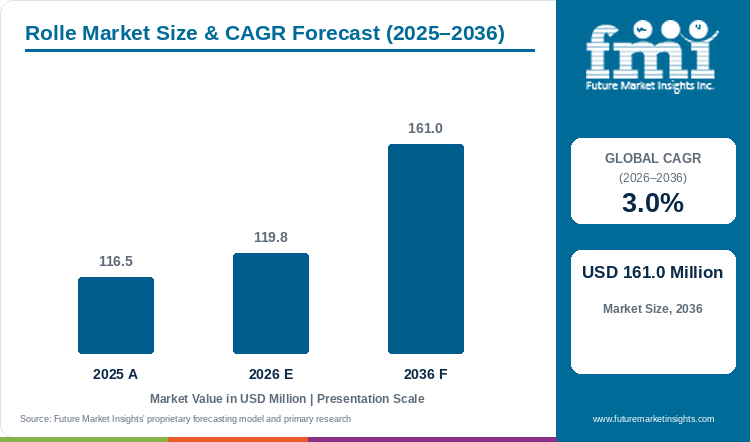
Starting from USD 116.5 million in 2025, the Rolle market valuation advanced to USD 119.8 million in 2026, with projections pointing toward USD 161.0 million by 2036 at a CAGR of 3.0%.
Coastal restaurant groups and luxury hotel sommeliers rotating summer by-the-glass lists away from high-alcohol Chardonnays toward crisp Mediterranean whites drive commercial demand for Rolle. When southern European vineyards experience extreme July and August heat spikes, early-ripening white cultivars lose malic acidity rapidly and produce flabby wines exceeding 14.5% alcohol, whereas late-ripening Rolle grapes retain natural tartaric acidity and saline citrus aromatics. Supported by this viticultural and hospitality advantage, the global Rolle market value rises from USD 116.5 million in 2025 to USD 119.8 million in 2026 and is projected by FMI to reach USD 161.0 million by 2036 at a 3.0% CAGR. Dry crisp mineral white Vermentino secures 47.8% of 2026 demand because chilled stainless-steel bottlings deliver immediate by-the-glass turnover across coastal seafood venues. This on-trade varietal premiumization separates Rolle demand from the broader still and sparkling wine category, where bulk table wine volumes face secular decline while appellation Mediterranean whites expand margin per case. in April 2025, the International Organisation of Vine and Wine reported that global wine production stood at 225.8 million hectoliters in 2024 as extreme climatic stress penalized heat-sensitive vineyards across traditional regions [1]. Meanwhile, in August 2025, Pernod Ricard reported full-year 2025 financial results detailing sustained luxury hospitality allocation for its Sainte Marguerite En Provence cru classe estates where Rolle anchors premier white and rose cuvées [24]. Even so, rising Extended Producer Responsibility glass packaging fees and strict summer drip-irrigation caps across French appellations restrain estate operating margins.
Key Market Trends & Insights
- By wine style: Dry Crisp Mineral White Vermentino holds an estimated 47.8% share in 2026 because reductive stainless-steel fermentation preserves bright grapefruit thiols and crisp acidity for seafood dining.
- By region of origin: Provence and Corsica France estates represent 51.5% in 2026 as AOC Coteaux d'Aix-en-Provence, Cotes de Provence with Bellet and Patrimonio producers dedicate prime limestone slopes to varietal Rolle.
- By distribution channel: On-Trade Mediterranean Hospitality HoReCa commands 71.9% in 2026 because beach clubs, hotel brasseries, and sommelier tasting menus generate 3.5x glass-pour markups.
- By packaging format: Standard 750 mL Flint and Antique Green Glass secures 64.2% in 2026 owing to prestige table presentation across European and North American fine dining venues.
- By price tier: Super-Premium Appellation bottlings (USD 15 to USD 30 retail) account for 52.4% in 2026 through strong sommelier placement as a value alternative to white Burgundy.
Regional Highlights
- Top national expansion: Brazil leads national growth projections at a 3.4% CAGR through 2036 under rising Sao Paulo and Rio de Janeiro hospitality imports of chilled Mediterranean whites.
- Broader country progression: Canada tracks at a 3.3% CAGR ahead of France at 3.2% and Mexico at 3.1%, whereas Japan advances at a 2.9% CAGR and the United Kingdom grows at 2.7%.
Market Size & Forecast
Table 1: Market Size and Forecast for the Rolle Market (USD million and CAGR percentage), 2025 to 2036
| Metric | Value |
|---|---|
| 2025 Market Size | USD 116.5 million |
| Estimated Market Size in 2026 | USD 119.8 million |
| Projected Market Size by 2036 | USD 161.0 million |
| CAGR, 2026 to 2036 | 3.0% |
| Added Value, 2026 to 2036 | USD 41.2 million |
Vineyard managers across Provence, Corsica with Sardinia and Liguria face escalating canopy heat stress that degrades aromatic precursors in conventional white grape varieties unless harvest and press protocols are tightly controlled. When wineries press Rolle grapes without oxygen exclusion or skin-contact temperature control, polyphenol oxidases rapidly brown the must and strip delicate monoterpenes. In January 2025, enological chemists publishing in Foods analyzed varietal volatile patterns across 18 monovarietal Italian white wines including Sardinian Vermentino (VIVC accession 12989) and demonstrated that terpene and norisoprenoid retention directly governs young and model-aged sensory scores [2]. Accordingly, estate cellar masters combine dry-ice press blanketing with certified organic wine viticulture to command 15% to 25% higher ex-cellar bottle realizations.
Vineyard Hectare and Enological Cellar Sizing
Table 2: Vineyard Production and Enological Input Sizing for the Rolle Market (USD million and operational ranges), 2025 to 2036
| Metric | 2025 | 2026 | 2036 |
|---|---|---|---|
| Market size (USD million) | 116.5 | 119.8 | 161.0 |
| Commercial Rolle & Vermentino production (million 9L cases) | 1.51 to 1.58 | 1.55 to 1.62 | 1.98 to 2.08 |
| Cultivated Rolle/Vermentino bearing area (thousand hectares) | 2.85 to 3.05 | 2.92 to 3.12 | 3.65 to 3.90 |
| Average ex-cellar realization per 9L case (USD) | 75.2 to 77.8 | 76.0 to 78.5 | 79.5 to 82.4 |
Operational note: Enological input ranges apply standard 20 to 30 g/hL thiol-releasing yeast inoculation and 2 to 4 mL/100 kg pectolytic maceration enzyme dosing across commercial Rolle crush volumes.
Modern reductive winemaking has transformed Rolle from a neutral blending grape into a high-margin aromatic varietal bottling by releasing bound cysteinylated and glutathionylated thiol precursors during fermentation. Unassisted spontaneous fermentations convert less than 5% of odourless grape precursors into active 3-mercaptohexanol passionfruit and citrus aromas. To maximize varietal bouquet, winemakers inoculate cold-settled Rolle musts with specialized selected wine yeast strains from DSM-Firmenich and Novonesis (Chr. Hansen) that express high beta-lyase enzymatic cleavage.
Per Capita & Hospitality Account Sizing
Table 3: Per Capita and On-Trade Hospitality Account Indicators for the Rolle Market (USD), 2025 to 2036
| Metric | 2025 | 2026 | 2036 |
|---|---|---|---|
| World population (billion) | 8.2 | 8.3 | 9.0 |
| Value per 1,000 people (USD) | 14.2 | 14.4 | 17.9 |
| Annual procurement per coastal hospitality venue (USD thousand) | 4.1 to 4.8 | 4.2 to 4.9 | 5.4 to 6.3 |
| Certified organic & biodynamic Rolle share (%) | 28.0% to 32.0% | 30.0% to 34.0% | 44.0% to 49.0% |
Table 4: Estate Winery & Distribution Channel Indicators for the Rolle Market (USD and percentages), 2026
| Metric | Value | Institutional Reference Basis |
|---|---|---|
| Market size, 2026 | USD 119.8 million | 2026 global valuation baseline (5.5% child share) |
| On-Trade Mediterranean Hospitality accounts | 27,500 venues | Coastal hotels, beach clubs, seafood brasseries & bistros |
| Average annual Rolle value per hospitality venue | USD 3,130.9 | Annualized on-trade Rolle procurement |
| On-Trade Hospitality HoReCa value, 2026 | USD 86.1 million | 71.9% distribution channel allocation |
Extraction of aromatic compounds from thick-skinned Rolle berries requires breaking down complex pectic polysaccharides during pre-fermentative cold skin contact without extracting bitter seed catechins. Extended skin contact without enzymatic assistance slows press cycle turnaround during peak September harvest weeks and increases suspended solids that require heavy bentonite fining. Cellar masters therefore dose purified pectolytic wine enzymes during 6-hour cryo-maceration at 8 degrees Celsius, boosting free-run juice yield by 9% per metric ton while cutting bentonite fining requirements by one-third.
Analyst Perspective
"Mediterranean estates and hospitality buyers no longer view Rolle merely as a minor blending component for Provence rosé; they treat 100% varietal Rolle and Vermentino as a climate-resilient answer to overpriced white Burgundy. Wineries that pair drought-hardy hillside clones with thiol-releasing yeast and enzyme biosolutions from DSM-Firmenich and Novonesis will capture top-tier sommelier placements through 2036."
- Nandini Roy Choudhury, Principal Consultant, Future Market Insights.
How is the Rolle market segmented?
The Rolle market is segmented by wine style, region of origin with distribution channel with packaging format and price tier. In 2026, Dry Crisp Mineral White Vermentino is projected at 47.8% with Provence and Corsica France at 51.5% with On-Trade Mediterranean Hospitality HoReCa at 71.9% with Standard 750 mL Glass at 64.2% and Super-Premium Appellation at 52.4%.
By wine style: Dry Crisp Mineral White Vermentino and Aromatic Floral Mediterranean Blend Component with Oak-Fermented Textured White.
By region of origin: Provence and Corsica France and Sardinia and Liguria Italy Vermentino with Southern Rhone Blends and New World Coastal Appellations.
By distribution channel: On-Trade Mediterranean Hospitality HoReCa and Boutique Wine Retailers with Supermarket Premium Wine Aisles and Direct-to-Consumer Winery Clubs.
By packaging format: Standard 750 mL Flint and Antique Green Glass and Lightweight Eco-Glass Bottles with Magnum Hospitality Formats and Bag-in-Box Premium On-Tap.
By price tier: Super-Premium Appellation and Ultra-Premium Estate Reserve with Premium Varietal.
Why does Dry Crisp Mineral White Vermentino lead the wine style category?
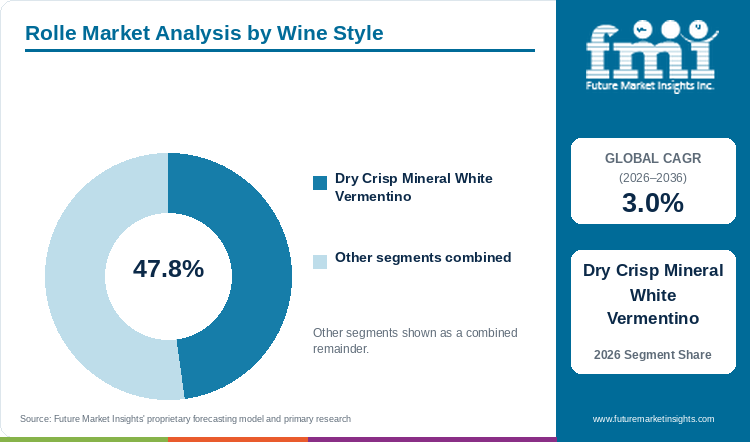
Dry Crisp Mineral White Vermentino holds an estimated 47.8% of wine style demand in 2026, anchored by high-acid seafood pairing velocity across coastal restaurants.
Table 5: Wine Style Share for the Rolle Market (percentage share), 2026
| Wine Style | Share (2026) |
|---|---|
| Dry Crisp Mineral White Vermentino | 47.8% |
| Other Segments Combined | 52.2%* |
| Total | 100.0% |
*Note: Remaining wine style categories account for the balance of 2026 global Rolle demand.
Table 6: Wine Style Leadership and Market Growth for the Rolle Market (segment and CAGR percentage), 2026 to 2036
| Metric | Value |
|---|---|
| Global CAGR (2026 to 2036) | 3.0% |
| Leading Segment | Dry Crisp Mineral White Vermentino |
Dry Crisp Mineral White Vermentino fermented in temperature-controlled stainless-steel tanks at 14 to 16 degrees Celsius without malolactic conversion retains bright natural acidity and saline minerality. Hospitality beverage directors managing summer wine lists as well as dry white wine portfolios prioritize this style because crisp 12.0% to 12.5% ABV bottlings pair cleanly with raw oysters, grilled Mediterranean sea bass, and crudo.
- Dry Crisp Mineral White Vermentino holds 47.8% of wine style value in 2026 because un-oaked reductive vinification enables rapid spring release within six months of harvest.
- In May 2025, researchers publishing in Foods demonstrated that adding glutathione-enriched inactive dry yeast during reductive white fruit fermentation scavenged ortho-quinones and preserved volatile ester and terpene intensity during storage [3].
What sustains Provence and Corsica France leadership in the region of origin segment?
Provence and Corsica France estates represent 51.5% of the region of origin category in 2026, supported by AOC varietal white conversions and luxury estate investments.
Vineyard estates across AOC Cotes de Provence, Coteaux d'Aix-en-Provence with Bellet above Nice and Patrimonio in northern Corsica grow Rolle on sun-drenched limestone and schist slopes cooled by mistral and maritime breezes. Prestige estate acquisitions by luxury groups and expanded export distribution as well as sparkling and coastal wine portfolios allow French appellation Rolle bottlings to realize double the ex-cellar price of bulk regional whites.
- Provence and Corsica France represent 51.5% of the region of origin segment in 2026 as INAO appellation decrees endorse 100% varietal Rolle white cuvées.
- In May 2024, researchers analyzing Mediterranean white grape supply chains in Antioxidants documented that Vermentino pomace contained 10,834 mg/kg of flavan-3-ols, confirming the cultivar's exceptional natural phenolic antioxidant resilience in hot coastal terroirs [4].
How do On-Trade Mediterranean Hospitality HoReCa accounts lead the distribution channel category?
On-Trade Mediterranean Hospitality HoReCa accounts for 71.9% of distribution channel volume in 2026, driven by sommelier by-the-glass placements at coastal resorts and seafood brasseries.
Coastal beach clubs in Saint-Tropez and Ibiza as well as fine dining seafood restaurants in Paris, London with Tokyo and New York serve as the primary discovery and volume engine for Rolle and Vermentino. Sommeliers actively hand-sell varietal Rolle to diners seeking distinctive Mediterranean cultivars, especially when estates hold vegan-certified wine credentials achieved by replacing animal gelatin and isinglass fining with pea proteins from Cargill and ADM.
- On-Trade Mediterranean Hospitality HoReCa accounts for 71.9% of distribution channel demand in 2026 because restaurant wine lists capture high-margin glass and bottle turnover during peak tourism seasons.
- In January 2026, an enological maceration study published in Molecules established that controlled four-day skin maceration increased white wine ferric-reducing antioxidant capacity by 3.40-fold, supporting gastronomical food-pairing structure in restaurant-tier whites [5].
Why does Standard 750 mL Flint and Antique Green Glass lead the packaging format category?
Standard 750 mL Flint and Antique Green Glass secures 64.2% of packaging format value in 2026, supported by appellation table-service rules and UV-protective antique green transitions.
Standard 750 mL glass bottles sealed with natural cork or technical micro-agglomerated closures remain mandatory for appellation table service across luxury hotels and fine dining rooms. While clear flint bottles present pale golden Provence hues, export-oriented wineries actively specify UV-filtering antique green glass and lightweight 400-gram moulds to prevent riboflavin lightstrike spoilage and reduce retail carbon fees.
- Standard 750 mL Flint and Antique Green Glass secures 64.2% of packaging format demand in 2026 as AOC appellation rules and sommelier service traditions mandate glass bottle presentation.
- In May 2025, a redox potential evolution study published in Biomolecules demonstrated that managing dissolved oxygen and glutathione disulfide ratios during bottling directly prevents premature oxidative browning in bottled wines [6].
What gives Super-Premium Appellation the leading position in price tier?
Super-Premium Appellation commands 52.4% of price tier share in 2026, anchored by USD 15 to USD 30 retail positioning across independent merchants and bistro wine lists.
Super-Premium Appellation bottlings retailing between USD 15 and USD 30 per 750 mL bottle occupy the sweet spot for both restaurant by-the-glass programs (allowing USD 14 to USD 18 glass pours) and independent wine merchant shelves. Single-vineyard Ultra-Premium Estate Reserve cuvées aged in French oak demi-muids or concrete eggs (retailing above USD 30) represent the fastest-growing tier as collectors seek age-worthy Mediterranean whites.
- Super-Premium Appellation commands 52.4% of price tier value in 2026 because AOC Cotes de Provence and Vermentino di Gallura DOCG bottlings deliver strong sommelier margin math.
- In August 2025, fermentation researchers publishing in Foods showed that sequential inoculation of Lachancea thermotolerans in warm-climate white musts naturally increased L-lactic acidity and enhanced mid-palate mouthfeel polysaccharides [7].
What are the drivers, restraints, and opportunities in the Rolle market?
In the Rolle market, Mediterranean vineyard warming and sommelier demand for crisp 12.0% ABV coastal whites are projected to drive adoption whereas glass packaging EPR fees and irrigation limits restrain estate margins and oak-aged cru reserves with 0.0% dealcoholized spritzers create high-margin expansion.
- Driver: Vineyard warming across southern Europe and sommelier rotation toward crisp 12.0% to 12.5% ABV coastal whites drive estate replanting and hospitality demand for Rolle.
- Restraint: Escalating European glass packaging Extended Producer Responsibility fees and strict summer irrigation restrictions compress grower yields and export margins.
- Opportunity: Single-parcel oak demi-muid reserve bottlings and natural aroma restitution for 0.0% ABV Mediterranean white wine alternatives open high-margin revenue streams.
Growth Analysis and Future Potential: Qualitative Demand Drivers
Higher growing-season temperatures across the Mediterranean basin compel vineyard owners to replace heat-sensitive white cultivars with late-ripening Rolle clones that preserve natural tartaric acidity without costly acidulation. At the same time, hospitality groups expanding low-alcohol wine and refreshing summer aperitif lists actively specify crisp 12.0% ABV coastal Rolle bottlings. In September 2025, an oenological study in Microorganisms confirmed that sequential inoculation with non-Saccharomyces Lachancea thermotolerans starter strains boosted glycerol and natural acidity in warm-climate white wines while lowering ethanol levels by 0.6% v/v [8].
Risk Assessment of the Rolle Market: Operational and Formulation Friction
Higher glass container weights, Extended Producer Responsibility environmental taxes, and ultraviolet lightstrike spoilage in clear flint bottles represent the primary commercial risks restraining export margins for Rolle producers. When Provence estates bottle delicate white Rolle in clear flint glass to mimic rosé aesthetics, supermarket fluorescent lighting triggers riboflavin photo-oxidation that produces cabbage-like dimethyl disulfide off-odors within weeks. In January 2026, the USDA Foreign Agricultural Service reported on European Union regulatory compliance updates impacting agricultural and packaging supply chains across member states [9]. Wineries upgrading wine packaging specifications accordingly transition export cuvées into UV-blocking dark antique green lightweight bottles.
Commercial Opportunity Analysis: Formulation Differentiation and Value-Add Formats
Prestige estates in Provence, Corsica and Bolgheri capture luxury collector margins by fermenting old-vine Rolle parcels in 600-liter French oak wine barrels and concrete amphorae while beverage formulators tap Givaudan and Symrise aroma restitution systems to launch 0.0% ABV Mediterranean white wine spritzers. Across vacuum dealcoholization, volatile varietal esters strip out as well as ethanol, requiring natural citrus and terpene aroma fractions from Givaudan or Symrise to rebuild authentic Rolle bouquet. In April 2025, a comprehensive review in Comprehensive Reviews in Food Science and Food Safety documented how membrane pervaporation and aroma recovery columns preserve sensory balance in dealcoholized white wines [10].
Rolle Market by Country (2026 to 2036)
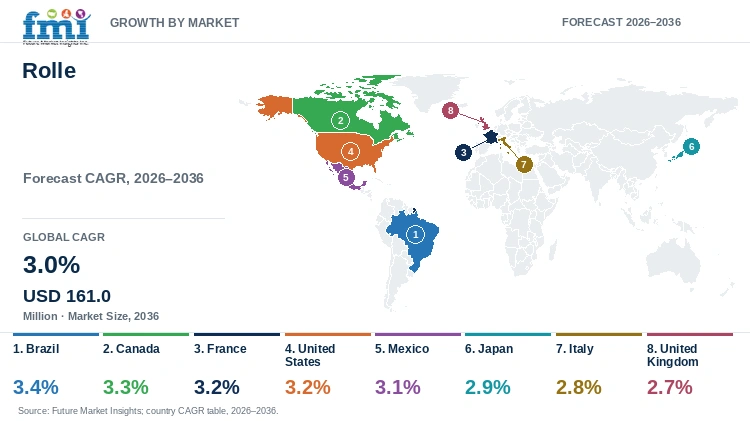
FMI country modeling indicates that Brazil leads Rolle expansion at a 3.4% CAGR through 2036, followed by Canada at 3.3% with France at 3.2% with the United States at 3.2% and Mexico at 3.1% while Japan (2.9%) with Italy (2.8%) and the United Kingdom (2.7%) anchor core specialty imports.
Table 7: Country CAGR and Primary Growth Levers for the Rolle Market (CAGR percentage and operational drivers), 2026 to 2036
| Country | CAGR (2026 to 2036) | Primary Growth Lever |
|---|---|---|
| Brazil | 3.4% | Sao Paulo and Rio beach-club hospitality imports and Campanha Gaucha vineyard trials |
| Canada | 3.3% | SAQ and LCBO monopoly tenders favoring lightweight organic Provence and Corsican whites |
| France | 3.2% | AOC Cotes de Provence, Bellet, and Patrimonio 100% varietal white estate conversions |
| United States | 3.2% | Coastal fine dining imports and drought-hardy California and Texas vineyard plantings |
| Mexico | 3.1% | Los Cabos and Riviera Maya resort dining and Valle de Guadalupe arid viticulture |
| Japan | 2.9% | Zero-tariff EU-Japan EPA imports and washoku sashimi sommelier pairings in Tokyo |
| Italy | 2.8% | Vermentino di Gallura DOCG and coastal Tuscan Bolgheri cryo-macerated cru releases |
| United Kingdom | 2.7% | HMRC ABV-tiered excise duty savings on 12.0% ABV whites across London restaurants |
Source: Future Market Insights analysis
France Rolle Market Outlook (2026 to 2036)
France acts as the global viticultural heartland and largest domestic consumption market for Rolle, expanding at a 3.2% CAGR from 2026 to 2036 as French Riviera beach clubs and Parisian seafood brasseries increase single-varietal Provence and Corsican white allocations. Across AOC Cotes de Provence and Coteaux d'Aix-en-Provence, winegrowers historically used Rolle to add acidity to rosé blends but now dedicate limestone parcels to 100% varietal white bottlings. In July 2026, the USDA Foreign Agricultural Service France Exporter Guide Annual documented how French hospitality and retail buyers actively prioritize certified organic and HVE sustainable domestic wines [11]. Prestige estates owned by LVMH and Pernod Ricard anchor cellar-door and gastronomic pricing above EUR 35 per bottle.
Key takeaway: In France, AOC Provence varietal white conversions and Riviera hospitality demand are projected to sustain 3.2% annual growth through 2036.
United Kingdom Rolle Market Outlook (2026 to 2036)
Whereas France is driven by domestic estate production, the United Kingdom Rolle market is shaped by duty-tiered import math and London's influential Mediterranean restaurant scene, advancing at a 2.7% CAGR between 2026 and 2036. Under the reformed UK alcohol excise duty regime implemented in February 2025, British wine merchants and gastropubs substitute 14.0% ABV Chardonnays with crisp 12.0% ABV French Rolle and Sardinian Vermentino to save GBP 0.42 per bottle in duty. In January 2026, HM Revenue and Customs Alcohol Bulletin statistics confirmed resilient UK clearances for still white wines in the 11.5% to 12.5% ABV band [12]. Independent wine shops and supermarket finest tiers drive off-trade repeat purchases.
Key takeaway: In the United Kingdom, ABV-linked excise duty advantages and London Mediterranean dining are estimated to support steady 2.7% CAGR expansion.
Japan Rolle Market Outlook (2026 to 2036)
Unlike European markets where Rolle is ordered as a summer terrace aperitif, Japan's Rolle market grows at a 2.9% CAGR through 2036 because Tokyo and Osaka sommeliers pair its saline with low-iron minerality directly with raw sashimi with uni and washoku tempura courses. Oak-heavy white wines clash with delicate dashi broths, whereas reductive stainless-steel Rolle fermented with Chr. Hansen (Novonesis) bio-protection yeasts delivers clean citrus acidity with minimal free sulfur dioxide. In October 2026, the USDA Foreign Agricultural Service FOODEX Japan report documented strong Japanese hospitality buyer demand for premium imported specialty wines and clean-label beverages [13]. Zero customs duties under the EU-Japan Economic Partnership Agreement further protect importer margins on Corsican and Provençal estates.
Key takeaway: In Japan, duty-free European wine imports and washoku seafood sommelier pairings are forecast to drive 2.9% annual growth.
Brazil Rolle Market Outlook (2026 to 2036)
Brazil leads all tracked nations at a 3.4% CAGR over the 2026 to 2036 decade because affluent consumers in Sao Paulo, Rio de Janeiro, and coastal beach clubs shift toward chilled Mediterranean whites. Whereas traditional Brazilian retail shelves were dominated by entry-level Chilean Sauvignon Blanc, subscription wine clubs and luxury importers now fly in AOC Cotes de Provence Rolle and Tuscan Vermentino for poolside and coastal dining. In June 2026, the USDA Foreign Agricultural Service Brazil Exporter Guide Annual noted expanding Brazilian upper-middle-class expenditure on imported gourmet food and European DOP wines [14]. In addition, boutique wineries in Rio Grande do Sul's Campanha Gaucha have begun harvesting domestic Vermentino blocks grafted onto heat-tolerant rootstocks.
Key takeaway: In Brazil, tropical beach-club hospitality and fine-wine subscription clubs are projected to propel market-leading 3.4% CAGR growth.
Mexico Rolle Market Outlook (2026 to 2036)
Mexico's Rolle market expands at a 3.1% CAGR during the ten-year forecast window, anchored by dual demand from five-star resort corridors in Los Cabos and Riviera Maya as well as drought-driven vineyard adaptation in Baja California's Valle de Guadalupe. Because Baja California winegrowers face acute Colorado River water allocations and rising soil salinity, viticulturists are grafting Mediterranean Rolle and Vermentino clones that thrive in arid granitic soils while retaining crisp natural acidity for ceviche and aguachile pairings. in july 2026, usda agricultural attaché analysts Mexico Exporter Guide Annual reported record hospitality food and beverage import demand across Mexican luxury resort destinations [15]. Domestic Valle de Guadalupe cellar-door releases retail above USD 30 per bottle while European imports supply Mexico City bistros.
Key takeaway: In Mexico, luxury coastal resort tourism and drought-adapted Baja California vineyard plantings are anticipated to sustain a 3.1% CAGR.
Canada Rolle Market Outlook (2026 to 2036)
Canada advances at a 3.3% CAGR in the Rolle market from 2026 to 2036 as provincial liquor control monopolies in Quebec (SAQ) and Ontario (LCBO) expand specialty Cellier and Vintages allocations for certified organic Provençal and Corsican whites. Provincial liquor boards enforce strict environmental packaging scoring that awards preferential shelf tenders to European estates shipping Rolle in lightweight glass bottles under 420 grams. In late July 2026, official USDA trade reports Canada Exporter Guide Annual documented how provincial liquor boards and bilingual hospitality venues in Montreal with Toronto and Vancouver diversify European varietal wine procurement [16]. Francophone Quebec consumers exhibit particularly high repeat velocity for AOC Cotes de Provence and Patrimonio Rolle cuvées during summer patio dining.
Key takeaway: In Canada, SAQ and LCBO monopoly tenders favoring lightweight organic Mediterranean bottles are expected to drive 3.3% annual growth.
Italy Rolle Market Outlook (2026 to 2036)
Italy represents the foundational sister market for the cultivar under its Vermentino name, expanding at a 2.8% CAGR between 2026 and 2036 across Sardinia (Vermentino di Gallura DOCG) with Liguria (Colli di Luni DOC) and coastal Tuscany (Bolgheri and Maremma DOC). Italian estates led by Banfi Vintners and Sardinian cooperatives use cryo-maceration with DSM-Firmenich pectolytic enzymes to produce aromatic coastal whites for domestic agriturismo and export. In April 2026, the USDA Foreign Agricultural Service Italy Food Processing Ingredients Annual documented strong Italian coastal tourism and premium food and wine export momentum [17]. Single-vineyard Gallura Superiore bottlings aged on fine yeast lees actively compete in the EUR 25 to EUR 45 luxury hospitality bracket.
Key takeaway: In Italy, Vermentino di Gallura DOCG and coastal Tuscan cru selections are slated to support steady 2.8% CAGR expansion.
United States Rolle Market Outlook (2026 to 2036)
The United States Rolle and Vermentino market grows at a 3.2% CAGR from 2026 to 2036, combining coastal fine dining imports from Provence and Sardinia as well as rapid domestic vineyard adoption across California (Paso Robles with Lodi with Sonoma) with Texas High Plains and Virginia. American winegrowers confronting recurring Western heatwaves and wildfire smoke risk favor Vermentino because its thick skins resist sunburn while its late ripening window allows harvest scheduling flexibility without sacrificing malic acidity. In March 2025, the USDA National Agricultural Statistics Service California Grape Crush Report confirmed strong processor demand and above-average district prices per ton for California-grown Vermentino winegrapes [18]. Direct-to-consumer winery tasting rooms and wine clubs capture 65%+ gross margins on domestic varietal releases.
Key takeaway: In the United States, heat-tolerant California and Texas vineyard plantings as well as coastal sommelier imports are predicted to drive a 3.2% CAGR.
Full report country CAGRs cover: North America; Latin America; Western Europe; Eastern Europe; East Asia; South Asia and Pacific; Middle East and Africa.
Who are the notable companies in the Rolle market?
LVMH Moet Hennessy Louis Vuitton, Pernod Ricard SA with Banfi Vintners with Treasury Wine Estates with DSM-Firmenich AG and Chr. Hansen Holding AS, Givaudan SA with Symrise AG with Archer Daniels Midland Company and Cargill Incorporated are the notable companies in the Rolle market.
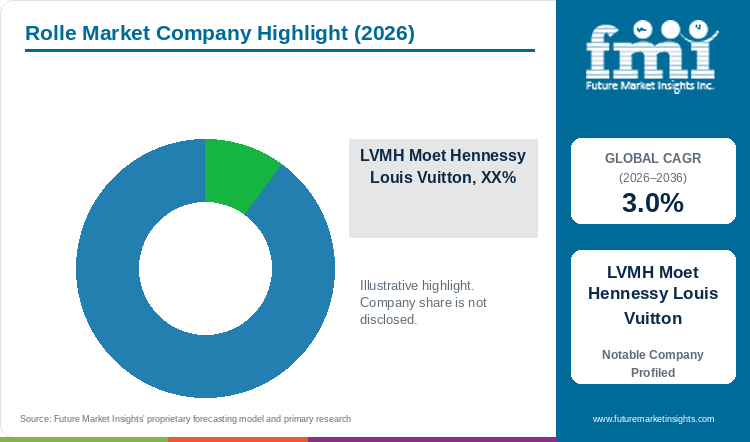
Competitive positioning across the Rolle value chain integrates flagship Mediterranean vineyard estates with specialized enological biotechnology producers and global beverage aroma and acidulant suppliers. LVMH Moet Hennessy Louis Vuitton and Pernod Ricard SA with Banfi Vintners and Treasury Wine Estates control prestige appellation vineyards and global sommelier distribution. DSM-Firmenich AG and Chr. Hansen Holding AS (Novonesis) supply thiol-releasing wine yeasts and maceration enzymes, whereas Givaudan SA and Symrise AG with Archer Daniels Midland Company and Cargill Incorporated provide natural aroma restitution fractions with tartaric acidulants and vegan fining proteins.
- Flagship Mediterranean Estates & Luxury Wine Houses: LVMH Moet Hennessy Louis Vuitton, Pernod Ricard SA with Banfi Vintners and Treasury Wine Estates grow and bottle premier AOC Provence Rolle and coastal Vermentino cuvées.
- Enological Yeast, Enzyme & Bio-Protection Specialists: DSM-Firmenich AG and Chr. Hansen Holding AS (operating as Novonesis) ferment beta-lyase thiol yeasts, non-Saccharomyces bio-protection cultures, and pectolytic clarification enzymes.
- Adjacent Beverage Aroma, Acidulant & Fining Suppliers: Givaudan with Symrise with ADM and Cargill supply citrus terpene modulators for 0.0% wines with tartaric acidulants and vegan fining proteins.
Competitive Benchmarking: Rolle Market
Table 8: Competitive Benchmarking for the Rolle Market (qualitative capability ratings), 2026
| Company | Appellation / Portfolio Role | Enological & Thiol Precision | Clean-Label & Low-Intervention Fit | Geographic Reach |
|---|---|---|---|---|
| LVMH Moet Hennessy Louis Vuitton | High (Chateau d'Esclans, Galoupet) | High | High | Provence France estates with global luxury hospitality distribution |
| Pernod Ricard SA | High (Sainte Marguerite En Provence) | High | High | Cru Classe Provence vineyards and 50+ country on-trade network |
| Banfi Vintners | High (La Pettegola, San Angelo) | High | High | Tuscan Maremma coastal estates exporting to US, UK, Japan & Brazil |
| Treasury Wine Estates | Medium (New World Vermentino) | High | Medium | South Australian vineyards and global luxury on-trade distribution |
| DSM-Firmenich AG | Enological Yeast & Enzyme Leader | High | High | Global Fermivin thiol yeasts and Rapidase maceration enzymes |
| Chr. Hansen Holding AS (Novonesis) | Bio-Protection & Enzyme Leader | High | High | Global Viniflora non-Saccharomyces cultures and wine enzymes |
| Givaudan SA | Aroma Restitution Specialist | High | High | Global Taste & Wellbeing citrus terpene fractions for 0.0% wines |
| Symrise AG | Sensory & Polyphenol Specialist | High | High | Global Food & Beverage naturals and dealcoholized wine modulators |
| Archer Daniels Midland Company | Acidulant & Nutrient Supplier | Medium | High | Global tartaric/malic acidulants and fermentation yeast nutrients |
| Cargill Incorporated | Vegan Fining & Stabilizer Supplier | Medium | High | Global plant-based fining proteins and mannoprotein stabilizers |
Evaluation basis: Appellation Vineyard & Estate Footprint evaluates ownership of certified AOC Provence, Corsican with Sardinian or New World varietal blocks and whereas Enological & Thiol Precision rates reductive cellar technology and enzymatic/yeast IP. Clean-Label & Low-Intervention Fit measures certified organic viticulture, sulfite-replacement bio-protection, and vegan fining integration.
Key Developments in the Rolle Market
- LVMH Moet Hennessy Louis Vuitton expanded its regenerative organic viticulture and ultra-lightweight bottle program at Cru Classe estate Chateau Galoupet in Cotes de Provence during 2025 and 2026, presenting drought-resilient Rolle parcels [19].
- Treasury Wine Estates announced its full-year 2025 results on August 13, 2025, reporting 7.2% net sales revenue growth to AUD 2.9 billion as luxury varietal hospitality allocations expanded across Asia-Pacific and Western markets [20].
- DSM-Firmenich AG unveiled major Taste, Texture & Health plant investments in August 2025 to accelerate natural beverage flavor with enzymatic clarification and clean-label ingredient supply across global markets [21].
Key Players in the Rolle Market
Flagship Mediterranean Estates & Luxury Wine Houses
- LVMH Moet Hennessy Louis Vuitton
- Pernod Ricard SA
- Banfi Vintners
- Treasury Wine Estates
Enological Yeast, Enzyme & Bio-Protection Specialists
- DSM-Firmenich AG
- Chr. Hansen Holding AS (Novonesis)
- Adjacent Beverage Aroma, Acidulant & Fining Ingredient Suppliers
- Givaudan SA
Symrise AG
- Archer Daniels Midland Company
- Cargill Incorporated
Rolle Market - Report Scope
Table 9: Report Scope for the Rolle Market (coverage fields and definitions), 2026 to 2036
| Coverage field | Report scope |
|---|---|
| Market breakdown | Wine Style; Region of Origin; Distribution Channel; Packaging Format; Price Tier |
| Quantitative Units | USD Million (Strict Lock: 2025 = 116.5, 2026 = 119.8, 2036 = 161.0) |
| Market Definition | Includes commercial revenue from single-varietal Rolle (Vermentino) still white wines, Rolle-dominant Mediterranean appellation blends, oak-fermented reserve bottlings, and attributable enological yeast, enzyme, acidulant, and aroma restitution inputs. Child market represents 5.5% of Global Food and Specialty Ingredients Industry. |
| Regions Covered | North America; Latin America; Western Europe; Eastern Europe; East Asia; South Asia and Pacific; Middle East and Africa |
| Countries Covered | France, United Kingdom, Japan, Brazil, Mexico, Canada, Italy, United States, and regional aggregates |
| Key Companies Covered | LVMH Moet Hennessy Louis Vuitton, Pernod Ricard SA, Banfi Vintners, Treasury Wine Estates, DSM-Firmenich AG, Chr. Hansen Holding AS, Givaudan SA, Symrise AG, Archer Daniels Midland Company, Cargill Incorporated |
| Forecast Period | 2026 to 2036 |
| Approach | Primary and secondary research triangulated via physical volume shipments, manufacturer ASP realizations, and published appellation registries. |
Rolle Market - Research Methodology
Table 10: Research Methodology for the Rolle Market (research methods and approach), 2026 edition
| Method | Approach |
|---|---|
| Primary Research | Structured interviews with Provence, Corsican, and Sardinian cellar masters, hospitality sommelier directors, and enological fermentation specialists at DSM-Firmenich and Novonesis. |
| Secondary Research | Analysis of OIV world wine production datasets, USDA FAS GAIN wine and exporter reports, HMRC alcohol duty bulletins, and PubMed/PMC peer-reviewed enology studies. |
| Market Sizing and Forecasting | Top-down Global Food and Specialty Ingredients Industry baseline (5.5% child share) reconciled against bottom-up physical case shipments (1.55M to 1.62M 9L cases in 2026) and ex-cellar ASP realizations from 2026 to 2036. |
| Country Forecasting Model | Econometric country projections weight coastal hospitality turnover, ABV-linked excise duty structures, monopoly liquor board tenders, and drought-adapted vineyard plantings across eight national markets. |
| Operational Benchmark Traceability | Vineyard hectare yields and enological dosing indicators in Tables 2, 3, and 4 trace to OIV harvest statistics, PMC thiol and maceration assays, and corporate disclosures. |
| Data Triangulation and Validation | Compounding validated at exactly 3.0% CAGR (USD 119.8 million in 2026 to USD 161.0 million in 2036) with zero hierarchy anomalies. |
Rolle Market by Segments
Rolle Market segmented by Wine Style:
- Dry Crisp Mineral White Vermentino
- Aromatic Floral Mediterranean Blend Component
- Oak-Fermented Textured White
- Single-Vineyard Amphora & Reserve Cuvées
Rolle Market segmented by Region of Origin:
- Provence and Corsica France
- Sardinia and Liguria Italy Vermentino
- Southern Rhone Blends
- New World Coastal Appellations
Rolle Market segmented by Distribution Channel:
- On-Trade Mediterranean Hospitality HoReCa
- Boutique Wine Retailers
- Supermarket Premium Wine Aisles
- Direct-to-Consumer Winery Clubs
- Luxury Travel Retail and Cruise Lines
Rolle Market segmented by Packaging Format:
- Standard 750 mL Flint and Antique Green Glass
- Lightweight Eco-Glass Bottles (<420g)
- Magnum Hospitality Formats (1.5L and 3.0L)
- Bag-in-Box and KeyKeg Premium On-Tap
Rolle Market segmented by Price Tier:
- Super-Premium Appellation (USD 15 to USD 30)
- Ultra-Premium Estate Reserve (>USD 30)
- Premium Varietal
- Collector Museum Releases
Rolle Market by Region
- North America
- United States
- Canada
- Latin America
- Brazil
- Mexico
- Argentina
- Chile
- Western Europe
- Germany
- France
- United Kingdom
- Italy
- Spain
- Benelux
- Nordics
- Eastern Europe
- Poland
- Czech Republic
- Romania
- Hungary
- East Asia
- China
- Japan
- South Korea
- South Asia and Pacific
- India
- ASEAN
- Australia and New Zealand
- Middle East and Africa
- GCC Countries
- South Africa
- Türkiye
- Israel
Research Sources and Bibliography
- [1] International Organisation of Vine and Wine. (2025, April 15). State of the World Vine and Wine Sector in 2024. OIV Intergovernmental Organization.
- [2] Carlin, S., Vrhovsek, U., & Mattivi, F. (2025, January 26). Varietal Volatile Patterns in Young and Model-Aged Italian Monovarietal White Wines Including Vermentino (PMC13085075). Foods (MDPI).
- [3] Zhao, Y., Wang, L., & Chen,FS. (2025, May 15). Effects of Glutathione-Enriched Inactive Dry Yeast on the Flavor Profile and Antioxidant Stability of Fermented Fruit Wines (PMC12111175). Foods (MDPI).
- [4] Fancello, F., Petretto, G. L., & Zara, S. (2024, May 04). A Preliminary Study Exploring the Impact of the Wine Supply Chain on the Polyphenolic and Flavan-3-ol Profile of Vermentino Pomace (PMC11083656). Antioxidants (MDPI).
- [5] Kapusta, I., Cebulak, T., & Oszmianski, J. (2026, January 03). Optimizing White Wine Production: Impact of Grape Skin Maceration Time on Polyphenolic Content and FRAP Antioxidant Capacity (PMC12787621). Molecules (MDPI).
- [6] Romanet, R., Gougeon, R. D., & Nikolantonaki, M. (2025, May 20). Effect of Contrasting Redox Potential Evolutions and Glutathione Derivatives on White Wine Oxidative Stability (PMC12348074). Biomolecules (MDPI).
- [7] Vaquero, C., Loira, I., & Morata, A. (2025, August 09). Innovative Fermentation Approach Employing Lachancea thermotolerans and Saccharomyces cerevisiae to Enhance Acidity and Mouthfeel in White Wine (PMC12385897). Foods (MDPI).
- [8] Benito, S., Vicente, J., & Marquina, D. (2025, September 26). Oenological Potential of Lachancea thermotolerans Starter Strains for Natural Biological Acidification in Warm-Climate White Wines (PMC12566197). Microorganisms (MDPI).
- [9] USDA Foreign Agricultural Service. (2026, January 05). European Union Agricultural and Packaging Supply Chain Regulatory Update (GAIN Report E42026-0001). United States Department of Agriculture.
- [10] Castro-Munoz, R., & Fitema-Huelva,M. (2025, April 17). Dealcoholized Wine: Post-Fermentation Membrane Techniques, Sensory Impacts, Aroma Retention, and Stability (PMC12004437). Comprehensive Reviews in Food Science and Food Safety.
- [11] USDA Foreign Agricultural Service. (2026, July 09). France: Exporter Guide Annual and Hospitality Beverage Market Overview. United States Department of Agriculture GAIN Report.
- [12] HM Revenue and Customs. (2026, January 30). Alcohol Bulletin: United Kingdom Still Wine Clearances and Duty Receipts by Alcoholic Strength Band. UK Government Official Statistics.
- [13] USDA Foreign Agricultural Service. (2026, October 20). Japan: FOODEX Japan 2026 Report and Imported Fine Wine & Beverage Trade Trends. United States Department of Agriculture GAIN Report.
- [14] USDA Foreign Agricultural Service. (2026, June 30). Brazil: Exporter Guide Annual and Imported Gourmet Food and Wine Market Analysis. United States Department of Agriculture GAIN Report.
- [15] USDA Foreign Agricultural Service. (2026, July 07). Mexico: Exporter Guide Annual and Resort Hospitality Beverage Sector Demand (GAIN Report MX2026-0034). United States Department of Agriculture.
- [16] USDA Foreign Agricultural Service. (2026, July 31). Canada: Exporter Guide Annual and Provincial Liquor Board Import Procurement (GAIN Report CA2026-0019). United States Department of Agriculture.
- [17] USDA Foreign Agricultural Service. (2026, April 02). Italy: Food Processing Ingredients Annual and Domestic Agri-Food & Wine Sector Overview (GAIN Report IT2026-0001). United States Department of Agriculture.
- [18] USDA National Agricultural Statistics Service. (2025, March 14). California Grape Crush Report Final 2024 Crop Tonnage and Average Prices for Vermentino. California Department of Food and Agriculture.
- [19] LVMH Moet Hennessy Louis Vuitton. (2026, March 18). Chateau Galoupet Cru Classe regenerative organic viticulture and lightweight bottle program in Provence. LVMH Wines & Spirits Maisons.
- [20] Treasury Wine Estates. (2025, August 13). Treasury Wine Estates 2025 Full-Year Results and Luxury Varietal Portfolio Expansion. Treasury Wine Estates Official Announcements.
- [21] DSM-Firmenich AG. (2025, August 26). dsm-firmenich Unveils Major Taste Texture and Health Plant Investments for Clean-Label Flavor and Beverage Innovation. dsm-firmenich Press Releases.
- [22] Givaudan SA. (2026, July 23). Givaudan 2026 Half-Year Results: Taste and Wellbeing Beverage Aroma and Modulation Performance. Givaudan Official Media Releases.
- [23] Symrise AG. (2026, October 28). Symrise Delivered Strong Volume-Driven Organic Sales Growth in Q3 2026 Led by Taste Nutrition and Health Naturals. Symrise Corporate Newsroom.
- [24] Pernod Ricard SA. (2025, August 28). FY25 Full-Year Sales and Results and Luxury Provence Wine Portfolio Performance. Pernod Ricard Financial Media Releases.
This bibliography is provided for reader reference and documents the verified primary sources cited across the report.
This Report Answers
- How large is the Rolle market in 2026 and what is forecast for 2036?
- Which Mediterranean vineyard warming and coastal hospitality trends support demand for Rolle?
- Why does Dry Crisp Mineral White Vermentino lead the wine style category?
- Why does Provence and Corsica France lead the region of origin category globally?
- How do growth rates differ across Brazil, Canada with France with Mexico with Japan and the UK?
- Which leading companies operate flagship Rolle estates versus enological yeast, enzyme, and aroma ingredient supply?
- What glass packaging taxes, lightstrike risks, or irrigation limits restrain margins in the Rolle market?
- What enological specifications should wineries evaluate when selecting thiol yeasts and maceration enzymes for Rolle?
Table of Content
- Key Takeaways
- Market Size and CAGR
- Top Growth Driver
- Fastest Growing Segment
- Leading Region
- Key Companies
- Emerging Opportunities
- Executive Summary
- Global Market Outlook
- Demand-side Trends
- Supply-side Trends
- Technology Roadmap Analysis
- Analysis and Recommendations
- Analyst Perspective (What is happening? Why now? What should investors know?)
- Key Questions Answered
- How large is the market?
- What is the CAGR?
- What are key trends?
- Which region dominates?
- Who are the leaders?
Read More...
- Market Overview
- Market Coverage / Taxonomy
- Market Definition / Scope / Limitations
- Research Methodology
- Chapter Orientation
- Analytical Lens and Working Hypotheses
- Market Structure, Signals, and Trend Drivers
- Benchmarking and Cross-market Comparability
- Market Sizing, Forecasting, and Opportunity Mapping
- Research Design and Evidence Framework
- Desk Research Programme (Secondary Evidence)
- Expert Input and Fieldwork (Primary Evidence)
- Tooling, Models, and Reference Databases
- Data Engineering and Model Build
- Quality Assurance and Audit Trail
- Market Background
- Market Dynamics (Drivers, Restraints, Opportunity, Trends)
- Scenario Forecast (Optimistic, Likely, Conservative)
- Impact Analysis
- AI Impact
- Sustainability Impact
- Regulatory Impact
- Technology Impact
- Consumer / Buyer Analysis
- Purchase Drivers
- Adoption Barriers
- Buyer Journey
- Opportunity Map Analysis
- Product Life Cycle Analysis
- Supply Chain Analysis
- Investment Feasibility Matrix
- Value Chain Analysis
- PESTLE and Porter's Analysis
- Regulatory Landscape
- Regional Parent Market Outlook
- Production and Consumption Statistics
- Import and Export Statistics
- Global Market Analysis and Forecast, 2021 to 2036
- Historical Market Size Value (USD Million) Analysis, 2021 to 2025
- Current and Future Market Size Value (USD Million) Projections, 2026 to 2036
- Y-o-Y Growth Trend Analysis
- Absolute $ Opportunity Analysis
- Global Market Pricing Analysis, 2021 to 2036
- Global Market Analysis and Forecast, By Wine Style, 2021 to 2036
- Introduction / Key Findings
- Historical Market Size Value (USD Million) Analysis By Wine Style, 2021 to 2025
- Current and Future Market Size Value (USD Million) Analysis and Forecast By Wine Style, 2026 to 2036
- Dry Crisp Mineral White Vermentino
- Aromatic Floral Mediterranean Blend Component
- Oak-Fermented Textured White
- Single-Vineyard Amphora & Reserve Cuvées
- Y-o-Y Growth Trend Analysis By Wine Style, 2021 to 2025
- Absolute $ Opportunity Analysis By Wine Style, 2026 to 2036
- Global Market Analysis and Forecast, By Region of Origin, 2021 to 2036
- Introduction / Key Findings
- Historical Market Size Value (USD Million) Analysis By Region of Origin, 2021 to 2025
- Current and Future Market Size Value (USD Million) Analysis and Forecast By Region of Origin, 2026 to 2036
- Provence and Corsica France
- Sardinia and Liguria Italy Vermentino
- Southern Rhone Blends
- New World Coastal Appellations
- Y-o-Y Growth Trend Analysis By Region of Origin, 2021 to 2025
- Absolute $ Opportunity Analysis By Region of Origin, 2026 to 2036
- Global Market Analysis and Forecast, By Distribution Channel, 2021 to 2036
- Introduction / Key Findings
- Historical Market Size Value (USD Million) Analysis By Distribution Channel, 2021 to 2025
- Current and Future Market Size Value (USD Million) Analysis and Forecast By Distribution Channel, 2026 to 2036
- On-Trade Mediterranean Hospitality HoReCa
- Boutique Wine Retailers
- Supermarket Premium Wine Aisles
- Direct-to-Consumer Winery Clubs
- Luxury Travel Retail and Cruise Lines
- Y-o-Y Growth Trend Analysis By Distribution Channel, 2021 to 2025
- Absolute $ Opportunity Analysis By Distribution Channel, 2026 to 2036
- Global Market Analysis and Forecast, By Packaging Format, 2021 to 2036
- Introduction / Key Findings
- Historical Market Size Value (USD Million) Analysis By Packaging Format, 2021 to 2025
- Current and Future Market Size Value (USD Million) Analysis and Forecast By Packaging Format, 2026 to 2036
- Standard 750 mL Flint and Antique Green Glass
- Lightweight Eco-Glass Bottles (<420g)
- Magnum Hospitality Formats (1.5L and 3.0L)
- Bag-in-Box and KeyKeg Premium On-Tap
- Y-o-Y Growth Trend Analysis By Packaging Format, 2021 to 2025
- Absolute $ Opportunity Analysis By Packaging Format, 2026 to 2036
- Global Market Analysis and Forecast, By Price Tier, 2021 to 2036
- Introduction / Key Findings
- Historical Market Size Value (USD Million) Analysis By Price Tier, 2021 to 2025
- Current and Future Market Size Value (USD Million) Analysis and Forecast By Price Tier, 2026 to 2036
- Super-Premium Appellation (USD 15 to USD 30)
- Ultra-Premium Estate Reserve (>USD 30)
- Premium Varietal (
- Collector Museum Releases
- Y-o-Y Growth Trend Analysis By Price Tier, 2021 to 2025
- Absolute $ Opportunity Analysis By Price Tier, 2026 to 2036
- Global Market Analysis and Forecast, By Region, 2021 to 2036
- Introduction
- Historical Market Size Value (USD Million) Analysis By Region, 2021 to 2025
- Current Market Size Value (USD Million) Analysis and Forecast By Region, 2026 to 2036
- North America
- Latin America
- Western Europe
- Eastern Europe
- East Asia
- South Asia and Pacific
- Middle East and Africa
- Market Attractiveness Analysis By Region
- North America Market Analysis and Forecast, By Country, 2021 to 2036
- Historical Market Size Value (USD Million) Trend Analysis By Market Taxonomy, 2021 to 2025
- Market Size Value (USD Million) Forecast By Market Taxonomy, 2026 to 2036
- By Country
- United States
- Canada
- By Wine Style
- By Region of Origin
- By Distribution Channel
- By Packaging Format
- By Price Tier
- By Country
- Market Attractiveness Analysis
- By Country
- By Wine Style
- By Region of Origin
- By Distribution Channel
- By Packaging Format
- By Price Tier
- Key Takeaways
- Latin America Market Analysis and Forecast, By Country
- Historical Market Size Value (USD Million) Trend Analysis By Market Taxonomy, 2021 to 2025
- Market Size Value (USD Million) Forecast By Market Taxonomy, 2026 to 2036
- By Country
- Brazil
- Mexico
- Argentina
- Chile
- By Wine Style
- By Region of Origin
- By Distribution Channel
- By Packaging Format
- By Price Tier
- By Country
- Market Attractiveness Analysis
- By Country
- By Wine Style
- By Region of Origin
- By Distribution Channel
- By Packaging Format
- By Price Tier
- Key Takeaways
- Western Europe Market Analysis and Forecast, By Country
- Historical Market Size Value (USD Million) Trend Analysis By Market Taxonomy, 2021 to 2025
- Market Size Value (USD Million) Forecast By Market Taxonomy, 2026 to 2036
- By Country
- Germany
- France
- United Kingdom
- Italy
- Spain
- Benelux
- Nordics
- By Wine Style
- By Region of Origin
- By Distribution Channel
- By Packaging Format
- By Price Tier
- By Country
- Market Attractiveness Analysis
- By Country
- By Wine Style
- By Region of Origin
- By Distribution Channel
- By Packaging Format
- By Price Tier
- Key Takeaways
- Eastern Europe Market Analysis and Forecast, By Country
- Historical Market Size Value (USD Million) Trend Analysis By Market Taxonomy, 2021 to 2025
- Market Size Value (USD Million) Forecast By Market Taxonomy, 2026 to 2036
- By Country
- Poland
- Czech Republic
- Romania
- Hungary
- By Wine Style
- By Region of Origin
- By Distribution Channel
- By Packaging Format
- By Price Tier
- By Country
- Market Attractiveness Analysis
- By Country
- By Wine Style
- By Region of Origin
- By Distribution Channel
- By Packaging Format
- By Price Tier
- Key Takeaways
- East Asia Market Analysis and Forecast, By Country
- Historical Market Size Value (USD Million) Trend Analysis By Market Taxonomy, 2021 to 2025
- Market Size Value (USD Million) Forecast By Market Taxonomy, 2026 to 2036
- By Country
- China
- Japan
- South Korea
- By Wine Style
- By Region of Origin
- By Distribution Channel
- By Packaging Format
- By Price Tier
- By Country
- Market Attractiveness Analysis
- By Country
- By Wine Style
- By Region of Origin
- By Distribution Channel
- By Packaging Format
- By Price Tier
- Key Takeaways
- South Asia and Pacific Market Analysis and Forecast, By Country
- Historical Market Size Value (USD Million) Trend Analysis By Market Taxonomy, 2021 to 2025
- Market Size Value (USD Million) Forecast By Market Taxonomy, 2026 to 2036
- By Country
- India
- ASEAN
- Australia and New Zealand
- By Wine Style
- By Region of Origin
- By Distribution Channel
- By Packaging Format
- By Price Tier
- By Country
- Market Attractiveness Analysis
- By Country
- By Wine Style
- By Region of Origin
- By Distribution Channel
- By Packaging Format
- By Price Tier
- Key Takeaways
- Middle East and Africa Market Analysis and Forecast, By Country
- Historical Market Size Value (USD Million) Trend Analysis By Market Taxonomy, 2021 to 2025
- Market Size Value (USD Million) Forecast By Market Taxonomy, 2026 to 2036
- By Country
- GCC Countries
- South Africa
- Türkiye
- Israel
- By Wine Style
- By Region of Origin
- By Distribution Channel
- By Packaging Format
- By Price Tier
- By Country
- Market Attractiveness Analysis
- By Country
- By Wine Style
- By Region of Origin
- By Distribution Channel
- By Packaging Format
- By Price Tier
- Key Takeaways
- Key Countries Market Analysis
- United States
- Pricing Analysis
- Market Share Analysis, 2025
- By Wine Style
- By Region of Origin
- By Distribution Channel
- By Packaging Format
- By Price Tier
- Canada
- Pricing Analysis
- Market Share Analysis, 2025
- By Wine Style
- By Region of Origin
- By Distribution Channel
- By Packaging Format
- By Price Tier
- Mexico
- Pricing Analysis
- Market Share Analysis, 2025
- By Wine Style
- By Region of Origin
- By Distribution Channel
- By Packaging Format
- By Price Tier
- Brazil
- Pricing Analysis
- Market Share Analysis, 2025
- By Wine Style
- By Region of Origin
- By Distribution Channel
- By Packaging Format
- By Price Tier
- Chile
- Pricing Analysis
- Market Share Analysis, 2025
- By Wine Style
- By Region of Origin
- By Distribution Channel
- By Packaging Format
- By Price Tier
- Germany
- Pricing Analysis
- Market Share Analysis, 2025
- By Wine Style
- By Region of Origin
- By Distribution Channel
- By Packaging Format
- By Price Tier
- United Kingdom
- Pricing Analysis
- Market Share Analysis, 2025
- By Wine Style
- By Region of Origin
- By Distribution Channel
- By Packaging Format
- By Price Tier
- Italy
- Pricing Analysis
- Market Share Analysis, 2025
- By Wine Style
- By Region of Origin
- By Distribution Channel
- By Packaging Format
- By Price Tier
- Spain
- Pricing Analysis
- Market Share Analysis, 2025
- By Wine Style
- By Region of Origin
- By Distribution Channel
- By Packaging Format
- By Price Tier
- France
- Pricing Analysis
- Market Share Analysis, 2025
- By Wine Style
- By Region of Origin
- By Distribution Channel
- By Packaging Format
- By Price Tier
- India
- Pricing Analysis
- Market Share Analysis, 2025
- By Wine Style
- By Region of Origin
- By Distribution Channel
- By Packaging Format
- By Price Tier
- ASEAN
- Pricing Analysis
- Market Share Analysis, 2025
- By Wine Style
- By Region of Origin
- By Distribution Channel
- By Packaging Format
- By Price Tier
- Australia and New Zealand
- Pricing Analysis
- Market Share Analysis, 2025
- By Wine Style
- By Region of Origin
- By Distribution Channel
- By Packaging Format
- By Price Tier
- China
- Pricing Analysis
- Market Share Analysis, 2025
- By Wine Style
- By Region of Origin
- By Distribution Channel
- By Packaging Format
- By Price Tier
- Japan
- Pricing Analysis
- Market Share Analysis, 2025
- By Wine Style
- By Region of Origin
- By Distribution Channel
- By Packaging Format
- By Price Tier
- South Korea
- Pricing Analysis
- Market Share Analysis, 2025
- By Wine Style
- By Region of Origin
- By Distribution Channel
- By Packaging Format
- By Price Tier
- Poland
- Pricing Analysis
- Market Share Analysis, 2025
- By Wine Style
- By Region of Origin
- By Distribution Channel
- By Packaging Format
- By Price Tier
- Hungary
- Pricing Analysis
- Market Share Analysis, 2025
- By Wine Style
- By Region of Origin
- By Distribution Channel
- By Packaging Format
- By Price Tier
- Türkiye
- Pricing Analysis
- Market Share Analysis, 2025
- By Wine Style
- By Region of Origin
- By Distribution Channel
- By Packaging Format
- By Price Tier
- South Africa
- Pricing Analysis
- Market Share Analysis, 2025
- By Wine Style
- By Region of Origin
- By Distribution Channel
- By Packaging Format
- By Price Tier
- United States
- Market Structure Analysis
- Competition Dashboard
- Competition Benchmarking
- Market Share Analysis of Top Players
- By Regional
- By Wine Style
- By Region of Origin
- By Distribution Channel
- By Packaging Format
- By Price Tier
- Emerging Startups
- Innovation Benchmarking
- Competition Analysis
- Competition Deep Dive
- LVMH Moet Hennessy Louis Vuitton
- Overview
- Product Portfolio
- Profitability by Market Segments
- Sales Footprint
- Strategy Overview
- Marketing Strategy
- Product Strategy
- Channel Strategy
- Pernod Ricard SA
- Banfi Vintners
- Treasury Wine Estates
- DSM-Firmenich AG
- Chr. Hansen Holding AS (Novonesis)
- Givaudan SA
- Symrise AG
- Archer Daniels Midland Company
- Cargill Incorporated
- Adjacent Beverage Aroma, Acidulant & Fining Ingredient Suppliers
- LVMH Moet Hennessy Louis Vuitton
- Case Studies
- Success Stories
- Recent Developments
- Competition Deep Dive
- Assumptions & Acronyms Used
List of Tables
- Table 1: Global Market Value (USD Million) Forecast by Region, 2021 to 2036
- Table 2: Global Market Value (USD Million) Forecast by Wine Style, 2021 to 2036
- Table 3: Global Market Value (USD Million) Forecast by Region of Origin, 2021 to 2036
- Table 4: Global Market Value (USD Million) Forecast by Distribution Channel, 2021 to 2036
- Table 5: Global Market Value (USD Million) Forecast by Packaging Format, 2021 to 2036
- Table 6: Global Market Value (USD Million) Forecast by Price Tier, 2021 to 2036
- Table 7: North America Market Value (USD Million) Forecast by Country, 2021 to 2036
- Table 8: North America Market Value (USD Million) Forecast by Wine Style, 2021 to 2036
- Table 9: North America Market Value (USD Million) Forecast by Region of Origin, 2021 to 2036
- Table 10: North America Market Value (USD Million) Forecast by Distribution Channel, 2021 to 2036
- Table 11: North America Market Value (USD Million) Forecast by Packaging Format, 2021 to 2036
- Table 12: North America Market Value (USD Million) Forecast by Price Tier, 2021 to 2036
- Table 13: Latin America Market Value (USD Million) Forecast by Country, 2021 to 2036
- Table 14: Latin America Market Value (USD Million) Forecast by Wine Style, 2021 to 2036
- Table 15: Latin America Market Value (USD Million) Forecast by Region of Origin, 2021 to 2036
- Table 16: Latin America Market Value (USD Million) Forecast by Distribution Channel, 2021 to 2036
- Table 17: Latin America Market Value (USD Million) Forecast by Packaging Format, 2021 to 2036
- Table 18: Latin America Market Value (USD Million) Forecast by Price Tier, 2021 to 2036
- Table 19: Western Europe Market Value (USD Million) Forecast by Country, 2021 to 2036
- Table 20: Western Europe Market Value (USD Million) Forecast by Wine Style, 2021 to 2036
- Table 21: Western Europe Market Value (USD Million) Forecast by Region of Origin, 2021 to 2036
- Table 22: Western Europe Market Value (USD Million) Forecast by Distribution Channel, 2021 to 2036
- Table 23: Western Europe Market Value (USD Million) Forecast by Packaging Format, 2021 to 2036
- Table 24: Western Europe Market Value (USD Million) Forecast by Price Tier, 2021 to 2036
- Table 25: Eastern Europe Market Value (USD Million) Forecast by Country, 2021 to 2036
- Table 26: Eastern Europe Market Value (USD Million) Forecast by Wine Style, 2021 to 2036
- Table 27: Eastern Europe Market Value (USD Million) Forecast by Region of Origin, 2021 to 2036
- Table 28: Eastern Europe Market Value (USD Million) Forecast by Distribution Channel, 2021 to 2036
- Table 29: Eastern Europe Market Value (USD Million) Forecast by Packaging Format, 2021 to 2036
- Table 30: Eastern Europe Market Value (USD Million) Forecast by Price Tier, 2021 to 2036
- Table 31: East Asia Market Value (USD Million) Forecast by Country, 2021 to 2036
- Table 32: East Asia Market Value (USD Million) Forecast by Wine Style, 2021 to 2036
- Table 33: East Asia Market Value (USD Million) Forecast by Region of Origin, 2021 to 2036
- Table 34: East Asia Market Value (USD Million) Forecast by Distribution Channel, 2021 to 2036
- Table 35: East Asia Market Value (USD Million) Forecast by Packaging Format, 2021 to 2036
- Table 36: East Asia Market Value (USD Million) Forecast by Price Tier, 2021 to 2036
- Table 37: South Asia and Pacific Market Value (USD Million) Forecast by Country, 2021 to 2036
- Table 38: South Asia and Pacific Market Value (USD Million) Forecast by Wine Style, 2021 to 2036
- Table 39: South Asia and Pacific Market Value (USD Million) Forecast by Region of Origin, 2021 to 2036
- Table 40: South Asia and Pacific Market Value (USD Million) Forecast by Distribution Channel, 2021 to 2036
- Table 41: South Asia and Pacific Market Value (USD Million) Forecast by Packaging Format, 2021 to 2036
- Table 42: South Asia and Pacific Market Value (USD Million) Forecast by Price Tier, 2021 to 2036
- Table 43: Middle East and Africa Market Value (USD Million) Forecast by Country, 2021 to 2036
- Table 44: Middle East and Africa Market Value (USD Million) Forecast by Wine Style, 2021 to 2036
- Table 45: Middle East and Africa Market Value (USD Million) Forecast by Region of Origin, 2021 to 2036
- Table 46: Middle East and Africa Market Value (USD Million) Forecast by Distribution Channel, 2021 to 2036
- Table 47: Middle East and Africa Market Value (USD Million) Forecast by Packaging Format, 2021 to 2036
- Table 48: Middle East and Africa Market Value (USD Million) Forecast by Price Tier, 2021 to 2036
List of Figures
- Figure 1: Global Market Pricing Analysis
- Figure 2: Global Market Value (USD Million) Forecast 2021-2036
- Figure 3: Global Market Value Share and BPS Analysis by Wine Style, 2026 and 2036
- Figure 4: Global Market Y-o-Y Growth Comparison by Wine Style, 2026-2036
- Figure 5: Global Market Attractiveness Analysis by Wine Style
- Figure 6: Global Market Value Share and BPS Analysis by Region of Origin, 2026 and 2036
- Figure 7: Global Market Y-o-Y Growth Comparison by Region of Origin, 2026-2036
- Figure 8: Global Market Attractiveness Analysis by Region of Origin
- Figure 9: Global Market Value Share and BPS Analysis by Distribution Channel, 2026 and 2036
- Figure 10: Global Market Y-o-Y Growth Comparison by Distribution Channel, 2026-2036
- Figure 11: Global Market Attractiveness Analysis by Distribution Channel
- Figure 12: Global Market Value Share and BPS Analysis by Packaging Format, 2026 and 2036
- Figure 13: Global Market Y-o-Y Growth Comparison by Packaging Format, 2026-2036
- Figure 14: Global Market Attractiveness Analysis by Packaging Format
- Figure 15: Global Market Value Share and BPS Analysis by Price Tier, 2026 and 2036
- Figure 16: Global Market Y-o-Y Growth Comparison by Price Tier, 2026-2036
- Figure 17: Global Market Attractiveness Analysis by Price Tier
- Figure 18: Global Market Value (USD Million) Share and BPS Analysis by Region, 2026 and 2036
- Figure 19: Global Market Y-o-Y Growth Comparison by Region, 2026-2036
- Figure 20: Global Market Attractiveness Analysis by Region
- Figure 21: North America Market Incremental Dollar Opportunity, 2026-2036
- Figure 22: Latin America Market Incremental Dollar Opportunity, 2026-2036
- Figure 23: Western Europe Market Incremental Dollar Opportunity, 2026-2036
- Figure 24: Eastern Europe Market Incremental Dollar Opportunity, 2026-2036
- Figure 25: East Asia Market Incremental Dollar Opportunity, 2026-2036
- Figure 26: South Asia and Pacific Market Incremental Dollar Opportunity, 2026-2036
- Figure 27: Middle East and Africa Market Incremental Dollar Opportunity, 2026-2036
- Figure 28: North America Market Value Share and BPS Analysis by Country, 2026 and 2036
- Figure 29: North America Market Value Share and BPS Analysis by Wine Style, 2026 and 2036
- Figure 30: North America Market Y-o-Y Growth Comparison by Wine Style, 2026-2036
- Figure 31: North America Market Attractiveness Analysis by Wine Style
- Figure 32: North America Market Value Share and BPS Analysis by Region of Origin, 2026 and 2036
- Figure 33: North America Market Y-o-Y Growth Comparison by Region of Origin, 2026-2036
- Figure 34: North America Market Attractiveness Analysis by Region of Origin
- Figure 35: North America Market Value Share and BPS Analysis by Distribution Channel, 2026 and 2036
- Figure 36: North America Market Y-o-Y Growth Comparison by Distribution Channel, 2026-2036
- Figure 37: North America Market Attractiveness Analysis by Distribution Channel
- Figure 38: North America Market Value Share and BPS Analysis by Packaging Format, 2026 and 2036
- Figure 39: North America Market Y-o-Y Growth Comparison by Packaging Format, 2026-2036
- Figure 40: North America Market Attractiveness Analysis by Packaging Format
- Figure 41: North America Market Value Share and BPS Analysis by Price Tier, 2026 and 2036
- Figure 42: North America Market Y-o-Y Growth Comparison by Price Tier, 2026-2036
- Figure 43: North America Market Attractiveness Analysis by Price Tier
- Figure 44: Latin America Market Value Share and BPS Analysis by Country, 2026 and 2036
- Figure 45: Latin America Market Value Share and BPS Analysis by Wine Style, 2026 and 2036
- Figure 46: Latin America Market Y-o-Y Growth Comparison by Wine Style, 2026-2036
- Figure 47: Latin America Market Attractiveness Analysis by Wine Style
- Figure 48: Latin America Market Value Share and BPS Analysis by Region of Origin, 2026 and 2036
- Figure 49: Latin America Market Y-o-Y Growth Comparison by Region of Origin, 2026-2036
- Figure 50: Latin America Market Attractiveness Analysis by Region of Origin
- Figure 51: Latin America Market Value Share and BPS Analysis by Distribution Channel, 2026 and 2036
- Figure 52: Latin America Market Y-o-Y Growth Comparison by Distribution Channel, 2026-2036
- Figure 53: Latin America Market Attractiveness Analysis by Distribution Channel
- Figure 54: Latin America Market Value Share and BPS Analysis by Packaging Format, 2026 and 2036
- Figure 55: Latin America Market Y-o-Y Growth Comparison by Packaging Format, 2026-2036
- Figure 56: Latin America Market Attractiveness Analysis by Packaging Format
- Figure 57: Latin America Market Value Share and BPS Analysis by Price Tier, 2026 and 2036
- Figure 58: Latin America Market Y-o-Y Growth Comparison by Price Tier, 2026-2036
- Figure 59: Latin America Market Attractiveness Analysis by Price Tier
- Figure 60: Western Europe Market Value Share and BPS Analysis by Country, 2026 and 2036
- Figure 61: Western Europe Market Value Share and BPS Analysis by Wine Style, 2026 and 2036
- Figure 62: Western Europe Market Y-o-Y Growth Comparison by Wine Style, 2026-2036
- Figure 63: Western Europe Market Attractiveness Analysis by Wine Style
- Figure 64: Western Europe Market Value Share and BPS Analysis by Region of Origin, 2026 and 2036
- Figure 65: Western Europe Market Y-o-Y Growth Comparison by Region of Origin, 2026-2036
- Figure 66: Western Europe Market Attractiveness Analysis by Region of Origin
- Figure 67: Western Europe Market Value Share and BPS Analysis by Distribution Channel, 2026 and 2036
- Figure 68: Western Europe Market Y-o-Y Growth Comparison by Distribution Channel, 2026-2036
- Figure 69: Western Europe Market Attractiveness Analysis by Distribution Channel
- Figure 70: Western Europe Market Value Share and BPS Analysis by Packaging Format, 2026 and 2036
- Figure 71: Western Europe Market Y-o-Y Growth Comparison by Packaging Format, 2026-2036
- Figure 72: Western Europe Market Attractiveness Analysis by Packaging Format
- Figure 73: Western Europe Market Value Share and BPS Analysis by Price Tier, 2026 and 2036
- Figure 74: Western Europe Market Y-o-Y Growth Comparison by Price Tier, 2026-2036
- Figure 75: Western Europe Market Attractiveness Analysis by Price Tier
- Figure 76: Eastern Europe Market Value Share and BPS Analysis by Country, 2026 and 2036
- Figure 77: Eastern Europe Market Value Share and BPS Analysis by Wine Style, 2026 and 2036
- Figure 78: Eastern Europe Market Y-o-Y Growth Comparison by Wine Style, 2026-2036
- Figure 79: Eastern Europe Market Attractiveness Analysis by Wine Style
- Figure 80: Eastern Europe Market Value Share and BPS Analysis by Region of Origin, 2026 and 2036
- Figure 81: Eastern Europe Market Y-o-Y Growth Comparison by Region of Origin, 2026-2036
- Figure 82: Eastern Europe Market Attractiveness Analysis by Region of Origin
- Figure 83: Eastern Europe Market Value Share and BPS Analysis by Distribution Channel, 2026 and 2036
- Figure 84: Eastern Europe Market Y-o-Y Growth Comparison by Distribution Channel, 2026-2036
- Figure 85: Eastern Europe Market Attractiveness Analysis by Distribution Channel
- Figure 86: Eastern Europe Market Value Share and BPS Analysis by Packaging Format, 2026 and 2036
- Figure 87: Eastern Europe Market Y-o-Y Growth Comparison by Packaging Format, 2026-2036
- Figure 88: Eastern Europe Market Attractiveness Analysis by Packaging Format
- Figure 89: Eastern Europe Market Value Share and BPS Analysis by Price Tier, 2026 and 2036
- Figure 90: Eastern Europe Market Y-o-Y Growth Comparison by Price Tier, 2026-2036
- Figure 91: Eastern Europe Market Attractiveness Analysis by Price Tier
- Figure 92: East Asia Market Value Share and BPS Analysis by Country, 2026 and 2036
- Figure 93: East Asia Market Value Share and BPS Analysis by Wine Style, 2026 and 2036
- Figure 94: East Asia Market Y-o-Y Growth Comparison by Wine Style, 2026-2036
- Figure 95: East Asia Market Attractiveness Analysis by Wine Style
- Figure 96: East Asia Market Value Share and BPS Analysis by Region of Origin, 2026 and 2036
- Figure 97: East Asia Market Y-o-Y Growth Comparison by Region of Origin, 2026-2036
- Figure 98: East Asia Market Attractiveness Analysis by Region of Origin
- Figure 99: East Asia Market Value Share and BPS Analysis by Distribution Channel, 2026 and 2036
- Figure 100: East Asia Market Y-o-Y Growth Comparison by Distribution Channel, 2026-2036
- Figure 101: East Asia Market Attractiveness Analysis by Distribution Channel
- Figure 102: East Asia Market Value Share and BPS Analysis by Packaging Format, 2026 and 2036
- Figure 103: East Asia Market Y-o-Y Growth Comparison by Packaging Format, 2026-2036
- Figure 104: East Asia Market Attractiveness Analysis by Packaging Format
- Figure 105: East Asia Market Value Share and BPS Analysis by Price Tier, 2026 and 2036
- Figure 106: East Asia Market Y-o-Y Growth Comparison by Price Tier, 2026-2036
- Figure 107: East Asia Market Attractiveness Analysis by Price Tier
- Figure 108: South Asia and Pacific Market Value Share and BPS Analysis by Country, 2026 and 2036
- Figure 109: South Asia and Pacific Market Value Share and BPS Analysis by Wine Style, 2026 and 2036
- Figure 110: South Asia and Pacific Market Y-o-Y Growth Comparison by Wine Style, 2026-2036
- Figure 111: South Asia and Pacific Market Attractiveness Analysis by Wine Style
- Figure 112: South Asia and Pacific Market Value Share and BPS Analysis by Region of Origin, 2026 and 2036
- Figure 113: South Asia and Pacific Market Y-o-Y Growth Comparison by Region of Origin, 2026-2036
- Figure 114: South Asia and Pacific Market Attractiveness Analysis by Region of Origin
- Figure 115: South Asia and Pacific Market Value Share and BPS Analysis by Distribution Channel, 2026 and 2036
- Figure 116: South Asia and Pacific Market Y-o-Y Growth Comparison by Distribution Channel, 2026-2036
- Figure 117: South Asia and Pacific Market Attractiveness Analysis by Distribution Channel
- Figure 118: South Asia and Pacific Market Value Share and BPS Analysis by Packaging Format, 2026 and 2036
- Figure 119: South Asia and Pacific Market Y-o-Y Growth Comparison by Packaging Format, 2026-2036
- Figure 120: South Asia and Pacific Market Attractiveness Analysis by Packaging Format
- Figure 121: South Asia and Pacific Market Value Share and BPS Analysis by Price Tier, 2026 and 2036
- Figure 122: South Asia and Pacific Market Y-o-Y Growth Comparison by Price Tier, 2026-2036
- Figure 123: South Asia and Pacific Market Attractiveness Analysis by Price Tier
- Figure 124: Middle East and Africa Market Value Share and BPS Analysis by Country, 2026 and 2036
- Figure 125: Middle East and Africa Market Value Share and BPS Analysis by Wine Style, 2026 and 2036
- Figure 126: Middle East and Africa Market Y-o-Y Growth Comparison by Wine Style, 2026-2036
- Figure 127: Middle East and Africa Market Attractiveness Analysis by Wine Style
- Figure 128: Middle East and Africa Market Value Share and BPS Analysis by Region of Origin, 2026 and 2036
- Figure 129: Middle East and Africa Market Y-o-Y Growth Comparison by Region of Origin, 2026-2036
- Figure 130: Middle East and Africa Market Attractiveness Analysis by Region of Origin
- Figure 131: Middle East and Africa Market Value Share and BPS Analysis by Distribution Channel, 2026 and 2036
- Figure 132: Middle East and Africa Market Y-o-Y Growth Comparison by Distribution Channel, 2026-2036
- Figure 133: Middle East and Africa Market Attractiveness Analysis by Distribution Channel
- Figure 134: Middle East and Africa Market Value Share and BPS Analysis by Packaging Format, 2026 and 2036
- Figure 135: Middle East and Africa Market Y-o-Y Growth Comparison by Packaging Format, 2026-2036
- Figure 136: Middle East and Africa Market Attractiveness Analysis by Packaging Format
- Figure 137: Middle East and Africa Market Value Share and BPS Analysis by Price Tier, 2026 and 2036
- Figure 138: Middle East and Africa Market Y-o-Y Growth Comparison by Price Tier, 2026-2036
- Figure 139: Middle East and Africa Market Attractiveness Analysis by Price Tier
- Figure 140: Global Market - Tier Structure Analysis
- Figure 141: Global Market - Company Share Analysis
Frequently Asked Questions
How big is the Rolle market in 2026, and what is forecast for 2036?
FMI estimates that the global Rolle market size stood at USD 116.5 million in 2025 and reached USD 119.8 million in 2026. Overall industry valuation is on track to hit USD 161.0 million by 2036 as coastal hospitality groups and drought-challenged Mediterranean vineyards expand varietal Rolle allocations.
What is the CAGR for the Rolle market from 2026 to 2036?
The Rolle sector is projected to expand at a 3.0% CAGR over the 2026 to 2036 window, adding USD 41.2 million across global on-trade and specialty retail channels.
Which wine style segment leads the Rolle market?
Dry Crisp Mineral White Vermentino holds 47.8% of wine style demand in 2026 because reductive stainless-steel bottlings deliver high-acid, moderate-alcohol seafood pairings.
Which region of origin segment leads the Rolle market?
Provence and Corsica France represent 51.5% of the region of origin category in 2026 as AOC Cotes de Provence, Bellet, and Patrimonio estates scale single-varietal white cuvées.
Which country has a notable growth outlook during the assessment period?
Brazil leads national expansion projections at a 3.4% CAGR through 2036, followed closely by Canada at 3.3% and France at 3.2%.
Who are the key players in the market?
and SA Banfi Vintners, Treasury Wine Estates DSM- AG and Chr. Commercial AS (Novonesis), Givaudan SA with AG with Midland Company and Cargill Incorporated lead across the three-tier value chain.
Preview the report firsthand - request a free sample
Get SampleGet the brochure for pricing and purchase details.
Get PDF
