

- Market Size (2026)
- USD 2.1 Bn
- Forecast (2036)
- USD 3.7 Bn
- CAGR (2026 to 2036)
- 5.8%
Roll-fed Wraparound Label Substrates Market Size, Market Forecast and Outlook By FMI
Summary of the Roll-fed Wraparound Label Substrates Market
- Demand and Growth Drivers
- Beverage converters still rely on roll-fed wraparound formats where labeling speed and unit economics matter most.
- Brand owners are pushing substrate suppliers toward thinner films and recycled-content grades without losing machine performance.
- Recyclability pressure is reshaping material development, especially for PET bottle applications and wash-off compatible structures.
- Product and Segment View
- BOPP films hold the largest share as they remain the standard substrate base for many beverage wraparound label lines.
- White opaque grades continue to perform strongly where shelf impact and print coverage matter more than a no-label look.
- Recycled-content and reclaimable film structures are gaining traction as brands look for more credible sustainability claims.
- Geography and Competitive Outlook
- Asia Pacific leads through beverage scale and cost-sensitive substrate procurement.
- North America remains important through material innovation in reclaimable and APR-aligned roll-fed structures.
- Europe is influencing product development through circularity pressure and materials disclosure requirements.
- Analyst Opinion
- "Roll-fed wraparound label substrates remain relevant as beverage packaging still rewards speed and cost discipline. The next phase of competition will center on who can improve recyclability without compromising runnability on existing lines," says Ismail Sutaria, Senior Consultant.
- The strongest suppliers are improving substrate performance inside current converting and labeling systems instead of asking fillers to rebuild the line.
- Buyers are placing more weight on reclaimability and print stability than on broad sustainability language.
- The market remains stable, though growth will depend on substrate innovation rather than pure volume expansion.
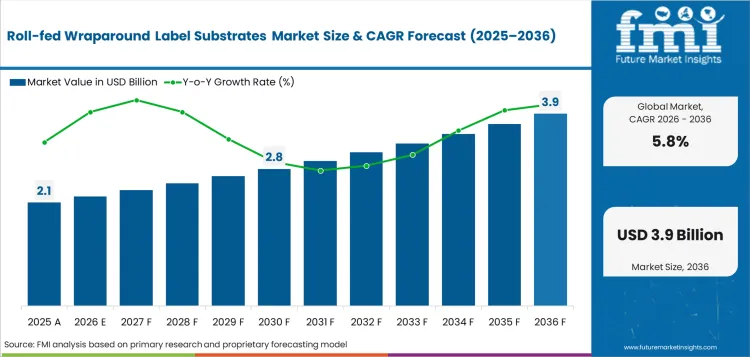
Key Takeaways, Market Size, and Forecast
- The roll-fed wraparound label substrates market is expected to be valued at USD 2.1 billion in 2026.
- By 2036, the roll-fed wraparound label substrates market is forecast to reach USD 3.7 billion.
- From 2026 to 2036, the market is projected to expand at a CAGR of 5.8%.
- The market is expected to create an incremental opportunity of USD 1.6 billion over the forecast period.
- BOPP films remain the leading material type as they balance printability with reliable line-speed performance.
- PET bottles lead container demand in 2026 as high-volume beverage packaging keeps supporting roll-fed wraparound label use.
- Asia Pacific remains the largest value region, while North America and Europe continue to shape recyclability standards and downgauged film development.
The underappreciated opportunity sits in reclaimable and downgauged film performance, not in volume expansion alone. First-hand signals from MCC's APR-recognized recycLABEL cPET structure, Innovia's recycled-content Encore RFC35m35 film, and Jindal's Label-Lyte 33DL247 launch show that substrate innovation is now centered on recyclability, yield, and line-speed stability. That means film suppliers can still create margin in a mature label format if they improve circularity outcomes without forcing converters or fillers to change existing systems. Suppliers that connect sustainability claims with proven runnability should hold the clearest advantage in beverage-led applications.
Roll-fed Wraparound Label Substrates Market Definition
The roll-fed wraparound label substrates market includes paper and filmic facestock materials used to produce reel-fed labels that wrap around rigid containers and are typically applied through high-speed hot-melt or similar adhesive-based labeling systems. It covers substrate grades supplied for beverage, household, food, and other consumer packaging applications where continuous roll-fed decoration remains commercially relevant.
Roll-fed Wraparound Label Substrates Market Inclusions
Market scope covers BOPP, PET, paper, and specialty coated substrate materials sold for roll-fed wraparound label conversion across clear, white, metallized, and recycled-content structures. The study includes segmentation by material type, appearance, film structure, container type, printing process, end use, and region for the period 2026 to 2036.
Key stakeholder scope includes resin suppliers, BOPP and PET film manufacturers, paper and specialty coated-substrate suppliers, label converters, printers, beverage bottlers, brand owners, recycling-validation bodies, packaging procurement teams, and regional distributors. Film and substrate suppliers benefit by selling downgauged, recycled-content, metallized, clear, and reclaimable structures; converters benefit from stable print and line performance; beverage brands and bottlers benefit from lower unit cost and faster application speeds; and recyclers benefit when label structures support PET bottle recovery.
Roll-fed Wraparound Label Substrates Market Exclusions
The scope does not include shrink sleeves, pressure-sensitive label constructions, in-mold labels, cut-and-stack labels, or finished label application equipment. It also excludes adhesives and inks sold independently from substrate supply.
Market Research Methodology
- Primary Research: Review of demand behavior across film suppliers, converters, beverage bottlers, plus label procurement teams in major markets.
- Desk Research: Assessment of public company announcements, label-material product launches, plus packaging substrate trends.
- Market sizing and forecasting: Revenue modeling based on substrate demand by beverage use, film mix shifts, plus regional packaging output.
- Data validation: Cross-checking against visible product launches, container demand patterns, plus material innovation activity.
Why is the Roll-fed Wraparound Label Substrates Market Growing?
- Beverage packaging still needs low-unit-cost label decoration at high application speeds.
- Film suppliers are keeping the format competitive through downgauging and reclaimability improvements.
- Brand owners want sustainability gains without forcing major filling-line changes.
The market is growing at a measured pace as roll-fed wraparound labels continue to hold a practical place in high-volume packaging. Beverage producers still value the format where application speed, print area, and cost per container remain decisive. That keeps substrate demand resilient even as pressure-sensitive and sleeve formats expand in other parts of labeling.
Material innovation is supporting that resilience. MCC received APR recognition for its recycLABEL cPET roll-fed label on PET bottles, reinforcing the push toward reclaimable substrate structures. Innovia Films said in June 2025 that its Encore RFC35m35 clear label film with mechanically recycled content is suited to roll-fed wraparound label applications. Jindal Films also introduced Label-Lyte 33DL247 for reel-fed wrap-around labeling applications, showing that product development continues around yield, stiffness, and graphics performance.
The category also benefits from installed-line economics. Many beverage fillers already run wraparound labeling at scale and do not want unnecessary line disruption. Substrate suppliers that improve print performance or downgauge the film without creating machine instability have a clearer route to commercial adoption.
The market still faces limits. Shelf differentiation is stronger in some sleeve and pressure-sensitive formats, paper substrates remain under pressure in moisture-heavy applications, and sustainability claims need to hold up under actual recycling conditions. Even so, the installed base for wraparound labeling keeps demand meaningful through the forecast period.
Market Segmentation Analysis
- BOPP films account for 61.0% of market revenue in 2026 as they remain the standard substrate family for many reel-fed beverage label lines. Source: FMI analysis, 2026.
- PET bottles hold a 37.0% share in 2026, keeping them the largest container type for roll-fed wraparound label substrate demand. Source: FMI analysis, 2026.
- Rotogravure and flexographic printing remain the leading process routes as converters prioritize line consistency and graphics quality.
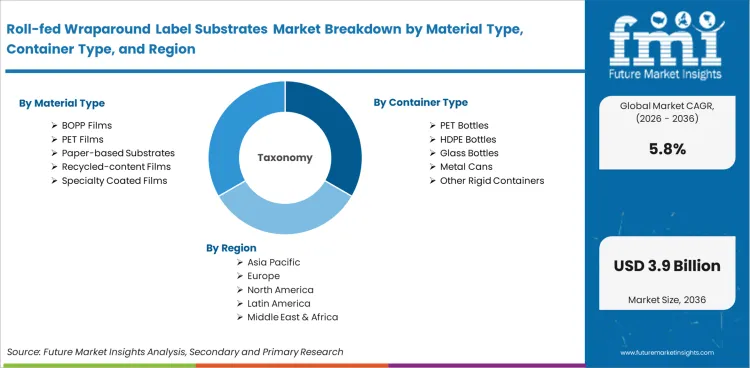
The roll-fed wraparound label substrates market is segmented by material type, appearance, film structure, container type, printing process, end use, and region. That structure reflects where value is forming: in film performance, container compatibility, and the ability to run reliably on high-speed labeling systems.
Insights into the BOPP Films Segment
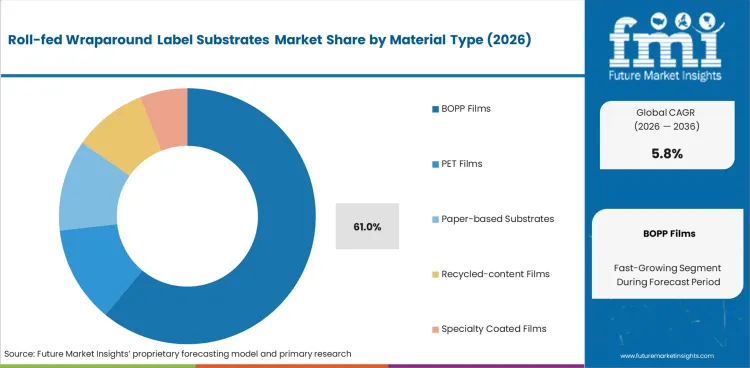
BOPP films remain the leading material segment in the roll-fed wraparound label substrates market. They offer strong stiffness, good moisture resistance, and a cost structure that still works for large beverage runs. That keeps them central to reel-fed wraparound label production.
The segment also benefits from wide converter familiarity. Printers and bottlers already understand how these films behave on established lines, which lowers switching friction when suppliers launch improved grades.
Insights into the PET Bottles Segment
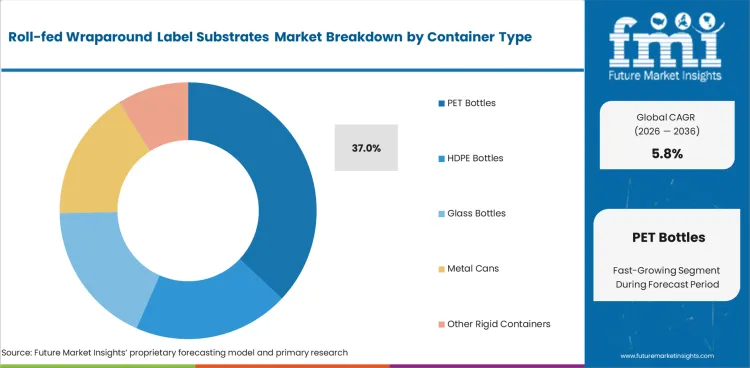
PET bottles remain the largest container segment in 2026. Carbonated drinks, bottled water, and many functional beverage lines still rely on PET formats where roll-fed wraparound decoration fits throughput and cost targets.
This segment matters even more as recyclability pressure rises. Substrate suppliers that can support PET bottle recovery without forcing brand owners into more expensive label formats should keep a stronger position.
Insights into the Carbonated Soft Drinks Segment
Carbonated soft drinks are expected to account for the largest end-use share in 2026. The segment still depends heavily on high-speed bottling and broad retail distribution, both of which support roll-fed wraparound labeling.
The category also remains important as a test bed for downgauged and high-yield substrate grades. Suppliers often prove line performance here before expanding into adjacent beverage uses.
Roll-fed Wraparound Label Substrates Market Drivers, Restraints, and Opportunities
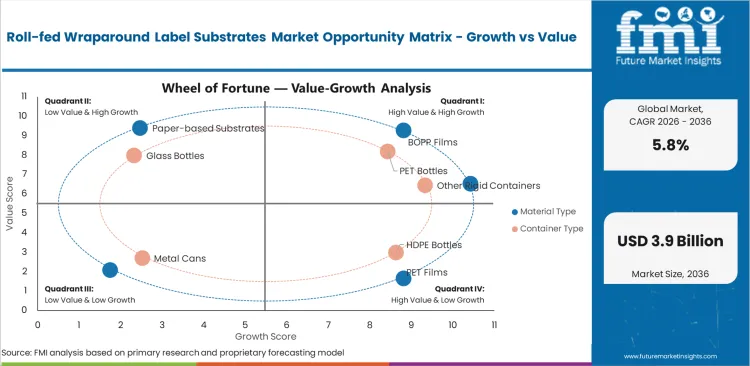
- Installed high-speed bottling infrastructure remains the main market driver.
- Format competition from sleeves and pressure-sensitive labels continues to restrain upside in premium applications.
- The strongest opportunities are opening in reclaimable PET-compatible films and downgauged high-yield substrates.
The market is not being driven by novelty. It is being sustained by packaging economics. Where converters and fillers need speed, consistency, and cost control, roll-fed wraparound substrates still hold a strong place.
Installed-Line Economics Continue to Support Demand
Many beverage operations already run wraparound label systems across large volumes. Replacing those lines or moving fully into premium decoration formats is not always commercially justified, especially in cost-sensitive categories.
Premium Format Competition Limits Value Expansion
The main restraint comes from format substitution. Shrink sleeves and pressure-sensitive labels offer stronger shelf differentiation in some categories, which can cap growth for roll-fed substrates in premium packaging segments.
Reclaimable and Recycled-content Films Create the Best Upside
The clearest opportunity sits in substrate grades that help brands meet recycling goals without compromising line speed. Reclaimable PET-compatible films, mechanically recycled-content structures, and downgauged high-yield grades are likely to see the strongest interest.
Regional Market Analysis
.webp "Top Country Growth Comparison Roll Fed Wraparound Label Substrates Market Cagr (2026 2036)")
- China is projected to grow at 6.4% CAGR from 2026 to 2036 and remain the largest country market in value terms.
- India and the United States are expected to expand at 6.7% and 4.9%, supported by beverage scale and substrate innovation.
- Germany and Brazil are forecast to post 4.3% and 5.2% growth as circularity standards and packaged beverage demand keep influencing label-material choices. Country growth rates are FMI estimates, 2026.
The roll-fed wraparound label substrates market is likely to stay strongest in countries with large beverage output, established bottling infrastructure, and price-sensitive packaging systems. Asia Pacific leads volume, while North America and Europe shape material reformulation and recycling alignment.
How Is China Shaping the Roll-fed Wraparound Label Substrates Market?
China remains the anchor market for roll-fed wraparound label substrates through large beverage output, deep converting capacity, and broad use of cost-efficient packaging formats.
- Beverage scale keeps substrate demand high across water and soft drinks, along with other value-focused packaged products.
- Local converting capacity supports both commodity and upgraded film supply.
- Buyers remain highly responsive to yield gains and downgauging.
Why Does India Matter in This Roll-fed Wraparound Label Substrates Market?
India matters through fast packaged beverage growth and ongoing investment in rigid-container filling lines. The market continues to reward packaging formats that balance speed with cost discipline.
- Water and soft drink demand support large-volume label runs.
- Packagers remain cost-sensitive, which helps the wraparound format hold relevance.
- Local and regional converters are likely to adopt improved film grades where line efficiency improves.
What Is Driving Demand in the United States?
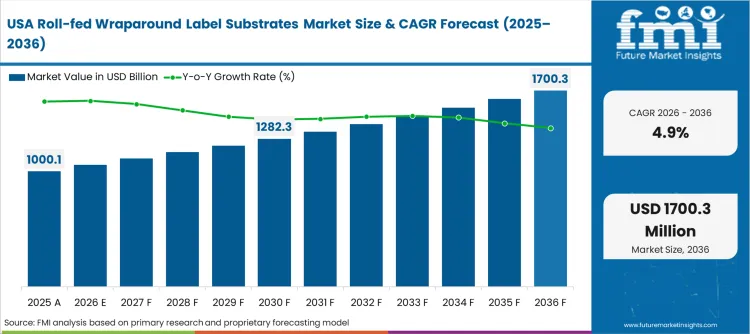
The United States remains important through material innovation rather than low-cost volume alone. Recyclability testing, APR-aligned label structures, and premium converter capability all influence substrate development here.
- Brand owners are pushing for more credible recyclability outcomes.
- Substrate innovation is moving through reclaimable and recycled-content film structures.
- Converters expect new grades to work on existing lines without major disruption.
How Are Germany and Brazil Supporting the Market?
Germany and Brazil support the market for different reasons. Germany influences circularity and materials performance expectations, while Brazil sustains demand through packaged beverage volumes and cost-driven label choices.
- Germany rewards materials that align with recycling goals and process discipline.
- Brazil remains a strong volume market for beverage labeling formats with lower unit costs.
- Both markets support continued demand for reliable wraparound film substrates.
Competitive Landscape and Strategic Positioning
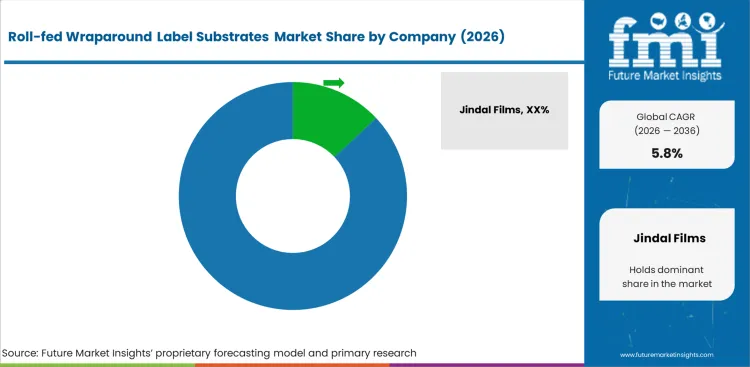
- Competition spans global film manufacturers, label-material suppliers, plus vertically integrated converters with substrate development capability.
- Competitive strength depends on film yield, machine runnability, plus print performance.
- The strongest suppliers are improving existing wraparound systems rather than treating the format as a legacy leftover.
Competition remains practical and specification-driven. Buyers care about whether a film runs cleanly, holds graphics well, and supports the sustainability claims attached to it. That keeps the market focused on performance details more than branding alone.
This matters in a mature substrate category. Suppliers can still win share, but gains usually come from thinner gauges, better stiffness, improved reclaimability, or better compatibility with current converting systems. Broad marketing claims have less value if a film does not run well on line.
Sustainability has become the main competitive differentiator, though only when supported by credible testing. Suppliers that can connect recycled content or reclaimability with stable machine performance are better placed to defend margins.
Key Companies in the Roll-fed Wraparound Label Substrates Market
Key companies active in the market include Jindal Films, Innovia Films, Multi-Color Corporation, CCL Label, Avery Dennison, and UPM Raflatac.
Competitive Benchmarking: Roll-fed Wraparound Label Substrates Market
| Company | Core Strength | Primary Roll-fed Wraparound Label Substrates Exposure | Strategic Positioning | Geographic Footprint |
|---|---|---|---|---|
| Jindal Films | Global OPP film manufacturing scale | Reel-fed wraparound BOPP substrate portfolio under Label-Lyte | High-yield and high-speed film performance | Global |
| Innovia Films | Specialty BOPP and label film engineering | Recycled-content and performance label films suited to roll-fed wraparound use | Sustainable film innovation for label markets | Europe, Americas, Asia |
| Multi-Color Corporation | Label conversion and packaging-market access | Recyclable and reclaimable roll-fed label structures for PET bottles | Converter-led substrate commercialization | Global |
| CCL Label | Beverage labeling scale and film converting depth | OPP wraparound label capability for beverage markets | High-volume beverage and decorative labeling | Global |
| Avery Dennison | Engineered label materials and film portfolio | Rapid-Roll and beverage label film solutions | Performance films with converter familiarity | Global |
| UPM Raflatac | Label materials and circularity-led portfolio development | Beverage and filmic label materials adjacent to wraparound applications | Sustainability-led label material expansion | Global |
Key Developments in Roll-fed Wraparound Label Substrates Market
- Multi-Color Corporation received APR recognition for its recycLABEL cPET roll-fed label on PET bottles, strengthening the case for reclaimable wraparound label structures in beverage packaging.
- Innovia Films said in June 2025 that its Encore RFC35m35 clear label film with 35% mechanically recycled plastic waste is suitable for roll-fed wraparound label applications.
- Jindal Films introduced Label-Lyte 33DL247 for reel-fed wrap-around labeling applications in 2024, targeting high yield and strong line performance.
- Avery Dennison continues to supply Rapid-Roll beverage film structures designed for roll-fed bottle and can labeling, reinforcing competition around machine performance and print stability.
Key Players in the Roll-fed Wraparound Label Substrates Market
Major Global Players
- Jindal Films
- Innovia Films
- Multi-Color Corporation
- CCL Label
- Avery Dennison
- UPM Raflatac
Emerging and Regional Growth Suppliers
- Regional film producers, converter-linked substrate suppliers, and niche coated-film specialists are likely to remain relevant where local beverage demand, specification flexibility, or price competitiveness matter more than global portfolio breadth.
Report Scope and Coverage
| Attribute | Details |
|---|---|
| Estimated market size (2026) | USD 2.1 billion |
| Projected market size (2036) | USD 3.7 billion |
| CAGR (2026 to 2036) | 5.8% |
| Quantitative units | USD billion |
| Key segment coverage | Material Type, Appearance, Film Structure, Container Type, Printing Process, End Use, Region |
| Regions covered | North America, Latin America, Europe, Asia Pacific, Middle East and Africa |
Segment Analysis by Material Type, Appearance, Film Structure, Container Type, Printing Process, End Use, and Region
By Material Type:
- BOPP Films
- PET Films
- Paper-based Substrates
- Recycled-content Films
- Specialty Coated Films
By Appearance:
- Clear
- White Opaque
- Metallized
By Film Structure:
- Single-web Films
- Lamination-grade Films
By Container Type:
- PET Bottles
- HDPE Bottles
- Glass Bottles
- Metal Cans
- Other Rigid Containers
By Printing Process:
- Rotogravure
- Flexographic
- Offset
- Hybrid
By End Use:
- Carbonated Soft Drinks
- Water and Functional Beverages
- Dairy and Dairy Alternatives
- Alcoholic Beverages
- Household and Personal Care
- Food and Condiments
- Other Consumer Goods
By Region:
- North America
- Latin America
- Europe
- Asia Pacific
- Middle East and Africa
Research Sources and Bibliography
- 1. FMI analysis, 2026.
- 2. Official company announcements and product launch disclosures referenced in the competitive landscape and key developments sections.
- 3. Company product pages, investor communications, and technology or portfolio documentation referenced for market context.
- 4. Public industry documentation, platform updates, and regulatory or standards-related materials used for category framing where relevant.
This Report Answers
- What is the projected value of the Roll-fed Wraparound Label Substrates Market in 2026 and 2036?
- What is the expected CAGR from 2026 to 2036?
- Which segment currently contributes the largest share in the market structure?
- Which countries are expected to expand faster than the global average through 2036?
- Which companies hold the strongest visible positions in the current competitive landscape?
- What commercial factors are supporting current market adoption?
- Which product, application, or end-use areas are expected to create the strongest opportunity?
Frequently Asked Questions
What is the global market demand for Roll-fed Wraparound Label Substrates Market in 2026?
In 2026, the global market for Roll-fed Wraparound Label Substrates Market is estimated at USD 2.1 billion.
What is the forecast market value by 2036?
By 2036, the market is projected to reach USD 3.7 billion under the base-case forecast model.
What is the forecast CAGR from 2026 to 2036?
The market is expected to expand at a 5.8% CAGR during the forecast period.
Which segment leads the market?
The leading segment is identified in the market segmentation analysis based on FMI estimates for 2026.
Which countries are expected to expand faster than the global average?
The regional market analysis highlights the faster-growing country markets under the FMI forecast model.
Why is Roll-fed Wraparound Label Substrates Market gaining market traction?
Adoption is rising as suppliers and buyers respond to measurable operational, commercial, and performance needs in the category.
Preview the report firsthand - request a free sample
Get SampleGet the brochure for pricing and purchase details.
Get PDFTable of Content
- Executive Summary
- Global Market Outlook
- Demand-side Trends
- Supply-side Trends
- Technology Roadmap Analysis
- Analysis and Recommendations
- Market Overview
- Market Coverage / Taxonomy
- Market Definition / Scope / Limitations
- Research Methodology
- Chapter Orientation
- Analytical Lens and Working Hypotheses
- Market Structure, Signals, and Trend Drivers
- Benchmarking and Cross-market Comparability
- Market Sizing, Forecasting, and Opportunity Mapping
- Research Design and Evidence Framework
- Desk Research Programme (Secondary Evidence)
- Company Annual and Sustainability Reports
- Peer-reviewed Journals and Academic Literature
- Corporate Websites, Product Literature, and Technical Notes
- Earnings Decks and Investor Briefings
- Statutory Filings and Regulatory Disclosures
- Technical White Papers and Standards Notes
- Trade Journals, Industry Magazines, and Analyst Briefs
- Conference Proceedings, Webinars, and Seminar Materials
- Government Statistics Portals and Public Data Releases
- Press Releases and Reputable Media Coverage
- Specialist Newsletters and Curated Briefings
- Sector Databases and Reference Repositories
- FMI Internal Proprietary Databases and Historical Market Datasets
- Subscription Datasets and Paid Sources
- Social Channels, Communities, and Digital Listening Inputs
- Additional Desk Sources
- Expert Input and Fieldwork (Primary Evidence)
- Primary Modes
- Qualitative Interviews and Expert Elicitation
- Quantitative Surveys and Structured Data Capture
- Blended Approach
- Why Primary Evidence is Used
- Field Techniques
- Interviews
- Surveys
- Focus Groups
- Observational and In-context Research
- Social and Community Interactions
- Stakeholder Universe Engaged
- C-suite Leaders
- Board Members
- Presidents and Vice Presidents
- R&D and Innovation Heads
- Technical Specialists
- Domain Subject-matter Experts
- Scientists
- Physicians and Other Healthcare Professionals
- Governance, Ethics, and Data Stewardship
- Research Ethics
- Data Integrity and Handling
- Primary Modes
- Tooling, Models, and Reference Databases
- Desk Research Programme (Secondary Evidence)
- Data Engineering and Model Build
- Data Acquisition and Ingestion
- Cleaning, Normalisation, and Verification
- Synthesis, Triangulation, and Analysis
- Quality Assurance and Audit Trail
- Market Background
- Market Dynamics
- Drivers
- Restraints
- Opportunity
- Trends
- Scenario Forecast
- Demand in Optimistic Scenario
- Demand in Likely Scenario
- Demand in Conservative Scenario
- Opportunity Map Analysis
- Product Life Cycle Analysis
- Supply Chain Analysis
- Investment Feasibility Matrix
- Value Chain Analysis
- PESTLE and Porter’s Analysis
- Regulatory Landscape
- Regional Parent Market Outlook
- Production and Consumption Statistics
- Import and Export Statistics
- Market Dynamics
- Global Market Analysis 2021 to 2025 and Forecast, 2026 to 2036
- Historical Market Size Value (USD Million) Analysis, 2021 to 2025
- Current and Future Market Size Value (USD Million) Projections, 2026 to 2036
- Y-o-Y Growth Trend Analysis
- Absolute $ Opportunity Analysis
- Global Market Pricing Analysis 2021 to 2025 and Forecast 2026 to 2036
- Global Market Analysis 2021 to 2025 and Forecast 2026 to 2036, By Material Type
- Introduction / Key Findings
- Historical Market Size Value (USD Million) Analysis By Material Type , 2021 to 2025
- Current and Future Market Size Value (USD Million) Analysis and Forecast By Material Type , 2026 to 2036
- BOPP Films
- PET Films
- Paper-based Substrates
- Recycled-content Films
- Specialty Coated Films
- BOPP Films
- Y-o-Y Growth Trend Analysis By Material Type , 2021 to 2025
- Absolute $ Opportunity Analysis By Material Type , 2026 to 2036
- Global Market Analysis 2021 to 2025 and Forecast 2026 to 2036, By Container Type
- Introduction / Key Findings
- Historical Market Size Value (USD Million) Analysis By Container Type, 2021 to 2025
- Current and Future Market Size Value (USD Million) Analysis and Forecast By Container Type, 2026 to 2036
- PET Bottles
- HDPE Bottles
- Glass Bottles
- Metal Cans
- Other Rigid Containers
- PET Bottles
- Y-o-Y Growth Trend Analysis By Container Type, 2021 to 2025
- Absolute $ Opportunity Analysis By Container Type, 2026 to 2036
- Global Market Analysis 2021 to 2025 and Forecast 2026 to 2036, By Region
- Introduction
- Historical Market Size Value (USD Million) Analysis By Region, 2021 to 2025
- Current Market Size Value (USD Million) Analysis and Forecast By Region, 2026 to 2036
- North America
- Latin America
- Western Europe
- Eastern Europe
- East Asia
- South Asia and Pacific
- Middle East & Africa
- Market Attractiveness Analysis By Region
- North America Market Analysis 2021 to 2025 and Forecast 2026 to 2036, By Country
- Historical Market Size Value (USD Million) Trend Analysis By Market Taxonomy, 2021 to 2025
- Market Size Value (USD Million) Forecast By Market Taxonomy, 2026 to 2036
- By Country
- USA
- Canada
- Mexico
- By Material Type
- By Container Type
- By Country
- Market Attractiveness Analysis
- By Country
- By Material Type
- By Container Type
- Key Takeaways
- Latin America Market Analysis 2021 to 2025 and Forecast 2026 to 2036, By Country
- Historical Market Size Value (USD Million) Trend Analysis By Market Taxonomy, 2021 to 2025
- Market Size Value (USD Million) Forecast By Market Taxonomy, 2026 to 2036
- By Country
- Brazil
- Chile
- Rest of Latin America
- By Material Type
- By Container Type
- By Country
- Market Attractiveness Analysis
- By Country
- By Material Type
- By Container Type
- Key Takeaways
- Western Europe Market Analysis 2021 to 2025 and Forecast 2026 to 2036, By Country
- Historical Market Size Value (USD Million) Trend Analysis By Market Taxonomy, 2021 to 2025
- Market Size Value (USD Million) Forecast By Market Taxonomy, 2026 to 2036
- By Country
- Germany
- UK
- Italy
- Spain
- France
- Nordic
- BENELUX
- Rest of Western Europe
- By Material Type
- By Container Type
- By Country
- Market Attractiveness Analysis
- By Country
- By Material Type
- By Container Type
- Key Takeaways
- Eastern Europe Market Analysis 2021 to 2025 and Forecast 2026 to 2036, By Country
- Historical Market Size Value (USD Million) Trend Analysis By Market Taxonomy, 2021 to 2025
- Market Size Value (USD Million) Forecast By Market Taxonomy, 2026 to 2036
- By Country
- Russia
- Poland
- Hungary
- Balkan & Baltic
- Rest of Eastern Europe
- By Material Type
- By Container Type
- By Country
- Market Attractiveness Analysis
- By Country
- By Material Type
- By Container Type
- Key Takeaways
- East Asia Market Analysis 2021 to 2025 and Forecast 2026 to 2036, By Country
- Historical Market Size Value (USD Million) Trend Analysis By Market Taxonomy, 2021 to 2025
- Market Size Value (USD Million) Forecast By Market Taxonomy, 2026 to 2036
- By Country
- China
- Japan
- South Korea
- By Material Type
- By Container Type
- By Country
- Market Attractiveness Analysis
- By Country
- By Material Type
- By Container Type
- Key Takeaways
- South Asia and Pacific Market Analysis 2021 to 2025 and Forecast 2026 to 2036, By Country
- Historical Market Size Value (USD Million) Trend Analysis By Market Taxonomy, 2021 to 2025
- Market Size Value (USD Million) Forecast By Market Taxonomy, 2026 to 2036
- By Country
- India
- ASEAN
- Australia & New Zealand
- Rest of South Asia and Pacific
- By Material Type
- By Container Type
- By Country
- Market Attractiveness Analysis
- By Country
- By Material Type
- By Container Type
- Key Takeaways
- Middle East & Africa Market Analysis 2021 to 2025 and Forecast 2026 to 2036, By Country
- Historical Market Size Value (USD Million) Trend Analysis By Market Taxonomy, 2021 to 2025
- Market Size Value (USD Million) Forecast By Market Taxonomy, 2026 to 2036
- By Country
- Kingdom of Saudi Arabia
- Other GCC Countries
- Turkiye
- South Africa
- Other African Union
- Rest of Middle East & Africa
- By Material Type
- By Container Type
- By Country
- Market Attractiveness Analysis
- By Country
- By Material Type
- By Container Type
- Key Takeaways
- Key Countries Market Analysis
- USA
- Pricing Analysis
- Market Share Analysis, 2025
- By Material Type
- By Container Type
- Canada
- Pricing Analysis
- Market Share Analysis, 2025
- By Material Type
- By Container Type
- Mexico
- Pricing Analysis
- Market Share Analysis, 2025
- By Material Type
- By Container Type
- Brazil
- Pricing Analysis
- Market Share Analysis, 2025
- By Material Type
- By Container Type
- Chile
- Pricing Analysis
- Market Share Analysis, 2025
- By Material Type
- By Container Type
- Germany
- Pricing Analysis
- Market Share Analysis, 2025
- By Material Type
- By Container Type
- UK
- Pricing Analysis
- Market Share Analysis, 2025
- By Material Type
- By Container Type
- Italy
- Pricing Analysis
- Market Share Analysis, 2025
- By Material Type
- By Container Type
- Spain
- Pricing Analysis
- Market Share Analysis, 2025
- By Material Type
- By Container Type
- France
- Pricing Analysis
- Market Share Analysis, 2025
- By Material Type
- By Container Type
- India
- Pricing Analysis
- Market Share Analysis, 2025
- By Material Type
- By Container Type
- ASEAN
- Pricing Analysis
- Market Share Analysis, 2025
- By Material Type
- By Container Type
- Australia & New Zealand
- Pricing Analysis
- Market Share Analysis, 2025
- By Material Type
- By Container Type
- China
- Pricing Analysis
- Market Share Analysis, 2025
- By Material Type
- By Container Type
- Japan
- Pricing Analysis
- Market Share Analysis, 2025
- By Material Type
- By Container Type
- South Korea
- Pricing Analysis
- Market Share Analysis, 2025
- By Material Type
- By Container Type
- Russia
- Pricing Analysis
- Market Share Analysis, 2025
- By Material Type
- By Container Type
- Poland
- Pricing Analysis
- Market Share Analysis, 2025
- By Material Type
- By Container Type
- Hungary
- Pricing Analysis
- Market Share Analysis, 2025
- By Material Type
- By Container Type
- Kingdom of Saudi Arabia
- Pricing Analysis
- Market Share Analysis, 2025
- By Material Type
- By Container Type
- Turkiye
- Pricing Analysis
- Market Share Analysis, 2025
- By Material Type
- By Container Type
- South Africa
- Pricing Analysis
- Market Share Analysis, 2025
- By Material Type
- By Container Type
- USA
- Market Structure Analysis
- Competition Dashboard
- Competition Benchmarking
- Market Share Analysis of Top Players
- By Regional
- By Material Type
- By Container Type
- Competition Analysis
- Competition Deep Dive
- Jindal Films
- Overview
- Product Portfolio
- Profitability by Market Segments (Product/Age /Sales Channel/Region)
- Sales Footprint
- Strategy Overview
- Marketing Strategy
- Product Strategy
- Channel Strategy
- Innovia Films
- Multi-Color Corporation
- CCL Label
- Avery Dennison
- UPM Raflatac
- Jindal Films
- Competition Deep Dive
- Assumptions & Acronyms Used


