

- Industry Size (2025)
- USD 5.5 Bn
- Forecast (2035)
- USD 6.9 Bn
- CAGR (2025 to 2035)
- 2.3%
Flexographic Printing Plate Market Outlook from 2025 to 2035
The flexographic printing plate market is experiencing steady growth driven by the expanding packaging industry, increasing demand for high-quality printing, and technological advancements in plate materials and imaging systems. The current market scenario reflects growing adoption of digital workflows, improved plate durability, and reduced turnaround times, which are enhancing operational efficiency and print consistency.
Sustainability trends are influencing product development, with eco-friendly materials and solvent-free processing gaining traction. The future outlook is positive, supported by the ongoing transition toward automation and the integration of smart printing technologies in both developed and emerging markets.
Rising demand for flexible packaging across food, beverage, and consumer goods sectors continues to reinforce market stability Growth rationale lies in the ability of flexographic printing plates to deliver superior precision, cost-effectiveness, and adaptability to various substrates, ensuring that technological evolution, combined with global packaging expansion, sustains the market’s upward trajectory in the coming years.
Quick Stats for Flexographic Printing Plate Market
- Flexographic Printing Plate Market Industry Value (2025): USD 5.5 billion
- Flexographic Printing Plate Market Forecast Value (2035): USD 6.9 billion
- Flexographic Printing Plate Market Forecast CAGR: 2.3%
- Leading Segment in Flexographic Printing Plate Market in 2025: Digital (61.4%)
- Key Growth Region in Flexographic Printing Plate Market: North America, Asia-Pacific, Europe
- Top Key Players in Flexographic Printing Plate Market: DuPont, Kodak, Esko, MacDermid Graphics Solutions, Asahi Photoproducts, Flint Group, Anderson & Vreeland, Toyobo, Flexographic Solutions LLC, Techkon, Zecher, Apex International, Allflex, Harper Corporation of America, Electro Optic US, Rossini, Trelleborg, Toyo Ink Group, CRON-ECRM, Daetwyler
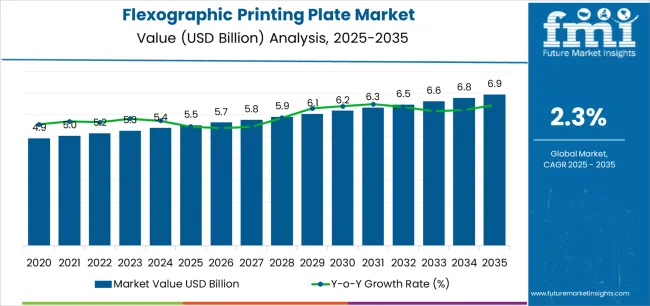
| Metric | Value |
|---|---|
| Flexographic Printing Plate Market Estimated Value in (2025 E) | USD 5.5 billion |
| Flexographic Printing Plate Market Forecast Value in (2035 F) | USD 6.9 billion |
| Forecast CAGR (2025 to 2035) | 2.3% |
Segmental Analysis
The market is segmented by Format, Type, Application, Design, and Ink Compatibility and region. By Format, the market is divided into Digital and Analogue. In terms of Type, the market is classified into Photopolymer, Rubber, and Others. Based on Application, the market is segmented into Package Printing, Paper Substrate Printing, Tag And Labels, Quality Flexography, and Others. By Design, the market is divided into Flat Top Dot and Rounded Top. By Type, the market is segmented into Thermal Plates, Solvent-Based, and Coating-Based. By Ink Compatibility, the market is segmented into Solvent-Based, Aqueous, UV Cured, and Cationic Inks. Regionally, the market is classified into North America, Latin America, Western Europe, Eastern Europe, Balkan & Baltic Countries, Russia & Belarus, Central Asia, East Asia, South Asia & Pacific, and the Middle East & Africa.
Insights into the Format Segment
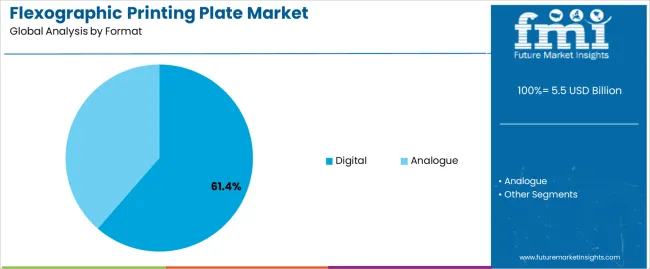
The digital segment, holding 61.40% of the format category, has emerged as the dominant segment due to its superior accuracy, shorter setup time, and compatibility with automated prepress systems. The segment’s growth has been supported by the shift from conventional to digital imaging, enabling faster plate production and reduced material wastage.
Enhanced reproducibility and consistency have made digital plates the preferred choice among converters and printers aiming for high-volume, short-run production. Manufacturers are focusing on innovations that improve laser engravability and plate uniformity, further strengthening the performance advantages of digital formats.
The integration of cloud-based workflow management and digital proofing systems is also enhancing productivity and cost efficiency As packaging requirements evolve toward greater customization and shorter print cycles, digital plates are expected to maintain their market leadership through continuous technological refinement and scalability.
Insights into the Type Segment
The photopolymer segment, accounting for 58.70% of the type category, has retained dominance owing to its excellent image reproduction, flexibility, and resilience under diverse printing conditions. Its widespread adoption has been driven by superior ink transfer capabilities and adaptability across paper, film, and foil substrates.
Advancements in polymer chemistry have improved plate hardness and ink compatibility, ensuring extended plate life and minimal distortion during long print runs. The segment’s market position has been further reinforced by the shift toward solvent-free and thermal processing technologies that enhance environmental compliance.
Producers are focusing on research to improve dimensional stability and minimize dot gain, enabling precise print quality even in high-speed operations These ongoing innovations, coupled with cost-effectiveness and ease of processing, are expected to sustain the photopolymer segment’s leading role in the global flexographic printing plate market.
Insights into the Application Segment
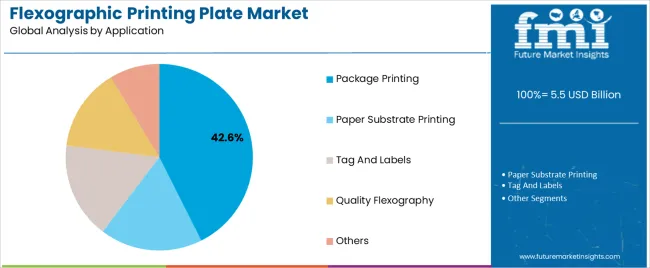
The package printing segment, representing 42.60% of the application category, continues to lead due to surging demand for high-quality, customizable, and visually appealing packaging across food, beverage, and personal care industries. The dominance of this segment is being driven by rapid growth in e-commerce and consumer preference for branded, flexible packaging solutions.
Flexographic printing plates have become integral to achieving fine details, vibrant colors, and durability in printed packaging. The segment benefits from continuous advancements in plate imaging and ink formulations, which have enabled higher efficiency and reduced setup costs.
Manufacturers are investing in automation and hybrid printing solutions to meet increasing design complexity and volume demands As global packaging consumption expands, package printing is expected to remain the key growth driver, reinforcing its position as the primary application area within the flexographic printing plate market.
Key Market Drivers
The last few years have seen a surge in consumer demand for customized and personalized products. This has pushed the demand for flexographic printing across various industries.
Apart from this, several other reasons are responsible for the growth of the flexographic printing plates market in the past few years:
- Rising consumer preference for flexible packaging due to convenience and portability
- Increasing demand for eco-friendly and sustainable packaging solutions
- Technological advancements improving print quality and efficiency in flexographic printing
- Expansion of the e-commerce sector, fueling the need for innovative packaging materials
- Growth in the food and beverage industry, necessitating high-quality packaging for product differentiation
- Cost-effectiveness of flexographic printing compared to alternative methods
- Regulatory requirements mandating clearer labeling and packaging standards
- Flexibility to print on a variety of substrates caters to diverse industry needs, augmenting the market for flexographic printing plates
- Shift towards shorter print runs and faster turnaround times favors flexographic printing's quick setup and production capabilities
- Innovations in ink and plate materials, enhancing durability and print longevity
Trends in the Global Flexographic Printing Plate Market
The global flexographic printing plates market is witnessing several notable trends that are shaping its trajectory in recent years:
- One prominent trend is the increasing adoption of water-washable flexographic printing plates due to their eco-friendly attributes and reduced environmental impact
- Advanced imaging technologies like laser engraving are also being integrated into the production process. This enhances plate quality and precision in flexographic printing.
- There's a growing demand for solvent-free and low-VOC inks, necessitating specialized flexographic printing plates compatible with such formulations.
- The packaging industry is also witnessing exponential expansion in recent years, especially in sectors like food and beverage, pharmaceuticals, and cosmetics. This is also fueling the surge in demand.
- The use of high-definition flexographic printing plates capable of achieving intricate designs and vibrant colors is on the rise due to the heightened focus on brand differentiation and product aesthetics.
- The rising adoption of digital flexographic printing solutions for shorter print runs is influencing the development of digital-ready flexographic printing plates.
High Upfront Investment to Slow down the Market Growth for Flexographic Printing Plates
- The cost of initial investment in flexographic printing equipment and plates can be high, discouraging smaller businesses from adopting this technology.
- Compared to other printing methods like offset or digital printing, flexographic printing typically has limited color range. This restricts its use in certain applications.
- Creating flexographic printing plates can be a complex and time-consuming process that requires skilled labor and specialized equipment.
- Although water-washable flexographic plates help address some environmental concerns, there are still challenges related to the overall environmental impact of flexographic printing, particularly in terms of ink and substrate waste.
- Some businesses may be hesitant to switch from traditional printing methods, especially if they have already invested heavily in existing infrastructure and processes.
Category-wise Insights
Digital Flexographic Printing Plates are Gaining Increasing Preference
On the basis of process, the market for flexographic printing plates is segmented into digital and analogue. The digital category is projected to hold the largest share of the global flexographic printing plate market in 2025, accounting for 71.20% of the market.
| Attributes | Details |
|---|---|
| Process | Digital |
| Market Share | 71.20% |
- The demand for digital flexographic printing plates is touching the skies as they enable faster plate production, reducing lead times and allowing for quicker job completion.
- They also eliminate the need for traditional plate-making processes, resulting in cost savings associated with labor, materials, and equipment.
- The increasing preference is also attributed to their precise imaging capabilities, resulting in high-quality reproductions of intricate designs, fine text, and vibrant colors.
Flexographic Printing Sheet Plates to Take the Lion’s Share in the Coming Years
Based on the format, the sheet plate category in the flexographic printing plate market dominates the market with a share of 56.40%.
| Attributes | Details |
|---|---|
| Format | Sheet Plates |
| Market Share | 56.40% |
- The versatility of flexographic printing sheet plates allows for their use on a variety of substrates, including paper, plastic, and cardboard, making them a popular choice for packaging applications across different industries.
- With advancements in plate technology, flexographic printing sheet plates now offer sharper prints and longer plate life. This has significantly increased the demand for sheet plates for high-quality and durable printing solutions.
Country-wise Insights
This section offers a comprehensive analysis of the flexographic printing plate market across various countries, including India, China, Thailand, South Korea, and Spain. The table presents the CAGR for each country, depicting the estimated market growth in these regions until 2035.
| Countries | CAGR |
|---|---|
| India | 5.10% |
| China | 4.20% |
| Thailand | 3.80% |
| South Korea | 2.40% |
| Spain | 2.40% |
‘Make in India’ to Bolster the Market Growth for Flexographic Printing Plates
India is expected to exhibit significant market growth over the forecast period. The Indian market for flexographic printing plates is anticipated to grow at a CAGR of 5.10% through 2035.
India is becoming a prominent player in the global flexographic printing plates market, thanks to its thriving packaging industry driven by increased consumer demand, urbanization, and economic growth.
The Indian government's "Make in India" initiative is promoting domestic manufacturing, which is driving the demand for packaging materials and printing technologies such as flexographic printing plates.
Vast Manufacturing Capabilities to Aid Chinese Flexographic Printing Plates Industry
India is also one of the lucrative markets in the flexographic printing plates industry. The Indian market for flexographic printing plates is anticipated to grow at a CAGR of 12.10%.
China's rising influence in the global flexographic printing plates market is attributed to its reputation as a major player in the global packaging industry and a manufacturing hub.
Its vast manufacturing capabilities and export-oriented economy are generating robust demand for flexographic printing plates, catering to both domestic consumption and international markets.
Thailand’s Location to Shape the Future of Flexographic Printing Plates Market
Thailand also is a promising market in the global flexographic printing plates industry. Over the next ten years, the Thai demand for flexographic printing plates is projected to rise at a 3.80% CAGR.
Thailand's growing presence in the global flexographic printing plates market is powered by its strategic location in Southeast Asia, favorable investment climate, and thriving packaging industry. The country's proximity to key export markets and its well-developed infrastructure make it an attractive destination for packaging manufacturers.
Manufacturing Excellence to Boost South Korean Flexographic Printing Plates Market
South Korea is also one of the countries that is filled with potential in this market. The South Korean flexographic printing plate market is anticipated to retain its dominance by progressing at a growth rate of 2.40% till 2035.
South Korea is emerging as a key player in the global flexographic printing plates market, thanks to its focus on technological innovation and manufacturing excellence. The country's advanced manufacturing capabilities and skilled workforce enable it to produce high-quality flexographic printing plates that meet international standards.
Spanish Flexographic Printing Plates Market to Benefit from its Circular Economy Initiatives
Spain also exhibits a promising future in the global flexographic printing plates market. The flexographic printing plate market in Spain is anticipated to retain its dominance by progressing at a growth rate of 2.40% till 2035.
Spain's growing influence in the global flexographic printing plates market is fueled by its well-established printing industry, strategic location in Europe, and commitment to sustainability.
Spain's emphasis on environmental sustainability and the circular economy is generating increasing demand for eco-friendly printing solutions like flexographic printing plates, further bolstering its position in the global market.
Competitive Landscape
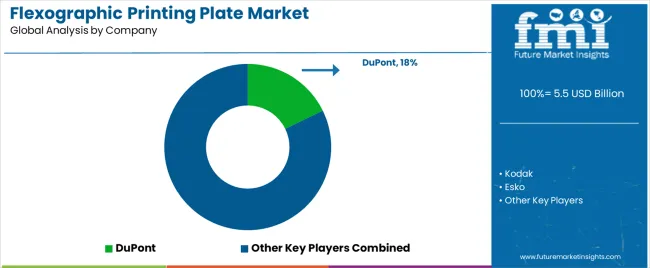
The flexographic printing plate market is filled with a multitude of companies that cater to both, industries as well as individual consumers. Some of the most prominent companies in the international marketplace are DuPont, Kodak, Esko, MacDermid Graphics Solutions, Asahi Photoproducts, Flint Group, Anderson & Vreeland, etc.
These companies have the majority share in the market while smaller companies that cater to the demands of regional clients are bringing in cost-effective methods to retain them.
Besides this, smaller companies, with limited consumer bases are also offering comprehensive customer support, including technical assistance, training programs, and after-sales services. This enhances their customer satisfaction and loyalty, leading to long-term relationships and repeat business.
Recent Developments
- In September 2025, MacDermid Graphics Solutions announced its groundbreaking partnership with Sustainable Solutionz, LLC, unveiling a patent-pending technology for recycling flexographic printing plates, with trials set to commence in North America by year-end.
- In January 2025, LeadEdge Flexo introduced cbak evolve, a bio-based polyethylene mounting material for corrugated post-printing. It aimed to reduce reliance on synthetic materials while maintaining high performance. The foam promised consistent ink coverage, reduced dot gain, and extended plate lifespan.
- In September 2025, Reproflex3 extended its strategic partnership with XSYS, installing flexographic plate manufacturing systems in Dubai and Mumbai. Andrew Hewitson, CEO, cited client satisfaction with new XSYS polymers and screening technologies, expressing excitement for future collaborations.
- In September 2025, XSYS appointed FERAG Australia Pty Ltd as the distributor for its flexographic printing plates and plate-making equipment in Australia and New Zealand. With FERAG's extensive experience, customers benefited from dedicated service as XSYS expanded its presence in the region.
Key Companies in the Market
- DuPont
- Kodak
- Esko
- MacDermid Graphics Solutions
- Asahi Photoproducts
- Flint Group
- Anderson & Vreeland
- Toyobo
- Flexographic Solutions LLC
- Techkon
- Zecher
- Apex International
- Allflex
- Harper Corporation of America
- Electro Optic US
- Rossini
- Trelleborg
- Toyo Ink Group
- CRON-ECRM
- Daetwyler
Key Coverage in the Flexographic Printing Plate Industry Report
- General Insights into the Flexo Plate-Making Process
- Demand Analysis of Flexographic Photopolymer Printing Plates
- Insights into Industrial Flexographic Printing Plates
- Top Flexo Printing Plate Manufacturers
- Conventional Analogue Flexo Printing Plate for Label Printing in China
Flexographic Printing Plate Market Segmentation
By Format:
- Digital
- Analogue
By Type:
- Photopolymer
- Rubber
- Others
By Application:
- Package Printing
- Paper Substrate Printing
- Tag and Labels
- Quality Flexography
- Others
By Design:
- Rounded Top
- Flat Top Dot
By Type:
- Thermal Plates
- Solvent-based
- Coating-based
By Ink Compatibility:
- Aqueous
- Solvent-based
- UV Cured
- Cationic Inks
By Region:
- North America
- Latin America
- Asia Pacific
- Middle East and Africa (MEA)
- Europe
Frequently Asked Questions
How big is the flexographic printing plate market in 2025?
The global flexographic printing plate market is estimated to be valued at USD 5.5 billion in 2025.
What will be the size of flexographic printing plate market in 2035?
The market size for the flexographic printing plate market is projected to reach USD 6.9 billion by 2035.
How much will be the flexographic printing plate market growth between 2025 and 2035?
The flexographic printing plate market is expected to grow at a 2.3% CAGR between 2025 and 2035.
What are the key product types in the flexographic printing plate market?
The key product types in flexographic printing plate market are digital and analogue.
Which type segment to contribute significant share in the flexographic printing plate market in 2025?
In terms of type, photopolymer segment to command 58.7% share in the flexographic printing plate market in 2025.
Preview the report firsthand - request a free sample
Get SampleGet the brochure for pricing and purchase details.
Get PDFTable of Content
- Executive Summary
- Global Market Outlook
- Demand-side Trends
- Supply-side Trends
- Technology Roadmap Analysis
- Analysis and Recommendations
- Market Overview
- Market Coverage / Taxonomy
- Market Definition / Scope / Limitations
- Market Background
- Market Dynamics
- Drivers
- Restraints
- Opportunity
- Trends
- Scenario Forecast
- Demand in Optimistic Scenario
- Demand in Likely Scenario
- Demand in Conservative Scenario
- Opportunity Map Analysis
- Product Life Cycle Analysis
- Supply Chain Analysis
- Investment Feasibility Matrix
- Value Chain Analysis
- PESTLE and Porter’s Analysis
- Regulatory Landscape
- Regional Parent Market Outlook
- Production and Consumption Statistics
- Import and Export Statistics
- Market Dynamics
- Global Market Analysis 2020 to 2024 and Forecast, 2025 to 2035
- Historical Market Size Value (USD Million) Analysis, 2020 to 2024
- Current and Future Market Size Value (USD Million) Projections, 2025 to 2035
- Y-o-Y Growth Trend Analysis
- Absolute $ Opportunity Analysis
- Global Market Pricing Analysis 2020 to 2024 and Forecast 2025 to 2035
- Global Market Analysis 2020 to 2024 and Forecast 2025 to 2035, By Format
- Introduction / Key Findings
- Historical Market Size Value (USD Million) Analysis By Format , 2020 to 2024
- Current and Future Market Size Value (USD Million) Analysis and Forecast By Format , 2025 to 2035
- Digital
- Analogue
- Y-o-Y Growth Trend Analysis By Format , 2020 to 2024
- Absolute $ Opportunity Analysis By Format , 2025 to 2035
- Global Market Analysis 2020 to 2024 and Forecast 2025 to 2035, By Type
- Introduction / Key Findings
- Historical Market Size Value (USD Million) Analysis By Type, 2020 to 2024
- Current and Future Market Size Value (USD Million) Analysis and Forecast By Type, 2025 to 2035
- Photopolymer
- Rubber
- Others
- Y-o-Y Growth Trend Analysis By Type, 2020 to 2024
- Absolute $ Opportunity Analysis By Type, 2025 to 2035
- Global Market Analysis 2020 to 2024 and Forecast 2025 to 2035, By Application
- Introduction / Key Findings
- Historical Market Size Value (USD Million) Analysis By Application, 2020 to 2024
- Current and Future Market Size Value (USD Million) Analysis and Forecast By Application, 2025 to 2035
- Package Printing
- Paper Substrate Printing
- Tag And Labels
- Quality Flexography
- Others
- Y-o-Y Growth Trend Analysis By Application, 2020 to 2024
- Absolute $ Opportunity Analysis By Application, 2025 to 2035
- Global Market Analysis 2020 to 2024 and Forecast 2025 to 2035, By Design
- Introduction / Key Findings
- Historical Market Size Value (USD Million) Analysis By Design, 2020 to 2024
- Current and Future Market Size Value (USD Million) Analysis and Forecast By Design, 2025 to 2035
- Flat Top Dot
- Rounded Top
- Y-o-Y Growth Trend Analysis By Design, 2020 to 2024
- Absolute $ Opportunity Analysis By Design, 2025 to 2035
- Global Market Analysis 2020 to 2024 and Forecast 2025 to 2035, By Type
- Introduction / Key Findings
- Historical Market Size Value (USD Million) Analysis By Type, 2020 to 2024
- Current and Future Market Size Value (USD Million) Analysis and Forecast By Type, 2025 to 2035
- Thermal Plates
- Solvent-Based
- Coating-Based
- Y-o-Y Growth Trend Analysis By Type, 2020 to 2024
- Absolute $ Opportunity Analysis By Type, 2025 to 2035
- Global Market Analysis 2020 to 2024 and Forecast 2025 to 2035, By Ink Compatibility
- Introduction / Key Findings
- Historical Market Size Value (USD Million) Analysis By Ink Compatibility, 2020 to 2024
- Current and Future Market Size Value (USD Million) Analysis and Forecast By Ink Compatibility, 2025 to 2035
- Solvent-Based
- Aqueous
- UV Cured
- Cationic Inks
- Y-o-Y Growth Trend Analysis By Ink Compatibility, 2020 to 2024
- Absolute $ Opportunity Analysis By Ink Compatibility, 2025 to 2035
- Global Market Analysis 2020 to 2024 and Forecast 2025 to 2035, By Region
- Introduction
- Historical Market Size Value (USD Million) Analysis By Region, 2020 to 2024
- Current Market Size Value (USD Million) Analysis and Forecast By Region, 2025 to 2035
- North America
- Latin America
- Western Europe
- Eastern Europe
- East Asia
- South Asia and Pacific
- Middle East & Africa
- Market Attractiveness Analysis By Region
- North America Market Analysis 2020 to 2024 and Forecast 2025 to 2035, By Country
- Historical Market Size Value (USD Million) Trend Analysis By Market Taxonomy, 2020 to 2024
- Market Size Value (USD Million) Forecast By Market Taxonomy, 2025 to 2035
- By Country
- USA
- Canada
- Mexico
- By Format
- By Type
- By Application
- By Design
- By Type
- By Ink Compatibility
- By Country
- Market Attractiveness Analysis
- By Country
- By Format
- By Type
- By Application
- By Design
- By Type
- By Ink Compatibility
- Key Takeaways
- Latin America Market Analysis 2020 to 2024 and Forecast 2025 to 2035, By Country
- Historical Market Size Value (USD Million) Trend Analysis By Market Taxonomy, 2020 to 2024
- Market Size Value (USD Million) Forecast By Market Taxonomy, 2025 to 2035
- By Country
- Brazil
- Chile
- Rest of Latin America
- By Format
- By Type
- By Application
- By Design
- By Type
- By Ink Compatibility
- By Country
- Market Attractiveness Analysis
- By Country
- By Format
- By Type
- By Application
- By Design
- By Type
- By Ink Compatibility
- Key Takeaways
- Western Europe Market Analysis 2020 to 2024 and Forecast 2025 to 2035, By Country
- Historical Market Size Value (USD Million) Trend Analysis By Market Taxonomy, 2020 to 2024
- Market Size Value (USD Million) Forecast By Market Taxonomy, 2025 to 2035
- By Country
- Germany
- UK
- Italy
- Spain
- France
- Nordic
- BENELUX
- Rest of Western Europe
- By Format
- By Type
- By Application
- By Design
- By Type
- By Ink Compatibility
- By Country
- Market Attractiveness Analysis
- By Country
- By Format
- By Type
- By Application
- By Design
- By Type
- By Ink Compatibility
- Key Takeaways
- Eastern Europe Market Analysis 2020 to 2024 and Forecast 2025 to 2035, By Country
- Historical Market Size Value (USD Million) Trend Analysis By Market Taxonomy, 2020 to 2024
- Market Size Value (USD Million) Forecast By Market Taxonomy, 2025 to 2035
- By Country
- Russia
- Poland
- Hungary
- Balkan & Baltic
- Rest of Eastern Europe
- By Format
- By Type
- By Application
- By Design
- By Type
- By Ink Compatibility
- By Country
- Market Attractiveness Analysis
- By Country
- By Format
- By Type
- By Application
- By Design
- By Type
- By Ink Compatibility
- Key Takeaways
- East Asia Market Analysis 2020 to 2024 and Forecast 2025 to 2035, By Country
- Historical Market Size Value (USD Million) Trend Analysis By Market Taxonomy, 2020 to 2024
- Market Size Value (USD Million) Forecast By Market Taxonomy, 2025 to 2035
- By Country
- China
- Japan
- South Korea
- By Format
- By Type
- By Application
- By Design
- By Type
- By Ink Compatibility
- By Country
- Market Attractiveness Analysis
- By Country
- By Format
- By Type
- By Application
- By Design
- By Type
- By Ink Compatibility
- Key Takeaways
- South Asia and Pacific Market Analysis 2020 to 2024 and Forecast 2025 to 2035, By Country
- Historical Market Size Value (USD Million) Trend Analysis By Market Taxonomy, 2020 to 2024
- Market Size Value (USD Million) Forecast By Market Taxonomy, 2025 to 2035
- By Country
- India
- ASEAN
- Australia & New Zealand
- Rest of South Asia and Pacific
- By Format
- By Type
- By Application
- By Design
- By Type
- By Ink Compatibility
- By Country
- Market Attractiveness Analysis
- By Country
- By Format
- By Type
- By Application
- By Design
- By Type
- By Ink Compatibility
- Key Takeaways
- Middle East & Africa Market Analysis 2020 to 2024 and Forecast 2025 to 2035, By Country
- Historical Market Size Value (USD Million) Trend Analysis By Market Taxonomy, 2020 to 2024
- Market Size Value (USD Million) Forecast By Market Taxonomy, 2025 to 2035
- By Country
- Kingdom of Saudi Arabia
- Other GCC Countries
- Turkiye
- South Africa
- Other African Union
- Rest of Middle East & Africa
- By Format
- By Type
- By Application
- By Design
- By Type
- By Ink Compatibility
- By Country
- Market Attractiveness Analysis
- By Country
- By Format
- By Type
- By Application
- By Design
- By Type
- By Ink Compatibility
- Key Takeaways
- Key Countries Market Analysis
- USA
- Pricing Analysis
- Market Share Analysis, 2024
- By Format
- By Type
- By Application
- By Design
- By Type
- By Ink Compatibility
- Canada
- Pricing Analysis
- Market Share Analysis, 2024
- By Format
- By Type
- By Application
- By Design
- By Type
- By Ink Compatibility
- Mexico
- Pricing Analysis
- Market Share Analysis, 2024
- By Format
- By Type
- By Application
- By Design
- By Type
- By Ink Compatibility
- Brazil
- Pricing Analysis
- Market Share Analysis, 2024
- By Format
- By Type
- By Application
- By Design
- By Type
- By Ink Compatibility
- Chile
- Pricing Analysis
- Market Share Analysis, 2024
- By Format
- By Type
- By Application
- By Design
- By Type
- By Ink Compatibility
- Germany
- Pricing Analysis
- Market Share Analysis, 2024
- By Format
- By Type
- By Application
- By Design
- By Type
- By Ink Compatibility
- UK
- Pricing Analysis
- Market Share Analysis, 2024
- By Format
- By Type
- By Application
- By Design
- By Type
- By Ink Compatibility
- Italy
- Pricing Analysis
- Market Share Analysis, 2024
- By Format
- By Type
- By Application
- By Design
- By Type
- By Ink Compatibility
- Spain
- Pricing Analysis
- Market Share Analysis, 2024
- By Format
- By Type
- By Application
- By Design
- By Type
- By Ink Compatibility
- France
- Pricing Analysis
- Market Share Analysis, 2024
- By Format
- By Type
- By Application
- By Design
- By Type
- By Ink Compatibility
- India
- Pricing Analysis
- Market Share Analysis, 2024
- By Format
- By Type
- By Application
- By Design
- By Type
- By Ink Compatibility
- ASEAN
- Pricing Analysis
- Market Share Analysis, 2024
- By Format
- By Type
- By Application
- By Design
- By Type
- By Ink Compatibility
- Australia & New Zealand
- Pricing Analysis
- Market Share Analysis, 2024
- By Format
- By Type
- By Application
- By Design
- By Type
- By Ink Compatibility
- China
- Pricing Analysis
- Market Share Analysis, 2024
- By Format
- By Type
- By Application
- By Design
- By Type
- By Ink Compatibility
- Japan
- Pricing Analysis
- Market Share Analysis, 2024
- By Format
- By Type
- By Application
- By Design
- By Type
- By Ink Compatibility
- South Korea
- Pricing Analysis
- Market Share Analysis, 2024
- By Format
- By Type
- By Application
- By Design
- By Type
- By Ink Compatibility
- Russia
- Pricing Analysis
- Market Share Analysis, 2024
- By Format
- By Type
- By Application
- By Design
- By Type
- By Ink Compatibility
- Poland
- Pricing Analysis
- Market Share Analysis, 2024
- By Format
- By Type
- By Application
- By Design
- By Type
- By Ink Compatibility
- Hungary
- Pricing Analysis
- Market Share Analysis, 2024
- By Format
- By Type
- By Application
- By Design
- By Type
- By Ink Compatibility
- Kingdom of Saudi Arabia
- Pricing Analysis
- Market Share Analysis, 2024
- By Format
- By Type
- By Application
- By Design
- By Type
- By Ink Compatibility
- Turkiye
- Pricing Analysis
- Market Share Analysis, 2024
- By Format
- By Type
- By Application
- By Design
- By Type
- By Ink Compatibility
- South Africa
- Pricing Analysis
- Market Share Analysis, 2024
- By Format
- By Type
- By Application
- By Design
- By Type
- By Ink Compatibility
- USA
- Market Structure Analysis
- Competition Dashboard
- Competition Benchmarking
- Market Share Analysis of Top Players
- By Regional
- By Format
- By Type
- By Application
- By Design
- By Type
- By Ink Compatibility
- Competition Analysis
- Competition Deep Dive
- DuPont
- Overview
- Product Portfolio
- Profitability by Market Segments (Product/Age /Sales Channel/Region)
- Sales Footprint
- Strategy Overview
- Marketing Strategy
- Product Strategy
- Channel Strategy
- Kodak
- Esko
- MacDermid Graphics Solutions
- Asahi Photoproducts
- Flint Group
- Anderson & Vreeland
- Toyobo
- Flexographic Solutions LLC
- Techkon
- Zecher
- Apex International
- Allflex
- Harper Corporation of America
- Electro Optic US
- Rossini
- Trelleborg
- Toyo Ink Group
- CRON-ECRM
- Daetwyler
- DuPont
- Competition Deep Dive
- Assumptions & Acronyms Used
- Research Methodology


