

- Market Size (2026)
- USD 5.4 Bn
- Forecast (2036)
- USD 8.4 Bn
- CAGR (2026 to 2036)
- 4.6%
How big is the turbine inlet cooling system market in 2026?
USD 5.4 billion in 2026, reaching USD 8.4 billion by 2036 at a 4.6% CAGR
The turbine inlet cooling system market was valued at USD 5.1 billion in 2025. The market is set to reach USD 5.4 billion by 2026-end and grow at a CAGR of 4.6% between 2026-2036 to reach USD 8.4 billion by 2036. Fogging System will dominate with a 45.0% share, while 200 To 500 will lead with a 55.0% share.
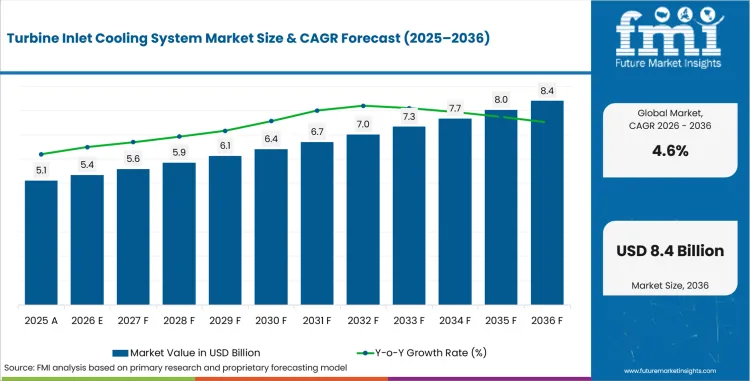
Key Takeaways, Market Size, and Forecast
- Turbine Inlet Cooling System Market Value (2026): USD 5.4 billion
- Turbine Inlet Cooling System Market Forecast Value (2036): USD 8.4 billion
- Turbine Inlet Cooling System Market Forecast CAGR (2026 TO 2036): 4.6%
- Turbine Inlet Cooling System Market Leading Product Type Segment: Fogging System (45.0%)
- Turbine Inlet Cooling System Market Key Growth Regions: Saudi Arabia, India, China, Brazil, UK, USA
- Turbine Inlet Cooling System Market Key Players: Stellar Energy, ARANER, Caldwell Energy, Camfil, Johnson Controls, Mee Industries, Mitsubishi Heavy Industries
| Parameter | Details |
|---|---|
| Market Size in 2026 (Value) | USD 5.4 Bn |
| Market Forecast in 2036 (Value) | USD 8.4 Bn |
| CAGR (2026 to 2036) | 4.6% |
| Years Considered | 2021 to 2036 |
| Base Year | 2025 |
| Forecast Period | 2026 to 2036 |
| Units Considered | Value (USD Bn) |
| Leading Sub-Region | Saudi Arabia |
Summary of the Turbine Inlet Cooling System Market
- Demand and Growth Drivers
- Rising ambient temperatures in power generation regions are reducing gas turbine output efficiency, creating demand for inlet cooling systems that restore rated power capacity during peak demand periods.
- Growing installed base of gas turbine power plants across the Middle East, South Asia, and tropical regions is expanding the addressable market for turbine inlet cooling retrofit and new-build installations.
- Peak power demand pricing incentives create economic justification for inlet cooling investment, as restored megawatt capacity during high-temperature periods generates incremental revenue for plant operators.
- Product and Segment View
- Fogging systems account for 45.0% of product type share, reflecting lower capital costs and simpler installation compared to chiller systems, making them preferred for mid-capacity power plants.
- Commercial power plants hold 62.0% of application share, as utility-scale gas turbine facilities represent the primary deployment setting for inlet cooling technology.
- The 200 to 500 MW capacity range accounts for 55.0% share, reflecting the concentration of gas turbine installations in mid-range power generation facilities.
- Geography and Competitive Outlook
- Saudi Arabia leads at 6.1% CAGR, reflecting extreme ambient temperature conditions that create the largest power output losses and strongest economic case for turbine inlet cooling investment.
- The Middle East and South Asia represent the highest growth regions, where high ambient temperatures and growing electricity demand create sustained need for turbine performance optimization.
- Companies with proven fogging and chiller system technology and established utility customer relationships are positioned to serve growing retrofit and new-build demand.
- Analyst Opinion
- Nikhil Kaitwade, Principal Consultant at FMI says, 'Technology providers that can deliver reliable inlet cooling performance with minimal water consumption are likely to gain preference from power plant operators in water-scarce regions over the forecast period.'
- The turbine inlet cooling system market is sustained by the physical relationship between ambient temperature and gas turbine output, which creates a permanent performance gap in hot climate regions.
- Adoption is increasing due to rising peak electricity demand that makes incremental turbine capacity restoration economically valuable during high-price demand periods.
- Demand is supported by the growing installed base of gas turbine power plants in tropical and arid climate zones where cooling systems deliver the greatest performance benefit.
- Growth is attributable to power grid reliability requirements that incentivize maximum available capacity during peak demand periods when ambient temperatures reduce turbine output.
What is a turbine inlet cooling system and what does the market cover?
Equipment and engineering solutions that cool gas-turbine inlet air to raise power output and efficiency
The turbine inlet cooling system market encompasses equipment and engineering solutions that cool the inlet air entering gas turbines to improve power output and thermal efficiency. Products include fogging systems, evaporative cooling systems, chiller systems, and thermal energy storage (TES) systems deployed at commercial and captive power plants as integrated or standalone cooling configurations.
What is included in the turbine inlet cooling system market scope?
Fogging systems, evaporative cooling systems, chiller systems and thermal energy storage (TES) systems, 2026 to 2036.
Market scope covers all commercially traded turbine inlet cooling systems categorized by product type (fogging system, evaporative cooling system, chiller system, thermal energy storage system), capacity (up to 200 MW, 200 to 500 MW, 500 to 800 MW, above 800 MW), application (commercial power plant, captive power plants), end user (utility power companies, independent power producers, industrial sector), and cooling technology integration (integrated power plant cooling, standalone cooling systems, hybrid cooling configurations). Revenue is tracked from 2026 to 2036.
What is excluded from the turbine inlet cooling system market scope?
Gas turbine equipment, steam turbine condenser cooling, building HVAC, and cooling tower equipment
The scope does not include gas turbine equipment itself, steam turbine condenser cooling systems, HVAC systems for power plant buildings, or cooling tower equipment used for combined cycle heat rejection.
How was the turbine inlet cooling system market research conducted?
Primary interviews, desk research, bottom-up sizing, and quarterly validation
- Primary Research: FMI analysts conducted interviews with power plant operators, gas turbine OEM engineers, inlet cooling system manufacturers, and utility procurement managers across key markets.
- Desk Research: Combined data from power generation capacity databases, climate temperature records, and manufacturer revenue disclosures.
- Market Sizing and Forecasting: Bottom-up aggregation of system installations across product types, capacity ranges, and geographic markets with climate-driven demand projections.
- Data Validation: Cross-validated quarterly against power plant capital expenditure tracking, turbine installation databases, and cooling system manufacturer shipment records.
Why is the turbine inlet cooling system market growing?
Rising ambient temperatures and power demand driving gas-turbine inlet-cooling adoption
- Increased ambient temperatures in major power generation regions have resulted in a 0.5 to 0.7% reduction in gas turbine output per degree Celsius above ISO conditions, and this performance gap can be quantified and mitigated by inlet cooling systems.
- The increasing demand for electricity in Middle East, South Asia and tropical regions is creating a concurrent demand for inlet cooling technology to be used in gas turbine power plants.
- Saudi Arabia is leading the charge with 6.1% CAGR, driven by extreme ambient temperatures above 45 degrees Celsius, which carry the highest penalties for turbine output and the strongest economic rationale for investment in cooling.
The thermodynamic relationship between air temperature and gas turbine performance governs the turbine inlet cooling demand. Gas turbine power output and heat rate are significantly affected when ambient temperature exceeds the ISO standard of 15 degrees Celsius. Turbine output can fall by 15-25% of rated capacity in areas where summer temperatures often exceed 40 degrees Celsius, creating a large shortfall in generation during peak electricity demand periods. The product type share of fogging systems is 45.0% and provides an economical means to introduce fine water droplets into the turbine inlet to cool air by evaporation.
Commercial power plants enjoy a share of 62.0% in application, as a result of the installation of inlet cooling in utility-scale gas turbine plants to maximize the available generation capacity in the period of high demand. The 200 to 500 MW capacity range accounts for 55.0% of demand. This is in line with the concentration of gas turbine installations in the mid-range capacity segment for both simple-cycle peaking units and combined-cycle baseload facilities. Integrated power plant cooling has 51.0% share of technology integration share, with inlet cooling becoming a standard design feature in new build facilities.
Regional demand depends on climate and the state of power generation infrastructure. The Middle East and South Asia are the strongest markets for the inlet cooling technology as they have the highest ambient temperatures and the fastest growth in electricity demand. The main demand centers for inlet cooling are Saudi Arabia, UAE, India and Iraq where extreme heat conditions make it economically essential. Demand in North America and Europe is primarily driven by retrofit installations at existing gas turbine plants and new build combined-cycle facilities.
How is the turbine inlet cooling system market segmented?
By product type, capacity, application, end user and cooling technology integration
- Fogging systems lead the product type at 45.0% as they provide lower capital cost and easier installation for mid-capacity gas turbine plants requiring inlet air temperature reduction.
- Commercial power plants have a 62.0% share of the application, with utility-scale gas turbine facilities being the primary market for inlet cooling technology deployment.
- Technology integration share is 51.0%. Integrated power plant cooling is increasingly being specified as a standard design component for new-build facilities.
Why do fogging systems lead the turbine inlet cooling system market?
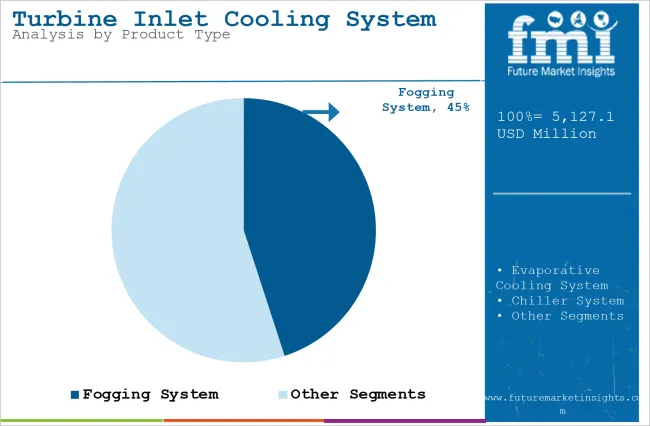
They hold 45.0% share, led by evaporative fogging with fine demineralized-water droplets
Fogging systems will account for 45.0% of product type share in 2026. These systems spray demineralized water in fine droplets (usually 10 to 20 microns) into the inlet duct of the gas turbine where evaporation of droplets removes heat and cools the incoming air stream. This results in increased density of the air entering the compressor. This brings the turbine power output back to rated conditions.
Fogging systems are more economical than mechanical chiller alternatives and provide an economical choice for a wide range of gas turbine installations. The water use is moderate, as evaporative cooling requires water in proportion to the cooling load. In dry regions where water availability is a limiting factor, fogging systems are sometimes combined with water recovery or condensate reuse systems to reduce net water consumption.
How big is the commercial power plant segment in the turbine inlet cooling system market?
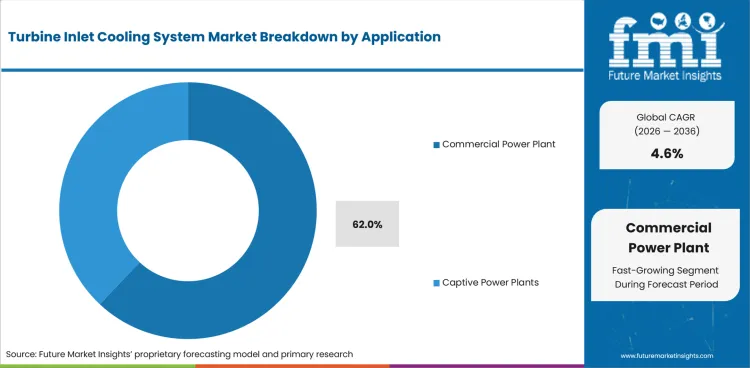
About 62.0% share, led by power-output gains at commercial generation plants
Power plants (commercial) Power plants (commercial) 62.0% of application share (2026) Inlet cooling is utilized in utility scale gas turbine facilities to maximize available generation capacity during peak demand periods when electricity prices are at their highest. The investment in the cooling system has an economic return that is directly proportional to the incremental revenue generated by the restored megawatt capacity during high temperature and high price periods.
A second application segment is that of captive power plants for industrial facilities where a reliable power supply, at rated capacity, supports manufacturing operations that are sensitive to power availability. Petrochemical, metals and cement industrial facilities use captive gas turbines with inlet cooling to support process power reliability at extreme temperatures.
What drives and restrains the turbine inlet cooling system market?
Driven by hot-climate power generation needs; restrained by water-consumption and availability constraints
\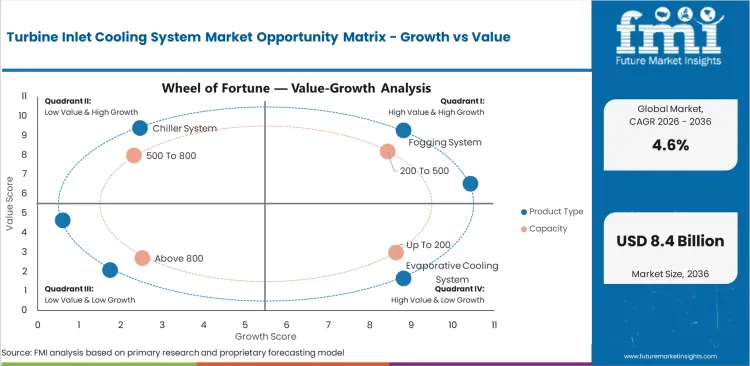
- Hot-climate power generation regions have a permanent and growing need for inlet cooling technology due to climate-driven turbine performance degradation.
- Water consumption needs and availability constraints in arid regions impose restrictions on the options for cooling system deployment and considerations on operational costs.
- Increasing installed base of gas turbines in tropical and Middle Eastern regions is driving retrofit and new-build demand for inlet cooling technology.
Climate-driven performance requirements, an increase in power demand, and growth in the installed base of gas turbines are driving the turbine inlet cooling system market. Constraints: Water availability and timing of capital investments Opportunities: Growth through retrofit opportunities and growth in power generation in emerging markets.
What drives demand?
The thermodynamic loss of turbine output as ambient temperature rises
Demand is driven by the irreversible thermodynamic relationship between ambient temperature and gas turbine output. The overall performance gap that can be addressed with inlet cooling technology grows structurally as global temperatures trend higher and power generation increases in hot-climate regions, providing long-term demand support.
What constrains evaporative and fogging systems?
Limited water availability and cost in many deployment regions
Water availability and cost are limiting factors for the use of evaporative and fogging cooling systems in arid regions. In Saudi Arabia, UAE and other Middle Eastern markets, water supply options like desalinated water, treated wastewater and condensate recovery have to be carefully evaluated to support the operation of cooling systems.
What opportunity does retrofit create?
A large installed base of gas turbines without inlet cooling systems
This growth is due to a large installed base of gas turbines without inlet cooling systems that would benefit from retrofit installation. Inlet cooling retrofit provides an attractive option for power plant operators contemplating options for capacity increase, as it can produce significant output gains at a lower cost than additional generation capacity.
How do market economics favor adoption?
Peak-demand pricing giving the strongest return on inlet-cooling investment
Markets with peak-demand pricing mechanisms provide the strongest economic incentives to invest in inlet cooling, since the ability to restore turbine capacity during periods of high temperature creates premium electricity revenue that exceeds the cost of a cooling system.
Analysis of Turbine Inlet Cooling System Market By Key Countries
Which countries are growing fastest in the turbine inlet cooling system market?
Saudi Arabia 6.1%, India 5.8%, China 5.5%, Brazil 4.8%, UK 3.9% through 2036
.webp "Top Country Growth Comparison Turbine Inlet Cooling System Market Cagr (2026 2036)")
| Country | CAGR |
|---|---|
| Saudi Arabia | 6.1% |
| India | 5.8% |
| China | 5.5% |
| Brazil | 4.8% |
| UK | 3.9% |
| USA | 3.8% |
| Germany | 3.5% |
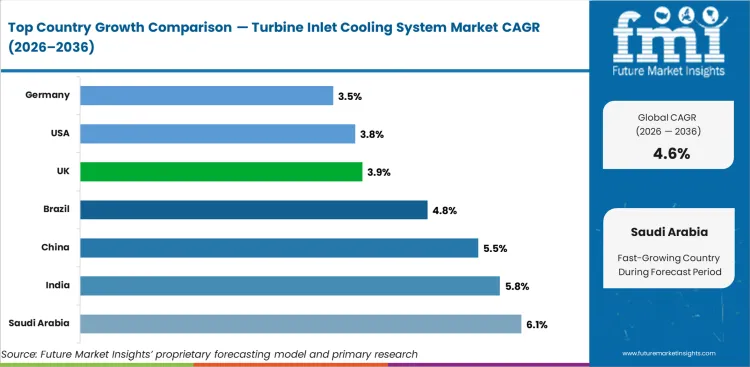
- Saudi Arabia leads at 6.1% CAGR, reflecting strong investment driving demand.
- India follows at 5.8%, supported by expanding market penetration.
- China (5.5%) and Brazil (4.8%) sustain growth through established demand.
The global turbine inlet cooling system market is estimated to grow at 4.6% CAGR from 2026 to 2036. The study covers more than 30 countries, and the key markets are listed below.
How fast is the turbine inlet cooling system market growing in Saudi Arabia?
6.1% CAGR through 2036, the fastest country-level market in the study
Saudi Arabia leads at 6.1% CAGR through 2036. Extreme ambient temperatures exceeding 45 degrees Celsius create the strongest economic case for turbine inlet cooling across the power generation fleet.
- Vision 2030 power sector development includes gas turbine capacity expansion where inlet cooling is specified as standard equipment for new-build facilities.
- IKTVA local content requirements are encouraging domestic assembly and service capability development for turbine inlet cooling equipment.
- Desalinated water availability at coastal power generation facilities supports fogging and evaporative cooling system operation despite the arid climate.
What is the turbine inlet cooling system market outlook in India?
5.8% CAGR, driven by Growing gas turbine power
India is projected to register 5.8% CAGR through 2036. Growing gas turbine power generation capacity and high ambient temperatures across most of the country sustain demand for inlet cooling technology.
- State electricity boards and independent power producers are evaluating inlet cooling retrofits to maximize generation output during summer peak demand periods.
- National power sector expansion includes new gas turbine installations where inlet cooling can be incorporated during facility design and construction.
- Climate conditions across most Indian states create year-round economic justification for inlet cooling that extends beyond seasonal peak demand periods.
What is driving turbine inlet cooling system growth in China?
5.5% CAGR, driven by Gas turbine capacity expansion and growing peak cooling demand in southern provinces
China is projected to register 5.5% CAGR through 2036. Gas turbine capacity expansion and growing peak cooling demand in southern provinces are driving inlet cooling adoption.
- Gas turbine power plant construction in southern provinces with high ambient temperatures creates demand for integrated inlet cooling systems at new-build facilities.
- Peak electricity demand during summer months in tropical and subtropical regions creates economic justification for cooling technology that restores generation capacity.
- Domestic engineering companies are developing inlet cooling system products that compete with international providers on price and local service capability.
How is the turbine inlet cooling system market performing in Brazil?
4.8% CAGR, driven by Thermal power
Brazil is projected to register 4.8% CAGR through 2036. Thermal power generation expansion and tropical climate conditions support growing demand for turbine inlet cooling technology.
- Thermal power plant investment to supplement hydroelectric generation creates new gas turbine installations in climate conditions that benefit from inlet cooling.
- Tropical temperatures across most Brazilian states reduce gas turbine output year-round, creating consistent economic value for inlet cooling system deployment.
- National infrastructure programs supporting power generation reliability include technology investment that encompasses turbine performance optimization.
What is the turbine inlet cooling system market forecast for the United States?
3.8% CAGR, driven by Gas turbine fleet modernization, Gulf Coast climate conditions, and peak demand pricing
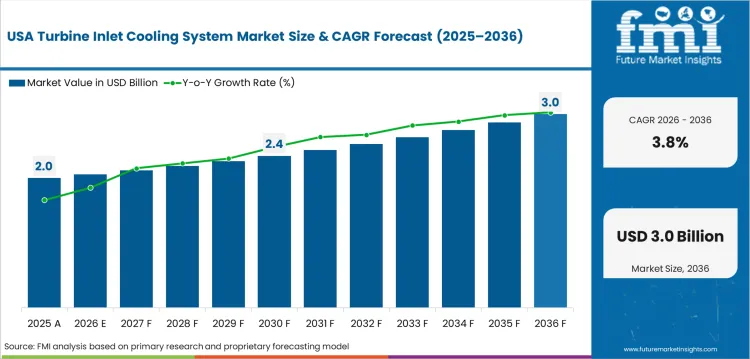
The United States is projected to register 3.8% CAGR through 2036. Gas turbine fleet modernization, Gulf Coast climate conditions, and peak demand pricing sustain retrofit and new-build demand.
- Gulf Coast and southwestern states experience ambient temperatures that create significant turbine output penalties during summer peak demand periods.
- Power market capacity pricing mechanisms create economic incentives for inlet cooling investment that restores maximum available generation during high-demand events.
- Retrofit installations at existing gas turbine facilities provide capacity enhancement at lower cost than new generation construction.
What is the growth outlook for the turbine inlet cooling system market in the United Kingdom?
3.9% CAGR, driven by Gas turbine fleet operation
The United Kingdom is projected to register 3.9% CAGR through 2036. Gas turbine fleet operation and increasing summer temperature variability support targeted inlet cooling adoption.
- Rising summer peak temperatures in the UK are creating emerging demand for inlet cooling at gas turbine facilities that previously operated within acceptable ambient temperature ranges.
- Combined cycle power plant operators are evaluating inlet cooling as a capacity enhancement option during increasingly frequent high-temperature periods.
- Great British Energy program investment in power generation reliability supports technology adoption that maximizes available capacity across the generation fleet.
Who are the leading companies in the turbine inlet cooling system market?
Stellar Energy, ARANER, Caldwell Energy, Camfil, and Johnson Controls
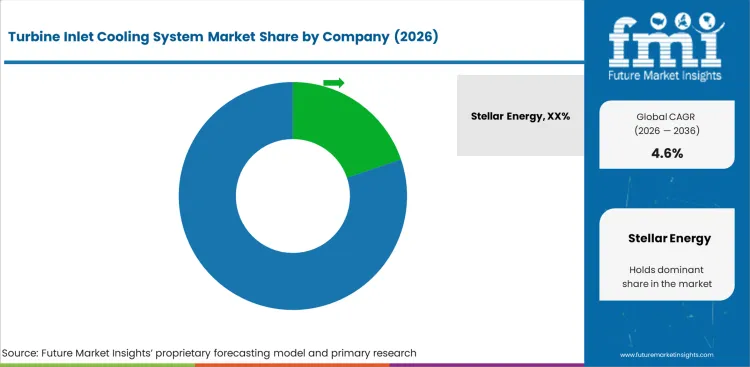
- Stellar Energy and ARANER are leaders in the design and engineering of specialized turbine inlet cooling systems with extensive installation experience in Middle East and global power generation markets.
- Johnson Controls and Mitsubishi Heavy Industries offer broad global distribution of cooling technology platforms to power generation and industrial applications.
- Mee Industries has extensive experience installing gas turbine inlet cooling systems in a wide range of climate conditions and has become a leader in fogging system technology.
- Regional players like Caldwell Energy and TAS Turbine Inlet Chilling, with specialized cooling system engineering and project delivery, targeted geographic markets.
Who are the key players in the turbine inlet cooling system market?
Stellar Energy, ARANER, Caldwell Energy, Camfil and Johnson Controls, plus regional players
Key global companies leading the turbine inlet cooling system market include:
- Stellar Energy (USA), ARANER (Spain), Johnson Controls (Ireland), and Mitsubishi Heavy Industries (Japan) lead global turbine inlet cooling system markets through specialized engineering capability, extensive project installation experience, and established power generation customer relationships across diverse climate regions.
- Caldwell Energy (USA), Camfil (Sweden), and Mee Industries (USA) hold strong positions through specialized fogging system technology, air treatment expertise, and targeted market segment penetration in gas turbine power generation.
- PowerServ (USA), TAS Turbine Inlet Chilling (USA), and UTC Technologies (USA) are expanding turbine inlet cooling capabilities through specialized engineering services and regional project delivery for power plant retrofit and new-build applications.
How do top turbine inlet cooling system companies compare?
Stellar Energy and ARANER lead globally; Caldwell Energy, Camfil and Johnson Controls are regional specialists
| Company | Cooling Technology Portfolio | Power Plant Engineering Capability | Utility Customer Access | Geographic Footprint |
|---|---|---|---|---|
| Stellar Energy | High | High | Strong | Global |
| ARANER | High | High | Strong | Middle East, Global |
| Johnson Controls | High | Medium | Strong | Global |
| Mitsubishi Heavy Industries | High | Medium | Strong | Asia, Global |
| Mee Industries | Medium | High | Moderate | N. America, Global |
| Caldwell Energy | Medium | Medium | Moderate | N. America |
| Camfil | Medium | Medium | Moderate | Europe, Global |
| PowerServ | Low | Medium | Low | N. America |
| TAS | Low | Medium | Low | N. America |
| UTC Technologies | Medium | Medium | Moderate | Global |
Source: Future Market Insights competitive analysis, 2026.
Key Developments in Turbine Inlet Cooling System Market
- In 2025, ARANER expanded deployment of its Turbine Inlet Air Cooling (TIAC) solutions, promoting chiller-based and thermal energy storage integrated systems to improve gas turbine output and efficiency in high-temperature power generation markets.
- In 2025, Caldwell Energy strengthened its turbine inlet cooling portfolio by advancing deployment of PowerChill® chiller-based cooling, PowerFog® evaporative cooling, and thermal energy storage solutions for both new and retrofit gas turbine installations.
Key Players in the Turbine Inlet Cooling System Market
Major Global Players
- Stellar Energy
- ARANER
- Caldwell Energy
- Camfil
- Johnson Controls
- Mee Industries
- Mitsubishi Heavy Industries
- PowerServ
Emerging Players/Startups
- TAS Turbine Inlet Chilling (TAS)
- Everest Sciences
- Cool Solutions Company
- Victory Turbine
- Andover Technology Partners
- Marlo Coil
- Score Energy
- Turbine Air Systems (TAS Energy)
What does the turbine inlet cooling system market report cover?
Turbine Inlet Cooling System Market - Research Methodology
| Method | Description |
|---|---|
| Primary Research | FMI analysts conducted interviews with manufacturers, distributors, procurement specialists, and end-use operators across Saudi Arabia, India, and China to validate demand patterns and pricing structures for Fogging System, and Evaporative Cooling System and related product categories. |
| Desk Research | Combined trade statistics, regulatory filings, industry association data, and manufacturer disclosures to establish baseline parameters for Turbine Inlet Cooling System across product, capacity, application, end user, and cooling technology integration segments. |
| Market Sizing & Forecasting | Bottom-up aggregation across Fogging System, Evaporative Cooling System, and Chiller System product categories and 200 To 500, Up To 200, and 500 To 800 capacity segments, triangulated with top-down macro indicators and regional adoption curves. |
| Data Validation | Cross-checked quarterly against production statistics, trade flow data, and manufacturer revenue disclosures for Turbine Inlet Cooling System products. |
2016 to 2025 history and 2026 to 2036 forecasts across all segments and 30+ countries
| Parameter | Details |
|---|---|
| Market size by 2036 | USD 8.4 Billion |
| Growth rate | 4.6% CAGR (2026 to 2036) |
| Forecast period | 2026 to 2036 |
| Base year value (2025) | USD 5.1 Billion |
| Key Segment Covered | Product Type, Capacity, Application, End User, Cooling Technology Integration |
| Regions covered | North America, Latin America, Eastern Europe, Western Europe, East Asia, South Asia and Pacific, Middle East and Africa |
| Countries covered | USA, Saudi Arabia, India, China, Brazil, UK, Germany, 30 plus countries |
| Key companies profiled | Stellar Energy, ARANER, Caldwell Energy, Camfil, Johnson Controls, Mee Industries, Mitsubishi Heavy Industries, PowerServ, TAS Turbine Inlet Chilling, UTC Technologies |
| Approach | Hybrid bottom-up and top-down methodology starting with verified transaction data, projecting adoption velocity across segments and regions. |
Market Segmentation Analysis
Turbine Inlet Cooling System Market Segmented by Product Type:
- Fogging System
- High Pressure Fogging
- Fine Water Droplet Injection
- Rapid Air Temperature Reduction
- Low Pressure Fogging
- Cost Effective Cooling Solution
- Enhanced Turbine Performance
- High Pressure Fogging
- Evaporative Cooling System
- Direct Evaporative Cooling
- Water Based Air Cooling
- Low Energy Consumption System
- Indirect Evaporative Cooling
- Heat Exchanger Based Cooling
- Improved Efficiency Output
- Direct Evaporative Cooling
- Chiller System
- Mechanical Chiller Systems
- High Cooling Precision
- Stable Temperature Control
- Absorption Chiller Systems
- Waste Heat Utilization
- Energy Efficient Cooling
- Mechanical Chiller Systems
- Thermal Energy Storage (TES) System
- Ice Storage Systems
- Peak Load Management
- Off Peak Energy Utilization
- Chilled Water Storage
- Grid Load Balancing
- Operational Cost Reduction
- Ice Storage Systems
- Combined Cooling Systems
- Hybrid Evaporative And Chiller Systems
- Optimized Cooling Efficiency
- Flexible Operation Modes
- Multi Stage Cooling Systems
- Enhanced Power Output Stability
- Integrated Energy Management
- Hybrid Evaporative And Chiller Systems
- Other
Turbine Inlet Cooling System Market Segmented by Capacity:
- 200 To 500
- Medium Capacity Plants
- Balanced Cooling Performance
- Standard Power Generation Units
- Regional Power Stations
- Moderate Load Handling
- Operational Flexibility
- Medium Capacity Plants
- Up To 200
- Small Scale Power Units
- Auxiliary Cooling Applications
- Compact Installation Design
- Industrial Small Turbines
- Low Output Power Plants
- Cost Efficient Cooling
- Small Scale Power Units
- 500 To 800
- Large Scale Power Plants
- High Efficiency Cooling Demand
- Enhanced Turbine Output
- Utility Scale Plants
- Stable Grid Support Systems
- Advanced Cooling Integration
- Large Scale Power Plants
- Above 800
- Mega Power Generation Plants
- High Performance Cooling Systems
- Maximum Power Efficiency
- Combined Cycle Power Plants
- Large Scale Energy Production
- Advanced Thermal Management
- Mega Power Generation Plants
Turbine Inlet Cooling System Market Segmented by Application:
- Commercial Power Plant
- Utility Power Generation
- Grid Connected Energy Production
- High Efficiency Turbine Cooling
- Independent Power Producers
- Peak Load Power Support
- Continuous Energy Supply
- Utility Power Generation
- Captive Power Plants
- Industrial Captive Units
- On Site Power Generation
- Reduced Grid Dependency
- Manufacturing Facility Power Systems
- Dedicated Energy Supply
- Operational Cost Optimization
- Industrial Captive Units
Turbine Inlet Cooling System Market Segmented by End User:
- Utility Power Companies
- National Grid Operators
- Large Scale Electricity Generation
- Grid Stability Management
- Regional Power Utilities
- Distributed Power Supply Systems
- Peak Demand Handling
- National Grid Operators
- Independent Power Producers (IPP)
- Private Power Generation Firms
- Merchant Power Plants
- Competitive Energy Supply
- Renewable Hybrid IPPs
- Integrated Cooling Optimization
- Efficiency Driven Power Output
- Private Power Generation Firms
- Industrial Sector
- Oil And Gas Facilities
- On Site Power Generation
- High Temperature Process Cooling
- Chemical And Petrochemical Plants
- Continuous Operation Support
- Energy Intensive Manufacturing Units
- Oil And Gas Facilities
Turbine Inlet Cooling System Market Segmented by Cooling Technology Integration:
- Integrated Power Plant Cooling
- Power Block Integrated Systems
- Combined Cycle Optimization
- Plant Wide Thermal Management
- Process Coupled Cooling
- Waste Heat Utilization
- Improved Efficiency Output
- Power Block Integrated Systems
- Standalone Cooling Systems
- Independent Cooling Units
- Dedicated Turbine Cooling Setup
- Simplified Maintenance Design
- Basic Evaporative Systems
- Low Capital Investment
- Quick Installation Solutions
- Independent Cooling Units
- Hybrid Cooling Configurations
- Multi Technology Integration
- Evaporative Plus Chiller Systems
- Enhanced Performance Stability
- Smart Controlled Cooling Systems
- AI Based Thermal Regulation
- Real Time Efficiency Adjustment
- Multi Technology Integration
Turbine Inlet Cooling System Market by Region:
- North America
- USA
- Canada
- Mexico
- Latin America
- Brazil
- Chile
- Rest of Latin America
- Western Europe
- Germany
- UK
- Italy
- Spain
- France
- Nordic
- BENELUX
- Rest of Western Europe
- Eastern Europe
- Russia
- Poland
- Hungary
- Balkan & Baltic
- Rest of Eastern Europe
- East Asia
- China
- Japan
- South Korea
- South Asia and Pacific
- India
- ASEAN
- Australia & New Zealand
- Rest of South Asia and Pacific
- Middle East & Africa
- Kingdom of Saudi Arabia
- Other GCC Countries
- Türkiye
- South Africa
- Other African Union
- Rest of Middle East & Africa
Research Sources and Bibliography
- International Energy Agency. (2025). IEA World Energy Outlook: Gas Turbine Power Generation. IEA.
- USA Department of Energy. (2025). DOE Gas Turbine Performance and Efficiency Report. DOE.
- International Organization for Standardization. (2025). ISO 2314: Gas Turbines Performance Testing. ISO.
- Gas Turbine Association. (2025). GTA Annual Performance and Capacity Report. GTA.
- World Meteorological Organization. (2025). WMO Global Temperature Trends Report. WMO.
This bibliography is provided for reader reference.
This Report Answers
- Estimating the size of the turbine inlet cooling system market and projected revenue from 2026 to 2036.
- Segmentation by product type, capacity, application, end user, cooling technology integration.
- Insights about more than 30 regional markets.
- Analysis of key market dynamics including demand drivers, restraints, and emerging opportunities.
- Assessment of the competitive landscape and strategic positioning of leading companies.
- Identifying investment opportunities across key product segments and geographic markets.
- Supply chain and distribution channel analysis.
- Delivery of data in PDF and Excel formats.
Frequently Asked Questions
How big is the turbine inlet cooling system market in 2026?
The global turbine inlet cooling system market is estimated to be valued at USD 5.4 billion in 2026.
What will be the size of the turbine inlet cooling system market in 2036?
The market size for the turbine inlet cooling system market is projected to reach USD 8.4 billion by 2036.
How much will the turbine inlet cooling system market growth be between 2026 and 2036?
The turbine inlet cooling system market is expected to grow at a 4.6% CAGR between 2026 and 2036.
What are the key product types in the turbine inlet cooling system market?
The key product types in the turbine inlet cooling system market are Fogging System, Evaporative Cooling System, Chiller System, Thermal Energy Storage (TES) System, Combined Cooling Systems and Other.
Which capacity segment is expected to contribute a significant share in the turbine inlet cooling system market in 2026?
In terms of capacity, the 200 to 500 segment is expected to command 55.0% share in the turbine inlet cooling system market in 2026.
Preview the report firsthand - request a free sample
Get SampleGet the brochure for pricing and purchase details.
Get PDFTable of Content
- Key Takeaways
- Market Size and CAGR
- Top Growth Driver
- Fastest Growing Segment
- Leading Region
- Key Companies
- Emerging Opportunities
- Executive Summary
- Global Market Outlook
- Demand-side Trends
- Supply-side Trends
- Technology Roadmap Analysis
- Analysis and Recommendations
- Analyst Perspective (What is happening? Why now? What should investors know?)
- Key Questions Answered
- How large is the market?
- What is the CAGR?
- What are key trends?
- Which region dominates?
- Who are the leaders?
- Market Overview
- Market Coverage / Taxonomy
- Market Definition / Scope / Limitations
- Research Methodology
- Chapter Orientation
- Analytical Lens and Working Hypotheses
- Market Structure, Signals, and Trend Drivers
- Benchmarking and Cross-market Comparability
- Market Sizing, Forecasting, and Opportunity Mapping
- Research Design and Evidence Framework
- Desk Research Programme (Secondary Evidence)
- Expert Input and Fieldwork (Primary Evidence)
- Tooling, Models, and Reference Databases
- Data Engineering and Model Build
- Quality Assurance and Audit Trail
- Market Background
- Market Dynamics (Drivers, Restraints, Opportunity, Trends)
- Scenario Forecast (Optimistic, Likely, Conservative)
- Impact Analysis
- AI Impact
- Sustainability Impact
- Regulatory Impact
- Technology Impact
- Consumer / Buyer Analysis
- Purchase Drivers
- Adoption Barriers
- Buyer Journey
- Opportunity Map Analysis
- Product Life Cycle Analysis
- Supply Chain Analysis
- Investment Feasibility Matrix
- Value Chain Analysis
- PESTLE and Porter's Analysis
- Regulatory Landscape
- Regional Parent Market Outlook
- Production and Consumption Statistics
- Import and Export Statistics
- Global Market Analysis and Forecast, 2021 to 2036
- Historical Market Size Value (USD Million) Analysis, 2021 to 2025
- Current and Future Market Size Value (USD Million) Projections, 2026 to 2036
- Y-o-Y Growth Trend Analysis
- Absolute $ Opportunity Analysis
- Global Market Pricing Analysis, 2021 to 2036
- Global Market Analysis and Forecast, By Product Type, 2021 to 2036
- Introduction / Key Findings
- Historical Market Size Value (USD Million) Analysis By Product Type, 2021 to 2025
- Current and Future Market Size Value (USD Million) Analysis and Forecast By Product Type, 2026 to 2036
- Fogging System
- High Pressure Fogging
- Low Pressure Fogging
- Evaporative Cooling System
- Direct Evaporative Cooling
- Indirect Evaporative Cooling
- Chiller System
- Mechanical Chiller Systems
- Absorption Chiller Systems
- Thermal Energy Storage (TES) System
- Ice Storage Systems
- Chilled Water Storage
- Combined Cooling Systems
- Hybrid Evaporative And Chiller Systems
- Multi Stage Cooling Systems
- Other
- Fogging System
- Y-o-Y Growth Trend Analysis By Product Type, 2021 to 2025
- Absolute $ Opportunity Analysis By Product Type, 2026 to 2036
- Global Market Analysis and Forecast, By Capacity, 2021 to 2036
- Introduction / Key Findings
- Historical Market Size Value (USD Million) Analysis By Capacity, 2021 to 2025
- Current and Future Market Size Value (USD Million) Analysis and Forecast By Capacity, 2026 to 2036
- 200 To 500
- Medium Capacity Plants
- Regional Power Stations
- Up To 200
- Small Scale Power Value (USD Million)s
- Industrial Small Turbines
- 500 To 800
- Large Scale Power Plants
- Utility Scale Plants
- Above 800
- Mega Power Generation Plants
- Combined Cycle Power Plants
- 200 To 500
- Y-o-Y Growth Trend Analysis By Capacity, 2021 to 2025
- Absolute $ Opportunity Analysis By Capacity, 2026 to 2036
- Global Market Analysis and Forecast, By Application, 2021 to 2036
- Introduction / Key Findings
- Historical Market Size Value (USD Million) Analysis By Application, 2021 to 2025
- Current and Future Market Size Value (USD Million) Analysis and Forecast By Application, 2026 to 2036
- Commercial Power Plant
- Utility Power Generation
- Independent Power Producers
- Captive Power Plants
- Industrial Captive Value (USD Million)s
- Manufacturing Facility Power Systems
- Commercial Power Plant
- Y-o-Y Growth Trend Analysis By Application, 2021 to 2025
- Absolute $ Opportunity Analysis By Application, 2026 to 2036
- Global Market Analysis and Forecast, By End User, 2021 to 2036
- Introduction / Key Findings
- Historical Market Size Value (USD Million) Analysis By End User, 2021 to 2025
- Current and Future Market Size Value (USD Million) Analysis and Forecast By End User, 2026 to 2036
- Utility Power Companies
- National Grid Operators
- Regional Power Utilities
- Independent Power Producers (IPP)
- Private Power Generation Firms
- Renewable Hybrid IPPs
- Industrial Sector
- Oil And Gas Facilities
- Chemical And Petrochemical Plants
- Utility Power Companies
- Y-o-Y Growth Trend Analysis By End User, 2021 to 2025
- Absolute $ Opportunity Analysis By End User, 2026 to 2036
- Global Market Analysis and Forecast, By Cooling Technology Integration, 2021 to 2036
- Introduction / Key Findings
- Historical Market Size Value (USD Million) Analysis By Cooling Technology Integration, 2021 to 2025
- Current and Future Market Size Value (USD Million) Analysis and Forecast By Cooling Technology Integration, 2026 to 2036
- Integrated Power Plant Cooling
- Power Block Integrated Systems
- Process Coupled Cooling
- Standalone Cooling Systems
- Independent Cooling Value (USD Million)s
- Basic Evaporative Systems
- Hybrid Cooling Configurations
- Multi Technology Integration
- Smart Controlled Cooling Systems
- Integrated Power Plant Cooling
- Y-o-Y Growth Trend Analysis By Cooling Technology Integration, 2021 to 2025
- Absolute $ Opportunity Analysis By Cooling Technology Integration, 2026 to 2036
- Global Market Analysis and Forecast, By Region, 2021 to 2036
- Introduction
- Historical Market Size Value (USD Million) Analysis By Region, 2021 to 2025
- Current Market Size Value (USD Million) Analysis and Forecast By Region, 2026 to 2036
- North America
- Latin America
- Western Europe
- Eastern Europe
- East Asia
- South Asia and Pacific
- Middle East & Africa
- Market Attractiveness Analysis By Region
- North America Market Analysis and Forecast, By Country, 2021 to 2036
- Historical Market Size Value (USD Million) Trend Analysis By Market Taxonomy, 2021 to 2025
- Market Size Value (USD Million) Forecast By Market Taxonomy, 2026 to 2036
- By Country
- USA
- Canada
- Mexico
- By Product Type
- By Capacity
- By Application
- By End User
- By Cooling Technology Integration
- By Country
- Market Attractiveness Analysis
- By Country
- By Product Type
- By Capacity
- By Application
- By End User
- By Cooling Technology Integration
- Key Takeaways
- Latin America Market Analysis and Forecast, By Country
- Historical Market Size Value (USD Million) Trend Analysis By Market Taxonomy, 2021 to 2025
- Market Size Value (USD Million) Forecast By Market Taxonomy, 2026 to 2036
- By Country
- Brazil
- Chile
- Rest of Latin America
- By Product Type
- By Capacity
- By Application
- By End User
- By Cooling Technology Integration
- By Country
- Market Attractiveness Analysis
- By Country
- By Product Type
- By Capacity
- By Application
- By End User
- By Cooling Technology Integration
- Key Takeaways
- Western Europe Market Analysis and Forecast, By Country
- Historical Market Size Value (USD Million) Trend Analysis By Market Taxonomy, 2021 to 2025
- Market Size Value (USD Million) Forecast By Market Taxonomy, 2026 to 2036
- By Country
- Germany
- UK
- Italy
- Spain
- France
- Nordic
- BENELUX
- Rest of Western Europe
- By Product Type
- By Capacity
- By Application
- By End User
- By Cooling Technology Integration
- By Country
- Market Attractiveness Analysis
- By Country
- By Product Type
- By Capacity
- By Application
- By End User
- By Cooling Technology Integration
- Key Takeaways
- Eastern Europe Market Analysis and Forecast, By Country
- Historical Market Size Value (USD Million) Trend Analysis By Market Taxonomy, 2021 to 2025
- Market Size Value (USD Million) Forecast By Market Taxonomy, 2026 to 2036
- By Country
- Russia
- Poland
- Hungary
- Balkan & Baltic
- Rest of Eastern Europe
- By Product Type
- By Capacity
- By Application
- By End User
- By Cooling Technology Integration
- By Country
- Market Attractiveness Analysis
- By Country
- By Product Type
- By Capacity
- By Application
- By End User
- By Cooling Technology Integration
- Key Takeaways
- East Asia Market Analysis and Forecast, By Country
- Historical Market Size Value (USD Million) Trend Analysis By Market Taxonomy, 2021 to 2025
- Market Size Value (USD Million) Forecast By Market Taxonomy, 2026 to 2036
- By Country
- China
- Japan
- South Korea
- By Product Type
- By Capacity
- By Application
- By End User
- By Cooling Technology Integration
- By Country
- Market Attractiveness Analysis
- By Country
- By Product Type
- By Capacity
- By Application
- By End User
- By Cooling Technology Integration
- Key Takeaways
- South Asia and Pacific Market Analysis and Forecast, By Country
- Historical Market Size Value (USD Million) Trend Analysis By Market Taxonomy, 2021 to 2025
- Market Size Value (USD Million) Forecast By Market Taxonomy, 2026 to 2036
- By Country
- India
- ASEAN
- Australia & New Zealand
- Rest of South Asia and Pacific
- By Product Type
- By Capacity
- By Application
- By End User
- By Cooling Technology Integration
- By Country
- Market Attractiveness Analysis
- By Country
- By Product Type
- By Capacity
- By Application
- By End User
- By Cooling Technology Integration
- Key Takeaways
- Middle East & Africa Market Analysis and Forecast, By Country
- Historical Market Size Value (USD Million) Trend Analysis By Market Taxonomy, 2021 to 2025
- Market Size Value (USD Million) Forecast By Market Taxonomy, 2026 to 2036
- By Country
- Kingdom of Saudi Arabia
- Other GCC Countries
- Türkiye
- South Africa
- Other African Union
- Rest of Middle East & Africa
- By Product Type
- By Capacity
- By Application
- By End User
- By Cooling Technology Integration
- By Country
- Market Attractiveness Analysis
- By Country
- By Product Type
- By Capacity
- By Application
- By End User
- By Cooling Technology Integration
- Key Takeaways
- Key Countries Market Analysis
- USA
- Pricing Analysis
- Market Share Analysis, 2025
- By Product Type
- By Capacity
- By Application
- By End User
- By Cooling Technology Integration
- Canada
- Pricing Analysis
- Market Share Analysis, 2025
- By Product Type
- By Capacity
- By Application
- By End User
- By Cooling Technology Integration
- Mexico
- Pricing Analysis
- Market Share Analysis, 2025
- By Product Type
- By Capacity
- By Application
- By End User
- By Cooling Technology Integration
- Brazil
- Pricing Analysis
- Market Share Analysis, 2025
- By Product Type
- By Capacity
- By Application
- By End User
- By Cooling Technology Integration
- Chile
- Pricing Analysis
- Market Share Analysis, 2025
- By Product Type
- By Capacity
- By Application
- By End User
- By Cooling Technology Integration
- Germany
- Pricing Analysis
- Market Share Analysis, 2025
- By Product Type
- By Capacity
- By Application
- By End User
- By Cooling Technology Integration
- UK
- Pricing Analysis
- Market Share Analysis, 2025
- By Product Type
- By Capacity
- By Application
- By End User
- By Cooling Technology Integration
- Italy
- Pricing Analysis
- Market Share Analysis, 2025
- By Product Type
- By Capacity
- By Application
- By End User
- By Cooling Technology Integration
- Spain
- Pricing Analysis
- Market Share Analysis, 2025
- By Product Type
- By Capacity
- By Application
- By End User
- By Cooling Technology Integration
- France
- Pricing Analysis
- Market Share Analysis, 2025
- By Product Type
- By Capacity
- By Application
- By End User
- By Cooling Technology Integration
- India
- Pricing Analysis
- Market Share Analysis, 2025
- By Product Type
- By Capacity
- By Application
- By End User
- By Cooling Technology Integration
- ASEAN
- Pricing Analysis
- Market Share Analysis, 2025
- By Product Type
- By Capacity
- By Application
- By End User
- By Cooling Technology Integration
- Australia & New Zealand
- Pricing Analysis
- Market Share Analysis, 2025
- By Product Type
- By Capacity
- By Application
- By End User
- By Cooling Technology Integration
- China
- Pricing Analysis
- Market Share Analysis, 2025
- By Product Type
- By Capacity
- By Application
- By End User
- By Cooling Technology Integration
- Japan
- Pricing Analysis
- Market Share Analysis, 2025
- By Product Type
- By Capacity
- By Application
- By End User
- By Cooling Technology Integration
- South Korea
- Pricing Analysis
- Market Share Analysis, 2025
- By Product Type
- By Capacity
- By Application
- By End User
- By Cooling Technology Integration
- Russia
- Pricing Analysis
- Market Share Analysis, 2025
- By Product Type
- By Capacity
- By Application
- By End User
- By Cooling Technology Integration
- Poland
- Pricing Analysis
- Market Share Analysis, 2025
- By Product Type
- By Capacity
- By Application
- By End User
- By Cooling Technology Integration
- Hungary
- Pricing Analysis
- Market Share Analysis, 2025
- By Product Type
- By Capacity
- By Application
- By End User
- By Cooling Technology Integration
- Kingdom of Saudi Arabia
- Pricing Analysis
- Market Share Analysis, 2025
- By Product Type
- By Capacity
- By Application
- By End User
- By Cooling Technology Integration
- Türkiye
- Pricing Analysis
- Market Share Analysis, 2025
- By Product Type
- By Capacity
- By Application
- By End User
- By Cooling Technology Integration
- South Africa
- Pricing Analysis
- Market Share Analysis, 2025
- By Product Type
- By Capacity
- By Application
- By End User
- By Cooling Technology Integration
- USA
- Market Structure Analysis
- Competition Dashboard
- Competition Benchmarking
- Market Share Analysis of Top Players
- By Regional
- By Product Type
- By Capacity
- By Application
- By End User
- By Cooling Technology Integration
- Emerging Startups
- Innovation Benchmarking
- Competition Analysis
- Competition Deep Dive
- Stellar Energy
- Overview
- Product Portfolio
- Profitability by Market Segments (Product/Region/Sales Channel)
- Sales Footprint
- Strategy Overview
- Marketing Strategy
- Product Strategy
- Channel Strategy
- ARANER
- Caldwell Energy
- Camfil
- Johnson Controls
- Mee Industries
- Mitsubishi Heavy Industries
- PowerServ
- TAS Turbine Inlet Chilling
- UTC Technologies
- Stellar Energy
- Case Studies
- Success Stories
- Recent Developments
- Competition Deep Dive
- Assumptions & Acronyms Used


