

- Industry Size (2026)
- USD 89.2 Mn
- Forecast (2036)
- USD 248.6 Mn
- CAGR (2026 to 2036)
- 10.8%
Microturbines Market Forecast and Outlook 2026 to 2036
The microturbines market is projected to be valued at USD 89.2 million in 2026. The industry is predicted to record a value of USD 248.6 million by 2036 while advancing at a CAGR of 10.8% over the forecast period. Expansion is anchored by the global shift towards decentralized and resilient power generation.
These compact systems offer a flexible solution for on-site energy production, reducing grid dependency and transmission losses. Their ability to run on multiple fuel types, including natural gas, biogas, and hydrogen blends, positions them as a transitional technology in the energy landscape.
Quick Stats for Microturbines Market
- Microturbines Market Value (2026): USD 89.2 million
- Microturbines Market Forecast Value (2036): USD 248.6 million
- Microturbines Market Forecast CAGR: 10.8%
- Leading Power Rating in Microturbines Market: 50 kW-250 kW (28.5%)
- Leading Application in Microturbines Market: Combined Heat and Power (CHP) (65.0%)
- Leading End User in Microturbines Market: Industrial (37.2%)
- Key Growth Countries in Microturbines Market: USA, UK, India, China, Japan
- Key Players in Microturbines Market: Capstone Green Energy Corporation, AnsaldoEnergia S.p.A., FlexEnergy, Brayton Energy LLC
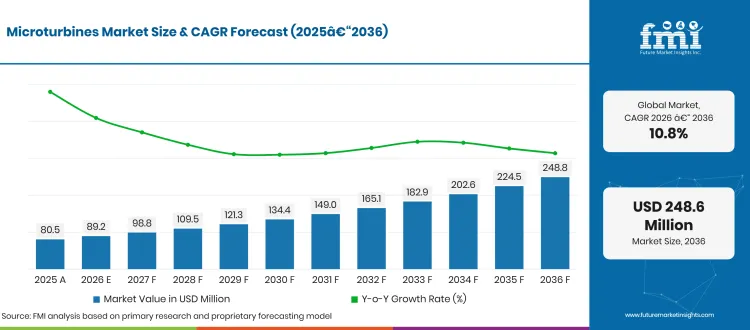
Demand dynamics are heavily influenced by the need for energy efficiency and carbon emission reductions. North American and European markets prioritize distributed energy systems for critical infrastructure and commercial facilities. The Asia Pacific region shows growing adoption driven by rapid industrialization and government policies supporting clean energy in China and India. The convergence of stringent environmental regulations, volatility in grid power prices, and incentives for cogeneration is compelling broader industry adoption.
Technological trends are coalescing around efficiency improvements and system integration. Innovations focus on advanced recuperators to enhance thermal efficiency and the development of hybrid systems that pair microturbines with renewable sources. Digital monitoring platforms for predictive maintenance are becoming standard. Market players are increasingly offering comprehensive energy-as-a-service models, bundling the technology with long-term maintenance and fuel supply agreements.
Microturbines Market Key Takeaways
| Metric | Value |
|---|---|
| Market Value (2026) | USD 89.2 million |
| Market Forecast Value (2036) | USD 248.6 million |
| Forecast CAGR 2026 to 2036 | 10.8% |
Source: Future Market Insights’ proprietary forecasting model and primary research
Why Is Demand for Microturbines Increasing?
Demand for microturbines is rising as industries and commercial entities seek reliable, on-site power generation. The high efficiency of combined heat and power (CHP) applications, which utilize waste heat for heating or cooling, delivers significant operational cost savings and a rapid return on investment.
This is crucial for energy-intensive sectors facing rising electricity costs. Regulatory support for clean, efficient generation and mandates for backup power in critical facilities further drive adoption. Their low emission profile compared to traditional diesel gensets aligns with corporate sustainability goals, making them a preferred choice for distributed power generation.
How Is the Microturbines Market Segmented?
The market is segmented by power output, primary application, and end-user industry to address specific energy requirements. This classification highlights the technology's versatility across different scales and use cases.
Which Power Rating Segment Is Most Prevalent?
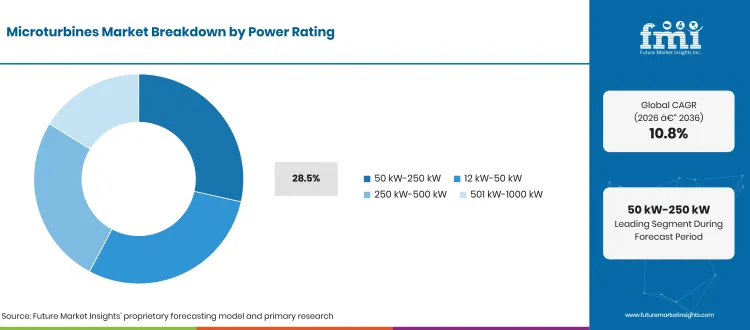
The 50 kW-250 kW range holds 28.5%, representing the largest share. This capacity band is ideal for a wide array of commercial and industrial applications, including small manufacturing plants, hospitality complexes, and healthcare facilities. It provides sufficient power for base-load or peak-shaving needs without the footprint of larger systems, offering a balance of output and practicality.
Which Application Drives the Market for Microturbines?
Combined heat and power (CHP) holds 65.0%, representing the dominant share. This application maximizes fuel efficiency by simultaneously producing electricity and usable thermal energy from a single source.
The economic and environmental benefits of cogeneration systems are the primary value proposition for microturbines, making CHP the central driver for adoption in settings with consistent thermal and electrical loads.
Which End-User Sector Is the Leading Adopter?
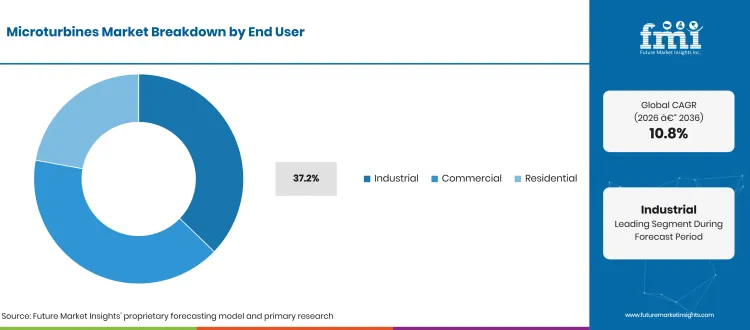
The industrial sector holds a 37.2%, representing the largest share. Industries such as manufacturing, oil & gas, and wastewater treatment utilize microturbines for on-site power generation to ensure process continuity, manage energy costs, and meet emission targets. The ability to utilize waste process gases as fuel provides an additional incentive for this sector.
Market Dynamics
How is the Push for Fuel Flexibility Influencing Development?
A major trend is the engineering focus on fuel-flexible microturbines capable of operating on renewable fuels like biogas, syngas, and eventually high-concentration hydrogen. This trend extends the technology's relevance in a decarbonizing energy market and allows operators to transition to greener fuels without replacing core assets.
Do High Initial Capital Costs Restrain Broader Adoption?
The most significant restraint is the higher upfront capital cost per kW compared to traditional reciprocating engine generators. This can deter investment, especially in price-sensitive markets or for applications with uncertain run-hours. Overcoming this barrier requires clear demonstrations of the total cost of ownership savings through efficiency and maintenance advantages.
How does Grid Modernization Create Opportunities?
The modernization of aging grid infrastructure and the integration of intermittent renewables present a key opportunity. Microturbines can provide grid support services like frequency regulation and decentralized backup power, enhancing grid stability. Utilities and independent power producers are exploring aggregated fleets of distributed generators, including microturbines, for these purposes.
How Is the Microturbines Market Expected to Evolve Across Major Nations?
Adoption is shaped by national energy policies, industrial activity, and natural gas infrastructure. Nations with strong support for cogeneration and distributed generation are leading the market.
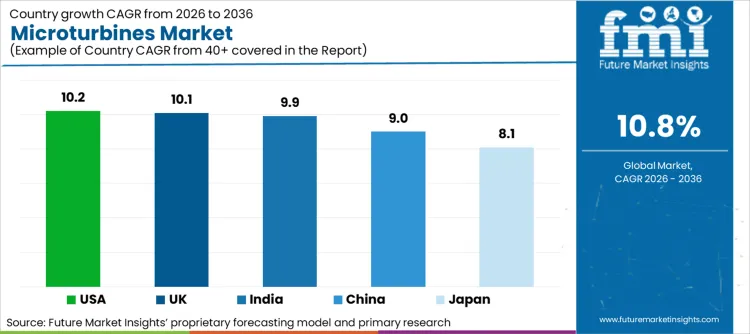
| Country | CAGR (2026-2036 ) |
|---|---|
| USA | 10.2% |
| UK | 10.1% |
| India | 9.9% |
| China | 9.0% |
| Japan | 8.1% |
Source: FMI analysis based on primary research and proprietary forecasting model
What Factors are Driving Steady Adoption in the USA?
The market in the USA is projected to record a CAGR of 10.2%. Growth is influenced by a mature natural gas infrastructure, incentives for CHP systems, and high demand for reliable backup power from data centers and healthcare facilities. The presence of leading technology providers also supports market development.
How are Energy Security Policies Shaping the UK Market?
Demand in the UK is estimated to expand at a CAGR of 10.1%. Supportive government policies for decentralized energy and carbon reduction, alongside a focus on energy security, are key drivers. Microturbines are deployed in commercial buildings and district energy schemes to improve efficiency and resilience.
Why Is India an Emerging Market for Microturbines?
The industry in India is likely to rise at a CAGR of 9.9%. Adoption is driven by the need to address frequent power outages in industrial zones and the availability of biogas from agricultural and municipal waste. Government initiatives promoting waste to energy projects create a favorable environment for biogas-fueled microturbines.
How Is China's Industrial Sector Influencing Demand?
Sales in China are set to achieve a CAGR of 9.0%. The massive scale of manufacturing and ongoing urbanization drives demand for efficient, on-site power. Industrial energy efficiency programs and the need to reduce reliance on the centralized grid in remote industrial parks support the adoption of microturbine-based CHP systems.
What role Does High Energy Density Play in Japan's Market?
Sales in Japan are likely to increase at a CAGR of 8.1%. The primary growth propeller is the need for compact, efficient power systems in space-constrained urban and industrial environments. Microturbines are utilized for building-scale cogeneration and as backup power sources, valued for their small footprint and low emissions.
What defines the Competitive Landscape for Microturbines?
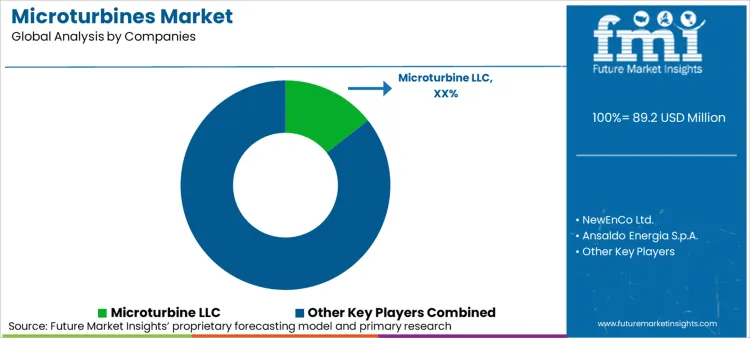
A mix of specialized technology developers and large industrial equipment conglomerates defines the competitive landscape. Companies compete on turbine efficiency, durability, total cost of ownership, and the strength of their service networks.
There is competition from other distributed generation technologies like fuel cells and advanced reciprocating engines. Strategic partnerships with energy service companies (ESCOs) and engineering firms are crucial for project deployment. Success hinges on demonstrating proven reliability and providing comprehensive financial and service packages to customers.
Key Players
- Capstone Green Energy Corporation
- AnsaldoEnergia S.p.A.
- FlexEnergy
- Brayton Energy LLC
- Toyota Turbine Systems
Scope of Report
| Items | Values |
|---|---|
| Quantitative Units | USD Million |
| Power Rating Segments | 12 kW-50 kW; 50 kW-250 kW; 250 kW-500 kW; 501 kW-1000 kW |
| Application Segments | Combined Heat and Power (CHP); Standby Power |
| End-User Segments | Industrial; Commercial; Residential |
| Regions Covered | North America, Europe, Asia Pacific, Latin America, Middle East & Africa |
| Key Countries | USA, UK, China, India, Japan |
Source: FMI’s proprietary forecasting model and primary research
Microturbines Market by Segment
By Power Rating:
- 12 kW-50 kW
- 50 kW-250 kW
- 250 kW-500 kW
- 501 kW-1000 kW
By Application:
- Combined Heat and Power (CHP)
- Standby Power
By End User:
- Industrial
- Commercial
- Residential
Bibliography
- International Energy Agency. (2023). The Role of Gas in Today's Energy Transitions. IEA Publications.
- USA Department of Energy. (2024). Combined Heat and Power Technology Fact Sheet Series. DOE Advanced Manufacturing Office.
- American Society of Mechanical Engineers. (2023). Performance Testing of Microturbine Energy Systems. ASME Journal of Engineering for Gas Turbines and Power.
- Energy Institute. (2024). Distributed Generation: Market Drivers and Policy. EI Statistical Review.
- International Renewable Energy Agency. (2023). Innovation Outlook: Renewable Methane. IRENA.
Frequently Asked Questions
How big is the microturbines market likely to be in 2026?
The microturbines market is projected to be valued at USD 89.2 million in 2026.
What will be the size of the microturbines market in 2036?
The market size for microturbines is projected to reach USD 248.6 million by 2036.
How fast will the microturbines market grow?
Demand for microturbines is projected to grow at a 10.8% CAGR between 2026 and 2036.
Which power rating segment holds the largest share?
The 50 kW-250 kW segment is expected to account for a 28.5% share of the market in 2026.
Which application is the primary driver for microturbines?
Combined Heat and Power (CHP) applications are expected to represent a 65.0% share in the microturbines market in 2026.
Preview the report firsthand - request a free sample
Get SampleGet the brochure for pricing and purchase details.
Get PDFTable of Content
- Executive Summary
- Global Market Outlook
- Demand-side Trends
- Supply-side Trends
- Technology Roadmap Analysis
- Analysis and Recommendations
- Market Overview
- Market Coverage / Taxonomy
- Chapter Orientation
- Analytical Lens and Working Hypotheses
- Market Structure, Signals, and Trend Drivers
- Benchmarking and Cross-market Comparability
- Market Sizing, Forecasting, and Opportunity Mapping
- Research Design and Evidence Framework
- Desk Research Programme (Secondary Evidence)
- Company Annual and Sustainability Reports
- Peer-reviewed Journals and Academic Literature
- Corporate Websites, Product Literature, and Technical Notes
- Earnings Decks and Investor Briefings
- Statutory Filings and Regulatory Disclosures
- Technical White Papers and Standards Notes
- Trade Journals, Industry Magazines, and Analyst Briefs
- Conference Proceedings, Webinars, and Seminar Materials
- Specialist Newsletters and Curated Briefings
- Sector Databases and Reference Repositories
- Roots Internal Knowledge Base and Historical Datasets
- Subscription Datasets and Paid Sources
- Social Channels, Communities, and Digital Listening Inputs
- Additional Desk Sources
- Expert Input and Fieldwork (Primary Evidence)
- Primary Modes
- Qualitative Interviews and Expert Elicitation
- Quantitative Surveys and Structured Data Capture
- Blended A8oach
- Why Primary Evidence is Used
- Field Techniques
- Interviews
- Surveys
- Focus Groups
- Observational and In-context Research
- Social and Community Interactions
- Stakeholder Universe Engaged
- C-suite Leaders
- Board Members
- Presidents and Vice Presidents
- R&D and Innovation Heads
- Technical Specialists
- Domain Subject-matter Experts
- Scientists
- Physicians and Other Healthcare Professionals
- Governance, Ethics, and Data Stewardship
- Research Ethics
- Data Integrity and Handling
- Primary Modes
- Tooling, Models, and Reference Databases
- Desk Research Programme (Secondary Evidence)
- Data Engineering and Model Build
- Data Acquisition and Ingestion
- Cleaning, Normalisation, and Verification
- Synthesis, Triangulation, and Analysis
- Quality Assurance and Audit Trail
- Market Background
- Market Dynamics
- Drivers
- Restraints
- Opportunity
- Trends
- Scenario Forecast
- Demand in Optimistic Scenario
- Demand in Likely Scenario
- Demand in Conservative Scenario
- Opportunity Map Analysis
- Product Life Cycle Analysis
- Supply Chain Analysis
- Investment Feasibility Matrix
- Value Chain Analysis
- PESTLE and Porter’s Analysis
- Regulatory Landscape
- Regional Parent Market Outlook
- Production and Consumption Statistics
- Import and Export Statistics
- Market Dynamics
- Global Market Analysis 2021 to 2025 and Forecast, 2026 to 2036
- Historical Market Size Value (USD Million) Analysis, 2021 to 2025
- Current and Future Market Size Value (USD Million) Projections, 2026 to 2036
- Y-o-Y Growth Trend Analysis
- Absolute $ Opportunity Analysis
- Global Market Pricing Analysis 2021 to 2025 and Forecast 2026 to 2036
- Global Market Analysis 2021 to 2025 and Forecast 2026 to 2036, By Power Rating
- Introduction / Key Findings
- Historical Market Size Value (USD Million) Analysis By Power Rating , 2021 to 2025
- Current and Future Market Size Value (USD Million) Analysis and Forecast By Power Rating , 2026 to 2036
- 50 kW-250 kW
- 12 kW-50 kW
- 250 kW-500 kW
- 501 kW-1000 kW
- 50 kW-250 kW
- Y-o-Y Growth Trend Analysis By Power Rating , 2021 to 2025
- Absolute $ Opportunity Analysis By Power Rating , 2026 to 2036
- Global Market Analysis 2021 to 2025 and Forecast 2026 to 2036, By Application
- Introduction / Key Findings
- Historical Market Size Value (USD Million) Analysis By Application, 2021 to 2025
- Current and Future Market Size Value (USD Million) Analysis and Forecast By Application, 2026 to 2036
- Combined Heat and Power (CHP)
- Standby Power
- Combined Heat and Power (CHP)
- Y-o-Y Growth Trend Analysis By Application, 2021 to 2025
- Absolute $ Opportunity Analysis By Application, 2026 to 2036
- Global Market Analysis 2021 to 2025 and Forecast 2026 to 2036, By End User
- Introduction / Key Findings
- Historical Market Size Value (USD Million) Analysis By End User, 2021 to 2025
- Current and Future Market Size Value (USD Million) Analysis and Forecast By End User, 2026 to 2036
- Industrial
- Commercial
- Residential
- Industrial
- Y-o-Y Growth Trend Analysis By End User, 2021 to 2025
- Absolute $ Opportunity Analysis By End User, 2026 to 2036
- Global Market Analysis 2021 to 2025 and Forecast 2026 to 2036, By Region
- Introduction
- Historical Market Size Value (USD Million) Analysis By Region, 2021 to 2025
- Current Market Size Value (USD Million) Analysis and Forecast By Region, 2026 to 2036
- North America
- Latin America
- Western Europe
- Eastern Europe
- East Asia
- South Asia and Pacific
- Middle East & Africa
- Market Attractiveness Analysis By Region
- North America Market Analysis 2021 to 2025 and Forecast 2026 to 2036, By Country
- Historical Market Size Value (USD Million) Trend Analysis By Market Taxonomy, 2021 to 2025
- Market Size Value (USD Million) Forecast By Market Taxonomy, 2026 to 2036
- By Country
- USA
- Canada
- Mexico
- By Power Rating
- By Application
- By End User
- By Country
- Market Attractiveness Analysis
- By Country
- By Power Rating
- By Application
- By End User
- Key Takeaways
- Latin America Market Analysis 2021 to 2025 and Forecast 2026 to 2036, By Country
- Historical Market Size Value (USD Million) Trend Analysis By Market Taxonomy, 2021 to 2025
- Market Size Value (USD Million) Forecast By Market Taxonomy, 2026 to 2036
- By Country
- Brazil
- Chile
- Rest of Latin America
- By Power Rating
- By Application
- By End User
- By Country
- Market Attractiveness Analysis
- By Country
- By Power Rating
- By Application
- By End User
- Key Takeaways
- Western Europe Market Analysis 2021 to 2025 and Forecast 2026 to 2036, By Country
- Historical Market Size Value (USD Million) Trend Analysis By Market Taxonomy, 2021 to 2025
- Market Size Value (USD Million) Forecast By Market Taxonomy, 2026 to 2036
- By Country
- Germany
- UK
- Italy
- Spain
- France
- Nordic
- BENELUX
- Rest of Western Europe
- By Power Rating
- By Application
- By End User
- By Country
- Market Attractiveness Analysis
- By Country
- By Power Rating
- By Application
- By End User
- Key Takeaways
- Eastern Europe Market Analysis 2021 to 2025 and Forecast 2026 to 2036, By Country
- Historical Market Size Value (USD Million) Trend Analysis By Market Taxonomy, 2021 to 2025
- Market Size Value (USD Million) Forecast By Market Taxonomy, 2026 to 2036
- By Country
- Russia
- Poland
- Hungary
- Balkan & Baltic
- Rest of Eastern Europe
- By Power Rating
- By Application
- By End User
- By Country
- Market Attractiveness Analysis
- By Country
- By Power Rating
- By Application
- By End User
- Key Takeaways
- East Asia Market Analysis 2021 to 2025 and Forecast 2026 to 2036, By Country
- Historical Market Size Value (USD Million) Trend Analysis By Market Taxonomy, 2021 to 2025
- Market Size Value (USD Million) Forecast By Market Taxonomy, 2026 to 2036
- By Country
- China
- Japan
- South Korea
- By Power Rating
- By Application
- By End User
- By Country
- Market Attractiveness Analysis
- By Country
- By Power Rating
- By Application
- By End User
- Key Takeaways
- South Asia and Pacific Market Analysis 2021 to 2025 and Forecast 2026 to 2036, By Country
- Historical Market Size Value (USD Million) Trend Analysis By Market Taxonomy, 2021 to 2025
- Market Size Value (USD Million) Forecast By Market Taxonomy, 2026 to 2036
- By Country
- India
- ASEAN
- Australia & New Zealand
- Rest of South Asia and Pacific
- By Power Rating
- By Application
- By End User
- By Country
- Market Attractiveness Analysis
- By Country
- By Power Rating
- By Application
- By End User
- Key Takeaways
- Middle East & Africa Market Analysis 2021 to 2025 and Forecast 2026 to 2036, By Country
- Historical Market Size Value (USD Million) Trend Analysis By Market Taxonomy, 2021 to 2025
- Market Size Value (USD Million) Forecast By Market Taxonomy, 2026 to 2036
- By Country
- Kingdom of Saudi Arabia
- Other GCC Countries
- Turkiye
- South Africa
- Other African Union
- Rest of Middle East & Africa
- By Power Rating
- By Application
- By End User
- By Country
- Market Attractiveness Analysis
- By Country
- By Power Rating
- By Application
- By End User
- Key Takeaways
- Key Countries Market Analysis
- USA
- Pricing Analysis
- Market Share Analysis, 2025
- By Power Rating
- By Application
- By End User
- Canada
- Pricing Analysis
- Market Share Analysis, 2025
- By Power Rating
- By Application
- By End User
- Mexico
- Pricing Analysis
- Market Share Analysis, 2025
- By Power Rating
- By Application
- By End User
- Brazil
- Pricing Analysis
- Market Share Analysis, 2025
- By Power Rating
- By Application
- By End User
- Chile
- Pricing Analysis
- Market Share Analysis, 2025
- By Power Rating
- By Application
- By End User
- Germany
- Pricing Analysis
- Market Share Analysis, 2025
- By Power Rating
- By Application
- By End User
- UK
- Pricing Analysis
- Market Share Analysis, 2025
- By Power Rating
- By Application
- By End User
- Italy
- Pricing Analysis
- Market Share Analysis, 2025
- By Power Rating
- By Application
- By End User
- Spain
- Pricing Analysis
- Market Share Analysis, 2025
- By Power Rating
- By Application
- By End User
- France
- Pricing Analysis
- Market Share Analysis, 2025
- By Power Rating
- By Application
- By End User
- India
- Pricing Analysis
- Market Share Analysis, 2025
- By Power Rating
- By Application
- By End User
- ASEAN
- Pricing Analysis
- Market Share Analysis, 2025
- By Power Rating
- By Application
- By End User
- Australia & New Zealand
- Pricing Analysis
- Market Share Analysis, 2025
- By Power Rating
- By Application
- By End User
- China
- Pricing Analysis
- Market Share Analysis, 2025
- By Power Rating
- By Application
- By End User
- Japan
- Pricing Analysis
- Market Share Analysis, 2025
- By Power Rating
- By Application
- By End User
- South Korea
- Pricing Analysis
- Market Share Analysis, 2025
- By Power Rating
- By Application
- By End User
- Russia
- Pricing Analysis
- Market Share Analysis, 2025
- By Power Rating
- By Application
- By End User
- Poland
- Pricing Analysis
- Market Share Analysis, 2025
- By Power Rating
- By Application
- By End User
- Hungary
- Pricing Analysis
- Market Share Analysis, 2025
- By Power Rating
- By Application
- By End User
- Kingdom of Saudi Arabia
- Pricing Analysis
- Market Share Analysis, 2025
- By Power Rating
- By Application
- By End User
- Turkiye
- Pricing Analysis
- Market Share Analysis, 2025
- By Power Rating
- By Application
- By End User
- South Africa
- Pricing Analysis
- Market Share Analysis, 2025
- By Power Rating
- By Application
- By End User
- USA
- Market Structure Analysis
- Competition Dashboard
- Competition Benchmarking
- Market Share Analysis of Top Players
- By Regional
- By Power Rating
- By Application
- By End User
- Competition Analysis
- Competition Deep Dive
- Microturbine LLC
- Overview
- Product Portfolio
- Profitability by Market Segments (Product/Age /Sales Channel/Region)
- Sales Footprint
- Strategy Overview
- Marketing Strategy
- Product Strategy
- Channel Strategy
- NewEnCo Ltd.
- Ansaldo Energia S.p.A.
- FlexEnergy
- Elliott Company, Inc.
- Ingersoll Rand Inc.
- ICR Turbine Engine Corporation
- Brayton Energy LLC
- Toyota Turbine Systems
- Microturbine LLC
- Competition Deep Dive
- Assumptions & Acronyms Used


