

- Industry Size (2026):
- USD 1006.5 Mn
- Forecast (2036):
- USD 1313.8 Mn
- CAGR (2026 to 2036)
- 2.7%
Vehicle Fluid Line Clamps Market Forecast and Outlook 2026 to 2036
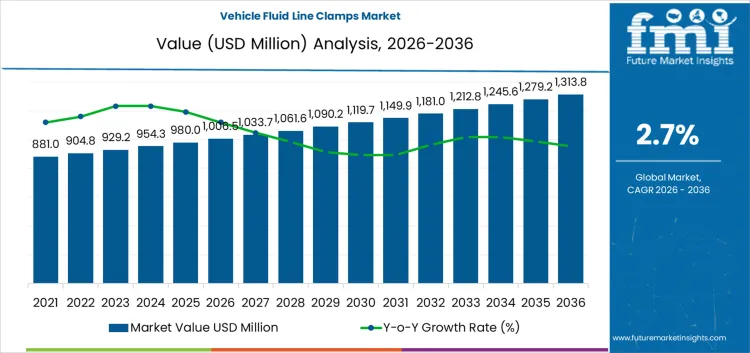
The vehicle fluid line clamps market is valued at USD 1,006.5 million in 2026 and is expected to reach USD 1,313.8 million by 2036 at a CAGR of 2.7%. Revenue formation is anchored in mandatory mechanical retention requirements within vehicle fluid architectures rather than discretionary system upgrades. Clamps function as load-bearing retention points that prevent displacement, fatigue failure, and abrasion across fuel, brake, coolant, and auxiliary fluid lines. Their economic relevance is defined by installation density, regulatory safety obligations, and tolerance to vibration and thermal cycling rather than by visible system performance enhancements.
From 2026 onward, value behavior reflects constraint-driven engineering decisions instead of expansion-led momentum. Increasing routing density beneath vehicle bodies and within engine bays raises specification sensitivity for clamp material, geometry, and fastening force. Electrified platforms introduce additional cooling and thermal circuits, incrementally increasing clamp counts while narrowing acceptable tolerance ranges. Procurement emphasis shifts toward corrosion stability, repeatable assembly torque, and long-life retention under mixed-material interfaces. Replacement volumes remain governed by corrosion exposure, road environment severity, and scheduled service intervals rather than accident or failure spikes. Cost control remains bounded by safety validation requirements, limiting substitution flexibility and constraining aggressive material downgrades across high-volume platforms.
Quick Stats for Vehicle Fluid Line Clamps Market
- Vehicle Fluid Line Clamps Market Value (2026): USD 1,006.5 million
- Vehicle Fluid Line Clamps Market Forecast Value (2036): USD 1,313.8 million
- Vehicle Fluid Line Clamps Market Forecast CAGR 2026 to 2036: 2.7%
- Leading Clamp Type by Demand Share: Hose Clamps
- Fastest-Growing Countries: China, Brazil, USA, Germany, South Korea
- Top Players in Global Demand: NORMA Group, Oetiker, Parker Hannifin, Gates, Eaton, Trelleborg, Cooper Standard, Sumitomo Riko, Toyoda Gosei, Ideal Tridon
Vehicle Fluid Line Clamps Market Key Takeaways
| Metric | Value |
|---|---|
| Market Value (2026) | USD 1,006.5 million |
| Market Forecast Value (2036) | USD 1,313.8 million |
| Forecast CAGR 2026 to 2036 | 2.7% |
Why is the Demand for Vehicle Fluid Line Clamps Growing?
Demand for vehicle fluid line clamps is rising as automotive and commercial vehicle manufacturers require secure retention of fuel, brake, coolant, and hydraulic lines to support system integrity and safety. Engineers specify clamps that meet criteria for corrosion resistance, tensile strength, and temperature tolerance because prevention of leaks and movement under vibration is critical for performance and regulatory compliance. Procurement teams assess material grade, design robustness, and compatibility with diverse line diameters when selecting components for new vehicle programs and maintenance inventories. Safety standards for fluid delivery systems influence selection of certified clamps that maintain secure engagement across varying operating environments.
Maintenance planners prioritize solutions that support predictable wear behavior and simplified installation to reduce downtime in service operations that support commercial fleets, specialty equipment, and passenger vehicles. Growth in electrification and advanced powertrain architectures reinforces uptake of precision fluid line clamps that align with evolving fluid routing and containment designs. OEMs and system integrators coordinate clamp selection with routing paths and protective coverings to minimize chafing and abrasion risk during service life. Workshops and parts distributors maintain inventories of clamps that match engineering specifications and support efficient replacement during scheduled maintenance. These technical and operational priorities support sustained adoption of fluid line clamp solutions across mobility and machinery segments.
How Are the Segments Classified in the Vehicle Fluid Line Clamps Market?
Demand for vehicle fluid line clamps is shaped by leak prevention requirements, vibration resistance, and long-term durability across automotive fluid systems. These components secure hoses and pipes carrying critical fluids under varying pressure and temperature conditions. Adoption aligns with increasing vehicle complexity and tighter reliability expectations. Design selection prioritizes clamping force consistency, corrosion resistance, and ease of installation. Segment classification reflects differentiation by clamp design, material composition, and fluid system application. Structure highlights how retention method, material choice, and line function influence specification priorities, replacement frequency, and deployment scale across vehicle platforms.
Which Clamp Type Represents the Largest Share of Demand?
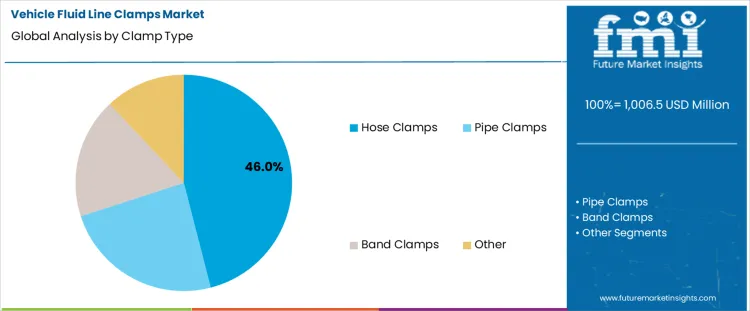
Hose clamps hold 46.0%, representing the largest share among clamp types due to widespread use across flexible fluid connections. These clamps secure rubber and polymer hoses used in cooling, fuel, and ventilation systems. Elastic clamping force accommodates thermal expansion and vibration during vehicle operation. Simple installation and broad size availability support adoption across passenger and commercial vehicles. Pipe clamps provide rigid support for metal lines with lower tolerance for movement. Band clamps support higher load retention in specific applications. Clamp type segmentation reflects preference for adaptable fastening solutions addressing diverse hose-based fluid routing requirements.
Key Points
- Hose clamps secure flexible connections across multiple fluid systems.
- Elastic retention supports vibration and thermal movement.
- Other clamp types address rigid or high-load fastening needs.
Which Material Accounts for the Highest Share of Demand?
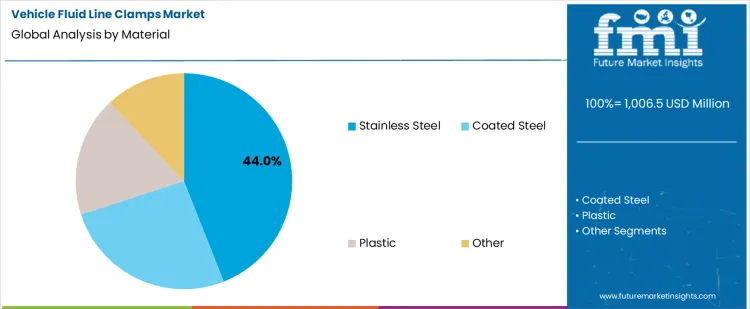
Stainless steel holds 44.0%, representing the largest share among materials used for vehicle fluid line clamps. Corrosion resistance supports long service life under exposure to moisture, chemicals, and road debris. Mechanical strength maintains clamping force under pressure and temperature variation. Compatibility with cooling and fuel systems reinforces widespread use. Coated steel offers cost efficiency with moderate protection in less exposed environments. Plastic clamps support lightweight and non-corrosive requirements with lower load tolerance. Material segmentation reflects emphasis on durability and reliability where fluid containment integrity remains critical.
Key Points
- Stainless steel provides corrosion resistance and strength.
- Stable clamping force supports long-term reliability.
- Other materials balance cost, weight, and exposure needs.
Which Application Area Drives the Largest Share of Demand?
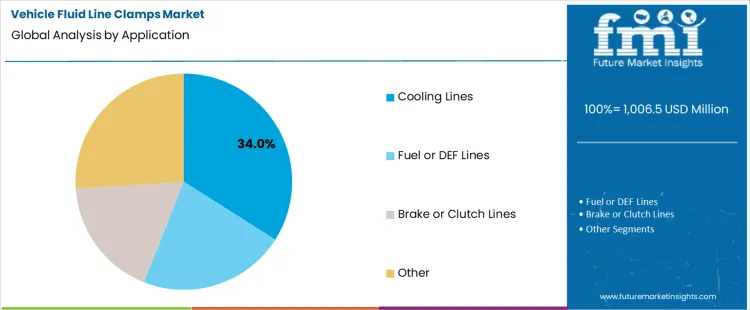
Cooling lines hold 34.0%, representing the largest share among applications due to extensive hose routing within thermal management systems. Engine and battery cooling circuits require multiple secure connections to maintain temperature control. Continuous thermal cycling increases stress on joints and fastening components. Clamp reliability directly affects cooling efficiency and system integrity. Fuel or DEF lines and brake or clutch lines apply clamps under different pressure and safety requirements. Other applications support auxiliary fluid systems. Application segmentation reflects concentration of clamp usage where fluid volume, routing complexity, and thermal exposure remain highest.
Key Points
- Cooling systems require numerous secure hose connections.
- Thermal cycling increases fastening reliability requirements.
- Other applications support fuel, braking, and auxiliary systems.
What are the Key Dynamics in the Vehicle Fluid Line Clamps Market?
Demand for vehicle fluid line clamps reflects requirements for secure routing and retention of hydraulic, pneumatic, fuel, and thermal lines within vehicle architectures. Adoption spans passenger vehicles, commercial vehicles, and off-highway equipment across OEM and service channels. Global scope aligns with platform modularization and durability expectations. Usage centers on metal and polymer clamps designed to control vibration, prevent abrasion, and maintain line positioning under dynamic operating conditions.
How do vehicle package density and durability requirements shape adoption?
Modern vehicle platforms incorporate dense routing of brake, fuel, coolant, and air lines within confined spaces. Demand increases as compact packaging elevates risk of line movement, chafing, and fatigue failure. Fluid line clamps provide positional stability under vibration, thermal expansion, and road-induced shock. Adoption strengthens where electrified platforms add cooling and thermal management circuits requiring additional retention points. Noise and vibration control relies on clamp design and isolating inserts to reduce structure-borne transmission. OEMs favor standardized clamp geometries compatible with automated assembly processes. Compatibility with mixed-material lines supports use across diverse fluid systems. Adoption reflects non-discretionary need for system integrity and long-term reliability.
How do material selection, cost pressure, and validation requirements influence market scalability?
Clamp performance depends on material strength, corrosion resistance, and temperature tolerance, increasing specification complexity. Demand sensitivity rises where cost reduction targets limit use of coated metals or high-performance polymers. Validation requirements include vibration, salt spray, and thermal cycling tests, extending approval timelines. Installation accuracy affects retention effectiveness, increasing dependence on assembly quality. Design customization across platforms limits standardization benefits. Supply chain exposure to metal stamping and molding capacity affects availability. Aftermarket competition emphasizes price over durability, influencing replacement cycles. Regulatory expectations for fuel and brake line safety constrain aggressive cost optimization.
How Is Demand for Vehicle Fluid Line Clamps Evolving Globally?
Demand for vehicle fluid line clamps is expanding globally due to durability requirements, vibration control needs, and maintenance-led replacement across passenger and commercial vehicle fleets. Usage aligns with secure routing of brake, fuel, coolant, and hydraulic lines under varied thermal and mechanical stress. Electrification and tighter packaging increase importance of clamp material performance and positioning accuracy. Aftermarket demand remains relevant where mileage accumulation is high. Growth rates in China at 3.7%, Brazil at 3.6%, USA at 2.5%, Germany at 2.3%, and South Korea at 2.1% indicate steady expansion driven by operating intensity, safety compliance, and lifecycle servicing rather than platform redesign.
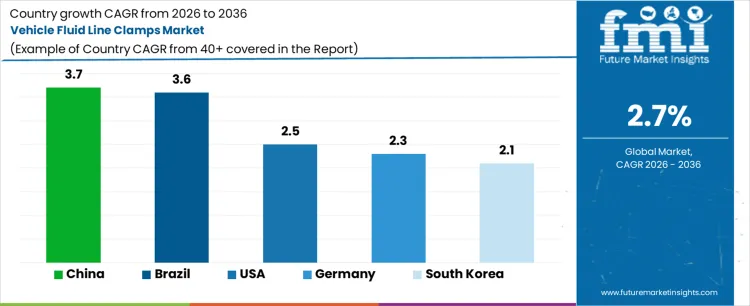
| Country | CAGR (%) |
|---|---|
| China | 3.7% |
| Brazil | 3.6% |
| USA | 2.5% |
| Germany | 2.3% |
| South Korea | 2.1% |
What Is Supporting Vehicle Fluid Line Clamp Demand Growth in China?
Vehicle fluid line clamp demand in China is growing at a CAGR of 3.7%, supported by high vehicle utilization across logistics, construction, and urban transport. Dense underbody packaging increases need for secure line retention under vibration. Exposure to dust, water, and debris accelerates clamp wear and corrosion. OEMs specify reinforced polymers and coated metal clamps to meet durability standards. Electrified powertrains introduce additional coolant and thermal lines requiring precise routing. Domestic vehicle production sustains OEM volumes, while inspection regimes encourage timely replacement under preventive maintenance practices.
- High vibration exposure in urban and construction use
- Dense underbody packaging increasing routing complexity
- Electrification adding thermal and coolant line requirements
- Stable OEM demand from domestic vehicle production
Why Is Brazil Experiencing Steady Expansion in Fluid Line Clamp Demand?
Operating environment conditions shape vehicle fluid line clamp demand in Brazil, expanding at a CAGR of 3.6%. Long-distance transport increases cumulative vibration and thermal cycling. High humidity and temperature variation accelerate material degradation and fastener loosening. Agricultural and mining vehicle usage elevates stress on fluid routing systems. Fleet aging contributes to aftermarket replacement as operators prioritize leak prevention. Demand growth reflects environmental exposure and maintenance needs rather than growth in new vehicle registrations.
- Vibration and thermal cycling from long routes
- Humidity and heat affecting clamp materials
- Agricultural and mining vehicle utilization
- Aging fleets driving aftermarket replacement
How Is the USA Sustaining Demand for Vehicle Fluid Line Clamps?
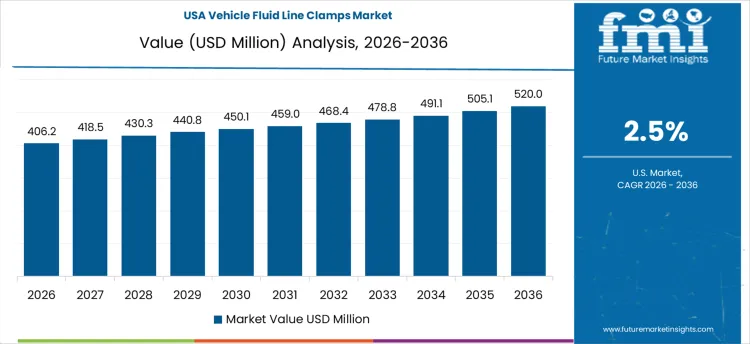
Vehicle fluid line clamp demand in the USA is expanding at a CAGR of 2.5%, driven by high mileage accumulation and preventive maintenance practices. Vehicles operate across diverse climates, increasing exposure to salt, moisture, and temperature extremes. Regulatory focus on leak prevention influences clamp performance specifications. Electrified and hybrid platforms introduce additional fluid routing points. Aftermarket replacement dominates due to long vehicle service life. Growth remains measured, aligned with maintenance cycles rather than increases in vehicle production.
- Climate diversity increasing corrosion exposure
- Leak prevention and safety compliance requirements
- Electrified platforms adding fluid routing complexity
- Strong aftermarket replacement orientation
What Factors Are Shaping Fluid Line Clamp Demand in Germany?
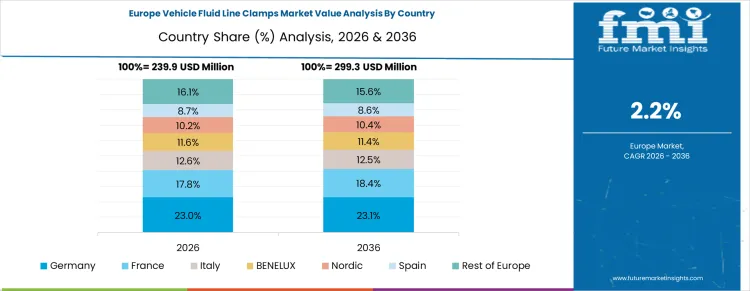
Engineering discipline shapes vehicle fluid line clamp demand in Germany, growing at a CAGR of 2.3%. High manufacturing quality standards extend clamp service life, moderating replacement frequency. Regulated vibration and noise standards influence clamp design and material selection. Preventive maintenance schedules create predictable replacement demand. Export-driven logistics sustain steady vehicle utilization. Growth reflects disciplined servicing within mature fleets rather than expansion of vehicle populations.
- High engineering and material quality standards
- Vibration and noise compliance requirements
- Predictable replacement under preventive maintenance
- Stable utilization from export logistics
Why Is South Korea Showing Controlled Growth in Fluid Line Clamp Demand?
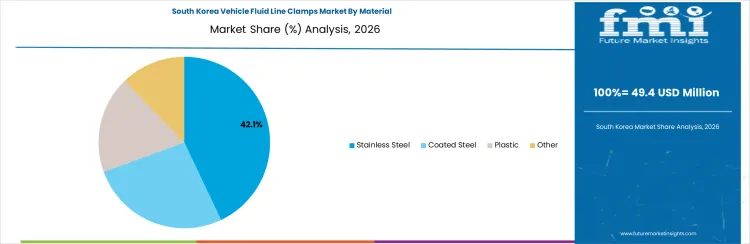
Vehicle fluid line clamp demand in South Korea is growing at a CAGR of 2.1%, influenced by efficient fleet management and compact operating geography. Shorter transport distances reduce cumulative vibration exposure. Strong maintenance discipline limits premature component failure. Manufacturing and port logistics sustain steady vehicle usage. OEMs favor standardized clamp designs with long service intervals. Growth remains controlled, reflecting efficient operations and scheduled replacement rather than increased vehicle deployment.
- Shorter routes limiting cumulative vibration stress
- Strong preventive maintenance discipline
- Manufacturing and port logistics activity
- Standardized long-life clamp designs
What is the competitive landscape of demand for the vehicle fluid line clamps market globally?
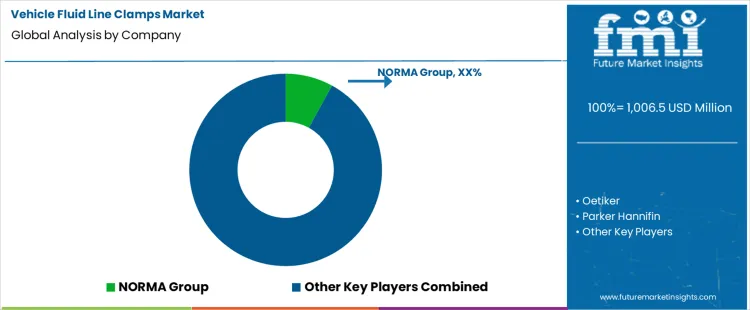
Demand for vehicle fluid line clamps is driven by automotive production, rising complexity of fluid networks, and requirements for secure routing of fuel, brake, coolant, and HVAC lines. These clamps must ensure leak-free fluid retention, vibration resistance, corrosion protection, and ease of assembly across diverse vehicle platforms. Buyers evaluate material durability, clamping force consistency, chemical resistance, and compatibility with automated manufacturing processes. Procurement teams prioritize suppliers with established OEM qualifications, global manufacturing presence, and strong quality management systems. Trend in the global market reflects increased integration of modular fluid harnesses, focus on NVH reduction, and use of lightweight materials to support overall vehicle efficiency targets.
NORMA Group holds leading positioning through a broad portfolio of precision fluid line clamp systems used extensively by global OEMs and supported by strong engineering and application support. Oetiker supports demand with ear clamp and ring clamp solutions tailored for fluid retention and hose management in automotive applications. Parker Hannifin contributes high-performance clamps and fluid line retainers integrated with fluid power and vehicle systems. Gates participates with engineered clamping solutions aligned with hose and belt systems used in powertrain and cooling circuits. Eaton supplies fluid line clamp products with emphasis on durability and chemical resistance for critical vehicle systems. Competitive differentiation depends on clamp reliability under thermal and vibration stress, material performance, global supply continuity, and ability to support automated assembly line integration.
Key Players in the Vehicle Fluid Line Clamps Market
- NORMA Group
- Oetiker
- Parker Hannifin
- Gates
- Eaton
- Trelleborg
- Cooper Standard
- Sumitomo Riko
- Toyoda Gosei
- Ideal Tridon
Scope of the Report
| Items | Values |
|---|---|
| Quantitative Units | USD million |
| Clamp Type | Hose Clamps; Pipe Clamps; Band Clamps; Other |
| Material | Stainless Steel; Coated Steel; Plastic; Other |
| Application | Cooling Lines; Fuel or DEF Lines; Brake or Clutch Lines; Other |
| Sales Channel | OEM Line-Fit; Aftermarket; Dealer or OES; Other |
| Regions Covered | Asia Pacific, Europe, North America, Latin America, Middle East & Africa |
| Countries Covered | China, Brazil, USA, Germany, South Korea, and 40+ countries |
| Key Companies Profiled | NORMA Group; Oetiker; Parker Hannifin; Gates; Eaton; Trelleborg; Cooper Standard; Sumitomo Riko; Toyoda Gosei; Ideal Tridon |
| Additional Attributes | Dollar sales by clamp type and application; adoption trends for corrosion-resistant and lightweight clamp designs in modern vehicle fluid architectures; clamping force retention, vibration resistance, and thermal cycling performance metrics; compatibility with rubber, plastic, and metal lines across cooling, fuel, and brake systems; installation repeatability, serviceability, and assembly-line efficiency considerations; compliance with OEM durability standards, leak prevention requirements, and regional automotive safety regulations influencing vehicle fluid line clamp selection. |
Vehicle Fluid Line Clamps Market by Segment
Clamp Type:
- Hose Clamps
- Pipe Clamps
- Band Clamps
- Other
Material:
- Stainless Steel
- Coated Steel
- Plastic
- Other
Application:
- Cooling Lines
- Fuel or DEF Lines
- Brake or Clutch Lines
- Other
Sales Channel:
- OEM Line-Fit
- Aftermarket
- Dealer or OES
- Other
Region:
- Asia Pacific
- China
- Japan
- South Korea
- India
- Australia & New Zealand
- ASEAN
- Rest of Asia Pacific
- Europe
- Germany
- United Kingdom
- France
- Italy
- Spain
- Nordic
- BENELUX
- Rest of Europe
- North America
- United States
- Canada
- Mexico
- Latin America
- Brazil
- Chile
- Rest of Latin America
- Middle East & Africa
- Kingdom of Saudi Arabia
- Other GCC Countries
- Turkey
- South Africa
- Other African Union
- Rest of Middle East & Africa
Bibliography
- National Highway Traffic Safety Administration. (2025). 49 CFR 571.106 Standard No. 106; Brake hoses. Electronic Code of Federal Regulations (eCFR), U.S. Department of Transportation.
- National Highway Traffic Safety Administration. (2025). 49 CFR 571.301 Standard No. 301; Fuel system integrity. Electronic Code of Federal Regulations (eCFR), U.S. Department of Transportation.
- National Highway Traffic Safety Administration. (2025). 49 CFR 571.135 Standard No. 135; Light vehicle brake systems. Electronic Code of Federal Regulations (eCFR), U.S. Department of Transportation.
- European Union. (2025). UN Regulation No. 34: Uniform provisions concerning the approval of vehicles with regard to the prevention of fire risks. Official Journal of the European Union.
Frequently Asked Questions
How big is the vehicle fluid line clamps market in 2026?
The global vehicle fluid line clamps market is estimated to be valued at USD 1,006.5 million in 2026.
What will be the size of vehicle fluid line clamps market in 2036?
The market size for the vehicle fluid line clamps market is projected to reach USD 1,313.8 million by 2036.
How much will be the vehicle fluid line clamps market growth between 2026 and 2036?
The vehicle fluid line clamps market is expected to grow at a 2.7% CAGR between 2026 and 2036.
What are the key product types in the vehicle fluid line clamps market?
The key product types in vehicle fluid line clamps market are hose clamps, pipe clamps, band clamps and other.
Which material segment to contribute significant share in the vehicle fluid line clamps market in 2026?
In terms of material, stainless steel segment to command 44.0% share in the vehicle fluid line clamps market in 2026.
Preview the report firsthand - request a free sample
Get SampleGet the brochure for pricing and purchase details.
Get PDFTable of Content
- Executive Summary
- Global Market Outlook
- Demand-side Trends
- Supply-side Trends
- Technology Roadmap Analysis
- Analysis and Recommendations
- Market Overview
- Market Coverage / Taxonomy
- Market Definition / Scope / Limitations
- Market Background
- Market Dynamics
- Drivers
- Restraints
- Opportunity
- Trends
- Scenario Forecast
- Demand in Optimistic Scenario
- Demand in Likely Scenario
- Demand in Conservative Scenario
- Opportunity Map Analysis
- Product Life Cycle Analysis
- Supply Chain Analysis
- Investment Feasibility Matrix
- Value Chain Analysis
- PESTLE and Porter’s Analysis
- Regulatory Landscape
- Regional Parent Market Outlook
- Production and Consumption Statistics
- Import and Export Statistics
- Market Dynamics
- Global Market Analysis 2021 to 2025 and Forecast, 2026 to 2036
- Historical Market Size Value (USD Million) Analysis, 2021 to 2025
- Current and Future Market Size Value (USD Million) Projections, 2026 to 2036
- Y-o-Y Growth Trend Analysis
- Absolute $ Opportunity Analysis
- Global Market Pricing Analysis 2021 to 2025 and Forecast 2026 to 2036
- Global Market Analysis 2021 to 2025 and Forecast 2026 to 2036, By Clamp Type
- Introduction / Key Findings
- Historical Market Size Value (USD Million) Analysis By Clamp Type , 2021 to 2025
- Current and Future Market Size Value (USD Million) Analysis and Forecast By Clamp Type , 2026 to 2036
- Hose Clamps
- Pipe Clamps
- Band Clamps
- Other
- Hose Clamps
- Y-o-Y Growth Trend Analysis By Clamp Type , 2021 to 2025
- Absolute $ Opportunity Analysis By Clamp Type , 2026 to 2036
- Global Market Analysis 2021 to 2025 and Forecast 2026 to 2036, By Material
- Introduction / Key Findings
- Historical Market Size Value (USD Million) Analysis By Material, 2021 to 2025
- Current and Future Market Size Value (USD Million) Analysis and Forecast By Material, 2026 to 2036
- Stainless Steel
- Coated Steel
- Plastic
- Other
- Stainless Steel
- Y-o-Y Growth Trend Analysis By Material, 2021 to 2025
- Absolute $ Opportunity Analysis By Material, 2026 to 2036
- Global Market Analysis 2021 to 2025 and Forecast 2026 to 2036, By Application
- Introduction / Key Findings
- Historical Market Size Value (USD Million) Analysis By Application, 2021 to 2025
- Current and Future Market Size Value (USD Million) Analysis and Forecast By Application, 2026 to 2036
- Cooling Lines
- Fuel or DEF Lines
- Brake or Clutch Lines
- Other
- Cooling Lines
- Y-o-Y Growth Trend Analysis By Application, 2021 to 2025
- Absolute $ Opportunity Analysis By Application, 2026 to 2036
- Global Market Analysis 2021 to 2025 and Forecast 2026 to 2036, By Sales Channel
- Introduction / Key Findings
- Historical Market Size Value (USD Million) Analysis By Sales Channel, 2021 to 2025
- Current and Future Market Size Value (USD Million) Analysis and Forecast By Sales Channel, 2026 to 2036
- OEM Line-Fit
- Aftermarket
- Dealer or OES
- Other
- OEM Line-Fit
- Y-o-Y Growth Trend Analysis By Sales Channel, 2021 to 2025
- Absolute $ Opportunity Analysis By Sales Channel, 2026 to 2036
- Global Market Analysis 2021 to 2025 and Forecast 2026 to 2036, By Region
- Introduction
- Historical Market Size Value (USD Million) Analysis By Region, 2021 to 2025
- Current Market Size Value (USD Million) Analysis and Forecast By Region, 2026 to 2036
- North America
- Latin America
- Western Europe
- Eastern Europe
- East Asia
- South Asia and Pacific
- Middle East & Africa
- Market Attractiveness Analysis By Region
- North America Market Analysis 2021 to 2025 and Forecast 2026 to 2036, By Country
- Historical Market Size Value (USD Million) Trend Analysis By Market Taxonomy, 2021 to 2025
- Market Size Value (USD Million) Forecast By Market Taxonomy, 2026 to 2036
- By Country
- USA
- Canada
- Mexico
- By Clamp Type
- By Material
- By Application
- By Sales Channel
- By Country
- Market Attractiveness Analysis
- By Country
- By Clamp Type
- By Material
- By Application
- By Sales Channel
- Key Takeaways
- Latin America Market Analysis 2021 to 2025 and Forecast 2026 to 2036, By Country
- Historical Market Size Value (USD Million) Trend Analysis By Market Taxonomy, 2021 to 2025
- Market Size Value (USD Million) Forecast By Market Taxonomy, 2026 to 2036
- By Country
- Brazil
- Chile
- Rest of Latin America
- By Clamp Type
- By Material
- By Application
- By Sales Channel
- By Country
- Market Attractiveness Analysis
- By Country
- By Clamp Type
- By Material
- By Application
- By Sales Channel
- Key Takeaways
- Western Europe Market Analysis 2021 to 2025 and Forecast 2026 to 2036, By Country
- Historical Market Size Value (USD Million) Trend Analysis By Market Taxonomy, 2021 to 2025
- Market Size Value (USD Million) Forecast By Market Taxonomy, 2026 to 2036
- By Country
- Germany
- UK
- Italy
- Spain
- France
- Nordic
- BENELUX
- Rest of Western Europe
- By Clamp Type
- By Material
- By Application
- By Sales Channel
- By Country
- Market Attractiveness Analysis
- By Country
- By Clamp Type
- By Material
- By Application
- By Sales Channel
- Key Takeaways
- Eastern Europe Market Analysis 2021 to 2025 and Forecast 2026 to 2036, By Country
- Historical Market Size Value (USD Million) Trend Analysis By Market Taxonomy, 2021 to 2025
- Market Size Value (USD Million) Forecast By Market Taxonomy, 2026 to 2036
- By Country
- Russia
- Poland
- Hungary
- Balkan & Baltic
- Rest of Eastern Europe
- By Clamp Type
- By Material
- By Application
- By Sales Channel
- By Country
- Market Attractiveness Analysis
- By Country
- By Clamp Type
- By Material
- By Application
- By Sales Channel
- Key Takeaways
- East Asia Market Analysis 2021 to 2025 and Forecast 2026 to 2036, By Country
- Historical Market Size Value (USD Million) Trend Analysis By Market Taxonomy, 2021 to 2025
- Market Size Value (USD Million) Forecast By Market Taxonomy, 2026 to 2036
- By Country
- China
- Japan
- South Korea
- By Clamp Type
- By Material
- By Application
- By Sales Channel
- By Country
- Market Attractiveness Analysis
- By Country
- By Clamp Type
- By Material
- By Application
- By Sales Channel
- Key Takeaways
- South Asia and Pacific Market Analysis 2021 to 2025 and Forecast 2026 to 2036, By Country
- Historical Market Size Value (USD Million) Trend Analysis By Market Taxonomy, 2021 to 2025
- Market Size Value (USD Million) Forecast By Market Taxonomy, 2026 to 2036
- By Country
- India
- ASEAN
- Australia & New Zealand
- Rest of South Asia and Pacific
- By Clamp Type
- By Material
- By Application
- By Sales Channel
- By Country
- Market Attractiveness Analysis
- By Country
- By Clamp Type
- By Material
- By Application
- By Sales Channel
- Key Takeaways
- Middle East & Africa Market Analysis 2021 to 2025 and Forecast 2026 to 2036, By Country
- Historical Market Size Value (USD Million) Trend Analysis By Market Taxonomy, 2021 to 2025
- Market Size Value (USD Million) Forecast By Market Taxonomy, 2026 to 2036
- By Country
- Kingdom of Saudi Arabia
- Other GCC Countries
- Turkiye
- South Africa
- Other African Union
- Rest of Middle East & Africa
- By Clamp Type
- By Material
- By Application
- By Sales Channel
- By Country
- Market Attractiveness Analysis
- By Country
- By Clamp Type
- By Material
- By Application
- By Sales Channel
- Key Takeaways
- Key Countries Market Analysis
- USA
- Pricing Analysis
- Market Share Analysis, 2025
- By Clamp Type
- By Material
- By Application
- By Sales Channel
- Canada
- Pricing Analysis
- Market Share Analysis, 2025
- By Clamp Type
- By Material
- By Application
- By Sales Channel
- Mexico
- Pricing Analysis
- Market Share Analysis, 2025
- By Clamp Type
- By Material
- By Application
- By Sales Channel
- Brazil
- Pricing Analysis
- Market Share Analysis, 2025
- By Clamp Type
- By Material
- By Application
- By Sales Channel
- Chile
- Pricing Analysis
- Market Share Analysis, 2025
- By Clamp Type
- By Material
- By Application
- By Sales Channel
- Germany
- Pricing Analysis
- Market Share Analysis, 2025
- By Clamp Type
- By Material
- By Application
- By Sales Channel
- UK
- Pricing Analysis
- Market Share Analysis, 2025
- By Clamp Type
- By Material
- By Application
- By Sales Channel
- Italy
- Pricing Analysis
- Market Share Analysis, 2025
- By Clamp Type
- By Material
- By Application
- By Sales Channel
- Spain
- Pricing Analysis
- Market Share Analysis, 2025
- By Clamp Type
- By Material
- By Application
- By Sales Channel
- France
- Pricing Analysis
- Market Share Analysis, 2025
- By Clamp Type
- By Material
- By Application
- By Sales Channel
- India
- Pricing Analysis
- Market Share Analysis, 2025
- By Clamp Type
- By Material
- By Application
- By Sales Channel
- ASEAN
- Pricing Analysis
- Market Share Analysis, 2025
- By Clamp Type
- By Material
- By Application
- By Sales Channel
- Australia & New Zealand
- Pricing Analysis
- Market Share Analysis, 2025
- By Clamp Type
- By Material
- By Application
- By Sales Channel
- China
- Pricing Analysis
- Market Share Analysis, 2025
- By Clamp Type
- By Material
- By Application
- By Sales Channel
- Japan
- Pricing Analysis
- Market Share Analysis, 2025
- By Clamp Type
- By Material
- By Application
- By Sales Channel
- South Korea
- Pricing Analysis
- Market Share Analysis, 2025
- By Clamp Type
- By Material
- By Application
- By Sales Channel
- Russia
- Pricing Analysis
- Market Share Analysis, 2025
- By Clamp Type
- By Material
- By Application
- By Sales Channel
- Poland
- Pricing Analysis
- Market Share Analysis, 2025
- By Clamp Type
- By Material
- By Application
- By Sales Channel
- Hungary
- Pricing Analysis
- Market Share Analysis, 2025
- By Clamp Type
- By Material
- By Application
- By Sales Channel
- Kingdom of Saudi Arabia
- Pricing Analysis
- Market Share Analysis, 2025
- By Clamp Type
- By Material
- By Application
- By Sales Channel
- Turkiye
- Pricing Analysis
- Market Share Analysis, 2025
- By Clamp Type
- By Material
- By Application
- By Sales Channel
- South Africa
- Pricing Analysis
- Market Share Analysis, 2025
- By Clamp Type
- By Material
- By Application
- By Sales Channel
- USA
- Market Structure Analysis
- Competition Dashboard
- Competition Benchmarking
- Market Share Analysis of Top Players
- By Regional
- By Clamp Type
- By Material
- By Application
- By Sales Channel
- Competition Analysis
- Competition Deep Dive
- NORMA Group
- Overview
- Product Portfolio
- Profitability by Market Segments (Product/Age /Sales Channel/Region)
- Sales Footprint
- Strategy Overview
- Marketing Strategy
- Product Strategy
- Channel Strategy
- Oetiker
- Parker Hannifin
- Gates
- Eaton
- Trelleborg
- Cooper Standard
- Sumitomo Riko
- Toyoda Gosei
- Ideal Tridon
- NORMA Group
- Competition Deep Dive
- Assumptions & Acronyms Used
- Research Methodology


