

- Market Size (2026)
- USD 3.9 Bn
- Forecast (2036)
- USD 7.0 Bn
- CAGR (2026 to 2036)
- 6.0%
How big is Automotive Coolant Junction Blocks Market in 2026?
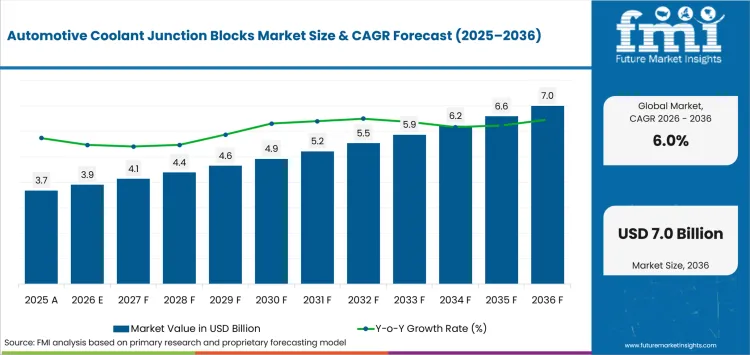
USD 3.9 billion in 2026 and USD 7.0 billion by 2036 at a 6.0% CAGR.
Demand for automotive coolant junction blocks is projected to expand at 6.0% CAGR between 2026 and 2036, increasing valuation from USD 3.9 billion in 2026 to USD 7.0 billion by 2036. Electrified platforms raise coolant-routing content because batteries and power electronics add dedicated loads to EV thermal systems. The International Energy Agency recorded more than 20 million electric-car sales in 2025, equal to one-quarter of new-car sales. That mix gives OEM thermal engineers more programs where compact junction blocks can replace several branch connections with controlled flow.
Country adoption changes how quickly that engineering need becomes a sourcing award. Australia provides a clear example because electric vehicles exceeded 20% of new-car sales during the first four months of 2026 according to the federal climate and energy minister. Faster electrification increases programs needing battery-specific coolant routing, yet each design must clear pressure-loss, sealing and material qualification before production.
Key Takeaways
- Battery and power-electronics cooling increase the number of controlled liquid-routing points that vehicle engineers must package inside electrified platforms.
- Based on block type, plastic coolant junction blocks are projected to account for 29.0% in 2026 due to molded passages that reduce interfaces and packaging space.
- In 2026, battery electric vehicles are expected to lead vehicle type with 36.0% share because batteries, inverters and charging hardware need coordinated liquid cooling.
- Battery thermal management is set to lead the application category with 29.0% share in 2026 due to temperature limits during charging and high-load operation.
- Leak integrity, pressure loss and long-duration water-glycol exposure can extend validation cycles and make late component substitution uneconomic.
- Some of the key players in this market include TI Automotive, Sanhua Automotive, DENSO, Valeo, Hanon Systems, MAHLE, Schaeffler, NORMA Group, Cooper Standard, and Marelli.
Analyst Perspective
"Automotive coolant junction blocks earn their place by removing interfaces without making the thermal system harder to validate. OEM teams should compare pressure loss, leak paths and coolant durability before treating a lower piece price as a saving."
- Nikhil Kaitwade, Principal Consultant, Future Market Insights
How is the automotive coolant junction blocks market segmented?
The automotive coolant junction blocks market is segmented by block type, vehicle type, application, material, sales channel and region.
Block type covers plastic coolant junction blocks, aluminum junction blocks, integrated valve blocks, EV thermal distribution blocks and sensor-integrated junctions. Vehicle type includes battery electric vehicles, hybrid vehicles, ICE vehicles and electric commercial vehicles. Applications comprise battery thermal management, engine cooling, power electronics cooling and cabin heat pump routing. Materials include glass-filled nylon, aluminum, PPS/PPA polymers, composite polymer and stamped/brazed metal. Sales channels include OEM direct, thermal system Tier-1s, battery pack suppliers and aftermarket/service.
Why do plastic coolant junction blocks lead the block type category?
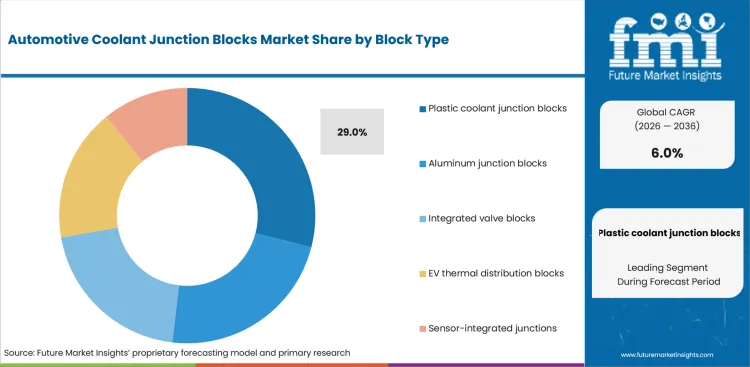
Plastic blocks let engineers mold branch passages, mounting features and pressure-balancing geometry into one compact part. Battery-electric platforms value that packaging because every extra hose joint requires more assembly work and introduces another potential leak path.
- Based on block type, plastic coolant junction blocks are projected to account for 29.0% in 2026 due to molded passages that reduce separate fittings and tube interfaces.
- BASF expanded its hydrolysis-resistant PPA range in March 2025 for automotive parts exposed to coolant media at elevated temperatures. Its testing included glycol-water exposure at 130°C, so molded junction programs still need material durability evidence beside leak and pressure testing.
Why do battery electric vehicles lead the vehicle type category?
Battery electric vehicles concentrate heat loads in the traction battery, inverter and electric motor without an engine waste-heat source. Their thermal architecture therefore requires controlled distribution between the pack, power electronics and cabin circuits.
- In 2026, battery electric vehicles are expected to lead vehicle type with 36.0% share because dedicated battery, inverter and motor circuits increase liquid-routing content.
- The International Energy Agency found that light-duty vehicles represented more than 85% of EV battery deployment in 2025. That concentration makes battery cooling the dominant liquid circuit on many BEV platforms and raises routing complexity at scale.
Why does battery thermal management lead the application category?
Battery coolant routing must maintain pack temperature during driving, fast charging and preconditioning while preserving low pressure loss. Junction blocks shorten branch paths between the battery, chiller, heater and pump after the integrated layout clears sealing tests.
- Battery thermal management is set to lead the application category with 29.0% share in 2026 due to cooling demand during driving, fast charging and preconditioning.
- NORMA Group secured an August 2025 contract for eM Safe quick connectors on a new US electric-vehicle platform with supply scheduled from 2027. The award shows battery-loop fluid hardware enters production after platform-specific safety and flow requirements are accepted.
What supports glass-filled nylon in the material category?
Glass-filled nylon gives multi-port coolant parts the stiffness needed for mounting loads while preserving molded geometry and lower mass. Chemical durability is the qualification challenge because heated water-glycol mixtures can attack resin over a long vehicle life.
- Glass-filled nylon is projected to hold 35.0% share in 2026 owing to reinforced grades that support complex molded passages with useful structural stiffness.
- BASF stated in January 2026 that some eMobility plastic applications can require 45,000 to 55,000 operating hours and described hydrolysis testing in water-glycol mixtures. That test route makes resin formulation part of junction-block approval instead of a simple weight comparison.
Why does OEM direct lead the sales channel category?
Junction geometry is fixed early because port position, target flow and mounting points depend on the vehicle layout. OEM thermal engineers influence the specification before a Tier-1 assembles the wider package or procurement awards production business.
- By sales channel, OEM direct is estimated to hold 51.0% in 2026 owing to platform-specific geometry and validation that tie the component to vehicle engineering.
- MAHLE said in May 2025 that its intelligent thermal management system for Mahindra battery-electric vehicles entered series production after a 24-month development period. That design-in cycle gives direct vehicle-program engineering more commercial weight than spot component purchasing.
What are the drivers, restraints and opportunities in the Automotive Coolant Junction Blocks Market?
Higher battery thermal loads raise coolant-routing content, stringent fluid and material qualification slows substitution, and sensor-integrated flow-control modules offer the clearest route to higher content per vehicle.
- Driver: Battery deployment increases the number and duty cycle of liquid-cooling circuits that require compact routing and controlled distribution.
- Restraint: Coolant chemistry, sealing durability and pressure-loss limits can extend qualification and make a late supplier change commercially unattractive.
- Opportunity: Temperature sensing and active flow control can move junction hardware from passive branching toward higher-value thermal control functions.
Battery deployment increases the thermal workload that vehicle programs must distribute through liquid circuits. The International Energy Agency measured 1.2 TWh of EV battery deployment in 2025, almost 30% above 2024. More battery capacity increases programs where one validated junction assembly can manage several coolant branches at production scale.
Qualification risk is commercial because a coolant leak can move beyond warranty cost into vehicle safety. NHTSA’s December 2025 recall report covered 388 Honda CR-V Fuel Cell EVs after coolant could leak into the fuel-cell stack case and cause an internal short circuit. Junction suppliers therefore need leak-tightness and material evidence before a late substitution enters a released cooling circuit.
Sensor-integrated fluid hardware can raise content without multiplying leak paths or adding a separate measurement body. Cooper Standard announced a December 2025 quick connector with an integrated coolant temperature sensor for a General Motors electric vehicle. One validated interface can therefore carry both connection and temperature feedback during full-vehicle qualification.
Which country CAGRs are profiled in the Automotive Coolant Junction Blocks Market?
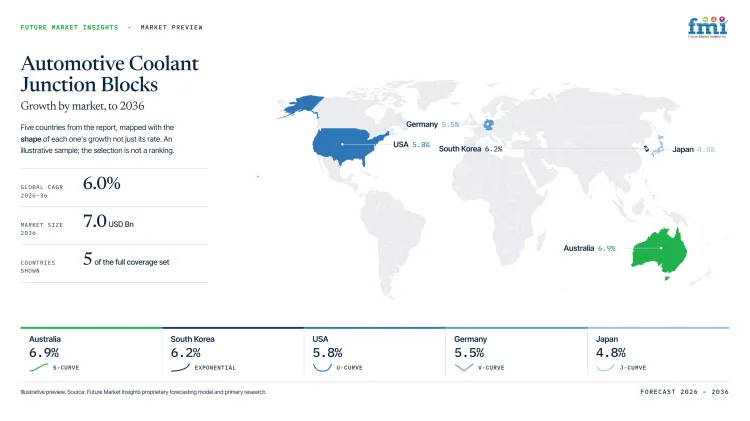
| Country | CAGR |
|---|---|
| Australia | 6.9% |
| Mexico | 6.5% |
| South Korea | 6.2% |
| USA | 5.8% |
| Germany | 5.5% |
| France | 5.1% |
| Japan | 4.8% |
How do country-level CAGRs compare in the Automotive Coolant Junction Blocks Market?
The 2.1-percentage-point spread separates Australia at 6.9% from Japan at 4.8%, with Mexico and South Korea joining the upper group. USA and Germany form a middle band. France and Japan advance more gradually because their platform mixes convert electrification into junction-block content at different rates. That spacing changes local sourcing priorities.
- Australia gains model choice faster than local assembly capacity.
- Mexico converts export-platform launches into localized fluid-routing awards.
- South Korea clusters battery and vehicle thermal engineering.
- US awards reward regional engineering during frequent platform changes.
- Germany weighs assembly simplification against tooling cost.
- France gains coolant content despite softer vehicle volumes.
- Japan spreads thermal investment over several powertrains.
Comparable growth rates still produce different entry conditions because production depth, platform mix and validation timing vary by country.
The full report covers North America, Latin America, Western Europe, Eastern Europe, East Asia, South Asia and Pacific, and Middle East and Africa.
Country-wise Analysis
- Australia is an import-heavy vehicle market, so service networks support many thermal architectures without local vehicle assembly. Automotive coolant junction block demand in Australia is forecast to rise at 6.9% CAGR through 2036, aided by wider electric-model choice. By June 2025, the National Electric Vehicle Strategy annual update listed 153 electric models available to Australian buyers. Broader choice expands BEV routing programs, though long service distances raise the cost of carrying platform-specific parts. Modular port families can reduce inventory breadth without changing each vehicle maker’s sealing and flow requirements. Importers also carry replacement seals and fittings for vehicle architectures sold in much smaller volumes.
- Mexico’s export assembly corridors make local industrialization and launch timing central to coolant-routing awards for North American vehicle programs. INEGI’s May 2026 release recorded 329,878 light vehicles produced and 286,317 exported during April. Automotive coolant junction block sales in Mexico are forecast to expand at 6.5% CAGR by 2036, tied to electrified program turnover and regional sourcing. Local molding shortens replenishment and engineering response, while shifting powertrain mixes complicate tooling decisions. Entrants gain an advantage from production-ready designs validated near assembly plants before vehicle launches. Local engineering teams therefore gain value from designs that can be released quickly against fixed export-program calendars.
- South Korean vehicle programs place fast charging and battery protection near the center of electric-platform thermal design. Eco-friendly vehicles reached 52% of domestic automobile sales in May 2025 according to MOTIE’s June release. That mix gives local engineering teams a larger base of electrified platforms that need stable coolant distribution during charging. In South Korea, automotive coolant junction block demand is predicted to advance at 6.2% CAGR through 2036, given dense battery and vehicle engineering capacity. Price pressure stays severe, so added integration must remove interfaces or validation work before it earns a high-volume production program award.
- US vehicle programs usually require regional engineering support before coolant hardware moves from prototype release into production validation. The automotive coolant junction blocks market in USA is projected to record 5.8% CAGR during the assessment period, attributable to a large electrified installed base. California had 1,843,100 registered electric light-duty vehicles in 2025 according to the US Department of Energy’s Alternative Fuels Data Center. That concentration gives OEM teams many cooling architectures to support, yet warranty exposure keeps leak integrity and service access visible during sourcing. Local validation capability reduces dependence on distant engineering centers during nameplate changes.
- Germany’s thermal-component programs face strict manufacturability reviews because integrated parts must justify tooling as well as system-level packaging gains. Destatis recorded 545,100 new battery-electric passenger cars in 2025, equal to 19.1% of new registrations. That penetration gives Tier-1 engineering teams a steady BEV program base, while weaker vehicle volumes keep part count and release cost under scrutiny. Germany is estimated to post 5.5% CAGR over the forecast period, reflecting electrified content within a mature production base. Suppliers must prove integration cuts assembly work or pressure loss enough to justify repeated European platform tooling on successive model derivatives.
- French vehicle programs are adding battery-electric coolant content even as weaker passenger-car registrations limit platforms reaching high volume. The automotive coolant junction blocks market in France is forecast to advance at 5.1% CAGR over the forecast period, supported by continued BEV penetration. SDES placed battery-electric vehicles at 19.9% of new passenger-car registrations in 2025. Higher coolant content per BEV raises junction-block value on selected programs, but lower vehicle volumes can dilute that gain. Manufacturers tied to high-content electric platforms have a clearer route than firms depending on broad registration recovery and low-cost catalog parts that reuse the same interfaces on several nameplates.
- Japanese automakers continue to engineer battery-electric, hybrid and combustion vehicles in parallel, spreading thermal investment over several architecture types. JAMA’s April 2026 market survey found passenger-car household ownership at 71.9% and multiple-car ownership at 30.5%, with both rates higher outside major metropolitan areas. That installed base favors reusable pumps, valves and coolant-routing logic that can serve several powertrains. Japan is expected to register 4.8% CAGR through 2036, helped by electrification but limited by slower BEV concentration than faster-growth markets. Multi-powertrain junction families fit local sourcing better than a design optimized for one battery-electric layout, especially where regional service coverage matters.
Who are the notable companies in the Automotive Coolant Junction Blocks Market?
TI Automotive, Sanhua Automotive, DENSO, Valeo, Hanon Systems, MAHLE, Schaeffler, NORMA Group, Cooper Standard, and Marelli are the notable companies profiled in this market.
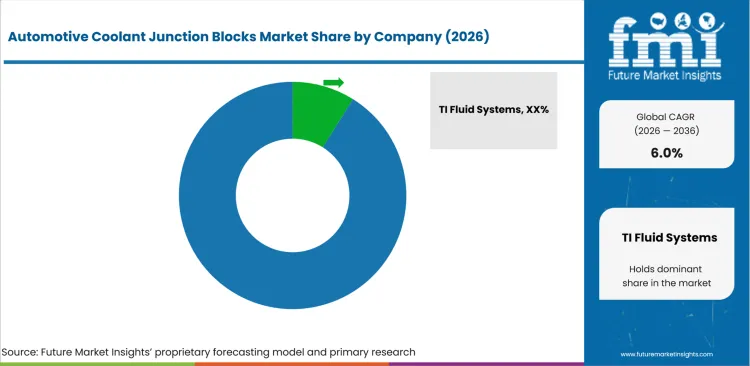
Competition splits between integrated thermal groups and fluid-routing specialists. DENSO, Valeo, Hanon Systems, MAHLE and Schaeffler place junction functions inside wider thermal packages. TI Automotive, Sanhua Automotive, NORMA Group and Cooper Standard specialize in fluid handling, while Marelli links thermal control with propulsion electronics.
- Integrated thermal architectures: DENSO, Valeo, Hanon Systems, MAHLE and Schaeffler serve broader thermal-system programs.
- Coolant routing and flow control: TI Automotive, Sanhua Automotive, NORMA Group and Cooper Standard focus on fluid handling.
- Cross-domain thermal control: Marelli places thermal functions beside propulsion controls in electrified architectures.
Competitive Benchmarking: Automotive Coolant Junction Blocks Market
| Company | Coolant Routing Integration | Active Flow-Control Integration | Electrified Thermal Coverage | Geographic Reach |
|---|---|---|---|---|
| TI Automotive | High | High | High | Europe, North America and Asia |
| Sanhua Automotive | High | High | High | Asia, Europe and North America |
| DENSO | Medium | High | High | Japan, Americas, Europe and Asia |
| Valeo | High | High | High | Europe, Asia and Americas |
| Hanon Systems | Medium | High | High | Asia, Americas and Europe |
| MAHLE | Medium | Medium | High | Europe, Asia and Americas |
| Schaeffler | Medium | High | High | Europe, Americas and Asia |
| NORMA Group | Low | Medium | Medium | Europe, North America and Asia |
| Cooper Standard | High | High | High | North America, Europe and Asia |
| Marelli | Medium | High | High | Asia, Europe and Americas |
Scoring basis: High coolant-routing integration requires multi-port capability, while Medium covers multi-line routing and Low covers connectors. High active flow control requires integrated valves, while Medium covers one active element and Low is passive. Electrified thermal coverage is High for two EV circuits, Medium for one primary circuit and Low for one use.
Key Developments in the Automotive Coolant Junction Blocks Market
- In March 2026, Hanon Systems began supplying its Highly Integrated Cooling Entity for the BMW iX3 with an electronic expansion valve block and sensors to reduce coolant interfaces while retaining centralized thermal control.
- In December 2025, Marelli unveiled Intelligent Energy Management for hybrid and electric vehicles at CTI Europe. Its software coordinates thermal and propulsion functions, increasing the value of coolant hardware that responds predictably to centralized commands.
- In September 2025, Valeo presented Smart Coolant Modules at IAA Mobility to centralize fluid flow and reduce pressure loss between battery, powertrain and cabin thermal circuits.
Key Players in the Automotive Coolant Junction Blocks Market
Integrated Thermal Architectures
- DENSO
- Valeo
- Hanon Systems
- MAHLE
- Schaeffler
Coolant Routing and Flow Control
- TI Automotive
- Sanhua Automotive
- NORMA Group
- Cooper Standard
Cross-Domain Thermal Control
- Marelli
Automotive Coolant Junction Blocks Market - Report Scope
| Coverage field | Report scope |
|---|---|
| Market breakdown | By block type, vehicle type, application, material, sales channel and region. |
| Quantitative Units | USD billion. |
| Market Definition | Revenue from automotive coolant junction blocks sold as discrete or integrated liquid-coolant routing assemblies. Excludes standalone hoses, pumps, valves, heat exchangers, coolant fluids, batteries, complete thermal systems, finished vehicles and service labor. |
| Regions Covered | North America, Latin America, Western Europe, Eastern Europe, East Asia, South Asia and Pacific, Middle East and Africa. |
| Countries Covered | Australia, USA, Japan, Germany, South Korea, Mexico, France, and 25+ countries included in the full report. |
| Key Companies Profiled | TI Automotive, Sanhua Automotive, DENSO, Valeo, Hanon Systems, MAHLE, Schaeffler, NORMA Group, Cooper Standard, Marelli. |
| Forecast Period | 2026 to 2036. |
| Approach | Primary and secondary research with market triangulation. |
Automotive Coolant Junction Blocks Market - Research Methodology
| Method | Approach |
|---|---|
| Primary Research | FMI analysts gathered input from manufacturers, service providers, technology developers, distributors, end users, procurement teams, and subject-matter experts. Interviews examined purchasing decisions, product or service evaluation, adoption barriers, approval requirements, pricing considerations, and expectations for technical or commercial support. Respondents were also asked what evidence is required before a trial, pilot, or initial order develops into regular purchasing. |
| Desk Research | Desk research covered government statistics, regulatory publications, trade data, industry associations, technical literature, standards, company filings, product information, and official corporate announcements. Sources were reviewed for relevance, publication date, geographic coverage, and consistency with the defined market scope. Claims relating to performance, applications, approvals, capacity, investment, and commercial activity were retained only when supported by credible public evidence. |
| Market Sizing and Forecasting | The market model combined the baseline value with historical performance, segment structure, pricing and volume indicators, adoption levels, company participation, and country-level demand conditions. Forecast assumptions considered economic activity, investment trends, regulatory developments, technology adoption, purchasing cycles, supply availability, and barriers to wider market use. Segment and regional estimates were reconciled before the final market total was calculated. |
| Data Validation | Estimates were checked against multiple independent indicators, including public data, company activity, trade patterns, industry developments, and findings from primary interviews. Validation also tested whether products, services, applications, and company revenues fell within the defined market boundaries. Adjacent categories, unsupported claims, overlapping revenues, and activities without direct market relevance were excluded to reduce double counting and maintain consistency across segments and countries. |
Automotive Coolant Junction Blocks Market by Segments
Automotive Coolant Junction Blocks Market segmented by Block Type:
- Plastic coolant junction blocks
- Aluminum junction blocks
- Integrated valve blocks
- EV thermal distribution blocks
- Sensor-integrated junctions
Automotive Coolant Junction Blocks Market segmented by Vehicle Type:
- Battery electric vehicles
- Hybrid vehicles
- ICE vehicles
- Electric commercial vehicles
Automotive Coolant Junction Blocks Market segmented by Application:
- Battery thermal management
- Engine cooling
- Power electronics cooling
- Cabin heat pump routing
Automotive Coolant Junction Blocks Market segmented by Material:
- Glass-filled nylon
- Aluminum
- PPS/PPA polymers
- Composite polymer
- Stamped/brazed metal
Automotive Coolant Junction Blocks Market segmented by Sales Channel:
- OEM direct
- Thermal system Tier-1s
- Battery pack suppliers
- Aftermarket/service
Automotive Coolant Junction Blocks Market by Region:
- North America
- United States
- Canada
- Latin America
- Brazil
- Mexico
- Argentina
- Chile
- Western Europe
- Germany
- France
- United Kingdom
- Italy
- Spain
- Benelux
- Nordics
- Eastern Europe
- Poland
- Czech Republic
- Romania
- Hungary
- East Asia
- China
- Japan
- South Korea
- South Asia and Pacific
- India
- ASEAN
- Australia and New Zealand
- Middle East and Africa
- GCC Countries
- South Africa
- Türkiye
- Israel
Research Sources and Bibliography
- International Energy Agency. (2026, May 20). Global EV Outlook 2026.
- Australian Government, Minister for Climate Change and Energy. (2026, May 29). Cleaner, cheaper energy and cars drive down emissions.
- BASF. (2025, March 27). Against hydrolytic degradation: durable PPAs for components in harsh environments.
- NORMA Group. (2025, August 25). NORMA Group to supply new electric car platform with quick connectors.
- BASF. (2026, January 12). Innovative polyamide materials from BASF meet new requirements of eMobility.
- MAHLE. (2025, May 15). MAHLE India Receives Award for Intelligent Thermal Management System.
- National Highway Traffic Safety Administration. (2025, December 15). Part 573 Safety Recall Report 25V858.
- Cooper Standard. (2025, December 16). Cooper Standard Quick Connector with Integrated Temperature Sensor Named SPE Automotive Innovation Award Finalist.
- Australian Government Department of Climate Change, Energy, the Environment and Water. (2025, October). National Electric Vehicle Strategy Annual Update: 2024-25.
- Instituto Nacional de Estadística y Geografía. (2026, May 11). Administrative record of the light vehicle automotive industry. April, 2026.
- Ministry of Trade, Industry and Energy, Republic of Korea. (2025, June 17). Eco-friendly auto sales surpass conventional cars in May.
- USA Department of Energy, Alternative Fuels Data Center. (2026). Vehicle Registration Counts by State.
- Federal Statistical Office of Germany (Destatis). (2026, January 22). E-Autos und Plug-in-Hybride: Ausstattung in Haushalten hängt stark vom Einkommen ab.
- Service des données et études statistiques. (2026, February 11). Immatriculations de voitures en 2025 : le marché du neuf baisse, celui de l’occasion résiste.
- Japan Automobile Manufacturers Association. (2026, April 14). 2025年度乗用車市場動向調査について.
- Hanon Systems. (2026, March 31). Hanon Systems Supplies Highly Integrated Cooling Entity for Electric Vehicles.
- Marelli. (2025, December 3). Marelli unveils Intelligent Energy Management technology for hybrid and electric vehicles at Berlin CTI Symposium 2025.
- Valeo. (2025, September 8). Valeo at the heart of tomorrow’s mobility | IAA Mobility 2025.
- ABC Technologies. (2025, April 15). ABC Technologies Completes Acquisition of TI Fluid Systems; Combined Business Will Rebrand as TI Automotive.
- TI Automotive. (2025, July 30). TI Automotive to make European debut at IAA Mobility.
- Zhejiang Sanhua Intelligent Controls Co., Ltd.. (2026, April 24). Annual Report 2025.
- DENSO CORPORATION. (2025, October 10). DENSO’s Electrification Products Adopted for TOYOTA’s New “bZ4X”.
- Schaeffler. (2025, April 16). Schaeffler presents expanded electrification and intelligent solutions at Auto Shanghai 2025.
- Schaeffler. (2026, June 8). Performance and efficiency under all conditions: Schaeffler showcases portfolio for integrated energy management.
- Schaeffler. (2025, December 2). Schaeffler presents new products from its electrification range at the CTI in Berlin.
- NORMA Group. (2026, August 7). NORMA Group secures largest project order in its history.
- Cooper Standard. (2026, August 5). Cooper Standard Highlights Positive Cash Flow and Continued Strong New Business Awards in the Second Quarter of 2026; Maintains Midpoint of Full-year Guidance.
- Cooper Standard. (2026, May 6). Cooper Standard Reports Solid First Quarter 2026 Results and Strong New Business Awards; Remains on Track to Achieve or Exceed Full Year Plans.
- Marelli. (2026, April 20). Marelli to showcase propulsion and thermal innovations supporting powertrain evolution at Auto China 2026.
- Valeo. (2026, June 9). Valeo and Calyos Revolutionize Thermal Management of Chips Used for Data Centers and Mobility with Advanced Passive Two-Phase Cooling Solutions.
- MAHLE. (2026, February 9). MAHLE HeatX Range+ for More Range in Winter.
- MAHLE. (2025, August 27). MAHLE Brings E-Compressor Production to the USA.
- Hanon Systems. (2025, January 6). Hankook & Company Group Completes Acquisition of Hanon Systems.
- Hanon Systems. (2025, November 4). Hanon Systems Joins Hankook & Company Group to Showcase Thermal Management Technologies at AAPEX 2025.
This bibliography is provided for reader reference and is not exhaustive. The full report contains the complete reference list and detailed citations.
This Report Answers
- What are the 2026 and 2036 market values?
- Which thermal loads increase junction-block content?
- Why do plastic junction blocks lead in 2026?
- Why do battery electric vehicles lead in 2026?
- Which requirements shape junction-block approval?
- How do country CAGRs differ through 2036?
- Which companies compete in coolant-routing hardware?
- What should OEM teams verify before award?
Frequently Asked Questions
How big is the Automotive Coolant Junction Blocks Market in 2026?
The automotive coolant junction blocks market is valued at USD 3.9 billion in 2026 and is projected to reach USD 7.0 billion by 2036. Battery and power-electronics cooling content supports the forecast.
What is the CAGR of the Automotive Coolant Junction Blocks Market from 2026 to 2036?
The automotive coolant junction blocks market is projected to grow at a CAGR of 6.0% between 2026 and 2036. Electrified platform launches and compact coolant distribution underpin expansion.
Which block type leads the Automotive Coolant Junction Blocks Market?
The plastic coolant junction blocks segment is expected to hold 29.0% of the automotive coolant junction blocks market in 2026, driven by molded passage integration. Fewer interfaces reduce packaging and assembly work.
Which vehicle type leads the Automotive Coolant Junction Blocks Market?
The battery electric vehicles segment is expected to hold 36.0% of the automotive coolant junction blocks market in 2026, attributable to dedicated cooling circuits. Batteries and power electronics increase liquid-routing content per vehicle.
Which countries are projected to record the highest growth in the Automotive Coolant Junction Blocks Market?
Australia is projected to grow at 6.9% CAGR, followed by Mexico at 6.5% and South Korea at 6.2% through 2036. Electric-model availability and regional manufacturing give these markets faster program turnover.
Which companies are active in the Automotive Coolant Junction Blocks Market?
Key companies operating in the automotive coolant junction blocks market include TI Automotive, Sanhua Automotive, DENSO, Valeo, Hanon Systems, MAHLE, Schaeffler, NORMA Group, Cooper Standard, and Marelli. Competition centers on thermal integration, fluid routing and vehicle-program access.
Preview the report firsthand - request a free sample
Get SampleGet the brochure for pricing and purchase details.
Get PDFTable of Content
- Key Takeaways
- Market Size and CAGR
- Top Growth Driver
- Fastest Growing Segment
- Leading Region
- Key Companies
- Emerging Opportunities
- Executive Summary
- Global Market Outlook
- Demand-side Trends
- Supply-side Trends
- Technology Roadmap Analysis
- Analysis and Recommendations
- Analyst Perspective (What is happening? Why now? What should investors know?)
- Key Questions Answered
- How large is the market?
- What is the CAGR?
- What are key trends?
- Which region dominates?
- Who are the leaders?
- Market Overview
- Market Coverage / Taxonomy
- Market Definition / Scope / Limitations
- Research Methodology
- Chapter Orientation
- Analytical Lens and Working Hypotheses
- Market Structure, Signals, and Trend Drivers
- Benchmarking and Cross-market Comparability
- Market Sizing, Forecasting, and Opportunity Mapping
- Research Design and Evidence Framework
- Desk Research Programme (Secondary Evidence)
- Expert Input and Fieldwork (Primary Evidence)
- Tooling, Models, and Reference Databases
- Data Engineering and Model Build
- Quality Assurance and Audit Trail
- Market Background
- Market Dynamics (Drivers, Restraints, Opportunity, Trends)
- Scenario Forecast (Optimistic, Likely, Conservative)
- Impact Analysis
- AI Impact
- Sustainability Impact
- Regulatory Impact
- Technology Impact
- Consumer / Buyer Analysis
- Purchase Drivers
- Adoption Barriers
- Buyer Journey
- Opportunity Map Analysis
- Product Life Cycle Analysis
- Supply Chain Analysis
- Investment Feasibility Matrix
- Value Chain Analysis
- PESTLE and Porter's Analysis
- Regulatory Landscape
- Regional Parent Market Outlook
- Production and Consumption Statistics
- Import and Export Statistics
- Global Market Analysis and Forecast, 2021 to 2036
- Historical Market Size Value (USD Billion) Analysis, 2021 to 2025
- Current and Future Market Size Value (USD Billion) Projections, 2026 to 2036
- Y-o-Y Growth Trend Analysis
- Absolute $ Opportunity Analysis
- Global Market Pricing Analysis, 2021 to 2036
- Global Market Analysis and Forecast, By Block Type, 2021 to 2036
- Introduction / Key Findings
- Historical Market Size Value (USD Billion) Analysis By Block Type, 2021 to 2025
- Current and Future Market Size Value (USD Billion) Analysis and Forecast By Block Type, 2026 to 2036
- Plastic coolant junction blocks
- Aluminum junction blocks
- Integrated valve blocks
- EV thermal distribution blocks
- Sensor-integrated junctions
- Plastic coolant junction blocks
- Y-o-Y Growth Trend Analysis By Block Type, 2021 to 2025
- Absolute $ Opportunity Analysis By Block Type, 2026 to 2036
- Global Market Analysis and Forecast, By Vehicle Type, 2021 to 2036
- Introduction / Key Findings
- Historical Market Size Value (USD Billion) Analysis By Vehicle Type, 2021 to 2025
- Current and Future Market Size Value (USD Billion) Analysis and Forecast By Vehicle Type, 2026 to 2036
- Battery electric vehicles
- Hybrid vehicles
- ICE vehicles
- Electric commercial vehicles
- Battery electric vehicles
- Y-o-Y Growth Trend Analysis By Vehicle Type, 2021 to 2025
- Absolute $ Opportunity Analysis By Vehicle Type, 2026 to 2036
- Global Market Analysis and Forecast, By Application, 2021 to 2036
- Introduction / Key Findings
- Historical Market Size Value (USD Billion) Analysis By Application, 2021 to 2025
- Current and Future Market Size Value (USD Billion) Analysis and Forecast By Application, 2026 to 2036
- Battery thermal management
- Engine cooling
- Power electronics cooling
- Cabin heat pump routing
- Battery thermal management
- Y-o-Y Growth Trend Analysis By Application, 2021 to 2025
- Absolute $ Opportunity Analysis By Application, 2026 to 2036
- Global Market Analysis and Forecast, By Material, 2021 to 2036
- Introduction / Key Findings
- Historical Market Size Value (USD Billion) Analysis By Material, 2021 to 2025
- Current and Future Market Size Value (USD Billion) Analysis and Forecast By Material, 2026 to 2036
- Glass-filled nylon
- Aluminum
- PPS/PPA polymers
- Composite polymer
- Stamped/brazed metal
- Glass-filled nylon
- Y-o-Y Growth Trend Analysis By Material, 2021 to 2025
- Absolute $ Opportunity Analysis By Material, 2026 to 2036
- Global Market Analysis and Forecast, By Sales Channel, 2021 to 2036
- Introduction / Key Findings
- Historical Market Size Value (USD Billion) Analysis By Sales Channel, 2021 to 2025
- Current and Future Market Size Value (USD Billion) Analysis and Forecast By Sales Channel, 2026 to 2036
- OEM direct
- Thermal system Tier-1s
- Battery pack suppliers
- Aftermarket/service
- OEM direct
- Y-o-Y Growth Trend Analysis By Sales Channel, 2021 to 2025
- Absolute $ Opportunity Analysis By Sales Channel, 2026 to 2036
- Global Market Analysis and Forecast, By Region, 2021 to 2036
- Introduction
- Historical Market Size Value (USD Billion) Analysis By Region, 2021 to 2025
- Current Market Size Value (USD Billion) Analysis and Forecast By Region, 2026 to 2036
- North America
- Latin America
- Western Europe
- Eastern Europe
- East Asia
- South Asia and Pacific
- Middle East & Africa
- Market Attractiveness Analysis By Region
- North America Market Analysis and Forecast, By Country, 2021 to 2036
- Historical Market Size Value (USD Billion) Trend Analysis By Market Taxonomy, 2021 to 2025
- Market Size Value (USD Billion) Forecast By Market Taxonomy, 2026 to 2036
- By Country
- USA
- Canada
- By Block Type
- By Vehicle Type
- By Application
- By Material
- By Sales Channel
- By Country
- Market Attractiveness Analysis
- By Country
- By Block Type
- By Vehicle Type
- By Application
- By Material
- By Sales Channel
- Key Takeaways
- Latin America Market Analysis and Forecast, By Country
- Historical Market Size Value (USD Billion) Trend Analysis By Market Taxonomy, 2021 to 2025
- Market Size Value (USD Billion) Forecast By Market Taxonomy, 2026 to 2036
- By Country
- Brazil
- Mexico
- Chile
- Rest of Latin America
- By Block Type
- By Vehicle Type
- By Application
- By Material
- By Sales Channel
- By Country
- Market Attractiveness Analysis
- By Country
- By Block Type
- By Vehicle Type
- By Application
- By Material
- By Sales Channel
- Key Takeaways
- Western Europe Market Analysis and Forecast, By Country
- Historical Market Size Value (USD Billion) Trend Analysis By Market Taxonomy, 2021 to 2025
- Market Size Value (USD Billion) Forecast By Market Taxonomy, 2026 to 2036
- By Country
- Germany
- UK
- Italy
- Spain
- France
- Nordic
- BENELUX
- Rest of Western Europe
- By Block Type
- By Vehicle Type
- By Application
- By Material
- By Sales Channel
- By Country
- Market Attractiveness Analysis
- By Country
- By Block Type
- By Vehicle Type
- By Application
- By Material
- By Sales Channel
- Key Takeaways
- Eastern Europe Market Analysis and Forecast, By Country
- Historical Market Size Value (USD Billion) Trend Analysis By Market Taxonomy, 2021 to 2025
- Market Size Value (USD Billion) Forecast By Market Taxonomy, 2026 to 2036
- By Country
- Russia
- Poland
- Hungary
- Balkan & Baltic
- Rest of Eastern Europe
- By Block Type
- By Vehicle Type
- By Application
- By Material
- By Sales Channel
- By Country
- Market Attractiveness Analysis
- By Country
- By Block Type
- By Vehicle Type
- By Application
- By Material
- By Sales Channel
- Key Takeaways
- East Asia Market Analysis and Forecast, By Country
- Historical Market Size Value (USD Billion) Trend Analysis By Market Taxonomy, 2021 to 2025
- Market Size Value (USD Billion) Forecast By Market Taxonomy, 2026 to 2036
- By Country
- China
- Japan
- South Korea
- By Block Type
- By Vehicle Type
- By Application
- By Material
- By Sales Channel
- By Country
- Market Attractiveness Analysis
- By Country
- By Block Type
- By Vehicle Type
- By Application
- By Material
- By Sales Channel
- Key Takeaways
- South Asia and Pacific Market Analysis and Forecast, By Country
- Historical Market Size Value (USD Billion) Trend Analysis By Market Taxonomy, 2021 to 2025
- Market Size Value (USD Billion) Forecast By Market Taxonomy, 2026 to 2036
- By Country
- India
- ASEAN
- Australia & New Zealand
- Rest of South Asia and Pacific
- By Block Type
- By Vehicle Type
- By Application
- By Material
- By Sales Channel
- By Country
- Market Attractiveness Analysis
- By Country
- By Block Type
- By Vehicle Type
- By Application
- By Material
- By Sales Channel
- Key Takeaways
- Middle East & Africa Market Analysis and Forecast, By Country
- Historical Market Size Value (USD Billion) Trend Analysis By Market Taxonomy, 2021 to 2025
- Market Size Value (USD Billion) Forecast By Market Taxonomy, 2026 to 2036
- By Country
- Kingdom of Saudi Arabia
- Other GCC Countries
- Türkiye
- South Africa
- Other African Union
- Rest of Middle East & Africa
- By Block Type
- By Vehicle Type
- By Application
- By Material
- By Sales Channel
- By Country
- Market Attractiveness Analysis
- By Country
- By Block Type
- By Vehicle Type
- By Application
- By Material
- By Sales Channel
- Key Takeaways
- Key Countries Market Analysis
- USA
- Pricing Analysis
- Market Share Analysis, 2025
- By Block Type
- By Vehicle Type
- By Application
- By Material
- By Sales Channel
- Canada
- Pricing Analysis
- Market Share Analysis, 2025
- By Block Type
- By Vehicle Type
- By Application
- By Material
- By Sales Channel
- Mexico
- Pricing Analysis
- Market Share Analysis, 2025
- By Block Type
- By Vehicle Type
- By Application
- By Material
- By Sales Channel
- Brazil
- Pricing Analysis
- Market Share Analysis, 2025
- By Block Type
- By Vehicle Type
- By Application
- By Material
- By Sales Channel
- Chile
- Pricing Analysis
- Market Share Analysis, 2025
- By Block Type
- By Vehicle Type
- By Application
- By Material
- By Sales Channel
- Germany
- Pricing Analysis
- Market Share Analysis, 2025
- By Block Type
- By Vehicle Type
- By Application
- By Material
- By Sales Channel
- UK
- Pricing Analysis
- Market Share Analysis, 2025
- By Block Type
- By Vehicle Type
- By Application
- By Material
- By Sales Channel
- Italy
- Pricing Analysis
- Market Share Analysis, 2025
- By Block Type
- By Vehicle Type
- By Application
- By Material
- By Sales Channel
- Spain
- Pricing Analysis
- Market Share Analysis, 2025
- By Block Type
- By Vehicle Type
- By Application
- By Material
- By Sales Channel
- France
- Pricing Analysis
- Market Share Analysis, 2025
- By Block Type
- By Vehicle Type
- By Application
- By Material
- By Sales Channel
- India
- Pricing Analysis
- Market Share Analysis, 2025
- By Block Type
- By Vehicle Type
- By Application
- By Material
- By Sales Channel
- ASEAN
- Pricing Analysis
- Market Share Analysis, 2025
- By Block Type
- By Vehicle Type
- By Application
- By Material
- By Sales Channel
- Australia & New Zealand
- Pricing Analysis
- Market Share Analysis, 2025
- By Block Type
- By Vehicle Type
- By Application
- By Material
- By Sales Channel
- China
- Pricing Analysis
- Market Share Analysis, 2025
- By Block Type
- By Vehicle Type
- By Application
- By Material
- By Sales Channel
- Japan
- Pricing Analysis
- Market Share Analysis, 2025
- By Block Type
- By Vehicle Type
- By Application
- By Material
- By Sales Channel
- South Korea
- Pricing Analysis
- Market Share Analysis, 2025
- By Block Type
- By Vehicle Type
- By Application
- By Material
- By Sales Channel
- Russia
- Pricing Analysis
- Market Share Analysis, 2025
- By Block Type
- By Vehicle Type
- By Application
- By Material
- By Sales Channel
- Poland
- Pricing Analysis
- Market Share Analysis, 2025
- By Block Type
- By Vehicle Type
- By Application
- By Material
- By Sales Channel
- Hungary
- Pricing Analysis
- Market Share Analysis, 2025
- By Block Type
- By Vehicle Type
- By Application
- By Material
- By Sales Channel
- Kingdom of Saudi Arabia
- Pricing Analysis
- Market Share Analysis, 2025
- By Block Type
- By Vehicle Type
- By Application
- By Material
- By Sales Channel
- Türkiye
- Pricing Analysis
- Market Share Analysis, 2025
- By Block Type
- By Vehicle Type
- By Application
- By Material
- By Sales Channel
- South Africa
- Pricing Analysis
- Market Share Analysis, 2025
- By Block Type
- By Vehicle Type
- By Application
- By Material
- By Sales Channel
- USA
- Market Structure Analysis
- Competition Dashboard
- Competition Benchmarking
- Market Share Analysis of Top Players
- By Regional
- By Block Type
- By Vehicle Type
- By Application
- By Material
- By Sales Channel
- Emerging Startups
- Innovation Benchmarking
- Competition Analysis
- Competition Deep Dive
- TI Fluid Systems
- Overview
- Product Portfolio
- Profitability by Market Segments
- Sales Footprint
- Strategy Overview
- Marketing Strategy
- Product Strategy
- Channel Strategy
- Sanhua Automotive
- Denso
- Valeo
- Hanon Systems
- MAHLE
- Vitesco Technologies
- Norma Group
- Cooper Standard
- Marelli
- TI Fluid Systems
- Case Studies
- Success Stories
- Recent Developments
- Competition Deep Dive
- Assumptions & Acronyms Used


