

- Market Size (2026)
- USD 1.2 Bn
- Forecast (2036)
- USD 4.0 Bn
- CAGR (2026 to 2036)
- 12.5%
How big is the Automotive Heat Pump Refrigerant Components Market in 2026?
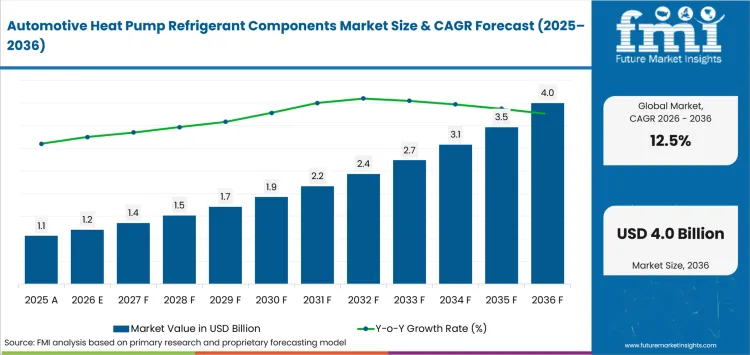
USD 1.2 billion in 2026 and USD 4.0 billion by 2036 at a 12.5% CAGR.
Demand for automotive heat pump refrigerant components are estimated to rise at 12.5% CAGR through 2036, increasing valuation from USD 1.2 billion in 2026 to USD 4.0 billion by 2036 Demand is expected to rise as electric vehicle programs are expanding spending across EV thermal systems. The International Energy Agency reported in May 2025 that global electric car sales exceeded 17 million during 2024. The 2024 vehicle base expands the number of platforms requiring pressure control and heat exchange suited to several ambient conditions. Common automotive refrigerants also need compatible seals and calibration across heating or cooling modes during operation. Reusable component families lower redesign work across related models and preserve winter range with practical workshop access.
United States programs follow federal SNAP decisions for each refrigerant; European platforms also meet fluorinated-gas restrictions through regional approval and service procedures. The U.S. Environmental Protection Agency explained in April 2026 that acceptable refrigerants carry defined use conditions for vehicle air conditioning. The defined conditions affect pressure controls and seals inside vehicle climate control systems rather than creating component demand by themselves. China-based factories can support large module runs but exported vehicles need fluid choices that satisfy destination-market rules. Engineering teams must validate hardware with control software and service instructions for every platform refrigerant. Modular architectures help manufacturers reuse proven components across regional variants and simplify automotive connectors during installation or repair.
Key Takeaways
- Electric vehicle platforms need coordinated refrigerant circuits that protect cabin comfort and battery performance without consuming excessive traction energy during winter operation.
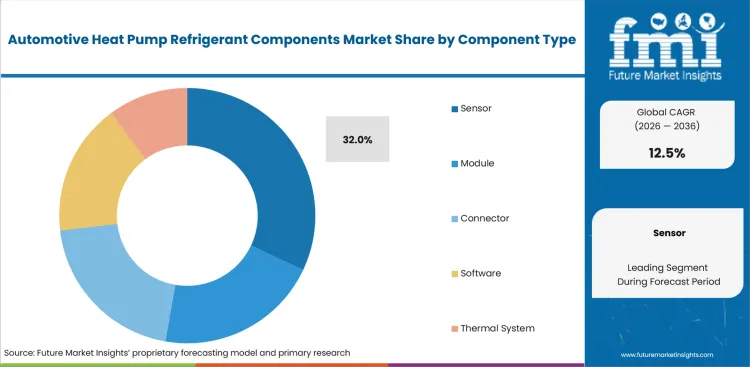
- By component type, sensor is expected to account for 32.0% share in 2026 owing to continuous pressure and temperature feedback across each operating mode.
- Passenger car is estimated to represent 27.0% share in 2026 within vehicle type due to volumes that spread validation costs across related models.
- In 2026, battery electric is forecast to capture 74.0% share by propulsion attributable to heating loads that draw directly from the traction battery.
- Fluid-specific safety rules and compact multi-loop packaging raise validation costs across regions using different refrigerants and workshop procedures.
- DENSO and Hanon Systems compete through integrated architectures; Valeo and MAHLE emphasize compact modules across high-volume vehicle platforms. Sanden focuses on compressors; Modine supplies commercial-vehicle thermal systems; Bosch and Marelli add modules or heat exchangers.
Analyst Perspective
“Automotive heat pump component decisions are shaped by two linked tests: winter range protection and safe refrigerant service across regional vehicle fleets. A compact module can shorten platform integration but it also concentrates valve and sensor failures inside one assembly. Manufacturers should compare energy performance with diagnostic access and fluid flexibility during architecture decisions spanning several vehicle models.”
- Nikhil Kaitwade, Principal Analyst, Future Market Insights
How is the automotive heat pump refrigerant components market segmented?
The automotive heat pump refrigerant components industry is segmented by component type, vehicle type, propulsion, sales channel, and region.
The market is segmented by component type, vehicle type, propulsion, sales channel, and region for detailed demand assessment. Component type covers sensors, modules, connectors, software, and complete thermal systems used across refrigerant circuits. Vehicle type separates passenger cars from commercial vehicles and two-wheelers with different duty cycles and packaging limits. Propulsion distinguishes battery electric, plug-in hybrid, fuel-cell, hybrid, and retrofit applications with different sources of usable heat. Sales channel analysis covers OEM integration, aftermarket replacement, fleet purchasing, distributors, and direct sales across the vehicle lifecycle. Regional assessment compares refrigerant rules, production networks, climate requirements, and service capability across major automotive markets.
Why does sensor lead the Component Type category?
Sensor accuracy controls compressor speed and valve position across heating or cooling modes throughout the same refrigerant circuit. MAHLE announced in July 2025 that its compact thermal management module combines a compressor and heat exchanger with pumps and temperature sensors. The architecture places measurement inside the control loop instead of treating temperature signals as passive indicators. Reliable feedback also supports fault isolation during workshop diagnosis and protects components from unsafe pressure or temperature conditions.
- By component type, sensor is estimated to hold 32.0% share in 2026 owing to continuous pressure and temperature feedback across each operating mode. Heat pump controls depend on these measurements to redirect flow and adjust compressor speed without destabilizing the circuit. The component also covers several thermal functions without the packaging cost of a complete module.
- Vehicle engineering teams increasingly specify sensors that retain accuracy across vibration and wide temperature changes. Diagnostic value provides a separate adoption benefit; workshop technicians need trustworthy signals to locate charge loss or control faults. Common sensing families reduce calibration work across related platforms and preserve fluid-specific materials together with appropriate pressure ratings.
Why does passenger car remain central to the Vehicle Type category?
Passenger platforms combine high production volumes with strict limits on cabin space and acoustic performance during low-speed electric driving. Refrigerant routing must also fit around automotive HVAC ducts and crowded body structures without creating difficult service access. Valeo announced in November 2025 that its compact five-way refrigerant valve replaces three solenoid valves and one check valve. Series production scheduled for September 2026 gives automakers a defined route from design recognition to commercial supply.
- By vehicle type, passenger car is forecast to represent 27.0% share in 2026 driven by production volumes that spread validation costs across related vehicle models. Automakers can standardize valves and heat exchangers across several trims but retain distinct refrigerant calibration for each platform. Dedicated tooling and regional compliance work become easier to justify than within lower-volume vehicle classes.
- Passenger-car developers favor compact components that preserve luggage space and limit compressor noise inside quiet electric cabins. Cold-weather testing must assess cabin heating and battery conditioning during the same drive cycle instead of using separate engineering exercises. Adoption advances through designs that balance occupant comfort with energy use and practical workshop access around tightly packaged assemblies.
How does battery electric shape demand within the Propulsion category?
Battery electric vehicles cannot rely on engine waste heat for cabin warming or battery conditioning during winter operation. Thermal loads therefore compete directly with propulsion energy across driving and charging cycles during demanding winter operation. System calibration must coordinate electric compressors with coolant pumps and vehicle control software across several operating modes. Valeo reported in September 2025 that its Smart Heat Pump manages heat exchange among the cabin and battery alongside the powertrain.
- Based on propulsion, battery electric is projected to account for 74.0% share in 2026 due to thermal loads that compete directly with available driving range. Efficient heat transfer reduces battery energy assigned to resistance heating during demanding winter operation and extended journeys. Battery electric platforms therefore provide a clearer economic case than propulsion types retaining dependable engine waste heat.
- Electric vehicle manufacturers favor integrated refrigerant components that recover ambient heat and redistribute energy from batteries or power electronics. Performance depends on calibration across charging and driving modes instead of one laboratory efficiency value. Programs spanning several vehicle sizes need scalable hardware that maintains control accuracy across different refrigerant charges and thermal loads.
How does OEM purchasing influence the Sales Channel category?
Factory integration fixes refrigerant routing and electronic interfaces during vehicle development instead of later replacement work. MAHLE reported in May 2025 that its intelligent thermal management system entered series production for Mahindra electric platforms following a twenty-four-month development program. The program shows how OEM nomination converts system validation into recurring component volume across defined vehicle models. Commercial approval also establishes diagnostic requirements and spare-part obligations across the vehicle lifecycle and related AC compressor platforms.
- The sales channel category is forecast to be led by OEM at 28.0% share in 2026 due to factory authority over platform architecture and serial component specifications. One nomination can generate repeat volume across several production years and establish requirements for later service parts. Factory purchasing therefore carries more commercial influence than channels serving vehicles with refrigerant routing already fixed.
- Automakers favor component partners that support drawing reviews and refrigerant safety validation across several engineering locations. Local production and technical assistance reduce prototype delays or regional launch risks during platform integration. Warranty reviews also examine diagnostic access and spare-part continuity; a small valve fault can interrupt cabin and battery conditioning together.
What are the drivers, restraints, and opportunities in the automotive heat pump refrigerant components market?
Electric vehicle program growth expands component demand; refrigerant safety requirements slow cross-region reuse; validated natural-refrigerant architectures create a practical route for differentiated component families.
- Driver: Electric vehicle programs increase the number of platforms requiring efficient cabin and battery heat transfer without dependable engine waste heat.
- Restraint: Fluid-specific safety rules and material compatibility requirements slow global reuse of one refrigerant circuit across vehicle programs.
- Opportunity: Natural-refrigerant systems reward companies that combine validated hardware with diagnostics and regional technician preparation.
Electric vehicle production is one of the volume drivers as every battery platform needs efficient thermal control without dependable engine waste heat. The International Energy Agency reported in May 2026 that global electric car sales exceeded 20 million during 2025. Each new platform adds valves and sensors inside modern air-conditioning systems across cabin and battery thermal loops. Component investment becomes more defensible as one validated family serves related models through calibrated variants and shared manufacturing tools across plants.
Refrigerant selection creates a material restraint through flammability rules and fluid-specific hardware requirements across major vehicle markets. Engineering teams must align seals and pressure controls with accepted refrigerants during platform validation and formal production release. The U.S. Environmental Protection Agency confirmed in April 2026 that hydrocarbon refrigerants remain unacceptable for motor vehicle air conditioning under SNAP. Global programs therefore absorb additional design and regional service work across markets permitting different refrigerant choices.
Natural refrigerants are offering an opportunity for companies able to validate complete loops and prepare technicians for distinct safety requirements. Hanon Systems reported in July 2026 that its roadmap covers R744 compressors and valves alongside developing R290 solutions. The announcement confirms that market access depends on compatible hardware together with dependable diagnostics and service procedures. Companies coordinating releases with thermal-service networks can reduce launch risk across regional vehicle programs and later maintenance.
Which country CAGRs are profiled in the automotive heat pump refrigerant components market?
| Country | CAGR |
|---|---|
| India | 16.9% |
| China | 15.6% |
| South Korea | 14.4% |
| United States | 13.1% |
| Germany | 11.9% |
| Japan | 10.6% |
How do country-level CAGRs compare in the automotive heat pump refrigerant components market?
The country forecast spans 6.3 percentage points from India to Japan and forms a measured progression rather than separate adoption tiers. India and China differ by 1.3 points as domestic vehicle programs expand component qualification activity. South Korea remains 1.2 points below China and the United States follows by another 1.3 points. Germany trails the United States by 1.2 points and Japan remains another 1.3 points lower. The balanced spacing reflects differences in platform conversion and local validation work instead of unequal engineering capability.
- India combines domestic manufacturing requirements with varied climate exposure that demands locally validated heat pump components across several vehicle classes.
- China converts large new-energy vehicle volumes into component scale but export programs require refrigerant choices suited to several destination markets.
- South Korea benefits from concentrated vehicle development and advanced component engineering although qualification depends on a limited group of global programs.
- The United States offers defined federal refrigerant listings; model-year and vehicle-class conditions complicate one common component portfolio across sales channels.
- Germany combines established automotive engineering with detailed documentation requirements that favor proven components during refrigerant transitions.
- Japan draws on extensive hybrid experience but gradual battery electric adoption moderates near-term expansion for dedicated heat pump circuits.
Comparable growth rates can produce materially different entry conditions across national refrigerant choices and established propulsion mixes. Component companies must align validation and service plans with each national platform base instead of treating forecast similarity as commercial equivalence. The full report provides country-level CAGR analysis across North America and Latin America with separate national operating conditions. Coverage also extends across Europe and East Asia together with South Asia and Oceania for broader regional comparison. The regional framework includes the Middle East and Africa to complete the global assessment of commercial entry conditions.
Country-wise Analysis
- India links electric vehicle incentives with domestic manufacturing rules that influence component sourcing and qualification routes. India's automotive heat pump refrigerant components outlook is anticipated to advance at 16.9% CAGR over the assessment period, shaped by a larger locally assembled electric vehicle base. The Press Information Bureau reported in December 2025 that India registered 1.968 million electric vehicles during fiscal 2024-25 with 7.50% penetration. PM E-DRIVE manufacturing requirements support nearby engineering and production capacity for specified electric vehicle components. Wide temperature ranges and uneven specialist service coverage complicate precise refrigerant charging and leak diagnosis outside major manufacturing centers. Price-sensitive programs also need modular components that control tooling costs without weakening refrigerant safety across several vehicle models. Component companies should pair local validation with technician training during wider nomination expansion across several vehicle classes.
- China concentrates new-energy vehicle production across large factories that can aggregate refrigerant component demand among related models. The State Council reported in January 2026 that new-energy vehicle sales reached 16.49 million units during 2025. Automotive heat pump refrigerant component sales in China are forecast to expand at 15.6% CAGR by 2036, linked to rapid platform refresh cycles and concentrated vehicle production. Large production runs enable integrated valves and sensors to spread tooling costs across several platforms. Export programs face different refrigerant rules and service documentation across destination markets and launch schedules. Local engineering teams must manage those regional variants without rebuilding the complete thermal circuit during platform development. Manufacturers entering China need nearby production capacity and disciplined change control across exported vehicle programs.
- South Korea combines concentrated vehicle manufacturing with strong domestic capability in batteries and thermal controls. Adoption of automotive heat pump refrigerant components in South Korea is estimated to expand at 14.4% CAGR through 2036, supported by electrified vehicle programs and advanced thermal engineering. The Ministry of Trade, Industry and Energy reported in June 2025 that eco-friendly vehicles represented 52.0% of domestic vehicle sales during May. Concentrated engineering programs provide a direct enabler for integrated heat pump validation across local vehicle platforms. Export programs face material friction from refrigerant approvals and workshop procedures that differ across destination markets and vehicle classes. Component developers need adaptable materials and calibration support that travel with each exported vehicle program.
- United States vehicle programs operate under federal refrigerant rules that separate new production requirements from servicing existing systems. The United States automotive heat pump refrigerant components sector is projected to record 13.1% CAGR during the assessment period, attributable to defined federal refrigerant routes for new vehicle platforms. The U.S. Environmental Protection Agency updated its substitute listings in March 2026 for new vehicle classes and existing service routes. Federal use conditions give engineering teams a clear basis for refrigerant selection and pressure-control validation. Model-year differences and legacy service requirements complicate one component set across factory and aftermarket channels. Programs need separate validation plans for new platforms and replacement support across older refrigerant systems.
- Germany combines premium vehicle engineering with formal refrigerant compliance and demanding winter performance expectations across passenger fleets. Battery electric vehicle registrations increased during 2025 but remained a minority of total passenger-car demand. Germany’s automotive heat pump refrigerant components market is estimated to post 11.9% CAGR over the forecast period, aided by continued electric platform replacement and detailed component validation. Statistisches Bundesamt reported in January 2026 that battery electric vehicles accounted for 19.1% of new passenger-car registrations during 2025. Germany’s engineering base supports precise component integration and winter testing across premium passenger vehicle platforms and regional model variants. Household income differences and uneven charging access create material friction for broader electric vehicle adoption across less connected regions. Component companies should balance energy efficiency with serviceable layouts and documented refrigerant compliance across national workshop networks.
- Japan uses electrified powertrains extensively but retains a large hybrid base with heat recovery options unavailable to fully electric vehicles. Automotive heat pump refrigerant components demand in Japan is forecast to rise at 10.6% CAGR over the forecast period, reinforced by gradual battery electric expansion within an established electrified fleet. The Agency for Natural Resources and Energy reported in June 2025 that electrified vehicles represented 57% of new passenger-car sales during 2024. Hybrid engineering experience provides a practical enabler through mature thermal controls and established national service practices. Different heat recovery routes create friction for one common heat pump configuration across propulsion types. Component developers should offer scalable valves and sensors that preserve quiet operation and compact packaging across several thermal architectures.
Who are the notable companies in the automotive heat pump refrigerant components market?
DENSO, Valeo, MAHLE, Hanon Systems, Sanden, Bosch, Modine, and Marelli are active companies within this market.
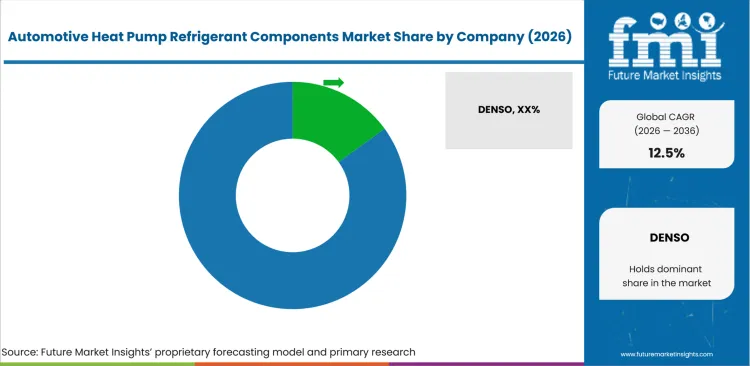
Competition outlook companies offering complete heat pump architectures from specialists focused on compressors and valves alongside refrigerant heat exchangers. Hanon Systems became a Hankook & Company Group subsidiary through a completed acquisition in January 2025. Modine’s fiscal 2026 Form 10-K confirms current battery thermal management systems and chillers for on-highway zero-emission vehicles. DENSO and Hanon Systems cover broad thermal architectures with coordinated controls for serial vehicle programs. Valeo and MAHLE emphasize compact modules that reduce refrigerant interfaces across high-volume passenger vehicle platforms. Sanden focuses on electric compressors and integrated systems for demanding vehicle applications; Modine supplies commercial-fleet chillers and battery thermal systems suited to harsh duty cycles. Bosch and Marelli add integrated modules or specialized heat exchangers for passenger vehicle platform development.
- DENSO and Hanon Systems connect refrigerant hardware with vehicle controls across integrated thermal architectures for serial production. Automakers assess calibration support and stable operation across several drive modes during regional vehicle validation. Engineering coverage across launch countries also supports fault diagnosis and warranty decisions throughout later service periods.
- Valeo and MAHLE package valves or thermal modules within limited installation space across high-volume passenger vehicle platforms. Engineering teams compare interface reduction with refrigerant flexibility across related models during platform design reviews. Documented serial supply strengthens commercial credibility throughout manufacturing approval and long-term component sourcing decision cycles.
- Sanden emphasizes compressor and integrated-system performance across demanding vehicle duty cycles and harsh operating environments. Modine supplies chillers and battery thermal systems that support demanding commercial electric vehicle duty cycles across regional fleets. Bosch and Marelli add control integration or specialized heat exchangers within passenger vehicle platform programs. Engineering teams compare exact vehicle evidence with technical support coverage across each planned launch country.
Competitive Benchmarking: Automotive Heat Pump Refrigerant Components Market
| Company | Refrigerant Component Breadth | Integrated Heat Pump Engineering | Documented Commercial Activity | Geographic Reach |
|---|---|---|---|---|
| DENSO | High | High | Medium | Global |
| Valeo | High | High | High | Global |
| MAHLE | High | High | High | Global |
| Hanon Systems | High | High | High | Global |
| Sanden | High | High | High | Global |
| Bosch | Medium | High | Medium | Global |
| Modine | Medium | Medium | Medium | North America and Europe |
| Marelli | Medium | Medium | Medium | Global |
Scoring basis: Refrigerant Component Breadth is High for at least three verified circuit families spanning compressors and valves together with sensors or heat exchangers. Medium covers two current component families within the exact market and Low denotes one narrowly defined family with verified commercial activity. Integrated Heat Pump Engineering is High for a complete module coordinating refrigerant and coolant control. Medium covers documented subsystem integration within a vehicle program and Low denotes standalone hardware without an integrated module. Documented Commercial Activity is High for named serial supply or a production milestone during 2025-2026. Medium covers a current customer-development or launch pathway and Low denotes verified pre-series activity without serial supply. Geographic Reach records verified operating coverage across active markets without applying High or Medium capability ratings.
Key Developments in the Automotive Heat Pump Refrigerant Components Market
- In September 2025, Hanon Systems reported that cumulative production of its R744 electric compressors exceeded one million units. The Portugal plant supplies Volkswagen Group electric platforms and provides serial evidence for carbon-dioxide refrigerant hardware. Vehicle programs evaluating R744 heat pumps therefore gain a proven compressor supply route supported by documented serial production. The milestone also increases the value of compatible valves and service procedures across later platform nominations.
- In April 2026, Marelli announced a high-performance chiller for electric vehicle battery thermal management at Auto China. Its compact internal-fin design improves heat transfer and supports uniform refrigerant flow inside limited installation space. Vehicle programs gain another heat exchanger option for high charging loads and tightly packaged platforms. Commercial evaluation must connect thermal capacity with control requirements and verified vehicle-level packaging data during nomination reviews.
- In May 2026, Sanden initiated customer co-development of a next-generation R290-compatible integrated thermal management system in China. The program places propane refrigerant engineering inside a customer-linked development route rather than a general technology display. Vehicle manufacturers gain earlier influence over packaging and control requirements for future electric platforms and validation schedules. Commercial progress requires verified safety performance and practical service procedures under local workshop conditions during production launches.
- In September 2025, Bosch presented preintegrated thermal management modules using propane refrigerant at IAA Mobility. The architecture combines electric refrigerant compressors with coolant pumps to reduce interfaces and installation work. Vehicle manufacturers gain a system-level option for battery conditioning and cabin heating across electrified platforms. Final nomination requires refrigerant compatibility and packaging evidence across the intended climate range and vehicle architecture.
Automotive Heat Pump Refrigerant Components Market - Report Scope
| Coverage field | Report scope |
|---|---|
| Market breakdown | Component type, vehicle type, propulsion, sales channel, and region. |
| Quantitative Units | USD Million, CAGR in %. |
| Market Definition | Commercial demand for refrigerant circuit components used within automotive heat pump and integrated thermal management systems. |
| Regions Covered | North America, Latin America, Western Europe, Eastern Europe, East Asia, South Asia and Pacific, and Middle East and Africa. |
| Countries Covered | India, China, South Korea, United States, Germany, Japan, and 30+ countries. |
| Key Companies Profiled | DENSO, Valeo, MAHLE, Hanon Systems, Sanden, Bosch, Modine, and Marelli. |
| Forecast Period | 2026 to 2036. |
| Approach | Hybrid bottom-up and top-down market sizing supported by primary interviews and official desk research. |
Automotive Heat Pump Refrigerant Components Market - Research Methodology
| Method | Approach |
|---|---|
| Primary Research | FMI analysts gathered input from manufacturers, service providers, technology developers, distributors, end users, procurement teams, and subject-matter experts. Interviews examined purchasing decisions, product or service evaluation, adoption barriers, approval requirements, pricing considerations, and expectations for technical or commercial support. Respondents were also asked what evidence is required before a trial, pilot, or initial order develops into regular purchasing. |
| Desk Research | Desk research covered government statistics, regulatory publications, trade data, industry associations, technical literature, standards, company filings, product information, and official corporate announcements. Sources were reviewed for relevance, publication date, geographic coverage, and consistency with the defined market scope. Claims relating to performance, applications, approvals, capacity, investment, and commercial activity were retained only when supported by credible public evidence. |
| Market Sizing and Forecasting | The market model combined the baseline value with historical performance, segment structure, pricing and volume indicators, adoption levels, company participation, and country-level demand conditions. Forecast assumptions considered economic activity, investment trends, regulatory developments, technology adoption, purchasing cycles, supply availability, and barriers to wider market use. Segment and regional estimates were reconciled before the final market total was calculated. |
| Data Validation | Estimates were checked against multiple independent indicators, including public data, company activity, trade patterns, industry developments, and findings from primary interviews. Validation also tested whether products, services, applications, and company revenues fell within the defined market boundaries. Adjacent categories, unsupported claims, overlapping revenues, and activities without direct market relevance were excluded to reduce double counting and maintain consistency across segments and countries. |
Automotive Heat Pump Refrigerant Components Market by Segments
Automotive Heat Pump Refrigerant Components Market segmented by Component Type:
- Sensor
- Module
- Connector
- Software
- Thermal System
Automotive Heat Pump Refrigerant Components Market segmented by Vehicle Type:
- Passenger Car
- Light Commercial Vehicle
- Heavy Truck
- Two Wheeler
- Bus
Automotive Heat Pump Refrigerant Components Market segmented by Propulsion:
- Battery Electric
- Plug-in Hybrid
- Fuel Cell
- Hybrid
- ICE Retrofit
Automotive Heat Pump Refrigerant Components Market segmented by Sales Channel:
- OEM
- Aftermarket
- Fleet Operators
- Distributors
- Direct Sales
Research Sources and Bibliography
- International Energy Agency. (2025, May 14). Global EV Outlook 2025.
- U.S. Environmental Protection Agency. (2026, April 28). Acceptable Refrigerants and their Impacts.
- MAHLE. (2025, July 23). MAHLE goes full speed ahead with decarbonization.
- Valeo. (2025, November 6). Valeo Named as CES Innovation Awards® 2026 Honoree for its Compact 5-Ways Refrigerant Valve for Next-Generation Electric Vehicles’ Heat Pump Systems.
- Valeo. (2025, September 8). Valeo at the heart of tomorrow’s mobility | IAA Mobility 2025.
- MAHLE. (2025, May 15). MAHLE India Receives Award for Intelligent Thermal Management System.
- International Energy Agency. (2026, May 20). Global EV Outlook 2026.
- U.S. Environmental Protection Agency. (2026, April 9). Questions and Answers About the Safety Risks of Using Hydrocarbons (HCs) in Motor Vehicle Air Conditioners (MVACs).
- Hanon Systems. (2026, July 6). Hanon Systems Publishes White Paper on Next-Generation PFAS-Free Natural Refrigerant Technologies.
- Press Information Bureau. (2025, December 9). INCENTIVES FOR ELECTRIC VEHICLES.
- State Council of the People’s Republic of China. (2026, January 14). China’s auto output, sales reach new highs in 2025.
- Ministry of Trade, Industry and Energy. (2025, June 17). Eco-friendly auto sales surpass conventional cars in May.
- U.S. Environmental Protection Agency. (2026, March 19). Substitutes in MVAC: Passenger Air Conditioning in Light-Duty, Medium-Duty, Heavy-Duty and Off-Road Vehicles.
- Statistisches Bundesamt. (2026, January 22). E-Autos und Plug-in-Hybride: Ausstattung in Haushalten hängt stark vom Einkommen ab.
- Agency for Natural Resources and Energy. (2025, June).
- Hanon Systems. (2025, January 6). Hankook & Company Group Completes Acquisition of Hanon Systems.
- Modine Manufacturing Company. (2026, May 27). Fiscal 2026 Annual Report on Form 10-K.
- Hanon Systems. (2025, September 16). Hanon Systems Production of Eco-Friendly R744 Electric Compressors Surpasses 1 Million Units.
- Marelli. (2026, April 20). Marelli to showcase propulsion and thermal innovations supporting powertrain evolution at Auto China 2026.
- Sanden Corporation. (2026, May 15). Sanden Initiates Its First Customer Co-Creation-Based Advanced Development of Next-Generation ITMS (R290-Compatible) in the China Market.
- Robert Bosch GmbH. (2025, September 2). Bosch überzeugt mit einem umfassenden Portfolio für die softwaregetriebene Mobilität.
- DENSO Corporation. (2025, January 20). DENSO Exhibits at Bharat Mobility Global Expo 2025, New Delhi.
This bibliography is provided for reader reference and is not exhaustive. The full report contains the complete reference list and detailed citations
This Report Answers
- How large is the automotive heat pump refrigerant components market in 2026 and 2036?
- Which operating conditions support investment in refrigerant valves and thermal control sensors?
- Why does sensor account for a notable component type share in 2026?
- How do passenger-car packaging requirements influence heat pump component selection?
- Why does battery electric create the largest propulsion share in 2026?
- How do country growth rates differ across India, China, South Korea, the United States, Germany, and Japan?
- Which companies supply integrated modules or specialized refrigerant components?
- What limits reuse of one refrigerant architecture across major vehicle markets?
- How should OEM teams evaluate validation support and long-term service readiness?
Frequently Asked Questions
How big is the Automotive Heat Pump Refrigerant Components Market in 2026?
The automotive heat pump refrigerant components market is valued at USD 1.2 billion in 2026 and reaches USD 4.0 billion by 2036. The International Energy Agency reported global electric car sales exceeding 17 million units during 2024, expanding the number of platforms requiring pressure control and heat exchange components across heating and cooling modes.
What is the CAGR of the Automotive Heat Pump Refrigerant Components Market from 2026 to 2036?
At 12.5% CAGR, the automotive heat pump refrigerant components market grows from USD 1.2 billion in 2026 to USD 4.0 billion by 2036. Battery electric vehicle programs require efficient cabin and battery heat transfer without engine waste heat, as automakers nominate component families demonstrating calibration accuracy, regional refrigerant compliance, and workshop serviceability.
Which component type leads the Automotive Heat Pump Refrigerant Components Market?
Sensors hold 32.0% share of the automotive heat pump refrigerant components market by component type in 2026, backed by continuous pressure and temperature feedback across each operating mode. Heat pump controls depend on these measurements to redirect flow and adjust compressor speed, while diagnostic value helps workshop technicians locate charge loss or control faults.
How much will the Automotive Heat Pump Refrigerant Components Market add between 2026 and 2036?
USD 2.8 billion will be added to the automotive heat pump refrigerant components market between 2026 and 2036, growing from USD 1.2 billion to USD 4.0 billion. Integrated thermal management modules, natural-refrigerant circuit hardware, and scalable valve and sensor families enter serial production across passenger car and commercial electric vehicle programs in six profiled countries.
Who are the leading companies in the Automotive Heat Pump Refrigerant Components Market?
Eight companies shape the automotive heat pump refrigerant components market, including DENSO, Valeo, MAHLE, Hanon Systems, Sanden, Bosch, Modine, and Marelli. Competition centers on integrated thermal architectures, compact multi-function valve modules, electric compressor portfolios covering R744 and R290 refrigerants, and specialized heat exchangers serving passenger car and commercial electric vehicle programs across global service networks.
Preview the report firsthand - request a free sample
Get SampleGet the brochure for pricing and purchase details.
Get PDFTable of Content
- Key Takeaways
- Market Size and CAGR
- Top Growth Driver
- Fastest Growing Segment
- Leading Region
- Key Companies
- Emerging Opportunities
- Executive Summary
- Global Market Outlook
- Demand-side Trends
- Supply-side Trends
- Technology Roadmap Analysis
- Analysis and Recommendations
- Analyst Perspective (What is happening? Why now? What should investors know?)
- Key Questions Answered
- How large is the market?
- What is the CAGR?
- What are key trends?
- Which region dominates?
- Who are the leaders?
- Market Overview
- Market Coverage / Taxonomy
- Market Definition / Scope / Limitations
- Research Methodology
- Chapter Orientation
- Analytical Lens and Working Hypotheses
- Market Structure, Signals, and Trend Drivers
- Benchmarking and Cross-market Comparability
- Market Sizing, Forecasting, and Opportunity Mapping
- Research Design and Evidence Framework
- Desk Research Programme (Secondary Evidence)
- Expert Input and Fieldwork (Primary Evidence)
- Tooling, Models, and Reference Databases
- Data Engineering and Model Build
- Quality Assurance and Audit Trail
- Market Background
- Market Dynamics (Drivers, Restraints, Opportunity, Trends)
- Scenario Forecast (Optimistic, Likely, Conservative)
- Impact Analysis
- AI Impact
- Sustainability Impact
- Regulatory Impact
- Technology Impact
- Consumer / Buyer Analysis
- Purchase Drivers
- Adoption Barriers
- Buyer Journey
- Opportunity Map Analysis
- Product Life Cycle Analysis
- Supply Chain Analysis
- Investment Feasibility Matrix
- Value Chain Analysis
- PESTLE and Porter's Analysis
- Regulatory Landscape
- Regional Parent Market Outlook
- Production and Consumption Statistics
- Import and Export Statistics
- Global Market Analysis and Forecast, 2021 to 2036
- Historical Market Size Value (USD Billion) Analysis, 2021 to 2025
- Current and Future Market Size Value (USD Billion) Projections, 2026 to 2036
- Y-o-Y Growth Trend Analysis
- Absolute $ Opportunity Analysis
- Global Market Pricing Analysis, 2021 to 2036
- Global Market Analysis and Forecast, By Component Type, 2021 to 2036
- Introduction / Key Findings
- Historical Market Size Value (USD Billion) Analysis By Component Type, 2021 to 2025
- Current and Future Market Size Value (USD Billion) Analysis and Forecast By Component Type, 2026 to 2036
- Sensor
- Module
- Connector
- Software
- Thermal System
- Sensor
- Y-o-Y Growth Trend Analysis By Component Type, 2021 to 2025
- Absolute $ Opportunity Analysis By Component Type, 2026 to 2036
- Global Market Analysis and Forecast, By Vehicle Type, 2021 to 2036
- Introduction / Key Findings
- Historical Market Size Value (USD Billion) Analysis By Vehicle Type, 2021 to 2025
- Current and Future Market Size Value (USD Billion) Analysis and Forecast By Vehicle Type, 2026 to 2036
- Passenger Car
- Light Commercial Vehicle
- Heavy Truck
- Two Wheeler
- Bus
- Passenger Car
- Y-o-Y Growth Trend Analysis By Vehicle Type, 2021 to 2025
- Absolute $ Opportunity Analysis By Vehicle Type, 2026 to 2036
- Global Market Analysis and Forecast, By Propulsion, 2021 to 2036
- Introduction / Key Findings
- Historical Market Size Value (USD Billion) Analysis By Propulsion, 2021 to 2025
- Current and Future Market Size Value (USD Billion) Analysis and Forecast By Propulsion, 2026 to 2036
- Battery Electric
- Plug-in Hybrid
- Fuel Cell
- Hybrid
- ICE Retrofit
- Battery Electric
- Y-o-Y Growth Trend Analysis By Propulsion, 2021 to 2025
- Absolute $ Opportunity Analysis By Propulsion, 2026 to 2036
- Global Market Analysis and Forecast, By Sales Channel, 2021 to 2036
- Introduction / Key Findings
- Historical Market Size Value (USD Billion) Analysis By Sales Channel, 2021 to 2025
- Current and Future Market Size Value (USD Billion) Analysis and Forecast By Sales Channel, 2026 to 2036
- OEM
- Tier 1
- Aftermarket
- Fleet Retrofit
- Charging Network
- OEM
- Y-o-Y Growth Trend Analysis By Sales Channel, 2021 to 2025
- Absolute $ Opportunity Analysis By Sales Channel, 2026 to 2036
- Global Market Analysis and Forecast, By Region, 2021 to 2036
- Introduction
- Historical Market Size Value (USD Billion) Analysis By Region, 2021 to 2025
- Current Market Size Value (USD Billion) Analysis and Forecast By Region, 2026 to 2036
- North America
- Latin America
- Western Europe
- Eastern Europe
- East Asia
- South Asia and Pacific
- Middle East & Africa
- Market Attractiveness Analysis By Region
- North America Market Analysis and Forecast, By Country, 2021 to 2036
- Historical Market Size Value (USD Billion) Trend Analysis By Market Taxonomy, 2021 to 2025
- Market Size Value (USD Billion) Forecast By Market Taxonomy, 2026 to 2036
- By Country
- USA
- Canada
- By Component Type
- By Vehicle Type
- By Propulsion
- By Sales Channel
- By Country
- Market Attractiveness Analysis
- By Country
- By Component Type
- By Vehicle Type
- By Propulsion
- By Sales Channel
- Key Takeaways
- Latin America Market Analysis and Forecast, By Country
- Historical Market Size Value (USD Billion) Trend Analysis By Market Taxonomy, 2021 to 2025
- Market Size Value (USD Billion) Forecast By Market Taxonomy, 2026 to 2036
- By Country
- Brazil
- Mexico
- Chile
- Rest of Latin America
- By Component Type
- By Vehicle Type
- By Propulsion
- By Sales Channel
- By Country
- Market Attractiveness Analysis
- By Country
- By Component Type
- By Vehicle Type
- By Propulsion
- By Sales Channel
- Key Takeaways
- Western Europe Market Analysis and Forecast, By Country
- Historical Market Size Value (USD Billion) Trend Analysis By Market Taxonomy, 2021 to 2025
- Market Size Value (USD Billion) Forecast By Market Taxonomy, 2026 to 2036
- By Country
- Germany
- UK
- Italy
- Spain
- France
- Nordic
- BENELUX
- Rest of Western Europe
- By Component Type
- By Vehicle Type
- By Propulsion
- By Sales Channel
- By Country
- Market Attractiveness Analysis
- By Country
- By Component Type
- By Vehicle Type
- By Propulsion
- By Sales Channel
- Key Takeaways
- Eastern Europe Market Analysis and Forecast, By Country
- Historical Market Size Value (USD Billion) Trend Analysis By Market Taxonomy, 2021 to 2025
- Market Size Value (USD Billion) Forecast By Market Taxonomy, 2026 to 2036
- By Country
- Russia
- Poland
- Hungary
- Balkan & Baltic
- Rest of Eastern Europe
- By Component Type
- By Vehicle Type
- By Propulsion
- By Sales Channel
- By Country
- Market Attractiveness Analysis
- By Country
- By Component Type
- By Vehicle Type
- By Propulsion
- By Sales Channel
- Key Takeaways
- East Asia Market Analysis and Forecast, By Country
- Historical Market Size Value (USD Billion) Trend Analysis By Market Taxonomy, 2021 to 2025
- Market Size Value (USD Billion) Forecast By Market Taxonomy, 2026 to 2036
- By Country
- China
- Japan
- South Korea
- By Component Type
- By Vehicle Type
- By Propulsion
- By Sales Channel
- By Country
- Market Attractiveness Analysis
- By Country
- By Component Type
- By Vehicle Type
- By Propulsion
- By Sales Channel
- Key Takeaways
- South Asia and Pacific Market Analysis and Forecast, By Country
- Historical Market Size Value (USD Billion) Trend Analysis By Market Taxonomy, 2021 to 2025
- Market Size Value (USD Billion) Forecast By Market Taxonomy, 2026 to 2036
- By Country
- India
- ASEAN
- Australia & New Zealand
- Rest of South Asia and Pacific
- By Component Type
- By Vehicle Type
- By Propulsion
- By Sales Channel
- By Country
- Market Attractiveness Analysis
- By Country
- By Component Type
- By Vehicle Type
- By Propulsion
- By Sales Channel
- Key Takeaways
- Middle East & Africa Market Analysis and Forecast, By Country
- Historical Market Size Value (USD Billion) Trend Analysis By Market Taxonomy, 2021 to 2025
- Market Size Value (USD Billion) Forecast By Market Taxonomy, 2026 to 2036
- By Country
- Kingdom of Saudi Arabia
- Other GCC Countries
- Türkiye
- South Africa
- Other African Union
- Rest of Middle East & Africa
- By Component Type
- By Vehicle Type
- By Propulsion
- By Sales Channel
- By Country
- Market Attractiveness Analysis
- By Country
- By Component Type
- By Vehicle Type
- By Propulsion
- By Sales Channel
- Key Takeaways
- Key Countries Market Analysis
- USA
- Pricing Analysis
- Market Share Analysis, 2025
- By Component Type
- By Vehicle Type
- By Propulsion
- By Sales Channel
- Canada
- Pricing Analysis
- Market Share Analysis, 2025
- By Component Type
- By Vehicle Type
- By Propulsion
- By Sales Channel
- Mexico
- Pricing Analysis
- Market Share Analysis, 2025
- By Component Type
- By Vehicle Type
- By Propulsion
- By Sales Channel
- Brazil
- Pricing Analysis
- Market Share Analysis, 2025
- By Component Type
- By Vehicle Type
- By Propulsion
- By Sales Channel
- Chile
- Pricing Analysis
- Market Share Analysis, 2025
- By Component Type
- By Vehicle Type
- By Propulsion
- By Sales Channel
- Germany
- Pricing Analysis
- Market Share Analysis, 2025
- By Component Type
- By Vehicle Type
- By Propulsion
- By Sales Channel
- UK
- Pricing Analysis
- Market Share Analysis, 2025
- By Component Type
- By Vehicle Type
- By Propulsion
- By Sales Channel
- Italy
- Pricing Analysis
- Market Share Analysis, 2025
- By Component Type
- By Vehicle Type
- By Propulsion
- By Sales Channel
- Spain
- Pricing Analysis
- Market Share Analysis, 2025
- By Component Type
- By Vehicle Type
- By Propulsion
- By Sales Channel
- France
- Pricing Analysis
- Market Share Analysis, 2025
- By Component Type
- By Vehicle Type
- By Propulsion
- By Sales Channel
- India
- Pricing Analysis
- Market Share Analysis, 2025
- By Component Type
- By Vehicle Type
- By Propulsion
- By Sales Channel
- ASEAN
- Pricing Analysis
- Market Share Analysis, 2025
- By Component Type
- By Vehicle Type
- By Propulsion
- By Sales Channel
- Australia & New Zealand
- Pricing Analysis
- Market Share Analysis, 2025
- By Component Type
- By Vehicle Type
- By Propulsion
- By Sales Channel
- China
- Pricing Analysis
- Market Share Analysis, 2025
- By Component Type
- By Vehicle Type
- By Propulsion
- By Sales Channel
- Japan
- Pricing Analysis
- Market Share Analysis, 2025
- By Component Type
- By Vehicle Type
- By Propulsion
- By Sales Channel
- South Korea
- Pricing Analysis
- Market Share Analysis, 2025
- By Component Type
- By Vehicle Type
- By Propulsion
- By Sales Channel
- Russia
- Pricing Analysis
- Market Share Analysis, 2025
- By Component Type
- By Vehicle Type
- By Propulsion
- By Sales Channel
- Poland
- Pricing Analysis
- Market Share Analysis, 2025
- By Component Type
- By Vehicle Type
- By Propulsion
- By Sales Channel
- Hungary
- Pricing Analysis
- Market Share Analysis, 2025
- By Component Type
- By Vehicle Type
- By Propulsion
- By Sales Channel
- Kingdom of Saudi Arabia
- Pricing Analysis
- Market Share Analysis, 2025
- By Component Type
- By Vehicle Type
- By Propulsion
- By Sales Channel
- Türkiye
- Pricing Analysis
- Market Share Analysis, 2025
- By Component Type
- By Vehicle Type
- By Propulsion
- By Sales Channel
- South Africa
- Pricing Analysis
- Market Share Analysis, 2025
- By Component Type
- By Vehicle Type
- By Propulsion
- By Sales Channel
- USA
- Market Structure Analysis
- Competition Dashboard
- Competition Benchmarking
- Market Share Analysis of Top Players
- By Regional
- By Component Type
- By Vehicle Type
- By Propulsion
- By Sales Channel
- Emerging Startups
- Innovation Benchmarking
- Competition Analysis
- Competition Deep Dive
- DENSO
- Overview
- Product Portfolio
- Profitability by Market Segments
- Sales Footprint
- Strategy Overview
- Marketing Strategy
- Product Strategy
- Channel Strategy
- Valeo
- MAHLE
- Hanon Systems
- Sanden
- Bosch
- Modine
- Marelli
- DENSO
- Case Studies
- Success Stories
- Recent Developments
- Competition Deep Dive
- Assumptions & Acronyms Used


