

- Industry Size (2026)
- USD 1.8 Bn
- Forecast (2036)
- USD 4.3 Bn
- CAGR (2026 to 2036)
- 9.6%
Air Circulation and Filtration Systems for CEA Market Forecast and Outlook 2026 to 2036
The air circulation and filtration systems for CEA market is likely to be valued at USD 1.8 billion in 2026 and is projected to reach USD 4.5 billion by 2036, reflecting a CAGR of 9.6%. Early demand is shaped by crop loss prevention strategies rather than by capacity expansion alone. Operators design airflow patterns to control humidity pockets, spore movement, and temperature layering across stacked growing areas. Equipment sizing depends on room geometry and planting density, which fixes fan counts and filter stages at the layout stage. Purchasing decisions focus on reliability, cleaning access, and containment performance more than on upfront equipment cost.
As the period advances, demand patterns reflect tighter biosecurity protocols and more formal operating procedures. Facilities begin to standardize airflow modules and filtration stages across sites to simplify maintenance and training. Retrofit activity grows as early installations are rebalanced for higher density or different crop types. Supplier switching remains limited because airflow systems are integrated into building management and crop control routines. Pricing pressure exists, yet performance specifications set firm limits. Capacity planning follows regional build programs and operator consolidation rather than short term fluctuations in planting volumes.
Quick Stats of the Air Circulation and Filtration Systems for CEA Market
- Air Circulation and Filtration Systems for CEA Market Value (2026): USD 1.8 billion
- Air Circulation and Filtration Systems for CEA Forecast Value (2036): USD 4.5 billion
- Air Circulation and Filtration Systems for CEA Forecast CAGR 2026 to 2036: 9.6%
- Leading System Type in Air Circulation and Filtration Systems for CEA Market: Air Handling Units (34 % share)
- Leading Contaminant Focus in Air Circulation and Filtration Systems for CEA Market: Particulate/Dust Control (38 % share)
- Key Growth Regions in Air Circulation and Filtration Systems for CEA Market: India, China, USA, South Korea, Japan
- Top Players in Air Circulation and Filtration Systems for CEA Market: Munters, Camfil, AAF International, Pall (Danaher), Donaldson, Daikin, Johnson Controls, Carrier, Trane Technologies, Honeywell
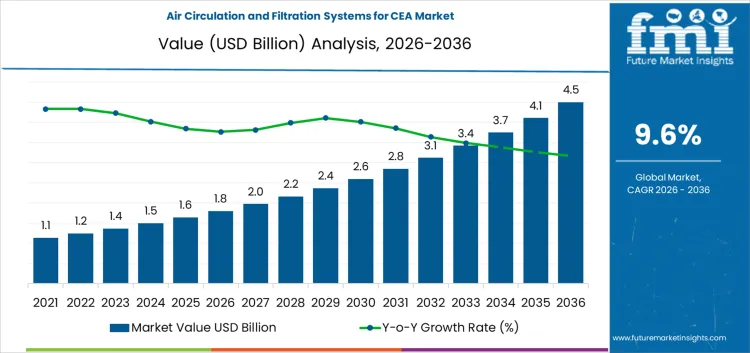
What is the Growth Forecast for Air Circulation and Filtration Systems for CEA Market through 2036?
Between 2026 and 2031, the air circulation and filtration systems for CEA market is projected to grow from USD 1.8 billion along a trajectory consistent with a 9.6% CAGR, reflecting a shift in controlled-environment agriculture from simple climate control toward contamination risk management. As plant densities increase, airflow design becomes a biological control tool, not just a comfort parameter. Facilities invest in air handling units and filtration modules to manage spores, dust, and moisture-driven disease vectors that can spread rapidly in closed spaces. Spending decisions are therefore tied to crop loss prevention rather than to energy optimization alone. Early adopters prioritize system layouts that can be validated and cleaned easily, which shapes equipment selection and integration strategies.
From 2031 to 2036, the market is expected to reach USD 4.3 billion, with expansion driven by professionalization and scaling of indoor farming operations. Larger operators begin to treat air management as part of standard operating protocols rather than as project-specific engineering. This increases replication of proven system designs across sites, lifting equipment volumes per operator. HEPA and pathogen-control modules gain relevance in nurseries and high-value crops, where biosecurity failures carry disproportionate financial risk. Procurement increasingly runs through integrators and EPC partners who bundle airflow systems into facility packages. Competitive strength depends on filtration performance credibility, system engineering support, and service infrastructure, benefiting suppliers such as Munters, Camfil, AAF International, Pall (Danaher), Donaldson, Daikin, Johnson Controls, Carrier, Trane Technologies, and Honeywell.
Air Circulation and Filtration Systems for CEA Market Key Takeaways
| Metric | Value |
|---|---|
| Market Value (2026) | USD 1.8 billion |
| Forecast Value (2036) | USD 4.5 billion |
| Forecast CAGR 2026 to 2036 | 9.6% |
How Are Air Circulation and Filtration Systems Supporting Controlled-Environment Agriculture?
Air circulation and filtration systems for controlled-environment agriculture (CEA) are increasingly adopted to maintain uniform airflow, manage humidity, and reduce airborne contaminants in indoor farming environments. Historically, farms relied on basic fans or passive ventilation, which caused uneven microclimates, increased disease risk, and reduced crop quality. Modern systems integrate high-efficiency filters, variable-speed fans, and automated airflow management to optimize plant health, control pathogens, and improve energy efficiency. Greenhouse operators, vertical farming companies, and indoor agriculture technology providers prioritize air quality, system reliability, and ease of integration with environmental controls. Early adoption focused on high-value crops and research facilities, while current demand spans commercial vertical farms, hydroponics, and large-scale greenhouses, driven by productivity optimization, disease prevention, and regulatory compliance. Filter efficiency, airflow uniformity, and operational durability influence supplier selection.
Increasing indoor farm adoption, pathogen control requirements, and precision agriculture initiatives are shaping market growth. Compared with conventional ventilation, modern air circulation and filtration systems emphasize contaminant removal, uniform airflow distribution, and integration with climate monitoring systems. Cost structures depend on fan and filter quality, automation features, and maintenance requirements, concentrating margins among suppliers capable of delivering high-performance, reliable solutions. Operators adopt these systems to protect crop health, maintain environmental stability, and enhance yield consistency. By 2036, advanced air circulation and filtration systems are expected to become standard in CEA operations, supporting disease management, energy efficiency, and optimized plant growth.
What Factors Are Shaping the Demand for Air Circulation and Filtration Systems for CEA by Equipment Role and Contaminant Control Focus in 2026?
The air circulation and filtration systems for CEA market in 2026 is segmented by system type and by contaminant control objective. By equipment role, demand is divided into air handling units, HEPA or ULPA filtration modules, circulation fans, and other components that move and condition air within sealed growing environments. By contaminant focus, demand is organized around particulate or dust control, mold and pathogen reduction, odor or VOC management, and other targets that reflect biosecurity and crop quality priorities. These segments reflect how operators balance airflow distribution, cleanliness standards, disease risk management, and operating cost while designing facilities that must run continuously with limited tolerance for downtime or contamination events.
Why Do Air Handling Units Anchor the Majority of System Spending?
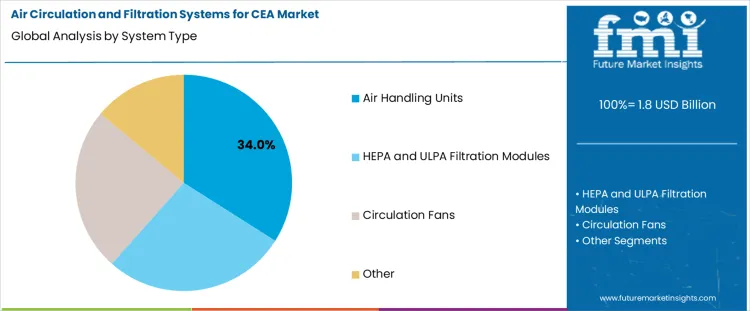
Air handling units account for about 34% of demand in 2026 because they function as the structural backbone of controlled environment airflow management. These units integrate fans, coils, filters, and dampers into a single platform that defines how air is distributed, cooled, heated, and partially cleaned. In CEA facilities, airflow uniformity affects temperature consistency, humidity gradients, and CO₂ distribution, which directly influences crop performance. Centralized air handlers allow operators to control these variables from fewer points, which simplifies monitoring and maintenance. Their size and integration level also concentrate capital spending into fewer pieces of equipment, which explains their large share of system value even when other components are numerous.
HEPA or ULPA modules and circulation fans play more targeted roles within the overall air system architecture. High efficiency filtration units focus on removing fine particles, spores, and microorganisms, yet their airflow volumes are usually lower and their placement is localized to sensitive zones. Circulation fans address air mixing and boundary layer disruption rather than full air treatment. Both are essential for performance, but they rely on the primary air handling infrastructure to set baseline conditions. Their procurement is often incremental or zone specific, which spreads purchases over time. This keeps their individual market shares below that of air handling units, which are typically installed as core systems during initial facility build out.
Why Does Particulate and Dust Control Represent the Largest Contaminant Management Priority?
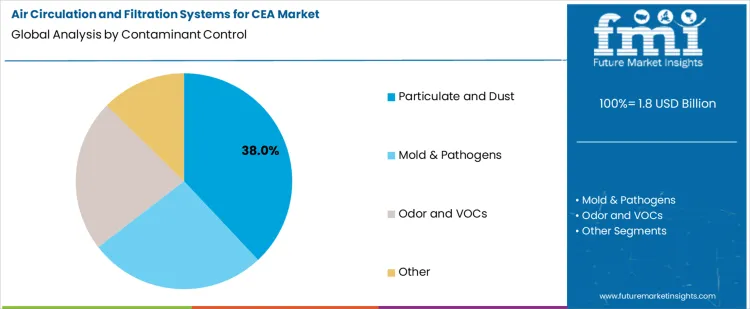
Particulate and dust control represents about 38% of demand in 2026 because solid contaminants act as carriers for many secondary problems. Dust can block heat exchange surfaces, reduce light transmission, and transport spores and bacteria across growing areas. In enclosed farms, once particles are airborne, they tend to recirculate repeatedly unless actively removed. Filtration aimed at particulate removal therefore serves as a first line of defense that supports both equipment reliability and crop health. It also delivers visible, measurable results, which makes it easier for operators to justify and monitor. This broad protective effect keeps particulate control as the most widely specified contaminant management objective.
Mold and pathogen control and odor or VOC management address more specific risk scenarios. Pathogen focused systems require higher grade filtration, UV, or other treatments that increase cost and maintenance burden, so they are often applied in high value or high risk zones rather than everywhere. Odor and VOC control becomes important in facilities near urban areas or in certain crop types, yet it does not affect all operations equally. These objectives tend to be layered on top of basic particulate control rather than replacing it. This hierarchy of needs explains why particulate management anchors most system specifications, with other contaminant controls added selectively based on crop, location, and regulatory context.
Why Are Canopy Level Uniformity and Disease Risk Management Driving Air Circulation and Filtration Investment in CEA through 2036?
Demand is rooted in biological consistency rather than in facility size. In controlled environment agriculture, uneven airflow creates temperature pockets, humidity gradients, and stagnant zones where pests and fungal pressure increase. These microclimates directly affect crop uniformity and loss rates. As farms move toward denser planting and taller vertical stacks, natural convection becomes irrelevant and forced circulation becomes mandatory. Filtration also gains importance as operators try to limit pathogen introduction and cross room contamination. Once airflow patterns are designed into a grow room, they are rarely changed, which makes air handling systems a core production asset rather than an auxiliary building service.
What Energy Load, Maintenance Burden, and System Complexity Are Constraining Wider Deployment?
Restraints are operational rather than technical. Fans, ducts, and filters add continuous energy load in facilities that already carry heavy lighting and HVAC demand. Filters require regular replacement and monitoring, and clogged media can quickly upset pressure balance and airflow distribution. Cleaning and sanitation protocols increase labor and downtime. In retrofits, routing ductwork through active grow areas is disruptive and sometimes impossible. Many operators also struggle to tune systems correctly, leading to overdesign or underperformance. These factors make some farms rely on simpler circulation approaches even when more advanced filtration and airflow control would reduce long term crop risk.
How Are Biosecurity Protocols and Multi Zone Farm Layouts Reshaping System Architecture?
Structural change is driven by how farms manage risk. More operators divide facilities into hygiene zones and treat air movement as a vector that must be controlled, not just a comfort function. This leads to localized circulation loops, pressure zoning, and dedicated filtration stages per room or per crop group. Integration with central control systems allows airflow rates to change with plant growth stages. Some farms favor modular fan wall and filter units to scale room by room. The category is shifting from large, shared air systems toward segmented, controllable networks aligned with production and sanitation workflows.
What is the Demand for Air Circulation and Filtration Systems for CEA by Country?
| Country | CAGR (%) |
|---|---|
| India | 11.4% |
| China | 10.9% |
| USA | 7.6% |
| South Korea | 7.3% |
| Japan | 6.1% |
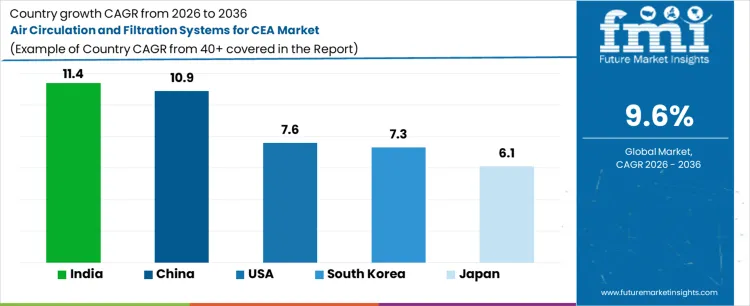
Demand for air circulation and filtration systems for controlled-environment agriculture (CEA) is rising as indoor farms adopt advanced solutions to optimize air quality, temperature, and humidity for higher crop yield and disease prevention. India leads with an 11.4% CAGR, driven by rapid growth in vertical farming, greenhouse cultivation, and investment in precision agriculture. China follows at 10.9%, supported by large-scale CEA facilities, government incentives, and technological integration. The USA grows at 7.6%, shaped by adoption in urban and high-value crop farming. South Korea records 7.3% growth, influenced by modern indoor farming initiatives. Japan shows 6.1% CAGR, reflecting steady expansion of climate-controlled agriculture and adoption of air management systems.
How is India experiencing growth in the air circulation and filtration systems for CEA market?
India is experiencing growth at a CAGR of 11.4%, supported by adoption of air circulation and filtration systems for CEA market solutions to improve air quality, climate control, and plant health in controlled-environment agriculture. Manufacturers and suppliers are producing systems optimized for airflow efficiency, particulate removal, and integration with greenhouse and vertical farming facilities. Demand is concentrated in indoor farms, commercial greenhouses, and agri-tech R&D centers. Investments focus on material quality, system performance, and compliance with agricultural and environmental standards rather than fleet-scale deployment. Growth reflects rising adoption of modern CEA practices, industrial focus on crop quality, and increasing need for energy-efficient air management.
- Air quality drives adoption.
- Systems optimize airflow efficiency and filtration performance.
- Indoor farms and greenhouses concentrate demand.
- Material quality and compliance guide investment.
How is China witnessing growth in the air circulation and filtration systems for CEA market?
China is witnessing growth at a CAGR of 10.9%, fueled by adoption of air circulation and filtration systems for CEA market solutions to enhance plant health, environmental control, and energy efficiency in indoor farming. Manufacturers and suppliers are deploying systems optimized for high airflow, particulate filtration, and integration with controlled-environment agriculture setups. Demand is concentrated in greenhouse farms, vertical farming facilities, and agricultural R&D centers. Investments prioritize material durability, system reliability, and adherence to agricultural and environmental standards rather than large-scale deployment. Growth reflects industrial adoption of modern air management solutions and focus on crop productivity.
- Plant health drives adoption.
- Systems enhance airflow and filtration efficiency.
- Greenhouses and vertical farms concentrate demand.
- Material durability and standards compliance guide investment.
How is the United States experiencing growth in the air circulation and filtration systems for CEA market?
United States is experiencing growth at a CAGR of 7.6%, supported by adoption of air circulation and filtration systems for CEA market solutions to improve environmental control, air quality, and operational efficiency in indoor farms. Manufacturers and suppliers are producing systems optimized for airflow performance, filtration efficiency, and integration with greenhouse and vertical farming operations. Demand is concentrated in commercial greenhouses, indoor cultivation centers, and agri-tech R&D hubs. Investments focus on system reliability, material performance, and compliance with agricultural and environmental standards rather than fleet-scale deployment. Growth reflects moderate adoption of CEA practices and industrial focus on crop quality.
- Environmental control drives adoption.
- Systems optimize airflow and filtration performance.
- Greenhouses and indoor farms concentrate demand.
- System reliability and compliance guide investment.
How is South Korea witnessing growth in the air circulation and filtration systems for CEA market?
South Korea is witnessing growth at a CAGR of 7.3%, fueled by adoption of air circulation and filtration systems for CEA market solutions to enhance plant health, air quality, and operational efficiency in controlled-environment agriculture. Manufacturers and suppliers are deploying systems optimized for airflow efficiency, filtration performance, and integration with greenhouse and indoor farm setups. Demand is concentrated in industrial greenhouses, vertical farming facilities, and agri-tech R&D centers. Investments prioritize material quality, system reliability, and compliance with agricultural and environmental standards rather than fleet-scale deployment. Growth reflects industrial adoption of modern air management technologies and focus on crop quality.
- Plant health drives adoption.
- Systems enhance airflow efficiency and filtration performance.
- Greenhouses and vertical farms concentrate demand.
- Material quality and compliance guide investment.
How is Japan experiencing growth in the air circulation and filtration systems for CEA market?
Japan is experiencing growth at a CAGR of 6.1%, supported by adoption of air circulation and filtration systems for CEA market solutions to improve indoor farm environmental control, air quality, and plant productivity. Manufacturers and suppliers are producing systems optimized for airflow stability, particulate removal, and integration with greenhouse and vertical farm operations. Demand is concentrated in indoor farming hubs, greenhouse facilities, and agri-tech R&D centers. Investments focus on system performance, material reliability, and compliance with agricultural and environmental standards rather than large-scale deployment. Growth reflects moderate adoption of modern CEA practices and industrial focus on crop quality and energy-efficient air management.
- Environmental control drives adoption.
- Systems optimize airflow stability and filtration performance.
- Indoor farms and greenhouses concentrate demand.
- System performance and compliance guide investment.
Who Competes in the Air Circulation and Filtration Systems for CEA Market and What Defines Their Capabilities?
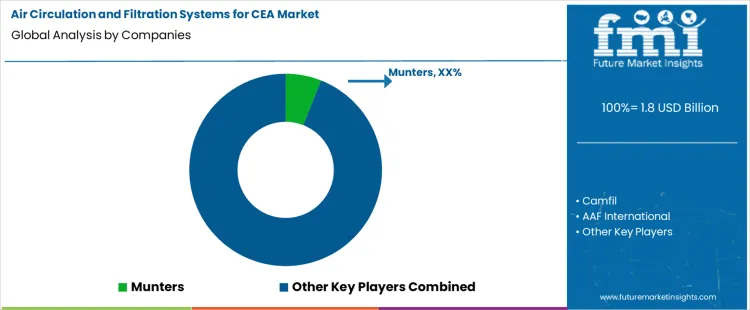
Competition in the air circulation and filtration systems for controlled-environment agriculture (CEA) market is defined by airflow efficiency, particulate removal performance, and environmental control integration. Munters supplies air circulation and filtration systems engineered for precise humidity, temperature, and particulate management in CEA facilities. Camfil develops high-efficiency filters and airflow systems designed for consistent air quality and reduced contamination risk. AAF International provides modular filtration solutions suitable for multi-zone indoor farming applications with low pressure drop. Pall (Danaher) delivers filtration systems optimized for pathogen and particle control in high-density CEA setups. Donaldson offers air filters and circulation units designed for durable, long-term operation.
Daikin supplies systems integrating airflow, temperature, and humidity management for indoor farming environments. Johnson Controls delivers modular air handling solutions with filtration and environmental control integration. Carrier provides efficient air circulation systems optimized for plant growth and energy conservation. Trane Technologies develops systems for multi-zone environmental management and high-density filtration. Honeywell supplies filtration and air management systems compatible with smart monitoring platforms. Other regional and specialty suppliers focus on energy efficiency, low-maintenance filtration, and precise environmental control. Competitive differentiation arises from airflow efficiency, filtration effectiveness, integration with CEA environmental systems, scalability, and reliability under continuous indoor farming conditions.
Key Players in the Air Circulation and Filtration Systems for CEA Market
- Munters
- Camfil
- AAF International
- Pall (Danaher)
- Donaldson
- Daikin
- Johnson Controls
- Carrier
- Trane Technologies
- Honeywell
Scope of the Report
| Items | Values |
|---|---|
| Quantitative Units (2026) | USD billion |
| System Type | Air Handling Units, HEPA/ULPA Filtration Modules, Circulation Fans, Other |
| Contaminant Control | Particulate/Dust, Mold & Pathogens, Odor/VOCs, Other |
| Facility Type | Vertical Farms, Greenhouses, Nursery/Propagation, Other |
| Sales Channel | Integrators/EPC, HVAC Distributors, Direct OEM, Other |
| Regions Covered | Asia Pacific, Europe, North America, Latin America, Middle East & Africa |
| Countries Covered | China, Japan, South Korea, India, Australia & New Zealand, ASEAN, Germany, United Kingdom, France, Italy, Spain, Nordic, BENELUX, United States, Canada, Mexico, Brazil, Chile, Saudi Arabia, Turkey, South Africa, and other regional markets |
| Key Companies Profiled | Munters, Camfil, AAF International, Pall (Danaher), Donaldson, Daikin, Johnson Controls, Carrier, Trane Technologies, Honeywell |
| Additional Attributes | Dollar sales by system type, contaminant control focus, facility type, and sales channel, demand driven by crop loss prevention and biosecurity rather than capacity expansion alone, airflow and filtration specified at layout stage based on room geometry and planting density, air handling units as the backbone of system architecture, particulate and dust control as the primary first-line defense, increasing use of HEPA and pathogen-control modules in nurseries and high-value crops, procurement increasingly routed through integrators and EPC partners, systems integrated with building management and crop control routines, and market growth tied to standardization of airflow modules, retrofit of early facilities, and scaling of professional indoor farming operations. |
Air Circulation and Filtration Systems for CEA Market Segmentation
System Type:
- Air Handling Units
- HEPA/ULPA Filtration Modules
- Circulation Fans
- Other
Contaminant Control:
- Particulate/Dust
- Mold & Pathogens
- Odor/VOCs
- Other
Facility Type:
- Vertical Farms
- Greenhouses
- Nursery/Propagation
- Other
Sales Channel:
- Integrators/EPC
- HVAC Distributors
- Direct OEM
- Other
Region:
- Asia Pacific
- China
- Japan
- South Korea
- India
- Australia & New Zealand
- ASEAN
- Rest of Asia Pacific
- Europe
- Germany
- United Kingdom
- France
- Italy
- Spain
- Nordic
- BENELUX
- Rest of Europe
- North America
- United States
- Canada
- Mexico
- Latin America
- Brazil
- Chile
- Rest of Latin America
- Middle East & Africa
- Kingdom of Saudi Arabia
- Other GCC Countries
- Turkey
- South Africa
- Other African Union
- Rest of Middle East & Africa
References
- American Society of Heating, Refrigerating and Air-Conditioning Engineers. (2024). ASHRAE Standard 62.1: Ventilation for acceptable indoor air quality. ASHRAE.
- European Commission. (2024). Regulation (EU) 2016/2281 on the energy performance of buildings (EPBD) and HVAC system standards. Official Journal of the European Union.
- USA Environmental Protection Agency. (2024). ENERGY STAR certified HVAC specification and guidance. USA Environmental Protection Agency.
- Food and Agriculture Organization of the United Nations. (2024). Controlled environment agriculture and indoor farming systems. FAO.
- Government of Canada, Natural Resources Canada. (2023). National Energy Code of Canada for Buildings - HVAC and ventilation requirements. Government of Canada.
Frequently Asked Questions
How big is the air circulation and filtration systems for cea market in 2026?
The global air circulation and filtration systems for cea market is estimated to be valued at USD 1.8 billion in 2026.
What will be the size of air circulation and filtration systems for cea market in 2036?
The market size for the air circulation and filtration systems for cea market is projected to reach USD 4.5 billion by 2036.
How much will be the air circulation and filtration systems for cea market growth between 2026 and 2036?
The air circulation and filtration systems for cea market is expected to grow at a 9.6% CAGR between 2026 and 2036.
What are the key product types in the air circulation and filtration systems for cea market?
The key product types in air circulation and filtration systems for cea market are air handling units, hepa and ulpa filtration modules, circulation fans and other.
Which contaminant control segment to contribute significant share in the air circulation and filtration systems for cea market in 2026?
In terms of contaminant control, particulate and dust segment to command 38.0% share in the air circulation and filtration systems for cea market in 2026.
Preview the report firsthand - request a free sample
Get SampleGet the brochure for pricing and purchase details.
Get PDFTable of Content
- Executive Summary
- Global Market Outlook
- Demand-side Trends
- Supply-side Trends
- Technology Roadmap Analysis
- Analysis and Recommendations
- Market Overview
- Market Coverage / Taxonomy
- Market Definition / Scope / Limitations
- Market Background
- Market Dynamics
- Drivers
- Restraints
- Opportunity
- Trends
- Scenario Forecast
- Demand in Optimistic Scenario
- Demand in Likely Scenario
- Demand in Conservative Scenario
- Opportunity Map Analysis
- Product Life Cycle Analysis
- Supply Chain Analysis
- Investment Feasibility Matrix
- Value Chain Analysis
- PESTLE and Porter’s Analysis
- Regulatory Landscape
- Regional Parent Market Outlook
- Production and Consumption Statistics
- Import and Export Statistics
- Market Dynamics
- Global Market Analysis 2021 to 2025 and Forecast, 2026 to 2036
- Historical Market Size Value (USD Million) Analysis, 2021 to 2025
- Current and Future Market Size Value (USD Million) Projections, 2026 to 2036
- Y-o-Y Growth Trend Analysis
- Absolute $ Opportunity Analysis
- Global Market Pricing Analysis 2021 to 2025 and Forecast 2026 to 2036
- Global Market Analysis 2021 to 2025 and Forecast 2026 to 2036, By System Type
- Introduction / Key Findings
- Historical Market Size Value (USD Million) Analysis By System Type , 2021 to 2025
- Current and Future Market Size Value (USD Million) Analysis and Forecast By System Type , 2026 to 2036
- Air Handling Value (USD Million)s
- HEPA and ULPA Filtration Modules
- Circulation Fans
- Other
- Air Handling Value (USD Million)s
- Y-o-Y Growth Trend Analysis By System Type , 2021 to 2025
- Absolute $ Opportunity Analysis By System Type , 2026 to 2036
- Global Market Analysis 2021 to 2025 and Forecast 2026 to 2036, By Contaminant Control
- Introduction / Key Findings
- Historical Market Size Value (USD Million) Analysis By Contaminant Control, 2021 to 2025
- Current and Future Market Size Value (USD Million) Analysis and Forecast By Contaminant Control, 2026 to 2036
- Particulate and Dust
- Mold & Pathogens
- Odor and VOCs
- Other
- Particulate and Dust
- Y-o-Y Growth Trend Analysis By Contaminant Control, 2021 to 2025
- Absolute $ Opportunity Analysis By Contaminant Control, 2026 to 2036
- Global Market Analysis 2021 to 2025 and Forecast 2026 to 2036, By Facility Type
- Introduction / Key Findings
- Historical Market Size Value (USD Million) Analysis By Facility Type, 2021 to 2025
- Current and Future Market Size Value (USD Million) Analysis and Forecast By Facility Type, 2026 to 2036
- Vertical Farms
- Greenhouses
- Nursery and Propagation
- Other
- Vertical Farms
- Y-o-Y Growth Trend Analysis By Facility Type, 2021 to 2025
- Absolute $ Opportunity Analysis By Facility Type, 2026 to 2036
- Global Market Analysis 2021 to 2025 and Forecast 2026 to 2036, By Sales Channel
- Introduction / Key Findings
- Historical Market Size Value (USD Million) Analysis By Sales Channel, 2021 to 2025
- Current and Future Market Size Value (USD Million) Analysis and Forecast By Sales Channel, 2026 to 2036
- Integrators and EPC
- HVAC Distributors
- Direct OEM
- Other
- Integrators and EPC
- Y-o-Y Growth Trend Analysis By Sales Channel, 2021 to 2025
- Absolute $ Opportunity Analysis By Sales Channel, 2026 to 2036
- Global Market Analysis 2021 to 2025 and Forecast 2026 to 2036, By Region
- Introduction
- Historical Market Size Value (USD Million) Analysis By Region, 2021 to 2025
- Current Market Size Value (USD Million) Analysis and Forecast By Region, 2026 to 2036
- North America
- Latin America
- Western Europe
- Eastern Europe
- East Asia
- South Asia and Pacific
- Middle East & Africa
- Market Attractiveness Analysis By Region
- North America Market Analysis 2021 to 2025 and Forecast 2026 to 2036, By Country
- Historical Market Size Value (USD Million) Trend Analysis By Market Taxonomy, 2021 to 2025
- Market Size Value (USD Million) Forecast By Market Taxonomy, 2026 to 2036
- By Country
- USA
- Canada
- Mexico
- By System Type
- By Contaminant Control
- By Facility Type
- By Sales Channel
- By Country
- Market Attractiveness Analysis
- By Country
- By System Type
- By Contaminant Control
- By Facility Type
- By Sales Channel
- Key Takeaways
- Latin America Market Analysis 2021 to 2025 and Forecast 2026 to 2036, By Country
- Historical Market Size Value (USD Million) Trend Analysis By Market Taxonomy, 2021 to 2025
- Market Size Value (USD Million) Forecast By Market Taxonomy, 2026 to 2036
- By Country
- Brazil
- Chile
- Rest of Latin America
- By System Type
- By Contaminant Control
- By Facility Type
- By Sales Channel
- By Country
- Market Attractiveness Analysis
- By Country
- By System Type
- By Contaminant Control
- By Facility Type
- By Sales Channel
- Key Takeaways
- Western Europe Market Analysis 2021 to 2025 and Forecast 2026 to 2036, By Country
- Historical Market Size Value (USD Million) Trend Analysis By Market Taxonomy, 2021 to 2025
- Market Size Value (USD Million) Forecast By Market Taxonomy, 2026 to 2036
- By Country
- Germany
- UK
- Italy
- Spain
- France
- Nordic
- BENELUX
- Rest of Western Europe
- By System Type
- By Contaminant Control
- By Facility Type
- By Sales Channel
- By Country
- Market Attractiveness Analysis
- By Country
- By System Type
- By Contaminant Control
- By Facility Type
- By Sales Channel
- Key Takeaways
- Eastern Europe Market Analysis 2021 to 2025 and Forecast 2026 to 2036, By Country
- Historical Market Size Value (USD Million) Trend Analysis By Market Taxonomy, 2021 to 2025
- Market Size Value (USD Million) Forecast By Market Taxonomy, 2026 to 2036
- By Country
- Russia
- Poland
- Hungary
- Balkan & Baltic
- Rest of Eastern Europe
- By System Type
- By Contaminant Control
- By Facility Type
- By Sales Channel
- By Country
- Market Attractiveness Analysis
- By Country
- By System Type
- By Contaminant Control
- By Facility Type
- By Sales Channel
- Key Takeaways
- East Asia Market Analysis 2021 to 2025 and Forecast 2026 to 2036, By Country
- Historical Market Size Value (USD Million) Trend Analysis By Market Taxonomy, 2021 to 2025
- Market Size Value (USD Million) Forecast By Market Taxonomy, 2026 to 2036
- By Country
- China
- Japan
- South Korea
- By System Type
- By Contaminant Control
- By Facility Type
- By Sales Channel
- By Country
- Market Attractiveness Analysis
- By Country
- By System Type
- By Contaminant Control
- By Facility Type
- By Sales Channel
- Key Takeaways
- South Asia and Pacific Market Analysis 2021 to 2025 and Forecast 2026 to 2036, By Country
- Historical Market Size Value (USD Million) Trend Analysis By Market Taxonomy, 2021 to 2025
- Market Size Value (USD Million) Forecast By Market Taxonomy, 2026 to 2036
- By Country
- India
- ASEAN
- Australia & New Zealand
- Rest of South Asia and Pacific
- By System Type
- By Contaminant Control
- By Facility Type
- By Sales Channel
- By Country
- Market Attractiveness Analysis
- By Country
- By System Type
- By Contaminant Control
- By Facility Type
- By Sales Channel
- Key Takeaways
- Middle East & Africa Market Analysis 2021 to 2025 and Forecast 2026 to 2036, By Country
- Historical Market Size Value (USD Million) Trend Analysis By Market Taxonomy, 2021 to 2025
- Market Size Value (USD Million) Forecast By Market Taxonomy, 2026 to 2036
- By Country
- Kingdom of Saudi Arabia
- Other GCC Countries
- Turkiye
- South Africa
- Other African Union
- Rest of Middle East & Africa
- By System Type
- By Contaminant Control
- By Facility Type
- By Sales Channel
- By Country
- Market Attractiveness Analysis
- By Country
- By System Type
- By Contaminant Control
- By Facility Type
- By Sales Channel
- Key Takeaways
- Key Countries Market Analysis
- USA
- Pricing Analysis
- Market Share Analysis, 2025
- By System Type
- By Contaminant Control
- By Facility Type
- By Sales Channel
- Canada
- Pricing Analysis
- Market Share Analysis, 2025
- By System Type
- By Contaminant Control
- By Facility Type
- By Sales Channel
- Mexico
- Pricing Analysis
- Market Share Analysis, 2025
- By System Type
- By Contaminant Control
- By Facility Type
- By Sales Channel
- Brazil
- Pricing Analysis
- Market Share Analysis, 2025
- By System Type
- By Contaminant Control
- By Facility Type
- By Sales Channel
- Chile
- Pricing Analysis
- Market Share Analysis, 2025
- By System Type
- By Contaminant Control
- By Facility Type
- By Sales Channel
- Germany
- Pricing Analysis
- Market Share Analysis, 2025
- By System Type
- By Contaminant Control
- By Facility Type
- By Sales Channel
- UK
- Pricing Analysis
- Market Share Analysis, 2025
- By System Type
- By Contaminant Control
- By Facility Type
- By Sales Channel
- Italy
- Pricing Analysis
- Market Share Analysis, 2025
- By System Type
- By Contaminant Control
- By Facility Type
- By Sales Channel
- Spain
- Pricing Analysis
- Market Share Analysis, 2025
- By System Type
- By Contaminant Control
- By Facility Type
- By Sales Channel
- France
- Pricing Analysis
- Market Share Analysis, 2025
- By System Type
- By Contaminant Control
- By Facility Type
- By Sales Channel
- India
- Pricing Analysis
- Market Share Analysis, 2025
- By System Type
- By Contaminant Control
- By Facility Type
- By Sales Channel
- ASEAN
- Pricing Analysis
- Market Share Analysis, 2025
- By System Type
- By Contaminant Control
- By Facility Type
- By Sales Channel
- Australia & New Zealand
- Pricing Analysis
- Market Share Analysis, 2025
- By System Type
- By Contaminant Control
- By Facility Type
- By Sales Channel
- China
- Pricing Analysis
- Market Share Analysis, 2025
- By System Type
- By Contaminant Control
- By Facility Type
- By Sales Channel
- Japan
- Pricing Analysis
- Market Share Analysis, 2025
- By System Type
- By Contaminant Control
- By Facility Type
- By Sales Channel
- South Korea
- Pricing Analysis
- Market Share Analysis, 2025
- By System Type
- By Contaminant Control
- By Facility Type
- By Sales Channel
- Russia
- Pricing Analysis
- Market Share Analysis, 2025
- By System Type
- By Contaminant Control
- By Facility Type
- By Sales Channel
- Poland
- Pricing Analysis
- Market Share Analysis, 2025
- By System Type
- By Contaminant Control
- By Facility Type
- By Sales Channel
- Hungary
- Pricing Analysis
- Market Share Analysis, 2025
- By System Type
- By Contaminant Control
- By Facility Type
- By Sales Channel
- Kingdom of Saudi Arabia
- Pricing Analysis
- Market Share Analysis, 2025
- By System Type
- By Contaminant Control
- By Facility Type
- By Sales Channel
- Turkiye
- Pricing Analysis
- Market Share Analysis, 2025
- By System Type
- By Contaminant Control
- By Facility Type
- By Sales Channel
- South Africa
- Pricing Analysis
- Market Share Analysis, 2025
- By System Type
- By Contaminant Control
- By Facility Type
- By Sales Channel
- USA
- Market Structure Analysis
- Competition Dashboard
- Competition Benchmarking
- Market Share Analysis of Top Players
- By Regional
- By System Type
- By Contaminant Control
- By Facility Type
- By Sales Channel
- Competition Analysis
- Competition Deep Dive
- Munters
- Overview
- Product Portfolio
- Profitability by Market Segments (Product/Age /Sales Channel/Region)
- Sales Footprint
- Strategy Overview
- Marketing Strategy
- Product Strategy
- Channel Strategy
- Camfil
- AAF International
- Pall (Danaher)
- Donaldson
- Daikin
- Johnson Controls
- Carrier
- Trane Technologies
- Honeywell
- Munters
- Competition Deep Dive
- Assumptions & Acronyms Used
- Research Methodology


