

- Industry Size (2026)
- USD 1.8 Bn
- Forecast (2036)
- USD 5.7 Bn
- CAGR (2026 to 2036)
- 12.2%
3D Secure Payment Authentication Market Size, Market Forecast and Outlook By FMI
Summary of the 3D Secure Payment Authentication Market
- Demand and Growth Drivers
- Regulatory mandates for stronger customer authentication, including PSD2 and RBI directives, are creating structured compliance demand across payment networks and card issuers.
- More people are using mobile wallets and shopping online across borders, which means that 3D secure payment authentication solutions can reach more merchants and gateways.
- Risk-based authentication and biometric verification are becoming more popular, which is moving procurement toward solutions that make transactions easier while still keeping fraud prevention standards high.
- Product and Segment View
- Access Control Server is expected to make up 42.5% of the Component segment in 2026. This is because it is the main authentication infrastructure for card issuer networks.
- The Application segment is led by Banks and Financial Institutions, which make up 38.2% of the total. This is because financial institutions have to spend money to follow the rules and stop fraud.
- One Time Password Authentication makes up 36.8% of the Authentication Market segment, which means it is used a lot in banking and e-commerce.
- Geography and Competitive Outlook
- China is expected to lead growth at 15.7%, supported by rapid digital payment adoption, mobile commerce expansion, and regulatory enforcement of authentication standards.
- India follows at 14.5%, reflecting RBI mandates for two-factor authentication, rising e-commerce penetration, and digital wallet growth.
- Visa Inc. and other established players are competing on platform integration breadth, fraud detection capabilities, and merchant network reach.
- Analyst Opinion
- The 3D Secure Payment Authentication Market is transitioning from a compliance-driven adoption model to a commercial value proposition centered on fraud reduction and checkout optimization.
- Biometric authentication and risk-based verification are expected to replace static password methods, shifting competitive dynamics toward AI-integrated platforms.
- Cross-border e-commerce growth and mobile payment expansion are creating new authentication volume that was not part of the original 3DS deployment base.
- Companies that can reduce transaction abandonment rates while maintaining fraud prevention standards are expected to capture merchant-side procurement budgets.
- Regulatory convergence across jurisdictions, including PSD2 and RBI mandates, is standardizing authentication requirements and reducing compliance fragmentation for global payment networks.
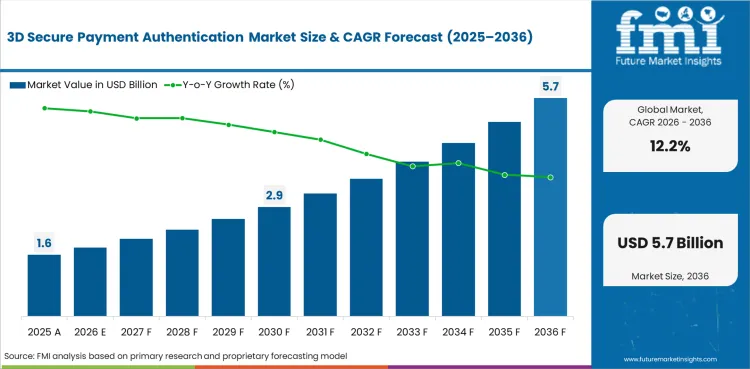
Key Takeaways, Market Size, and Forecast
- The 3D Secure payment authentication market is projected to grow from USD 1.8 billion in 2026 to USD 5.7 billion by 2036, at a CAGR of 12.2%.
- The 3D Secure payment authentication market was valued at USD 1.61 billion in 2025.
- By 2036, the 3D Secure payment authentication market is expected to be worth USD 5.71 billion.
- From 2026 to 2036, the market is projected to expand at a CAGR of 12.2%.
- The market is projected to create an incremental opportunity of USD 3.91 billion between 2026 and 2036.
- In 2026, access control server is expected to account for 42.5% of the component segment, driven by demand for secure transaction processing infrastructure.
- China (15.7%) and India (14.5%) are two of the fastest growing markets in the world.
3D Secure Payment Authentication Market Definition
The 3D Secure Payment Authentication Market includes authentication solutions, protocols, and supporting infrastructure that are used to check the identity of the cardholder when they are not present. This includes access control servers, merchant plug-ins, fraud detection engines, and other software that helps make online payments safe on e-commerce, banking, and digital wallet platforms.
3D Secure Payment Authentication Market Inclusions
The market scope includes all 3D Secure authentication products and services that are available for commercial use. These are grouped by component (Component, Access Control Server, Merchant Plug-in, Fraud Detection and Risk Management Solutions), application (Application, Banks and Financial Institutions, Merchants and E-commerce Platforms, Payment Gateways and Processors, Digital Wallet Providers), authentication market (Authentication Market, One Time Password Authentication, Biometric Authentication, Risk Based Authentication, Token Based Authentication), payment interface (Payment Interface, Browser Based, Native App Based, Device Based), end use industry (End Use Industry, E-commerce, Financial Services, Travel and Hospitality, Digital Wallets), and deployment mode (Deployment Mode, On-Premise, Cloud-Based). The revenue coverage goes from 2026 to 2036.
3D Secure Payment Authentication Market Exclusions
General cybersecurity solutions that have nothing to do with payment authentication, internal bank fraud detection systems that don't follow 3DS protocols, or payment processing infrastructure that doesn't include cardholder authentication are not part of the scope.
3D Secure Payment Authentication Market Research Methodology
- Primary Research: FMI analysts conducted interviews with payment network operators, card issuers, e-commerce platform security teams, and fraud prevention technology providers across key markets.
- Desk Research: This combined information from reports from payment networks, regulatory filings, e-commerce transaction data, and publications from the fraud prevention industry.
- Market sizing and forecasting: Bottom-up aggregation across segments and regions, with adoption velocity modeling and cross-validation against industry benchmarks.
- Data validation: Cross-checked quarterly against payment network transaction volumes, merchant adoption data, and regulatory compliance reporting.
Why is the 3D Secure Payment Authentication Market Growing?
- Regulatory requirements for strong customer authentication (PSD2, RBI two-factor requirements) are driving demand for compliance, which means that 3D Secure deployment is now a requirement for purchases instead of just an extra layer of security.
- The growth of cross-border e-commerce and mobile payment platforms is increasing the number of transactions that need to be verified. This is opening up new markets beyond just card-present environments in the US.
- China is growing the fastest at 15.7%, thanks to the rapid adoption of digital payments, the growth of mobile commerce, and the enforcement of authentication standards by the government.
The market for 3D Secure Payment Authentication is growing because major economies are making it harder to use credit cards without being present. In Europe, PSD2 and the Reserve Bank of India's requirement for two-factor authentication have turned 3D Secure from an optional fraud prevention tool into a requirement for compliance. This change in the rules is creating structured demand all along the payment value chain, from card issuers using access control servers to merchants adding plug-in solutions at checkout. The move from 3DS 1.0 to 3DS 2.0 has made it less likely that people will abandon transactions because it allows for risk-based authentication that processes low-risk payments without needing the cardholder to enter information manually. This makes it easier for merchants to adopt the new system.
The number of e-commerce transactions is still going up around the world, and mobile commerce is making up a bigger and bigger share of those purchases. Every new way to pay online, like through a browser checkout, in-app payments, or digital wallets, adds another way to verify your identity. Payment gateways and processors are putting money into authentication systems that can handle transactions across multiple channels while still keeping fraud prevention standards. The result is a market where growth is linked to more transactions instead of people spending money on technology they don't need.
The economics of fraud prevention are changing the cost-benefit analysis to favor spending money on authentication. Card-not-present fraud losses are still growing as a percentage of all payment fraud. This means that authentication can help card issuers and merchants save money directly. Risk scoring and biometric verification that use AI are lowering the number of false positives, which used to lead to legitimate transactions being denied, which cost the company money. This better accuracy in authentication is helping more merchants use 3DS, which they had previously resisted because they were worried about checkout friction.
Market Segmentation Analysis
- Access Control Server holds 42.5% of the Component segment in 2026, reflecting its role as the core authentication infrastructure for card issuer networks.
- Banks and Financial Institutions accounts for 38.2% of the Application segment, driven by regulatory compliance and fraud prevention spending by financial institutions.
The 3D Secure Payment Authentication Market is organized across 6 segmentation dimensions: Component, Application, Authentication Market, Payment Interface, End Use Industry, Deployment Mode. Access Control Server leads the Component segment, while Banks and Financial Institutions leads Application. Procurement patterns reflect the structure of payment infrastructure deployment and compliance requirements.
Insights into the Access Control Server Component Segment
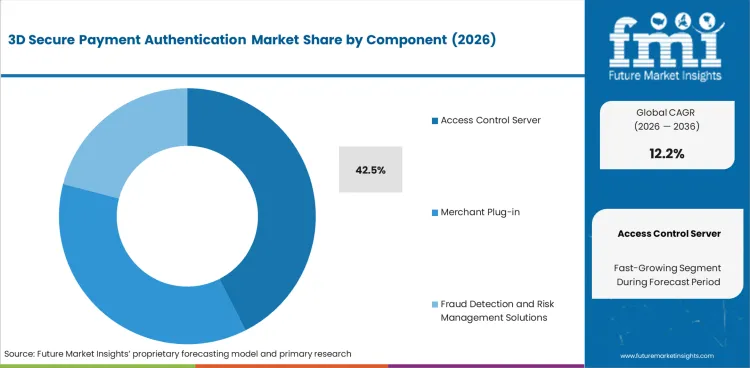
In 2026, Access Control Server is expected to make up 42.5% of the Component segment. Key subcategories include Issuer Domain Control, Authentication Processing Engine, and Directory Server Integration. Each of these adds to the overall segment through its own set of specialized applications.
Access Control Server has 42.5% of the market because it is the main way for card issuer networks to verify users. Merchant Plug-in is also helping the segment grow by allowing merchants and payment providers to add multi-layered authentication features.
Insights into the One Time Password Authentication Authentication Market Segment
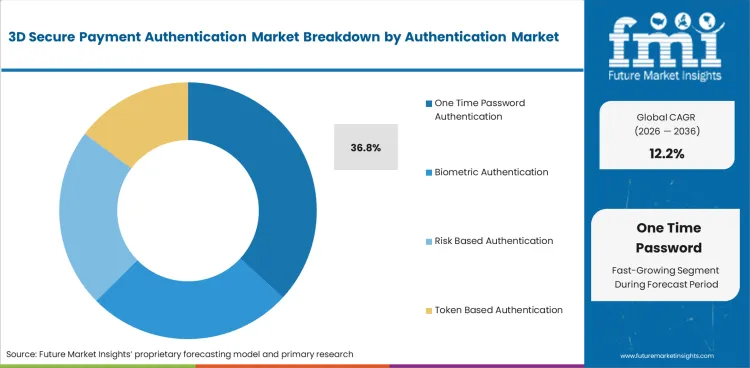
One Time Password Authentication is expected to make up 36.8% of the Authentication Market segment by 2026. Key subcategories are SMS-Based OTP and Email-Based OTP, both of which add to the overall segment through their own unique applications.
One Time Password Authentication makes up 36.8% of the segment, thanks to its widespread use in banking and e-commerce. Biometric authentication is also helping the segment grow as merchants and payment processors add multi-layered authentication features.
3D Secure Payment Authentication Market Drivers, Restraints, and Opportunities
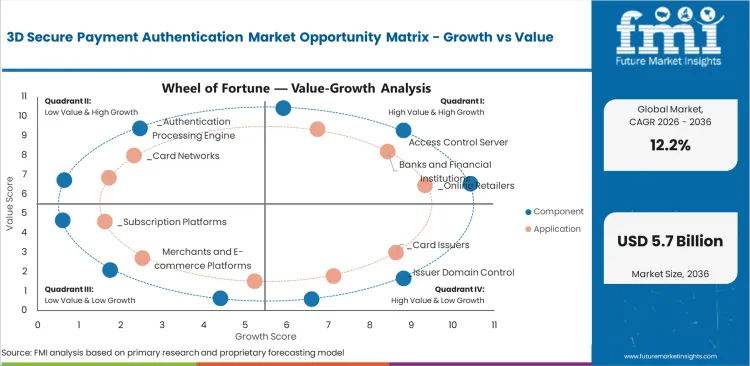
- Regulatory requirements for strong customer authentication are making merchants and card issuers buy 3D Secure because they have to.
- People still don't want to use authentication methods that require more steps, which makes demand shift toward methods that are easier and less risky.
- Cross-border e-commerce growth is opening up new markets for multi-currency authentication solutions and increasing the number of transactions they can handle.
The 3D Secure Payment Authentication Market is shaped by regulatory compliance requirements, e-commerce transaction growth, and the ongoing balance between security and checkout friction. Regulatory mandates provide the primary demand driver, while technology advances in risk-based authentication and biometrics are addressing adoption barriers related to user experience.
Regulatory Compliance as a Structural Demand Driver
PSD2 in Europe, RBI two-factor authentication mandates in India, and evolving payment security standards across Asia Pacific are converting 3D Secure from an optional fraud tool into a regulatory requirement. This compliance driver creates predictable demand that is less sensitive to discretionary technology budgets.
Transaction Friction and Checkout Abandonment
Additional authentication steps increase checkout time and cause transaction abandonment, particularly on mobile devices. The transition to 3DS 2.0 risk-based authentication addresses this by processing low-risk transactions without manual cardholder input, improving merchant adoption rates.
E-commerce and Mobile Payment Expansion
Growth in online retail and mobile wallet transactions is increasing the volume of card-not-present payments that require authentication. Each new payment channel, from browser checkout to in-app purchases, creates additional authentication demand.
AI-Integrated Fraud Prevention
Machine learning models that improve risk scoring accuracy are reducing false positive rates, making authentication more commercially attractive for merchants. Real-time behavioral analytics and biometric verification are expected to replace static password methods over the forecast period.
Analysis of 3D Secure Payment Authentication Market By Key Countries
.webp "Top Country Growth Comparison 3d Secure Payment Authentication Market Cagr (2026 2036)")
| Country | CAGR |
|---|---|
| USA | 11.1% |
| UK | 9.9% |
| Germany | 13.4% |
| Japan | 8.7% |
| China | 15.7% |
| India | 14.5% |
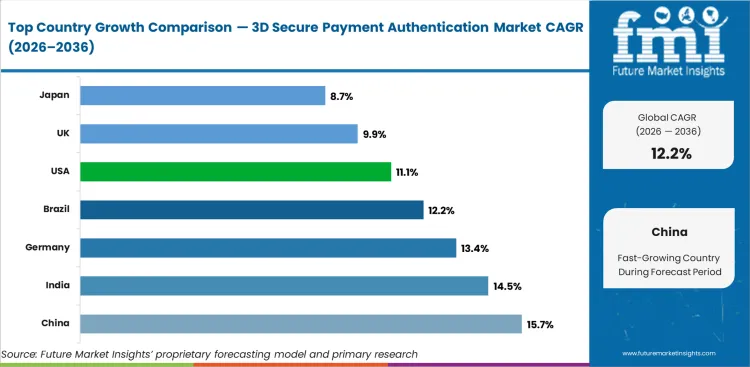
- China at 15.7% is expanding on the strength of digital payment adoption and mobile commerce growth.
- India at 14.5% reflects RBI authentication mandates and rising e-commerce penetration.
- Germany at 13.4% is supported by PSD2 compliance requirements and e-commerce infrastructure.
- USA at 11.1% is sustained by enterprise fraud prevention investment and e-commerce scale.
The global 3D Secure Payment Authentication Market is projected to expand at a CAGR of 12.2% from 2026 to 2036. The analysis covers more than 30 countries, with the following markets showing distinct growth profiles based on regulatory environments, e-commerce maturity, and payment infrastructure development.
Demand Outlook for 3D Secure Payment Authentication Market in the United States
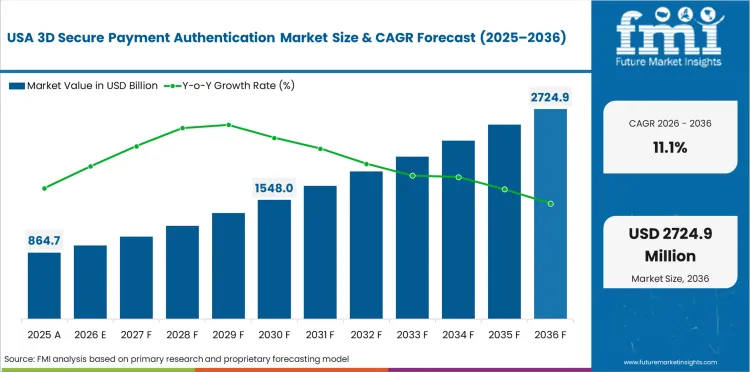
The United States is projected to grow at 11.1% through 2036. Mature e-commerce infrastructure and enterprise investment in fraud prevention are the primary factors shaping demand.
- Enterprise fraud prevention budgets support investment in AI-integrated authentication.
- E-commerce scale creates the largest transaction volume base for authentication solutions.
- Card network mandates for 3DS adoption are expanding merchant deployment.
Future Outlook for 3D Secure Payment Authentication Market in the United Kingdom
The United Kingdom is projected to grow at 9.9% through 2036. Open banking regulations and high card-not-present transaction volumes are the primary factors shaping demand.
- Open banking regulations support integration of authentication into payment flows.
- Card-not-present transaction volumes sustain demand for fraud prevention.
- Fintech innovation is creating new payment channels requiring authentication.
Opportunity Analysis of 3D Secure Payment Authentication Market in Germany
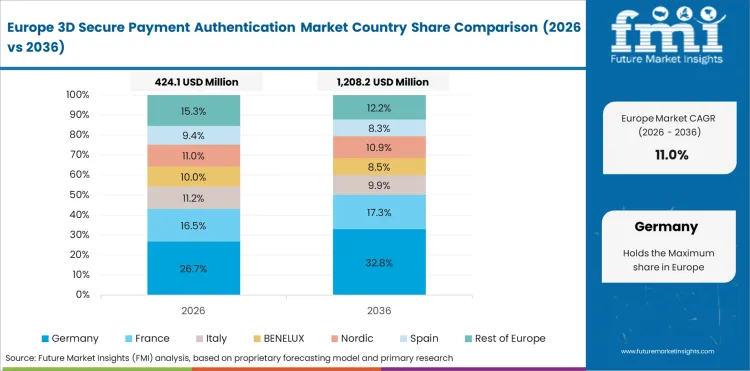
Germany is projected to grow at 13.4% through 2036. PSD2 compliance requirements and strong e-commerce infrastructure across the EU are the primary factors shaping demand.
- PSD2 compliance is the primary demand driver for merchant and issuer adoption.
- E-commerce transaction volumes support sustained procurement of authentication solutions.
- Cross-border EU transactions require multi-jurisdiction authentication support.
In-depth Analysis of 3D Secure Payment Authentication Market in Japan
Japan is projected to grow at 8.7% through 2036. Cashless payment promotion initiatives and advanced payment infrastructure are the primary factors shaping demand.
- Cashless payment promotion initiatives are expanding digital transaction volumes.
- Advanced payment infrastructure supports rapid adoption of 3DS 2.0.
- Cross-border transaction growth requires multi-currency authentication support.
Sales Analysis of 3D Secure Payment Authentication Market in China
China is projected to grow at 15.7% through 2036. Rapid digital payment adoption, mobile commerce expansion, and regulatory enforcement of authentication standards are the primary factors shaping demand.
- Digital payment platform growth is expanding the authentication transaction base.
- Mobile commerce penetration is creating demand for in-app and SDK-based authentication.
- Regulatory enforcement of payment security standards is sustaining compliance-driven procurement.
In-depth Analysis of 3D Secure Payment Authentication Market in India
India is projected to grow at 14.5% through 2036. RBI mandates for two-factor authentication, rising e-commerce penetration, and digital wallet growth are the primary factors shaping demand.
- RBI two-factor authentication mandates make 3DS deployment a compliance requirement.
- E-commerce penetration growth is increasing card-not-present transaction volumes.
- Digital wallet adoption is creating new authentication touchpoints.
Competitive Landscape and Strategic Positioning
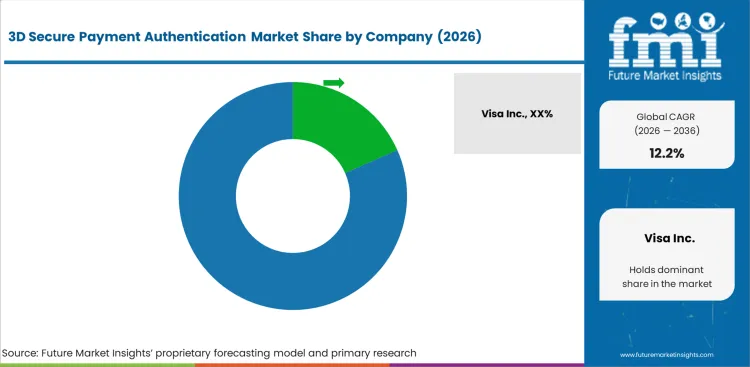
- Visa Inc. holds a leading position based on platform integration breadth, fraud detection capabilities, and merchant network reach.
- Established players compete on platform breadth, fraud detection accuracy, and integration capabilities across payment networks.
- Emerging players are focusing on specialized authentication methods, biometric solutions, and niche payment channel integration.
Visa Inc. holds a commanding position through its role as a card network operator with built-in 3DS infrastructure. Mastercard Inc. maintains a comparable position through its global payment network and merchant authentication capabilities. Both companies benefit from the network effects of card issuance volume and merchant acceptance.
Authentication technology providers like American Express, Broadcom Inc., RSA Security LLC compete on fraud detection accuracy, integration flexibility, and the ability to support multiple authentication methods. These companies sell solutions to banks, merchants, and payment processors rather than operating payment networks directly.
Entry barriers include the complexity of payment network integration, regulatory compliance across jurisdictions, and the trust requirements of handling sensitive financial data. Established companies benefit from existing merchant and issuer relationships that take years to develop.
Key Companies in the 3D Secure Payment Authentication Market
Key global companies leading the 3d secure payment authentication market include:
- Visa Inc., Mastercard Inc., American Express, Broadcom Inc. are the established market leaders with integrated payment authentication platforms and global merchant network relationships.
- RSA Security LLC, Thales Group, Entrust Corporation have built regional positions through specialized authentication capabilities and targeted merchant segments.
- GPayments, Netcetera, SISA Information Security, Stripe are entering through biometric authentication innovation, AI-powered risk scoring, and API-first integration approaches.
Competitive Benchmarking: 3D Secure Payment Authentication Market
| Company | Platform Breadth | Fraud Detection Capability | Merchant Network Reach | Geographic Footprint |
|---|---|---|---|---|
| Visa Inc. | High | High | Strong | Global |
| Mastercard Inc. | High | High | Strong | Global |
| American Express | High | High | Strong | Global |
| Broadcom Inc. | Medium | High | Moderate | Regional |
| RSA Security LLC | Medium | High | Moderate | Regional |
| Thales Group | Medium | High | Moderate | Regional |
| Entrust Corporation | Medium | Medium | Low | Regional |
| GPayments | Medium | Medium | Low | Regional |
| Netcetera | Medium | Medium | Low | Regional |
| SISA Information Security | Medium | Medium | Low | Regional |
Source: Future Market Insights competitive analysis, 2026.
Key Developments in 3D Secure Payment Authentication Market
- In 2025, Visa continued expanding support for biometric authentication (including passkeys) and frictionless 3DS flows in mobile and e-commerce payments, with notable progress in Asia Pacific markets.
- In 2025, card networks including American Express advanced AI and risk-based authentication within 3DS frameworks to improve fraud detection and reduce unnecessary transaction declines.
Key Players in the 3D Secure Payment Authentication Market
Major Global Players:
- Visa Inc.
- Mastercard Inc.
- American Express
- Broadcom Inc.
- RSA Security LLC
- Thales Group
- Entrust Corporation
Emerging Players/Startups
- GPayments
- Netcetera
- SISA Information Security
- Stripe
Report Scope and Coverage
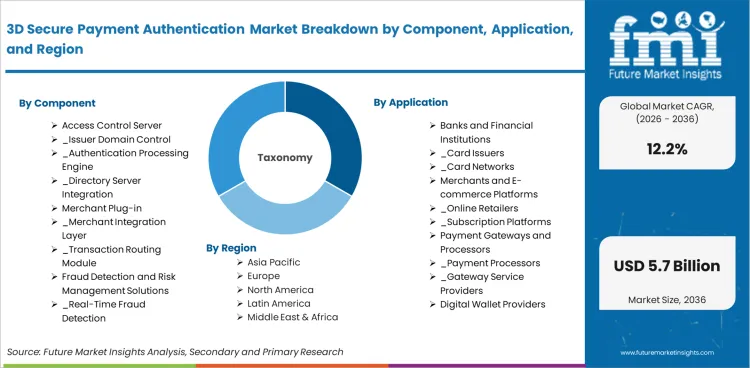
| Parameter | Details |
|---|---|
| Quantitative Units | USD 1.81 billion to USD 5.71 billion, at a CAGR of 12.2% |
| Market Definition | The 3D Secure Payment Authentication Market covers authentication solutions and infrastructure for verifying cardholder identity during card-not-present transactions across e-commerce, banking, and digital wallet platforms. |
| Regions Covered | North America, Latin America, Europe, East Asia, South Asia and Pacific, Middle East and Africa |
| Countries Covered | USA, UK, Germany, Japan, China, India, Italy, South Korea, 30 plus countries |
| Key Companies Profiled | Visa Inc., Mastercard Inc., American Express, Broadcom Inc., RSA Security LLC, Thales Group, Entrust Corporation, GPayments, Netcetera, SISA Information Security, Stripe |
| Forecast Period | 2026 to 2036 |
| Approach | Hybrid bottom-up and top-down methodology starting with verified transaction data, projecting adoption velocity across segments and regions. |
3D Secure Payment Authentication Market Segmentation
3D Secure Payment Authentication Market Market Segmented by Component:
- Access Control Server
- Issuer Domain Control
- Authentication Processing Engine
- Directory Server Integration
- Merchant Plug-in
- Merchant Integration Layer
- Transaction Routing Module
- Fraud Detection and Risk Management Solutions
- Real-Time Fraud Detection
- Risk Scoring Engines
- Behavioral Analytics
3D Secure Payment Authentication Market Market Segmented by Application:
- Banks and Financial Institutions
- Card Issuers
- Card Networks
- Merchants and E-commerce Platforms
- Online Retailers
- Subscription Platforms
- Payment Gateways and Processors
- Payment Processors
- Gateway Service Providers
- Digital Wallet Providers
- Mobile Wallet Platforms
- Super Apps
3D Secure Payment Authentication Market Market Segmented by Authentication Market:
- One Time Password Authentication
- SMS Based OTP
- Email Based OTP
- Biometric Authentication
- Fingerprint Recognition
- Facial Recognition
- Risk Based Authentication
- Behavioral Biometrics
- Transaction Risk Analysis
- Token Based Authentication
- Hardware Tokens
- Software Tokens
3D Secure Payment Authentication Market Market Segmented by Payment Interface:
- Browser Based
- Desktop Browser
- Mobile Browser
- Native App Based
- In-App Payments
- SDK Integrated Payments
- Device Based
- Wearables
- Point of Sale Devices
3D Secure Payment Authentication Market Market Segmented by End Use Industry:
- E-commerce
- Online Retail
- Marketplace Platforms
- Financial Services
- Banking Services
- Insurance Payments
- Travel and Hospitality
- Airlines
- Hotels and Booking Platforms
- Digital Wallets
- Mobile Payment Apps
- Peer to Peer Payments
3D Secure Payment Authentication Market Market Segmented by Deployment Mode:
- On-Premise
- Enterprise Data Centers
- Private Infrastructure
- Cloud-Based
- Public Cloud
- Hybrid Cloud
3D Secure Payment Authentication Market Market by Region:
- North America
- USA
- Canada
- Mexico
- Latin America
- Brazil
- Chile
- Rest of Latin America
- Western Europe
- Germany
- UK
- Italy
- Spain
- France
- Nordic
- BENELUX
- Rest of Western Europe
- Eastern Europe
- Russia
- Poland
- Hungary
- Balkan & Baltic
- Rest of Eastern Europe
- East Asia
- China
- Japan
- South Korea
- South Asia and Pacific
- India
- ASEAN
- Australia & New Zealand
- Rest of South Asia and Pacific
- Middle East & Africa
- Kingdom of Saudi Arabia
- Other GCC Countries
- Turkiye
- South Africa
- Other African Union
- Rest of Middle East & Africa
Research Sources and Bibliography
- European Commission. (2024). Payment Services Directive 2 (PSD2): Strong Customer Authentication Requirements. EC.
- Reserve Bank of India. (2024). Guidelines on Regulation of Payment Aggregators and Payment Gateways. RBI.
- EMVCo. (2025). EMV 3-D Secure Protocol and Core Functions Specification. EMVCo.
- World Bank. (2024). Global Payment Systems Report: Digital Payment Infrastructure Development. World Bank.
- International Organization for Standardization. (2024). ISO 27001: Information Security Management Systems Requirements. ISO.
- Federal Reserve Board. (2024). Payments System Policy Advisory Committee: Digital Payment Authentication Standards. FRB.
This bibliography is provided for reader reference. The full Future Market Insights report contains the complete reference list with publication dates, URLs, and supporting data for all cited works.
This Report Answers
- Estimating the size of the market and revenue from 2026 to 2036.
- Segmentation by Component, Application, Authentication Market, Payment Interface, End Use Industry, Deployment Mode, and region.
- Insights about more than 30 markets across regions.
- Analysis of authentication technology, fraud prevention, and risk management trends.
- Assessment of the competitive landscape.
- Finding investment opportunities across segments and regions.
- Supply chain and distribution analysis.
- Delivery of data in PDF and Excel formats.
Frequently Asked Questions
What is the global market demand for 3D Secure Payment Authentication in 2026?
In 2026, the global 3d secure payment authentication market is expected to be worth USD 1.81 billion.
How big will the 3D Secure Payment Authentication Market be in 2036?
By 2036, the 3d secure payment authentication market is expected to be worth USD 5.71 billion.
How much is demand for 3D Secure Payment Authentication expected to grow between 2026 and 2036?
Between 2026 and 2036, demand is expected to grow at a CAGR of 12.2%.
Which Component segment is expected to lead in 2026?
Access Control Server is expected to account for 42.5% of the Component segment in 2026, driven by demand for secure transaction processing infrastructure.
What is causing demand to rise in China?
China is projected to grow at 15.7% through 2036, supported by rapid digital payment adoption, mobile commerce expansion, and regulatory enforcement of authentication standards.
What is causing demand to rise in India?
India is projected to grow at 14.5% through 2036, supported by RBI mandates for two-factor authentication, rising e-commerce penetration, and digital wallet growth.
What does this report mean by '3D Secure Payment Authentication Market definition'?
The 3D Secure Payment Authentication Market covers authentication solutions and infrastructure for verifying cardholder identity during card-not-present transactions across e-commerce, banking, and digital wallet platforms.
How does FMI make the 3D Secure Payment Authentication forecast and validate it?
Forecasting models use a hybrid bottom-up and top-down approach, starting with verified transaction data and checking it against payment network transaction volumes and regulatory compliance data.
What is the global market demand for 3D Secure Payment Authentication in 2026?
In 2026, the global 3d secure payment authentication market is expected to be worth USD 1.81 billion.
How big will the 3D Secure Payment Authentication Market be in 2036?
By 2036, the 3d secure payment authentication market is expected to be worth USD 5.71 billion.
How much is demand for 3D Secure Payment Authentication expected to grow between 2026 and 2036?
Between 2026 and 2036, demand is expected to grow at a CAGR of 12.2%.
Which Component segment is expected to lead in 2026?
Access Control Server is expected to account for 42.5% of the Component segment in 2026, driven by demand for secure transaction processing infrastructure.
What is causing demand to rise in China?
China is projected to grow at 15.7% through 2036, supported by rapid digital payment adoption, mobile commerce expansion, and regulatory enforcement of authentication standards.
What is causing demand to rise in India?
India is projected to grow at 14.5% through 2036, supported by RBI mandates for two-factor authentication, rising e-commerce penetration, and digital wallet growth.
What does this report mean by '3D Secure Payment Authentication Market definition'?
The 3D Secure Payment Authentication Market covers authentication solutions and infrastructure for verifying cardholder identity during card-not-present transactions across e-commerce, banking, and digital wallet platforms.
How does FMI make the 3D Secure Payment Authentication forecast and validate it?
Forecasting models use a hybrid bottom-up and top-down approach, starting with verified transaction data and checking it against payment network transaction volumes and regulatory compliance data.
Preview the report firsthand - request a free sample
Get SampleGet the brochure for pricing and purchase details.
Get PDFTable of Content
- Executive Summary
- Global Market Outlook
- Demand-side Trends
- Supply-side Trends
- Technology Roadmap Analysis
- Analysis and Recommendations
- Market Overview
- Market Coverage / Taxonomy
- Market Definition / Scope / Limitations
- Research Methodology
- Chapter Orientation
- Analytical Lens and Working Hypotheses
- Market Structure, Signals, and Trend Drivers
- Benchmarking and Cross-market Comparability
- Market Sizing, Forecasting, and Opportunity Mapping
- Research Design and Evidence Framework
- Desk Research Programme (Secondary Evidence)
- Company Annual and Sustainability Reports
- Peer-reviewed Journals and Academic Literature
- Corporate Websites, Product Literature, and Technical Notes
- Earnings Decks and Investor Briefings
- Statutory Filings and Regulatory Disclosures
- Technical White Papers and Standards Notes
- Trade Journals, Industry Magazines, and Analyst Briefs
- Conference Proceedings, Webinars, and Seminar Materials
- Government Statistics Portals and Public Data Releases
- Press Releases and Reputable Media Coverage
- Specialist Newsletters and Curated Briefings
- Sector Databases and Reference Repositories
- FMI Internal Proprietary Databases and Historical Market Datasets
- Subscription Datasets and Paid Sources
- Social Channels, Communities, and Digital Listening Inputs
- Additional Desk Sources
- Expert Input and Fieldwork (Primary Evidence)
- Primary Modes
- Qualitative Interviews and Expert Elicitation
- Quantitative Surveys and Structured Data Capture
- Blended Approach
- Why Primary Evidence is Used
- Field Techniques
- Interviews
- Surveys
- Focus Groups
- Observational and In-context Research
- Social and Community Interactions
- Stakeholder Universe Engaged
- C-suite Leaders
- Board Members
- Presidents and Vice Presidents
- R&D and Innovation Heads
- Technical Specialists
- Domain Subject-matter Experts
- Scientists
- Physicians and Other Healthcare Professionals
- Governance, Ethics, and Data Stewardship
- Research Ethics
- Data Integrity and Handling
- Primary Modes
- Tooling, Models, and Reference Databases
- Desk Research Programme (Secondary Evidence)
- Data Engineering and Model Build
- Data Acquisition and Ingestion
- Cleaning, Normalisation, and Verification
- Synthesis, Triangulation, and Analysis
- Quality Assurance and Audit Trail
- Market Background
- Market Dynamics
- Drivers
- Restraints
- Opportunity
- Trends
- Scenario Forecast
- Demand in Optimistic Scenario
- Demand in Likely Scenario
- Demand in Conservative Scenario
- Opportunity Map Analysis
- Product Life Cycle Analysis
- Supply Chain Analysis
- Investment Feasibility Matrix
- Value Chain Analysis
- PESTLE and Porter’s Analysis
- Regulatory Landscape
- Regional Parent Market Outlook
- Production and Consumption Statistics
- Import and Export Statistics
- Market Dynamics
- Global Market Analysis 2021 to 2025 and Forecast, 2026 to 2036
- Historical Market Size Value (USD Million) Analysis, 2021 to 2025
- Current and Future Market Size Value (USD Million) Projections, 2026 to 2036
- Y-o-Y Growth Trend Analysis
- Absolute $ Opportunity Analysis
- Global Market Pricing Analysis 2021 to 2025 and Forecast 2026 to 2036
- Global Market Analysis 2021 to 2025 and Forecast 2026 to 2036, By Component
- Introduction / Key Findings
- Historical Market Size Value (USD Million) Analysis By Component , 2021 to 2025
- Current and Future Market Size Value (USD Million) Analysis and Forecast By Component , 2026 to 2036
- Access Control Server
- Issuer Domain Control
- Authentication Processing Engine
- Directory Server Integration
- Merchant Plug-in
- Merchant Integration Layer
- Transaction Routing Module
- Fraud Detection and Risk Management Solutions
- Real-Time Fraud Detection
- Risk Scoring Engines
- Behavioral Analytics
- Access Control Server
- Y-o-Y Growth Trend Analysis By Component , 2021 to 2025
- Absolute $ Opportunity Analysis By Component , 2026 to 2036
- Global Market Analysis 2021 to 2025 and Forecast 2026 to 2036, By Application
- Introduction / Key Findings
- Historical Market Size Value (USD Million) Analysis By Application, 2021 to 2025
- Current and Future Market Size Value (USD Million) Analysis and Forecast By Application, 2026 to 2036
- Banks and Financial Institutions
- Card Issuers
- Card Networks
- Merchants and E-commerce Platforms
- Online Retailers
- Subscription Platforms
- Payment Gateways and Processors
- Payment Processors
- Gateway Service Providers
- Digital Wallet Providers
- Mobile Wallet Platforms
- Super Apps
- Banks and Financial Institutions
- Y-o-Y Growth Trend Analysis By Application, 2021 to 2025
- Absolute $ Opportunity Analysis By Application, 2026 to 2036
- Global Market Analysis 2021 to 2025 and Forecast 2026 to 2036, By Authentication Market
- Introduction / Key Findings
- Historical Market Size Value (USD Million) Analysis By Authentication Market, 2021 to 2025
- Current and Future Market Size Value (USD Million) Analysis and Forecast By Authentication Market, 2026 to 2036
- One Time Password Authentication
- SMS Based OTP
- Email Based OTP
- Biometric Authentication
- Fingerprint Recognition
- Facial Recognition
- Risk Based Authentication
- Behavioral Biometrics
- Transaction Risk Analysis
- Token Based Authentication
- Hardware Tokens
- Software Tokens
- One Time Password Authentication
- Y-o-Y Growth Trend Analysis By Authentication Market, 2021 to 2025
- Absolute $ Opportunity Analysis By Authentication Market, 2026 to 2036
- Global Market Analysis 2021 to 2025 and Forecast 2026 to 2036, By Payment Interface
- Introduction / Key Findings
- Historical Market Size Value (USD Million) Analysis By Payment Interface, 2021 to 2025
- Current and Future Market Size Value (USD Million) Analysis and Forecast By Payment Interface, 2026 to 2036
- Browser Based
- Desktop Browser
- Mobile Browser
- Native App Based
- In-App Payments
- SDK Integrated Payments
- Device Based
- Wearables
- Point of Sale Devices
- Browser Based
- Y-o-Y Growth Trend Analysis By Payment Interface, 2021 to 2025
- Absolute $ Opportunity Analysis By Payment Interface, 2026 to 2036
- Global Market Analysis 2021 to 2025 and Forecast 2026 to 2036, By End Use Industry
- Introduction / Key Findings
- Historical Market Size Value (USD Million) Analysis By End Use Industry, 2021 to 2025
- Current and Future Market Size Value (USD Million) Analysis and Forecast By End Use Industry, 2026 to 2036
- E-commerce
- Online Retail
- Marketplace Platforms
- Financial Services
- Banking Services
- Insurance Payments
- Travel and Hospitality
- Airlines
- Hotels and Booking Platforms
- Digital Wallets
- Mobile Payment Apps
- Peer to Peer Payments
- E-commerce
- Y-o-Y Growth Trend Analysis By End Use Industry, 2021 to 2025
- Absolute $ Opportunity Analysis By End Use Industry, 2026 to 2036
- Global Market Analysis 2021 to 2025 and Forecast 2026 to 2036, By Deployment Mode
- Introduction / Key Findings
- Historical Market Size Value (USD Million) Analysis By Deployment Mode, 2021 to 2025
- Current and Future Market Size Value (USD Million) Analysis and Forecast By Deployment Mode, 2026 to 2036
- On-Premise
- Enterprise Data Centers
- Private Infrastructure
- Cloud-Based
- Public Cloud
- Hybrid Cloud
- On-Premise
- Y-o-Y Growth Trend Analysis By Deployment Mode, 2021 to 2025
- Absolute $ Opportunity Analysis By Deployment Mode, 2026 to 2036
- Global Market Analysis 2021 to 2025 and Forecast 2026 to 2036, By Region
- Introduction
- Historical Market Size Value (USD Million) Analysis By Region, 2021 to 2025
- Current Market Size Value (USD Million) Analysis and Forecast By Region, 2026 to 2036
- North America
- Latin America
- Western Europe
- Eastern Europe
- East Asia
- South Asia and Pacific
- Middle East & Africa
- Market Attractiveness Analysis By Region
- North America Market Analysis 2021 to 2025 and Forecast 2026 to 2036, By Country
- Historical Market Size Value (USD Million) Trend Analysis By Market Taxonomy, 2021 to 2025
- Market Size Value (USD Million) Forecast By Market Taxonomy, 2026 to 2036
- By Country
- USA
- Canada
- Mexico
- By Component
- By Application
- By Authentication Market
- By Payment Interface
- By End Use Industry
- By Deployment Mode
- By Country
- Market Attractiveness Analysis
- By Country
- By Component
- By Application
- By Authentication Market
- By Payment Interface
- By End Use Industry
- By Deployment Mode
- Key Takeaways
- Latin America Market Analysis 2021 to 2025 and Forecast 2026 to 2036, By Country
- Historical Market Size Value (USD Million) Trend Analysis By Market Taxonomy, 2021 to 2025
- Market Size Value (USD Million) Forecast By Market Taxonomy, 2026 to 2036
- By Country
- Brazil
- Chile
- Rest of Latin America
- By Component
- By Application
- By Authentication Market
- By Payment Interface
- By End Use Industry
- By Deployment Mode
- By Country
- Market Attractiveness Analysis
- By Country
- By Component
- By Application
- By Authentication Market
- By Payment Interface
- By End Use Industry
- By Deployment Mode
- Key Takeaways
- Western Europe Market Analysis 2021 to 2025 and Forecast 2026 to 2036, By Country
- Historical Market Size Value (USD Million) Trend Analysis By Market Taxonomy, 2021 to 2025
- Market Size Value (USD Million) Forecast By Market Taxonomy, 2026 to 2036
- By Country
- Germany
- UK
- Italy
- Spain
- France
- Nordic
- BENELUX
- Rest of Western Europe
- By Component
- By Application
- By Authentication Market
- By Payment Interface
- By End Use Industry
- By Deployment Mode
- By Country
- Market Attractiveness Analysis
- By Country
- By Component
- By Application
- By Authentication Market
- By Payment Interface
- By End Use Industry
- By Deployment Mode
- Key Takeaways
- Eastern Europe Market Analysis 2021 to 2025 and Forecast 2026 to 2036, By Country
- Historical Market Size Value (USD Million) Trend Analysis By Market Taxonomy, 2021 to 2025
- Market Size Value (USD Million) Forecast By Market Taxonomy, 2026 to 2036
- By Country
- Russia
- Poland
- Hungary
- Balkan & Baltic
- Rest of Eastern Europe
- By Component
- By Application
- By Authentication Market
- By Payment Interface
- By End Use Industry
- By Deployment Mode
- By Country
- Market Attractiveness Analysis
- By Country
- By Component
- By Application
- By Authentication Market
- By Payment Interface
- By End Use Industry
- By Deployment Mode
- Key Takeaways
- East Asia Market Analysis 2021 to 2025 and Forecast 2026 to 2036, By Country
- Historical Market Size Value (USD Million) Trend Analysis By Market Taxonomy, 2021 to 2025
- Market Size Value (USD Million) Forecast By Market Taxonomy, 2026 to 2036
- By Country
- China
- Japan
- South Korea
- By Component
- By Application
- By Authentication Market
- By Payment Interface
- By End Use Industry
- By Deployment Mode
- By Country
- Market Attractiveness Analysis
- By Country
- By Component
- By Application
- By Authentication Market
- By Payment Interface
- By End Use Industry
- By Deployment Mode
- Key Takeaways
- South Asia and Pacific Market Analysis 2021 to 2025 and Forecast 2026 to 2036, By Country
- Historical Market Size Value (USD Million) Trend Analysis By Market Taxonomy, 2021 to 2025
- Market Size Value (USD Million) Forecast By Market Taxonomy, 2026 to 2036
- By Country
- India
- ASEAN
- Australia & New Zealand
- Rest of South Asia and Pacific
- By Component
- By Application
- By Authentication Market
- By Payment Interface
- By End Use Industry
- By Deployment Mode
- By Country
- Market Attractiveness Analysis
- By Country
- By Component
- By Application
- By Authentication Market
- By Payment Interface
- By End Use Industry
- By Deployment Mode
- Key Takeaways
- Middle East & Africa Market Analysis 2021 to 2025 and Forecast 2026 to 2036, By Country
- Historical Market Size Value (USD Million) Trend Analysis By Market Taxonomy, 2021 to 2025
- Market Size Value (USD Million) Forecast By Market Taxonomy, 2026 to 2036
- By Country
- Kingdom of Saudi Arabia
- Other GCC Countries
- Turkiye
- South Africa
- Other African Union
- Rest of Middle East & Africa
- By Component
- By Application
- By Authentication Market
- By Payment Interface
- By End Use Industry
- By Deployment Mode
- By Country
- Market Attractiveness Analysis
- By Country
- By Component
- By Application
- By Authentication Market
- By Payment Interface
- By End Use Industry
- By Deployment Mode
- Key Takeaways
- Key Countries Market Analysis
- USA
- Pricing Analysis
- Market Share Analysis, 2025
- By Component
- By Application
- By Authentication Market
- By Payment Interface
- By End Use Industry
- By Deployment Mode
- Canada
- Pricing Analysis
- Market Share Analysis, 2025
- By Component
- By Application
- By Authentication Market
- By Payment Interface
- By End Use Industry
- By Deployment Mode
- Mexico
- Pricing Analysis
- Market Share Analysis, 2025
- By Component
- By Application
- By Authentication Market
- By Payment Interface
- By End Use Industry
- By Deployment Mode
- Brazil
- Pricing Analysis
- Market Share Analysis, 2025
- By Component
- By Application
- By Authentication Market
- By Payment Interface
- By End Use Industry
- By Deployment Mode
- Chile
- Pricing Analysis
- Market Share Analysis, 2025
- By Component
- By Application
- By Authentication Market
- By Payment Interface
- By End Use Industry
- By Deployment Mode
- Germany
- Pricing Analysis
- Market Share Analysis, 2025
- By Component
- By Application
- By Authentication Market
- By Payment Interface
- By End Use Industry
- By Deployment Mode
- UK
- Pricing Analysis
- Market Share Analysis, 2025
- By Component
- By Application
- By Authentication Market
- By Payment Interface
- By End Use Industry
- By Deployment Mode
- Italy
- Pricing Analysis
- Market Share Analysis, 2025
- By Component
- By Application
- By Authentication Market
- By Payment Interface
- By End Use Industry
- By Deployment Mode
- Spain
- Pricing Analysis
- Market Share Analysis, 2025
- By Component
- By Application
- By Authentication Market
- By Payment Interface
- By End Use Industry
- By Deployment Mode
- France
- Pricing Analysis
- Market Share Analysis, 2025
- By Component
- By Application
- By Authentication Market
- By Payment Interface
- By End Use Industry
- By Deployment Mode
- India
- Pricing Analysis
- Market Share Analysis, 2025
- By Component
- By Application
- By Authentication Market
- By Payment Interface
- By End Use Industry
- By Deployment Mode
- ASEAN
- Pricing Analysis
- Market Share Analysis, 2025
- By Component
- By Application
- By Authentication Market
- By Payment Interface
- By End Use Industry
- By Deployment Mode
- Australia & New Zealand
- Pricing Analysis
- Market Share Analysis, 2025
- By Component
- By Application
- By Authentication Market
- By Payment Interface
- By End Use Industry
- By Deployment Mode
- China
- Pricing Analysis
- Market Share Analysis, 2025
- By Component
- By Application
- By Authentication Market
- By Payment Interface
- By End Use Industry
- By Deployment Mode
- Japan
- Pricing Analysis
- Market Share Analysis, 2025
- By Component
- By Application
- By Authentication Market
- By Payment Interface
- By End Use Industry
- By Deployment Mode
- South Korea
- Pricing Analysis
- Market Share Analysis, 2025
- By Component
- By Application
- By Authentication Market
- By Payment Interface
- By End Use Industry
- By Deployment Mode
- Russia
- Pricing Analysis
- Market Share Analysis, 2025
- By Component
- By Application
- By Authentication Market
- By Payment Interface
- By End Use Industry
- By Deployment Mode
- Poland
- Pricing Analysis
- Market Share Analysis, 2025
- By Component
- By Application
- By Authentication Market
- By Payment Interface
- By End Use Industry
- By Deployment Mode
- Hungary
- Pricing Analysis
- Market Share Analysis, 2025
- By Component
- By Application
- By Authentication Market
- By Payment Interface
- By End Use Industry
- By Deployment Mode
- Kingdom of Saudi Arabia
- Pricing Analysis
- Market Share Analysis, 2025
- By Component
- By Application
- By Authentication Market
- By Payment Interface
- By End Use Industry
- By Deployment Mode
- Turkiye
- Pricing Analysis
- Market Share Analysis, 2025
- By Component
- By Application
- By Authentication Market
- By Payment Interface
- By End Use Industry
- By Deployment Mode
- South Africa
- Pricing Analysis
- Market Share Analysis, 2025
- By Component
- By Application
- By Authentication Market
- By Payment Interface
- By End Use Industry
- By Deployment Mode
- USA
- Market Structure Analysis
- Competition Dashboard
- Competition Benchmarking
- Market Share Analysis of Top Players
- By Regional
- By Component
- By Application
- By Authentication Market
- By Payment Interface
- By End Use Industry
- By Deployment Mode
- Competition Analysis
- Competition Deep Dive
- Visa Inc.
- Overview
- Product Portfolio
- Profitability by Market Segments (Product/Age /Sales Channel/Region)
- Sales Footprint
- Strategy Overview
- Marketing Strategy
- Product Strategy
- Channel Strategy
- Mastercard Inc.
- American Express
- Broadcom Inc.
- RSA Security LLC
- Thales Group
- Entrust Corporation
- GPayments
- Netcetera
- SISA Information Security
- Stripe
- Visa Inc.
- Competition Deep Dive
- Assumptions & Acronyms Used


