

- Industry Size (2026)
- USD 1.4 Bn
- Forecast (2036)
- USD 4.8 Bn
- CAGR (2026 to 2036)
- 13.1%
Smart EV Charging Adapters and Plug Converters Market Forecast and Outlook 2026 to 2036
The smart EV charging adapters and plug converters market is projected to reach USD 4.4 billion by 2036, growing at a CAGR of 13.1% from its 2026 value of USD 1.4 billion. Commercial performance in this space will be influenced by pricing discipline, as companies navigate the tension between offering competitive prices and maintaining profit margins in a rapidly expanding but cost-sensitive market. Buyer leverage will continue to grow, especially among large commercial clients and infrastructure developers, pushing for more value at lower prices.
Volume predictability remains a challenge, as demand fluctuates with shifts in government policies, infrastructure development, and consumer adoption rates. Companies must contend with these uncertainties, balancing the need for short-term flexibility with long-term strategic investments in technology and supply chain management. Effective pricing strategies and strong buyer relationships will be critical to securing market share and sustaining growth amidst competitive pressures and economic volatility.
Quick Stats for the Smart EV Charging Adapters and Plug Converters Market:
- Smart EV Charging Adapters and Plug Converters Market Value (2026): USD 1.4 billion
- Smart EV Charging Adapters and Plug Converters Market Forecast Value (2036): USD 4.8 billion
- Smart EV Charging Adapters and Plug Converters Market Global Forecast CAGR 2026 to 2036: 13.1%
- Smart EV Charging Adapters and Plug Converters Market Leading Segment: AC Level 1/2 (62%)
- Key Growth Regions in Smart EV Charging Adapters and Plug Converters Market: USA
- Top Players in Smart EV Charging Adapters and Plug Converters Market: Tesla, Lectron, ChargePoint, Wallbox, ABB, Schneider Electric, Siemens, Delta Electronics, EVBox, Enphase (ClipperCreek)
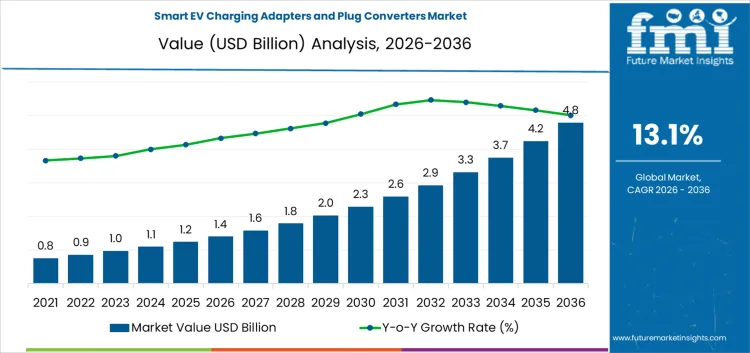
What is the Growth Contribution Index for the Smart EV Charging Adapters and Plug Converters Market through 2036?
The growth contribution index for the smart EV charging adapters and plug converters market reflects the impact of various factors on the overall market expansion. From 2026 to 2028, the market will experience steady, incremental growth. During this phase, the growth contribution is primarily driven by the increasing number of EVs on the road and the expansion of charging infrastructure. As the demand for more flexible, standardized charging solutions rises, the market will grow from USD 1.6 billion in 2026 to USD 2.1 billion by 2028.
The next phase, from 2029 to 2032, will see a stronger contribution from technological advancements in smart charging solutions, which will enhance charging speed, efficiency, and interoperability across different EV models and charging stations. The market will rise from USD 2.4 billion in 2029 to USD 3.4 billion in 2032, with the growth driven by the development of next-generation adapters and plug converters.
From 2032 to 2036, the growth contribution will be driven by the increasing adoption of standardized charging systems, as well as the growing focus on reducing EV charging time and increasing overall convenience for consumers. By 2036, the market will reach USD 4.4 billion, with the final years contributing a more significant portion of the total growth due to the wide-scale deployment of smart charging solutions. The market will be characterized by the need for more efficient, universal, and cost-effective charging technology in the growing global EV ecosystem.
Smart EV Charging Adapters and Plug Converters Market Key Takeaways
| Metric | Value |
|---|---|
| Industry Sales Value (2026) | USD 1.4 billion |
| Industry Forecast Value (2036) | USD 4.8 billion |
| Industry Forecast CAGR 2026 to 2036 | 13.1% |
What Is Driving the Smart EV Charging Adapters and Plug Converters Market?
Historically, the smart EV charging adapters and plug converters market developed from the need to bridge early compatibility gaps between electric vehicles and charging infrastructure. In the initial stages of EV adoption, a variety of charging standards and connector types coexisted, including J1772, Type 2, CHAdeMO, and early proprietary interfaces. EV drivers and fleet operators often encountered situations where the available EV supply equipment did not match the vehicle’s inlet, prompting use of simple mechanical adapters that lacked intelligence and safety features.
These basic adapters helped expand charging accessibility but offered limited functionality, presenting risks such as poor communication between vehicle and charger, inadequate load control, and potential overcurrent conditions. Early awareness of these limitations motivated suppliers to explore more sophisticated adapter designs with embedded electronics that supported signaling protocols, negotiated charging parameters, and tracked usage data. This formative period underscored the value of intelligent adaptation between disparate charging systems, particularly for travelers, second-car households, and multi-vehicle fleets where interoperability challenges were most acute.
Future demand for smart EV charging adapters and plug converters is expected to be shaped by accelerating global EV adoption, expansion of public and residential charging networks, and ongoing diversification of charging standards across regions and vehicle segments. Growth drivers will include the need for seamless interoperability between vehicles and chargers that support different protocols, such as AC to DC adaptation or legacy to next-generation connectors, without compromising safety or charging efficiency.
Smart adapters that incorporate load management, real-time communication, and overcurrent protection can enhance user experience by optimizing charging sessions, enabling firmware updates, and supporting usage reporting for fleet management. As EVs enter cost-sensitive fleet and commercial segments, adapters that reduce dependency on bespoke charging stations will be valued for flexibility and reduced infrastructure spending. Regulatory emphasis on safety and certification of charging accessories will further encourage adoption of smart solutions over passive converters. Barriers to growth include the complexity of meeting diverse regional standards, ensuring compatibility with fast-charging protocols, and consumer education about intelligent features. Long-term market expansion will depend on how effectively smart adapters balance universal compatibility with robust communication, safety, and convenience across a maturing EV charging ecosystem.
What are the Key Segments in the Smart EV Charging Adapters and Plug Converters Market?
The Smart EV Charging Adapters and Plug Converters market is segmented by charging level and sales channels. Charging level segments include AC Level 1/2, DC fast charging, both AC and DC, and others, with AC Level 1/2 leading the market at 62%. Sales channels consist of online direct-to-consumer (D2C), retail & distributors, OEM or charger bundled, and others, with online D2C holding the largest share at 46%. The market is driven by the increasing adoption of electric vehicles (EVs) and the need for efficient, versatile charging solutions to support various charging levels and standards. As EV infrastructure continues to grow, both for home and public charging, the demand for smart adapters and plug converters is expanding. Key regions driving the market include North America, Europe, and Asia Pacific, where EV adoption and charging network development are accelerating.
What is Driving Growth in the AC Level 1/2 Charging Level Segment?

AC Level 1/2 is the dominant charging level segment in the Smart EV Charging Adapters and Plug Converters market, representing 62% of the market share. This growth is largely driven by the widespread use of Level 1 and Level 2 charging solutions in residential settings, where they offer convenient and cost-effective charging options for EV owners. Level 1 charging typically uses a standard 120V outlet and is often used for overnight charging in home garages, while Level 2 charging, which operates at 240V, is gaining popularity due to its faster charging capabilities.
The growing adoption of Level 2 home chargers is particularly evident in markets like North America and Europe, where many homeowners are installing these systems for personal EVs. Additionally, AC Level 1/2 chargers are widely compatible with a variety of EV models, making them an essential part of the home and workplace charging infrastructure. As the number of EVs on the road increases and the demand for home-based charging solutions rises, the AC Level 1/2 segment is expected to maintain its dominance, driving the continued growth of smart adapters and plug converters.
What is Driving the Demand for Online D2C Sales Channels in the Market?
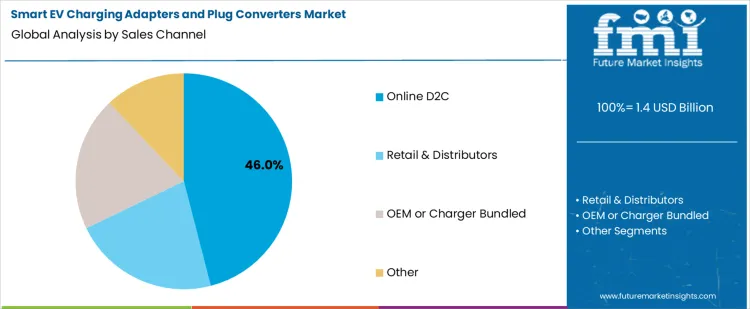
Online direct-to-consumer (D2C) is the leading sales channel in the Smart EV Charging Adapters and Plug Converters market, holding 46% of the market share. The growth of this segment is driven by the convenience and accessibility of online shopping, allowing consumers to easily compare, purchase, and have charging adapters and plug converters delivered directly to their homes. The online D2C model offers significant benefits, including direct access to a wide range of products, detailed product descriptions, customer reviews, and the ability to easily return or exchange items.
As EV ownership continues to grow, especially in North America and Europe, online retailers are increasingly becoming the preferred platform for purchasing smart charging solutions, including adapters and converters. The ease of online purchasing is particularly attractive to consumers looking to upgrade their home charging infrastructure or purchase compatible charging accessories for different EV models. Furthermore, the increasing focus on e-commerce, especially due to the convenience it offers and the global shift toward digital shopping, is further boosting the demand for online D2C sales channels in the EV charging market. As more EV owners seek reliable and easily accessible charging solutions, online D2C sales are expected to continue expanding.
What are the Key Dynamics in the Smart EV Charging Adapters and Plug Converters Market?
The smart EV charging adapters and plug converters market is growing in response to the rapid adoption of electric vehicles (EVs) and the need for flexible, efficient, and accessible charging solutions. As EV ownership increases globally, drivers face challenges with varying charging standards and incompatible charging ports. Smart EV charging adapters and plug converters are designed to bridge these gaps, allowing users to connect their vehicles to different charging stations with ease. These products offer advanced features such as connectivity to mobile apps for real-time monitoring, automatic adjustments for optimal charging speed, and compatibility with multiple charging types, driving their demand in both residential and commercial sectors.
What are the Key Drivers of Growth in the Smart EV Charging Adapters and Plug Converters Market?
The growth of the smart EV charging adapters and plug converters market is largely driven by the expansion of the EV market itself, which has increased the demand for versatile and convenient charging solutions. The proliferation of different charging standards, including CCS, CHAdeMO, and Tesla’s proprietary connector, is creating a need for adapters and plug converters that ensure compatibility between various EV models and charging stations. Additionally, the rise in the number of public charging stations and the growing adoption of home charging systems further support the demand for such products. The integration of smart technologies, like remote monitoring and optimization of charging processes, is another driver, as users seek more intelligent and efficient solutions. Government incentives and policies promoting EV adoption are also fueling market growth by increasing the need for accessible and flexible charging solutions.
What are the Key Restraints in the Smart EV Charging Adapters and Plug Converters Market?
Despite the market’s potential, several challenges exist. One of the primary restraints is the high cost of smart EV charging adapters and plug converters, particularly for users in regions where EV adoption is still in its early stages. The added expense of purchasing these devices, in addition to the cost of the vehicle and home charging infrastructure, may discourage some consumers. Another challenge is the potential for technological fragmentation, with various EV manufacturers adopting different charging standards, which can complicate the development of universal adapters and plug converters. Additionally, while smart features provide convenience, they require reliable internet connectivity and may introduce cybersecurity risks, which could concern some users. As the market continues to evolve, the lack of standardized charging protocols may also pose challenges for long-term adoption of universal charging solutions.
What are the Key Trends in the Smart EV Charging Adapters and Plug Converters Market?
Several trends are shaping the smart EV charging adapters and plug converters market. A key trend is the growing integration of IoT (Internet of Things) technologies, which allow these devices to connect to smartphones and cloud-based platforms for real-time monitoring, diagnostics, and remote control. This trend reflects the broader move toward smart home technologies, where EV chargers and their accessories become part of an interconnected ecosystem. Another significant trend is the development of more compact and portable charging solutions, which provide consumers with greater flexibility when using public charging stations or traveling long distances. As more electric vehicles with varying plug configurations enter the market, there is an increasing demand for universal adapters that can cater to multiple charging standards, improving the accessibility of EV charging infrastructure. Additionally, eco-conscious consumers are driving demand for sustainable and energy-efficient charging accessories, prompting manufacturers to design products with reduced environmental impact.
What is the Country-Wise Analysis of the Smart EV Charging Adapters and Plug Converters Market?
The smart EV charging adapters and plug converters market is expanding due to the growing adoption of electric vehicles (EVs) and the need for efficient, versatile charging solutions. These adapters and converters are crucial for enabling seamless connections between EVs and different types of charging infrastructure, improving convenience for users. As the global EV market continues to grow, the demand for charging solutions that offer compatibility across different charging stations and regions is rising. Key countries like the USA, India, China, Germany, and the UK are witnessing significant growth in this market, driven by increasing EV sales, government incentives, and the expansion of charging infrastructure.
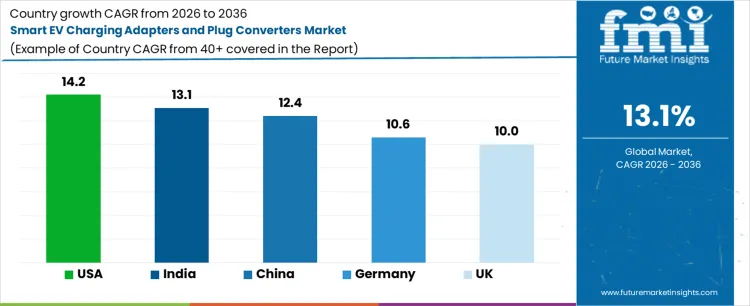
| Country | CAGR (%) |
|---|---|
| USA | 14.2% |
| India | 13.1% |
| China | 12.4% |
| Germany | 10.6% |
| UK | 10% |
What is Driving the Growth of the Smart EV Charging Adapters and Plug Converters Market in the USA?
The smart EV charging adapters and plug converters market in the USA is growing at a CAGR of 14.2%. The USA is one of the largest EV markets globally, with significant investments in EV infrastructure and adoption. The increasing number of electric vehicles on the road, combined with the need for compatible and convenient charging solutions, is driving the demand for smart charging adapters and plug converters. As the EV industry continues to expand, more consumers are seeking charging solutions that offer seamless interoperability across different types of charging stations. Additionally, government initiatives to promote clean energy and increase EV adoption are accelerating the need for smart charging solutions. The rising demand for home charging stations and the shift towards a more sustainable automotive ecosystem are expected to continue supporting market growth in the USA.
How is the Smart EV Charging Adapters and Plug Converters Market Performing in India?
India’s smart EV charging adapters and plug converters market is growing at a CAGR of 13.1%. India is rapidly adopting electric vehicles, supported by government incentives, environmental concerns, and a focus on reducing urban air pollution. As the number of EVs on the road increases, the need for efficient and versatile charging solutions becomes essential. Smart EV charging adapters and plug converters are critical for enabling charging at various locations and with different types of chargers. India’s expanding charging infrastructure and increasing demand for electric vehicles in both urban and rural areas are driving the growth of the market. As the country works to build a more sustainable transportation system, the demand for smart EV charging solutions will continue to rise.
What Factors are Shaping the Smart EV Charging Adapters and Plug Converters Market in China?
China’s smart EV charging adapters and plug converters market is growing at a CAGR of 12.4%. As the largest EV market in the world, China is at the forefront of the transition to electric mobility. The Chinese government’s strong support for EV adoption, including incentives and the development of a comprehensive charging network, is contributing to the growth of this market. As the EV market expands, there is an increasing need for charging solutions that are compatible with different types of vehicles and charging stations. The demand for smart adapters and converters that allow for flexible and efficient charging is rising. Additionally, the growing number of home and public charging stations in China is further driving market growth. With China’s dominance in EV production and infrastructure development, the smart EV charging adapters and plug converters market is expected to grow steadily.
How is the Smart EV Charging Adapters and Plug Converters Market Evolving in Germany?
Germany’s smart EV charging adapters and plug converters market is growing at a CAGR of 10.6%. Germany is a key player in the European EV market, with increasing EV adoption and a strong focus on sustainable mobility. The country’s automotive industry is transitioning to electric mobility, and as more EVs are on the road, the need for compatible charging solutions is rising. Smart EV charging adapters and plug converters are essential for users to access a wide range of charging stations with ease. Germany’s focus on improving its charging infrastructure and its commitment to reducing emissions are further driving the demand for these products. With government support for EV initiatives and a growing number of charging stations, Germany’s market for smart EV charging adapters and plug converters is expected to expand steadily.
What is Contributing to the Growth of the Smart EV Charging Adapters and Plug Converters Market in the UK?
The smart EV charging adapters and plug converters market in the UK is growing at a CAGR of 10%. The UK is witnessing rapid growth in electric vehicle adoption, driven by government incentives, increasing environmental awareness, and a focus on decarbonizing transportation. As the number of EVs on the road continues to rise, there is a growing need for convenient and efficient charging solutions. Smart EV charging adapters and plug converters are essential to ensure that EV owners can charge their vehicles across different charging stations with ease. The UK government’s commitment to expanding EV infrastructure and the shift towards a more sustainable transportation system are contributing to the growing demand for these charging solutions. With increasing investments in EV charging infrastructure and the UK’s efforts to meet climate goals, the market for smart EV charging adapters and plug converters is expected to see continued growth.
What is the Competitive Landscape for the Smart EV Charging Adapters and Plug Converters Market?
The smart EV charging adapters and plug converters market is rapidly expanding, driven by the increasing adoption of electric vehicles (EVs) and the growing need for accessible, convenient, and efficient charging solutions. Tesla leads the market, offering advanced charging adapters and plug converters that ensure compatibility with Tesla's proprietary Supercharger network as well as other charging infrastructures. Tesla’s focus on seamless integration with its electric vehicle ecosystem, combined with its innovation in smart charging technology, has solidified its position as a dominant player.
Lectron is another key competitor, providing affordable and versatile charging adapters and converters that cater to a wide range of EV models, helping users charge their vehicles across different charging networks with ease. ChargePoint is also a significant player, offering smart charging adapters that enhance the user experience by integrating with its network of public charging stations, offering convenience and real-time monitoring. Wallbox competes by offering smart, user-friendly plug converters that allow for easy interaction with charging networks while promoting energy efficiency.
ABB, a major force in the charging infrastructure market, offers high-quality, smart charging adapters and plug converters designed for commercial and residential use, focusing on efficiency, reliability, and user control. Schneider Electric and Siemens both contribute to the market by offering smart charging solutions that integrate with broader energy management systems, providing users with full control over their energy consumption and ensuring optimal use of renewable energy.
Delta Electronics provides robust and scalable charging solutions, focusing on enhancing the charging experience with its smart plug converters. EVBox, known for its commitment to smart EV charging infrastructure, offers a range of plug converters and adapters that support the growing demand for efficient, integrated charging solutions. Enphase (ClipperCreek) is also competing in the market by providing durable and high-performance charging adapters that are compatible with various EV models and offer intuitive, smart features.
To remain competitive in the smart EV charging adapters and plug converters market, companies are emphasizing innovation, ease of use, and integration with smart grid and energy management systems. Tesla continues to lead with its focus on ensuring seamless connectivity between its vehicles and the global charging network, providing users with a superior charging experience.
Lectron is expanding its product line by introducing new adapters and converters designed to accommodate a broader range of vehicles, making it easier for EV owners to access charging infrastructure. ChargePoint’s strategy includes enhancing its network connectivity, offering real-time monitoring, and improving user interaction with its smart charging adapters. Wallbox is focusing on providing intelligent charging solutions that prioritize energy savings and grid optimization, making its adapters and converters more attractive to eco-conscious consumers.
ABB and Schneider Electric are investing heavily in smart technology, with a focus on integrating energy management systems to optimize charging times and reduce overall electricity consumption. Siemens continues to advance its product offerings by incorporating renewable energy solutions, ensuring that its smart chargers work efficiently in homes and commercial environments.
Delta Electronics and EVBox are refining their products by focusing on reliability and scalability to meet the growing demand for EV charging infrastructure. Enphase (ClipperCreek) is focusing on high-quality, affordable adapters that meet the needs of both individual EV owners and commercial fleets. These strategies, combined with the increasing shift toward electric mobility, position these companies as key players in the growing smart EV charging adapters and plug converters market.
Key Players of the Smart EV Charging Adapters and Plug Converters Market
- Tesla
- Lectron
- ChargePoint
- Wallbox
- ABB
- Schneider Electric
- Siemens
- Delta Electronics
- EVBox
- Enphase (ClipperCreek)
Scope of the Report
| Items | Values |
|---|---|
| Quantitative Units (2026) | USD Billion |
| Adapter Function | Connector Converters, Protocol-Smart Adapters, Load/Temperature Monitoring Adapters, Other |
| Connector Standard | NACS, Type 2 (IEC), Type 1 (J1772), CHAdeMO or Other |
| Charging Level | AC Level 1/2, DC Fast Charging, Both AC and DC, Other |
| Sales Channel | Online D2C, Retail & Distributors, OEM or Charger Bundled, Other |
| Companies | Tesla, Lectron, ChargePoint, Wallbox, ABB, Schneider Electric, Siemens, Delta Electronics, EVBox, Enphase (ClipperCreek) |
| Regions Covered | North America, Latin America, Western Europe, Eastern Europe, South Asia and Pacific, East Asia, Middle East & Africa |
| Countries Covered | United States, Canada, Mexico, Brazil, Argentina, Germany, France, United Kingdom, Italy, Spain, Netherlands, China, India, Japan, South Korea, ANZ, GCC Countries, South Africa |
| Additional Attributes | Dollar by sales by adapter function, connector standard, charging level, and sales channel. Includes market trends towards smart charging technologies, cost-effectiveness, regulatory compliance, and the role of adapters in improving the EV charging infrastructure. |
Smart EV Charging Adapters and Plug Converters Market Segmentation
By Adapter Function:
- Connector Converters
- Protocol-Smart Adapters
- Load/Temperature Monitoring Adapters
- Other
By Connector Standard:
- NACS
- Type 2 (IEC)
- Type 1 (J1772)
- CHAdeMO or Other
- Other
By Charging Level:
- AC Level 1/2
- DC Fast Charging
- Both AC and DC
- Other
By Sales Channel:
- Online D2C
- Retail & Distributors
- OEM or Charger Bundled
- Other
By Region:
- Asia Pacific
- China
- Japan
- India
- Australia & New Zealand
- ASEAN
- Rest of Asia Pacific
- Europe
- Germany
- United Kingdom
- France
- Italy
- Spain
- Nordic
- BENELUX
- Rest of Europe
- North America
- United States
- Canada
- Mexico
- Latin America
- Brazil
- Argentina
- Rest of Latin America
- Middle East & Africa
- Kingdom of Saudi Arabia
- Other GCC Countries
- South Africa
- Rest of Middle East & Africa
Bibliography
- Tesla. (2023). Smart EV Charging Solutions: Adaptability and Innovation in Charging Infrastructure. Tesla EV Product Catalog.
- Lectron. (2023). Versatile Charging Solutions: Connecting EVs Across Charging Networks. Lectron Product Overview.
- ChargePoint. (2023). Enhancing the Charging Experience: Smart Adapters and Plug Converters for EVs. ChargePoint Insights.
- Wallbox. (2023). Intelligent Charging Solutions: Optimizing Energy Use and Efficiency for Electric Vehicles. Wallbox EV Technology.
- ABB. (2023). Smart EV Adapters: Bridging the Gap Between Charging Standards and EVs. ABB Charging Solutions.
Frequently Asked Questions
How big is the smart ev charging adapters and plug converters market in 2026?
The global smart ev charging adapters and plug converters market is estimated to be valued at USD 1.4 billion in 2026.
What will be the size of smart ev charging adapters and plug converters market in 2036?
The market size for the smart ev charging adapters and plug converters market is projected to reach USD 4.8 billion by 2036.
How much will be the smart ev charging adapters and plug converters market growth between 2026 and 2036?
The smart ev charging adapters and plug converters market is expected to grow at a 13.1% CAGR between 2026 and 2036.
What are the key product types in the smart ev charging adapters and plug converters market?
The key product types in smart ev charging adapters and plug converters market are connector converters, protocol-smart adapters, load/temperature monitoring adapters and other.
Which connector standard segment to contribute significant share in the smart ev charging adapters and plug converters market in 2026?
In terms of connector standard, nacs segment to command 36.0% share in the smart ev charging adapters and plug converters market in 2026.
Preview the report firsthand - request a free sample
Get SampleGet the brochure for pricing and purchase details.
Get PDFTable of Content
- Executive Summary
- Global Market Outlook
- Demand-side Trends
- Supply-side Trends
- Technology Roadmap Analysis
- Analysis and Recommendations
- Market Overview
- Market Coverage / Taxonomy
- Market Definition / Scope / Limitations
- Market Background
- Market Dynamics
- Drivers
- Restraints
- Opportunity
- Trends
- Scenario Forecast
- Demand in Optimistic Scenario
- Demand in Likely Scenario
- Demand in Conservative Scenario
- Opportunity Map Analysis
- Product Life Cycle Analysis
- Supply Chain Analysis
- Investment Feasibility Matrix
- Value Chain Analysis
- PESTLE and Porter’s Analysis
- Regulatory Landscape
- Regional Parent Market Outlook
- Production and Consumption Statistics
- Import and Export Statistics
- Market Dynamics
- Global Market Analysis 2021 to 2025 and Forecast, 2026 to 2036
- Historical Market Size Value (USD Million) Analysis, 2021 to 2025
- Current and Future Market Size Value (USD Million) Projections, 2026 to 2036
- Y-o-Y Growth Trend Analysis
- Absolute $ Opportunity Analysis
- Global Market Pricing Analysis 2021 to 2025 and Forecast 2026 to 2036
- Global Market Analysis 2021 to 2025 and Forecast 2026 to 2036, By Adapter Function
- Introduction / Key Findings
- Historical Market Size Value (USD Million) Analysis By Adapter Function , 2021 to 2025
- Current and Future Market Size Value (USD Million) Analysis and Forecast By Adapter Function , 2026 to 2036
- Connector Converters
- Protocol-Smart Adapters
- Load/Temperature Monitoring Adapters
- Other
- Connector Converters
- Y-o-Y Growth Trend Analysis By Adapter Function , 2021 to 2025
- Absolute $ Opportunity Analysis By Adapter Function , 2026 to 2036
- Global Market Analysis 2021 to 2025 and Forecast 2026 to 2036, By Connector Standard
- Introduction / Key Findings
- Historical Market Size Value (USD Million) Analysis By Connector Standard, 2021 to 2025
- Current and Future Market Size Value (USD Million) Analysis and Forecast By Connector Standard, 2026 to 2036
- NACS
- Type 2 (IEC)
- Type 1 (J1772)
- CHAdeMO or Other
- NACS
- Y-o-Y Growth Trend Analysis By Connector Standard, 2021 to 2025
- Absolute $ Opportunity Analysis By Connector Standard, 2026 to 2036
- Global Market Analysis 2021 to 2025 and Forecast 2026 to 2036, By Charging Level
- Introduction / Key Findings
- Historical Market Size Value (USD Million) Analysis By Charging Level, 2021 to 2025
- Current and Future Market Size Value (USD Million) Analysis and Forecast By Charging Level, 2026 to 2036
- AC Level 1/2
- DC Fast Charging
- Both AC and DC
- Other
- AC Level 1/2
- Y-o-Y Growth Trend Analysis By Charging Level, 2021 to 2025
- Absolute $ Opportunity Analysis By Charging Level, 2026 to 2036
- Global Market Analysis 2021 to 2025 and Forecast 2026 to 2036, By Sales Channel
- Introduction / Key Findings
- Historical Market Size Value (USD Million) Analysis By Sales Channel, 2021 to 2025
- Current and Future Market Size Value (USD Million) Analysis and Forecast By Sales Channel, 2026 to 2036
- Online D2C
- Retail & Distributors
- OEM or Charger Bundled
- Other
- Online D2C
- Y-o-Y Growth Trend Analysis By Sales Channel, 2021 to 2025
- Absolute $ Opportunity Analysis By Sales Channel, 2026 to 2036
- Global Market Analysis 2021 to 2025 and Forecast 2026 to 2036, By Region
- Introduction
- Historical Market Size Value (USD Million) Analysis By Region, 2021 to 2025
- Current Market Size Value (USD Million) Analysis and Forecast By Region, 2026 to 2036
- North America
- Latin America
- Western Europe
- Eastern Europe
- East Asia
- South Asia and Pacific
- Middle East & Africa
- Market Attractiveness Analysis By Region
- North America Market Analysis 2021 to 2025 and Forecast 2026 to 2036, By Country
- Historical Market Size Value (USD Million) Trend Analysis By Market Taxonomy, 2021 to 2025
- Market Size Value (USD Million) Forecast By Market Taxonomy, 2026 to 2036
- By Country
- USA
- Canada
- Mexico
- By Adapter Function
- By Connector Standard
- By Charging Level
- By Sales Channel
- By Country
- Market Attractiveness Analysis
- By Country
- By Adapter Function
- By Connector Standard
- By Charging Level
- By Sales Channel
- Key Takeaways
- Latin America Market Analysis 2021 to 2025 and Forecast 2026 to 2036, By Country
- Historical Market Size Value (USD Million) Trend Analysis By Market Taxonomy, 2021 to 2025
- Market Size Value (USD Million) Forecast By Market Taxonomy, 2026 to 2036
- By Country
- Brazil
- Chile
- Rest of Latin America
- By Adapter Function
- By Connector Standard
- By Charging Level
- By Sales Channel
- By Country
- Market Attractiveness Analysis
- By Country
- By Adapter Function
- By Connector Standard
- By Charging Level
- By Sales Channel
- Key Takeaways
- Western Europe Market Analysis 2021 to 2025 and Forecast 2026 to 2036, By Country
- Historical Market Size Value (USD Million) Trend Analysis By Market Taxonomy, 2021 to 2025
- Market Size Value (USD Million) Forecast By Market Taxonomy, 2026 to 2036
- By Country
- Germany
- UK
- Italy
- Spain
- France
- Nordic
- BENELUX
- Rest of Western Europe
- By Adapter Function
- By Connector Standard
- By Charging Level
- By Sales Channel
- By Country
- Market Attractiveness Analysis
- By Country
- By Adapter Function
- By Connector Standard
- By Charging Level
- By Sales Channel
- Key Takeaways
- Eastern Europe Market Analysis 2021 to 2025 and Forecast 2026 to 2036, By Country
- Historical Market Size Value (USD Million) Trend Analysis By Market Taxonomy, 2021 to 2025
- Market Size Value (USD Million) Forecast By Market Taxonomy, 2026 to 2036
- By Country
- Russia
- Poland
- Hungary
- Balkan & Baltic
- Rest of Eastern Europe
- By Adapter Function
- By Connector Standard
- By Charging Level
- By Sales Channel
- By Country
- Market Attractiveness Analysis
- By Country
- By Adapter Function
- By Connector Standard
- By Charging Level
- By Sales Channel
- Key Takeaways
- East Asia Market Analysis 2021 to 2025 and Forecast 2026 to 2036, By Country
- Historical Market Size Value (USD Million) Trend Analysis By Market Taxonomy, 2021 to 2025
- Market Size Value (USD Million) Forecast By Market Taxonomy, 2026 to 2036
- By Country
- China
- Japan
- South Korea
- By Adapter Function
- By Connector Standard
- By Charging Level
- By Sales Channel
- By Country
- Market Attractiveness Analysis
- By Country
- By Adapter Function
- By Connector Standard
- By Charging Level
- By Sales Channel
- Key Takeaways
- South Asia and Pacific Market Analysis 2021 to 2025 and Forecast 2026 to 2036, By Country
- Historical Market Size Value (USD Million) Trend Analysis By Market Taxonomy, 2021 to 2025
- Market Size Value (USD Million) Forecast By Market Taxonomy, 2026 to 2036
- By Country
- India
- ASEAN
- Australia & New Zealand
- Rest of South Asia and Pacific
- By Adapter Function
- By Connector Standard
- By Charging Level
- By Sales Channel
- By Country
- Market Attractiveness Analysis
- By Country
- By Adapter Function
- By Connector Standard
- By Charging Level
- By Sales Channel
- Key Takeaways
- Middle East & Africa Market Analysis 2021 to 2025 and Forecast 2026 to 2036, By Country
- Historical Market Size Value (USD Million) Trend Analysis By Market Taxonomy, 2021 to 2025
- Market Size Value (USD Million) Forecast By Market Taxonomy, 2026 to 2036
- By Country
- Kingdom of Saudi Arabia
- Other GCC Countries
- Turkiye
- South Africa
- Other African Union
- Rest of Middle East & Africa
- By Adapter Function
- By Connector Standard
- By Charging Level
- By Sales Channel
- By Country
- Market Attractiveness Analysis
- By Country
- By Adapter Function
- By Connector Standard
- By Charging Level
- By Sales Channel
- Key Takeaways
- Key Countries Market Analysis
- USA
- Pricing Analysis
- Market Share Analysis, 2025
- By Adapter Function
- By Connector Standard
- By Charging Level
- By Sales Channel
- Canada
- Pricing Analysis
- Market Share Analysis, 2025
- By Adapter Function
- By Connector Standard
- By Charging Level
- By Sales Channel
- Mexico
- Pricing Analysis
- Market Share Analysis, 2025
- By Adapter Function
- By Connector Standard
- By Charging Level
- By Sales Channel
- Brazil
- Pricing Analysis
- Market Share Analysis, 2025
- By Adapter Function
- By Connector Standard
- By Charging Level
- By Sales Channel
- Chile
- Pricing Analysis
- Market Share Analysis, 2025
- By Adapter Function
- By Connector Standard
- By Charging Level
- By Sales Channel
- Germany
- Pricing Analysis
- Market Share Analysis, 2025
- By Adapter Function
- By Connector Standard
- By Charging Level
- By Sales Channel
- UK
- Pricing Analysis
- Market Share Analysis, 2025
- By Adapter Function
- By Connector Standard
- By Charging Level
- By Sales Channel
- Italy
- Pricing Analysis
- Market Share Analysis, 2025
- By Adapter Function
- By Connector Standard
- By Charging Level
- By Sales Channel
- Spain
- Pricing Analysis
- Market Share Analysis, 2025
- By Adapter Function
- By Connector Standard
- By Charging Level
- By Sales Channel
- France
- Pricing Analysis
- Market Share Analysis, 2025
- By Adapter Function
- By Connector Standard
- By Charging Level
- By Sales Channel
- India
- Pricing Analysis
- Market Share Analysis, 2025
- By Adapter Function
- By Connector Standard
- By Charging Level
- By Sales Channel
- ASEAN
- Pricing Analysis
- Market Share Analysis, 2025
- By Adapter Function
- By Connector Standard
- By Charging Level
- By Sales Channel
- Australia & New Zealand
- Pricing Analysis
- Market Share Analysis, 2025
- By Adapter Function
- By Connector Standard
- By Charging Level
- By Sales Channel
- China
- Pricing Analysis
- Market Share Analysis, 2025
- By Adapter Function
- By Connector Standard
- By Charging Level
- By Sales Channel
- Japan
- Pricing Analysis
- Market Share Analysis, 2025
- By Adapter Function
- By Connector Standard
- By Charging Level
- By Sales Channel
- South Korea
- Pricing Analysis
- Market Share Analysis, 2025
- By Adapter Function
- By Connector Standard
- By Charging Level
- By Sales Channel
- Russia
- Pricing Analysis
- Market Share Analysis, 2025
- By Adapter Function
- By Connector Standard
- By Charging Level
- By Sales Channel
- Poland
- Pricing Analysis
- Market Share Analysis, 2025
- By Adapter Function
- By Connector Standard
- By Charging Level
- By Sales Channel
- Hungary
- Pricing Analysis
- Market Share Analysis, 2025
- By Adapter Function
- By Connector Standard
- By Charging Level
- By Sales Channel
- Kingdom of Saudi Arabia
- Pricing Analysis
- Market Share Analysis, 2025
- By Adapter Function
- By Connector Standard
- By Charging Level
- By Sales Channel
- Turkiye
- Pricing Analysis
- Market Share Analysis, 2025
- By Adapter Function
- By Connector Standard
- By Charging Level
- By Sales Channel
- South Africa
- Pricing Analysis
- Market Share Analysis, 2025
- By Adapter Function
- By Connector Standard
- By Charging Level
- By Sales Channel
- USA
- Market Structure Analysis
- Competition Dashboard
- Competition Benchmarking
- Market Share Analysis of Top Players
- By Regional
- By Adapter Function
- By Connector Standard
- By Charging Level
- By Sales Channel
- Competition Analysis
- Competition Deep Dive
- Lectron
- Overview
- Product Portfolio
- Profitability by Market Segments (Product/Age /Sales Channel/Region)
- Sales Footprint
- Strategy Overview
- Marketing Strategy
- Product Strategy
- Channel Strategy
- ChargePoint
- Wallbox
- ABB
- Schneider Electric
- Siemens
- Delta Electronics
- EVBox
- Enphase (ClipperCreek)
- Lectron
- Competition Deep Dive
- Assumptions & Acronyms Used
- Research Methodology


