

- Industry Size (2026)
- USD 0.6 Bn
- Forecast (2036)
- USD 1.3 Bn
- CAGR (2026 to 2036)
- 8.0%
Inline Beverage Gas and Microbial Load Monitoring Test Systems Market Size, Market Forecast and Outlook By FMI
The inline beverage gas and microbial load monitoring test systems market was valued at USD 0.5 billion in 2025, projected to reach USD 0.6 billion in 2026. By 2036, the market is set to reach USD 1.3 billion at a CAGR of 8.0% during the forecast period.
Inline Beverage Gas and Microbial Load Monitoring Test Systems Market Summary
- The inline beverage gas and microbial load monitoring test systems market is forecast to reach USD 1.3 billion by 2036.
- The inline beverage gas and microbial load monitoring test systems market is expected to grow at a CAGR of 8.0% from 2026 to 2036.
- The inline beverage gas and microbial load monitoring test systems market was estimated at USD 0.5 billion in 2025.
- CO2 measurement is expected to account for 34% share in 2026 because carbonation directly affects taste and product stability.
- Inline skids are expected to secure 42% share in 2026, reflecting demand for systems that allow faster response.
- Standalone analyzers represent 38% of total demand in 2026, with many facilities beginning with single-parameter monitoring before moving to integrated systems.
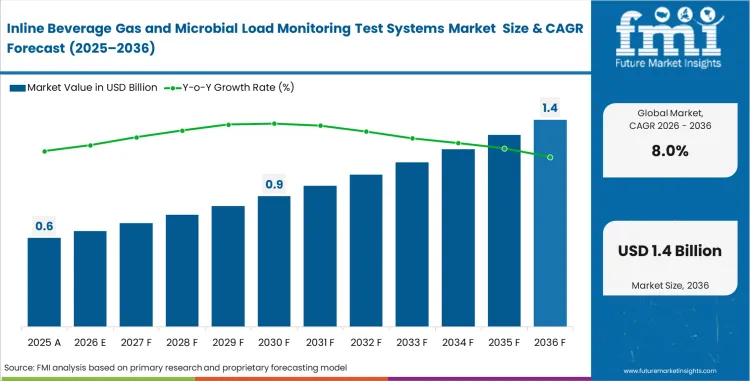
Key Takeaways, Market Size, and Forecast
- mRNA Vaccine Formulation Stability and Stress Test Systems Market is projected to increase from USD 0.8 billion in 2026 to USD 2.2 billion by 2036, at a CAGR of 10.6%.
- The mRNA vaccine formulation stability and stress test systems market was valued at USD 0.7 billion in 2025.
- By 2036, the mRNA Vaccine Formulation Stability and Stress Test Systems Market is expected to be worth USD 2.2 billion.
- From 2026 through 2036, the market is set to expand at a CAGR of 10.6%.
- In 2026, LNP dispersions are expected to account for 72.0% of the formulation format segment.
- India (12.9%) and China (12.4%) are two of the fastest growing markets.
Inline Beverage Gas and Microbial Load Monitoring Test Systems Market Key Takeaways
| Parameter | Details |
|---|---|
| Market value (2026) | USD 0.6 billion |
| Forecast value (2036) | USD 1.3 billion |
| CAGR (2026 to 2036) | 8.0% |
| Estimated market value (2025) | USD 0.5 billion |
| Leading measurement parameter | CO2 |
| Parameter share (2026) | 34% |
| Leading technology | Optical Sensors |
| Technology share (2026) | 31% |
| Leading installation mode | Inline Skids |
| Installation share (2026) | 42% |
| Leading beverage type | Carbonated Soft Drinks |
| Beverage share (2026) | 29% |
| Leading microbial method | ATP Screening |
| Microbial method share (2026) | 44% |
| Leading end user | Large Bottlers |
| End-user share (2026) | 36% |
| Leading system architecture | Standalone Analyzers |
| Architecture share (2026) | 38% |
| Fastest-growing country | India |
| India CAGR | 8.6% |
[Text Wrapping Break]Source: Future Market Insights (FMI) analysis, based on proprietary forecasting model and primary research
Rising beverage output and quality control needs continue to support demand for inline monitoring systems. Demand is increasing as beverage manufacturers look for faster ways to track gas balance and microbial risk during production without slowing the line. Interest is also rising as plants try to reduce repeated manual testing and improve response time during quality checks.
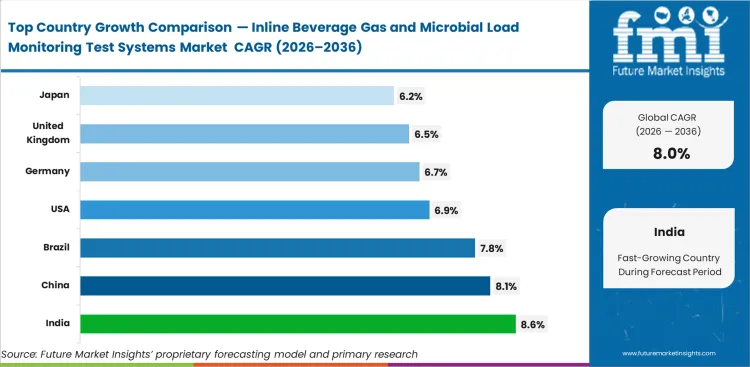
India is expected to record the fastest growth, with demand for inline beverage gas and microbial load monitoring test systems projected to rise at a CAGR of 8.6% during 2026 to 2036. China is expected to follow at 8.1%, Brazil is projected to expand at a CAGR of 7.8%. United States is expected to grow at a CAGR of 6.9%, while Germany is set to grow at a CAGR of 6.7%. United Kingdom and Japan are projected to grow at a CAGR of 6.5% and 6.2% respectively.
Inline Beverage Gas and Microbial Load Monitoring Test Systems Market Key Takeaways
| Metric | Details |
|---|---|
| Industry Size (2026) | USD 0.6 billion |
| Industry Value (2036) | USD 1.3 billion |
| CAGR (2026-2036) | 8.0% |
Source: Future Market Insights (FMI) analysis, based on proprietary forecasting model and primary research
Segmental Analysis
Key Facts About Segments
- CO2 measurement is expected to hold 34% share in 2026.
- Optical sensor technology is projected to account for 31% share in 2026 because it needs less maintenance.
- Reflecting the need for minimal delay between measurement and corrective action within high-speed filling lines, Inline skids are likely to represent 42% share in 2026.
- Carbonated soft drinks are anticipated to capture 29% share, where gas balance directly affects product identity and shelf performance.
- ATP screening is expected to hold 44% share in 2026.
- Large bottlers are expected to account for 36% share, supported by higher throughput exposure and lower tolerance for delays in release or rechecking.
- Standalone analyzers are projected to hold 38% share, as facilities often begin with single-parameter deployment before moving toward integrated monitoring systems.
Inline Beverage Gas and Microbial Load Monitoring Test Systems Market Analysis by Measurement Parameter
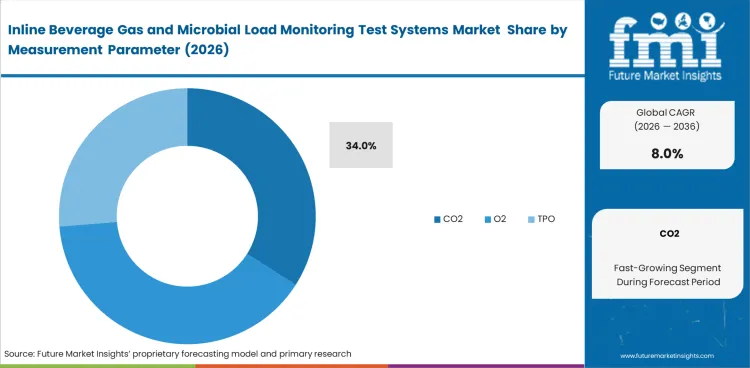
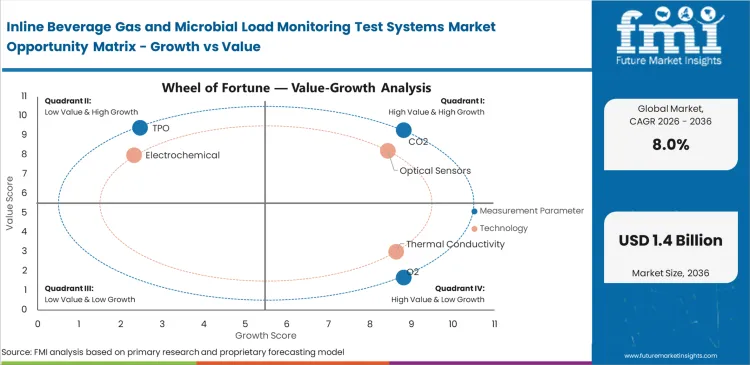
CO2 is expected to account for 34% share in 2026, reflecting how often beverage plants treat carbonation correction as a direct operating priority rather than a secondary quality check. O2 and TPO also remain important, mainly in beer and other oxygen-sensitive packaged drinks, where product stability depends on lower oxygen exposure. Microbial load monitoring serves a different purpose and is more closely linked to hygiene checks and batch release supports.
- Carbonation control: CO2 measurement helps operators correct line conditions before beverage quality and pack performance start to shift.
- Taste stability: Gas readings help maintain more consistent packaged output across formats where small sensory changes are noticed quickly. This gives quality teams a clearer basis for action during production.
- Line correction: Parameter choice matters most when the reading supports direct action on the line. CO2 remains the leading measure because it helps teams respond immediately instead of waiting for later reviews.
Inline Beverage Gas and Microbial Load Monitoring Test Systems Market Analysis by Technology
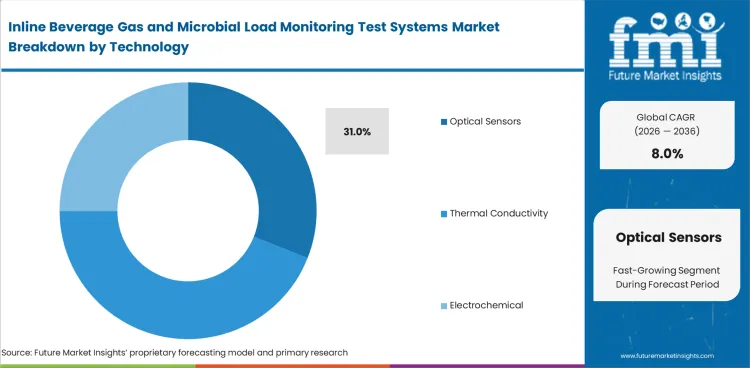
Optical sensors are anticipated to represent 31% of the market in 2026 supported by their fit with continuous beverage monitoring and easier use in plant operations. Measurement methods that remain stable under repeated use allow quick interpretation, and fit hygienic environments without causing frequent service disruptions. Electrochemical and thermal methods remain relevant where plant and installed use are already established. Luminescence ATP and PCR are more closely linked to microbial monitoring and are used on a different testing timeline.
- Repeatability: Plants favor technology that gives stable readings through repeated production cycles. Confidence improves when verification does not turn into constant intervention.
- Service burden: Lower maintenance demand matters in beverage environments where downtime ripples quickly across filling and packaging.
- Integration fit: Technology leadership strengthens when signals can move into plant controls and operator routines with minimal translation.
Inline Beverage Gas and Microbial Load Monitoring Test Systems Market Analysis by Installation Mode
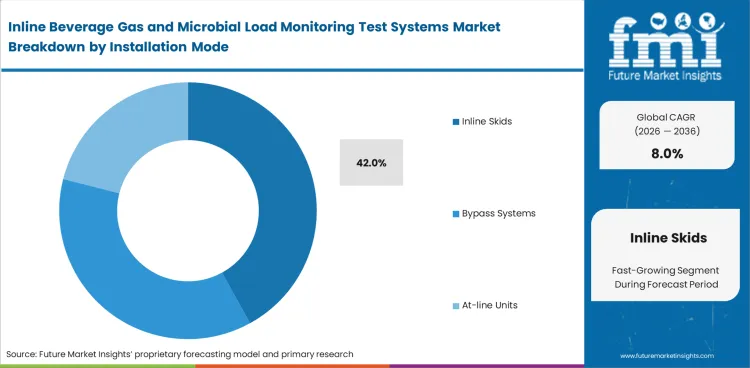
Inline Skids are projected to secure 42% share in 2026, because they are widely used for carbonation control and dissolved-gas correction. Demand stays strong because they allow faster response during production. Bypass systems and at-line units still have a place where retrofit limits or budget constraints delay full inline installation. Portable testers also remain useful in plants that still depend on periodic checks, though this becomes less practical.
- Placement advantage: Inline skids reduce the gap between measurement and response on the production line.
- Retrofit fit: Bypass and at-line options still work well in plants where older lines cannot support full inline integration.
- Timing benefit: Installation mode affects whether the instrument changes an operating decision in real time.
Inline Beverage Gas and Microbial Load Monitoring Test Systems Market Analysis by Beverage Type
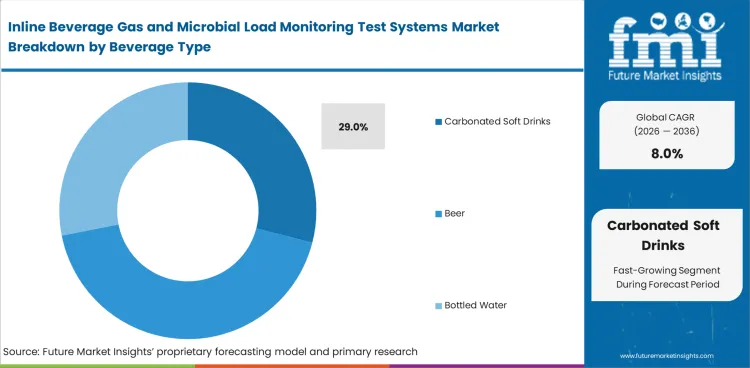
Carbonated Soft Drinks are expected to account for 29% share in 2026 because gas balance has a direct effect on product taste and consumer acceptance. Even a small shift in carbonation handling can appear quickly in taste and shelf stability. Beer also requires control of oxygen and gas levels, though many breweries already operate with more established quality systems. It can reduce first-time equipment demand compared with faster plant expansion markets.
- Package sensitivity: Carbonated soft drinks require close attention to gas balance during filling and final pack condition.
- Portfolio breadth: Beverage type affects how plants divide monitoring between gas and microbial checks.
- Shelf reliability: Leading beverage categories need equipment that helps preserve consistent pack performance from production to release.
Inline Beverage Gas and Microbial Load Monitoring Test Systems Market Analysis by Process Stage
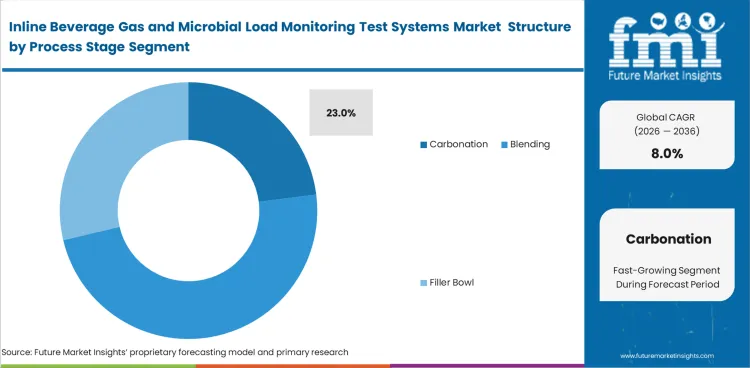
Carbonation is likely to account for 23% share in 2026 within process-stage demand because gas control remains critical before filling is completed. This stage carries higher relevance than several later checkpoints, as readings taken here can still affect the final product outcome. Microbial-load tools see stronger use around CIP validation and release, while gas analyzers remain essential during active production.
- Immediate action: Carbonation-stage monitoring allows operators to correct process conditions before filling losses increase. This stage demands faster action, as product identity depends heavily on gas balance.
- Release support: Package release and hygiene checkpoints rely more heavily on fast interpretation than on continuous correction. Microbial monitoring becomes more important at that point.
- Process fit: Stage selection shows how closely the instrument is tied to an actual operating decision. Equipment placed at the wrong point often loses practical value, even when the measurement itself remains accurate.
Inline Beverage Gas and Microbial Load Monitoring Test Systems Market Analysis by End User
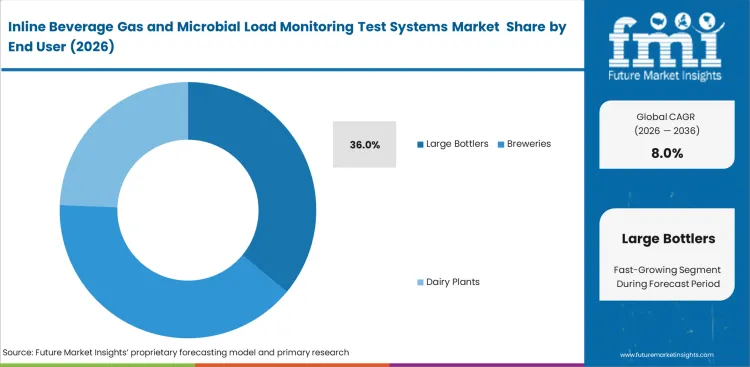
Large Bottlers are expected to make up 36% of the market in 2026 driven by line speed and consistency requirements that support repeatable monitoring near production. Breweries and other beverage-processing facilities remain important sources of demand, though purchase decisions differ by product mix and existing capability. Larger bottling operations usually have less capacity for rechecks that delay release or interrupt filling rhythm.
- Throughput exposure: Large bottlers face higher disruption when quality signals arrive late. Monitoring helps keep production consistent across high-speed lines and varied packaging runs.
- Format diversity: End-user type affects how much one system needs to handle across product formats and process steps.
- Downtime pressure: Avoidable interruptions become more costly at larger plant scale. As a result, larger plants tend to adopt sooner when measurement helps reduce stoppages and repeat checks.
Inline Beverage Gas and Microbial Load Monitoring Test Systems Market Analysis by System Architecture
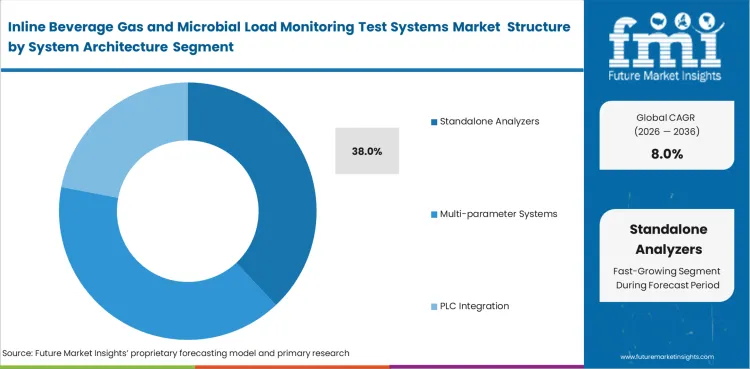
Standalone Analyzers are set to make up 38% of the market in 2026 because many beverage plants still prefer equipment that can solve one clear measurement problem without a broader digital upgrade. Multi-parameter systems and connected platforms are becoming more relevant, but many facilities still begin with dedicated units for a specific gas.
- Single-point focus: Standalone analyzers are used to solve clearly defined gas or hygiene problems with limited installation effort. Approval is often faster because the purpose is easy to understand.
- Control linkage: Integrated architectures become more useful when beverage lines need boarder monitoring.
- Expansion path: Many facilities start with one reading and add more features later if the system works well in daily use.
Gas Analyzer Segment Market Size, Pricing Trends, and Technology Advancements in Inline Beverage Monitoring Systems
The leading industry participants are accelerating innovation and portfolio expansion, as demonstrated by ABB Ltd is actively expanding its portfolio of continuous gas analyzer solutions with advanced real-time monitoring to enhance process optimization and safety across various sectors. This shows that inline monitoring systems are becoming more important for product consistency and regulatory compliance.
Opportunities in the Inline Beverage Gas and Microbial Load Monitoring Test Systems Market
- Multi-format lines: Beverage plants running different products on the same line often need wider monitoring. Suppliers that can show the system works well across changing product conditions can get approval sooner.
- Digital visibility: Connected measurement becomes more useful when beverage plants need one clear view of gas control and sanitation status.
- Rapid hygiene workflows: Sanitation teams can capture more value from quick microbial indication where cleaning verification affects restart timing and line utilization.
Regional Analysis
Key Facts About Country
- India is expected to grow at a CAGR of 8.6% through 2036.
- China is projected to grow at a CAGR of 8.1% by 2036, adoption is increasing in large production facilities with stronger local manufacturing support.
- Brazil is expected to grow at a CAGR of 7.8%, where beverage processors focus on improving carbonation consistency and reducing oxygen variability during high-volume operations.
- United States is expected to record 6.9% CAGR through 2036, because of replacement demand and ongoing system upgrades across existing beverage plants.
- Germany is advancing at 6.7% CAGR, supported by established beverage processing infrastructure and preference for systems with reliable service support and stable calibration performance.
- United Kingdom is estimated to grow at 6.5% CAGR because shorter production runs and mixed beverage lines are increasing the need for faster measurement and easier installation.
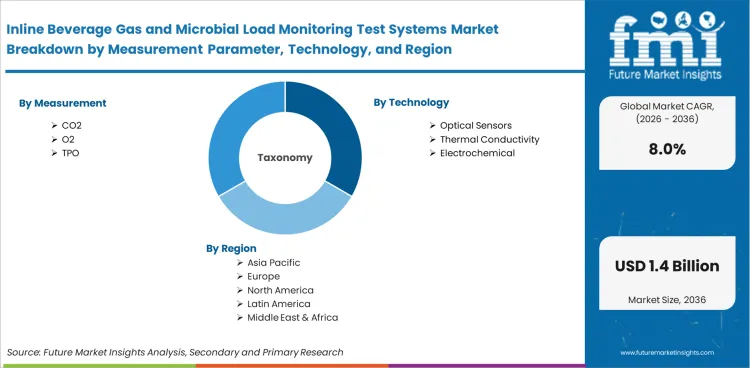
Based on the regional analysis, the Inline Beverage Gas and Microbial Load Monitoring Test Systems market is segmented into North America, Europe, Asia Pacific, and Latin America across 40 plus countries.
.webp "Top Country Growth Comparison Inline Beverage Gas And Microbial Load Monitoring Test Systems Market Cagr (2026 2036)")
| Country | CAGR (2026 to 2036) |
|---|---|
| India | 8.6% |
| China | 8.1% |
| Brazil | 7.8% |
| United States | 6.9% |
| Germany | 6.7% |
| United Kingdom | 6.5% |
| Japan | 6.2% |
Source: Future Market Insights (FMI) analysis, based on proprietary forecasting model and primary research
North America Inline Beverage Gas and Microbial Load Monitoring Test Systems Market Analysis
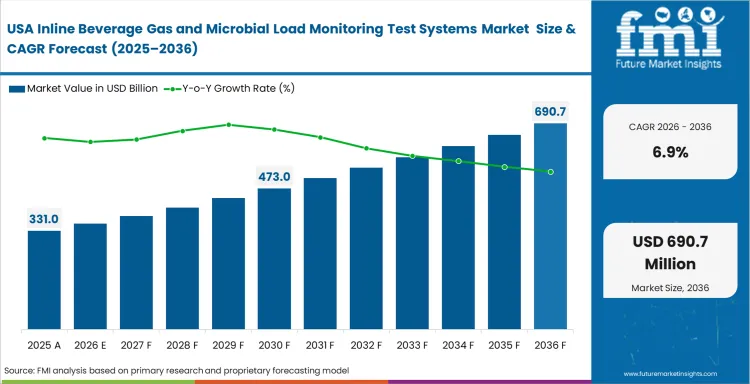
North America remains a steady market for inline beverage gas and microbial load monitoring systems because packaged beverage plants already operate with tight quality control and low tolerance for disruption. Demand is driven by system replacement and new installations, while upgrades continue as plants seek better line visibility and easier daily use.
-
United States: A large beverage base and established brewing capacity support steady demand in the United States. Demand for inline beverage gas and microbial load monitoring test systems in the country is anticipated to rise at a CAGR of 6.9% through 2036. Demand is driven by replacement cycles, control-system upgrades and faster hygiene checks than to first-time equipment buying. Buyers usually favor systems that improve carbonation control and sanitation review without adding extra work on the line.
FMI's report includes Canada and Mexico. Beverage operations in these countries add regional depth through packaged drink output and continued interest in line-level monitoring that improves everyday quality control.
Europe Inline Beverage Gas and Microbial Load Monitoring Test Systems Market Analysis
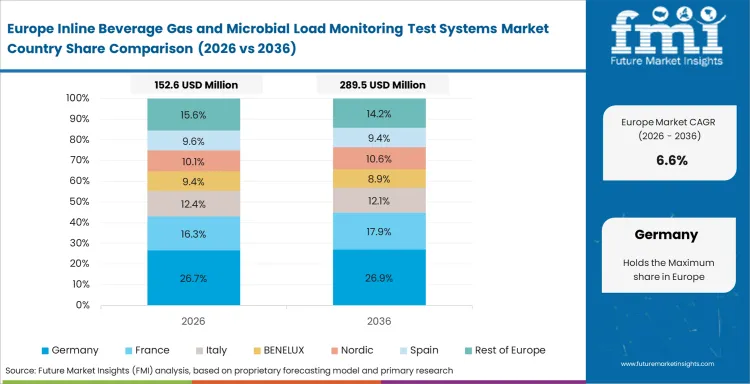
Europe stays important in this market because beverage producers across the region already work with strict quality control and steady process requirements. Demand comes more from system upgrades than from new plant setup. Buyers usually focus on accuracy and easier sanitation review during daily operations. In this market, dependable performance matters more than added technical complexity.
- Germany: Germany is expected to grow at a CAGR of 6.7% through 2036 in inline beverage gas and microbial load monitoring test systems. Demand is supported mainly by replacement needs and closer use of analyzer readings during active production. Buyers in this market usually pay close attention to calibration effort, maintenance needs, and fit with existing production routines. Systems that are easier to integrate are more likely to gain wider use.
- United Kingdom: Demand for inline beverage gas and microbial load monitoring test systems in the United Kingdom is expected to rise at a CAGR of 6.5% through 2036. Shorter production runs and broader product variety are increasing the need for faster line-side measurement. Plants usually prefer systems that fit current operating layouts without requiring major changes to quality routines. Adoption tends to improve when readings can be used directly in release decisions and sanitation review.
Asia Pacific and Latin America Inline Beverage Gas and Microbial Load Monitoring Test Systems Market Analysis
Asia Pacific and Latin America are growing faster than other regions in this market because beverage production capacity is still expanding and more plants are moving from limited checks to wider line-level monitoring.
- India: India has the strongest growth outlook among the countries covered in this report. Demand for inline beverage gas and microbial load monitoring test systems in India is expected to grow at a CAGR of 8.6% through 2036. Line additions and broader modernization are increasing the need for better carbonation control, oxygen monitoring, and faster hygiene checks. Plants in this market usually prefer systems that are useful without being difficult to install or run every day.
- China: China remains one of the faster-growing markets because of its large beverage production base and wider use of automation. Demand in China is expected to rise at a CAGR of 8.1% through 2036. Plants usually look for systems that reduce repeated manual checking and fit smoothly into high-output operations. Reliability matters a great deal in this market.
- Brazil: Brazil is expected to grow at a CAGR of 7.8% through 2036. Beverage producers are using these systems more widely to improve carbonation control, reduce oxygen variation, and support quicker hygiene review. Buyers usually prefer equipment that shows clear value on the line and does not create service problems during active production.
- Japan: Japan is expected to grow at a CAGR of 6.2% through 2036. Demand comes more from replacement and precision-focused upgrades than from first-time installation. Buyers in this market usually pay close attention to measurement stability, maintenance fit, and how easily the system works within existing production routines.
FMI's report includes South Korea, Australia, ASEAN countries, and additional Latin American markets beyond Brazil. Industry direction across these countries depends on how quickly beverage processors make line-side measurement part of normal production control rather than occasional confirmation.
Competitive Aligners for Market Players
Competition in this market is neither highly concentrated nor fully fragmented. Large instrumentation suppliers hold an advantage because beverage plants usually prefer vendors that can provide reliable calibration and support hygienic production. Anton Paar, Pentair, Danaher, and METTLER TOLEDO benefit from that preference, while specialized names such as Maselli Misure, Hygiena, and Promicol stay relevant where a plant is solving a narrower gas or microbial task.
Plants already using a supplier’s analyzers or service setup are more likely to stay with the same vendor when adding another gas reading or a rapid microbial check. Challengers can still win, though they usually need stronger proof around service speed and easier rollout across mixed beverage setups. Categories such as microbial growth monitoring and packaging testing equipment show similar buying behavior where operating proof matters more than feature depth alone.
Buyers want dependable systems, but they also want the flexibility to compare service terms and future expansion across different suppliers. That keeps the market from becoming too concentrated even as leading brands remain strong. Over time, competition is likely to favor vendors that offer reliable line performance, easier use, and lower service burden across both gas and hygiene monitoring.
Key Players in Inline Beverage Gas and Microbial Load Monitoring Test Systems Market
- Anton Paar GmbH
- Pentair plc
- Danaher Corporation
- METTLER TOLEDO International Inc.
- Maselli Misure S.p.A.
- Hygiena LLC
- Promicol B.V.
Scope of the Report
| Metric | Value |
|---|---|
| Quantitative Units | USD 0.6 billion to USD 1.3 billion, at a CAGR of 8.0% |
| Market Definition | Inline Beverage Gas and Microbial Load Monitoring Test Systems Market covers line-adjacent gas analyzers and rapid microbial monitoring tools used to support beverage consistency, hygiene control, and release timing. Scope focuses on systems that influence beverage production decisions close to the line. |
| Measurement Parameter Segmentation | CO2, O2, Microbial Load, TPO, Brix, pH |
| Technology Segmentation | Optical Sensors, Thermal Conductivity, Electrochemical, Luminescence ATP, PCR Assays, Flow Cytometry |
| Installation Mode Segmentation | Inline Skids, Bypass Systems, At-line Units, Portable Testers |
| Beverage Type Segmentation | Carbonated Soft Drinks, Beer, Bottled Water, Juice Drinks, Dairy Beverages, Plant Beverages, RTD Tea, RTD Coffee |
| Process Stage Segmentation | Carbonation, Blending, Filler Bowl, Package Release, CIP Validation, Water Treatment, Fermentation |
| End User Segmentation | Large Bottlers, Breweries, Dairy Plants, Juice Processors, Contract Packers, Co-manufacturers |
| System Architecture Segmentation | Standalone Analyzers, Multi-parameter Systems, PLC Integration, SCADA Integration, Cloud Dashboards |
| Microbial Method Segmentation | ATP Screening, Membrane Filtration, PCR Detection, Flow Cytometry, Biosensors |
| Regions Covered | North America, Europe, Asia Pacific, Latin America |
| Countries Covered | India, China, Brazil, United States, Germany, United Kingdom, Japan, and 40 plus countries |
| Key Companies Profiled | Anton Paar GmbH, Pentair plc, Danaher Corporation, METTLER TOLEDO International Inc., Maselli Misure S.p.A., Hygiena LLC, Promicol B.V. |
| Forecast Period | 2026 to 2036 |
| Approach | FMI combined primary interviews with beverage quality managers, plant engineers, and sanitation leads with desk research across public company material, technical literature, and process references. Baseline industry sizing was built from beverage production conditions, supplier participation, and likely monitoring intensity by use case. Forecasts were checked against country-level modernization patterns, installed process conditions, and segment-level operating logic. |
Source: Future Market Insights (FMI) analysis, based on proprietary forecasting model and primary research
Inline Beverage Gas and Microbial Load Monitoring Test Systems Market Analysis by Segments
Measurement Parameter:
- CO2
- O2
- Microbial Load
- TPO
- Brix
- pH
Technology:
- Optical Sensors
- Thermal Conductivity
- Electrochemical
- Luminescence ATP
- PCR Assays
- Flow Cytometry
Installation Mode:
- Inline Skids
- Bypass Systems
- At-line Units
- Portable Testers
Beverage Type:
- Carbonated Soft Drinks
- Beer
- Bottled Water
- Juice Drinks
- Dairy Beverages
- Plant Beverages
- RTD Tea
- RTD Coffee
Process Stage:
- Carbonation
- Blending
- Filler Bowl
- Package Release
- CIP Validation
- Water Treatment
- Fermentation
End User:
- Large Bottlers
- Breweries
- Dairy Plants
- Juice Processors
- Contract Packers
- Co-manufacturers
System Architecture:
- Standalone Analyzers
- Multi-parameter Systems
- PLC Integration
- SCADA Integration
- Cloud Dashboards
Microbial Method:
- ATP Screening
- Membrane Filtration
- PCR Detection
- Flow Cytometry
- Biosensors
Region:
- North America
- United States
- Europe
- Germany
- United Kingdom
- Asia Pacific
- India
- China
- Japan
- Latin America
- Brazil
Bibliography
- Astute Analytica. (2026, February 6). Gas Sensors Market Set for US$ 4,709.9 Million Valuation by 2035 as Electric Vehicles Drive Battery Safety Innovation Says Astute Analytica. GlobeNewswire.
- Brewers Association. (2025, April 15). Brewers Association reports 2024 USA craft brewing industry figures.
- Brewers of Europe. (2025, December). European beer trends: Statistics report, 2025 edition.
- Chen, W. S., Abkar, L., & Mohseni, M. (2024, November 05). Evaluating ATP testing for distribution system monitoring: Comparison to HPC, impact of chlorine quenching, and hold time dependency.
- Sofiene Mansouri (2024, July 01). Recent developments of (bio)-sensors for detection of main microbiological and non-biological pollutants in plastic bottled water samples: A critical review.
This bibliography is provided for reader reference. The full FMI report contains the complete reference list with primary source documentation.
This Report Addresses
- Market intelligence to support strategic decision making across inline gas analyzers, dissolved oxygen systems, carbonation control tools, rapid microbial screening tools, and line-adjacent beverage quality instruments.
- Market size estimation and 10-year revenue forecasts from 2026 to 2036, supported by primary interviews with beverage quality managers, plant engineers, and sanitation leads.
- Growth opportunity mapping across measurement parameter, technology, installation mode, beverage type, process stage, end user, system architecture, and microbial method, with emphasis on the point where plants begin trusting readings for active release or correction decisions.
- Segment and regional revenue forecasts covering CO2, optical sensors, inline skids, carbonated soft drinks, ATP screening, and key country outlook across India, China, Brazil, the United States, Germany, the United Kingdom, and Japan.
- Competition assessment including service reliability, calibration discipline, line compatibility, data usability, integration readiness, and ease of expansion across gas and hygiene workflows.
- Product and capability tracking across dissolved gas monitoring, TPO measurement, ATP screening, membrane filtration, PCR detection, PLC integration, SCADA integration, and cloud dashboard deployment.
- Market access analysis covering line installation fit, validation burden, calibration handling, plant control compatibility, and release-timing requirements within beverage production environments.
- Market report delivery in PDF, Excel, PPT, and interactive dashboard formats for executive planning, category review, plant investment evaluation, and operating benchmark use.
Frequently Asked Questions
How large is the Inline Beverage Gas and Microbial Load Monitoring Test Systems Market in 2026?
Inline Beverage Gas and Microbial Load Monitoring Test Systems Market is estimated at USD 0.6 billion in 2026. Size at that level shows a specialized but rising category inside beverage quality control.
What will the market be worth by 2036?
Industry valuation is projected to reach USD 1.3 billion by 2036. That means more beverage plants are expected to use line-side gas and microbial monitoring as part of normal production control.
What CAGR is projected for the market?
Forecast for 2026 to 2036 points to a CAGR of 8.0%. Pace at that level reflects steady adoption rather than a short-lived buying wave.
Which measurement parameter segment leads the market?
CO2 leads the measurement parameter category. It is expected to account for 34% share in 2026 because carbonation control affects taste, pack behavior, and line correction very quickly.
Which technology segment leads the market?
Optical Sensors lead the technology category. They are projected to secure 31% share in 2026 because they fit continuous use and usually create less operating burden during repeat measurement.
Which installation mode segment leads the market?
Inline Skids lead installation mode. They are likely to represent 42% share in 2026 since they place the reading close enough to the process for quick action.
What is pushing this market upward?
Plants need faster quality decisions during filling, cleaning, and release. Gas balance, oxygen control, and hygiene checks now have to happen in ways that do not slow production more than necessary.
What is the biggest restraint in this market?
Older line layouts and mixed-control environments make integration harder. Many plants can see the value of faster monitoring, yet adoption slows when installation, calibration, and data use look difficult.
Which country is expected to grow the fastest?
India ranks first among the countries covered in this report. Industry outlook for India points to 8.6% CAGR through 2036.
Why are gas monitoring and microbial monitoring often discussed together?
Both are used to reduce uncertainty during active production. Plants often judge them by the same practical test: can the system help a team act earlier during blending, filling, cleaning, or release?
Why does CO2 keep a strong place in this market?
CO2 readings are closely tied to carbonation control. When carbonation moves off target, beverage quality problems can appear quickly in taste, fill behavior, and pack condition.
Why is ATP screening important in this market?
ATP screening gives a fast indication of hygiene status. Plants use it when they need a quicker view of cleanliness around restart, sanitation review, and release support.
Why do inline skids matter more than some other installation options?
Inline skids reduce the gap between reading and response. At-line and portable systems still matter, though inline placement usually gives faster control on active lines.
Why do standalone analyzers still lead system architecture?
Many plants begin with one instrument for one clear problem. Standalone Analyzers are expected to make up 38% of the market in 2026 because they are easier to justify and install than wider connected setups.
Which beverage type contributes the highest share?
Carbonated Soft Drinks lead beverage type demand. They are anticipated to hold 29% share in 2026 because gas balance is closely tied to product identity in that category.
How does the United States compare with faster countries?
United States is projected to record 6.9% CAGR through 2036. Pace there comes more from replacement demand and tighter line control than from broad first-time installation.
What explains Germany’s outlook?
Germany is expected to post 6.7% CAGR during 2026 to 2036. Large beverage processing capacity and strong attention to operating reliability support that pace.
How does the United Kingdom fit into the outlook?
United Kingdom is expected to record 6.5% CAGR through 2036. Shorter runs, mixed product lines, and quality assurance needs support steady use of faster monitoring tools.
Why is China growing faster than many mature markets?
China is likely to advance at a CAGR of 8.1% through 2036. Manufacturing scale, automation spending, and high-output beverage lines create more room for line-side monitoring.
Why does Brazil stay above the global average?
Brazil is expected to register 7.8% CAGR in this market through 2036. Packaged beverage output and the need for clearer control over carbonation, oxygen exposure, and hygiene keep the country on a positive trend.
Why is Japan growing more steadily?
Japan is set to post 6.2% CAGR through 2036. Many facilities already run mature production practices, so value comes more from refinement and replacement than from broad first-time rollout.
What is included in this report?
Report covers inline and bypass gas analyzers, at-line dissolved gas systems, rapid microbial monitoring methods used around beverage lines, and connected tools that support production decisions.
What kind of companies compete best in this market?
Suppliers compete best when they combine reliable readings with service support, calibration discipline, and line compatibility.
How was the market estimated?
Estimate combines primary interviews, public company material, technical literature, and beverage process references.
Preview the report firsthand - request a free sample
Get SampleGet the brochure for pricing and purchase details.
Get PDFTable of Content
- Executive Summary
- Global Market Outlook
- Demand-side Trends
- Supply-side Trends
- Technology Roadmap Analysis
- Analysis and Recommendations
- Market Overview
- Market Coverage / Taxonomy
- Market Definition / Scope / Limitations
- Research Methodology
- Chapter Orientation
- Analytical Lens and Working Hypotheses
- Market Structure, Signals, and Trend Drivers
- Benchmarking and Cross-market Comparability
- Market Sizing, Forecasting, and Opportunity Mapping
- Research Design and Evidence Framework
- Desk Research Programme (Secondary Evidence)
- Company Annual and Sustainability Reports
- Peer-reviewed Journals and Academic Literature
- Corporate Websites, Product Literature, and Technical Notes
- Earnings Decks and Investor Briefings
- Statutory Filings and Regulatory Disclosures
- Technical White Papers and Standards Notes
- Trade Journals, Industry Magazines, and Analyst Briefs
- Conference Proceedings, Webinars, and Seminar Materials
- Government Statistics Portals and Public Data Releases
- Press Releases and Reputable Media Coverage
- Specialist Newsletters and Curated Briefings
- Sector Databases and Reference Repositories
- FMI Internal Proprietary Databases and Historical Market Datasets
- Subscription Datasets and Paid Sources
- Social Channels, Communities, and Digital Listening Inputs
- Additional Desk Sources
- Expert Input and Fieldwork (Primary Evidence)
- Primary Modes
- Qualitative Interviews and Expert Elicitation
- Quantitative Surveys and Structured Data Capture
- Blended Approach
- Why Primary Evidence is Used
- Field Techniques
- Interviews
- Surveys
- Focus Groups
- Observational and In-context Research
- Social and Community Interactions
- Stakeholder Universe Engaged
- C-suite Leaders
- Board Members
- Presidents and Vice Presidents
- R&D and Innovation Heads
- Technical Specialists
- Domain Subject-matter Experts
- Scientists
- Physicians and Other Healthcare Professionals
- Governance, Ethics, and Data Stewardship
- Research Ethics
- Data Integrity and Handling
- Primary Modes
- Tooling, Models, and Reference Databases
- Desk Research Programme (Secondary Evidence)
- Data Engineering and Model Build
- Data Acquisition and Ingestion
- Cleaning, Normalisation, and Verification
- Synthesis, Triangulation, and Analysis
- Quality Assurance and Audit Trail
- Market Background
- Market Dynamics
- Drivers
- Restraints
- Opportunity
- Trends
- Scenario Forecast
- Demand in Optimistic Scenario
- Demand in Likely Scenario
- Demand in Conservative Scenario
- Opportunity Map Analysis
- Product Life Cycle Analysis
- Supply Chain Analysis
- Investment Feasibility Matrix
- Value Chain Analysis
- PESTLE and Porter’s Analysis
- Regulatory Landscape
- Regional Parent Market Outlook
- Production and Consumption Statistics
- Import and Export Statistics
- Market Dynamics
- Global Market Analysis 2021 to 2025 and Forecast, 2026 to 2036
- Historical Market Size Value (USD Million) Analysis, 2021 to 2025
- Current and Future Market Size Value (USD Million) Projections, 2026 to 2036
- Y-o-Y Growth Trend Analysis
- Absolute $ Opportunity Analysis
- Global Market Pricing Analysis 2021 to 2025 and Forecast 2026 to 2036
- Global Market Analysis 2021 to 2025 and Forecast 2026 to 2036, By Measurement Parameter
- Introduction / Key Findings
- Historical Market Size Value (USD Million) Analysis By Measurement Parameter , 2021 to 2025
- Current and Future Market Size Value (USD Million) Analysis and Forecast By Measurement Parameter , 2026 to 2036
- CO2
- O2
- TPO
- CO2
- Y-o-Y Growth Trend Analysis By Measurement Parameter , 2021 to 2025
- Absolute $ Opportunity Analysis By Measurement Parameter , 2026 to 2036
- Global Market Analysis 2021 to 2025 and Forecast 2026 to 2036, By Technology
- Introduction / Key Findings
- Historical Market Size Value (USD Million) Analysis By Technology, 2021 to 2025
- Current and Future Market Size Value (USD Million) Analysis and Forecast By Technology, 2026 to 2036
- Optical Sensors
- Thermal Conductivity
- Electrochemical
- Optical Sensors
- Y-o-Y Growth Trend Analysis By Technology, 2021 to 2025
- Absolute $ Opportunity Analysis By Technology, 2026 to 2036
- Global Market Analysis 2021 to 2025 and Forecast 2026 to 2036, By Installation Mode
- Introduction / Key Findings
- Historical Market Size Value (USD Million) Analysis By Installation Mode, 2021 to 2025
- Current and Future Market Size Value (USD Million) Analysis and Forecast By Installation Mode, 2026 to 2036
- Inline Skids
- Bypass Systems
- At-line Value (USD Million)s
- Inline Skids
- Y-o-Y Growth Trend Analysis By Installation Mode, 2021 to 2025
- Absolute $ Opportunity Analysis By Installation Mode, 2026 to 2036
- Global Market Analysis 2021 to 2025 and Forecast 2026 to 2036, By Beverage Type
- Introduction / Key Findings
- Historical Market Size Value (USD Million) Analysis By Beverage Type, 2021 to 2025
- Current and Future Market Size Value (USD Million) Analysis and Forecast By Beverage Type, 2026 to 2036
- Carbonated Soft Drinks
- Beer
- Bottled Water
- Carbonated Soft Drinks
- Y-o-Y Growth Trend Analysis By Beverage Type, 2021 to 2025
- Absolute $ Opportunity Analysis By Beverage Type, 2026 to 2036
- Global Market Analysis 2021 to 2025 and Forecast 2026 to 2036, By Process Stage
- Introduction / Key Findings
- Historical Market Size Value (USD Million) Analysis By Process Stage, 2021 to 2025
- Current and Future Market Size Value (USD Million) Analysis and Forecast By Process Stage, 2026 to 2036
- Carbonation
- Blending
- Filler Bowl
- Carbonation
- Y-o-Y Growth Trend Analysis By Process Stage, 2021 to 2025
- Absolute $ Opportunity Analysis By Process Stage, 2026 to 2036
- Global Market Analysis 2021 to 2025 and Forecast 2026 to 2036, By End User
- Introduction / Key Findings
- Historical Market Size Value (USD Million) Analysis By End User, 2021 to 2025
- Current and Future Market Size Value (USD Million) Analysis and Forecast By End User, 2026 to 2036
- Large Bottlers
- Breweries
- Dairy Plants
- Large Bottlers
- Y-o-Y Growth Trend Analysis By End User, 2021 to 2025
- Absolute $ Opportunity Analysis By End User, 2026 to 2036
- Global Market Analysis 2021 to 2025 and Forecast 2026 to 2036, By System Architecture
- Introduction / Key Findings
- Historical Market Size Value (USD Million) Analysis By System Architecture, 2021 to 2025
- Current and Future Market Size Value (USD Million) Analysis and Forecast By System Architecture, 2026 to 2036
- Standalone Analyzers
- Multi-parameter Systems
- PLC Integration
- Standalone Analyzers
- Y-o-Y Growth Trend Analysis By System Architecture, 2021 to 2025
- Absolute $ Opportunity Analysis By System Architecture, 2026 to 2036
- Global Market Analysis 2021 to 2025 and Forecast 2026 to 2036, By Region
- Introduction
- Historical Market Size Value (USD Million) Analysis By Region, 2021 to 2025
- Current Market Size Value (USD Million) Analysis and Forecast By Region, 2026 to 2036
- North America
- Latin America
- Western Europe
- Eastern Europe
- East Asia
- South Asia and Pacific
- Middle East & Africa
- Market Attractiveness Analysis By Region
- North America Market Analysis 2021 to 2025 and Forecast 2026 to 2036, By Country
- Historical Market Size Value (USD Million) Trend Analysis By Market Taxonomy, 2021 to 2025
- Market Size Value (USD Million) Forecast By Market Taxonomy, 2026 to 2036
- By Country
- USA
- Canada
- Mexico
- By Measurement Parameter
- By Technology
- By Installation Mode
- By Beverage Type
- By Process Stage
- By End User
- By System Architecture
- By Country
- Market Attractiveness Analysis
- By Country
- By Measurement Parameter
- By Technology
- By Installation Mode
- By Beverage Type
- By Process Stage
- By End User
- By System Architecture
- Key Takeaways
- Latin America Market Analysis 2021 to 2025 and Forecast 2026 to 2036, By Country
- Historical Market Size Value (USD Million) Trend Analysis By Market Taxonomy, 2021 to 2025
- Market Size Value (USD Million) Forecast By Market Taxonomy, 2026 to 2036
- By Country
- Brazil
- Chile
- Rest of Latin America
- By Measurement Parameter
- By Technology
- By Installation Mode
- By Beverage Type
- By Process Stage
- By End User
- By System Architecture
- By Country
- Market Attractiveness Analysis
- By Country
- By Measurement Parameter
- By Technology
- By Installation Mode
- By Beverage Type
- By Process Stage
- By End User
- By System Architecture
- Key Takeaways
- Western Europe Market Analysis 2021 to 2025 and Forecast 2026 to 2036, By Country
- Historical Market Size Value (USD Million) Trend Analysis By Market Taxonomy, 2021 to 2025
- Market Size Value (USD Million) Forecast By Market Taxonomy, 2026 to 2036
- By Country
- Germany
- UK
- Italy
- Spain
- France
- Nordic
- BENELUX
- Rest of Western Europe
- By Measurement Parameter
- By Technology
- By Installation Mode
- By Beverage Type
- By Process Stage
- By End User
- By System Architecture
- By Country
- Market Attractiveness Analysis
- By Country
- By Measurement Parameter
- By Technology
- By Installation Mode
- By Beverage Type
- By Process Stage
- By End User
- By System Architecture
- Key Takeaways
- Eastern Europe Market Analysis 2021 to 2025 and Forecast 2026 to 2036, By Country
- Historical Market Size Value (USD Million) Trend Analysis By Market Taxonomy, 2021 to 2025
- Market Size Value (USD Million) Forecast By Market Taxonomy, 2026 to 2036
- By Country
- Russia
- Poland
- Hungary
- Balkan & Baltic
- Rest of Eastern Europe
- By Measurement Parameter
- By Technology
- By Installation Mode
- By Beverage Type
- By Process Stage
- By End User
- By System Architecture
- By Country
- Market Attractiveness Analysis
- By Country
- By Measurement Parameter
- By Technology
- By Installation Mode
- By Beverage Type
- By Process Stage
- By End User
- By System Architecture
- Key Takeaways
- East Asia Market Analysis 2021 to 2025 and Forecast 2026 to 2036, By Country
- Historical Market Size Value (USD Million) Trend Analysis By Market Taxonomy, 2021 to 2025
- Market Size Value (USD Million) Forecast By Market Taxonomy, 2026 to 2036
- By Country
- China
- Japan
- South Korea
- By Measurement Parameter
- By Technology
- By Installation Mode
- By Beverage Type
- By Process Stage
- By End User
- By System Architecture
- By Country
- Market Attractiveness Analysis
- By Country
- By Measurement Parameter
- By Technology
- By Installation Mode
- By Beverage Type
- By Process Stage
- By End User
- By System Architecture
- Key Takeaways
- South Asia and Pacific Market Analysis 2021 to 2025 and Forecast 2026 to 2036, By Country
- Historical Market Size Value (USD Million) Trend Analysis By Market Taxonomy, 2021 to 2025
- Market Size Value (USD Million) Forecast By Market Taxonomy, 2026 to 2036
- By Country
- India
- ASEAN
- Australia & New Zealand
- Rest of South Asia and Pacific
- By Measurement Parameter
- By Technology
- By Installation Mode
- By Beverage Type
- By Process Stage
- By End User
- By System Architecture
- By Country
- Market Attractiveness Analysis
- By Country
- By Measurement Parameter
- By Technology
- By Installation Mode
- By Beverage Type
- By Process Stage
- By End User
- By System Architecture
- Key Takeaways
- Middle East & Africa Market Analysis 2021 to 2025 and Forecast 2026 to 2036, By Country
- Historical Market Size Value (USD Million) Trend Analysis By Market Taxonomy, 2021 to 2025
- Market Size Value (USD Million) Forecast By Market Taxonomy, 2026 to 2036
- By Country
- Kingdom of Saudi Arabia
- Other GCC Countries
- Turkiye
- South Africa
- Other African Union
- Rest of Middle East & Africa
- By Measurement Parameter
- By Technology
- By Installation Mode
- By Beverage Type
- By Process Stage
- By End User
- By System Architecture
- By Country
- Market Attractiveness Analysis
- By Country
- By Measurement Parameter
- By Technology
- By Installation Mode
- By Beverage Type
- By Process Stage
- By End User
- By System Architecture
- Key Takeaways
- Key Countries Market Analysis
- USA
- Pricing Analysis
- Market Share Analysis, 2025
- By Measurement Parameter
- By Technology
- By Installation Mode
- By Beverage Type
- By Process Stage
- By End User
- By System Architecture
- Canada
- Pricing Analysis
- Market Share Analysis, 2025
- By Measurement Parameter
- By Technology
- By Installation Mode
- By Beverage Type
- By Process Stage
- By End User
- By System Architecture
- Mexico
- Pricing Analysis
- Market Share Analysis, 2025
- By Measurement Parameter
- By Technology
- By Installation Mode
- By Beverage Type
- By Process Stage
- By End User
- By System Architecture
- Brazil
- Pricing Analysis
- Market Share Analysis, 2025
- By Measurement Parameter
- By Technology
- By Installation Mode
- By Beverage Type
- By Process Stage
- By End User
- By System Architecture
- Chile
- Pricing Analysis
- Market Share Analysis, 2025
- By Measurement Parameter
- By Technology
- By Installation Mode
- By Beverage Type
- By Process Stage
- By End User
- By System Architecture
- Germany
- Pricing Analysis
- Market Share Analysis, 2025
- By Measurement Parameter
- By Technology
- By Installation Mode
- By Beverage Type
- By Process Stage
- By End User
- By System Architecture
- UK
- Pricing Analysis
- Market Share Analysis, 2025
- By Measurement Parameter
- By Technology
- By Installation Mode
- By Beverage Type
- By Process Stage
- By End User
- By System Architecture
- Italy
- Pricing Analysis
- Market Share Analysis, 2025
- By Measurement Parameter
- By Technology
- By Installation Mode
- By Beverage Type
- By Process Stage
- By End User
- By System Architecture
- Spain
- Pricing Analysis
- Market Share Analysis, 2025
- By Measurement Parameter
- By Technology
- By Installation Mode
- By Beverage Type
- By Process Stage
- By End User
- By System Architecture
- France
- Pricing Analysis
- Market Share Analysis, 2025
- By Measurement Parameter
- By Technology
- By Installation Mode
- By Beverage Type
- By Process Stage
- By End User
- By System Architecture
- India
- Pricing Analysis
- Market Share Analysis, 2025
- By Measurement Parameter
- By Technology
- By Installation Mode
- By Beverage Type
- By Process Stage
- By End User
- By System Architecture
- ASEAN
- Pricing Analysis
- Market Share Analysis, 2025
- By Measurement Parameter
- By Technology
- By Installation Mode
- By Beverage Type
- By Process Stage
- By End User
- By System Architecture
- Australia & New Zealand
- Pricing Analysis
- Market Share Analysis, 2025
- By Measurement Parameter
- By Technology
- By Installation Mode
- By Beverage Type
- By Process Stage
- By End User
- By System Architecture
- China
- Pricing Analysis
- Market Share Analysis, 2025
- By Measurement Parameter
- By Technology
- By Installation Mode
- By Beverage Type
- By Process Stage
- By End User
- By System Architecture
- Japan
- Pricing Analysis
- Market Share Analysis, 2025
- By Measurement Parameter
- By Technology
- By Installation Mode
- By Beverage Type
- By Process Stage
- By End User
- By System Architecture
- South Korea
- Pricing Analysis
- Market Share Analysis, 2025
- By Measurement Parameter
- By Technology
- By Installation Mode
- By Beverage Type
- By Process Stage
- By End User
- By System Architecture
- Russia
- Pricing Analysis
- Market Share Analysis, 2025
- By Measurement Parameter
- By Technology
- By Installation Mode
- By Beverage Type
- By Process Stage
- By End User
- By System Architecture
- Poland
- Pricing Analysis
- Market Share Analysis, 2025
- By Measurement Parameter
- By Technology
- By Installation Mode
- By Beverage Type
- By Process Stage
- By End User
- By System Architecture
- Hungary
- Pricing Analysis
- Market Share Analysis, 2025
- By Measurement Parameter
- By Technology
- By Installation Mode
- By Beverage Type
- By Process Stage
- By End User
- By System Architecture
- Kingdom of Saudi Arabia
- Pricing Analysis
- Market Share Analysis, 2025
- By Measurement Parameter
- By Technology
- By Installation Mode
- By Beverage Type
- By Process Stage
- By End User
- By System Architecture
- Turkiye
- Pricing Analysis
- Market Share Analysis, 2025
- By Measurement Parameter
- By Technology
- By Installation Mode
- By Beverage Type
- By Process Stage
- By End User
- By System Architecture
- South Africa
- Pricing Analysis
- Market Share Analysis, 2025
- By Measurement Parameter
- By Technology
- By Installation Mode
- By Beverage Type
- By Process Stage
- By End User
- By System Architecture
- USA
- Market Structure Analysis
- Competition Dashboard
- Competition Benchmarking
- Market Share Analysis of Top Players
- By Regional
- By Measurement Parameter
- By Technology
- By Installation Mode
- By Beverage Type
- By Process Stage
- By End User
- By System Architecture
- Competition Analysis
- Competition Deep Dive
- Anton Paar GmbH
- Overview
- Product Portfolio
- Profitability by Market Segments (Product/Age /Sales Channel/Region)
- Sales Footprint
- Strategy Overview
- Marketing Strategy
- Product Strategy
- Channel Strategy
- Pentair plc
- Danaher Corporation
- METTLER TOLEDO International Inc.
- Maselli Misure S.p.A.
- Hygiena LLC
- Promicol B.V.
- Anton Paar GmbH
- Competition Deep Dive
- Assumptions & Acronyms Used


